


Abstract
There are several frameworks for corporate sustainability indicators (GRI, B-LAB, WBCSD, etc.) which allow for the selection of indicators based on convenience or subjective criteria. In this work, we aim to propose a common framework based on relevant indicators for companies operating in the Mexican context to provide a basis for their transition to sustainability. We analyzed five international corporate sustainability indicator frameworks and decided to use the CoP, BIA, and CSA evaluation tools. The set of indicators (n = 294) was evaluated by a panel of judges with profiles covering several fields of sustainability, followed by an analysis of agreement using Kendall’s W. The weighting for each judge was equally distributed, and the TOPSIS Multicriteria Decision Method (MCDM) was used to calculate the Relative Proximity Coefficient (RPC) for each indicator. The RPC values were stratified into priority levels and used to build a model to guide Mexican enterprises toward sustainability, which indicates that planet factors initially have the highest priority. As the company grows, it should incorporate more sustainable elements across the social, governance, and prosperity spheres. The model may serve as a roadmap for companies seeking sustainability.
1. Introduction
Sustainable Development (hereinafter, SD) has evolved since its original proposal in the Brundtland Report [1] and can now be considered a paradigm from which many countries seek to reconcile human activities and needs with the environment and preserve natural resources.
At the international level, global efforts have focused on providing general guidelines, treaties, and agreements to guide countries’ actions. The Millennium Development Goals were among the first efforts and provided guidelines for structuring the 2030 Agenda, fifteen years later [2,3].
This agenda, composed of 17 Sustainable Development Goals (hereinafter, SDGs), 169 targets, and 232 indicators, was initially oriented to countries so that, from their realities, they could generate action plans, policies, and initiatives towards these goals [4]. However, countries have little room for investment, and it is estimated that they require between 5.0 and 7.0 trillion USD per year. Accordingly, the private sector has received special attention and is crucial to achieving SD due to its financing potential, technology, and infrastructure [5,6].
Companies face the challenge of transforming their structures and strategies to integrate environmental, social, and economic issues [7]. The Classical Theory of Management [8] and Friedman’s Theory of Shareholder Supremacy [9] promoted the idea of organizational efficiency and the generation of profits for shareholders, prioritizing economic growth over other values, leading to environmental and social problems on a global scale.
In response, the Stakeholder Theory [10] marks a significant change in traditional thinking and connects the paradigm of sustainability in business practice by expanding the shareholder-centric approach to any group that may affect or be affected by the achievement of the company’s objectives, even beyond the market, e.g., local communities, the environment, and future generations [11].
In this sense, “corporate sustainability” (CS) or “business sustainability”, as a research line, aims to align SD at the company level [12]; CS is not just about incorporating isolated practices; rather, it implies that, from the recognition of global sustainability challenges, the company is transformed, balancing its economic objectives with environmental and social ones to reduce negative impacts and increase benefits to society and the planet [13].
Initially, CS was incorporated to comply with international agreements, build trust, and improve image and reputation; now, it has transcended into a strategic tool for decision-making, investment attraction, organizational development, and accountability [14,15,16].
To verify that companies contribute to achieving SD, it is necessary to evaluate their performance [14]. The Corporate Sustainability Assessment (CSA) is a management approach that usually details the measurement based on indicators [17]. The derived information is used for two purposes: to report or to make an improvement. The first seeks transparency and accountability to inform stakeholders about the impacts of companies; the second aims to identify critical points for the management of business strategy to improve the sustainability of the company [18].
According to Pazienza et al. [15], there are various methodologies, including indexes and scorecards, methods, performance scores, models, and web-based tools. Under this scenario, the challenge for companies is to determine which framework to use to assess their sustainability performance, which may depend on their purpose, scope, or knowledge, or the environment in which they operate.
The literature indicates that, in general, CSA is not yet measured [15]. We identified three reasons: (1) there are diverse evaluation frameworks and methods, (2) the lack of a general framework and a cohesive measure for global comparison and measurement, and (3) subjectivity in the selection of frameworks and indicators.
In contrast to the first two, Schneider & Meins [19] and Pazienza et al. [15] analyze different evaluation methods to propose a cohesive measure for global measurement [14,15]. However, other authors affirm that a general measure is not possible, such that it must be based on the incorporation of individual and contextual aspects that reflect different realities [20,21,22], such as the organizational context [23], the characteristics of the company [19] and, very importantly, the country—specifically, its regulatory framework or interaction with stakeholders [20,24].
This makes indicator selection for evaluating the company’s sustainability a subjective, decision-maker-dependent process [14]. Therefore, the alignment approach in sustainability frameworks [25] or the global sustainability strategy has been proposed for local operations [26], and the use of quantitative methods has been suggested to provide certainty to the selection process [27,28,29]. Countries such as Sweden and The Netherlands [25], Malaysia [26], China [27], Brazil [28], and Taiwan [29] have conducted these exercises.
In Mexico, there is a Performance Evaluation System for measuring agencies’ progress in meeting the SDGs. However, no specific set of indicators for the business sector was established. Also, in 2019, a collaboration and commitment agreement was signed by the Federal government, Global Compact Mexico, and the Business Coordinating Council, resulting in the National Strategy for the implementation of the 2030 Agenda (ENA 2030) [30].
However, in general, the country’s companies are in the early stages of adopting a sustainability strategy, as more than 50% do not consider it a priority over the next two years, and only 18% have formal schemes for comprehensively collecting, analyzing, and managing sustainability information. In addition, its main frameworks are international, such as the SDGs, the Global Reporting Initiative (GRI), and the Sustainability Reporting Standards of the International Financial Reporting Standards [31].
Other frameworks, such as S&P Global’s Corporate Sustainability Assessment, although generally assumed to be in use, are applied to determine the Dow Jones Sustainability Index (DJSI), which is based on the evaluation of companies listed on the Mexican Stock Exchange (S&P DJI, 2023) [31].
Companies such as Cemex Mexico (construction) and Grupo Bimbo Mexico (food) are evaluated across multiple frameworks. The multinational Cemex identifies that the evolution of the global regulatory framework and the lack of clarity, the incoherence, and the contradiction of regulations and standards in each of the places in which they operate are potential risks that can lead to non-compliance, as well as adherence or adaptation delays. This would therefore incur significant fines or interrupt their operations [32], representing a real problem that requires further analysis. The use of various frameworks and the recognition of risks by Mexican companies are practical evidence of gaps to be filled.
The literature shows discrepancies in alignment and quantitative methods, for which no international research applied to the Mexican context was identified. Likewise, practical evidence indicates a lack of a general framework to guide more than 5 million companies, of which 95.5% are microenterprises, underscoring the relevance of this research [33].
The objective of this work is to propose a common framework, based on relevant international indicators of corporate sustainability, for companies operating in the Mexican context that considers the characteristics of the country (external) and the company itself (internal), providing a basis for their transition to sustainability.
This study contributes to the topic with (1) the alignment of international evaluation frameworks, (2) the proposal of a framework of sustainable indicators applicable to Mexican companies, and, in a practical way, (3) the gradual integration of the indicators into a three-level model, which serves as a roadmap for companies seeking the transition towards sustainability.
The document begins with an introduction, followed by an analysis of the indicator frameworks of five international organizations. From these, we selected three quantitative frameworks and analyzed their indicators that contribute to transition model development. Finally, we discuss the results and present our conclusions.
2. Materials and Methods
To determine indicators of corporate sustainability, we analyzed five international indicator frameworks issued by organizations—(1) WBCSD, (2) GRI, (3) UNGC, (4) B-Lab, and (5) BMV—in conjunction with S&P Global.
Considering the structure and objectives of these frameworks, we selected three measurement/evaluation instruments—CoP (UNGC), BIA (B-LAB), and CSA (BMV and S&P Global)—because they are based on and interrelate with other international frameworks, such as GRI, Carbon Disclosure Project (CDP), and International Standards of Accounting and Reporting (ISAR). They are structured as general-purpose questionnaires; they have broader coverage and are applicable to different kinds of companies. On the other hand, the GRI framework is used to inform; the WBCSD focuses on the circular economy. Also, we avoid repetition; Table 1 shows that relevant GRI indicators are included.
With these tools, international companies can measure and publicize their sustainability. However, it is necessary to verify its validity in the Mexican context, which we did by conducting a concordance analysis using expert judgment and Kendall’s W coefficient for ordinal data. We applied a modification of the method used by Escobar-Pérez & Cuervo-Martínez [34] and Galicia et al. [35].
We designed an evaluation template that included a section of general data; a justification; the objective of the study; and the aspect to be rated, “relevance”, included together with “clarity and coherence”. An ascending Likert rating scale was used, where 1 indicated non-relevance and 5 the highest relevance for the Mexican context. Therefore, the list of items for each tool, their justifications, and additional data, whether they relate to the SDGs or other frameworks, also includes the section for the judge’s qualification.
We invited six experts to serve as an evaluation panel [34]. The highlights of the profiles are as follows: A solid academic foundation with four doctoral and two master’s degrees. They have an average of 23 years of experience in the fields of business administration, environmental and economic sustainability, toxicology, consulting services, accounting and auditing, communitarian work, and research, and they include former government officials and two enterprise CEOs. The profiles of the experts and their professional experience cover several aspects of sustainability, and a broad cross-section of enterprises in México.
We mentioned the importance of the judges’ contributions. We sent the evaluation template and additional information via email, including a deadline for submitting their responses.
We recorded the evaluation results in spreadsheets, generating a 6 × 294 matrix. The data was processed using Microsoft Excel, IBM SPSS Statistics v27.0.1.0, and Python 3.10 (Google Colab). We determined Cronbach’s Alpha using reliability analysis, and the degree of concordance and correlation between the evaluations was obtained by means of nonparametric analysis with Kendall’s W coefficient. This was to finally analyze the results obtained using the Technique for Order Preference by Similarity to Ideal Solution (TOPSIS) Multicriteria Decision Method [36,37] to select, classify, and prioritize indicators relevant and applicable to the Mexican context, at three levels.
The TOPSIS method seeks to identify the solution closest to the ideal solution and furthest from the non-ideal solutions among a finite number of alternatives evaluated under a finite number of criteria. This method has been widely used for indicator selection [38,39,40] and strategy selection [41]. In this way, we constructed the initial matrix using data from expert evaluations, rating each indicator according to its relevance; indicators correspond to alternatives, and judges to attributes, with an increasing valuation: the greater the relevance, the higher the rating. The weighting for each attribute was 0.167, equally distributed across the six judges to avoid bias. The step-by-step procedure continued [37,38,39,40,42] to obtain the score of the Relative Proximity Coefficient (RPC) for each alternative.
Based on the judges’ relevance scores for each indicator, the TOPSIS method produces RPC values ranging from 0 to 1. The indicators with higher scores are more relevant and were considered high priority, and so on.
The RPCs for each indicator were ordered from highest to lowest. Next, we stratified the RPC values and established a midpoint on the Likert scale for the six attributes, i.e., the RPC value for a score of 2.5 (2.5 Likert = 0.453 RPC). A total of 21 coefficients between 0 and 0.453 were considered less relevant and were eliminated, while 61 indicators were considered redundant.
Next, the remaining RPC values were stratified into three levels. The interval from 0.453 to 1 was divided into equal-width intervals. The indicators with the best scores appear in levels 1 (21 indicators), 2 (87 indicators), and 3 (104 indicators).
The indicators were categorized into four dimensions—(1) governance, (2) prosperity, (3) planet, and (4) people—as proposed by Cantele et al. [43], and were incorporated into the final model.
Table 1.
Indicator frameworks for sustainability.
3. Results
3.1. Top Organizations for CS Measurement and Outreach
Five main organizations were identified in the literature reviewed as proposing general frameworks for corporate sustainability:
- (1)
- World Business Council for Sustainable Development (WBCSD).
- (2)
- Global Reporting Initiative (GRI).
- (3)
- UNGC Global Compact.
- (4)
- B Lab.
- (5)
- S&P/BMV Total Mexico Index.
All these organizations emerged after the Brundtland report, but before the publication of the 2030 Agenda, which reinforces the argument that, given the lack of a general framework, they began to look for ways to make visible the interest of companies in being sustainable, first as an act of transparency and then for strategic management.
The United Nations Organization (UN) sets the stage for the Sustainable Movement, and the Global Compact is a derivative organization for business action; however, it was the WBCSD that was the first to disseminate the concept of SD and proposes the measurement of eco-efficiency.
In Mexico, the Dow Jones sustainable index was created in 1999; twelve years later, a collaboration with the BMV was established with the aim of representing and promoting other companies in the Mexican market and to obtain financing.
The BMV is the only one that explicitly excludes certain companies, such as those in the arms industry and tobacco, which cannot be considered sustainable. Here, we can detect that business sustainability is not about attacking and then remedying the damage—performing a harmful activity and then compensating for it with good actions. Rather, it is an effort to make economic activity sustainable.
The approach of the WBCSD and B Lab seeks to promote a change in the economic paradigm to a sustainable one, which entails the conception of the business logic to promote a “better world”. The GRI and WBCSD focus on transparency, that is, showing the compliance of companies; they are not intended to be used for evaluation because they do not provide reference limits that indicate good or bad performance.
On the other hand, UNGC, B Lab, and S&P Global demonstrate a strategic approach to improvement grounded in measurement and evaluation. This reduces companies’ discretion, which, although they may omit some questions in an argumentative manner, constitutes an advance in measuring sustainability, as the frameworks presented are standardized and applicable to any type of company.
3.2. Reliability of the Assessment Instrument
The evaluation of the panel of expert judges yielded 1764 data points, which were subjected to a reliability analysis in SPSS using Cronbach’s Alpha. The Alpha value obtained in the evaluation instrument was 0.954, considered a high value that may well indicate redundancy of the items (see Table 2); that is, they evaluate the same question but differently; however, the number of items in the test can also affect its value [54,55] (see Table 3).
Table 2.
Reliability of assessment instrument.
Table 3.
Reliability by indicator framework.
When evaluating reliability by frame, Cronbach’s Alpha is affected by the number of elements; however, in all three cases, desirable values above 0.70 are still obtained.
3.3. Concordance and Multivariate Correlation Analysis of the Instrument
The concordance analysis, based on the sum of the item evaluation ranges across the six judges, yielded Kendall’s W = 0.502 and reflected the degree of congruence (see Table 4). A highly significant correlation shows that the agreement between the evaluators is not due to chance.
Table 4.
Kendall’s W nonparametric multiple correlation-assessment instrument.
The above shows that, given the degree of agreement and correlation regarding the relevance of the items of three frameworks of international indicators of business sustainability, it is possible to create a proposal of indicators applicable to the Mexican context based on the ratings given by the judges by calculating a coefficient of relative closeness for each indicator through the TOPSIS method.
3.4. Stratification and Creation of the Model
Given that the selection of indicators in the evaluation of business sustainability is usually a subjective process [14], based on the ratings given by the judges with respect to their relevance, the TOPSIS method allowed a single score to be calculated for each indicator (values from 0 to 1); the higher the value, the closer it is to the ideal solution [56]. In other words, the indicators with higher scores have greater relevance and should be considered in the first instance, and so on.
Therefore, the RPCs obtained for each indicator were ordered from highest to lowest (see Table 5), revealing that three indicators obtained the maximum value—“total waste eliminated”, “total recycled waste”, and “monitoring of greenhouse gas emissions”—all of which correspond to the BIA. The minimum value was obtained by the indicator “payments to the government”, which also belongs to the BIA.
Table 5.
Maximum and minimum relative proximity coefficient.
To eliminate indicators with the lowest scores, a cut was made at the midpoint of the Likert scale. We calculated the RPC value for a score of 2.5 in the six attributes (2.5 Likert = 0.453 RPC) and then the alternatives with coefficients between 0 and 0.453 were eliminated (21 indicators). In the Mexican context, evaluators consider these indicators least relevant.
Next, RPC values > 0.453 were stratified into three levels. The range from 0.453 to 1 was divided into equal-width intervals (see Table 6), and the indicators were classified and ordered by their scores at their respective levels.
Table 6.
Stratification criteria.
Level 1 includes the indicators with the highest scores because they are considered highly relevant and applicable to all types of companies in Mexico. That is, these indicators can be met by both a small company in the financial sector in the north of the country and a large one in the automotive sector in the center of the country. Level 2 includes scores with medium relevance or where the size or activity influences whether the company is not in the right conditions or does not have the capabilities, information, or infrastructure to cover that indicator. Level 3 includes indicators with lower scores; they are considered relevant, but in general, only large companies comply with them, including international corporations listed on stock exchanges or those already monitoring their sustainability progress.
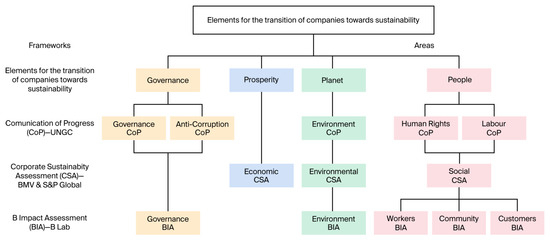
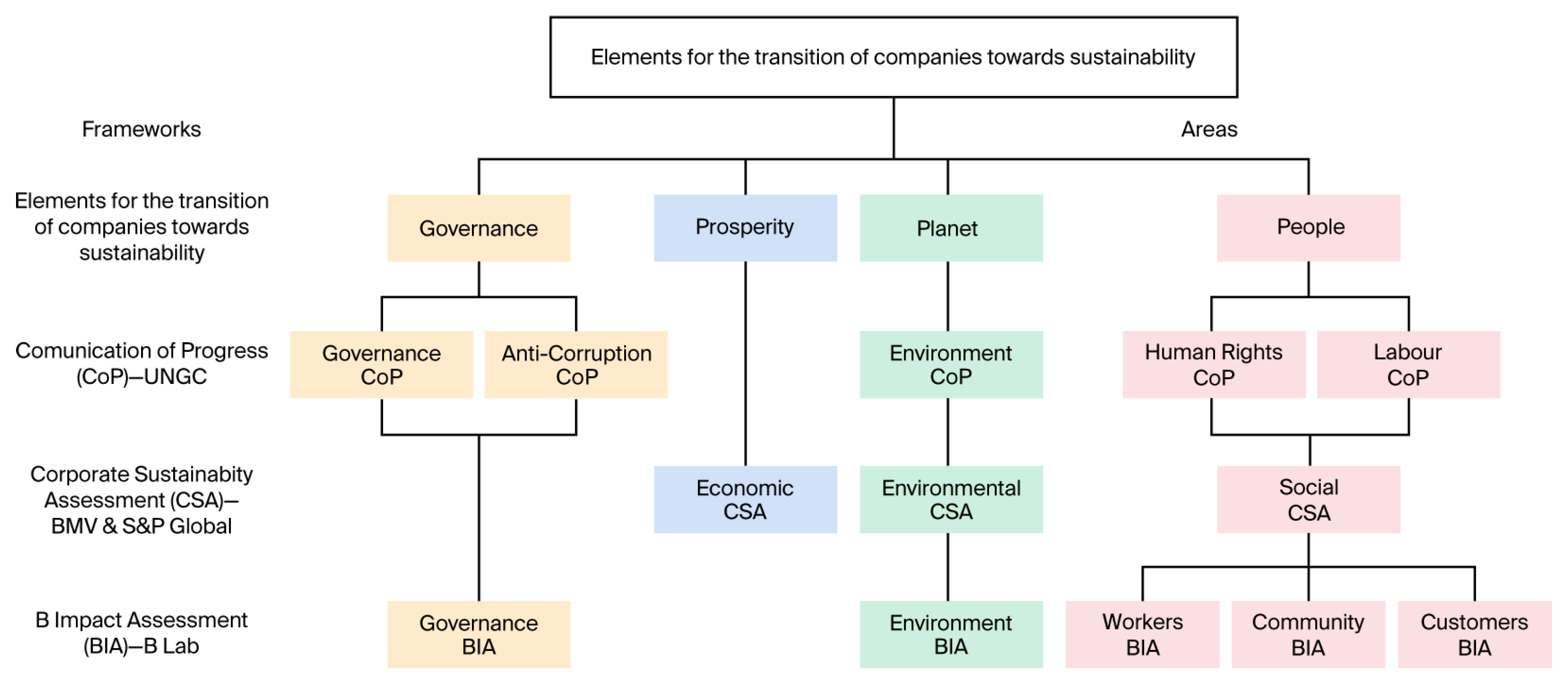
After stratification, the indicators were categorized into distinct dimensions (see Figure 1). Most publications classify the indicators within the three conventional dimensions of sustainability (economic, social, and environmental) [57]; in the case of the three indicator frameworks analyzed, the CoP is organized into five areas with a focus on the principles of the Global Compact [51], BIA is also organized into five but with a focus on the company’s key stakeholders [46], and the CSA is organized into the commonly used dimensions [52].
Figure 1.
Structure of the elements proposed to transition companies towards sustainability.
The integration of Environmental, Social, and Governance (ESG) elements is gaining ground [58], and in some cases, it has replaced conventional dimensions [43,57]. There is confusion between the economic dimension and governance, since there is often imprecision about the aspects that concern them [19]; in fact, it is not common to find them simultaneously, as observed in the frameworks analyzed here. At the same time, indicators related to financial aspects should not be confused with structural characteristics related to sustainability [19]. This proposal is structured around the work of Cantele et al. [43], who integrate the concept of the Triple Bottom Line (people, profit, planet) [59] and ESG approaches in four dimensions: (1) governance, (2) prosperity, (3) planet, and (4) people.
This procedure made it possible to identify those indicators that could be redundant; however, each organization approaches them differently, and despite dealing with the same element, sustainability reports require different information, for example, for waste, quantity, management, procedures, and practical actions. In these cases, they were organized and clustered around the central element.
For redundancies, for example, in the case of emissions levels 1, 2 or 3, all frameworks referred to quantity, so we maintain the indicator with the highest RPC and eliminate the other two; in total, 61 indicators were eliminated because of repetition among the frameworks. The final stratification, grouping the indicators by level and dimension, is shown in Table 7.
Table 7.
Final stratification of indicators.
The results show that a greater number of social indicators and, to a lesser extent, economic indicators prevail, which may be because the economic analysis of companies is still conducted separately from sustainability evaluation. In fact, within the frameworks, governance indicators appear mixed with economic indicators, and vice versa, so we must be aware that these dimensions still present ambiguities.
At level 1, the evaluators indicated that aspects such as waste disposal, gas emissions, recycling practices, treatment, waste reduction, work-related deaths, and due diligence are highly relevant in Mexico and that their implementation is feasible for all types of companies.
This stratification does not imply that covering level 1 is sufficient; instead, it shows that, as the company advances in its transition towards sustainability, it must incorporate additional criteria. In addition, it indicates that a small company would not be able to cover aspects such as supplier certifications or the development of its suppliers, if its priority remains profitability or its own well-being. As soon as it manages to cross this gap, it will be able to transfer its benefit to other actors.
Level 2 considers elements such as transparency, information security, water conservation, risk management, the use of ecological equipment, codes of conduct, and others, which would be difficult for a small company to cover. However, as it grows and improves its sustainability, it can and should incorporate them.
At level 3, there are elements such as the public disclosure of sustainability information, risk culture, participation in the Global Compact, donations, types of facilities, codes of conduct, or relationships with suppliers, to name a few. In this sense, the demands increase; companies must no longer conduct only internal evaluation, but also consider their participation and interrelations with the macrosystem. At this level, it is worth mentioning that indicators considered requirements in more developed countries, such as “environmental efficiency” and “wage growth”, are subordinated to other priorities in the Mexican context.
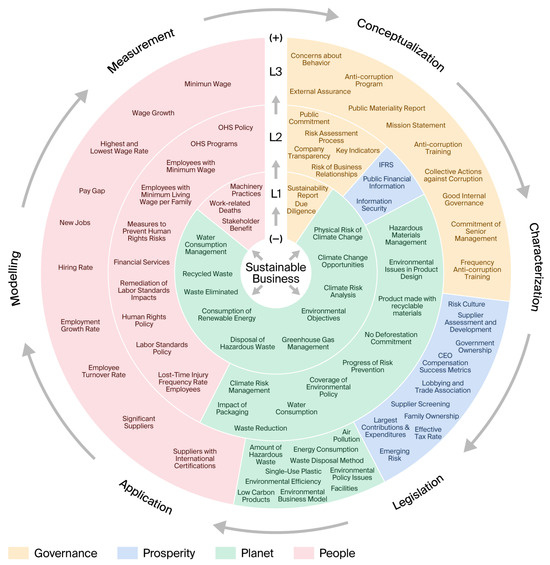
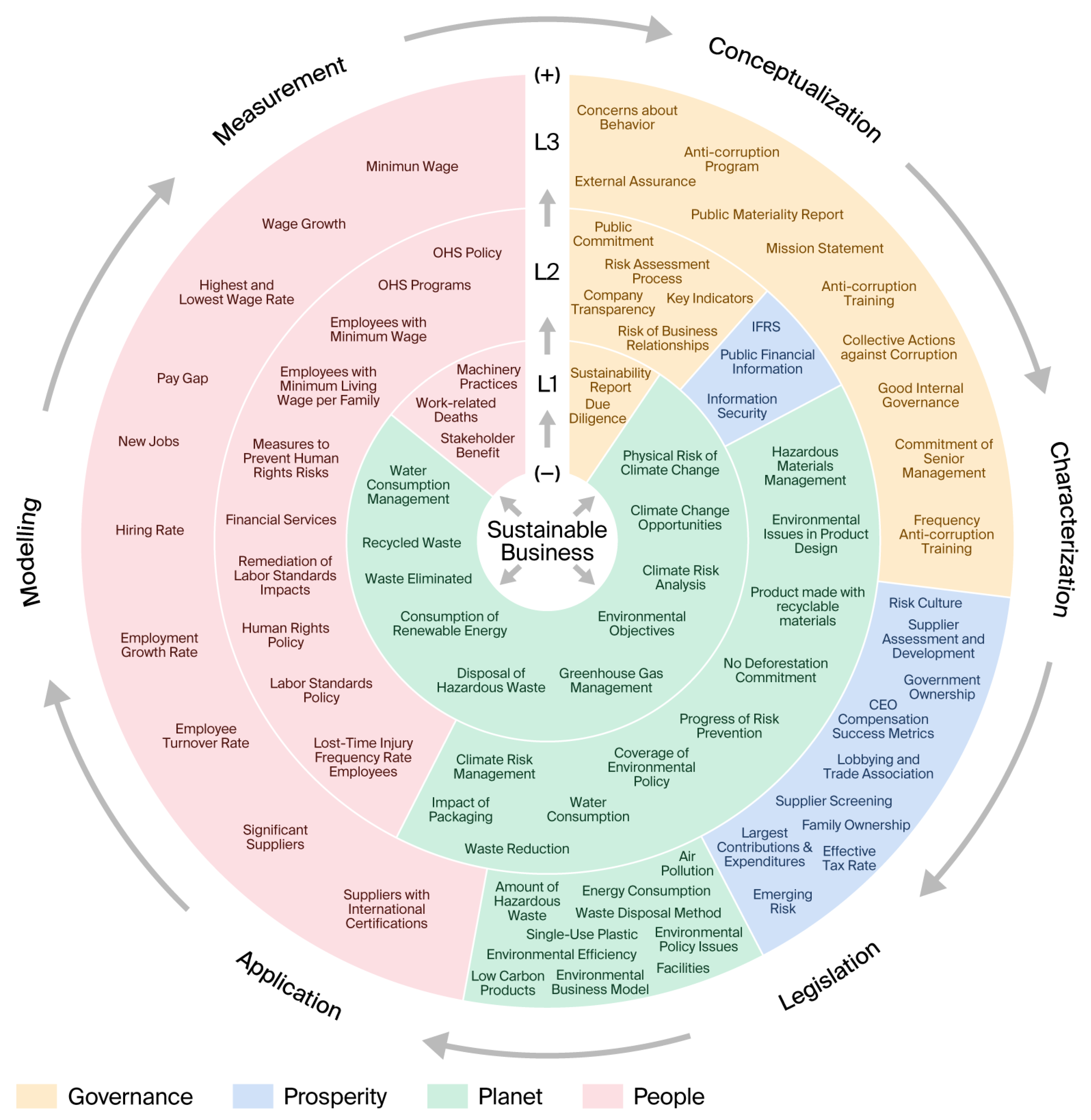
Figure 2 shows a model to support companies in their transition to sustainability. The model considers a sustainable company as part of a larger system in which to incorporate sustainability. It must first define it and plan how to achieve it, so the organization must conceive concepts and characteristics of sustainability. It must then link up with the outside world when it realizes that there are already regulations that must be complied with and companies that are already considered sustainable from which it can obtain relevant information or practices to replicate or improve.
Figure 2.
Model of transition towards business sustainability in Mexico. Note: The model displays up to 10 of the most relevant indicators for each level and dimension; the complete list is available upon request.
Next, the company will integrate these elements to organize and structure its strategy or business model, in which it must define the process managers and thus establish their priorities and outline the way in which they will contribute to their dimensions of governance, prosperity, planet, and people; their environment; and the global context. Finally, metrics need to be established that allow progress to be observed, potential deviations to be monitored, and adjustments to be made when necessary.
In line with this, there is a model that serves as a guide in transitioning Mexican companies to sustainability, using internationally established indicators. The center reflects stratification, represented in three circles that refer to each of the levels divided into the four dimensions proposed by Cantele et al. [43]. The number of indicators included relates to the size of each dimension. This model proposes that Mexican companies integrate primarily environmental elements at the first level, social aspects at the second, and economic and governance elements at the third.
Companies should not concentrate on one dimension and leave the others aside or assume that one dimension is more relevant than another, but rather recognize that, for companies in Mexico, there are better conditions to transcend in this way.
4. Discussion
Sustainability has driven changes in organizational theory, and, as refs. [7,13] suggest, we consider that changes in the company’s structure and strategy are required to incorporate social and environmental aspects.
In the context of Mexican companies, traditional theory and the sustainable paradigm coexist. Our model proposes adapting the traditional administrative process to the demands of sustainability for the transition, considering six stages—conceptualization, characterization, legislation, application, and measurement control—which involve planning, modeling, organization, direction, and measurement control.
Organizations such as WBCSD and the GRI were pioneers in driving companies to change their thinking about SD, enabling them to take action and report on their progress. Since then, the academic and business fields have shown evidence of growth in the subject; authors such as Pranugrahaning et al. [17] indicate that it began in 2012, although in our review, we recognize an increase in the production of scientific articles from 2003, and with a greater increase since the publication of the 2030 Agenda.
However, there is still a need to objectively evaluate business sustainability to identify critical points to be addressed beyond just reporting.
We selected three tools as a general-purpose questionnaire, which were evaluated by a panel of judges who, based on their experience and a quantitative method, aim to eliminate subjectivity in the selection of indicators and to rescue from the generality what is pertinent to the Mexican context. Although the group of judges is small, they have diverse profiles and have absolutely no conflicts of interest, unlike government officials, environmental activists, or businessmen. A larger number of judges may appear more representative, but given the contrasting criteria within the sustainability dimensions, it would be difficult to avoid sampling bias stemming from common perceptions among judges with equivalent profiles.
Although it could be considered a reductionist approach that does not address the complexity of the multidimensionality of sustainability [20], nor consider their interrelationship, and condenses a smaller number of indicators, some authors consider that, for a system of indicators to work, the number of indicators must be manageable and represent the criteria of the CEO [35]. In addition, multicriteria decision-making methodologies are widely used in problems where it is necessary to evaluate various alternatives with different approaches, as well as to classify and order decisions [23].
We propose transitioning to sustainability by identifying a framework of indicators stratified into a three-level model, complementing the typology of Dyllick et al. [13], which characterizes the integration of sustainability in companies.
- (1)
- Business as usual: companies continue to operate under traditional theory. In our model, this level is not considered because it is assumed that the company intends to move towards sustainability.
- (2)
- Sustainability 1.0—Level 1: Sustainability as compliance, generating income and responding to external demands; Greenhouse Gas Management or Consumption of Renewable Energy are relevant even for small companies because they integrate them to meet the demands of their customers, usually larger companies.
- (3)
- Sustainability 2.0—Level 2: Balance of environmental, social, and economic elements to generate a positive impact. The governance dimension is observed as a necessary integrating element of the three.
- (4)
- Sustainability 3.0—Level 3: Creating value for the common good; the company identifies global challenges and contributes to their solution, which implies transforming the business. The mission statement indicates that the company will need to redefine its raison d’être in terms of sustainability.
The model visualizes CS as a process of gradual incorporation because we recognize that the company’s activity is directly related to its effects [60]. As it grows, so do the effects it generates, though this does not mean that a larger one is more sustainable.
The evaluators consider that, given Mexico’s economic, social, and environmental conditions and those of its companies, the indicators with RPC values between 0 and 0.453 are the least relevant. The majority of businesses in Mexico are microenterprises, accounting for 95.5% of the total economic units and contributing 17.1% to total revenues [33], with numbers of employees ranging from 1 to 10 [61]; such conditions do not allow them to have formal structures, and indicators related to corporate governance or their financial statements would not apply to them. However, from now on, as the company grows, they must cover them.
There are indicators that are difficult to address, and one option may be to eliminate or replace them [62]. We believe that the performance and information provided by companies should be a function of the conditions and the national and international regulatory framework. Likewise, care must be taken that resource constraints, organizational culture, or employee resistance do not hinder the transition to sustainability [63].
Countries in Latin America, such as Brazil, are also making efforts to contribute to solving global challenges and to report criteria for evaluating SC in specific sectors [64] or for large companies [28,65]. Like in our study, water management, emissions and energy, waste and biodiversity, working conditions, impact on communities, and anti-corruption practices are deemed relevant indicators for its application.
The limitations of this study are as follows. Although this research is an exercise in aligning indicators, it is conducted solely within international frameworks. The country’s conditions and characteristics are included based on expert judgment.
Although companies can identify areas for improvement from the model, no metrics or limits are provided that indicate good or bad performance.
TOPSIS considers independent indicators; it does not visualize how one indicator can influence another. Sustainability is multidimensional and interdependent [66], which poses a limitation for the model.
Although selecting and stratifying a set of indicators based on expert judgment is a first step, this model has not been empirically validated, which is necessary for its adjustment and practical applicability in real contexts [64].
For future research, a two-way alignment approach, from the outside in and from the inside out, is suggested, which would involve the consideration of frameworks beyond international ones, for example, of a specific sector.
Research is required to determine possible measures or targets for specific indicators to place a company at a sustainable level.
Measuring the indicators could provide information about the company’s current sustainability status and support scenario planning for decision-making.
Practical implications. Our proposal aims to serve as a guide for incorporating actions in a staggered manner that move us towards sustainability, based on relevant international metrics for companies in the Mexican context.
Given the fundamental role of government regulation in business sustainability [20,67], this proposal can serve as the basis for the Mexican Performance Evaluation System to measure the level of progress in corporate sustainability and its contribution to achieving the SDGs.
Awareness among decision-makers is required to advance sustainability through continuous training in the interpretation and application of sustainable indicators, laws, and standards.
5. Conclusions
Sustainability indicators play a significant role in companies’ transition toward sustainability. In this article, we use indicators from three international organizations to select and stratify indicators, assuming that, although there is general information, an adequate measure of sustainability must account for the broader context and the company’s particularities.
However, we consider that both the general (macro/outside-in, exogenous) and the specialized (micro/inside-out, endogenous) approaches must work together—not in opposition, but in alignment: these two approaches require the role of governments to be crucial, because they must serve as the bridge that unites both criteria.
Our model starts with international tools but integrates them with the conditions of Mexican companies, using expert judgment to determine what is pertinent to the country. In addition, under the criterion of proximity to the ideal solution, it is possible to stratify, suggesting that some elements are more relevant than others, which most Mexican companies can implement given their conditions. By contrast, others will incorporate them as the company grows and advances in its sustainable performance.
Of 294 indicators, 21 deemed irrelevant were removed, and an additional 61 were removed due to duplication. This shows that the indicator frameworks are not mutually exclusive, even though they seem to measure the same thing; instead, they complement each other, and large companies often use more than one. This effort linked global corporate sustainability frameworks to the specific conditions of Mexican companies and brought together 212 indicators organized into levels and dimensions.
The work suggests starting the transition towards sustainability from the environmental dimension, which coincides with the antecedents of Sustainable Development, where the objective of “mitigating the negative effects that economic activities produce on the environment” is highlighted. Although this was the starting point, sustainability speaks to linkage and interrelation; that is, the “economic” activity translates into a positive impact on environmental or social matters, or both. This aims to shift the business’s focus from being an entity “that causes harm” to one “that creates value for itself and its exterior”. Under this idea, the company does not use the outside; instead, global challenges constitute an opportunity to address them through its activities.
Author Contributions
Conceptualization, M.C.M.-C., A.D.C. and M.M.-A.; methodology, M.C.M.-C., A.D.C. and B.E.G.-B.; software, M.C.M.-C. and C.Y.V.-R.; formal analysis, M.C.M.-C. and A.D.C.; investigation, M.C.M.-C., M.M.-A. and B.E.G.-B.; resources, A.D.C., M.M.-A. and B.E.G.-B.; data curation, M.C.M.-C.; writing—original draft preparation, M.C.M.-C. and A.D.C.; writing—review and editing M.C.M.-C., A.D.C., M.M.-A. and C.Y.V.-R.; visualization, M.C.M.-C. and C.Y.V.-R.; supervision, A.D.C. and M.M.-A.; project administration, M.M.-A. and C.Y.V.-R.; funding acquisition, A.D.C., M.M.-A. and B.E.G.-B. All authors have read and agreed to the published version of the manuscript.
Funding
This research was funded by Instituto Politécnico Nacional grant number SIP-CC-003-2024.
Institutional Review Board Statement
Not applicable.
Informed Consent Statement
Not applicable.
Data Availability Statement
The original data presented in the study are openly available in Instituto Politécnico Nacional at https://ipn.mx (accessed on 20 August 2024).
Conflicts of Interest
The authors declare no conflicts of interest.
Abbreviations
The following abbreviations are used in this manuscript:
| BIA | B Impact Assessment |
| BMV | Mexican Stock Exchange |
| CDP | Carbon Disclosure Project |
| CoP | Communication of Progress |
| CS | Corporate Sustainability |
| CSA | Corporate Sustainability Assessment |
| CTI | Circular Transition Indicators |
| DJSI | Dow Jones Sustainability Index |
| ESG | Environmental, Social, and Governance |
| GRI | Global Reporting Initiative |
| ISAR | International Standards of Accounting and Reporting |
| MCDM | Multicriteria Decision Method |
| RPC | Relative Proximity Coefficient |
| SD | Sustainable Development |
| SDGs | Sustainable Development Goals |
| TOPSIS | Technique for Order of Preference by Similarity to Ideal Solution |
| UN | United Nations Organization |
| UNGC | United Nations Global Compact |
| WBCSD | World Business Council for Sustainable Development |
References
- WCED. Report of the World Commission on Environment and Development: Our Common Future. 1987. Available online: https://goo.su/6ZJZ0T (accessed on 29 September 2024).
- Pradhan, P.; Costa, L.; Rybski, D.; Lucht, W.; Kropp, J.P. A Systematic Study of Sustainable Development Goal (SDG) Interactions. Earths Future 2017, 5, 1169–1179. [Google Scholar] [CrossRef] [Scilit]
- Sachs, J.D. From Millennium Development Goals to Sustainable Development Goals. Lancet 2012, 379, 2206–2211. [Google Scholar] [CrossRef] [Scilit] [PubMed]
- UN. Transformar Nuestro Mundo: La Agenda 2030 para el Desarrollo Sostenible. 2015. Available online: https://goo.su/R9PoZ (accessed on 8 September 2024).
- ASF. La Agenda 2030 de Las Naciones Unidas: El Contexto Mundial y El Caso de México. 2023. Available online: https://www.asf.gob.mx/uploads/1823_Novedades_Editoriales/Agenda_2030_131021_-_ISBN.pdf (accessed on 20 August 2024).
- Senge, P.M.; Carstedt, G. Innovating Our Way to the Next Industrial Revolution. MIT Sloan Manag. Rev. 2001, 42, 24–38. [Google Scholar]
- Carbal Herrera, A.E.; Luna Amador, J.A.; Carballo Payares, A.M. Teoría organizacional y sostenibilidad empresarial: Un análisis teórico. Rev. Cienc. Soc. 2024, 30, 531–550. [Google Scholar] [CrossRef] [Scilit]
- Fayol, H. General and Industrial Management; Institute of Electrical and Electronics Engineering: New York, NY, USA, 1916. [Google Scholar]
- Friedman, M. Capitalism and Freedom; University of Chicago Press: Chicago, IL, USA, 1962. [Google Scholar]
- Freeman, R.E. Strategic Management: A Stakeholder Approach; Cambridge University Press: Cambridge, UK, 1984. [Google Scholar]
- Barney, J.B. Why Resource-based Theory’s Model of Profit Appropriation Must Incorporate a Stakeholder Perspective. Strateg. Manag. J. 2018, 39, 3305–3325. [Google Scholar] [CrossRef] [Scilit]
- Chang, R.-D.; Zuo, J.; Zhao, Z.-Y.; Zillante, G.; Gan, X.-L.; Soebarto, V. Evolving Theories of Sustainability and Firms: History, Future Directions and Implications for Renewable Energy Research. Renew. Sustain. Energy Rev. 2017, 72, 48–56. [Google Scholar] [CrossRef] [Scilit]
- Dyllick, T.; Muff, K. Clarifying the Meaning of Sustainable Business. Organ. Environ. 2016, 29, 156–174. [Google Scholar] [CrossRef] [Scilit]
- Gáspár, S.; Musinszki, Z.; Hágen, I.Z.; Barta, Á.; Bárczi, J.; Thalmeiner, G. Developing a Controlling Model for Analyzing the Subjectivity of Enterprise Sustainability and Expert Group Judgments Using Fuzzy Triangular Membership Functions. Sustainability 2023, 15, 7981. [Google Scholar] [CrossRef] [Scilit]
- Pazienza, M.; de Jong, M.; Schoenmaker, D. Why Corporate Sustainability Is Not Yet Measured. Sustainability 2023, 15, 6275. [Google Scholar] [CrossRef] [Scilit]
- KPMG. The Time Has Come. The KPMG Survey of Sustainability Reporting 2020. 2020. Available online: https://goo.su/tISoB7c (accessed on 18 September 2025).
- Pranugrahaning, A.; Donovan, J.D.; Topple, C.; Masli, E.K. Corporate Sustainability Assessments: A Systematic Literature Review and Conceptual Framework. J. Clean. Prod. 2021, 295, 126385. [Google Scholar] [CrossRef] [Scilit]
- Maas, K.; Schaltegger, S.; Crutzen, N. Integrating Corporate Sustainability Assessment, Management Accounting, Control, and Reporting. J. Clean. Prod. 2016, 136, 237–248. [Google Scholar] [CrossRef] [Scilit]
- Schneider, A.; Meins, E. Two Dimensions of Corporate Sustainability Assessment: Towards a Comprehensive Framework. Bus. Strateg. Environ. 2012, 21, 211–222. [Google Scholar] [CrossRef] [Scilit]
- Blinova, E.; Ponomarenko, T.; Tesovskaya, S. Key Corporate Sustainability Assessment Methods for Coal Companies. Sustainability 2023, 15, 5763. [Google Scholar] [CrossRef] [Scilit]
- Keeble, J.J.; Topiol, S.; Berkeley, S. Using Indicators to Measure Sustainability Performance at a Corporate and Project Level. J. Bus. Ethics 2003, 44, 149–158. [Google Scholar] [CrossRef] [Scilit]
- Searcy, C. Corporate Sustainability Performance Measurement Systems: A Review and Research Agenda. J. Bus. Ethics 2012, 107, 239–253. [Google Scholar] [CrossRef] [Scilit]
- Moldavska, A.; Welo, T. Testing and Verification of a New Corporate Sustainability Assessment Method for Manufacturing: A Multiple Case Research Study. Sustainability 2018, 10, 4121. [Google Scholar] [CrossRef] [Scilit]
- Vormedal, I.; Ruud, A. Sustainability Reporting in Norway—An Assessment of Performance in the Context of Legal Demands and Socio-political Drivers. Bus. Strateg. Environ. 2009, 18, 207–222. [Google Scholar] [CrossRef] [Scilit]
- Kücükgül, E.; Cerin, P.; Liu, Y. Enhancing the Value of Corporate Sustainability: An Approach for Aligning Multiple SDGs Guides on Reporting. J. Clean. Prod. 2022, 333, 130005. [Google Scholar] [CrossRef] [Scilit]
- Pranugrahaning, A.; Donovan, J.D.; Topple, C.; Masli, E.K. Exploring Corporate Sustainability in the Insurance Sector: A Case Study of a Multinational Enterprise Engaging with UN SDGs in Malaysia. Sustainability 2023, 15, 8609. [Google Scholar] [CrossRef] [Scilit]
- Jiang, Q.; Liu, Z.; Liu, W.; Li, T.; Cong, W.; Zhang, H.; Shi, J. A Principal Component Analysis Based Three-Dimensional Sustainability Assessment Model to Evaluate Corporate Sustainable Performance. J. Clean. Prod. 2018, 187, 625–637. [Google Scholar] [CrossRef] [Scilit]
- Schrippe, P.; Ribeiro, J.L.D. Corporate Sustainability Assessment Heuristics: A Study of Large Brazilian Companies. J. Clean. Prod. 2018, 188, 589–600. [Google Scholar] [CrossRef] [Scilit]
- Tseng, M.-L.; Wu, K.-J.; Ma, L.; Kuo, T.C.; Sai, F. A Hierarchical Framework for Assessing Corporate Sustainability Performance Using a Hybrid Fuzzy Synthetic Method-DEMATEL. Technol. Forecast. Soc. Change 2019, 144, 524–533. [Google Scholar] [CrossRef] [Scilit]
- Gobierno de México. Estrategia Nacional Para la Implementación de la Agenda 2030 en México. Oficina de la Presidencia de la República. 2019. Available online: https://goo.su/GjLdx3z (accessed on 5 September 2025).
- KPMG. Panorama ASG en México y Centroamérica. Integrar la Sostenibilidad Para Impulsar El Crecimiento. Available online: https://goo.su/cUjcMML (accessed on 11 August 2025).
- Cemex. Reporte Integrado Cemex 2023-Marcando la Pauta-Demostrando Nuestro Compromiso Con Acciones. 2023. Available online: https://goo.su/3OzZA (accessed on 13 September 2025).
- INEGI. Estadísticas a Propósito Del Día de Las Micro, Pequeñas y Medianas Empresas (Mipymes). 2025. Available online: https://goo.su/nqqvq (accessed on 29 September 2025).
- Escobar-Pérez, J.; Cuervo-Martínez, A. Validez de contenido y juicio de expertos: Una aproximación a su utilización. Av. Med. 2008, 6, 27–36. Available online: https://goo.su/Zpz9nP8 (accessed on 15 June 2025).
- Galicia Alarcón, L.A.; Balderrama Trápaga, J.A.; Edel Navarro, R. Content Validity by Experts Judgment: Proposal for a Virtual Tool. Apertura 2017, 9, 42–53. [Google Scholar] [CrossRef] [Scilit]
- Rodríguez Carrillo, M.L.; Pérez Domínguez, L.; Romero López, R.; León Castro, E. Método Multicriterio Topsis para valoración de la innovación en las pymes. Inst. Ing. Tecnol. 2024, 295, 1169–1179. Available online: https://cathi.uacj.mx/20.500.11961/29044 (accessed on 16 June 2025).
- Behzadian, M.; Khanmohammadi Otaghsara, S.; Yazdani, M.; Ignatius, J. A State-of the-Art Survey of TOPSIS Applications. Expert Syst. Appl. 2012, 39, 13051–13069. [Google Scholar] [CrossRef] [Scilit]
- Blasco-Blasco, O.; Coll-Serrano, V. Selección de indicadores basada en métodos de optimización multicriterio, una aplicación a la estrategia de cultura y desarrollo de España. Rev. Electrón. Comun. Trab. ASEPUMA 2016, 17, 19–33. Available online: https://goo.su/LI023I2 (accessed on 16 June 2025).
- Do Carmo Silva, M.; Gomes, C.F.; Da Costa Junior, C.L. The Use of TOPSIS for Ranking WIPO’S Innovation Indicators. Innovar 2019, 29, 133–148. [Google Scholar] [CrossRef] [Scilit]
- González Nuñez, B.M.; Pérez Peña, O.; Leyva Vázquez, M.Y. Selección de Indicadores Medioambientales Mediante Técnicas de Decisión Multicriterio Neutrosóficas. Neutrosophic Comput. Mach. Learn. 2021, 16, 56–64. Available online: https://fs.unm.edu/NCML2/index.php/112/article/view/148 (accessed on 17 June 2025).
- Khlie, K.; Pugalenthi, A.; Jebbor, I. Sustainable Supply Chains in the Industry X.0 Era: Overcoming Integration Challenges in the UAE. Adm. Sci. 2025, 15, 417. [Google Scholar] [CrossRef] [Scilit]
- Hwang, C.L.; Yoon, K. Multiple Attribute Decision Making: Methods and Applications: A State-of-the-Art Survey; Springer: Berlin/Heidelberg, Germany, 2012; ISBN 9783642483189. [Google Scholar]
- Cantele, S.; Landi, S.; Vernizzi, S. Measuring Corporate Sustainability in Its Multidimensionality: A Formative Approach to Integrate ESG and Triple Bottom Line Approaches. Bus. Strateg. Environ. 2024, 33, 7383–7408. [Google Scholar] [CrossRef] [Scilit]
- WBCSD. Página Oficial. Available online: https://www.wbcsd.org/ (accessed on 18 September 2025).
- Global Compact Network Mexico. Página Oficial. Available online: https://pactomundial.org.mx/ (accessed on 19 September 2025).
- B Lab. B Impact Assessment. Available online: https://embedded-bia.bcorporation.net/login (accessed on 17 July 2025).
- B Lab. Página Oficial. Available online: https://www.bcorporation.net/en-us/ (accessed on 17 July 2025).
- GRI. Estándares GRI Consolidados. Available online: https://goo.su/QYF9dza (accessed on 19 September 2025).
- GRI. Página Oficial. Available online: https://www.globalreporting.org/ (accessed on 2 September 2025).
- UNGC. Página Oficial. Available online: https://unglobalcompact.org/ (accessed on 28 September 2025).
- UNGC. Communication of Progress Guidebook; United Nations Global Compact: New York, NY, USA, 2024; Available online: https://unglobalcompact.org/library/6107 (accessed on 18 September 2025).
- S&P. Global CSA Handbook 2023. Corporate Sustainability Assessment; S&P Global: New York, NY, USA, 2023; Available online: https://goo.su/2jh2I7 (accessed on 19 September 2025).
- BMV. Página Oficial. Available online: https://www.bmv.com.mx/ (accessed on 19 September 2025).
- Tavakol, M.; Dennick, R. Making Sense of Cronbach’s Alpha. Int. J. Med. Educ. 2011, 2, 53–55. Available online: https://pmc.ncbi.nlm.nih.gov/articles/PMC4205511/ (accessed on 15 May 2025). [CrossRef] [Scilit] [PubMed]
- Taber, K.S. The Use of Cronbach’s Alpha When Developing and Reporting Research Instruments in Science Education. Res. Sci. Educ. 2018, 48, 1273–1296. [Google Scholar] [CrossRef] [Scilit]
- Márquez-Barja, J.; Calafate, C.T.; Cano, J.-C.; Manzoni, P. An Overview of Vertical Handover Techniques: Algorithms, Protocols and Tools. Comput. Commun. 2011, 34, 985–997. [Google Scholar] [CrossRef] [Scilit]
- Roca, L.C.; Searcy, C. An Analysis of Indicators Disclosed in Corporate Sustainability Reports. J. Clean. Prod. 2012, 20, 103–118. [Google Scholar] [CrossRef] [Scilit]
- Dauerer, A. A Systematic Literature Review of Performance Measurement Systems and the Integration of ESG Factors. Environ. Sustain. Indic. 2025, 27, 100746. [Google Scholar] [CrossRef] [Scilit]
- Elkington, J. Towards the Sustainable Corporation: Win-Win-Win Business Strategies for Sustainable Development. Calif. Manag. Rev. 1994, 36, 90–100. [Google Scholar] [CrossRef] [Scilit]
- Daub, C.-H. Assessing the Quality of Sustainability Reporting: An Alternative Methodological Approach. J. Clean. Prod. 2007, 15, 75–85. [Google Scholar] [CrossRef] [Scilit]
- GRI. GRI Annual Sustainability Report 2022: Towards a Global Comprehensive Reporting System. 2023. Available online: https://goo.su/jPFcY (accessed on 17 September 2025).
- Bartkus, E.V.; Grunda, R. Business Sustainability Assessment: Comparing Results of Two Studies. Eng. Econ. 2011, 22, 32–40. [Google Scholar] [CrossRef] [Scilit]
- Moldavska, A. Defining Organizational Context for Corporate Sustainability Assessment: Cross-Disciplinary Approach. Sustainability 2017, 9, 2365. [Google Scholar] [CrossRef] [Scilit]
- Feil, A.A.; Zapata, A.L.G.; Lazo, M.A.P.; Rosa, M.C.D.; Oliveira, J.D.; Schreiber, D. A Set of Sustainability Indicators for Brazilian Small and Medium-Sized Non-Alcoholic Beverage Industries. Sustainability 2025, 17, 6794. [Google Scholar] [CrossRef] [Scilit]
- Schrippe, P.; Ribeiro, J.L.D. Preponderant criteria for the definition of corporate sustainability based on Brazilian sustainable companies. J. Clean. Prod. 2019, 209, 10–19. [Google Scholar] [CrossRef] [Scilit]
- Carmine, S.; De Marchi, V. Reviewing Paradox Theory in Corporate Sustainability Toward a Systems Perspective. J. Bus. Ethics 2023, 184, 139–158. [Google Scholar] [CrossRef] [Scilit]
- Borgert, T.; Donovan, J.D.; Topple, C.; Masli, E.K. Impact Analysis in the Assessment of Corporate Sustainability by Foreign Multinationals Operating in Emerging Markets: Evidence from Manufacturing in Indonesia. J. Clean. Prod. 2020, 260, 120714. [Google Scholar] [CrossRef] [Scilit]

Disclaimer/Publisher’s Note: The statements, opinions and data contained in all publications are solely those of the individual author(s) and contributor(s) and not of MDPI and/or the editor(s). MDPI and/or the editor(s) disclaim responsibility for any injury to people or property resulting from any ideas, methods, instructions or products referred to in the content. |
© 2026 by the authors. Licensee MDPI, Basel, Switzerland. This article is an open access article distributed under the terms and conditions of the Creative Commons Attribution (CC BY) license.