


Abstract
Learning environment and student engagement (SE) are widely considered valuable to foreign language learning, but how they influence foreign language achievement (LA) remains underexplored. Drawing on sociocultural theory, this survey study explored the impact of the online learning environment (OLE) on LA of Chinese as a Foreign Language (CFL) and the mediating role of SE among 447 international students in China by using structural equation modeling. The results indicated that: (1) the participants had favorable perceptions toward OLE, SE and LA; (2) OLE factors, i.e., accessibility of online learning materials, student interaction, and course organization significantly positively influenced LA, whereas teacher support did not influence LA; (3) SE mediated the positive effects of all the OLE factors on LA. The results suggest that enhancing online learning environment and increasing student engagement are effective means to improve online CFL learning achievement.
1. Introduction
Over the past decade, China has become a major study destination globally, with an increasing student population. In 2018, China attracted 492,185 international students from 196 different countries and regions, who were studying at more than 1000 Chinese higher education institutions [1]. International student education in China includes two main instructional modes: Chinese-medium instruction (CMI) and English-medium instruction (EMI). While CMI students receive instruction in Chinese, EMI students are also required to undertake at least one year of Chinese language study to reach a minimum proficiency level of HSK 4. Therefore, Chinese as a foreign language (CFL) learning, as a core component of their academic journey, is not only vital for academic success but also for adapting to life in China and developing intercultural competence. International students learning CFL in China come from a wide range of countries and regions, particularly Asia and Africa, and represent diverse linguistic and educational backgrounds [2,3]. Such diversity adds complexity to CFL learning contexts [4], and highlights the importance of examining how online learning conditions shape international students’ CFL learning experience.
The rapid advances of information technology have reshaped higher education, making online learning an integral component of educational systems. Online learning is increasingly recognized as a sustainable long-term educational approach that supports the ongoing transformation of higher education [5]. At the policy level, international organizations have emphasized the educational value of digital technologies. UNESCO, for example, has highlighted that digital innovation can widen participation in education, support inclusive learning practices, and enhance the overall quality and relevance of learning experiences [6]. In line with these policy perspectives, online learning helps create learning environments that are more inclusive and equitable by expanding access to education [5].
Despite these advantages, the effectiveness of online learning, especially in language education, is still contested. The inherent separation of time and space often reduces social presence [7], and the lack of face-to-face communication may hinder social interaction and student engagement [8], potentially compromising learning effectiveness. Importantly, learning outcomes are not solely determined by environmental conditions. They also depend on how learners interact with their environment. From a sociocultural perspective, learning is a mediated process involving both social interaction and the use of cultural tools [9]. Learners can exercise agency by actively engaging with their environment and using available mediation tools to achieve their learning goals [10].
Learning environment is commonly considered an important determinant of students’ learning attitudes and outcomes [11]. Within second language acquisition research, this factor is especially important for cognitive and linguistic development. However, while existing research has explored how online learning environment relates to second language achievement [12], the specific mechanism through which these effects occur remains underexplored.
In addition, student engagement is widely regarded as a critical indicator of learning effectiveness in online contexts [13], and has attracted growing attention in language learning research [7]. Recent research has highlighted the importance of sustained student engagement for supporting not only immediate learning outcomes but also long-term learning processes and educational sustainability [14]. Yet its mediating effect on the relationship between the online learning environment and foreign language achievement has not been fully examined.
Therefore, drawing on sociocultural theory, this study investigates how features of the online CFL learning environment are associated with international students’ learning achievement, with student engagement considered as an important mediator. This research contributes to the theoretical understanding of engagement-mediated language learning in online contexts, whilst offering practical implications for the design and delivery of effective and sustainable online CFL education, with broader relevance to online foreign language learning for international students.
2. Literature Review
2.1. Sociocultural Theory
Sociocultural theory emphasizes the interaction between individuals and their environment, conceptualizing learning as a developmental process in which cognitive functions are shaped and regulated through socially mediated activity [15]. This theory was later applied to second language acquisition by Lantolf and other researchers, highlighting the critical role of mediation through tools, signs, and artifacts in cognitive development [9]. Through mediation, learners are able to process external information and gradually internalize it as personal knowledge and forms of action [15].
From a sociocultural perspective, learning development involves a gradual shift in control over cognitive activity from external sources to the learner [15]. This shift in control is achieved through mediation, which can be conceptualized as processing through three levels: object regulation, other regulation, and self-regulation. Learners develop and refine their cognitive abilities by advancing through these stages [16]. Lower-level mental functions are typically achieved through object regulation and other regulation [15], such as using dictionaries or seeking help from teachers and peers. Self-regulation refers to the internalization of these previously external regulatory forms by the individual in order to accomplish learning tasks [16]. Through self-regulation, learners gradually increase their capacity to appropriate and use mediational means and gain greater autonomy in controlling their thoughts and actions [16].
Drawing on the sociocultural theory, this study investigates how the online learning environment and student engagement are related to CFL learning achievement among international students in China. In this study, features of online learning environment are understood as providing regulatory conditions that afford object regulation and other regulation during online learning. These conditions shape how learners engage in learning activities, manage learning tasks, and communicate with teachers and peers. Student engagement is conceptualized as a process that reflects learners’ sustained involvement in learning activities, such as their effort, persistence, and responsiveness to learning tasks and interactions in the learning environment [17,18]. Regulation in sociocultural theory is understood as a developmental process that unfolds through activity [15,16]. Therefore, learners’ patterns of participation provide an empirical basis for observing how regulation is enacted during learning, as learners engage with and respond to object regulation and other regulation in the learning environment. Learning achievement is viewed as the outcome of this regulation process, representing how learners’ participation in learning activities contributes to their learning development.
2.2. Online Learning Environment and Foreign Language Learning Achievement
Online learning environment refers to “a system and process that connects learners with distributed and online learning materials” and involves the separation of teachers, learners, and learning resources across space and time [19]. In line with this definition, the present research focuses on features of the online learning environment across four dimensions: teacher support, student interaction, accessibility of online learning materials, and course organization.
According to sociocultural theory, learning occurs through interaction with the social and cultural environment, including interaction with other people and with cultural artifacts. In online learning contexts, both teachers and peers, considered significant “others”, play crucial roles. Teacher support, as a form of other-regulation, provides learners with scaffolding and feedback [9] which foster learners’ enjoyment of online foreign language learning, and contributes to improved academic outcomes [12]. Meanwhile, positive peer interaction similarly facilitates collaborative learning and mutual support, which are positively linked to learning success [12,20]. In addition to interpersonal interaction, object regulation forms, such as learning resources and course design, are fundamental to the development of foreign language proficiency [9]. Appropriate learning materials, effective technology use, and clear instructional design contribute to an inclusive and motivating online learning environment, and support learners’ positive perceptions and online learning success [12,21,22].
Although these studies demonstrated a clear link between online learning environment and foreign language learning achievement, most existing research has been qualitative in nature. There remains a lack of empirical investigation into the mechanisms and pathways through which online learning environment affects foreign language learning achievement. In particular, how learners utilize object regulation and other regulation strategies to engage with cultural tools and social agents in achieving language learning goals remains insufficiently understood. Furthermore, while previous research has focused extensively on teacher–student and peer interaction, the accessibility of learning materials and course organization have received relatively less attention. Few studies have adopted an integrative perspective that considers teachers, peers, curriculum design, and digital resources collectively in examining the effects of online learning environment on foreign language learning.
The majority of prior studies have focused on learners of English as a foreign language (EFL), while the learning experience of CFL learners remains largely underexplored, particularly among international students in China, who engage in language acquisition within a cross-cultural educational context. They must navigate not only linguistic complexity but also cultural differences, which compound the learning demands. Accordingly, this research seeks to examine how online learning environment influences Chinese language learning achievement among international students in China. The findings would offer insights and practical implications for the design of more effective online Chinese language instruction.
2.3. Online Learning Environment, Student Engagement, and Foreign Language Learning Achievement
Student engagement refers to “the time and energy students devote to educationally purposeful activities” [23]. From a sociocultural perspective, engagement is driven by internal motivation and shaped through interactions between the learner and their environment, requiring learners to respond to environmental changes [24]. Within this framework, features of the learning environment, including teachers, peers, curriculum, and learning materials, serve as influential factors in shaping engagement [18]. Empirical research has shown that teachers and peers, understood as key “others” within the learning process, positively impact engagement in online foreign language learning. For instance, teachers’ care and respect [25], as well as emotional and academic support [7,26], can enhance students’ willingness to actively participate in learning, thereby increasing their engagement. Similarly, peer collaboration, mutual assistance, and feedback contribute to the co-construction of knowledge and reduce the sense of isolation in online settings, promoting greater engagement in foreign language learning [7,26]. Nevertheless, some studies have reported that teacher support [27] and student interaction [26] do not significantly predict engagement among EFL learners studying online in China. These mixed findings suggest that teacher and peer support may predict engagement in different ways across learner populations and learning conditions.
In addition, learning resources and course design, viewed as sociocultural artifacts, also function as object regulation tools that influence student engagement in online foreign language learning. Empirical studies have demonstrated that perceptions of course design and instructional planning [8,28], along with system accessibility and the ease of obtaining learning materials [29], positively affect engagement levels. These findings collectively suggest that online learning environment, through both object- and other-mediated regulation, plays a critical role in shaping foreign language learners’ engagement. Nevertheless, prior studies have primarily examined the influence of teachers and peers, with limited attention given to the impact of course organization and the accessibility of learning materials. Moreover, most previous research has examined engagement in EFL context, whereas engagement in online CFL learning remains largely underexplored.
Moreover, student engagement is widely viewed as a crucial indicator of academic performance and personal development [23], and is closely associated with learning achievement [18]. Research on online foreign language learning has shown that engagement can significantly predict Chinese university students’ English writing proficiency [30] as well as their scores on standardized English language tests such as the CET-4 [31]. However, most prior studies have addressed the direct effects of engagement, with limited attention to its mediating role. One notable exception is the study by Wang et al. [31], which reported that online engagement mediated the relationship between learning-related emotions and English achievement. Beyond foreign language learning contexts, recent studies in higher education have begun to examine student engagement as a mediating factor linking academic adaptation to performance among international students [32], and within broader frameworks of sustainable learning [14]. Yet, within foreign language learning research, how student engagement mediates the influence of online learning environment on foreign language learning achievement remains insufficiently explored.
In summary, learners’ engagement in online learning is shaped by multiple environmental factors, including resource accessibility, interaction with peers, teacher support, and course organization. These factors encourage students to devote more time and effort to online language learning. In turn, higher levels of engagement have been shown to significantly predict learning achievement in online foreign language contexts and contribute to improved academic performance.
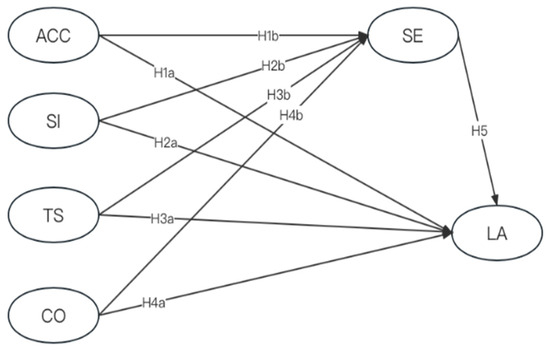
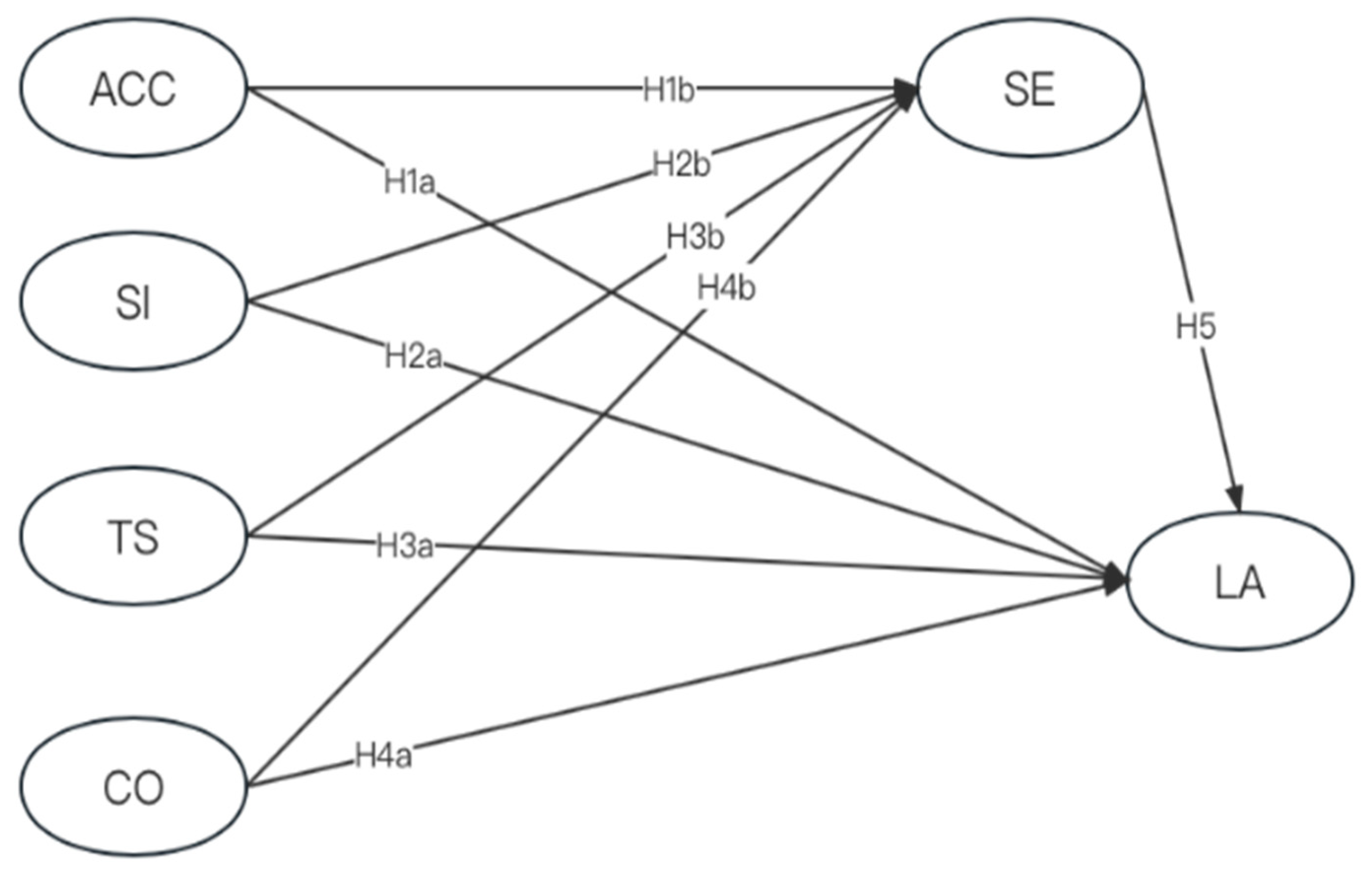
Drawing on previous research, the current research aims to investigate how features of the online learning environment relate to international students’ engagement and their perceived CFL learning achievement, with student engagement examined as a mediator. To achieve this aim, a hypothetical model was constructed (see Figure 1), and a set of hypotheses was proposed:
Hypothesis 1a (H1a).
Accessibility of online learning materials (ACC) positively predicts online CFL learning achievement (LA).
Hypothesis 2a (H2a).
Student interaction (SI) positively predicts online CFL learning achievement (LA).
Hypothesis 3a (H3a).
Teacher support (TS) positively predicts online CFL learning achievement (LA).
Hypothesis 4a (H4a).
Course organization (CO) positively predicts online CFL learning achievement (LA).
Hypothesis 1b (H1b).
Accessibility of online learning materials (ACC) positively predicts student engagement (SE) in online CFL learning.
Hypothesis 2b (H2b).
Student interaction (SI) positively predicts student engagement (SE) in online CFL learning.
Hypothesis 3b (H3b).
Teacher support (TS) positively predicts student engagement (SE) in online CFL learning.
Hypothesis 4b (H4b).
Course organization (CO) positively predicts student engagement (SE) in online CFL learning.
Hypothesis 5 (H5).
Student engagement (SE) positively predicts online CFL learning achievement (LA).
Hypothesis 6 (H6).
Student engagement (SE) is a mediating variable between accessibility of online learning materials (ACC) and online CFL learning achievement (LA).
Hypothesis 7 (H7).
Student engagement (SE) is a mediating variable between student interaction (SI) and online CFL learning achievement (LA).
Hypothesis 8 (H8).
Student engagement (SE) is a mediating variable between teacher support (TS) and online CFL learning achievement (LA).
Hypothesis 9 (H9).
Student engagement (SE) is a mediating variable between course organization (CO) and online CFL learning achievement (LA).
Figure 1.
The hypothetical research model. Note: ACC = accessibility of online learning materials, CO = course organization, SI = student interaction, TS = teacher support, LA = learning achievement, SE = student engagement.
3. Methodology
3.1. Research Sample
The participants in this survey were international students from eight universities located across eastern, central, and northwestern China. With the assistance of the universities’ international offices, the research team distributed a bilingual (Chinese and English) electronic questionnaire during the mid-term of the Fall semester in 2021. International students enrolled in synchronous and asynchronous online Chinese language courses completed the questionnaire. Sent via WeChat, a social media platform that is widely used, the questionnaire clearly outlined the research objectives and the principle of voluntary participation.
All participants were provided with information regarding the study’s purpose and procedures before completing the questionnaire. The informed consent statement emphasized that participation was voluntary and anonymous. No personally identifiable information was collected. Ethical standards for research involving human participants were strictly observed throughout the study. Completion of the online questionnaire was taken as informed consent. A total of 455 questionnaires were collected. After calculating the Mahalanobis distance, eight extreme outliers were excluded, resulting in 447 valid responses.
The sample included international students with diverse demographic backgrounds, including gender, educational level, region of origin, and types of online CFL courses. Table 1 reports detailed demographic information about the participants.
Table 1.
Participant demographics.
3.2. Measurement Scales
The questionnaire included two sections. The first focused on demographic characteristics of international students, such as gender, country of origin, and online Chinese course types. The second part focused on international students’ self-reported perceptions of online learning environment (OLE), SE, and LA in their online CFL courses. A five-point Likert scale was employed, with response options ranging from “strongly disagree” (scored as 1) to “strongly agree” (scored as 5). The original items were adapted to align with the purpose of the present study.
Firstly, the subscale measuring OLE was primarily derived from Web-based Learning Environment Instrument (WEBLEI) [19] to investigate international students’ perceptions of ACC, SI, and CO. TS was measured using six items from University Mathematics Classroom Environment Questionnaire (UMCEQ) [33]. The UMCEQ was developed by Chinese scholars, and a modified version has been used in studies involving international students from different disciplines, with evidence of good reliability and validity [34].
Secondly, items used to measure international students’ engagement were adapted from studies by Dowson and McIneney [35] and Skinner et al. [36] for the online CFL learning.
Lastly, we used a five-item subscale measuring LA based on self-reported development in key language skills, including listening, speaking, reading, writing, and overall communicative ability, among international students within online CFL learning. Existing studies have assessed LA using diverse indicators, including standardized test scores, teacher ratings, and students’ self-reported perception of their competence and development [37]. Students’ self-reported learning achievement, based on accumulated learning outcomes, does not differ significantly from test score outcomes [38]. In addition, as the data were gathered from international students enrolled at multiple universities taking online CFL courses, standardized test scores or comparable course grades were not consistently available. Therefore, students’ self-reported learning achievement provides a feasible and contextually appropriate indicator for capturing learning outcomes in large-scale, multi-institutional online learning settings.
3.3. Data Analysis
Data analyses were performed using SPSS 25 and AMOS 23. SPSS 25 was employed to assess normal distribution, evaluate instrument reliability, and perform descriptive statistics and correlation analysis. AMOS 23 was used to test instrument validity, conduct structural equation modeling, and examine mediating effects. The fit of the model was evaluated according to the ratio of chi-square to degree of freedom (χ2/df), Root Mean Square Error of Approximation (RMSEA), Comparative Fit Index (CFI) and Non-Normed Fit Index (NNFI).
4. Results
4.1. Reliability and Construct Validity
Skewness and Kurtosis were calculated, with the values ranging from −0.595 to +1.266. The absolute value of both Skewness and Kurtosis was below 2, indicating that the data generally conformed to a normal distribution [39].
Furthermore, the instruments’ reliability and validity were tested. Table 2 presents the results. The Cronbach’s alpha coefficient values varied between 0.879 and 0.948, higher than 0.8, suggesting a robust internal reliability of the instruments [40]. Additionally, the factor loadings of all the items were above 0.7, surpassing the suggested threshold of 0.7 [41], indicating strong reliability of indicators for each construct in the model. Moreover, composite reliability (CR) of each construct ranged from 0.882 to 0.949, exceeding the minimum requirement of 0.7 proposed by Hair [42]. The average variance extracted (AVE) of each construct ranged from 0.608 to 0.727, all exceeding the acceptable threshold of 0.5 proposed by Fornell and Larcker [43]. The high CR and AVE values confirmed the robust reliability and convergent validity of all constructs.
Table 2.
Measurement reliability and validity.
Moreover, confirmatory factor analyses (CFA) were conducted for the instruments. The results demonstrated satisfactory fit indices for OLE (χ2/df = 600.986/182 = 3.302 < 5, p = 0.000, RMSEA = 0.072 < 0.08, CFI = 0.951 > 0.9, NNFI = 0.944 > 0.9), SE (χ2/df = 64.489/21 = 3.071 < 5, p = 0.000, RMSEA = 0.068 < 0.08, CFI = 0.987 > 0.9, NNFI = 0.977 > 0.9) and LA (χ2/df = 12.169/4 = 3.042 < 5, p = 0.016, RMSEA = 0.068 < 0.08, CFI = 0.995 > 0.9, NNFI = 0.987 > 0.9). Therefore, all constructs exhibited a satisfactory level of goodness of fit.
4.2. Descriptive Statistics Results and Correlation Analysis
Descriptive statistics results are presented in Table 3. The mean scores of the four dimensions of OLE were more than the median score of 3, indicating that international students tended to hold a positive view of OLE. Among the OLE factors, the highest mean score was for TS (4.150), while the lowest was for SI (3.674). The mean score of SE was 3.960, suggesting that international students generally expressed an adequate level of SE in their online CFL learning. Regarding LA, the mean score of 3.679 indicated that international students perceived satisfactory progress in their CFL skills.
Table 3.
Descriptive statistics and Correlations.
Table 3 reports the correlations among the OLE factors, SE, and LA. All variables were positively correlated, with correlation coefficients indicating moderate (0.70 > r > 0.50) to strong (r > 0.70) associations, all of which were statistically significant [44].
4.3. Hypothesis Testing of Direct Effects
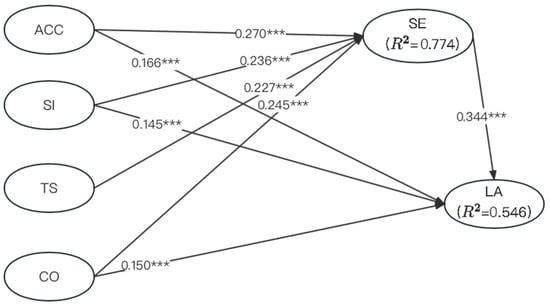
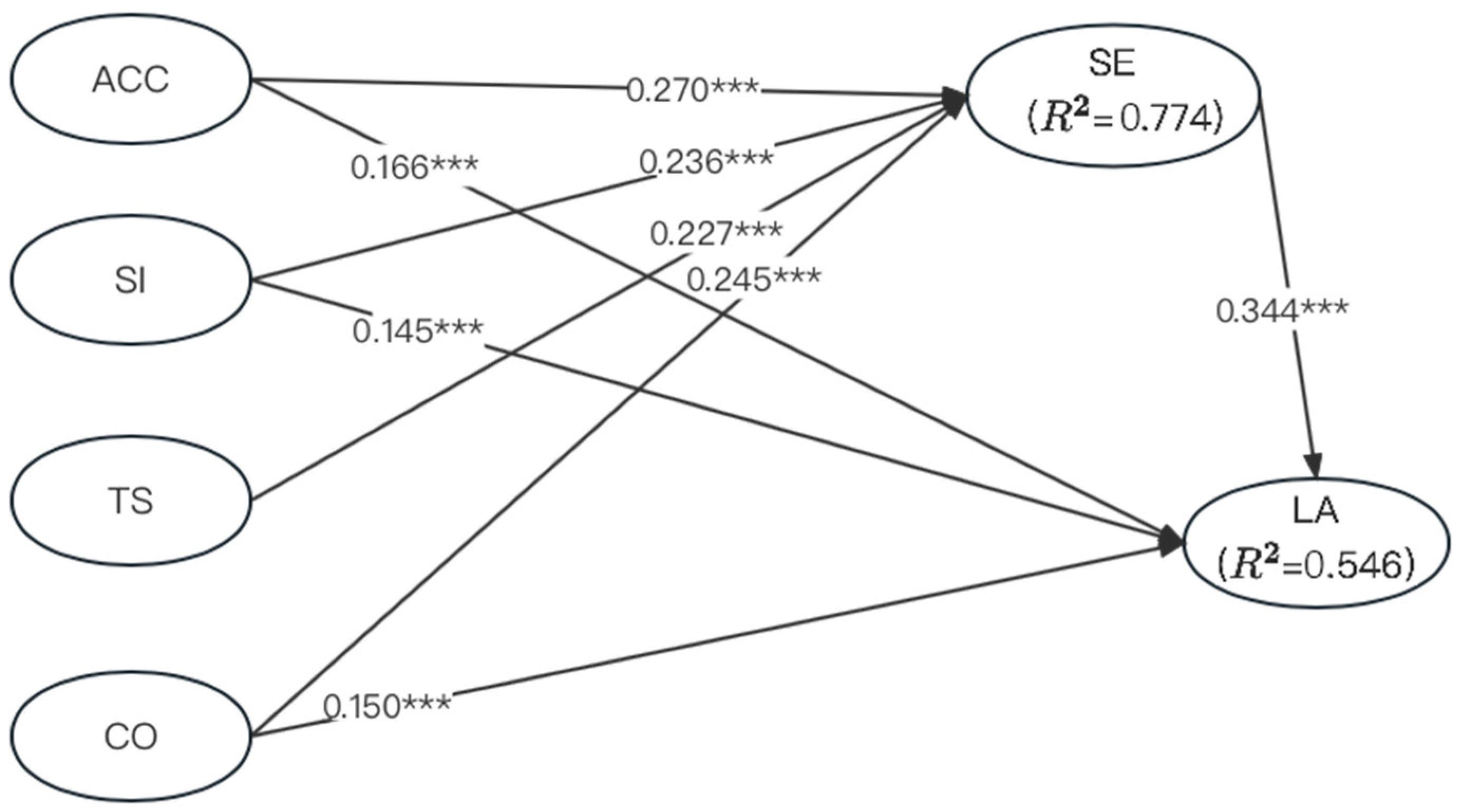
This study employed the maximum likelihood method for parameter estimation, establishing a structural equation model (Figure 2), in which OLE factors served as independent variables, LA was the outcome, and SE functioned as a mediator. After model modification and optimization, non-significant paths were removed. The model fit estimates indicated that all fit indices met the satisfactory criteria: χ2/df = 2.474 < 3, p = 0.000, RMSEA = 0.057 < 0.08, CFI = 0.945 > 0.9, NNFI = 0.940 > 0.9. The square root of the multiple correlation (R2) for LA was 0.546, indicating that 54.6% of its variance was explained by this model. Therefore, this model demonstrated a relatively high explanatory power for CFL learning achievement.
Figure 2.
Results of SEM testing. Note: *** p < 0.001. ACC = accessibility of online learning materials, CO = course organization, SI = student interaction, TS = teacher support, LA = learning achievement, SE = student engagement.
As presented in Table 4, among the four variables of OLE, ACC (β = 0.166, p < 0.001), SI (β = 0.145, p < 0.001), and CO (β = 0.150, p < 0.001) had significant and positive effects on LA. However, the influence of TS on LA was not significant. Therefore, hypotheses H1a, H2a, and H4a were supported. Furthermore, ACC (β = 0.270, p < 0.001), SI (β = 0.236, p < 0.001), TS (β = 0.227, p < 0.001), and CO (β = 0.245, p < 0.001) significantly and positively predicted SE. Thus, hypotheses H1b, H2b, H3b and H4b were accepted. Moreover, SE (β = 0.344, p < 0.001) significantly and positively impacted LA. Hence, hypothesis H5 was accepted.
Table 4.
Results of hypothesis testing: direct effects.
4.4. Mediating Effect of SE
Bootstrap method with 5000 samples was utilized to examine the mediating effects of international students’ engagement within their online CFL context. As indicated in Table 5, the results revealed that the 95% confidence intervals for all mediating paths in the model did not include zero, reaching a significant level of p = 0.002. This indicated that, in addition to a significant direct predictive effect on CFL LA, OLE can also significantly predict LA through the mediating role of SE. The results demonstrated that the mediating path coefficients were, respectively, 0.093 (ACC), 0.081 (SI), 0.078 (TS), and 0.084 (CO). The proportions of explained variance are 0.359 (ACC), 0.358 (SI), 1 (TS), and 0.359 (CO). Hypotheses H6–H9 were supported. These results revealed that student engagement fully mediated the effect of TS on LA, and partially mediated the effects of ACC, SI, and CO on LA.
Table 5.
Results of hypothesis testing: indirect effects.
5. Discussion
5.1. Features of the Online CFL Learning Environment, Engagement, and Learning Achievement Among International Students
This study found that international students in China generally held favorable perceptions of OLE, with all environmental variables scoring above the median score of 3. In particular, their perception of TS was comparable to that of Chinese university students engaged in online EFL learning [25], suggesting that international students generally recognized the emotional and academic support provided by their Chinese language instructors. Additionally, participants reported favorable perceptions of CO and ACC, indicating that the online CFL courses were perceived as clearly structured and equipped with readily accessible materials that support autonomous learning.
However, the study also revealed relatively lower scores in SI, suggesting that opportunities for learner–learner interaction may be insufficient within the online learning environment.
Furthermore, according to the results, international students reported comparatively higher SE in online CFL learning, slightly exceeding the engagement levels reported by Chinese domestic students in online EFL learning [26]. This indicates that international students invested considerable time and effort in their online language studies. Lastly, participants also expressed positive perceptions of LA, suggesting that their listening, speaking, reading, writing, and communicative skills in Chinese had improved through online learning.
The results demonstrated significant positive correlations among OLE, SE, and Chinese language LA. These findings highlight the close interconnection between international students’ perceptions of these variables.
5.2. Direct Influence of Online Learning Environment on CFL Learning Achievement
Significant positive associations were observed among OLE, SE and Chinese language LA. The structural equation modeling revealed that ACC, SI, and CO exerted a significant direct positive impact on international students’ Chinese language LA within the online context. These results align with sociocultural theory, which highlights the importance of interaction in second language learning environments [8]. Through interaction with peers, course content, and online learning materials, learners develop language knowledge and skills via processes of object regulation and other regulation.
At the level of object regulation, accessible and abundant online learning resources offer international students flexible learning opportunities. These resources support autonomous exploration of content, independent use of language learning resources and tools, and the development of flexible thinking skills, enabling learners to become creators of knowledge rather than mere recipients [21,22]. In addition, clearly defined learning objectives, well-designed instructional activities, and the effective integration of online technologies help digital-native learners quickly adapt to the online environment. They are able to use various digital tools to complete learning tasks [12], enhance their foreign language communication skills in virtual settings [20], and ultimately improve their Chinese language LA.
At the level of other regulation, online CFL courses provide opportunities for peer interaction and collaboration. These interactions encourage learners to learn from each other, receive feedback, and engage in meaning negotiation. Such processes foster the development of higher-order thinking skills and contribute to more effective learning outcomes. These findings align with previous research [12,20].
Thus, the OLE, through its provision of rich learning resources, structured course design, and opportunities for peer interaction, functions as both an object regulation and other regulation tool, creating a supportive environment that facilitates international students’ development of Chinese language skills and intercultural understanding through social interaction.
It is noteworthy that, although international students in China perceived a high level of teacher support in OLE, teacher support, as a form of other regulation, did not have a direct positive impact on their Chinese language LA. This finding contrasts with results from the previous study [12]. One possible explanation is that in online settings, teachers are often expected to act as guides and facilitators rather than mere instructors or transmitters of knowledge [8]. From a sociocultural perspective, learning outcomes are shaped by how environmental factors are embedded in learners’ ongoing goal-directed activities. In this study, teacher support primarily captures affective and behavioral dimensions, such as friendliness, fairness, emotional consideration, availability of help, frequency of communication, and encouragement. These forms of support primarily operate at a contextual level, shaping learners’ willingness to engage, rather than directly scaffolding. As a result, teacher support may influence achievement indirectly by creating favorable conditions for self-regulation and engagement, rather than through an immediate impact on language outcomes.
In contrast, student interaction, another form of other regulation, involves communicative exchanges, timely response, and collaborative problem-solving, often occurring at moments when learners encounter difficulties or interruptions in the learning process. Such interaction provides immediate opportunities for feedback, negotiation of meaning, and task performance, thereby exerting a more proximal influence on learning achievement.
5.3. Student Engagement as a Mediator Linking Online Learning Environment and CFL Learning Achievement
The current study found that student engagement served as a mediator between OLE and Chinese language LA among international students in China, which aligns with sociocultural theory. According to this theory, various dimensions of OLE function as both object regulation and other regulation tools, enabling learners to activate self-regulation through social interaction with the learning environment and the use of mediation tools. This process, in turn, increases their engagement and enhances their LA.
Teacher support and peer interaction provide a sense of social presence, which facilitates social interaction [8], helps construct a supportive environment, and fosters a positive attitude towards online learning [26]. This encourages students to trust and rely on their teachers and peers [25], increasing the frequency of use of cognitive strategies and prompting greater engagement in online foreign language learning [7]. Additionally, ACC and CO function as object regulation tools, providing a better collaborative environment [28]. They meet learners’ individualized learning needs, supporting the creative development of autonomous learning [29], and significantly enhance student engagement within online learning. The increased engagement further promotes international students’ acquisition of Chinese language skills and intercultural understanding. This finding validates the significant impact of student engagement on LA, which aligns with the previous studies [30,31].
Although teacher support showed no significant direct effect on international students’ Chinese language LA, its impact was transmitted via student engagement during online learning. This finding suggests that international students engaged in online learning place greater reliance on autonomy and self-regulation to achieve their learning goals, underscoring the critical role of learner self-regulation in online foreign language education. Furthermore, the results revealed a distinctive role of teacher support within the online CFL learning context. Specifically, the function of teacher support as other regulation is manifested more through its capacity to stimulate and guide students’ engagement, rather than directly influencing LA. Timely feedback from teachers, as well as their understanding and respect for the intercultural backgrounds of international students, effectively nurtured their emotions and feelings. This, in turn, stimulates their affective involvement and engagement. A higher level of engagement facilitates the internalization of Chinese language knowledge, thus contributing to improving LA.
This study contributes to a more nuanced view of student engagement within online foreign language learning. While previous research has demonstrated that engagement serves as a mediator linking academic emotions to learning achievement [31], as well as between academic adaptation and academic performance [32], the present research further reveals that international students’ engagement within online CFL learning also serves as an intermediary mechanism linking learners’ perceived online learning environment to learning achievement. From a sociocultural perspective, the mediating effect of student engagement is consistent with the view that learning is shaped through learners’ active involvement in material and social environments. Within the online foreign language learning context, student engagement can be understood as reflecting how learners respond to object regulation and other regulation during the learning process, thereby linking environmental conditions and learning achievement.
5.4. Practical Implications
These findings revealed that effective online foreign language learning relies on the coordinated functioning of object regulation, other regulation, and learner self-regulation. More specifically, effective online foreign language learning should not only consider environmental design, but should also consider how such environmental conditions encourage both immediate and sustained learner engagement. Several practical implications for online CFL instruction—and online foreign language education more broadly—are recommended.
First, with regard to object regulation, the accessibility of learning materials and clear course organization represent important environmental conditions in online CFL learning. Hence, higher education institutions and instructors are suggested to prioritize the optimization of online learning environment. Specifically, broad access to learning resources, flexibility in learning time and pace, and well-organized course structures should be ensured. These conditions help provide international students with stable and manageable learning conditions that support sustained participation in online CFL learning.
Second, in terms of other regulation, both teacher support and student interaction should be fostered as important sources of academic and social support in online CFL learning settings. Teachers are encouraged to provide appropriate guidance, encouragement, and communication to help students remain engaged and supported throughout the learning process. In addition, communication among students should be facilitated to promote supportive peer relationships, reduce feelings of isolation, and encourage continued participation in online learning. Such forms of support are particularly important for international students facing linguistic and intercultural challenges in online contexts.
Finally, regarding self-regulation, sustaining student engagement is important for maintaining learning continuity and quality for international learners. Accordingly, instructional practices should place greater emphasis on supporting student engagement in online learning, helping international students to remain actively involved in language learning activities beyond temporal and spatial constraints.
6. Conclusions
This study investigated 447 international students in China regarding their perceptions of online learning environment (OLE), student engagement (SE), and their learning achievement (LA) in online Chinese as a Foreign Language (CFL) learning. Using structural equation modeling, the study explored the associations between these variables and the mediating role of SE. The results revealed that accessibility of online learning materials, student interaction, and course organization had significant positive effects on LA. Furthermore, SE mediated the positive influence of OLE on LA. These results highlight the importance of both environmental and learner-related factors in enhancing outcomes in online CFL learning. In particular, the findings emphasize the unique role of teacher support in online learning environment and the critical importance of learner self-regulation.
In addition, the findings offer insights for promoting the sustainable development of digital learning provision and the long-term delivery of online foreign language learning in higher education. Online language learning serves as an approach supporting educational transformation when appropriate learning conditions are in place. The present study illustrates that the sustainability of online CFL education depends not only on the availability of technological infrastructure, but also on a well-designed and carefully maintained digital learning environment that encourages active participation and sustained engagement, particularly among international students from diverse linguistic and cultural backgrounds.
This study has the following limitations. First, it relied solely on quantitative data collected through a questionnaire survey. Qualitative methods, such as in-depth interviews, could be employed in future research to explore additional factors that may influence online CFL learning achievement. Second, learning achievement in this study was measured using self-reported perceptions. Although self-reported measures have been widely used and validated in educational research, they may still be subject to common method bias. Future studies are therefore encouraged to include objective measures of language proficiency, where feasible, to allow for a more holistic assessment of international students’ learning outcomes in online CFL courses.
Author Contributions
Conceptualization, J.F. and M.T.; methodology, J.F. and M.T.; software, J.F.; validation, J.F. and M.T.; investigation, J.F. and M.T.; data curation, J.F.; writing—original draft preparation, J.F.; writing—review and editing, M.T.; supervision, M.T.; project administration, M.T.; funding acquisition, M.T. All authors have read and agreed to the published version of the manuscript.
Funding
This research was funded by Shaanxi Social Science Research Fund, grant number 2023P001.
Institutional Review Board Statement
The study was conducted in accordance with the Declaration of Helsinki and approved by the Departmental Research Committee, School of Foreign Studies, Xi’an Jiaotong University, Shaanxi (protocol code XJTU-SFS-RECA-1-011 and date of 1 September 2021 approval).
Informed Consent Statement
Informed consent was obtained from all subjects involved in the study.
Data Availability Statement
The data that support the findings of this study are available from the corresponding author upon reasonable request.
Conflicts of Interest
The authors declare no conflicts of interest. The funders had no role in the design of the study; in the collection, analyses, or interpretation of data; in the writing of the manuscript; or in the decision to publish the results.
References
- Ministry of Education of the People’s Republic of China. Statistics of International Students in China in 2018. Available online: http://www.moe.gov.cn/jyb_xwfb/gzdt_gzdt/s5987/201904/t20190412_377692.html (accessed on 26 March 2025).
- Wan, Z.; Gao, X. English or Chinese as medium of instruction? International students’ perceptions and practices in Chinese universities. Engl. Today 2019, 36, 37–44. [Google Scholar] [CrossRef] [Scilit]
- Wang, W.; Curdt-Christiansen, X.L. Teaching Chinese to International Students in China: Political Rhetoric and Ground Realities. Asia-Pac. Educ. Res. 2016, 25, 723–734. [Google Scholar] [CrossRef] [Scilit]
- Song, Y. Translanguaging as sociolinguistic infrastructuring to foster epistemic justice in international Chinese-medium-instruction degree programs in China. Appl. Linguist. Rev. 2024, 15, 1407–1431. [Google Scholar] [CrossRef] [Scilit]
- Lasekan, O.A.; Pachava, V.; Pena, M.T.G.; Golla, S.K.; Raje, M.S. Investigating Factors Influencing Students’ Engagement in Sustainable Online Education. Sustainability 2024, 16, 689. [Google Scholar] [CrossRef] [Scilit]
- UNESCO Digital Learning and Education: What you Need to Know About Digital Learning and Transformation of Education. Available online: https://www.unesco.org/en/digital-education/need-know (accessed on 4 December 2025).
- Hui, L.; Feng, X. The impact of resilience on online English learning engagement: The mediating role of transactional distance. Mod. Foreign Lang. 2023, 4, 552–562. [Google Scholar] [CrossRef]
- Harsch, C.; Mueller-Karabil, A.; Buchminskaia, E. Addressing the challenges of interaction in online language courses. System 2021, 103, 102673. [Google Scholar] [CrossRef] [Scilit]
- Xu, J.; Lei, P. Foreign language classroom research from a sociocultural perspective. Mod. Foreign Lang. 2018, 4, 563–573. [Google Scholar]
- Qin, L.; Zhao, Y.; Ouyang, X.; Yao, L. Development of English learners’ agency in the cloud-based flipped classroom: A sociocultural theory perspective. Mod. Foreign Lang. 2022, 3, 381–393. [Google Scholar]
- Fraser, B.J.; Kahle, J.B. Classroom, home and peer environment influences on student outcomes in science and mathematics: An analysis of systemic reform data. Int. J. Sci. Educ. 2007, 29, 1891–1909. [Google Scholar] [CrossRef] [Scilit]
- Lee, S.M. Factors affecting the quality of online learning in a task-based college course. Foreign Lang. Ann. 2021, 55, 116–134. [Google Scholar] [CrossRef] [Scilit]
- Henrie, C.R.; Halverson, L.R.; Graham, C.R. Measuring student engagement in technology-mediated learning: A review. Comput. Educ. 2015, 90, 36–53. [Google Scholar] [CrossRef] [Scilit]
- Jallali, B.; Hafdhi, S.; Aloufi, A.M.E.; Masoudi, B.K.; Alshmrani, A.M. Toward Sustainable Learning: A Multidimensional Framework of AI Integration, Engagement, and Digital Resilience in Saudi Higher Education. Sustainability 2026, 18, 944. [Google Scholar] [CrossRef] [Scilit]
- Vygotsky, L.S. Mind in Society: The Development of Higher Psychological Processes; Harvard University Press: Cambridge, MA, USA, 1978; Volume 86. [Google Scholar]
- Lantolf, J.P.; Thorne, S.L.; Poehner, M.E. Sociocultural theory and second language development. In Theories in Second Language Acquisition; Routledge: New York, NY, USA, 2014; pp. 221–240. [Google Scholar]
- Kahu, E.R. Framing student engagement in higher education. Stud. High. Educ. 2013, 38, 758–773. [Google Scholar] [CrossRef] [Scilit]
- Fredricks, J.A.; Blumenfeld, P.C.; Paris, A.H. School Engagement Potential of the Concept, State of the Evidence. Rev. Educ. Res. 2004, 74, 59–109. [Google Scholar] [CrossRef] [Scilit]
- Chang, V.; Fisher, D. The validation and application of a new learning environment instrument to evaluate online learning in higher education. In Technology-Rich Learning Environments: A Future Perspective; World Scientific Publishing Company: Singapore, 2003; pp. 1–18. [Google Scholar]
- Junn, H. L2 communicative competence analysis via synchronous computer-mediated communication (SCMC) as an alternative to formal classrooms. Innov. Lang. Learn. Teach. 2021, 17, 15–31. [Google Scholar] [CrossRef] [Scilit]
- Tarrayo, V.N.; Anudin, A.G. Materials development in flexible learning amid the pandemic: Perspectives from English language teachers in a Philippine state university. Innov. Lang. Learn. Teach. 2021, 17, 102–113. [Google Scholar] [CrossRef] [Scilit]
- Tarrayo, V.N.; Paz, R.M.O.; Gepila, E.C. The shift to flexible learning amidst the pandemic: The case of English language teachers in a Philippine state university. Innov. Lang. Learn. Teach. 2021, 17, 130–143. [Google Scholar] [CrossRef] [Scilit]
- Kuh, G.D.; Hu, S.P. The effects of student-faculty interaction in the 1990s. Rev. High. Educ. 2001, 24, 309–332. [Google Scholar] [CrossRef] [Scilit]
- Connell, J.P. Context, self, and action: A motivational analysis of self-system processes across the life span. In The Self in Transition: Infancy to Childhood; Cicchetti, D., Ed.; University of Chicago Press: Chicago, IL, USA, 1990. [Google Scholar]
- Luan, L.; Hong, J.-C.; Cao, M.; Dong, Y.; Hou, X. Exploring the role of online EFL learners’ perceived social support in their learning engagement: A structural equation model. Interact. Learn. Environ. 2020, 31, 1703–1714. [Google Scholar] [CrossRef] [Scilit]
- Miao, J.; Chang, J.; Ma, L. Teacher–Student Interaction, Student–Student Interaction and Social Presence: Their Impacts on Learning Engagement in Online Learning Environments. J. Genet. Psychol. 2022, 183, 514–526. [Google Scholar] [CrossRef] [Scilit] [PubMed]
- Han, J.; Geng, X.; Wang, Q. Sustainable development of university EFL Learners’ engagement, satisfaction, and self-efficacy in online learning environments: Chinese experiences. Sustainability 2021, 13, 11655. [Google Scholar] [CrossRef] [Scilit]
- Aubrey, S. Dynamic engagement in second language computer-mediated collaborative writing tasks: Does communication mode matter? Stud. Second. Lang. Learn. Teach. 2022, 12, 59–86. [Google Scholar] [CrossRef] [Scilit]
- Cai, C. A correlation study on affordance perception and English learning engagement in the mobile environment. Foreign Lang. World 2021, 6, 63–71. [Google Scholar]
- Zhang, Y.; Jiang, Z. Effects of the integrated teacher-AWE feedback environment on learner engagement and second language writing performance. Foreign Lang. World 2022, 4, 40–48. [Google Scholar]
- Wang, H.; Wang, Y.; Li, S. Unpacking the relationships between emotions and achievement of EFL learners in China: Engagement as a mediator. Front. Psychol. 2023, 14, 1098916. [Google Scholar] [CrossRef] [Scilit]
- Liu, Y.; Ismail, A. Academic Adaptation and Performance Among International Students in China: The Mediating Role of Student Engagement. Sustainability 2025, 17, 11256. [Google Scholar] [CrossRef] [Scilit]
- Yin, H.; Lu, G. Development and validation of an instrument for assessing mathematics classroom environment in tertiary institutions. Asia-Pac. Educ. Res. 2014, 23, 655–669. [Google Scholar] [CrossRef] [Scilit]
- Tian, M.; Lu, G.; Yin, H.; Li, L. Student engagement for sustainability of Chinese international education: The case of international undergraduate students in China. Sustainability 2020, 12, 6831. [Google Scholar] [CrossRef] [Scilit]
- Dowson, M.; McInerney, D.M. The development and validation of the Goal Orientation and Learning Strategies Survey (GOALS-S). Educ. Psychol. Meas. 2004, 64, 290–310. [Google Scholar] [CrossRef] [Scilit]
- Skinner, E.; Marchand, G.; Furrer, C.; Kindermann, T. Engagement and disaffection in the classroom: Part of a larger motivational dynamic? J. Educ. Psychol. 2008, 100, 765–781. [Google Scholar] [CrossRef] [Scilit]
- Niepel, C.; Marsh, H.W.; Guo, J.; Pekrun, R.; Möller, J. Revealing dynamic relations between mathematics self-concept and perceived achievement from lesson to lesson: An experience-sampling study. J. Educ. Psychol. 2022, 114, 1380. [Google Scholar]
- Pike, G.R. The relationship between self reports of college experiences and achievement test scores. Res. High. Educ. 1995, 36, 1–21. [Google Scholar] [CrossRef] [Scilit]
- Kunnan, A.J. An introduction to structural equation modelling for language assessment research. Lang. Test. 1998, 15, 295–332. [Google Scholar] [PubMed]
- Cronbach, L.J. Coefficient alpha and the internal structure of tests. Psychometrika 1951, 16, 297–334. [Google Scholar] [CrossRef] [Scilit]
- Chin, W.W. The partial least squares approach to structure equation modeling. Adv. Hosp. Leis. 1998, 8, 295–336. [Google Scholar]
- Hair, J.F.; Black, W.C.; Babin, B.J.; Anderson, R.E. Multivariate Data Analysis: A Global Perspective, 7th ed.; Pearson Education: Upper Saddle River, NJ, USA, 2010. [Google Scholar]
- Fornell, C.; Larcker, D.F. Structural equation models with unobservable variables and measurement error: Algebra and statistics. J. Mark. Res. 1981, 18, 382–388. [Google Scholar] [CrossRef] [Scilit] [PubMed]
- Hinkle, D.E.; Wiersma, W.; Jurs, S.G. Applied Statistics for the Behavioral Sciences; Houghton Mifflflin: Boston, MA, USA, 2003. [Google Scholar]

Disclaimer/Publisher’s Note: The statements, opinions and data contained in all publications are solely those of the individual author(s) and contributor(s) and not of MDPI and/or the editor(s). MDPI and/or the editor(s) disclaim responsibility for any injury to people or property resulting from any ideas, methods, instructions or products referred to in the content. |
© 2026 by the authors. Licensee MDPI, Basel, Switzerland. This article is an open access article distributed under the terms and conditions of the Creative Commons Attribution (CC BY) license.