


Abstract
This study aims to develop a conceptual framework for integrating sustainability into Turkish language teaching through the synthesis of relevant academic literature and policy documents. Although the intersection of language education and sustainability has been expanding globally, its application within the specific context of Turkish language education remains insufficiently examined. To address this gap, a qualitative integrative literature review was adopted, enabling the analytical synthesis of diverse theoretical and policy sources to generate new conceptual insights and a coherent framework, rather than merely aggregating or descriptively summarizing existing findings. The findings indicate that integrating sustainability into Turkish language teaching may enhance students’ sustainability awareness and global citizenship while also supporting motivation by providing meaningful, real-world contexts for language use. The analysis further suggests that effective integration requires structural alignment among curriculum design, pedagogical approaches, teacher competencies, instructional materials, and assessment processes. The study also highlights the importance of targeted professional development for teachers in addressing challenges such as limited pedagogical knowledge and workload constraints. Overall, the study proposes a conceptual framework that contributes to ongoing theoretical discussions on integrating sustainability into Turkish language teaching.
1. Introduction
Human beings are both the cause of unsustainable development and the key variable underlying hopes for sustainable development [1] (p. 16). The attitudes of individuals, who are placed at the center of sustainable development, play a vital role in determining the future of the world. Education is positioned not merely as a normative objective of sustainable development but as a fundamental mechanism that restructures the ways in which individuals relate to environmental, social, and economic systems. The severity of the current global problems indicates that sustainability must be integrated into all levels of education and across all fields of instruction. Recognizing this necessity, sustainable development entered international policy discourse in late 1980s, laying the groundwork for education for sustainable development (ESD). Goals for restructuring education in line with sustainable development were established through the Agenda 21 document adopted after the 1992 Rio Conference [2]. The UN [3] emphasizes that by 2030, all learners should be equipped with the knowledge and skills necessary to promote sustainable development. These goals, which are closely aligned with key policy documents in Türkiye, such as the Twelfth Development Plan [4], MoNE 2023 Vision [5], and MoNE 2024–2028 Strategic Plan [6], render the sustainability-oriented structural transformation of education systems not a matter of choice but a necessity. When considered together, international and national policy frameworks clearly demonstrate that sustainability is expected to be realized through education and that educational systems should be restructured accordingly.
Given the growing global consensus that a sustainable future cannot be achieved without education, there is an increasing need to enhance educational quality across all levels and to address sustainability through interdisciplinary approaches. This imperative extends beyond traditionally associated subjects such as science and geography and encompasses language education as well. The integration of sustainability into the teaching of Turkish emerges as a necessary and significant step in achieving sustainable development goals (SDGs). Therefore, integrating sustainability into language education goes beyond a thematic inclusion and becomes a structural necessity that enables learners to develop awareness of global challenges and to engage in informed and meaningful communication about them.
A review of various sustainable development approaches reveals that, regardless of how the concept is defined, the fundamental components of sustainable development are education, communication, and critical thinking. These components are areas that are strongly influenced by language use [7]. Language plays a significant role in the structure of human relations as a means of negotiation and an indicator of social participation [8]. Sustainability education and language teaching are intrinsically linked [9]. Language classrooms can be used as platforms to positively influence students’ environmental values, beliefs, and norms [10], making them important educational environments that contribute to sustainability. Robinson [11] (p. 4) emphasizes the critical importance of language in development processes with the following statement: “Wherever people are placed at the center of the development process, language-related issues will always be close to the surface.” In his pioneering study that introduced the concept of ecolinguistics as a framework for incorporating environmental issues into language learning, Stibbe [12] emphasizes that language education can contribute to environmental awareness and sustainability. The way people understand the environment is directly related to how they use language. Language influences how we think and act; therefore, it emerges as an important factor that encourages us either to destroy or to protect the ecosystems to which we belong [12]. Taken together, these perspectives position language not merely as a medium of instruction but as a constitutive element in shaping environmental awareness and social engagement within sustainability education. Against this conceptual background, the present study addresses Turkish language education in two interrelated contexts: instruction for native speakers of Turkish and the teaching of Turkish as a second or foreign language.
An examination of domestic studies reveals that no research directly addressing Turkish language teaching and sustainability has been conducted. Instead, research has predominantly focused on the topics of sustainability and education, and studies have been conducted that gather the views of teachers and students regarding sustainability. Bulut and Çakmak [13] studied the beliefs and views of Turkish, Social Studies, Preschool, and Science teachers regarding ESD. While Yıldırım [14] examined educational research conducted on sustainability, Yalçın and Köybaşı-Şemin [15], in their study investigating the views of ninth-grade students on sustainable development and sustainable education, found that none of the participants had any prior knowledge of this subject. Ülker et al. [16] redesigned an academic English course curriculum by incorporating SDGs and 21st-century skills. Crucially, while these domestic studies offer a valuable foundation for general awareness, they often stop short of addressing the unique, discipline-specific pedagogical needs of Turkish language teaching.
In the international context, however, various works addressing language teaching and sustainability have been conducted. Tavakkoli and Rashidi [9] examined the competencies of teachers teaching English as a foreign language with regard to sustainability. In the study conducted with 150 teachers using a Sustainability Education questionnaire, it was found that teachers had significant deficiencies in sustainability literacy. Hossain [17] addressed language teaching practices in an English as a foreign language classroom through a green pedagogy approach. Throughout the implementation, language learning tasks and materials presented to students were designed to be connected to environmental problems and related solutions. The results of the study, conducted with 35 students over a four-month period, indicate that the green pedagogy approach positively affected students’ language skills. Gunina et al. [18] examined the inclusion of sustainable development topics in university-level English language courses. Based on survey data collected from universities in Russia and Türkiye, the researchers proposed a course design structured around cognitive, affective, and behavioral objectives aligned with students’ needs and stated that sustainability themes could be effectively integrated into language teaching through project-based and task-based instructional methods. Similarly, Cordova [19] investigated the integration of SDGs into English language and literature teaching at a laboratory school affiliated with a public university in the Philippines. Examining the learning experiences and feedback of pre-service teachers and secondary school students, the study found that this integration provided various benefits for both groups.
When international and national policy documents are examined, it becomes evident that sustainability is not merely a topic of academic discussion; rather, it is positioned as a central objective in international frameworks such as the Paris Agreement, the UN 2030 Agenda [3], and Agenda 21 [2], as well as in national policy documents including the Twelfth Development Plan [4], the 2023 Education Vision [5], the 2024–2028 Strategic Plan [6], and the Turkish Language Teaching Curriculum [20,21]. In this broader context, these research findings and policy frameworks underscore the significant role of language teaching in achieving SDGs that place human beings at their center. As emphasized by Zaimoğlu [22] (p. 1), “Sustainability in language education is a multidimensional concept encompassing environmental, linguistic, and educational dimensions. As the world faces both environmental problems and the rapid loss of linguistic diversity, integrating sustainable practices into language teaching has become a necessity.”
In summary, international studies reveal that applied models have been developed in which SDGs are directly integrated into language teaching processes. Nevertheless, many of these international models remain closely tied to English as a global lingua franca, which leads to the neglect of the socio-cultural and programmatic specificities of languages such as Turkish. In this respect, the absence of studies that directly address the relationship between Turkish language teaching and sustainability points to a clear methodological gap in the literature. Although applied sustainability–language education models have been developed in international scholarship, their direct transfer to the Turkish educational context requires careful and context-sensitive adaptation. This underscores the need for a discipline-sensitive framework that aligns universal SDGs with the distinctive characteristics of Turkish language instruction. In this context, Turkish language education occupies a distinctive position, as it enables value-based learning, critical thinking, and participation through language use.
Considering the identified gap in the domestic literature and the growing emphasis on sustainability in international and national policy documents, this study aims to develop a comprehensive conceptual framework for integrating sustainability into Turkish. This section synthesizes global research and key policy documents in order to present the conceptual and theoretical foundations supporting the integration of sustainability into Turkish language education. It provides the theoretical groundwork for the analytical framework developed in the subsequent sections. It examines policy documents and curricular frameworks in order to conceptualize how sustainability can inform curriculum design, pedagogical approaches, teacher competencies, instructional materials, and assessment practices in Turkish language education.
Research Objectives and Research Questions
Based on the identified gap in the literature, this study aims to propose a conceptual framework for integrating sustainability into Turkish language teaching. In line with this aim, the following research questions are addressed in the study:
- What are the pedagogical contributions of integrating sustainability into Turkish language teaching?
- How can the integration of sustainability into Turkish language teaching be conceptualized in terms of curriculum design, pedagogical approaches, teacher competencies, instructional materials, and assessment practices?
2. Theoretical Background
This section synthesizes global research and key policy documents in order to present the conceptual framework supporting the integration of sustainability into Turkish language education. Rather than presenting raw data, it analyzes and organizes existing knowledge in the literature, thereby providing a theoretical foundation for the holistic model and analytical categories elaborated in the subsequent sections.
2.1. The Pedagogical Significance of Integrating Sustainability into Turkish Language Teaching
Since the second half of the twentieth century, interdisciplinary methodological approaches have increasingly gained prominence in educational sciences, particularly in the field of language education [23]. In this context, integrating sustainability into Turkish language teaching enables the incorporation of perspectives and knowledge drawn from diverse disciplines into instructional processes. As emphasized in the MoNE 2023 Vision [5], interdisciplinary approaches aim to support students in transferring their language skills across domains. Research indicates that addressing sustainability-related issues in language classrooms supports students’ linguistic development [17] and fosters goal-oriented perspectives toward global challenges [19]. Moreover, this approach has been associated with communicative competence and global citizenship practices [9].
Furthermore, sustainability-oriented content contributes to thematic diversity in language instruction and fosters more inclusive and context-responsive learning environments. It is well established that engagement with global issues enhances students’ problem-solving approaches and critical awareness [24] and that authentic contexts are essential for meaningful language learning [25]. Sustainability-based approaches, including green pedagogy, have been shown to contribute to the development of critical literacy skills [17]. Exposure to sustainability-related terminology expands students’ conceptual repertoire and facilitates interdisciplinary knowledge integration [26]. In these respects, sustainability constitutes an important pedagogical foundation for Turkish language education.
2.2. Language-Specific Perspectives on Sustainability Integration
The literature on ESD conceptualizes transformative teaching approaches under three main dimensions: holistic, pluralistic, and action-oriented approaches [27,28]. The holistic approach addresses the environmental, social, and economic dimensions of sustainability in relation to past, present, and future while considering local, regional, and global scales. The pluralistic approach promotes critical thinking and dialogue, based on the premise that complex and multidimensional issues such as sustainable development do not have a single correct solution and require multiple perspectives. The action-oriented approach focuses on developing learners’ action competence and emphasizes conscious and responsible engagement with sustainability-related issues. Jensen [29] argues that action should be directed toward solving a problem and consciously decided upon by those who implement it. Similarly, Rieckmann [30] emphasizes that ESD should go beyond knowledge transmission and aim to educate individuals who adopt sustainable lifestyles and actively participate in social transformation. Sinakou et al. [28] suggest that integrating these three dimensions enables educators to design powerful learning environments that foster genuine transformation. Within the context of language education, Maijala et al. [27] propose the transformative language learning approach as a model developed specifically for ESD integration. They argue that the distinctive nature of language teaching requires a tailored pedagogy for sustainability integration. This approach consists of three components: identification, awareness-raising, and integration. The identification stage involves recognizing sustainability-related elements within language teaching; awareness-raising aims to foster learners’ understanding of sustainable development; and integration refers to incorporating sustainability at both content and methodological levels. This framework suggests that language classrooms can evolve into interactive environments where global issues are explored through linguistic practice.
In addition to pedagogical approaches, curriculum design emerges as a structural dimension that shapes how sustainability is embedded in language education. Accordingly, countries have begun to integrate sustainable development into educational curricula. For example, the “Sustainable Backpack” program implemented in Norway aims to enhance teachers’ and students’ awareness, understanding, and competencies related to sustainable development [31]. Such initiatives provide concrete examples of how sustainability can be embedded in curricula. Scholarship in this field emphasizes the importance of approaching curricula from an interdisciplinary perspective and incorporating sustainability-related themes—such as environmental science, geography, and ethics—into language education. McKeown et al. [32] explain that in curricula where sustainability is emphasized, knowledge, skills, perspectives, values, and topics should be reorganized accordingly. Students are expected to be equipped multidimensionally across these dimensions. One of the most important considerations in aligning curricula with sustainability is the adoption of a holistic approach; otherwise, sustainability may remain merely an added topic rather than a fundamental component of the learning process [33]. A further challenge concerns determining which types of knowledge should be included to effectively support sustainable development [32]. Local context constitutes another essential consideration in curriculum design for sustainability integration. McKeown et al. [32] stress that connections to local elements and cultural relevance should be taken into account and that sustainability-related programs should reflect the environmental, social, and economic dimensions within their specific contexts.
From the perspective of Turkish language curricula, sustainability was not explicitly included in the programs published in 2006, 2015, and 2017 [34,35,36], although it was indirectly addressed through nature-related themes. For instance, the 2006 curriculum included environmental protection under the theme “Nature and the Universe” [34]. This suggests that sustainability was positioned thematically rather than within a holistic conceptual framework. In contrast, the inclusion of “sustainability literacy” as an explicit competence in the updated Secondary School Turkish Language Teaching Curriculum (Grades 5–8) [21] represents a significant conceptual shift. The framework text defines sustainability literacy as a process beginning with awareness and culminating in transforming proposed solutions into action [20]. In the 2024 curriculum, sustainability is addressed at the 8th-grade level under the theme “Nature and Human,” associated with issues such as clean water, responsible production and consumption, climate crisis, environmental protection, and planned urbanization [21]. In this respect, it can be argued that the Ministry of National Education has moved sustainability from a thematic reference toward a competence-based framework aligned with global challenges, in line with policy documents such as the “2023 Education Vision” [5] and the “2024–2028 Strategic Plan” [6]. An examination of the Turkish as a Foreign Language Teaching Curriculum prepared by the Turkish Maarif Foundation shows that sustainability is not explicitly framed as a competence; however, themes potentially related to sustainability—such as “Global Warming,” “Economy from Past to Present,” “Living Together,” “Exploring Nature,” and “Nature and Human”—are included at different levels [37]. This indicates that there is not yet full conceptual alignment between the mother tongue curriculum and the Turkish as a foreign language curriculum in framing sustainability as an explicit and systematic competence area.
Beyond curricular alignment, the literature also highlights the importance of instructional methods in operationalizing sustainability within classroom practice. The literature indicates that integrating sustainability into language teaching requires the use of instructional methods that promote active learning, critical thinking, and collaboration [33]. Theoretical studies suggest that sustainability-oriented language instruction can be structured through interactive activities, real-life case analyses, and practice-based projects [38]. Approaches such as project-based learning, collaborative learning, task-based and action-oriented learning, case-based learning, problem solving, and discussion can be combined with language teaching techniques including drama/role-play, question–answer activities, and the six thinking hats technique. These strategies contribute simultaneously to the development of language skills, deeper understanding of sustainability themes, and enhanced critical thinking [33].
Among the integrated approaches, Content and Language Integrated Learning (CLIL) [38], first introduced by Marsh [39], is identified as a dual-focused instructional framework in which content and language are developed simultaneously. Described as flexible and adaptable to different contexts [40] (p. 1), CLIL is grounded in interdisciplinarity and multilingualism, enabling content to be addressed from multiple perspectives and facilitating interdisciplinary connections [41]. Recent studies report its growing use in addressing sustainability-related issues [38]. For instance, Jodoin [10] found that CLIL-based instruction on sustainable development topics in higher education EFL contexts was associated with increases in students’ environmental values, beliefs, and norms. Similarly, Ruhama and Haque [42] report that teachers perceived CLIL as providing an effective learning environment, although challenges such as limited professional training and the complexity of sustainability themes were also noted.
Closely connected to teaching methods, instructional materials function as concrete mediators through which sustainability themes are translated into classroom practice. The use of authentic sustainability-related materials and real-life scenarios not only supports the language learning process but also enables students to engage in discussions on global challenges, their underlying causes, and possible solutions [33]. Literature suggests that materials used in language teaching function as multifaceted tools that contribute to learners’ communicative development while fostering intercultural awareness and citizenship consciousness; in this sense, they are described as windows through which learners encounter and interpret the world from different perspectives [43]. Textbooks, in particular, hold considerable potential for integrating language teaching with ESD [44]. However, synthesizing existing research, Arslan and Curle [45] indicate that SDGs are represented to a limited extent in language textbooks. Mohammadnia and Moghadam [44], examining English language textbooks in Iran from a sustainability perspective, found that sustainability-related themes were unevenly distributed across volumes. While environmental issues such as natural resource conservation, environmental pollution, and climate change were addressed more frequently, themes related to social justice and cultural diversity were comparatively underrepresented. Arslan and Curle [45] further highlight that sustainability-related learning objectives in textbooks are not always balanced across cognitive, affective, and behavioral dimensions.
While materials provide structural support, the effective integration of sustainability ultimately depends on teachers’ professional capacities and interpretive decisions. Particularly when textbooks partially or entirely lack explicit sustainability-related content, teachers’ professional judgment becomes crucial. Sustainability themes are often absent in beginner-level textbooks, and activities are only indirectly related to sustainability; however, such activities can be contextualized within sustainability frameworks through informed pedagogical guidance [44]. Kwee [26] (p. 3) emphasizes that successful integration of sustainability into education is closely linked to teachers’ motivation and identifies several challenges: lack of professional training in relevant teaching methods, negative student feedback, limited awareness of sustainable development policies, personal value-based resistance, and reluctance to incorporate sustainability into instruction. The literature further indicates that these challenges are largely rooted in the interdisciplinary nature of sustainable development, which requires teachers to engage with content beyond their primary field of expertise and to undertake additional preparation [46]. Consequently, recent studies increasingly stress the importance of teacher-targeted professional development for integrating sustainability into curricula [9,47,48,49]. Growing research also highlights the need to equip teachers to address urgent socio-environmental issues such as climate change and social injustice [50]. Teachers’ perspectives on ESD are therefore regarded as critical both for instructional practice and for preparing students for the future [47]. Moreover, Maijala et al. [27] note that due to differing curriculum priorities, limited local resources, and insufficient experience with ESD, language teachers tend to integrate sustainability-related topics less frequently than teachers in other subject areas.
With the growing integration of sustainability into educational processes, approaches to assessing and evaluating learning outcomes in this field have increasingly been addressed in the literature. Olsson, Gericke, and Rundgren [51] developed a Likert-type scale measuring sustainability consciousness, encompassing students’ knowledge, attitudes, and behaviors across the environmental, economic, and social dimensions of sustainability. Rather than relying solely on traditional language tests, the literature emphasizes multidimensional assessment tools aligned with sustainability objectives. Such tools assess not only reading, writing, speaking, and listening skills but also students’ awareness of ESD themes, critical thinking abilities, and problem-solving competencies. Yu et al. [33] underline that integrating sustainability into language assessment requires focusing on learners’ ability to articulate, justify, and critically evaluate ideas related to sustainable practices, using language as a problem-solving instrument.
From a holistic perspective, effective assessment involves evaluating knowledge, attitudes, and behaviors simultaneously [52]. Cognitive dimensions may be assessed through sustainability-themed reading comprehension tasks, vocabulary activities, and content-based language tests, enabling the evaluation of conceptual understanding alongside linguistic proficiency. Affective dimensions are often addressed through reflective journals and self-assessment forms following sustainability-focused tasks, while behavioral development can be observed through projects, presentations, and role-play activities centered on sustainability issues. Because values and attitudes are more difficult to measure directly, the literature recommends indirect and process-oriented methods such as observation, reflection, portfolios, concept maps, and interim presentations to monitor development over time. Thus, as highlighted by Yu et al. [33], sustainability-oriented language education necessitates alternative and multidimensional assessment tools that support comprehensive and process-based evaluation.
Collectively, these perspectives demonstrate that sustainability integration in language education operates across interconnected dimensions of pedagogy, curriculum, materials, teacher capacity, and assessment.
3. Materials and Methods
3.1. Research Design
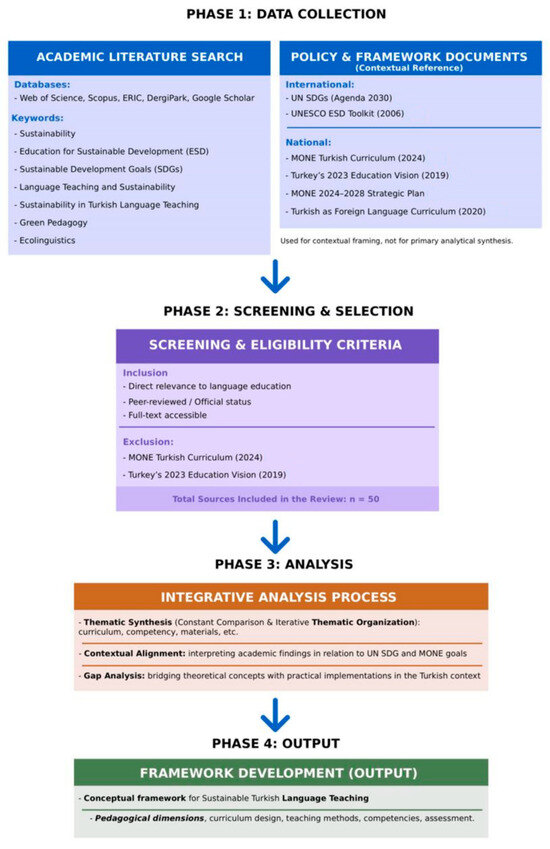
This study adopts a qualitative research design based on an integrative literature review. In qualitative research, literature reviews are preferred due to their exploratory nature and their potential to develop an understanding grounded in researchers’ perspectives on the topic [53] (p. 63). Accordingly, this study aims to develop a conceptual understanding of the integration of sustainability into Turkish language teaching by synthesizing relevant literature and policy documents. The systematic stages of the integrative review process, including data identification, screening, and synthesis, are illustrated in the methodology flowchart presented in Figure 1.
Figure 1.
Flowchart of the integrative review process [3,5,6,21,32,37].
3.2. Data Sources and Search Strategy
The literature reviewed in this study was limited to Turkish and English sources published between 1990 and 2025. The search was conducted across multiple academic databases, including Web of Science, Education Resources Information Center (ERIC), Scopus, Google Scholar, and DergiPark. To address the scarcity of direct literature on the intersection of Turkish language teaching and sustainability, a broad search strategy was employed using keywords such as sustainability, education for sustainable development (ESD), sustainable development goals (SDGs), language teaching and sustainability, sustainability in Turkish language teaching, green pedagogy, and ecolinguistics.
3.3. Inclusion Criteria and Study Selection
The initial search yielded approximately 100 publications. Studies were selected based on the following inclusion criteria: (1) direct relevance to language education and sustainability, (2) peer-reviewed academic or official policy document status, and (3) full-text accessibility to enable in-depth analysis. Sources lacking a clear pedagogical focus were excluded. Following the screening process, 50 sources were retained: 34 peer-reviewed publications and 16 policy/framework documents, representing both theoretical and applied dimensions of the field.
3.4. Document Analysis
In addition to academic publications, international policy documents and national education frameworks were examined to contextualize the integration of sustainability into Turkish language teaching. Key documents included the UN 2030 Agenda [3], UNESCO ESD Toolkit [32], Türkiye’s 2023 Education Vision [5], MoNE 2024–2028 Strategic Plan [6], Turkish Language Teaching Curriculum (2024) [21], and the Türkiye Maarif Foundation Turkish as a Foreign Language Curriculum [37]. These documents provided contextual framing, while the identification and synthesis of pedagogical dimensions primarily relied on peer-reviewed academic sources.
In this study, generative artificial intelligence was used for translating support, for linguistic editing, and for generating visual materials used to summarize the information. All AI-generated content was critically reviewed, verified, and revised by the author to ensure alignment with the study’s scientific context and original intent.
3.5. Analytical Process
The analytical process was conducted through iterative and comparative reading within the framework of an integrative literature review. The analysis adopted a hybrid approach combining deductive and inductive elements. Guided by the research questions and the broader literature on ESD, certain sensitizing concepts—such as curriculum design, pedagogical approaches, and assessment practices—were identified at the outset. However, additional themes and subcategories emerged progressively during repeated engagement with the selected sources (n = 50). No formal coding scheme or predefined codebook was employed in this study. Instead, the analysis involved iterative thematic organization and comparative grouping of recurring pedagogical concepts across sources. Conceptually related findings were organized into broader analytical categories, which were gradually clarified and refined through comparative evaluation. Peer-reviewed academic studies constituted the primary basis for identifying pedagogical patterns, while policy and framework documents contributed to interpreting the findings within the context of international sustainability agendas and national education policies. In the final stage, the developed categories were synthesized into higher-level pedagogical dimensions, forming the conceptual framework presented in the Results Section. This hybrid and iterative analytical process strengthens this study.
4. Results
4.1. Pedagogical Contributions of Integrating Sustainability into Turkish Language Teaching
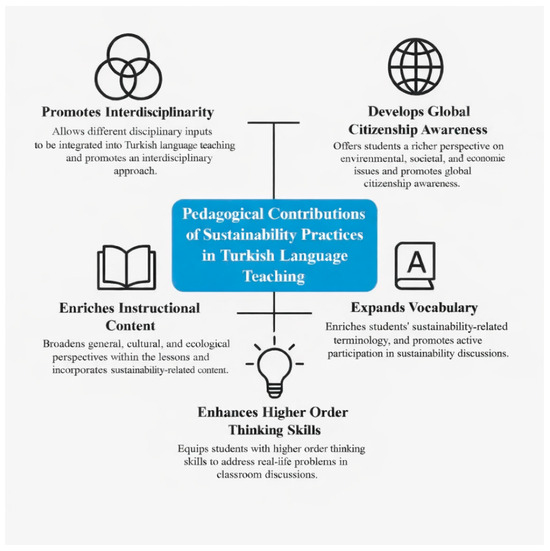
The analysis of the reviewed literature revealed five key pedagogical contribution areas associated with integrating sustainability into Turkish language teaching. Sustainability emerges not merely as thematic enrichment but as a multidimensional pedagogical resource that reshapes language education in structural and functional terms.
First, sustainability strengthens an interdisciplinary orientation in Turkish language instruction. In alignment with broader developments in educational sciences [23] and national policy frameworks such as the MoNE 2023 Vision [5], linking language education with other disciplines enhances the transferability of linguistic competencies across domains.
Second, sustainability contributes to raising awareness of global issues. Research suggests that addressing sustainability themes in language classrooms is associated with communicative competence and goal-oriented engagement with global challenges [17,19], while also supporting global citizenship perspectives [9]. In this respect, Turkish language education extends beyond linguistic acquisition and facilitates learners’ engagement with urgent global concerns.
Third, sustainability enriches instructional content by broadening the thematic scope of language courses. Integrating global and local sustainability-related issues into classroom practice increases students’ interaction with socially and culturally meaningful topics [19], thereby fostering a more context-responsive and inclusive curriculum.
Fourth, sustainability-oriented instruction supports the development of higher-order thinking skills. Engagement with global problems has been shown to enhance learners’ problem-solving approaches and critical awareness [24], and authentic learning contexts are considered essential for meaningful language education [25]. Sustainability-based approaches, including green pedagogy [17], contribute to critical literacy development and reinforce analytical and evaluative thinking processes central to Turkish language instruction.
Finally, sustainability facilitates vocabulary development by introducing discipline-specific terminology grounded in real-world contexts. Sustainability-integrated language teaching expands students’ conceptual repertoire—through concepts such as “carbon footprint” and “renewable energy”—and supports interdisciplinary knowledge connections [26]. The analysis demonstrates that integrating sustainability into Turkish language teaching generates multidimensional pedagogical benefits that extend beyond thematic enrichment and contribute to structural transformation within language education. The pedagogical contributions outlined above are illustrated in Figure 2.
Figure 2.
Pedagogical contributions of sustainability practices in Turkish language teaching.
4.2. Components of Sustainability-Oriented Turkish Language Teaching
Based on the thematic synthesis of the reviewed literature and policy documents, the findings of this study were organized under five pedagogical analytical categories: curriculum design, pedagogical approaches, teacher competencies, instructional materials, and assessment practices. Table 1 presents a summary of the analytical categories, the approximate number of reviewed studies, and the main conclusions.
Table 1.
Summary of analytical categories, number of reviewed studies, and core synthesis findings.
4.2.1. Pedagogical Approaches
The findings indicate that integrating sustainability into Turkish language teaching cannot be limited to the mere transmission of information; rather, it requires a more comprehensive pedagogical approach grounded in three interconnected transformative dimensions. The pedagogical framework identified in the literature is built upon holistic, pluralistic, and action-oriented perspectives [27,28,29]. The holistic perspective ensures the integration of environmental, social, and economic dimensions, while the pluralistic approach enables the examination of diverse viewpoints and experiences within the classroom. The action-oriented perspective emphasizes not only the acquisition of knowledge but also the development of informed and responsible behaviors.
Another significant shift highlighted by the findings is the transition from information to competence. Rather than focusing on teaching about sustainability, the literature underscores the importance of developing competencies for sustainability [27,30]. This shift requires moving away from teacher-centered transmission models toward learner-centered pedagogies in which students construct meaning through language use, develop values, and, through active participation, aim to transform knowledge into action.
Finally, language instruction provides a distinctive space in which this transformation can be realized. The findings suggest that the communicative and dialogic nature of language classrooms enables the practical enactment of holistic, pluralistic, and action-oriented approaches [28]. Within this framework, language teaching functions as a learning environment where linguistic proficiency, critical thinking, and participatory competencies are developed simultaneously through interaction and meaning-making.
4.2.2. Curriculum Design
Another important dimension concerns the emphasis on local relevance [32]. The examined curricula and policy texts consistently frame sustainability-oriented programs as responsive to local environmental, social, and cultural conditions.
A significant transformation identified in the analysis relates to the evolution of the Turkish language curriculum over time. Earlier Turkish Language Teaching Curricula (2006, 2015, 2017) [34,35,36] addressed sustainability only indirectly, primarily through nature-related themes. In contrast, the updated curriculum (2024) [21] explicitly defines sustainability literacy as a core competence. The curriculum does not approach sustainability literacy merely at the level of knowledge; rather, it frames it as a developmental process encompassing awareness-building, the evaluation of proposed solutions, and the translation of these solutions into practice. This transformation demonstrates that sustainability has been repositioned from implicit thematic references to an explicitly defined, systematic, and process-oriented domain of competence.
4.2.3. Teaching Methods and Techniques
The findings indicate that a range of active learning strategies are suitable for integrating sustainability into Turkish language teaching. These strategies are structured at two complementary functional levels that support both linguistic development and sustainability-oriented competencies. At the core instructional level, project-based learning, case-based analysis, and collaborative research are presented as approaches through which language skills are connected to sustainability issues situated in real-life contexts [33]. These methods are described as learning arrangements, in which students actively participate in inquiry- and research-based activities.
The analysis indicates that integrated approaches—particularly Content and Language Integrated Learning (CLIL) [10,38,42]—feature prominently in the literature. The findings show that CLIL offers a dual-focused instructional framework in which sustainability-related content and linguistic proficiency are addressed simultaneously. This approach is described as a structure in which sustainability themes are explored within meaningful communicative contexts.
Finally, the findings highlight the emphasis placed on complementary active learning techniques, including drama, role-play, the six thinking hats technique, and simulation games [33]. These techniques are presented as practices associated with critical thinking, interaction, and meaning-making processes. In this context, sustainability-oriented language instruction is addressed not merely as the transmission of theoretical knowledge, but in conjunction with participatory and practice-based learning arrangements.
4.2.4. Materials
The findings indicate that instructional materials used in Turkish language teaching function not merely as tools for linguistic instruction but also as multifaceted resources that enable learners to engage with global sustainability issues. According to the analysis, authentic texts and real-life scenarios feature as prominent components of sustainability-oriented language instruction [33]. Such materials provide meaningful communicative contexts in which students can discuss the causes of environmental and social challenges as well as potential solutions. Within this framework, instructional materials are addressed in relation to communicative competence, critical awareness, and citizenship-related skills.
Findings related to textbook content reveal a thematic imbalance in the representation of the (SDGs) [44]. Environmental topics—such as natural resource conservation, environmental pollution, and climate change—are addressed relatively more frequently, whereas themes related to social justice and cultural diversity appear in more limited ways [45]. The analysis further indicates that sustainability-related learning objectives are not distributed evenly across cognitive, affective, and behavioral dimensions. Sustainability is addressed predominantly at the cognitive level, while affective and behavioral domains receive comparatively less emphasis. This distribution demonstrates that sustainability objectives are not structured with equal weight across learning domains.
4.2.5. Teacher Competencies and Implementation Challenges
The findings indicate that teachers assume a central mediating role in contextualizing sustainability within Turkish language teaching. Particularly in cases where instructional materials include limited or indirect references to sustainability, teachers’ role in linking existing content with sustainability principles becomes more visible [44]. According to the analysis, teachers are able to incorporate sustainability themes that are not explicitly presented in textbooks into classroom practice through professional judgment and pedagogical guidance, thereby increasing the visibility of sustainability-related issues in indirect ways.
At the same time, several challenges that hinder the effective integration of sustainability into language instruction feature prominently. The literature identifies insufficient specialized training, limited awareness of sustainable development policies, and reservations stemming from personal values or beliefs as key barriers faced by teachers [26,47]. Moreover, the interdisciplinary nature of sustainability requires language teachers to engage with content beyond their primary field of expertise, which makes preparation processes more complex and time-intensive.
The findings further reveal an increasing need for targeted professional development to support sustainability-oriented language teaching. Due to differences in curriculum priorities and limited experience with ESD, language teachers appear less likely to integrate sustainability-related themes compared to teachers in other subject areas [27]. This pattern reflects that teachers are positioned not only as implementers of the curriculum but also as actors who shape and interpret instructional content.
4.2.6. Assessment and Evaluation Process
The qualitative analysis indicates a shift in assessment approaches within the integration of sustainability into Turkish language teaching [33]. The findings describe a movement from traditional language testing toward multidimensional assessment frameworks that address both linguistic proficiency and sustainability-related competencies. Within this framework, the assessment process is reported to encompass critical thinking, problem-solving, and learners’ ability to articulate and justify sustainability-related ideas through language use [51].
The analysis further highlights holistic assessment perspectives encompassing knowledge, attitudes, and behaviors aligned with the three pillars of sustainability [52]. Cognitive dimensions are assessed through sustainability-themed vocabulary and reading activities, affective dimensions through reflective journals and self-assessment tools, and behavioral dimensions through projects, presentations, and role-play activities.
Another key finding concerns the growing emphasis on process-oriented and alternative assessment strategies [33]. Assessment practices are portrayed as incorporating ongoing monitoring of learner development through tools such as concept maps, interim presentations, and portfolios. Since values and attitudes are not easily measured directly, observation and reflective portfolios are identified as qualitative approaches used to capture changes in learners’ sustainability awareness and dispositions.
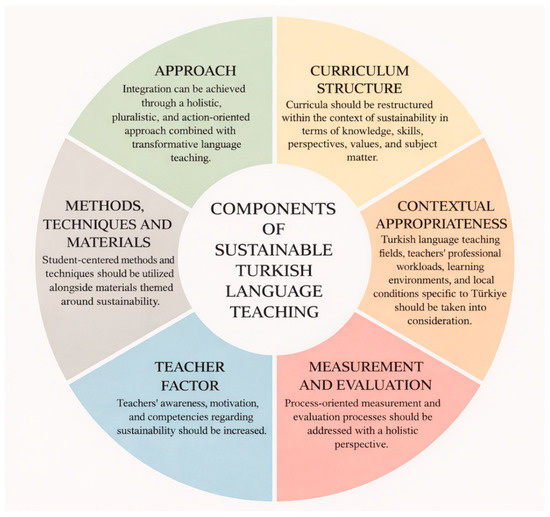
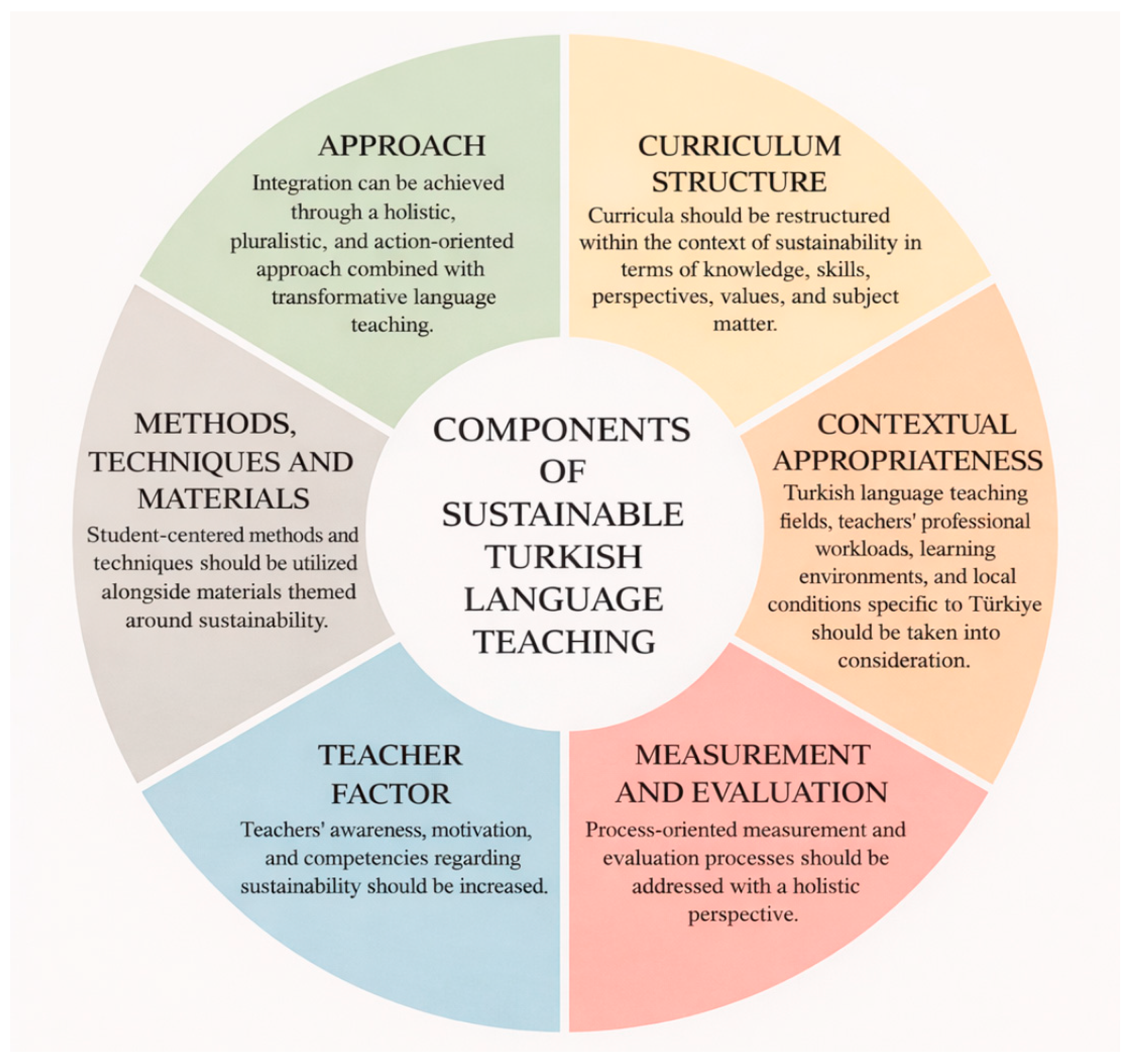
Collectively, the findings point to a multidimensional and interrelated framework for integrating sustainability into Turkish language teaching. The thematic components and pedagogical dimensions derived from this synthesis are systematically illustrated in Figure 3.
Figure 3.
Components of sustainable Turkish language teaching.
In response to the need for greater practical clarity, Table 2 provides brief schematic examples of sustainability-oriented tasks aligned with key linguistic goals in Turkish language teaching.
Table 2.
Sustainability-oriented illustrative tasks aligned with linguistic goals in Turkish language teaching.
5. Discussion
This study aimed to identify how sustainability can be incorporated into Turkish language teaching. Regarding the first sub-problem “What are the pedagogical contributions of integrating sustainability into Turkish language teaching?”, the findings indicate that integrating sustainability into Turkish language teaching offers multiple benefits, including the development of higher-order thinking skills, enriched instructional content, enhanced domain-specific vocabulary, and increased awareness of global issues [9,17,19,33]. Previous research demonstrates that addressing sustainability in language classrooms positively influences students’ language skills [17] and supports the development of a sense of purpose in relation to global issues [19]. Language education offers a particularly suitable environment for sustainability integration, as it naturally facilitates discussion-based learning and enables students to develop both linguistic competencies and critical engagement with global challenges [9,33].
Regarding the second sub-research problem, “What kind of pedagogical approach should be adopted in integrating sustainability into Turkish language teaching?”, the findings reveal that sustainability should not be addressed solely at the content level but requires comprehensive restructuring across curriculum design, instructional approaches, materials, teacher competencies, and assessment practices. The analysis identified holistic, pluralistic, and action-oriented dimensions [28,29,30] as foundational to transformative language teaching for sustainability. While various student-centered approaches have been explored in sustainability-oriented language teaching, including CLIL [10,42], the literature lacks comparative studies systematically evaluating the effectiveness of different pedagogical methods [33]. Moreover, the distinctive nature of language teaching requires language-specific pedagogical templates and approaches [27], yet such tailored frameworks remain underdeveloped. These gaps highlight the need for empirical research examining which instructional approaches are most effective for integrating sustainability into language education contexts.
Our textbook analysis revealed thematic imbalances, with environmental topics dominating, while social justice and cultural diversity remain underrepresented [44,45]. This finding reflects broader concerns in language education regarding superficial treatment of sustainability [38] and underscores the need for curriculum restructuring that addresses all four sustainability dimensions—environmental, social, economic, and cultural [27,54,55]—in Turkish language teaching. While textbooks play a facilitating role in ESD implementation [47], teachers remain central to effectively integrating sustainability into classroom practice. Given the interdisciplinary nature of sustainability and the need for pedagogical adaptation, teacher education emerges as a critical prerequisite [9,26,47,48,49].
In the Turkish context, the current teacher education framework presents significant gaps. Although the Turkish Language Teaching Undergraduate Program includes “Sustainable Development and Education” as an elective course [56], this structure is insufficient given the urgency of global sustainability challenges. This course warrants stronger curricular positioning, including consideration as a compulsory component, supported by specialized courses addressing pedagogical approaches and practical strategies for integrating sustainability into Turkish language teaching.
Different countries adopt distinct approaches to integrating sustainability into language education, shaped by their cultural and educational contexts. For example, Scandinavian countries emphasize experiential learning and outdoor education to foster connection with nature, while East Asian educational systems tend to favor more traditional, content-focused models [33]. Türkiye’s 2024 curriculum reform appears to position itself between these paradigms, combining thematic content integration with action-oriented competencies. This hybrid approach suggests that Turkish language education is developing a contextually responsive framework—one that incorporates local cultural priorities while engaging with global sustainability challenges.
One of the most significant challenges encountered in practice when integrating sustainability into Turkish language teaching is teachers’ workload and the limited number of hours allocated to Turkish language courses. The time-consuming nature of assessment processes and the additional workload they create [57,58] further increase teachers’ professional burden. Moreover, due to the dense content and limited instructional time of the Turkish Language Curriculum prepared within the framework of the Türkiye Century Education Model, teachers experience serious difficulties in time management [59]. Therefore, it is important to recognize that integrating sustainability into Turkish language teaching should not be regarded solely as the responsibility of Turkish language teachers. Program developers, faculties of education responsible for teacher training, and institutions shaping educational policies all have crucial roles to play in this process. Accordingly, adopting a holistic approach that involves structured educational policies, curricula sensitive to both global and local contexts, and well-equipped teacher profiles appears increasingly necessary.
Rather than merely synthesizing existing findings, this study proposes that sustainability in Turkish language teaching should be understood as a holistic pedagogical framework rather than an isolated curricular topic. As illustrated in Figure 3, sustainability is conceptualized as a multidimensional construct that interacts with curriculum design, pedagogical approaches, teacher competencies, material development, and assessment processes specific to language education. This integrated perspective responds to an underdeveloped area in the literature: although sustainability has been incorporated into language curricula, systematically articulated frameworks specific to language education remain limited [27,33]. However, such a transfer should not be understood as direct replication. The framework requires contextual adaptation, taking into account the structural characteristics of the target language, cultural priorities, and specific curricular conditions. The proposed framework makes visible how sustainability can support the development of higher-order thinking skills, value-oriented language use, and sociocultural awareness in Turkish language teaching. While grounded in the Turkish context, the framework’s principles are transferable to other language education settings—both first language and foreign language instruction—suggesting that sustainability can function as a transformative pedagogical lens rather than mere thematic content.
Nevertheless, the study is conceptual in nature, and the proposed framework requires empirical validation. Future research should investigate its applicability and effectiveness through: (1) classroom-based implementation studies examining how teachers operationalize the framework in Turkish language teaching contexts, both as a native language and as a foreign language; (2) comparative studies evaluating the framework’s adaptability across different educational levels and cultural contexts; and (3) longitudinal research assessing the framework’s impact on students’ sustainability literacy, language proficiency, and critical thinking development over time.
6. Conclusions
This study identifies the pedagogical contributions of integrating sustainability into Turkish language teaching and suggests that such integration requires an integrated pedagogical restructuring rather than a superficial addition of content. The findings indicate that sustainability should be understood not as an isolated thematic element, but as a discipline-specific pedagogical lens that interacts with all components of language instruction.
As emphasized by Zaimoğlu [22], integrating sustainability into language education enables individuals to develop the capacity to envision and shape the future through language use. In this respect, the proposed approach holds transformative potential in both first language and foreign language contexts by supporting higher-order thinking skills, value-oriented language use, and socio-cultural awareness. By articulating a multidimensional framework that encompasses both native and foreign language teaching contexts, this study contributes theoretically to the emerging field of sustainability-oriented language education. However, the application of this framework across different contexts requires careful contextual adaptation rather than direct replication.
6.1. Implications
The implications and recommendations derived from this study are structured with consideration of practical challenges, such as teachers’ workload, limited instructional time, and dense curricula. Accordingly, the recommendations address the integration of sustainability into Turkish language teaching not only from a theoretical perspective but also in terms of feasibility and sustainability.
6.1.1. Implications for Policy Makers
Given existing workload pressures and time limitations, effective sustainability integration in Turkish language teaching requires institutional support rather than relying solely on individual teacher initiative. The Ministry of National Education and relevant institutions may play a coordinating role in establishing supportive policy orientations and curricular frameworks aligned with sustainability and ESD principles. In addition, faculties of education could strengthen sustainability-oriented components within teacher education programs and expand in-service training opportunities to enhance teachers’ pedagogical readiness.
6.1.2. Implications for Curriculum Developers
Curriculum developers hold a central role in addressing challenges related to instructional time and curriculum density. Integrating sustainability into Turkish language curricula can extend beyond content representation to encompass skills, values, perspectives, and attitudes within a holistic structure. Designing curricula that support approaches such as CLIL, project-based learning, task-based learning, and action-oriented instruction may facilitate sustainability integration without necessitating separate instructional units. In this process, incorporating sustainability themes relevant to Türkiye and aligning curricular goals with the UN SDGs can strengthen contextual coherence. Textbooks and instructional materials may likewise be revised to better reflect sustainability-oriented pedagogical objectives.
6.1.3. Implications for Turkish Language Teachers
Within existing time and content constraints, Turkish language teachers can consider manageable and context-sensitive strategies for integrating sustainability into their lessons. Sustainability themes may be incorporated through critical reading, interpretation, inference activities, and discussion-based tasks embedded within the current course content. Small-scale adjustments—such as selecting sustainability-related texts or integrating environmental and social issues into classroom dialogue—offer practical and time-efficient pathways. Furthermore, adopting a process-oriented and multidimensional perspective in assessment practices, including the use of alternative assessment tools, may support more comprehensive learning outcomes.
Funding
This research received no external funding.
Institutional Review Board Statement
Not applicable.
Informed Consent Statement
Not applicable.
Data Availability Statement
No new data were created or analyzed in this study.
Acknowledgments
During the preparation of this study, ChatGPT (OpenAI, GPT-4-series models, web interface version 5.2) and Gemini (Google, Gemini 1.5 Pro) were used to support translation, linguistic editing, and the creation of visual materials intended to summarize the information. The author has critically reviewed all outputs and takes full responsibility for the content of this publication.
Conflicts of Interest
The author declares no conflicts of interest.
Abbreviations
The following abbreviations are used in this manuscript:
| Approx. | Approximately |
| CLIL | Content and Language Integrated Learning |
| ESD | Education for Sustainable Development |
| GenAI | Generative Artificial Intelligence |
| MoNE | Ministry of National Education |
| SDGs | Sustainable Development Goals |
| Sustain. | Sustainability |
| UN | United Nations |
| UNESCO | United Nations Educational, Scientific, and Cultural Organization |
References
- United Nations Educational; Scientific; and Cultural Organization (UNESCO). Draft International Implementation Scheme for the United Nations Decade of Education for Sustainable Development; UNESCO: Paris, France, 2005. [Google Scholar]
- United Nations (UN). Agenda 21: Programme of Action for Sustainable Development; United Nations Department of Economic and Social Affairs: New York, NY, USA, 1992. [Google Scholar]
- United Nations (UN). The 2030 Agenda and the Sustainable Development Goals: An Opportunity for Latin America and the Caribbean; United Nations: New York, NY, USA, 2018. [Google Scholar]
- Presidency of Strategy and Budget (PSB). On İkinci Kalkınma Planı (2024–2028); Presidency of Strategy and Budget: Ankara, Türkiye, 2023. Available online: https://www.sbb.gov.tr/wp-content/uploads/2023/12/On-Ikinci-Kalkinma-Plani_2024-2028_11122023.pdf (accessed on 10 June 2025).
- Ministry of National Education (MoNE). 2023 Türkiye Eğitim Vizyonu; Millî Eğitim Bakanlığı: Ankara, Türkiye, 2019. Available online: https://baklan.meb.gov.tr/meb_iys_dosyalar/2018_12/11144802_2023_EGITIM_VIZYONU.pdf (accessed on 10 June 2025).
- Ministry of National Education (MoNE). 2024–2028 Stratejik Planı; Millî Eğitim Bakanlığı: Ankara, Türkiye, 2024. Available online: https://sgb.meb.gov.tr/www/icerik_goruntule.php?KNO=498 (accessed on 11 June 2025).
- Trudell, B. Local-language literacy and sustainable development in Africa. Int. J. Educ. Dev. 2009, 29, 73–79. [Google Scholar] [CrossRef] [Scilit]
- Gayatri, P.; Sit, H.; Chen, S.; Li, H. Sustainable EFL blended education in Indonesia: Practical recommendations. Sustainability 2023, 15, 2254. [Google Scholar] [CrossRef] [Scilit]
- Tavakkoli, Z.; Rashidi, N. A Study on the status of sustainability education among Iranian EFL instructors: Developing a glocalized model. J. Teach. Educ. Sustain. 2020, 22, 66–89. [Google Scholar] [CrossRef] [Scilit]
- Jodoin, J.J. Promoting language education for sustainable development: A program effects case study in Japanese higher education. Int. J. Sustain. High. Educ. 2020, 21, 779–798. [Google Scholar] [CrossRef] [Scilit]
- Robinson, C. Language Use in Rural Development: An African Perspective; Mouton de Gruyter: Berlin, Germany, 1996. [Google Scholar]
- Stibbe, A. Ecolinguistics: Language, Ecology and the Stories We Live by; Routledge: New York, NY, USA, 2015. [Google Scholar]
- Bulut, B.; Çakmak, Z. Sürdürülebilir kalkınma eğitimi ve öğretim programlarına yansımaları. Int. J. Turk. Lit. Cult. Educ. 2018, 7, 2680–2697. [Google Scholar]
- Yıldırım, G. Sürdürülebilirlik konusundaki eğitim araştırmalarının tematik olarak incelenmesi. Mediterr. J. Educ. Res. 2020, 14, 70–106. [Google Scholar] [CrossRef] [Scilit]
- Yalçın, K.; Köybaşı-Şemin, E. Sürdürülebilir gelişme ve sürdürülebilir eğitime ilişkin öğrenci görüşleri. Gazi Univ. J. Gazi Fac. Educ. 2024, 44, 171–207. [Google Scholar] [CrossRef] [Scilit]
- Ülker, N.; Ayar-Gemalmaz, Ö.; Yılmaz-Yüksek, Y. Towards 21st century citizenship through sustainable development goals in foreign language education. In SEFI 2022—50th Annual Conference of the European Society for Engineering Education Proceedings; Jarvinen, H.-M., Silvestre, S., Llorens, A., Nagy, B.V., Eds.; European Society for Engineering Education (SEFI): Brussels, Belgium, 2022; pp. 1731–1740. [Google Scholar]
- Hossain, M. Enacting Green pedagogy in the EFL classrooms in Bangladesh: Prospects, challenges and pragmatic Breakthroughs. Lang. Educ. Forum 2019, 1, 1–5. [Google Scholar] [CrossRef]
- Gunina, N.; Mordovina, T.; Shelenkova, I. Integrating sustainability Issues into English language courses at university. E3S Web Conf. 2021, 295, 05006. [Google Scholar] [CrossRef] [Scilit]
- Cordova, M. Integrating sustainable development goals in English language and literature teaching. Front. Educ. 2024, 9, 1330034. [Google Scholar] [CrossRef] [Scilit]
- Ministry of National Education (MoNE). Türkiye Yüzyılı Maarif Modeli Öğretim Programları Ortak Metni; Millî Eğitim Bakanlığı: Ankara, Türkiye, 2024. [Google Scholar]
- Ministry of National Education (MoNE). Ortaokul Türkçe Dersi Öğretim Programı (5, 6, 7 ve 8. Sınıflar) Türkiye Yüzyılı Maarif Modeli; Millî Eğitim Bakanlığı: Ankara, Türkiye, 2024. [Google Scholar]
- Zaimoğlu, S. Exploring Research trends in sustainability in English language education from 2014 to 2024: A Bibliometric analysis. J. Lang. Res. 2024, 8, 1–18. [Google Scholar] [CrossRef] [Scilit]
- Onan, B. Interdisciplinary approaches in language teaching. Mustafa Kemal Univ. J. Soc. Sci. Inst. 2017, 14, 145–159. [Google Scholar]
- Astawa, P.S.N.P.L.N.; Santosa, H.M.; Artini, L.P.; Nitiasih, K.P. Sustainable development goals in EFL students’ learning: A systematic review. Pegem J. Educ. Instr. 2024, 14, 1–11. [Google Scholar]
- Astawa, N.L.P.N.S.P.; Artini, L.P.; Nitiasih, P.K. Project-based learning activities and EFL students’ productive skills in English. J. Lang. Teach. Res. 2017, 8, 1147–1155. [Google Scholar] [CrossRef] [Scilit]
- Kwee, C.T.T. I want to teach sustainable development in my English classroom: A case study of incorporating sustainable development goals in English teaching. Sustainability 2021, 13, 4195. [Google Scholar] [CrossRef] [Scilit]
- Maijala, M.; Gericke, N.; Kuusalu, S.R.; Heikkola, L.M.; Mutta, M.; Mäntylä, K.; Rose, J. Conceptualising transformative language teaching for sustainability and why it is needed. Environ. Educ. Res. 2024, 30, 377–396. [Google Scholar] [CrossRef] [Scilit]
- Sinakou, E.; Donche, V.; Boeve-de Pauw, J.; Van Petegem, P. Designing powerful learning environments in education for sustainable development: A conceptual framework. Sustainability 2019, 11, 5994. [Google Scholar] [CrossRef] [Scilit]
- Jensen, B.B. Knowledge, action and pro-environmental behaviour. Environ. Educ. Res. 2002, 8, 325–334. [Google Scholar] [CrossRef] [Scilit]
- Rieckmann, M. Learning to transform our world: Key competencies in education for sustainable development. In Issues and Trends in Education for Sustainable Development; UNESCO Publishing: Paris, France, 2018; pp. 39–59. Available online: https://unesdoc.unesco.org/ark:/48223/pf0000261802 (accessed on 5 May 2025).
- One Planet Network (10-Year Framework of Programmes on Sustainable Consumption and Production). The Sustainable Backpack Programme. 2019. Available online: https://www.oneplanetnetwork.org/knowledge-centre/policies/sustainable-backpack-programme (accessed on 11 May 2025).
- McKeown, R.; Hopkins, C.; Rizzi, R.; Chrystalbride, M. Education for Sustainable Development Toolkit.; UNESCO, Section for Education for Sustainable Development (ED/UNP/ESD): Paris, France, 2006. [Google Scholar]
- Yu, B.; Guo, W.Y.; Fu, H. Sustainability in English language teaching: Strategies for empowering students to achieve the sustainable development goals. Sustainability 2024, 16, 3325. [Google Scholar] [CrossRef] [Scilit]
- Ministry of National Education (MoNE). İlköğretim Türkçe Dersi (6, 7, 8. Sınıflar) Öğretim Program; Millî Eğitim Basımevi: Ankara, Türkiye, 2006. [Google Scholar]
- Ministry of National Education (MoNE). Türkçe Dersi (1–8. Sınıflar) Öğretim Program; Millî Eğitim Basımevi: Ankara, Türkiye, 2015. [Google Scholar]
- Ministry of National Education (MoNE). Türkçe Dersi (1–8. Sınıflar) Öğretim Program; Millî Eğitim Basımevi: Ankara, Türkiye, 2017. [Google Scholar]
- Türkiye Maarif Foundation. Türkçenin Yabancı Dil Olarak Öğretimi Programı; Türkiye Maarif Vakfı: İstanbul, Türkiye, 2020; Available online: https://turkiyemaarif.org/editions/turkcenin-yabanci-dil-olarak-ogretimi-programi-2-baski (accessed on 15 June 2025).
- Arslan, S.; Curle, S. Institutionalising English as a Foreign Language Teachers for Global Sustainability: Perceptions of Education for Sustainable Development in Turkey. Int. J. Educ. Res. 2024, 124, 102353. [Google Scholar] [CrossRef] [Scilit]
- Marsh, D. Bilingual Education & Content and Language Integrated Learning; International Association for Cross-Cultural Communication, University of Sorbonne: Paris, France, 1994. [Google Scholar]
- Coyle, D.; Hood, P.; Marsh, D. CLIL: Content and Language Integrated Learning; Cambridge University Press: Cambridge, UK, 2010. [Google Scholar]
- Günday, R. İçerik ve dil bütünleştirilmiş öğrenme modeline farklı açılardan yaklaşım. Int. J. Lang. Educ. Teach. 2021, 9, 232–249. [Google Scholar] [CrossRef] [Scilit]
- Ruhama, M.; Haque, M.A. Teachers’ perception of integrating sustainability through CLIL at the primary level English language classrooms in Bangladesh. Int. J. Adv. Res. 2024, 12, 368–374. [Google Scholar] [CrossRef] [Scilit]
- Risager, K. Language textbooks: Windows to the world. Lang. Cult. Curric. 2020, 34, 119–132. [Google Scholar] [CrossRef] [Scilit]
- Mohammadnia, Z.; Moghadam, F.D. Textbooks as resources for education for sustainable development: A content analysis. J. Teach. Educ. Sustain. 2019, 21, 103–114. [Google Scholar] [CrossRef] [Scilit]
- Arslan, S.; Curle, S. Sustainable development goals in the English language high school curriculum in Turkey. Eur. J. Educ. 2021, 56, 681–695. [Google Scholar] [CrossRef] [Scilit]
- Munkebye, E.; Scheie, E.; Gabrielsen, A.; Jordet, A.; Misund, S.; Nergård, T.; Øyehaug, A.B. Interdisciplinary primary school curriculum units for sustainable development. Environ. Educ. Res. 2020, 26, 795–811. [Google Scholar] [CrossRef] [Scilit]
- Anyolo, E.O.; Kärkkäinen, S.; Keinonen, T. Implementing education for sustainable development in Namibia: School teachers’ perceptions and teaching practices. J. Teach. Educ. Sustain. 2018, 20, 64–81. [Google Scholar] [CrossRef] [Scilit]
- Borg, C.; Gericke, N.; Höglund, H.O.; Bergman, E. Subject- and experience-bound differences in teachers’ conceptual understanding of sustainable development. Environ. Educ. Res. 2014, 20, 526–551. [Google Scholar] [CrossRef] [Scilit]
- Summers, M.; Childs, A.; Corney, G. Education for sustainable development in initial teacher training: Issues for interdisciplinary collaboration. Environ. Educ. Res. 2005, 11, 623–647. [Google Scholar] [CrossRef] [Scilit]
- Fischer, D.; King, J.; Rieckmann, M.; Barth, M.; Büssing, A.; Hemmer, I.; Lindau-Bank, D. Teacher education for sustainable development: A review of an emerging research field. J. Teach. Educ. 2022, 73, 509–524. [Google Scholar] [CrossRef] [Scilit]
- Olsson, D.; Gericke, N.M.; Chang Rundgren, S.N. The effect of implementation of education for sustainable development in Swedish compulsory schools: Assessing pupils’ sustainability consciousness. Environ. Educ. Res. 2016, 22, 176–202. [Google Scholar] [CrossRef] [Scilit]
- Bonello, C.; Musumeci, M. Assessment and ESD—Which way forward? In EduChange Methodology; Palacký University Olomouc: Olomouc, Czech Republic, 2022; pp. 63–71. [Google Scholar] [CrossRef] [Scilit]
- Creswell, J.W. Research Design: Qualitative, Quantitative, and Mixed Methods Approaches, 4th ed.; Sage Publications: Thousand Oaks, CA, USA, 2013. [Google Scholar]
- Munasinghe, M. The sustainomics trans-disciplinary meta-framework for making development more sustainable: Applications to energy issues. Int. J. Sustain. Dev. 2002, 4, 6–54. [Google Scholar] [CrossRef] [Scilit]
- Burford, G.; Hoover, E.; Velasco, I.; Janoušková, S.; Jimenez, A.; Piggot, G.; Podger, D.; Harder, M. Bringing the “missing pillar” into sustainable development goals: Towards intersubjective values-based indicators. Sustainability 2013, 5, 3035–3059. [Google Scholar] [CrossRef] [Scilit]
- Council of Higher Education (CoHE). Yeni Öğretmen Yetiştirme Lisans Programları: Türkçe Öğretmenliği Lisans Programı; Council of Higher Education: Ankara, Türkiye, 2018. Available online: https://web.archive.org/web/20240114030726/https://www.yok.gov.tr/Documents/Kurumsal/egitim_ogretim_dairesi/Yeni-Ogretmen-Yetistirme-Lisans-Programlari/Turkce_Ogretmenligi_Lisans_Programi.pdf (accessed on 5 April 2025).
- Çağ, H.D. Türkçe öğretmenlerinin konuşma sınavlarına ilişkin deneyimleri ve görüşleri. In Proceedings of the 6th Rumeli [Language, Literature and Translation] Symposium, Istanbul, Türkiye, 20–21 January 2024. [Google Scholar]
- Gülden, B.; Kaplan, K. Türkçe öğretmenlerinin Millî Eğitim Bakanlığı Ölçme ve Değerlendirme Yönetmeliği’ndeki değişikliklere yönelik görüşleri. Buca Eğit. Fak. Derg. 2025, 63, 61–80. [Google Scholar]
- Uludağ Kırçıl, R.; Uluçınar Sağır, Ş. Türkiye Yüzyılı Maarif Modeli’nin sınıf içi yansımaları: Öğretmen görüşleri. Erciyes Eğit. Derg. 2025, 9, 24–46. [Google Scholar] [CrossRef] [Scilit]

Disclaimer/Publisher’s Note: The statements, opinions and data contained in all publications are solely those of the individual author(s) and contributor(s) and not of MDPI and/or the editor(s). MDPI and/or the editor(s) disclaim responsibility for any injury to people or property resulting from any ideas, methods, instructions or products referred to in the content. |
© 2026 by the author. Licensee MDPI, Basel, Switzerland. This article is an open access article distributed under the terms and conditions of the Creative Commons Attribution (CC BY) license.