


Abstract
The Erasmus+ YOU4BLUE project represents an interdisciplinary educational initiative aimed at fostering a youth culture of sustainability through hands-on learning, scientific literacy, and critical thinking focused on the marine environment. The project aimed to encourage lasting behavioural change and empower young people to act. It engaged secondary school students aged 14 to 18 on three Mediterranean islands (Sardinia, Crete, and Mallorca) through a blended Place-Based Education (PBE) model that integrates online learning with local, experiential activities. Forty-nine students completed a pre-assessment questionnaire measuring baseline marine ecosystem knowledge, sustainability-related behaviours, and attitudes toward the sea. Following three international exchanges involving the learning activities, roughly the same cohort of students completed post-activity surveys assessing self-perceived knowledge gains and intercultural interaction. Qualitative data from emotional mapping, field observations, and group reflections complemented the quantitative analysis. The results indicate substantial self-perceived increases in students’ understanding of marine ecosystems (+1.0 to +1.7 points on a 5-point scale), enhanced collaboration with international peers, and strengthened environmental awareness. Across all three sites, students applied their learning by co-designing proposals addressing local coastal challenges, demonstrating emerging civic responsibility and the ability to integrate scientific observations into real-world problem solving. These findings suggest that combining place-based education, citizen science, and participatory methods can effectively support the development of sustainability competences among youth in coastal contexts. This study contributes empirical evidence to the growing literature on education for sustainable development and highlights the value of blended, experiential, and intercultural approaches in promoting environmentally responsible behaviour.
1. Introduction
Sustainability is a multifaceted and evolving concept, shaped by environmental, economic, sociocultural, and technological dynamics. Since the Brundtland Commission’s landmark definition of sustainable development in 1987 (WCED 1987) [1]—“development that meets the needs of the present without compromising the ability of future generations to meet their own needs”—the global discourse has broadened to encompass increasingly complex challenges, such as climate change, biodiversity loss, and the overexploitation of natural resources. Despite broad scientific and political consensus on the urgency of addressing these issues, translating sustainability awareness into tangible behavioural change—particularly among young people—remains a persistent challenge.
According to The Geneva Environment Network, young people aged 15 to 24 years old currently represent over 16% of the global population, a figure expected to rise to nearly 1.3 billion by 2030. Their role in shaping sustainable futures is therefore critical [2]. However, studies indicate that many European youths continue to exhibit sociocultural resistance to sustainable transformation [3]. At the same time, young people are increasingly disconnected from natural environments due to excessive digital exposure, spending an average of 8.5 h per day on screens [4]. This trend was further reinforced during the COVID-19 pandemic, which significantly limited outdoor activities [5].
Such reduced contact with nature not only diminishes experiential environmental learning opportunities but also affects how youth process information. Research shows that digital media environments often reinforce confirmation bias and selective exposure (“cherry picking”), hindering the ability to critically evaluate scientific information [6]. Conversely, multiple studies demonstrate that engagement with nature strengthens youth development, mental health, and well-being, fostering resilience, self-esteem, and optimism [7,8,9,10]. These findings reinforce the importance of accessible nature-based educational experiences.
Young people today face an uncertain future due to climate change and other global challenges, leading to concerns about their job prospects and the health of the planet. Yet, rather than disengaging, many are taking action—like through the Fridays for Future movement, where students worldwide protest for climate protection. These actions show that youth are willing and able to make a difference. To support this momentum, it is essential to equip them with the right tools through education. Schools and other learning spaces can foster peer connection, deepen understanding of environmental challenges, and involve students in the search for solutions. By empowering youth with knowledge, skills, and a strong sense of community, educators can help them become confident leaders for a more sustainable and fair future [10,11,12].
Education is increasingly recognized as a transformative driver capable of countering these trends. The 2030 Agenda for Sustainable Development, adopted by the United Nations in 2015, positions education as a key enabler, with SDG 4.7 calling for learners to acquire the knowledge and skills needed to promote sustainable development [13]. In this context, scientific literacy, critical thinking, media literacy, and active citizenship are central competences that enable young people to engage with complex socio-ecological challenges.
Translating these global ambitions into educational practice requires pedagogical frameworks that support the development of such competences. Within environmental education, several complementary theoretical frameworks support the development of such competences. Ocean literacy has gained prominence as an approach that promotes understanding of the ocean’s influence on humans and humans’ influence on the ocean. Although not explicitly labelled as such in earlier literature, ocean literacy principles are embedded in many educational initiatives addressing marine biodiversity, cultural ties with the sea, and the impacts of human activities on marine ecosystems [6,7,8,9,10]. Similarly, place-based education (PBE) offers a pedagogical model that situates learning within local socio-ecological contexts. As emphasized in recent analyses of educational approaches to sustainability [14] and in systematic reviews [15], PBE fosters experiential and inquiry-based learning that enhances environmental awareness, strengthens students’ sense of connection with their surrounding landscapes, and links global sustainability challenges to local realities. These features are especially relevant in Mediterranean island settings, where the sea constitutes both an ecological asset and a cultural reference point. A third complementary approach is citizen science, which encourages public participation in scientific data collection and environmental monitoring. Citizen science methods have been shown to promote scientific literacy, strengthen youth agency, and foster positive attitudes toward conservation [16]. By involving students in authentic scientific practices—such as species identification, environmental assessments, and biodiversity monitoring—citizen science helps bridge the gap between conceptual understanding and real-world action.
At the European level, recent policy frameworks—including the EU Green Deal, the Education for Climate Coalition, and the Council Recommendation on Learning for Environmental Sustainability [17]—have underscored the need for interdisciplinary and participatory educational approaches that empower young people to engage meaningfully with sustainability challenges. Within this landscape, the Erasmus+ Program 2021–2027 identifies environmental sustainability as one of its four overarching priorities, promoting a green transition through cross-border educational cooperation, youth engagement, and lifelong learning [18]. Special emphasis is placed on youth engagement and on fostering a culture of active citizenship and environmental responsibility, equipping young Europeans to take an active role in shaping a more sustainable and resilient future.
In this context, the present paper introduces the Erasmus+ YOU4BLUE project as a case study that integrates ocean literacy principles, PBE education, and citizen science to foster a youth culture of sustainability across three Mediterranean islands—Sardinia (Italy), Crete (Greece), and Mallorca (Spain). These islands share strong cultural relationships with the sea and face comparable environmental pressures linked to mass tourism, marine pollution, and climate vulnerability. At the same time, their distinct educational landscapes provide an opportunity to explore how blended and participatory pedagogical approaches operate across diverse local contexts.
Through a combination of online and experiential learning, YOU4BLUE engages students in real-world marine environmental challenges and supports them in co-designing proposals for local stakeholders, helping them shift from awareness to meaningful action.
The purpose of this article is to present the pedagogical foundations, implementation, and mixed-method evaluation of the YOU4BLUE project, examining the extent to which its blended and experiential approach contributed to the development of sustainability competences in youth. By doing so, this study seeks to enrich the growing body of literature on education for sustainable development and to offer insights into designing educational interventions that integrate scientific literacy, place-based learning, and participatory methodologies to support long-term behavioural change and civic engagement.
2. Materials and Methods
2.1. The YOU4BLUE Project
YOU4BLUE [19] is an educational project for secondary school students (ages 14–18) aimed at increasing the knowledge and awareness of young generations of the importance of nature for their life and wellbeing, as well as the need for a more responsible use of natural resources. Focusing on seas and oceans as key educational contexts, the project highlighted both the ecological and cultural value of marine ecosystems and emphasized the importance of informed, sustainable behaviours, including conscious seafood consumption.
The key objectives of YOU4BLUE were: (i) strengthening students’ knowledge of marine ecosystems and sustainable practices, as well as their attitudes towards the sea; (ii) fostering interest in STEAM, ICT, and English language; (iii) deepening students’ connection to their local seascape; (iv) promoting critical thinking and social cohesion; and (v) testing a blended learning methodology combining online content with place-based experiences.
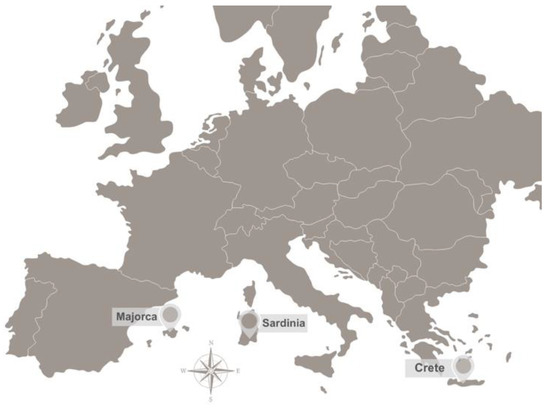
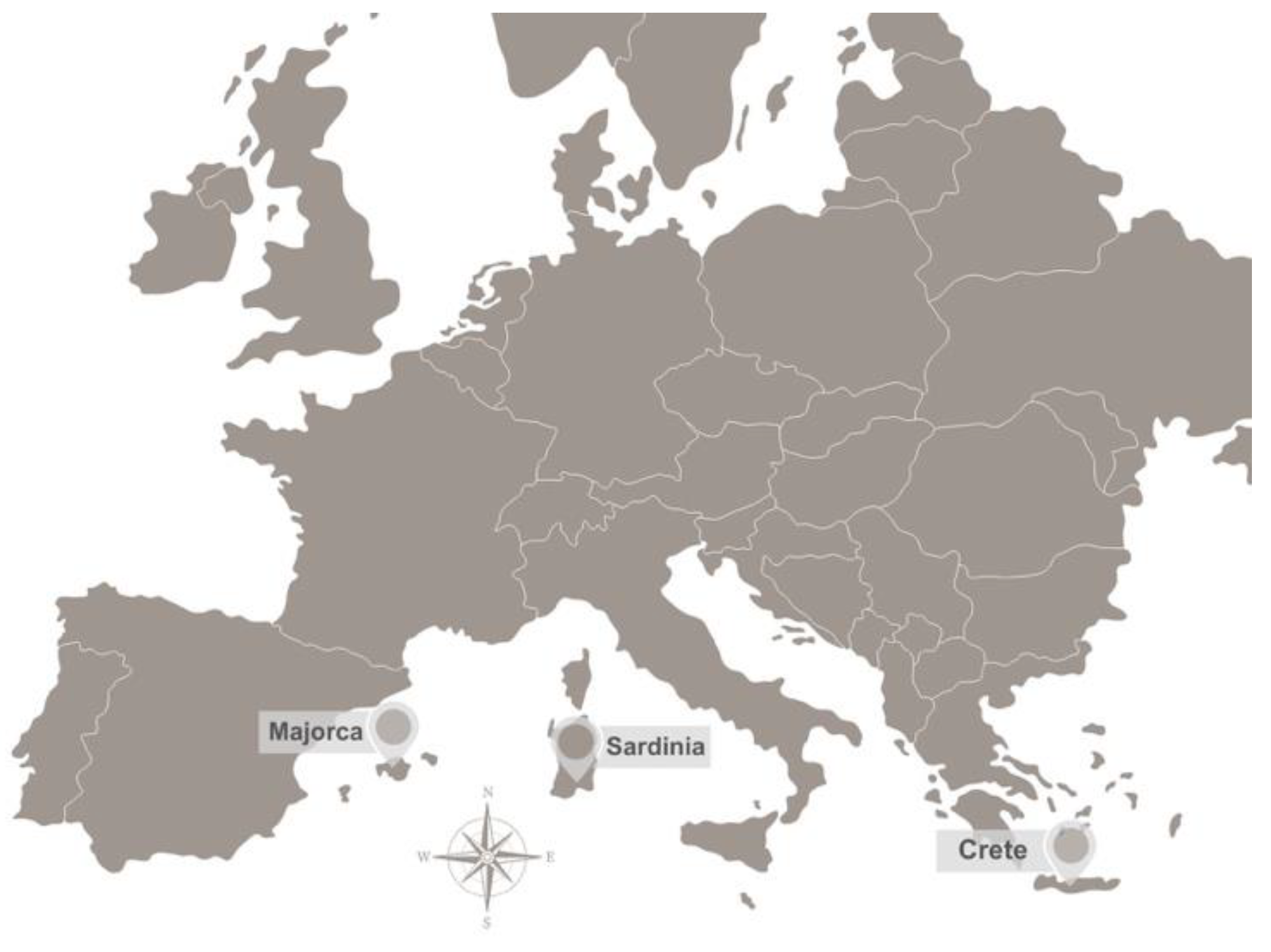
The project was implemented in three Mediterranean islands—Sardinia (Italy), Crete (Greece), and Mallorca (Spain)—(Figure 1), each represented by one secondary school partnered with a local scientific institution. A total of 49 students (65% female) aged 14–18 participated in the pre-assessment phase, while roughly the same cohort of students took part in the international exchanges (51 in Sardinia, 47 in Crete, and 51 in Mallorca). Schools represented different academic profiles (vocational, language-oriented, and applied science), allowing for interdisciplinary interaction. Participants were recruited by teachers based on voluntary participation and interest in the project. Prior consent was obtained from students and families, in line with ethical principles for educational research.
Figure 1.
Area of study—Islands involved in the project.
Scientific partners were selected according to a complementarity criterion: each specialized in different disciplines related to the topics of the project (e.g., marine ecology, oceanography, climate change), enabling them to synergistically develop a comprehensive learning curriculum.
The pedagogical approach, validated by an academic institution, was adapted to the specific local context of each island under the coordination of a start-up company with expertise in scientific communication and dissemination of EU-funded projects.
2.2. The Approach
A recent analysis of Erasmus+ projects (2014–2020) on education for environmental sustainability, commissioned by the European Commission, highlights effective strategies for moving from awareness to action [20]. Key recommendations include using hands-on activities, positive communication, peer-to-peer teaching, and bottom-up approaches to empower individuals and communities. The report also emphasizes how interdisciplinary learning, long-term perspectives, and community engagement can help scale these initiatives beyond project duration and foster lasting behavioural change.
Following these recommendations, YOU4BLUE adopted a PBE model [20] that combines online learning, local field experiences, and international peer exchange. Unlike traditional PBE approaches, YOU4BLUE did not focus on a single geographical area; instead, activities were carried out in three Mediterranean contexts, allowing for cross-territorial learning and collaboration. By integrating formal and informal learning, YOU4BLUE offered students a transformative educational experience. Teachers and scientists acted as facilitators, while student cross-country collaboration promoted intercultural exchange and peer learning.
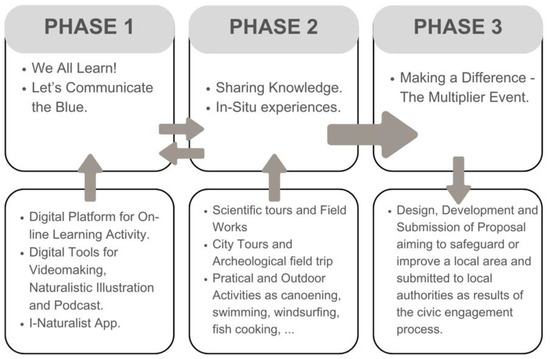
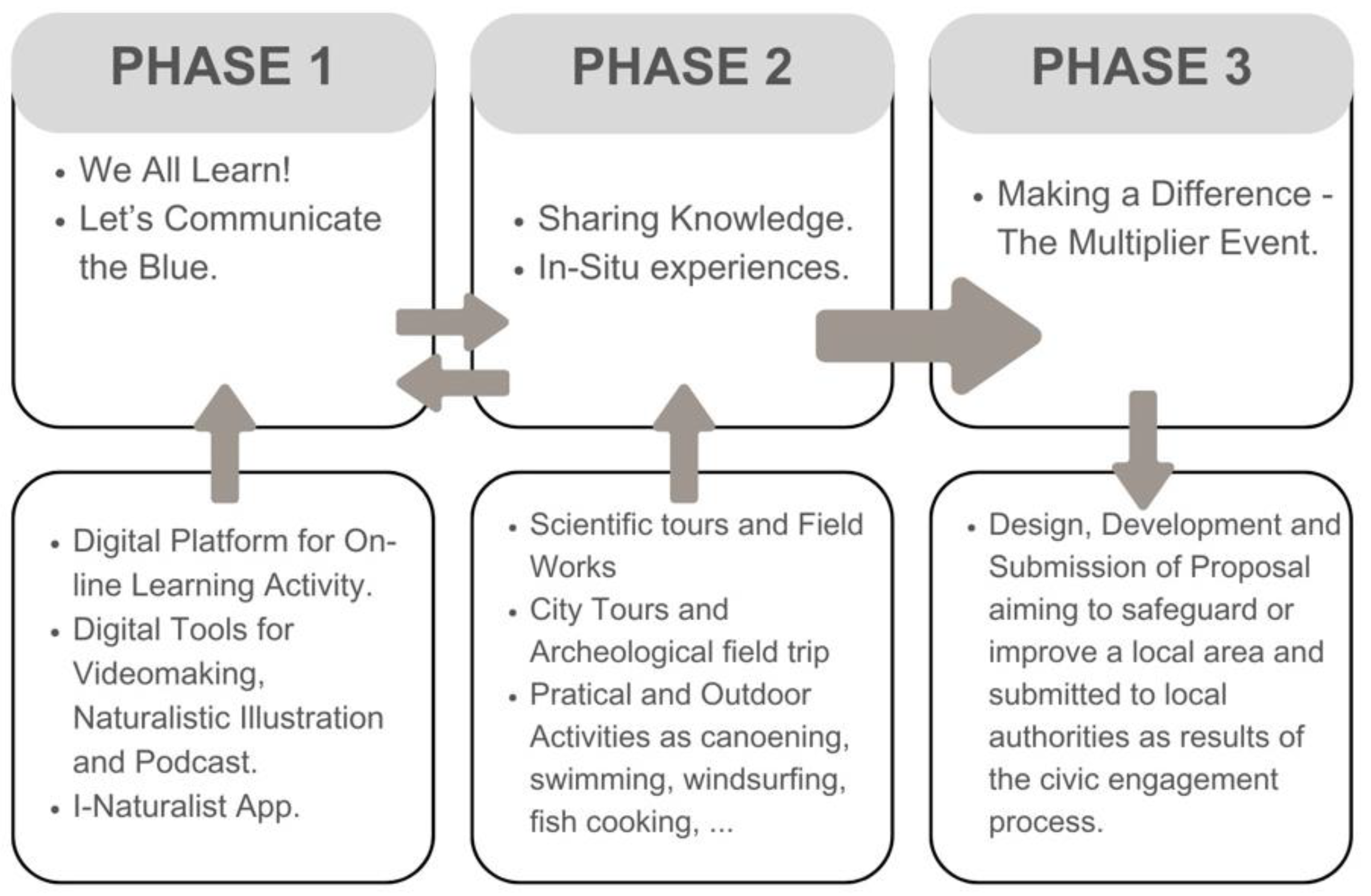
Educational activities were structured into three interconnected phases (Figure 2), grounded in inquiry-based learning, peer education, and outdoor experiential learning.
Figure 2.
The interconnected phase of the You4Blue project.
Phase 1—We all learn!
This phase began with a structured online course to provide foundational “blue knowledge,” co-designed by the scientific partners. It was followed by in situ workshops on videomaking, illustration, podcasting, and civic engagement. These activities developed digital, scientific, and communication skills, promoted media literacy and encouraged students to communicate environmental messages using modern tools and platforms.
Phase 2—Sharing knowledge!
International exchanges immersed students in field activities on the three participating Mediterranean islands. Guided by local scientific partners, they explored marine habitats, ecosystems, and socio-cultural contexts, developing a scientific mindset and greater environmental awareness. Interaction with peers from different countries promoted intercultural understanding and a shared Mediterranean identity, grounded in common environmental challenges. The hands-on, inquiry-based learning approach reinforced an understanding of the interdependence between human activities and marine ecosystems.
Phase 3: Making a difference!
In the final phase, students applied their acquired knowledge and skills to promote ownership and civic responsibility. This included creating media products (e.g., videos, illustrated books and podcasts) to raise awareness of key challenges, as well as developing proposals for community stakeholders to improve or protect a specific local marine or coastal site on their own island. This stage supported the internalization of sustainability values and encouraged long-term behavioral change through real-world problem solving.
2.3. Implementation and Activities
2.3.1. Online Learning Foundation
A dedicated self-paced e-learning course titled “YOU4BLUE—Young Generations for Sustainable Blue Growth” was hosted on the EMMA platform [21]. Designed to last four weeks, the course comprised five modules (20 units in total), each centered on a 20-min video produced by the project’s scientific partners. Topics ranged from marine biodiversity and ecosystem services to cultural ties with the sea, human impacts, and conservation strategies. Pre- and post-unit insights and assessments as well as interactive tools (i.e., Padlets) reinforced learning and engagement.
This online component laid the science-based foundation for subsequent activities, incorporating STEAM principles and ICT skills to prepare students for in-situ workshops and field activities.
2.3.2. In Situ Learning Activities
Following the online phase, students continued their educational journey through hands-on experiences within their local environments. All in situ activities were designed, organized, and implemented by the scientific partner responsible for each territory and delivered to the local student groups (Italian, Greek, and Spanish cohorts, respectively). To ensure coherence across sites, each program combined field visits, laboratory work, and thematic workshops linked to marine science and conservation. These place-based experiences complemented the online modules, strengthened scientific and environmental literacy, nurtured a deeper connection with local marine heritage, and encouraged eco-conscious behaviours.
In Sardinia, activities were implemented by CEAS Laguna di Nora and included “A sailing day” at the Porto d’Agumu Centre (navigation techniques, meteorology, and introductory water sports such as windsurfing, SUP, and canoeing) and “Seafood to love”, a workshop promoting sustainable seafood culture and responsible consumption.
In Crete, activities took place at the facilities of the Hellenic Centre for Marine Research (HCMR) and the CretAquarium, under the responsibility of the HCMR education and research team. Students participated in a laboratory workshop on plankton biodiversity, a guided visit to the CretAquarium focused on native and non-native fish species, and a thematic workshop on marine debris (origins and persistence of marine litter, dispersion through sea currents, ecological and human impacts, and relevant European legislation), followed by a beach cleanup.
In Mallorca, activities were coordinated by the Mediterranean Institute for Advanced Studies (IMEDEA-CSIC-UIB) and included a guided visit to the institute with laboratory demonstrations on marine science and climate change, a field excursion to the Cabrera Archipelago Maritime-Terrestrial National Park to learn about local conservation practices, and a visit to the Palma fish auction to explore local species, fishing techniques, and the role of small-scale fisheries in regional culture. Additional initiatives addressed marine debris and sustainable fishing (Table 1).
Table 1.
In situ learning activities conducted in the three territories with the respective student group.
2.3.3. International Student Exchanges
Student exchanges were organized on each of the three islands with the dual aim of strengthening students’ connection to the marine environment and fostering behavioural change toward more sustainable and healthy lifestyle choices. Through hands-on fieldwork and intercultural interaction, participants deepened their understanding of marine ecosystems, developed key soft skills (e.g., empathy, inclusiveness, intercultural dialogue), and reinforced their sense of European and Mediterranean identity.
A total of eleven scientific and twelve cultural activities were carried out, including field studies, workshops, citizen science experiences, and guided visits to marine and cultural heritage sites (Table 2 and Table 3). In Sardinia, cultural activities during exchanges included a visit to the Archaeological Museum of Cagliari and a guided city tour, as well as an excursion to the Archaeological Area of Nora. Leisure time was also dedicated to swimming and sunbathing at Poetto Beach and Nora Lagoon. In Crete, participants visited the Archaeological Museum of Heraklion—highlighting the ancient relationship between Cretans and the sea—followed by engaging icebreaking games “to get to know each other”, and a field trip to the coastal village of Plaka and to the seaside town of Agios Nikolaos. In Mallorca, students took part in a full-day excursion to the Cabrera National Park, which included snorkeling activities and naturalistic trails, during which students collected photos for the citizen science workshop. Aquatic and outdoor activities were particularly well-received and proved effective in increasing student engagement and awareness.
Table 2.
Scientific educational activities implemented during the three exchanges to all three students’ groups.
Table 3.
Cultural educational activities implemented during the three exchanges to all three students’ groups.
2.3.4. Key Digital Skills and Hands-On Workshops
Three hands-on workshops on scientific communication—video-making, digital illustration, and podcast production—were organized to strengthen key digital and creative skills. In the video-making workshop, students used smartphones to learn filming techniques of framing, composition, angles, movement, and audio. In the digital illustration workshop, they practiced photo-taking, editing with GIMP, applying filters, and creating presentations. Finally, in the podcast workshop, they learned to structure, record, and edit audio files using smartphones and Audacity software v 3.6.1. Working in multinational groups, students created and shared videos, presentations, and podcasts.
A citizen science workshop was also organized to engage students in co-creating knowledge with stakeholders, addressing marine pollution through a collaborative, hands-on approach. Following an introduction to citizen science methods and examples, students used the i-Naturalist app [22] to collect and identify species data, recording 204 observations and 108 species during their stay in Mallorca.
2.4. Evaluation of Impact
To assess the impact of the educational intervention, pre- and post-activity questionnaires were administered that targeted several key dimensions: scientific knowledge of marine ecosystems, attitudes towards sustainability and the marine environment, behaviours related to environmental conservation, and awareness of human impacts on the sea. Representative questionnaire items included questions on participants’ understanding of human influences on marine biodiversity, their perceived responsibility for sustainable seafood consumption, and participation in citizen science activities.
The questionnaires used in this study were developed following established guidelines in educational research. Initially, constructs focusing on marine ecosystem knowledge, sustainability attitudes, and environmental behaviours were identified based on theory and project objectives. Items were drafted collaboratively by the research team and refined through expert review to ensure content validity and clarity. A pilot test with a small student subgroup evaluated comprehension and relevance. While a full psychometric validation was not possible, internal consistency was checked, and weaker items were revised or excluded.
In addition to the quantitative questionnaires, qualitative tools were employed such as emotional mapping, field observations, and group reflections conducted during workshops and in situ activities. These qualitative methods provided deeper insights into students’ perceptions, motivations, and learning processes, complementing the numerical data and supporting comprehensive interpretation of the findings.
The participant group consisted of forty-nine students, with a gender distribution of approximately 65% female, recruited from three secondary schools located on the Mediterranean islands of Sardinia (Italy), Crete (Greece), and Mallorca (Spain). Recruitment was voluntary and based on student interest in the project, with informed consent obtained from parents or guardians. This approach ensured motivated participation and a culturally diverse sample representative of the local educational contexts involved.
The project began with an online anonymous pre-assessment questionnaire administered to students at the outset. This semi-structured instrument comprised 30 items, including four socio-demographic questions (age, residence, gender, and distance from the coast), six questions on socio-cultural behaviours related to the marine environment (e.g., sea-related activities, transportation habits, drinking-water use, information sources, and fish consumption), and two questions assessing students’ awareness of local environmental conditions and perceived human impacts. The remaining 18 close-ended questions evaluated baseline marine literacy across topics such as the United Nations Decade of Ocean Science, marine biodiversity, human pressures on oceans, sustainable consumption, marine policy, and ecosystem services. This pre-assessment enabled identification of students’ initial profiles and knowledge gaps, informing subsequent methodological steps such as the development of the e-learning course.
To assess learning experiences and intercultural engagement during the exchanges, a second questionnaire was administered immediately before and after each mobility. It included four socio-demographic items (residence, family origin, age, and gender identity), two Likert-scale questions evaluating perceived ease of interaction with peers from other countries, and activity-specific sections assessing perceived knowledge gains for each scientific activity (three in Sardinia and Mallorca; five in Crete). Additional items measured enjoyment of the scientific and free-time activities, and one item evaluated satisfaction with accommodation. This pre/post design allowed for the identification of changes in students’ perceptions, knowledge, and engagement associated with the exchange activities.
In Mallorca, the feedback questionnaire included additional items evaluating the citizen science activity. Students rated, on a five-point Likert scale (1 = not at all, 5 = very much), the helpfulness of examples provided during the Active Citizenship workshop, the usefulness of the i-Naturalist app for data collection during the field trip to Cabrera Archipelago Maritime–Terrestrial National Park, the value of app data discussed with the expert, and whether the experience was replicable on their own island. These questions were placed immediately after the accommodation item and provided insights into students’ engagement with authentic scientific practices and perceptions of active citizenship.
Complementary qualitative tools—such as emotional mapping and group reflection—were used during workshops to explore students’ perceptions of local environmental issues and support co-design of their proposals. This triangulated approach provided insights into both individual and collective learning outcomes.
At the end of the project, a short questionnaire was administered to teachers and project staff (N = 12) to gather perceptions of student engagement and learning outcomes. Respondents reported student participation and rated involvement, perceived gains in knowledge of seas and oceans, environmental awareness, interest in STEAM subjects, critical thinking, ICT competencies, English language skills, and engagement in outdoor and sports activities. They also evaluated the effectiveness of the blended methodology. This instrument provided complementary observational data to triangulate student self-reports and support evaluation of the project’s educational and intercultural impacts.
2.5. Methodological Limitations
Consistent with similar educational interventions, this study faced limitations, including reliance on self-reported measures, variation in student participation across countries, short timeframe for capturing behavioural change, and lack of long-term follow-up. These constraints are considered in the discussion section.
3. Results
As a result of this interdisciplinary educational initiative, students were empowered to take practical action and engage actively within their communities. Outcomes included the development of media products—such as videos, illustrated books, and podcasts—to raise awareness of key environmental challenges, as well as proposals addressed to local authorities, offering ideas to protect or improve specific areas. These outputs were the culmination of a civic engagement process in which students identified local environmental issues, analysed their causes, and designed community-oriented solutions.
3.1. Student Proposals and Civic Engagement
Although the content and focus of proposals varied across the three locations, all demonstrated a shared commitment to environmental stewardship and sustainable development. The experience fostered a deeper connection with local territories and highlighted the importance of preserving them through a sustainability lens that integrates environmental, economic, and socio-cultural dimensions.
A brief overview of the student proposals is provided below and summarized in Table 4.
Table 4.
Summary of student proposals and civic engagement. For more details, please visit the project website: https://www.youforblue.org/multiplier-events accessed 26 November 2025.
The complete set of digital and communication materials—including videos, illustrations, and podcasts—is available on the project website [19].
3.1.1. Sardinia—Enhancing the Usability of a Degraded Coastal Green Area
In Cagliari, students selected the “Su Siccu” pine forest, an underutilized coastal area adjacent to their school, as the focus of their citizen science project. Field visits, environmental assessments, and community interviews revealed issues such as poor lighting, lack of basic infrastructure, and limited accessibility. Supported by CEAS Laguna di Nora, students co-designed a redevelopment plan titled “Pineta Blu”, featuring benches, picnic areas, waste bins, Wi-Fi spots, and spaces for sports and children’s activities. Their work was publicly presented at a multiplier event to local authorities, citizens, and peers accompanied by multimedia materials (podcast, video, and a presentation), and gained visibility through regional media coverage.
3.1.2. Crete—Sustainable Management for a Polluted Coastal Ecosystem
Students in Crete focused on “Fodele Beach”, an ecologically rich coastal site facing growing pressures from pollution and tourism. Guided by experts from HCMR, they conducted field monitoring, biodiversity recording, and interviews with local stakeholders, including a retired marine biologist. They identified key threats—primarily plastic waste—and formulated proposals aimed at improving beach management and balancing ecological protection with local economic needs. These recommendations were presented at a multiplier event during the 11th International Scientific Conference of IHSS in Heraklion, attended by 170 participants. The project reached a wider audience through digital dissemination, engaging over 2000 additional students across the region.
3.1.3. Mallorca—Smoke-Free Beaches and Public Awareness on Coastal Pollution
Students in Mallorca tackled the pervasive issue of cigarette butt pollution in local beaches, linking it to the impacts of mass tourism. Through regular clean-ups and data collection, they identified cigarette filters as a significant source of non-biodegradable waste. Their proposal included smoke-free zones, disposal bins, and awareness-raising through signage and outreach campaigns. Communication materials—including a video, podcast, and posters—helped them reach the wider community and encourage behavioral change among beachgoers. Findings were also disseminated during an Environmental Week exhibition, a multiplier event with the participation of local authorities and IMEDEA scientists, and that included a “Think Tank” on sustainable tourism with participation of students, scientists, ONGs and authorities. The visibility of the proposal was further enhanced by the dissemination of the podcast recording on the Spotify channel of a local radio.
3.1.4. Cross-Site Synthesis
Across all three locations, students engaged deeply with local environmental challenges, applying scientific methods and communication tools to propose feasible, context-specific solutions. These actions fostered a stronger sense of civic responsibility, enhanced environmental literacy, and encouraged community dialogue. Moreover, the student projects demonstrated that youth-led initiatives, when supported by interdisciplinary education and local partnerships, can generate meaningful contributions toward coastal conservation and sustainability.
3.2. Measured Impacts and Indicators
Quantitative Scoring and Interpretation
The quantitative data reported in this study are derived from students’ self-assessments using a five-point Likert scale questionnaire. For each item, participants rated their perceived knowledge or competence on a scale from 1 (“very low”) to 5 (“very high”). The reported scores, such as 2.1, represent the mean value across all respondents for a given knowledge domain or questionnaire item.
Specifically, the “knowledge” construct refers to the students perceived understanding of topics related to marine ecosystems, sustainability, and environmental practices. The mean score of 2.1 indicates an average self-perceived knowledge level slightly above the lowest point on the scale, serving here as a baseline measurement before intervention activities.
This approach is a common method in educational research to gauge perceived learning progress, providing valuable insights into participants’ subjective appraisal of their knowledge gains. Ideally, such self-reported measures should be complemented by objective assessments or qualitative data—both of which are integrated within this study—to enrich and validate the interpretation of learning outcomes.
The pre-assessment results highlighted heterogeneous socio-cultural profiles and initial knowledge gaps among students (Table 5). For example, 63% reported using social media as their primary information source, 45% predominantly consumed water from plastic bottles, and 73% did not engage in water-related sports. These baseline patterns underscore the relevance of integrating sustainability and marine literacy topics into educational programs.
Table 5.
Overview of pre-assessment questionnaire responses with selected indicators.
Self-reported data from feedback questionnaires, administered before and after each exchange, indicated substantial knowledge gains across all three locations. Students rated their understanding of scientific activities and environmental topics on a five-point Likert scale (1 = very low, 5 = very high), with mean scores increasing from 2.1 to 3.8 in Sardinia, 2.6 to 4.0 in Crete, and 2.9 to 3.9 in Mallorca (Table 6). Perceived ease of interaction with peers from other countries also improved modestly across exchanges (e.g., Sardinia 3.3 → 3.6; Crete 3.5 → 4.1; Mallorca 3.3 → 3.5). These results reflect the combined effect of hands-on workshops, field studies, and guided tours in enhancing marine literacy and intercultural collaboration.
Table 6.
Students’ self-perceived knowledge and social interaction (Before and After each exchange).
In Mallorca, students participated in a citizen science component involving an Active Citizenship workshop and field data collection using the i-Naturalist app in Cabrera Archipelago Maritime–Terrestrial National Park. Students’ perceptions of this activity were generally positive. As summarized in Table 7, mean ratings (on the 1 to 5 scale) were 3.66 for the helpfulness of workshop examples, 3.72 for the usefulness of the i-Naturalist app for data collection, 3.63 for the value of app data discussed with the expert, and 4.27 for the replicability of the experience on their own island. Despite some missing responses, these results indicate meaningful engagement with citizen science practices, acquisition of practical biodiversity monitoring skills, and recognition of opportunities to replicate similar activities locally. This component illustrates how citizen science can reinforce scientific literacy, active participation, and environmental stewardship.
Table 7.
Student perceptions of the citizen science activity (Mallorca, N = 47).
Qualitative observations from workshops and student reflections suggested additional gains in individual awareness, critical thinking, and a shared sense of environmental responsibility. Engagement in outdoor and sports activities, as well as enjoyment of free-time components, further supported holistic learning outcomes. Collectively, these findings indicate that inquiry-based, place-based, and collaborative international learning can effectively foster sustainability competences in secondary school students.
Teachers and project staff (N = 12) provided complementary perspectives on student engagement and learning outcomes at the end of the project. Teachers consistently rated student involvement higher than project staff, particularly for the e-learning component, and both groups observed substantial improvements in knowledge of seas and oceans, environmental awareness, interest in STEAM subjects, and critical thinking. Gains in ICT and English language skills were more variable, while increases in participation in outdoor and sports activities were noted. The blended methodology combining e-learning and in situ learning was consistently rated as effective, providing triangulated evidence that the project positively influenced multiple dimensions of student learning and engagement.
4. Discussion
The YOU4BLUE project adopted a blended PBE approach, integrating online learning with experiential activities in coastal settings. This model effectively fostered interdisciplinary learning, civic engagement, and environmental awareness by connecting local marine issues to broader sustainability goals. Interaction with researchers and international peers enhanced students’ communication skills, critical thinking, and digital literacy, while creative outputs, such as videos and podcasts, and co-designed provided concrete opportunities for applying their knowledge to community improvement.
Grounded in active and transdisciplinary learning, the YOU4BLUE project aimed not only to transmit knowledge but also to cultivate the capacity for independent learning, critical engagement, and responsible action. In line with Edgar Morin’s call to overcome the compartmentalization of knowledge and embrace complexity [23], the project sought to prepare minds capable of addressing the complex and interdependent challenges of the 21st century. The thematic focus on seas and oceans as both ecological and cultural assets proved particularly effective in stimulating both emotional and intellectual engagement.
Our findings align with recent research emphasizing PBE as a powerful pedagogical tool for fostering environmental awareness and community connection. Consistent with studies highlighting the value of interdisciplinary and participatory approaches, the integration of hands-on learning and citizen science contributed significantly to student engagement and the development of sustainability competences. Moreover, the observed improvements in intercultural collaboration and digital literacy extend previous insights into the social dimensions of environmental sustainability education.
This study advances the literature by demonstrating that interdisciplinary educational interventions can effectively mobilize youth to co-design local solutions to environmental challenges, thereby bridging scientific literacy with civic responsibility. The results reinforce the pedagogical value of blending experiential, collaborative, and transdisciplinary learning strategies in fostering sustainable behaviours.
Despite its strengths, the project faced several challenges. Ensuring methodological consistency across participating countries proved difficult, particularly in the implementation of evaluation tools and the comparability of feedback data. The short duration of exchanges and the limited timeframe for local project implementation constrained the depth of stakeholder involvement and limited the capacity for longer-term community engagement. Furthermore, self-assessment tools, while useful, provided limited insight into actual knowledge acquisition and behaviour change, due to potential biases and uneven participation. Additional challenges included a gender imbalance in student participants, especially in Greece, which may have influenced group dynamics, as well as occasionally language barriers and differences in school organization that hindered smooth collaboration.
5. Conclusions
An education system focused on teaching a “method”—the ability to inquire, analyse, and problem-solve—has greater longer-term impact than merely transmitting isolated discipline content. Such an approach equips students not only with knowledge but also with the mindset and skills to be aware, responsible citizens capable of lifelong learning.
The results across the three project sites highlight how student engagement with local environmental challenges, through scientific methods and communication tools, extends learning beyond the classroom, fostering a tangible sense of civic responsibility. This outcome suggests that interdisciplinary education combined with local partnerships is crucial in empowering youth to become active contributors to coastal sustainability. However, further research is needed to evaluate the long-term impact of such projects on actual conservation outcomes. The variability in student engagement and community response across locations also points to the importance of tailoring educational strategies to local contexts to maximize effectiveness. These insights underscore the potential of integrating practical environmental problem-solving within educational frameworks as a pathway to sustainable development.
This project also emphasizes the importance of bridging the gap between humanistic and scientific knowledge and highlights the pivotal role played by teachers, whose commitment and expertise were instrumental to the success of the project. Their ability to integrate interdisciplinary approaches and foster student engagement demonstrates the critical impact educators can have when adequately supported. However, systemic barriers, such as limited resources, time constraints, and the entrenched bureaucratization of the school system, alongside rigid and compartmentalized curricula, continues to limit the uptake of innovative, flexible, and personalized teaching practices. Addressing these structural obstacles is essential to fully harness the potential of teachers as catalysts for educational transformation and sustainability.
Author Contributions
Conceptualization, M.C., S.B., A.T. and G.S.; methodology, M.C., S.B., A.T. and G.S.; writing—original draft preparation, M.C., G.S., A.T., S.B., C.P., S.d.J., S.G., A.A., D.F. and A.O.; writing—review and editing, all.; project administration, S.B. and E.C. All authors have read and agreed to the published version of the manuscript.
Funding
This work has been funded by YOU4BLUE-Young generations for sustainable blue growth, Grant agreement No. 2022-1-IT02-KA220-SCH-000087250, 2022-2025. EU-ERASMUS+ Key Action 2: Cooperation among organisations and institutions—Co-funded by the European Union.
Data Availability Statement
For data supporting the reported results, please contact the corresponding author and sara.bertuzzi@opentea.eu.
Acknowledgments
This paper was also produced in the frame of a Ph.D. in Agro-food system (AGRISYSTEM)-XXXVIII Cycle. We also want to thank: all teachers and staff at Liceo Alberti school who contributed to the project, Maria Assunta Melis, Roberto Bernardini, Paola Vassallo, Annarita Meloni, Antonio Paolo Maurandi, all teachers and staff at IES Bendinat school who contributed to the project, all teachers and staff at Educational Association MORFI who contributed to the project, Evgenia Psaltaki, Antigoni Andreadaki, Efthalia Andreadaki, Zacharenia Andreadaki. IMEDEA is an accredited “María de Maeztu Unit of Excellence” (Grant CEX2021-001198, funded by MICIU/AEI/10.13039/501100011033).
Conflicts of Interest
The authors declare no conflicts of interest. Sara Bertuzzi, Alice Tediosi and Gabriele Sacchettini were employed by OpenTea s.r.l. The remaining authors declare that the research was conducted in the absence of any commercial or financial relationships that could be construed as a potential conflict of interest. The funders had no role in the design of this study; in the collection, analyses, or interpretation of data; in the writing of the manuscript; or in the decision to publish the results.
References
- World Commission on Environment and Development. Our Common Future; Oxford University Press: Oxford, UK, 1987. [Google Scholar]
- Geneva Environment Network. Youth and the Environment. Available online: https://www.genevaenvironmentnetwork.org/resources/updates/youth-and-the-environment/ (accessed on 1 February 2025).
- Urberg, L.; Öhman, J. Resisting sustainable development: An analysis of young people’s online discussions. J. Youth Stud. 2024, 1–17. [Google Scholar] [CrossRef] [Scilit]
- Ofcom. Teens on Screens: Life Online for Children and Young Adults Revealed; Office of Communications: London, UK, 2023; Available online: https://www.ofcom.org.uk/media-use-and-attitudes/online-habits/life-online-for-children-and-young-adults-revealed (accessed on 1 February 2025).
- Oleniacz, L. COVID-19: How Less Time in Nature Impacted Young People. World Economic Forum (Online). 2021. Available online: https://www.weforum.org/agenda/2021/12/green-space-mental-health-young-people/ (accessed on 1 February 2025).
- Siarova, H.; Sternadel, D.; Szőnyi, E. Science and Scientific Literacy as an Educational Challenge; Policy Department for Structural and Cohesion Policies, European Parliament: Brussels, Belgium, 2019. [Google Scholar]
- Ekenga, C.C.; Sprague, N.; Shobiye, D.M. Promoting health-related quality of life in minority youth through environmental education and nature contact. Sustainability 2019, 11, 3544. [Google Scholar] [CrossRef] [Scilit]
- Hatala, A.R.; Njeze, C.; Morton, D.; Pearl, T.; Bird-Naytowhow, K. Land and nature as sources of health and resilience among Indigenous youth in an urban Canadian context: A photovoice exploration. BMC Public Health 2020, 20, 538. [Google Scholar] [CrossRef] [Scilit] [PubMed]
- Rana, S.; Ávila-García, D.; Dib, V.; Familia, L.; Gerhardinger, L.C.; Martin, E.; Martins, P.I.; Pompeu, J.; Selomane, O.; Tauli, J.I.; et al. The voices of youth in envisioning positive futures for nature and people. Ecosyst. People 2020, 16, 326–344. [Google Scholar] [CrossRef] [Scilit]
- Bowers, E.P.; Larson, L.R.; Parry, B.J. Nature as an ecological asset for positive youth development: Empirical evidence from rural communities. Front. Psychol. 2021, 12, 688574. [Google Scholar] [CrossRef] [Scilit] [PubMed]
- Noth, F.; Tonzer, L. Understanding climate activism: Who participates in climate marches such as “Fridays for Future” and what can we learn from it? Energy Res. Soc. Sci. 2022, 84, 102360. [Google Scholar] [CrossRef] [Scilit]
- Wallis, H.; Loy, L.S. What drives pro-environmental activism of young people? A survey study on the Fridays for Future movement. J. Environ. Psychol. 2021, 74, 101581. [Google Scholar] [CrossRef] [Scilit]
- United Nations. World Youth Report: Youth and the 2030 Agenda for Sustainable Development; United Nations: New York, NY, USA, 2018; ISBN 978-92-1-130349-0. [Google Scholar]
- European Commission, Directorate-General for Education, Youth, Sport and Culture. Data Collection and Analysis of Erasmus+ Projects: Focus on Education for Environmental Sustainability—Final Report; Publications Office of the European Union: Luxembourg, 2022; ISBN 978-92-76-43470-2. [Google Scholar] [CrossRef]
- Paul, R.K.; Mezirow, J. Transformative learning: Theory to practice. New Dir. Adult Contin. Educ. 2002, 1997, 5–12. [Google Scholar]
- Gruenewald, D.A. The best of both worlds: A critical pedagogy of place. Educ. Res. 2003, 32, 3–13. [Google Scholar] [CrossRef] [Scilit]
- Council of the European Union. Document ST-9242-2022-INIT. Available online: https://data.consilium.europa.eu/doc/document/ST-9242-2022-INIT/en/pdf (accessed on 25 August 2025).
- European Commission. What Is Erasmus+? Available online: https://erasmus-plus.ec.europa.eu/about-erasmus/what-is-erasmus (accessed on 25 August 2025).
- YOU4BLUE—Young Generations for Sustainable Blue Growth. Erasmus+ Key Action 2: Cooperation among Organisations and Institutions. Grant Agreement No. 2022-1-IT02-KA220-SCH-000087250, 2022–2025. Available online: https://youforblue.org (accessed on 25 August 2025).
- Yemini, M.; Engel, L.; Ben Simon, A. Place-based education—A systematic review of literature. Educ. Rev. 2023, 77, 640–660. [Google Scholar] [CrossRef] [Scilit]
- EMMA (European Multiple MOOC Aggregator). EMMA European MOOCs Platform. Available online: https://platform.europeanmoocs.eu/ (accessed on 25 August 2025).
- iNaturalist. Citizen Science Platform by the California Academy of Sciences and National Geographic Society. Available online: https://www.inaturalist.org (accessed on 25 August 2025).
- Morin, E. La Testa Ben Fatta. Riforma Dell’insegnamento e Riforma del Pensiero; Cortina Editore: Milano, Italy, 1999; EAN 9788870786132. [Google Scholar]

Disclaimer/Publisher’s Note: The statements, opinions and data contained in all publications are solely those of the individual author(s) and contributor(s) and not of MDPI and/or the editor(s). MDPI and/or the editor(s) disclaim responsibility for any injury to people or property resulting from any ideas, methods, instructions or products referred to in the content. |
© 2026 by the authors. Licensee MDPI, Basel, Switzerland. This article is an open access article distributed under the terms and conditions of the Creative Commons Attribution (CC BY) license.