
Article

Landscape Pattern Evolution in the Source Region of the Chishui River

1
School of Geographical Sciences and Tourism, Zhaotong University, Zhaotong 657000, China
2
Xinjiang Institute of Ecology and Geography, Chinese Academy of Sciences, Urumqi 830011, China
*
Author to whom correspondence should be addressed.
Sustainability 2026, 18(2), 914; https://doi.org/10.3390/su18020914 (registering DOI)
Submission received: 25 October 2025 / Revised: 8 January 2026 / Accepted: 13 January 2026 / Published: 15 January 2026
(This article belongs to the Special Issue Global Hydrological Studies and Ecological Sustainability)

Abstract

Recognizing the evolution of landscape patterns in the Chishui River source region is essential for protecting ecosystems and sustainable growth in the Yangtze River Basin and other similar areas. However, knowledge of landscape pattern evolution within the primary channel zone remains insufficient. To address this gap, the current study used 2000–2020 land-use, geography, and socio-economic data, integrating landscape pattern indices, land-use transfer matrices, dynamic degree, the GeoDetector model, and the PLUS model. Results revealed that forest and cropland remained the prevailing land-use types throughout 2000–2020, comprising over 85% of the landscape. Grassland had the highest dynamic degree (1.58%), and landscape evolution during the study period was characterized by increased fragmentation, enhanced diversity, and stable dominance of major forms of land use. Anthropogenic influence on different landscape types followed the order: construction land > cropland > grassland > forest > water bodies. Land-use change in this region is a complex process governed by the interrelationships among various factors. Scenario-based predictions demonstrate pronounced variability in various land types. These findings provided a more comprehensive understanding of landscape patterns in karst river source regions, provided evidence-based support for regional planning, and offered guidance for ecological management of similar global river sources.

1. Introduction

Studies on landscape pattern evolution largely focus on the spatial heterogeneity and underlying causes of land use/cover change (LUCC), which are considered essential for understanding interactions between humans and the earth [1,2,3]. Anthropogenic changes have altered the natural landscape substantially, leading to ecological degradation and reduced biodiversity, posing a threat to ecosystem security [4,5,6]. Comprehensive analysis of changes in landscape patterns can offer theoretical guidance for constructing ecological security patterns and formulating regional sustainable development policies, raising coordinated ecological, economic, and social development [7,8,9].
Technological innovations in remote sensing and GIS since the 1980s have substantially enhanced the collection of multi-source heterogeneous spatiotemporal data, increasing quantitative dynamic monitoring in landscape pattern research [10,11,12]. Based on landscape index systems, spatial heterogeneity and driving factor measurement models (e.g., GeoDetector model), multi-temporal remote sensing interpretation technology has become a key methodology for investigating the processes of landscape pattern evolution [13,14,15]. Yang et al. [16] used information on land cover and use acquired from remote sensing to evaluate the influence of LUCC on landscape patterns of the Yangtze River (YR) Basin from 2001 to 2019, highlighting spatial and temporal variations. Furthermore, Liu et al. [17] combined remote-sensing data with the GeoDetector model to assess the heterogeneity of patterns of urban expansion in Chenggong District, Kunming City, Yunnan Province, China. Du et al. [18] employed the same methodological approach to assess spatiotemporal changes and associated drivers of landscape patterns in Yujiang District, Jiangxi Province. These studies highlight the significance of geospatial technology in landscape pattern diagnosis.
A variety of models have been proposed to predict future landscape pattern dynamics [11,15,19], among which patch-generating land use simulation (FLUS) has shown marked advantages [20]. The FLUS model integrates random forest algorithms with traditional land use simulation approaches, performing well in simulating changes in land use, thereby offering more accurate predictions of future land use. Consequently, it has been widely applied in regional-scale studies due to its remarkable predictive capabilities. For example, Cagliyan and Dagli [21] employed the FLUS model for predicting the LUCC trends in the Diyarbakir region in the future, indicating that by 2038, the extent of agricultural and pasture lands, as well as water bodies, is expected to decrease, while built-up areas are anticipated to increase steadily. Using the FLUS model, Jiang et al. [22] demonstrated land use evolution of the Henan area of the Yellow River basin under various 2035 developmental scenarios, showing that urban expansion consistently encroached upon cropland across all scenarios.
Currently, various studies have been carried out globally regarding the evolution of landscape patterns [17,23,24]. However, most existing theories of landscape evolution are mostly based on plain or conventional landforms and do not consider the complex characteristics of mountainous river source regions, including topographic dissection, ecological fragility, and concentrated policy regulation. This largely neglects the distinctive role of river source regions as “ecological starting points”, particularly in karst landform areas. Changes in the landscape within river source regions are transmitted downstream through hydrological, soil-related, and other processes. In karst landform river source areas, these evolution patterns may differ from those in other regions due to strict ecological protection measures and the unique limitations of karst topography [25,26]. However, systematic research focusing specifically on these regions remains limited.
As the only first-order tributary of the upper YR that still maintains a natural flow regime, the Chishui River supports a well-preserved riparian ecosystem and acts as a major ecological barrier protecting the environmental integrity of the upper Yangtze basin [27,28]. The basin sustains a unique and highly diverse ecological system while fulfilling a strategic role as a major water resource reserve for the YR Economic Belt [29]. Changes in the landscape pattern of this basin exert significant control over regional ecosystem functions and downstream water quality and safety, making it critical for ecological protection and economic coordinated development across the YR Basin [27,28]. As a typical mountainous ecosystem in the river source region of karst landforms, a comprehensive investigation of the changes in landscape patterns in the Chishui River Basin is essential, as such insights provide a reference for land spatial planning, ecological protection, and restoration. Moreover, they can elucidate the coupled dynamics between human activities and mountain–river processes, informing the construction of a basin ecological compensation mechanism of karst landforms. However, research on landscape pattern evolution in this region remains limited, particularly in the primary channel zone [30,31]. Existing studies offer insufficient insight into the evolution of landscape patterns, associated driving mechanisms, and future prediction in the primary channel zone of the Chishui River source region. These gaps significantly impede the development of targeted approaches for ecological protection, restricting the advancement of ecological conservation and regional economic growth. Thus, this study addresses the following scientific questions: (1) What are the spatiotemporal evolution characteristics of the landscape pattern in the primary channel zone of the Chishui River Source region? (2) What are the core driving factors and their interactive effects? (3) What evolutionary trends will the landscape pattern in this region present in the future?
Here, the primary channel zone of the Chishui River source region in Zhenxiong County, Yunnan Province, China, was investigated. A comprehensive technical framework of “pattern characterization-driving factor subdivision-scenario focus” was constructed with the three aims of “clarifying evolutionary characteristics, analyzing driving mechanisms, and predicting future trends”. This study employed the five-phase remote sensing-retrieved land use data from 2000 to 2020 as the core dataset, while also integrating multi-source data including field surveys, topography, climate, and socio-economic statistics. The characteristics of the historical evolution of the landscape pattern were analyzed using methods such as landscape pattern metrics, land use transfer matrix, and the dynamic degree model. Furthermore, the underlying driving mechanisms were investigated using the GeoDetector model, while multi-scenario simulations to predict future variations were conducted with the PLUS model.
This study has the following objectives: (1) to clarify the features associated with the evolution of landscape patterns between 2000 and 2020; (2) to quantify driving factors; and (3) to predict the future evolutionary changes in the landscape pattern in the primary channel zone of the Chishui River source region from 2030 to 2040. This study deepens the understanding of landscape theory in the river source regions of karst landforms and provides both theoretical insights and empirical data to support both coordinated ecological protection and sustainable economic development in the region of the source of the Chishui River.

2. Materials and Methods

2.1. Study Area

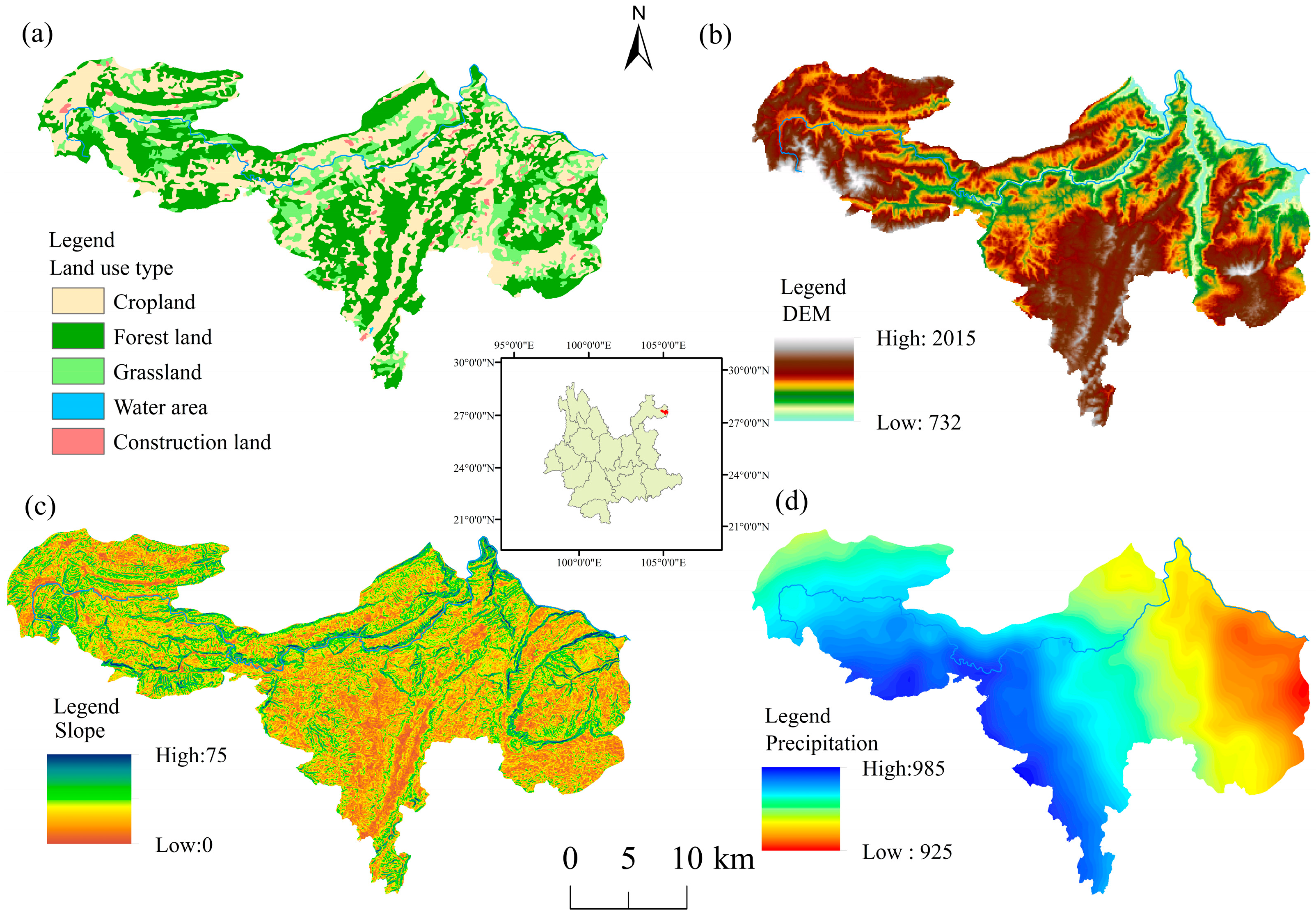
The primary channel zone at the Chishui River source is situated in Zhenxiong County, Yunnan Province (27°52′–28°16′ N, 105°12′–105°20′ E), encompassing an area of over 600 km2. The region is characterized by well-developed karst landforms, with pronounced topographic relief, including high mountains along with deep valleys, with elevations covering a range of 732 m to 2015 m. The area has a subtropical monsoon climate and displays distinct vertical climatic characteristics, with an average annual precipitation of 930 mm and a temperature of 11.8 °C [32,33,34]. The land is dominated by cropland and forest, alongside grassland, water bodies, and scattered construction land, with water bodies occupying the smallest area of the land (Figure 1). This region experiences a higher intensity of human activities, particularly agricultural practices, compared with other regions of the Chishui River source area. The recent implementation of ecological conservation measures and economic development initiatives has significantly altered the land use changes (LUCC) [30,32].

2.2. Data Sources

The study utilized three distinct types of data, namely, information on land use, driving factors, and field surveys (Table 1). Information on land use was acquired from the China National Multi-temporal Land Use/Cover Remote Sensing Monitoring Dataset (CNLUCC), released by the Resource and Environmental Science Data Platform, Institute of Geographic Sciences and Natural Resources Research, Chinese Academy of Sciences (CAS; http://www.resdc.cn). This dataset was developed using multi-source remote sensing image fusion technology. For data source selection, Landsat-TM imagery served as the primary source for the period 2000–2010, while Landsat-8 imagery was used for 2015–2020. Image acquisition was carried out in July–September, when vegetation cover is fully developed, enhancing land-cover discrimination. Data derived from remote sensing were resampled to a 30 m uniform spatial resolution to ensure consistency across datasets. The data platform verified that the overall classification accuracy was greater than 90% [35]. The applicability of the dataset was further evaluated through field surveys conducted at 25 field verification points. The results confirmed that the dataset closely aligned with observed land-use patterns, demonstrating its reliability for subsequent analysis.
The driving factor dataset included topographic variables (elevation and slope), precipitation data, population, gross domestic product (GDP), soil type, roads, river, settlements, and seats of township governments. The Geospatial Data Cloud (https://www.gscloud.cn) was used to obtain the elevation data; information on slope was obtained from the elevation data; the precipitation data between 2000 and 2020 was from the Data Center of the Institute of Mountain Hazards and Environment, CAS (https://imde.cas.cn); the population, soil type and GDP data were retrieved from the Resource and Environmental Science Data Platform, CAS (https://www.resdc.cn); the road and river data source was OpenStreetMap (https://openmaptiles.org); the National Center for Fundamental Geographic Information (NCFGI) (https://www.webmap.cn) was used to derive the data on the seats of township governments and settlements.
Field investigations employed both questionnaires and interview methods to collect detailed information on local land use and related influencing factors. The surveys covered land use and conversion, population size and structure, economic development status, climate conditions, and relevant policies. These data could serve to validate the reliability of the study’s findings and support an in-depth examination of the factors influencing the evolution of land patterns. Relevant policy content, including “Returning cropland to forest”, “Occupation-compensation balance”, “Residential land approval”, and “Ecological protection zone”, was derived from local government policy documents and ecological governance bulletins [34,36,37,38,39,40].

2.3. Methods

This study proposed a methodological framework of “pattern characterization-driving factor subdivision-scenario focus” to address the distinctive characteristics of fragmented karst landscapes and the significant ecological–economic contradictions in the primary channel zone of the Chishui River source [30,32].

2.3.1. Determination of Indices of Landscape Patterns Indices

Indicators of landscape patterns, calculated using ArcGIS 10.7 and Fragstats 4.2, serve as a valuable tool for assessing regional landscape configurations across temporal scales, enabling the identification and evaluation of spatiotemporal changes [2,41]. Data on land use for the individual study periods were preprocessed using 10.7. Following the mosaic and merge operations, the data were exported in TIFF raster format suitable for Fragstats 4.2, which was then used for calculating various landscape pattern indices. Based on previous research results [42,43], specific conditions of the study area, landscape changes were analyzed at two levels, namely, individual and overall land-use types, focusing on three key dimensions: landscape fragmentation, landscape diversity, and landscape connectivity. In terms of class, the indices calculated included the Patch Density (PD), Landscape Shape Index (LSI), Interspersion and Juxtaposition Index (IJI), Aggregation Index (AI), and Perimeter-Area Fractal Dimension (PAFRAC). In terms of landscape, the Number of Patches (NP), PD, AI, Contagion Index (CONTAG), Landscape Division Index (DIVISION), LSI, Shannon Diversity Index (SHDI), and Shannon Evenness Index (SHEI) were calculated. Following these procedures, a complete set of landscape pattern indices was generated, providing a robust basis for quantitative analysis regarding landscape structure as well as dynamics.

2.3.2. Land-Use Transfer Matrix

The land-use transfer matrix (LUTM) is a key tool for quantitative analysis of LUCC, providing insight regarding transfer scale and direction between various types of land use [44,45], which can be mathematically expressed as:
D ij =   D 11 D 1 n D n 1 D n n
where Dij indicates transformation from the ith type of land use at the start of the study period to the jth type at the final stage, and n represents the overall types of land use. The ArcGIS 10.7 and Excel 2018 were employed to calculate the LUTM.

2.3.3. Land Use Dynamics

Dynamic changes in land use serve as an important indicator for evaluating the rate and magnitude of changes in land use over time [2,44]. It reflects the intensity and direction of transformations and is calculated as:
K i   =   ( A b A a ) A a × 1 T × 100 %
where Ki is the extent of type i land use within the study area; Aa denotes the area of type i land use at the start of the study (in km2); Ab is the area of type i land use at the end of the study (in km2); T represents the study duration, typically years.

2.3.4. GeoDetector Model

The GeoDetector1.0-3 model is a statistical method for quantifying factors driving changes in landscape patterns [46]. The model can directly incorporate categorical variables, such as land use types, while numerical factors can be analyzed after discretization. All datasets were uniformly resampled to a spatial resolution of 1 km to quantitatively analyze the driving factors using the GeoDetector1.0-3 model, ensuring robust spatial matching. Landscape pattern indices were used as dependent variables, while factors related to nature, socioeconomics, and policies served as the independent variables [17,47]. Following spatial alignment and preprocessing of the datasets, the GeoDetector1.0-3 software was applied to quantitatively assess the drivers of changes in landscape patterns. According to local surveys and previous studies [30,32,48], twelve key influencing factors were selected to assess their effects on changes in landscape patterns for the primary channel zone of the Chishui River source [49,50].

2.3.5. PLUS Model

The PLUS.V14 model is used for predicting future LUCC [20,22]. In the model operation, the land expansion analysis strategy module first estimates the likelihood of expansion for each land-use type using a random forest algorithm, integrating factors such as the natural geography, socioeconomics, and accessibility of the study area. The multi-type random patch seeds module then simulates land-use spatial transitions by integrating random seed generation with the threshold reduction rule [20,51]. Using 2015 land-use data as the baseline, the PLUS.V14 model generated a 2020 land-use simulation map. The validation against actual 2020 data produced a Kappa index of 0.85, indicating a high predictive accuracy. The validated PLUS model was subsequently applied for the prediction of future LUCC in the primary channel zone of the Chishui River source region for the years 2030, 2035, and 2040, providing insights into potential landscape evolution under current trends.
Considering the study area characteristics, including river source, mountainous region, and key agricultural region, four development scenarios were established to simulate future landscape patterns: cropland protection, natural development, ecological protection, and economic development. Under the scenario of natural development, the PLUS.V14 model used 2015 and 2020 land use data to generate land use demand and development probabilities for 2030, 2035, and 2040. Under the conditions of cropland protection, cropland is strictly preserved, with all conversions to other land types restricted, to ensure sustainable use of resources and the environmental carrying capacity of the river basin. Conversion of land within water bodies and nature reserves is strictly prohibited, classifying these areas as protected zones. Based on conversion probabilities during 2015–2020, this scenario limited forest and grassland conversions to construction land by 20% and cropland conversions to construction land by 60%, reflecting stricter land protection measures [30,31,52,53,54]. In the ecological protection scenario, priority is given to conserving ecological land, including grasslands, forests, and water areas. Water areas and nature reserves are designated as restricted conversion zones, with strict limits on converting ecological land to construction land: cropland conversion was reduced by 30%, while forests, grasslands, and water areas experienced a 70% reduction in conversion probability [30,31,52,53,54]. In the economic development scenario, priority is given to promoting economic growth, resulting in the expansion of construction land. This scenario enhances the likelihood of other land types undergoing conversion to construction land while restricting the conversion of construction land to other uses. Based on the conversion probabilities during 2015–2020, this scenario adjusts conversion probabilities as follows: the probability of construction land reverting to cropland is reduced by 40%; the probability of cropland, grassland, and forest land converting into construction land is increased by 20%; unused land conversion into construction land is increased by 50%, and water areas conversion into construction land is increased by 10% [30,31,52,53,54].

3. Results

3.1. Landscape Pattern Indices

Comparing the landscape-level indices in the primary channel zone of the Chishui River source region from 2000 to 2020 (Table 2) demonstrated a slight decrease in the SHEI and AI, while the remaining landscape indices exhibited varying degrees of increase. The net increase in the NP was found to be 93, indicating the increased fragmentation degree of the landscape. High CONTAG values alongside increasing DIVISION indicated that the dominant landscape types were clustered, while other landscape types became more fragmented and spatially isolated. The observed increased SHDI indicated the simultaneous increase in the land use type richness. Although SHEI declined slightly by 0.05, it remained relatively high at 0.65, indicating that the distribution of the landscape types continued to be relatively balanced. The AI was found to be 95, reflecting a retained continuous distribution characteristic in the main landscape. Analysis of the landscape indices revealed that the study area is experiencing a complex evolution process characterized by increased fragmentation, enhanced diversity, and stable dominant landscape types.
Comparison of land types in the primary channel zone of the Chishui River source region from 2000 to 2020 (Table 3) demonstrated a significantly increased PD and LSI, with slightly increased PAFRAC, thus indicating an increased landscape complexity. Except for grassland and water areas, all other land use types demonstrated increased IJI to varying degrees, with the largest rises in construction land (63.73), followed by cropland (4.18) and grassland (3.22), while forest land (0.66) and water area (0) revealed a minimal change. These results indicated that human activities demonstrated a significant effect on construction land, cropland, and grassland, while the forest land and water areas remained largely unaffected. The overall value of the AI was found to be highest, indicating that most landscape patches were highly aggregated, whereas the relatively low AI for construction land suggests its patches were relatively dispersed.

3.2. Land Use Change

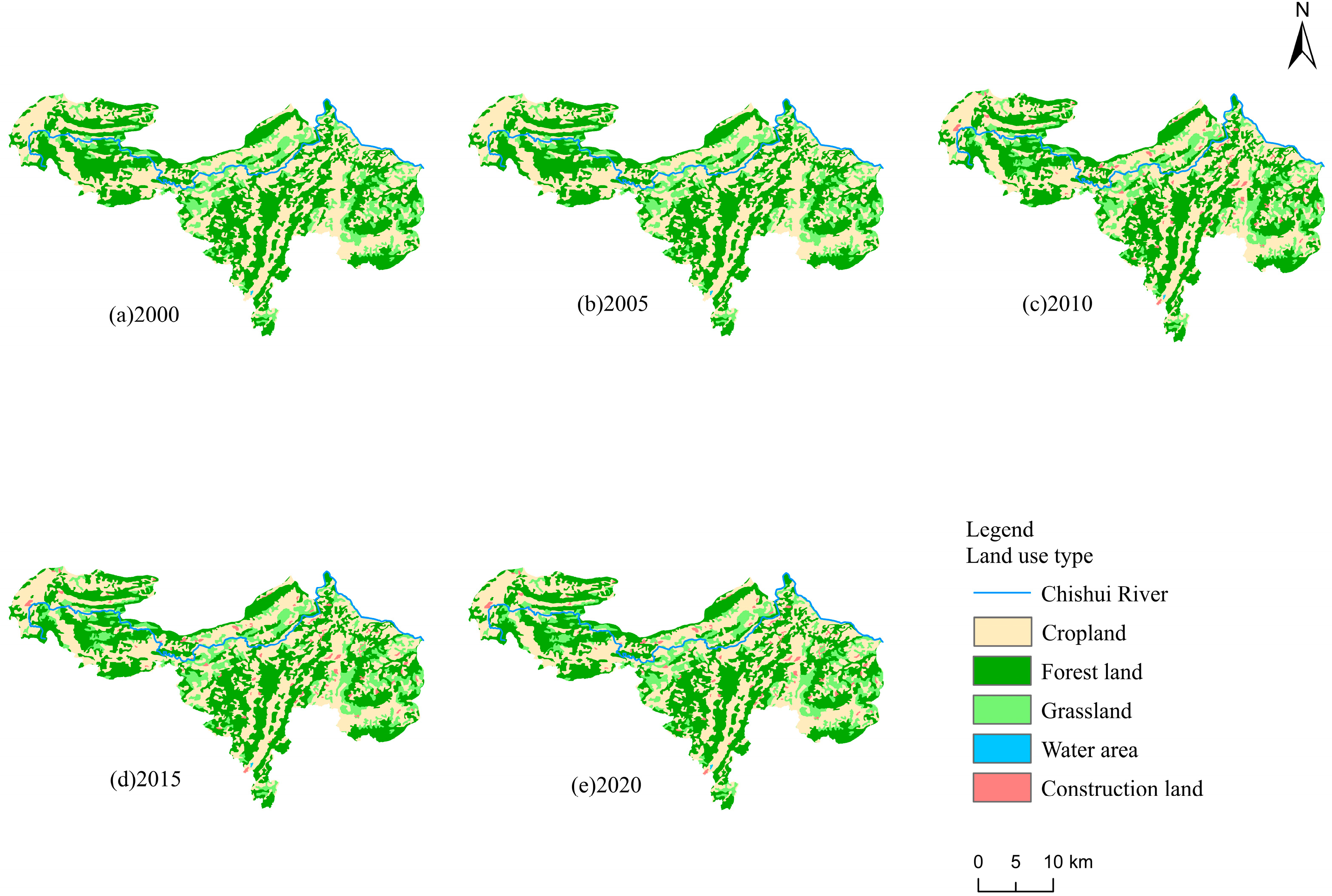
Throughout the duration of 2000 to 2020, the primary channel zone of the Chishui River source region was dominated by forest and cropland, together accounting for over 85% of the landscape, with their patches closely intermingled across the region. Grassland was the next most prevalent extensive land use type, covering 12.09–13.11% of the area, while water bodies were minimal, accounting for only 0.02%. From 2000 to 2005, construction land was not mapped because its scattered patches were smaller than the minimum mapping unit. After 2010, the construction land demonstrated a clear pattern of spatial expansion, primarily originating from the marginal conversion zones of cropland (Figure 2). From 2015 to 2020, its area was stabilized at around 1.43% (Table 4).
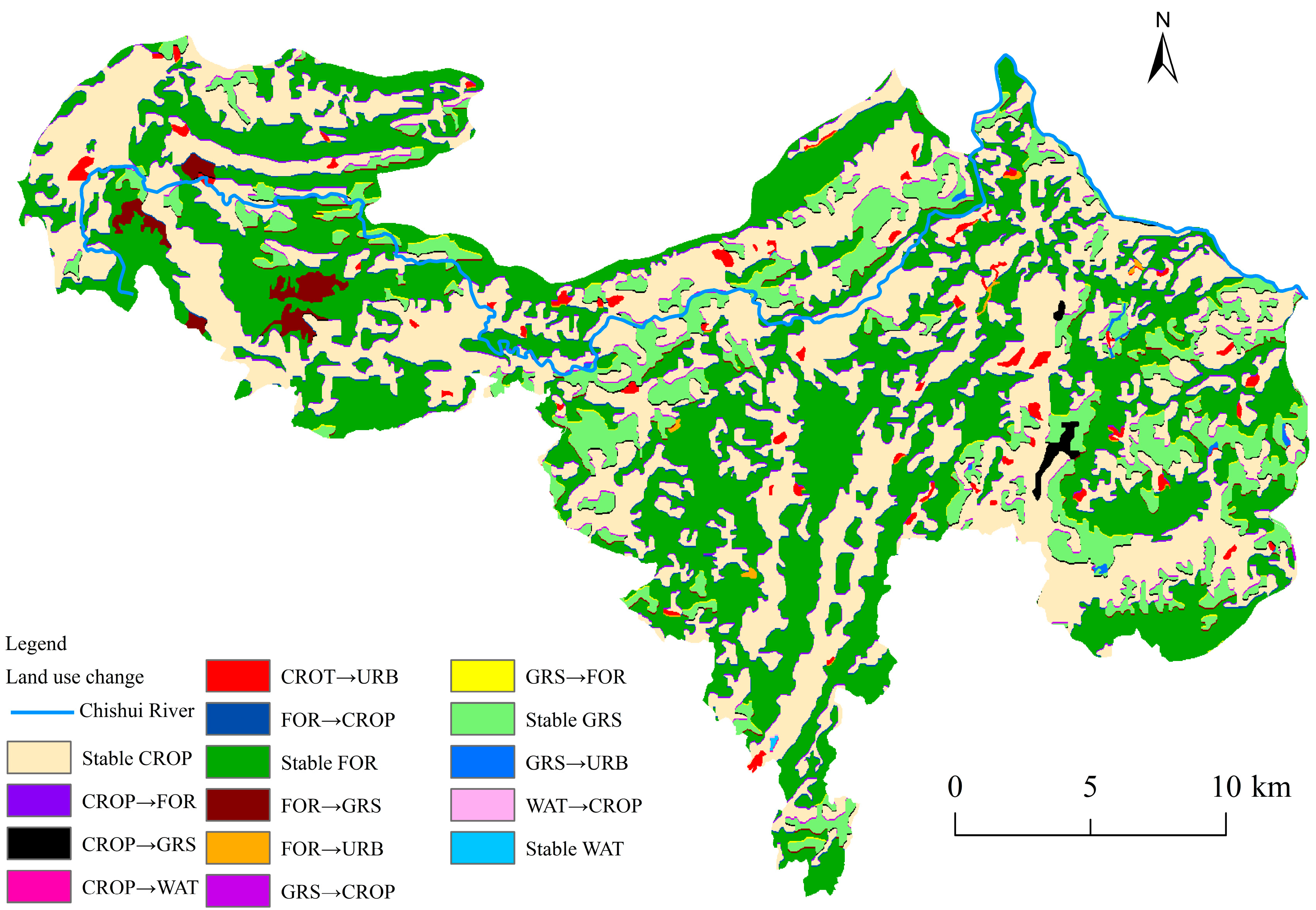
The most prominent changes in land use found between 2000 and 2020 were the shift in cropland into construction land and grassland, along with the conversion of forest land to grassland (Figure 3). Furthermore, the area of construction land increased by 9.01 km2, whereas water bodies showed only a negligible variation (Table 5). Construction land demonstrated the greatest degree of transformation among all land use categories, reflected in an exceptionally high average annual dynamic degree of 180.14%. Grassland was identified as the second most dynamic, with an average annual dynamic degree of 1.58% (Table 6).
Forest and cropland were the major landscape forms in the primary channel zone at the source of the Chishui River, with both accounting for roughly equal proportions and together accounting for over 85% of the total area (Table 4). These two types also had the largest areas of conversion (Figure 3). Between 2000 and 2020, the area of cropland converted to forest land was found to be 13.69 km2, slightly larger than the area of forest land converted to cropland (13.17 km2; Figure 3). This supported the impact of national ecological restoration initiatives, demonstrating the effectiveness of both the “Returning cropland to forest” policy and the “Cropland occupation-compensation balance” policy. The survey indicated that the local authorities promoted the conversion of cropland in environmentally sensitive areas, such as steep-slope cropland, into forests, a practice that contributes to effective ecological conservation. Concurrently, to maintain the cropland quantity, the government simultaneously reclaimed suitable forest areas for agricultural purposes.
Construction land in the primary channel zone of the Chishui River source region experienced substantial growth between 2000 and 2020 (Table 5 and Table 6). The spatial expansion was most pronounced between 2005 and 2015, with an increase of 9.03 km2, while growth slowed progressively from 2015 to 2020 (Table 5). Similarly, in 2010, the study area experienced the centralized development of tourism infrastructure, accompanied by government-led resident relocation projects, facilitating the establishment of new residential land.

3.3. Driving Factors

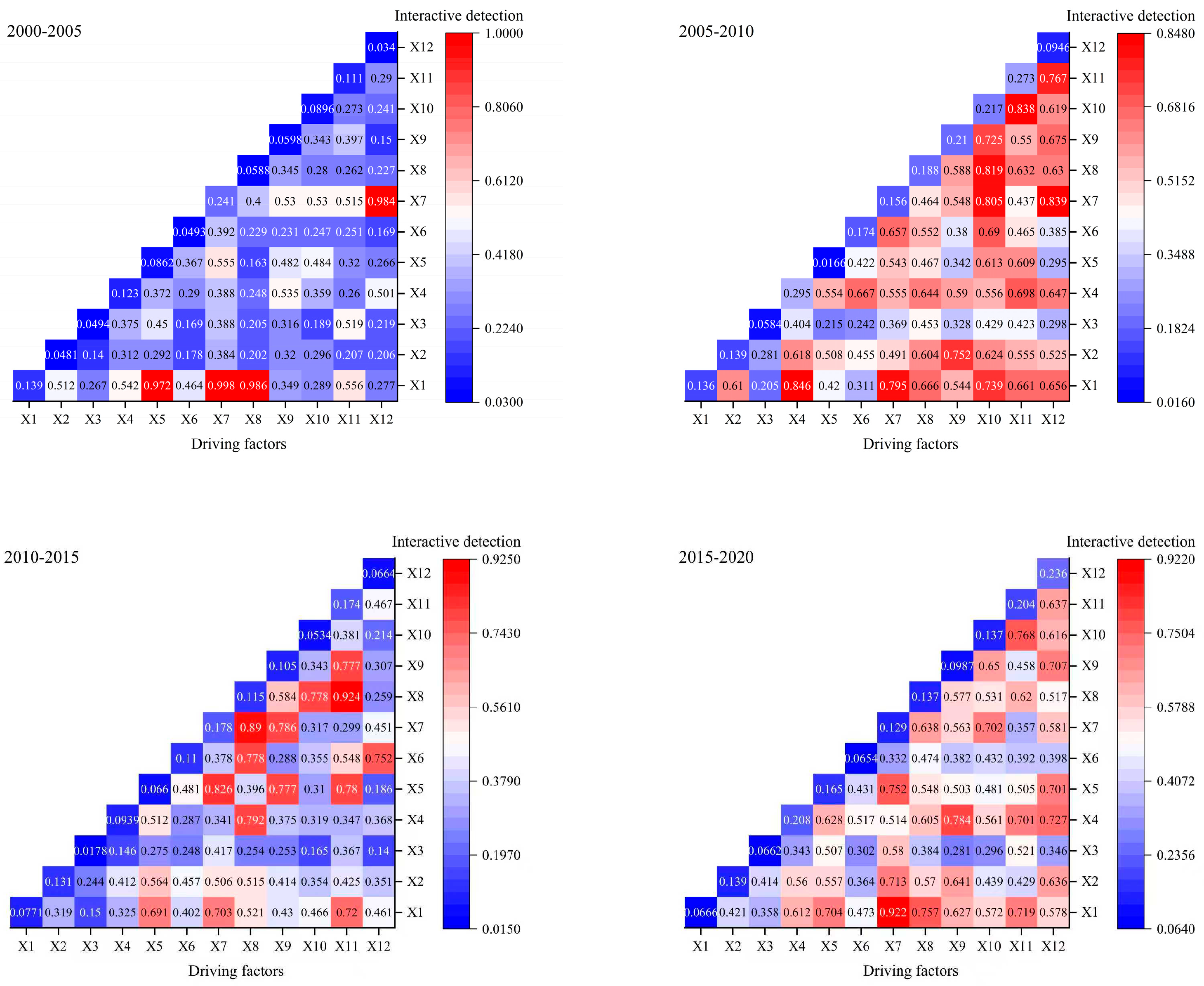
Across different periods from 2000 to 2020, the interactions among driving factors exerted a greater influence on LUCC in the primary channel zone of the Chishui River source than that of individual factors. These interactions demonstrated either non-linear or two-factor enhancement effects, indicating that LUCC in the study area is a complex process regulated by the interactions of multiple driving factors in this region (Figure 4).
From 2000 to 2005, the interactive explanatory powers of several factor combinations were assessed, including elevation (X1) and distance to township government seats (X5) (X1∩X5), elevation (X1) and distance to provincial roads (X7) (X1∩X7), elevation (X1) and distance to settlements (X8) (X1∩X8), distance to provincial roads (X7) and GDP (X12) (X7∩X12). The respective values were determined to be 0.972, 0.998, 0.986, and 0.984, respectively, indicating that all these combinations demonstrated strong interactive explanatory power. The findings revealed that LUCC during this period was primarily influenced by interactions of elevation, transportation distance to provincial roads, township government seats and settlements, and GDP (Figure 4).
From 2005 to 2010, the interactive explanatory powers of several factor combinations, including elevation (X1) and distance to county roads (X4); distance to provincial roads (X7) and population (X10), distance to settlements (X8) and population (X10), population (X10) and annual average precipitation (X11), and distance to provincial roads (X7) and GDP (X12),were determined to be 0.846, 0.805, 0.819, 0.838 and 0.839, respectively, indicating that these two combinations demonstrated relatively strong interactive explanatory power. The findings revealed that elevation, population, transportation distance to county roads, provincial roads, and settlements, annual average precipitation and GDP were the main factors affecting the LUCC during this period (Figure 4).
Between 2010 and 2015, the interactive explanatory powers of several factor combinations, including distance to township government seats (X5) and distance to provincial roads (X7), distance to provincial roads (X7) and distance to settlements (X8), distance to settlements (X8) and annual average precipitation (X11), denoted as X5∩X7, X7∩X8, X8∩X11, respectively, revealed that all these combinations had relatively strong interactive explanatory power, with the explanatory power of all interactions exceeding 0.8. Furthermore, the greatest explanatory power was 0.924 for the interaction between distance to settlements and annual average precipitation (X8∩X11). The results suggest that the combined effects of transportation distance to settlements, township government seats, and provincial roads, and annual average precipitation greatly influenced the LUCC during this period (Figure 4).
From 2015 to 2020, the interaction between elevation (X1) and distance to provincial roads (X7) (X1∩X7) revealed that the explanatory power of all interactions was 0.922, indicating that this combination demonstrated strong interactive explanatory power. These results indicated that elevation and distance to provincial roads were the key interacting factors driving LUCC during this period (Figure 4).

3.4. Future Multi-Scenario Prediction of Landscape Patterns

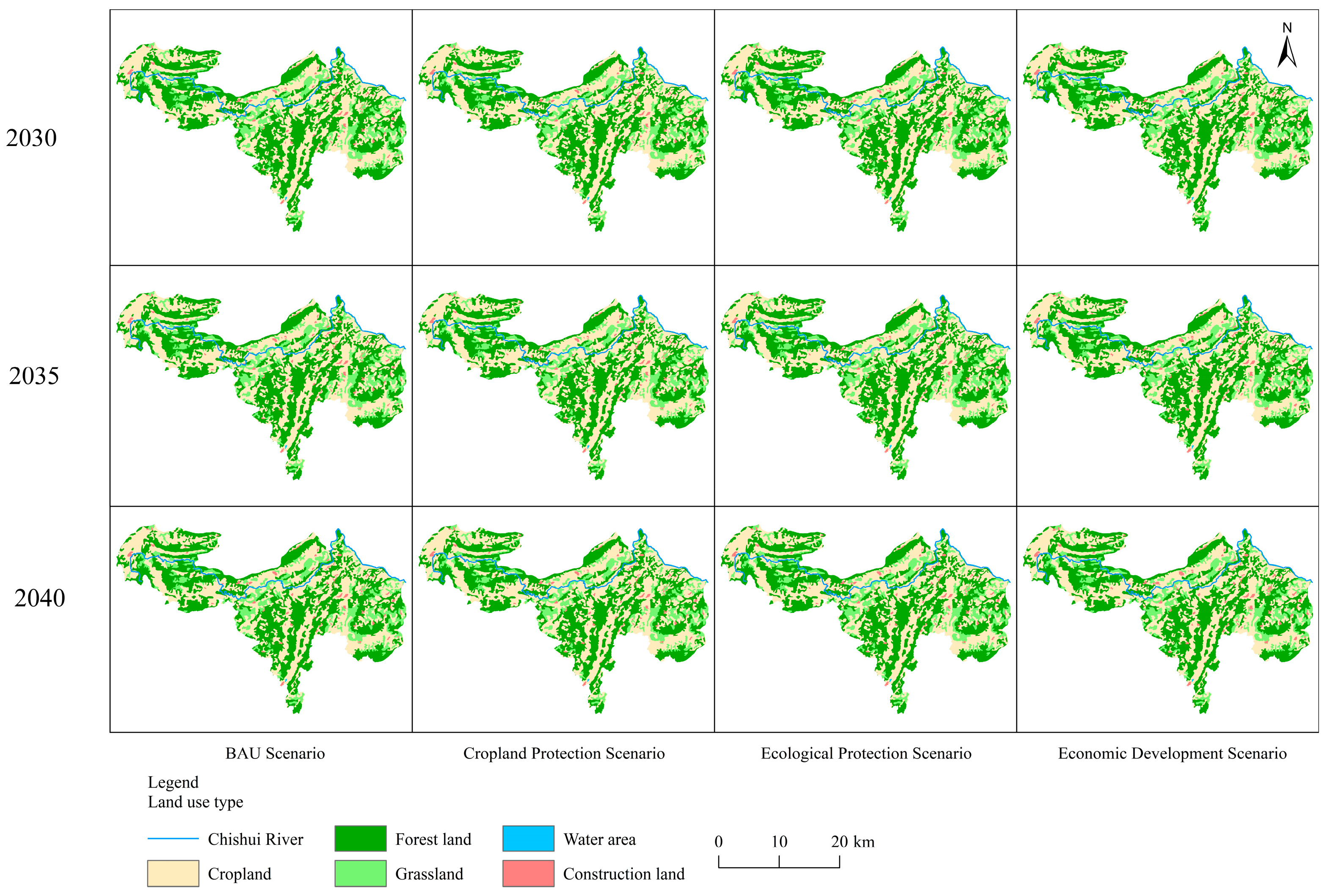
Under the scenario of natural development from 2020 to 2040, the cropland will demonstrate a decreasing trend, while water areas remained unchanged, with areas of all other land types displaying an increasing trend. The observed findings indicate that, without regulatory constraints, economic development will lead to the encroachment of construction land into other land types, accompanied by an increasing trend of land abandonment in the study area. Under the scenario of cropland protection, the cropland will demonstrate the largest expansion, increasing by 7.01 km2 compared with that in 2020, primarily at the expense of forest land and grassland. Under the scenario of ecological protection, forest land and grassland will experience the largest increases in area, water areas expanded moderately, construction land demonstrated a slight increase, and cropland was the only land type experiencing a decrease. Under this scenario, the constraints restricted the expansion of construction land into forest land, contributing to the protection of regional ecological stability. Under the scenario of economic development, construction land demonstrated the most prominent expansion, increasing by a total of 2.52 km2 over 20 years. The area of grassland increased by 0.43 km2, while cropland, forest land, and water areas declined by 3.30, 0.54, and 0.01 km2. The expansion of construction land primarily occurred in areas adjacent to cropland (Figure 5 and Table 7).

4. Discussion

4.1. Landscape Pattern Evolution

The landscape pattern evolution in the primary channel area of the Chishui River source evolved with increasing fragmentation, enhanced diversity, and stable dominant landscape types. It is essentially an unavoidable consequence of the prolonged interaction between the unique natural background of karst mountainous areas and human activities, and its core underlying mechanism can be analyzed from three perspectives: natural endowment constraints, human activity dominance, and policy regulation and guidance [6,41,55]. In terms of natural endowments, the Chishui River source is dominated by karst landforms, characterized by intense dissolution and rugged terrain, leading to pronounced topographic relief and a naturally highly fragmented landscape (Figure 1) [28,29]. Historical differences in hydrothermal conditions across the peaks, slopes, and depressions have contributed to diverse vegetation communities. According to the field surveys, human development activities are naturally constrained by rugged terrain and poor traffic accessibility at higher elevations, preserving forests in a relatively intact and contiguous distribution and allowing them to serve as the core carrier of the regional dominant landscape. The low-altitude river valleys, with flat terrain and abundant water resources, are not only the preferred areas for human settlement and agricultural production, but also the prominent zones of transportation construction and economic activities. Diverse land development strategies have directly increased the degree of landscape fragmentation in these regions, resulting in a spatial differentiation pattern characterized by “stability in high altitudes and fragmentation in low altitudes”. The intensity and patterns of human activities directly influence the direction and rate of landscape pattern evolution. From 2000 to 2020, the total population of the study area experienced continuous growth, and the population density increased steadily, resulting in a significant increase in the demand for residential and production spaces and directly contributing to the expansion of construction land. However, such expansion was not characterized by unorganized sprawl; rather, its spatial distribution was strictly regulated by transportation accessibility and economic development level. Areas along roads, taking advantage of areas close to residential settlements and convenient logistics, with concentrated labor forces, emerged as the core zones for construction land expansion, accounting for the phenomenon that the conversion of cropland to construction land predominantly occurred in the marginal cropland conversion zones. Meanwhile, two major types of land use changes have been initiated against the dual backdrop of limited regional land resources and rural labor transfer. To meet the requirements of agricultural production, steep slope reclamation was implemented in some areas, thus compromising the integrity of the original landscape. The increasing number of migrant workers has resulted in the abandonment of some cropland, allowing for the natural restoration of grasslands and forest lands and indirectly enhancing greater landscape diversity. With growing national emphasis on ecological protection and the implementation of policies, such as returning cropland to forest and controlling rocky desertification, the land use pattern of the region has undergone significant changes. Consequently, forest and cropland, the dominant landscape types in the Chishui River source region, consistently covered over 85% of the study area, reflecting the influence of the government’s constraints on ecological protection red line policies and spatial planning. The Grain for Green program, which involves converting steep-slope cropland into forests, has promoted the conversion of unsuitable cropland into forest land areas. However, the effectiveness of such ecological restoration is associated with certain economic costs. Reduced cropland may have long-term effects on grain production capacity. The government has simultaneously reclaimed suitable forest areas for agricultural uses to maintain the quantity of cropland. As a result, the proportional areas of local forest land and cropland have not significantly changed over time.
The evolution of landscape patterns was found to be a complex process shaped by multiple interacting driving factors. Although the interactive dual-factor combinations driving LUCC varied across different stages, the combined effects of distance to provincial roads and several other factors consistently exerted a strong influence throughout each period. The interactive effect of elevation was particularly pronounced in the periods of 2000–2010 and 2015–2020, whereas that of annual average precipitation was prominent during 2005–2015. Meanwhile, the interactive effect of GDP stood out in 2000–2010, and that of population was distinct in 2005–2010 (Figure 4). These results indicated that LUCC in the primary channel area of the Chishui River source region was strongly influenced by natural factors, human activities, and phased economic development, with the transport accessibility and elevation playing the most prominent role. The karst landforms in the Chishui River source region provide the fundamental constraints on land use, while human activities and socio-economic factors act as reinforcing disturbances, indicating that regional management in this region needs to comprehensively consider the synergistic effects of natural conditions and socioeconomic factors.
In the future multi-scenario prediction of LUCC, the four scenarios of natural development, cropland protection, ecological protection, and economic development directly address the key trade-offs among ecological, production, and living spaces in the primary channel area of the Chishui River source region. The natural development scenario serves as a baseline for evaluating policy interventions; the cropland protection scenario aligned with the national policy of the “red line for cropland protection” and reflects the limited availability of high-quality cropland in the karst river source region; the ecological protection scenario conforms to the ecological positioning of the Chishui River as a “natural-flow tributary in the upper reaches of the YR”; and the economic development scenario addresses local needs for economic growth and infrastructure improvement. The prediction results provide a quantitative basis for territorial spatial planning. In future development, achieving a balance between ecological conservation and economic development has become the key challenge to regional management in this region [29,30,32]. Moving forward, integrating the outcomes of multi-scenario predictions will be essential to evaluate the relationship between these two aspects and to optimize the land use structure, which is critical for the sustainable development of the region.

4.2. Comparison with Previous Studies

Many studies have examined the evolution of landscape patterns across different regions [56,57,58]. For example, Yang, Zhong, Deng and Nie [16] investigated the effects of LUCC on landscape patterns in the YR Basin from 2001 to 2019 and identified human activities as the primary driving factor. This finding partially aligns with the present study, where construction and cropland were significantly affected by human activities. While the YR Basin spans a vast area, the primary channel area of the Chishui River source region, as a mountainous headwater area of karst landforms, features a highly dissected natural base (e.g., karst dissolution landforms) and specific human activities (e.g., returning cropland to forest and cropland reclamation), resulting in a distinctive pattern of landscape fragmentation. Liu et al. [59], using multispectral remote sensing, confirmed that urban sprawl significantly affected the landscape patterns of wetland parks, which is consistent with this study’s finding that the construction land expansion increased landscape diversity. However, unlike the contiguous urban sprawl pattern observed in plain areas, construction land expansion in the primary channel area of the Chishui River source region was constrained by the mountainous terrain, resulting in a dispersed layout along river valleys.
Previous studies have investigated changes in landscape patterns in the Chishui River Basin [27,28,29]. For example, Ma, Feng, Song, Ji, Yang and Li [30] analyzed the spatial distribution and temporal–spatial changes in land use types in the Chishui River Basin from 1990 to 2018 using land use transfer matrices and dynamic degree, based on data from the Resource and Environmental Science Data Platform, CAS. Wu and Wang [31] employed the intensity map model and the Markov-PLUS model to analyze land use and land cover and to predict future multi-scenario changes in the Chishui River Basin, Guizhou Province, using the China Land Cover Dataset from Wuhan University. However, most existing studies have focused on the entire Chishui River Basin or its middle and lower reaches, while research on landscape pattern evolution in the source region, particularly in the primary channel area with relatively intense human activities, remains limited. This study systematically analyzed the landscape pattern evolution, quantified driving factors, and predicted future multi-scenario changes in the primary channel area of the Chishui River source region by integrating landscape pattern indices, land use transfer matrices, dynamic degree, the GeoDetector model, and the PLUS model. To further enhance the reliability of the research, extensive field surveys were conducted in the local study region, providing a scientific basis for territorial spatial planning and supporting the effective implementation of ecological and economic development in the region. As an important tributary of the Yangtze River, well-planned ecological and economic development activities in the source region of the Chishui River can positively contribute to the healthy and sustainable development of the entire Yangtze River Basin. Furthermore, as a representative mountain–river system in the karst river source region, analysis of the evolution of landscape patterns in the primary channel area of the Chishui River source region provides valuable insights into the dynamics of landscape patterns in other similar mountain-river systems.
As with any study in landscape ecology and land use simulation, this study has certain inherent limitations. The PLUS model showed limited responsiveness to sudden ecological compensation policies and other emergent policy interventions, potentially affecting the accuracy of LUCC predictions, especially in policy-driven ecological conservation zones. To address this limitation, future research could focus on technical optimizations tailored for policy-sensitive simulation scenarios, particularly by integrating a dynamic policy parameter adjustment module capable of adapting to the timing, intensity, and scope of emergent policy measures. These modifications are expected to significantly enhance the model’s predictive adaptability in complex real-world contexts, allowing it to more accurately capture the interactions between sudden policy changes and landscape ecological dynamics.

5. Conclusions

This study analyzed the evolution of landscape patterns in the primary channel area of the Chishui River source region from 2000 to 2020 and predicted the landscape pattern changes from 2030 to 2040. Between 2000 and 2020, the landscape evolution was characterized by increased fragmentation, enhanced diversity, and stable dominant landscape types, resulting from the combined influence of natural as well as anthropogenic factors. Forest land and cropland were the main landscape types in the study area, consistently covering over 85% of the total area, largely due to government regulations on ecological protection red lines and spatial planning. At the landscape pattern type level, the patch and interspersion index values were ranked as follows: construction land (63.73) > cropland (4.18) > grassland (3.22) > forest land (0.66) > water area (0), indicating that construction land, cropland, and grassland were relatively more affected by human activities, while forest land and water areas were relatively less affected. Landscape pattern evolution is primarily influenced by natural factors, human activities, and phased economic development, with the transport accessibility and elevation playing the most significant role. Future LUCC in the study area is expected to vary considerably under different scenarios. This study deepens the understanding of landscape pattern evolution in karst river source regions, providing scientific support for local territorial spatial planning, ecological protection, and the coordinated development of ecology and economy. Regarding limitations, the PLUS model shows limited responsiveness to emergent policy interventions, which restricts its ability to accurately capture the immediate effects of short-term, intensive policy measures. Therefore, developing a dynamic policy parameter module in future studies would enhance prediction reliability under complex policy scenarios.

Author Contributions

Y.G.: writing—original draft, writing—review and editing, methodology, software, formal analysis, data curation, validation, investigation, and conceptualization; X.H.: writing—review and editing, supervision, resources, project administration, methodology, investigation, conceptualization, and funding acquisition; J.L.: formal analysis, data curation; J.Z.: writing—review and editing; D.F.: writing—review and editing; G.L.: supervision, writing—review and editing. All authors have read and agreed to the published version of the manuscript.

Funding

This research was funded by the Yunnan Provincial Department of Education Science Research Foundation Funded Project (2026J1146) and the National Natural Science Foundation of China (U21A20185).

Institutional Review Board Statement

Ethical review and approval were waived for this study by Institutional Committee due to Legal Regulations: https://www.gov.cn/zhengce/zhengceku/2023-02/28/content_5743658.htm (accessed on 24 October 2025).

Informed Consent Statement

Informed consent for participation was obtained from all subjects involved in the study.

Data Availability Statement

The raw data supporting the conclusions of this article will be made available by the authors on request.

Conflicts of Interest

The authors declare that they have no known competing financial interests or personal relationships that could have appeared to influence the work reported in this paper.

References

  1. Dong, X.; Stokes, M.F.; Hendry, A.P.; Larsen, L.G.; Dolby, G.A. Geo-evolutionary feedbacks: Integrating rapid evolution and landscape change. Trends Ecol. Evol. 2024, 39, 863–876. [Google Scholar] [CrossRef]
  2. Fu, F.; Deng, S.; Wu, D.; Liu, W.; Bai, Z. Research on the spatiotemporal evolution of land use landscape pattern in a county area based on CA-Markov model. Sustain. Cities Soc. 2022, 80, 103760. [Google Scholar] [CrossRef]
  3. Leonard, J.S.; Whipple, K.X.; Heimsath, A.M. Isolating climatic, tectonic, and lithologic controls on mountain landscape evolution. Sci. Adv. 2023, 9, eadd8915. [Google Scholar] [CrossRef] [PubMed]
  4. Karlstrom, L.; Klema, N.; Grant, G.E.; Finn, C.; Sullivan, P.L.; Cooley, S.; Simpson, A.; Fasth, B.; Cashman, K.; Ferrier, K.; et al. State shifts in the deep Critical Zone drive landscape evolution in volcanic terrains. Proc. Natl. Acad. Sci. USA 2025, 122, e2415155122. [Google Scholar] [CrossRef]
  5. Kwang, J.S.; Thaler, E.A.; Quirk, B.J.; Quarrier, C.L.; Larsen, I.J. A Landscape Evolution Modeling Approach for Predicting Three-Dimensional Soil Organic Carbon Redistribution in Agricultural Landscapes. J. Geophys. Res. Biogeosci. 2022, 127, e2021JG006616. [Google Scholar] [CrossRef]
  6. Li, N.; Zhao, F.; Chen, S.; Li, C.; Wang, Y.; Ma, Y.; Chen, L. Indirect non-linear effects of landscape patterns on vegetation growth in Kunming City. npj Urban Sustain. 2024, 4, 30. [Google Scholar] [CrossRef]
  7. Lyu, X.; Li, X.; Wang, K.; Dang, D.; Gong, J.; Wang, H.; Lou, A. Optimizing landscape patterns to maximize ecological-production benefits of water-food relationship: Evidence from the West Liaohe River basin, China. Land Degrad. Dev. 2023, 34, 3388–3405. [Google Scholar] [CrossRef]
  8. Liu, Q.; Qiao, J.; Li, M.; Dun, Y.; Zhu, X.; Ji, X. Spatiotemporal evolution of ecological environmental quality and its dynamic relationships with landscape pattern in the Zhengzhou Metropolitan Area: A perspective based on nonlinear effects and spatiotemporal heterogeneity. J. Clean. Prod. 2024, 480, 144102. [Google Scholar] [CrossRef]
  9. Meng, F.Q.; Dong, L.; Zhang, Y. Spatiotemporal Dynamic Analysis and Simulation Prediction of Land Use and Landscape Patterns from the Perspective of Sustainable Development in Tourist Cities. Sustainability 2023, 15, 14450. [Google Scholar] [CrossRef]
  10. Hou, B.; Wei, C.; Liu, X.; Meng, Y.; Li, X. Assessing Forest Landscape Stability Through Automatic Identification of Landscape Pattern Evolution in Shanxi Province of China. Remote Sens. 2023, 15, 545. [Google Scholar] [CrossRef]
  11. Beroho, M.; Briak, H.; Cherif, E.K.; Boulahfa, I.; Ouallali, A.; Mrabet, R.; Kebede, F.; Bernardino, A.; Aboumaria, K. Future Scenarios of Land Use/Land Cover (LULC) Based on a CA-Markov Simulation Model: Case of a Mediterranean Watershed in Morocco. Remote Sens. 2023, 15, 1162. [Google Scholar] [CrossRef]
  12. Peng, C.H.; Huang, L.C.; Yang, L.X.; Li, Y.; Zhang, W.K. Spatiotemporal Evolution of Land-Use Landscape Patterns Under Park City Construction: A GIS-Based Case Study of Shenyang’s Main Urban Area (2000–2020). Sustainability 2025, 17, 7360. [Google Scholar] [CrossRef]
  13. Wei, Y.; Zhou, P.; Zhang, L.; Zhang, Y. Spatio-temporal evolution analysis of land use change and landscape ecological risks in rapidly urbanizing areas based on Multi-Situation simulation—A case study of Chengdu Plain. Ecol. Indic. 2024, 166, 112245. [Google Scholar] [CrossRef]
  14. Wu, J.; Wu, C.; Zhang, Q.; Zhuang, M.; Xiao, H.; Wu, H.; Ouyang, L.; Liu, Y.; Meng, C.; Song, C.; et al. Spatiotemporal Evolution of Urban Agglomeration and Its Impact on Landscape Patterns in the Pearl River Delta, China. Remote Sens. 2023, 15, 2520. [Google Scholar] [CrossRef]
  15. Yuan, X.P.; Jiao, R.; Dupont-Nivet, G.; Shen, X. Southeastern Tibetan Plateau Growth Revealed by Inverse Analysis of Landscape Evolution Model. Geophys. Res. Lett. 2022, 49, e2021GL097623. [Google Scholar] [CrossRef]
  16. Yang, H.; Zhong, X.; Deng, S.; Nie, S. Impact of LUCC on landscape pattern in the Yangtze River Basin during 2001–2019. Ecol. Inform. 2022, 69, 101631. [Google Scholar] [CrossRef]
  17. Liu, J.; Xu, Q.L.; Yi, J.H.; Huang, X. Analysis of the heterogeneity of urban expansion landscape patterns and driving factors based on a combined Multi-Order Adjacency Index and Geodetector model. Ecol. Indic. 2022, 136, 108655. [Google Scholar] [CrossRef]
  18. Du, X.T.; Fang, Y.; Zhao, H.Y.; Xu, X.M. Spatiotemporal evolution and driving forces of landscape structure and habitat quality in river corridors with ceased flow: A case study of the Yongding River corridor in Beijing, China. J. Environ. Manag. 2025, 374, 123861. [Google Scholar] [CrossRef] [PubMed]
  19. Curry, M.E.; van der Beek, P. Exploring Controls on Post-Orogenic Topographic Stasis of the Pyrenees Mountains with Inverse Landscape Evolution Modeling. J. Geophys. Res. Earth Surf. 2025, 130, e2024JF007759. [Google Scholar] [CrossRef]
  20. Cao, J.; Cao, W.D.; Cao, Y.H.; Wang, X.W.; Zhang, Y.Z.; Ma, J.J. Multi-scenario land use prediction and layout optimization in Nanjing Metropolitan Area based on the PLUS model. J. Geogr. Sci. 2024, 34, 1415–1436. [Google Scholar] [CrossRef]
  21. Cagliyan, A.; Dagli, D. Monitoring Land Use Land Cover Changes and Modelling of Urban Growth Using a Future Land Use Simulation Model (FLUS) in Diyarbakir, Turkey. Sustainability 2022, 14, 9180. [Google Scholar] [CrossRef]
  22. Jiang, L.; Wang, Z.Z.; Zuo, Q.T.; Du, H.H. Simulating the impact of land use change on ecosystem services in agricultural production areas with multiple scenarios considering ecosystem service richness. J. Clean. Prod. 2023, 397, 136485. [Google Scholar] [CrossRef]
  23. Sun, Y.; Wu, Y.; Yu, H.; Li, Y. Spatiotemporal evolution of urban landscapes in Chinese historic water towns (1918–2021). Landsc. Res. 2024, 49, 568–583. [Google Scholar] [CrossRef]
  24. Zhao, J.; Liu, S.; Wang, Z.; Gao, H.; Feng, S.; Wei, B.; Hou, Z.; Xiao, F.; Jing, L.; Liao, X. The Impact of Land Use and Landscape Pattern on Ecosystem Services in the Dongting Lake Region, China. Remote Sens. 2023, 15, 2228. [Google Scholar] [CrossRef]
  25. Li, Y.; Geng, H.; Luo, G.; Wu, L.; Wang, J.; Wu, Q. Multiscale characteristics of ecosystem service value trade-offs/synergies and their response to landscape pattern evolution in a typical karst basin in southern China. Ecol. Inform. 2024, 81, 102584. [Google Scholar] [CrossRef]
  26. Bai, X.; Xiong, K.; Chen, Y.; Liu, Z. Spatiotemporal evolution of landscape stability in World Heritage Karst Sites: A case study of Shibing Karst and Libo-Huanjiang Karst. Herit. Sci. 2024, 12, 215. [Google Scholar] [CrossRef]
  27. Zhan, J.X.; Wu, Z.X. Effects of liquor production wastewater discharge on water quality and health risks in the Chishui River Basin, Southwest China. J. Clean. Prod. 2023, 418, 138136. [Google Scholar] [CrossRef]
  28. Zhou, C.; Ran, M.L.; Wang, Z.Y.; Li, M.; Wang, X.D.; Zhang, C.H.; Song, Z.B. Baseline biomonitoring of microplastic pollution in freshwater fish from the Chishui River, China: Insights into accumulation patterns and influencing factors. J. Hazard. Mater. 2025, 495, 139055. [Google Scholar] [CrossRef] [PubMed]
  29. Chi, S.Y.; Gong, Y.T.; Wang, H.J.; Zheng, J.X.; Hu, J.; Hu, J.X.; Dong, F.Y. A pilot macroinvertebrate-based multimetric index (MMI-CS) for assessing the ecological status of the Chishui River basin, China. Ecol. Indic. 2017, 83, 84–95. [Google Scholar] [CrossRef]
  30. Ma, H.; Feng, C.; Song, T.; Ji, W.; Yang, J.; Li, F. Study on the characteristics of land use change in Chishui River Basin from 1990 to 2018. J. Environ. Eng. Technol. 2021, 11, 428–436. [Google Scholar]
  31. Wu, C.; Wang, Z. Multi-scenario simulation and evaluation of the impacts of land use change on ecosystem service values in the Chishui River Basin of Guizhou Province, China. Ecol. Indic. 2024, 163, 112078. [Google Scholar] [CrossRef]
  32. Rong, G.; Weici, S.; Wenzhuo, D.; Liang, H. Topographic gradient analysis and application of machine learning models for trade-offs and synergies of ecosystem services in the Chishui River Basin. Acta Ecol. Sin. 2025, 45, 9980–9996. [Google Scholar]
  33. Wang, W.B.; Zhao, Y.Y.; Guan, T.Z.; Qin, C.X.; Chen, D.N.; Jia, H.F.; Zhang, X.Z.; Yu, Y.H. A novel method for hydrology and water quality simulation in karst regions using machine learning model. Ecol. Indic. 2025, 178, 113862. [Google Scholar] [CrossRef]
  34. He, K.Q.; Jia, Y.Y.; Wang, F.; Lu, Y.R. Overview of karst geo-environments and karst water resources in north and south China. Environ. Earth Sci. 2011, 64, 1865–1873. [Google Scholar] [CrossRef]
  35. Xu, X.; Liu, J.; Zhang, S.; Li, R.; Yan, C.; Wu, S. China Multi-period Land Use Remote Sensing Monitoring Dataset. Resour. Environ. Sci. Data Platf. 2024. [Google Scholar] [CrossRef]
  36. Zhenxiong County People’s Government. Overview of Ecological and Environmental Protection Work During the 13th Five-Year Plan Period (5 Years) and 2020, Major Goals and Tasks for the 14th Five-Year Plan Period, and Key Work for 2021 in the City. 2021. Available online: http://www.zx.gov.cn/searchDetail.html?channelId=5538&id=19436 (accessed on 24 October 2025).
  37. Zhenxiong County People’s Government. Zhenxiong County Coordinates and Promotes the Work of Cultivated Land Protection. 2023. Available online: http://www.zx.gov.cn/searchDetail.html?channelId=5498&id=25446 (accessed on 24 October 2025).
  38. Zhenxiong County People’s Government. Public Notice Form of the 2024 County-Level Inspection and Acceptance Results for the 2020 Grain for Green Program in Zhenxiong County. 2024. Available online: http://www.zx.gov.cn/searchDetail.html?channelId=5501&id=32033 (accessed on 24 October 2025).
  39. Zhenxiong County People’s Government. Yang Xuchun Conducts an Investigation and Research Tour in Chishuiyuan Town. 2024. Available online: http://www.zx.gov.cn/searchDetail.html?channelId=5498&id=31974 (accessed on 24 October 2025).
  40. Zhenxiong County People’s Government. Draft for Public Comment on the Interim Measures for the Administration of Rural Homesteads in Zhenxiong County. 2024. Available online: http://www.zx.gov.cn/searchDetail.html?channelId=5468&id=31023 (accessed on 24 October 2025).
  41. Fox, M.; Clinger, A.; Smith, A.G.G.; Cuffey, K.; Shuster, D.; Herman, F. Antarctic Peninsula glaciation patterns set by landscape evolution and dynamic topography. Nat. Geosci. 2024, 17, 73–78. [Google Scholar] [CrossRef]
  42. Le, Z.; Jinrui, L.; Zongzhu, C.; Yiqing, C.; Peng, Z. Spatio-temporal Evolution Characteristics and Influencing Factors of Landscape Ecological Risks in the Three Major Basins of Hainan Island, China. Acta Ecol. Sin. 2025, 45, 1646–1658. [Google Scholar]
  43. Yijun, W.; Chao, S.; Shuwei, W.; Jinlong, Z.; Xiaofang, M. Landscape pattern evolution and its driving forces in the Shiyang River Basin from 1986 to 2020. Pratacultural Sci. 2023, 40, 303–317. [Google Scholar]
  44. Liu, Y.Y.; Ma, C.H.; Ma, L.Y.; Li, N. Ecological effects of land use and land cover change in the typical ecological functional zones of Egypt. Ecol. Indic. 2024, 168, 112747. [Google Scholar] [CrossRef]
  45. Lin, F.; Chen, X.W.; Yao, H.X.; Lin, F.Y. SWAT model-based quantification of the impact of land-use change on forest-regulated water flow. Catena 2022, 211, 105975. [Google Scholar] [CrossRef]
  46. Jinfeng, W.; Chengdong, X. Geodetector: Principle and prospective. Acta Geogr. Sin. 2017, 72, 116–134. [Google Scholar]
  47. Guo, L.L.; Wu, Z.W.; Li, S.; Xie, G. The relative impacts of vegetation, topography and weather on landscape patterns of burn severity in subtropical forests of southern China. J. Environ. Manag. 2024, 351, 119733. [Google Scholar] [CrossRef]
  48. Luo, Q.; Liu, F. Spatial-temporal evolution and driving forces of landscape ecological risk in the Chishui River Basin (Guizhou section). Chin. J. Eco-Agric. 2025, 33, 550–562. [Google Scholar]
  49. Mandal, B.; Goswami, K.P. Evaluating the influence of biophysical factors in explaining spatial heterogeneity of LST: Insights from Brahmani-Dwarka interfluve leveraging Geodetector, GWR, and MGWR models. Phys. Chem. Earth 2025, 138, 103836. [Google Scholar] [CrossRef]
  50. Zhang, M.M.; Tan, S.K.; Chen, E.Q.; Li, J.X. Spatio-temporal characteristics and influencing factors of land disputes in China: Do socio-economic factors matter? Ecol. Indic. 2024, 160, 111938. [Google Scholar] [CrossRef]
  51. Wang, J.; Zhang, J.P.; Xiong, N.N.; Liang, B.Y.; Wang, Z.; Cressey, E.L. Spatial and Temporal Variation, Simulation and Prediction of Land Use in Ecological Conservation Area of Western Beijing. Remote Sens. 2022, 14, 1452. [Google Scholar] [CrossRef]
  52. Tongli, N.; Lihua, X.; Jie, C.; Yanlai, Z.; Jiabo, Y.; Dedi, L. Land use simulation and multi-scenario prediction of the Yangtze River Basin based on PLUS model. Eng. J. Wuhan Univ. 2024, 57, 129–141. [Google Scholar]
  53. Wang, F.; Li, J.; Wang, J.; Xiang, S.Y.; Chen, X.T.; Yi, X.M.; Huang, X.T.; Huang, T. Multi-Scenario Simulation of Land Use Change in Chengyu Economic Zone and Its Influence on Carbon Reserves. Environ. Sci. 2025, 46, 5718–5728. [Google Scholar]
  54. Gao, L.A.; Tao, F.; Liu, R.R.; Wang, Z.L.; Leng, H.J.; Zhou, T. Multi-scenario simulation and ecological risk analysis of land use based on the PLUS model: A case study of Nanjing. Sustain. Cities Soc. 2022, 85, 104055. [Google Scholar] [CrossRef]
  55. Wang, H.; Wang, K.; Zhou, Y.; Bai, X. Effects of human disturbance on the landscape pattern in the mountainous area of western Henan, China. J. Environ. Manag. 2025, 380, 124959. [Google Scholar] [CrossRef]
  56. Deng, L.; Zhang, Q.; Cheng, Y.; Cao, Q.; Wang, Z.; Wu, Q.; Qiao, J. Underlying the influencing factors behind the heterogeneous change of urban landscape patterns since 1990: A multiple dimension analysis. Ecol. Indic. 2022, 140, 108967. [Google Scholar] [CrossRef]
  57. Gu, L.; Yan, J.; Li, Y.; Gong, Z. Spatial-temporal evolution and correlation analysis between habitat quality and landscape patterns based on land use change in Shaanxi Province, China. Ecol. Evol. 2023, 13, e10657. [Google Scholar] [CrossRef] [PubMed]
  58. Alberti, M.; Wang, T. Detecting patterns of vertebrate biodiversity across the multidimensional urban landscape. Ecol. Lett. 2022, 25, 1027–1045. [Google Scholar] [CrossRef] [PubMed]
  59. Liu, C.; Yuan, X.; Ni, G.; Liu, Y.; Qi, Y.; Miao, S. Utilizing deep transfer learning to discover changes in landscape patterns in urban wetland parks based on multispectral remote sensing. Ecol. Inform. 2024, 83, 102808. [Google Scholar] [CrossRef]
Figure 1. Spatial patterns in the study region. (a) Land use in 2010, (b) Elevation, (c) slope, and (d) annual average precipitation between 2000 and 2020. (Note: Land use data in 2010 were obtained from the Resource and Environmental Science Data Platform, Institute of Geographic Sciences and Natural Resources Research, CAS; DEM data were obtained from the Geospatial Data Cloud; information on slope was obtained from the elevation data; precipitation data were obtained from the Data Center of the Institute of Mountain Hazards).
Sustainability 18 00914 g001
Figure 2. Land use distribution in the primary channel zone of the Chishui River source region from 2000 to 2020.
Sustainability 18 00914 g002
Figure 3. Spatial distribution of LUCC in the primary channel zone of the Chishui River source region from 2000 to 2020. Note: CROP, Cropland; FOR, Forest land; GRS, Grassland; WAT, Water area; URB, Construction land.
Sustainability 18 00914 g003
Figure 4. Interactive explanatory power factors driving LUCC in the primary channel zone (2000–2020). Note: X1 = Elevation; X2 = Slope gradient; X3 = Soil type; X4 = Distance to county roads; X5 = Distance to township government seats; X6 = Distance to township roads; X7 = Distance to provincial roads; X8 = Distance to settlements; X9 = Distance to rivers; X10 = Population; X11 = Annual average precipitation; X12 = GDP.
Sustainability 18 00914 g004
Figure 5. Multi-scenario prediction of land use distribution in the primary channel zone of the Chishui River source region in 2030, 2035, and 2040. Note: BAU represents Natural Development Scenario.
Sustainability 18 00914 g005
Table 1. Sources of data.
DataSpatial ResolutionYearData SourceWebsite
Land use30 m2000–2020Resource and Environmental Science Data Platform, Institute of Geographic Sciences and Natural Resources Research, CAShttps://www.resdc.cn
Elevation30 m2020Geospatial Data Cloudhttps://www.gscloud.cn
Slope-2020DEM-
Precipitation30 m2000–2020Data Center of the Institute of Mountain Hazards and Environment, CAShttps://imde.cas.cn
Population1 km2000–2020Resource and Environmental Science Data Platform, Institute of Geographic Sciences and Natural Resources Research, CAShttps://www.resdc.cn
GDP1 km2000–2020Resource and Environmental Science Data Platform, Institute of Geographic Sciences and Natural Resources Research, CAShttps://www.resdc.cn
Soil type1 km1995Resource and Environmental Science Data Platform, Institute of Geographic Sciences and Natural Resources Research, CAShttps://www.resdc.cn
Road data-2020OpenStreetMaphttps://openmaptiles.org
River Data-2020OpenStreetMaphttps://openmaptiles.org
Settlement25 m2000National Center for Fundamental Geographic Informationhttps://www.webmap.cn
Seats of township governments25 m2000National Center for Fundamental Geographic Informationhttps://www.webmap.cn
Field survey data--Questionnaire surveys and interviews-
Note: CAS, Chinese Academy of Sciences; DEM, digital elevation model; GDP, gross domestic product.
Table 2. Comparison of the landscape-level indices in the primary channel zone of the Chishui River source region during the period of 2000 and 2020.
YearNPPDLSICONTAGDIVISIONSHDISHEIAI
20002730.432319.603557.73530.92860.97980.706895.821
20203660.579521.149560.61550.94011.05520.655795.4641
Note: SHDI, Shannon Diversity Index; SHEI, Shannon Evenness Index; PD, Patch Density; NP, Number of Patches; LSI, Landscape Shape Index; CONTAG, Contagion Index; AI, Aggregation Index.
Table 3. Comparison of land types in the primary channel zone of the Chishui River source region in 2000 and 2020.
Land TypesPDLSIPAFRACIJIAI
2000202020002020200020202000202020002020
Cropland0.1710.19023.19724.6231.3181.34252.27356.46195.99895.671
Grassland0.1570.16818.27319.1931.2651.30860.89757.67094.05193.975
Forest land0.1030.10822.39223.1411.3601.35942.62843.29096.13295.954
Water area0.0020.0021.3911.3910.0000.0000.0000.00096.03596.170
Construction land 0.112 12.637 1.329 63.734 88.282
Note: AI, Aggregation Index; IJI, Interspersion and Juxtaposition Index; LSI, Landscape Shape Index; PD, Patch Density; PAFRAC, Perimeter-Area Fractal Dimension. Due to the limited area of construction land patches in this region in 2000, and considering the 30 m-spatial resolution of our land use data, the identification of overly small construction land patches was not feasible, thus failing to calculate the corresponding area of construction land.
Table 4. Land use types proportion in the primary channel zone of the Chishui River source region from 2000 to 2020.
YearProportion of Land Use Types/%
CroplandForest LandGrasslandWater AreaConstruction Land
200044.0543.8412.090.020.00
200544.0643.8112.110.020.00
201042.6442.8513.110.021.37
201542.6042.8713.080.021.43
202042.6342.8813.050.021.43
Table 5. Land use transitions in the primary channel zone of the Chishui River source region from 2000 to 2020 (km2).
YearCroplandForest LandGrasslandWater AreaConstruction Land
2000–20050.080.560.290.000.00
2005–2010−9.69−6.796.140.008.68
2010–2015−0.260.08−0.190.010.35
2015–20200.170.07−0.22−0.01−0.02
2000–2020−8.99−6.076.020.009.01
Table 6. Dynamic degree of land use in the primary channel zone of the Chishui River source region from 2000 to 2020 (%).
YearCroplandForest LandGrasslandWater AreaConstruction Land
2000–20050.060.040.080.000.00
2005–2010−0.69−0.491.600.00173.59
2010–2015−0.020.01−0.051.80.81
2015–20200.010.01−0.05−1.7−0.05
2000–2020−0.65−0.441.580.00180.14
Table 7. Area changes in different land use types under multi-scenario prediction in the primary channel zone of the Chishui river source region during 2020–2040.
Multi-Scenario Prediction of Land Use Area Changes/km2
TypeCroplandForest LandGrasslandWater AreaConstruction LandScenario
Year
2020–2030−1.65−0.110.830.000.02Natural
development
2030–2035−0.440.160.190.000.09
2035–2040−0.450.140.160.000.15
2020–2040−2.540.191.180.000.26
2020–20305.84−5.88−0.880.000.01Cropland
protection
2030–20350.56−0.30−0.270.000.01
2035–20400.61−0.34−0.300.000.02
2020–20407.01−6.52−1.450.000.04
2020–2030−2.270.361.000.000.00Ecological
protection
2030–2035−0.360.160.190.000.01
2035–2040−0.450.140.160.010.15
2020–2040−3.080.661.350.010.16
2020–2030−2.39−0.220.72−0.010.99Economic
development
2030–2035−0.62−0.10−0.090.000.81
2035–2040−0.29−0.22−0.200.000.72
2020–2040−3.30−0.540.43−0.012.52
Disclaimer/Publisher’s Note: The statements, opinions and data contained in all publications are solely those of the individual author(s) and contributor(s) and not of MDPI and/or the editor(s). MDPI and/or the editor(s) disclaim responsibility for any injury to people or property resulting from any ideas, methods, instructions or products referred to in the content.