


Abstract
Artificial intelligence (AI) provides significant benefits for hydroponic systems by enabling precise nutrient management, efficient water recycling, and predictive decision support. However, adoption of AI in Omani hydroponic operations remains inconsistent, and the mechanisms linking contextual factors to farm-level performance are not well understood. This study investigates how technological, organizational, and environmental conditions relate to AI adoption, the association between adoption and perceived performance, and the mediating role of adoption in this relationship. An exploratory sequential mixed-methods approach, based on the Technology–Organization–Environment (TOE) framework, was employed. Data from nineteen interviews produced 563 coded references, and that material then shaped the item wording of a structured survey we administered to seventy-nine respondents. Reliability analysis using Cronbach’s alpha demonstrated acceptable to excellent internal consistency (α = 0.71–0.92). All three TOE dimensions were significant predictors of AI adoption (β = 0.29–0.33; R2 = 0.58). AI adoption emerged as the sole significant direct predictor of perceived performance (β = 0.70; R2 = 0.67), with none of the TOE dimensions retaining a significant direct association. Bootstrap analysis with five thousand resamples confirmed significant indirect effects for the Technological and Environmental dimensions, while the indirect effect for the Organizational dimension was inconclusive: its confidence interval crossing zero—a pattern we read as jointly reflecting heterogeneous organizational capacity across farms and the limited statistical power of a study this size for smaller effects. This study advances the TOE framework within Gulf-region hydroponic agriculture, identifies AI adoption as a key mediating mechanism, and provides evidence-based recommendations for policymakers, agricultural institutions, and technology providers. Since we define performance here in terms of water recycling, resource use and yield stability, the observed associations speak directly to sustainable production in arid settings.
1. Introduction
Water is central to agriculture in the Arabian Peninsula. In Oman, high evaporation, low rainfall, and widespread soil and groundwater salinity have made conventional farming difficult [1,2]. As a result, national strategies like Oman Vision 2040 have made sustainable food production a top priority. Hydroponic farming has become an important option. By recycling water in closed systems and growing crops without soil, hydroponics uses fewer resources, extends the growing season, and could help make Oman’s food supply more resilient [3,4]. Artificial intelligence (AI) expands the benefits of hydroponics. A working hydroponic farm is already logging pH, electrical conductivity, dissolved oxygen, humidity, temperature and light on a continuous basis. That standing data stream is what makes AI useful here in the first place. Machine-learning models sitting on top of it tune irrigation and nutrient dosing, to spot disease and stress earlier than people can, and to adjust the growing environment as needed [5,6,7]. Recent studies show that AI-powered hydroponic systems can cut fertilizer use by over forty percent and recycle nearly all water [8,9]. As part of the Agriculture 4.0 movement [10,11], AI is now seen as the next logical step for hydroponics in Oman. Uptake on the ground, however, is uneven. Even where the policy backing is in place and the technology is on the market, Omani hydroponic farms are moving at very different speeds, and the reasons for that variation have not been systematically documented [12,13]. The Technology–Organization–Environment (TOE) framework by Tornatzky and Fleischer [14] helps explain this variation. It shows that adoption depends on three factors: the technology, the organization, and the surrounding environment, rather than on a single factor. This framework has been used for decades in information systems research [15,16] and, more recently, for studying AI adoption in small and medium-sized businesses [17,18,19]. However, it has rarely been applied to hydroponic agriculture, and to our knowledge, no previous study has tested it in Omani hydroponics. Prior applications of the framework have concentrated on explaining whether adoption occurs, leaving open the question of what adoption then does for the organization [20]. This framing leaves an unanswered question about the mechanism that connects readiness to outcomes. A smaller but influential line of work has begun to treat adoption as a mediator, arguing that TOE conditions matter for performance only insofar as they are converted into routine, data-driven use of AI [17,19,21]. This paper builds on that argument and tests it in a setting where it has not previously been examined. Four research questions frame the study. RQ1 asks which technological, organizational and environmental conditions are associated with AI adoption in Omani hydroponic systems. RQ2 asks how strongly AI adoption itself associates with perceived farm performance. RQ3 tests whether AI adoption mediates the TOE–performance link. RQ4 asks what actionable guidance follows for decision-makers who want to accelerate effective adoption in Omani hydroponic farming. To answer these questions, we work with a mixed-methods design. It combines nineteen semi-structured interviews with a survey of seventy-nine participants. The rest of the paper is organized into seven sections. Section 2 reviews the relevant literature and lays out the conceptual model. Section 3 sets out the methodology. The qualitative and quantitative results are reported in Section 4 and Section 5 respectively. Section 6 brings the two strands together and reads the joint result against prior work. Section 7 draws out the implications, notes the limitations, and lists directions for further research.
This study makes three contributions. Most immediately, we extend the TOE framework into hydroponic agriculture in an arid, state-led Gulf economy—a setting where the environmental dimension (not technological readiness) carried the largest standardized association with adoption in our data, and we describe the institutional configuration that plausibly produces that ordering. Second, we treat AI adoption as a mediating mechanism rather than a terminal outcome and test that mechanism directly, asking whether favorable conditions correspond to farm-level results or merely to the capacity to adopt. Third, the exploratory-sequential design means the interview phase generates the constructs and item wording that the survey phase then tests, so the two strands are integrated by construction including the performance construct itself, defined by the resource-efficiency and sustainability outcomes practitioners said they value.
2. Literature Review and Conceptual Framework
This study draws on three main areas of literature: the technical development of AI in smart farming and hydroponics, theories on how organizations adopt digital innovations, and new evidence on how AI affects performance in resource-constrained settings. In this section, the authors review each area and then bring them together into a testable conceptual model.
2.1. AI in Smart Farming and Hydroponic Systems
The intellectual roots of AI in agriculture lie in the machine-learning revolution of the 2010s [22]. Reviews of machine learning in agriculture [23] and of deep learning specifically [24] documented how algorithms trained on sensor and image data could support tasks ranging from yield prediction to weed identification [25] and disease detection. What began as an academic proof of concept has, over the past five years, matured into deployable systems. Baraskar et al. [12], for instance, describe an end-to-end AI-powered hydroponic platform that integrates sensing, ML-based prediction and automated control. Rahman et al. [9] and Kulkarni et al. [8] document precision-nutrient systems that maintain electrical conductivity within tight tolerances while cutting fertiliser input by more than forty percent. Métwalli et al. [26] show that ML models can now anticipate hydroponic plant growth trajectories with useful accuracy.
The value proposition of AI in hydroponics is therefore no longer speculative. Where earlier reviews of digital agriculture emphasized what AI might do [27], recent studies increasingly report what AI has done. Yet reviews of the field consistently caution that technical feasibility does not translate directly into organizational adoption [7,28]. Cost, infrastructure, skills and integration with routine practice all mediate the path from availability to use [29]. In the Omani context, empirical work by Ramanathan et al. [13] and Divyajyothi et al. [2] demonstrates that AI-based analytics can support smart farming under local conditions, but neither study asks the organizational question of why adoption is patchy even where feasibility is clear.
2.2. The Technology–Organization–Environment Framework
The difference between what is possible and what is actually used has been a focus in information-systems research for many years. One of the main frameworks for studying this is the Technology–Organization–Environment (TOE) framework by Tornatzky and Fleischer [14]. TOE decomposes the adoption decision into three interacting contexts. The technological context captures the properties of the innovation itself—its relative advantage, its compatibility with existing systems, its complexity, and the infrastructure it presupposes. The organizational context covers what the adopting firm brings to the table: management support, financial and human resources, workforce skills, and organizational culture. The environmental context takes in the pressures acting on the firm from outside, including government policy, competitive dynamics, supplier availability, and, in resource-stressed settings, ecological constraints such as climate and water scarcity [15,30].
The TOE framework is especially useful for this study because it does not require a fixed list of factors. Instead, it lets researchers choose the conditions that matter most in each situation [16,31]. This flexibility means TOE has been used to study many technologies, including e-business [32], enterprise systems [31], business intelligence [33,34], big data analytics [35], blockchain [36], and, most relevant here, artificial intelligence [17,18,20]. Researchers often combine TOE with other theories. For example, the Technology Acceptance Model [37] adds a focus on usefulness and ease of use, the Diffusion of Innovations theory [38] adds ideas like trialability and observability, and the Resource-Based View [39] explains how firms turn resources into advantages. Recent studies of AI in resource-limited settings use TOE along with these theories to better explain adoption [19,21,40].
One disagreement in this literature bears directly on the present study: which TOE dimension carries the most weight. Technology-led accounts hold that infrastructure and compatibility set the feasible frontier of adoption [35,41]; organization-led accounts hold that absorptive capacity is what converts available technology into use [21,42]; environment-led accounts, mostly from agriculture under resource stress, hold that necessity and policy can override internal constraints [43]; and a fourth position treats the ordering as configurational and context-specific [16,19]. Table 1 summarizes the positions. Because the ranking appears to depend on setting, a context in which environmental pressure and policy support are unusually strongly coupled offers a useful case for testing whether the ordering shifts.
Table 1.
Competing positions on the relative weight of the TOE dimensions in AI adoption.
2.3. From TOE Conditions to Performance Outcomes
For most of its history, the TOE literature has treated adoption as the phenomenon to be explained. A firm has favorable technological, organizational, or environmental conditions, and it adopts an innovation. But this framing leaves an important question unanswered: does adoption make the firm better off? A growing minority of studies argues that adoption should be understood as an intermediate step—a mechanism that connects readiness to performance rather than a final outcome in itself. Badghish and Soomro [17] offer perhaps the clearest recent statement of this view. In their study of AI adoption in Saudi Arabian SMEs, they show that TOE conditions predict adoption and that adoption, in turn, predicts sustainable business performance. Mikalef and Gupta [21] reach a similar conclusion in a different setting, demonstrating that AI capability mediates the link between resources and organizational creativity. Ul Haq et al. [19], working explicitly in resource-constrained environments, extend the argument by combining TOE with the Resource-Based View and showing that AI adoption mediates the effect of both internal capabilities and external support on SME performance. Chowdhury et al. [42] provide theoretical scaffolding for the same logic in the human-resources domain. Together, these studies suggest that the mediation view is not merely plausible but consistent with a growing body of evidence.
When it comes to hydroponic agriculture, performance needs to be defined carefully. Financial returns are important, but they are not the only factor. Hydroponic systems depend on resource efficiency, such as saving water, using less fertilizer, and maintaining steady yields even under stress. So, in this context, performance is best measured by operational and sustainability outcomes [9,44], not just financial results. This idea guides how we measure performance in Section 3.
2.4. Research Gaps
This review highlights three main gaps in the literature. First, while the TOE framework has often been used to study AI in small and medium-sized businesses, it has rarely been applied to agriculture, particularly hydroponics [17]. In Oman, most research has focused solely on whether the technology works, rather than on broader adoption [2,13]. Second, most TOE-AI studies treat adoption as the main outcome rather than as a link between readiness and farm performance, so the process is not fully explained [20]. Third, very few studies use both qualitative and quantitative methods together in TOE-AI research. The consequence is that the two studies answer different halves of the question. Survey-based TOE studies estimate the strength of each dimension but cannot say what respondents understood the items to mean, or why a dimension carries the weight it does in a particular setting; interview-based studies recover that meaning but cannot test whether the conditions their participants describe are systematically associated with adoption across the sector, nor establish the relative weight of one condition against another. Neither design, on its own, can both identify the mechanism and estimate it. This study addresses all three gaps by developing and testing a combined model for Omani hydroponics, using both qualitative and quantitative methods that inform one another. These gaps also sit inside the live disagreement summarized in Table 1: if the relative weight of the TOE dimensions is context-specific, then a country-led setting in which environmental pressure and policy support are tightly joined is precisely the kind of case that can move that debate forward.
2.5. Conceptual Model and Hypotheses
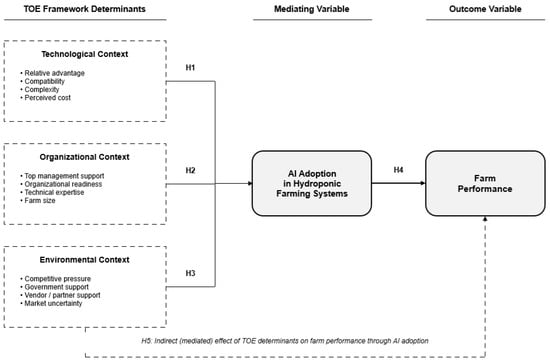
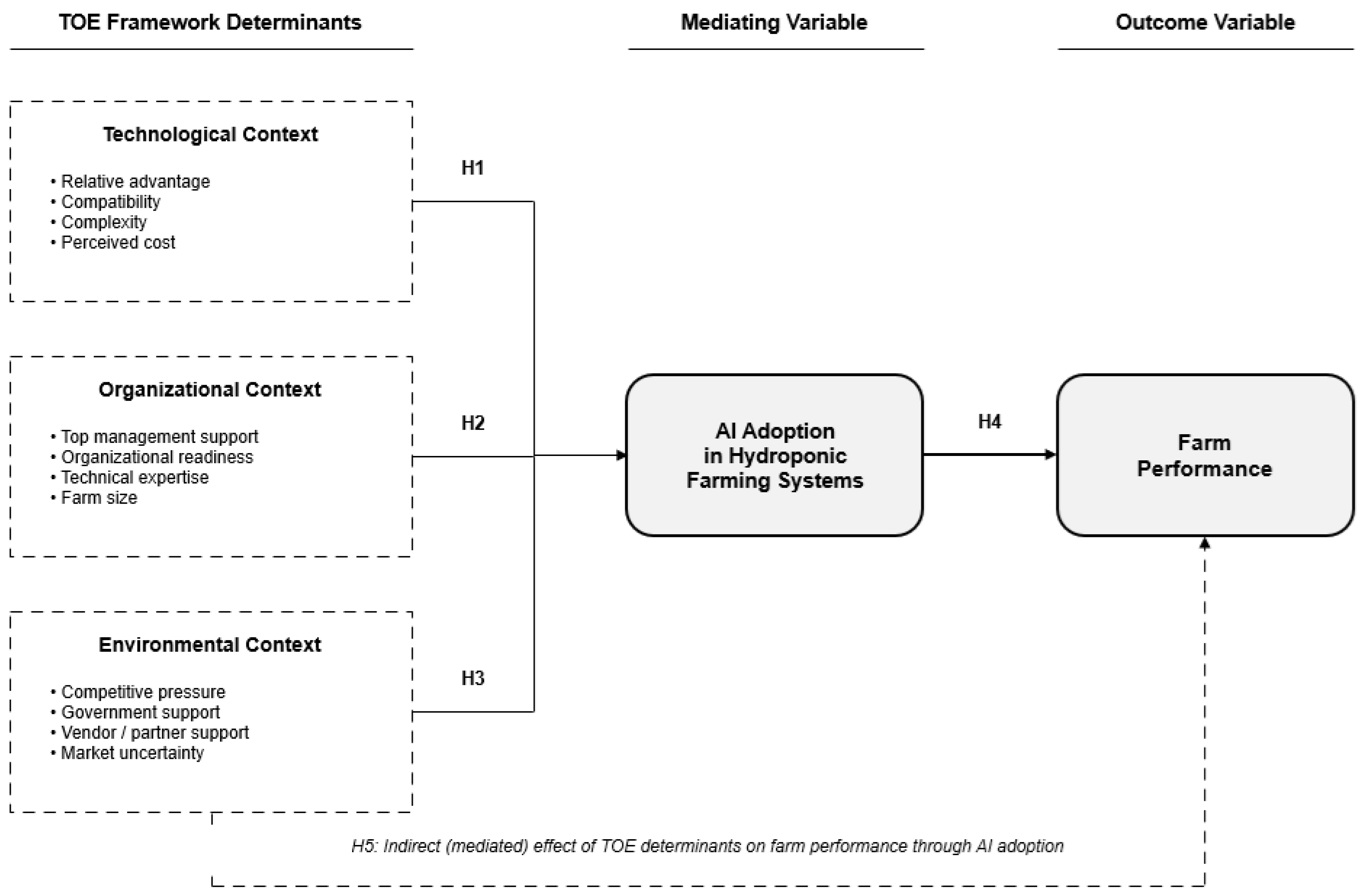
Based on the literature discussed above, we propose a model in which the three TOE factors are positively associated with AI adoption. AI adoption, in turn, is directly associated with farm performance and links TOE conditions to performance. Figure 1 shows this model. Each hypothesis is based on a specific part of the review.
Figure 1.
Conceptual model. Solid arrows represent direct hypotheses (H1–H4); dashed arrows represent mediated indirect hypotheses (H5–H7). Source: authors’ own elaboration.
The technological hypothesis rests on a mechanism specific to controlled-environment production. Hydroponic systems already instrument the growing environment continuously (pH, electrical conductivity, dissolved oxygen, humidity, temperature, and light) so the marginal step to AI is analytics on an existing data stream rather than construction of a new one [5,26,41]. Technological readiness therefore determines whether AI arrives as an increment or as a capital project: where sensor networks, connectivity, and control systems are in place, adding AI requires little additional effort; where they are missing, even advanced systems cannot be used effectively. Based on this, we propose the following hypothesis:
H1.
Technological conditions are positively associated with AI adoption in Omani hydroponic systems.
The organizational hypothesis rests on what an AI system in this setting actually produces: a recommendation about dosing, irrigation, or intervention timing. Value is realized only when someone acts on that recommendation, which requires staff who can interpret the output, management that delegates the decision, and enough trust for the recommendation to override habit [27,29,42]. Management support, training, digital skills, and culture matter because they determine whether the recommendation becomes an action; this is a constraint that binds hardest where resources are limited [18,19]. Therefore, we propose:
H2.
Organizational conditions are positively associated with AI adoption in Omani hydroponic systems.
The environmental hypothesis rests on the way scarcity changes the return to adoption. Under acute water stress, the efficiency gains that AI offers are not optional improvements but conditions of continued operation, and Omani policy attaches actual support, like programs, incentives, and extension services, to their pursuit [43,45,46,47]. Environmental conditions therefore alter the payoff of adoption, not merely the pressure to appear modern; Oman is a strong example, where environmental pressure and explicit country policy support jointly make AI actively promoted rather than merely permitted [1,2]. Based on this, we propose:
H3.
Environmental conditions are positively associated with AI adoption in Omani hydroponic systems.
The adoption-performance hypothesis states where the mechanism does its work. The three TOE conditions are properties of context; performance is a property of operations. When AI is deployed in routine monitoring, dosing, and decision-making, it is that routine deployment, not readiness itself, that alters resource consumption, costs, and yield stability [8,9,24]. In formal terms:
H4.
AI adoption is positively associated with perceived farm-level performance in Omani hydroponic systems.
The three mediation hypotheses round out the model. Drawing on the work of Badghish and Soomro [17], Mikalef and Gupta [21], and Ul Haq et al. [19], we suggest that TOE conditions are linked to farm performance primarily through AI adoption, so when conditions are favorable, adoption is more likely, and it is adoption that corresponds to real, measurable results. The model indicates that if TOE conditions still show strong links to performance after adoption, the mediating account would be incomplete.
H5.
AI adoption mediates the association between technological conditions and perceived farm performance.
H6.
AI adoption mediates the association between organizational conditions and perceived farm performance.
H7.
AI adoption mediates the association between environmental conditions and perceived farm performance.
3. Methodology
3.1. Design
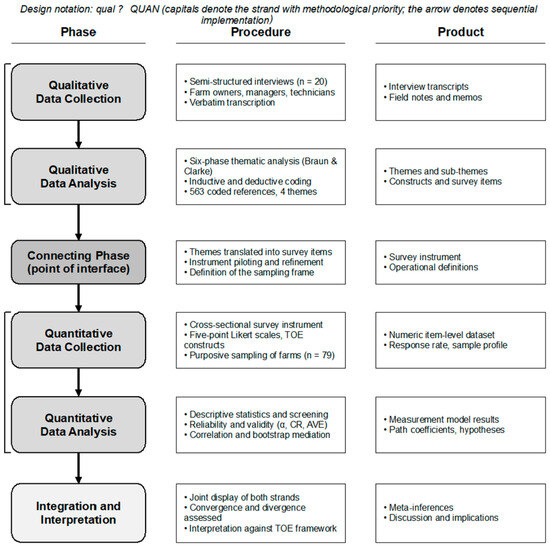
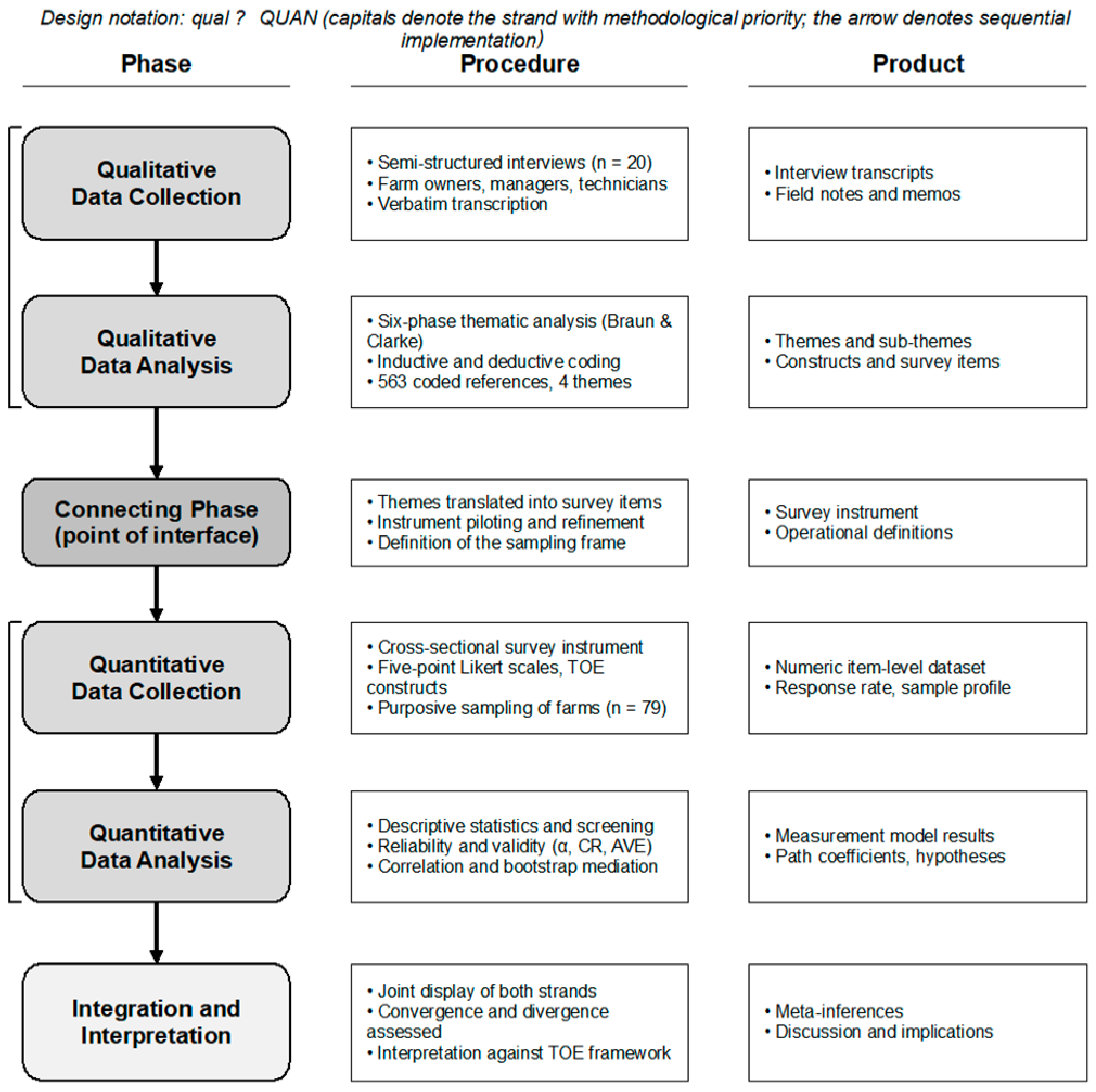
We adopted an exploratory sequential mixed-methods design [48] based on a practical approach. The first phase is qualitative and does two things simultaneously: it surfaces the concerns and vocabulary of Omani stakeholders, and it sharpens the survey instrument that follows. The second phase is quantitative and tests the model against a larger respondent pool. Integration happens at the interpretation stage: the interview material contextualises the statistical results, and the statistical results in turn discipline how we read the interview material. Figure 2 shows the design at a glance.
Figure 2.
Exploratory sequential mixed-methods design. Source: authors’ own elaboration, based on Creswell and Poth [48].
3.2. Qualitative Phase
Nineteen semi-structured interviews were conducted with stakeholders in Oman’s hydroponic and smart-farming sectors. The sampling frame was designed to reach four stakeholder groups: researchers and academics; farm managers and directors; agricultural engineers and technicians; and farmer-practitioners. The interview protocol worked through six areas in order: background and awareness; technological readiness; organizational capacity; environmental conditions; and perceived outcomes and risks. Questions were based on previous TOE and AI adoption studies [17,37,41,42] and tailored to the hydroponic context. Interviews were held in Arabic or English by participant preference, and each was recorded with prior consent, transcribed in full, and translated where the working language of coding required it. Thematic analysis followed the six-phase procedure of Braun and Clarke [49] and returned 563 coded references distributed across four main themes and twenty-two sub-themes.
3.3. Quantitative Phase
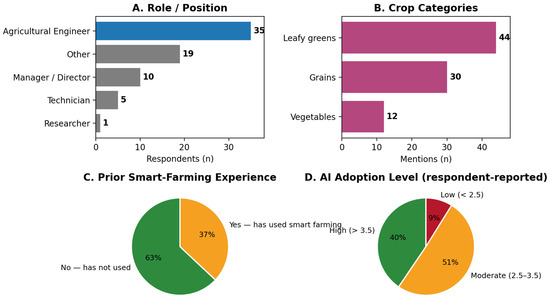
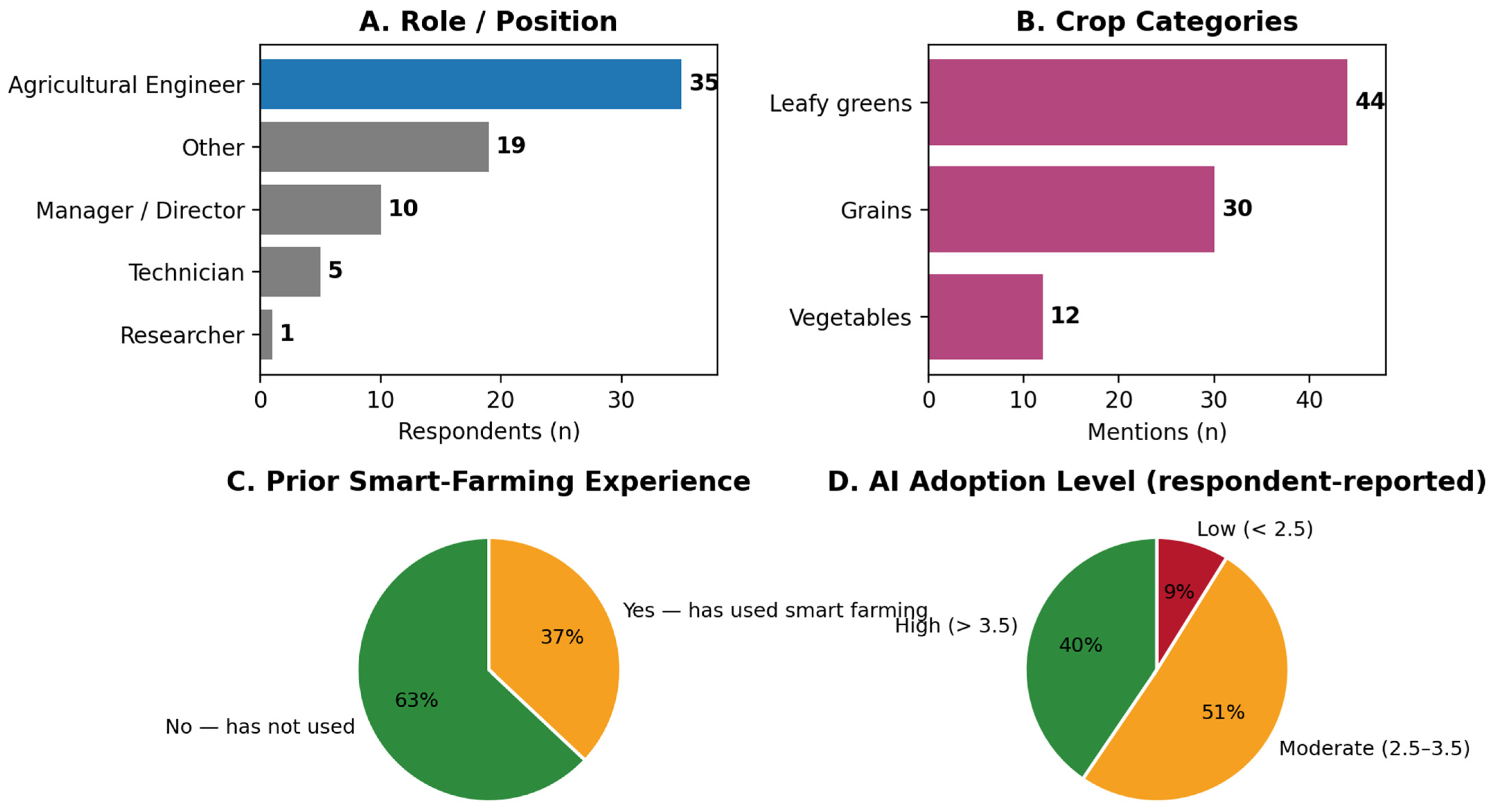
The survey was conducted online and received 79 valid responses from people working at hydroponic farms, smart farming operations, and agricultural institutions across Oman. Figure 3 shows the sample profile. The group takes in managers, engineers and researchers, with prior smart-farming experience that varies substantially from person to person. For descriptive purposes, respondents were grouped at the tertile boundaries of the AI-adoption composite (cut points 3.00 and 3.67), giving low (n = 17), moderate (n = 36), and high (n = 26) adoption groups; all inferential analyses use the continuous adoption score.
Figure 3.
Sample demographics and adoption profile (N = 79). Source: authors’ own elaboration.
The instrument used five-point Likert items to measure five constructs. The Technological Context included ten items on infrastructure readiness, compatibility, complexity, and relative advantage. The Organizational Context had eight items on management support, resources, training, skills, and culture. The Environmental Context included nine items on government policy, market and supplier factors, and peer influence. The AI Adoption construct comprised six items measuring the extent to which AI is used in routine operations. The Performance Outcomes construct had six items on operational efficiency, resource optimization, cost reduction, and sustainability. Two negatively worded items in the technological construct were reverse-coded before analysis. The items were based on previous studies [17,21,27,32,35,37,41,43,50,51,52]. Because the performance items ask respondents to assess their own operations rather than to report objective metrics, we refer to the construct as perceived performance throughout. The instrument was administered in Arabic; Appendix B reproduces all thirty-nine items as administered, with an English rendering, grouped by construct and with the two reverse-coded items marked.
3.4. Measurement and Reliability
Cronbach’s alpha was used to check internal consistency. Table 2 shows that all five constructs exceed the 0.70 threshold for acceptable reliability, and three exceed 0.85. Composite reliability values are similarly strong (0.81, 0.89, 0.86, 0.91, and 0.94 for the technological, organizational, environmental, adoption, and performance constructs, respectively).
Table 2.
Internal consistency of measurement constructs.
3.5. Analysis
The analysis proceeded in three stages. First, descriptive statistics and correlations characterized the sample and the pattern of associations among constructs. Second, a pair of hierarchical regression models tested the direct effects: Model 1 regressed AI adoption on the three TOE predictors, and Model 2 added AI adoption alongside the TOE predictors to explain performance. Third, mediation was tested using bootstrap resampling with 5000 replicates [53,54]; an indirect effect was considered significant when its 95% confidence interval excluded zero. All computations were performed in Python 3.11 using pandas 2.2.2, statsmodels 0.14.2, and NumPy 1.26.4. A sensitivity analysis indicated that, at α = 0.05 and 80% power, the design detects overall effects of f2 ≥ 0.15 in Model 1 and f2 ≥ 0.16 in Model 2 and standardized coefficients corresponding to partial correlations of about 0.31 or larger; the study is therefore adequately powered for medium and large effects but not for small ones, including small indirect effects. Bootstrap confidence intervals reported for indirect effects are percentile intervals. Throughout, the verbs predict and effect are used in their statistical sense and carry no causal claim.
Covariance-based structural equation modelling was considered and set aside on power grounds. The measurement model comprises thirty-nine indicators across five constructs, and stable estimation of a full latent model of that size requires several times the present sample under the conventional guidance of five to ten cases per estimated parameter. The analysis therefore uses composite scores with ordinary least squares estimation and bootstrap tests of the indirect effects. So composites treat the constructs as measured without error, so structural estimates are attenuated relative to a latent-variable model, and latent estimation on a larger sample is identified in Section 7 as a direction for future work.
3.6. Trustworthiness and Ethics
Qualitative trustworthiness was supported by verbatim quotations, iterative coding, systematic documentation, and triangulation with the quantitative results [48,49]. Quantitative validity was supported by theory-driven item development, reliability testing, and explicit treatment of reverse-coded items. All participants provided informed consent, and identifying details were removed from any published material. The study followed Dhofar University’s ethical guidelines for research involving human participants.
4. Qualitative Findings
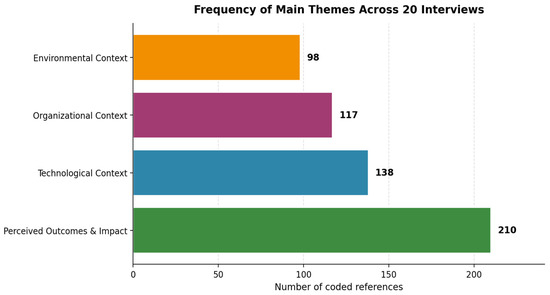
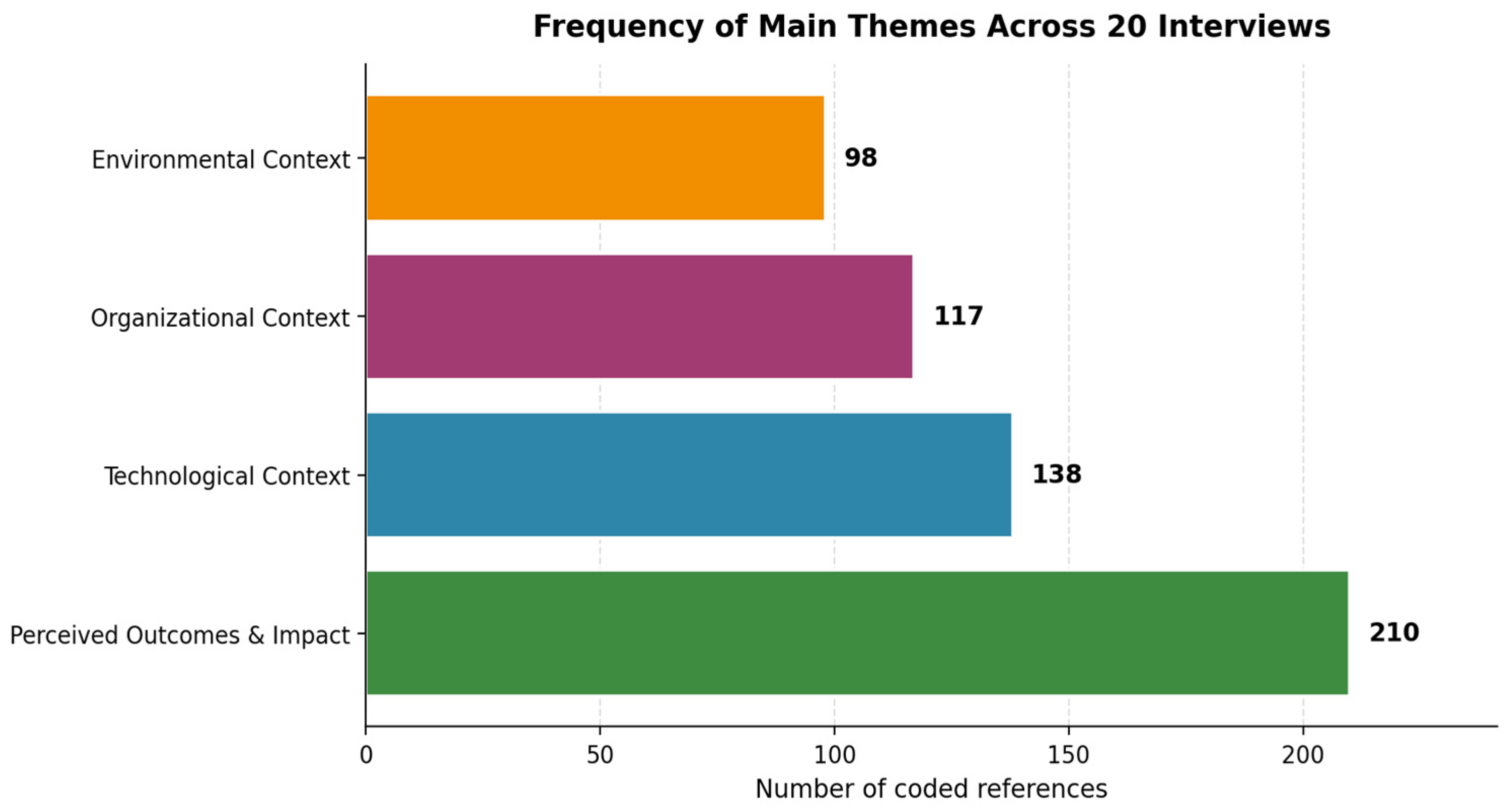
The qualitative analysis returned a structured picture of how Omani stakeholders perceive AI adoption in hydroponic and smart-farming settings. A comprehensive treatment of every code and sub-theme would run well past the length of this article; the section that follows is limited to the material that speaks most directly to the quantitative results reported later. Figure 4 shows the frequency of coded references across the four main themes. Perceived Outcomes and Impact dominated the corpus with 210 references, followed by Technological Context (138), Organizational Context (117), and Environmental Context (98). The pattern indicates that participants naturally speak about AI in terms of what it does rather than in the abstract.
Figure 4.
Frequency of main themes across the coded corpus. Source: authors’ own elaboration.
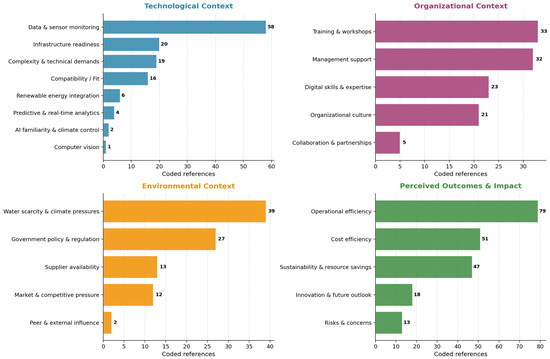
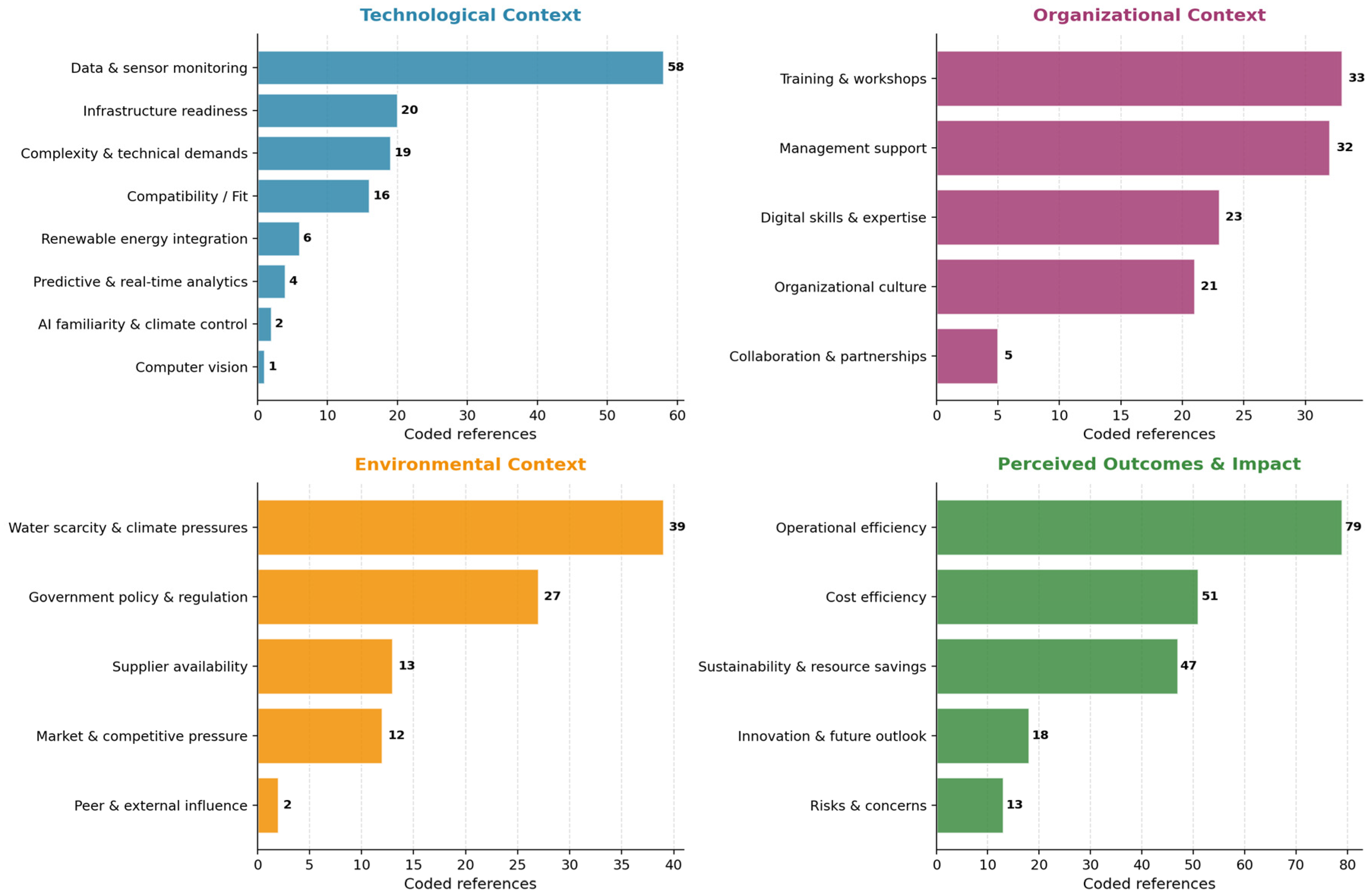
Within each main dimension, certain sub-themes emerged. On the technological side, sensor-based monitoring dominated, followed by infrastructure readiness and setup complexity. On the organizational side, training and workshops, management support, and digital skills ranked highest. Environmental discussions centered on water scarcity and climate pressures, as well as government policy and regulation. Perceived outcomes were led by operational efficiency, followed by cost efficiency and sustainability. Figure 5 disaggregates the sub-themes.
Figure 5.
Sub-theme frequencies within each TOE dimension. Source: authors’ own elaboration.
Four illustrative quotations capture the tenor of the corpus. On technology:
“A key advantage of these greenhouses is that they can be deployed anywhere in Oman: they generate electricity, produce water, and grow crops year-round. At the same time, the AI manages the greenhouse according to the programmed settings.”(INT01)
On organizational readiness:
“Technology alone is not enough; people must also be trained to use it effectively.”(INT10)
On environmental pressure:
“Due to climatic challenges and water scarcity in Oman, there is a pressing need to adopt artificial intelligence technologies to improve resource efficiency and ensure agricultural sustainability.”(INT05)
And on outcomes:
“Although there are initial setup costs, significant long-term operational savings are achieved, particularly by reducing energy consumption: operating systems run only when needed, based on sensor readings.”(INT11)
Two aggregate patterns are worth noting. A hierarchical cluster analysis of sub-themes indicates that participants tend to discuss internal capacity, infrastructure and water-scarcity pressures together, while market dynamics and risk concerns form a separate, smaller conversation. A saturation analysis of new sub-themes across interviews shows that the dataset stabilized at around the tenth interview, consistent with saturation expectations in qualitative research [49]. These qualitative signals provide the interpretive backdrop for the quantitative analysis presented next.
5. Quantitative Findings
5.1. Descriptive Statistics and Response Patterns
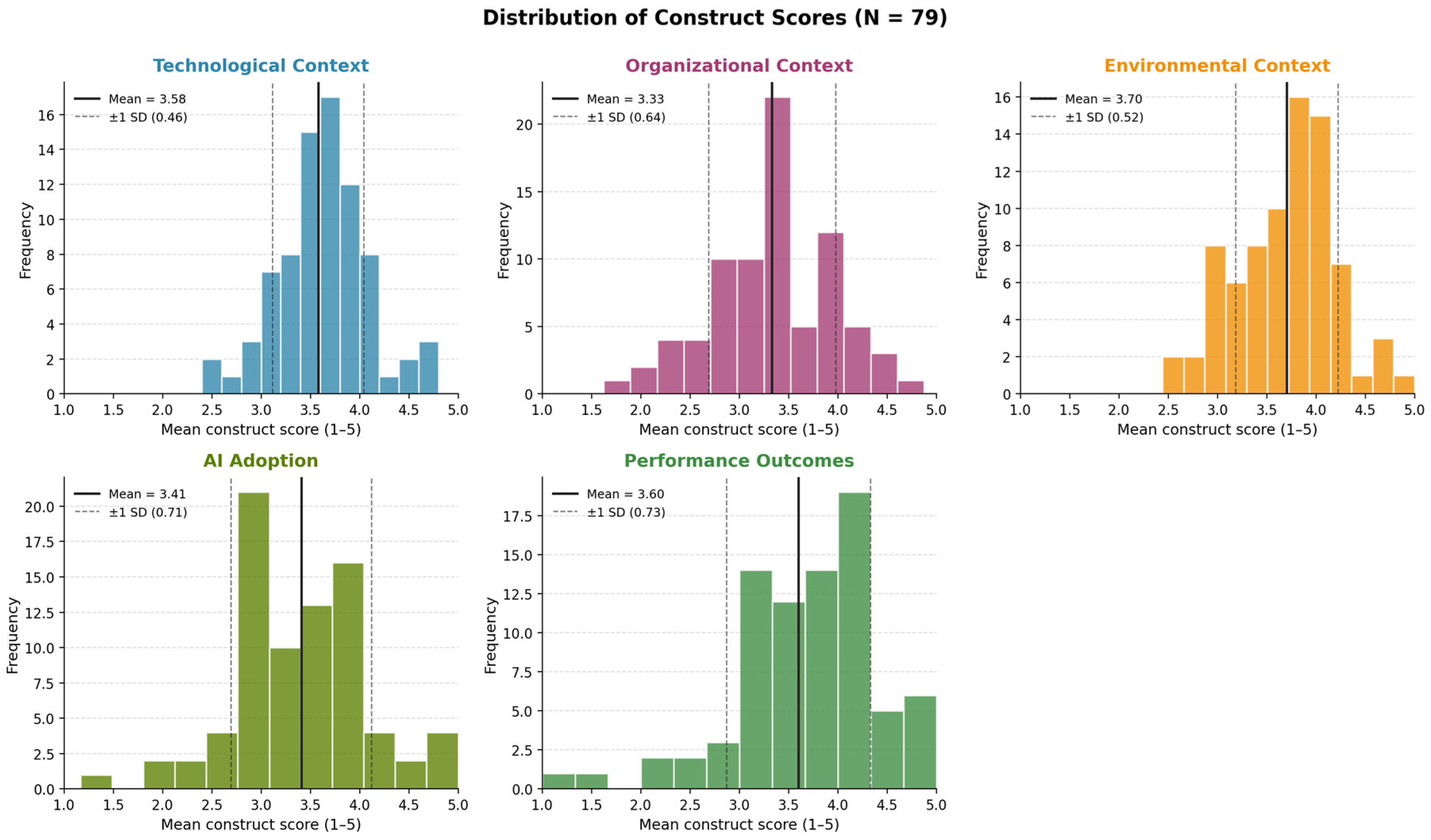
Construct scores were computed as the mean of each construct’s items after reverse-coding the two negatively worded technological items. Table 3 reports the descriptive statistics. All five construct means are above the neutral midpoint of 3, indicating a sample that is broadly positive about the conditions for AI adoption in Omani hydroponics. Environmental Context has the highest mean (3.70), consistent with the widespread perception that water scarcity and policy support make AI adoption a natural direction. Organizational Context has the lowest mean (3.33) and the widest standard deviation (0.64), indicating both moderate readiness and considerable heterogeneity among respondents.
Table 3.
Descriptive statistics for the five constructs (N = 79).
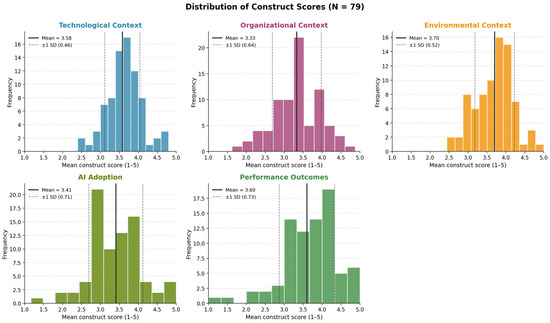
Figure 6 shows how the construct scores are distributed, with the mean and one standard deviation marked in each panel. The Technological and Environmental Contexts have fairly tight distributions, which suggests that most respondents agree on these points. In contrast, the scores for AI Adoption and Performance Outcomes are more spread out, reflecting that organizations in the sector are at different stages of adoption maturity.
Figure 6.
Distribution of construct scores. Source: authors’ own elaboration.
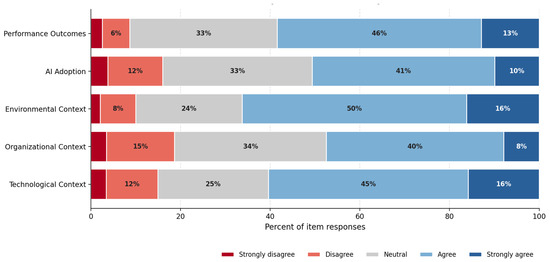
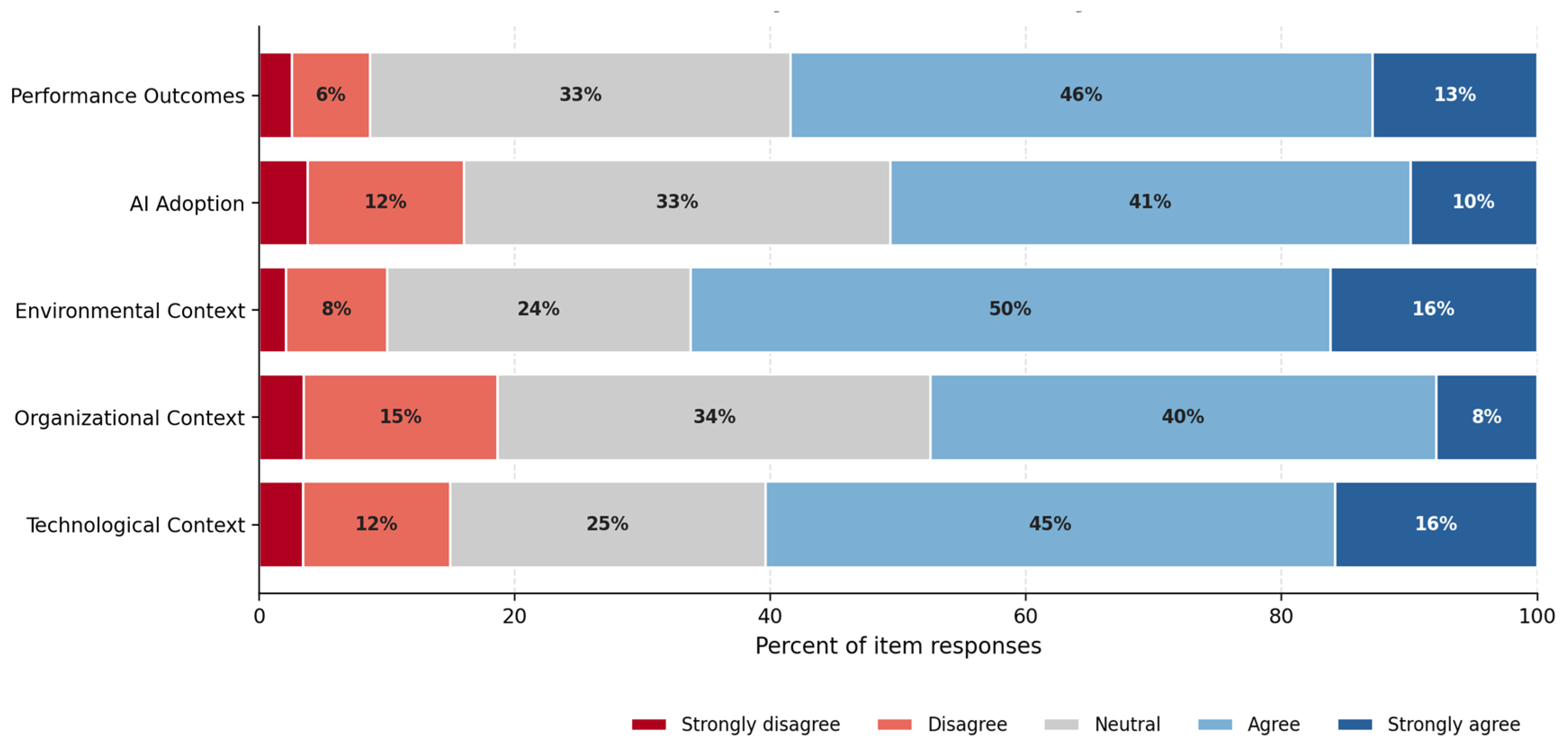
Figure 7 pushes the description one level deeper, showing the proportion of Likert responses at each level for each construct. Agreement (agree plus strongly agree) dominates every construct but is highest for Environmental Context and lowest for Organizational Context. The concentration of neutral responses in the Organizational construct is particularly noteworthy as it suggests that many respondents are unsure about the organizational conditions in their own institutions, which reflects the qualitative theme of variable internal capacity.
Figure 7.
Item-level response distribution by construct. Source: authors’ own elaboration.
5.2. Correlations
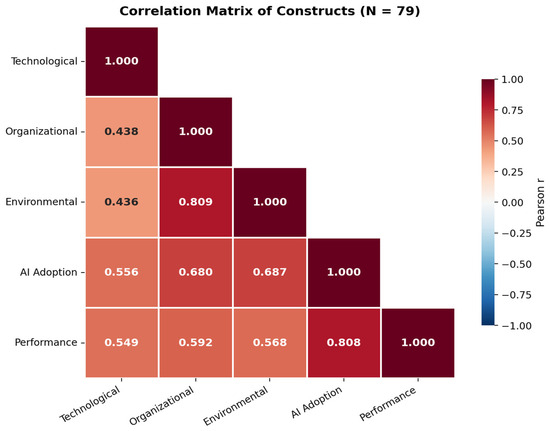
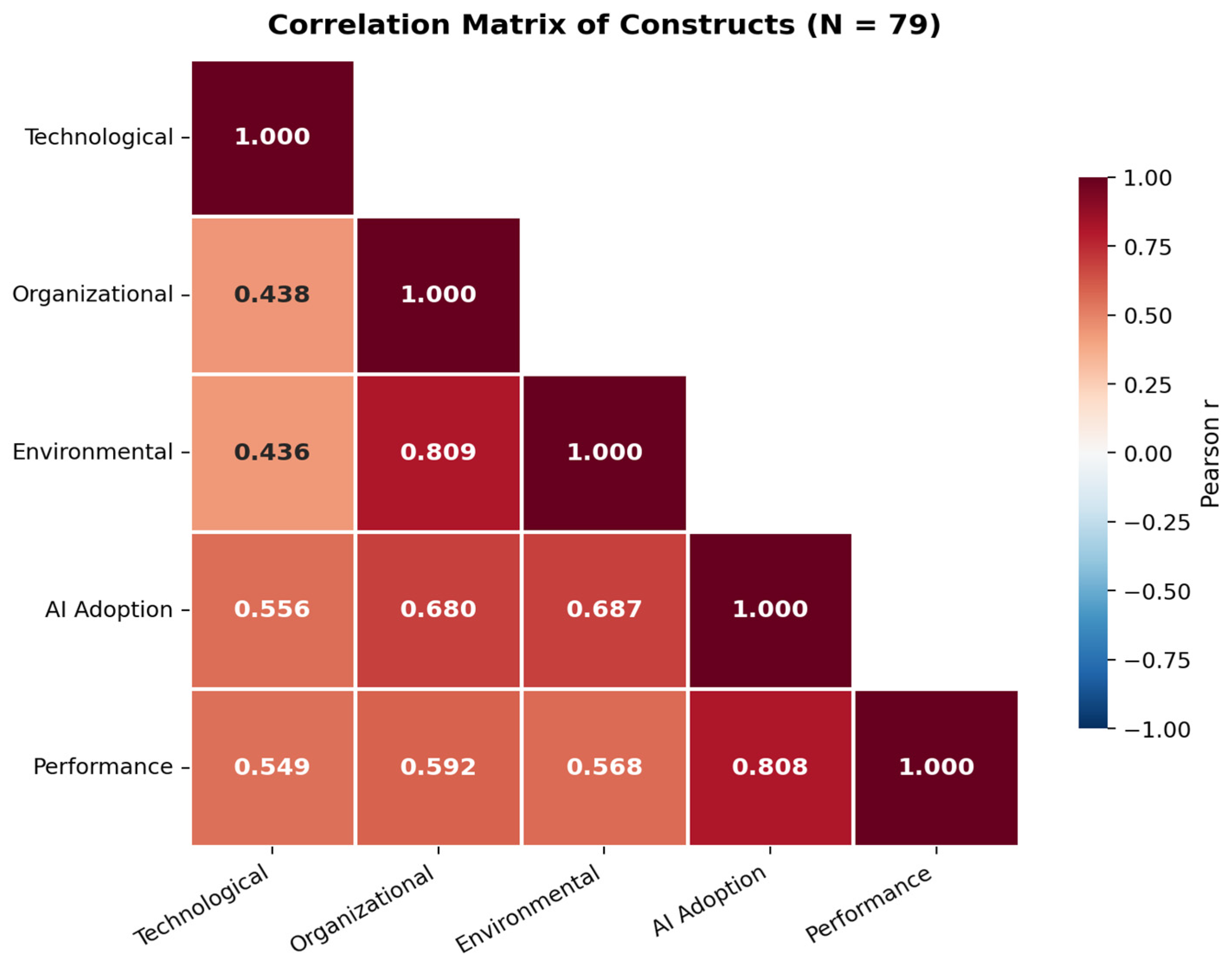
Table 4 and Figure 8 present the correlation matrix. All five constructs correlate positively and significantly with one another. The three strongest associations involve AI Adoption and Performance Outcomes on one side (r = 0.81) and the intra-context correlation of Organizational with Environmental (r = 0.81) on the other. AI Adoption itself correlates almost as strongly with Environmental Context (r = 0.69) and Organizational Context (r = 0.68) as with Performance.
Table 4.
Pearson correlation matrix (N = 79).
Figure 8.
Correlation matrix visualized as a heatmap. Source: authors’ own elaboration.
One feature of the matrix bears on the interpretation of the individual TOE coefficients. The correlation between the organizational and environmental composites (r = 0.81) is of the same order as their correlations with AI Adoption (r = 0.68 and r = 0.69), which indicates appreciable empirical overlap between the two constructs even though they are theoretically distinct and were measured with separate item sets of acceptable internal consistency (α = 0.86 and α = 0.82). Discriminant validity cannot be assessed formally here, because the tests normally used for that purpose, such as the Fornell–Larcker criterion and the heterotrait–monotrait ratio, require the latent-variable measurement model that the present sample cannot support (Section 3.5). Two consequences follow and are carried through the discussion. First, the variance inflation factors reported in Section 5.3 (2.96 to 3.21 for these two predictors) remain below conventional thresholds but confirm that the two dimensions compete for shared variance, so their separate coefficients are estimated less precisely than the technological coefficient. Second, comparisons of magnitude between the organizational and environmental effects are correspondingly unreliable, and the two are best read as partially overlapping facets of the external and institutional conditions surrounding a farm rather than as cleanly separable determinants. Establishing whether they are empirically distinct constructs in this population is a task for a larger sample.
5.3. Regression Analysis
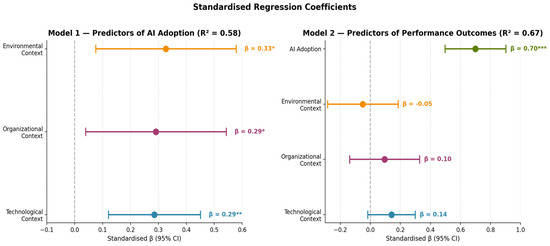
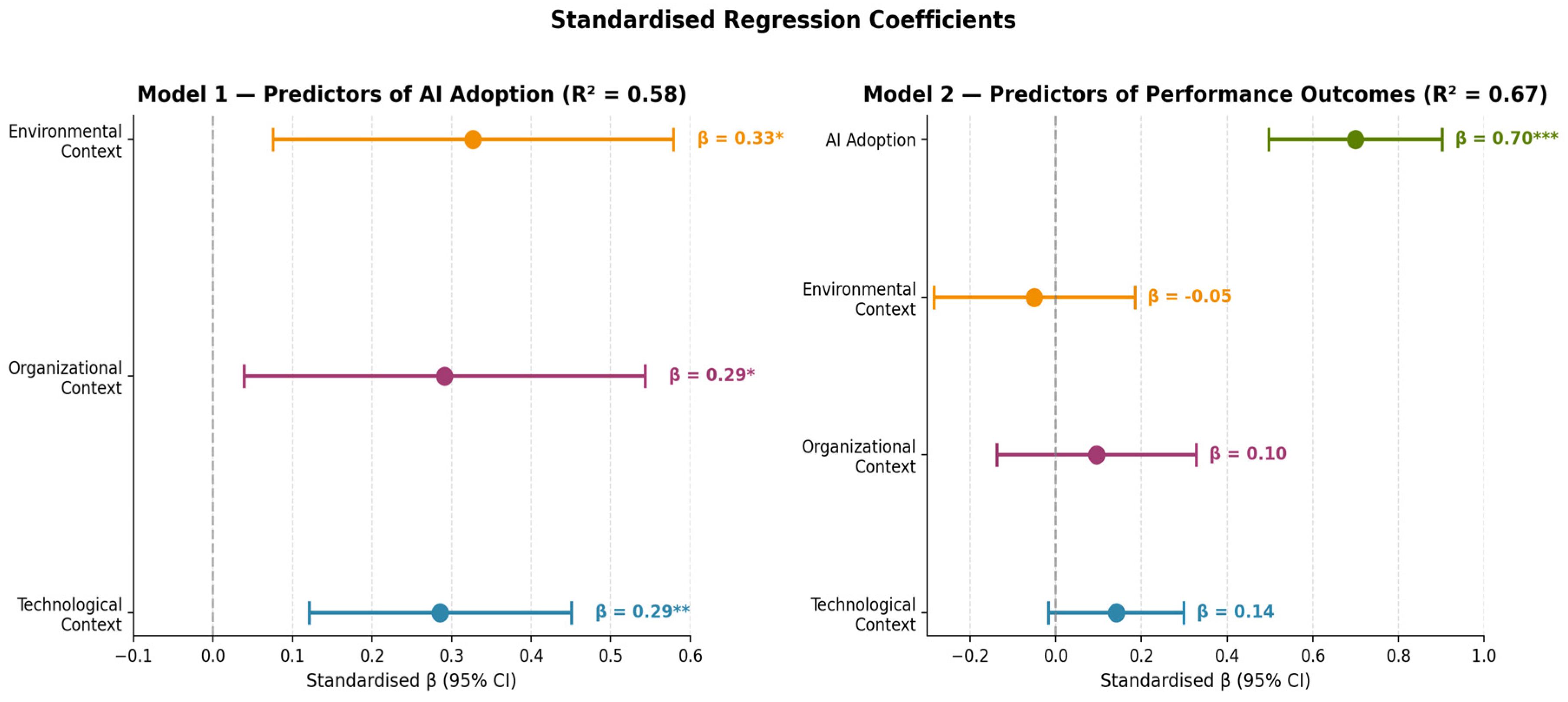
Figure 9 plots the two regression models side by side. Model 1 regresses AI Adoption on the three TOE predictors and accounts for 58 percent of the variance in adoption. Each of the three predictors contributes significantly (Technological β = 0.29, p = 0.001; Organizational β = 0.29, p = 0.027; Environmental β = 0.33, p = 0.013), with the environmental dimension showing the largest standardized point estimate. The three coefficients are, however, of similar magnitude and their confidence intervals overlap, so the estimates support the joint significance of the three dimensions rather than any ranking among them. This supports H1, H2 and H3.
Figure 9.
Standardized regression coefficients with 95% confidence intervals. Source: authors’ own elaboration. * p < 0.05; ** p < 0.01; *** p < 0.001.
Model 2 adds AI Adoption to the set of predictors and sharpens the picture considerably. The full model accounts for 67 percent of the variance in perceived performance. AI Adoption is by some distance the strongest predictor in the model (β = 0.70, p < 0.001), and once it enters the model none of the three TOE dimensions retains a significant direct effect on performance. This is strong support for H4.
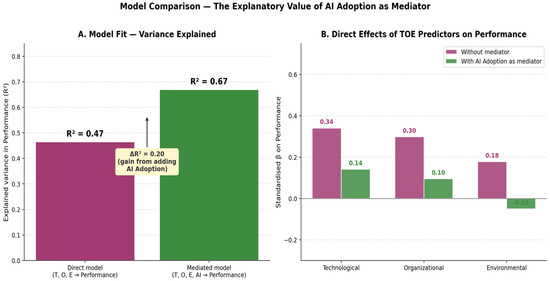
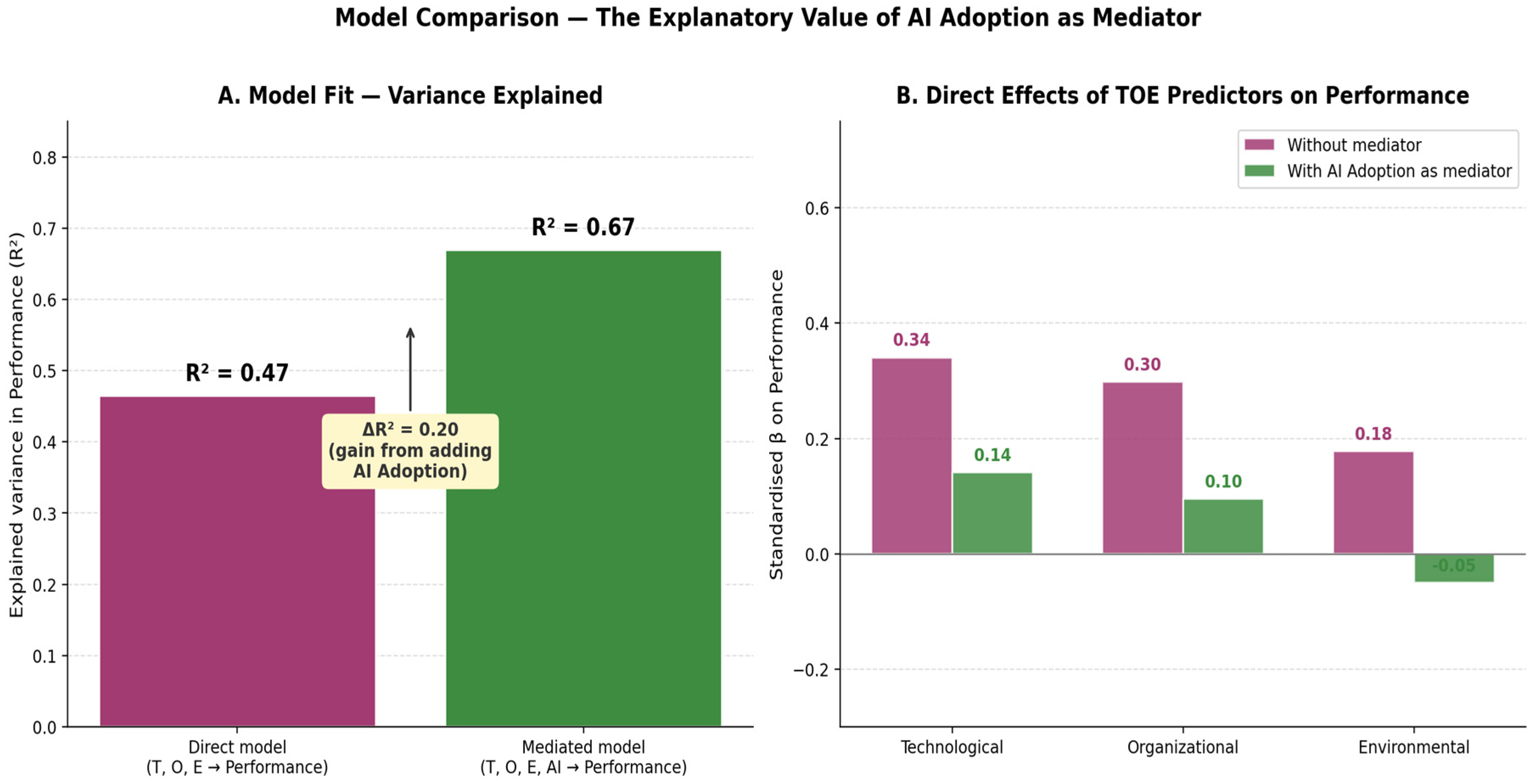
Figure 10 makes the mediation logic explicit by placing the no-mediator model next to the model with AI Adoption included. Panel A shows that adding AI Adoption raises the explained variance in performance from R2 = 0.47 (adjusted R2 = 0.44) to R2 = 0.67—an increase of twenty percentage points. Panel B decomposes what happens to the TOE effects themselves: each direct effect on performance shrinks toward zero once AI Adoption enters the model, indicating that, in the model, the TOE–performance association is carried by the mediator.
Figure 10.
Direct versus mediated model. Panel (A) shows the gain in R2 from adding AI Adoption; Panel (B) shows how TOE direct effects shrink toward zero once the mediator is included. The baseline value shown in Panel (A) corresponds to the adjusted R2 of the no-mediator model. Source: authors’ own elaboration.
Collinearity and residual diagnostics supported both models: variance inflation factors were 1.27, 2.96, and 2.96 in Model 1 and 1.46, 3.17, 3.21, and 2.39 in Model 2 (all tolerances ≥ 0.31); residuals were approximately normal (Shapiro–Wilk p = 0.67 and p = 0.24), independent (Durbin–Watson 2.18 and 2.05), and free of influential cases (maximum Cook’s distance = 0.19). Harman’s single-factor test on all thirty-nine items showed a first unrotated factor accounting for 34.8% of the variance, below the conventional 50% criterion. Table 5 reports the complete estimates for both models.
Table 5.
Regression estimates for the adoption and performance models (N = 79).
5.4. Mediation Analysis
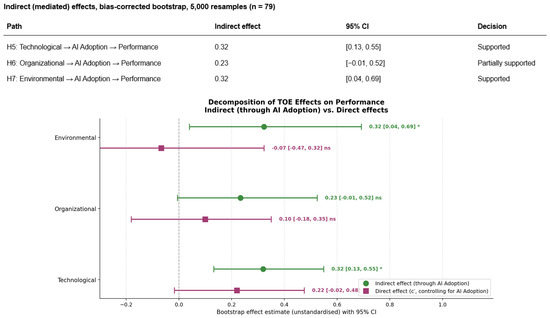
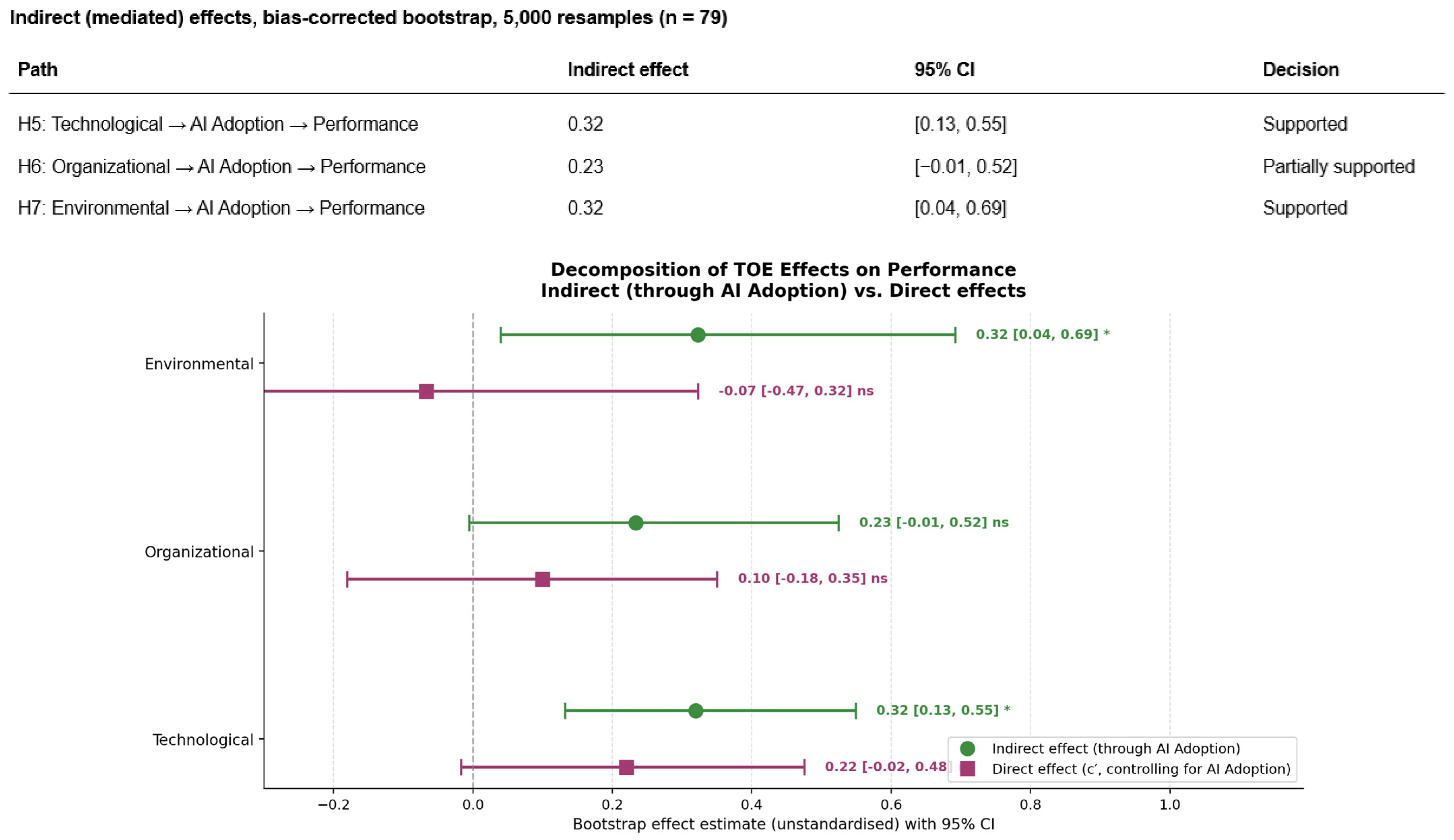
For a formal test of the mediation hypotheses we ran a bootstrap procedure with 5000 resamples. Figure 11 plots the indirect and direct effects of each TOE predictor along with their confidence intervals. Two mediation results stand out clearly. The indirect effect of Technological Context on performance through AI Adoption is 0.32 (95% CI [0.13, 0.55]), and the indirect effect of Environmental Context is also 0.32 (95% CI [0.04, 0.69]). Since both intervals are entirely above zero, this provides strong support for H5 and H7.
Figure 11.
Decomposition of TOE effects on performance. * p < 0.05.
The third mediation result is less clean. For Organizational Context the indirect effect is 0.23, with a 95 percent bootstrap confidence interval of [−0.01, 0.52]. Because that interval crosses zero, we treat H6 as inconclusive rather than as refuted. The point estimate is positive and close in magnitude to the two supported indirect paths, but a study of this size is not powered to resolve an effect of that magnitude (Section 3.5), so the data neither establish nor rule out organizational mediation. Section 6.2 discusses the organizational heterogeneity that plausibly underlies the wide interval.
5.5. Integrated Path Model and Hypothesis Summary
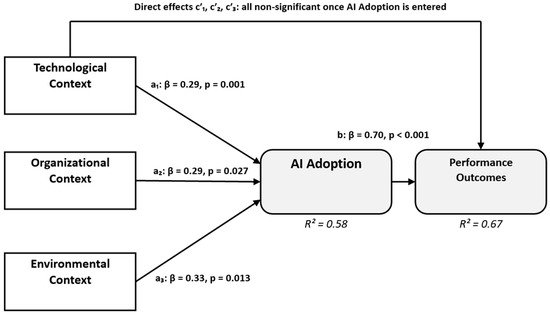
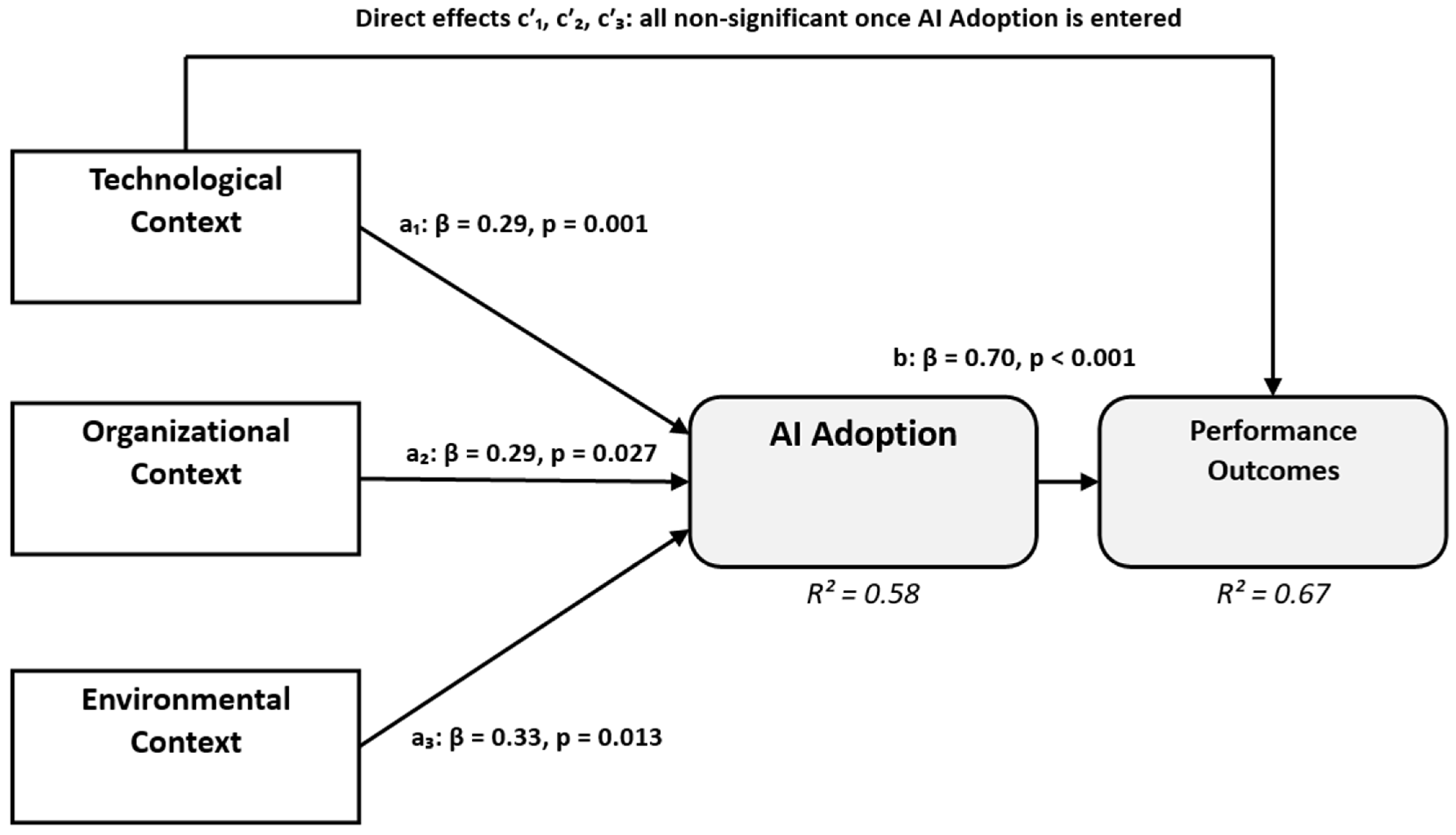
Figure 12 assembles all of these results into a single mediation path diagram. The three a paths from TOE dimensions to AI Adoption are all positive and significant. The b path from AI Adoption to Performance Outcomes is large and highly significant. And the three c′ direct paths from TOE dimensions to Performance are small and non-significant. Read as a whole, the model routes almost all of the TOE–performance association through AI Adoption.
Figure 12.
Mediation path model with standardized coefficients. Source: authors’ own elaboration.
Table 6 summarises the seven hypotheses and their status.
Table 6.
Hypothesis testing summary.
6. Discussion
The qualitative and quantitative strands line up into a single coherent reading as each TOE dimension is associated with AI adoption; AI adoption is the strongest correlate of performance in the model; and the indirect pathway from contextual conditions to performance runs almost entirely through adoption.
6.1. Technological Conditions
The finding that technological readiness is positively associated with AI adoption (β = 0.29) and indirectly with better perceived performance (indirect effect = 0.32) is consistent with a broad prior literature. Badghish and Soomro [17] report a similar pattern for technological compatibility in Saudi Arabian SMEs. Issa et al. [41] treat technological infrastructure as a central component of their AI-readiness framework for AgriTech firms. On the hydroponic side, Bhandari et al. [5], Kulkarni et al. [8] and Rahman et al. [9] all document that systems with more advanced sensors and IoT infrastructure derive proportionally more value from AI. Our interviews back this up: participants repeatedly pointed to sensor-based monitoring, robust infrastructure and mature automated controls as the preconditions for AI adoption to work at all. A subtle divergence appears in the relative importance of the technological dimension. Several prior studies report technology as the strongest single TOE predictor of AI adoption [35]. In our data the environmental dimension carries the largest point estimate, but the three coefficients are close (β = 0.33 versus β = 0.29 and β = 0.29), their confidence intervals overlap substantially, and the organizational and environmental composites are strongly intercorrelated (r = 0.81). The ordering of the three dimensions is therefore not established by these data, and no claim of differential importance is made. What the estimates do support is the weaker statement that environmental conditions are at least as salient here as technological ones, which is consistent with the acute water and climate pressure described by interviewees but requires a larger sample and latent-variable estimation to test directly.
6.2. Organizational Conditions
The direct effect of organizational readiness on AI adoption (β = 0.29) is similar to the findings of Chowdhury et al. [42], Mikalef and Gupta [21], and Ul Haq et al. [19]. However, our mediation test is different, as the indirect effect on performance is 0.23, but 95% confidence interval includes zero, so H6 is inconclusive rather than refuted. The qualitative material clarifies what is going on. Interviewees described organizational readiness as the most variable condition across the Omani sector but some institutions have strong management support, systematic training and innovation-oriented cultures, while others have none of these. That heterogeneity is not a nuisance to be explained away; it is a substantive finding about the sector. The organizational composite carries a standard deviation of 0.64, the highest of any TOE dimension—and Figure 7 shows a concentration of neutral responses on this construct that no other construct in the study exhibits. When the underlying variable is this heterogeneous, the bootstrap distribution widens accordingly, and that in turn widens the confidence interval enough to push the mediation across the significance threshold. Klerkx et al. [29] and Schwaeke et al. [55] both note similar heterogeneity in organizational readiness for digital agriculture, so the pattern we observe is consistent with an emerging literature.
6.3. Environmental Conditions
In the adoption model the environmental factor carries the largest standardized point estimate (β = 0.33) and a strong indirect effect on performance (95% CI [0.04, 0.69]). This is consistent with prior work in arid regions. Adams et al. [43] found that environmental and socioeconomic factors influence technology adoption among Ghanaian farmers. Benke and Tomkins [45] showed that water and climate pressures drive vertical and controlled-environment agriculture. Xing and Wang [46] and Zhang et al. [47] found that water scarcity leads to greater adoption of precision agriculture in dry areas. In Oman, Divyajyothi et al. [2] and Ramanathan et al. [13] both found that environmental constraints are the main reasons for adopting AI in agriculture. But Badghish and Soomro [17], in their study of Saudi SMEs, find that environmental factors play a meaningful but not dominant role. Our Omani data show the environmental dimension carrying the largest standardized point estimate among the TOE dimensions, although, as noted in Section 6.1, the three coefficients are close and the organizational and environmental composites are strongly intercorrelated, so that ordering should not be treated as established. The qualitative analysis indicates why environmental conditions are salient in this setting: water scarcity, climate stress and explicit government policy on smart agriculture together construct a setting in which AI adoption is not merely permitted but actively encouraged. This particular configuration of environmental pressure and policy support appears to be more pronounced in Oman than in the SME markets typically studied in the TOE-AI literature.
6.4. AI Adoption and Performance
The largest coefficient in this study is the association between AI adoption and perceived performance (β = 0.70, p < 0.001). This aligns with case studies of AI-controlled hydroponic systems, which show significant improvements in nutrient efficiency, water recycling, and yield [8,9,26]. It also fits with TOE-AI studies of SMEs that report links between adoption and performance [17,21,40], as well as broader reviews of machine learning in agriculture [23,24].
The size of the effect deserves comment. SME-focused studies typically report adoption–performance coefficients in the 0.30 to 0.50 band [18,35], but ours is materially higher. Two candidate explanations are worth putting on the table. First, hydroponic operations may be structurally better suited to AI than the average SME, so the return on adoption is higher—a possibility raised but not directly modelled by Wolfert et al. [27] and Klerkx et al. [29]. Second, the use of self-reported performance may inflate the coefficient, as Mikalef and Gupta [21] warned. Distinguishing between these two explanations will require follow-up work using objective farm-level data.
6.5. The Omani TOE-AI Configuration
The findings describe a distinctive configuration for this sector. Environmental necessity supplies an unusually strong motivational base. Technological readiness runs high specifically inside hydroponic operations but is uneven across the wider agricultural setting. Organizational capacity varies substantially from farm to farm and is what actually binds whether motivation converts into action. AI adoption, in this configuration, is the principal channel through which contextual conditions become reported value. This configuration extends but does not replicate the patterns documented by Badghish and Soomro [17], Ul Haq et al. [19], and Sánchez et al. [18]. It clarifies how a resource-constrained, arid, state-led agricultural ecosystem differs from the SME settings that dominate the current literature and points to the specific interventions most likely to advance adoption.
6.6. Practical Implications
The findings carry three practical implications. For Omani policymakers, this reinforces the case for continued investment in smart-agriculture policy while highlighting the importance of complementary investment in organizational capacity, training infrastructure, and supplier ecosystem development, which is also recommended by Divyajyothi et al. [2] and Ramanathan et al. [13]. For agricultural institutions and farm operators, the results suggest that constrained budgets are best spent on joint investment across the three dimensions rather than concentrated on any one of them; the qualitative material makes clear that sensors without skills, or skills without infrastructure, tend to underdeliver [29,41]. For technology providers, the findings imply that locally adapted solutions, transparent pricing and demonstrable pilot projects are likely to produce the strongest adoption response [12,27].
6.7. Theoretical Contribution
This study contributes to the TOE-AI literature in three main ways. First, it expands the framework to cover hydroponic and smart-farming systems in a Gulf-region arid setting, an area with little previous research [13,16]. Second, it treats AI adoption as a step in the process, not just an end result, and provides data to support this view [19,21]. Third, it combines qualitative and quantitative data in a mixed-methods design, so the insights from interviews help interpret the survey results [48]. Each of these contributions addresses a specific gap in the literature and helps move the field forward. Treating AI adoption as a mediator is not itself novel Badghish and Soomro [17]; the contribution lies in the hydroponic Gulf setting, the perceived performance constructed in the qualitative phase, and the instrument developed from the interview corpus.
7. Conclusions
This exploratory sequential mixed-methods study examined how the Technology–Organization–Environment framework relates to AI adoption and perceived farm performance in Omani hydroponic and smart-farming systems. The qualitative phase, based on nineteen interviews and 563 coded references, identified the contextual conditions and outcomes that stakeholders consider central to adoption. The quantitative phase, based on responses from seventy-nine respondents, tested seven hypotheses using regression and bootstrap mediation analysis.
For RQ1, all three TOE conditions are positively associated with AI adoption, with the environmental dimension showing the largest point estimate, although the three coefficients are close enough that their ordering should not be treated as established. For RQ2, AI adoption shows a strong and statistically significant association with perceived farm performance, accounting for most of the explained variance in outcomes. For RQ3, mediation analysis supports indirect associations linking technological and environmental conditions to performance through adoption, while the organizational indirect effect is inconclusive: its confidence interval includes zero, a pattern that plausibly reflects heterogeneous organizational capacity across farms together with limited statistical power for smaller effects. On RQ4, the combined results point to a practical plan in which policymakers, institutions and technology providers each have distinct but complementary roles.
7.1. Limitations
Several limitations should be flagged. Our sample size of 79 is adequate for the analyses reported but small enough to lose statistical power for detecting small effects. This is in part a reflection of the early stage of AI adoption in Omani hydroponics [13]. Self-report survey data carries known biases, though juxtaposing it against the qualitative material helps discipline it [48]. The cross-sectional design means we cannot make strong causal claims. Because performance is measured via perceptions rather than through actual farm records, our estimates of real productivity gains are inherently loose [21]. Section 7.2 sketches how subsequent work could address each of these constraints in turn.
A further limitation concerns common method variance. Because predictor and criterion measures were obtained from the same respondents at the same time, the estimates are exposed to shared method variance; Harman’s single-factor test did not indicate a dominant general factor, but that test is a weak diagnostic, and its result should not be read as clearance. The adoption–performance coefficient is the estimate most exposed to this inflation, and its true magnitude is plausibly smaller than reported.
7.2. Future Research Directions
Five directions follow from the limitations above, and each is framed so that it would test, rather than assume, a claim the present design cannot settle.
First, and most directly, the measurement model requires a larger sample. A latent-variable estimation of the thirty-nine indicators would allow the measurement error that composite scores ignore to be modelled explicitly, and would permit the formal discriminant-validity tests that Section 5.2 identifies as unavailable here. Conventional guidance of five to ten cases per estimated parameter implies a sample in the low hundreds for a model of this size, which is attainable through a multi-country Gulf survey even where a single national sector remains small. Such a study would establish whether the organizational and environmental dimensions are empirically separable constructs in this population, and would resolve the ranking question that the present coefficients leave open.
Second, the organizational path deserves a design built specifically for it. The indirect effect reported here is positive but inconclusive, and Section 6.2 traces that imprecision to genuine heterogeneity in organizational capacity across Omani farms rather than to an absent relationship. Two approaches would be informative: a moderated-mediation specification testing whether organizational readiness operates conditionally, for example only above a threshold of management support or training provision; and a multi-group or latent-class analysis that treats the heterogeneity as structure to be modelled rather than as noise. A sample stratified by institutional type would support either approach.
Third, performance should be measured independently of the respondents who report the predictors. The construct used here is perceptual, and the shared-method exposure noted above falls most heavily on the adoption–performance coefficient. Farm-level operational records, such as metered water consumption per kilogram of yield, nutrient-solution replacement intervals, energy use, and harvest weight and grade, are collected by many hydroponic operations already and could be obtained directly from farm management systems. Estimating the adoption–performance relation against such measures would establish how much of the strong association observed here reflects operational gains rather than favourable self-assessment, and would also allow the sustainability claims to be quantified in physical units rather than inferred from perceptions.
Fourth, the temporal ordering assumed by the mediation logic requires longitudinal data. The present design is cross-sectional and cannot distinguish adoption improving performance from better-performing farms being readier to adopt. A panel following farms across successive production cycles, or a staggered design keyed to the timing of adoption decisions, would permit that separation. Given that AI adoption in Omani hydroponics is at an early stage, a cohort recruited now and observed over three to five years would capture the adoption transition itself, which retrospective designs cannot.
Fifth, the boundary conditions of the model invite comparative work. The configuration described in Section 6.5, in which acute environmental pressure coincides with explicit state policy on smart agriculture, is not unique to Oman but is not universal either. Replication across Gulf states with differing policy instruments, and in arid regions outside the Gulf where comparable water stress exists without comparable state support, would identify which elements of the pattern are attributable to environmental conditions and which to the policy environment. Extending the framework to specific AI applications would refine the adoption construct that we treat here as unitary; computer-vision disease detection, predictive nutrient dosing and yield forecasting almost certainly face different adoption barriers in practice.
Finally, the qualitative corpus supports questions this article does not pursue. The 563 coded references include material on perceived risk, workforce displacement, and trust in automated decision-making that a dedicated study could develop, and the instrument reproduced in Appendix B is available for reuse and for cross-cultural validation.
The paper offers empirical support for an integrated TOE-based model of AI adoption in hydroponic agriculture and provides practical guidance to accelerate adoption in Oman. It provides a theoretically grounded account of a sector at what may prove to be an important inflection point.
Beyond the immediate findings, the results bear directly on sustainable food production in arid economies. Because perceived performance is defined here by water recycling, resource efficiency, and yield stability, the strong association between adoption and performance is, in this setting, an association with sustainability outcomes aligning the study with Oman Vision 2040 and with Sustainable Development Goals 2, 6, 12, and 13.
Author Contributions
D.A.G. conducted the investigation, managed data collection and data curation. A.A. led the conceptualization, research design, methodology, project administration, performed the formal analysis, and prepared the tables and figures in addition to preparation of the original manuscript. S.H. contributed to the literature review, validation of the findings, interpretation of the results, and critical revision of the manuscript. All authors have read and agreed to the published version of the manuscript.
Funding
This research received no external funding.
Institutional Review Board Statement
The study was conducted in accordance with the Declaration of Helsinki, and approved by the department of research at Dhofar University (DU/AY/2025-26/QUES-021, 9 October 2025).
Informed Consent Statement
Informed consent was obtained from all subjects involved in the study.
Data Availability Statement
The quantitative survey data presented in this study are available on reasonable request to the corresponding authors. The interview transcripts are not publicly available in order to protect participant privacy and confidentiality.
Acknowledgments
During the preparation of this manuscript, the authors used Grammarly (Version 1.2.250.1876) and Claude (Opus 5) for language proofreading, figure creation in Python, to suggest alternative framings and lines of argument, and to support the analysis by proposing possible readings of the findings.
Conflicts of Interest
The authors declare no conflicts of interest.
Appendix A. Interview Protocol Used in the Qualitative Phase
The nineteen interviews followed a uniform semi-structured protocol of twenty questions, administered in Arabic or English according to participant preference. The English protocol is reproduced below.
A1. Please introduce yourself and describe your experience in agriculture and the projects you have supervised.
A2. Can you describe your overall experience with smart agriculture in Oman?
A3. How familiar are you with artificial intelligence technologies in agriculture?
A4. How do technological challenges or opportunities affect your decision to adopt artificial intelligence technologies in agriculture in general and hydroponic systems in particular?
A5. How can artificial intelligence technologies contribute to improving or complicating your daily agricultural operations?
A6. What smart or digital technologies do you consider most suitable for agriculture in Oman, and why?
A7. Can you provide examples of how artificial intelligence contributes to improving production or decision-making on your farm?
A8. How do costs or financial returns influence your decision to use artificial intelligence on the farm?
A9. How does your institution or farm management support the adoption of new technologies such as artificial intelligence?
A10. How do employee training and skills influence the adoption of artificial intelligence on your farm?
A11. Can you share an example of how organizational culture influences your decision to adopt or not adopt artificial intelligence?
A12. Based on your experience, why do internal barriers such as cost or lack of knowledge limit the adoption of artificial intelligence?
A13. How do government policies, suppliers, or competition influence your decision to adopt artificial intelligence?
A14. How does the local agricultural environment in Oman affect your perspective on adopting artificial intelligence?
A15. What challenges in Oman, such as water scarcity or high costs, make artificial intelligence adoption more or less important?
A16. How does collaboration with farmers, suppliers, or researchers influence your decision to use artificial intelligence?
A17. In your opinion, how does artificial intelligence adoption affect agricultural system performance—particularly hydroponics—in terms of efficiency, productivity, and sustainability?
A18. What positive or negative changes have appeared on your farm after introducing artificial intelligence or smart agriculture?
A19. What concerns do you have regarding the use of artificial intelligence, such as privacy, costs, or reliance on technology?
A20. How do you see the future of artificial intelligence in agriculture and hydroponic systems in Oman over the coming years?
Appendix B. Survey Instrument (English Rendering of the Arabic Original)
The survey was administered online in Arabic between October and December 2025. Respondents rated each statement on a five-point Likert scale from strongly agree (5) to strongly disagree (1). The thirty-nine items are reproduced below in the Arabic wording as administered, with an English rendering for reference, grouped by construct; items marked (R) were reverse-coded before analysis.
| Code | Item (English Rendering) |
| Technological Context (T1–T10) | |
| T1 | Our organization has sufficient digital infrastructure (internet, sensors, devices) to adopt artificial intelligence technologies. |
| T2 | Applying artificial intelligence reduces operating costs in the long term. |
| T3 | Using artificial intelligence technologies improves productivity and quality. |
| T4 | These technologies reduce the costs of labor, fertilizers, and pesticides. |
| T5 | These technologies support faster and more accurate decision-making on the farm. |
| T6 | These technologies are compatible with our existing equipment and systems. |
| T7 | These technologies solve our farms’ current problems. |
| T8 | The skills required to operate these technologies are easy to acquire. |
| T9 (R) | Operating artificial intelligence technologies and tools is technically difficult. |
| T10 (R) | There is concern about privacy or misuse of farm data. |
| Organizational Context (O1–O8) | |
| O1 | Our management supports and encourages the use of artificial intelligence technologies in agriculture. |
| O2 | Management allocates resources (budget/staff) to adopt these technologies when needed. |
| O3 | Adopting artificial intelligence is consistent with our organization’s strategic goals and values. |
| O4 | We have sufficient financial and human resources to integrate artificial intelligence into our operations. |
| O5 | All relevant staff receive adequate training on artificial intelligence before use. |
| O6 | A sufficient budget is available for implementing artificial intelligence technologies. |
| O7 | Management is willing to take calculated risks to try new technologies. |
| O8 | There is effective communication between management and technicians regarding technological transformation. |
| Environmental Context (E1–E9) | |
| E1 | Government policies support the adoption of artificial intelligence in agriculture. |
| E2 | Regulatory frameworks and infrastructure exist that facilitate the adoption of artificial intelligence. |
| E3 | The competent authorities in the Ministry of Agriculture provide training or demonstrations for learning artificial intelligence technologies. |
| E4 | Policies and incentives encourage farms like ours to adopt artificial intelligence applications. |
| E5 | Showcasing successful cases of adopting artificial intelligence technologies motivates their local adoption. |
| E6 | If competitors or other organizations adopt artificial intelligence technologies, we are likely to adopt them as well. |
| E7 | We need to integrate artificial intelligence technologies into our work in order to distinguish ourselves from others. |
| E8 | Competition pushes us to adapt in order to remain viable. |
| E9 | Collaboration with universities or researchers enhances our ability to use these technologies. |
| AI Adoption (AI1–AI6) | |
| AI1 | Our organization has adopted AI-based monitoring systems (such as nutrient, water, or climate monitoring). |
| AI2 | Artificial intelligence technologies are fully integrated into daily agricultural operations. |
| AI3 | There is continuous managerial readiness to adopt artificial intelligence technologies to improve operations. |
| AI4 | Our organization’s reliance on artificial intelligence has increased over the past few years. |
| AI5 | We expect to use AI-supported tools regularly in our operations in the future. |
| AI6 | We intend to integrate artificial intelligence into our daily decisions. |
| Performance Outcomes (P1–P6) | |
| P1 | The adoption of artificial intelligence has improved our operational efficiency. |
| P2 | Artificial intelligence technologies have improved the quality of decision-making in our organization’s management. |
| P3 | The use of artificial intelligence has improved resource management (water, nutrients, and energy). |
| P4 | Our organization has achieved higher yields and productivity after adopting artificial intelligence. |
| P5 | Input costs (water, fertilizers, and labor) have decreased. |
| P6 | The use of artificial intelligence technologies contributes to promoting sustainable agriculture practices by reducing pesticide use and reducing resource waste. |
References
- Al-Mulla, Y.; Al-Ruheili, A.; Al-Lawati, A.; Parimi, K.; Ali, A.; Al-Sadi, N.; Al-Harrasi, F. Assessment of urban expansion’s impact on changes in vegetation patterns in Dhofar, Oman, using remote sensing and GIS techniques. IEEE Access 2022, 10, 86782–86792. [Google Scholar] [CrossRef] [Scilit]
- Divyajyothi, M.G.; Jopate, R.; Albalushi, R.A.A.; Al Balushi, S.A.S. AI precision for irrigation, crop management, and pest control for sustainable agriculture in Oman. IOP Conf. Ser. Earth Environ. Sci. 2024, 1401, 012005. [Google Scholar] [CrossRef] [Scilit]
- Abdullah, M.S.T.; Mazalan, L. Smart automation aquaponics monitoring system. JOIV Int. J. Inform. Vis. 2022, 6, 45–50. [Google Scholar] [CrossRef] [Scilit]
- Rajaseger, G.; Chan, K.L.; Tan, K.Y.; Ramasamy, S.; Khin, M.C.; Amaladoss, A.; Haribhai, P.K. Hydroponics: Current trends in sustainable crop production. Bioinformation 2023, 19, 925. [Google Scholar] [CrossRef] [Scilit]
- Bhandari, N.S.; Bhandari, N.; Agarwal, R.; Sharma, P.K. An insight on artificial intelligence (AI) and Internet of Things (IoT) driven hydroponics farming. In 2024 5th International Conference on Image Processing and Capsule Networks (ICIPCN); IEEE: Piscataway, NJ, USA, 2024; pp. 496–501. [Google Scholar]
- Li, Z.; Li, Y.; Yang, Y.; Guo, R.; Yang, J.; Yue, J.; Wang, Y. A high-precision detection method of hydroponic lettuce seedlings status based on improved Faster RCNN. Comput. Electron. Agric. 2021, 182, 106054. [Google Scholar] [CrossRef] [Scilit]
- Sharma, V.; Tripathi, A.K.; Mittal, H. Technological revolutions in smart farming: Current trends, challenges & future directions. Comput. Electron. Agric. 2022, 201, 107217. [Google Scholar] [CrossRef] [Scilit]
- Kulkarni, P.V.; Gohokar, V.; Kulkarni, K. Smart nutrient management in hydroponics: IoT-driven optimization for enhanced crop yield and resource efficiency. Panam. Math. J. 2024, 34, 128–140. [Google Scholar] [CrossRef] [Scilit]
- Rahman, M.A.; Chakraborty, N.R.; Sufiun, A.; Banshal, S.K.; Tajnin, F.R. An AIoT-based hydroponic system for crop recommendation and nutrient parameter monitorization. Smart Agric. Technol. 2024, 8, 100472. [Google Scholar] [CrossRef] [Scilit]
- Lezoche, M.; Hernandez, J.E.; Díaz, M.D.M.E.A.; Panetto, H.; Kacprzyk, J. Agri-food 4.0: A survey of the supply chains and technologies for the future agriculture. Comput. Ind. 2020, 117, 103187. [Google Scholar] [CrossRef] [Scilit]
- Zhai, Z.; Martínez, J.F.; Beltran, V.; Martínez, N.L. Decision support systems for agriculture 4.0: Survey and challenges. Comput. Electron. Agric. 2020, 170, 105256. [Google Scholar] [CrossRef] [Scilit]
- Baraskar, T.; Khatri, V.; Kolhe, P.; Katyarmal, M.; Khedekar, S. AI-powered automated hydroponic system for smart agriculture. MethodsX 2025, 15, 103579. [Google Scholar] [CrossRef] [Scilit]
- Ramanathan, S.K.; Bharathi, L.M.; Venusamy, K. Implementation of artificial intelligence based predictive analysis of data for smart farming in Sultanate of Oman. In 2022 6th International Conference on Trends in Electronics and Informatics (ICOEI); IEEE: Piscataway, NJ, USA, 2022; pp. 1004–1007. [Google Scholar]
- Tornatzky, L.; Fleischer, M. The Processes of Technological Innovation; Lexington Books: Lanham, MD, USA, 1990. [Google Scholar]
- Baker, J. The technology–organization–environment framework. In Information Systems Theory: Explaining and Predicting Our Digital Society; Dwivedi, Y.K., Wade, M.R., Schneberger, S.L., Eds.; Springer: Berlin/Heidelberg, Germany, 2011; Volume 1, pp. 231–245. [Google Scholar]
- Camilleri, M.A.; Camilleri, A.C. The technology–organization–environment framework: A review and suggestions for future research. Technol. Soc. 2022, 68, 101912. [Google Scholar]
- Badghish, S.; Soomro, Y.A. Artificial intelligence adoption by SMEs to achieve sustainable business performance: Application of technology–organization–environment framework. Sustainability 2024, 16, 1864. [Google Scholar] [CrossRef] [Scilit]
- Sánchez, E.; Calderón, R.; Herrera, F. Artificial intelligence adoption in SMEs: Survey based on TOE–DOI framework, primary methodology and challenges. Appl. Sci. 2025, 15, 6465. [Google Scholar] [CrossRef] [Scilit]
- Ul Haq, F.; Suki, N.M.; Zaigham, H.; Masood, A.; Rajput, A. Exploring AI adoption and SME performance in resource-constrained environments: A TOE–RBV perspective with mediation and moderation effects. J. Digit. Econ. 2026, 5, 160–181. [Google Scholar] [CrossRef] [Scilit]
- Nawaf Alka’awneh, S.M.; Abdul-Halim, H.; Saad, N.H.M. A review of Diffusion of Innovations Theory (DOI) and Technology, Organization, and Environment Framework (TOE) in the adoption of artificial intelligence. Int. J. Acad. Res. Bus. Soc. Sci. 2025, 15, 2118–2129. [Google Scholar] [CrossRef] [Scilit]
- Mikalef, P.; Gupta, M. Artificial intelligence capability: Conceptualization, measurement calibration, and empirical study on its impact on organizational creativity and firm performance. Inf. Manag. 2021, 58, 103434. [Google Scholar] [CrossRef] [Scilit]
- Jordan, M.I.; Mitchell, T.M. Machine learning: Trends, perspectives, and prospects. Science 2015, 349, 255–260. [Google Scholar] [CrossRef] [Scilit]
- Liakos, K.G.; Busato, P.; Moshou, D.; Pearson, S.; Bochtis, D. Machine learning in agriculture: A review. Sensors 2018, 18, 2674. [Google Scholar] [CrossRef] [Scilit]
- Kamilaris, A.; Prenafeta-Boldú, F.X. Deep learning in agriculture: A survey. Comput. Electron. Agric. 2018, 147, 70–90. [Google Scholar] [CrossRef] [Scilit]
- Soni, J.A.; Patel, H.N. Deep learning-based weed identification for precision farming. ITEE J. 2021, 10, 52–60. [Google Scholar]
- Métwalli, A.; Shalash, O.; Elhefny, A.; Rezk, N.; El Gohary, F.; El Hennawy, O.; Akrab, F.; Shawky, A.; Mohamed, Z.; Hassan, N.; et al. Enhancing hydroponic farming with machine learning: Growth prediction and anomaly detection. Eng. Appl. Artif. Intell. 2025, 157, 111214. [Google Scholar] [CrossRef] [Scilit]
- Wolfert, S.; Ge, L.; Verdouw, C.; Bogaardt, M.J. Big data in smart farming—A review. Agric. Syst. 2017, 153, 69–80. [Google Scholar] [CrossRef] [Scilit]
- Avila, F.R.D.; Barbosa, J.L.V. Smart environments in digital agriculture: A systematic review and taxonomy. Comput. Electron. Agric. 2025, 236, 110393. [Google Scholar] [CrossRef] [Scilit]
- Klerkx, L.; Jakku, E.; Labarthe, P. A review of social science on digital agriculture, smart farming and agriculture 4.0: New contributions and a future research agenda. NJAS Wagening. J. Life Sci. 2019, 90, 1–16. [Google Scholar] [CrossRef] [Scilit]
- Daniels, N.; Jokonya, O. Factors affecting digital transformation in the retail supply chain. In Proceedings of the 2020 International Conference on Multidisciplinary Research, Virtual, 14–15 December 2020. [Google Scholar]
- Awa, H.O.; Ukoha, O.; Emecheta, B.C. Using TOE theoretical framework to study the adoption of ERP solution. Cogent Bus. Manag. 2016, 3, 1196571. [Google Scholar] [CrossRef] [Scilit]
- Zhu, K.; Kraemer, K.L. Post-adoption variations in usage and value of e-business by organizations: Cross-country evidence from the retail industry. Inf. Syst. Res. 2005, 16, 61–84. [Google Scholar] [CrossRef] [Scilit]
- Jaradat, Z.; Al-Dmour, A.; Alshurafat, H.; Al-Hazaima, H.; Al Shbail, M.O. Factors influencing business intelligence adoption: Evidence from Jordan. J. Decis. Syst. 2024, 33, 242–262. [Google Scholar] [CrossRef] [Scilit]
- Qatawneh, N. Empirical insights into business intelligence adoption and decision-making performance during the digital transformation era: Extending the TOE model in the Jordanian banking sector. J. Open Innov. Technol. Mark. Complex. 2024, 10, 100401. [Google Scholar] [CrossRef] [Scilit]
- Maroufkhani, P.; Wan Ismail, W.K.; Ghobakhloo, M. Big data analytics adoption model for small and medium enterprises. J. Sci. Technol. Policy Manag. 2020, 11, 483–513. [Google Scholar] [CrossRef] [Scilit]
- Lin, H.F. Blockchain adoption in the maritime industry: Empirical evidence from the technological–organizational–environmental framework. Marit. Policy Manag. 2024, 51, 1474–1496. [Google Scholar] [CrossRef] [Scilit]
- Davis, F.D. Perceived usefulness, perceived ease of use, and user acceptance of information technology. MIS Q. 1989, 13, 319–340. [Google Scholar] [CrossRef] [Scilit]
- Rogers, E.M. Diffusion of Innovations, 5th ed.; Free Press: New York, NY, USA, 2003. [Google Scholar]
- Barney, J. Firm resources and sustained competitive advantage. J. Manag. 1991, 17, 99–120. [Google Scholar] [CrossRef] [Scilit]
- Soomro, R.B.; Al-Rahmi, W.M.; Dahri, N.A.; Almuqren, L.; Al-mogren, A.S.; Aldaijy, A. A SEM–ANN analysis to examine impact of artificial intelligence technologies on sustainable performance of SMEs. Sci. Rep. 2025, 15, 86464. [Google Scholar] [CrossRef] [Scilit]
- Issa, H.; Jabbouri, R.; Palmer, M. An artificial intelligence (AI)-readiness and adoption framework for AgriTech firms. Technol. Forecast. Soc. Change 2022, 182, 121874. [Google Scholar] [CrossRef] [Scilit]
- Chowdhury, S.; Dey, P.; Joel-Edgar, S.; Bhattacharya, S.; Rodriguez-Espindola, O.; Abadie, A.; Truong, L. Unlocking the value of artificial intelligence in human resource management through AI capability framework. Hum. Resour. Manag. Rev. 2023, 33, 100899. [Google Scholar] [CrossRef] [Scilit]
- Adams, A.; Jumpah, E.T.; Caesar, L.D. The nexuses between technology adoption and socioeconomic changes among farmers in Ghana. Technol. Forecast. Soc. Change 2021, 173, 121133. [Google Scholar] [CrossRef] [Scilit]
- Lajoie-O’Malley, A.; Bronson, K.; van der Burg, S.; Klerkx, L. The future(s) of digital agriculture and sustainable food systems: An analysis of high-level policy documents. Ecosyst. Serv. 2020, 45, 101183. [Google Scholar] [CrossRef] [Scilit]
- Benke, K.; Tomkins, B. Future food-production systems: Vertical farming and controlled-environment agriculture. Sustain. Sci. Pract. Policy 2017, 13, 13–26. [Google Scholar] [CrossRef] [Scilit]
- Xing, Y.; Wang, X. Precision agriculture and water conservation strategies for sustainable crop production in arid regions. Plants 2024, 13, 3184. [Google Scholar] [CrossRef] [Scilit]
- Zhang, B.; Fu, Z.; Wang, J.; Zhang, L. Farmers’ adoption of water-saving irrigation technology alleviates water scarcity in metropolis suburbs: A case study of Beijing, China. Agric. Water Manag. 2019, 212, 349–357. [Google Scholar] [CrossRef] [Scilit]
- Creswell, J.W.; Poth, C.N. Qualitative Inquiry and Research Design: Choosing Among Five Approaches, 4th ed.; Sage Publications: Thousand Oaks, CA, USA, 2016. [Google Scholar]
- Braun, V.; Clarke, V. Reflecting on reflexive thematic analysis. Qual. Res. Sport Exerc. Health 2019, 11, 589–597. [Google Scholar] [CrossRef] [Scilit]
- Al Mamun, A.; Naznen, F.; Jingzu, G.; Yang, Q. Predicting the intention and adoption of hydroponic farming among Chinese urbanites. Heliyon 2023, 9, e14420. [Google Scholar] [CrossRef] [Scilit]
- Chen, P.K.; Ye, Y.; Huang, X. Technology-driven managerial cognition and firm performance. J. Innov. Knowl. 2023. [Google Scholar]
- Geng, H.; Li, J.; Zhao, Y. Aligning institutional strategies with digital transformation: An empirical study in higher education. Educ. Technol. Soc. 2023, 26, 100–116. [Google Scholar]
- Hayes, A.F. Introduction to Mediation, Moderation, and Conditional Process Analysis, 2nd ed.; Guilford Press: New York, NY, USA, 2018. [Google Scholar]
- Preacher, K.J.; Hayes, A.F. Asymptotic and resampling strategies for assessing and comparing indirect effects in multiple mediator models. Behav. Res. Methods 2008, 40, 879–891. [Google Scholar] [CrossRef] [Scilit]
- Schwaeke, J.; Peters, A.; Kanbach, D.K.; Kraus, S.; Jones, P. The new normal: The status quo of AI adoption in SMEs. J. Small Bus. Manag. 2025, 63, 1297–1331. [Google Scholar] [CrossRef] [Scilit]

Disclaimer/Publisher’s Note: The statements, opinions and data contained in all publications are solely those of the individual author(s) and contributor(s) and not of MDPI and/or the editor(s). MDPI and/or the editor(s) disclaim responsibility for any injury to people or property resulting from any ideas, methods, instructions or products referred to in the content. |
© 2026 by the authors. Licensee MDPI, Basel, Switzerland. This article is an open access article distributed under the terms and conditions of the Creative Commons Attribution (CC BY) license.