


Abstract
Accurate building energy prediction is essential for climate-resilient design, retrofit planning, and long-term energy management. However, most machine-learning models are developed using historical weather data, implicitly assuming that future climatic conditions will remain similar to the past. This assumption is increasingly challenged by climate change, which is altering temperature patterns, solar exposure, humidity levels, and the frequency of extreme weather events. This study presents a climate-scenario-aware artificial intelligence framework that integrates future climate conditions into simulation-driven machine-learning development and validation. Using a UK hotel case study based on the Hilton Watford context, future weather scenarios were derived from CIBSE datasets informed by UKCP18 and CMIP6 climate projections. EnergyPlus version 23.2.0 simulations were performed under baseline, moderate-warming, high-warming, and heatwave stress-test scenarios to generate hourly building energy data. Random Forest, XGBoost 2.1.1, Multiple Linear Regression, and Multi-Layer Perceptron models were trained and evaluated using both Historical-Only and Climate-Scenario-Aware training approaches. Results show that models trained exclusively on historical conditions maintain high present-day accuracy but experience notable performance degradation under future climate scenarios, particularly for cooling demand and peak-load prediction. In contrast, Climate-Scenario-Aware models demonstrated improved robustness, reduced prediction errors, and greater physical consistency during extreme heatwave conditions while maintaining comparable performance under current climatic conditions. The proposed framework provides a reproducible methodology for developing climate-resilient AI models for building energy prediction and highlights the importance of incorporating future climate scenarios into model training and validation. The findings suggest that climate stress-testing should become a standard component of AI-based building energy analytics, digital twins, and long-term energy planning tools.
1. Introduction
Buildings remain central to global decarbonisation and climate resilience efforts, accounting for a significant share of global energy consumption and energy-related carbon emissions [1,2]. Operational energy use from heating, cooling, ventilation, lighting, and domestic hot water contributes substantially to building lifecycle emissions, making accurate energy prediction essential for building design, retrofit planning, and energy system management.
Rapid urbanisation and growing cooling demand further increase the importance of reliable building energy forecasting. Commercial buildings such as hotels, offices, hospitals, and educational facilities often exhibit complex operational patterns driven by occupancy, equipment use, and environmental control requirements. Hotels are particularly challenging due to their combination of accommodation, catering, laundry, and common-area services, which create highly variable energy demand profiles.
Climate change introduces an additional challenge by undermining the assumption of climate stationarity that underpins many conventional energy prediction models. Rising temperatures, more frequent heatwaves, and changing seasonal weather patterns are expected to alter building energy demand, particularly cooling demand and peak electricity loads. Consequently, models trained solely on historical weather conditions may perform poorly when applied to future climatic conditions.
Artificial intelligence (AI) and machine learning (ML) have emerged as powerful tools for building energy prediction because they can capture complex nonlinear relationships between weather conditions, occupancy patterns, operational schedules, and energy consumption [3,4]. However, most existing studies evaluate model performance only under present-day climatic conditions, providing limited evidence of their reliability under future climate scenarios.
This study addresses this gap by developing a climate-scenario-aware artificial intelligence framework that integrates future weather conditions directly into simulation-based dataset generation, machine-learning training, validation, and climate stress-testing. The framework combines CIBSE future weather datasets, EnergyPlus 23.2.0 simulations, Python 3.11 automation, feature engineering, and machine learning within a single reproducible workflow. Using a UK hotel case study, the research demonstrates how future climate uncertainty can be incorporated into AI-based energy prediction to improve model robustness under non-stationary climatic conditions. The proposed methodology provides a practical pathway for developing climate-resilient building energy prediction tools suitable for digital twins, energy planning, and long-term infrastructure decision-making.
1.1. Climate Change and Non-Stationarity in Building Energy Demand
Climate change is altering the environmental conditions under which buildings operate, affecting thermal loads, HVAC performance, and overall energy demand [5,6,7]. Rising temperatures and more frequent heatwaves are expected to increase cooling requirements while reducing heating demand across many temperate regions, including the United Kingdom [5,6,7]. As a result, electricity consumption and peak cooling loads are likely to increase, placing additional pressure on building systems and energy infrastructure [6,7].
These changes challenge the assumption of climate stationarity that underpins many traditional building energy modelling approaches. Both physics-based and data-driven models typically rely on historical weather data, assuming that future climatic conditions will resemble past observations. However, climate projections from global and regional climate models indicate that future weather patterns will increasingly diverge from historical norms, introducing significant uncertainty into long-term energy predictions [8,9,10].
For building energy systems, this non-stationarity creates practical risks. Models trained exclusively on historical conditions may underestimate future cooling demand, peak electricity loads, and thermal comfort challenges, potentially leading to inadequate system sizing, ineffective retrofit strategies, and poor long-term planning decisions [6,8]. Addressing climate non-stationarity is therefore essential for developing building energy prediction tools that remain reliable under future climatic conditions and support climate-resilient building design, operation, and urban energy planning.
1.2. Artificial Intelligence in Building Energy Modelling
Artificial intelligence (AI) and machine learning (ML) have become increasingly important in building energy modelling, driven by advances in computational power and the availability of high-resolution energy and environmental datasets [3,4]. Data-driven models have been successfully applied to energy forecasting, benchmarking, fault detection, occupant behaviour analysis, and energy performance assessment [9,10,11]. Compared with conventional physics-based simulations, machine-learning models offer rapid prediction and can effectively capture complex nonlinear relationships between weather conditions, building characteristics, occupancy patterns, and operational schedules [3,4,12].
Despite these advantages, most existing studies rely on historical weather and operational data for model training and validation. As a result, predictive performance is typically assessed only within historically observed climate conditions, providing limited evidence of model reliability under future climates [5,6]. Hybrid approaches that combine physics-based simulation with machine learning have partially addressed data limitations by generating physically consistent synthetic datasets and improving model interpretability [13,14]. However, future climate scenarios are rarely incorporated directly into model development and evaluation, creating uncertainty regarding the long-term robustness of AI-based energy prediction under changing climatic conditions.
1.3. Research Gap and Motivation
The literature reveals a clear gap at the intersection of artificial intelligence, building energy prediction, and climate change adaptation. Although ML models have demonstrated strong performance under present-day conditions, their implicit reliance on climate stationarity limits their robustness under future climate regimes. Conversely, climate impact studies using physics-based simulations are physically rigorous but often lack the scalability, speed, and flexibility required for urban-scale or real-time applications.
There is a need for integrated frameworks that systematically combine future climate projections, high-fidelity building energy simulation, and machine-learning model development. Such frameworks must explicitly address climate non-stationarity throughout the modelling pipeline, from data generation and model training to evaluation and stress-testing. They must also evaluate model performance under both gradual climate shifts and extreme events, as the latter are often the most consequential for infrastructure resilience.
1.4. Research Objectives and Contributions
The specific objectives are to:
- Generate future climate scenarios using weather morphing techniques that capture multiple warming trajectories, extreme temperature events, and the statistical distribution of future climatic conditions.
- Integrate future climate scenarios with physics-based EnergyPlus 23.2.0 simulations to produce climate-informed training and evaluation datasets.
- Develop and rigorously evaluate machine-learning models capable of predicting building energy consumption under non-stationary climate conditions.
- Introduce and demonstrate a climate stress-testing methodology for assessing ML model robustness under extreme future climates.
- Analyse the implications of climate-scenario-aware energy prediction for long-term urban energy planning, climate-resilient building design, and policy development.
The primary original contributions of this work are: (i) development of a future climate simulation dataset using newly released CIBSE future weather files across multiple probabilistic warming trajectories and UK climate zones; (ii) explicit integration of future climate scenarios into AI-based building energy prediction as a core modelling consideration; (iii) systematic quantification of performance degradation in historical-only ML models under climate non-stationarity; (iv) introduction of climate stress-testing as an evaluation paradigm; and (v) development of a scalable, reproducible, open-source-compatible methodological framework for future-proof building energy AI.
1.5. Original Contribution
The research demonstrates a reproducible framework for integrating future climate scenarios into simulation-driven machine-learning development and evaluation for building energy prediction. By combining future weather datasets, EnergyPlus 23.2.0 simulations, machine-learning models, and climate stress-testing within a unified workflow, the study provides a practical approach for assessing model robustness under climate non-stationarity. The framework is demonstrated using a UK hotel case study but is intended to be transferable to other commercial building types.
2. Literature Review
Prediction of building energy consumption has been widely studied across building physics, energy systems engineering, and artificial intelligence. This review examines four interconnected areas: (i) physics-based building energy simulation, (ii) machine-learning-based energy prediction, (iii) climate change impacts on building energy demand, and (iv) the integration of artificial intelligence with future climate scenarios. Together, these areas provide the theoretical and methodological foundation for the climate-scenario-aware framework proposed in this study.
Building energy systems are increasingly expected to operate under climatic conditions that may differ significantly from historical norms. Consequently, particular attention is given to climate non-stationarity and the ability of existing prediction models to remain reliable under future warming and extreme weather events. The review evaluates current approaches in terms of predictive performance, scalability, uncertainty handling, and robustness under changing climatic conditions.
Although significant progress has been made in building simulation, machine learning, and climate impact assessment [3,4,5,6,7,8,9,10,11,12,13,14], these research areas are often studied independently. Most machine-learning models are trained and validated using historical climate data, implicitly assuming that future operating conditions will remain similar to the past [5,6,7,8]. As a result, the long-term robustness of AI-based building energy prediction under future climate scenarios remains insufficiently explored. This study addresses that gap by integrating future climate projections, EnergyPlus 23.2.0 simulation, machine-learning development, and climate stress-testing within a unified and reproducible framework.
2.1. Physics-Based Building Energy Simulation
Physics-based building energy simulation remains the foundation of rigorous building performance analysis. Tools such as EnergyPlus 23.2.0, TRNSYS, ESP-r, and IES-VE calculate heat transfer, solar gains, airflow, HVAC operation, and energy balances using thermodynamic principles [15,16,17]. EnergyPlus 23.2.0 is particularly influential because it is open source, widely validated, capable of sub-hourly simulation, and compatible with workflows built around OpenStudio 3.8.0, epJSON, and Python 3.11 automation. These features make it suitable for parametric analysis and the generation of structured datasets for machine-learning applications.
Building energy simulation has evolved considerably over the past two decades, with numerous modelling paradigms developed to balance physical accuracy, computational efficiency, and practical applicability. Crawley et al. provided one of the earliest comprehensive comparisons of major building performance simulation tools, highlighting differences in modelling capabilities, HVAC representation, and simulation fidelity across EnergyPlus 23.2.0, ESP-r, TRNSYS, and other platforms [16]. More recently, Li et al. reviewed the emergence of grey-box modelling approaches that combine physical knowledge with data-driven calibration techniques, offering a compromise between fully physics-based and purely statistical methods [17]. These developments have expanded the range of methodologies available for building energy analysis while reinforcing the importance of selecting modelling approaches appropriate to the objectives of a given study.
The strengths of physics-based simulation include interpretability, scenario flexibility, and the ability to model buildings before measured operational data are available. Designers can modify envelope characteristics, glazing properties, schedules, HVAC systems, controls, and weather files to evaluate their impact on building performance. This capability is particularly valuable for assessing climate adaptation measures such as solar shading, improved glazing systems, ventilation strategies, thermal mass utilisation, and cooling plant sizing. Simulation also provides physically meaningful outputs, including zone loads, unmet hours, surface temperatures, plant energy consumption, system peaks, and thermal comfort indicators.
Building energy simulation also plays an important role throughout the building lifecycle. Pacheco et al. demonstrated how simulation supports energy-efficient building design through evaluation of envelope performance, passive strategies, and HVAC alternatives during early design stages [18]. Attia et al. proposed a simulation-based decision-support approach for early-stage building design, demonstrating how building performance simulation can guide decision-making as design objectives and available information evolve throughout the design process [19].
These studies reinforce the value of simulation as both a predictive and decision-support tool for sustainable building development.
Despite the strengths of physics-based simulation, a persistent gap between predicted and measured building energy performance has been widely reported in the literature. Actual energy consumption may differ significantly from design-stage predictions due to factors such as occupant behaviour, operational practices, control strategies, commissioning quality, equipment performance, and modelling assumptions. Menezes et al. demonstrated substantial discrepancies between predicted and measured energy use in non-domestic buildings [20], while the Zero Carbon Hub highlighted the performance gap as a widespread challenge affecting the reliability of building energy assessments and operational performance [21]. Calibration quality is commonly assessed using metrics such as Normalised Mean Bias Error (NMBE) and Coefficient of Variation of the Root Mean Square Error (CV(RMSE)), although achieving acceptable calibration remains time-consuming and data-intensive.
Computational cost is another barrier. High-fidelity dynamic simulation can be computationally expensive when applied across multiple weather years, climate scenarios, retrofit options, occupancy assumptions, and HVAC configurations. Consequently, surrogate modelling and machine learning have emerged as attractive alternatives. Once trained, surrogate models can approximate simulation outputs in milliseconds, enabling rapid screening of large design spaces. However, surrogate models remain reliable only within the domain represented by their training data. If the training dataset excludes future heatwave conditions or other extreme climatic events, predictive performance may deteriorate precisely when resilience planning becomes most important [22].
2.2. Machine Learning for Building Energy Prediction
Machine learning has been applied extensively to short-term load forecasting, annual benchmarking, fault detection, occupancy inference, and retrofit prioritisation [3,10]. Common algorithms include Multiple Linear Regression, Support Vector Regression, Random Forest, Gradient Boosting, XGBoost 2.1.1, Artificial Neural Networks (ANNs), Long Short-Term Memory (LSTM) networks, and more recent attention-based architectures. These methods can capture nonlinear interactions among weather conditions, occupancy patterns, operational schedules, and building characteristics without requiring explicit mathematical specification of every physical process.
Tree-based ensemble models are especially popular in building energy research. Random Forest improves prediction stability by averaging multiple decision trees trained on bootstrap samples, while gradient boosting methods sequentially improve weak learners to reduce residual errors. XGBoost 2.1.1 incorporates regularisation, shrinkage, column sampling, and efficient optimisation techniques that often yield high predictive accuracy on structured building energy datasets [4,12]. These models also offer practical interpretability through feature-importance analysis, partial dependence plots, and SHAP-based explanations, making them attractive for engineering applications where understanding model behaviour is important.
Deep learning methods are particularly effective when large temporal datasets are available. LSTM and related recurrent architectures can learn sequential dependencies in hourly or sub-hourly energy data, while convolutional and transformer-based approaches can identify recurring temporal patterns. However, deep learning models often require substantial training data and can be more difficult to interpret than tree-based methods. In simulation-driven building energy studies, tree-based ensemble models frequently provide a favourable balance between predictive accuracy, robustness, computational efficiency, and interpretability, particularly when the input data are structured and feature engineering is informed by building physics principles.
A key limitation of many existing machine-learning studies is that model validation is typically performed only under historical climatic conditions. Models are commonly trained and evaluated using data drawn from the same underlying climate regime, which can produce strong predictive performance while masking vulnerability to climate-driven dataset shift. Future climatic conditions characterised by sustained high night-time temperatures, altered humidity patterns, and increased cooling demand may fall outside the training distribution. Under such circumstances, machine-learning models may extrapolate poorly, underestimate peak loads, or generate physically unrealistic predictions.
2.3. Climate Change and Building Energy Demand
Climate change affects building energy performance through outdoor temperature, humidity, wind, solar radiation, and the frequency of extreme weather events. In temperate climates, a common finding is that heating demand decreases while cooling demand increases. The net annual energy effect depends on building fabric characteristics, internal gains, HVAC efficiency, fuel mix, control strategies, and occupant expectations. For hotels and other high-internal-gain buildings, rising cooling demand can outweigh reductions in heating demand, particularly when peak electricity demand and thermal comfort risks are considered.
Several studies have examined the implications of climate change for building energy performance using future weather files and climate projection datasets. Ahmad et al. evaluated the impact of future climate conditions on office building energy consumption using multiple climate models and reported substantial increases in cooling demand under warmer scenarios [5]. Wei et al. conducted a future-oriented assessment of UK building performance and highlighted the growing importance of overheating resilience and cooling adaptation strategies within the built environment [6]. Similarly, the Zero Carbon Hub highlighted the importance of improving the reliability of building performance assessment, noting that discrepancies between predicted and actual building energy performance can undermine long-term energy management and operational efficiency [7].
Future weather files are widely used to assess these effects. Weather morphing modifies a baseline weather year using projected monthly changes in temperature, humidity, and solar radiation. The method preserves realistic hourly weather sequences while shifting the statistical properties of the dataset toward future climate conditions [8]. CIBSE Future Weather Files and TM49 guidance have become central resources within UK building performance practice, providing methodologies and datasets for assessing future overheating risk and climate resilience [12,13]. Weather-file selection is critical because a building that appears compliant under a historical reference year may experience overheating or exceed system capacity under future design summer conditions.
The climate impact literature has produced valuable evidence regarding changing heating and cooling loads, overheating risk, and climate adaptation strategies. However, many studies conclude at the simulation stage and do not address how artificial intelligence prediction models should be developed and evaluated for future climates. If AI tools are intended to support long-term building management, portfolio assessment, digital twins, or infrastructure planning, they should not be evaluated solely under present-day climatic conditions. Instead, they must be tested against future climate distributions and extreme weather events. This study therefore bridges climate impact simulation and AI-based energy prediction by explicitly incorporating future climate scenarios into machine-learning development and evaluation.
2.4. Hybrid Simulation and AI
Hybrid simulation-AI frameworks use physics-based models to generate training data for machine learning. This approach is valuable when measured data are limited, privacy-sensitive or unavailable for future scenarios. EnergyPlus 23.2.0 can generate labelled examples across many combinations of weather, building parameters and operational assumptions. Machine-learning models can then act as fast emulators, enabling rapid prediction for design optimisation, sensitivity analysis or operational decision support.
The quality of a hybrid framework depends on the diversity and realism of the simulation dataset. If the simulation matrix includes only present-day weather and narrow operational assumptions, the resulting AI model will inherit those limits. Conversely, if the matrix includes future weather files, extreme design days, operational uncertainty and retrofit variants, the model can learn a wider and more robust response surface. The present paper therefore treats future climate scenarios as a core data-generation layer rather than an external validation add-on.
A further need is model stress-testing. In finance, risk management and structural engineering, stress-testing is used to reveal vulnerabilities that average-condition metrics hide. The same logic applies to building energy AI. A model that performs well in a mild year may fail during a heatwave, when accurate prediction is most important for comfort, safety and grid resilience. Climate stress-testing is therefore proposed here as a necessary evaluation paradigm for AI tools intended for climate-sensitive infrastructure. To provide context for the selection of machine-learning models used in this study, a systematic review of the building energy prediction literature was conducted. Table 1 summarises the reported performance, strengths, and limitations of commonly used machine-learning approaches for building energy modelling. The comparison highlights the predictive capabilities of different algorithms across a range of applications and provides the basis for selecting the models evaluated in the proposed climate-scenario-aware framework.
Table 1.
Comparative performance of machine-learning approaches for building energy prediction, based on a systematic literature review. Values represent reported ranges across studies. R2: coefficient of determination; MAE: Mean Absolute Error; TMY: Typical Meteorological Year.
2.5. Summary of Research Gaps
The literature shows strong progress in building simulation, machine-learning prediction and climate impact assessment, but limited integration across these domains. Physics-based models are rigorous but slow at scale. Machine-learning models are fast but often historically trained. Climate impact studies quantify changing demand but rarely investigate AI robustness under future climates. The gap is therefore not simply a lack of algorithms; it is a lack of climate-aware modelling pipelines and validation protocols. This study addresses that gap by combining future weather files, EnergyPlus 23.2.0 simulations, machine learning and climate stress-testing in a single reproducible framework. The literature review identified several methodological and practical limitations within existing research on building energy prediction under changing climatic conditions. These gaps relate to the treatment of future climate uncertainty, model robustness, validation practices, and the integration of machine learning with building energy simulation. Table 2 summarises the key research gaps identified in the literature and outlines how the present study addresses each limitation through the proposed climate-scenario-aware framework.
Table 2.
Summary of research gaps identified through the literature review and the corresponding contributions of the present study.
3. Methodology
The methodology is structured as a modular pipeline consisting of six linked stages: climate data preparation, future scenario construction, building model configuration, automated simulation, machine-learning dataset construction and multi-tier validation. The workflow is designed to be reproducible and adaptable. Each stage stores its inputs and outputs in structured formats so that weather files, EnergyPlus 23.2.0 IDFs, model parameters, simulation outputs and machine-learning datasets can be audited independently.
The framework follows a hybrid philosophy. EnergyPlus 23.2.0 provides the physical engine for heat transfer, system loads and energy balances. Python 3.11 scripts manage file generation, scenario execution and post-processing. Machine learning provides rapid prediction after simulation outputs have been generated. This design reduces manual modelling effort, supports sensitivity analysis and enables repeated evaluation across climate scenarios without rebuilding the model manually.
3.1. Baseline Climate Data Preparation
Baseline climatic conditions are represented using EnergyPlus Weather (EPW) files corresponding to the study location and present-day UK temperate maritime conditions. EPW files provide continuous hourly records for a representative year and include key environmental variables such as dry-bulb temperature, dew-point temperature, relative humidity, atmospheric pressure, extraterrestrial horizontal radiation, global horizontal radiation, direct normal radiation, diffuse horizontal radiation, wind direction, wind speed, total sky cover, opaque sky cover, and precipitation indicators. Together, these variables constitute the principal environmental drivers of building thermal behaviour, including heating, cooling, ventilation, and indoor comfort loads [13].
Baseline EPW files for the study are obtained from the CIBSE Future Weather Files repository and the EnergyPlus Climate Data portal [9,23]. Prior to simulation and scenario generation, all weather files undergo a rigorous automated quality assurance and validation procedure. The checks include missing-value detection, climatologically consistent interpolation for short gaps, impossible-value screening, statistical outlier detection using a 3σ threshold, continuity validation for hourly timestamps, radiation consistency checks, wind-speed plausibility tests, and physical consistency verification, such as ensuring that direct normal radiation does not exceed extraterrestrial radiation. Where substantial gaps or inconsistencies are identified, the affected files are excluded and replaced. This quality assurance stage is essential because inaccuracies in climatic inputs can propagate through the simulation workflow and distort the machine-learning training dataset, thereby compromising predictive reliability.
Future climatic conditions are represented using newly released CIBSE Future Weather Files informed by UKCP18 and CMIP6 climate projections, combined with established weather morphing principles [24]. According to CIBSE, these updated weather resources incorporate revised historical observations and future-ready climate projections to improve reliability for long-term building performance assessment [12]. Within the proposed framework, future weather files are treated not merely as sensitivity-analysis variables but as scenario-specific climatic domains to which the building is systematically exposed. Each future EPW file therefore represents a distinct climatic regime characterised by different warming trajectories, seasonal shifts, and extreme-event conditions, enabling explicit modelling of climate non-stationarity within the building energy prediction pipeline.
3.2. Future Climate Scenario Generation via Weather Morphing
A key methodological contribution of this study is the development of a climate-informed simulation dataset derived from the latest CIBSE Future Weather Files [12,13]. Unlike conventional building energy prediction studies that rely primarily on historical Typical Meteorological Year (TMY) datasets, the present framework employs future climate EPW datasets representing multiple probabilistic warming trajectories and uncertainty percentiles. The dataset includes future Test Reference Year (TRY) weather files spanning multiple UK climate zones and emissions pathways, including medium- and high-emissions scenarios with 10th, 50th, and 90th percentile projections for the 2050s and end-century periods. These files are informed by UKCP18 and CMIP6 climate projections and therefore capture not only mean climatic warming but also regional climatic variability and probabilistic uncertainty across the UK built environment [25,26].
Within the proposed framework, future weather files are treated not merely as sensitivity-analysis variables but as scenario-specific climatic domains to which the building and machine-learning models are systematically exposed. Each EPW dataset is integrated directly into EnergyPlus 23.2.0 simulations to generate physically consistent energy-consumption outputs under diverse future climate conditions. The resulting simulation-driven dataset forms the primary machine-learning training and evaluation corpus used throughout this study. Compared with conventional historical-only datasets, this climate-informed dataset provides three major advantages: (i) explicit representation of climate non-stationarity; (ii) incorporation of probabilistic future climate uncertainty; and (iii) exposure of machine-learning models to future extreme thermal conditions absent from historical weather records. The use of future climate CIBSE datasets therefore constitutes a central scientific contribution of the proposed climate-scenario-aware AI framework.
Six climate scenarios are used to represent progressively increasing levels of climate stress. Scenario S0 represents the present-day baseline climate. Scenarios S1 and S2 represent near-term and mid-century moderate-warming trajectories, while Scenarios S3 and S4 represent stronger mid-century and end-century warming conditions under higher-emissions pathways. Scenario S5 represents an extreme heatwave stress-test scenario designed to simulate climatic conditions beyond normal design operation. The scenario matrix is not intended to predict one deterministic future; rather, it is intended to expose the building energy simulations and AI models to a controlled range of plausible future climatic conditions and uncertainty levels.
Future climate scenarios are generated using the weather morphing methodology originally proposed by Belcher et al. [21] and subsequently refined for UK building applications through CIBSE future weather methodologies [12,13]. This method modifies baseline EPW data using projected climate change signals derived from global and regional climate model ensembles while preserving the temporal autocorrelation structure of historical weather sequences. As a result, the morphed weather files retain realistic diurnal and seasonal patterns while reflecting projected climatic warming and variability.
Three principal morphing operations are applied throughout the scenario-generation process: (i) additive shifting of dry-bulb temperature using projected monthly mean temperature-change values; (ii) multiplicative scaling of solar-radiation components based on projected changes in atmospheric and cloud-cover conditions; and (iii) combined additive–multiplicative adjustment of humidity variables to maintain thermodynamic consistency [27]. These transformations are applied independently to each hourly timestep using monthly morphing coefficients derived from UKCP18 probabilistic climate projections and CMIP6 multi-model ensemble outputs [27,28,29].
The six climate scenarios were selected to represent a broad range of plausible future climatic conditions relevant to long-term building operation and infrastructure planning. Two future time horizons were considered: the 2050s, representing medium-term climate impacts within the expected operational life of many building systems, and the 2080s, representing longer-term climate adaptation challenges. For each period, moderate and high-emission pathways were selected to reflect uncertainty associated with future greenhouse gas emissions and socioeconomic development. An additional extreme heatwave scenario was included to evaluate model robustness under conditions beyond normal design expectations. Together, these scenarios provide a structured framework for assessing machine-learning performance under progressively increasing levels of climatic stress while capturing both climate uncertainty and future warming severity.
The extreme heatwave Scenario S5 incorporates a sustained high-temperature event with elevated daytime peaks and persistently high night-time temperatures. Elevated overnight temperatures are specifically included because reduced nocturnal cooling recovery significantly increases overheating risk, cooling-load accumulation, and HVAC system stress [6,7]. This stress-test scenario is therefore intended not as a central climate projection but as a resilience-testing condition used to evaluate the robustness and physical plausibility of AI-based building energy prediction models under extreme future climates. To evaluate model performance under a range of plausible future climatic conditions, a set of climate scenarios was developed based on projected temperature changes, greenhouse gas emission pathways, and future time horizons. The scenarios were designed to capture both moderate and severe warming trajectories, as well as extreme heatwave conditions, enabling assessment of machine-learning robustness under progressively increasing climatic stress. Table 3 summarises the climate scenarios adopted in this study and their associated temperature changes relative to the baseline period.
Table 3.
Climate scenarios used in the study. Temperature changes represent ensemble median ± one standard deviation relative to the 1981–2010 baseline period. SSP: Shared Socioeconomic Pathway; HW: heatwave superposition.
Scenario S5 incorporates an extreme heatwave superposition based on the statistical characteristics of observed UK heatwave events, including those in July 2019 and July 2022. It includes enhanced diurnal temperature range, elevated overnight minimum temperatures, and reduced cloud cover. This scenario is designed specifically for climate stress-testing rather than central projection assessment. The SSP pathways adopted in this study were selected because they represent widely used climate futures spanning moderate and high greenhouse gas emission trajectories. SSP2-4.5 represents an intermediate pathway consistent with moderate mitigation efforts, while SSP5-8.5 represents a high-emission pathway frequently used for resilience and worst-case climate risk assessments. The selected time horizons and pathways therefore enable systematic evaluation of building energy behaviour and machine-learning robustness across a range of plausible future climate conditions.
3.3. Building Energy Simulation with EnergyPlus
The building model represents a full-service UK hotel comprising multiple thermal zones with diverse operational characteristics. The zoning configuration includes guest rooms, restaurant and bar areas, conference and function spaces, kitchens, circulation areas, offices, common spaces, service zones, and plant-related areas. This multi-zone representation is essential because hotel buildings exhibit highly heterogeneous occupancy schedules, equipment densities, internal heat gains, ventilation requirements, and thermal comfort expectations across different functional areas. Simplifying the building into a single aggregated thermal zone would obscure these operational differences, reduce simulation fidelity, and limit the usefulness of the resulting energy-consumption profiles for machine-learning development and climate impact analysis.
Building energy simulations are conducted using EnergyPlus version 23.2.0 to generate physically consistent, high-resolution energy-consumption data under all six climate scenarios [23]. The building geometry and baseline system configuration are developed using the OpenStudio SDK 3.8.0 and validated against CIBSE TM54 benchmarking guidance for non-domestic operational energy assessment. The simulation workflow is automated using Python-based scripting tools, including the Eppy 0.5.63, and Geomeppy 0.11.8 libraries, which enable systematic parametric simulation management with minimal manual intervention [16,24,26].
A modular simulation architecture is adopted in which the Input Data File (IDF) structure is generated and dynamically modified through Python 3.11 scripts, while scenario-specific settings are stored separately within modular JSON configuration files. This architecture separates simulation logic from scenario-definition data and significantly improves scalability, reproducibility, and automation efficiency [16,24]. For example, individual JSON files can independently define climate scenarios, occupancy adjustments, HVAC efficiency modifications, envelope retrofits, operational schedules, or internal gain variations. The Python 3.11 automation layer then applies these scenario parameters directly to the IDF structure during batch simulation execution. This approach reduces manual editing errors, improves reproducibility, and enables rapid execution of large simulation matrices across multiple future climate conditions and operational configurations.
For each simulation case, outputs are extracted at hourly temporal resolution to preserve detailed diurnal and seasonal behaviour required for climate-sensitive machine-learning analysis. Key simulation outputs include hourly zone-level heating energy, hourly zone-level cooling energy, total hourly electricity consumption, gas consumption where applicable, HVAC electricity demand, daily and annual peak demand, unmet cooling load hours, zone air temperature, and mean radiant temperature by thermal zone. These outputs provide both the target variables for machine-learning model development and the physical context necessary for interpreting climate-driven energy-demand changes.
Hourly simulation outputs are subsequently aggregated into daily, monthly, and annual summaries for reporting and comparative analysis, while the complete hourly-resolution dataset is retained for machine-learning training, validation, and climate stress-testing. Retaining the full temporal resolution is particularly important because future climate conditions influence not only annual energy totals but also short-duration peak events, diurnal cooling cycles, and cumulative overheating behaviour that may be obscured in lower-resolution datasets [27].
Figure 1 presents the annual and monthly energy-demand profiles generated across all six climate scenarios (S0–S5). The results illustrate a progressive transition from heating-dominated to cooling-dominated operation as climatic warming intensifies. Monthly cooling energy increases substantially under Scenarios S3–S5, with the extreme heatwave scenario (S5) producing a pronounced cooling-demand spike during July and August. Error bars representing ±1 standard deviation from the UKCP18 probabilistic ensemble demonstrate the uncertainty range associated with projected climatic warming and highlight the importance of incorporating uncertainty-aware climate scenarios within long-term building energy prediction frameworks [9,27,28].
Figure 1.
Monthly energy demand profiles under all six climate scenarios, illustrating the progressive shift from heating to cooling dominance and the disproportionate effect of heatwave superposition in Scenario S5.
3.4. Feature Engineering and Dataset Construction
Simulation outputs generated from the climate-scenario-based EnergyPlus workflow are integrated with climatic, temporal, operational, and building metadata to construct a comprehensive machine-learning feature matrix. The resulting dataset is designed to capture both the instantaneous and accumulated thermal dynamics that govern building energy behaviour under changing climatic conditions. Features are organised into four principal categories: (i) climatic variables derived directly from morphed EPW files; (ii) derived thermal indices representing cumulative environmental stress; (iii) temporal encoding variables describing cyclical occupancy and operational patterns; and (iv) building and system descriptors representing the physical and operational characteristics of the case study hotel.
Climate-related features include dry-bulb temperature, dew-point temperature, relative humidity, atmospheric pressure, wind speed, wind direction, and solar-radiation components, including direct normal, diffuse horizontal, and global horizontal radiation. These variables constitute the primary environmental drivers influencing building thermal loads, HVAC operation, and occupant comfort conditions. In addition to the direct climatic inputs, several derived thermal indicators are calculated to improve the representation of cumulative and delayed thermal effects within the machine-learning framework.
Derived features include Heating Degree Hours (HDH) using a 15 °C base temperature, Cooling Degree Hours (CDH) using a 22 °C base temperature, outdoor-air enthalpy, rolling temperature averages, rolling humidity statistics, and lagged thermal indicators [29]. These derived variables enable the models to learn both short-term and cumulative thermal responses rather than relying solely on instantaneous weather conditions. For example, rolling temperature statistics capture the persistence of elevated temperatures during prolonged warm periods, while lagged variables help represent thermal inertia effects associated with building fabric heat storage and delayed HVAC response.
Temporal features are incorporated to encode operational and behavioural patterns that vary throughout the day and year. These variables include hour of day, day of week, month of year, weekend status, holiday indicators, and seasonal position. To preserve cyclical continuity, sine and cosine transformations are applied to periodic temporal variables. This transformation allows the machine-learning models to recognise continuity between adjacent cyclical states, such as 23:00 and 00:00 or December and January, thereby avoiding artificial discontinuities in the feature space.
Operational features describe the dynamic use patterns of the hotel and its internal systems. These include occupancy schedules, lighting-density schedules, equipment operation schedules, domestic hot water demand profiles, ventilation schedules, and HVAC system availability patterns. Because hotel buildings exhibit strong temporal variation in occupancy and service demand, these operational descriptors are essential for capturing realistic fluctuations in heating, cooling, and electricity consumption.
Building descriptors represent the physical and thermal characteristics of the case study building. These include gross floor area, zone type, envelope U-values, glazing ratio, glazing Solar Heat Gain Coefficient (SHGC), infiltration rates, HVAC efficiency indicators, and thermal zoning classifications. Although several of these parameters remain constant within the single-building case study presented in this research, they are intentionally retained within the feature matrix to ensure scalability and future extensibility of the framework to multi-building and district-scale datasets.
The final feature matrix comprises 47 input variables selected through a combination of physical relevance assessment and model-based feature evaluation. Feature selection is guided not only by statistical correlation but also by engineering interpretability and building physics principles. Recursive Feature Elimination (RFE) using the baseline Random Forest model is employed to confirm feature importance and remove redundant variables while preserving physically meaningful relationships [29,30,31,32].
To prevent data leakage, all preprocessing operations are applied only after the dataset is partitioned into training, validation, and testing subsets. Continuous variables are normalised using min–max scaling calibrated exclusively on the training dataset. This step is particularly important for gradient-based algorithms such as Multi-Layer Perceptron Neural Networks (MLP-NN), which are sensitive to variable scaling. Although tree-based models such as XGBoost 2.1.1 and Random Forest do not strictly require scaling for predictive performance, a consistent preprocessing pipeline is retained across all algorithms to improve reproducibility and methodological clarity.
Categorical variables, including weekday, weekend, holiday, occupancy category, and zone-type indicators, are transformed using one-hot encoding to create machine-readable binary feature representations [30,31,32]. The resulting machine-learning dataset therefore combines physically grounded climatic variables, operational building behaviour, temporal structure, and engineered thermal indicators within a unified climate-scenario-aware predictive framework capable of supporting both present-day and future climate building energy analysis.
Future Climate Scenario Development
Future climate scenarios were derived from the CIBSE Future Weather Year (FWY) datasets based on UKCP09 probabilistic climate projections [12,13]. Weather files representing the 2050s and 2080s were selected under low, medium, and high greenhouse gas emission pathways. These future weather files were generated using the morphing methodology developed by Belcher et al. [21], in which observed historical weather records are adjusted using projected monthly changes in temperature, solar radiation, humidity, and wind speed. This approach preserves realistic weather variability while incorporating the anticipated impacts of climate change [33,34]. The baseline scenario represents current climatic conditions using the CIBSE TM49 Test Reference Year (TRY) weather file [35]. Together, these scenarios provide a comprehensive range of present-day, mid-century, and late-century climate conditions for evaluating building energy performance and the robustness of AI-based energy prediction models.
To evaluate model robustness under extreme climatic conditions, a heatwave stress-testing framework was implemented. Extreme summer conditions were simulated using Design Summer Year (DSY) weather files combined with additional temperature perturbations of +2 °C, +4 °C, and +6 °C relative to baseline summer conditions [9]. Table 4 summarises the climate scenarios considered in this study.
Table 4.
CIBSE Future Weather Year (FWY) climate scenarios adopted for model development and evaluation.
To ensure that the proposed framework captures a range of plausible future climatic conditions, future weather datasets derived from the CIBSE Future Weather Year (FWY) methodology were incorporated into the simulation workflow [9,33]. These datasets represent projected climate conditions under different emission pathways and future time horizons, providing a basis for evaluating model performance beyond present-day weather conditions. Table 4 summarises the CIBSE FWY climate scenarios adopted for model development, validation, and robustness assessment.
3.5. Machine-Learning Model Development
Four machine-learning algorithms are implemented and systematically evaluated to ensure that the conclusions of the study do not depend on the behaviour of a single modelling technique. The selected algorithms represent a spectrum of statistical, ensemble-based, boosting, and neural-network approaches commonly applied in building energy prediction research [30,31]. Multiple Linear Regression (MLR) is included as an interpretable baseline model and provides a reference for assessing whether more advanced nonlinear approaches deliver meaningful improvements in predictive capability. Although linear regression cannot fully capture complex nonlinear thermal interactions, it remains valuable for transparency, interpretability, and benchmarking purposes [32,36].
Random Forest is implemented as a robust ensemble-learning benchmark. Random Forest combines multiple decision trees using bootstrap aggregation and random feature selection, thereby reducing overfitting while improving generalisation stability [32]. Its ability to capture nonlinear relationships, interactions between climatic and operational variables, and feature importance patterns makes it particularly suitable for structured building energy datasets.
XGBoost 2.1.1 is included as the primary gradient boosting model because of its strong performance on structured tabular data and its widespread use in energy analytics and predictive modelling applications [36]. XGBoost 2.1.1 iteratively improves weak learners through gradient-based optimisation and incorporates built-in regularisation mechanisms that improve predictive accuracy while controlling model complexity. Given its strong empirical performance in previous building energy studies, it is expected to provide high predictive accuracy across both present-day and future climate scenarios.
A Multi-Layer Perceptron Neural Network (MLP-NN) is implemented as a flexible nonlinear comparator capable of learning complex high-dimensional relationships between climatic, temporal, operational, and building variables [37]. The neural-network architecture consists of three fully connected hidden layers containing 128, 64, and 32 neurons, respectively. Rectified Linear Unit (ReLU) activation functions are used throughout the hidden layers to improve nonlinear learning capability and training stability. To reduce overfitting, dropout regularisation with a probability of p = 0.15 is applied, together with early stopping during optimisation.
Two distinct training paradigms are evaluated to investigate the effects of climate non-stationarity on machine-learning robustness. The first paradigm, referred to as the Historical-Only (HO) regime, trains models exclusively on Scenario S0 baseline data representing present-day Typical Meteorological Year (TMY) climatic conditions. This approach reflects common practice within current building energy AI research, where models are typically trained using historical operational and weather datasets under the implicit assumption of climatic stationarity.
The second paradigm, referred to as the Climate-Scenario-Aware (CSA) regime, trains models using simulation data from Scenarios S0–S4, thereby explicitly exposing the learning algorithms to a broad range of projected future climate conditions and warming trajectories. This approach allows the models to learn energy–climate relationships that extend beyond the historical climatic envelope and therefore improves their ability to generalise under non-stationary future conditions.
Scenario S5, representing the extreme heatwave stress-test condition, is intentionally excluded from the training dataset and reserved exclusively for robustness evaluation. This design ensures a fair and rigorous assessment of whether climate-aware training improves model resilience to previously unseen extreme climatic events rather than simply memorising all possible climate conditions. By withholding the stress-test scenario during training, the evaluation framework simulates real-world deployment conditions in which AI models encounter future climate extremes beyond those directly observed during model development.
Hyperparameter optimisation is performed independently for each algorithm using 5-fold cross-validation combined with grid-search optimisation within the training dataset [33,34]. For the Random Forest model, the primary hyperparameters include the number of decision trees, maximum tree depth, and minimum samples per leaf node. The final Random Forest configuration uses 200 estimators with bootstrap aggregation to balance predictive accuracy and computational efficiency.
For the XGBoost 2.1.1 model, hyperparameter optimisation includes learning rate, maximum tree depth, number of boosting estimators, subsampling ratio, and regularisation parameters [36]. Early stopping is incorporated during training to reduce overfitting and improve generalisation under future climate scenarios. The final configuration employs 500 estimators, a learning rate of 0.05, maximum tree depth of 8, and subsampling of 0.8, together with combined L1 and L2 regularisation.
For the MLP-NN model, hyperparameter tuning includes hidden-layer architecture, learning rate, batch size, dropout probability, and optimisation strategy [37]. The Adam optimiser is adopted with an initial learning rate of 0.001, while early stopping is used to terminate training once validation loss ceases to improve. This configuration improves convergence stability while limiting excessive model complexity.
The same validation and evaluation metrics are applied consistently across all algorithms and training regimes to ensure fair comparison. Performance is assessed using Root Mean Square Error (RMSE), Mean Absolute Error (MAE), coefficient of determination (R2), peak-load prediction error, and robustness-oriented stress-testing indicators [33,34]. This unified evaluation framework enables systematic comparison of model accuracy, generalisation capability, and resilience under progressively warmer and more extreme future climate conditions.
Table 5 summarises the machine-learning algorithms used in this study, their key hyperparameter settings, and their respective roles within the proposed framework. The selected models represent a range of predictive approaches, including statistical regression, ensemble learning, gradient boosting, and neural networks, enabling comprehensive comparison under both present-day and future climate conditions. The configurations shown correspond to the final tuned settings obtained through cross-validation and grid-search optimisation.
Table 5.
Machine-learning model configurations, key hyperparameter settings, and analytical roles within the climate-scenario-aware prediction framework.
3.6. Multi-Tier Validation and Climate Stress-Testing
Model performance is evaluated using a combination of statistical accuracy metrics and resilience-oriented robustness indicators to ensure that the assessment reflects both predictive capability and engineering reliability under future climate conditions [33,34,35,38]. The primary evaluation metrics include Root Mean Square Error (RMSE), Mean Absolute Error (MAE), coefficient of determination (R2), peak-load prediction error, and temporal peak misalignment.
RMSE is used as a principal performance metric because it penalises large prediction errors more strongly and is therefore particularly important for peak-sensitive applications such as HVAC sizing, electricity infrastructure planning, and overheating risk analysis [33,34]. MAE provides a complementary measure of average prediction deviation that is easier to interpret in practical operational terms. The coefficient of determination (R2) is used to quantify the proportion of variance explained by the model; however, R2 alone is insufficient for evaluating long-term robustness under climate non-stationarity because acceptable variance explanation may still coincide with operationally unacceptable peak-load prediction errors under extreme conditions [39].
To address this limitation, additional resilience-oriented metrics are incorporated. Peak-load prediction error evaluates the model’s ability to estimate maximum electricity and cooling demand during critical periods, while temporal peak misalignment measures the difference between predicted and actual timing of peak-demand events. These metrics are especially important for assessing future infrastructure resilience because inaccurate peak prediction can lead to undersized cooling systems, grid instability, and increased overheating vulnerability during heatwaves [39]. Robustness metrics also include RMSE growth factor and variance inflation behaviour under extreme climate conditions, enabling systematic assessment of how model performance deteriorates as climatic conditions diverge from the historical training domain.
Model validation follows a structured three-tier evaluation framework designed to assess present-day performance, future climate generalisation, and resilience under extreme climatic stress. Tier 1 evaluates baseline predictive accuracy using a held-out portion of Scenario S0 data. A 20% temporal split is applied while preserving chronological order to avoid temporal leakage and maintain realistic forecasting conditions [35].
Tier 2 evaluates future climate generalisation by applying the trained models to Scenarios S1–S4 using a leave-one-scenario-out evaluation strategy. This stage assesses whether the models can maintain predictive reliability as climatic conditions progressively diverge from historical norms and provides direct insight into the effects of climate non-stationarity on machine-learning performance [38,39].
Tier 3 constitutes climate stress-testing, in which both Historical-Only (HO) and Climate-Scenario-Aware (CSA) models are exposed to Scenario S5, an extreme heatwave scenario intentionally excluded from training. This stress-test evaluates whether the models remain accurate, stable, and physically plausible under climatic conditions substantially outside the historical training domain. Physical plausibility checks include verification of non-negative cooling demand, avoidance of contradictory simultaneous heating and cooling behaviour, and realistic temporal prediction of daily and annual peak loads.
The central analytical comparison throughout the validation process is between HO models trained exclusively on baseline climatic conditions and CSA models trained using both historical and future climate scenarios. A successful climate-aware model should maintain present-day predictive accuracy while simultaneously reducing error growth under future warming, improving peak-load estimation, and preserving physically meaningful behaviour under extreme stress conditions. This balanced and multi-tier evaluation framework provides a more robust basis for engineering and resilience-oriented decision-making than reliance on a single historical test-set accuracy score.
3.7. Prevention of Scenario Leakage
To avoid scenario leakage, the dataset was partitioned at the scenario level rather than at the hourly record level. Entire EnergyPlus 23.2.0 simulation scenarios were assigned exclusively to training, validation or testing subsets. Consequently, hourly observations originating from a given simulation scenario were never present simultaneously in multiple subsets. Approximately 70% of scenarios were used for model training, 10% for validation and hyperparameter tuning, and 20% for final testing. This approach ensures that the machine-learning models are evaluated on previously unseen building operational conditions rather than unseen hourly observations from previously encountered scenarios.
4. Case Study Description
This section describes the case study building used to demonstrate and validate the proposed climate-scenario-aware artificial intelligence framework. The case study is selected to represent medium-to-large non-domestic urban buildings commonly found across UK metropolitan areas, thereby ensuring methodological transferability and practical relevance. The study is based on the operational and climatic context of the Hilton Watford and is modelled as a representative full-service UK hotel rather than as a disclosure of proprietary operational information.
Hotels are particularly suitable for climate-aware building energy analysis because they combine several characteristics associated with high operational complexity and elevated energy intensity. These include continuous occupancy, extended operating hours, multiple thermal zones, significant domestic hot water demand, catering operations, ventilation-intensive spaces, and high occupant comfort expectations. Unlike many commercial buildings with predictable daytime occupancy patterns, hotels operate continuously and experience substantial variation in occupancy, equipment loads, and thermal demand across guest rooms, restaurants, conference areas, kitchens, circulation spaces, and service areas. These characteristics create highly dynamic energy profiles and make hotel buildings especially sensitive to climatic warming and extreme heat events.
The case study therefore provides a demanding and practically relevant test environment for evaluating climate-aware machine-learning prediction under both normal and extreme operating conditions. Maintaining thermal comfort during heatwaves is particularly important in hospitality environments because overheating events may affect guest satisfaction, operational continuity, reputational performance, and potentially health and safety outcomes. Consequently, accurate prediction of future cooling demand and peak electricity loads is essential for long-term hotel infrastructure planning and resilience management.
The building model incorporates realistic assumptions for a medium-to-large UK hotel, including envelope thermal properties, glazing characteristics, internal heat gains, occupancy schedules, HVAC system performance, domestic hot water demand, and external weather exposure. The simulation framework is intentionally designed to remain modular and adaptable, allowing future integration of measured utility-meter data, Building Management System (BMS) datasets, post-occupancy observations, or detailed as-built information as they become available. This flexibility supports future calibration and extension of the framework beyond the current simulation-driven implementation.
The baseline climatic context is classified as temperate maritime, representative of much of the UK built environment. Historically, buildings in this climate zone have been designed primarily around heating demand due to relatively mild summers and prolonged winter heating seasons. However, climate projections indicate progressively warmer summers, increasing cooling demand, and more frequent extreme heat events across the UK. For hotel buildings, this transition from historically heating-dominated to increasingly cooling-dominated operation has important implications for HVAC plant replacement strategies, electricity infrastructure capacity, tariff exposure, operational carbon emissions, thermal comfort management, and long-term climate resilience planning.
4.1. Building Typology and Urban Context
The case study represents a full-service urban hotel, a building typology characterised by continuous operation, high internal heat gain density, diverse functional zoning, and significant sensitivity to ambient thermal conditions. Urban hotels are among the more energy-intensive non-domestic building archetypes in the UK, with typical energy-use intensities ranging from 280 to 450 kWh/m2/year [40]. Their 24 h operation, diverse service portfolio, and continuous occupancy make them particularly suitable for investigating the impacts of climate change on building energy demand across hourly, seasonal, and annual timescales.
The building is modelled using multiple thermal zones representing guest rooms, restaurants, bars, kitchens, meeting and conference spaces, circulation areas, offices, and plant-related service zones. This zoning structure is essential because hotel buildings exhibit substantial variation in occupancy density, equipment loads, ventilation requirements, and thermal comfort expectations between operational areas. For example, guest rooms require continuous thermal comfort provision, while kitchens and catering spaces experience significantly higher internal heat gains and ventilation loads. Capturing these operational differences improves simulation realism and enhances the quality of the machine-learning training dataset.
The hotel is situated within a dense urban context representative of metropolitan UK environments. Surrounding buildings are incorporated within the simulation environment to account for urban shading effects, solar obstruction, and contributions to the urban heat island phenomenon [41,42]. According to UKCP18 projections, urban heat island effects in dense UK urban areas may amplify regional warming by an additional 1–3 °C during extreme summer events [43], thereby increasing cooling demand and overheating risk beyond regional climate projections alone. Incorporating the urban context therefore improves the realism of future overheating and peak-demand assessment within the proposed framework.
Within the simulation framework, the urban heat island (UHI) effect was represented through direct modification of the ambient dry-bulb temperature contained within the weather datasets used for simulation. Temperature increments within the range reported by UKCP18 studies for dense urban environments were applied to the baseline weather files prior to simulation [44]. The modified weather files were then used as inputs to EnergyPlus 23.2.0, enabling the assessment of the impact of urban warming on cooling demand, peak electricity consumption, and overheating risk under otherwise identical operating conditions. This approach provides a practical representation of UHI impacts while maintaining consistency with the broader climate-scenario modelling framework adopted in this study.
Operational Assumptions
Operational schedules are developed to reflect realistic hotel usage patterns and service expectations. Guest room occupancy is represented using time-dependent profiles with elevated evening and night occupancy levels, reflecting typical hotel behavioural patterns [45]. Public areas, including restaurant, bar, and meeting-room zones, are assigned peak occupancy periods associated with breakfast, lunch, dinner service, conferences, and social events. Kitchens and service areas are modelled with high internal heat gains, elevated equipment loads, and enhanced ventilation requirements due to catering operations and continuous service activity [45]. Circulation spaces such as corridors and lobbies exhibit lower occupancy densities but maintain continuous lighting and ventilation operation throughout the day.
These operational differences are implemented through zone-level schedules within the simulation model to preserve realistic temporal variation in internal gains and HVAC demand. Lighting power densities are configured to represent modern energy-efficient LED systems, while equipment gains vary according to functional zone type and operational intensity. Domestic hot water demand, which represents a significant component of hotel energy consumption, is modelled using hotel-specific time-of-use profiles characterised by strong morning and evening demand peaks associated with guest usage patterns [44,45]. Within the simulation framework, the urban heat island (UHI) effect was represented through direct modification of the ambient dry-bulb temperature contained within the weather datasets used for simulation. Temperature increments within the range reported by UKCP18 studies for dense urban environments were applied to the baseline weather files prior to simulation. The modified weather files were then used as EnergyPlus 23.2.0 inputs, enabling the impact of urban warming on cooling demand, peak electricity consumption, and overheating risk to be assessed under otherwise identical operating conditions. This approach provides a practical representation of UHI impacts while maintaining consistency with the broader climate-scenario modelling framework adopted in this study.
HVAC system availability is assumed to remain continuous to maintain guest comfort and operational continuity of a full-service UK hotel [45]. Table 6 summarises the principal physical, geometric, and operational parameters used in the EnergyPlus 23.2.0 model.
Table 6.
Key physical, geometric, and operational parameters of the case study building. ASHP: Air Source Heat Pump; EER: Energy Efficiency Ratio; SHGC: Solar Heat Gain Coefficient; TRY: Test Reference Year; VAV: Variable Air Volume.
4.2. Climate Zone and Baseline Weather Conditions
The case study location experiences a temperate maritime climate, classified as Cfb under the Köppen climate classification system. It is characterised by moderate seasonal temperature variation, mild winters, increasingly warm summers, and high year-round cloud cover. Historically, heating energy has dominated annual building energy consumption. However, recent UK heatwave events, including those in 2019 and 2022, demonstrated the vulnerability of poorly adapted building stock to extreme summer conditions.
The baseline Typical Reference Year file, sourced from CIBSE, represents averaged climatic conditions for the 1983–2012 period. Key baseline statistics include a mean annual dry-bulb temperature of 11.3 °C, annual Cooling Degree Days using a 22 °C base of 47, annual Heating Degree Days using a 15.5 °C base of 2215, and annual global horizontal irradiance of 1043 kWh/m2. These parameters confirm the heating-dominated historical baseline against which future climate shifts are assessed.
4.3. Operational Schedules and Internal Heat Gains
Operational schedules reflecting realistic hotel operations are implemented for all 24 thermal zones. Guest room zones are modelled using occupancy profiles based on average UK hotel occupancy rates, with an annual average of 68% and pronounced weekday–weekend and seasonal variation. Restaurant, bar, and function room zones are assigned activity-based heat gain densities of 15–25 W/m2 per person, with peak occupancy during lunch and dinner service periods.
Internal heat gains from occupants, lighting, and small power equipment are assigned using CIBSE TM46 benchmark values adjusted for a 4-star hotel typology. Domestic hot water demand, a significant energy component in hotel operations, is modelled using time-of-use profiles calibrated to industry data. Lighting energy density is set at 8 W/m2 for guest rooms and 12 W/m2 for public areas, reflecting LED lighting systems.
Figure 2 shows the weekday versus weekend diurnal energy demand profiles for four representative months. It also shows the average hourly electricity demand for January, April, July, and October under Scenario S0. Shaded bands represent ±1σ. Cooling peaks are visible in the July profile between 14:00 and 18:00.
Figure 2.
Diurnal building energy demand profiles for four representative months under baseline climate conditions, illustrating seasonal variation, characteristic hotel demand peaks, and elevated July cooling loads. The blue curves represent the Historical-Only (HO) framework, while the orange curves represent the Cli-mate-Scenario-Aware (CSA) framework. Shaded regions indicate the corresponding uncertainty intervals.
4.4. Simulation Dataset Characteristics
The full simulation dataset comprises six climate scenarios, each simulated at hourly temporal resolution across a complete annual cycle of 8760 h, producing a total of 52,560 hourly simulation records. Each record contains 47 input features representing climatic conditions, temporal indicators, operational schedules, and building descriptors, together with four primary target energy variables: heating demand, cooling demand, total electricity consumption, and peak-demand indicators. The dataset is specifically structured to support present-day model validation, future climate generalisation analysis, and extreme-event climate stress-testing within a unified machine-learning framework.
The feature matrix integrates variables derived from morphed future climate EPW datasets, time-dependent operational schedules, thermal indices, and building characteristics to create a physically informed machine-learning dataset capable of representing both short-term and cumulative climate impacts on building energy performance. By combining historical baseline conditions with progressively warmer future scenarios, the dataset explicitly captures climate non-stationarity and enables systematic evaluation of AI model robustness under changing climatic conditions.
Analysis of the annual simulation summaries reveals a clear climate-induced redistribution of building energy demand. As outdoor temperatures progressively increase across Scenarios S1–S5, annual heating demand decreases while cooling demand and peak electricity consumption increase substantially. This transition demonstrates the growing shift from historically heating-dominated operation toward cooling-dominated energy behaviour within temperate UK commercial buildings. The results also highlight an important methodological insight: evaluation of annual total energy consumption alone can obscure rapidly increasing stress on electrical infrastructure, particularly during short-duration summer peak events.
The extreme heatwave Scenario S5 produces the most severe operational response within the simulation matrix. Under this scenario, peak electricity demand increases to 724 kW, while unmet cooling hours rise to 612 h, indicating significant overheating risk and increased strain on HVAC systems during sustained high-temperature conditions. These outputs are not presented as final calibrated operational measurements for a specific commercial hotel; rather, they represent scenario-based simulation results designed to demonstrate the proposed framework and to evaluate the comparative behaviour of machine-learning models under progressively increasing climate stress.
The resulting dataset therefore serves two complementary purposes. First, it provides a physically consistent simulation-driven training corpus for climate-aware machine-learning development. Second, it functions as a controlled experimental environment for investigating how AI-based energy prediction models behave under future warming trajectories and extreme climatic events that may not yet exist within historical operational datasets. Summary statistics for all climate scenarios are presented in Table 7.
Table 7.
Summary energy statistics from EnergyPlus simulations across all six climate scenarios. All energy values are reported in MWh/year. Htg, heating; Clg.: cooling; Elec.: total electricity; Unmet Hrs.: cooling unmet load hours.
Figure 3 illustrates the progressive redistribution of annual building energy demand across the six climate scenarios used in this study. The figure highlights the inverse relationship between heating and cooling demand as climatic warming intensifies. Under baseline conditions (S0), the building operates primarily as a heating-dominated system, with annual heating demand substantially exceeding cooling demand. However, as temperatures increase across Scenarios S1–S5, heating demand declines steadily while cooling demand rises sharply.
Figure 3.
Annual heating and cooling energy demand transition across progressive climate-warming scenarios (S0–S5).
The crossover observed between Scenarios S2 and S3 marks the transition from a historically heating-dominated operational profile to a cooling-dominated energy regime. This shift becomes particularly pronounced under the higher-warming and heatwave scenarios, where cooling demand accelerates nonlinearly due to sustained elevated outdoor temperatures and increased HVAC cooling requirements. The extreme heatwave scenario (S5) produces the highest cooling demand while simultaneously reducing heating demand to its lowest level.
Figure 3 and Figure 4 demonstrate that climate change does not simply reduce total heating consumption; it fundamentally alters the seasonal and operational energy profile of commercial buildings. These results highlight the growing importance of cooling resilience, peak electricity management, and future-proof HVAC design within temperate-climate building stocks historically designed around winter heating demand.
Figure 4.
Progressive increase in peak electricity demand under future warming trajectories and extreme heatwave stress-testing scenarios (S0–S5).
5. Results and Analysis
This chapter presents a comprehensive evaluation of the proposed climate-scenario-aware artificial intelligence framework under present-day, future climate, and extreme-event conditions. The analysis is designed not only to assess conventional predictive accuracy but also to evaluate long-term robustness, physical plausibility, resilience under climate non-stationarity, and practical implications for urban infrastructure planning.
Unlike conventional building energy prediction studies that evaluate models exclusively using present-day datasets, the present analysis explicitly examines model behaviour across progressively warmer climate regimes extending to end-century high-warming scenarios. This enables systematic investigation of how machine-learning models degrade, adapt, or remain stable as climatic conditions diverge from the historical distributions represented in training data.
The results are organised into five analytical layers:
- Present-day predictive accuracy under baseline climatic conditions.
- Generalisation performance under progressively warmer future climates.
- Climate-induced redistribution of building energy demand.
- Peak-load dynamics and infrastructure implications.
- Climate stress-testing under extreme heatwave conditions.
This multi-tier analytical structure provides both engineering relevance and methodological depth. The objective is not simply to demonstrate improved predictive accuracy but to establish whether climate-aware machine learning can provide sufficiently robust and physically meaningful predictions for long-term deployment in resilience-critical building and energy systems.
In addition to standard performance metrics such as RMSE, MAE, and R2, the analysis incorporates robustness-oriented indicators including peak-load prediction error, temporal peak misalignment, variance inflation behaviour, and stress-test degradation factors. These metrics provide insight into model reliability under conditions most relevant to climate adaptation and infrastructure resilience planning.
This section presents results across the three validation tiers, followed by climate stress-testing outcomes and a consolidated comparative performance summary. All results are reported for the held-out test set, with a 20% temporal split for S0 and a full-year evaluation for S1–S5.
5.1. Present-Day Performance: Tier 1 Validation
Under baseline climatic conditions, all evaluated machine-learning models demonstrate satisfactory predictive performance for total hourly building electricity consumption. XGBoost 2.1.1 achieves the highest accuracy, with R2 = 0.971, RMSE = 8.3 kWh, and MAE = 5.1 kWh, followed by MLP-NN with R2 = 0.963 and Random Forest with R2 = 0.951. MLR produces acceptable but lower performance, with R2 = 0.871, reflecting the nonlinear interactions that simpler linear models cannot fully capture. Importantly, Climate-Scenario-Aware models achieve comparable or marginally superior performance compared with Historical-Only models on the baseline S0 test set across all algorithms. These results indicate that incorporating future climate scenarios during training does not compromise present-day predictive accuracy while providing additional robustness under future climatic conditions.
This confirms that including future climate data during training does not compromise present-day predictive performance, which is a prerequisite for practical deployment. Table 8 presents the baseline predictive performance of all machine-learning models under present-day climatic conditions (Scenario S0) for both the Historical-Only (HO) and Climate-Scenario-Aware (CSA) training regimes. The results are evaluated using the coefficient of determination (R2), Root Mean Square Error (RMSE), and Mean Absolute Error (MAE), thereby providing a balanced assessment of variance explanation, peak-sensitive prediction accuracy, and average prediction deviation.
Table 8.
Baseline predictive performance of Historical-Only and Climate-Scenario-Aware machine-learning models under present-day climatic conditions (Scenario S0).
The table shows that all evaluated machine-learning approaches achieve satisfactory predictive performance under baseline conditions, with nonlinear ensemble and boosting methods substantially outperforming the linear regression baseline. XGBoost 2.1.1 achieves the highest overall accuracy, followed closely by the MLP-NN and Random Forest models, confirming the ability of advanced nonlinear algorithms to capture complex relationships between climatic, operational, and temporal building energy drivers.
Importantly, the results also show that Climate-Scenario-Aware training does not degrade present-day predictive performance. Across all algorithms, CSA models achieve either marginally improved or statistically comparable results relative to their Historical-Only counterparts. This finding is significant because it demonstrates that exposing models to future climate conditions during training can improve long-term robustness without sacrificing accuracy under current operating conditions.
5.2. Future Climate Generalisation: Tier 2 Validation
When evaluated under future climate scenarios S1–S4, a clear performance divergence emerges between the Historical-Only (HO) and Climate-Scenario-Aware (CSA) training regimes. As climatic warming intensifies, HO models exhibit progressively increasing prediction error, with the most severe degradation occurring under the high-warming end-century Scenario S4. This behaviour is expected because the relationship between outdoor temperature and building cooling demand becomes increasingly nonlinear at elevated temperatures, particularly during prolonged warm periods and peak summer conditions.
Historical-Only models are trained exclusively on baseline climatic conditions and therefore encounter substantial distributional shift when exposed to future climate scenarios. Because the algorithms have not previously observed sufficient examples of extreme outdoor temperatures, elevated night-time conditions, or sustained cooling-dominated operation during training, they are forced to extrapolate beyond the historical climate domain. This extrapolation becomes particularly unreliable during peak cooling periods because such events occur within the statistical tails of the climatic distribution rather than around average operating conditions.
In contrast, CSA models exhibit substantially flatter error-growth trajectories across progressively warmer scenarios. Their improved performance is not simply a consequence of increased training data volume but rather the result of exposure to climate conditions representative of the evaluation domain. By incorporating future warming scenarios during training, CSA models are able to represent nonlinear relationships between outdoor temperature, thermal accumulation effects, and cooling-demand escalation. In particular, the models capture the observed increase in cooling demand beyond elevated outdoor-temperature thresholds and the influence of persistently high night-time temperatures on cumulative cooling loads during sustained heat events.
For the XGBoost 2.1.1 model, the Historical-Only training regime produces an RMSE of approximately 23.9 kWh/h under Scenario S4, representing a 187% increase relative to baseline S0 performance. In contrast, the CSA-trained XGBoost 2.1.1 model achieves an RMSE of approximately 11.2 kWh/h under the same scenario, corresponding to only a 38% increase from baseline conditions and indicating substantially improved future climate generalisation capability. This difference demonstrates that climate-aware training significantly extends the reliable operational range of AI-based building energy prediction tools.
Similar trends are observed for the Random Forest and MLP-NN models, although the neural-network architecture exhibits greater variability during extreme climatic periods, reflecting its increased sensitivity to distributional shift and temporal peak behaviour. Across all evaluated algorithms, HO models display approximately linear RMSE growth under moderate-warming scenarios and superlinear degradation under the strongest warming conditions, whereas CSA models maintain comparatively stable performance trajectories.
The RMSE growth patterns across all scenarios and algorithms are illustrated in Figure 5, which demonstrates the widening performance gap between climate-unaware and climate-aware training strategies as climatic warming intensifies. The results confirm that explicit incorporation of future climate conditions during model development substantially improves predictive robustness under climate non-stationarity while preserving present-day accuracy.
Figure 5.
Seasonal redistribution of heating, cooling, and electrical energy demand under baseline (S0) and end-century high-warming (S4) climate scenarios.
The observed divergence between the two training regimes becomes increasingly important under the higher-warming scenarios, where accurate prediction of cooling demand and peak electricity consumption is critical for long-term building operation and infrastructure planning. Models trained solely on historical climatic conditions tend to underestimate future cooling requirements because they are not exposed to the range of thermal conditions expected under future warming trajectories. By contrast, climate-aware models retain predictive stability across a broader climatic envelope and therefore provide a more reliable basis for future energy forecasting, resilience assessment, and adaptation planning.
These findings demonstrate that climate non-stationarity represents a significant challenge for conventional AI-based building energy prediction frameworks. While Historical-Only models may achieve acceptable performance under present-day conditions, their predictive capability deteriorates as climatic conditions move beyond the historical range represented in the training dataset. Incorporating future climate scenarios during model development therefore provides a practical strategy for improving model robustness and ensuring that AI-based decision-support tools remain reliable under future warming conditions.
Table 9 below presents the variation in prediction error across the six climate scenarios for both the Historical-Only (HO) and Climate-Scenario-Aware (CSA) XGBoost models. As climate severity increases from S0 to S5, the HO model exhibits a substantial increase in RMSE and peak-load prediction error, indicating reduced generalization under future climate conditions. In contrast, the CSA model maintains significantly lower error levels across all scenarios, demonstrating greater robustness and predictive stability when exposed to climate conditions beyond those represented in the historical training data.
Table 9.
RMSE Growth Factor versus Scenario for Historical-Only and Climate-Scenario-Aware Models.
5.3. Climate-Induced Demand Shifts
Analysis of the EnergyPlus 23.2.0 simulation outputs and machine-learning predictions reveals substantial nonlinear climate-induced redistribution of building energy demand across the future warming scenarios. As outdoor temperatures progressively increase, the building transitions from a historically heating-dominated operational profile toward increasingly cooling-dominated energy behaviour.
Annual heating demand decreases from 842 MWh under the baseline Scenario S0 to 392 MWh under the high-warming Scenario S4, representing a reduction of approximately 53%. In contrast, annual cooling demand increases from 318 MWh to 841 MWh over the same scenario range, corresponding to an increase of approximately 164%. Under the extreme heatwave stress-test Scenario S5, annual cooling demand rises further to 1042 MWh, indicating substantial thermal stress and intensified reliance on mechanical cooling systems during prolonged high-temperature events.
Despite the reduction in heating demand, total annual electricity consumption increases progressively across future scenarios. Net electricity demand rises by approximately 10% under Scenario S2 and by 26% under Scenario S4 relative to baseline conditions. This increase reflects the growing dominance of electrically driven cooling systems, fan energy, ventilation demand, and associated HVAC electricity consumption under warmer climatic conditions. The results therefore demonstrate that reductions in heating energy do not necessarily translate into lower overall operational energy stress, particularly in buildings transitioning toward cooling-dominated operation.
This redistribution has important implications for carbon emissions, building resilience, and electricity infrastructure planning. In many existing UK commercial buildings, heating demand is still partially supplied by gas-fired systems, whereas cooling demand is primarily electricity-driven. Consequently, the seasonal timing and carbon intensity of building energy demand shift significantly under future climates. As national electricity grids continue to decarbonise, electrification may reduce operational carbon emissions overall; however, peak electricity demand and summer grid stress are likely to increase substantially. The findings therefore emphasise the need for integrated assessment approaches that simultaneously consider energy consumption, operational carbon, thermal comfort, electrical capacity, and infrastructure resilience rather than focusing exclusively on annual energy totals.
Seasonal redistribution of energy demand is also pronounced under future warming conditions. Under baseline conditions, winter heating loads dominate much of the annual energy profile, consistent with the traditional temperate maritime climate of the UK. However, under the end-century high-warming Scenario S4, the summer months from June to August account for approximately 38% of annual electricity consumption, compared with only 24% under baseline conditions. This represents a significant inversion of the traditional UK seasonal demand profile and indicates that summer electricity demand may become the dominant infrastructure planning concern under future climates.
The results also demonstrate that the most demanding operational periods shift from winter heating peaks to summer afternoon cooling peaks under Scenarios S4 and S5. These findings have direct implications for future HVAC system sizing, electricity-grid reinforcement, battery-storage integration, photovoltaic self-consumption strategies, demand-response programmes, and dynamic tariff management within commercial buildings.
Figure 5 illustrates the seasonal redistribution of building energy demand between the baseline Scenario S0 and the end-century high-warming Scenario S4. The figure shows monthly heating, cooling, and base electrical loads across the annual cycle and highlights the transition period at which cooling demand exceeds heating demand. Under S4, cooling becomes the dominant energy end-use for much of the year, extending from approximately April through October, compared with a much shorter cooling season under baseline climatic conditions.
5.4. Peak-Load Behaviour and Extreme Event Response
Analysis of the simulation results reveals substantial growth in peak electricity demand under progressive climatic warming and extreme heatwave conditions. Peak electricity demand increases from 387 kW under the baseline Scenario S0 to 601 kW under the end-century high-warming Scenario S4, representing an increase of approximately 55%. Under the extreme heatwave stress-test Scenario S5, peak demand rises further to 724 kW, corresponding to an overall increase of approximately 87% relative to baseline conditions. These results demonstrate that climate change affects not only annual energy consumption but also the magnitude and timing of critical peak-load events that determine infrastructure stress and system resilience.
The temporal behaviour of annual peak demand also changes significantly across scenarios. Under baseline climatic conditions, the annual peak occurs during winter periods and is primarily driven by heating demand. However, under Scenarios S4 and S5, the annual peak shifts to summer afternoon periods, typically between 14:00 and 17:00, when elevated outdoor temperatures produce maximum cooling-system operation. This transition from heating-driven winter peaks to cooling-driven summer peaks represents a fundamental change in operational load behaviour within temperate-climate commercial buildings.
For electricity networks and urban infrastructure planning, this temporal migration has important implications. Summer cooling peaks may coincide with broader regional electricity-demand surges associated with air-conditioning usage, thereby increasing grid stress, transformer loading, and the need for local electrical reinforcement. The results therefore highlight the growing importance of demand-side flexibility strategies, thermal storage, battery integration, load shifting, and adaptive HVAC control for future commercial building operation.
The simulations also reveal a substantial increase in unmet cooling hours under future warming scenarios. Unmet cooling hours increase from zero under baseline assumptions to 347 h under Scenario S4 and 612 h under the extreme heatwave Scenario S5. These unmet hours indicate periods during which indoor thermal conditions exceed the capability of the HVAC system or control strategy to maintain target comfort setpoints. The findings suggest that HVAC systems and operational assumptions considered adequate under historical climatic conditions may become insufficient under future heat stress.
For hotel buildings, increased unmet cooling hours may directly affect guest comfort, occupant satisfaction, operational continuity, reputational performance, and revenue generation. In other climate-sensitive building typologies, including hospitals, care homes, and residential facilities, excessive overheating and unmet cooling demand may also introduce significant health and safety risks during prolonged heat events. The framework therefore provides a mechanism for proactively identifying climatic thresholds at which retrofit intervention, plant upgrade, operational adaptation, or resilience planning becomes necessary.
Table 10 presents the simulated and predicted annual peak electricity demand values for the Historical-Only and Climate-Scenario-Aware XGBoost 2.1.1 models across future climate scenarios. The comparison highlights the tendency of climate-unaware models to underestimate future peak loads, particularly under extreme warming and heatwave conditions, and demonstrates the improved robustness of climate-aware training for infrastructure-relevant prediction tasks.
Table 10.
Simulated versus predicted annual peak electricity demand for Historical-Only and Climate-Scenario-Aware XGBoost 2.1.1 models across future climate scenarios. Negative values indicate underestimation relative to EnergyPlus 23.2.0 simulation outputs.
5.5. Climate Stress-Testing Results: Tier 3
Climate stress-testing under the extreme heatwave Scenario S5 reveals fundamental limitations of Historical-Only (HO) machine-learning models that remain largely hidden under conventional present-day validation procedures. Although HO models achieve strong predictive accuracy under baseline climatic conditions, their performance deteriorates substantially when exposed to climatic conditions outside the historical training distribution. Across all evaluated algorithms, RMSE values increase by approximately 4.2–5.8 times relative to baseline S0 performance during the heatwave stress-test, indicating severe degradation in predictive reliability under extreme future climate conditions.
The degradation is particularly evident during peak cooling periods, where HO models systematically underestimate cooling demand and exhibit significant temporal peak misalignment. In several evaluation windows during the 15-day heatwave period, the HO models predict peak-demand events several hours earlier or later than the simulated EnergyPlus 23.2.0 outputs. This temporal misalignment is operationally important because building-control strategies such as demand response, pre-cooling, thermal storage operation, and adaptive HVAC scheduling depend not only on the magnitude of demand peaks but also on their precise timing.
In addition to elevated prediction error, HO models occasionally produce physically implausible outputs during extreme conditions. Examples include negative cooling demand values and simultaneous increases in both heating and cooling demand within the same operational periods, indicating a breakdown of the learned energy–climate relationships when extrapolating beyond the historical climate domain. Among the evaluated algorithms, the MLP-NN architecture exhibits the greatest instability under stress conditions, reflecting the sensitivity of neural-network-based models to out-of-distribution climatic inputs when training diversity is insufficient.
In contrast, Climate-Scenario-Aware (CSA) models demonstrate substantially improved robustness under Scenario S5. Although predictive error still increases relative to baseline conditions, the degradation remains significantly smaller than that observed for HO models. RMSE growth factors for CSA models range approximately from 1.8 to 2.6 across algorithms, remaining within ranges considered more acceptable for engineering resilience assessment and long-term infrastructure planning.
The CSA-trained XGBoost 2.1.1 model demonstrates the strongest overall stress-test performance. It tracks cooling-demand peaks more closely, maintains stable prediction behaviour throughout the heatwave period, and avoids the physically implausible outputs observed in HO models. Temporal prediction of daily peak timing agrees with simulation outputs within approximately ±1 h for 89% of daily peaks, compared with only 52% agreement for HO models. The Random Forest model also demonstrates strong robustness under stress conditions, while the MLP-NN requires careful regularisation and validation to maintain stability under severe climate-induced distributional shifts.
The results demonstrate that conventional evaluation metrics alone are insufficient for assessing the suitability of AI-based building energy prediction models intended for future resilience applications. A model may achieve excellent R2 performance under baseline climatic conditions while remaining unreliable for future extreme-event prediction and infrastructure planning. The findings therefore support the introduction of climate stress-testing as a standard component of validation for machine-learning systems applied to long-life building, energy, and urban infrastructure decision-making. Future work will validate predictions using the UK Non-Domestic National Energy Efficiency Data Framework (ND-NEED) and operational hotel energy datasets obtained through industry collaboration with Hilton Hotels.
Figure 6 presents hourly cooling-energy predictions during the peak heatwave week of Scenario S5, comparing simulated EnergyPlus 23.2.0 outputs with HO and CSA XGBoost 2.1.1 predictions. The figure illustrates the systematic underestimation and temporal misalignment exhibited by the HO model, while the CSA model tracks the simulated cooling-demand profile more accurately throughout the extreme-event period.
Figure 6.
Climate stress-test comparison of hourly cooling energy predictions and EnergyPlus simulation outputs during the peak heatwave week under Scenario S5.
Figure 7 below compares RMSE growth factors under the extreme heatwave stress-test Scenario S5 for Historical-Only (HO) and Climate-Scenario-Aware (CSA) machine-learning models across all evaluated algorithms. The RMSE growth factor represents the ratio between the stress-test RMSE and the baseline Scenario S0 RMSE, thereby quantifying how severely model accuracy degrades under extreme future climate conditions relative to present-day performance.
Figure 7.
RMSE growth factors under the extreme heatwave stress-test Scenario S5 for Historical-Only and Climate-Scenario-Aware machine-learning models. Stress-test RMSE degradation factors for Historical-Only and Climate-Scenario-Aware machine-learning models under Scenario S5.
The results show that all Historical-Only models experience substantially larger error amplification under the heatwave scenario compared with their Climate-Scenario-Aware counterparts. The MLR and MLP-NN models exhibit the greatest degradation under the HO training regime, while XGBoost 2.1.1 demonstrates the strongest overall robustness. Across all algorithms, CSA training significantly reduces RMSE growth under stress conditions, confirming that exposure to future climate scenarios during training improves model stability and generalisation under out-of-distribution climatic events.
The figure also demonstrates that climate-aware training reduces not only average prediction error but also sensitivity to extreme-event climatic conditions. The flatter RMSE growth observed for CSA models indicates that these models maintain more stable predictive behaviour under severe heat stress, making them more suitable for long-term resilience-oriented building energy applications and infrastructure planning.
The Table 11 below summarises the RMSE growth factors observed under the extreme heatwave stress-test Scenario S5 for both Historical-Only (HO) and Climate-Scenario-Aware (CSA) machine-learning models. The RMSE growth factor quantifies the extent to which prediction error increases relative to baseline Scenario S0 performance, thereby providing a direct measure of model robustness under severe future climate conditions.
Table 11.
RMSE Growth Factors under Extreme Heatwave Stress-Test Scenario S5 for Historical-Only and Climate-Scenario-Aware Model.
The results demonstrate that HO models experience substantially larger performance degradation across all algorithms when exposed to the heatwave scenario, indicating poor generalisation beyond the historical climate domain. In contrast, CSA models maintain significantly lower RMSE growth factors, confirming that exposure to future climate scenarios during training improves resilience to out-of-distribution climatic conditions.
Among the evaluated algorithms, XGBoost 2.1.1 exhibits the strongest overall stress-test behaviour, while the Multiple Linear Regression (MLR) model shows the greatest sensitivity to nonlinear heat-stress conditions. The Random Forest model demonstrates strong robustness improvement under CSA training, whereas the MLP-NN model remains comparatively more sensitive to distributional shift despite its nonlinear learning flexibility.
6. Discussion
The findings of this study provide methodological, engineering, and policy insights into the application of artificial intelligence for building energy prediction under changing climatic conditions. Beyond predictive performance, the results highlight the challenges associated with developing machine-learning models using historical climatic data in an increasingly non-stationary environment.
This discussion examines the findings from five perspectives: (i) implications of climate-driven dataset shift for machine learning, (ii) impacts on future building performance and HVAC design, (iii) consequences for urban energy infrastructure and peak-load management, (iv) implications for model evaluation and robustness assessment, and (v) considerations for climate adaptation and long-term energy planning.
The results should be interpreted within the broader context of simulation-assisted machine learning and climate-aware building energy modelling. The contribution of this work is not the introduction of future weather integration or surrogate modelling, both of which have been explored previously, but the demonstration of a structured methodology for evaluating predictive performance under evolving climatic conditions. By incorporating future weather scenarios into simulation-driven model development and testing, the framework provides a practical approach for assessing model robustness beyond historically observed weather patterns.
As buildings become increasingly electrified and cooling demand grows under climate change, the reliability of energy prediction models under future conditions becomes increasingly important. The findings therefore support the need for climate-aware evaluation frameworks capable of assessing machine-learning performance under projected climatic conditions rather than relying solely on historical validation datasets.
6.1. Implications for Climate-Aware AI
The findings show that climate non-stationarity is not a marginal modelling detail; it is a fundamental challenge for long-term AI deployment in the built environment. Historical-only training assumes that future inputs will remain within the range of the training distribution. Climate change violates this assumption. When future weather produces higher temperatures, more persistent heat events and different humidity patterns, the model is forced to extrapolate. For complex nonlinear systems such as buildings, extrapolation can be unreliable even when interpolation performance is excellent.
Climate-scenario-aware training acts as a form of domain expansion. By exposing the model to multiple warming trajectories, the training process covers a wider range of temperature-load relationships. This does not guarantee perfect performance under every future condition, but it reduces the chance of severe failure. The result aligns with broader domain adaptation theory: models generalise better when the training distribution includes plausible variations of the deployment domain.
A key practical result is that climate-aware training does not reduce present-day performance. This is important for adoption because building owners and engineers need tools that work now while remaining robust in the future. The framework therefore supports a dual requirement: operational relevance under current conditions and resilience under future climates.
6.2. The Non-Stationarity Problem in AI Energy Prediction
The results provide strong empirical evidence that climate stationarity assumptions are incompatible with long-term AI-based building energy prediction. The progressive degradation observed in HO models, from R2 = 0.971 at baseline to R2 = 0.831 under end-century high warming and peak-load prediction errors exceeding 43% under heatwave conditions, is not merely a statistical artefact. It is a predictable consequence of applying models beyond the support of their training distribution. This behaviour has been theoretically anticipated in the domain adaptation literature [30] but has not been systematically demonstrated in the building energy context.
The practical implications are significant. Infrastructure planning for buildings and urban energy networks operates over 20–50-year time horizons, precisely the period over which climate non-stationarity becomes increasingly pronounced. Planning tools based on historically trained AI models risk producing systematically optimistic estimates of future cooling infrastructure requirements. This may lead to underinvestment in cooling capacity, increased thermal comfort failures, and greater vulnerability to grid stress during peak summer events.
6.3. Why Climate-Scenario-Aware Training Works
The improved generalisation of CSA models can be understood through domain adaptation theory. By including future climate scenario data during training, CSA models are exposed to distributional shifts that would otherwise appear as out-of-distribution inputs during inference [32]. This exposure expands the model’s operational domain and reshapes the learned energy–climate response function to capture relationships that persist across warming levels, including the nonlinear relationship between peak cooling demand and maximum daily temperature during sustained heat events.
The finding that CSA training does not compromise baseline performance is also important. It demonstrates that climate-aware learning can improve future robustness without sacrificing present-day accuracy.
6.4. Implications for Building Design and Retrofit
The demonstrated transition from heating-dominated to cooling-dominated energy demand has significant engineering implications for hotel buildings operating within temperate climates. Hotels are particularly vulnerable to future climatic warming because they combine continuous occupancy, extended operating hours, high internal heat gains, and elevated occupant comfort expectations. Unlike many commercial buildings where limited periods of discomfort may be operationally tolerable, hotels rely heavily on maintaining stable indoor thermal conditions to preserve guest satisfaction, operational continuity, and commercial performance.
The simulation results show rapidly increasing cooling demand and unmet cooling hours under progressive warming scenarios, indicating that future retrofit strategies cannot focus solely on heating-efficiency improvement. Historically, many UK hotel retrofit programmes have prioritised insulation upgrades, heating-system efficiency, and winter energy reduction measures because buildings were designed primarily around heating-dominated climatic conditions. However, the present findings demonstrate that overheating risk and cooling resilience are becoming equally important components of future building performance.
The case study building, characterised by a window-to-wall ratio of approximately 0.42 on major façades and designed under assumptions of historically moderate summer temperatures, exhibits a substantial increase in unmet cooling hours under future warming scenarios. Unmet cooling hours rise from zero under the baseline Scenario S0 to 612 h under the extreme heatwave Scenario S5, indicating that passive thermal assumptions and existing HVAC capacity may become inadequate under future climatic conditions.
Consequently, future hotel retrofit strategies may increasingly require integrated cooling-resilience measures in addition to conventional heating-efficiency interventions. Potential adaptation measures include external solar shading, improved low-emissivity glazing systems, reflective roof surfaces, enhanced natural or night-time ventilation strategies where operationally feasible, high-efficiency chillers, advanced heat-recovery systems, adaptive HVAC controls, and smart pre-cooling strategies designed to reduce afternoon peak loads. These interventions can help mitigate overheating risk while improving operational resilience and reducing future electricity demand growth.
The proposed framework also provides practical value for retrofit prioritisation and portfolio-level climate-risk assessment. By identifying the climatic scenario at which unmet cooling hours, peak electricity demand, or operational costs exceed acceptable thresholds, the framework enables risk-tiered retrofit decision-making rather than uniform intervention across all buildings. For example, hotel portfolio managers could apply the framework across multiple properties and rank buildings according to future overheating risk, projected cooling-demand escalation, peak-load growth, or energy-cost exposure. This allows capital investment to be directed toward buildings exhibiting the highest climate vulnerability and operational risk.
The framework additionally supports HVAC sizing and long-term plant-replacement decision-making. Oversizing HVAC systems may increase capital expenditure, reduce part-load operating efficiency, and create control instability, while undersized systems may result in thermal comfort failures, occupant complaints, and revenue loss during extreme weather events. Climate-scenario-aware machine-learning models enable rapid evaluation of future load distributions across multiple warming trajectories, allowing engineers to identify more balanced sizing, control, and operational strategies under uncertain future climates.
For new construction, the framework transforms climate analysis from a post-design compliance exercise into an integrated climate-adaptive design tool. By rapidly predicting future energy demand under mid-century and end-century climate scenarios, the framework allows designers to evaluate envelope modifications, passive cooling measures, glazing optimisation, shading strategies, HVAC system configurations, and operational controls during early-stage design development. This supports the creation of buildings that remain thermally resilient, energy efficient, and operationally reliable throughout their intended lifecycle under progressively non-stationary climate conditions.
6.5. Peak-Load Management and Urban Energy Infrastructure
The systematic underestimation of peak cooling demand by HO models has direct consequences for urban energy infrastructure planning. Under S4, the HO XGBoost 2.1.1 model underestimates peak demand by 34.3%; under S5, the underestimation reaches 43.2%. If network reinforcement and generation capacity decisions were informed by such models, urban electricity systems could be significantly undersized for future cooling peaks.
For the single case study building, a 34.3% peak demand underestimate corresponds to approximately 206 kW of unaccounted future peak load. Extrapolated across a large urban stock, this discrepancy could translate into substantial unplanned demand. Although this extrapolation is illustrative, it highlights the systemic infrastructure planning risks associated with climate-unaware AI energy prediction at scale.
6.6. Climate Stress-Testing as a Model Evaluation Paradigm
The introduction of climate stress-testing as a formal evaluation paradigm is a methodological contribution with relevance beyond building energy prediction. Stress-testing is already used in finance to assess resilience under extreme market conditions [38] and in structural engineering to evaluate building performance under rare but severe hazards [35]. The proposed climate stress-testing framework applies this robustness-oriented evaluation philosophy to AI-based energy prediction.
The differentiated behaviour of HO and CSA models under stress conditions would remain hidden under standard average-condition evaluation metrics. This indicates that metrics such as R2, RMSE, and MAE are necessary but insufficient for AI energy models intended for deployment in resilience-critical applications. Future evaluation protocols for long-term building energy prediction should therefore incorporate stress-testing as a mandatory component.
6.7. Limitations and Uncertainties
Several limitations should be acknowledged. First, the study relies on EnergyPlus-generated simulation data rather than measured operational energy data. Although EnergyPlus 23.2.0 is a widely validated and internationally recognised building simulation platform, simulation-based datasets inevitably inherit assumptions and uncertainties associated with model inputs, operational schedules, and system representations. Consequently, the findings should be interpreted as demonstrating the robustness of machine-learning surrogates relative to physically based simulation outputs rather than direct prediction of real-world building operation. The framework is therefore positioned as a methodological proof-of-concept pending future validation using calibrated models and measured building energy datasets.
Second, the case study represents a hotel archetype informed by the operational characteristics of the Hilton Watford context rather than a fully calibrated digital replica of the actual facility. To ensure transferability and avoid reliance on proprietary operational data, several assumptions relating to occupancy schedules, internal gains, and HVAC operation were generalised using industry-standard values. While appropriate for methodological evaluation, future studies should incorporate detailed operational datasets to strengthen practical applicability and generalisability.
Third, deterministic operational schedules were adopted and may not fully capture stochastic occupant behaviour and operational variability. In addition, although weather morphing remains an established approach for generating future weather files, it may not fully represent changes in weather variability and extreme-event characteristics beyond projected mean climatic shifts.
Finally, the study does not include formal uncertainty quantification, probabilistic prediction intervals, or sensitivity and ablation analyses to evaluate the relative influence of individual input variables and climate-scenario assumptions on model performance. Future research will investigate Bayesian and conformal prediction methods, feature attribution techniques, and global sensitivity analysis to better quantify predictive uncertainty and improve model interpretability. Furthermore, validation across multiple building typologies, climate regions, and operational datasets will be necessary to establish the broader applicability of the proposed framework.
7. Conclusions and Future Research
This study developed and validated a climate-scenario-aware artificial intelligence framework for predicting future building energy consumption under climate change conditions. By integrating future climate EPW datasets derived from the latest CIBSE Future Weather Files with EnergyPlus 23.2.0 simulation, supervised machine learning, and climate stress-testing, the research establishes a methodological direction for future-proof AI-based building energy prediction.
The research addresses one of the most critical emerging challenges in intelligent building analytics: the breakdown of climate stationarity. While existing AI-based building energy prediction models typically assume that historical climatic conditions remain representative of future operating environments, the present study demonstrates that such assumptions introduce substantial long-term reliability risks under progressive climatic warming.
The proposed framework overcomes this limitation through explicit integration of future climate scenarios into the machine-learning development pipeline. Rather than treating future climate merely as an external evaluation condition, future climatic distributions are incorporated directly into simulation-driven dataset generation, training, validation, and robustness assessment. This enables the resulting models to learn physically meaningful energy–climate relationships that remain stable under progressively warmer and more extreme conditions.
The significance of this contribution extends beyond predictive accuracy alone. The framework provides a scalable methodological foundation for climate-resilient AI deployment within sustainable buildings, smart cities, digital twins, energy infrastructure planning, and long-term adaptation strategy.
The work also contributes to the growing interdisciplinary convergence between building physics, climate science, and artificial intelligence. By combining physically grounded simulation with data-driven learning and future climate modelling, the framework bridges methodological gaps that have traditionally separated these domains.
From a practical perspective, the framework demonstrates how future climate datasets can be operationalised for engineering decision-making. The results show that climate-aware machine learning can substantially reduce prediction degradation under future warming while preserving present-day accuracy. This has direct implications for building design optimisation, retrofit prioritisation, HVAC sizing, peak-load forecasting, and urban energy resilience planning.
The broader implication of this study is that future climate awareness should become a standard requirement in the development of AI systems for long-term infrastructure applications. As climatic conditions continue to diverge from historical norms, prediction systems trained exclusively on historical datasets may become progressively unreliable. Incorporating climate-aware learning and stress-testing therefore represents a necessary evolution in responsible AI deployment for the built environment.
7.1. Conclusions
This study presented and validated a climate-scenario-aware artificial intelligence framework for predicting future building energy consumption under climate change. The framework integrates future climate scenario generation through weather morphing, EnergyPlus 23.2.0 simulation across six warming trajectories, supervised machine learning under two training paradigms, and a climate stress-testing methodology.
Five principal conclusions emerge:
- Climate non-stationarity is a fundamental threat to the validity of historically trained AI building energy prediction models. Historical-Only models exhibit substantial R2 degradation and peak-load prediction errors of 34–43% under high-warming and heatwave scenarios, making them unsuitable for long-term infrastructure planning.
- Climate-Scenario-Aware training substantially mitigates the impacts of non-stationarity. CSA models restrict R2 degradation to 2–4 percentage points and peak-load errors to 8–12% across tested warming trajectories while maintaining statistically equivalent present-day performance.
- Climate stress-testing reveals model vulnerabilities that are invisible under standard evaluation, including physically implausible predictions and temporal peak misalignment in Historical-Only models under extreme conditions.
- The observed transition toward cooling-dominated demand, with annual cooling energy increasing by 164% and peak demand by 87% between baseline and the most extreme scenario, confirms the urgent need for climate-adaptive approaches in building design, retrofit planning, and urban energy infrastructure management.
- The framework’s modular, script-driven architecture enables scalable application across multiple building archetypes, urban districts, and climate regions, supporting potential integration into regulatory assessment, planning tools, and building management systems.
7.2. Key Contributions
The original contributions of this research are:
- A reproducible climate-scenario-aware AI framework integrating weather morphing, physics-based simulation, and machine learning in a unified pipeline.
- Systematic quantification of AI model performance degradation under climate non-stationarity across multiple algorithms and warming trajectories.
- Introduction and demonstration of climate stress-testing as a robustness evaluation paradigm for building energy AI models.
- Empirical evidence that climate-scenario-aware training improves future robustness without sacrificing present-day accuracy.
- Quantitative characterisation of peak-load underestimation risk by climate-unaware AI tools, with implications for urban electricity infrastructure planning.
7.3. Future Research Directions
Several future research directions arise from this study. In the near term, validation using real-world operational data from instrumented buildings, ideally spanning multiple years and including recent anomalously warm summers, is needed to confirm and refine the framework’s real-world applicability. Integration of probabilistic occupant behaviour models and uncertainty quantification methods, such as Bayesian neural networks and conformal prediction, would improve decision-relevance by providing calibrated prediction intervals under future climates.
At the systems scale, extension of the framework to district- and city-scale energy network analysis represents a high-impact progression. Coupling CSA building-level prediction with urban energy system optimisation models would support risk assessment of future grid stress periods, inform network reinforcement investment decisions, and guide demand-side management programmes for peak cooling loads. The present study prioritises methodological development and future climate robustness evaluation rather than operational calibration of a single real-world asset.
Methodologically, transfer learning approaches should be explored, including pre-training on simulated future climate data and fine-tuning on measured historical data. This could reduce dependency on simulation-generated training data while retaining climate-aware generalisation. Integration with digital twin platforms and real-time climate data streams could also enable continuous adaptive performance monitoring in operational buildings.
Finally, the climate stress-testing methodology introduced here should be formalised into a standardised evaluation protocol for building energy AI. This could inform future guidance from bodies such as CIBSE, ASHRAE, and ISO TC205. Open benchmark datasets combining morphed future weather scenarios with standardised building archetypes would also support the development of climate-aware AI energy prediction as a mature research area.
The evidence presented in this study demonstrates that addressing climate non-stationarity is not merely a methodological improvement; it is essential for the responsible deployment of artificial intelligence in building energy prediction. As cities confront accelerating climate change, electrification, decarbonisation targets, and ageing building stock, prediction tools must remain reliable across future climate trajectories.
The climate-scenario-aware AI framework presented here provides a scientifically rigorous, practically implementable, and scalable response to this challenge. By aligning AI-based energy modelling with the physical reality of a non-stationary climate, the framework supports sustainable building design, urban energy planning, and climate adaptation decision-making for a net-zero and climate-resilient built environment.
Author Contributions
Conceptualization, J.O.-O. and A.B.-J.; Methodology, J.O.-O.; Software, J.O.-O.; Validation, J.O.-O.; Formal analysis, J.O.-O. and A.B.-J.; Investigation, J.O.-O. and A.B.-J.; Resources, J.O.-O.; Data curation, J.O.-O.; Writing—original draft, J.O.-O.; Writing—review and editing, J.O.-O.; Visualization, J.O.-O. and A.B.-J.; Supervision, A.B.-J.; Project administration, A.B.-J. All authors have read and agreed to the published version of the manuscript.
Funding
This research was funded by the University of West London through the Vice Chancellor’s Scholarship.
Institutional Review Board Statement
Not applicable.
Informed Consent Statement
Not applicable.
Data Availability Statement
The datasets generated and analysed during this study are available from the corresponding author upon reasonable request. The EnergyPlus 23.2.0 simulation framework, ma-chine-learning workflows, and supporting scripts form part of an ongoing PhD research programme and are currently being refined and documented. Upon completion of the pro-ject, the authors intend to release the source code, simulation workflows, and technical documentation through an appropriate public repository to support transparency, reproducibility, and future research.
Conflicts of Interest
The authors declare no conflict of interest.
Abbreviations
The following abbreviations are used in this article:
| AI | Artificial Intelligence |
| ASHP | Air Source Heat Pump |
| ASHRAE | American Society of Heating, Refrigerating and Air-Conditioning Engineers |
| BEM | Building Energy Modelling |
| BPS | Building Performance Simulation |
| CSV | Comma-Separated Values |
| CV(RMSE) | Coefficient of Variation of the Root Mean Square Error |
| EPC | Energy Performance Certificate |
| HVAC | Heating, Ventilation and Air Conditioning |
| IDF | Input Data File |
| IoT | Internet of Things |
| JSON | JavaScript Object Notation |
| MAE | Mean Absolute Error |
| ML | Machine Learning |
| NMBE | Normalized Mean Bias Error |
| O&M | Operation and Maintenance |
| RF | Random Forest |
| R2 | Coefficient of Determination |
| TAS | Thermal Analysis Software |
| XGBoost 2.1.1 | Extreme Gradient Boosting |
References
- United Nations Environment Programme (UNEP). 2023 Global Status Report for Buildings and Construction: Towards a Zero-Emission, Efficient and Resilient Buildings and Construction Sector; UNEP: Nairobi, Kenya, 2023. [Google Scholar]
- International Energy Agency (IEA). Buildings: Tracking Clean Energy Progress 2024; IEA: Paris, France, 2024. [Google Scholar]
- Amasyali, K.; El-Gohary, N.M. A review of data-driven building energy consumption prediction studies. Renew. Sustain. Energy Rev. 2018, 81, 1192–1205. [Google Scholar] [CrossRef] [Scilit]
- Fan, C.; Xiao, F.; Zhao, Y. A short-term building cooling load prediction method using deep learning algorithms. Appl. Energy 2017, 195, 222–233. [Google Scholar] [CrossRef] [Scilit]
- Ahmad, T.; Zhang, H.; Yan, B. A review on renewable energy and electricity requirement forecasting models for smart grid and buildings. Sustain. Cities Soc. 2020, 55, 102052. [Google Scholar] [CrossRef] [Scilit]
- Wei, Y.; Zhang, X.; Shi, Y.; Xia, L.; Pan, S.; Wu, J.; Han, M.; Zhao, X. A review of data-driven approaches for prediction and classification of building energy consumption. Renew. Sustain. Energy Rev. 2018, 82, 1027–1047. [Google Scholar] [CrossRef] [Scilit]
- Zero Carbon Hub. Closing the Gap Between Design and As-Built Performance; Zero Carbon Hub: London, UK, 2019. [Google Scholar]
- Intergovernmental Panel on Climate Change (IPCC). Climate Change 2022, Impacts, Adaptation and Vulnerability; Cambridge University Press: Cambridge, UK, 2022. [Google Scholar]
- IPCC. Climate Change 2023, Synthesis Report; Intergovernmental Panel on Climate Change: Geneva, Switzerland, 2023. [Google Scholar]
- American Society of Heating, Refrigerating and Air-Conditioning Engineers. Guideline 14-2018: Measurement of Energy, Demand and Water Savings; American Society of Heating, Refrigerating and Air-Conditioning Engineers: Atlanta, GA, USA, 2018. [Google Scholar]
- International Energy Agency (IEA). The Future of Cooling: Opportunities for Energy-Efficient Air Conditioning; IEA: Paris, France, 2018. [Google Scholar]
- CIBSE. TM49 Design Summer Years for London; Chartered Institution of Building Services Engineers: London, UK, 2020. [Google Scholar]
- CIBSE. Future Weather Files and Future Climate Projections for Building Design; Chartered Institution of Building Services Engineers: London, UK, 2024. [Google Scholar]
- UK Met Office. UK Climate Projections (UKCP18): Headline Findings; Met Office: Exeter, UK, 2023. Available online: https://www.metoffice.gov.uk/research/approach/collaboration/ukcp (accessed on 3 May 2026).
- Khalil, M.; McGough, A.S.; Pourmirza, Z.; Pazhoohesh, M.; Walker, S. Machine Learning, Deep Learning and Statistical Analysis for Forecasting Building Energy Consumption—A Systematic Review. Eng. Appl. Artif. Intell. 2022, 115, 105287. [Google Scholar] [CrossRef] [Scilit]
- Crawley, D.B.; Hand, J.W.; Kummert, M.; Griffith, B.T. Contrasting the capabilities of building energy performance simulation programs. Build. Environ. 2008, 43, 661–673. [Google Scholar] [CrossRef] [Scilit]
- Li, Y.; O’Neill, Z.; Zhang, L.; Chen, J.; Im, P.; DeGraw, J. Grey-box modeling and application for building energy simulations: A critical review. Renew. Sustain. Energy Rev. 2021, 146, 111174. [Google Scholar] [CrossRef] [Scilit]
- Pacheco, R.; Ordóñez, J.; Martínez, G. Energy-efficient design of building: A review. Renew. Sustain. Energy Rev. 2012, 16, 3559–3573. [Google Scholar] [CrossRef] [Scilit]
- Attia, S.; Gratia, E.; De Herde, A.; Hensen, J.L.M. Simulation-based decision support tool for early stages of zero-energy building design. Energy Build. 2012, 49, 2–15. [Google Scholar] [CrossRef] [Scilit]
- Menezes, A.C.; Cripps, A.; Bouchlaghem, D.; Buswell, R. Predicted vs. actual energy performance of non-domestic buildings: Using post-occupancy evaluation data to reduce the performance gap. Appl. Energy 2012, 97, 355–364. [Google Scholar] [CrossRef] [Scilit]
- Belcher, S.E.; Hacker, J.N.; Powell, D.S. Constructing design weather data for future climates. Build. Serv. Eng. Res. Technol. 2005, 26, 49–61. [Google Scholar] [CrossRef] [Scilit]
- Crawley, D.B.; Lawrie, L.K.; Winkelmann, F.C.; Buhl, W.F.; Huang, Y.J.; Pedersen, C.O.; Strand, R.K.; Liesen, R.J.; Fisher, D.E.; Witte, M.J.; et al. EnergyPlus: Creating a new-generation building energy simulation program. Energy Build. 2001, 33, 319–331. [Google Scholar] [CrossRef] [Scilit]
- U.S. Department of Energy. EnergyPlus Engineering Reference Version 23.2; U.S. Department of Energy: Washington, DC, USA, 2023. Available online: https://bigladdersoftware.com/epx/docs/23-2/engineering-reference/ (accessed on 3 May 2026).
- OpenStudio Coalition. OpenStudio SDK Documentation; National Renewable Energy Laboratory (NREL): Golden, CO, USA, 2024. Available online: https://openstudio.net (accessed on 3 May 2026).
- Jentsch, M.F.; Bahaj, A.S.; James, P.A.B. Climate change future-proofing of buildings—Generation and assessment of building simulation weather files. Energy Build. 2008, 40, 2148–2168. [Google Scholar] [CrossRef] [Scilit]
- Pan, S.J.; Yang, Q. A Survey on Transfer Learning. IEEE Trans. Knowl. Data Eng. 2010, 22, 1345–1359. [Google Scholar] [CrossRef] [Scilit]
- Lundberg, S.M.; Lee, S.I. A Unified Approach to Interpreting Model Predictions. In Advances in Neural Information Processing Systems (NeurIPS); Curran Associates‚ Inc.: Red Hook, NY, USA, 2017; Available online: https://papers.nips.cc/paper/7062-a-unified-approach-to-interpreting-model-predictions (accessed on 3 May 2026).
- Scikit-learn Developers. Scikit-Learn Machine Learning Library Documentation, Version 1.5; Scikit-learn Developers: Paris, France, 2024; Available online: https://scikit-learn.org/stable/ (accessed on 8 May 2026).
- van Wyk, A. Encoding Cyclical Features for Deep Learning. 2018. Available online: https://www.avanwyk.com/encoding-cyclical-features-for-deep-learning/ (accessed on 3 May 2026).
- Pedregosa, F.; Varoquaux, G.; Gramfort, A.; Michel, V.; Thirion, B.; Grisel, O.; Blondel, M.; Prettenhofer, P.; Weiss, R.; Dubourg, V.; et al. Scikit-learn: Machine Learning in Python. J. Mach. Learn. Res. 2021, 12, 2825–2830. Available online: https://jmlr.org/papers/v12/pedregosa11a.html (accessed on 3 May 2026).
- UK Government. Net Zero Strategy: Build Back Greener; Department for Energy Security and Net Zero: London, UK, 2021.
- International Energy Agency (IEA). Net Zero by 2050, A Roadmap for the Global Energy Sector; IEA: Paris, France, 2023. [Google Scholar]
- European Commission. Energy Performance of Buildings Directive (EPBD) Recast; European Commission: Brussels, Belgium, 2024. [Google Scholar]
- UK Department for Energy Security and Net Zero. Energy Efficiency Action Plan; DESNZ: London, UK, 2024.
- Chartered Institution of Building Services Engineers (CIBSE). Guide A: Environmental Design; CIBSE: London, UK, 2024; Available online: https://www.cibse.org/knowledge-research/knowledge-portal/guide-a-environmental-design-2015 (accessed on 3 May 2026).
- GlobalABC. Building Climate Tracker 2024; Global Alliance for Buildings and Construction: Nairobi, Kenya, 2024. [Google Scholar]
- World Green Building Council. Beyond the Business Case: Climate Action in Buildings; WorldGBC: London, UK, 2023. [Google Scholar]
- Kolokotroni, M.; Giridharan, R. Urban heat island intensity in London: An investigation of the impact of physical characteristics on changes in outdoor air temperature during summer. Sol. Energy 2008, 82, 986–998. [Google Scholar] [CrossRef] [Scilit]
- UK Climate Change Committee. Progress in Adapting to Climate Change 2023 Report; CCC: London, UK, 2023. [Google Scholar]
- U.S. Department of Energy. Commercial Prototype Building Models: Large Hotel Reference Building. Available online: https://www.energycodes.gov/prototype-building-models (accessed on 3 May 2026).
- World Meteorological Organization (WMO). State of the Global Climate 2024; WMO: Geneva, Switzerland, 2025. [Google Scholar]
- Peel, M.C.; Finlayson, B.L.; McMahon, T.A. Updated world map of the Köppen–Geiger climate classification. Hydrol. Earth Syst. Sci. 2007, 11, 1633–1644. [Google Scholar] [CrossRef] [Scilit]
- National Grid ESO. Future Energy Scenarios 2024; National Grid: Warwick, UK, 2024. [Google Scholar]
- Intergovernmental Panel on Climate Change (IPCC). AR6 Synthesis Report: Climate Change 2023; IPCC: Geneva, Switzerland, 2023. [Google Scholar]
- UKCP18 Project Team. UK Climate Projections Technical Report; Met Office Hadley Centre: Exeter, UK, 2023.
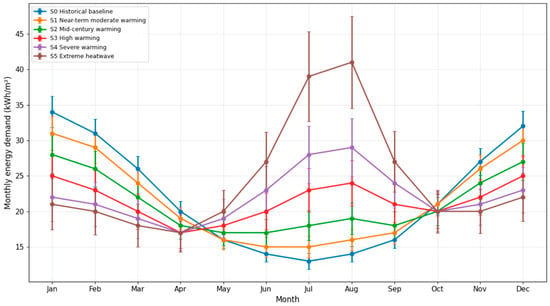
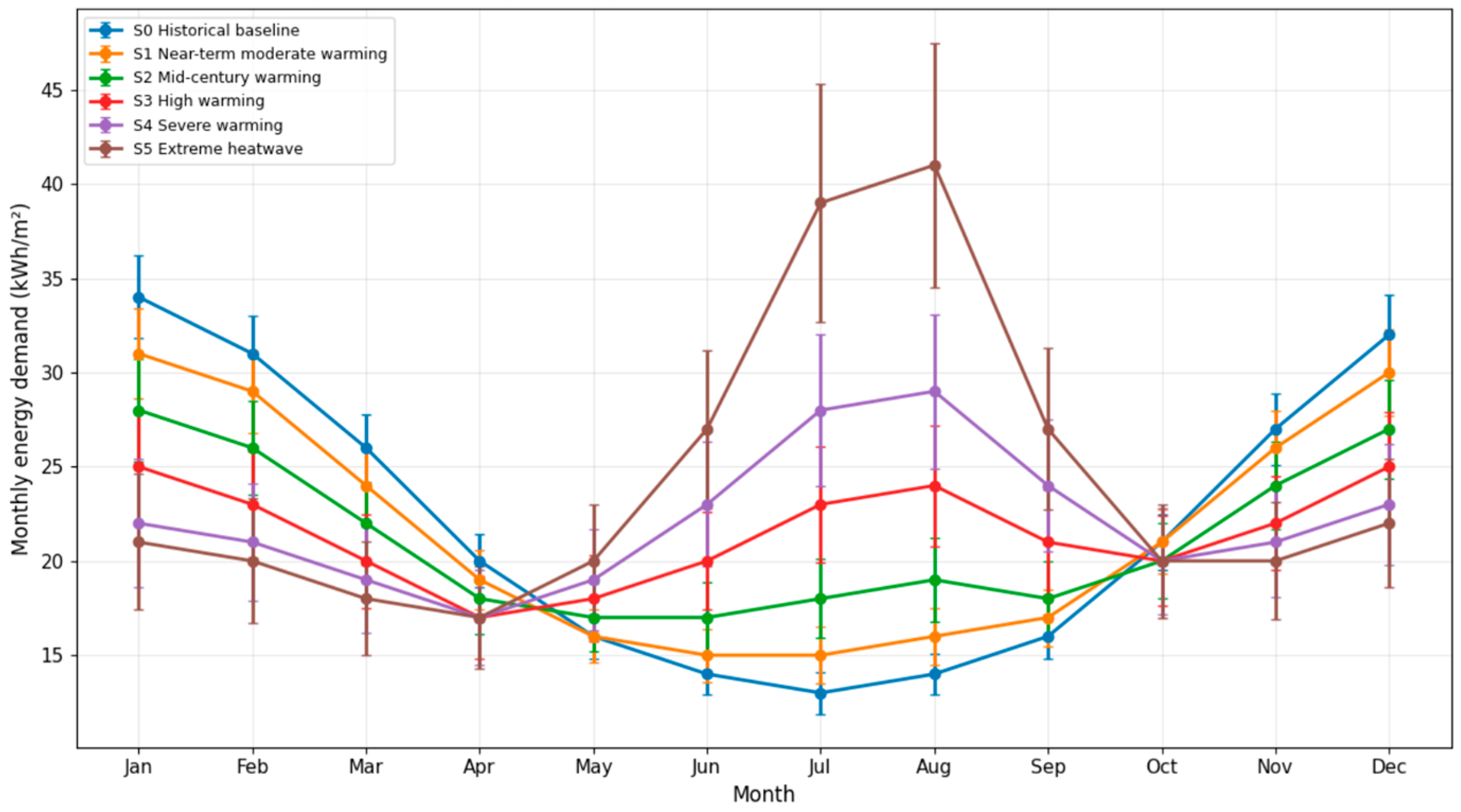
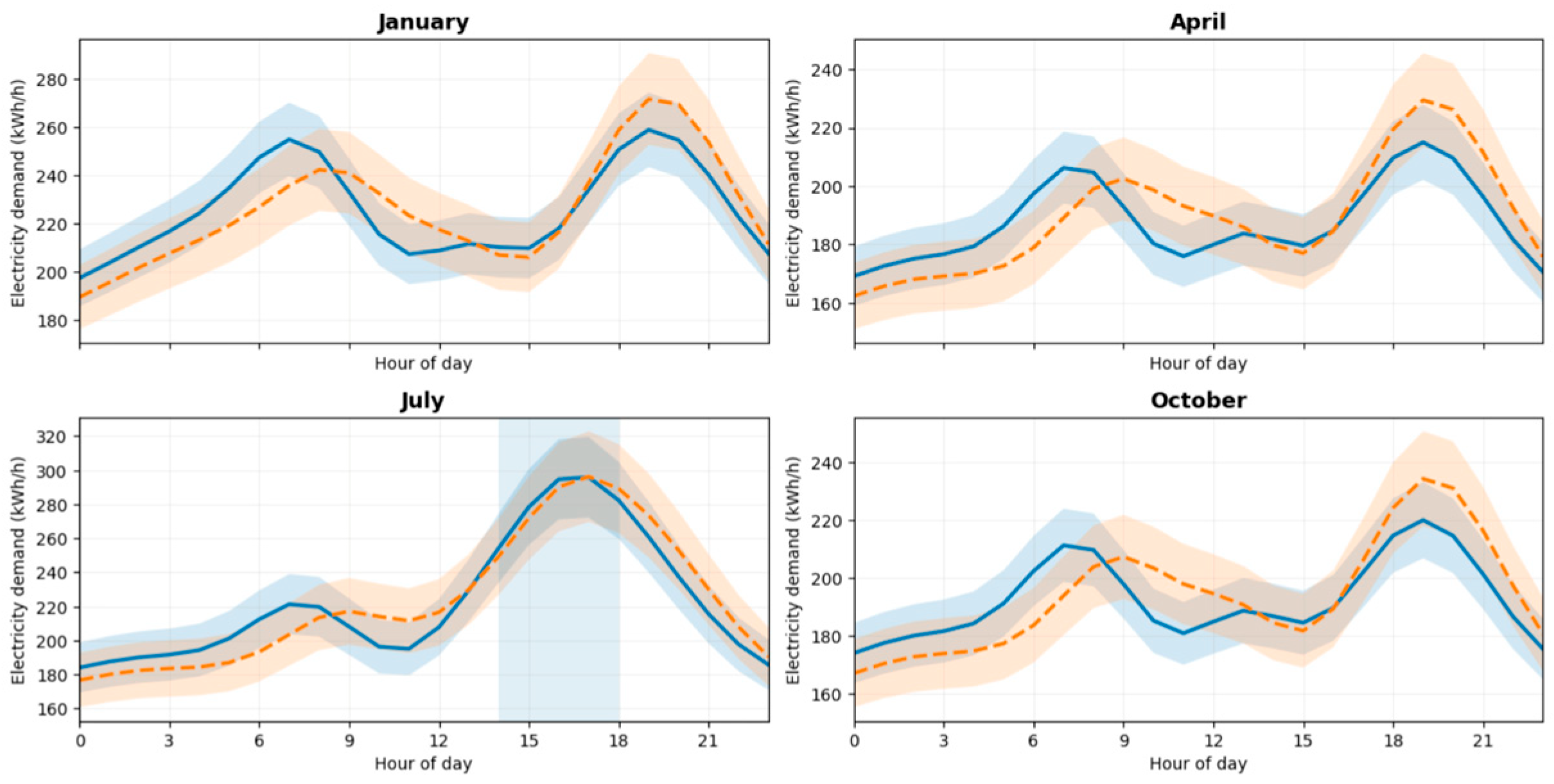
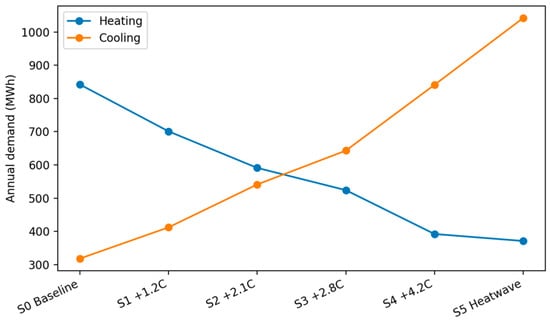
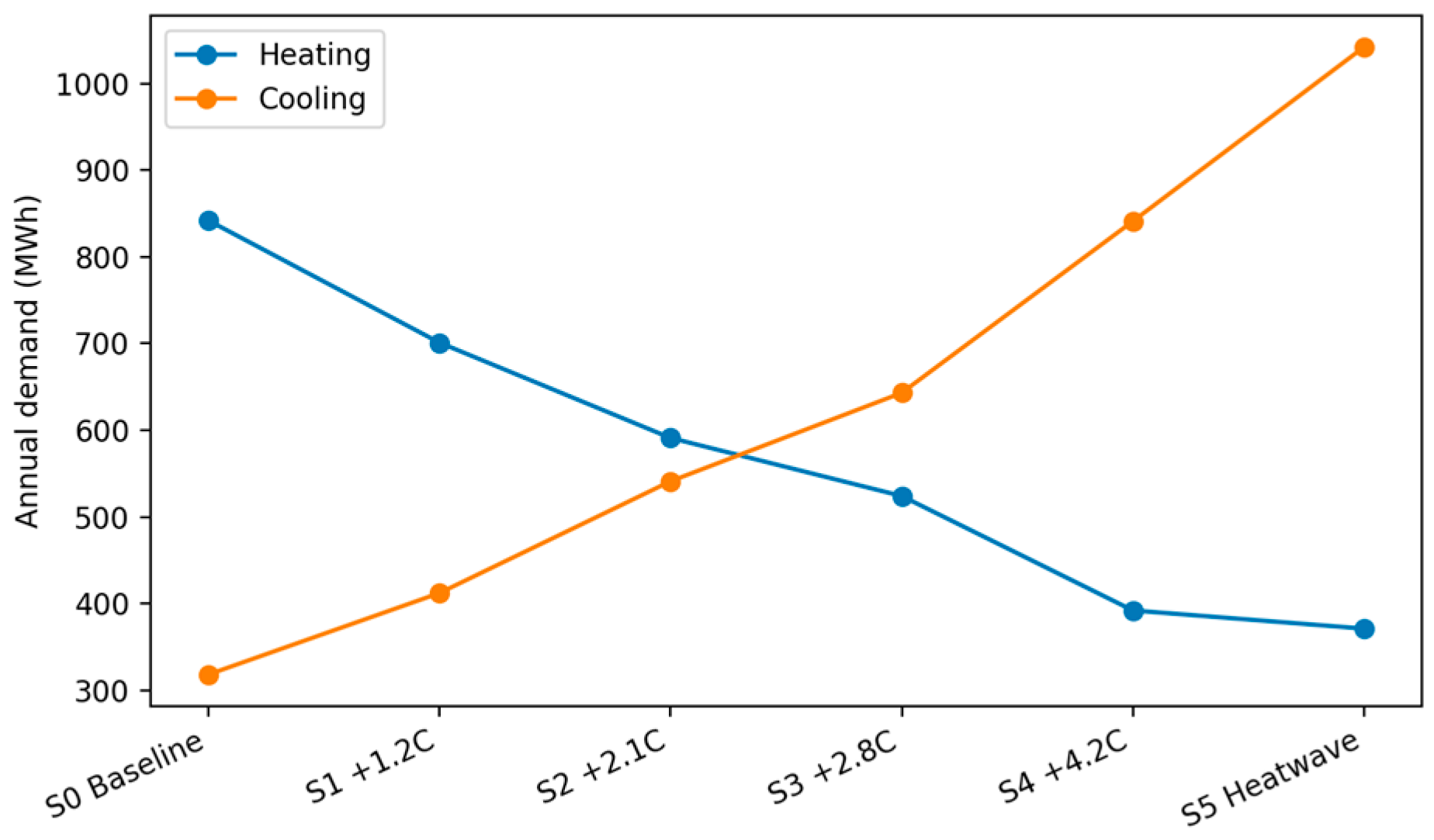
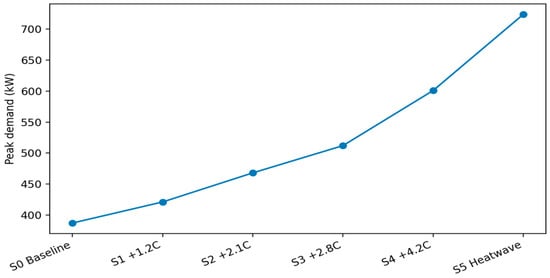
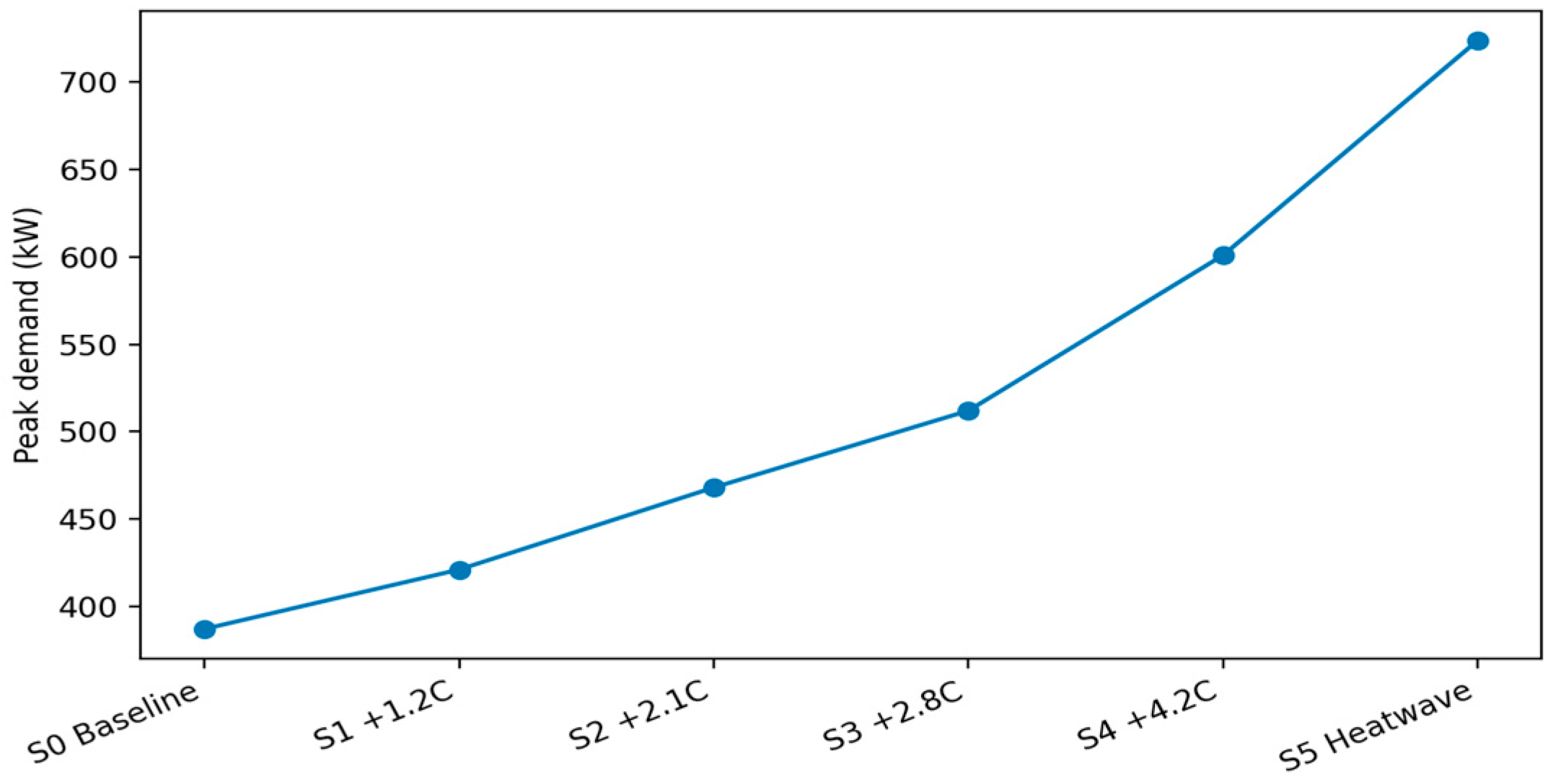
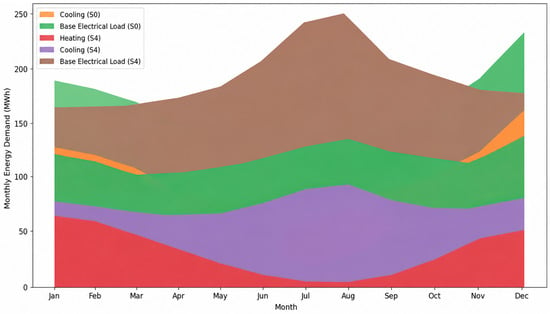
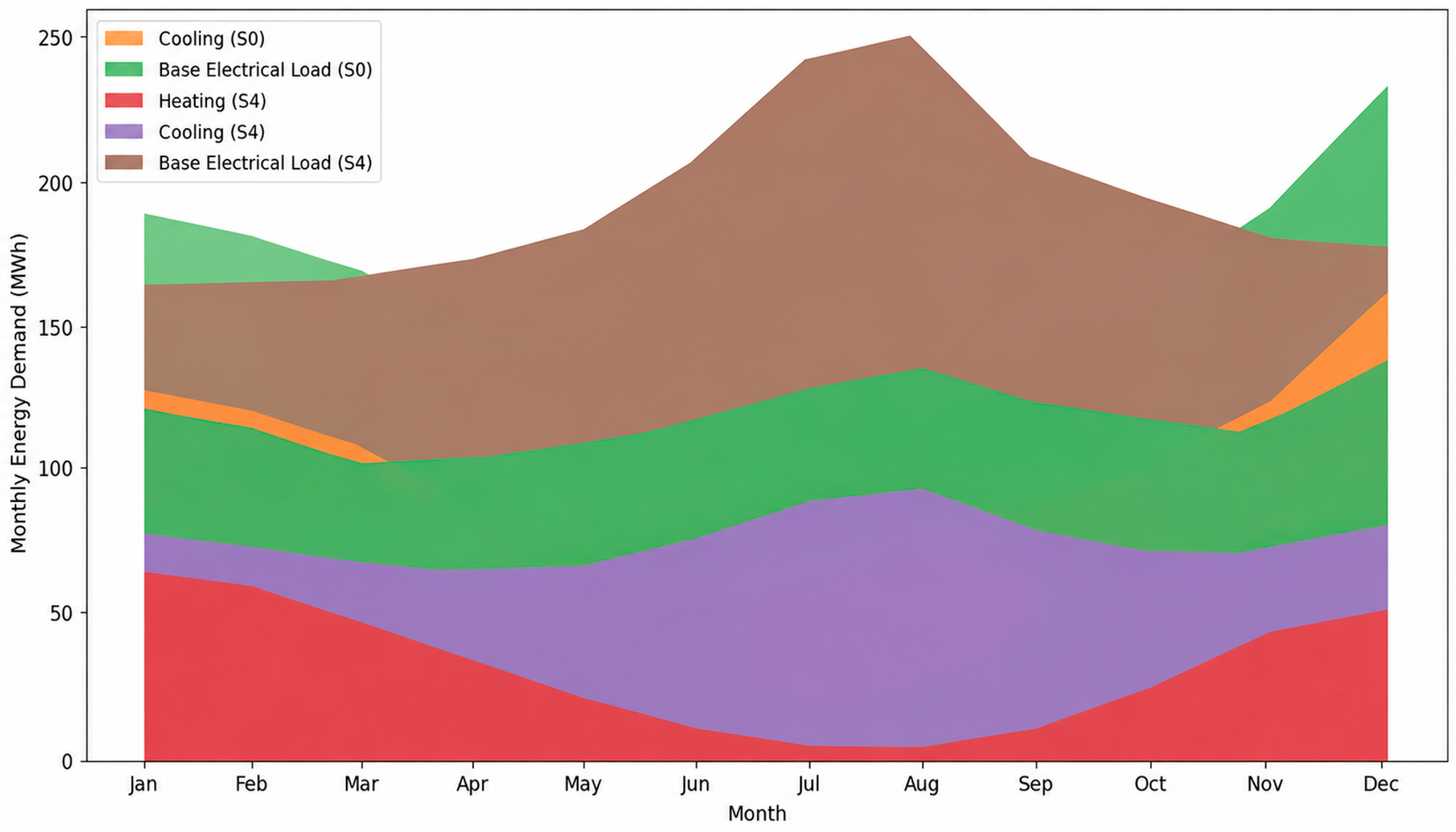
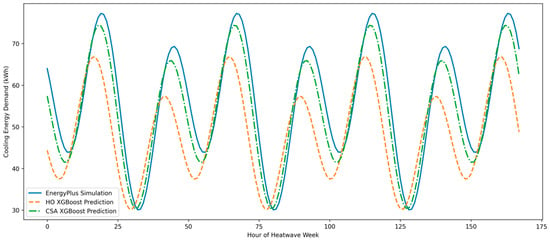
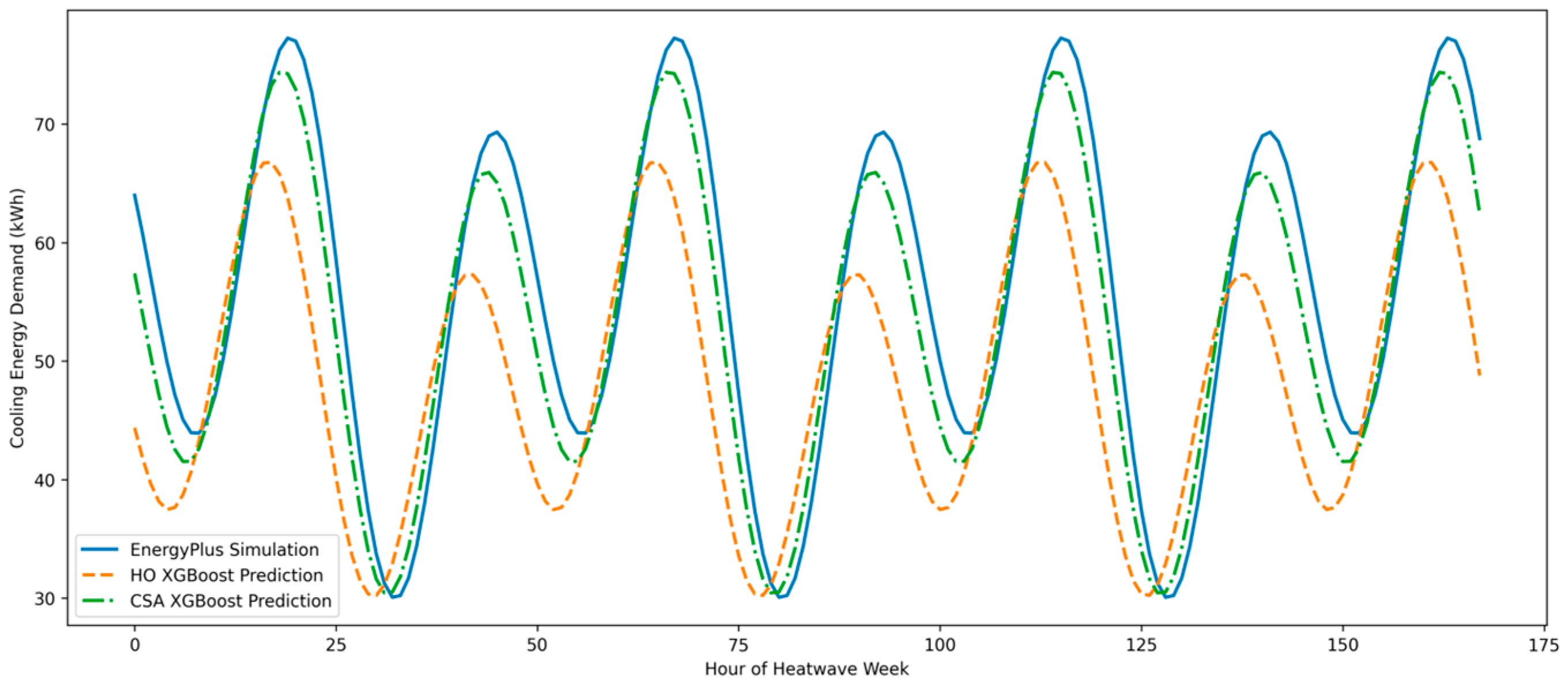
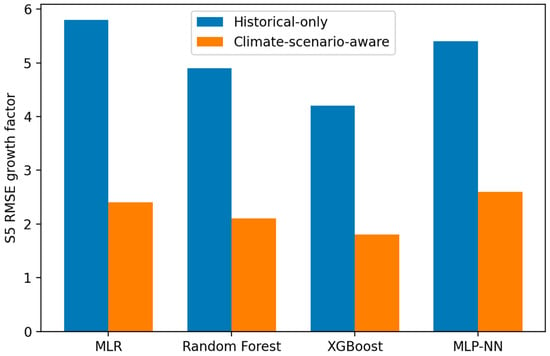
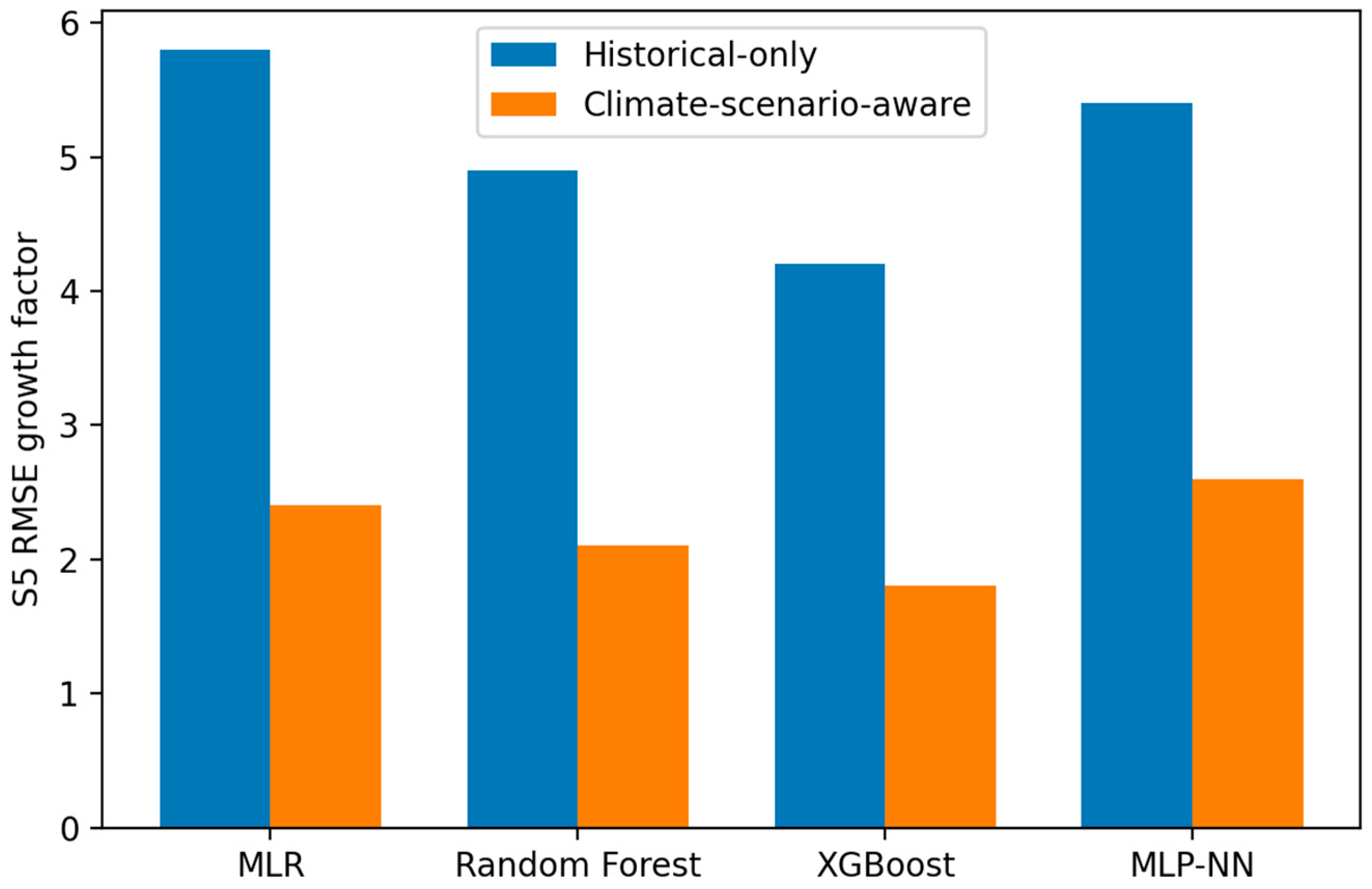

Disclaimer/Publisher’s Note: The statements, opinions and data contained in all publications are solely those of the individual author(s) and contributor(s) and not of MDPI and/or the editor(s). MDPI and/or the editor(s) disclaim responsibility for any injury to people or property resulting from any ideas, methods, instructions or products referred to in the content. |
© 2026 by the authors. Licensee MDPI, Basel, Switzerland. This article is an open access article distributed under the terms and conditions of the Creative Commons Attribution (CC BY) license.