


Abstract
Botanical gardens are multifunctional institutions that perform a wide range of functions using limited resources. Their social significance has grown alongside global challenges like biodiversity loss, the climate crisis, and food security, as well as the need to train future professionals. This study analyzes public preferences for the diverse functions of botanical gardens to inform sustainable management strategies, using the Sejong National Arboretum in South Korea as a case study. We identified seven attributes, including five traditional functions (collection, conservation, research, exhibition, and education) and two extended functions (healing and networking) that reflect the contemporary roles of botanical gardens. We conducted a discrete choice experiment in 2024 with 1200 respondents to assess preferences and marginal willingness to pay. Respondents showed the strongest preferences for research commercialization and global conservation, followed by urban outreach in healing. In contrast, we observed negative marginal willingness to pay values for exhibition, professional certification, national networking, and nationwide outreach in healing. Our findings indicate that the public interest in botanical garden activities extends beyond visitor-oriented functions to include conservation, research commercialization, and locally embedded healing services. These results offer an empirical basis for resource allocation and sustainable management strategies in botanical gardens.
1. Introduction
Although no single internationally agreed-upon legal definition of botanical gardens exists, individual countries and researchers have proposed definitions from multiple perspectives. Botanical Gardens Conservation International (BGCI) describes them as “institutions holding documented collections of living plants for the purposes of scientific research, conservation, display, and education” [1]. Building on earlier functional approaches, Smith and Harvey-Brown [2] updated the criteria to reflect changing societal conditions, highlighting additional considerations, such as compliance with international policies, as well as sustainability and ethics initiatives. In South Korea, botanical gardens are legally defined under the Act on the Creation and Furtherance of Arboretums and Gardens as institutions primarily engaged in collecting, propagating, conserving, managing, and exhibiting the genetic resources of forest trees, as well as conducting scientific and industrial research.
Botanical gardens also fulfill a wide range of societal roles. Smith and Harvey-Brown [3] categorized the value of these institutions into economic, social, and environmental dimensions, identifying multidimensional impacts across sectors like tourism, research, education, culture, and environmental conservation. Focusing on the historical development and functions of botanical gardens, Demirel et al. [4] suggested that their core roles today are horticulture, protection, research, education, and recreation. Botanical gardens also play an important role in addressing the global challenges of the 21st century, including climate change and food security [5]. Botanical gardens function as multifaceted institutions that deliver diverse socio-cultural benefits in addition to their fundamental role in biodiversity conservation.
In urban contexts, botanical gardens additionally function as components of urban green infrastructure. Publicly accessible green spaces contribute to urban quality of life by providing environmental, aesthetic, educational, and social benefits [6]. They provide various ecosystem services to urban residents, among which regulating and supporting cultural ecosystem services are particularly emphasized [7]. These services enhance urban resilience and contribute to human health and well-being, potentially reducing health-related social costs [8,9]. Previous studies have shown that botanical gardens support visitors’ physical and psychological well-being and have recommended that they operate as multifunctional spaces integrating conservation, recreation, education, and tourism to deliver ecosystem services effectively [9,10]. As global demand for urban green space increases, demand for botanical garden services is likely to grow as well [11]. As the roles of botanical gardens continue to expand, understanding how the public values their diverse functions and attributes is important for ensuring their sustainable management and responding to the growing societal demand for multifunctional urban green spaces.
In addition to this broader societal relevance, botanical garden management sometimes requires more detailed information regarding which features or attributes to improve. Without such information, administrators face challenges in efficiently allocating limited budget and staffing resources, forcing them to deprioritize certain functions under short-term operational pressures [2]. Many botanical gardens receive public funding and are accessible at low or no cost; thus, evidence-based prioritization across functions is particularly important. A systematic assessment of the multifunctional value of botanical gardens and the relative importance of each function is essential.
Despite this need, empirical research on the economic role of botanical gardens remains limited and has treated each institution as a single, undifferentiated good. Prior valuation studies have focused on non-use value estimates based on contingent valuation (CV) [12,13] or use-value estimates based on the travel cost method (TCM) [14,15,16]. The two approaches differ fundamentally in what they measure. CV is a stated-preference (SP) method that elicits values from hypothetical survey responses, whereas the TCM is a revealed-preference method grounded in observed visitation behavior. Researchers have typically used CV to value conservation-related (non-use) benefits and the TCM to value recreation-related (use) benefits. Although these studies have established an important foundation, two gaps remain. First, by valuing the botanical garden as a whole, they cannot reveal how the public weighs the specific functions that compete for limited management resources. Second, because conservation and recreation values are estimated through different methods, the resulting estimates rest on distinct welfare concepts and are not directly comparable across functions.
Mwebaze and Bennett [13] have presented an example that illustrates the second gap. They combined CV and the TCM to assess the value of Australian botanical gardens. They found that TCM-based estimates exceeded CV-based estimates, a difference they attributed to the distinct value components and welfare measures captured by each method. Such method-driven discrepancies imply that conservation and recreation values estimated separately cannot be ranked against one another, even though management must balance them within a single budget. Overcoming both gaps requires a framework that jointly values the individual functions of a botanical garden using a common metric within a single stated-preference setting. We use a discrete choice experiment (DCE) for this purpose. A DCE rests on the Lancaster [17] view of demand, in which a good is valued not as a monolith but as a bundle of separable attributes, each contributing to utility [18,19]. This perspective is especially helpful for assessing multifunctional institutions like botanical gardens.
Our study identifies management functions to prioritize in sustainable botanical garden management and estimates the economic value the public assigns to each. We apply a DCE to the Sejong National Arboretum (SNA) in South Korea as a case study [20]. We value distinct functions on a single monetary metric within a stated-preference instrument, enabling direct comparisons across functions that prior CV- and TCM-based studies could not provide. Drawing on the multifunctional perspective of botanical gardens and prior valuation studies, we formulate the following hypotheses:
H1.
The public assigns significant economic value to improvements in botanical garden functions.
H2.
The economic value of botanical garden functions differs across attributes, reflecting variation in the perceived importance of each function.
H3.
Preferences for botanical garden functions are heterogeneous across individual respondents, reflecting differences in how the roles of botanical gardens are perceived.
Our study also addresses the research question: which botanical garden attributes generate the highest marginal willingness to pay (MWTP), and which, if any, yield negative values?
Our findings provide empirical estimates of the economic value of each function, contributing to the development of evidence-based policies and management strategies for future botanical gardens that meet public demand while continuing to support their multifaceted functions.
2. Literature Review
A DCE is a leading SP approach that infers economic value from respondents’ choices among alternatives. Researchers widely use SP methods to value nonmarket public and environmental goods for which no behavioral trace exists, including changes that fall outside currently observed market conditions [18]. Building on the attribute-based view of value, the technique classifies a good into its constituent attributes and estimates the marginal contribution of each to utility. Thus, it is well-suited to valuing several functions simultaneously.
A DCE offers several methodological advantages for valuing the multifunctional attributes of botanical gardens. First, a DCE is particularly suited to estimating the relative attractiveness of the various constituent attributes. Second, DCE provides an opportunity to estimate marginal values that may be difficult to identify because of multicollinearity or limited data variation. Third, whereas CV presents respondents with an all-or-nothing decision, a DCE offers repeated choice opportunities across multiple choice sets, in which respondents select between environmental alternatives and the status quo [19].
A DCE is particularly useful when policy interventions are costly or difficult to reverse once implemented [11,21]. The method has considerable potential to inform effective policy decisions while accounting for public demand and feasibility considerations. Despite the growing use of DCEs in environmental valuation, applications in botanical gardens remain limited. However, a small number of studies have examined preference structures for specific attributes within these institutions.
Trull et al. [11] designed a DCE for the Urban County Government Arboretum in Kentucky, United States, to explore future operational strategies and policy options. To capture potential trade-offs in arboretum management, they specified attributes that reflected both potential revenue-generating elements (e.g., a vending machine) and visitor-attraction elements (e.g., a pollinator garden and picnic tables). They reported strong preferences for attributes related to visitor experience and recreation. Attributes directly associated with revenue generation elicited negative preferences. Their findings highlight the importance of aligning management strategies with visitor preferences and proactively expanding recreation and observation-oriented facilities to meet changing visitor demand.
Affandi et al. [14] combined the TCM and a DCE to estimate visitors’ valuation of services at the Bogor Botanical Garden in Indonesia. They reported that visitors expressed stronger preferences for attributes related to education, information provision, and tour services than for ecosystem-conservation functions such as species conservation. They further noted that conservation preferences may be difficult to characterize with a single, broad attribute (e.g., species conservation), and suggested that future studies adopt more finely specified conservation attributes.
In South Korea, Hong et al. [22] conducted a DCE before the establishment of the SNA to assess economic feasibility and potential demand. Their results showed statistically significant preferences for attributes that were uncommon in existing Korean arboreta, such as a wetland botanical garden and forest trails in dense woodland. In contrast, attributes related to education, facilities, and accessibility were not statistically significant, prompting the authors to highlight the need for further empirical research into visitors’ needs and usage patterns. Kang [23] conducted a DCE at the local government-operated Gyeongnam Arboretum and estimated attribute values for guided interpretation, spatial design, and tree diversity. All attributes yielded statistically significant positive MWTP, with the largest value associated with improvements in tree diversity. The study also emphasized the importance of incorporating a broader set of attributes and functions to quantify the multifunctional value of arboreta. To the best of our knowledge, DCE-based valuation studies of botanical gardens and arboreta in South Korea have not been reported since 2013. Given that the available Korean evidence is now more than a decade old, it is necessary to re-examine public preferences in light of current conditions in botanical garden management.
Hong et al. [22] is particularly relevant to the present study as they examined the same case site, the SNA. However, the authors conducted their analysis before the arboretum’s establishment and therefore relied on hypothetical attributes defined before actual development and operations; as a result, it could not fully reflect operational realities or actual visitor experiences. Their study provides a useful benchmark for exploring potential shifts in preferences before and after opening, motivating the present study’s post-opening analysis under real-world operating conditions.
Most previous studies focus on traditional functions like conservation, education, and recreation. As a result, they may not fully capture the expanding roles of modern botanical gardens. More recently, researchers have paid increasing attention to their broader functions. Historically, botanical gardens have maintained living plant collections. However, they have evolved into spaces that offer health and healing benefits to surrounding communities [24]. Horticultural therapy programs provided by botanical gardens significantly reduce stress levels among individuals with mental health conditions [25], and botanical gardens more broadly contribute to both physical and emotional well-being [9].
Botanical gardens also curate substantial knowledge about plant science, but it is not always effectively communicated to the public. Disseminating scientific knowledge and its applications, overcoming barriers to information access, and stimulating public interest in biodiversity remain key challenges [26]. Addressing these challenges requires strengthening the knowledge-exchange role of botanical gardens through various forms of networks, among institutions, between local communities and botanical gardens, and across national boundaries. Cavender and Donnelly [6] note that achieving urban sustainability and human-environmental well-being requires new collaborative partnerships, a need that botanical gardens can help address. Contemporary botanical gardens are likely to extend beyond their core functions of collection, conservation, research, exhibition, and education to include healing and networking functions. To address this gap, we evaluate both traditional functions and extended functions, including healing and networking, as attributes of contemporary botanical garden management.
3. Materials and Methods
3.1. Study Area
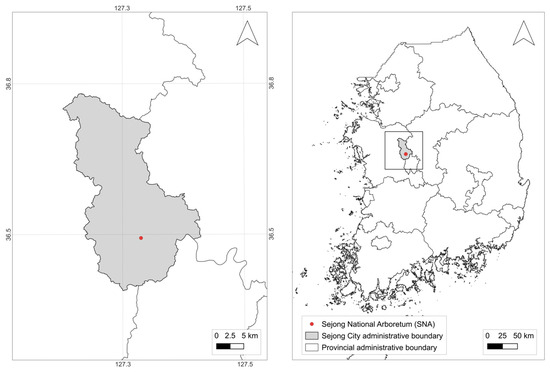
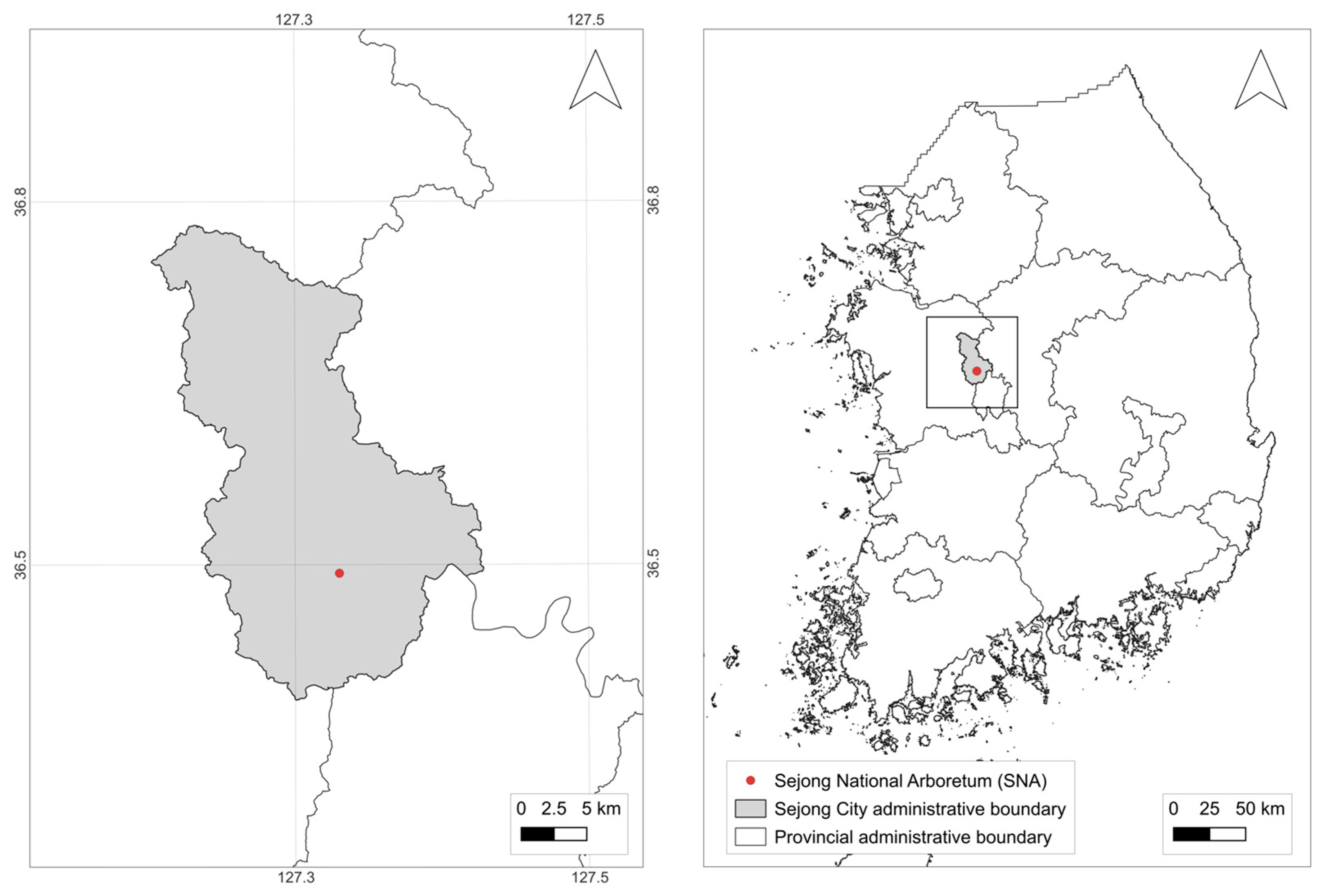
Opened in Sejong City in 2020, the SNA is the first national arboretum established in an urban area in South Korea (Figure 1). It covers approximately 65 ha and features 26 thematic gardens. The primary operational objectives of the SNA include conserving biological resources, expanding the public arboretum and botanical garden services, promoting garden culture, and establishing an ESG (Environmental, Social, and Governance) management framework. Currently, the institution maintains a collection of 4367 plant species and attracts over 800,000 annual visitors and 10,000 registered members, serving as a major national facility for urban green space services.
Figure 1.
Location of the Sejong National Arboretum (SNA) in the Republic of Korea.
Korean law does not provide a separate legal definition for botanical gardens, and these are often understood as a subset of arboreta, resulting in substantial functional overlap between the two categories. The Korea Arboreta and Gardens Institute (KoAGI), the parent organization of the SNA, is registered with BGCI, and the SNA’s core functions are consistent with the internationally recognized roles of botanical gardens. We treat the SNA as a botanical garden in this study.
Beyond its ecological mandate, the SNA annually hosts approximately 20 exhibitions and cultural events, as well as educational and experiential programs that engage 60,000 participants. It also supports professional workforce development training and internship programs for approximately 300 trainees annually. The SNA supports local socioeconomic development through partnerships with regional farms and local employment initiatives. In collaboration with universities and specialized research institutes, the SNA also advances the conservation and utilization of forest biological resources.
The SNA represents a contemporary botanical garden that extends beyond traditional functions to encompass broader social, educational, cultural, and economic functions. This multifunctional characteristic makes the SNA a suitable case for the present research.
3.2. Experimental Design
We first reviewed the literature to develop a preliminary set of attributes appropriate for the SNA. Three criteria guided our attribute selection. First, each attribute had to represent a function of botanical gardens recognized in international and academic discussions. We included this criterion to ensure the generalizability of the findings and the framework’s potential applicability to other botanical gardens. Second, the function had to be actively performed by the SNA, and its improvements had to be expressible through discrete, ordered levels suitable for a DCE design. Third, each attribute had to be communicable to non-expert respondents and adequately conveyable through the survey materials. We identified six preliminary attributes: collection, exhibition, research, education, conservation, and recreation.
We then re-examined and refined the preliminary attributes and their levels using a focus group with internal experts. The two-hour session included four SNA experts and three research team members. All participating experts were affiliated with the KoAGI at the time of the focus group and had prior working experience at other national botanical gardens. The well-qualified expert panel assessed the relevance of attributes based on direct knowledge of the SNA’s operational context and the broader functions of botanical gardens.
We structured the focus group around four tasks: (i) assessing the content validity of the six preliminary attributes against the actual operational scope of the SNA; (ii) identifying major SNA functions not represented in the initial attribute set; (iii) ensuring that the final attribute set applied to other botanical gardens; and (iv) reviewing the clarity of the proposed levels, photo materials, and payment vehicle.
Two substantive changes emerged from the discussion. First, participants noted that the six preliminary attributes did not adequately reflect the SNA’s recent emphasis on regional and inter-institutional partnerships and knowledge-exchange systems. We added networking as an additional attribute. Second, participants indicated that the conventional notion of recreation did not fully capture the wellness-oriented services provided by contemporary botanical gardens. We renamed the attribute healing. We initially proposed several alternative candidates (e.g., technology) as attributes. We excluded tram and AI-based exhibition as candidate levels because they did not meet the selection criteria or were not sufficiently communicable to non-expert respondents.
The addition of networking and healing reflects the broader shift in contemporary botanical garden functions discussed in Section 2, including the extended networking role highlighted by Smith and Harvey-Brown [2] and the transition toward wellness-oriented institutions noted by Shaw [27]. To operationalize these concepts within the DCE framework, we categorized networking into levels representing the expanding scope of partnership activity, from regional to international cooperation. We classified healing into levels representing the spatial reach of healing and garden-culture programs, ranging from in-garden activities to urban and nationwide outreach. This operationalization translated the functions identified through the literature review and expert consultation into concrete policy alternatives for respondents to evaluate in a DCE.
To validate the suitability and clarity of the defined attributes and levels, we conducted a pilot survey with visitors to the SNA on 27–28 September 2024. The pilot study aimed to (i) assess whether respondents experienced any difficulty understanding the proposed attributes and levels and (ii) identify a reasonable range for the payment attribute. Respondents reported their WTP in an open-ended format, with values ranging from ₩5000 ($3.61) to ₩1,000,000 ($722.54) and a calculated mean of ₩80,543 ($58.20). During the survey period, USD 1 was equivalent to KRW 1384, and EUR 1 was equivalent to USD 1.05.
Drawing on both the pilot survey results and payment levels used in previous studies, we set seven payment levels for the main survey: ₩1000 ($0.72), ₩5000 ($3.61), ₩10,000 ($7.23), ₩30,000 ($21.68), ₩50,000 ($36.13), ₩100,000 ($72.25), and ₩200,000 ($144.51). The payment vehicle was a conservation fund. We acknowledge that a conservation fund mechanism may raise incentive-compatibility and consequentiality concerns in stated-preference valuation [28]. We nevertheless adopted this payment vehicle given the SNA’s institutional context, in which policy sets admission fees; increasing the existing charge of approximately ₩5000 is not feasible. However, a voluntary conservation fund can elicit additional nonmarket value beyond the admission fee. These estimates can also inform the SNA’s future management and pricing policy discussions.
The final design included seven non-monetary attributes, each with three levels, plus a payment attribute with seven levels (Table 1). A full factorial design including all combinations of attributes and levels yields all alternatives (). Presenting all combinations to respondents is not feasible; thus, we employed a fractional factorial design to reduce the number of alternatives while maintaining statistical efficiency.
Table 1.
Attributes and Levels for the Discrete Choice Experiment.
We generated the choice sets using the dcreate package in Stata version 19 (StataCorp LLC, College Station, TX, USA) based on the D-efficiency design. D-efficiency seeks to minimize the standard errors of the estimated parameters while avoiding excessive correlations among parameter estimates [29]. The D-efficiency for this study was 0.619. We generated 36 alternatives and combined them into 12 choice sets, each consisting of three alternatives, including a status quo option. We divided the 12 choice sets into three blocks, each containing four. Respondents were randomly assigned to one of the three blocks (400 respondents per block) and completed the four choice tasks in that block.
3.3. Econometric Models
To translate individual choice data into estimable parameters, discrete choice models are typically grounded in the Random Utility Maximization (RUM) framework [30]. RUM assumes that individuals behave to maximize their own utility. However, researchers cannot directly observe an individual’s total utility, and only some attributes and characteristics of each alternative are observable [29]. We can express the indirect utility of the alternative to the respondent as , where is the deterministic component of utility consisting of observable factors, and denotes an unobserved random component that affects utility, but that does not capture.
Various econometric models can be employed to estimate respondents’ utility functions. Jumamyradov et al. [31] suggest that a conditional logit (CL) model is appropriate when the coefficient estimates themselves are the primary focus. In contrast, the mixed logit (MXL) model is preferable when interpretive indicators, such as WTP, are of central interest. The MXL extends the CL model by allowing coefficients to vary randomly across respondents, thereby capturing heterogeneity in preferences. It is typically estimated using maximum simulated likelihood. By incorporating random parameters, the MXL can capture preference heterogeneity in the sample and relax the independence of irrelevant alternatives (IIA) restriction implied by the CL model. For these reasons, we estimated both the CL and MXL models. We focus on the MXL results in the final interpretation.
With alternatives in a choice set, the probability that the individual chooses the alternative under the MXL specification is given by [21,32]:
Here, is the vector of individual-specific (random) coefficients, denotes their assumed density with parameter , and is the deterministic utility component for the alternative .
We assumed that preferences for the seven non-monetary attributes followed a normal distribution, allowing both positive and negative individual preferences [29,33]. Bass et al. [34] noted that restricting WTP to positive values only may lead to upwardly biased estimates. Thus, we also allowed for negative WTP values. This specification is also consistent with our research question, which explicitly considers the possibility of negative attribute values. We attempted to assess the robustness of alternative distributional specifications; however, models with these distributions did not consistently converge under our parameter specifications; thus, we retained the normal distribution assumption.
Regarding the model’s structural parameters, we estimated an alternative-specific constant (ASC) for the status quo option, with the ASCs for the remaining two alternatives normalized to zero. Because each non-monetary attribute is specified with three levels and dummy-coded, we estimated MWTP for the two improvement levels, allowing us to examine nonlinear preferences and scope sensitivity [33,35,36].
The decision to estimate the ASC as a fixed coefficient rather than a random parameter follows King et al. [33] and Toledo-Gallegos et al. [37]. This specification allows us to focus on preference heterogeneity in the DCE attributes while keeping the model parsimonious and the estimates readily interpretable.
3.4. Data
Data were collected through an online panel survey administered from 22–29 November 2024, using a large proprietary panel maintained by a professional research company. We applied quota sampling by gender, age, and region of residence to ensure the sample approximated the national population distribution. We acknowledge that recruitment through a proprietary online panel may introduce some degree of self-selection bias, as panel members are likely to be more familiar with online surveys and may differ from the general population in unobserved characteristics. Thus, we applied demographic quotas and examined the sample’s representativeness against national statistics in Section 4.1.
Before beginning the questionnaire, we provided respondents with information on the study’s purpose, the role of botanical gardens, key background information on the SNA, and explanations of the seven functions examined in our study. Respondents then completed four discrete-choice tasks, followed by questions on socioeconomic characteristics, including age, gender, education level, and household income. We obtained informed consent from all respondents via the online interface before participation.
We obtained a total of 1200 valid responses. Because each respondent completed four choice tasks with three alternatives per task, the final dataset comprised 14,400 alternative-level observations. To account for the repeated-choice panel structure and intra-individual correlation, we linked observations from the same respondent using a respondent identifier during estimation.
4. Results
4.1. Survey Results
Table 2 compares respondents’ socioeconomic characteristics with national statistics for South Korea. To ensure sample representativeness, we used quota sampling by gender and age, resulting in a distribution that closely approximates the national population. Mean monthly household income was ₩7.08 million ($5116), which is higher than the national average of ₩5.14 million ($3714). Regarding marital status, 62.0% of respondents were married, approximately six percentage points above the national proportion. Educational attainment was high, 83.0% reported having a university degree or higher, compared with 56.6% in the general population, suggesting the sample is more highly educated than the general population.
Table 2.
Basic Statistics of the Socioeconomic Characteristics of the Survey Respondents.
4.2. Model Results
Table 3 presents the estimated results of the logit models based on 1200 respondents. To validate the model selection, we present results from the CL and MXL models. The AIC and BIC penalize model complexity by adding a function of the number of parameters to the negative log-likelihood, so that lower values indicate a better balance between fit and parsimony. The MXL produced lower AIC and BIC values, and other fit measures favored it.
Table 3.
Estimated Results of the Conditional Logit and Mixed Logit Models.
The MXL improves on the CL by relaxing its restrictive assumptions and explicitly accounting for preference heterogeneity across respondents. Most of the estimated standard deviation coefficients in the MXL were statistically significant, indicating substantial variation in preferences across respondents. Thus, we used the MXL for the final interpretation and MWTP estimation.
According to the MXL results, the ASC was negative but not statistically significant. This pattern suggests a slight tendency for respondents to prefer change over the status quo; however, the effect was not statistically significant [37].
The estimated coefficients indicate positive preferences for both collection levels (4586 and 4804 species), both conservation scopes (East Asia-wide and global), research commercialization, and urban outreach in healing. In contrast, we observed statistically significant negative preferences for both exhibition levels (demand-driven exhibitions and forest museum) and for professional certification, national networking, and nationwide outreach in healing. Applied technologies, job creation, and global networking did not show statistically significant effects.
The estimated standard deviations were statistically significant for most attributes, indicating heterogeneous preferences across respondents. The standard deviations for global conservation, forest museum, and job creation were not statistically significant, suggesting homogeneous preferences for these attributes [38].
4.3. MWTP
With estimated coefficients embedded in a nonlinear utility function, the MWTP provides a more appropriate basis for comparing the relative magnitudes of attribute effects. Table 4 presents the MWTP estimates derived from the MXL coefficients.
Table 4.
Estimated Mean MWTP for Potential Improvements to the SNA Based on the MXL.
Among the attributes with positive MWTP, research commercialization and global conservation yielded the highest values, at ₩42,842 ($30.96) and ₩41,625 ($30.08), respectively. Urban outreach in healing followed, with an MWTP of ₩31,933 ($23.07). Both collection levels (4586 and 4804 species) and East Asia-wide conservation each generated statistically significant positive MWTP values ranging from ₩22,623 ($16.35) to ₩24,368 ($17.61). In contrast, the MWTP for applied technologies was positive but not statistically significant because its 95% confidence interval included zero.
We observed negative MWTP estimates across exhibitions, education, networking, and nationwide outreach in healing, suggesting lower preferences relative to the corresponding reference level. Demand-driven exhibition had the largest negative MWTP at −₩52,937 (−$38.25), followed by national networking at −₩36,925 (−$26.67) and the forest museum at −₩33,590 (−$24.27). Job creation and global networking also showed negative MWTP estimates; however, neither effect was statistically significant.
To assess scope sensitivity, we conducted Wald tests to compare the coefficients for the two improvement levels for each non-monetary attribute [36,39]. For five of the seven attributes (conservation, research, exhibition, healing, and networking), the two levels differed significantly (), indicating that respondents distinguished between the magnitudes of improvement. The difference in education was not statistically significant at the 5% level, but it was close to the conventional threshold (, ). The main exception was collection, for which the two levels did not differ significantly (, ), suggesting that respondents did not clearly distinguish between a 5% and a 10% increase in plant species. Thus, we should interpret the results for collection with caution. Rather than emphasizing differences between the two levels, we focus on the broader finding that respondents expressed a significantly positive preference for improvements to collections.
5. Discussion
We conducted this study to identify the botanical garden attributes most highly valued by the public and to examine how botanical gardens’ roles and functions are perceived today. We analyzed preferences for seven attributes, including traditional botanical garden functions and more recent developments, such as healing and networking, that have become increasingly important in contemporary society.
The results support the hypotheses formulated in our study. H1 was supported, as most attribute levels generated statistically significant MWTP estimates, although applied technologies, job creation, and global networking were not significant. H2 was supported, as the MWTP varied across attributes, indicating that respondents perceived the relative importance of each attribute differently. H3 was also supported, with statistically significant standard deviations of most random coefficients in the MXL specification, indicating heterogeneous preferences across respondents.
In response to the research question, research commercialization and global conservation had the highest MWTP values. This finding indicates that respondents place a high value on the practical and societal applications of research, as well as on the role of botanical gardens in global conservation. The absence of preference heterogeneity for global conservation further indicates a societal consensus regarding the importance of this role. The MWTP for plant collections was also high, suggesting that respondents considered the collection, conservation, and utilization of plant resources to be important core functions of botanical gardens.
These findings are consistent with studies on urban green spaces that report strong preferences for naturalness and biodiversity. Bertram and Rehdanz [7] found that the richness of animal and plant species, as well as overall biodiversity levels, were regarded as important factors, along with cleanliness and low crime. Bronnmann et al. [40] further showed that respondents were willing to pay an additional €20.25 ($21.27) per month for a one-step increase in naturalness. Koo et al. [41] reported that biodiversity, representing the biotic condition of forests, was the most influential factor in citizens’ preferences for urban forests. This pattern is consistent with the present findings, which show significantly positive MWTP estimates for nature-related attributes like collection and conservation. This finding suggests that respondents value botanical gardens as spaces for recreation and education as well as components of urban green infrastructure that contribute to biodiversity and naturalness.
The strong public support for conservation and research commercialization has important implications for the sustainability of botanical gardens. By collecting and preserving plant species and seeds, botanical gardens can help address biodiversity loss [42], and conservationists can use conserved genetic resources to restore and reintroduce endangered species. This conservation role is increasingly important as more species become threatened by climate change. Applied research at botanical gardens can also contribute to food security and climate adaptation by developing climate-resilient traits such as drought tolerance and pest resistance [43,44]. These roles are closely connected to broader sustainability agendas, including the United Nations Sustainable Development Goal (SDG 15: Life on Land and SDG 13: Climate Action), indicating that botanical gardens can serve as key institutional platforms supporting biodiversity conservation and climate change responses.
We observed significantly negative MWTP estimates for exhibition, professional certification, national networking, and nationwide outreach in healing. These patterns should be interpreted with caution, as they reflect a combination of substantive and methodological factors. We consider four non-mutually exclusive possibilities.
First, the estimates may partly reflect attribute framing effects, since responses in SP surveys can be influenced by how attributes are described [45]. The improvement levels for collection and conservation represented concrete, easily grasped changes relative to the reference, whereas we necessarily described those for exhibition and education in more abstract terms, which may have dampened stated preferences independent of the value of the underlying functions.
Second, the estimates may reflect cognitive burden. The present study included seven non-monetary attributes, more than the three to four commonly used in previous botanical garden DCE studies, which may have imposed substantial cognitive load on some respondents [46,47].
Third, the negative estimates may reflect a genuinely lower public valuation of these functions in the current Korean context, which prioritizes conservation, research, and direct healing experiences. This pattern is consistent with previous Korean studies. Kang [23] reported the lowest MWTP for an education-related attribute, and Hong et al. [22] similarly found that education was not statistically significant.
Fourth, respondents may have perceived networking and nationwide outreach in healing as less direct than collection or conservation. Networking is widely recognized as a core function of contemporary botanical gardens [6,44,48]. However, its benefits, like large-scale biodiversity data collection, inter-institutional collaboration, and knowledge exchange, are indirect for individual visitors. Nationwide outreach in healing may follow a similar logic. Urban outreach aligns closely with citizens’ everyday environments. In contrast, nationwide benefits extend beyond their immediate surroundings and may not be perceived directly. Catahan et al. [26] similarly note that assessing the social health benefits delivered through botanical gardens is complex and difficult to capture within a single survey instrument.
Although the present data cannot fully distinguish among these explanations, they offer meaningful evidence for a particular reading. The contrast within the healing attribute is a case in point. Because urban and nationwide outreach are parallel levels of the same underlying function, their opposite signs are difficult to explain through framing or cognitive burden alone, and more likely reflect a genuine public preference for direct, personally accessible benefits over diffuse, collective ones. We therefore interpret these negative estimates as reflecting, at least in part, the imperfect public perception of the indirect, collective benefits of these functions, rather than treating them solely as evidence of genuine public disutility.
Beyond these attribute-level explanations, we must also consider the composition of the survey sample when interpreting the broader pattern of results. Most respondents held a university degree (83.0%), compared with 56.6% in the general population, and the mean household income was also higher than the national average. As Grilli et al. [49] document, higher educational attainment and income are commonly associated with greater willingness to pay for environmental and ecosystem services. This difference may have contributed in two ways. First, the absolute MWTP values for conservation and research attributes may be higher than those observed in a fully representative sample because more educated respondents may attach greater importance to these functions. Second, the relative preference for conservation and research over educational and exhibition functions may also be partially shaped by sample composition, as more educated respondents may already have ample access to educational and cultural opportunities elsewhere, reducing the marginal value they place on these functions at botanical gardens.
We must also acknowledge several limitations. First, as a SP study, our MWTP estimates may be subject to hypothetical bias. Although the survey incorporated detailed information provision, an earmarked payment vehicle, and pilot-based refinement of materials, it did not employ explicit cheap-talk or consequentiality scripts. The voluntary conservation fund adopted as the payment vehicle due to policy constraints on admission fees may have influenced the MWTP estimates through potential free-riding behavior. Future research should incorporate explicit bias-mitigation instruments such as cheap talk or consequentiality scripts to minimize respondent bias.
Second, the sample was not demographically balanced. We conducted subgroup analyses by education and income to examine whether preference patterns differed across demographic groups. The mixed logit specification did not consistently converge in the smaller subgroups due to the complexity of the 14-parameter random-effects specification and reduced sample sizes. Future research with larger and more balanced samples, post-stratification weighting, or more parsimonious model specifications could more systematically assess preference heterogeneity across demographic groups.
Third, we may not have fully conveyed some attributes to respondents. Extended functions such as networking and healing are less familiar to the public and may have been difficult for respondents to evaluate. Future studies introducing such functions should therefore devote greater attention to attribute development, including expert interviews and more thorough pre-testing of the survey design.
As our study focused on a single institution, the SNA, the generalizability of the findings is limited. Future research could incorporate multiple botanical gardens to validate and extend these results.
6. Conclusions
Evaluating the economic value of botanical gardens is important for setting sustainable management priorities and understanding their role as urban green spaces. Using a DCE, our study quantified public preferences and willingness to pay for the diverse functions of botanical gardens, an area where empirical evidence remains limited.
The results suggest several implications for botanical garden management. First, we would prioritize funding for functions such as plant resource collection, conservation, and research for the utilization of forest biological resources, as they underpin the public legitimacy of botanical gardens. Thus, decision-makers should allocate related budgets and personnel to ensure the continuity of these core conservation and research functions rather than focusing solely on exhibition and visitor-oriented services. Second, given the observed preference for urban outreach in healing, botanical gardens could reinforce their role as public green spaces that promote daily recovery and mental well-being among urban residents by expanding healing programs and implementing urban-linked, site-specific green space initiatives. Instead of pursuing broad nationwide cultural outreach, management could focus on programs that deliver direct restorative benefits to local communities. Third, although networking is important for operational effectiveness and conservation outcomes, the public may not adequately appreciate its value. Thus, networking should not remain merely an inter-institutional activity. Botanical garden decision-makers should communicate this essential task in more concrete, publicly visible ways, such as through collaborative conservation projects, announcements of research achievements, and hosting plant-resource exchange events. Finally, the MWTP estimates in this study exceed the SNA’s current admission fee of ₩5000 ($3.61). Although administrative and political considerations often constrain increases to admission fees at publicly funded institutions, respondents valued the proposed improvements well above the existing charge. These estimates can therefore inform decisions on revenue generation and pricing and may support the financial sustainability of public botanical gardens.
Our findings provide empirical evidence that public valuation of botanical gardens extends beyond the exhibition and education functions traditionally emphasized to include conservation, research, and healing. By identifying the operational strategies botanical gardens should emphasize and the functions they need to communicate more effectively, we provide a preference-informed basis for resource allocation and sustainable management. Future research should further refine the modern roles of botanical gardens and present them in more differentiated ways, while designing attribute meanings in forms that are easier for the public to understand, enabling more sophisticated preference analyses. Future research should also extend this approach to multiple botanical gardens and more representative samples to track shifts in public perceptions over time.
Author Contributions
Conceptualization, S.Y.H. and H.J.K.; Methodology, H.J.K.; Formal analysis, H.J.K.; Investigation, H.W.K.; Resources, H.W.K.; Data curation, H.J.K.; Writing—original draft preparation, H.J.K.; Writing—review and editing, H.W.K.; Supervision, S.Y.H.; Project administration, H.J.K.; Funding acquisition, S.Y.H. All authors have read and agreed to the published version of the manuscript.
Funding
This research was funded by the Sejong National Arboretum (grant number 202421030000). The APC was funded by R&D Program for Forest Science Technology (grant number RS-2024-00404388), provided by Korea Forest Service (Korea Forestry Promotion Institute).
Institutional Review Board Statement
The study was conducted in accordance with the Declaration of Helsinki and approved by the Institutional Review Board of Kyungpook National University (2024-0549, 5 November 2024).
Informed Consent Statement
Informed consent was obtained from all subjects involved in the study.
Data Availability Statement
The data presented in this study are available on request from the corresponding author due to privacy and ethical restrictions.
Conflicts of Interest
The authors declare no conflicts of interest.
References
- Jackson, P.S.W. Experimentation on a large scale—An analysis of the holdings and resources of botanic gardens. Bot. Gard. Conserv. News 1999, 3, 27–30. [Google Scholar]
- Smith, P.; Harvey-Brown, Y. BGCI Technical Review: Defining the Botanic Garden, and How to Measure Performance and Success; Botanic Gardens Conservation International: Richmond, UK, 2017. [Google Scholar]
- Smith, P.; Harvey-Brown, Y. BGCI Technical Review: The Economic, Social and Environmental Impacts of Botanic Gardens; Botanic Gardens Conservation International: Richmond, UK, 2018. [Google Scholar]
- Demirel, Ö.; Bingül Bulut, M.B.; Aydoğan, T. A Review on Botanic Gardens. Biodivers. Stud. 2022, 1, 75–83. [Google Scholar] [CrossRef] [Scilit]
- Krishnan, S.; Novy, A. The role of botanic gardens in the twenty-first century. CABI Rev. 2017, 11, 1–10. [Google Scholar] [CrossRef] [Scilit]
- Cavender, N.; Donnelly, G. Intersecting urban forestry and botanical gardens to address big challenges for healthier trees, people, and cities. Plants People Planet 2019, 1, 315–322. [Google Scholar] [CrossRef] [Scilit]
- Bertram, C.; Rehdanz, K. Preferences for cultural urban ecosystem services: Comparing attitudes, perception, and use. Ecosyst. Serv. 2015, 12, 187–199. [Google Scholar] [CrossRef] [Scilit]
- Thompson, C.W. Urban open space in the 21st century. Landsc. Urban Plan. 2002, 60, 59–72. [Google Scholar] [CrossRef] [Scilit]
- Pinto, L.; Ferreira, C.S.S.; Pereira, P. Environmental and socioeconomic factors influencing the use of urban green spaces in Coimbra (Portugal). Sci. Total Environ. 2021, 792, 148293. [Google Scholar] [CrossRef] [Scilit]
- Mekhloufi, N.; Baziz, A. Exploring the effects of visit motivation and user experience on perceptions of cultural ecosystem services in botanical garden: A case study of Algiers, Algeria. J. Outdoor Recreat. Tour.-Res. Plan. Manag. 2025, 50, 100879. [Google Scholar] [CrossRef] [Scilit]
- Trull, N.; Penn, J.; Hu, W. Visitor support for growth and funding in public built environments: The case of an arboretum. J. Hous. Built Environ. 2018, 33, 829–841. [Google Scholar] [CrossRef] [Scilit]
- Alvares, M.d.R.; Angelo, H.; Almeida, A.N.d.; Paula, M.F.d.; Brasil, A.A.; Matricardi, E.A.T. Economic Valuation of the University of Brasília Arboretum and Determinants of Willingness to Pay for the Arboretum. Sustainability 2024, 16, 5724. [Google Scholar] [CrossRef] [Scilit]
- Mwebaze, P.; Bennett, J. Valuing Australian botanic collections: A combined travel-cost and contingent valuation study. Aust. J. Agric. Resour. Econ. 2012, 56, 498–520. [Google Scholar] [CrossRef] [Scilit]
- Affandi, S.D.; Halimatussadiah, A.; Asrofani, F.W. Visitors’ Preferences on the Characteristics of Bogor Botanical Gardens. Sustainability 2020, 12, 9489. [Google Scholar] [CrossRef] [Scilit]
- Demir, A. Determination of the Economic Value of Botanic Garden. New Biotechnol. 2012, 29, S194. [Google Scholar] [CrossRef] [Scilit]
- Funsten, C.; Di Franco, C.; Borsellino, V.; Surano, N.; Asciuto, A.; Schimmenti, E. The recreational value of botanic garden events: A case study of the Zagara plant fair in Palermo, Italy. J. Outdoor Recreat. Tour. 2022, 39, 100565. [Google Scholar] [CrossRef] [Scilit]
- Lancaster, K.J. A New Approach to Consumer Theory. J. Polit. Econ. 1966, 74, 132–157. [Google Scholar] [CrossRef] [Scilit]
- Johnston, R.J.; Boyle, K.J.; Adamowicz, W.; Bennett, J.; Brouwer, R.; Cameron, T.A.; Hanemann, W.M.; Hanley, N.; Ryan, M.; Scarpa, R.; et al. Contemporary Guidance for Stated Preference Studies. J. Assoc. Environ. Resour. Econ. 2017, 4, 319–405. [Google Scholar] [CrossRef] [Scilit] [PubMed]
- Hanley, N.; Wright, R.E.; Adamowicz, V. Using Choice Experiments to Value the Environment. Environ. Resour. Econ. 1998, 11, 413–428. [Google Scholar] [CrossRef] [Scilit]
- Kang, H.J.; Kwon, H.W.; Han, S.Y. Preference and Valuation of Arboretum Attributes Using Discrete Choice Experiment. In Proceedings of the 2025 Summer Conference of the Korean Society of Forest Science, Gangneung, Republic of Korea, 25–27 August 2025; p. 347. [Google Scholar]
- Train, K.E. Discrete Choice Methods with Simulation, 2nd ed.; Cambridge University Press: Cambridge, UK, 2009; pp. 13–21. [Google Scholar]
- Hong, S.-K.; Kim, J.-H.; Jung, S.-J.; Tae, Y.-L. An Economic Valuation of Arboretum Using Choice Experiments. J. Korean Inst. Landsc. Archit. 2010, 37, 1–11. [Google Scholar]
- Kang, K.-R. A Study on the Estimation of Values Individual Services of an Arboretum using CE Method—Focused on Gyeongnam Arboretum. J. Korean Inst. Landsc. Archit. 2013, 41, 41–49. [Google Scholar] [CrossRef] [Scilit]
- Entwisle, T. A healing place: Reimagining the modern botanic garden as a physic garden. Biol. Divers. 2024, 1, 9–12. [Google Scholar] [CrossRef] [Scilit]
- Vujcic, M.; Tomicevic-Dubljevic, J.; Grbic, M.; Lecic-Tosevski, D.; Vukovic, O.; Toskovic, O. Nature based solution for improving mental health and well-being in urban areas. Environ. Res. 2017, 158, 385–392. [Google Scholar] [CrossRef] [Scilit]
- Catahan, N.; Hopwood, M.; Suraweera, P. Botanic Garden Tourism, Social Value, Health, and Well-Being. J. Zool. Bot. Gard. 2024, 5, 187–199. [Google Scholar] [CrossRef] [Scilit]
- Shaw, S. The Positive Effects on Mental Health of Visiting Botanic Gardens. Sibbaldia Int. J. Bot. Gard. Hortic. 2015, 13, 51–60. [Google Scholar] [CrossRef] [Scilit]
- Carson, R.T.; Groves, T.; List, J.A. Consequentiality: A Theoretical and Experimental Exploration of a Single Binary Choice. J. Assoc. Environ. Resour. Econ. 2014, 1, 171–207. [Google Scholar] [CrossRef] [Scilit]
- Mariel, P.; Hoyos, D.; Meyerhoff, J.; Czajkowski, M.; Dekker, T.; Glenk, K.; Jacobsen, J.B.; Liebe, U.; Olsen, S.B.; Sagebiel, J.; et al. Environmental Valuation with Discrete Choice Experiments; Springer: Cham, Switzerland, 2021; pp. 16–79. [Google Scholar]
- McFadden, D. Conditional logit analysis of qualitative choice behavior. In Frontiers in Econometrics; Zarembka, P., Ed.; Academic Press: New York, NY, USA, 1974; pp. 105–142. [Google Scholar]
- Jumamyradov, M.; Craig, B.M.; Greene, W.H.; Munkin, M. Comparing the Mixed Logit Estimates and True Parameters under Informative and Uninformative Heterogeneity: A Simulated Discrete Choice Experiment. Comput. Econ. 2025, 65, 3295–3324. [Google Scholar] [CrossRef] [Scilit]
- Ghosh, S.; Maitra, B.; Das, S.S. Effect of Distributional Assumption of Random Parameters of Mixed Logit Model on Willingness-to-Pay Values. Procedia—Soc. Behav. Sci. 2013, 104, 601–610. [Google Scholar] [CrossRef] [Scilit]
- King, P.M.; Dallimer, M.; Lundhede, T.; Austen, G.E.; Fisher, J.C.; Irvine, K.N.; Fish, R.D.; Davies, Z.G. Stated preferences for the colours, smells, and sounds of biodiversity. Ecol. Econ. 2025, 227, 108410. [Google Scholar] [CrossRef] [Scilit]
- Bass, D.A.; McFadden, B.R.; Messer, K.D. A case for measuring negative willingness to pay for consumer goods. Food Policy 2021, 104, 102126. [Google Scholar] [CrossRef] [Scilit]
- Czajkowski, M.; Budziński, W.; Campbell, D.; Giergiczny, M.; Hanley, N. Spatial Heterogeneity of Willingness to Pay for Forest Management. Environ. Resour. Econ. 2017, 68, 705–727. [Google Scholar] [CrossRef] [Scilit]
- Lew, D.K.; Wallmo, K. External Tests of Scope and Embedding in Stated Preference Choice Experiments: An Application to Endangered Species Valuation. Environ. Resour. Econ. 2011, 48, 1–23. [Google Scholar] [CrossRef] [Scilit]
- Toledo-Gallegos, V.M.; Long, J.; Campbell, D.; Börger, T.; Hanley, N. Spatial clustering of willingness to pay for ecosystem services. J. Agric. Econ. 2021, 72, 673–697. [Google Scholar] [CrossRef] [Scilit]
- Rihn, A.; Khachatryan, H.; Wei, X. Perceived subjective versus objective knowledge: Consumer valuation of genetically modified certification on food producing plants. PLoS ONE 2021, 16, e0255406. [Google Scholar] [CrossRef] [Scilit]
- Kipperberg, G.; Dugstad, A.; Lopes, A.; Grimsrud, K.; Lindhjem, H.; Navrud, S. Scope effects in stated preference research: From construct validity to economic significance. Res. Prepr. 2024, Preprint. [Google Scholar] [CrossRef]
- Bronnmann, J.; Liebelt, V.; Marder, F.; Meya, J.; Quaas, M. The Value of Naturalness of Urban Green Spaces: Evidence from a Discrete Choice Experiment. Land Econ. 2023, 99, 528–542. [Google Scholar] [CrossRef] [Scilit]
- Koo, J.-C.; Park, M.S.; Youn, Y.-C. Preferences of urban dwellers on urban forest recreational services in South Korea. Urban For. Urban Green. 2013, 12, 200–210. [Google Scholar] [CrossRef] [Scilit]
- Jackson, P.S.W.; Sutherland, L.A. International Agenda for Botanic Gardens in Conservation; BGCI: Richmond, UK, 2000; ISBN 0-9520275-93. [Google Scholar]
- Sharrock, S.; Chavez, M. The Role of Botanic Gardens in Building Capacity for Plant Conservation. BGjournal 2013, 10, 3–7. [Google Scholar]
- Primack, R.B.; Ellwood, E.R.; Gallinat, A.S.; Miller-Rushing, A.J. The growing and vital role of botanical gardens in climate change research. New Phytol. 2021, 231, 917–932. [Google Scholar] [CrossRef] [Scilit]
- Kragt, M.E.; Bennett, J.W. Attribute Framing in Choice Experiments: How Do Attribute Level Descriptions Affect Value Estimates? Environ. Resour. Econ. 2012, 51, 43–59. [Google Scholar] [CrossRef] [Scilit]
- Hoyos, D. The state of the art of environmental valuation with discrete choice experiments. Ecol. Econ. 2010, 69, 1595–1603. [Google Scholar] [CrossRef] [Scilit]
- Caussade, S.; Ortúzar, J.D.; Rizzi, L.I.; Hensher, D.A. Assessing the influence of design dimensions on stated choice experiment estimates. Transp. Res. Part B Methodol. 2005, 39, 621–640. [Google Scholar] [CrossRef] [Scilit]
- Raschke, A.B.; Pegram, K.V.; Melkonoff, N.A.; Davis, J.; Blackwell, S.A. Collaborative Conservation by Botanical Gardens: Unique Opportunities for Local to Global Impacts. J. Zool. Bot. Gard. 2022, 3, 463–487. [Google Scholar] [CrossRef] [Scilit]
- Grilli, G.; Tyllianakis, E.; Luisetti, T.; Ferrini, S.; Turner, R.K. Prospective tourist preferences for sustainable tourism development in Small Island Developing States. Tour. Manag. 2021, 82, 104178. [Google Scholar] [CrossRef] [Scilit]

Disclaimer/Publisher’s Note: The statements, opinions and data contained in all publications are solely those of the individual author(s) and contributor(s) and not of MDPI and/or the editor(s). MDPI and/or the editor(s) disclaim responsibility for any injury to people or property resulting from any ideas, methods, instructions or products referred to in the content. |
© 2026 by the authors. Licensee MDPI, Basel, Switzerland. This article is an open access article distributed under the terms and conditions of the Creative Commons Attribution (CC BY) license.