Review

Sustainable Outdoor Recreation: Definition, Conceptual Development, and Future Directions

US Forest Service, Pacific Northwest Research Station, 400 N. 34th St., Suite 201, Seattle, WA 98103, USA
*
Author to whom correspondence should be addressed.
Emeritus.
Sustainability 2026, 18(12), 6012; https://doi.org/10.3390/su18126012
Submission received: 3 April 2026 / Revised: 13 May 2026 / Accepted: 5 June 2026 / Published: 11 June 2026
(This article belongs to the Section Tourism, Culture, and Heritage)

Abstract

Protected area (PA) managers balance the need to provide quality visitor experiences with other management objectives (e.g., conservation, economic use), particularly in multi-use agencies. Sustainability science has informed PA management, emphasizing consideration of economic, environmental, and social interactions. Sustainable management of outdoor recreation has received far less attention. Moreover, there has been a lack of agreement among PA managers about how sustainable outdoor recreation is defined, operationalized, managed, or monitored. Having a shared understanding of ‘sustainable recreation’ will provide a foundation for PA managers to identify specific sustainability objectives and design strategies in alignment with agency goals. In this review article, we reflect on two decades of outdoor recreation research and synthesize ideas generated by a workshop of outdoor recreation scholars and practitioners. We compare notions of sustainable recreation across PA agencies in the U.S. to demonstrate the need for a unified approach and to inform the selection of appropriate recreation management and planning tools. Our definition of sustainable recreation builds on traditional pillars of sustainability while embracing notions of stewardship and resilience. We conclude by discussing a potential operational model for sustainable recreation and identifying future research needs to advance the field in new directions.

1. Introduction

Protected areas (PAs) are geographical spaces or jurisdictions managed by legal means to achieve long-term nature conservation [1]. In 2026, PAs encompass 17.6% of the globe’s terrestrial area [2] and thus are important tools for species and ecosystem protection in the face of change, while providing ecosystem services for people, including recreational spaces [3]. Managers of PAs and public lands that allow public visitation are charged with managing visitor use alongside other agency objectives [4]. Typically, this requires the need to balance human use with protection of natural and cultural resources as well as other mission-critical goals such as sustainable resource extraction, energy production, habitat restoration, or reduction in wildfire risk.
Outdoor recreation refers to the array of activities people do outside or in natural settings for leisure, sport, lifestyle, exercise, quality of life, or spiritual renewal [5]. Examples include hiking, camping, wildlife viewing, fishing, kayaking, skiing, and swimming. Outdoor recreation management involves the planning, oversight, and monitoring of recreational activities to protect natural and cultural resources and allow for visitor enjoyment [6]. Recreation management includes three elements: management of the biophysical environment affected by human use; management of visitation (volume, type, duration, timing and activities); and management of services, facilities, and infrastructure (trails, camping areas, visitor centers) supporting visitation. Recreation managers rely on a variety of tools and frameworks to generate a range of visitor experiences [7]. PA visitation generates economic benefits that contribute to domestic GDP and creates local employment opportunities [8]. Investments in recreation infrastructure benefit communities as well as visitors by creating recreation and stewardship opportunities. Meanwhile, elevated PA visitation or inappropriate uses can result in management challenges. Rising visitation levels and a diversifying array of outdoor activities and emerging technologies may contribute to deleterious effects on ecological systems, heritage resources, and the social environment without proper management [9]. Increased visitation also raises stakes for gateway communities as they address challenges related to traffic, aging infrastructure, protection of cultural property, rising living costs, and changes to local identity [10].
Sustainability concepts have been circulating widely since the 1980s and are ubiquitous in resource management practice. The notion of sustainable development was introduced in the Brundtland Report in 1987, defined as “an approach to growth and human development that aims to meet the needs of the present without compromising the ability of future generations to meet their own needs” [11]. This definition was codified by the United Nations (UN) organizations, and endorsed by PAs worldwide, to ensure that visitation is conducted in a way that serves the needs of the environment, the economy, and social equity and well-being [12]. Described often as ‘three pillars,’ these are often depicted in overlapping, concentric circles, suggesting that sustainability is achieved when all three components are in balance [13]. Many have noted that the diagram assumes equal importance of the pillars and that balance is achievable, measurable, and desirable, although this assumption has not been supported by theory. Still, the model provides a useful conceptual framework to consider ecological, economic, and social elements and implications. While sustainability concepts have long been in practice, they have not been consistently applied to the management of outdoor recreation.
Sustainable recreation is one of many pathways to meet general global sustainability goals but with a primary focus on the management and stewardship of natural ecosystems and landscapes [14]. PA managers striving to integrate outdoor recreation management approaches with the UN’s Agenda for Sustainable Development require clear definitions and objectives for sustainable recreation management. Some emphasis has been placed on identifying PA objectives for sustainable tourism, a related concept [15,16,17]. As defined by the UN World Tourism Organization, sustainable tourism “takes full account of its current and future economic, social and environmental impacts, addressing the needs of visitors, the industry, the environment and host communities”, thus focusing on the touristic industry and its destinations [18,19]. In contrast, sustainable recreation, with a focus on PA management, has seldom been addressed. Management frameworks built on sustainability principles that highlight the myriad interactions between outdoor recreation and the economy, environment, and society are needed.
In the U.S., public land and resource management agencies have adopted ‘sustainable outdoor recreation’ as a conceptual approach to address social, economic, and environmental challenges [20]. Most agencies have strategic documents and guidelines for sustainable recreation, but formal definitions tend to be vague and variable across agencies [21,22]. Federal land management agencies in the U.S. identify sustainable recreation goals for natural and cultural resource protection. Those agencies with ‘multiple use’ mandates (i.e., managing for diverse, simultaneous uses such as recreation, grazing, timber, mining, and watershed protection) focus heavily on accommodating increasing recreation demand and visitor diversity, incorporating community benefits, collaboration in decision-making, and improving agency recreation budgets, staffing, and operations. Future recreation management depends on expanding, adapting, and integrating outdoor recreation practices of the past with growth, development, and broader landscape conservation needs of the future [21].
We propose the use of the definition of sustainable outdoor recreation, which was previously published in a research strategy developed by recreation scientists in 2022 [23]. We discuss how the definition compares with current federal agency practice in the U.S. and with existing and emerging outdoor recreation planning and management strategies and frameworks. We offer case studies to illustrate the adoption of sustainable recreation approaches and an operational model for implementing sustainable recreation. We conclude by identifying future challenges and directions to advance the field of sustainable recreation management. By establishing a shared notion of sustainable outdoor recreation, PA managers may accelerate efforts to design, implement, measure and monitor recreation activities and settings in ways that are consistent with sustainability principles and that align visitation with conservation goals. While our focus is primarily on outdoor recreation in the U.S., our conceptualization contributes to conversations about sustainable management of outdoor recreation and PA visitation globally.

2. Background

After World War II, public lands in the U.S. experienced an “explosion” in recreational use [24]. Since then, state and federal land management agencies have adopted a multitude of planning and management practices designed to protect natural environmental conditions and provide quality recreational experiences for visitors [25,26]. Throughout the late 20th century, hikers, campers, boaters, anglers, motorized riders, bicyclists, and many other visitors flocked to public lands and sought trails, sites, and facilities to support their use. The increasing intensity of use raised questions in the minds of ‘multiple use’ agency planners about the effects of visitor use on wildlife, watersheds, soils, vegetation, and ecosystems [27,28]. Others expressed concern about changes in the social environment due to an influx of visitors, including some who had expectations of solitude or pristine outdoor experiences, particularly in wilderness areas [29]. Some asked whether visitor growth rates were sustainable given the setting conditions, infrastructure, personnel, and administrative resources to accommodate growing use.
Recreation preferences, patterns, and policies changed dramatically in the 21st century. Population growth, urbanization, updates in outdoor gear and technology, and marketing initiatives from outdoor gear manufacturers contributed to growth in public lands visitation [30]. During the 2020–2021 global pandemic, visitation to public lands increased as people sought healthy activities in outdoor spaces [31]. Policy initiatives also played a role as public land agencies reached out to diverse groups, and recreation providers were encouraged to cater to a broader array of activities and public benefits from recreational use, such as rural community and economic development, tribal co-management and traditional uses, public health outcomes, and many others [5,32]. These 21st-century demands are not well addressed by past recreation planning and management practices that focus on on-site uses and problems rather than creating societal benefits and opportunities for growth, diversity, and outreach [5,33]. Moreover, historic practices focus on managing settings within PA boundaries without consideration of the broader social-ecological system [34,35].
There has also been growing recognition of the economic importance of the outdoor recreation industry [36]. Recreation visitors to public lands contribute non-local expenditures to gateway communities for retail, transportation, and hospitality services, adding to the local tax base [37]. Businesses catering to visitors, such as outfitters, guides, and resorts, provide employment. In 2023, the value added of the outdoor recreation economy accounted for 2.3 percent ($639.5 billion) of gross domestic product for the United States [38]. Public agencies actively cultivate recreation opportunities, acknowledging these economic benefits [8]. Rural and regional economic development entities also recognize the ability of public lands to generate tourism [39].
Pressures on state, federal, and private land managers to provide for public use and to simultaneously protect natural and cultural resources are unprecedented, but dominant recreation management practices have changed little in the last 50 years [33,40]. New conceptual and practical orientations to the provision of outdoor recreation opportunities are needed.

3. Concepts

Sustainable recreation is a subcomponent of global sustainability, which is defined in the Brundtland Report as “meeting the needs of the present without compromising the ability of future generations to meet their own needs” [11]. Some have described sustainability as “a social goal for people to co-exist on Earth over a long period of time”. As noted, sustainability is often presented as having three dimensions (pillars): social, economic, and environmental. This broad conceptualization of global sustainability is often criticized as being ambiguous or “too fuzzy” [41]. A social goal, however, can be understood as an ideal, not a specific target or set of actions. The purpose of a social goal is to instigate actions and policies that move human systems in a particular direction. For example, individuals deciding to take mass transit, communities adopting recycling programs, companies developing carbon-neutral policies, and nations moving economic subsidies toward renewable energy are vastly different tactics, but each moves human activities incrementally toward global sustainability. Moreover, each tactic has social, economic, and environmental factors and implications.
This view leads to two important general characteristics of sustainability. First, it should not be thought of as a “utopian endpoint,” but rather a process that requires many interacting plans, policies, and actions that help human social and economic systems move toward sustainable interactions within environmental systems [42]. As Berkes et al. explain: “We consider sustainability as a process rather than an end product, a dynamic process that requires adaptive capacity for societies to deal with change” [43]. UN notions of sustainable development are more concrete, being understood as the processes, pathways, and actions taken to achieve sustainability, including shifts in investment, technology, and institutional policy [11].
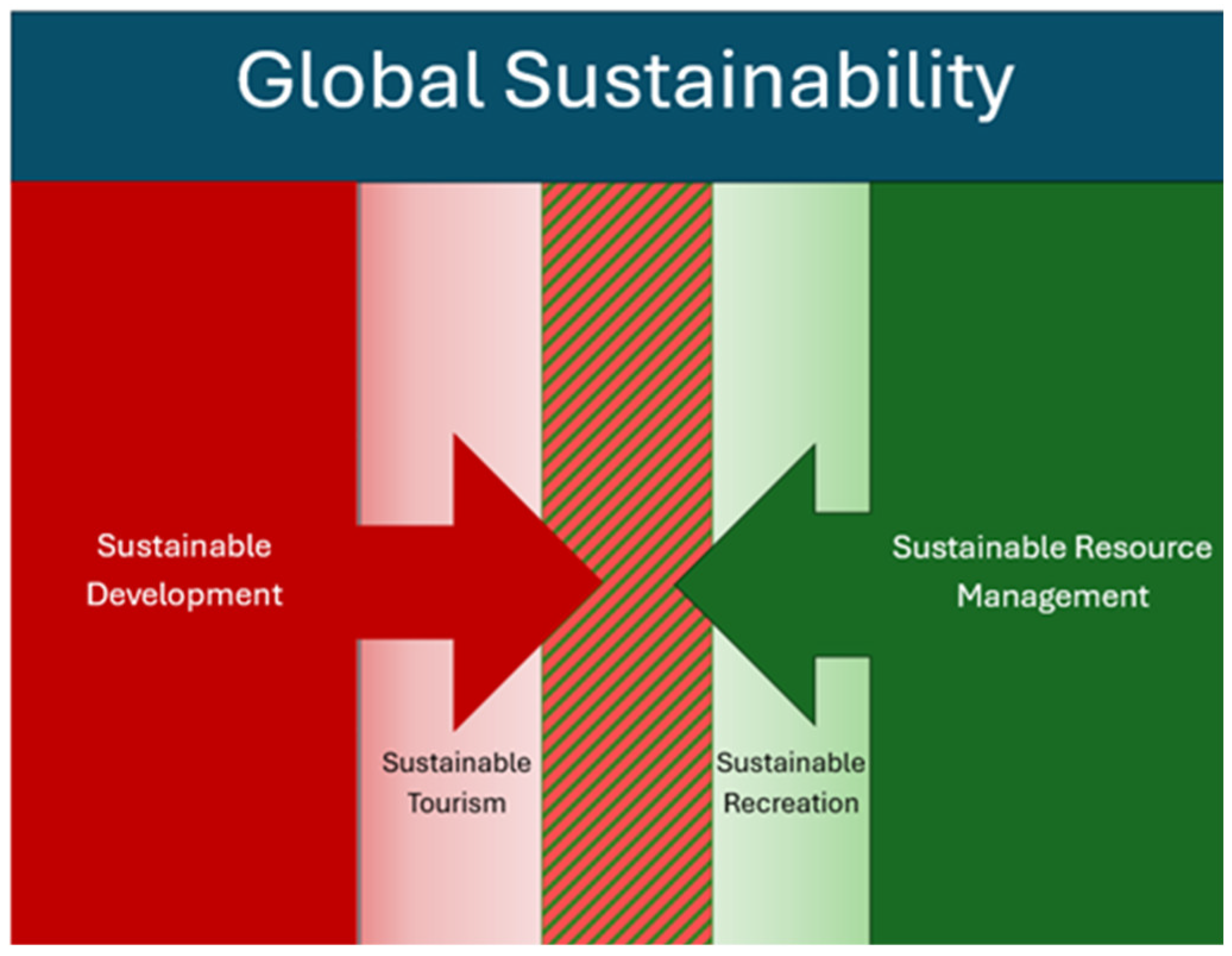
Second, there are many different but complementary subcategories or components of sustainability that are necessary to help organize and design sustainability efforts. Figure 1 describes how these concepts are interrelated and nested. Sustainable development emphasizes strategies designed to meet human needs and improve the human condition. Sustainable tourism refers to practices by the tourism industry that account for “current and future economic, social and environmental impacts, addressing the needs of visitors, the industry, the environment and host communities” [18]. We view sustainable tourism as a subset of sustainable development.
At a similar level of abstraction is sustainable resource management, which focuses more on the capabilities and persistence of the land and water resources needed to meet human needs [44]. In this subcategory, we include management of forests, ranges, fish, wildlife, minerals, and watersheds. We view sustainable recreation as a subset of sustainable resource management with a focus on PA visitation.
Both types of sustainability (sustainable development and sustainable resource management) contain overlapping subcomponents related to leisure pursuits (indicated by the shaded area) and are dependent on community infrastructure, economic development, and resource management practices that protect underlying landscape conditions and provide nature-oriented tourism attractions. Yet there are important differences to highlight. For sustainable recreation, the primary focus is on the management and stewardship of natural ecosystems and landscapes [44,45,46], which better reflects the mandates of PA management agencies. Sustainable tourism lends itself to consideration of the constellation of tourism entities, enterprises, systems and processes that support the visitor industry and its impacts on social, environmental, and economic conditions. While they are overlapping concepts, sustainable tourism and sustainable recreation have different foci and relevance to agencies, organizations, and economic sectors where those activities dominate [14]. Several key differences between sustainable recreation and sustainable tourism are highlighted in Table 1.
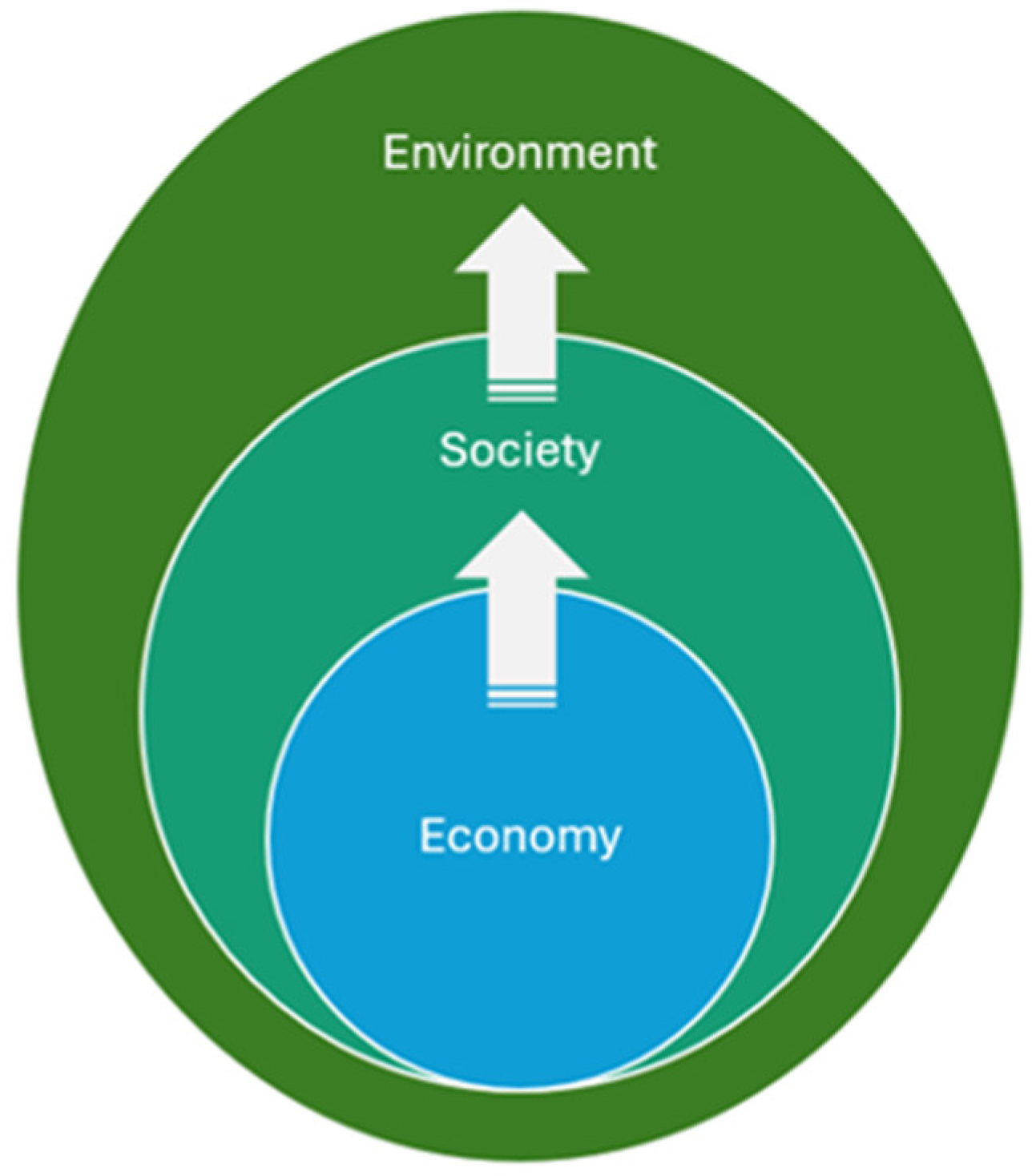
As with all aspects of global sustainability, planning for sustainable recreation (or sustainable tourism) focuses on the ‘three pillars’ of environment, economy, and society, and the assumption is that these are equal elements that operate in balance, which is not always the case [13]. Interpretations and applications of sustainable management in practical applications of PA management vary tremendously, suggesting that sustainability is context dependent. Some approaches or interpretations squarely start with the goal of environmental protection or resource conservation and allowance of social and economic benefits to the extent that the environment is not compromised. In these situations, a more descriptive diagram of the nested and interacting character of the three pillars is warranted, with the ‘environment’ being the broader container upon which the other two pillars depend or are nested (Figure 2). However, while the environment is the foundation or basis of human development (and outdoor recreation), human interactions with and effects on the environment are dependent on economic and societal factors. It would be a mistake to consider the physical environment any more important in the abstract for the development of sustainability policies or management actions than the economic and societal factors that dictate how we interact with the environment in both positive and negative ways. Rather than prioritize one pillar over the other, interactions of all three factors and the pathways supporting them should be explored simultaneously and in context.
The field of ‘recreation ecology’ has traditionally focused on quantifying and minimizing the negative impacts that recreation has on the physical environment and rarely considered the human preferences, drivers, or alternatives for meeting human recreational needs, causing biophysical impacts [27,28]. Thus, for example, decisions to close areas to recreational use to protect the biophysical environment may lead to dispersal of recreationists and inadvertently increase environmental impacts when recreationists visit places that are more environmentally sensitive. As a result, recreation ecology is shifting towards a more holistic social-ecological systems approach to understanding challenges and opportunities related to natural spaces hosting outdoor recreation [3]. However, the physical environment may be the primary driver of sustainability management in certain circumstances if the resources in question are unique, particularly sensitive, or rare. Likewise, other approaches may emphasize the economic or social sector with goals like community development, poverty reduction, or minimizing damage to historical and cultural resources [47,48]. In other words, one pillar may be prioritized and viewed as primary, while the others are perceived to be secondary or in service to that primary pillar.
Many have noted that achieving sustainability is not a balancing act (treating all as equal and maximizing all factors at once), but rather a process or way of thinking; some elements of sustainability may be prioritized or emphasized depending on the context and management objectives [13,43,49]. However, consideration and integration of all three factors in the planning of policy and management actions is essential. There are also variations in how recreation is managed sustainably within PA boundaries or whether the social-ecological system across jurisdictions is considered [34].

4. Federal Land Management Agencies and Sustainable Recreation

In the United States, federal and state land management agencies have identified sustainable recreation as a management goal to meet increasing visitor demand and retain local economic benefits, while simultaneously protecting the natural and cultural resources that underpin outdoor experiences. While governmental agencies share a sense of need for incorporating sustainable recreation in land management, goals, implementation standards, and practices differ across agencies, and there is a great deal of flexibility in operational approaches [50,51,52]. Agency definitions are varied, however, and their understanding of sustainable recreation is still evolving as each agency links sustainability goals to their broader purpose and mandate [10]. We compare notions of sustainable recreation across four U.S. natural resource agencies.

4.1. U.S. Fish and Wildlife Service

The U.S. Fish and Wildlife Service (FWS) is part of the U.S. Department of Interior with the mission “to conserve, protect, and enhance fish, wildlife, plants, and their habitats for the continuing benefit of the American people” [53]. An important role of the agency is in managing 573 wildlife refuges and 38 wetlands in 50 states. FWS descriptions of sustainable recreation reflect the agency’s primary mandate to conserve wild plants, fish, animals, and their habitat, help achieve carbon neutrality through recreation management, and work with other federal agencies and stakeholders to meet those goals for the benefit of future generations [54]. Within these descriptions, there is no mention of meeting public needs, sustaining recreation activities or experiences, or generating economic benefits.

4.2. National Park Service

The National Park Service (NPS) is also an agency within the U.S. Department of Interior that is responsible for overseeing 433 units (including 65 national parks) with the goal to preserve “unimpaired the natural and cultural resources and values of the National Park System for the enjoyment, education, and inspiration of this and future generations” [55]. As such, sustainability goals are linked to environmental protection, visitor experiences, climate change, partnerships, and agency operations [56,57]. While it does not focus on recreation, the NPS Green Parks Plan is a “long-term strategic plan for sustainable operations at the park level” [57]. The plan was updated in 2016 to help reduce the environmental footprint of all national park management by reducing waste and greenhouse gas emissions and improving facility and procurement procedures, such as upgrading park facilities to be more energy-efficient and implementing sustainable procurement practices.

4.3. Bureau of Land Management

The Bureau of Land Management (BLM) is another resource management agency within the U.S. Department of Interior responsible for the management of 245 million acres (99.1 million ha) of land across 160 distinct resources areas primarily in the western states and Alaska. Reflecting a ‘multiple use’ ethic, the agency’s mission is to “sustain the health, diversity, and productivity of public lands for the use and enjoyment of present and future generations” [58]. The BLM uses the UNWTO definition of sustainable tourism as a surrogate for sustainable recreation, emphasizing the three pillars and the need to “include tourism and travel management practices that support sustaining resources consistent with multiple use” [59]. While acknowledging the importance of industry initiatives and the generation of recreation jobs, the approach does not stipulate actions related to sustainable visitor management. The BLM’s Blueprint for 21st Century Outdoor Recreation identifies five key themes that address: (1) accommodating increasing demand, (2) improved access and inclusion, (3) diverse and sustainable funding, and (4) preservation of natural and cultural resources. Key metrics of success for the BLM include leadership recognition, partnerships, inclusivity of access and participation, durability of natural and cultural resources, and sustainable funding.

4.4. U.S. Forest Service

The Forest Service (USFS) is an agency within the U.S. Department of Agriculture that manages 154 national forests and 20 national grasslands to “sustain the health, diversity, and productivity of the nation’s forests and grasslands for present and future generations” [60]. Like the BLM, the USFS uses a ‘multiple use’ management approach that includes recreation, timber, grazing, watershed, and habitat. The USFS National Framework for Sustainable Recreation (2010) lists several sustainability goals relating directly to recreation use and management [53]. These include: (a) provide a diverse range of quality natural and cultural resource-based recreation opportunities in partnership with people and communities, (b) protect the natural, cultural, and scenic environment for present and future generations, (c) partner with public and private recreation benefit providers, and (d) perform and plan by implementing systems and processes to ensure effective decisions, sound investments, and accountability, as well as implementing collaborative approaches to integrated solutions across the landscape and enhancing the professionalism of our workforce. The guidance for implementing the USFS 2012 Planning Rule defines sustainable recreation as “the set of recreation settings and opportunities on the National Forest System that is ecologically, socially, and economically sustainable for present and future generations” [61].

4.5. Comparing Sustainable Recreation Across Agencies

The diversity of approaches and interpretations apparent across these four U.S. agencies suggests that ‘sustainable recreation’ remains an experimental and formative approach to recreation planning and management. Despite emphasis on sustainability in each agency’s mission statement (protecting resources for future generations), consistent notions of sustainable recreation are lacking, and the promise of sustainable recreation has yet to be fully realized. This is particularly evident in the distinction between the agencies that tend to prioritize environmental protection over public access and recreation (NPS and FWS) compared to agencies managing multiple uses that consider recreation on par with other aspects of their mandate (BLM and USFS). Furthermore, having a diversity of conceptual frameworks across conservation agencies hinders landscape-scale collaboration and multilateral planning, as each agency has its own idea of how to operationalize and manage for sustainability [62]. A reliable and generalizable definition of ‘sustainable recreation’ is the first step in developing a consistent set of principles and approaches for implementing it across agencies with varying objectives.

5. Sustainable Recreation Definition for Protected Area Agencies

The need for alignment around the meaning of sustainable recreation for PAs and public land management agencies was widely shared by scholars and practitioners. In 2017, this need prompted a small group of scientists across multiple federal agencies and universities in the U.S. to plan a workshop of experts to identify contemporary issues in public lands visitation, information needs, as well as current research trends, and to propose directions for future focus.
Prior to the workshop, the planning team administered a brief survey to recreation planners, managers, and academics operating in the U.S. and globally. The survey link was posted on distribution lists of those working in the fields of recreation management, protected area tourism, and cultural heritage and was shared through word-of-mouth. Among other questions, the survey asked 217 respondents to provide their ‘working definition’ of sustainable recreation (or sustainable tourism, depending on their focus) in the context of PA management. A codebook was developed to capture prominent elements apparent in each definition provided (e.g., pillars of sustainability, fiscal or capacity concerns, civic engagement, community, etc.).
Distinct response patterns were apparent in how respondents conceptualized sustainability [22]. Definitions fell into four major categories: (a) definitions that embraced the three sustainability pillars (ecological, economic, social); (b) definitions that emphasized a ‘dual mandate’ approach, highlighting the need to protect natural and cultural resources and provide quality recreation opportunities (and little mention of regional economic or social benefits); (c) definitions that focused on fiscal responsibility, organizational capacity, and managing recreation programs within existing budgetary and personnel constraints; and (d) definitions that emphasized notions of civic engagement, volunteering, partnerships, and shared stewardship [22]. The diversity of working definitions drew attention to the lack of conceptual consistency and the need for a unified approach. It also raised to the surface the importance of stewardship, partnership and civic engagement.
In 2018, 88 scholars, scientists, recreation professionals from the four federal resource management U.S. agencies mentioned above, industry specialists, and nongovernmental organization leaders gathered in Golden, Colorado (USA) as part of the ‘Igniting the Science of Outdoor Recreation’ workshop [63]. The workshop objective was to identify key issues, and information needs and to prioritize research objectives for outdoor recreation on U.S. public lands for the next decade. Building from survey findings, the team shared a working definition of sustainable recreation with the expert group and gathered feedback. After several rounds of revision, a new definition and conceptual orientation of sustainable recreation management was encapsulated in the 2022 publication, “A Research Strategy for Enhancing Sustainable Recreation and Tourism on Public Lands” with the intent of creating a consistent definition for application across PA agencies [23,64]. Sustainable recreation management was defined as:
“the provision of desirable outdoor opportunities for all people, in a way that supports ecosystems, contributes to healthy communities, promotes equitable economies, respects culture and traditions, and develops stewardship values now and for future generations”.
[23]
The definition builds on original notions of sustainability introduced by the Brundtland report and acknowledges the importance of stewardship and engagement. The elements of this definition can be used for agency area managers to identify specific sustainable recreation objectives and to guide the selection of sustainable recreation planning and management tools. This has been a weakness in PA planning and management for generations [65,66,67].

6. Sustainable Recreation Management and Planning Strategies

Sustainable recreation builds on and extends a long history of outdoor recreation and environmental conservation-based principles and concepts. Below, we summarize several recreation planning strategies and management frameworks and discuss how each supports sustainable recreation management goals. The strategies and frameworks are organized into two broad categories: recreation-focused public land management strategies (Table 2), and broader ecosystem management and systems planning frameworks that may include sustainable recreation as an element (Table 3). Potential use of these concepts to meet sustainable recreation goals is summarized in the last column of each table. Our objective is to provide a conceptual bridge from traditional recreation planning strategies to emerging frameworks, illustrating their relevance for meeting PA management objectives based on notions of sustainable recreation. The strategies/frameworks listed are based in distinct social and ecological concepts and each has a long history of research and management applications. Our intent here is to provide a brief overview and to suggest how each serves sustainable recreation management objectives. We hope this will spark future investigation and deliberation.

6.1. Recreation-Focused Management and Planning Strategies

Recreation management and planning methods that have at least implicit sustainable recreation goals have been the subject of intense research for over 60 years [24,26,27]. This body of literature has two general goals: (a) understanding how to improve visitor experiences (e.g., reduce crowding or conflicts; improve visitor satisfaction) and, (b) endeavoring to reduce visitor impacts on the environment. Manning et al. summarize this body of work into five categories: information and education; rules, regulations, and law enforcement; use rationing and allocation; site and facility design and maintenance; and zoning-specific recreational areas for different types of visitors and/or uses [26].
The ‘traditional’ recreation management strategies shown in Table 2 can be used to help address specific sustainable recreation problems or needs. First, visitor information, education, and behavior modification strategies rely on signage, rules, and policies, such as “Leave No Trace,” a set of ethical principles designed to reduce human impacts on the landscape [68,69]. Other examples include anti-littering campaigns and instructions about campfire safety. These strategies focus primarily on the protection of biophysical and cultural resources. Next, there are enforcement strategies, which modify behavior to limit resource damage [70,71]. Strategies include camp size limits, stay limitations, activity restrictions, and area closures. Again, these strategies emphasize resource protection but say little about other elements of sustainability. Similarly, rationing systems that limit visitor numbers within designated areas (e.g., site limits, fees, lotteries, reservation systems) are designed to protect resources, while also contributing to improved visitor experiences by reducing congestion [24,26,72]. These strategies may be informed by Recreation Carrying Capacity models, which estimate visitor limits based on social and ecological thresholds [27,73]. Next, sustainable recreation site design uses engineering of built and landscape features and design principles to allocate people across a site or landscape, contributing to improved visitor experiences and reduced resource impacts [74]. Examples include site hardening, paving, corralling, and built landscape design. Finally, PA planners rely on a variety of recreation zoning strategies (e.g., the Recreation Opportunity Spectrum, Limits of Acceptable Change, Visitor Impact Management) that provide recommendations for site management based on relationships between managerial and biophysical settings and associated outdoor experiences [26,40].
While we cannot address each strategy individually here, we suggest that collectively these strategies protect biophysical or cultural resources or selected on-site social conditions for existing visitors, like conflicts or perceived crowding. They do not address ways to increase visitation, enhance economic opportunity, reduce poverty, improve visitor diversity or equity, contribute to the welfare of local communities, or improve partnerships in ways that may help advance sustainable recreation goals [33]. Thus, they are only focused on some pillars but may contribute as specific tactics implemented to meet certain specific sustainable recreation goals.

6.2. Recreation as an Element of Broader Regional Landscape Planning

Given the breadth and diversity of sustainable recreation goals, they must be developed within the context of the broader socio-ecological system in which parks and other public land recreation areas are found. Table 3 lists general principles and frameworks for analyzing ecosystems where PAs are integrated as critical landscape use. Ecosystem services frameworks evaluate benefits provided by ecosystems to humans, which address both biophysical and cultural resource protection and highlight social benefits generated by the recreation experience, including economic, cultural, and health [75,76,77,78]. Ecosystem management is an approach based on sustainability principles that meets policy goals and considers biophysical and cultural resources as well as built environments with attention to community and economic development [44,79,80]. Socio-ecological systems highlight the complex web of interactions between social and ecological elements and the impact of external and internal forces of change on those interacting elements [9,34,81]. This holistic framework examines social, cultural, ecological, and economic factors and directly resonates with sustainability science. Finally, destination management approaches balance the needs of visitors, communities, the environment and development with an emphasis on retaining local character [39,82].
Sustainable recreation being treated as a key element of planning for broader social and ecological systems reflects new thinking in the field: the goal of recreation management is not just providing the lands and then managing impacts where recreation occurs, but actively providing experience opportunities integrated in a diverse socio-cultural, economic, and regional context, which requires the use and application of ideas and methods from systems analysis and ecosystem conservation [33,34]. The strategies in Table 2 were designed to address the more traditional recreation management issues and do not speak to concerns with recreation access and diversity, community and regional economic development, partnerships, or other sustainable recreation goals. Thus, a shared definition of sustainable recreation helps clarify the need to first use the larger scale and more integrative framework listed in Table 3 to prioritize, select, and implement agency recreation goals and then use the more specific recreation management strategies listed in Table 2 to achieve those goals specifically related to protecting the land and visitor experiences. Once consistent thinking and objectives of sustainable recreation are adopted by PA agencies, then existing and emerging tools can be better applied to meeting sustainable recreation objectives.

7. Applied Case Studies

In an era of declining recreation budgets and staffing, it is important to identify sustainable recreation objectives within a large-scale socio-ecological system and then implement a decision process for evaluating policy and management actions and monitoring the outcomes. Case studies are helpful in describing how principles of sustainable recreation have been embedded into institutions and planning processes. We present four examples from the U.S. that meet many of the objectives of the new definition, even though they were implemented before the definition presented above. In fact, principal planners from three of the cases were participants in the task force that developed the definition.

7.1. Northern Great Lakes Visitor Center, Wisconsin

The Northern Great Lakes Visitor Center was an early experiment in sustainable management launched in 1998. The NGLVC was a partnership between federal (USFS, NPS, FWS), state and local government agencies, University of Wisconsin and the Wisconsin Historical Society. As a gateway to the region, NGLVC introduced the region’s natural and cultural resources, including Native American culture and history, pioneer and industrial history, birds and wildlife. The NGLVC’s vision emphasized “being a leader in advancing the sustainability of the region’s culture, history, and natural resources through innovative partnerships that engage people and communities in positive change.” Collaborative partnerships, community access, and educational programming engagement were instrumental to NGLVC’s everyday operations. The NGLVC recognized the importance of the outdoor economy to the region and saw its role as important for creating a regional network of institutions related to history, archeology, education, natural heritage, and tourism [83]. The focus on community connection and grassroots engagement was unique in the foundation of this organization. While ‘sustainable recreation’ was not identified as an explicit objective, the project embodied core sustainability principles.

7.2. Prince William Sound, Alaska

One example of sustainable recreation planning was applied in Prince William Sound, Alaska. A team of scientists and USFS managers identified five recreation sustainability issues and then conducted a four-step needs analysis process for each issue: frame the issue based on its social, ecological, and economic components at three different scales of analysis; identify sustainability objectives for each issue; evaluate and select policy and management actions to meet issue objectives; and identify and implement issue monitoring activities. The goal was to sustain ‘keystone’ recreation experiences while simultaneously protecting cultural and environmental resources, and to recommend practical and affordable management actions [84]. The general approach starts with identifying recreation sustainability threats and data needs, then works systematically toward site-specific, landscape-level, and ecosystem-based solutions, simultaneously using a relatively quick and inexpensive process.

7.3. Eastern Sierra Recreation Partnership, California

In the Eastern Sierra region of California, sustainable recreation has also served as a unifying concept for a diverse set of landscape-level partnerships between federal land management agencies, state government, conservation organizations, and local communities [85]. In 2017, the partnership was formed by representatives of Mono County, the Town of Mammoth Lakes, two national forests (Inyo and Humboldt Toiyabe), and Mammoth Lakes Recreation. The Eastern Sierra Sustainable Recreation Partnership (ESRP) worked collaboratively over a decade to improve recreation opportunities and restore ecosystems in this rural region. The latest iteration on this landscape-level partnership, the Sustainable Recreation and Ecosystem Management Program, has a goal of uniting the jurisdictions of the Eastern Sierra to implement coordinated projects integrating sustainable recreation management and natural resource conservation.

7.4. Prescott National Forest, Arizona

In 2009, the USFS adopted sustainable recreation as one of its primary goals and initiated a series of pilot projects that emphasized the idea of collaborative management and shared stewardship. One pilot was the Prescott National Forest (Arizona), where the emphasis was on a landscape scale or an ‘all hands all lands’ approach, bringing together land managers, communities, and visitors to identify common challenges and develop shared recreation goals. The forest was divided into zones, with each zone represented by a collaborative partnership of stakeholders. The partnership groups worked together to prioritize strategies, establish a plan, and share ideas with communities. They also developed a standard set of sustainability measures identified for the purpose of evaluating the effectiveness of management actions. This pilot informed the development of the Southwest Region (Arizona/New Mexico) Sustainable Recreation Strategy [86]. The strategy included “overarching goals,” “critical success factors,” and “necessary conditions” for sustainable recreation, as well as areas needing improvement and strategic actions for addressing them. Each national forest in the region developed a sustainable recreation strategy.
The case studies demonstrate applications of core tenets of sustainable recreation management that are instructive as we chart a future course. In the case of the NGLVC and the ESRP, strong partnerships among multilateral actors contributed to their success. The NGLVC model actively blended natural and cultural heritage frameworks, engaged Tribes, and was grounded in goals of community and economic development and education. The ESRP was driven by community-based leadership that coalesced around shared notions of sustainability. The Prince William Sound case relied on an issue-based approach to planning where team members systematically considered social, ecological, and economic ramifications for each issue at various scales. The Prescott case similarly relied on partnerships and place-based groups to address common challenges and define their own sustainability measures. While different, these cases emphasize the importance of collaboration, shared stewardship, and community engagement. These cases lend support to our proposed definitional elements focused on communities, culture, and stewardship.

8. Operational Model: A Way Forward

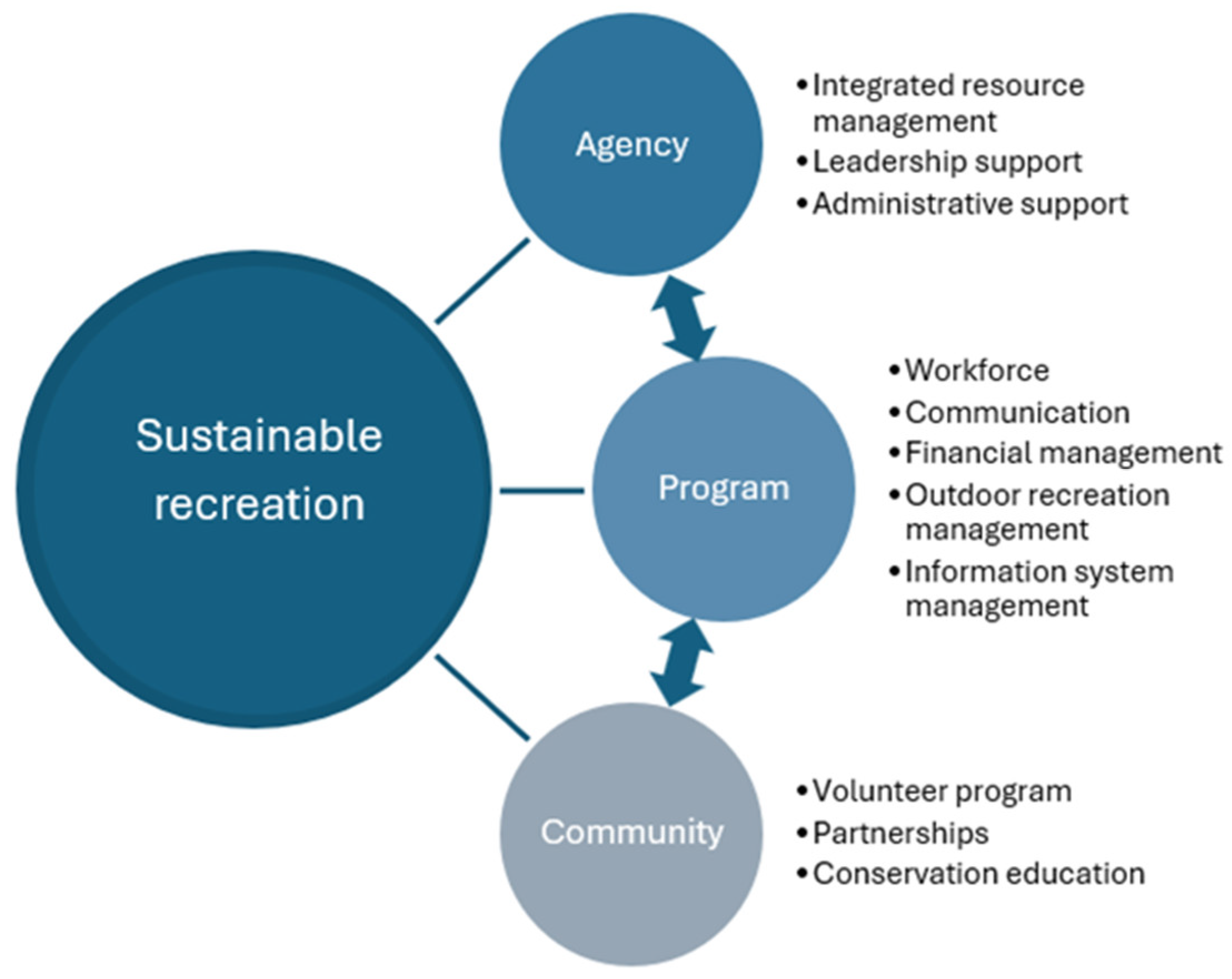
While sustainable recreation applications are still evolving, enough examples exist to start developing operational approaches. Selin et al. studied eleven USFS sustainable recreation plans to identify areas of congruence [87]. They developed a sustainable recreation program operational model based on three interactive foundational areas and 11 component areas (Figure 3). The arrows between the foundational and component areas of the model reflect the iterative and dynamic nature of sustainable recreation program development and routes for expanding sustainable recreation programs. Like all models, the sustainable recreation operational model reflects a simplified and optimal version of reality.
The model was offered to provide recreation practitioners and managers with a structure for organizing sustainable recreation operations, while responding to local needs and conditions. This model reflects the administrative actions of just one land management agency, the USFS, which, compared to other agencies, (a) emphasizes the ‘multiple use’ mandate, (b) operates a dedicated staff and budget line assigned to recreation management, and (c) operates with a high level of managerial discretion at the local level. However, the generalizability of the model can provide initial guidance to other land management agencies.
PA management worldwide is confronting conflicting social, economic, and ecological stressors. It is rare that recreation and other public use and access considerations are not among agency governance issues that need integration with other land use concerns. As such, the operational model may serve a variety of functions. At the unit (forest, park, refuge) level, the model may directly provide an organizational structure for a recreation program (or for planning for the reorganization of a recreation program). Budget justification is often based on showing program relevance and structure. Used in tandem with the definition of sustainable recreation (to show relevance), the model can help provide a structural element that may help move recreation to a more central role within PA management.
The model also serves as a needs assessment (or issue analysis) checklist for decision-makers to identify how organizational functions may help address recreation-related problems or meet unmet needs based on the definition of sustainable recreation. For example, if ecological deterioration is being caused by recreational use, the model may help organize an “issue analysis” [84] to identify how leadership and administrative support, internal workforce and communication programs, and community partnerships and volunteerism may be used to address the problem. At the highest agency administrative levels, the model may provide an organizing tool for guiding individual units around focal points to emphasize priority elements of sustainable recreation. For example, large units may emphasize all aspects of the model while sub-units focus on specific elements (e.g., conservation partnerships and education).

9. Challenges and New Directions for Sustainable Recreation

We acknowledge that there are many internal or institutional challenges to the implementation of sustainable recreation. Change within large organizations is always difficult, and governmental agencies are particularly constrained by rigid organizational roles and silos, especially in situations of expanded complexity and declining budget and staffing [88,89]. Adopting sustainability principles requires a shift in thinking that can be difficult when these processes become codified in agency handbooks and legislation. Despite the challenges, case study examples like those described above illustrate the potential success opportunities for applying sustainable recreation principles. Developing new approaches and confronting new thinking in the field is essential. New research directions that support sustainable recreation are emerging. We have listed a few areas ripe for investigation, along with research questions:
A. Planning recreation in a regional context. Research has shown the importance of understanding recreation patterns and effects beyond PA jurisdictional boundaries and approaching planning from a regional context [84]. Visitors travel across boundaries, seeking different experiences and opportunities in various settings. When PA managers only focus on sustainability within their borders and ignore the influence of activities and uses in neighboring jurisdictions, a partial picture is possible.
  • What planning framework and visitor monitoring approaches are needed to allow sustainable recreation planning across agency jurisdictions?
  • How might recreation demand be shaped by regional marketing entities and consumer trends?
B. Diversified demand for recreation. Outdoor recreation involves an increasingly broad array of activities (beyond hiking and camping), the use of technologies, and expanded notions of what might constitute a recreation activity. As PAs become accessible to a wider variety of user groups, new planning elements and concepts are needed to allow for sustainable use [5,90,91].
  • What settings are needed to accommodate shifting demand for outdoor recreation and visitor use? How are these activities managed sustainably?
  • What strategies are needed to reach out and serve new social groups seeking outdoor recreation experiences? How might the quality of these experiences be enhanced while protecting natural and cultural heritage resources?
C. Human health and well-being. Public health, social, psychological, community, and cultural benefits are as important as recreational experiences and resource protection in recreation planning and management [92,93,94,95].
  • What PA management approaches enhance opportunities and conditions for positive health outcomes?
  • How might sustainable recreation frameworks be designed to account for and plan for the benefits of outdoor recreation to human health and well-being? How might human health benefits of nature-contact and outdoor recreation be measured and monitored?
D. Indigenous knowledge, co-management and cultural heritage. Models of co-management of PAs and the growth of Indigenous Protected Areas suggest opportunities to understand how sustainable recreation can be managed and approached in these contexts alongside indigenous knowledge [96]. Stronger ties are needed to connect sustainable recreation management with cultural heritage management objectives [97,98].
  • How do indigenous knowledge systems engage with policies and practices associated with sustainable recreation management? To what extent are sustainable recreation goals consistent with the protection of indigenous lifeways, land tenure systems, and cultural practices?
  • How might classic outdoor recreation planning approaches be reconfigured to emphasize heritage activities and uses?
E. Recreation ecology and climate change. PA managers recognize a need to adapt recreation infrastructure and shift opportunities in response to future climate scenarios [99,100].
  • What research is needed to inform the adaptation or modification of recreation settings in response to changing climate conditions?
  • What models are needed to predict future recreation demand and develop subsequent policies to shift demand in response to climate change?
Given the constraints to implementing sustainable recreation in natural resource agencies, fostering organizational change is a key consideration for future research. Selin et al. [87] provide nine organizational change factors that will be important for facilitating sustainable recreation within and across PA agencies: (1) establish a sense of urgency, (2) form a powerful guiding coalition, (3) develop a plan, (4) build internal support, (5) ensure top management support, (6) build external support, (7) create short-term wins, (8) leverage resources to implement change, and (9) institutionalize change. Successful implementation of sustainable recreation by natural resource agencies requires models of governance that emphasize collaboration, partnerships, and engagement with Tribes, communities, and stakeholders to promote mutual interaction, learning, and transparency [101]. Supporting these collaborative structures can aid in the implementation of sustainable recreation. Sustainable recreation also benefits from a mentality where visitors, communities, stakeholders, and agency officials recognize themselves as part of the natural world and acknowledge a shared responsibility as stewards [102].

10. Conclusions

Protected area agencies need a better understanding of how existing recreation and land management policies and regulatory and decision-making frameworks facilitate or impede sustainable recreation, and how ecosystem services, ecosystem management, public health benefits, systems planning methods, and other values and action frameworks interact to guide and support sustainable recreation. Despite the importance of outdoor recreation to public health, community well-being, and regional economies, management of outdoor recreation is often considered an “ancillary function” for protected area agencies. Traditional recreation management strategies and frameworks emphasize protection of biophysical and cultural resources and visitor experiences but do not readily embrace the importance of the effects on nearby communities, nor of the value of engaging Indigenous groups, community partners, and resource users beyond jurisdictional boundaries.
We propose the adoption of a standardized definition of sustainable recreation: “the provision of desirable outdoor opportunities for all people, in a way that supports ecosystems, contributes to healthy communities, promotes equitable economies, respects culture and traditions, and develops stewardship values now and for future generations” [23]. Adopting a common definition of sustainable recreation may help PA managers to identify the most relevant recreation management goals and objectives, select specific planning and management tools, and coordinate among governmental and private entities to identify regional needs and collaborations. Furthermore, this definition also supports PA managers’ needs to manage recreation in support of UN sustainability goals. Recreation planning and management goals implied by the new definition of sustainable recreation are much more comprehensive and integrative than traditional outdoor recreation management perspectives that tend to focus on site-specific visitor problems or preferences occurring within certain visitor use areas and within agency boundaries. While agency leaders may emphasize different aspects of sustainable recreation depending on their administrative mandates and social, economic, and environmental contexts, a shared definition could inform the development of comprehensive and coherent approaches.

Author Contributions

Conceptualization, L.K.C. and D.J.B.; methodology, L.K.C. and D.J.B.; formal analysis, L.K.C. and D.J.B.; writing—original draft preparation, L.K.C. and D.J.B.; writing—review and editing, L.K.C. and D.J.B.; visualization, L.K.C. All authors have read and agreed to the published version of the manuscript.

Funding

This research received no external funding.

Institutional Review Board Statement

Not applicable.

Informed Consent Statement

Not applicable.

Data Availability Statement

No new data were created.

Acknowledgments

We thank Steve Selin, Francisco Valenzuela, and Anna Miller for reviewing an early draft of this material.

Conflicts of Interest

The authors declare no conflicts of interest.

Abbreviations

The following abbreviations are used in this manuscript:
BLMBureau of Land Management
NPSNational Park Service
FWSUnited States Fish and Wildlife Service
USFSUnited States Forest Service
UNWTO United Nations World Tourism Organization

References

  1. Dudley, N. (Ed.) Guidelines for Applying Protected Area Management Categories; IUCN: Gland, Switzerland, 2008; 86p, Available online: https://portals.iucn.org/library/sites/library/files/documents/pag-021.pdf (accessed on 10 May 2026).
  2. Protect Planet. 2026. Available online: https://www.protectedplanet.net/en (accessed on 10 May 2026).
  3. Roux, D.J.; Smith, M.K.S.; Smit, I.P.; Freitag, S.; Slabbert, L.; Mokhatla, M.M.; Hayes, J.; Mpapane, N.P. Cultural ecosystem services as complex outcomes of people–nature interactions in protected areas. Ecosyst. Serv. 2020, 43, 101111. [Google Scholar] [CrossRef]
  4. Weaver, D.B.; Lawton, L.J. A new visitation paradigm for protected areas. Tour. Manag. 2017, 60, 140–146. [Google Scholar] [CrossRef]
  5. Blahna, D.J.; Cerveny, L.K.; Williams, D.R.; Kline, J.D.; Helmer, M.; McCool, S.F.; Valenzuela, F. Rethinking “outdoor recreation” to account for the diversity of human experiences and connections to public lands. In Igniting Research for Outdoor Recreation: Linking Science, Policy, and Action; Selin, S., Cerveny, L.K., Blahna, D.J., Miller, A.B., Eds.; Gen. Tech. Rep. PNW-GTR-987; U.S. Department of Agriculture, Forest Service, Pacific Northwest Research Station: Portland, OR, USA, 2020; pp. 65–84. [Google Scholar]
  6. Manning, R.; Valliere, W.; Anderson, L.; McCown, R.S.; Pettengill, P.; Reigner, N.; Lawson, S.; Newman, P.; Budruk, M.; Laven, D.; et al. Defining, measuring, monitoring, and managing the sustainability of parks for outdoor recreation. J. Park Recreat. Adm. 2011, 29, 24–37. [Google Scholar]
  7. Moore, L.R.; Driver, L.B. Introduction to Outdoor Recreation: Providing and Managing Natural Resource Based Opportunities; Venture Pub: Wigan, UK, 2011; pp. 1–19. [Google Scholar]
  8. White, E.M.; Bowker, J.M.; Askew, A.E.; Langner, L.L.; Arnold, J.R.; English, D.B.K. Federal Outdoor Recreation Trends: Effects on Economic Opportunities; Gen. Tech. Rep. PNW-GTR-945; U.S. Department of Agriculture, Forest Service, Pacific Northwest Research Station: Portland, OR, USA, 2016.
  9. Miller, A.B.; Blahna, D.J.; Morse, W.C.; Leung, Y.F.; Rowland, M.M. From recreation ecology to a recreation ecosystem: A framework accounting for social-ecological systems. J. Outdoor Recreat. Tour. 2022, 38, 100455. [Google Scholar] [CrossRef]
  10. Stoker, P.; Rumore, D.; Romaniello, L.; Levine, Z. Planning and development challenges in western gateway communities. J. Am. Plan. Assoc. 2021, 87, 21–33. [Google Scholar] [CrossRef]
  11. Brundtland, G.H. Our Common Future: Report of the World Commission on Environment and Development; United Nations: New York, NY, USA, 1987. [Google Scholar]
  12. United Nations General Assembly. Report of the World Commission on Environment and Development (Resolution 42/187); United Nations General Assembly: New York, NY, USA, 1987. [Google Scholar]
  13. Purvis, B.; Mao, Y.; Robinson, D. Three pillars of sustainability: In search of conceptual origins. Sustain. Sci. 2019, 14, 681–695. [Google Scholar] [CrossRef]
  14. Winter, P.L.; Selin, S.; Cerveny, L.; Bricker, K. Outdoor recreation, nature-based tourism, and sustainability. Sustainability 2019, 12, 81. [Google Scholar] [CrossRef]
  15. Eagles, P.F.J.; McCool, S.F.; Haynes, C.D.A. Sustainable Tourism in Protected Areas: Guidelines for Planning and Management; IUCN: Gland, Switzerland; Cambridge, UK, 2002; 183p. [Google Scholar]
  16. Leung, Y.F.; Spenceley, A.; Hvenegaard, G.; Buckley, R.; Groves, C. Tourism and Visitor Management in Protected Areas: Guidelines for Sustainability; IUCN: Gland, Switzerland, 2018; Volume 27. [Google Scholar]
  17. Silva, S.; Silva, L.F.; Vieira, A. Protected areas and nature-based tourism: A 30-year bibliometric review. Sustainability 2023, 15, 11698. [Google Scholar] [CrossRef]
  18. United Nations Environment Programme & UN Tourism. Making Tourism More Sustainable: A Guide for Policy Makers; United Nations Environment Programme & UN Tourism: Nairobi, Kenya, 2005; Available online: https://www.unep.org/ (accessed on 10 May 2026).
  19. Buckley, R. Sustainable tourism: Research and reality. Ann. Tour. Res. 2012, 39, 528–546. [Google Scholar] [CrossRef]
  20. Cerveny, L.K.; Selin, S.W.; Morse, W.C.; Blahna, D.J. Sustainability and outdoor recreation management on public lands: New directions. J. Park Recreat. Adm. 2022, 40, 1–8. [Google Scholar]
  21. Selin, S. Operationalizing sustainable recreation across the National Forest System: A qualitative content analysis of six regional strategies. J. Park Recreat. Adm. 2017, 35, 35–47. [Google Scholar] [CrossRef]
  22. Cerveny, L.K. Sustainable recreation and tourism: Making sense of diverse conceptualizations and management paradigms. J. Outdoor Recreat. Tour. 2022, 38, 100520. [Google Scholar] [CrossRef]
  23. Cerveny, L.K.; Derrien, M.M.; Miller, A.B. A Research Strategy for Enhancing Sustainable Recreation and Tourism on Public Lands; Gen. Tech. Rep. PNW-GTR-991; U.S. Department of Agriculture, Forest Service, Pacific Northwest Research Station: Portland, OR, USA, 2020.
  24. Rutkow, E. American Canopy: Trees, Forests, and the Making of a Nation; Scribner: New York, NY, USA, 2012. [Google Scholar]
  25. Hammitt, W.E.; Cole, D.N.; Monz, C.A. Wildland Recreation: Ecology and Management; John Wiley & Sons: Hoboken, NJ, USA, 2015. [Google Scholar]
  26. Manning, R.E. Studies in Outdoor Recreation: Search and Research for Satisfaction, 4th ed.; Oregon State University Press: Portland, OR, USA, 2022. [Google Scholar]
  27. Marion, J.L.; Leung, Y.F.; Eagleston, H.; Burroughs, K. A review and synthesis of recreation ecology research findings on visitor impacts to wilderness and protected natural areas. J. For. 2016, 114, 352–362. [Google Scholar] [CrossRef]
  28. Marion, J.L. A review and synthesis of recreation ecology research supporting carrying capacity and visitor use management decisionmaking. J. For. 2016, 114, 339–351. [Google Scholar] [CrossRef]
  29. Stankey, G.H.; Lucas, R.C.; Lime, D.W. Crowding in parks and wilderness. Des. Environ. 1976, 7, 38–41. [Google Scholar]
  30. Cordell, H.K. Outdoor Recreation Trends and Futures: A Technical Document Supporting the Forest Service 2010 RPA Assessment; Gen. Tech. Rep. SRS-150; U.S. Department of Agriculture, Forest Service, Southern Research Station: Portland, OR, USA, 2012.
  31. Taff, B.D.; Thomsen, J.; Rice, W.L.; Miller, Z.; Newton, J.; Miller, L.; Gibson, A.; Riddle, M.; Schaberl, J.P.; McCormick, M. US national park visitor experiences during COVID-19. Parks Steward. Forum 2022, 38, 145–159. [Google Scholar] [CrossRef]
  32. Blahna, D.J.; Kline, J.D.; Williams, D.R.; Rogers, K.; Miller, A.B.; McCool, S.F.; Valenzuela, F. Integrating social, ecological, and economic factors in sustainable recreation planning and decisionmaking. In Igniting Research for Outdoor Recreation: Linking Science, Policy, and Action; Selin, S., Cerveny, L.K., Blahna, D.J., Miller, A.B., Eds.; Gen. Tech. Rep. PNW-GTR-987; U.S. Department of Agriculture, Forest Service, Pacific Northwest Research Station: Portland, OR, USA, 2020; pp. 173–188. [Google Scholar]
  33. Blahna, D.J.; Valenzuela, F.; Selin, S.; Cerveny, L.K.; Schlafmann, M.; McCool, S.F. The shifting outdoor recreation paradigm: Time for change. In Igniting Research for Outdoor Recreation: Linking Science, Policy, and Action; Selin, S., Cerveny, L.K., Blahna, D.J., Miller, A.B., Eds.; Gen. Tech. Rep. PNW-GTR-987; U.S. Department of Agriculture, Forest Service, Pacific Northwest Research Station: Portland, OR, USA, 2020; pp. 9–22. [Google Scholar]
  34. Morse, W.C. Recreation as a social-ecological complex adaptive system. Sustainability 2020, 12, 753. [Google Scholar] [CrossRef]
  35. McCool, S.F. Thinking like a system in the turbulent world of outdoor recreation management. J. Outdoor Recreat. Tour. 2022, 38, 100484. [Google Scholar] [CrossRef]
  36. Rosenberger, R.S.; White, E.M.; Kline, J.D.; Cvitanovich, C. Recreation Economic Values for Estimating Outdoor Recreation Economic Benefits from the National Forest System; Gen. Tech. Rep. PNW-GTR-957; U.S. Department of Agriculture, Forest Service, Pacific Northwest Research Station: Portland, OR, USA, 2017.
  37. Howe, J.; McMahon, E.T.; Propst, L. Balancing Nature and Commerce in Gateway Communities; Island Press: Washington, DC, USA, 2012. [Google Scholar]
  38. U.S. Bureau of Economic Analysis. Outdoor Recreation. 2025. Available online: https://www.bea.gov/data/special-topics/outdoor-recreation#:~:text=The%20value%20added%20of%20the,in%20the%20District%20of%20Columbia (accessed on 10 May 2026).
  39. Bricker, K.S.; Lackey, N.Q.; Joyner, L. A framework for sustainable tourism development in and around national parks. J. Park Recreat. Adm. 2022, 40, 134–153. [Google Scholar] [CrossRef]
  40. McCool, S.F. An Assessment of Frameworks Useful for Public Land Recreation Planning; Gen. Tech. Rep. PNW-GTR-705; U.S. Department of Agriculture, Forest Service, Pacific Northwest Research Station: Portland, OR, USA, 2007.
  41. Ducey, M.J.; Larson, B.C. A fuzzy set approach to the problem of sustainability. For. Ecol. Manag. 1999, 115, 29–40. [Google Scholar] [CrossRef]
  42. Nelson, J.G.; Eidsvik, H.E. Sustainable development, conservation strategies, and heritage: Three basic tools for influencing the global future. Alternatives 1990, 16, 62–71. [Google Scholar]
  43. Berkes, F.; Colding, J.; Folke, C. (Eds.) Navigating Social-Ecological Systems: Building Resilience for Complexity and Change; Cambridge University Press: Cambridge, UK, 2003. [Google Scholar]
  44. Meffe, G.K.; Nielsen, L.A.; Knight, R.L.; Schenborn, D.A. Ecosystem Management: Adaptive, Community-Based Conservation; Island Press: Washington, DC, USA, 2002. [Google Scholar]
  45. Maser, C. Sustainable Forestry: Philosophy, Science, and Economics; St. Lucie Press: Delray Beach, FL, USA, 1994. [Google Scholar]
  46. Norton, B.G. Sustainability: A Philosophy of Adaptive Ecosystem Management; University of Chicago Press: Chicago, IL, USA, 2005. [Google Scholar]
  47. Norton, B.G. Epistemology and environmental values. Monist 1992, 75, 208–226. [Google Scholar] [CrossRef]
  48. Sayer, J.; Campbell, B. The Science of Sustainable Development; Cambridge University Press: Cambridge, UK, 2004. [Google Scholar]
  49. Gunderson, L.H.; Holling, C.S. Panarchy: Understanding Transformations in Human and Natural Systems; Island Press: Washington, DC, USA, 2002. [Google Scholar]
  50. Bureau of Land Management. Blueprint for 21st Century Outdoor Recreation; U.S. Department of the Interior: Washington, DC, USA, 2023. Available online: https://material-civet.files.svdcdn.com/production/images/documents/Blueprint-for-21st-Century-Outdoor-Recreation.pdf?dm=1700243822 (accessed on 10 May 2026).
  51. National Park Service. The Eastern Sierra Sustainable Recreation Partnership; U.S. Department of the Interior: Washington, DC, USA, 2022. Available online: https://www.nps.gov/articles/000/the-eastern-sierra-sustainable-recreation-partnership.htm (accessed on 10 May 2026).
  52. U.S. Forest Service. Connecting People with America’s Great Outdoors: A Framework for Sustainable Recreation; U.S. Department of Agriculture: Washington, DC, USA, 2010. Available online: https://www.nationalforests.org/assets/pdfs/Framework-for-Sustainable-Recreation.pdf (accessed on 10 May 2026).
  53. U.S. Fish and Wildlife Service. About Us: Mission and Vision; U.S. Department of the Interior: Washington, DC, USA, 2026. Available online: https://www.fws.gov/about/mission-and-vision (accessed on 10 May 2026).
  54. Davis, M. BLM Releases Outdoor Recreation Blueprint; Powell Tribune: Powell, WY, USA, 2023; Available online: https://www.powelltribune.com/stories/blm-releases-outdoor-recreation-blueprint,99506 (accessed on 10 May 2026).
  55. National Park Service. About Us; U.S. Department of the Interior: Washington, DC, USA, 2026. Available online: https://www.nps.gov/aboutus/index.htm (accessed on 10 May 2026).
  56. National Park Service. Green Parks Plan: Advancing Our Mission Through Sustainable Operations, 3rd ed.; U.S. Department of the Interior: Washington, DC, USA, 2023. Available online: https://npshistory.com/publications/public-health/green-parks-plan-2023.pdf (accessed on 10 May 2026).
  57. Slocum, S.L. Operationalizing both sustainability and neo-liberalism in protected areas: Implications from the USA’s National Park Service’s evolving experiences and challenges. J. Sustain. Tour. 2016, 25, 1748–1764. [Google Scholar]
  58. Bureau of Land Management. Bureau of Land Management Home; U.S. Department of the Interior: Washington, DC, USA, 2026. Available online: https://www.blm.gov/ (accessed on 10 May 2026).
  59. Bureau of Land Management. Bureau of Land Management Travel and Tourism Action Plan to Implement the National Travel and Tourism Strategy for the United States; U.S. Department of the Interior, Washington Office: Washington, DC, USA, 2019.
  60. U.S. Forest Service. About the Agency; U.S. Department of Agriculture: Washington, DC, USA, 2026. Available online: https://www.fs.usda.gov/about-agency (accessed on 10 May 2026).
  61. U.S. Forest Service. Recreation Opportunity Technical Guide: Practices and Resources for Implementing the 2012 Planning Rule (FS-1240a); U.S. Department of Agriculture: Washington, DC, USA, 2024.
  62. Wyborn, C.; Bixler, R.P. Collaboration and nested environmental governance: Scale dependency, scale framing, and cross-scale interactions in collaborative conservation. J. Environ. Manag. 2013, 123, 58–67. [Google Scholar] [CrossRef]
  63. Selin, S.; Cerveny, L.K.; Blahna, D.J.; Miller, A.B. (Eds.) Igniting Research for Outdoor Recreation: Linking Science, Policy, and Action; Gen. Tech. Rep. PNW-GTR-987; U.S. Department of Agriculture, Forest Service, Pacific Northwest Research Station: Portland, OR, USA, 2020.
  64. Miller, A.B.; Cerveny, L.K.; Derrien, M.M.; Selin, S.; Blahna, D.J. A research strategy to ignite the science of outdoor recreation on public lands. J. Park Recreat. Adm. 2020, 38, 1–13. [Google Scholar] [CrossRef]
  65. Borrie, W.T.; McCool, S.F.; Stankey, G.H. Protected area planning principles and strategies. In Ecotourism: A Guide for Planners and Managers; Lindberg, K., Wood, M.E., Engeldrum, D., Eds.; The Ecotourism Society: Washington, DC, USA, 1998; Volume 2, pp. 133–154. [Google Scholar]
  66. Stankey, G.H. The recreation opportunity spectrum and the limits of acceptable change planning systems: A review of experiences and lessons. In Ecosystem Management: Adaptive Strategies for Natural Resources Organizations in the 21st Century; Aley, J., Burch, W.R., Conover, B., Field, D., Eds.; Taylor & Francis: Philadelphia, PA, USA, 1999; pp. 173–188. [Google Scholar]
  67. Haas, G. Visitor capacity: A dilemma of perspective. Parks Recreat. 2003, 38, 66–74. [Google Scholar]
  68. Marion, J.L.; Reid, S.E. Development of the U.S. Leave No Trace program: A historical perspective. Enjoyment Underst. Natl. Herit. 2001, 81–92. Available online: https://lnt.org/sites/default/files/Leave_No_Trace_History_Paper.pdf (accessed on 10 May 2026).
  69. Lawhon, B.; Newman, P.; Taff, D.; Vaske, J.; Vagias, W.; Lawson, S.; Monz, C. Factors influencing behavioral intentions for Leave No Trace behavior in national parks. J. Interpret. Res. 2013, 18, 23–38. [Google Scholar] [CrossRef]
  70. Lucas, R.C. The role of regulations in recreation management. West. Wildlands 1983, 9, 6–10. [Google Scholar]
  71. Carter, D.P.; Weible, C.M. Assessing rule compliance and robustness in recreational resource management. J. Environ. Policy Plan. 2014, 16, 117–139. [Google Scholar] [CrossRef]
  72. Phillips, K.E.; Rice, W.L.; Armatas, C.A.; Pitas, N.; Zou, S.S. Allocating Recreation with Fairness at the Forefront: A Research-Based Planning and Management Guidebook; University of Montana, Wildland and Recreation Management Research Laboratory: Missoula, MT, USA, 2024. Available online: https://www.fs.usda.gov/rm/pubs_journals/2024/rmrs_2024_phillips_k001.pdf (accessed on 10 May 2026).
  73. Lime, D.W.; Stankey, G.H. Carrying capacity: Maintaining outdoor recreation quality. In Land and Leisure; Routledge: London, UK, 2019; pp. 105–118. [Google Scholar]
  74. U.S. Forest Service. Sustainable Recreation: Site Design Guide; U.S. Department of Agriculture: Washington, DC, USA, 2024. Available online: https://www.fs.usda.gov/td/pubs/pdfpubs/pdf22232803/2223%E2%80%932803_SRSDG_240408_LoRez_508.pdf (accessed on 10 May 2026).
  75. Millennium Ecosystem Assessment. Ecosystems and Human Well-Being: Synthesis; Island Press: Washington, DC, USA, 2005. [Google Scholar]
  76. Chan, K.M.; Satterfield, T.; Goldstein, J. Rethinking ecosystem services to better address and navigate cultural values. Ecol. Econ. 2012, 74, 8–18. [Google Scholar] [CrossRef]
  77. Kline, J.D.; Mazzotta, M.J.; Spies, T.A.; Harmon, M.E. Applying the ecosystem services concept to public lands management. Agric. Resour. Econ. Rev. 2013, 42, 139–158. [Google Scholar] [CrossRef]
  78. Arlinghaus, R.; Alos, J.; Beardmore, B.; Daedlow, K.; Dorow, M.; Fujitani, M.; Hühn, D.; Haider, W.; Hunt, L.M.; Johnson, B.M.; et al. Understanding and managing freshwater recreational fisheries as complex adaptive social-ecological systems. Rev. Fish. Sci. Aquac. 2017, 25, 1–41. [Google Scholar] [CrossRef]
  79. Keough, H.L.; Blahna, D.J. Achieving integrative, collaborative ecosystem management. Conserv. Biol. 2006, 20, 1373–1382. [Google Scholar] [CrossRef]
  80. Koontz, T.M.; Bodine, J. Implementing ecosystem management in public agencies: Lessons from the US Bureau of Land Management and the Forest Service. Conserv. Biol. 2008, 22, 60–69. [Google Scholar] [CrossRef] [PubMed]
  81. McCool, S.F.; Kline, J.D. A systems thinking approach for thinking and reflecting on sustainable recreation on public lands in an era of complexity, uncertainty, and change. In Igniting Research for Outdoor Recreation: Linking Science, Policy, and Action; Selin, S., Cerveny, L.K., Blahna, D.J., Miller, A.B., Eds.; Gen. Tech. Rep. PNW-GTR-987; U.S. Department of Agriculture, Forest Service, Pacific Northwest Research Station: Portland, OR, USA, 2020; pp. 161–172. [Google Scholar]
  82. Wickens, E.; Bakir, A.; Alvarez, M.D. Sustainable destination development: Issues and challenges. Tour. Plan. Dev. 2015, 12, 1–5. [Google Scholar] [CrossRef]
  83. Hokans, R.; Maloney, J.; Marcouiller, D.; Mich, J.; Wojciechowski, T. Community Economic Impacts of Interpretive Centers: A Case Study of the Northern Great Lakes Visitor Center; University of Wisconsin Extension: Madison, WI, USA, 2013; Available online: https://dpla.wiscweb.wisc.edu/wp-content/uploads/sites/1021/2017/06/13NGLVCFinal.pdf (accessed on 10 May 2026).
  84. Blahna, D.J.; Poe, A.; Brown, C.; Ryan, C.M.; Gimblett, H.R. Social and environmental sustainability in large-scale coastal zones: Taking an issue-based approach to the implementation of the Prince William Sound Sustainable Human Use Framework. Tour. Mar. Environ. 2017, 12, 183–197. [Google Scholar] [CrossRef]
  85. Eastern Sierra Sustainable Recreation Partnerships; Sustainable Recreation and Tourism Initiative, Lake Tahoe, CA, USA, 2019. Available online: https://mltpa.org/our-work/sustainable-recreation-and-tourism-project (accessed on 10 May 2026).
  86. U.S. Forest Service. Southwest Region Sustainable Recreation Strategy; U.S. Department of Agriculture: Albuquerque, NM, USA, 2014. Available online: https://mltpa.org/images/downloads/025_25_20140210finalSustainableRecreationStrategy1fv.pdf (accessed on 10 May 2026).
  87. Selin, S.; Golston, J.; Valenzuela, F. Developing a capacity-building, operational model of a sustainable recreation program. J. Park Recreat. Adm. 2022, 40, 61–78. [Google Scholar] [CrossRef]
  88. Wilson, J.Q. Bureaucracy: What Government Agencies Do and Why They Do It; Basic Books: New York, NY, USA, 1989. [Google Scholar]
  89. Cerveny, L.K.; Selin, S.; Blahna, D.J.; Meier, N.; Barborak, J.R.; McCool, S.F. Agency capacity for effective outdoor recreation and tourism management. In Igniting Research for Outdoor Recreation: Linking Science, Policy, and Action; Selin, S., Cerveny, L.K., Blahna, D.J., Miller, A.B., Eds.; Gen. Tech. Rep. PNW-GTR-987; U.S. Department of Agriculture, Forest Service, Pacific Northwest Research Station: Portland, OR, USA, 2020; pp. 23–40. [Google Scholar]
  90. Collins, S.; Brown, H. The growing challenge of managing outdoor recreation. J. For. 2007, 105, 371. [Google Scholar] [CrossRef]
  91. Sanchez, J.J.; Cerveny, L.K.; Blahna, D.J.; Valenzuela, F.; Schlafman, M. Recreation opportunities and human connections on public land: Constraints that limit recreation participation. In Igniting Research for Outdoor Recreation: Linking Science, Policy, and Action; Selin, S., Cerveny, L.K., Blahna, D.J., Miller, A.B., Eds.; Gen. Tech. Rep. PNW-GTR-987; U.S. Department of Agriculture, Forest Service, Pacific Northwest Research Station: Portland, OR, USA, 2020; pp. 41–49. [Google Scholar]
  92. Driver, B.L.; Dustin, D.; Baltic, T.; Elsner, G.; Peterson, G. (Eds.) Nature and the Human Spirit: Toward an Expanded Land Management Ethic; Venture Publishing: State College, PA, USA, 1996. [Google Scholar]
  93. Wolf, K.L.; Derrien, M.M.; Kruger, L.E.; Penbrooke, T.L. Nature, outdoor experiences, and human health. In Igniting Research for Outdoor Recreation: Linking Science, Policy, and Action; Selin, S., Cerveny, L.K., Blahna, D.J., Miller, A.B., Eds.; Gen. Tech. Rep. PNW-GTR-987; U.S. Department of Agriculture, Forest Service, Pacific Northwest Research Station: Portland, OR, USA, 2020; pp. 85–99. [Google Scholar]
  94. Derrien, M.; Bloom, T.; Duke, S. Local partnerships for health on national forests. J. Park Recreat. Adm. 2022, 40, 216–227. [Google Scholar] [CrossRef]
  95. Zwart, R.; Ewert, A. Human health and outdoor adventure recreation: Perceived health outcomes. Forests 2022, 13, 869. [Google Scholar] [CrossRef]
  96. Butler, C.F.; Menzies, C.R. Traditional ecological knowledge and indigenous tourism. In Tourism and Indigenous Peoples; Butler, R., Hinch, T., Eds.; Routledge: London, UK, 2007; pp. 15–27. [Google Scholar]
  97. Masini, N.; Soldovieri, F. Cultural heritage sites and sustainable management strategies. In Sensing the Past: From Artifact to Historical Site; Masini, N., Soldovieri, F., Eds.; Springer: Cham, Switzerland, 2017; pp. 1–19. [Google Scholar]
  98. Saviano, M.; Di Nauta, P.; Montella, M.M.; Sciarelli, F. The cultural value of protected areas as models of sustainable development. Sustainability 2018, 10, 1567. [Google Scholar] [CrossRef]
  99. Miller, A.B.; Winter, P.L.; Sanchez, J.J.; Peterson, D.L.; Smith, J.W. Climate change and recreation in the western United States: Effects and opportunities for adaptation. J. For. 2022, 120, 443–472. [Google Scholar] [CrossRef]
  100. O’Toole, D.; Brandt, L.A.; Janowiak, M.K.; Schmitt, K.M.; Shannon, P.D.; Leopold, P.R.; Handler, S.D.; Ontl, T.A.; Swanston, C.W. Climate change adaptation strategies and approaches for outdoor recreation. Sustainability 2019, 11, 7030. [Google Scholar] [CrossRef]
  101. Bettis, A.; Schoon, M.; Blanchette, G. Enabling regional collaborative governance for sustainable recreation on public lands: The Verde Front. J. Environ. Plan. Manag. 2021, 64, 101–123. [Google Scholar] [CrossRef]
  102. Lehew, M.; Gimblett, R.; Valenzuela, F. Enhancing recreation sustainability through social capital development. Nat. Resour. Conserv. 2015, 3, 57–69. [Google Scholar] [CrossRef]
Figure 1. Global sustainability as a concept.
Sustainability 18 06012 g001
Figure 2. Nested and interacting elements of sustainability.
Sustainability 18 06012 g002
Figure 3. Operational model for sustainable recreation adapted from Selin et al. [87].
Sustainability 18 06012 g003
Table 1. Differences between sustainable recreation and sustainable tourism.
ElementSustainable RecreationSustainable Tourism
Management ObjectiveManagement and stewardship of natural ecosystems and landscapesManagement of tourism destinations, enterprises, and travel systems
ContextPA managementDestination management (which may include PAs)
Focal areasRecreation activities (or resource uses) and settings (biophysical, managerial, and social) within broader landscapes and ecosystemsTravel and hospitality industry activities, industry providers, transportation and travel networks and PAs within local economies
Targeted audiencePA managers (public land agencies), partners, stakeholdersPrivate firms, destination organizations, regional tourism development entities
Priorities Resource protectionEconomic development
Table 2. Recreation-focused planning and management strategies.
StrategyDescriptionHow It Supports Sustainable Recreation Management Goals
Visitor information and education Strategies that provide information to visitors about how to self-monitor behavior to minimize impacts on resources. Protects biophysical or cultural resources.
Enforcement of rules and regulations Agency rules are designed to prevent visitors from causing damage to the biophysical, cultural, and built environment due to frequency of use, timing of use, nature of use, or spatial distribution of use.Protects biophysical or cultural resources.
Use rationing and allocation Strategies used when agencies need to reduce or limit visitor numbers to protect biophysical or cultural resources or reduce crowding.Protects biophysical or cultural resources, reduces crowding, or improves visitor experiences.
Sustainable recreation site design Strategies associated with enhancing performance or quality of recreation sites and trails through design or engineering.Protects biophysical or cultural resources or improves visitor experiences.
Recreation zoning and visitor impact analysis frameworks Site planning and analysis frameworks help managers analyze visitation effects and identify appropriate management actions. Many of these tools were developed based on the assumption that recreation settings influence recreation opportunities and experiences. Tools include steps to identify social or environmental problems and evaluate management alternatives. Protects biophysical or cultural resources, reduces crowding, and encourages desirable experiences or outcomes for visitors.
Table 3. Frameworks that emphasize a regional landscape planning approach.
FrameworkDescriptionHow It Supports Sustainable Recreation Management Goals
Ecosystems services Ecosystem services (ES) frameworks estimate the benefits (often monetary) that ecosystems provide to humans, including values for recreation, scenery, health, well-being, economic, and cultural uses. Attaching values to ES helps analysts to weigh outcomes of management actions and sustainability trade-offs.Protects biophysical or cultural resources and meets on-site and broader societal needs to assess existing and missing recreational benefits.
Ecosystem management This is a resource management approach that aims to ensure the sustainability of ecosystem functions and services while meeting socioeconomic, policy, and cultural needs. Encourages consideration and integration of social, economic, and ecological knowledge. Spatial analysis is based on social and environmental ecosystem function related to the problem(s) of focus.Considers biophysical, cultural and built resources as well as implications for visitors and for human communities and economies.
Socio-ecological systems A series of approaches that recognize an ecosystem as an interconnected web of relationships between social and ecological systems, emphasizing how human societies and the natural environment mutually influence each other. It acknowledges that humans are an integral part of nature and that social and ecological components are dynamically linked.Provides a holistic view of the positive and negative interactions of social, ecological, cultural, and economic factors that are the core of sustainability science.
Destination management
planning
Destination management involves strategically managing a destination’s resources to ensure its long-term viability and positive impacts. Key aspects include stakeholder engagement, risk management, and a focus on minimizing negative impacts while maximizing the benefits PA visitation. Examples include the sustainable visitation index.Aims to balance the needs of visitors, the local community, and the environment, promoting sustainable development and preserving the destination’s unique character.
Disclaimer/Publisher’s Note: The statements, opinions and data contained in all publications are solely those of the individual author(s) and contributor(s) and not of MDPI and/or the editor(s). MDPI and/or the editor(s) disclaim responsibility for any injury to people or property resulting from any ideas, methods, instructions or products referred to in the content.