


Abstract
This study examines how smart city discourse is structurally configured across different contexts from the perspective of policy mobility. To this end, three types of data were analyzed: South Korean policy reports, South Korean academic literature, and global academic literature. Based on these sources, text datasets were constructed and analyzed using text mining-based semantic network analysis to identify key concepts and their relational structures. The results show that while similar keywords appear across datasets, differences are observed in the relative positions and relational patterns of key concepts. In South Korean policy reports, implementation- and operation-related concepts such as “service,” “information,” and “management” exhibit relatively higher centrality. In South Korean academic literature, “planning,” “policy,” “research,” and “technology” appear alongside governance- and actor-related concepts, indicating broader relational configurations. In global academic literature, concepts such as “sustainable,” “social,” “governance,” and “policy” show relatively similar levels of centrality, suggesting the coexistence of multiple dimensions within the discourse. These findings suggest that smart city discourse may be configured differently depending on institutional and discursive contexts, rather than converging into a single uniform structure. However, the observed differences should not be interpreted solely as reflecting national contextual differences, as variations in dataset composition may also have partially influenced the results. By conceptualizing the smart city as a structured policy discourse, this study contributes to understanding how policy-related concepts may be selectively emphasized and reconfigured across contexts. Methodologically, the study demonstrates the applicability of semantic network analysis for examining relational patterns within smart city discourse across different data types and contexts.
1. Introduction
Over the past few decades, the smart city has emerged as a major urban development strategy aimed at addressing complex urban challenges such as transportation, energy, environment, and public safety, primarily through the use of information and communication technologies (ICT) [1,2]. Beyond being a national policy agenda, the smart city has evolved into a global policy discourse that spreads through international organizations, multinational corporations, and transnational academic networks [3,4]. Early discussions mainly focused on sensor networks, data platforms, and integrated management systems, conceptualizing the city as a technologically manageable system that can be optimized through data-driven decision-making and automation [1,5]. While this approach has contributed to improving operational efficiency, it has also been criticized for reducing urban space to a technical object of management, rather than a socially and institutionally embedded environment.
Subsequent studies have highlighted the limitations of technology-centered smart city models, arguing that such approaches tend to overlook social contexts, institutional conditions, and the role of citizens [3,6,7,8]. In addition, concerns have been raised that the diffusion of standardized technological solutions may weaken democratic governance and undermine local urban diversity [9,10]. In response, recent studies have re-conceptualized the smart city as a broader urban planning paradigm that incorporates governance structures, spatial configurations, and citizen participation, rather than a purely technological project [11].
In this context, the smart city can be understood from the perspective of policy mobility. According to policy mobility studies, policies do not travel unchanged; rather, they are selectively adopted, translated, and reconstructed across different institutional contexts [12,13]. Representative cases such as Singapore’s Smart Nation, Barcelona’s Digital City, and Amsterdam Smart City have spread globally through policy networks and knowledge exchange, yet their implementation varies significantly depending on national planning systems and governance structures. Therefore, the smart city should be understood not as a universal policy model, but as a policy discourse that is recontextualized within specific institutional environments. South Korea provides a noteworthy case in this regard. Following the U-City initiative, the Korean government has actively institutionalized smart city policies at the national level and promoted large-scale pilot projects led by the central government [14]. Domestic discourse tends to emphasize service provision, system integration, data management, and platform development, reflecting a centralized planning system and a governance structure led by the public sector.
Despite these developments, existing smart city research has largely focused on evaluating technological performance or analyzing individual policy cases. In addition, quantitative studies examining the structural configuration of smart city discourse from a policy mobility perspective remain limited. Although text mining and network analysis have increasingly been applied in urban policy research, studies that distinguish between policy-oriented and academic materials at the discourse level and compare discourse structures formed across different institutional and knowledge-production contexts are still insufficient. To address this gap, this study analyzes smart city discourse by categorizing it into three types: South Korean policy reports, South Korean academic literature, and global academic literature. Semantic network analysis is applied to each dataset in order to identify key concepts and relational structures. Through this approach, the study examines differences between policy-oriented and academic materials within the same national context, while also comparing differences in discourse structures between South Korean academic literature and global academic literature.
Accordingly, this study addresses the following research questions. First, what differences exist in the semantic network structure between domestic policy reports and domestic academic literature? Second, what differences are observed in key concepts and relational structures between domestic and global academic literature? Third, how do these structural differences suggest the ways in which smart city discourse is constructed across different contexts?
By addressing these questions, this study aims to examine how smart city discourse is structured differently across institutional and knowledge production contexts, rather than assuming a single unified form. In particular, policy mobility is employed as an interpretive framework to understand how such structural differences are formed. Through this approach, the study contributes to understanding the smart city not merely as a technology-driven urban development strategy, but as a policy discourse that is structurally reconfigured. Furthermore, by highlighting how differences in discourse structure may relate to governance priorities, modes of policy implementation, and the relationship between technological and social dimensions, the study offers implications for policy and urban planning discussions.
2. Theoretical Framework
2.1. Evolution of the Smart City Concept
The concept of the smart city has generally been understood as an urban development strategy that leverages information and communication technologies (ICT) to enhance efficiency in urban management and address complex urban problems. However, rather than representing a single, universally agreed-upon policy model, the smart city constitutes a multifaceted concept shaped by diverse actors, institutions, technologies, and spatial contexts. Previous studies have approached the smart city from multiple perspectives—including technological infrastructure, data-driven urban management, governance, citizen participation, and planning strategy—thereby forming distinct conceptual domains within smart city discourse [2,15].
In this study, smart city discourse is analytically categorized into three interrelated domains: (1) technology and infrastructure, (2) governance, and (3) urban planning and policy.
First, the technology and infrastructure domain represents one of the earliest and most prominent perspectives in smart city discourse. This perspective emphasizes ICT, the Internet of Things (IoT), artificial intelligence (AI), intelligent transport systems, and integrated data platforms as mechanisms for optimizing urban systems. Cities are conceptualized as manageable systems whose problems can be addressed through technological solutions and data-driven decision-making [1,5,16,17,18]. This approach places emphasis on efficiency, automation, and real-time management.
Second, the governance domain highlights the importance of collaboration among diverse actors—including governments, private firms, research institutions, and civil society—and considers citizen participation as a key component of smart city development. Concepts such as collaborative governance and participatory urban management have become increasingly important [19,20]. As smart city initiatives have expanded, issues related to data governance, privacy, digital democracy, and institutional accountability have emerged, shifting attention beyond technological implementation toward broader governance structures.
Third, the urban planning and policy domain interprets the smart city as part of long-term urban development strategies embedded within national and municipal planning systems. From this perspective, smart city initiatives are understood not merely as technological upgrades but as integrated policy frameworks encompassing transport, environment, economy, and governance [21,22]. Scholars have emphasized that smart city strategies are shaped by local institutional contexts and planning systems, and that cities increasingly function as experimental policy spaces [23,24,25]. Taken together, these perspectives suggest that the smart city should be understood not as a universal technological model but as a policy discourse that is selectively interpreted and reconfigured within specific institutional and spatial contexts.
2.2. Research Trends and Gaps in Smart City Studies
Over the past decade, research on smart cities has expanded rapidly, with a noticeable shift from technology-centered approaches toward governance- and policy-oriented analyses. Early studies conceptualized the city as a networked and data-driven system and emphasized the potential of technological innovation to improve efficiency and service delivery [1,17,18].
As smart city initiatives moved beyond conceptual discussions to real-world implementation, scholarly attention increasingly turned to governance structures, institutional arrangements, and stakeholder participation [7,19,20,24]. More recently, researchers have examined smart cities as policy frameworks embedded within broader urban development strategies [11,21]. At the same time, growing attention has been paid to the transnational circulation of smart city models. Scholars argue that smart city initiatives spread globally through international organizations, consulting firms, expert networks, and leading cities, and are reshaped in the process of local adoption [4,19,26,27]. This body of research suggests that smart city policies are not transferred as fixed models but are interpreted and reassembled differently across contexts.
Despite these developments, much of the existing literature continues to focus on technological performance evaluation or single-city case studies. Recent studies have further expanded the field by examining digital transformation, data-driven governance, and network-based decision-making in complex urban systems [8,11,28,29]. These studies highlight that smart city development is increasingly shaped by the interaction between technological infrastructure and institutional coordination mechanisms, emphasizing the importance of integrated governance strategies in digitally mediated environments. However, quantitative analyses that systematically examine the structural configuration of smart city discourse across different national contexts remain limited. In particular, large-scale analyses of textual data that reveal the relational structure of smart city discourse are still insufficient.
Accordingly, this study applies text mining and semantic network analysis to domestic and global smart city literature in order to examine differences in conceptual structures and relational configurations. Through this approach, the smart city is understood not merely as a technological project but as a policy discourse whose meaning is reshaped across national planning systems. This analytical approach provides a basis for linking smart city research with the framework of policy mobility, which is discussed in the following section.
From a methodological perspective, semantic network analysis provides an appropriate empirical strategy for examining smart city discourse within a policy mobility framework. By capturing co-occurrence patterns among key concepts, this approach enables the identification of relational structures and discursive configurations through which policy ideas are organized and circulated. In particular, it allows for the analysis of how certain concepts occupy central or peripheral positions within the discourse, as well as how they are structurally interconnected. In this sense, semantic network analysis offers a systematic way to empirically examine how smart city discourse is constructed and reconfigured across different institutional contexts.
2.3. Policy Mobility
Policy mobility emerged as a critical response to earlier policy transfer studies, which tended to conceptualize policy movement as a relatively linear and static process. Rooted in diffusion theory, policy transfer research primarily focused on explaining how policies, institutions, and administrative practices spread from one jurisdiction to another [30]. It distinguished between voluntary mechanisms—such as lesson-drawing, emulation, and benchmarking—and coercive forms of transfer driven by external pressures [31,32]. However, critics argue that policy transfer approaches often treat policies as stable and transferable objects and do not sufficiently account for the political relations, spatial contexts, and power dynamics embedded in processes of policy movement [26]. In practice, policies are rarely adopted in their original form. Instead, they are selectively interpreted, translated, and reshaped within specific institutional and socio-political contexts. The key conceptual differences between policy transfer and policy mobility are summarized in Table 1.
Table 1.
Comparison between policy transfer and policy mobility.
In response to these limitations, the policy mobility perspective conceptualizes policy not as a fixed institutional product but as something that moves across places and is continuously reconstructed in the process [26,33]. Policies travel through networks of actors—including experts, public agencies, private firms, international organizations, and research communities—who actively interpret and reframe policy ideas. As policies circulate, they are reassembled in relation to local institutional arrangements, regulatory environments, and political priorities.
Key concepts in policy mobility research include recontextualization and assemblage [34,35]. Policies are not transferred as complete models; rather, they are recombined with existing practices and discourses in each context, producing hybrid configurations. Policy actors often mobilize “best practice” narratives to legitimize policy adoption, and symbolic representations of success play an important role in shaping how policies are understood and justified [36].
Policy mobility is also linked to the broader “mobility turn,” which emphasizes that flows of people, capital, information, and policy ideas are central to contemporary socio-spatial transformation [37]. From this perspective, mobility is not neutral but shaped by power relations and uneven geographies. Policy circulation can therefore be understood as a political process through which authority, legitimacy, and development trajectories are negotiated.
In the context of smart cities, this perspective suggests that smart city initiatives should not be understood as the diffusion of a universal technological model. Rather, they can be interpreted as a policy discourse that is selectively interpreted and reconfigured within different national planning systems. This theoretical perspective provides a basis for analyzing how smart city discourse is structured and articulated across different contexts, including South Korea and the global setting.
3. Materials and Methods
3.1. Scope and Data Sources
This study examines the formation and structural evolution of smart city discourse between 2015 and 2025. This period was selected because, since the mid-2010s, smart city policies have moved beyond a predominantly technology-centered discourse and have become institutionalized within national policy agendas and urban planning strategies. Accordingly, this timeframe reflects the phase during which smart city discourse expanded substantially across both policy and academic domains [11,19,21,25].
This study analyzes smart city discourse by categorizing it into three types of data sources: (1) South Korean policy reports, (2) South Korean academic literature, and (3) global academic literature (Table 2). This classification is intended to examine differences between policy discourse and academic discourse within the same national context, as well as differences in academic discourse across national contexts.
Table 2.
Types of research materials and data collection methods.
The South Korean dataset consists of official policy reports issued by the Ministry of Land, Infrastructure and Transport, local governments, and national smart city initiatives, as well as academic articles indexed in the Korea Citation Index (KCI). This enables the analysis to capture both policy discourse and academic discourse within the South Korean context. The global dataset consists of academic articles indexed in the Web of Science database.
Global policy reports were not included in this study. Global policy reports were not included in this study. This was not due to a limitation in data collection, but rather a decision based on the analytical purpose of the study. From a policy mobility perspective, examining how policies are transferred and reconfigured across contexts requires policy materials at the level of individual countries. However, collecting and comparing policy reports from multiple countries under consistent criteria is practically limited and makes it difficult to ensure analytical consistency. Accordingly, this study does not treat the global discourse as a simple aggregation of national policy documents, but rather approaches it as a discursive space in which policy concepts are circulated and reconfigured across different contexts.
In this regard, global smart city discourse is approached not as a collection of national policy frameworks, but as a transnational conceptual structure formed through academic literature. In other words, global academic literature is considered a discursive basis through which smart city concepts are shared and diffused across contexts, allowing for an indirect examination of how policy concepts are circulated and reconfigured. Although this data configuration involves differences in data types, it reflects an analytical design intended to compare discourse structures formed across different institutional and academic contexts. Rather than assuming strict equivalence between datasets, this study focuses on how smart city discourse is structured differently across policy and academic contexts. Rather than assuming strict equivalence between datasets, this study focuses on how smart city discourse is structured differently across policy and academic contexts. In addition, this study focuses on comparing relational patterns among key concepts and relative centrality distributions; accordingly, additional network-level analyses (e.g., network centralization and community detection) were not included.
To ensure consistency in data collection, South Korean academic literature was retrieved from the RISS database, while global academic literature was collected from the Web of Science database. The primary search term was “smart city,” combined with related keywords including “policy,” “planning,” “concept,” “theory,” “governance,” and “framework.” The initial search yielded 60 South Korean policy reports, 160 South Korean academic articles, and 27,026 global academic articles.
3.2. Data Screening and Selection Process
A four-step filtering process was conducted to refine the dataset (Table 3). In this study, the filtering procedure was applied only to the academic literature datasets among the three data types, while South Korean policy reports were not subjected to additional filtering. This reflects an analytical design that considers differences in data characteristics across material types.
Table 3.
Data filtering process (Academic articles).
In the case of academic literature, large-scale data are collected through keyword-based searches, which increases the likelihood of including documents that are not directly relevant to the research objective. Therefore, a systematic filtering process is required to ensure alignment with the research scope. In contrast, South Korean policy reports consist of official documents published by national and local governments and smart city-related agencies, and are inherently limited to materials directly related to smart city policy. Accordingly, additional filtering was considered unnecessary. This distinction was adopted to maintain the integrity of institutionally grounded policy documents while ensuring analytical rigor in the academic datasets.
Accordingly, the following filtering procedures were applied consistently to both South Korean and global academic literature datasets in order to ensure analytical consistency and comparability.
- Step 1: Removal of duplicates and document-type refinement
Duplicate records were removed from both the South Korean and global datasets. For academic literature, only Korean-language publications were retained in the South Korean dataset, and only English-language publications were retained in the global dataset. In addition, only journal articles published in KCI-indexed journals (South Korea) and Web of Science-indexed journals (global) were included, while conference proceedings, book chapters, and other non-academic materials were excluded. This step ensured consistency in document type and language, thereby improving the reliability of cross-dataset comparison. As a result, 152 South Korean and 16,356 global academic articles remained.
- Step 2: Disciplinary relevance screening
To ensure alignment with the research objective, articles were screened based on their research focus. Studies that focused exclusively on technical system development, algorithm design, or engineering implementation were excluded. Priority was given to studies addressing policy, planning, governance, institutional contexts, and conceptual discussions related to smart cities. This step was intended to reflect the discursive and institutional dimensions of smart cities rather than purely technical aspects. As a result, 141 South Korean and 1526 global articles remained. The substantial reduction at this stage reflects a typical refinement process in large-scale literature screening, where initial broad retrieval is systematically narrowed to enhance relevance.
- Step 3: Citation-based influence filtering
After ensuring thematic relevance in Step 2, this step was conducted to enhance analytical focus by selecting influential studies. To capture studies that have contributed to the formation of smart city discourse, the top 15% of articles ranked by citation count were retained separately within the South Korean and global datasets.
Citation-based filtering is widely used in large-scale literature analysis to identify influential studies [38,39], and percentile-based approaches are commonly applied in bibliometric research. In this study, a relatively inclusive threshold (top 15%) was adopted instead of more restrictive thresholds (e.g., top 1% or 5%) in order to maintain a balance between analytical focus and dataset coverage. This approach helps to avoid excessive concentration on a small number of highly cited studies while still capturing a broader range of research contributing to discourse formation.
Furthermore, this step is not intended to evaluate research quality per se, but to approximate discursive influence within the literature. By applying the same percentile-based criterion to both datasets, this study ensures methodological consistency in the selection of influential studies across contexts.
Accordingly, this step should be understood not as an arbitrary reduction of data, but as a systematic refinement process aimed at reducing noise and improving the clarity of discourse structure. After this step, 113 South Korean and 602 global articles remained.
- Step 4: Final content validation
Finally, titles, abstracts, and, where necessary, full texts were manually reviewed to ensure substantive relevance to smart city discourse. Articles in which the term “smart city” was only mentioned superficially without direct relevance to the research questions were excluded. This step serves as a qualitative validation process to minimize potential errors remaining after automated and metric-based filtering. As a result, 82 South Korean academic articles and 293 global academic articles were selected. In addition, 60 South Korean policy reports were collected separately and included in the analysis, as noted earlier, without applying the filtering procedure.
Overall, the data screening process follows a sequential refinement strategy commonly used in systematic literature reviews and bibliometric studies, consisting of data cleaning, relevance screening, influence-based selection, and qualitative validation [40]. This stepwise approach enhances transparency and reproducibility while ensuring that the final dataset is both analytically focused and conceptually relevant.
3.3. Text Preprocessing and Keyword Extraction
This study applied a text mining procedure to three types of data sources—South Korean policy reports, South Korean academic literature, and global academic literature—in order to derive the conceptual structure of smart city discourse. After the data screening process described in Section 3.2, the academic datasets consisted of 82 South Korean academic articles and 293 global academic articles. In addition, 60 South Korean policy reports were included, resulting in three corpora for analysis.
All text data were processed using Python 3.12.12 (Python software foundation, Wilmington, DE, USA) in the Google Colab environment (runtime version 2025.10; Google LLC, Mountain View, CA, USA). The preprocessing procedure consisted of several steps. First, stopwords and general terms with low analytical relevance were removed. Second, lemmatization was applied to standardize word forms. Third, synonyms and semantically equivalent expressions were unified. Fourth, abbreviations and frequently occurring terms with low analytical relevance (e.g., “sc”) were removed. These steps were conducted to more clearly represent relationships among concepts and to minimize noise in the network analysis. In particular, the synonym integration process combined automated procedures with manual review to ensure conceptual consistency across documents. In addition, differences in singular and plural forms and variations in expression were normalized to prevent the fragmentation of semantically identical terms.
After preprocessing, keywords were extracted from each corpus through morphological analysis and tokenization, and word frequencies were calculated. For the South Korean datasets, morphological analysis was conducted on the original Korean texts, after which the extracted keywords were translated into English to enable comparison with the global corpus. To ensure semantic equivalence, a cross-validation procedure was applied during the translation process. Specifically, initial translations were generated using machine translation tools (e.g., Google Translate, LLC, Mountain View, CA, USA) and were subsequently reviewed and refined manually by the authors to ensure contextual appropriateness within the smart city research domain. This two-step translation process was adopted to balance efficiency and semantic accuracy in cross-linguistic analysis.
For terms with multiple meanings, the most appropriate translation was selected based on commonly used expressions in international smart city literature. In addition, translation consistency was maintained by aligning the translated terms with the synonym standardization scheme applied during preprocessing. To enhance transparency and reproducibility, a Korean–English keyword concordance table is provided in the Supplementary Materials Table S1.
The extracted keywords were then used to construct a co-occurrence dataset, which served as the basis for semantic network analysis. In this study, the network was constructed to focus on relationships among core concepts in order to examine the structural characteristics of smart city discourse. In addition, frequency-based word clouds were used as a supplementary visualization to provide an intuitive overview of keyword distribution. These visualizations serve as a reference for interpreting the network analysis results, while the primary analytical findings are presented through the semantic network structure analysis.
3.4. Semantic Network Construction and Centrality Analysis
Semantic network analysis was conducted based on the refined keyword data derived from 60 South Korean policy reports, 82 South Korean academic articles, and 293 global academic articles. This analysis utilizes the preprocessed and standardized keyword data described in Section 3.3, with the aim of identifying structural relationships among concepts and their relative importance within smart city discourse.
To construct the network, the top 100 keywords from each dataset were selected for analysis. This threshold was established to ensure comparability across datasets while maintaining sufficient conceptual coverage, allowing the analysis to focus on core relationships among key concepts while minimizing the influence of peripheral or transient terms. The threshold was determined to balance structural stability and interpretability of the network.
The analytical procedure involved constructing a two-mode matrix (document × keyword) using Python 3.12.12 (Python software foundation, Wilmington, DE, USA), which was subsequently converted into a one-mode matrix representing co-occurrence relationships among keywords. In this network, nodes represent individual keywords, and the strength of connections between keywords was defined based on their co-occurrence frequency within the same document. Co-occurrence was defined at the document level rather than at the sentence level, in order to capture thematic relationships across entire documents. However, this approach may result in broader estimations of conceptual relationships, and co-occurrence does not necessarily indicate direct semantic relationships. This limitation was taken into account when interpreting the network structures.
The constructed one-mode network was analyzed using the social network analysis (SNA) software UCINET 6.813 and NetDraw 2.192 (Analytic Technologies, Lexington, KY, USA). To identify structurally important concepts within each discourse network, centrality measures including degree centrality, eigenvector centrality, and betweenness centrality were calculated. These centrality measures are widely used to assess the relative position and role of nodes within a network [41].
Degree centrality indicates the number of direct connections a keyword has with other keywords, representing the extent of its connectivity within the network. In this study, normalized degree centrality was used to allow comparison across networks of different sizes. Eigenvector centrality extends beyond simple connection counts by considering the importance of connected nodes, assigning higher values to nodes that are connected to other highly influential nodes [42,43,44]. In this study, eigenvector centrality was used as the primary indicator for interpreting the structural importance and influence of concepts within smart city discourse, while degree centrality was presented to capture the extent of direct connections among concepts.
Betweenness centrality measures the extent to which a node acts as an intermediary in the connections between other nodes, indicating its potential role in mediating relationships within the network [41]. This measure was also calculated and included in the results tables to provide additional insight into the structure of conceptual connections. However, given the characteristics of co-occurrence-based networks, where a large number of nodes tend to be directly connected, betweenness values showed relatively limited variation and were therefore used as a supplementary reference indicator rather than a primary basis for interpretation.
Network visualization was conducted using the NetDraw function in UCINET. To improve visual interpretability in the presence of complex network structures, only the top 30 keywords based on eigenvector centrality were displayed for each dataset. This approach allows for clearer comparison of key conceptual structures while maintaining the overall configuration of the network. While the network was constructed based on the top 100 keywords to ensure analytical coverage, the centrality results were presented using the same threshold as the visualization (top 30 keywords) to enhance interpretability (Table 4, Table 5 and Table 6).
Table 4.
Top 30 keywords ranked by eigenvector centrality in South Korean smart city policy reports (Excerpted from Table S1).
Table 5.
Top 30 keywords ranked by eigenvector centrality in south smart city academic literature (Excerpted from Table S2).
Table 6.
Top 30 keywords ranked by eigenvector centrality in global smart city academic literature (Excerpted from Table S3).
Through this analytical framework, this study examines how key concepts in smart city discourse are structurally organized, interconnected, and positioned across different institutional and academic contexts. However, the structural interpretations presented in this study are based on relative comparisons derived from centrality measures and should be understood as exploratory rather than definitive representations of the overall network structure.
4. Results
4.1. Morphological Analysis
Following the data filtering process, the final dataset consisted of 60 South Korean policy reports, 82 South Korean academic articles, and 293 global academic articles. A text mining-based morphological analysis was conducted across the three corpora to extract key keywords. To identify core concepts for subsequent semantic network analysis, the top 100 keywords in each dataset were selected based on eigenvector centrality.
Eigenvector centrality reflects not only the number of connections but also the importance of connected nodes, and is therefore used to identify relatively influential concepts within the discourse. In cases where keywords had identical eigenvector centrality values, degree centrality was used as a secondary criterion for ranking. This approach allows for the selection of keywords based on relational structure rather than simple frequency.
Across all three corpora, keywords such as “system,” “planning,” and “management” consistently appeared among the highest-ranked terms. This indicates that concepts related to system development, planning processes, and urban management recur regardless of data type or discursive context. Differences are observed in the composition of key keywords across data types. In South Korean policy reports, terms such as “service,” “information,” “management,” “construction,” “planning,” “operation,” “system,” “data,” “integration,” and “facility” appear among the top-ranked keywords. This suggests that concepts related to service provision, information management, and system construction and operation occupy relatively prominent positions.
In South Korean academic literature, keywords such as “planning,” “policy,” “service,” “research,” “technology,” “local government,” “utilization,” “implementation,” “citizen,” and “information” appear among the top-ranked terms. These results indicate that concepts related to policy, planning, research, technology, and actors are represented together. In global academic literature, keywords such as “sustainable,” “social,” “system,” “service,” “innovation,” “governance,” “policy,” “management,” “planning,” and “government” appear among the top-ranked terms. Compared to the South Korean policy reports and academic literature, terms related to social aspects, sustainability, and governance appear more prominently.
Overall, the results of the morphological analysis show that the composition of key keywords varies depending on data type and analytical context. These results provide a basis for examining relational structures among concepts in the subsequent semantic network analysis.
4.2. Semantic Network: South Korea Policy Reports
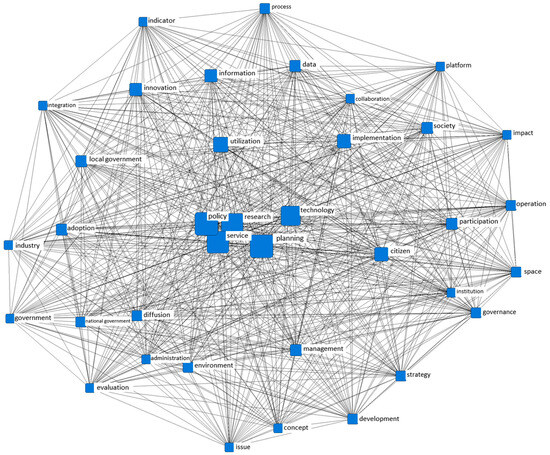
The centrality analysis results of the semantic network constructed from South Korean policy reports are presented in Table 4, and the corresponding network visualization is shown in Figure 1. The network visualization is based on the top 30 keywords ranked by eigenvector centrality. Node size represents eigenvector centrality, while edge thickness indicates the frequency of co-occurrence between keywords.
Figure 1.
Semantic network of smart city discourse in South Korean policy reports. Node size represents eigenvector centrality, and edge thickness indicates the frequency of co-occurrence between keywords.
Because the network visualization is influenced by layout algorithms, the spatial position of nodes does not represent absolute distance but rather reflects relative patterns of connectivity. In addition, connection strength is normalized within each network, which limits direct comparison across datasets. Therefore, the interpretation of network structure should be conducted in conjunction with the centrality measures presented in Table 4.
The results show that “service” exhibits the highest values across eigenvector centrality (0.437), degree centrality (2,951,371,264), and normalized degree centrality (0.17). This indicates that the keyword is strongly connected to other prominent concepts within the network. Keywords such as “information” (0.353), “management” (0.276), “construction” (0.256), and “planning” (0.243) also show relatively high eigenvector centrality values, forming a group of central concepts.
These keywords co-occur with terms such as “operation,” “system,” “data,” and “integration,” indicating that concepts related to service provision, information management, and system construction and operation tend to be interconnected within the network. In contrast, keywords such as “citizen” (0.110), “environment” (0.098), and “collaboration” (0.059) show relatively lower eigenvector centrality values, suggesting differences in their relative positions compared to the higher-ranked concepts. This pattern is also observed across the full set of top 100 keywords.
Betweenness centrality measures the extent to which a keyword mediates connections between other keywords. In this analysis, all keywords exhibit a betweenness centrality value of zero. This may be attributed to the characteristics of document-level co-occurrence networks, in which a large number of keywords are directly connected, resulting in limited intermediary pathways within the network.
Overall, the results suggest that relationships among key keywords in South Korean policy reports tend to be organized around a set of closely connected concepts, and the distribution of connections among keywords can be quantitatively identified through centrality measures.
4.3. Semantic Network: South Korea Policy Academic Literature
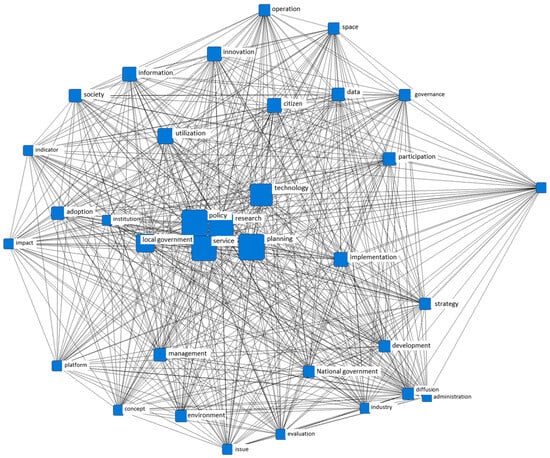
The results of the centrality analysis for the semantic network constructed from South Korean academic literature are presented in Table 5, and the corresponding visualization is shown in Figure 2. The network visualization is based on the top 30 keywords ranked by eigenvector centrality. Node size represents eigenvector centrality, while edge thickness indicates the frequency of co-occurrence between keywords.
Figure 2.
Semantic network of smart city discourse in South Korean Academic Literature. Node size represents eigenvector centrality, and edge thickness indicates the frequency of co-occurrence between keywords.
As in the previous network, degree centrality values tend to be relatively high due to the document-level co-occurrence structure; therefore, interpretation is therefore primarily based on eigenvector centrality.
According to the results, “planning” (0.319) and “policy” (0.319) show identical eigenvector centrality values and occupy central positions within the network. In addition, “service” (0.306), “research” (0.300), and “technology” (0.256) also exhibit relatively high eigenvector centrality values, forming a group of key concepts. This indicates that concepts related to planning, policy, research, and technology tend to be closely interconnected in South Korean academic literature.
Keywords related to actors, such as “local government” (0.204), “national government” (0.100), and “citizen” (0.147), are also included among the higher-ranked terms. These appear alongside concepts such as “governance” (0.091), “participation” (0.109), “diffusion” (0.093), and “adoption” (0.111), suggesting that discussions related to institutional context, actor relationships, and policy diffusion are addressed together with policy implementation.
Some keywords exhibit relatively high betweenness centrality values. For example, “technology” (306.321), “local government” (306.321), “indicator” (306.321), and “evaluation” (306.321) appear to mediate connections between different groups of concepts. Betweenness centrality indicates the extent to which a keyword lies on the shortest paths between other keywords, and these results suggest that certain concepts function as intermediaries within the network. This differs from the relational pattern observed in South Korean policy reports, where such intermediary roles were not identified.
When considering the distribution of eigenvector centrality and degree centrality together, higher-ranked keywords tend to show relatively high values in both measures. For example, “planning” and “policy” exhibit high eigenvector and degree centrality, indicating that they are directly connected to many concepts while also occupying structurally important positions in the network. In contrast, some keywords show relatively lower eigenvector centrality despite having a relatively high degree centrality, suggesting that the importance of connections varies depending on the centrality of connected concepts. This indicates that the structure of relationships among concepts is shaped not only by the number of connections but also by the relative importance of those connections.
In addition, keywords such as “society,” “environment,” “innovation,” “platform,” and “strategy” appear with intermediate levels of eigenvector centrality, indicating that technological aspects are addressed alongside social, institutional, and strategic considerations.
These results suggest that smart city discourse in South Korean academic literature appears to be structured through the interconnection of policy, planning, technology, actors, and institutional elements. Rather than being concentrated around a single dominant concept, relationships among concepts are formed through multiple connections. However, these interpretations are based on relative comparisons using centrality measures and should be understood at an exploratory level rather than as definitive structural classifications.
4.4. Semantic Network: Global Academic Literature
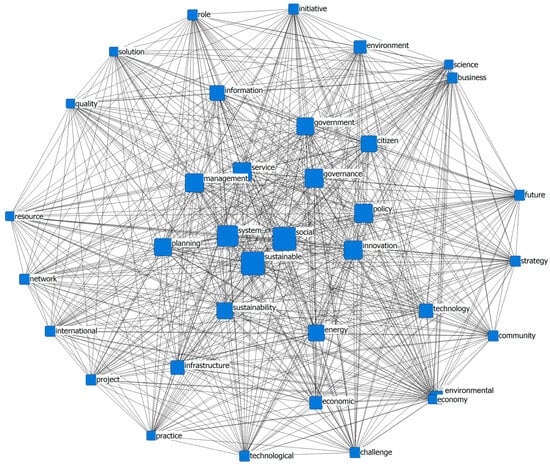
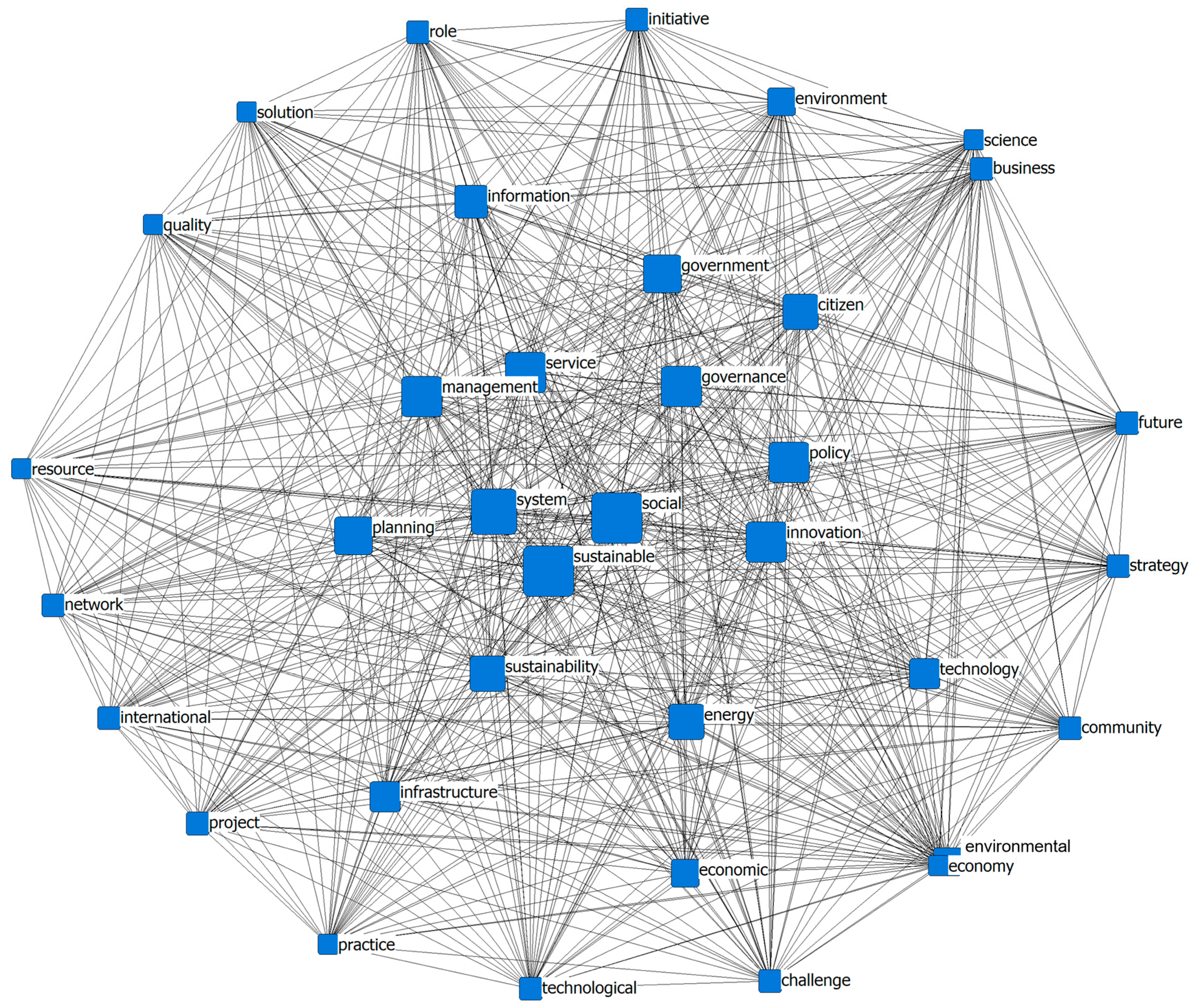
The results of the centrality analysis for the semantic network constructed from global academic literature are presented in Table 6, and the corresponding visualization is shown in Figure 3. The visualization is based on the top 30 keywords ranked by eigenvector centrality, where node size represents eigenvector centrality and edge thickness indicates the frequency of co-occurrence between keywords. As in the previous networks, the document-level co-occurrence structure results in relatively dense connections among keywords; therefore, structural differences are interpreted primarily based on eigenvector centrality.
Figure 3.
Semantic network of smart city discourse in Global Academic Literature. Node size represents eigenvector centrality, and edge thickness indicates the frequency of co-occurrence between keywords.
The results show that keywords such as “sustainable” (0.248), “social” (0.243), “system” (0.217), “service” (0.199), “innovation” (0.191), “governance” (0.189), “policy” (0.188), “management” (0.188), and “planning” (0.184) exhibit relatively high eigenvector centrality values and form a group of key concepts. These keywords tend to be distributed within a similar range rather than being strongly concentrated around a single dominant concept.
In addition, “government” (0.176), “citizen” (0.171), and “sustainability” (0.173) are also included among the higher-ranked keywords, indicating that institutional and social elements appear together. At the same time, environmental keywords such as “energy” (0.161), “environmental” (0.122), and “environment” (0.121), along with technological keywords such as “technology” (0.133), “infrastructure” (0.135), and “information” (0.147), are also present, suggesting that multiple dimensions are addressed simultaneously within the discourse. Degree centrality values among the top keywords are also relatively similar, indicating that connections among concepts are distributed across multiple keywords rather than concentrated on a single node.
Some keywords show relatively high betweenness centrality values. For example, “service” (305.591), “policy” (305.591), “sustainability” (305.591), and “information” (305.591) appear to mediate connections between different concepts, suggesting that certain keywords function as linking elements within the network structure.
Taken together, these findings suggest that smart city discourse in global academic literature is organized through the interconnection of technological, policy, environmental, and social elements, with relationships formed through multiple connections rather than centered on a single dominant concept.
5. Discussion
The findings of this study show that the smart city does not diffuse as a single, universally standardized policy model, but is instead configured differently across institutional and academic contexts. By comparing three types of data—South Korean policy reports, South Korean academic literature, and global academic literature—this study confirmed that even the same smart city concept may exhibit differences in the composition of core concepts and relational structures within semantic networks depending on data type and discursive context. Across all three datasets, common concepts such as “system,” “planning,” “service,” and “policy” repeatedly appeared; however, differences were observed in both the composition of core concepts and the distribution of centrality within the semantic networks. These differences should not be interpreted solely as reflecting national contextual differences, as variations in data composition may also have partially influenced the observed patterns. Therefore, the findings of this study should be understood not as a direct cross-national comparison based on equivalent datasets, but rather as an exploratory analysis of differences in smart city discourse structures formed across different institutional and knowledge-production contexts.
First, the comparison between South Korean policy reports and South Korean academic literature showed that both datasets tended to assign important positions to implementation- and operation-related concepts, although differences in discourse structure were also observed. In policy reports, concepts such as “service,” “information,” “management,” and “operation” exhibited relatively high eigenvector centrality, suggesting a relational structure centered on policy implementation and system construction. In contrast, South Korean academic literature includes not only “planning,” “policy,” “research,” and “technology,” but also actor- and institution-related concepts such as “local government,” “citizen,” and “governance.” These concepts appeared alongside terms such as “participation,” “diffusion,” and “adoption,” indicating more diverse relational configurations. This suggests that even within the same national context, policy-oriented and academic discourse may be structured differently according to their respective functions and objectives. In addition, these differences may be interpreted in relation to the state-led and implementation-oriented planning approaches that have long been emphasized within South Korean urban planning and policy contexts.
Next, the comparison between South Korean academic literature and global academic literature revealed that both datasets included concepts related to policy, planning, and technology; however, differences were observed in conceptual composition and relational patterns. In South Korean academic literature, concepts associated with policy implementation, institutions, technological application, and actor relationships tended to appear in relatively close association. By contrast, global academic literature revealed the concurrent appearance of concepts such as “sustainable,” “social,” “governance,” “environment,” and “community,” indicating a tendency for multiple dimensions to be considered simultaneously. In addition, the global academic literature exhibited relational patterns in which several highly ranked concepts showed similar levels of centrality, rather than being concentrated around a single dominant concept. These interpretations are based on relative comparisons of centrality distributions and should not be regarded as definitive classifications of network structure. Furthermore, the observed differences may reflect not only national contexts but also differences in the formation of global academic discourse and dataset composition.
These findings can be interpreted through the lens of policy mobility. According to policy mobility theory, policy ideas are not transferred unchanged across contexts; rather, they are reconfigured through processes of translation, mutation, and selective appropriation. The differences in discourse structures observed in this study suggest that such processes of recontextualization may also be reflected in the relational configurations among concepts. In other words, smart city-related concepts discussed globally may be selectively emphasized or restructured within different national policy and institutional contexts, potentially forming different relational structures. However, this study analyzed discourse structures rather than directly examining policy mobility mechanisms themselves. Therefore, policy mobility was employed as an analytical perspective for interpreting the discourse structures observed in this study.
More specifically, the relative concentration of implementation- and operation-oriented concepts observed in South Korean policy reports may be interpreted in relation to policy orientation emphasizing technological application and service provision. In contrast, South Korean academic literature revealed a broader discursive configuration in which discussions concerning policy, planning, governance, and actor relationships appeared together. Meanwhile, global academic literature reflected a more multidimensional understanding of smart cities through the simultaneous appearance of technological, social, environmental, and governance-related concepts. These differences suggest that smart city discourse is formed not only around technological application and administrative efficiency, but also in relation to institutional discussions, social values, and environmental considerations.
6. Conclusions
This study analyzed how smart city discourse is configured across different institutional and academic contexts from the perspective of policy mobility. To this end, the study distinguished among South Korean policy reports, South Korean academic literature, and global academic literature in order to examine how the composition of smart city-related concepts and their relational structures differ according to data type and discursive context.
The findings revealed differences in both the distribution of centrality and the relational structures of key concepts depending on data type and discursive context. In South Korean policy reports, implementation- and operation-related concepts tended to occupy relatively central positions, whereas South Korean academic literature showed a broader relational configuration in which policy-, planning-, technology-, and actor-related concepts appeared together. By contrast, the global academic literature exhibited the concurrent appearance of concepts such as “sustainable,” “social,” “governance,” and “policy,” with relatively similar levels of centrality. These findings suggest that smart city discourse does not converge into a single structure, but may instead be configured differently across contexts. However, these differences should not be interpreted solely as reflecting national contextual differences, as variations in dataset composition between policy-oriented and academic materials may also have partially influenced the observed patterns.
This study is significant in that it approached differences in smart city discourse not simply as differences in how policy concepts are relationally configured across institutional and academic contexts. In particular, the study showed that smart city-related concepts may be selectively emphasized or reconfigured across contexts rather than diffusing in a fixed form. This suggests that policy mobility perspectives may also be useful for examining discourse structures and changes in relationships among concepts, beyond tracing the movement of policy cases.
In addition, this study has methodological significance in that it employed semantic network analysis to compare the relative positions of key concepts and relational patterns within smart city discourse. The findings further indicate that smart city discourse involves not only technological efficiency, but also social and institutional dimensions. This further highlights the need for more balanced perspectives in future discussions of smart city strategies.
Finally, this study analyzed semantic networks based on document-level textual data and therefore did not directly examine interactions among actors or institutional negotiation processes within actual policy processes. Furthermore, the analysis focused on comparing relational patterns among key concepts using centralization or community detection. Future research could incorporate case studies, qualitative approaches, and additional network analyses to examine the reconfiguration of smart city discourse in a more multilayered manner.
Supplementary Materials
The following supporting information can be downloaded at: https://www.mdpi.com/article/10.3390/su18125809/s1, Table S1: Top 100 Keywords Ranked by Eigenvector Centrality in South Korean Smart City Policy Reports; Table S2: Top 100 Keywords Ranked by Eigenvector Centrality in South Korean Smart City Academic Literature; Table S3: Top 100 Keywords Ranked by Eigenvector Centrality in Global Smart City Academic Literature.
Author Contributions
Conceptualization, S.B. and J.K.; methodology, S.B. and S.H.; formal analysis, S.B. and S.H.; investigation, S.B.; writing—original draft preparation, S.B.; writing—review and editing, S.B., S.H. and J.K.; supervision, J.K.; project administration, J.K. All authors have read and agreed to the published version of the manuscript.
Funding
This work was supported by a Junior Faculty Support Program of Pusan National University. No grant number was assigned.
Institutional Review Board Statement
Not applicable.
Informed Consent Statement
Not applicable.
Data Availability Statement
The data presented in this study are available in public policy reports and academic publications. These data were derived from the following resources available in the public domain: policy reports published by the South Korean national and local governments and peer-reviewed academic publications indexed in the RISS and Web of Science databases. The analytical codes used for text mining and semantic network analysis will be made available by the authors upon reasonable request.
Acknowledgments
Artificial intelligence tools were used in this study for data processing and analysis. Google Colaboratory (Google Colab) was used as a computational environment to implement Python-based text mining and semantic network analysis, including data preprocessing, keyword extraction, and network construction. No generative AI tools were used to produce the manuscript text, and all interpretations and conclusions were developed by the authors. The authors reviewed and edited the output and take full responsibility for the content of this publication.
Conflicts of Interest
The authors declare no conflicts of interest.
References
- Harrison, C.; Eckman, B.; Hamilton, R.; Hartswick, P.; Kalagnanam, J.; Paraszczak, J.; Williams, P. Foundations for smarter cities. IBM J. Res. Dev. 2010, 54, 350–365. [Google Scholar] [CrossRef] [Scilit]
- Albino, V.; Berardi, U.; Dangelico, R.M. Smart Cities: Definitions, Dimensions, Performance, and Initiatives. J. Urban Technol. 2015, 22, 3–21. [Google Scholar] [CrossRef] [Scilit]
- Hollands, R.G. Will the real smart city please stand up? Intelligent, progressive or entrepreneurial? City 2008, 12, 303–320. [Google Scholar] [CrossRef] [Scilit]
- Söderström, O.; Paasche, T.; Klauser, F. Smart cities as corporate storytelling. City 2014, 18, 307–320. [Google Scholar] [CrossRef] [Scilit]
- Kitchin, R. The real-time city? Big data and smart urbanism. GeoJournal 2014, 79, 1–14. [Google Scholar] [CrossRef] [Scilit]
- Glasmeier, A.K.; Nebiolo, M. Thinking about Smart Cities: The Travels of a Policy Idea that Promises a Great Deal, but So Far Has Delivered Modest Results. Sustainability 2016, 8, 1122. [Google Scholar] [CrossRef] [Scilit]
- Mora, L.; Bolici, R.; Deakin, M. The First Two Decades of Smart-City Research: A Bibliometric Analysis. J. Urban Technol. 2017, 24, 3–27. [Google Scholar] [CrossRef] [Scilit]
- Tan, S.Y.; Taeihagh, A. Smart City Governance in Developing Countries: A Systematic Literature Review. Sustainability 2020, 12, 899. [Google Scholar] [CrossRef] [Scilit]
- Myat, S.S. Citizens in the “smart city”: Participation, co-production, governance, by Paolo Cardullo, New York, Routledge, 2021, 163 pp., £120.00, ISBN 9781138343948. Urban Geogr. 2021, 42, 860–861. [Google Scholar] [CrossRef] [Scilit]
- Hacker, P.; Neyer, J. Substantively smart cities—Participation, fundamental rights and temporality. Internet Policy Rev. 2023, 12. [Google Scholar] [CrossRef] [Scilit]
- Jiang, H.; Geertman, S.; Witte, P. Smart urban governance: An alternative to technocratic “smartness”. GeoJournal 2022, 87, 1639–1655. [Google Scholar] [CrossRef] [Scilit] [PubMed]
- Peck, J.; Theodore, N. Fast Policy: Experimental Statecraft at the Thresholds of Neoliberalism; University of Minnesota Press: Minneapolis, MN, USA, 2015. [Google Scholar]
- Prince, R. Mobile Urbanism: Cities and Policymaking in the Global Age. Urban Geogr. 2012, 33, 158–160. [Google Scholar] [CrossRef] [Scilit]
- Ministry of Land, Infrastructure and Transport. Smart City National Strategic Project R&D Project Detailed Planning; National Library of Korea: Seoul, Republic of Korea, 2018. [Google Scholar]
- Nam, T.; Pardo, T.A. Conceptualizing Smart City with Dimensions of Technology, People, and Institutions. In Proceedings of the 12th Annual International Digital Government Research Conference, College Park, MD, USA, 12–15 June 2011; pp. 282–291. [Google Scholar] [CrossRef] [Scilit]
- Caragliu, A.; Del Bo, C.; Nijkamp, P. Smart Cities in Europe. J. Urban Technol. 2011, 18, 65–82. [Google Scholar] [CrossRef] [Scilit]
- Batty, M.; Axhausen, K.W.; Giannotti, F.; Pozdnoukhov, A.; Bazzani, A.; Wachowicz, M.; Ouzounis, G.; Portugali, Y. Smart cities of the future. Eur. Phys. J. Spec. Top. 2012, 214, 481–518. [Google Scholar] [CrossRef] [Scilit]
- Townsend, A.M. SMART CITIES: Big Data, Civic Hackers, and the Quest for a New Utopia; W. W. Norton & Company, Inc.: New York, NY, USA, 2013. [Google Scholar] [CrossRef]
- Meijer, A.; Bolívar, M.P.R. Governing the smart city: A review of the literature on smart urban governance. Int. Rev. Adm. Sci. 2016, 82, 392–408. [Google Scholar] [CrossRef] [Scilit]
- Cardullo, P. Citizens in the ‘Smart City’: Participation, Co-Production, Governance; Routledge: London, UK, 2020. [Google Scholar]
- Angelidou, M. Smart Cities: A Conjuncture of Four Forces. Cities 2015, 47, 95–106. [Google Scholar] [CrossRef] [Scilit]
- Neirotti, P.; Marco, A.D.; Cagliano, A.C.; Mangano, G.; Scorrano, F. Current trends in Smart City initiatives: Some stylised facts. Cities 2014, 38, 25–36. [Google Scholar] [CrossRef] [Scilit]
- Vanolo, A. Smartmentality: The Smart City as Disciplinary Strategy. Urban Stud. 2013, 51, 883–898. [Google Scholar] [CrossRef] [Scilit]
- Kummitha, R.; Crutzen, N. How do we understand smart cities? An evolutionary perspective. Cities 2017, 67, 43–52. [Google Scholar] [CrossRef] [Scilit]
- Caprotti, F.; Cowley, R. Varieties of smart urbanism in the UK: Discursive logics, the state and local urban context. Trans. Inst. Br. Geogr. 2019, 44, 587–601. [Google Scholar] [CrossRef] [Scilit]
- McCann, E. Urban Policy Mobilities and Global Circuits of Knowledge: Toward a Research Agenda. Ann. Assoc. Am. Geogr. 2011, 101, 107–130. [Google Scholar] [CrossRef] [Scilit]
- Datta, A. New urban utopias of postcolonial India. Dialogues Hum. Geogr. 2015, 5, 3–22. [Google Scholar] [CrossRef] [Scilit]
- Kaiser, Z.R.M.A. Smart governance for smart cities and nations. J. Econ. Technol. 2024, 2, 216–234. [Google Scholar] [CrossRef] [Scilit]
- Akpınar, M.T.; Korkut, C. Data-Driven Decision-Making for Smart City Investments: A Multi-Criteria Framework for Strategic Digital Governance. Sayıştay Derg. 2025, 36, 859–888. [Google Scholar] [CrossRef] [Scilit]
- Dolowitz, D.; Marsh, D. Who Learns What from Whom: A Review of the Policy Transfer Literature. Political Stud. 1996, 44, 343–357. [Google Scholar] [CrossRef] [Scilit]
- Bennett, C.J. Understanding Ripple Effects: The Cross–National Adoption of Policy Instruments for Bureaucratic Accountability. Governance 1997, 10, 213–233. [Google Scholar] [CrossRef] [Scilit]
- Minkman, E.; van Buuren, M.W.; Bekkers, V.J.J.M. Policy transfer routes: An evidence-based conceptual model to explain policy adoption. Policy Stud. 2018, 39, 222–250. [Google Scholar] [CrossRef] [Scilit]
- Peck, J.; Theodore, N. Mobilizing policy: Models, methods, and mutations. Geoforum 2010, 41, 169–174. [Google Scholar] [CrossRef] [Scilit]
- McCann, E.; Ward, K. Assembling Urbanism: Following Policies and ‘Studying Through’ the Sites and Situations of Policy Making. Environ. Plan. A 2012, 44, 42–51. [Google Scholar] [CrossRef] [Scilit]
- Crivello, S. Urban Policy Mobilities: The Case of Turin as a Smart City. Eur. Plan. Stud. 2015, 23, 909–921. [Google Scholar] [CrossRef] [Scilit]
- McCann, E. Policy Boosterism, Policy Mobilities, and the Extrospective City. Urban Geogr. 2013, 34, 5–29. [Google Scholar] [CrossRef] [Scilit]
- Cresswell, T. Towards a Politics of Mobility. Environ. Plan. D 2010, 28, 17–31. [Google Scholar] [CrossRef] [Scilit]
- Bornmann, L.; Marx, W.; Barth, A. The Normalization of Citation Counts Based on Classification Systems. Publications 2013, 1, 78–86. [Google Scholar] [CrossRef] [Scilit]
- Bornmann, L. How are excellent (highly cited) papers defined in bibliometrics? A quantitative analysis of the literature. Res. Eval. 2014, 23, 166–173. [Google Scholar] [CrossRef] [Scilit]
- Donthu, N.; Kumar, S.; Mukherjee, D.; Pandey, N.; Lim, W.M. How to conduct a bibliometric analysis: An overview and guidelines. J. Bus. Res. 2021, 133, 285–296. [Google Scholar] [CrossRef] [Scilit]
- Freeman, L.C. Centrality in social networks conceptual clarification. Soc. Netw. 1978, 1, 215–239. [Google Scholar] [CrossRef] [Scilit]
- Bonacich, P. Power and Centrality: A Family of Measures. Am. J. Soc. 1987, 92, 1170–1182. Available online: http://www.jstor.org/stable/2780000 (accessed on 2 February 2026).
- Bonacich, P. Some unique properties of eigenvector centrality. Soc. Netw. 2007, 29, 555–564. [Google Scholar] [CrossRef] [Scilit]
- Ruhnau, B. Eigenvector-centrality—A node-centrality? Soc. Netw. 2000, 22, 357–365. [Google Scholar] [CrossRef] [Scilit]

Disclaimer/Publisher’s Note: The statements, opinions and data contained in all publications are solely those of the individual author(s) and contributor(s) and not of MDPI and/or the editor(s). MDPI and/or the editor(s) disclaim responsibility for any injury to people or property resulting from any ideas, methods, instructions or products referred to in the content. |
© 2026 by the authors. Licensee MDPI, Basel, Switzerland. This article is an open access article distributed under the terms and conditions of the Creative Commons Attribution (CC BY) license.