


Abstract
Sustainable agritourism has been raised as a vital ally for rural development, green preservation, and experiential tourism enrichment. However, guests’ behavioral intentions in the agritourism context are regularly shaped not only by sustainability concerns but also by nostalgic ties to rural life and traditional farming practices. This study explored how pro-environmental behavior (PEB) and intrinsic motivation can influence visitors’ revisit and recommendation intentions in agritourism settings, while testing the moderating effects of personal nostalgia. Based on Self-Determination Theory (SDT) and the PEB literature, this study assumes that visitors who are internally driven by learning, enjoyment, and personal achievement, as well as those who exhibit environmentally accountable orientations, are more likely to develop favorable revisit intentions toward agritourism places. Data was collected from 420 visitors to agritourism sites using a self-administered questionnaire and tested using PLS-SEM. The results revealed that both intrinsic motivation and PEB have significant positive impacts on revisit and recommendation intentions. Furthermore, personal nostalgia can intensify these relationships. The study can contribute to the sustainable tourism and agritourism literature by emphasizing the joint roles of internal motivation, PEB, and emotional bond in reshaping visitors’ revisit intention and positive word of mouth.
1. Introduction
Over the last decades, agriculture business has experienced substantial economic and social shifts as a response to several sustainability challenges, inconsistent farm revenue, and extending environmental awareness [1]. These challenges have fostered many agriculture farms to diversify their products and services beyond traditional activities by combining practical and value-added operations that link agriculture with rural tourism [2]. Consequently, agritourism has appeared as a significant alternative that encourages farm resilience while fulfilling tourists’ continuous demand for authentic, true, and environmentally deliberated experiences [3]. Agritourism generally describes all tourism practices that take place within the agricultural working context, where visitors are directly engaged with farming practices, rural regimes, and natural countryside [4]. Such activities may involve farm tours, product harvesting, food production shows, and educational activities rooted in agricultural environments. Unlike traditional tourism, agritourism highlights interaction, reality, and emotional bond, making it a rich context for exploring internal psychological motives and triggers of tourist behavior [5].
Based on the visitor’s standpoint, agritourism travel experiences are regularly driven by some intrinsic motivators, where visitors are guided by amusement, curiosity, and satisfaction, rather than extrinsic motivators [6]. The learning opportunity, nature exploration, and the active participation in farm life can create feelings of independence and satisfaction, which are focal to intrinsically motivated attitude. These internally driven behaviors are likely to improve visitors’ connection to agritourism destinations and impact their revisit intentions and intentions of recommending them to others [7]. Besides the intrinsic motivators, pro-environmental behavior has become growingly relevant in reshaping the decision-making process [8,9,10]. Increasing environmental consciousness has led many visitors to choose destinations and experiences that exhibit sustainable practices, natural accountability, and recognition of the local settings [11]. Agritourism context can offer an ideal setting for visitors to explicitly emphasize their pro-environmental beliefs. Visitors who participate in ecologically responsible behaviors may show stronger emotional connections with agritourism destinations, fostering their likelihood of place revisiting intention and recommending to others [12].
Additionally, agritourism activities repeatedly induce personal nostalgia [13]. The term nostalgia is described in the words of Holbrook [14], who defined it as “a longing for the past, a yearning for yesterday”. Since the past has vanished forever, it has a kind of gloomy charm [15]. Nostalgia has been described as a maladaptive and self-indulgent feeling that people experience when they are surrounded by their past circumstances. This involves recalling an experience from one’s past and wanting to return to it. Consequently, an individual might feel nostalgic and happy but with a tint of yearning [16]. Rural agritourism with its conventional farming activities and farm-based social practices can activate childhood memories, family rituals, or an idealized association with nature [17]. Nostalgia can strengthen emotional commitments and deepen behavioral intentions by generating a feeling of continuity between past practices and present actions [18]. When linked with intrinsic motivation and pro-environmental behavior, nostalgia might further strengthen visitors’ revisit intention to agritourism destinations and cause them to recommend the destinations to others.
This research paper can contribute theoretically in two main ways. First, it expanded SDT to the agritourism settings by highlighting how intrinsic motivations and nostalgia-related feelings may foster revisit and recommendation intentions toward agritourism destinations. Second, it integrated intrinsic motivation, personal nostalgia, pro-environmental behavioral and revisit and recommendation intentions into a single theoretically grounded model, hence offering a more comprehensive interpretation of how experiential tourism context might foster sustainability-oriented behaviors among guests.
Despite the increasing attention to agritourism, limited empirical studies have been conducted to explore how intrinsic motivation and pro-environmental behavior together can impact revisit and recommendation intentions, specifically when personal nostalgia is applied as a moderator. Addressing this gap, the current study examines how intrinsic motivation and pro-environmental behavior can shape visitors’ behavioral intentions in agritourism setting, while testing the moderating key role of personal nostalgia. By highlighting these internal and value-based triggers, this study can offer insights into how agritourism experiences can be developed to foster repeat visits and positive recommendations.
2. Literature Review
2.1. Theoretical Background
Tourism destinations regularly provide a wide variety of services, products, and experiences to fulfil and satisfy diverse visitors’ requirements [19]. These tourism offerings might include hotel accommodation, leisure activities, cultural places, natural landscape, and existential products that serve diverse interests and requirements [20]. Visitors’ selections among these diverse destinations are not unplanned; rather, they are formed by a mixture of socio-demographic, situational, economic, and psychological dimensions [21]. Previous studies have steadily proved that factors such as income, age group, distance, value, cost, and, most prominently, motivation can play a significant role in impacting tourists’ destination choices and visit intentions [22].
Based on a psychological standpoint, Self-Determination Theory (SDT) can offer a strong background to understanding how motivation informs the tourism decision-making process [23]. SDT differentiates between autonomous (intrinsic) motivation and controlled (external) motivation, highlighting that individuals tend to engage in practices that fulfil their main psychological urgent need for autonomy, aptitude, and affiliation [24,25]. Intrinsic motivation pertains to visitors’ internal motives (drives), such as autonomy (independence), self-determination and satisfaction, lacking external controlled motives. In tourism settings, destinations that permit tourists to freely select activities, feel competent and engage, and associate significantly with places or residents are more likely to encourage autonomous kinds of motivation [26]. Additionally, based on the Value-Based Theory (VBT), this research can argue that tourism experiences that evoke personal nostalgia can be aligned with visitors’ core values, such as PEB. Such values can foster intrinsic motivation by filling fundamental psychological needs, fostering emotional involvement, and generating meaningful association with the environment. As a result, guests are more likely to form PEB intentions, which reflect their need to act consistently with personally meaningful and nostalgic experiences. Furthermore, VBT and Norm Activation Theory (NAT) can explain how personal nostalgia might activate social norms that direct responsible behavior. By reconnecting guests with beloved past practices, nostalgia intensifies awareness of the results of environmental actions and reinforces internalized obligations to protect valued natural resources. These normative impacts, together with intrinsic motivation, not only foster sustainability-derived behaviors amid the visit but also reinforce revisit intentions and positive recommendations after the visit.
2.2. Hypotheses Development
Intrinsic motivation plays a focal role in destination selection when visitors seek leisure, innovation, knowledge, and personal enhancement. Tourists who are intrinsically motivated are inclined to choose places that can offer authentic and participative experiences rather than simply extrinsic motives such as status or distinction. Empirical research shows that intrinsically motivated visitors report greater satisfaction levels, deeper emotional connections, and higher levels of revisit intentions than those driven mainly by controlled external motives [27]. Previous research on the hospitality industry has investigated visitors’ intrinsic motivators and yielded significant results [28]. For example, ref. [29] explored five main intrinsic motivators for recreational travelers: (1) socializing, (2) developing kid’s cognitive skills, (3) family competence, (4) family attachment, and (5) escape and relaxation. Agritourism can be categorized as a sub-segment of the main tourism industry, and these intrinsic motivators are also relevant to tourists of agritourism places. These intrinsic motivators can drive visitors to revisit and recommend farm destinations. In this context, previous studies have explored several shared motivational drivers, involving the desire for farm exposure, engaging in farm operations, leisure, family gathering, knowledge gain, purchasing farm products, and socializing [6,30,31]. In more detail, agritourism guests seek farm exposure, which involves knowledge about farm operations, production process, and seasonal facilities [30,31]. Along with engaging in farming activities, guests can obtain educational knowledge into the significance of agritourism for farm owners, the role of agritourism in sustaining rural communities, and the link between tourism and agriculture in local destinations. Another intrinsic driver is spending time with family. Agritourism offers family leisure time, investigation of rural community lifestyle, and knowledge about local food processes and agriculture [6,30]. Moreover, the purchase of fresh farm products has been frequently identified as a key motivator that attracts tourists to revisit and recommend agritourism destinations [30,31]. Hence, we can assume that
H1:
Intrinsic motivation has a positive significant association with revisit intention to agritourism destination.
H2:
Intrinsic motivation has a positive significant association with recommendation intention to agritourism destination.
H3:
Intrinsic motivation has a positive significant indirect association with recommendation intention through revisit intention to agritourism destination.
Pro-environmental behavior (PEB) is conceptualized as all essential behaviors and actions taken to bypass causing any damage to the surrounding setting while constantly supporting and protecting it [32]. Such behaviors and actions include participating correctly when outdoors and even recycling home wastes. PEB can also include adaptive reactions to the effects of continuous climate change, such as buying environmental-based goods (e.g., local products, carbon-free products), saving water and energy, switching transportation styles (e.g., from driving a car to walking or cycling), purchasing a hybrid car [33]. De Groot et al. [34] introduced four main kinds of PEB: (1) altruistic values (highlighting people’s well-being), (2) egoistic main values (fostering and protecting individual resources), (3) biospheric values (worrying about nature and environment defense), and (4) hedonic values (minimizing effort and targeting pleasure). The biospheric values are the highest substantial type, as these values can motivate and foster individuals to behave environmentally even when it is high cost [35]. Prominently, nostalgic feelings induced in an experiential context such as agritourism may extend beyond affective responses and impact environmental reaction attitudes. When guests emotionally reconnect with valued remembrances linked with nature and rural settings, they might develop sturdier motivations to protect such environments, which can be translated into pro-environmental behavioral intentions.
Recently, travelers’ ecological concerns have risen substantially; elements such as public group-wide pressure, increased environmental consciousness, continuously dynamic public opinion, social media expansion, and growing governmental legislation have determined revisit and recommendation intentions to agritourism destinations [36]. As many visitor destinations and attractions depend directly on natural and environmental resources, environmental concerns must be considered. Destinations can attract visitors who are mainly focused on defending the environment and showing more ecologically friendly behavior and positive actions, which all are vital for fostering environmental tourism [37,38]. One of the biospheric main PEB values linked with agritourism tourists is their support of consuming local food and buying locally produced items, which may affect their revisit and recommendation intentions to others; hence,
H4:
PEB has a positive significant association with revisit intention to agritourism destination.
H5:
PEB has a positive significant association with recommendation intention to agritourism destination.
H6:
PEB has a positive significant indirect association with recommendation intention through revisit intention to agritourism destination.
H7:
Revisit intention has a positive significant association with recommendation intention to agritourism destination.
Nostalgia is one of the utmost substantial new developments of postmodernist tourism [39]. It focuses on the tourist’s psychographic continuum. That is, it is widespread and universal, and its impacts are perceived by more age groups levels than is usually recognized [40,41]. Recent research has reported the positive consequences of nostalgia on selecting tourist destinations. Moreover, it appears as a commanding driver [42], and it improves marketing opportunities of tourism destinations [40]. It can also add value to the overall experience of tourists [43]. Furthermore, it influences favorably upon destinations since it guides future revisit and recommendation intentions [44].
Nostalgia is conceptualized as a multidimensional factor that can manifest in different forms based on the resources and emphasis of the remembered past. Previous research widely distinguished between two types of nostalgia: personal nostalgia and collective nostalgia. Personal nostalgia denotes a sentimental desire for one’s private lived experiences and nonfictional memories, often activated by cues that remind people of meaningful moments in their private past lives [43]. However, collective nostalgia refers to the shared longing for a group of people’s past, such as countrywide history, cultural norms, or generational past memories that are collectively experienced or socially formed [44]. While both types have positive recollections of past life, they mainly differ in their psychological emphasis: personal nostalgia functions mainly at the individual level, based on personal past memories and emotions, whereas collective nostalgia is deeply rooted in shared social identity and group-level memories. Given the experiential and psychological nature of tourism and hospitality consumption, the current research focused mainly on personal nostalgia.
Responding to the value of nostalgia within the tourism setting, a large number of previous studies allocate nostalgia within a historical experiential setting. For example, scholars tested the impacts of museum exhibitions and commercialized and purchased items on visitors’ behavior [45]. Nonetheless, a few specific studies related to visitors’ emotional and nostalgic experience have been developed recently. These studies include the likelihood of visitors to revisit and recommend certain destinations due to nostalgia [46]. Hence, academic attention has been directed towards testing nostalgia from the consumer perspective. It has been discovered that the rural context, with its natural sense and conventional food [47], can foster nostalgia and the memories of a beautiful past. It is also widely noted that rural contexts bear a nostalgic feature and invoke a desire for a past time [48]. They can also offer emotional (i.e., nostalgic) feelings to their visitors [49]. Which in turn can intensify visitors’ intentions to revisit and recommend destinations [50,51]. Likewise, nostalgia can intensify the behavioral outcomes of PEB by strengthening moral feelings, endurance of self-identity, and a feeling of responsibility toward agricultural and rural places [29,52]. When visitors nostalgically remember ecologically accountable experiences, they are more likely to transform PEB into robust revisit and recommend intentions. Therefore, we can argue that
H8:
Nostalgia can moderate the link from intrinsic motivation to revisit intention of agritourism destinations.
H9:
Nostalgia can moderate the link from intrinsic motivation to recommendation intention of agritourism destinations.
H10:
Nostalgia can moderate the link from PEB to revisit intention of agritourism destinations.
H11:
Nostalgia can moderate the link from PEB to recommendation intention of agritourism destinations.
3. Methods
3.1. Measures
The current study has two independent variables (intrinsic motivation and PEB), two dependent variables (revisit intention and recommendation intention), and one moderating variable (personal nostalgia). All measures were derived from previously validates scales. Intrinsic motivation was measured by five items as recommended by Flanigan et al. [5] and Quella et al. [53]; sample items include “I visited the agritourism destination to rest and relax” and “I visited the agritourism destination to gain knowledge”. Similarly, PEB was measured by five items as recommended by Brune et al. [54], Han et al. [55], and Li et al. [56]; sample items include “agritourism supports the local economy” and “agritourism is more environmentally friendly”. Furthermore, revisit intention was measured by two items derived from Phillips et al. [57]; sample variables include “how likely are you to revisit this destination” and “how likely are you to visit other agritourism destinations”. Recommendation intention also has two reflective items as suggested by Yoon et al. [58]; sample items include “how likely are you to recommend to others regarding this destination” and “how likely are you to recommend to others regarding agritourism”. All variables were assessed using 5 items. Finally, personal nostalgia was measured by four reflective items as suggested by Chen et al. [59]; sample items include “this place evokes memories of delightful moments from my past” and “this place allows me to experience the serenity of simple life”. The variables for measuring personal nostalgia were evaluated on a 7-point Likert scale (1 = “Strongly Disagree” to 7 = “Strongly Agree”). All scale items are included in Appendix A. To guarantee the measures have adequate content validity, the designed scale was evaluated by 20 experts (10 professors and 10 practitioners). The 20 experts verified that all the items in the developed questionnaire are clear, acceptable, and relevant. Consequently, no corrections were required.
3.2. Data Collection
Data was collected employing a quantitative, cross-sectional survey approach and targeted tourists to agritourism places in Egypt. A post-visit technique was adopted to guarantee that visitors’ evaluations were based on actual experiences rather than their pre-visit expectations. A purposive non-probability sampling approach was employed, as the study precisely required respondents who had recently stayed at agritourism places. Participants were targeted either on-site at the departure points of agritourism places (permitting guests to complete the questionnaire immediately after their visit, when their memories and emotional responses were fresh) or through an online follow-up questionnaire shortly after the visit spread via their available social network sites. Data collection took place over July–August 2025, resulting in a final sample of 600 responses, of which 250 completed the paper-based survey and 350 completed the online survey. This dual-mode data collection ensured both immediacy of responses and broader reach while maintaining a focus on guests with relevant agritourism experience.
Completion of the questionnaire was completely voluntary, and participants were informed of the study purpose and assured of their anonymity and confidentiality. Additionally, informed consent was obtained before participation. A total of 600 forms were distributed, of which 420 were found usable, with a response rate of 75%. After screening the data collected and removing incomplete replies, the final dataset consisted of 420 responses. The sample size collected was considered appropriate for further analyses as it is consistent with suggested procedures for structural equation modeling (SEM). Following well-established criteria [60] with a level of 95% confidence and an error margin of 5%, the highest value in the sample size table is usually used when the total population number is unidentified. For populations exceeding 100,000 subjects, a sample of 384 can be considered appropriate for generalizability. The obtained sample of 420 respondents in the current study surpasses that threshold, ensuring the validity and reliability of its findings. The study sample has around 65% of males and around 35% of females. Most of the participants were between 36 and 50 years old (70%) or 25 to 36 years old (25%), while only 5% of participants were under 25 years old. Using educational level, most respondents had a bachelor’s degree level (65%), while 22% only had a postgraduate grade.
3.3. Data Analysis Techniques
The designed research framework has two main independent variables (intrinsic motivation and PEB), two main dependent variables (revisit intentions and recommendation intentions), and only one moderating variable (personal nostalgia); the model can be described as complex. Additionally, as the core purpose of this study is to predict relationships between the previously justified interrelated variables instead of approving an existing theory, the “Partial Least Squares Structural Equation Modeling” (PLS-SEM) technique was adequate [61]. SmartPLS software v4 (GmbH, Monheim am Rhein, Germany) was employed to conduct the analysis. The analysis process proceeded in two main stages. The first aims to evaluate measurement model convergent validity, with several criteria such as “Cronbach’s alpha, item loadings, composite reliability, and AVE”, and discriminant validity using “Fornell–Larcker criterion and the HTMT”. The second stage aims to assess the structural path model with path coefficients values (β), R2 values, Q2 values, and t-values [62].
4. Study Results
4.1. Common Method Bias Assessment
To detect common method bias (CMB), some statistics were calculated. First, “Harman’s single factor” analysis was carried out, as recommended by [63]. The findings showed that a single factor could only explain 40.67% of the variance. This value is below the threshold of 50%, revealing that CMB was not a concern. Moreover, all “variance inflation factor” (VIF) values were found to range from 1.470 to 3.641 (Table 1), and all were below the suggested score of 5.0, revealing no multicollinearity issues among the study items [64]. Additionally, skewness and kurtosis (skewness: −0.645 to 0.514; kurtosis: 3.182 to 0.235; see Table 1) are adequately below the value of 0.5, verifying normality [65].
Table 1.
Measurement model output.
4.2. First Phase: Measurement Model Inspection
Before estimating the full model, the outer model was first inspected. As the typical goodness-of-fit (GoF) criteria in CB-SEM are not reported in PLS-SEM, because of its variance-based nature [66], several substitutes values were considered. Following the suggestions of Hair et al. [61], “convergent validity” (CV) was first reviewed with regards to “item loadings” (λ), “Cronbach’s alpha” (α), “composite reliability” (CR), and “average variance extracted” (AVE). As shown in Table 1 all λ were above the score of 0.70 (0.745–0.914); CR (0.727–0.913) and α (0.723–0.912) scores satisfied the recommended threshold of 0.70, and all AVE values were above the suggested score of 0.50 (0.626 to 0.832). Consequently, these findings verified an adequate CV.
Additionally, DV was estimated with the “Fornell–Larcker metric”, which indicated that all the AVE square root scores of each single factor should be above its correlations with all factors [67]. As shown in Table 2, this condition was met, verifying the distinctiveness of all factors.
Table 2.
Fornell–Larcker calculations.
The “Heterotrait–Monotrait” (HTMT) ratio was also estimated to evaluate DV. As proposed by Henseler et al. [68], an HTMT value of 0.90 implies that dimensions are theoretically correlated, whereas a maximum value of 0.85 is ideal when dimensions are distinctive. As shown in Table 3, all HTMT values were below the value of 0.85, providing additional evidence for DV.
Table 3.
HTMT calculations.
4.3. Second Phase: Structural Model Testing and Hypotheses Evalaution
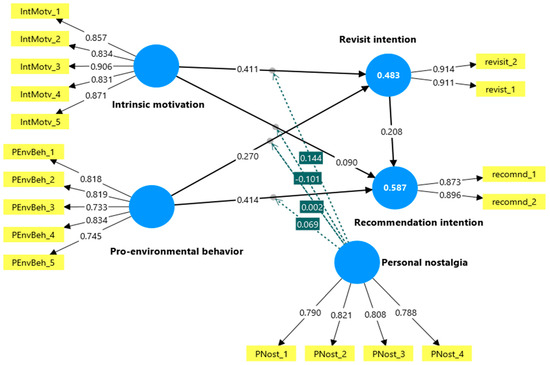
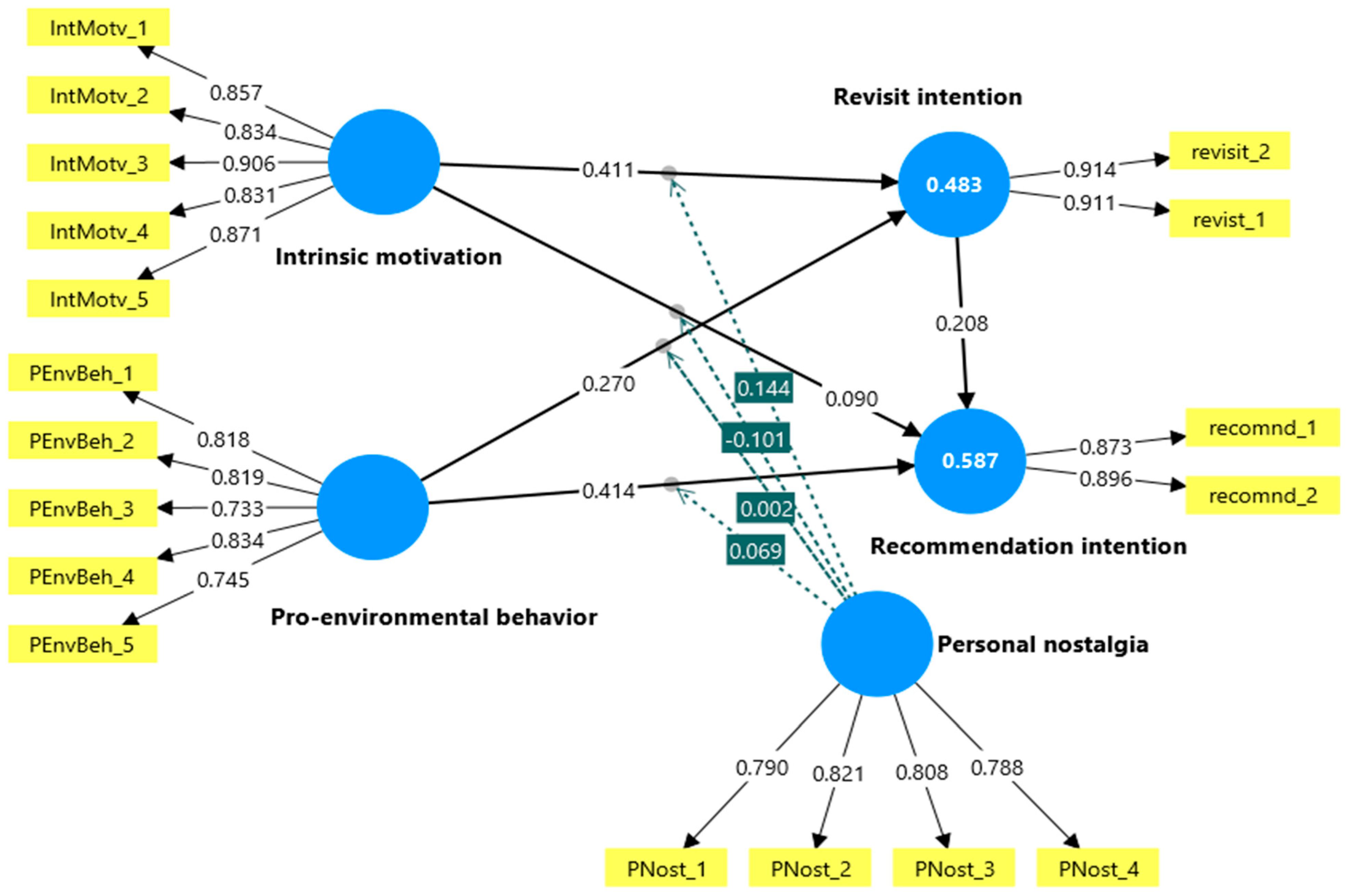
The tested model was found to explain a good level of variance in the endogenous variables: revisit intention (R2 = 0.483) and recommendation intention (R2 = 0.587). These R2 scores are considered adequate as suggested by [69]. These substantial R2 scores showed that the study structure model has proper predictive and explanatory capacity. Furthermore, the predictive power, as depicted by the Q2 metric, was well above zero [70]. Furthermore, the “standardized root means square residual” (SRMR) as an approximate metric of model GoF is 0.042, which is under the recommended value of 0.08, implying adequate fit [71]. Additionally, the “Normed Fit Index” (NFI) was also reviewed to test the overall fit [72]. In the current study, the NFI value was 0.921, verifying the adequacy of the model fit [70].
After inspecting and confirming the reliability, validity and GoF of the tested model and adopting Henseler’s et al. [68] two phases, hypothesis significance was calculated employing “t-values, β coefficients, and p-values” from estimating the model with 5000 bootstrapped resamples. As shown in Table 4 and Figure 1, intrinsic motivation has a significant positive association with revisit intention among agritourism visitors (β = 0.411, t = 5.783, p < 0.001), confirming H1. However, intrinsic motivation failed to directly increase the visitor’s recommendation intention (β = 0.090, t = 1.307, p = 0.191), rejecting H2. However, intrinsic motivation succeeded indirectly through revisit intention to improve recommendation intention, supporting H3. Moreover, PEB was found to have significant direct association with revisit intention (β = 0.270, t = 4.069) and recommendation intention (β = 0.414, t = 7.856), with significant partial mediation impacts (β = 0.056, t = 2.491), accepting H4, H5, and H6.
Table 4.
Hypotheses results.
Figure 1.
Evaluated model.
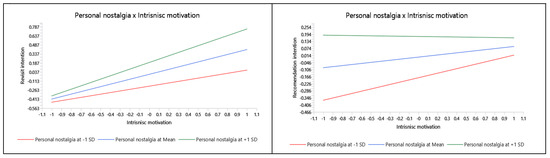
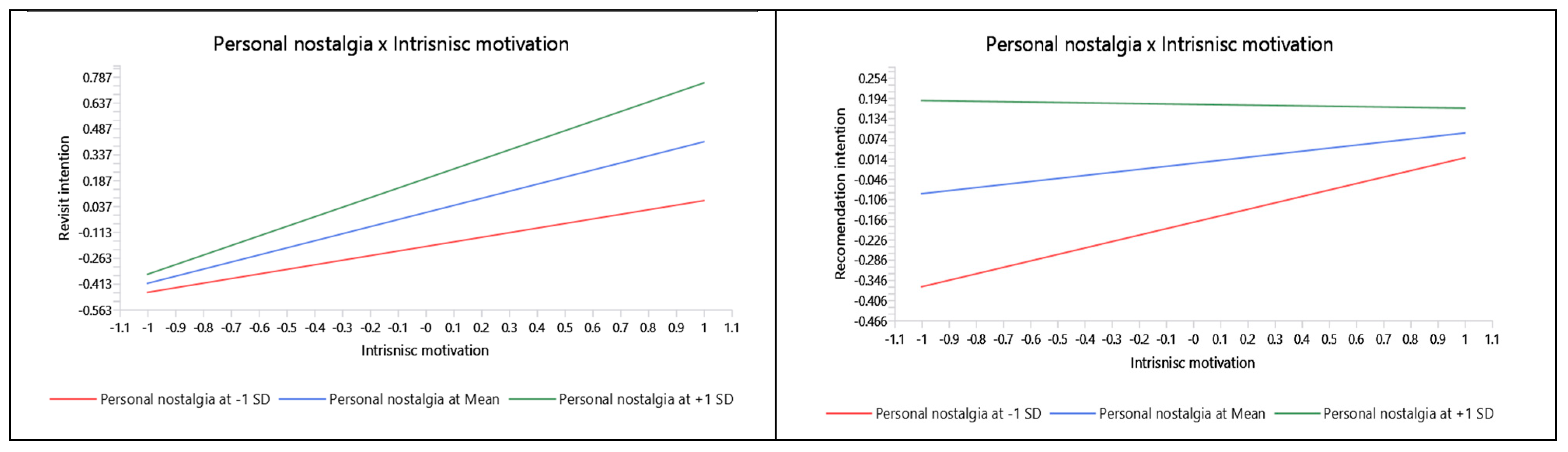
In addition, the moderating role of personal nostalgia was also inspected as seen in Figure 2. Personal nostalgia can intensify the impact of intrinsic motivation on revisit intention (β = 0.144, t = 2.379, p < 0.05), supporting H8. However, the moderating role of personal nostalgia on recommendation intention was significant but negative (β = −0.101, t = 2.679, p < 0.05), rejecting H9.
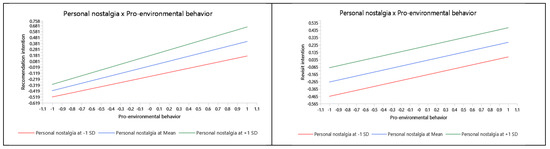
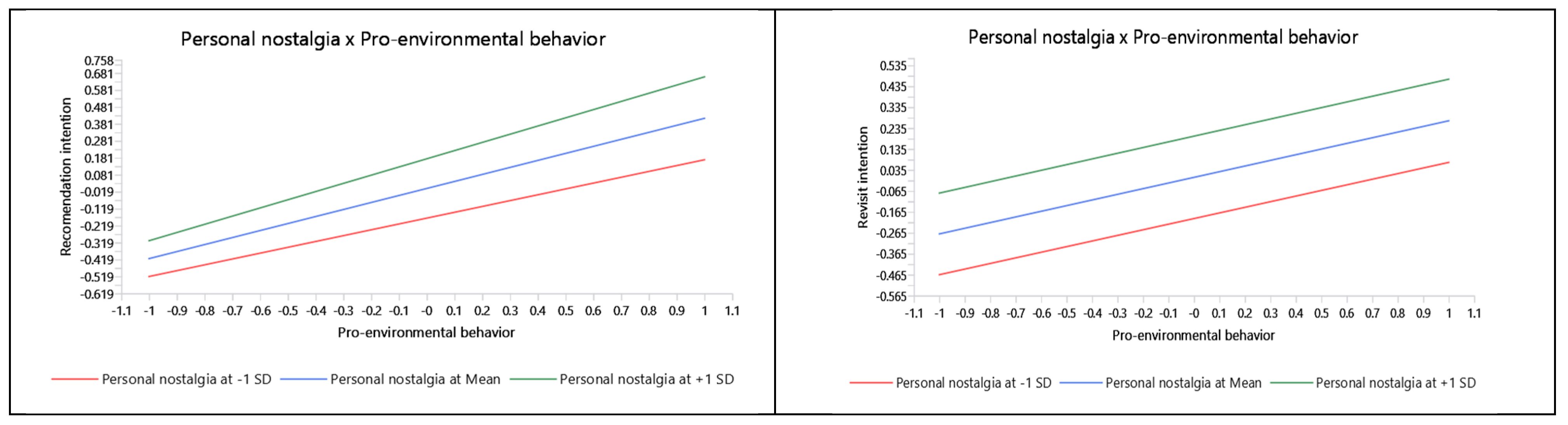
Figure 2.
Slope analysis.
Furthermore, personal nostalgia was able to moderate the impact of PEB on recommendation intention (β = 0.069, t = 2.789, p < 0.05), accepting H11, but failed to moderate the impact of PEB on revisit intention (β = 0.002, t = 0.029, p = 0.977), rejecting H10.
5. Discussion and Implications
The findings indicated that intrinsic motivation showed a strong and significant positive relationship with revisit intention among agritourism tourists. This result is aligned with SDT, which supposes that intrinsically motivated people are engaged in activities for inherent satisfaction, personal achievement, and interest, which leads to dedicated intentions to repeat the practice [24]. In the agritourism settings, intrinsically motivated tourists are likely driven by authentic countryside experiences, opportunities to learn, and emotional fulfillment, which fuel attachment and a desire to revisit [42,73,74]. However, intrinsic motivation failed to directly impact recommendation intention. This interesting finding indicates that, while intrinsically motivated tourists might personally enjoy and value the agritourism destination, such internal fulfillment did not directly be translated into an outward-oriented attitude such as recommending the place to others. Recommendation intention regularly echoes relational, social, and assessment processes that go beyond personal fulfillment, comprising credibility and confidence in people’s preferences [75,76]. In the agritourism context, tourists might need repeated experience before recommending the agritourism destination to others, which might offer a reasonable explanation for the observed nonsignificant direct effects.
Additionally, the results demonstrated that intrinsic motivation can indirectly foster recommendation intention through revisit intention. This partial mediation impact implied that revisit intention can act as a significant behavioral confirmation instrument that can link internal motivation to social confirmation. Tourists who are intrinsically motivated are more motivated to revisit, and this repeated experience reinforces confidence, attachment, and fulfilment, which in turn upsurges their willingness to recommend the agritourism destination to others [77,78].
Furthermore, the findings demonstrated that PEB has a positive significant and direct relationship with both revisit and recommendation intentions among agritourism tourists. Theses outcomes are consistent with the value–belief–norm (VBN) theory [79] and the norm-activation model (NAM) [80], which argues that people who are engaged in ecologically responsible behaviors can develop firmer moral commitment and destination attachment, which mirrors their deep environmental values [79]. In agritourism settings, where environmental sustainability, nature preservation, and rural legitimacy are dominant, visitors who poses PEB are more likely to recognize their value alignment with the place, thereby strengthening their intentions to revisit and recommend it to other people [74,81]. Likewise, the results revealed a partially significant mediation impact, signaling that revisit intention can partially mediate the relationship between PEB and recommendation intention. This finding proposed that, while PEB can directly foster tourists to recommend agritourism places to others, repeated visits to the agritourism destination can strengthen confidence, fulfilment, and emotional commitment, which further fosters recommendation intentions [77,78].
Furthermore, the PLS-SEM slope analysis revealed an interesting moderating role of personal nostalgia in modeling agritourism tourist’s behavioral intentions. Precisely, personal nostalgia can significantly and positively moderate the path from intrinsic motivation to revisit intention. This result is aligned with nostalgia assumptions, which theorizes that nostalgic feelings improve emotional attachment, self-continuity, and the recognized meaningfulness of prior experiences, thus strengthening approach-oriented attitudes such as revisit intention [50]. Similarly, personal nostalgia can significantly intensify the positive impact of PEB on recommendation intention. This result is aligned with research arguing that nostalgia increases the moral and emotional meaning of prior experiences, thus fostering people’s motivation to transmit and share those good experiences with others [41].
In contrast, the slope analysis results of moderating effects in PLS-SEM revealed an asymmetric and nuanced key role of personal nostalgia in modeling agritourism visitors’ behavioral intentions. While personal nostalgia can strengthen inward-directed behaviors such as revisiting intention by fostering emotional self-continuity and attachment, it exerted a negative but significant moderating impact on the path from intrinsic motivation to recommendation intention. This unexpected finding suggests that nostalgic past experiences may minimize tourists’ willingness to participate in an outward-directed encouragement attitude, such as recommending the agritourism destination to others [82,83]. Moreover, personal nostalgia failed to moderate the path from PEB to revisit intention, indicating that the impact of PEB on repeat visitation is relatively driven mainly by cognitive evaluations and fulfillment rather than emotional situations (i.e., nostalgia) [74,77].
Theoretically, this study progresses the agritourism literature by exploring the asymmetric and differentiated role of personal nostalgia in modeling tourist’s behavioral intentions. The results extend SDT and PEB frameworks by demonstrating that intrinsic motivation and PEB did not consistently translate into revisit and recommendation intentions; as a substitute, their impacts depend on emotional drivers such as nostalgia. Significantly, the findings revealed that nostalgia can function as a frontier instrument that supports inward-driven behaviors (e.g., revisit intention directed by intrinsic motivation) and outward-driven supported behaviors (e.g., recommendation intention motivated by PEB). The moderating effects of personal nostalgia suggest that emotionally meaningful experiences associated with guests’ previous memories might strengthen the positive influence of intrinsic motivation on PEB and post-visit intentions. These results signal that agritourism managers and destination operators can improve sustainability-oriented results by designing tourism experiences that induce nostalgic emotions related to the traditional rural lifestyles, nature-based activities, and cultural heritage.
However, personal nostalgia demonstrated limited moderating impacts on other tested relationships. From a managerial standpoint, the results suggested that agritourism managers should develop experiences and practices that support intrinsic satisfaction and environmentally accountable involvement while deliberately energizing nostalgic factors, such as old farming operations, heritage myths, and traditional rituals. Marketing strategies should force nostalgia feelings to foster revisit intentions among intrinsically motivated tourists and to stimulate word-of-mouth support among environmentally accountable visitors. However, agritourism practitioners should acknowledge that highly nostalgic feelings may be recognized as intimate and personal and consequently should be elevated through authenticated storytelling rather than mass marketing campaigns.
Practically, agritourism managers and destination operators might benefit from the results of this study by developing tourism experiences that foster intrinsic motivation and nostalgic feelings, which together might inspire environmentally responsible behavior among guests. The moderating key role of personal nostalgia suggests that, when agritourism experiences evoke expressive memories related to nature, rural norms, or childhood past experiences, the positive impact of intrinsic motivation on PEB and post-visit behavioral consequences becomes stronger. Hence, agritourism providers might enhance sustainability-oriented consequences by incorporating factors that evoke nostalgic emotions, such as traditional farming practices, heritage-based storytelling, authentic rural lifestyles, and interactive nature-based experiences. These experiential factors might strengthen guests’ emotional connectedness with rural settings, which might not only foster PEB during the visit but also enhance the likelihood of revisit intentions and positive word-of-mouth recommendations after the visit.
6. Limitations and Future Opportunities to Study
Despite the contributions discussed, this paper has some limitations that should be addressed in further research opportunities. First, we employed a cross-sectional research approach with a post-visit investigation, which might limit the ability to infer causal relationships or address changes in tourists’ behavioral intentions over long time. Future research papers might conduct longitudinal research designs to explore how intrinsic motivation, PEB, and nostalgia can evolve across longer time periods. Second, data were obtained from agritourism tourists within a single national (Egypt) context, which might limit the generalizability of the study findings to other countries. Future research could retest the study model in different regional contexts or conduct comparative multigroup analysis studies in multiple countries to explore potential cultural moderators. Third, while Harman’s single-factor test and VIF scores showed no serious signals of common method bias (CMB), the likelihood of CMB might not be entirely ruled out. Future research might apply more-advanced statistical remedies, such as marker variables or the CLF approach, to further alleviate possible CMB issues. Fourth, the study employed a purposive non-probability sampling method, although this technique ensured that respondents had relevant experiential knowledge, it might reduce the representativeness of the sample and minimize the generalizability of the results to the wider tourist population. Hence, the study findings should be interpreted with caution. Future studies are encouraged to implement other sampling methods in order to enhance the validity and generalizability of the current study findings. Finally, while the study tested revisit and recommendation intentions, the actual behavior was not investigated. Future research papers could track real revisits or online word of mouth to reinforce the predictive validity of the study model.
Author Contributions
Conceptualization, I.A.E.; Methodology, A.M.S.A.; Formal analysis, A.M.S.A.; Investigation, I.A.E.; Writing—original draft, A.M.S.A. and I.A.E.; Writing—review & editing, A.M.S.A. and I.A.E.; Visualization, I.A.E.; Supervision, I.A.E.; Funding acquisition, I.A.E. All authors have read and agreed to the published version of the manuscript.
Funding
This work was funded by the Deanship of Scientific Research, Vice Presidency for Graduate Studies and Scientific Research, King Faisal University, Saudi Arabia (Project No. KFU 260815).
Institutional Review Board Statement
The study was conducted in accordance with the Declaration of Helsinki and approved by the Institutional Review Board of King Faisal University (protocol code KFU−260815 and date of approval 25 October 2025).
Informed Consent Statement
Informed consent was obtained from all subjects involved in the study.
Data Availability Statement
The data presented in this study are available on request from the corresponding author due to privacy and ethical restrictions.
Conflicts of Interest
The authors declare no conflicts of interest.
Appendix A. The Employed Scale and References
| Dimensions | Items | Reference |
| Intrinsic motivation | ||
| IntMotv_1 | “I visited the agritourism destination to rest and relax.” | Flanigan et al. [5]; Quella et al. [53] |
| IntMotv_2 | “I visited the agritourism destination to spend time with my family.” | |
| IntMotv_3 | “I visited the agritourism destination to have fun/enjoy/playfulness.” | |
| IntMotv_4 | “I visited the agritourism destination to have a novel experience.” | |
| IntMotv_5 | “I visited the agritourism destination to gain knowledge.” | |
| Personal nostalgia | ||
| PNost_1 | “This place evokes memories of delightful moments from my past.” | Chen et al. [59] |
| PNost_2 | “This place allows me to experience the serenity of simple life.” | |
| PNost_3 | “This place makes me revisit my childhood.” | |
| PNost_4 | “This place enables me to remember how things used to be.” | |
| Pro-environmental behavior | ||
| PEnvBeh_1 | “Agritourism supports and helps local farmers.” | Brune et al. [54]; Han et al. [55]; Li et al. [56] |
| PEnvBeh_2 | “Agritourism is more environmentally friendly.” | |
| PEnvBeh_3 | “Agritourism supports the local economy.” | |
| PEnvBeh_4 | “Agritourism brings the community together.” | |
| PEnvBeh_5 | “Agritourism supports sustainable agriculture.” | |
| Recommendation intentions | ||
| recomnd_1 | “How likely are you to recommend to others regarding this destination?” | Yoon et al. [58]; Phillips et al. [57] |
| recomnd_2 | “How likely are you to recommend to others regarding agritourism?” | |
| Revisit intentions | ||
| revisit_1 | “How likely are you to revisit this destination?” | Yoon et al. [58]; Phillips et al. [57] |
| revist_2 | “How likely are you to visit other agritourism destinations?” | |
References
- Rauniyar, S.; Awasthi, M.K.; Kapoor, S.; Mishra, A.K. Agritourism: Structured Literature Review and Bibliometric Analysis. Tour. Recreat. Res. 2021, 46, 52–70. [Google Scholar] [CrossRef] [Scilit]
- Barbieri, C. Assessing the Sustainability of Agritourism in the US: A Comparison between Agritourism and Other Farm Entrepreneurial Ventures. J. Sustain. Tour. 2013, 21, 252–270. [Google Scholar] [CrossRef] [Scilit]
- Veeck, G.; Che, D.; Veeck, A. America’s Changing Farmscape: A Study of Agricultural Tourism in Michigan. Prof. Geogr. 2006, 58, 235–248. [Google Scholar] [CrossRef] [Scilit]
- Arroyo, C.G.; Barbieri, C.; Rich, S.R. Defining Agritourism: A Comparative Study of Stakeholders’ Perceptions in Missouri and North Carolina. Tour. Manag. 2013, 37, 39–47. [Google Scholar] [CrossRef] [Scilit]
- Flanigan, S.; Blackstock, K.; Hunter, C. Agritourism from the Perspective of Providers and Visitors: A Typology-Based Study. Tour. Manag. 2014, 40, 394–405. [Google Scholar] [CrossRef] [Scilit]
- Phillip, S.; Hunter, C.; Blackstock, K. A Typology for Defining Agritourism. Tour. Manag. 2010, 31, 754–758. [Google Scholar] [CrossRef] [Scilit]
- Khanal, A.R.; Honey, U.; Omobitan, O. Diversification through ‘Fun in the Farm’: Analyzing Structural Factors Affecting Agritourism in Tennessee. Int. Food Agribus. Manag. Rev. 2020, 23, 105–120. [Google Scholar] [CrossRef] [Scilit]
- Al-Sabi, S.M.; Al-Ababneh, M.M.; Al Qsssem, A.H.; Afaneh, J.A.A.; Elshaer, I.A. Green Human Resource Management Practices and Environmental Performance: The Mediating Role of Job Satisfaction and pro-Environmental Behavior. Cogent Bus. Manag. 2024, 11, 2328316. [Google Scholar] [CrossRef] [Scilit]
- Huo, X.; Zou, X.; Zhang, Y.; Ma, R. Driving Factors of Pro-Environmental Behavior among Rural Tourism Destination Residents-Considering the Moderating Effect of Environmental Policies. Sci. Rep. 2025, 15, 7663. [Google Scholar]
- Lutfi, A.; Al-Hiyari, A.; Elshaer, I.A.; Alrawad, M.; Almaiah, M.A. Green Environmental Management System and Environmental Performance: Results from PLS-SEM and fsQCA. Sustain. Futures 2024, 8, 100276. [Google Scholar] [CrossRef] [Scilit]
- Shen, C.-C.; Wang, D. Using the RPM Model to Explore the Impact of Organic Agritourism Destination Fascination on Loyalty—The Mediating Roles of Place Attachment and pro-Environmental Behavior. Agriculture 2023, 13, 1767. [Google Scholar]
- Tang, H.; Liu, Z.; Long, X. Analyzing the Farmers’ pro-Environmental Behavior Intention and Their Rural Tourism Livelihood in Tourist Village Where Its Ecological Environment Is Polluted. PLoS ONE 2021, 16, e0247407. [Google Scholar]
- Christou, P.; Farmaki, A.; Evangelou, G. Nurturing Nostalgia?: A Response from Rural Tourism Stakeholders. Tour. Manag. 2018, 69, 42–51. [Google Scholar] [CrossRef] [Scilit]
- Holbrook, M.B. Nostalgia and Consumption Preferences: Some Emerging Patterns of Consumer Tastes. J. Consum. Res. 1993, 20, 245–256. [Google Scholar] [CrossRef] [Scilit]
- Bazin, Y. L’irréversible et La Nostalgie (Irreversibility and Nostalgia). Soc. Bus. Rev. 2013, 8, 90–92. [Google Scholar] [CrossRef] [Scilit]
- Stephan, E.; Sedikides, C.; Wildschut, T.; Cheung, W.-Y.; Routledge, C.; Arndt, J. Nostalgia-Evoked Inspiration: Mediating Mechanisms and Motivational Implications. Personal. Soc. Psychol. Bull. 2015, 41, 1395–1410. [Google Scholar] [CrossRef] [Scilit]
- Palmi, P.; Lezzi, G.E. How Authenticity and Tradition Shift into Sustainability and Innovation: Evidence from Italian Agritourism. Int. J. Environ. Res. Public Health 2020, 17, 5389. [Google Scholar] [CrossRef] [Scilit]
- Jian, Y.; Lin, J.; Zhou, Z. The Role of Travel Constraints in Shaping Nostalgia, Destination Attachment and Revisit Intentions and the Moderating Effect of Prevention Regulatory Focus. J. Destin. Mark. Manag. 2021, 19, 100516. [Google Scholar] [CrossRef] [Scilit]
- Robinson, P. Tourism: The Key Concepts; Routledge: London, UK, 2012. [Google Scholar]
- Getz, D. Travel, Tourism, and Hospitality Research: A Handbook for Managers and Researchers; John Wiley& Sons: New York, NY, USA, 1994. [Google Scholar]
- Gürdoğan, A. Destination Choice Behaviour and Tourists’ Travel Behaviour and Patterns. In Managing Risk and Decision Making in Times of Economic Distress, Part A; Emerald Publishing Limited: Leeds, UK, 2022; pp. 151–170. [Google Scholar]
- McKercher, B.; Tolkach, D.; Mahadewi, N.M.E.; Byomantara, D.G.N. The Relationship between Motive and In-Destination Behaviour. J. Hosp. Tour. Manag. 2021, 46, 432–439. [Google Scholar] [CrossRef] [Scilit]
- Kim, Y. Exploring the Interplay of Psychological Need Satisfaction, Well-Being, and Behavioral Intentions in Tourism: A Self-Determination Theory Perspective. J. Travel Res. 2026, 65, 222–241. [Google Scholar] [CrossRef] [Scilit]
- Ryan, R.M.; Deci, E.L. Self-Determination Theory and the Facilitation of Intrinsic Motivation, Social Development, and Well-Being. Am. Psychol. 2000, 55, 68. [Google Scholar] [CrossRef]
- Ryan, R.M.; Deci, E.L. Intrinsic and Extrinsic Motivation from a Self-Determination Theory Perspective: Definitions, Theory, Practices, and Future Directions. Contemp. Educ. Psychol. 2020, 61, 101860. [Google Scholar] [CrossRef] [Scilit]
- Ciki, K.D.; Tanriverdi, H. Examining the Relationships among Nature-Based Tourists’ Travel Motivations, Ecologically Responsible Attitudes and Subjective Well-Being within the Scope of Self-Determination Theory. Curr. Issues Tour. 2024, 27, 2363–2368. [Google Scholar] [CrossRef] [Scilit]
- Yoo, C.-K.; Yoon, D.; Park, E. Tourist Motivation: An Integral Approach to Destination Choices. Tour. Rev. 2018, 73, 169–185. [Google Scholar] [CrossRef] [Scilit]
- Pomfret, G.; Bramwell, B. The Characteristics and Motivational Decisions of Outdoor Adventure Tourists: A Review and Analysis. Curr. Issues Tour. 2016, 19, 1447–1478. [Google Scholar] [CrossRef] [Scilit]
- Kim, S.; Lehto, X.Y. Travel by Families with Children Possessing Disabilities: Motives and Activities. Tour. Manag. 2013, 37, 13–24. [Google Scholar] [CrossRef] [Scilit]
- Kim, S.; Lee, S.K.; Lee, D.; Jeong, J.; Moon, J. The Effect of Agritourism Experience on Consumers’ Future Food Purchase Patterns. Tour. Manag. 2019, 70, 144–152. [Google Scholar] [CrossRef] [Scilit]
- Tew, C.; Barbieri, C. The Perceived Benefits of Agritourism: The Provider’s Perspective. Tour. Manag. 2012, 33, 215–224. [Google Scholar] [CrossRef] [Scilit]
- Steg, L.; Vlek, C. Encouraging Pro-Environmental Behaviour: An Integrative Review and Research Agenda. J. Environ. Psychol. 2009, 29, 309–317. [Google Scholar] [CrossRef] [Scilit]
- Hadler, M.; Haller, M. Global Activism and Nationally Driven Recycling: The Influence of World Society and National Contexts on Public and Private Environmental Behavior. Int. Sociol. 2011, 26, 315–345. [Google Scholar] [CrossRef] [Scilit]
- De Groot, J.I.; Steg, L.; Keizer, M.; Farsang, A.; Watt, A. Environmental Values in Post-Socialist Hungary: Is It Useful to Distinguish Egoistic, Altruistic and Biospheric Values? Sociol. Cas. 2012, 48, 421. [Google Scholar]
- De Groot, J.I.M.; Steg, L. Mean or Green: Which Values Can Promote Stable Pro-environmental Behavior? Conserv. Lett. 2009, 2, 61–66. [Google Scholar] [CrossRef] [Scilit]
- Han, H.; Al-Ansi, A.; Olya, H.G.; Kim, W. Exploring Halal-Friendly Destination Attributes in South Korea: Perceptions and Behaviors of Muslim Travelers toward a Non-Muslim Destination. Tour. Manag. 2019, 71, 151–164. [Google Scholar] [CrossRef] [Scilit]
- Dolnicar, S.; Knezevic Cvelbar, L.; Grün, B. Do Pro-Environmental Appeals Trigger Pro-Environmental Behavior in Hotel Guests? J. Travel Res. 2017, 56, 988–997. [Google Scholar] [CrossRef] [Scilit]
- Xu, F.; Huang, L.; Whitmarsh, L. Home and Away: Cross-Contextual Consistency in Tourists’ pro-Environmental Behavior. J. Sustain. Tour. 2020, 28, 1443–1459. [Google Scholar] [CrossRef] [Scilit]
- Earl, A.; Hall, C.M. Nostalgia and Tourism. J. Herit. Tour. 2023, 18, 307–317. [Google Scholar] [CrossRef] [Scilit]
- Hunt, L.; Johns, N. Image, Place and Nostalgia in Hospitality Branding and Marketing. Worldw. Hosp. Tour. Themes 2013, 5, 14–26. [Google Scholar] [CrossRef] [Scilit]
- Sedikides, C.; Wildschut, T.; Routledge, C.; Arndt, J.; Hepper, E.G.; Zhou, X. To Nostalgize: Mixing Memory with Affect and Desire. In Advances in Experimental Social Psychology; Elsevier: Amsterdam, The Netherlands, 2015; Volume 51, pp. 189–273. [Google Scholar]
- Yoon, Y.; Uysal, M. An Examination of the Effects of Motivation and Satisfaction on Destination Loyalty: A Structural Model. Tour. Manag. 2005, 26, 45–56. [Google Scholar] [CrossRef] [Scilit]
- Jarratt, D.; Gammon, S. ‘We Had the Most Wonderful Times’: Seaside Nostalgia at a British Resort. Tour. Recreat. Res. 2016, 41, 123–133. [Google Scholar] [CrossRef] [Scilit]
- Leong, A.M.W.; Yeh, S.-S.; Chang, L.-H. Nostalgic Tourism in Macau: The Bidirectional Causal Relationship between Destination Image and Experiential Value. J. Hosp. Tour. Technol. 2015, 6, 89–99. [Google Scholar]
- Brown, J. Dark Tourism Shops: Selling “Dark” and “Difficult” Products. Int. J. Cult. Tour. Hosp. Res. 2013, 7, 272–280. [Google Scholar] [CrossRef] [Scilit]
- Yeh, S.-S.; Chen, C.; Liu, Y.-C. Nostalgic Emotion, Experiential Value, Destination Image, and Place Attachment of Cultural Tourists. In Advances in Hospitality and Leisure; Emerald Group Publishing Limited: Leeds, UK, 2012; pp. 167–187. [Google Scholar]
- Renko, S.; Bucar, K. Sensing Nostalgia through Traditional Food: An Insight from Croatia. Br. Food J. 2014, 116, 1672–1691. [Google Scholar] [CrossRef] [Scilit]
- Creighton, M. Nostalgia, Anthropology Of. In International Encyclopedia of the Social & Behavioral Sciences, 2nd ed.; Elsevier: Amsterdam, The Netherlands, 2015. [Google Scholar]
- Sharpley, R.; Jepson, D. Rural Tourism: A Spiritual Experience? Ann. Tour. Res. 2011, 38, 52–71. [Google Scholar] [CrossRef] [Scilit]
- Sedikides, C.; Wildschut, T. Past Forward: Nostalgia as a Motivational Force. Trends Cogn. Sci. 2016, 20, 319–321. [Google Scholar] [CrossRef] [Scilit]
- Sedikides, C.; Wildschut, T. Nostalgia as Motivation. Curr. Opin. Psychol. 2023, 49, 101537. [Google Scholar] [CrossRef] [Scilit]
- Onel, N.; Mukherjee, A. Why Do Consumers Recycle? A Holistic Perspective Encompassing Moral Considerations, Affective Responses, and Self-interest Motives. Psychol. Mark. 2017, 34, 956–971. [Google Scholar] [CrossRef] [Scilit]
- Quella, L.; Chase, L.; Conner, D.; Reynolds, T.; Wang, W.; Singh-Knights, D. Visitors and Values: A Qualitative Analysis of Agritourism Operator Motivations across the US. J. Agric. Food Syst. Community Dev. 2021, 10, 287–301. [Google Scholar] [CrossRef] [Scilit]
- Brune, S.; Knollenberg, W.; Stevenson, K.T.; Barbieri, C.; Schroeder-Moreno, M. The Influence of Agritourism Experiences on Consumer Behavior toward Local Food. J. Travel Res. 2021, 60, 1318–1332. [Google Scholar] [CrossRef] [Scilit]
- Han, J.H.; Lee, M.J.; Hwang, Y.-S. Tourists’ Environmentally Responsible Behavior in Response to Climate Change and Tourist Experiences in Nature-Based Tourism. Sustainability 2016, 8, 644. [Google Scholar] [CrossRef] [Scilit]
- Li, S.; Wei, M.; Qu, H.; Qiu, S. How Does Self-Image Congruity Affect Tourists’ Environmentally Responsible Behavior? J. Sustain. Tour. 2020, 28, 2156–2174. [Google Scholar] [CrossRef] [Scilit]
- Phillips, W.J.; Wolfe, K.; Hodur, N.; Leistritz, F.L. Tourist Word of Mouth and Revisit Intentions to Rural Tourism Destinations: A Case of North Dakota, USA. J. Tour. Res. 2013, 15, 93–104. [Google Scholar] [CrossRef] [Scilit]
- Yoon, Y.-S.; Lee, J.-S.; Lee, C.-K. Measuring Festival Quality and Value Affecting Visitors’ Satisfaction and Loyalty Using a Structural Approach. Int. J. Hosp. Manag. 2010, 29, 335–342. [Google Scholar] [CrossRef] [Scilit]
- Chen, Q.; Huang, R.; Zhang, A. A Bite of Nostalgia: The Influence of Nostalgia in Consumers’ Loyalty Intentions at Traditional Restaurants. J. Hosp. Tour. Manag. 2020, 45, 604–614. [Google Scholar] [CrossRef] [Scilit]
- Krejcie, R.V.; Morgan, D.W. Determining Sample Size for Research Activities. Educ. Psychol. Meas. 1970, 30, 607–610. [Google Scholar] [CrossRef] [Scilit]
- Hair, J.F.; Hult, G.T.M.; Ringle, C.M.; Sarstedt, M. A Primer on Partial Least Squares Structural Equation Modeling (PLS-SEM), 3rd ed.; Sage Publications: Thousand Oaks, CA, USA, 2021. [Google Scholar]
- Leguina, A. A Primer on Partial Least Squares Structural Equation Modeling (PLS-SEM). Int. J. Res. Method Educ. 2015, 38, 220–221. [Google Scholar] [CrossRef] [Scilit]
- Lindell, M.K.; Whitney, D.J. Accounting for Common Method Variance in Cross-Sectional Research Designs. J. Appl. Psychol. 2001, 86, 114–121. [Google Scholar] [CrossRef] [Scilit] [PubMed]
- Tabachnick, B.G.; Fidell, L.S. Using Multivariate Statistics; Pearson Education: Boston, MA, USA, 2007. [Google Scholar]
- Bryman, A.; Cramer, D. Quantitative Data Analysis with SPSS 14, 15 & 16: A Guide for Social Scientists; Routledge/Taylor & Francis Group: London, UK, 2009. [Google Scholar]
- Chin, W.W. The Partial Least Squares Approach to Structural Equation Modeling. In Modern Methods for Business Research; Psychology Press: New York, NY, USA, 1998; pp. 295–336. [Google Scholar]
- Henseler, J.; Sarstedt, M. Goodness-of-Fit Indices for Partial Least Squares Path Modeling. Comput. Stat. 2013, 28, 565–580. [Google Scholar] [CrossRef] [Scilit]
- Henseler, J.; Ringle, C.M.; Sarstedt, M. A New Criterion for Assessing Discriminant Validity in Variance-Based Structural Equation Modeling. J. Acad. Mark. Sci. 2015, 43, 115–135. [Google Scholar] [CrossRef] [Scilit]
- Sarstedt, M.; Ringle, C.M.; Cheah, J.-H.; Ting, H.; Moisescu, O.I.; Radomir, L. Structural Model Robustness Checks in PLS-SEM. Tour. Econ. 2020, 26, 531–554. [Google Scholar] [CrossRef] [Scilit]
- Chin, W.W. How to Write Up and Report PLS Analyses. In Handbook of Partial Least Squares; Esposito Vinzi, V., Chin, W.W., Henseler, J., Wang, H., Eds.; Springer: Berlin/Heidelberg, Germany, 2010; pp. 655–690. ISBN 978-3-540-32825-4. [Google Scholar]
- Kline, R.B. Principles and Practice of Structural Equation Modeling; Guilford Publications: New York City, NY, USA, 2023. [Google Scholar]
- Hair, J.F.; Ringle, C.M.; Sarstedt, M. Partial Least Squares: The Better Approach to Structural Equation Modeling? Long Range Plan. 2012, 45, 312–319. [Google Scholar] [CrossRef] [Scilit]
- Kastenholz, E.; Carneiro, M.J.; Marques, C.P.; Lima, J. Understanding and Managing the Rural Tourism Experience—The Case of a Historical Village in Portugal. Tour. Manag. Perspect. 2012, 4, 207–214. [Google Scholar]
- Lee, T.H.; Jan, F.-H.; Yang, C.-C. Conceptualizing and Measuring Environmentally Responsible Behaviors from the Perspective of Community-Based Tourists. Tour. Manag. 2013, 36, 454–468. [Google Scholar] [CrossRef] [Scilit]
- Kim, K.; Hallab, Z.; Kim, J.N. The Moderating Effect of Travel Experience in a Destination on the Relationship Between the Destination Image and the Intention to Revisit. J. Hosp. Mark. Manag. 2012, 21, 486–505. [Google Scholar] [CrossRef] [Scilit]
- Zeithaml, V.A.; Berry, L.L.; Parasuraman, A. The Behavioral Consequences of Service Quality. J. Mark. 1996, 60, 31–46. [Google Scholar] [CrossRef] [Scilit]
- Chen, C.-F.; Tsai, D. How Destination Image and Evaluative Factors Affect Behavioral Intentions? Tour. Manag. 2007, 28, 1115–1122. [Google Scholar] [CrossRef] [Scilit]
- Prayag, G.; Ryan, C. Antecedents of Tourists’ Loyalty to Mauritius: The Role and Influence of Destination Image, Place Attachment, Personal Involvement, and Satisfaction. J. Travel Res. 2012, 51, 342–356. [Google Scholar] [CrossRef] [Scilit]
- Stern, P.; Dietz, T.; Abel, T.; Guagnano, G.; Kalof, L. A Value-Belief-Norm Theory of Support for Social Movements: The Case of Environmentalism. Hum. Ecol. Rev. 1999, 6, 81–97. [Google Scholar]
- Schwartz, S. The Justice of Need and the Activation of Humanitarian Norms. J. Soc. Issues 1975, 31, 111–136. [Google Scholar] [CrossRef] [Scilit]
- Kiatkawsin, K.; Han, H. Young Travelers’ Intention to Behave pro-Environmentally: Merging the Value-Belief-Norm Theory and the Expectancy Theory. Tour. Manag. 2017, 59, 76–88. [Google Scholar] [CrossRef] [Scilit]
- Batcho, K.I. Nostalgia: Retreat or Support in Difficult Times? Am. J. Psychol. 2013, 126, 355–367. [Google Scholar] [CrossRef] [Scilit] [PubMed]
- Lasaleta, J.D.; Sedikides, C.; Vohs, K.D. Nostalgia Weakens the Desire for Money. J. Consum. Res. 2014, 41, 713–729. [Google Scholar] [CrossRef] [Scilit]

Disclaimer/Publisher’s Note: The statements, opinions and data contained in all publications are solely those of the individual author(s) and contributor(s) and not of MDPI and/or the editor(s). MDPI and/or the editor(s) disclaim responsibility for any injury to people or property resulting from any ideas, methods, instructions or products referred to in the content. |
© 2026 by the authors. Licensee MDPI, Basel, Switzerland. This article is an open access article distributed under the terms and conditions of the Creative Commons Attribution (CC BY) license.