


Abstract
This research investigates how ingredient statement (IS) labels influence consumer perceptions of food processing and the downstream effects on behavioral intentions, with implications for sustainability. Across three studies, we demonstrate that consumers rely more heavily on IS labels than Nutrition Facts (NF) panels when judging the degree of food processing. Study 1 shows that IS labels attract greater attention and are perceived as more diagnostic for processing judgments. Study 2 confirms that IS labels elicit higher processing perceptions than NF labels across multiple food categories. Study 3 reveals that IS label length and ingredient familiarity interact to shape processing perceptions and behavioral intentions, with longer and less familiar ingredient lists reducing purchase and recommendation intentions. Theoretically, these findings support schema and dual-process models of consumer cognition, highlighting the role of heuristic cues in food evaluation. Practically, they suggest that simplifying ingredient lists may enhance consumer trust and product appeal. From a policy perspective, IS labels may serve as informal sustainability heuristics, nudging consumers toward less processed, potentially lower-impact foods. We discuss the implications for labeling regulation, product reformulation, and integrated health–sustainability frameworks, while identifying avenues for future research on real-world behavior and environmental metrics.
1. Introduction
The global food system faces mounting challenges related to health, sustainability, and consumer trust, yet labeling practices remain primarily focused on nutrient disclosure rather than processing transparency. Ingredient Statement (IS) labels, which list product components in descending order of predominance, have emerged as a key heuristic for consumers seeking to evaluate how processed a food is—often more so than standardized Nutrition Facts (NF) panels. This research investigates how IS labels shape perceptions of food processing and influence behavioral intentions, such as purchase likelihood and word-of-mouth recommendations, while exploring their potential role as informal sustainability cues. By examining the cognitive mechanisms underlying these judgments and testing the effects of IS label features across three empirical studies, we aim to advance understanding of how labeling design can align consumer choices with health and environmental objectives.
2. Theoretical Background
Packaged food labels have become one of the most consequential interfaces between consumers and the food system. In grocery aisles where choice overload is the norm, back of package (BOP) information—principally the Nutrition Facts (NF) panel and the Ingredient Statement (IS)—is intended to help consumers make informed decisions about product healthfulness and composition. In practice, however, these two labeling formats provide very different kinds of information: NF panels convey standardized, quantitative nutrient amounts, whereas IS labels provide qualitative details about what a product actually contains and in what order by weight, as mandated by U.S. regulation requiring common or usual names in descending order of predominance and disclosure of sub ingredients where applicable (21 C.F.R. § 101.4). At the same time, the NF panel’s standardized design—modernized in 2016 to emphasize serving size and calories—aims to support quick, cross-product comparisons, reinforcing its role in nutrition education and chronic disease risk reduction messaging [1]. Despite decades of attention to NF comprehension and front-of-package (FOP) systems, consumers frequently report using ingredient lists to identify whether a food is “processed,” an intuition aligned with the clean label movement and growing skepticism toward long or unrecognizable ingredient lists. In a national survey, more than half of U.S. consumers indicated they look first to the list of ingredients to judge whether a food is processed, ahead of other cues such as the NF panel [2]. These behavioral patterns underscore a core premise of the present research: when consumers evaluate a packaged food’s level of processing, they appear to rely more heavily on the IS than on the NF, because ingredient content and complexity are psychologically closer to the construct of “processing” than are nutrient tallies.
2.1. From Health to Sustainability: Why Processing Matters Beyond Nutrition
The stakes of these labeling effects extend beyond individual health. When production, processing, transport, packaging, retail, consumption, and waste are included, the global food system accounts for roughly one-third of anthropogenic greenhouse gas (GHG) emissions [3]. Authoritative syntheses highlight agriculture’s land, water, and nutrient impacts and identify dietary change and supply chain efficiencies as necessary levers for meeting climate goals [4]. The EAT–Lancet Commission further frames healthy, sustainable diets as those richer in plant foods and lower in refined grains, added sugars, and certain animal source foods—emphasizing that achieving public health and planetary health objectives requires transforming both what we eat and how foods are produced and processed [5].
Yet most sustainability assessments and dietary guidelines focus on commodities and nutrients, not on the degree of processing per se. A growing literature argues that ultra-processed foods (UPFs)—industrial formulations with little or no whole foods that often contain additives and processing aids—impose environmental burdens that are undercounted when analyses consider only primary agricultural production. Life cycle and conceptual analyses indicate that for UPFs, processing, storage, and packaging can contribute substantially to environmental pressures, above and beyond agricultural inputs [6,7]. Commentary in The Lancet Planetary Health similarly calls for integrating processing stages into sustainability metrics, noting that UPFs’ extensive packaging and energy-intensive transformation are material to their impacts [8]. Meanwhile, epidemiological syntheses continue to link higher UPF exposure to multiple adverse health outcomes, underscoring the potential for co-benefits when shifting away from UPFs [9]. The NOVA classification—widely used in public health and policy analysis—operationalizes the degree of processing along four groups and provides a common language for connecting processing to health and sustainability debates [10].
2.2. Policymakers Are Beginning to Connect Labeling, Food Environments, and Sustainability
EU Farm to Fork Strategy, a pillar of the European Green Deal, explicitly links healthier diets with climate and biodiversity goals, committing to tools that promote sustainable consumption, reduce waste, and encourage food businesses to reformulate and provide more transparent information [11]. In the U.S., the FDA’s nutrition and labeling portfolio continues to evolve through guidance and initiatives—signaling ongoing interest in formats that help consumers make quick, informed choices in line with public health goals [12]. However, neither EU nor U.S. frameworks currently provide a standardized, regulated signal of degree of processing—leaving the IS label as the de facto source for consumers to infer processing and, by extension, to proxy certain sustainability attributes [13].
2.3. Cognitive Mechanisms: Why the Ingredient Statement Is a Powerful Cue
Two complementary perspectives help explain why IS labels may dominate processing judgments. First, schema theory implies that consumers possess lay mental models linking short, familiar ingredient lists with “homemade,” “natural,” or minimally processed foods; IS content maps directly onto these schemas, facilitating rapid categorization. The theoretical foundation for this effect draws on schema theory, which posits that consumers rely on mental models to interpret ingredient lists, associating shorter and more familiar lists with “natural” or minimally processed foods [14,15]. This aligns with the “clean label” movement, where consumers increasingly seek products with simple, recognizable ingredients [16].
Second, dual process accounts and heuristic processing predict reliance on surface features—such as list length (a salient, low effort cue) and ingredient familiarity (a deeper, meaning-based cue)—especially under time pressure and low motivation. Dual-process theories further suggest that under time pressure or low motivation, individuals default to heuristic cues such as list length and ingredient familiarity [17,18]. These heuristics are reinforced by marketplace trends and regulatory frameworks that mandate ingredient disclosure [12,13]. The NF panel, by contrast, provides nutrient quantities that are indirect proxies for processing and often require more deliberate interpretation. Although these theoretical perspectives are well established in the labeling literature, empirical policy reviews note that most interventions still emphasize information provision (e.g., nutrient labeling) rather than representing processing itself—leaving room for complementary approaches that elevate processing information [19].
2.4. Sustainability Relevance of Label-Induced Processing Perceptions
If consumers systematically use IS cues (such as length and familiarity) to infer processing level, these inferences may sometimes overlap with sustainability considerations. This is plausible for two reasons. First, longer ingredient lists often include stabilizers, emulsifiers, colorings, and flavor enhancers—signals of more complex transformation steps and packaging requirements, which life cycle studies associate with higher energy demand and emissions, especially in highly processed categories [6]. Second, the documented dietary shift toward UPFs in many countries tends to increase total energy intake and reliance on resource-intensive, packaged products—patterns relevant to environmental burden estimates and public health concerns [3,9]. However, it would be inaccurate to claim that “short list = sustainable” in a strict life cycle accounting sense, as some minimally processed foods can still have high environmental impacts. This underscores the need for comprehensive Life Cycle Assessment (LCA) studies to verify the actual implications of ingredient list length for sustainability outcomes. While consumers’ use of IS-based heuristics may nudge choices toward patterns broadly aligned with sustainability roadmaps, robust LCA evidence is essential to avoid oversimplification and to inform both policy and consumer guidance.
Recent research has highlighted that consumers often use IS labels to infer not only healthfulness but also the degree of processing, which is psychologically closer to the construct of “processing” than nutrient tallies provided by Nutrition Facts (NF) panels [2,20]. Studies have shown that longer ingredient lists and the presence of unfamiliar additives are perceived as signals of higher processing, which can negatively impact purchase intentions [21,22]. This is consistent with findings that consumers’ trust in food products is undermined by complex or artificial-sounding ingredients [23].
2.5. Positioning and Contributions of the Present Research
Against this backdrop, our program of studies examines how Ingredient Statement labels, relative to Nutrition Facts, shape perceptions of food processing and the behavioral consequences of these perceptions (choice, purchase intention, word of mouth). Building on the marketplace reality that the IS is the only mandatory label element that explicitly discloses formulation, we test three interlocking ideas. First, consumers preferentially use IS over NF when assessing processing level because IS content directly instantiates “what the product is” rather than “what nutrients it contains”—consistent with self-reports that ingredient lists are primary cues for identifying processed foods [2]. Second, we distinguish IS length (a “quick look” peripheral cue) from IS familiarity (a more effortful, meaning-based cue), predicting that long lists and unfamiliar ingredients will elevate perceived processing, with downstream reductions in positive behavioral intentions. Third, we situate label-induced processing perceptions within the sustainability discourse: to the extent that IS-driven heuristics steer consumers toward shorter, more familiar ingredient products, they may co-benefit sustainability objectives—especially in categories where processing and packaging stages are sizable portions of environmental burdens [6,7].
The implications of food processing extend beyond individual health to encompass environmental sustainability. Ultra-processed foods, characterized by industrial formulations and extensive use of additives, have been linked to adverse health outcomes such as obesity, cardiovascular disease, and metabolic syndrome [9,10,24]. From a sustainability perspective, UPFs contribute disproportionately to greenhouse gas emissions, resource use, and waste due to their intensive processing, packaging, and distribution requirements [3,4,6,8].
Despite these concerns, most dietary guidelines and sustainability assessments focus on nutrients and commodities rather than processing degree [5,11]. The NOVA classification system has emerged as a widely adopted framework for categorizing foods by processing level, facilitating research and policy analysis [10]. However, regulatory responses remain skewed toward behavior change rather than systemic transformation, with labeling interventions often emphasizing nutrient information over processing cues [19].
For regulators, clarifying or augmenting how food processing information is communicated (e.g., enhancing readability of IS, exploring harmonized front-of-pack signals) could align consumer decision aids with both public health and climate goals articulated in international strategies [11,12]. For manufacturers, product reformulation that reduces list length and substitutes unfamiliar additives where feasible can yield reputational benefits among consumers who equate “short and simple” with “less processed”—and may, in some cases, reduce energy and packaging-related burdens captured in life cycle assessments [6]. Policymakers are increasingly recognizing the need for labeling formats that support sustainable consumption and public health goals. The EU Farm-to-Fork Strategy and ongoing FDA initiatives signal a shift toward more transparent and informative labeling, though standardized signals of processing are still lacking [11,12]. Research suggests that enhancing the readability and interpretability of IS labels, or introducing harmonized front-of-pack signals, could better align consumer decision aids with health and sustainability objectives [16,20]. For researchers, connecting label-induced processing perceptions to objective environmental metrics is a promising next step toward integrated health–sustainability labeling frameworks.
In sum, by tracing how consumers extract processing signals from Ingredient Statements—and by quantifying the downstream effects on choice and intentions—this research contributes to labeling scholarship that has historically centered on nutrients, while opening a bridge to sustainability science where processing stages are increasingly recognized as material to the food system’s environmental footprint [3,4].
3. Materials and Methods
To systematically investigate the impact of IS and NF labels on consumer perceptions and choices, we conducted three complementary studies. Study 1 utilized a survey design to assess whether consumers preferentially use IS or NF labels to judge food processing levels, employing heatmap analysis and repeated-measures ANOVA across eight food categories. Study 2 employed a between-subjects experimental design, randomly assigning participants to view either an IS or NF label and rate perceived processing levels on a continuous scale. Study 3 extended this approach by manipulating IS label length and ingredient familiarity in a factorial design, examining their interactive effects on processing perceptions and behavioral intentions (purchase, recommendation, word-of-mouth). Across all studies, robust statistical analyses—including ANCOVA and moderated mediation—were used to test hypotheses and control for covariates such as nutrition knowledge and perceived label realism. This multi-method approach provides convergent evidence for the central role of IS labels in shaping consumer judgments about food processing and downstream behavioral outcomes.
3.1. Study 1
Participants and Procedure
Study 1 was conducted using a survey design to explore whether NF and IS labels affect levels of food processing perceptions differently. We recruited 101 respondents (Mage = 42.6, 61.9% females) using Prolific in exchange for payment. Four respondents completed the survey +2SDs from the average study completion time, so their responses were excluded from our analysis.
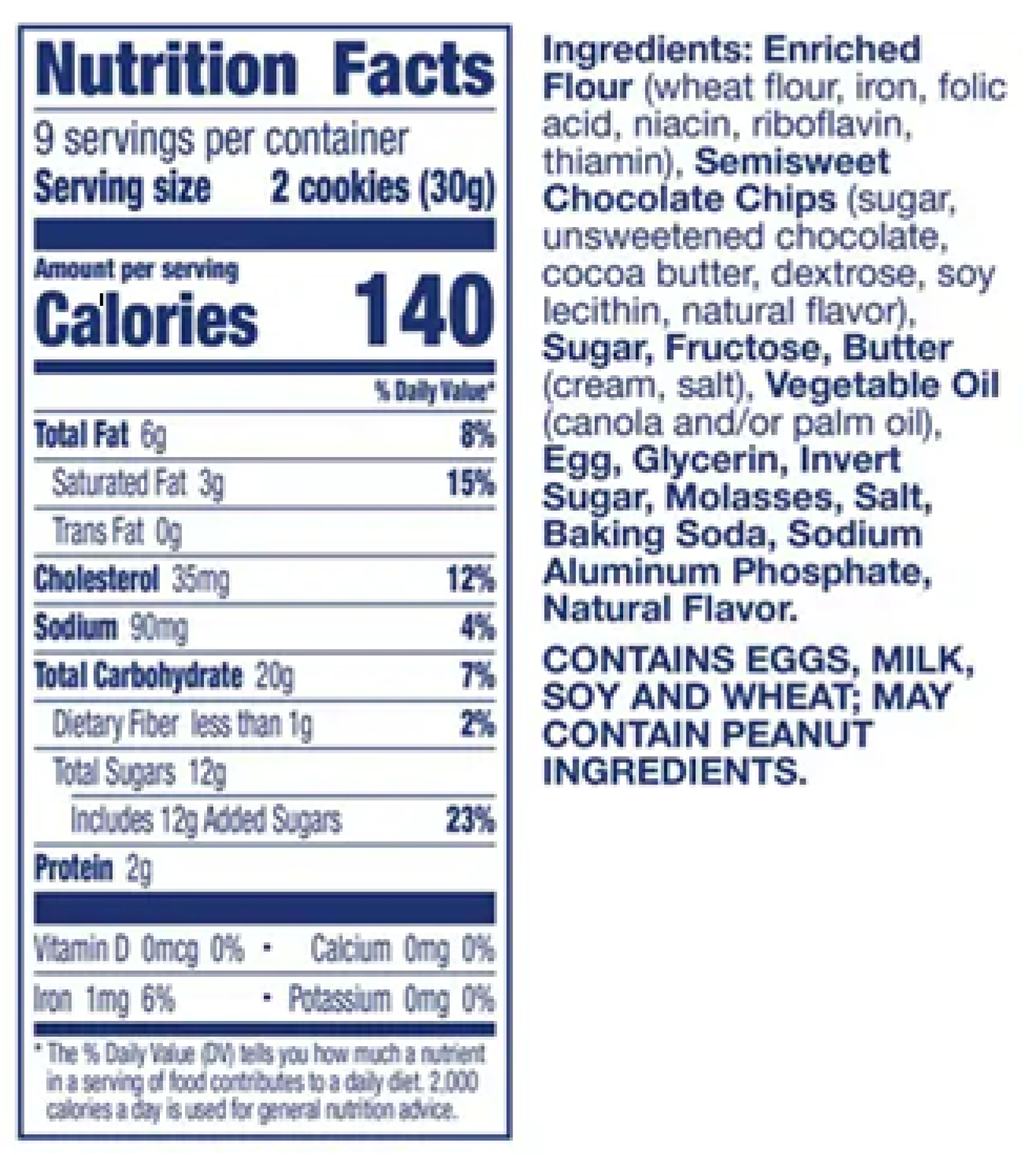
We conducted the survey with two sections: first, respondents were shown a combination of NF label and IS label of a Pillsbury Soft Baked Cookie product (see Figure 1) and were asked to click the most important part of the label that may provide information about how processed this food is. Next, they were told that there are two major sources of information in packaged food and were shown an example of an NF label and an IS label. Afterward, they were separately asked to indicate the likelihood of using the NF and IS labels to assess how processed the following eight food products were using a 5-point Unlikely/Likely scale. The food products were sliced bread, potato chips, breakfast cereal, soda, frozen food, canned soup, cookies, and jam. Then, they were asked to indicate their age and gender and were dismissed.
Figure 1.
Study 1 Stimulus.
3.2. Study 2
Participants and Procedure
We conducted a 2-level (Label: NF vs. IS) between-subjects experiment using the same product categories utilized in our previous study. 201 Prolific participants (Mage = 39.1, 66.2% females) were recruited in exchange for payment. We showed either an NF or an IS label and asked participants to rate “the level of processing of this product is…” using a 0–100-point sliding scale anchored at Not processed at all/Ultra-processed scale. The product categories were randomized. After answering this question, participants indicated their gender and age and were dismissed.
3.3. Study 3
Participants and Procedure
We recruited 402 Prolific participants (Mage = 41.8, 60% females) and randomly assigned them to a 2 (IS length: short vs. long) × 2 (IS familiarity: mixed vs. familiar) between-subjects design study. Each condition had approximately 100–101 participants. We excluded eight participants from the analysis since their completion times were more than 2SDs of the study average.
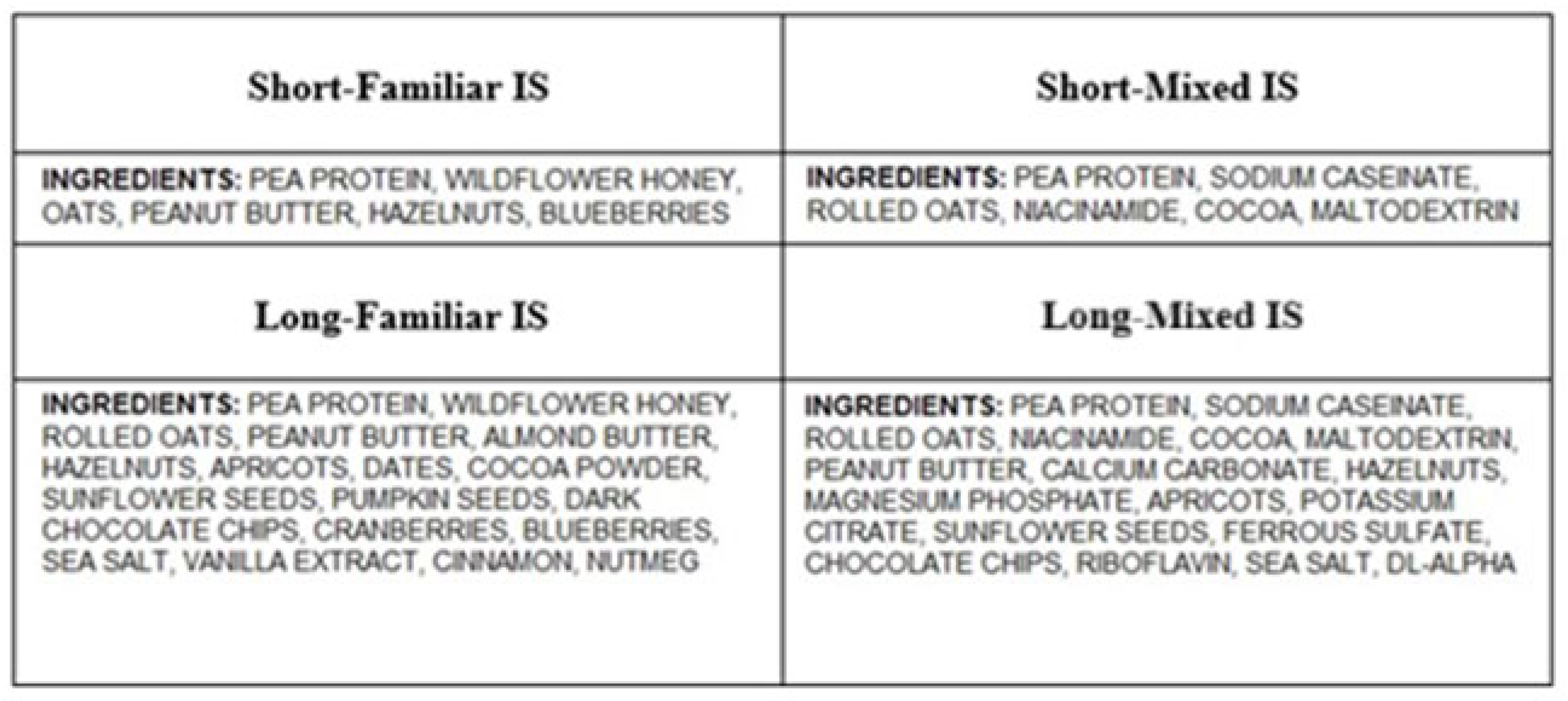
We used the actual NF and IS labels of Great Value sliced white bread sold at Walmart as our stimulus. Participants in the IS long and mixed experimental group saw this product’s real NF and IS labels. We changed the IS labels in other groups to make them shorter or offer more familiar ingredients using Photoshop. Specifically, participants were shown all familiar ingredients that can be found in an average kitchen, while those in the mixed condition saw ingredients both familiar and chemical-sounding. All IS labels are available in Figure 2.
Figure 2.
Study 3 Stimuli.
We kept the NF labels identical across groups. Unlike the previous studies, we only showed the NF and IS labels to minimize the effects of brand perceptions. Participants were given the following instructions: “Imagine you are shopping at a grocery store and browsing the nutrition information of the following bread.” Afterward, they saw the NF and IS labels together. Once completing the evaluation of the label, they were asked to indicate their agreement using a 5-point Disagree/Agree scale for the following randomized items: “This food is highly processed” to measure food processing perceptions (Processing) and three items to measure Behavioral Intentions (BI): “I’d purchase this product/I would tell others about the product/I would recommend this product to others.” After responding to these items, participants were asked to indicate their agreement with the following statements using a 5-point Likert scale: “This product has a lot of ingredients”, “I’m familiar with these ingredients”, and “The nutrition information for this product is realistic”. The first two items were collected as manipulation checks for IS length and IS familiarity, respectively. The last item was collected as a covariate to ensure our IS labels are realistic. Afterward, we asked them to evaluate their personal knowledge about nutrition compared to others as another covariate using a 5-point Far below average/Far above average scale. Then, they were asked to indicate their age and gender and were dismissed.
4. Results and Discussions
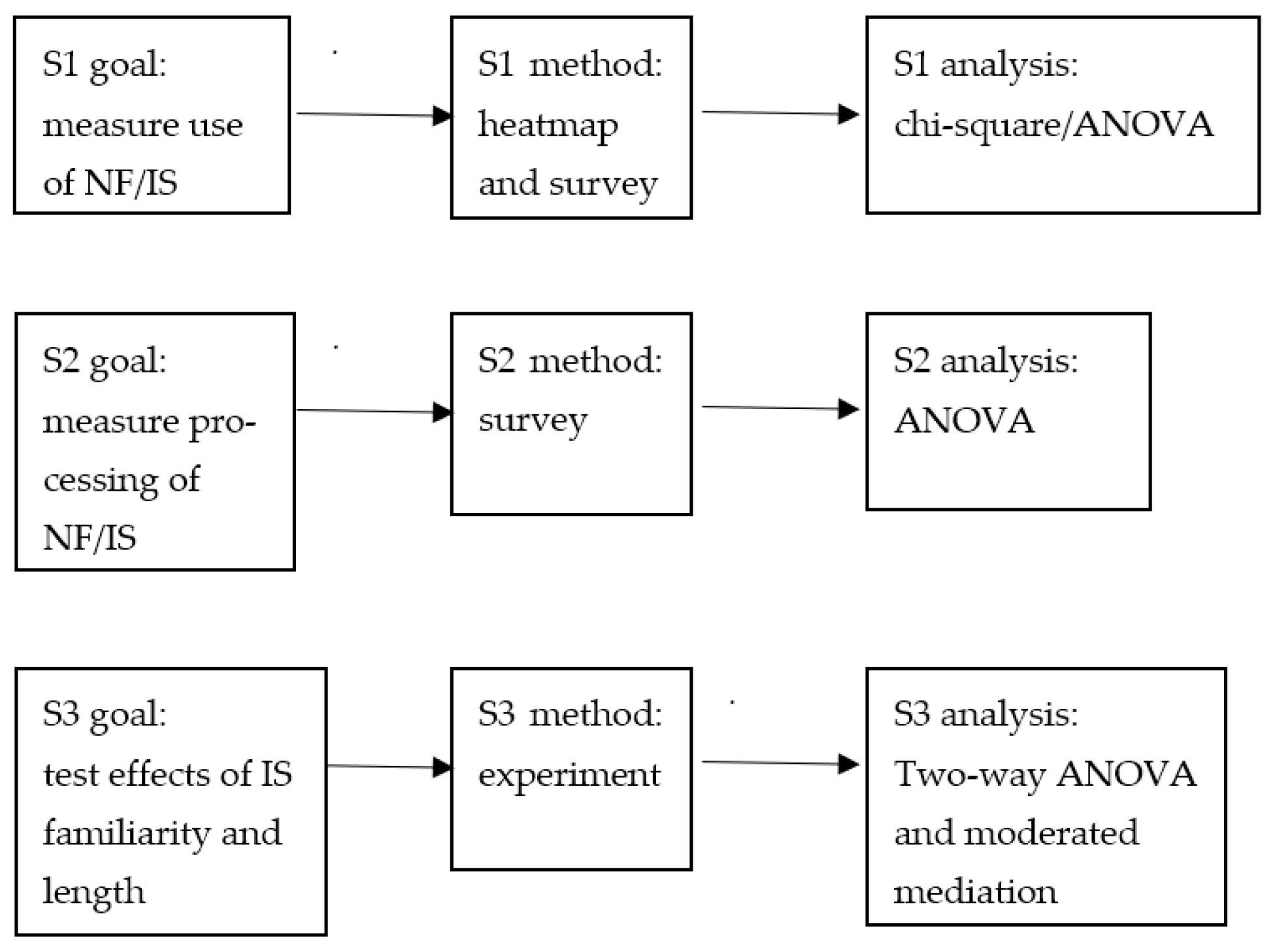
The relationship between the three studies and their corresponding data analyses is demonstrated in Figure 3 below.
Figure 3.
Methods and analyses of the studies.
4.1. Study 1
4.1.1. Results
For the first section of the survey, we divided the NF and IS label combination into two sections for a heatmap analysis, which was made available by Qualtrics—the survey platform we used to conduct the study. To conduct a heatmap analysis, researchers in the back end choose the area in the stimulus and give it a numerical value. Participants do not see the divided areas during the survey. We then ask participants to click the area they think answers the question. We divided each of these sections, which were approximately the same size. The first section was the NF label, and the second was the IS label. The analysis shows that 80.4% of the clicks were made for the IS section. A one-sample chi-square test indicates that these proportions are significantly different from occurring with equal probabilities (χ2(96) = 35.89, p < 0.001). Overall, the initial evidence from our heatmap analysis shows that the IS label seems more likely to be utilized for making assumptions about food processing levels than the NF label.
Next, we asked each respondent to rate their likelihood of using the NF and IS labels to assess how processed eight different foods are. For each food category, we conducted a repeated-measures ANOVA to compare the likelihood of using the NF label against the likelihood of using the IS label.
The results show that in seven of eight food categories examined, our respondents indicated they would be more likely to use the IS label over the NF label to assess food processing levels. There was no significant difference for one category (i.e., potato chips). The results are shown in Table 1.
Table 1.
Likelihood of Using NF vs. IS Labels for Processed Food Assessments.
4.1.2. Discussion
Study 1 results demonstrate that when shown together, consumers may utilize the IS label over the NF label when assessing the processing levels of packaged food products. This effect was significant for all the processed product categories tested except for potato chips, which may indicate that for that particular product category, consumers use both labels equally to assess food processing perceptions. Overall the this study presents some are important results since it demonstrates which one of these labels is more diagnostic for consumers to form opinions about how processed the food is. The results indicate that compared to the NF labels, the IS labels are more likely to be utilized for assessing food processing levels.
While this study was important to gain an initial understanding of how these labels affect consumers’ perceptions of food processing level, it utilized a survey method, which cannot assume any causality. It also showed both NF and IS labels together, allowing a possible confound of NF and IS interaction in the results. To alleviate these issues, we utilized an experimental design in the following study.
4.2. Study 2
4.2.1. Results
One-way ANOVA results show that participants in the IS condition found these food products significantly more processed than those in the NF condition. The effect was replicated in all food categories (Bread: F(1, 199) = 26.64, p < 0.001, ηp2 = 0.118, MNF = 45.71, MIS = 60.96; Cereal: F(1, 199) = 4.54, p = 0.034, ηp2 = 0.022, MNF = 57.11, MIS = 63.96; Chips: F(1, 199) = 32.19, p < 0.001, ηp2 = 0.139, MNF = 47.78, MIS = 64.14; Frozen food: F(1, 199) = 15.36, p < 0.001, ηp2 = 0.072, MNF = 71.24, MIS = 82.40; Protein bar: F(1, 199) = 22.46, p < 0.001, ηp2 = 0.101, MNF = 54.41, MIS = 68.51).
4.2.2. Discussion
The findings of Study 2 supported the findings of Study 1 and shed light on how the IS labels contribute to the perceptions of food processing compared to the NF labels. Without any other information, participants indicated higher levels of food processing perceptions when they were shown an IS label. In the next study, we further explored how IS length and IS familiarity may interact for consumers’ behavioral intentions.
4.3. Study 3
4.3.1. Results
Manipulation checks for both the IS length (F(1, 392) = 681.8, p < 0.0001, Mshort = 4.21, Mlong = 1.71) and IS familiarity (F(1, 392) = 156.01, p < 0.0001, Mmixed = 3.53, Mfamiliar = 4.65) were successful. Three items used to measure BI were reliable (α = 0.85) and averaged into one measure.
First, we ran two-way ANCOVAs in which the IS length and the IS familiarity served as independent variables, the Processing and the BI served as dependent variables and knowledge and realism were covariates. The main effects of both the IS length F(1, 388) = 27.77, p < 0.0001, ηp2 = 0.067, Mshort = 2.75, Mlong = 3.39) and the IS familiarity (F(1, 388) = 40.31, p < 0.001, ηp2 = 0.094, Mmixed = 2.69, Mfamiliar = 3.45) were significant. More importantly, the two-way interaction between these variables was also significant (F(1, 388) = 26.82, p < 0.001, ηp2 = 0.065). Further analysis of the mean scores indicates that when participants perceived the IS to be more familiar, the IS length did not affect processing perceptions (Mlong = 2.70, Mshort = 2.69, F(1, 388) = 0.009, p = 0.927). However, when the IS had mixed ingredients, longer IS labels were perceived to be more processed than the shorter ones (Mlong = 4.07, Mshort = 2.82, F(1, 388) = 53.68, p < 0.001, ηp2 = 0.122).
Next, we conducted a moderated mediation test (Model 7). Specifically, our analysis followed this model: IS Length → Processing → BI. IS Familiarity was included as a moderator between IS Length and Processing variables, and Realism and Knowledge were incorporated as covariates. The results show a significant indirect-only moderated mediation (ab = −0.3533; 95% CI: −0.5217 to −0.2003), supporting our hypothesis. Further details of this analysis are in Table 2.
Table 2.
Study 3: Moderated Mediation Results (Process Model 7).
4.3.2. Discussion
Study 3 investigated the impact of label-induced perceptions like label length and label familiarity, and examined how these perceptions shape consumers’ behavioral intentions, including purchase intention and word-of-mouth recommendations. Then we further disentangled these results, showing that when participants perceived the ingredients in IS to be more familiar, the IS length did not affect processing perceptions. However, when the IS had mixed or unfamiliar ingredients, longer IS labels were perceived to be more processed than the shorter ones, leading to decreased behavioral intentions.
5. General Discussion
This research contributes to the growing body of literature on consumer food labeling by demonstrating that Ingredient Statement (IS) labels play a central role in shaping perceptions of food processing, often more so than Nutrition Facts (NF) panels. Across three studies, we show that consumers rely on IS labels—particularly their length and ingredient familiarity—as heuristic cues to infer the degree of processing. These perceptions, in turn, influence behavioral intentions such as purchase likelihood and word-of-mouth recommendations.
From a theoretical standpoint, our findings reinforce and extend schema theory and dual-process models of consumer cognition. Schema theory suggests that consumers possess mental templates that associate short, familiar ingredient lists with minimally processed or “natural” foods [2,15]. Our results confirm that IS labels activate these schemas more effectively than NF panels, which require more deliberate cognitive effort to interpret. Dual-process theories [17] further explain why consumers default to surface-level cues like list length under time pressure or low motivation—conditions typical in grocery shopping environments.
Moreover, our findings align with research on clean label preferences and ingredient transparency, which show that consumers are increasingly skeptical of long or artificial-sounding ingredient lists [16,23]. By demonstrating that IS label features directly influence processing perceptions and behavioral outcomes, this research bridges cognitive psychology with food marketing and public health domains.
For food manufacturers and marketers, the implications are clear: ingredient list design matters. Products with shorter, more familiar ingredient lists are perceived as less processed and are more likely to be purchased and recommended. This suggests that reformulation strategies aimed at simplifying ingredient lists—such as removing unnecessary additives or substituting complex ingredients with recognizable alternatives—can enhance consumer trust and brand reputation.
Retailers and digital platforms may also benefit from highlighting IS label features in product descriptions or search filters. For example, e-commerce platforms could allow consumers to sort products by ingredient list length or familiarity, aligning with emerging consumer preferences for transparency and simplicity.
Additionally, these findings have implications for product innovation and branding. Brands that position themselves as “clean label” or “minimally processed” can leverage IS label design as a tangible signal of authenticity and healthfulness. This is especially relevant in categories like snacks, beverages, and convenience foods, where processing concerns are most salient.
At the policy level, our research underscores the need for regulatory frameworks that better communicate processing information to consumers. While current labeling standards mandate ingredient disclosure, they do not provide a standardized signal of processing degree. Policymakers could consider augmenting IS labels with front-of-pack indicators or harmonized labeling systems that integrate processing cues alongside nutrient information.
Such interventions could support public health goals by nudging consumers away from ultra-processed foods (UPFs), which are linked to adverse health outcomes [9,10]. They could also advance sustainability objectives, as UPFs tend to have higher environmental footprints due to energy-intensive processing and packaging [3,6].
International strategies like the EU Farm-to-Fork and the EAT–Lancet Commission already emphasize the need for dietary shifts toward less processed, plant-based foods. Labeling reforms that make processing information more salient could serve as a low-cost, scalable tool to align consumer behavior with these goals.
Finally, this research opens the door to integrated labeling frameworks that combine health, sustainability, and processing information. While nutrient-based labels have dominated for decades, our findings suggest that consumers are ready—and perhaps eager—for labeling systems that reflect the complexity of modern food systems. Future labeling innovations could incorporate lifecycle data, processing scores, or ingredient transparency metrics to provide a more holistic view of product impact.
Such frameworks would not only empower consumers but also incentivize manufacturers to reformulate products in ways that are healthier and more sustainable. By connecting consumer psychology with environmental science and regulatory policy, this research contributes to a multidisciplinary vision for the future of food labeling. Future research should move beyond stated intentions and examine actual consumer behavior in real-world contexts, as the environmental and health impacts depend on what people ultimately purchase and consume, not just what they say they prefer. While IS-based heuristics may nudge choices toward patterns broadly aligned with sustainability roadmaps, robust LCA evidence and behavioral data are essential to avoid oversimplification and to inform both policy and consumer guidance. Additionally, cross-cultural studies are essential to test the robustness of these effects, as ingredient familiarity, processing perceptions, and sustainability norms vary widely across food cultures. Finally, researchers could directly measure environmental impacts by linking observed purchasing patterns to product-level LCA data, enabling a more precise assessment of whether IS-based heuristics translate into meaningful reductions in energy use, emissions, and resource intensity.
Author Contributions
Conceptualization, Z.T. and T.O.; methodology, T.O. and A.M.H.; software, A.M.H.; validation, Z.T. and T.O.; formal analysis, Z.T.; investigation, A.M.H.; resources, T.O.; data curation, Z.T.; writing—original draft preparation, Z.T.; writing—review and editing, T.O.; visualization, A.M.H.; supervision, Z.T.; project administration, Z.T.; funding acquisition, Z.T. All authors have read and agreed to the published version of the manuscript.
Funding
This research received no external funding.
Institutional Review Board Statement
The study was conducted in accordance with the Declaration of Helsinki, and approved by the Institutional Review Board of James Madison University (IRB-FY25-758, approved 5 May 2025) for studies involving humans.
Informed Consent Statement
Informed consent was obtained from all subjects involved in the study.
Data Availability Statement
Data can be accessed at https://researchbox.org/4692&PEER_REVIEW_passcode=PKPHKO (accessed on 23 November 2025).
Conflicts of Interest
The authors declare no conflicts of interest.
References
- U.S. Food and Drug Administration. How to Understand and Use the Nutrition Facts Label. Available online: https://www.fda.gov/food/nutrition-facts-label/how-understand-and-use-nutrition-facts-label (accessed on 5 May 2025).
- International Food Information Council. Perceptions on Processed: Consumer Sentiment and Purchasing Habits. 2021. Available online: https://ific.org/wp-content/uploads/2021/10/IFIC-Perceptions-on-Processed.July-2021-2.pdf (accessed on 5 May 2025).
- Crippa, M.; Solazzo, E.; Guizzardi, D.; Monforti-Ferrario, F.; Tubiello, F.N.; Leip, A. Food systems are responsible for a third of global anthropogenic GHG emissions. Nat. Food 2021, 2, 198–209. [Google Scholar] [CrossRef] [Scilit] [PubMed]
- Poore, J.; Nemecek, T. Reducing food’s environmental impacts through producers and consumers. Science 2018, 360, 987–992. [Google Scholar] [CrossRef] [Scilit] [PubMed]
- Willett, W.; Rockström, J.; Loken, B.; Springmann, M.; Lang, T.; Vermeulen, S.; Murray, C.J.L. Food in the Anthropocene: The EAT–Lancet Commission on healthy diets from sustainable food systems. Lancet 2019, 393, 447–492. [Google Scholar] [CrossRef] [Scilit] [PubMed]
- Kesse-Guyot, E.; Allès, B.; Brunin, J.; Fouillet, H.; Dussiot, A.; Berthy, F.; Perraud, E.; Hercberg, S.; Julia, C.; Mariotti, F.; et al. Environmental impacts along the value chain from the consumption of ultra-processed foods. Nat. Sustain. 2023, 6, 192–202. [Google Scholar] [CrossRef] [Scilit]
- Anastasiou, K.; Baker, P.; Hadjikakou, M.; Hendrie, G.A.; Lawrence, M. A conceptual framework for understanding the environmental impacts of ultra-processed foods and implications for sustainable food systems. J. Clean. Prod. 2022, 363, 133155. [Google Scholar] [CrossRef] [Scilit]
- Seferidi, P.; Scrinis, G.; Huybrechts, I.; Woods, J.; Vineis, P.; Millett, C. The neglected environmental impacts of ultra-processed foods. Lancet Planet. Health 2020, 4, e437–e438. [Google Scholar] [CrossRef] [Scilit] [PubMed]
- Lane, M.M.; Gamage, E.; Du, S.; Ashtree, D.N.; McGuinness, A.J.; Gauci, S.; Marx, W. Ultra-processed food exposure and adverse health outcomes: Umbrella review of epidemiological meta-analyses. BMJ 2024, 384, e077310. [Google Scholar] [CrossRef] [Scilit] [PubMed]
- Monteiro, C.A.; Cannon, G.; Moubarac, J.C.; Levy, R.B.; Louzada, M.L.C.; Jaime, P.C. The UN Decade of Nutrition, the NOVA food classification and the trouble with ultra-processing. Public Health Nutr. 2018, 21, 5–17. [Google Scholar] [CrossRef] [Scilit] [PubMed]
- European Commission. A Farm to Fork Strategy for a Fair, Healthy and Environmentally Friendly Food System (COM(2020) 381 Final). 2020. Available online: https://eur-lex.europa.eu/legal-content/EN/TXT/?uri=CELEX:52020DC0381 (accessed on 5 May 2025).
- US. Food and Drug Administration. Nutrition, Food Labeling, and Critical Foods. Available online: https://www.fda.gov/food/nutrition-food-labeling-and-critical-foods (accessed on 5 May 2025).
- United States Code of Federal Regulations (eCFR). 21 C.F.R. § 101.4—Food; Designation of Ingredients. 2025. Available online: https://www.ecfr.gov/current/title-21/chapter-I/subchapter-B/part-101/subpart-A/section-101.4 (accessed on 5 May 2025).
- Fiske, S.T.; Taylor, S.E. Social Cognition, 2nd ed.; McGraw-Hill: New York, NY, USA, 1991. [Google Scholar]
- Rozin, P.; Fischler, C.; Imada, S.; Sarubin, A.; Wrzesniewski, A. Attitudes to food and the role of food in life in the USA, Japan, Flemish Belgium and France: Possible implications for the diet–health debate. Appetite 1999, 33, 163–180. [Google Scholar] [CrossRef] [Scilit] [PubMed]
- Aschemann-Witzel, J.; Ares, G.; Bianchi, F. Clean-label foods: Trends, consumer preferences and challenges. Trends Food Sci. Technol. 2019, 93, 50–58. [Google Scholar]
- Kahneman, D. Thinking, Fast and Slow; Farrar, Straus and Giroux: New York, NY, USA, 2011. [Google Scholar]
- Wansink, B.; Just, D.R.; Payne, C.R. Mindless eating and healthy heuristics for the irrational. Am. Econ. Rev. 2009, 99, 165–169. [Google Scholar] [CrossRef] [Scilit] [PubMed]
- Northcott, T.; Lawrence, M.; Parker, C.; Reeve, B.; Baker, P. Regulatory responses to ultra-processed foods are skewed towards behaviour change and not food system transformation. Nat. Food 2025, 6, 273–282. [Google Scholar] [CrossRef] [Scilit] [PubMed]
- van der Bend, D.L.M.; Lissner, L. Differences and similarities between front-of-pack nutrition labels in Europe: A comparison of functional and visual aspects. Nutrients 2019, 11, 626. [Google Scholar] [CrossRef] [Scilit] [PubMed]
- Lähteenmäki, L. Claiming health in food products. Food Qual. Prefer. 2013, 27, 196–201. [Google Scholar] [CrossRef] [Scilit]
- Pires, S.M.; Evers, E.G.; Van Pelt, W.; Ayers, T.; Scallan, E.; Angulo, F.J.; Hald, T. Consumers’ perception and knowledge of food additives: A pilot study. Open J. Appl. Sci. 2022, 12, 1–12. [Google Scholar] [CrossRef]
- Siegrist, M.; Sütterlin, B. Importance of perceived naturalness for acceptance of food additives and cultured meat. Appetite 2017, 113, 320–326. [Google Scholar] [CrossRef] [Scilit] [PubMed]
- Srour, B.; Fezeu, L.K.; Kesse-Guyot, E.; Allès, B.; Méjean, C.; Andrianasolo, R.M.; Touvier, M. Ultra-processed food intake and risk of cardiovascular disease: Prospective cohort study (NutriNet-Santé). BMJ 2019, 365, l1451. [Google Scholar] [CrossRef] [Scilit] [PubMed]




Disclaimer/Publisher’s Note: The statements, opinions and data contained in all publications are solely those of the individual author(s) and contributor(s) and not of MDPI and/or the editor(s). MDPI and/or the editor(s) disclaim responsibility for any injury to people or property resulting from any ideas, methods, instructions or products referred to in the content. |
© 2025 by the authors. Licensee MDPI, Basel, Switzerland. This article is an open access article distributed under the terms and conditions of the Creative Commons Attribution (CC BY) license (https://creativecommons.org/licenses/by/4.0/).