Air Emissions from Municipal Solid Waste Management: Comparing Landfilling, Incineration, and Composting

Abstract
1. Introduction
2. Materials and Methods
2.1. Analytical Basis
2.2. Key Methodological Drivers and Harmonization Approach
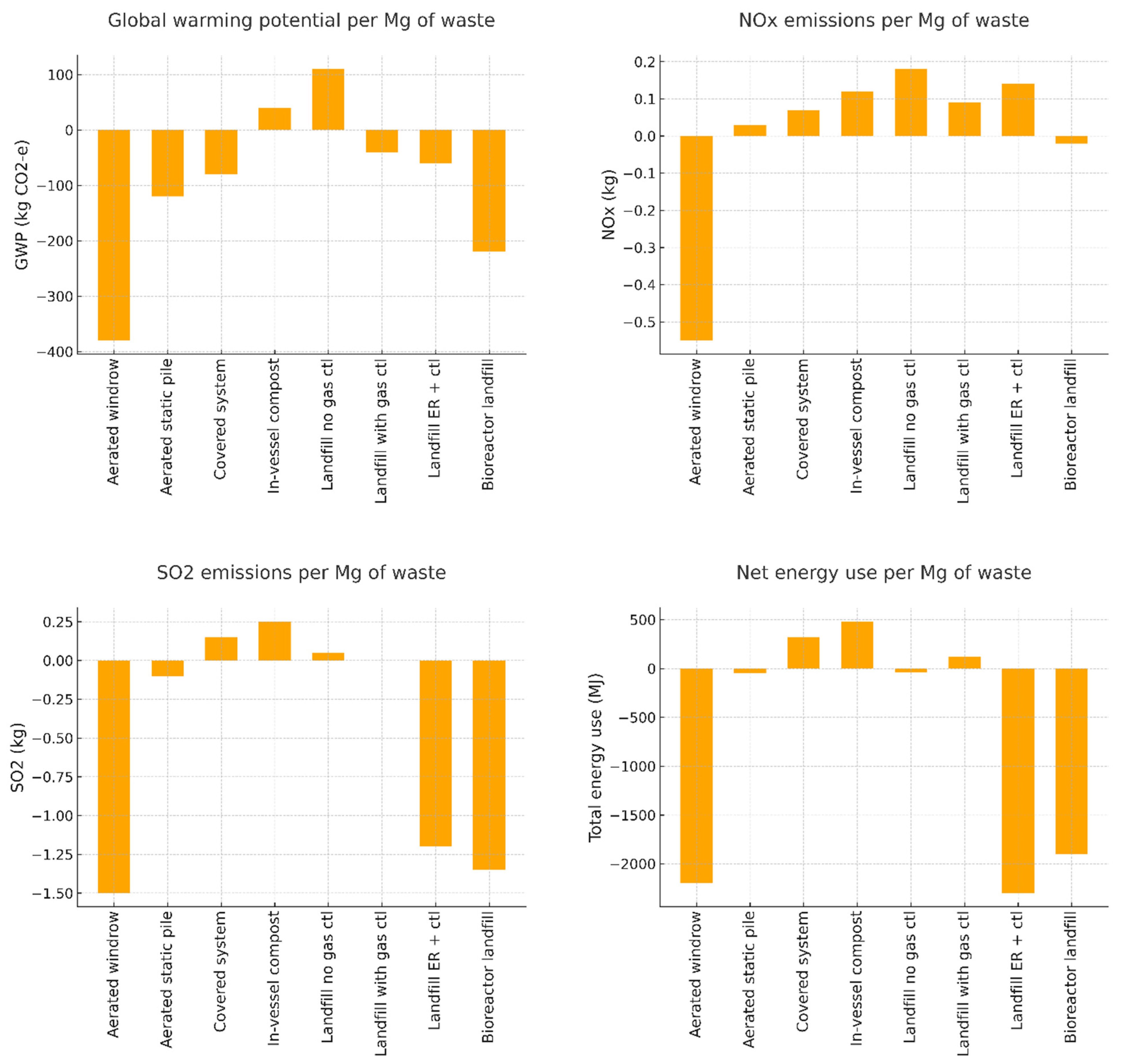
- Process-Gas Control in Composting and AD: Nordahl et al. [12] observed ten-fold CH4 increases under poor aeration, while N-rich feedstocks elevate N2O release. These findings are consistent with field data from Yolo and Napa hybrid composting facilities [18] showing normalized operational carbon intensities of 0.42–0.55 Mg CO2 eq t−1 dry waste, intermediate between pure aerobic composting and MSW landfills.
2.3. Uncertainties and Scope Limitations
3. Policy and Regulatory Framework
3.1. Global and Regional Context
3.2. United States Regulatory Framework
3.2.1. Landfills
3.2.2. Incineration and Waste-to-Energy
3.2.3. Composting and Biological Treatment
3.3. Comparative Air Quality and Economic Implications
4. Social and Economic Dimensions of Waste Management Pathway Selection
4.1. Socioeconomic Context and Decision Drivers
4.2. Integrating Social and Economic Indicators into LCA and Modeling
- When energy recovery efficiency exceeds 25% and grid intensity is greater than 0.17 kg CO2 eq MJ−1, waste-to-energy outperforms composting on climate metrics.
- When organics diversion exceeds 60% and composting emissions remain below 500 kg CO2 eq t−1, composting yields greater overall benefit.
- Landfilling is favorable only when gas collection efficiency is above 85% and captured methane is used as renewable fuel [18].
5. Quantitative Comparison of Emission Outcomes and Energy Balances
5.1. Analytical Scope and Data Foundation
5.2. Landfilling
5.3. Waste-to-Energy Incineration
5.4. Composting and Anaerobic Digestion
5.5. Comparative Energy Balance
6. Discussion and Integrated Evaluation
6.1. Overall Comparative Insights
6.2. Air Quality Co-Benefits and Trade-Offs
6.3. Regulatory and Policy Integration
6.4. Synthesis of Comparative Performance
7. Life Cycle Assessment Modeling and Scenario Evaluation
7.1. Purpose and Model Selection
- EPA Waste Reduction Model (WARM, version 16)—the official national calculator for GHG equivalence across materials and management options [39].
- RMI WasteMAP framework—a marginal abatement cost optimization tool linking emissions, cost, and energy data for U.S. regions [38].
- SWOLF model—developed by North Carolina State University for scenario-based solid waste system LCA that couples waste composition, facility type, and collection logistics [44].
- Landfill module: first-order decay constant = 0.05 yr−1; gas capture efficiencies of 50% (base) and 85% (optimized).
- WtE module: boiler efficiency = 25% (electricity only) or 65% (combined heat and power); stack control meeting CISWI MACT limits.
- Composting module: active aeration energy demand = 40 kWh t−1; curing loss fraction = 100 kg CO2 eq t−1 MSW; fertilizer-substitution credit = 50 kg CO2 eq t−1 MSW.
- Anaerobic digestion module: methane yield = 100 m3 t−1 volatile solids; recovery efficiency = 85%; combined heat and power efficiency = 30%.
7.2. Scenario Definitions
- S1: Current U.S. practice. 55% landfill, 12% WtE, 33% organics diversion, landfill capture ≈ 60%.
- S2: Organics diversion mandate. 40% landfill, 20% WtE, 40% composting/AD, landfill capture ≈ 70%.
- S3: High-efficiency systems. 30% landfill with 85% capture, 30% WtE with CHP, 40% composting/AD.
- S4: Net-zero waste future. 20% landfill (RNG with LCFS credit), 40% WtE + CCS, 40% AD with nutrient recovery.
7.3. Model Results
7.4. Sensitivity and Uncertainty Analysis
- Methane capture rate (±15% variation → ±120 kg CO2 eq t−1 MSW)
- Electric-grid carbon intensity (±0.06 kg CO2 eq MJ−1 → ±150 kg CO2 eq t−1 MSW)
- Composting N2O emission factor (±0.2% → ±80 kg CO2 eq t−1 MSW)
8. Economic Assessment and Policy Scenarios
8.1. Cost Structure of Landfilling, Incineration, and Composting
8.2. Role of Landfill Tipping Fees
8.3. Value of Renewable Fuel and LCFS Crediting
8.4. Policy Scenarios
- Current practice with low tipping fees. Landfilling remains dominant. Composting grows only where state law mandates organics collection. Waste-to-energy remains marginal. Total system cost is lowest, but greenhouse gas intensity is highest.
- Regional landfill surcharge. A regional or state level surcharge of 25 to 40 dollars per ton on landfill disposal raises gate fees above 90 dollars per ton in high-cost regions. At this point composting and digestion are competitive and waste-to-energy becomes justifiable for urban cores. This is the pathway observed in the Northeast United States and in several European Union member states.
- Climate crediting for methane destruction. When LCFS or similar programs recognize landfill gas and digestion gas at current credit prices, high capture systems become financially optimal even without high tipping fees. This scenario is visible in California and in Oregon clean fuel programs.
- Integrated diversion and combustion. Where organics diversion is mandatory and landfill space is scarce, the combination of composting or digestion for organics and waste-to-energy for residuals yields the lowest long-term cost, because it stabilizes gate fees and reduces the risk of noncompliance penalties. This is the configuration promoted in California SB 1383 implementation guidance.
9. Research Gaps, Data Limitations, and Emerging Contaminants
9.1. Analytical Gap: PFAS Is Not Included in Current LCA Frameworks
9.2. Operational Gap: Disposal Units Differ Sharply in Containment Performance
9.3. Policy Gap: Interim Guidance, Non-Uniform State Requirements, and Pending Rulemaking
10. Conclusions and Recommendations
- Climate performance is conditional. Landfills with captures below 60% are the highest greenhouse gas source, with net emissions near 400 to 800 kg of carbon dioxide equivalent to each ton of municipal solid waste. Landfills with capture at or above 85% and with beneficial use of gas can reach near zero or negative values, which is now documented in the California Air Resources Board validation of negative carbon landfill gas. Incineration with energy recovery performs within minus 200 to plus 200 kg of carbon dioxide equivalent per ton when it displaces fossil intensive power. Composting and anaerobic digestion can reach minus 900 kg of carbon dioxide equivalent per ton when process control is good but can move into the positive range when aeration or moisture control is poor.
- Air quality requirements are not symmetrical. Waste-to-energy facilities operate under the most stringent federal standards for solid waste combustion. Landfills operate under performance-based gas collection and control standards that focus on methane and non-methane organic compounds. Composting facilities are governed by state and local odor and pathogen rules. As a result, the economic burden on the three technologies is different even when the climate benefit is similar. Any policy comparison must state this difference.
- Economic signals explain regional choices. In regions where landfill tipping fees remain in the range of 55 to 65 dollars per ton, landfilling is the rational economic choice and will continue to be selected. Where tipping fees rise above 80 to 100 dollars per ton, or where landfill surcharges are applied, composting, digestion, and incineration become competitive. Where low carbon fuel standard credits are available for landfill gas and digestion gas, high capture systems become financially preferable even without high tipping fees.
- Life cycle models are mature for climate impacts but incomplete for PFAS and some air toxics. EPA WARM, SWOLF, and WasteMAP can compare climate and energy outcomes of the three options. They cannot yet compare the fate of PFAS and other persistent organics across landfilling, incineration, and composting. The 2024 interim guidance on PFAS destruction and disposal states clearly that none of the current options guarantees complete destruction. This limitation must be reported in every publication that evaluates PFAS-bearing waste.
- Social acceptance and environmental justice considerations modify technical rankings. Incineration may be the best option in some urban and high grid carbon contexts but may face local opposition. Composting is often preferred by communities but requires strict process control to avoid odor and ammonia issues. Landfills are acceptable where they are distant from communities and can demonstrate effective gas capture. These factors need to be integrated into planning-level life cycle studies.
- a.
- Future LCA studies on waste management in the United States should report at least three landfill capture levels, at least two grid carbon intensities for waste-to-energy, and at least two composting or digestion control levels. Reporting only one value for each technology is no longer sufficient because it conceals the source of disagreement in the literature.
- b.
- States that are developing organics diversion programs should couple them with explicit performance targets for methane and nitrous oxide emissions from composting and digestion and compare them with emissions from landfills. Without such performance metrics, diversion programs may not deliver the intended climate benefits.
- c.
- EPA and state agencies should move WARM and related tools toward inclusion of PFAS, short chain fluorinated compounds, and air toxics from combustion. This will allow solid waste planners to apply a single tool for climate, criteria pollutants, and emerging contaminants.
- d.
- Municipalities that plan to reduce landfill disposal should evaluate a mixed strategy in which source separated organics are composted or digested, while the residual stream is sent to a high-efficiency waste-to-energy facility or to a landfill with automated gas collection. This configuration matches the results of the high-efficiency and net-zero technology scenarios discussed earlier.
Funding
Institutional Review Board Statement
Informed Consent Statement
Data Availability Statement
Conflicts of Interest
References
- U.S. Environmental Protection Agency (EPA). Inventory of U.S. Greenhouse Gas Emissions and Sinks: 1990–2021; Chapter 7: Waste; EPA: Washington, DC, USA, 2023. Available online: https://www.epa.gov/system/files/documents/2023-04/US-GHG-Inventory-2023-Chapter-7-Waste.pdf (accessed on 12 December 2025).
- Intergovernmental Panel on Climate Change (IPCC). Climate Change 2021: The Physical Science Basis. Contribution of Working Group I to the Sixth Assessment Report of the Intergovernmental Panel on Climate Change; Cambridge University Press: Cambridge, UK, 2021. [Google Scholar] [CrossRef]
- Laurent, A.; Bakas, I.; Clavreul, J.; Bernstad, A.; Niero, M.; Gentil, E.; Hauschild, M.Z.; Christensen, T.H. Review of LCA studies of solid waste management systems-Part I: Lessons learned and perspectives. Waste Manag. 2014, 34, 573–588. [Google Scholar] [CrossRef]
- Banar, M.; Cokaygil, Z.; Ozkan, A. Life cycle assessment of solid waste management options for Eskisehir, Turkey. Waste Manag. 2009, 29, 54–62. [Google Scholar] [CrossRef] [PubMed]
- Levis, J.W.; Barlaz, M.A.; DeCarolis, J.F.; Ranjithan, S.R. A generalized multistage optimization modeling framework for LCA-based integrated solid waste management. Environ. Model. Softw. 2013, 50, 51–65. [Google Scholar] [CrossRef]
- Beylot, A.; Muller, S.; Descat, M.; Ménard, Y.; Villeneuve, J. Life cycle assessment of the French municipal solid waste incineration sector. Waste Manag. 2018, 80, 144–153. [Google Scholar] [CrossRef] [PubMed]
- Bueno, G.; Latasa, I.; Lozano, P.J. Comparative LCA of two approaches with different emphasis on energy or material recovery for a municipal solid waste management system in Gipuzkoa. Renew. Sustain. Energy Rev. 2015, 51, 449–459. [Google Scholar] [CrossRef]
- Astrup, T.F.; Tonini, D.; Turconi, R.; Boldrin, A. Life cycle assessment of thermal Waste-to-Energy technologies: Review and recommendations. Waste Manag. 2015, 37, 104–115. [Google Scholar] [CrossRef]
- Manfredi, S.; Christensen, T.H. Environmental assessment of solid waste landfilling technologies by means of LCA-modeling. Waste Manag. 2009, 29, 32–43. [Google Scholar] [CrossRef]
- Anshassi, M.; Sackles, H.; Townsend, T.G. A review of LCA assumptions impacting whether landfilling or incineration results in less greenhouse gas emissions. Resour. Conserv. Recycl. 2021, 174, 105810. [Google Scholar] [CrossRef]
- Boldrin, A.; Andersen, J.K.; Møller, J.; Favoino, E.; Christensen, T.H. Composting and compost utilization: Accounting of greenhouse gases and global warming contributions. Waste Manag. Res. 2009, 27, 800–812. [Google Scholar] [CrossRef]
- Nordahl, S.L.; Preble, C.V.; Kirchstetter, T.W.; Scown, C.D. Greenhouse gas and air pollutant emissions from composting. Environ. Sci. Technol. 2023, 57, 2235–2247. [Google Scholar] [CrossRef]
- Cherubini, F.; Bargigli, S.; Ulgiati, S. Life cycle assessment of waste management strategies: Landfilling, sorting plant and incineration. Energy 2009, 34, 2116–2123. [Google Scholar] [CrossRef]
- Lou, S.; Nair, J. The impact of landfilling and composting on greenhouse gas emissions-A review. Bioresour. Technol. 2009, 100, 3792–3798. [Google Scholar] [CrossRef] [PubMed]
- Han, X.; Li, Y.; Nie, L.; Huang, X.; Deng, Y.; Yan, J. Comparative life cycle greenhouse gas emissions assessment of battery energy storage technologies for grid applications. J. Clean. Prod. 2023, 392, 136251. [Google Scholar] [CrossRef]
- U.S. Environmental Protection Agency (EPA). Interim Guidance on the Destruction and Disposal of Perfluoroalkyl and Polyfluoroalkyl Substances and Materials Containing Perfluoroalkyl and Polyfluoroalkyl Substances, Version 2; Interim Guidance for Public Comment; EPA: Washington, DC, USA, 2024. Available online: https://www.epa.gov/system/files/documents/2024-04/2024-interim-guidance-on-pfas-destruction-and-disposal.pdf (accessed on 12 December 2025).
- American Biogas Council. American Biogas Council Launches Carbon Accounting Tool to Provide More Precise Valuation of RNG and Biogas in Carbon Markets. 2025. Available online: https://americanbiogascouncil.org/american-biogas-council-launches-carbon-accounting-tool-to-provide-more-precise-valuation-of-rng-and-biogas-in-carbon-markets/ (accessed on 12 December 2025).
- Karimi, S.; Delkash, M.; Imhoff, P.; Manheim, D.C.; Yazdani, R. Facility-Wide Greenhouse Gas and Pollutant Emissions from Covered Aerated Static Pile Composting. Waste Manag. 2025; submitted. [Google Scholar]
- De Feo, G.; Malvano, C. The use of LCA in selecting the best MSW management system. Waste Manag. 2009, 29, 1901–1915. [Google Scholar] [CrossRef]
- Villanueva, A.; Wenzel, H. Paper waste-recycling, incineration or landfilling? A review of existing life cycle assessments. Waste Manag. 2007, 27, S29–S46. [Google Scholar] [CrossRef]
- Doka, G. Life Cycle Inventories of Waste Treatment Services; Swiss Centre for Life Cycle Inventories: Dübendorf, Switzerland, 2009. [Google Scholar]
- Wang, Y.; Levis, J.W.; Barlaz, M.A. Life-cycle assessment of a regulatory compliant U.S. municipal solid waste landfill. Environ. Sci. Technol. 2021, 55, 13583–13592. [Google Scholar] [CrossRef]
- Ning, S.-K.; Chang, N.-B.; Hung, M.-C. Comparative streamlined life cycle assessment for two types of municipal solid waste incinerator. J. Clean. Prod. 2013, 53, 56–66. [Google Scholar] [CrossRef]
- United Nations Environment Programme (UNEP). Global Methane Assessment: 2030 Baseline Report; UNEP: Nairobi, Kenya, 2022; Available online: https://www.unep.org/resources/report/global-methane-assessment-2030-baseline-report (accessed on 12 December 2025).
- U.S. Environmental Protection Agency (EPA). National Emission Standards for Hazardous Air Pollutants: Municipal Solid Waste Landfills; Residual Risk and Technology Review (Final Rule). Fed. Regist. 2020, 85, 17244. Available online: https://www.govinfo.gov/app/details/FR-2020-03-26/2020-04800 (accessed on 12 December 2025).
- U.S. Environmental Protection Agency (EPA). LFG Energy Project Development Handbook; Landfill Methane Outreach Program (LMOP): Washington, DC, USA, 2024. Available online: https://www.epa.gov/system/files/documents/2024-01/pdh_full.pdf (accessed on 12 December 2025).
- California Air Resources Board (CARB). Short-Lived Climate Pollutant Reduction Strategy; California Environmental Protection Agency: Sacramento, CA, USA, 2017. Available online: https://ww2.arb.ca.gov/sites/default/files/2020-07/final_SLCP_strategy.pdf (accessed on 12 December 2025).
- U.S. Environmental Protection Agency (EPA). 40 CFR Part 60, Subpart Eb: Standards of Performance for Large Municipal Waste Combustors for Which Construction is Commenced After September 20, 1994 or for Which Modification or Reconstruction is Commenced After June 19, 1996; Electronic Code of Federal Regulations (eCFR). Available online: https://www.ecfr.gov/current/title-40/chapter-I/subchapter-C/part-60/subpart-Eb (accessed on 12 December 2025).
- U.S. Environmental Protection Agency (EPA). Standards of Performance for New Stationary Sources and Emission Guidelines for Existing Sources: Commercial and Industrial Solid Waste Incineration Units. Fed. Regist. 2020, 85, 63394–63422. Available online: https://www.govinfo.gov/content/pkg/FR-2020-10-07/html/2020-18824.htm (accessed on 12 December 2025).
- U.S. Environmental Protection Agency (EPA). Federal Plan Requirements for Hospital/Medical/Infectious Waste Incinerators. Fed. Regist. 2013, 78, 28052. Available online: https://www.govinfo.gov/app/details/FR-2013-05-13/2013-09427 (accessed on 12 December 2025).
- U.S. Environmental Protection Agency (EPA). Sustainable Materials Management (SMM) Metrics and Composting Regulations; EPA: Washington, DC, USA, 2025.
- CalRecycle. SB 1383 Short-Lived Climate Pollutant (SLCP) Organic Waste Reductions. Available online: https://calrecycle.ca.gov/organics/slcp/ (accessed on 12 December 2025).
- California State Water Resources Control Board. Regulation of Composting Operations (Composting General Order; Order WQ 2020-0012-DWQ, as Amended). Available online: https://www.waterboards.ca.gov/water_issues/programs/compost/ (accessed on 12 December 2025).
- Amlinger, F.; Peyr, S.; Cuhls, C. Greenhouse gas emissions from composting and mechanical biological treatment. Waste Manag. Res. 2008, 26, 47–60. [Google Scholar] [CrossRef] [PubMed]
- European Commission. Regulation (EU) 2020/852 of the European Parliament and of the Council of 18 June 2020 on the establishment of a framework to facilitate sustainable investment, and amending Regulation (EU) 2019/2088. Off. J. Eur. Union 2020, 198, 13–43. Available online: https://eur-lex.europa.eu/ (accessed on 15 December 2025).
- Cao, Y.; Wang, X.; Bai, Z.; Chadwick, D.; Misselbrook, T.; Sommer, S.G.; Ma, L. Mitigation of ammonia, nitrous oxide and methane emissions during solid waste composting with different additives: A meta-analysis. J. Clean. Prod. 2019, 235, 626–635. [Google Scholar] [CrossRef]
- BioCycle. California Food Businesses Tackle Climate Law Compliance; BioCycle: Kowloon, Hong Kong, 2022. [Google Scholar]
- Rocky Mountain Institute (RMI). Introducing WasteMAP: A New Tool to Track and Reduce Waste Methane Emissions. 2023. Available online: https://rmi.org/introducing-wastemap-a-new-tool-to-track-and-reduce-waste-methane-emissions (accessed on 12 December 2025).
- U.S. Environmental Protection Agency (EPA). WARM Excel User’s Guide, Version 16; EPA: Washington, DC, USA, 2023. Available online: https://www.epa.gov/system/files/documents/2023-12/warm-users-guide-excel_v16_dec.pdf (accessed on 13 December 2025).
- California Air Resources Board (CARB). LCFS Pathway Certified Carbon Intensities (Certified Fuel Pathway Table). Available online: https://ww2.arb.ca.gov/resources/documents/lcfs-pathway-certified-carbon-intensities (accessed on 12 December 2025).
- Levis, J.W.; Barlaz, M.A. What is the most environmentally beneficial way to treat commercial food waste? Environ. Sci. Technol. 2011, 45, 7438–7444. [Google Scholar] [CrossRef]
- Assamoi, B.; Lawryshyn, Y. The environmental comparison of landfilling vs. incineration of MSW accounting for waste diversion. Waste Manag. 2012, 32, 1019–1030. [Google Scholar] [CrossRef]
- Morris, J.; Matthews, H.S.; Morawski, C. Review and meta-analysis of 82 studies on end-of-life management methods for source separated organics. Waste Manag. 2013, 33, 545–551. [Google Scholar] [CrossRef]
- Sardarmehni, M.; Anchieta, P.H.C.; Levis, J.W. Solid waste optimization life-cycle framework in Python (SwolfPy). J. Ind. Ecol. 2022, 26, 748–762. [Google Scholar] [CrossRef]
- Jaunich, M.K.; Levis, J.W.; DeCarolis, J.F.; Barlaz, M.A.; Ranjithan, S.R. Solid waste management policy implications on waste process choices and systemwide cost and greenhouse gas performance. Environ. Sci. Technol. 2019, 53, 1766–1775. [Google Scholar] [CrossRef]
- Harrison, K.W.; Dumas, R.D.; Barlaz, M.A.; Nishtala, S.R. A life-cycle inventory model of municipal solid waste combustion. J. Air Waste Manag. Assoc. 2000, 50, 993–1003. [Google Scholar] [CrossRef][Green Version]
- Environmental Research and Education Foundation (EREF); Knowlton, A.; Ward, C.; Boxman, S.; Staley, B. Analysis of MSW Landfill Tipping Fees-2024; EREF: Raleigh, NC, USA, 2025; Available online: https://erefdn.org/ (accessed on 13 December 2025).
- O’Brien, J. Aging Waste-to-Energy Facilities: Refurbish or Replace? Waste Today, 1 December 2025. Available online: https://www.wastetodaymagazine.com/article/should-aging-waste-to-energy-facilities-be-refurbished-or-replaced/ (accessed on 13 December 2025).



| Process | Functional Unit | Boundary Elements | Reported GWP Range (kg CO2 eq t−1 MSW) | Key Driver | Representative Sources |
|---|---|---|---|---|---|
| Landfilling | 1 t MSW | Collection → gas capture/utilization | +300 to +800 | Capture efficiency | [10,22] |
| WtE (CHP) | 1 t MSW | Combustion → energy recovery → ash | –200 to +600 | Grid carbon factor | [6,7] |
| Composting/AD | 1 t organics | Aeration → curing → soil use | –900 to +300 | CH4 and N2O control | [11,12] |
| Treatment Pathway | Net Energy Output (GJ t−1 MSW) | Electricity Equivalent (kWh t−1) | Net GWP Range (kg CO2 eq t−1 MSW) | Key Sensitivity Parameter | References |
|---|---|---|---|---|---|
| Landfill gas with flare only | 0 | 0 | +650 to +850 | Gas capture ≤ 50% | [9,41] |
| Landfill gas with energy recovery | 0.5–1.5 | 140–420 | +300 to +500 | Capture ≈ 70% | [10] |
| Optimized landfill RNG pathway | 2.0–2.8 | 560–780 | 0 to −300 | Capture ≥ 85%, credit scheme | [4] |
| WtE incineration (CHP) | 1.8–2.3 | 500–650 | −200 to +200 | Grid carbon factor 0.05–0.8 | [6,7] |
| Composting (open windrow) | 0 | 0 | −100 to +300 | Oxygen availability | [11,12] |
| Covered ASP composting | 0 | 0 | −300 to 0 | Aeration rate and moisture | [18] |
| Anaerobic digestion | 2.5–3.5 | 700–970 | −600 to 0 | Biogas recovery > 80% | [4,41] |
| System | GHG Outcome (kg CO2 eq t−1 MSW) | Energy Output (GJ t−1) | Air Quality Control | Social Acceptance | Overall Assessment |
|---|---|---|---|---|---|
| Landfill (60–70% capture) | +400 to +600 | 0.5–1.5 | Moderate | Moderate | Transitional baseline |
| Optimized landfill (≥85%) | 0 to −300 | 2.0–2.8 | High | Moderate | Carbon-neutral potential |
| WtE incineration (CHP) | −200 to +200 | 1.8–2.3 | Very high | Low to moderate | Effective where grid carbon is high |
| Composting (aerated static pile) | −300 to 0 | 0 | Moderate | High | Best under organics mandates |
| Anaerobic digestion | −600 to 0 | 2.5–3.5 | High | High | Most balanced overall |
| Scenario | Net GHG Emissions (kg CO2 eq t−1 MSW) | Net Energy Output (GJ t−1) | Dominant Control Parameter | Reference |
|---|---|---|---|---|
| S1—Current practice | +420 ± 110 | 0.8 | Gas capture 60% | [5] |
| S2—Organics diversion | +150 ± 90 | 1.6 | Composting efficiency | [4,12] |
| S3—High-efficiency | −80 ± 60 | 2.4 | Energy recovery + CHP | [6,7] |
| S4—Net-zero | −280 ± 70 | 3.2 | Carbon capture + crediting | [10] |
Disclaimer/Publisher’s Note: The statements, opinions and data contained in all publications are solely those of the individual author(s) and contributor(s) and not of MDPI and/or the editor(s). MDPI and/or the editor(s) disclaim responsibility for any injury to people or property resulting from any ideas, methods, instructions or products referred to in the content. |
© 2025 by the author. Licensee MDPI, Basel, Switzerland. This article is an open access article distributed under the terms and conditions of the Creative Commons Attribution (CC BY) license.
Share and Cite
Delkash, M. Air Emissions from Municipal Solid Waste Management: Comparing Landfilling, Incineration, and Composting. Sustainability 2026, 18, 108. https://doi.org/10.3390/su18010108
Delkash M. Air Emissions from Municipal Solid Waste Management: Comparing Landfilling, Incineration, and Composting. Sustainability. 2026; 18(1):108. https://doi.org/10.3390/su18010108
Chicago/Turabian StyleDelkash, Madjid. 2026. "Air Emissions from Municipal Solid Waste Management: Comparing Landfilling, Incineration, and Composting" Sustainability 18, no. 1: 108. https://doi.org/10.3390/su18010108
APA StyleDelkash, M. (2026). Air Emissions from Municipal Solid Waste Management: Comparing Landfilling, Incineration, and Composting. Sustainability, 18(1), 108. https://doi.org/10.3390/su18010108