


Abstract
This study investigates the relationship between Environmental, Social, and Governance (ESG) performance and the financial performance of startups in emerging economies. We posit that strong ESG practices serve as a critical signal of quality and legitimacy, helping to alleviate the liability of newness by mitigating information asymmetries for external stakeholders. Analyzing a longitudinal dataset of startups, we find a positive main effect of ESG on financial performance. Further, we demonstrate that this relationship is contingent on factors at multiple levels. The positive effect of ESG is weakened in contexts of high firm digitalization, greater analyst coverage, and developed regional institutions, as these factors act as substitutes by providing alternative sources of credible information, thereby reducing the unique signaling value of ESG. Conversely, intense industry competition amplifies the ESG advantage, as the signal becomes more critical for differentiation. Our findings contribute by shifting the ESG discourse to the entrepreneurial context and offering a nuanced, multi-level understanding of when a firm’s sustainable investment is most pivotal as a strategic asset for startups navigating institutional voids.
1. Introduction
A large body of literature has advocated the performance-increasing effect of a firm’s engagement in Environment, Social, and Governance (ESG) [1,2]. This stream of research theoretically argues and empirically examines the mechanisms, such as reputational capital, support from various stakeholders, and the insurance effect, underlying the positive relationship between ESG performance and financial performance [3,4,5,6]. An important question remains, however, regarding whether ESG performance is still financially attractive for startups. Such concern among scholars is highly pertinent for two reasons. First, given limited resources, firms’ engagement with sustainable activities imposes opportunistic costs upon entrepreneurs that limit the scope of various alternative ways to financial success [7]. Second, unlike large established firms, startups hardly benefit from the economies of scope in ESG investment, which amplifies the uncertainty regarding financial returns from ESG activities [8].
Our study aims to address the important question: Does it pay for startups to engage in ESG investment? Moreover, we would like to go a step further to examine what are the external and internal factors governing the relationship between ESG performance and financial performance? Answering the two questions can provide a more nuanced understanding of the economic value of ESG in the context of startups, especially in emerging economies, since these firms are representative of the limited resources and prominent uncertainty.
To advance this line of inquiry, we combine the liability of newness perspective with signaling theory to analyze the common issue of newly established firms and the potential signaling role of ESG activities play in overcoming it [9,10,11]. Specifically, the literature on startups consistently agrees that liability of newness accounts for the high failure rate for these small and young firms. The issue constrains their access to various resources and threatens their eventual financial performance [12,13]. In this regard, according to the literature on the signaling effect of ESG performance [14,15], we argue that ESG performance conveys the information of the focal firm’s both moral character and capability, then helps firms probably obtain more support from resource providers. In sum, we propose that ESG performance is able to mitigate the liability of newness for startups and then improve firm financial performance.
Moreover, we examine two sets of moderators that can shape the association between ESG performance and firm financial performance. First, theoretically, some factors play a similar role in increasing the information quality of the focal firm to the outside actors, which substitutes the signaling role of ESG performance to some extent. For example, firm digitalization effectively improves firm visibility and transparency, which facilitates information flow from the inside to the outside, and also functions as a tool to alleviate the potential information asymmetry [7,16,17]. In addition, as financial market intermediaries, the number of analysts covering the focal firm is related to the magnitude of the information that can be conferred by the outside actors as well [18,19,20], then probably reducing the importance of ESG performance in increasing firm financial performance. Moreover, at the institution level, the regional institutional development that facilitates the information flow in the market offsets the alternative access to startups’ internal knowledge [21,22], then reducing the impact of ESG performance on financial performance.
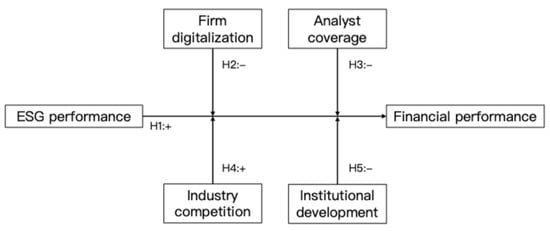
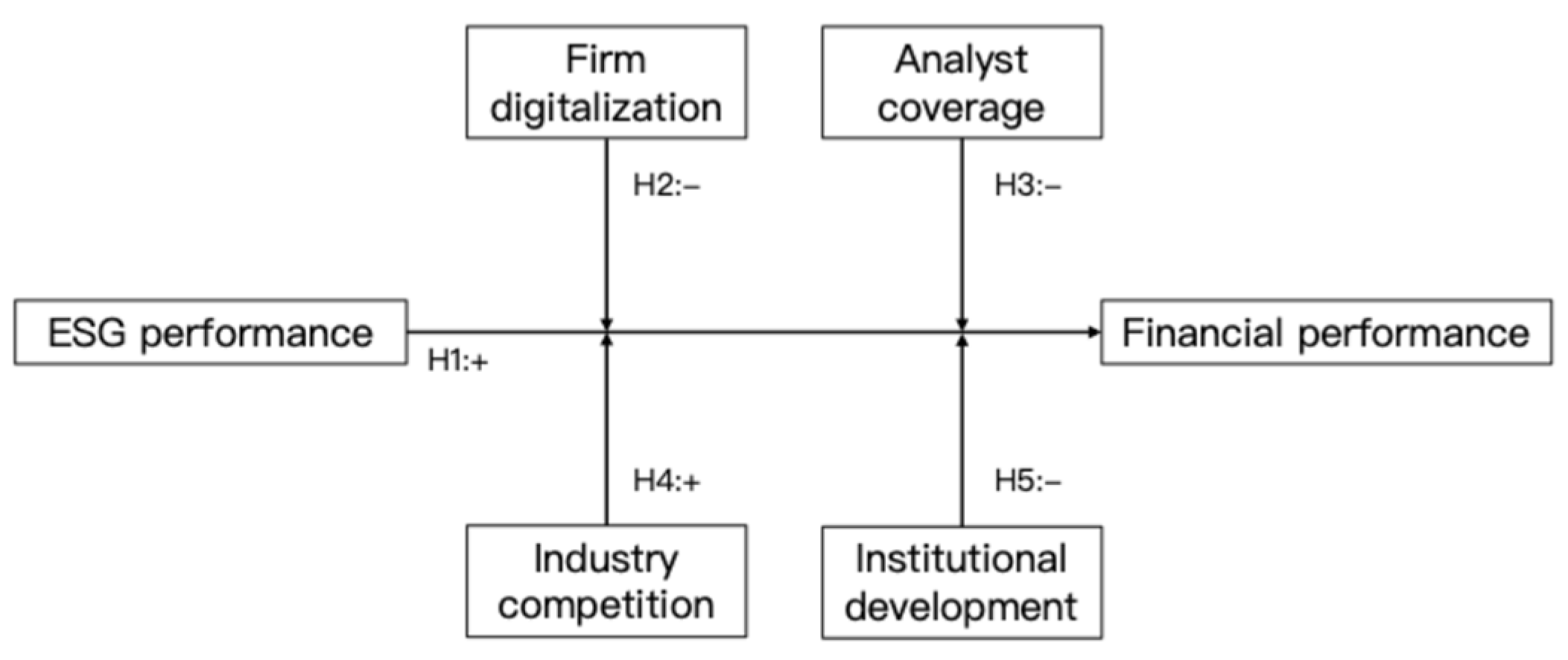
Second, the signaling literature emphasizes that market competition tends to strengthen the value of various signals in improving firm outcomes [23,24]. We then expect that the competition intensity the focal firm experiences would amplify the effect of the signaling role of ESG performance in securing financial performance, because the intense competition impairs the attractiveness of their current products and highlights the distinctive role of the firm’s moral image [25,26]. In sum, we propose four moderators altogether, respectively, at the firm, industry, and region levels to provide a more complete picture of how ESG performance plays a signaling role and how the factors from the three levels strengthen or weaken the main association. Figure 1 depicts our conceptual model.
Figure 1.
The conceptual model of the impact of ESG performance on financial performance for startups.
Empirically, we examine 1021 publicly listed firms in the A-share stock market in China from 2012 to 2023 and finally obtain 4723 firm-year observations. The empirical results strongly support our theory that ESG performance positively impacts financial performance for startups. Our analyses also reveal that firm digitalization, analyst coverage, and institutional development negatively moderate the main effect. In addition, the results suggest that industry competition amplifies the main effect.
This study offers several important insights. First, we contribute to ESG literature to examine the value of ESG investment specifically for startups by overcoming the liability of newness. The attempt responds to the call for more research on ethical behaviors for small and young firms [27]. Although the value of firms’ sustainable orientation is consistently recognized in the literature, it is still far less understood in the context of startups, which generally suffer from the liability of newness. Our research answers the question by offering a more complete theory of how startups’ ESG performance combats the liability of newness, and how heterogeneity in the firm- and industry-levels shapes the main association. Second, we identify the contingent role of regional-level institutional environments, which extends signaling literature by investigating how institutional factors may shape the amount of conveyed information that relies on a specific signal. Our research shows that the signaling effect of ESG behaviors is influenced by regional market development, which contributes to an under-explored topic on how the value of signaling is contingent upon signaling environments [28].
2. Research Hypotheses
2.1. Liability of Newness of Startups
The liability of newness refers to a critical impediment for startups, stemming from a lack of resources and legitimacy compared with established firms. Such liability constrains their capacity to develop exchange relationships with suppliers and customers, attract employees, and obtain financial support. Liability of newness is thus fundamental for the high failure rates among startups [13].
In the absence of a proven track record, these firms are compelled to engage in strategic signaling to confer legitimacy and thereby secure reliable resource supply and exchange relationships. A large body of entrepreneurship research examines the effective signals to overcome the liability of newness. For example, focusing on the tool of corporate governance, Kor and Misangyi [9] suggest that the appointment of outside directors possessing industry expertise serves as a potent legitimizing signal. In addition, Wiklund et al. [10] emphasize the role of long-neglected accounting indicators by arguing that performance measures can mitigate the information asymmetry, alleviating external stakeholders’ concern with the uncertainty and unreliability of young firms. Moreover, from the perspective of social capital, a study posits that virtual embeddedness facilitated by electronic technology can positively affect new venture survival by creating new systems [12].
Rooted in the legitimacy challenge that is central to the liability of newness, some scholars have gone a step further to concentrate on some specific aspects of firm responsible behaviors, such as philanthropic donations and pecuniary investments in environmental protection, to evaluate their impact on legitimacy benefit and then overcome the liability of newness [11]. This stream of research, however, mainly adopts the focus on some specific aspects of firm pro-social or pro-environmental behaviors, lacking a more holistic view of environment, social, and governance (ESG) strategy. ESG evolves from the concept of corporate social responsibility (CSR) while adopting an investment perspective and combining financial relevance with ethical value [29]. Moreover, though there are some studies trying to reveal the impact of ESG on alleviating the liability of newness [27], the investigation from the startups in emerging economies is still nascent. Given the surge of stock market access provided for new ventures, we consider it a unique setting for us to explore how entrepreneurs in emerging markets seek to increase profits by investing in ESG strategies.
2.2. ESG Performance and Financial Performance of Startups
Building on the works of DesJardine et al. [23] and Kim et al. [30], we define ESG scores as firm performance in sustainability issues, including three pillars in environmental, social, and governance (ESG). It measures a firm’s engagement in its responsible behaviors that create a positive impact on stakeholders [31]. ESG scores function as public goodwill or moral capital, allowing firms to mitigate legitimacy challenges. Then, a growing body of research highlights that ESG performance is an effective signal to convey information about a firm’s moral character [32,33].
In line with stakeholder theory’s argument, as a signal, ESG performance alleviates the issue of liability of newness by managing critical relationships. In this regard, superior ESG scores drive value creation activities and ultimately increase financial performance. First, ESG behaviors are beneficial for startups to construct a trustworthy image, which helps them to be selected as a new supplier or customer [34]. In addition, ESG scores signal the information that the firm is a responsible employer. The image not only inspires incumbent employees’ loyalty and retention [35] but also attracts prospective new employees [36]. Finally, due to the resource consumption nature of ESG activities, ESG scores convey the information on the focal firms’ resource endowments, implying the firms’ ability and potential in revenue-generating [33,37]. It is then useful to address the concern from investors, resulting in startups obtaining more financial support. In sum, high ESG scores target various stakeholders, leading to more sources of revenue, a higher level of productivity, and more secure financial support, which altogether contribute to superior financial performance. Therefore, we propose the following:
Hypothesis 1.
ESG performance is positively associated with financial performance for startups.
2.3. The Moderating Factors
As discussed above, ESG performance functions as the signal to convey the information on both the capability of integrity of focal firms and helps facilitate more support from stakeholders, consequently manifested by an increase in financial performance. We thus highlight the signaling role of ESG performance for startups in alleviating the problem of liability of newness. Hence, in this part, we will theoretically argue three moderators: firm digitalization, analyst coverage, and institutional development, which also facilitate information flow from the inside to the outside of the firm, then diminishing the value of ESG performance in the signaling role.
2.3.1. Firm Digitalization
Firm digitalization refers to firms’ reliance on digital technologies to optimize organizational practices and facilitate communication [38]. In this regard, scholars find that firms benefit from digitalization in broadened interaction channels with external stakeholders and thus strengthen their mutual understandings [16]. Then, scholars argue that digitalization facilitates the acquisition and exchange of information, thus helping firms shift from a stand-alone entity to an information-flow-based ecosystem [39]. Hence, around the concept of information, it is well documented that the transformation towards a digitalized firm alleviates information asymmetry because it increases the firm’s proximity with its stakeholders and ensures more effective screening and monitoring [40]. In doing so, it reduces the risk of greenwashing. Consequently, in highly digitalized firms, the ESG score loses some of its unique power as a critical, standalone signal of credibility, as stakeholders have alternative means of verification.
Accordingly, when startups present a higher level of digitalization, the liability of newness caused by information asymmetry would be mitigated. In such cases, the signaling effect of ESG performance would be less critical for increasing financial performance. We thus propose the following:
Hypothesis 2.
The positive relationship between ESG performance and financial performance becomes weaker when the startup has a higher level of digitalization.
2.3.2. Analyst Coverage
Analysts play an information intermediary role. Their job is to collect, process, and disseminate information about the firms they follow [20,41]. They are critical in transforming the internal information to the outsiders and then help alleviate the information asymmetry of startups. Their coverage of the focal firm may provide a source of valuable information for stakeholders to evaluate the actual performance prospects [18]. Firms vary in the number of analysts who track and disclose earnings forecasts for them. Specifically, firms with a higher level of analyst coverage experience more intense publicity, which makes their internal information more transparent to the external audience. Rather, firms with a lower level of analyst coverage receive less attention and then face a higher level of information asymmetry.
As argued earlier, the dominant mechanism underlying the ESG performance and financial performance for startups is the signaling mechanism, i.e., ESG performance reduces the focal firm’s information asymmetry about its capability and integrity. However, analyst coverage plays a similar role by disseminating information about the covered firm. Accordingly, as the number of analyst coverage increases, the focal firm is known more about its goodwill and growth opportunities. Meanwhile, more monitoring caused by analyst coverage mitigates the risk of greenwashing, providing alternative channels for stakeholders to evaluate a firm’s morality and capability. This, in turn, reduces the startups’ reliance on ESG performance as a critical signal to overcome the liability of newness. We thus propose the following:
Hypothesis 3.
The positive relationship between ESG performance and financial performance becomes weaker when the startup has greater analyst coverage.
2.3.3. Industry Competition
Furthermore, according to the discussion with a focus on information asymmetry faced by startups, we would also like to address the conditions under which startups would rely more on ESG performance as a signal to overcome the liability of newness. Specifically, signaling literature emphasizes that the signaling value would be amplified by the competitive environment [24]. In a similar vein, the perspective of differentiation strategy also considers firm morality as a tool to create unique customer value and to help differentiate the firm from its peers under intense competition [42,43]. In this regard, firms would be rewarded to a great extent for ESG activities when the industry competition is strong. We next proceed by discussing how industry competition moderates the signaling value mechanism.
Industry competition refers to the intensity of competition the firm faces in its industry [44]. The high level of market competition forces firms to stand out for limited resources from the external environment [45], because their current product is potentially not that attractive in terms of profitability [46]. To achieve it, firms need to differentiate themselves from their peers by creating unique value. In this sense, the distinctive role of ESG signals is amplified in competitive industries than in less competitive ones. Then, the firm with superior moral character is more likely to benefit from its morality and legitimacy because it can extract more signaling value from such activities to overcome the liability of newness. Therefore, we propose the following:
Hypothesis 4.
The positive relationship between ESG performance and financial performance becomes stronger when industry competition is higher.
2.3.4. Institutional Development
Besides the focus on how the characteristic in the industry influences the main association, according to institutional economics theory, regional institutional development also theoretically affects the information asymmetry between the insider and the outsider of startups [22]. Institutional development refers to the efficiency of intermediary institutions, access to market information, and the development of capital markets [47]. Institutional development in China varies with regions, providing a substantially different market environment for Chinese firms. Regions with more developed institutions ensure more efficient information flow and stricter monitoring. It effectively guarantees the magnitude and quality of firms’ internal information disseminated to the outside actors. In this regard, the problem of information asymmetry between the firms and the outside actors is weakened.
Applying the logic to our study, we argue that institutional development improves the functioning of market mechanisms, partially offsetting the signaling benefits of ESG activities. First, market intermediaries can disseminate information, mitigating the concern of uncertainty for the evaluation of a firm [48]. In such cases, tacit information cannot be that challenging to obtain because competitive organizational routines and practices can be easily observed and monitored by a developed institution [49], mitigating the concern with greenwashing. In this regard, the confidence from investors is strengthened. Second, easier access to resources can be provided by stronger institutional support. The necessity to be differentiated by morality as a signal is lowered to a great extent for startups [50,51]. The performance advantage brought about from ESG activities would be reduced. Therefore, we propose the following:
Hypothesis 5.
The positive relationship between ESG performance and financial performance becomes weaker when the startup is located in a region with higher level of institutional support.
3. Methods
3.1. Sample
Testing our hypotheses requires a sample of startups that are newly established and that have limited resources and legitimacy to build relationships. First, we choose Chinese firms as our research sample. China, as an emerging economy, provides a valuable sociopolitical context in which to expand the arguments about the relationship between ESG and financial performance and test them in a profound and fine-grained manner. The diversity in Chinese institutional environments in various regions allows us to investigate the prominent variations in certain factors’ effect on shaping the main effect.
Second, ChiNext firms provide a suitable setting for us to test the argued hypotheses. Specifically, ChiNext is China’s Growth Enterprise Market (GEM), which was established in 2009 to facilitate national entrepreneurship by providing financial access for startups. ChiNext represents a typical emerging market with a not fully established institutional framework, with lower official requirements for candidate startups than other stock markets in China. For example, the ChiNext board establishes a distinct, single-year profitability threshold, mandating a net profit of RMB 5 million prior to listing. This contrasts with the requirement on other Chinese boards for three consecutive years of positive net profit cumulating to over RMB 30 million. Thus, firms listed in ChiNext are all small-to-medium-sized and growth-oriented private firms, which generally try to overcome the issue of liability of newness. Moreover, the relatively low disclosure requirement for listing in the ChiNext entails a higher level of information asymmetry. It highlights the necessity for startups to signal credible information in order to convince investors and to obtain more financial support [52].
We construct such a sample by consolidating information from various databases, including CSMAR, WIND, and Huazheng databases. We first exclude the firms delisting during the sample period. Then, firms in the finance industry are also excluded due to the distinctive accounting standards of the industry. It possibly forms a confounding factor causing estimation bias. Finally, after deleting observations with missing values, we have a final sample consisting of 4723 observations in 1021 firms spanning between 2012 and 2023.
3.2. Variable Measurement
3.2.1. Dependent Variable
The dependent variable is the financial performance of the company, measured by the return on assets (ROA). It reflects the firm’s efficiency in utilizing its resources to create profits.
3.2.2. Independent Variable
The independent variable in this study is the company’s ESG (Environmental, Social, and Governance) performance, with two data sources, such as the Wind and Huazheng databases, which are frequently used for collecting Chinese firms’ accounting and other information [48]. As ESG data is typically disclosed on a quarterly basis, this study calculates the mean of the four quarterly values to represent the annual ESG score.
3.2.3. Moderating Variables
Firm digitalization. In line with prior work on firm digitalization transformation [53], we measure firm digitalization using the number of patent applications in the area of digitalization at the firm-year level. We retrieve the data on the patents from.
Analyst coverage. In line with prior work [18,19], we search the CSMAR database for the total number of analysts covering the focal firm in each fiscal year. A higher value of this measure suggests more analyst coverage. We log-transformed the number for regression.
Industry competition. In line with the prior work [24], we use the Herfindahl-Hirschman Index (HHI) as a reverse measure for industry competition. A higher value of HHI indicates a lower level of competition within an industry. The equation is shown as follows:
where Xi is the sales revenue of firm i in the industry, X is the total sales revenue for all firms in the industry, and n is the number of firms. A lower value of HHI indicates higher competition.
Institutional development. Following prior research [49], we use the marketization index to measure the development of regional institutions where the focal firm is located. The National Economic Research Institute annually constructs a marketization Index that provides a composite score of market development for each of China’s 31 provincial-level administrative units.
3.2.4. Control Variables
In our estimations, we account for other factors that may influence firm financial performance. We start by controlling for a number of firm-level factors. First, as larger firms usually tend to have superior financial performance, we include firm size in the control variables [54]. Second, firm assets are demonstrated to be positively associated with firm performance [55]. We then include both fixed assets and intangible assets. Third, because cash is fundamental for business operations [56], we also include cash, measured by the amount of cash and cash equivalents held by the firm. Fourth, growth is related to the firm’s financial performance improvement [57]. We then include growth, calculated as the firm growth rate, into the model as a control. Fifth, following prior work [58], ownership concentration may affect the firm’s diversification strategy and the firm’s performance. We then control Top1, calculated as the shareholdings of the largest shareholder in the estimation model. Sixth, we control for the year-by-year industry effects to control for the industry trend.
3.2.5. Estimation Model
In our main analysis of the panel data, we use the fixed-effects regression model with robust standard errors clustered at the firm level to account for potential heteroscedasticity. All the variables are winsorized at the 1 and 99%. The analytical procedures are conducted in Stata 18.0. The estimation model is specified as follows:
4. Results
4.1. Summary Statistics
In Table 1, we provide the descriptive statistics and the correlation matrix. First, the results show that the average ESG score for the sample companies is 4.191 with a standard deviation of 0.963, indicating a significant variation in ESG performance across companies. Then, the average ROA for financial performance is 0.08, with a standard deviation of 0.059, reflecting the volatility in the companies’ financial performance. Next, the mean and standard deviation of the moderating variables also show notable differences across companies.
Table 1.
Descriptive statistics.
Furthermore, the correlations among the independent variables do not point to serious problems with collinearity. A correlation analysis of the main variables reveals a significant positive correlation between ESG scores and ROA (r = 0.149, p < 0.01), which provides preliminary support for Hypothesis 1. At the same time, ESG scores show varying degrees of correlation with the moderating variables, laying the groundwork for subsequent regression analysis.
4.2. Main Results
The main results are presented in Table 2. The baseline prediction is tested by Model (1). In Model (1), the coefficient of ESG performance is positive and significant (β = 0.01, p = 0.001), indicating that ESG performance positively impacts financial performance for startups. Hypothesis 1 is supported.
Table 2.
Results for the regression on the main effect and the moderating effect.
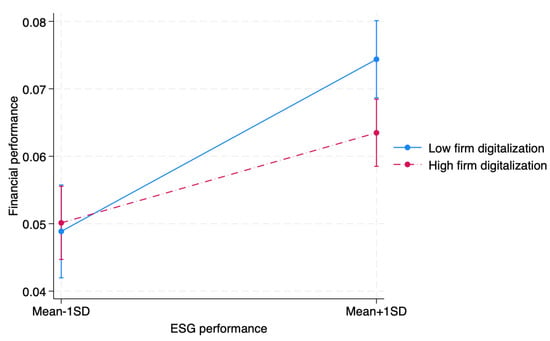
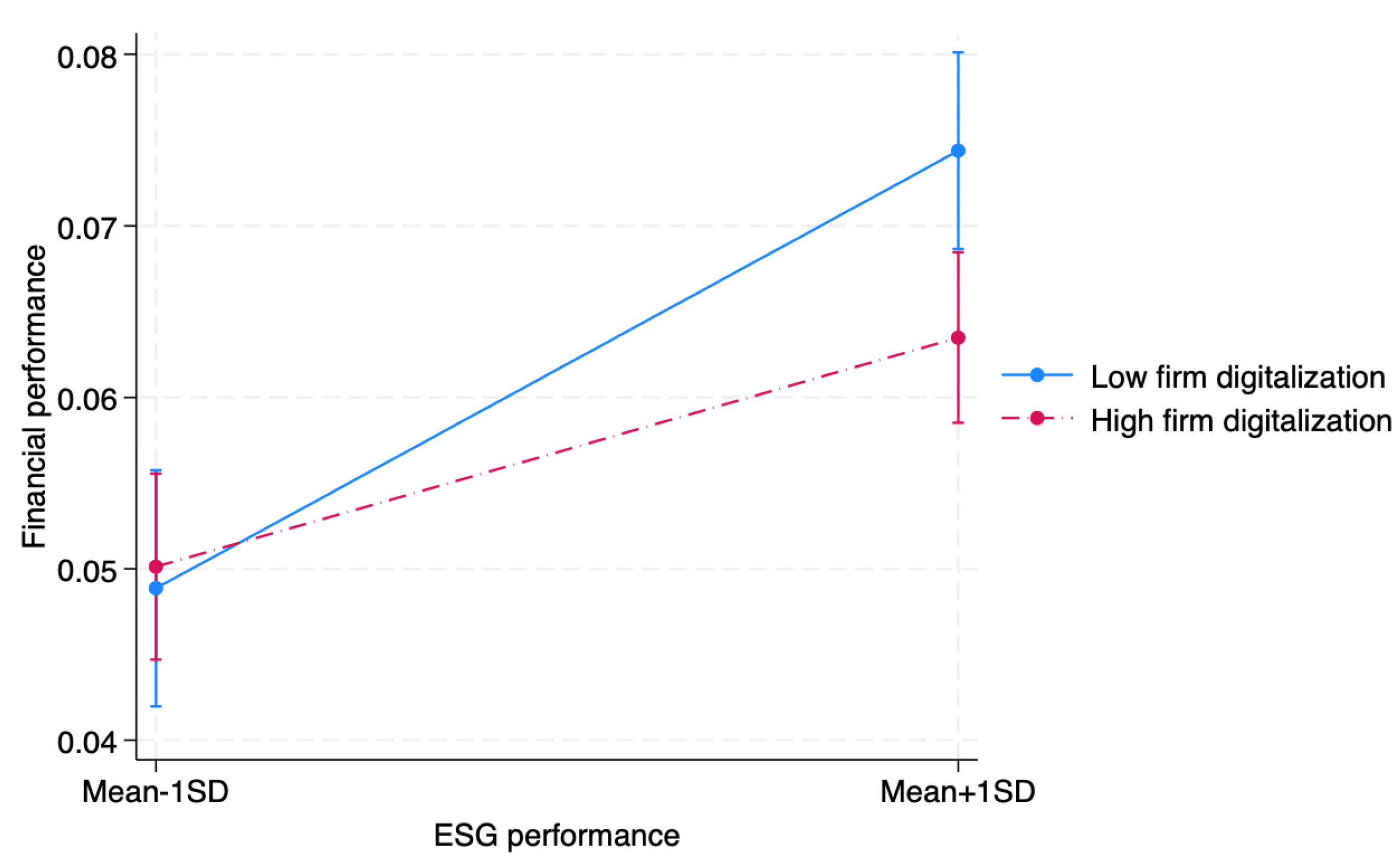
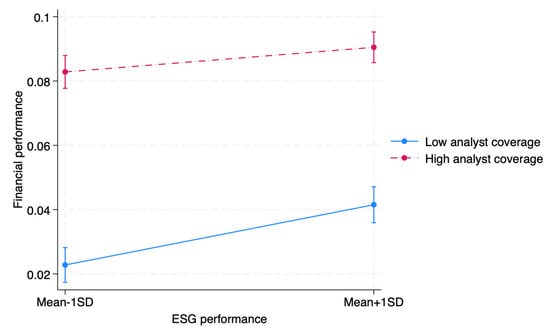
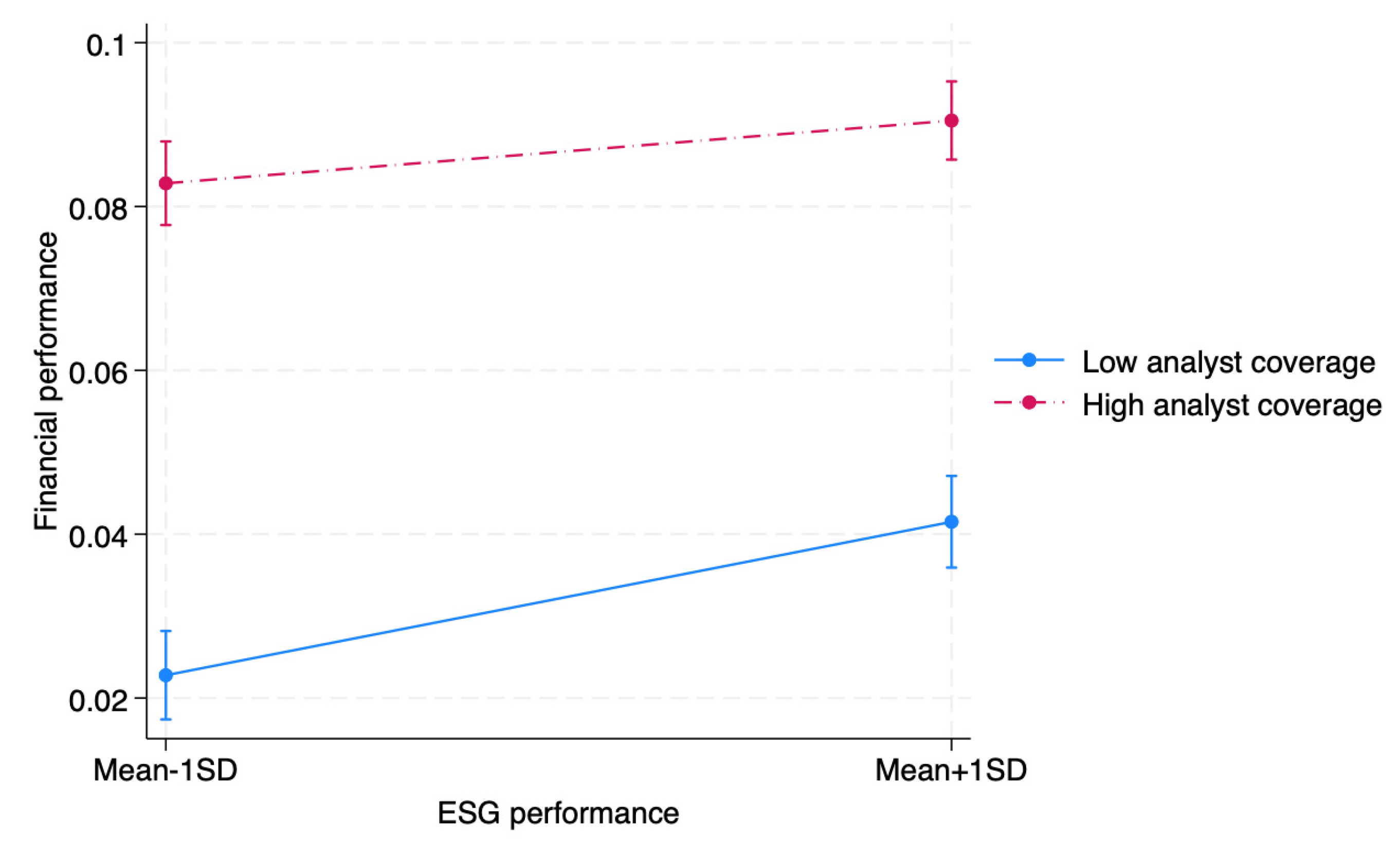
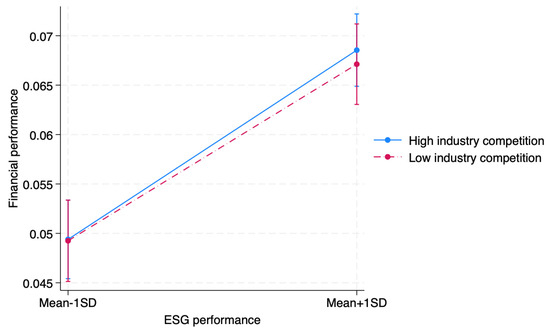
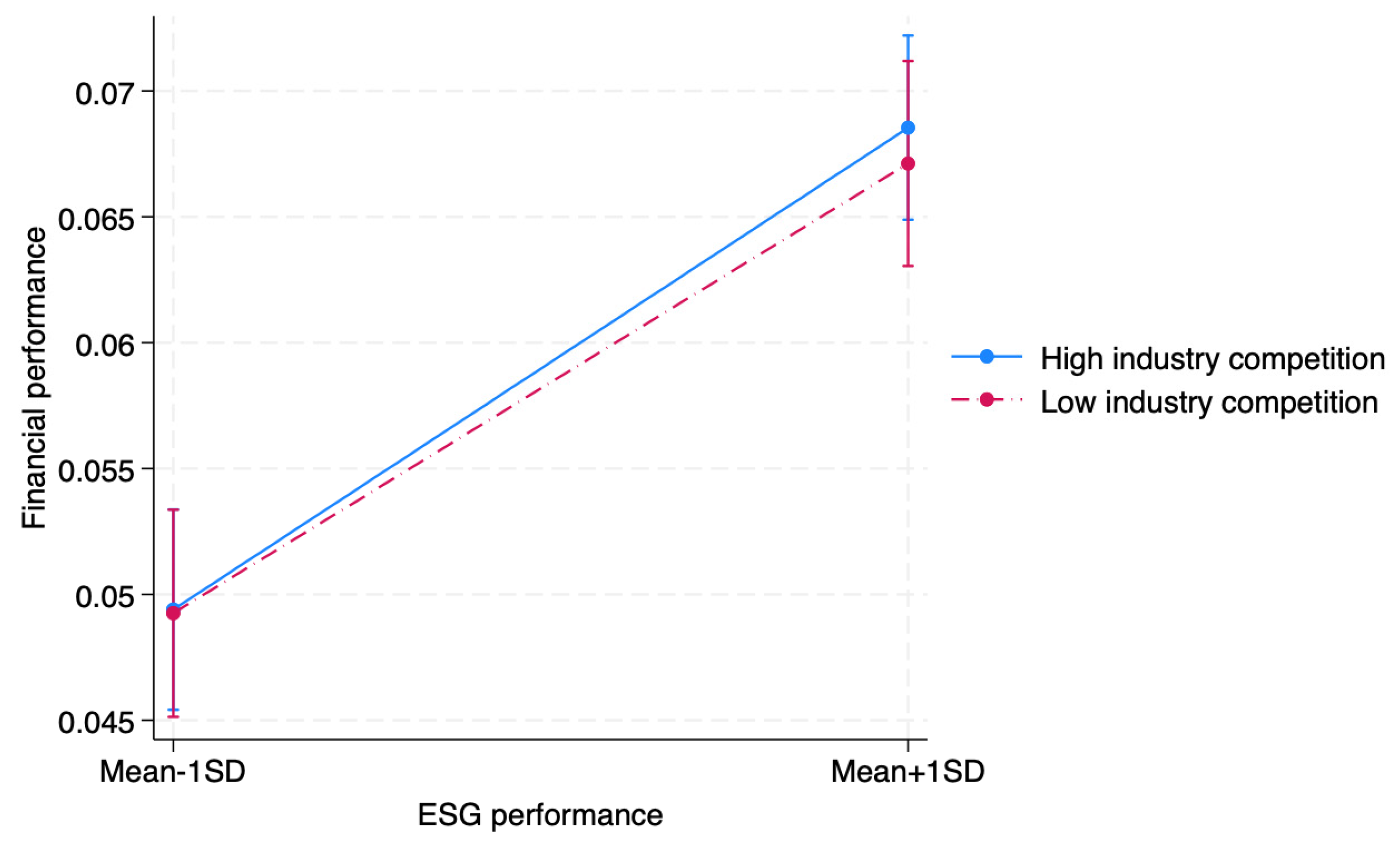
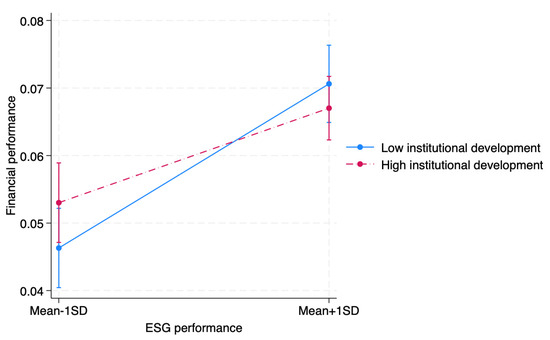
Models (2) to (5) examine the moderating hypotheses (Figure 2, Figure 3, Figure 4 and Figure 5). In Model (2), the coefficient of the interaction term constructed by ESG and firm digitalization is negative and significant (β = −0.002, p = 0.001), indicating that firm digitalization negatively moderates the positive relationship between ESG performance and financial performance for startups. In other words, firm digitalization mitigates the main effect. Hypothesis 2 is supported.
Figure 2.
Moderating effects of firm digitalization.
Figure 3.
Moderating effects of analyst coverage.
Figure 4.
Moderating effects of industry competition.
Figure 5.
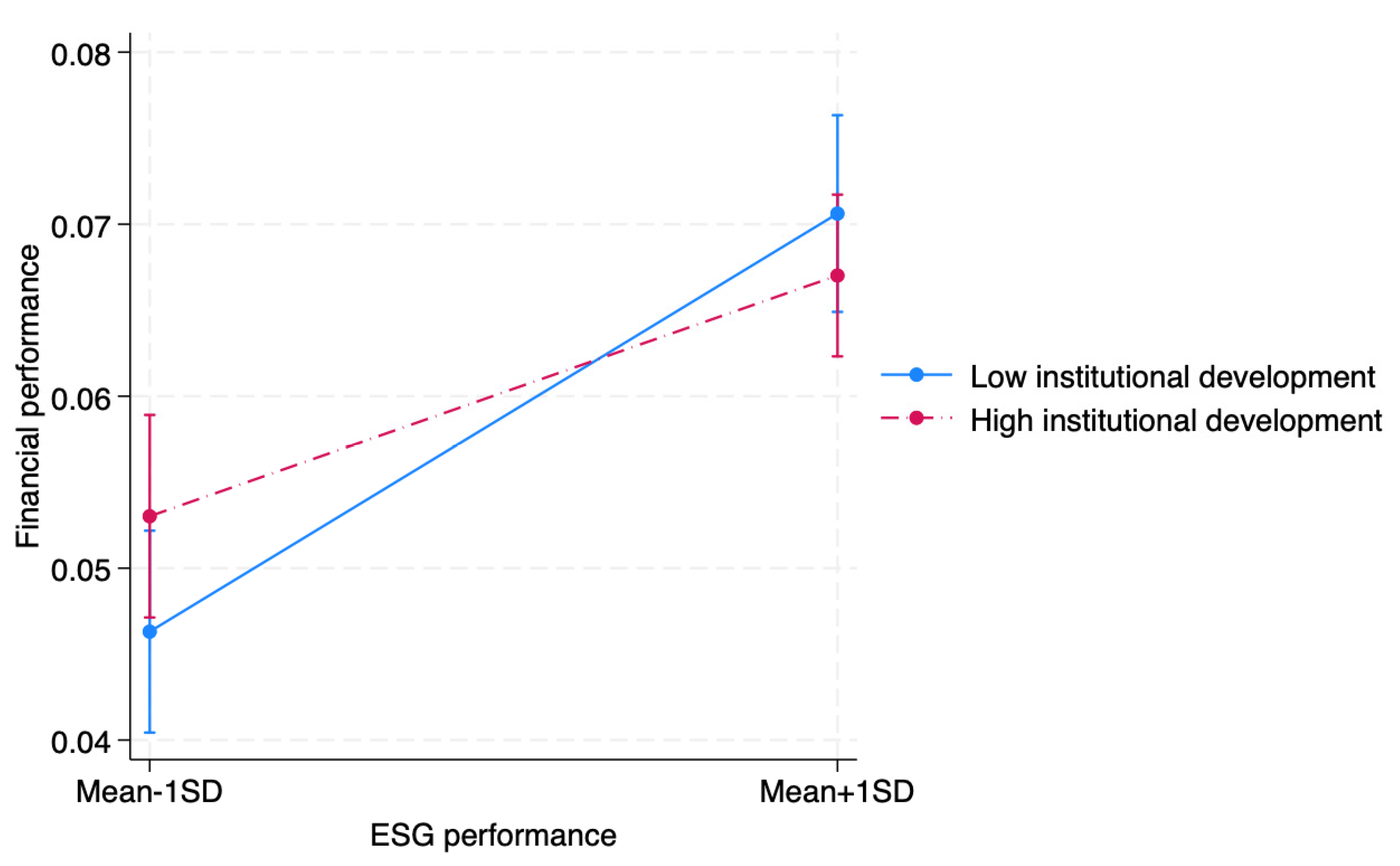
Moderating effects of institutional development.
In Model (3), the coefficient of the interaction term constructed by ESG and analyst coverage is negative and significant (β = −0.002, p = 0.001), indicating that analyst coverage negatively moderates the positive relationship between ESG performance and financial performance for startups. In other words, analyst coverage mitigates the main effect. Hypothesis 3 is supported.
In Model (4), the coefficient of the interaction term constructed by ESG and industry competition is negative and significant (β = −0.019, p = 0.009). Considering that the measurement of industry competition is a reverse code, the result indicates that the industry competition positively moderates the positive relationship between ESG performance and financial performance for startups. In other words, industry competition amplifies the main effect. Hypothesis 5 is supported.
In Model (5), the coefficient of the interaction term constructed by ESG and institutional development is negative and significant (β = −0.002, p = 0.001), indicating that institutional development negatively moderates the positive relationship between ESG performance and financial performance for startups. In other words, institutional development mitigates the main effect. Hypothesis 4 is supported.
4.3. Robustness Check
We conduct four tests to check the robustness of our main results. Specifically, we first use an alternative measurement of firm digitalization by the number of digitalization-related words in the annual reports of firms. The text-analysis method is frequently used for analyzing the extent of firm strategic adaptation [59]. We log-transformed the word frequency for regression. The results are shown in Model (1) of Table 3. The coefficient of the interaction term is significant and negative ( = −0.003, p = 0.036), which is consistent with our expectation. It suggests that our results are robust to the alternative measurement of the moderating variable.
Table 3.
Results for the robustness check.
Then, in the main analysis, the independent variable ESG performance and the dependent variable financial performance are set in the same year, which may cause a potential concern with reverse causality. To address the problem of causal identification, we lag the independent variable, ESG performance, by one year to identify the direction of causal inference. The results are shown in Model (2) of Table 3. The coefficient of lagged ESG performance is significant and positive ( = 0.009, p = 0.000), which is consistent with our expectation. It suggests that our results are robust to the alternative estimation approach.
Next, ROA is utilized as the primary dependent variable in the main analysis. Similar to ROA, ROE also reflects the accounting-based performance for firms, while the former reveals the utilization efficacy of resources, and the latter indicates the effectiveness of generating profits. Moreover, the literature suggests that Tobin’s Q reflects the market-based performance that is more responsive to a firm’s non-market strategies [60]. It is then commonly used to evaluate the performance impact of firm social investment as well. Hence, we use ROE and Tobin’s Q as alternative measurements for the dependent variable, respectively. The results are shown in Model (3) and Model (4) of Table 3. The coefficients of ESG performance are significant and positive (Model (3): = 0.016, p = 0.000; Model (4): β = 0.09, p = 0.023), which is consistent with our expectation. It suggests that our results are robust to the alternative measurements of the dependent variable.
Finally, our sample in the main analysis covers all the firm natures, including foreign-owned firms, collectively owned firms, private firms, and state-owned firms. Given the state influence on the startups’ motivation and capability to engage in pro-social behaviors in China, we exclude the firms that are owned by the state and re-estimate the main analysis to alleviate the effect of state influence on the results. The results are shown in Model (5) of Table 3. The coefficient of ESG performance is significant and positive ( = 0.007, p = 0.000), which is consistent with our expectation. It suggests that our results are robust to the alternative sample.
5. Discussion and Conclusions
This study addresses the important question of whether ESG performance positively affects corporate financial performance, particularly in the context of startups in emerging economies. This group of small and young firms is representative of resource scarcity and high uncertainty due to the issue of liability of newness. Our results demonstrate that ESG performance is positively correlated with financial performance for startups. However, ESG performance is less effective at improving financial performance under a high level of firm digitalization, a large amount of analyst coverage, and developed regional market institutions, but it becomes more effective for firms in industries with intense competition. In turn, our research makes three contributions to the literature.
5.1. Theoretical Implications
First, we highlight the fundamental signaling role of firm moral activities in addressing liability of newness and, more broadly, information asymmetry issues. Most of the extant work on ethical behaviors adopts the perspective of stakeholder theory and resource-based view, always viewing ESG performance can increase firm financial performance through the mechanism of reputation improvement and resource acquisition. Following this logic, scholars have extensively studied how ESG performance can secure and increase revenues by different indicators, or under different external and internal events [27,61]. However, scholars tend to overlook a prominent heterogeneity underpinning the analyzed value of ESG performance for those small and young ventures—they are probably not capable enough to capture the economies of scope in ESG investment. Although some pioneering research has diverted attention towards the issue but they mainly used the sample of startups in the developed countries [62], ignoring the prominent uncertainty in the context of the startups in emerging economies. This is problematic because, for startups, such concern may mitigate or even divert the positive association between ESG performance and financial performance that has been demonstrated by extant research utilizing the sample of large and established firms in developed countries. Therefore, our research foregrounds this missing element in the literature of sustainability in the business world and pays attention to whether and how ESG performance impacts financial performance for those newly established ventures. By empirically demonstrating the significant impact of ESG performance in signaling startups’ moral character and capability, our research reveals that ESG performance functions as a signal for startups to overcome the liability of newness, complementing the discussion around the grand assumption of ‘doing well by doing good’.
Second, we contribute to the extant signaling and ESG literature by examining how both internal and external environments shape the signaling effect of ESG performance. The findings indicate that the benefits of the signals generated by ESG performance are more pronounced for firms with a lower level of digitalization, a smaller number of analysts covering the focal firm, more intense industry competition, and less-developed regional markets. Recent studies have examined various signals for addressing the problem of maintaining and managing relationships with various stakeholders in the context of startups, such as the appointment of outside directors [9], disclosure of accounting indicators [10], and increasing virtual embeddedness [12]. We extend this line of work by showing how ESG performance can be used as a credible signal to boost startups’ financial performance, especially for those in transition economies. In this regard, our study sheds new light on signaling literature by demonstrating how signals work in different internal and external environments for startups. Specifically, the findings provide a holistic picture of how firm-level, industry-level, and regional institution-level factors simultaneously shape the positive association between ESG performance and financial performance in the context of startups.
5.2. Practical Implications
The findings of our study have several practical implications. Startups make up 99.9% of Chinese firms. Given their economic significance and nation-level impact, startups are considered pivotal to achieving a more sustainable economy by fostering socially responsible entrepreneurship. Thus, this paper lends advice to the government that regulators can promote detailed guidelines to advocate for entrepreneurial ventures to engage in ESG behaviors. In addition, the policies aiming to increase ESG-related information disclosure, especially for startups, are also highly recommended by us, since the benefits caused by ESG signals can be reaped by startups. Through this paper, we aim to assist policymakers in better understanding the signaling role of ESG behaviors for startups and their economic impact, with the goal of promoting their widespread adoption.
5.3. Limitations and Future Research
This study is subject to several limitations that could be addressed in future research. First, our measurement of ESG performance may involve decoupling between actual ethical activities and rhetorical disclosure. It is hard to differentiate the performance-increasing role origins from the actual engagement in ethical behaviors or the intentional information disclosure manipulated by startups. Thus, future research could corroborate our research findings by differentiating the signaling role of a firm’s substantial investment in sustainability activities and superficial claims. Second, we focus on startups listed in ChiNext to investigate our research questions. These firms experience considerable information asymmetry due to the weak regulations on financial disclosure and relatively lower listing requirements adopted by ChiNext compared to the Main Board. Though firms listed in ChiNext, to some extent, are representative of the liability of newness, the group of firms does not cover all the newly established and small firms in emerging economies. Hence, future studies could examine the effect of ESG performance among younger and smaller firms to further verify our key claims. Third, we have not empirically measured and tested the key mechanism: liability of newness in the estimation model, because the methods utilized do not allow for directly quantifying the magnitude involved. The theoretical arguments and empirical examination would be strongly improved if future studies could directly measure the existence of liability of newness, its extent, and its impact on startups.
Author Contributions
Conceptualization, M.D. and Q.S.; Methodology, M.D.; Software, Q.S.; Formal analysis, Q.S.; Investigation, S.C.; Resources, S.C.; Writing – original draft, Q.S.; Funding acquisition, M.D. All authors have read and agreed to the published version of the manuscript.
Funding
This research received no external funding.
Institutional Review Board Statement
Not applicable.
Informed Consent Statement
Not applicable.
Data Availability Statement
The data presented in this study are available on request from the corresponding author.
Conflicts of Interest
The authors declare no conflict of interest.
References
- Clementino, E.; Perkins, R. How Do Companies Respond to Environmental, Social and Governance (ESG) Ratings? Evidence from Italy. J. Bus. Ethics 2021, 171, 379–397. [Google Scholar] [CrossRef] [Scilit]
- Lee, M.T.; Raschke, R.L.; Krishen, A.S. Understanding ESG Scores and Firm Performance: Are High-Performing Firms E, S, and G-Balanced? Technol. Forecast. Soc. Chang. 2023, 195, 122779. [Google Scholar] [CrossRef] [Scilit]
- Awaysheh, A.; Heron, R.A.; Perry, T.; Wilson, J.I. On the Relation between Corporate Social Responsibility and Financial Performance. Strateg. Manag. J. 2020, 41, 965–987. [Google Scholar] [CrossRef] [Scilit]
- Minor, D.; Morgan, J. CSR as Reputation Insurance: Primum Non Nocere. Calif. Manag. Rev. 2011, 53, 40–59. [Google Scholar] [CrossRef] [Scilit]
- Wang, H.; Qian, C. Corporate Philanthropy and Corporate Financial Performance: The Roles of Stakeholder Response and Political Access. AMJ 2011, 54, 1159–1181. [Google Scholar] [CrossRef] [Scilit]
- Zhao, X.; Murrell, A.J. Revisiting the Corporate Social Performance-financial Performance Link: A Replication of W Addock and G Raves. Strateg. Manag. J. 2016, 37, 2378–2388. [Google Scholar] [CrossRef] [Scilit]
- Fasano, F.; La Rocca, T. Does the Bank-Firm Human Relationship Still Matter for SMEs? The Game-Changing Role of Digitalization. Small Bus. Econ. 2024, 62, 159–178. [Google Scholar] [CrossRef] [Scilit]
- Latham, S. Contrasting Strategic Response to Economic Recession in Start-up versus Established Software Firms. J. Small Bus. Manag. 2009, 47, 180–201. [Google Scholar] [CrossRef] [Scilit]
- Kor, Y.Y.; Misangyi, V.F. Outside Directors’ Industry-Specific Experience and Firms’ Liability of Newness. Strateg. Manag. J. 2008, 29, 1345–1355. [Google Scholar] [CrossRef] [Scilit]
- Wiklund, J.; Baker, T.; Shepherd, D. The Age-Effect of Financial Indicators as Buffers against the Liability of Newness. J. Bus. Ventur. 2010, 25, 423–437. [Google Scholar] [CrossRef] [Scilit]
- Zuo, Y.; Jiang, S.; Wei, J. Can Corporate Social Responsibility Mitigate the Liability of Newness? Evidence from China. Small Bus. Econ. 2022, 59, 573–592. [Google Scholar] [CrossRef] [Scilit]
- Morse, E.A.; Fowler, S.W.; Lawrence, T.B. The Impact of Virtual Embeddedness on New Venture Survival: Overcoming the Liabilities of Newness. Entrep. Theory Pract. 2007, 31, 139–159. [Google Scholar] [CrossRef] [Scilit]
- Singh, J.V.; Tucker, D.J.; House, R.J. Organizational Legitimacy and the Liability of Newness. Adm. Sci. Q. 1986, 31, 171–193. [Google Scholar] [CrossRef] [Scilit]
- Fu, L.; Boehe, D.M.; Orlitzky, M.O. Broad or Narrow Stakeholder Management? A Signaling Theory Perspective. Bus. Soc. 2022, 61, 1838–1880. [Google Scholar] [CrossRef] [Scilit]
- Ren, G.; Zeng, P.; Zhong, X. The Collaborative Innovation Effect of ESG Signals: Integrating Signaling and Trust Theories. Manag. Organ. Rev. 2025, 21, 73–101. [Google Scholar] [CrossRef] [Scilit]
- Li, L.; Tang, W.; Zhou, H.; Yang, S. Digitalization and Firm Performance: The Moderating Role of Top Management Team Attributes. IEEE Trans. Eng. Manag. 2024, 71, 6595–6605. [Google Scholar] [CrossRef] [Scilit]
- Zeng, H.; Ran, H.; Zhou, Q.; Jin, Y.; Cheng, X. The Financial Effect of Firm Digitalization: Evidence from China. Technol. Forecast. Soc. Chang. 2022, 183, 121951. [Google Scholar] [CrossRef] [Scilit]
- Brauer, M.; Wiersema, M. Analyzing Analyst Research: A Review of Past Coverage and Recommendations for Future Research. J. Manag. 2018, 44, 218–248. [Google Scholar] [CrossRef] [Scilit]
- Gentry, R.J.; Shen, W. The Impacts of Performance Relative to Analyst Forecasts and Analyst Coverage on Firm R&D Intensity. Strateg. Manag. J. 2013, 34, 121–130. [Google Scholar]
- Qian, C.; Lu, L.Y.; Yu, Y. Financial Analyst Coverage and Corporate Social Performance: Evidence from Natural Experiments. Strateg. Manag. J. 2019, 40, 2271–2286. [Google Scholar] [CrossRef] [Scilit]
- “Bryan” Jean, R.-J.; Kim, D.; Zhou, K.Z.; Cavusgil, S.T. E-Platform Use and Exporting in the Context of Alibaba: A Signaling Theory Perspective. J. Int. Bus. Stud. 2021, 52, 1501–1528. [Google Scholar] [CrossRef] [Scilit]
- Xie, Z.; Li, J. Exporting and Innovating among Emerging Market Firms: The Moderating Role of Institutional Development. J. Int. Bus. Stud. 2018, 49, 222–245. [Google Scholar] [CrossRef] [Scilit]
- DesJardine, M.R.; Li, B.; Shi, W. Information-Based Competition: The Case of Rival Owners in Rating Agencies. AMJ 2025, 68, 221–256. [Google Scholar] [CrossRef] [Scilit]
- Zhang, R.; Zhu, J.; Yue, H.; Zhu, C. Corporate Philanthropic Giving, Advertising Intensity, and Industry Competition Level. J. Bus. Ethics 2010, 94, 39–52. [Google Scholar] [CrossRef] [Scilit]
- Flammer, C. Does Product Market Competition Foster Corporate Social Responsibility? Evidence from Trade Liberalization. Strateg. Manag. J. 2015, 36, 1469–1485. [Google Scholar] [CrossRef] [Scilit]
- Roberts, P.W. Product Innovation, Product–Market Competition and Persistent Profitability in the US Pharmaceutical Industry. Strateg. Manag. J. 1999, 20, 655–670. [Google Scholar] [CrossRef]
- Chan, E.Y. Moral Signaling in Startups: How ESG Claims Shape Stakeholder Judgments and Ethical Legitimacy. J. Bus. Ethics 2025, 1–15. [Google Scholar] [CrossRef] [Scilit]
- Vasudeva, G.; Nachum, L.; Say, G.-D. A Signaling Theory of Institutional Activism: How Norway’s Sovereign Wealth Fund Investments Affect Firms’ Foreign Acquisitions. Acad. Manag. J. 2018, 61, 1583–1611. [Google Scholar] [CrossRef] [Scilit]
- Garrido-Ruso, M.; Otero-González, L.; López-Penabad, M.-C.; Santomil, P.D. Does ESG Implementation Influence Performance and Risk in SMEs? Corp. Soc. Responsib. Environ. Manag. 2024, 31, 4227–4247. [Google Scholar] [CrossRef] [Scilit]
- Kim, J.H.; Kwak, J.; Park, H.-K. ESG as a Nonmarket Strategy to Cope with Geopolitical Tension: Empirical Evidence from Multinationals’ ESG Performance. Strateg. Manag. J. 2025, 46, 693–722. [Google Scholar]
- Godfrey, P.C. The Relationship Between Corporate Philanthropy And Shareholder Wealth: A Risk Management Perspective. AMR 2005, 30, 777–798. [Google Scholar] [CrossRef] [Scilit]
- Yu, Q.; Cuypers, I.R.P.; Wang, H. A Tale of Two Signals: Partner CSR versus CSI and Alliance Formation. AMJ 2024, 68, 138–161. [Google Scholar] [CrossRef] [Scilit]
- Zerbini, F. CSR Initiatives as Market Signals: A Review and Research Agenda. J. Bus. Ethics 2017, 146, 1–23. [Google Scholar] [CrossRef] [Scilit]
- Tao, R.; Wu, J.; Zhao, H. Do Corporate Customers Prefer Socially Responsible Suppliers? An Instrumental Stakeholder Theory Perspective. J. Bus. Ethics 2023, 185, 689–712. [Google Scholar] [CrossRef] [Scilit]
- Księżak, P. The Benefits from CSR for a Company and Society. J. Corp. Responsib. Leadersh. 2016, 3, 53–65. [Google Scholar] [CrossRef] [Scilit]
- Klimkiewicz, K.; Oltra, V. Does CSR Enhance Employer Attractiveness? The Role of Millennial Job Seekers’ Attitudes. Corp. Soc. Responsib. Environ. Manag. 2017, 24, 449–463. [Google Scholar] [CrossRef] [Scilit]
- Paruchuri, S.; Han, J.-H.; Prakash, P. Salient Expectations? Incongruence across Capability and Integrity Signals and Investor Reactions to Organizational Misconduct. AMJ 2021, 64, 562–586. [Google Scholar] [CrossRef] [Scilit]
- Bouncken, R.B.; Fredrich, V.; Sinkovics, N.; Sinkovics, R.R. Digitalization of Cross-Border R&D Alliances: Configurational Insights and Cognitive Digitalization Biases. Glob. Strategy J. 2023, 13, 281–314. [Google Scholar] [CrossRef] [Scilit]
- Banalieva, E.R.; Dhanaraj, C. Internalization Theory for the Digital Economy. J. Int. Bus. Stud. 2019, 50, 1372–1387. [Google Scholar] [CrossRef] [Scilit]
- Brynjolfsson, E.; McElheran, K. The Rapid Adoption of Data-Driven Decision-Making. Am. Econ. Rev. 2016, 106, 133–139. [Google Scholar] [CrossRef] [Scilit]
- Jensen, M.C.; Meckling, W.H. Theory of the Firm: Managerial Behavior, Agency Costs and Ownership Structure. J. Financ. Econ. 1976, 3, 305–360. [Google Scholar] [CrossRef] [Scilit]
- Margolis, J.D.; Walsh, J.P. Misery Loves Companies: Rethinking Social Initiatives by Business. Adm. Sci. Q. 2003, 48, 268–305. [Google Scholar] [CrossRef] [Scilit]
- Su, W.; Peng, M.W.; Tan, W.; Cheung, Y.-L. The Signaling Effect of Corporate Social Responsibility in Emerging Economies. J. Bus. Ethics 2016, 134, 479–491. [Google Scholar] [CrossRef] [Scilit]
- Huang, Y.; Xie, E.; Li, Y.; Reddy, K.S. Does State Ownership Facilitate Outward FDI of Chinese SOEs? Institutional Development, Market Competition, and the Logic of Interdependence between Governments and SOEs. Int. Bus. Rev. 2017, 26, 176–188. [Google Scholar] [CrossRef] [Scilit]
- Pfeffer, J.; Salancik, G.R. The External Control of Organizations: A Resource Dependence Perspective; Harper & Row: New York, NY, USA, 1978. [Google Scholar]
- Shankar, V. Proactive and Reactive Product Line Strategies: Asymmetries Between Market Leaders and Followers. Manag. Sci. 2006, 52, 276–292. [Google Scholar] [CrossRef] [Scilit]
- Qian, C.; Wang, H.; Geng, X.; Yu, Y. Rent Appropriation of Knowledge-Based Assets and Firm Performance When Institutions Are Weak: A Study of Chinese Publicly Listed Firms. Strateg. Manag. J. 2017, 38, 892–911. [Google Scholar] [CrossRef] [Scilit]
- Liu, N. Institutional Intermediaries and Firm Choices in Response to Regulations. AMJ 2021, 64, 981–1007. [Google Scholar] [CrossRef] [Scilit]
- Wu, X.; Adbi, A.; Mahmood, I.P. The Social Structure of Insiders and Outsiders: Toward a Network Community Perspective on Firm Performance. Acad. Manag. J. 2023, 67, 903–932. [Google Scholar] [CrossRef] [Scilit]
- Guiso, L.; Sapienza, P.; Zingales, L. The Role of Social Capital in Financial Development. Am. Econ. Rev. 2004, 94, 526–556. [Google Scholar] [CrossRef] [Scilit]
- Amaeshi, K.; Adegbite, E.; Rajwani, T. Corporate Social Responsibility in Challenging and Non-Enabling Institutional Contexts: Do Institutional Voids Matter? J. Bus. Ethics 2016, 134, 135–153. [Google Scholar] [CrossRef] [Scilit]
- Zhang, J.; Zhang, W.; Schwab, A.; Zhang, S. Institutional Environment and IPO Strategy: A Study of ChiNext in China. Manag. Organ. Rev. 2017, 13, 399–430. [Google Scholar] [CrossRef] [Scilit]
- García-Romanos, J.; Martínez-Ros, E. Digitalization and Employment in Europe: The Role of Firm’s Size and the Complementarity of R&D. RD Manag. 2024, 54, 695–712. [Google Scholar] [CrossRef] [Scilit]
- Orlitzky, M. Does Firm Size Comfound the Relationship between Corporate Social Performance and Firm Financial Performance? J. Bus. Ethics 2001, 33, 167–180. [Google Scholar] [CrossRef] [Scilit]
- Aboody, D.; Barth, M.E.; Kasznik, R. Revaluations of Fixed Assets and Future Firm Performance: Evidence from the UK1. J. Account. Econ. 1999, 26, 149–178. [Google Scholar] [CrossRef] [Scilit]
- Deb, P.; David, P.; O’Brien, J. When Is Cash Good or Bad for Firm Performance? Strateg. Manag. J. 2017, 38, 436–454. [Google Scholar] [CrossRef] [Scilit]
- Reijonen, H.; Komppula, R. Perception of Success and Its Effect on Small Firm Performance. J. Small Bus. Enterp. Dev. 2007, 14, 689–701. [Google Scholar] [CrossRef] [Scilit]
- Andres, C. Large Shareholders and Firm Performance—An Empirical Examination of Founding-Family Ownership. J. Corp. Financ. 2008, 14, 431–445. [Google Scholar] [CrossRef] [Scilit]
- Luo, D.; Zhou, K.Z.; Shen, L. How Firm Digitalization Affects Targeted Poverty Alleviation Participation: A Capability-Based View. Asia Pac. J. Manag. 2024, 1–30. [Google Scholar] [CrossRef] [Scilit]
- Schifilliti, V.; Patti, A.; Centorrino, G. Grease the Wheel! An Empirical Study on Environmental, Social, and Governance (ESG) and SMEs’ Performance in the ICT Industry. Corp. Soc. Responsib. Environ. Manag. 2025, 32, 7871–7887. [Google Scholar] [CrossRef] [Scilit]
- Gillan, S.L.; Koch, A.; Starks, L.T. Firms and Social Responsibility: A Review of ESG and CSR Research in Corporate Finance. J. Corp. Financ. 2021, 66, 101889. [Google Scholar] [CrossRef] [Scilit]
- Momtaz, P.P.; Parra, I.M. Is Sustainable Entrepreneurship Profitable? ESG Disclosure and the Financial Performance of SMEs. Small Bus. Econ. 2025, 64, 1535–1564. [Google Scholar] [CrossRef] [Scilit]

Disclaimer/Publisher’s Note: The statements, opinions and data contained in all publications are solely those of the individual author(s) and contributor(s) and not of MDPI and/or the editor(s). MDPI and/or the editor(s) disclaim responsibility for any injury to people or property resulting from any ideas, methods, instructions or products referred to in the content. |
© 2025 by the authors. Licensee MDPI, Basel, Switzerland. This article is an open access article distributed under the terms and conditions of the Creative Commons Attribution (CC BY) license (https://creativecommons.org/licenses/by/4.0/).