Article

Intra-Urban CO2 Spatiotemporal Patterns and Driving Factors Using Multi-Source Data and AI Methods: A Case Study of Shanghai, China


1
The College of Architecture and Urban Planning, Tongji University, Shanghai 200092, China
2
Shanghai Academy of Environmental Sciences, Shanghai 200233, China
3
Environmental Monitoring Station of Pudong New District, Shanghai 200135, China
*
Authors to whom correspondence should be addressed.
Sustainability 2025, 17(23), 10794; https://doi.org/10.3390/su172310794
Submission received: 18 September 2025 / Revised: 21 October 2025 / Accepted: 7 November 2025 / Published: 2 December 2025
(This article belongs to the Special Issue AI-Driven Innovations in Urban Resilience and Climate Adaptation)

Abstract

Cities are major sources of anthropogenic carbon dioxide (CO2) emissions, making the study of intra-urban CO2 concentration patterns an emerging research priority. However, limited data availability and the complexity of urban environments have impeded detailed spatiotemporal analyses at the city scale. To address these challenges, an analysis supported by multi-source data and GeoAI methods is carried out to examine the spatial distribution, vertical variation, temporal dynamics, and driving factors of CO2 concentrations in urban areas. We combined OCO-2 satellite-derived XCO2 data (2014–2024) with ground-based measurements from the Shanghai Tower (August 2024 to March 2025), alongside meteorological and socioeconomic variables. The analysis employed spatial interpolation (inverse distance weighting), nonparametric testing (Mann–Whitney U test), time series decomposition, ordinary least squares (OLS) regression, and machine learning techniques including random forest and SHAP (SHapley Additive exPlanations) analysis. Results reveal that CO2 concentrations are significantly higher in central urban districts compared to suburban areas, with notable spatial heterogeneity. Elevated levels were detected near ports and ferry routes, with airports and industrial emissions identified as principal contributors. Vertically, CO2 concentrations decline with increasing altitude but exhibit a peak at mid-level heights. Temporally, a pronounced seasonal pattern was observed, characterized by higher concentrations in winter and lower levels in summer. Both OLS regression and machine learning models highlight proximity to emission sources, wind speed, and temperature as key determinants of spatial CO2 variability, with these factors collectively explaining 67% of the variance in OLS models. This study demonstrates how multi-source data and advanced methods can capture the spatial, vertical, and seasonal dynamics and driving factors of urban CO2 concentrations, offering insights for policy, planning, and mitigation.

1. Introduction

With the continuous increase in CO2 emissions, global warming has become a growing concern [1,2]. Rapid urbanization has exacerbated this issue, posing more severe challenges for cities compared to other areas [3]. Among greenhouse gases, carbon dioxide (CO2) plays an important role, accounting for over 80% of long-term radiative forcing along with methane [4,5]. This has made carbon neutrality a global priority, with the 2009 Copenhagen Accord establishing “measurable, reportable, and verifiable” standards, emphasizing the importance and uniqueness of CO2 emissions [2]. Meanwhile, research on CO2 has become extensive, covering various areas including CO2 emissions, CO2 flux, and CO2 concentrations. Studies on CO2 emissions indicate that fossil fuel combustion, urbanization, and suburban transportation are key drivers of rising CO2 levels, while compact urban layouts and vegetation help mitigate emissions and regulate seasonal variations [6,7,8,9,10,11]. Research on CO2 emissions reveal clear seasonal variations, driven largely by human activities and meteorological conditions [12,13]. Moreover, studies also show that CO2 concentrations are influenced by local emissions and topography, traffic also has a certain impact on it, exhibiting sharp peaks during traffic rush hours [14]. The studies, which reveal different characteristics of CO2, provide a basis for reducing carbon emissions, thus making CO2 a new focal point for research.
However, research on CO2 concentrations in urban areas, particularly in the city centers of large cities, remains insufficient. Further research in this area is important for addressing this gap. CO2 emissions and fluxes primarily describe sources and exchange processes in the atmosphere. In contrast, CO2 concentrations directly indicate the density of CO2 molecules in the air, accounting for atmospheric diffusion and long-term accumulation. Therefore, focusing on CO2 concentrations provides a more objective approach for analyzing spatial distribution patterns at the urban scale [14,15]. Extensive studies show that CO2 concentrations are generally higher in megacities, especially in city centers [5,16,17]. In Essen, Germany, CO2 concentrations within the urban canopy consistently exceed those in rural areas [18]. Similarly, ground-based observations and handheld measurements in China reveal that urban CO2 concentrations are typically higher than in suburban areas, with some big cities exhibiting an “urban CO2 dome” phenomenon [19,20]. These findings consistently indicate that megacities tend to exhibit higher CO2 concentrations, particularly in urban centers, highlighting the importance of understanding intra-urban CO2 distribution patterns. Although numerous inter-urban studies exist, research focusing on intra-urban CO2 concentrations in mega-cities remains limited. Investigating these spatial patterns is therefore important both for informing urban policies aimed at reducing emissions and mitigating climate change, and for addressing the current gap in studies of intra-urban CO2 dynamics [14,15,19,20].
Research about urban and regional CO2 concentration encompass multiple dimensions, including temporal variations, spatial distribution, vertical distribution, influencing factors and monitoring technologies, among others. Regarding spatial distribution, urbanization processes and associated anthropogenic activities considerably impact CO2 patterns, resulting in a typical “CO2 dome” phenomenon in city centers that is closely linked to emission density, traffic conditions, and industrial activities [1,21,22]. Industrial zones and urban core areas display relatively stable CO2 levels, while suburban areas experience an upward trend in CO2 concentration due to increased population density and seasonal human activity fluctuations [23]. In terms of temporal variation, CO2 concentration exhibits diurnal fluctuations, seasonal variations, and annual trends influenced by meteorological conditions and human activities [22]. The demand for heating in winter and the photosynthetic activity of plants in summer result in a general trend of higher CO2 levels in winter and lower levels in summer, reflecting a distinct seasonal pattern [24,25]. Furthermore, comprehensive studies of spatiotemporal characteristics reveal a strong coupling between spatial and temporal variations in CO2 concentration. In certain regions, temporal characteristics of CO2 levels are influenced by spatial factors, illustrating the combined effects of local climate, topography, and human activities on CO2 dynamics [23,24,26]. Research on the vertical distribution of CO2 concentrations is important for developing 3D CO2 transport models, indicating surface CO2 flux, estimating the distribution of surface sources and sinks, and validating satellite measurements and ground-based remote sensing instruments [27,28]. However, vertical distribution analysis is more focused on the troposphere and stratosphere, with less attention given to the boundary layer. Urban-scale impacts on CO2 concentrations are mainly concentrated below the boundary layer, and studies have shown that surface CO2 concentrations affect high-altitude concentrations only within 300 m, with diurnal variations more pronounced at the surface [29].
Studies also indicate that CO2 concentrations are influenced by various factors, such as land cover and vegetation, with more green space leading to lower CO2 levels and impervious surfaces contributing to higher CO2 levels. Meteorological factors like wind and humidity also regulate CO2 distribution, especially in non-urban areas [30,31,32]. Future studies need multi-site monitoring and long-term data to improve monitoring technologies and capture urban CO2 variations [22], which also reflects the importance of CO2 concentration monitoring technologies in promoting related studies.
CO2 monitoring technologies have evolved since the 19th century. From early chemical detection methods to the 1950s [33], when Keeling documented the “Keeling Curve” [34]. Since then, CO2-related issues have received widespread attention [35,36,37]. Advances in technology have led to the development of infrared gas analyzers and NDIR sensors [38,39], the promotion of carbon capture and storage (CCS) and carbon capture and utilization (CCU) technologies [40], and improvements in global climate models (GCMs) and regional climate models (RCMs), enhancing CO2 concentration predictions [41]. International agreements like the Paris Agreement have further driven CO2 monitoring and mitigation technologies [42,43]. In the 21st century, satellite remote sensing has become a key tool for global CO2 monitoring [44,45]. Early satellites, such as ESA’s ENVISAT and NASA’s AQUA and AURA, enabled CO2 column concentration observations but had low resolution [46,47,48]. The METOP series, equipped with the IASI instrument, improved atmospheric CO2 data accuracy [49,50,51]. Recent advancements include satellites launched by JAXA (GOSAT), NASA (OCO series), and China (TANSAT), which focus on high-precision CO2 monitoring, particularly for urban and point source emissions [52,53,54,55]. In addition, the OCO satellites, operating in a sun-synchronous orbit, observe CO2 in the afternoon with a 16-day revisit cycle, limiting its ability to monitor daily and short-term CO2 fluctuations [56,57,58,59], but the Snapshot Area Map (SAM) mode of the OCO satellite series has improved the limitations of low resolution and scan cycles for analyzing CO2 concentrations within individual cities [60,61].
After reviewing studies on CO2 concentrations and detection methods, several research gaps are identified. There is limited research on CO2 distribution in large cities at fine spatial scales, due to insufficient ground-based monitoring stations and low accuracy of satellite-derived CO2 column data. Although these two data types could complement each other, studies integrating both are scarce, highlighting a lack of comprehensive methodology. GeoAI has recently shown promise for integrating multi-source spatial data and modeling complex, non-linear environmental processes at regional scales. However, its application to intra-urban CO2 concentration analysis remains limited, leaving a gap for approaches that can capture fine-scale spatial variability and the relative importance of influencing factors [62,63,64]. Therefore, this study aims to provide a comprehensive understanding of intra-urban CO2 concentration dynamics by integrating multi-source datasets to analyze their spatiotemporal patterns, vertical distribution, and influencing factors.
The main research question of this study concerns the spatiotemporal patterns of intra-urban CO2 concentrations. Using the megacity of Shanghai as a case study area, the research explores the spatial characteristics from four scales of refined grid, district level and urban–rural differences, the vertical distributions from 30 m to 630 m, the temporal patterns of hourly and daily variation in summer and winter, and the influencing factors of the CO2 concentrations. Based on the findings, the study offers recommendations for policy and planning implementation across five key perspectives. The significance of this study lies in integrating multi-source data for analysis and addressing a novel research question by investigating multidimensional CO2 concentration patterns at the intra-urban scale.

2. Materials and Methods

To address the research objectives, this study establishes a systematic methodological framework. The analysis begins with data preparation, followed by spatial, temporal, and vertical analyses to characterize distribution patterns, and an assessment of influencing factors to identify key drivers. This integrated approach provides both descriptive and explanatory insights into urban CO2 dynamics, as outlined in the research flow chart in Figure 1.

2.1. Study Area

This study selects Shanghai as the research area. As a coastal city in eastern China and the core of the Yangtze River Delta region, Shanghai is a major economic center covering 6340.5 square kilometers in China. It experiences a subtropical maritime monsoon climate with distinct seasons, relatively high humidity, and ample sunshine throughout the year. The above climatic conditions, combined with the city’s expansive plains and island terrain, create favorable conditions for the dispersion of carbon emissions. Shanghai is also a major population hub, with a permanent population of 24.87 million in 2024 and an urbanization rate of 89.7% [65]. This high population density contributes to its substantial carbon emissions. According to data from National Bureau of Statistics (2024), although Shanghai occupies only 2% of the total land area of the Yangtze River Delta region, its carbon dioxide emissions reached 131 million tons, accounting for 10.9% of the region’s total emissions [65]. Accordingly, studying the spatiotemporal characteristics of carbon emissions in Shanghai and the differences between urban and suburban areas will help in developing effective emission reduction measures.

2.2. Data Preparation

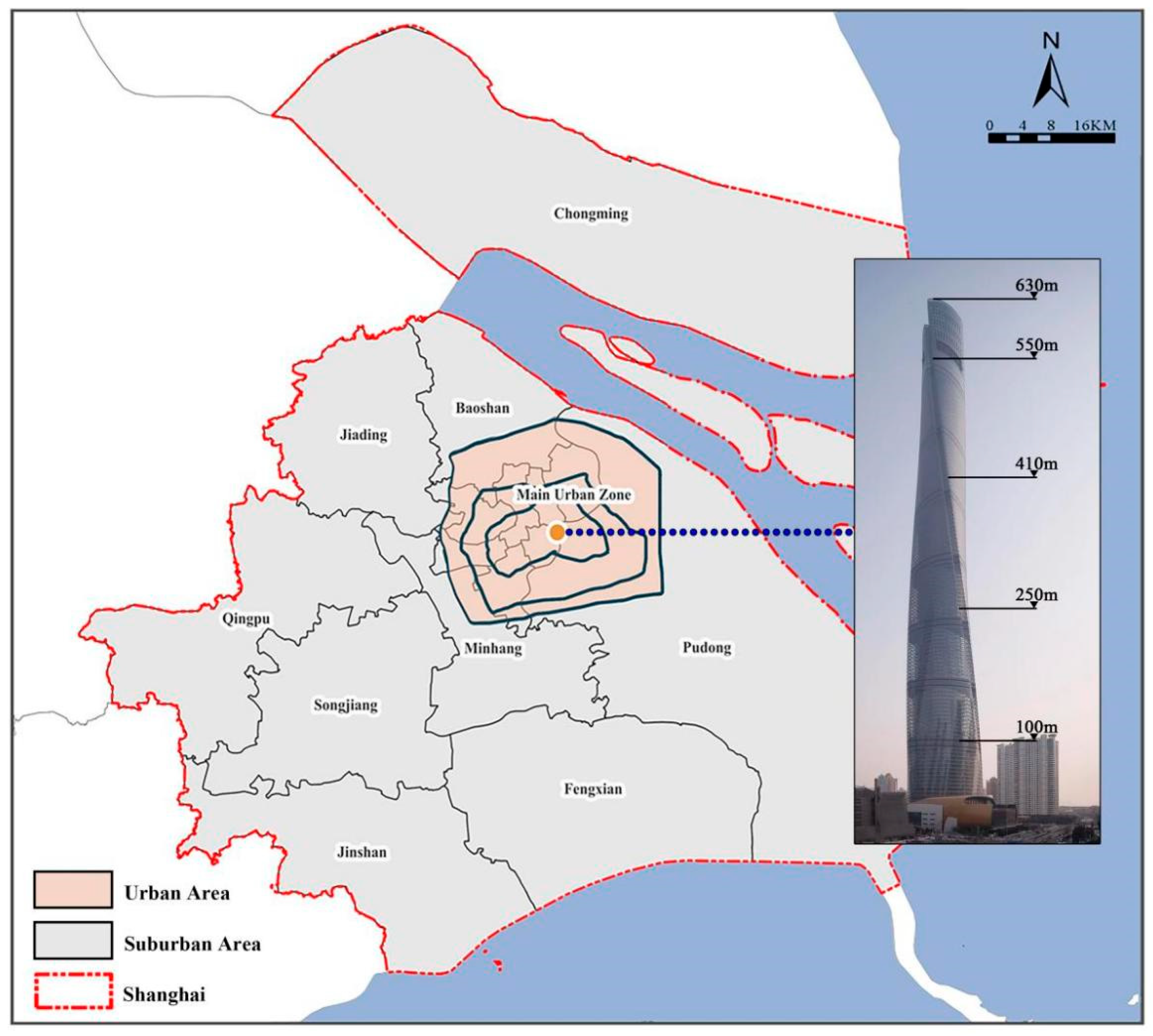
The measurement took place in nine stations at the different heights in the Shanghai Tower (Figure 2), in the following text, this location will be referred to as Shanghai Center.
Vertical daily average CO2 concentration data from August 2024 to August 2025 are obtained from the stations at different heights (represented by the daily averages measured at each height). The stations also provided data on the diurnal variation of CO2 concentrations, expressed as hourly averages throughout the days from August 2024 to August 2025, supporting the analysis of daily variations.
These data cover 8 months, with some dates having missing or abnormal data, which will be addressed in the subsequent analysis. The stations with multiple measurement levels have detection heights at 30 m, 100 m, 180 m, 250 m, 330 m, 410 m, 500 m, 580 m, and the top level at 630 m.
The planetary boundary layer height (PBLH) plays a crucial role in the vertical distribution of CO2 concentrations. Hourly PBLH data for the year 2024 to 2025 were obtained from the ERA5 reanalysis dataset provided by the European Centre for Medium-Range Weather Forecasts (ECMWF) via the Copernicus Climate Change Service platform [66] and processed using Python 3.11.9. The hourly PBLH data from August 2024 to August 2025 were averaged across all 365 days for each hour of the day (00:00–23:00) to produce the mean diurnal cycle, representing the typical daily variation over the year. This processing is consistent with that applied to CO2 concentration data at the SC monitoring station. With a spatial resolution of 0.25° × 0.25°, the PBLH values used correspond to the ERA5 grid cell center nearest to the SC station (31.25° N, 121.50° E), while the SC station itself is located at 31.23° N, 121.48° E.
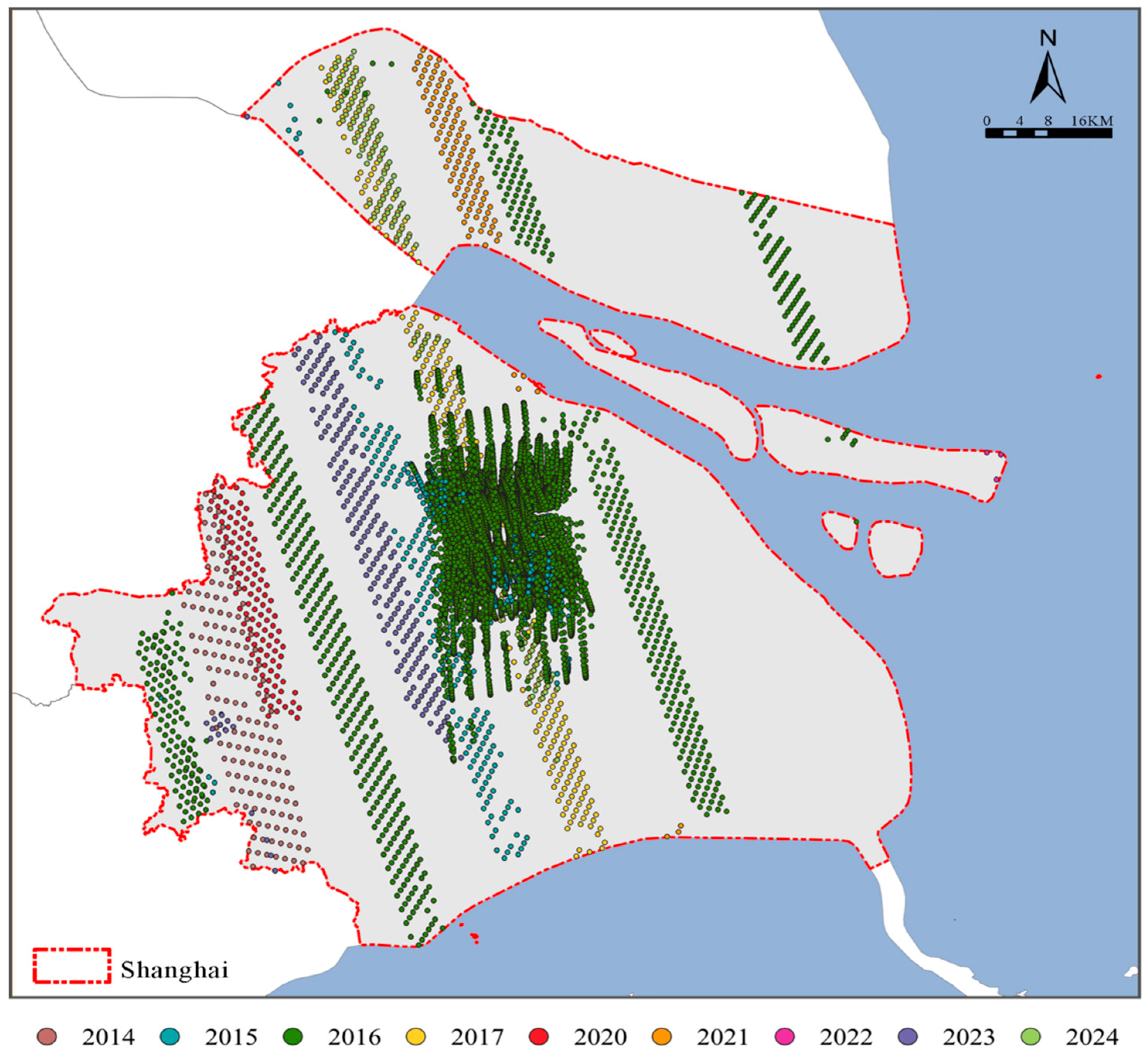
To address the limitation in the number of stations for studying spatial characteristics, this study downloaded the OCO-2 Level 2 XCO2 V11r products (OCO2_L2_Standard) for the winter months (December to February) of 2014–2024 from NASA Earthdata [67]. Valid XCO2 concentration data (column-averaged CO2 dry-air mole fraction, ppm) were retrieved and standardized, resulting in a total of 8875 samples. The data effectively covered all major regions of Shanghai (Figure 3) and are suitable for spatial feature analysis. XCO2 represents the average CO2 content in the atmospheric column, whereas CO2 surface concentration is measured at ground-based monitoring stations. The correlation between the two is typically greater than 0.6. On land, although differences between satellite XCO2 and ground-based CO2 surface concentrations are influenced by local environmental conditions and human activities around the monitoring stations. However, the two datasets overall exhibit high correlation and consistent spatial patterns [68].
This study incorporated multi-source datasets to investigate the factors influencing CO2 concentrations in Shanghai. Five categories of data were utilized: meteorological variables, land use, urban surface characteristics, socio-economic indicators, and major emission sources. Meteorological data included wind speed from NOAA’s National Centers for Environmental Information, interpolated using the inverse distance weighting method [69]; temperature and precipitation from the National Tibetan Plateau Data Center, downscaled from CRU and WorldClim datasets using the Delta method and validated by 496 observation stations across China [70,71]; and longitude, used to control for potential zonal climatic gradients. All meteorological variables were aggregated to monthly means and resampled to a 1 km spatial resolution. Land use data were derived from Wuhan University’s 30 m resolution annual land cover maps (1990–2023), reclassified into nine categories and aggregated to 1 km grids based on proportional area [72]. Urban surface data included water body coverage and road network density (expressways, primary and secondary roads) extracted from OpenStreetMap, and NDVI from NASA’s MOD13A3 dataset, representing vegetation cover [73]. Socio-economic variables comprised 2023 population density data provided by the Shanghai Statistics Bureau, derived from the seventh population census and spatially allocated to 1 km grids [74], as well as district-level housing prices from JuHui Data [75]. Locations of major emission sources, including power plants and steel facilities, were obtained from Amap’s POI database. Euclidean distances between each 1 km grid and the nearest major source were calculated using GIS. All datasets were standardized and spatially aligned using ArcGIS 10.8.2 to ensure consistency.

2.3. Model Setting

2.3.1. Spatial Distribution Analysis of CO2 Concentration in Shanghai

An important area of research at the spatial level, which is also another objective of the research, is the spatial distribution of CO2 concentration. This study analyzes the spatial distribution of column-averaged CO2 concentrations (XCO2) in Shanghai using the OCO-2 Level 2 (OCO2_L2_Standard) product, which provides satellite-retrieved data processed by NASA. The data spans a decade during which global carbon dioxide concentrations have been rapidly increasing. In the Yangtze River Delta region, the growth rate over the past five years has reached as high as 2.37 ppm/year [25]. Thus, differences between data from different scanning tracks are primarily due to temporal variations, with more recent years showing significantly higher carbon dioxide concentrations compared to earlier years. To address this, the data in this study are normalized, all annual data are adjusted to 2023 levels using a standard growth rate of 2.37 ppm/year [25]. Subsequently, spatial interpolation is conducted using the Inverse Distance Weighting (IDW) method in ArcGIS 10.8.2, and the accuracy of the interpolation is assessed by calculating the rRMSE (Relative Root Mean Squared Error).
CO2 emissions increase its concentration, and understanding the location of emission sources and the surrounding environment is significant for analyzing the spatial relationship of CO2 levels. This study identifies the primary emission sources of different sectors within the jurisdiction of Shanghai based on the greenhouse gas emission inventory from the Intergovernmental Panel on Climate Change (IPCC). These sources mainly include emission sources of CO2 from fossil fuel combustion in the energy industry, manufacturing industry, and transportation sector. It then qualitatively compares the impact of key emission sources on the surrounding CO2 concentrations using interpolated CO2 values. Finally, we analyze the NDVI values around emission sources and compare CO2 concentrations in key emission areas under different NDVI conditions to understand the impact of vegetation on CO2 levels.

2.3.2. Analyzing Urban–Rural and Inter-District CO2 Concentration Differences in Shanghai

In order to improve the efficiency of planning and governance and to provide decision-makers with more targeted strategies when formulating emission reduction policies, the study calculates the mean CO2 concentration for each district in Shanghai based on the interpolated CO2 values, and ranks them accordingly. This analysis aims to help decision-makers identify districts with higher CO2 concentrations, enabling them to pinpoint the underlying causes and develop more focused countermeasures. Additionally, to better quantify and accurately reflect the urban–rural differences, this study also compares the CO2 concentrations inside and outside the outer ring road of Shanghai using the Mann–Whitney U test [76,77].
This test is employed to assess the differences between two independent samples when the data does not meet the assumption of normality. These studies offer a quantitative understanding and clearer view of the differences in CO2 concentrations between urban and suburban areas from a data perspective.

2.3.3. Analyzing the Vertical and Temporal Distribution of CO2 Concentration in Shanghai

The vertical distribution of CO2 concentrations at different elevations in Shanghai is a focus of this study. By analyzing the variation of CO2 concentrations with altitude, we aim to gain deeper insights into atmospheric mixing processes and pollution dispersion patterns. We compared the diurnal variations of CO2 concentrations at multiple altitudes with planetary boundary layer height (PBLH), and visualized the hourly mean values of both variables from August 2024 to March 2025. This approach enables a clear depiction of inter-altitude differences in CO2 concentrations, their temporal trends, and the influence of boundary layer dynamics on CO2 distribution.
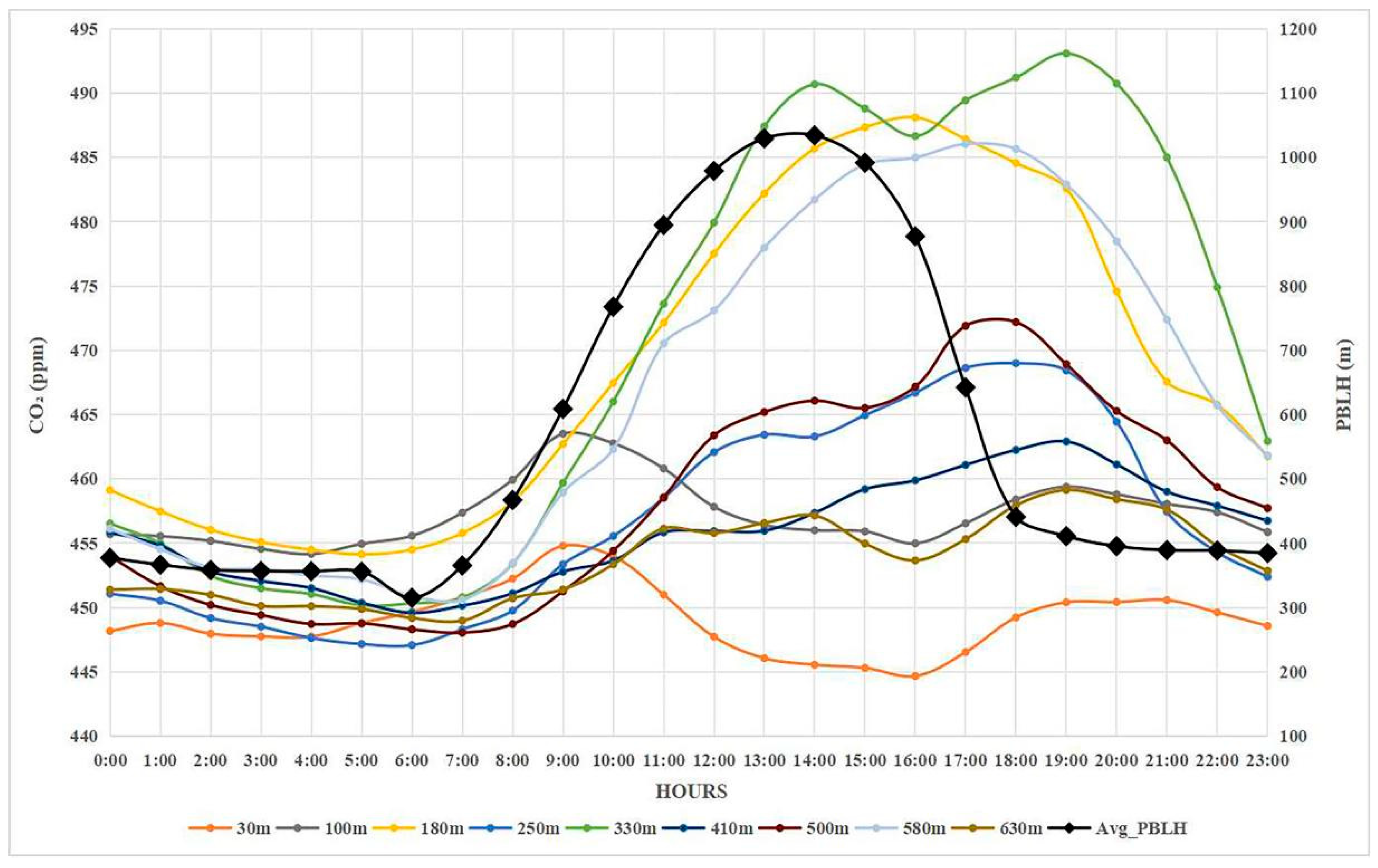
Hourly CO2 concentration and PBLH data were collected continuously over 24 h periods. For each time point, values were averaged across the study period to generate diurnal variation curves for each station (representing different altitudes), along with the corresponding boundary layer height curve. Line plots were used to visualize these trends, with the x-axis representing each hour of the day (0–23), and the primary and secondary y-axes displaying CO2 concentration (ppm) and boundary layer height (m), respectively. Distinct colors were assigned to each station for clarity, and the boundary layer height was highlighted using a black line with enlarged diamond markers for emphasis. This visualization method effectively identifies typical diurnal patterns of CO2 concentrations at various altitudes and reveals the influence of boundary layer height fluctuations on vertical CO2 distribution.
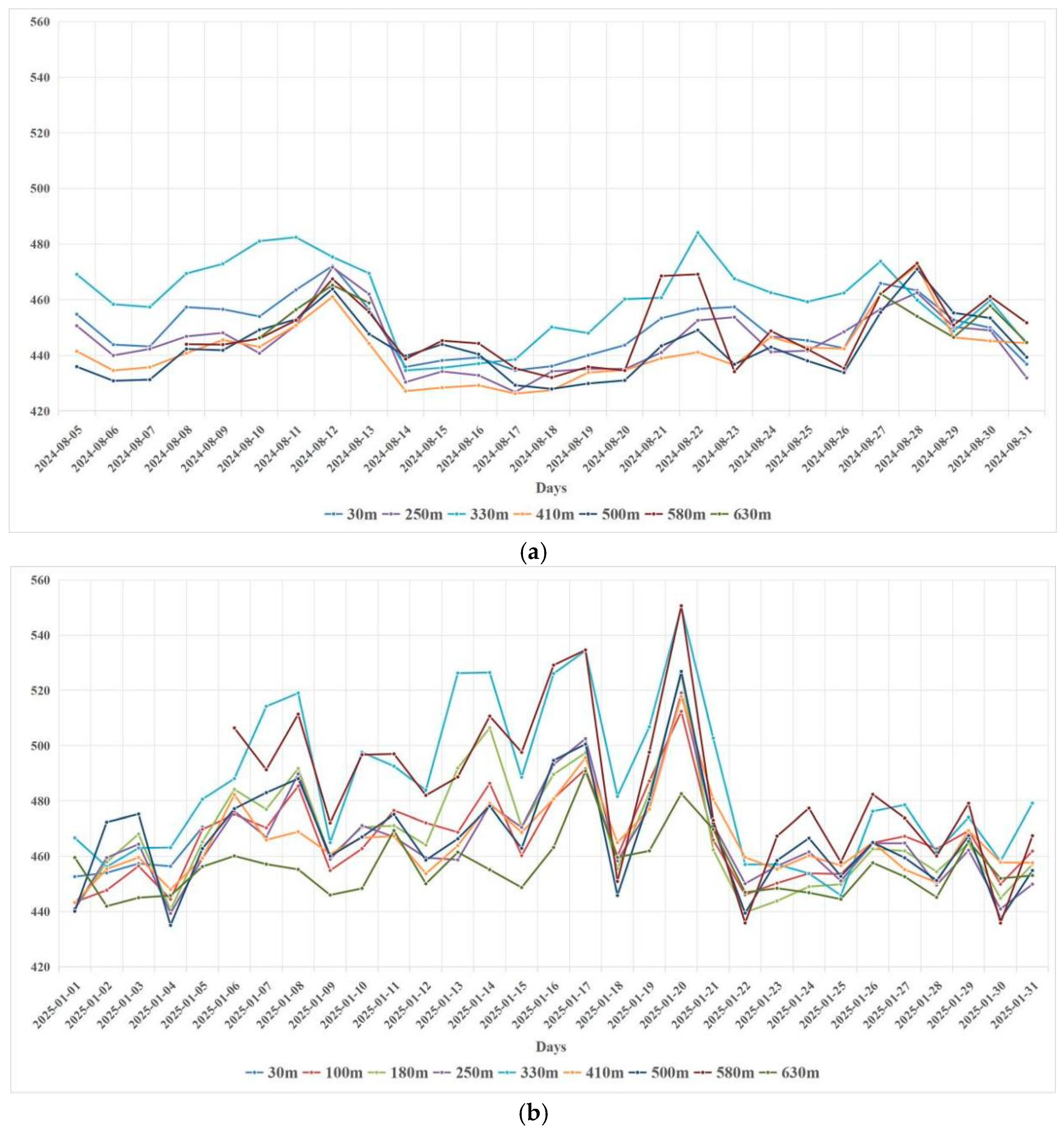
A time series analysis is conducted in this study to understand the temporal patterns of carbon dioxide (CO2) concentrations of the monitoring stations at different heights in Shanghai center. Through data processing and integration, daily average CO2 data are obtained, mitigating the impact of outliers and missing data. Time series plots are then generated for the daily average CO2 concentration during August 2024 (summer) and January 2025 (winter) at each monitoring station. The data from these two months represent the most typical seasonal CO2 concentration distribution patterns of the year, corresponding to the lowest (summer) and highest (winter) periods.
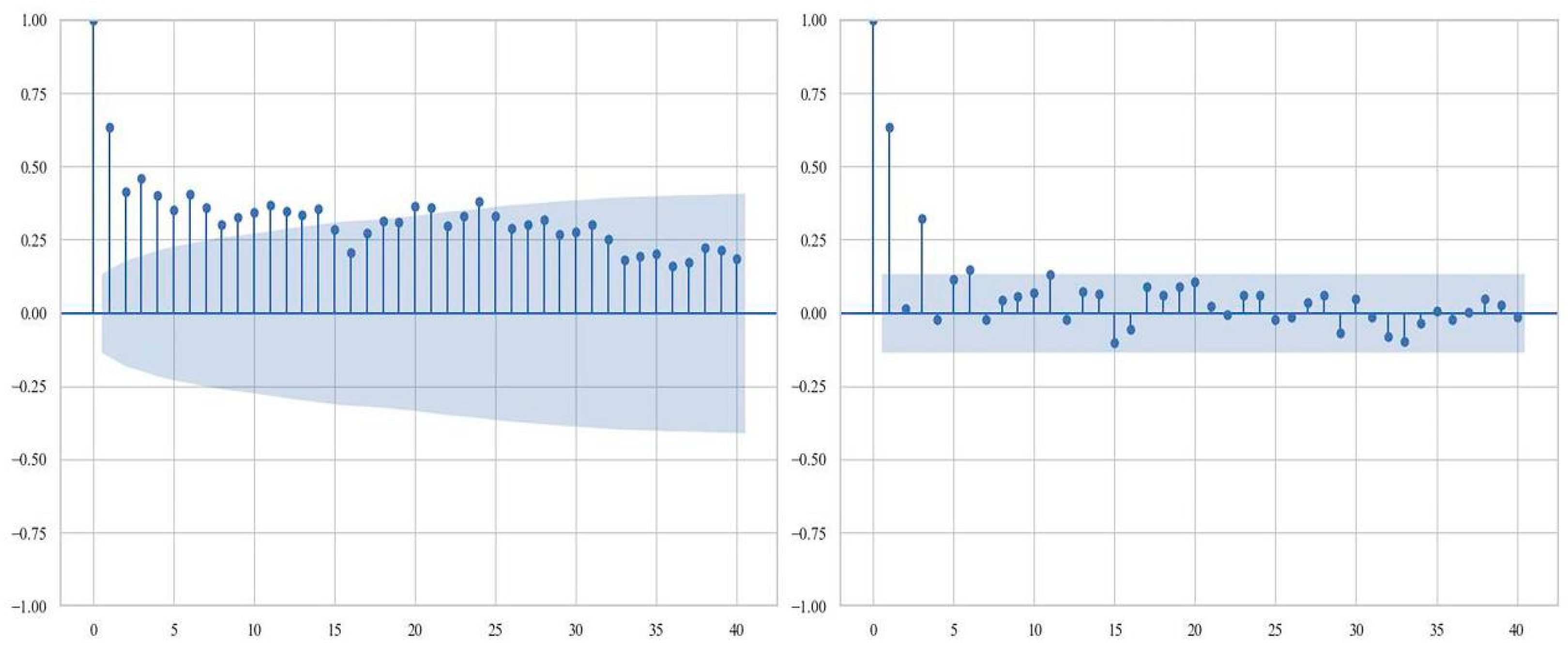
Additionally, to further investigate the stationarity and potential seasonal characteristics of carbon dioxide concentrations, we plot the ACF (Autocorrelation Function) graphs for the mean of the daily mean carbon dioxide concentrations across eight stations at different heights in Shanghai center. By analyzing the tapering or cut-off patterns in the results, we evaluate whether carbon dioxide concentrations exhibit periodicity or seasonality, as well as the relationships between carbon dioxide concentrations at different lags.

2.3.4. Diagnostic Screening of Influencing Variables on CO2 Concentration

To enhance the accuracy and reliability of regression models evaluating the impact of urban factors on CO2 concentrations, this study implemented a systematic screening process for 13 candidate variables (Table 1): population density, second-hand housing price, new housing price, water system, impervious surface, distance to major emission sources, longitude, local road network, highway density, NDVI, average wind speed, average precipitation, and average temperature. The selection integrated both theoretical relevance and empirical diagnostics. On the theoretical side, variables were chosen based on prior studies in urban planning and environmental science to ensure the inclusion of well-established drivers of CO2 variation. Empirically, statistical diagnostics were applied to identify redundant variables and address multicollinearity, thereby improving explanatory power and model stability.
Collinearity was assessed using the Variance Inflation Factor (VIF) and Tolerance (Table 2). Variables with VIF values exceeding 10 were considered to exhibit severe multicollinearity; accordingly, longitude (VIF = 10.022) was excluded. Pearson correlation analysis further identified a strong positive correlation between second-hand housing price and new housing price (r = 0.854, p < 0.01), suggesting redundancy, leading to the removal of the former. As a result, 11 variables were retained for subsequent regression modeling, encompassing demographic pressure (population density), economic activity (new housing price), ecological conditions (NDVI, water system), land cover characteristics (impervious surface), transportation infrastructure (local road network, highway density), proximity to emission sources (distance to major emission sources), and climatic conditions (average wind speed, average precipitation, and average temperature). This screening process minimized statistical distortion, stabilized coefficient estimation, and enhanced model interpretability, laying a solid foundation for the following OLS and spatial analyses.

2.3.5. Assessing the Importance of CO2 Influencing Factors Using Random Forest

While Ordinary Least Squares (OLS) regression provides interpretable coefficient estimates, it assumes linearity and spatial stationarity, which may limit its ability to capture non-linear relationships and complex interactions between variables. Moreover, OLS results cannot directly quantify the relative contribution of each explanatory variable to CO2 concentration variations.
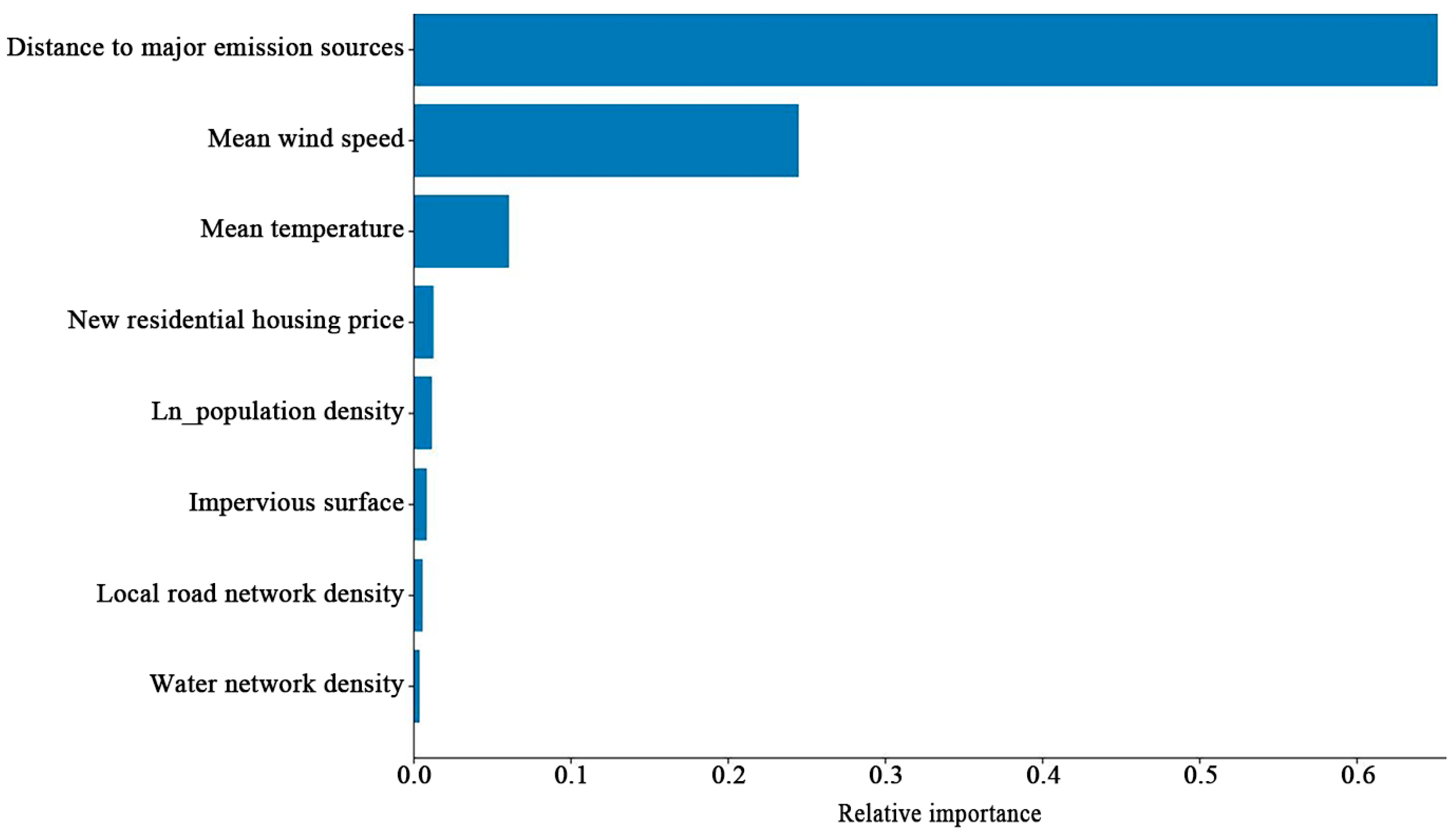
To address these limitations and complement the OLS analysis, this study employed the Random Forest (RF) algorithm, a non-parametric ensemble learning method. RF models the relationship between the selected explanatory variables and CO2 concentrations by aggregating the predictions of multiple decision trees, which enhances model stability and reduces overfitting. In this study, RF was used to derive the relative importance ranking of explanatory variables, providing a quantitative assessment of their contributions to CO2 concentration patterns.

2.3.6. Explaining the Contributions of Influencing Factors with SHAP

To further elucidate the mechanisms underlying the relationships identified by RF, SHapley Additive exPlanations (SHAP) were applied. SHAP is an interpretable framework grounded in cooperative game theory, which attributes the prediction outcome to individual variables by calculating their marginal contributions across all possible feature combinations.
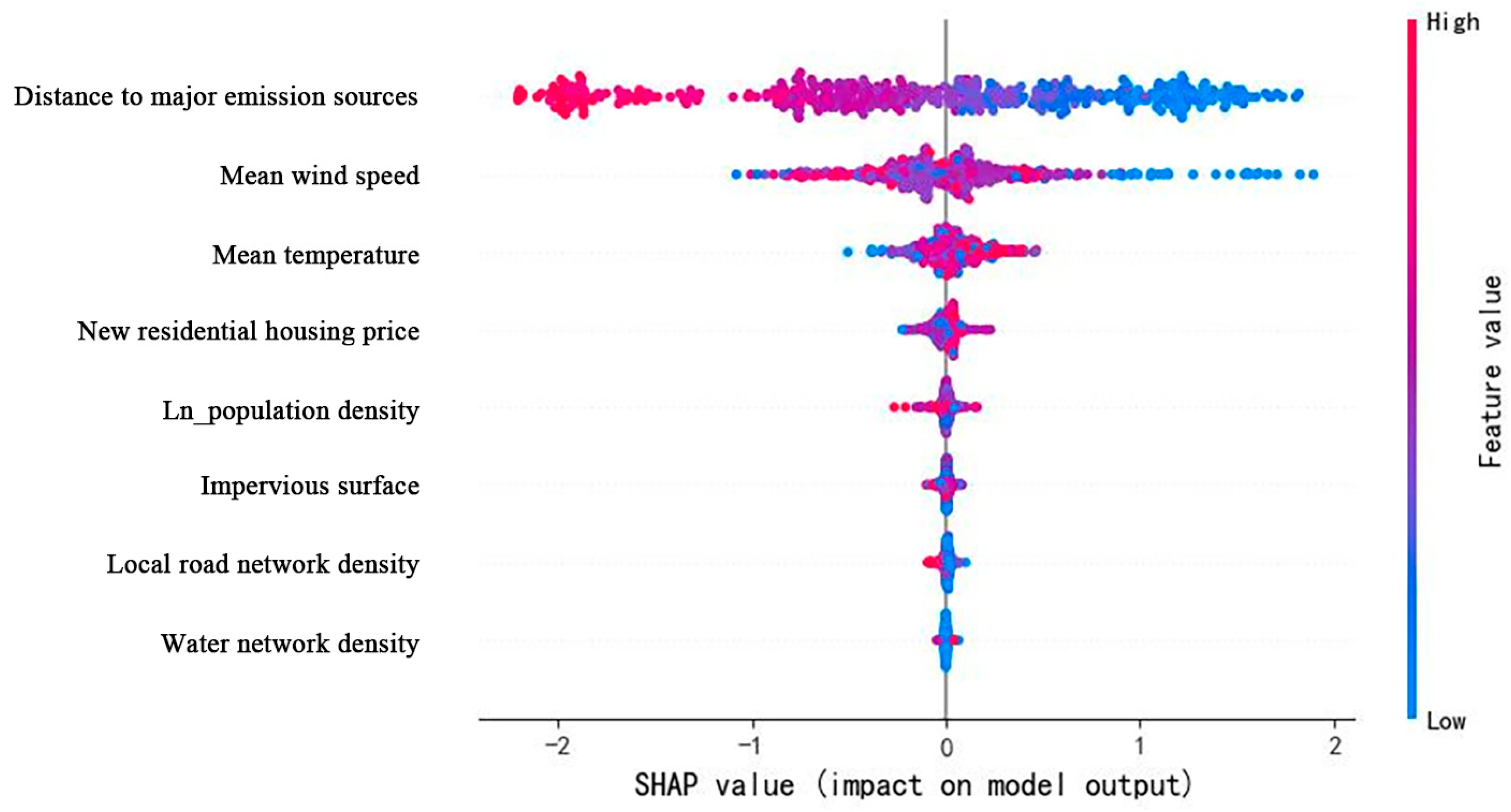
In this study, SHAP was employed to quantify both the magnitude and direction of each variable’s effect on CO2 concentrations. It also revealed potential non-linearities, threshold effects, and interactions among variables. By providing both global and local interpretability, SHAP allowed a more nuanced understanding of how socio-economic, meteorological, and built environment factors jointly influence intra-urban CO2 concentrations.

3. Results

3.1. Spatial Distributions of CO2 Concentration in Shanghai

The satellite-retrieved XCO2 data is generally comparable to ground-based CO2 concentration measurements, with a high correlation observed, particularly over land [68]. Consequently, interpolation studies based on CO2 satellite data can reflect the spatial distribution of CO2 concentrations in urban areas.
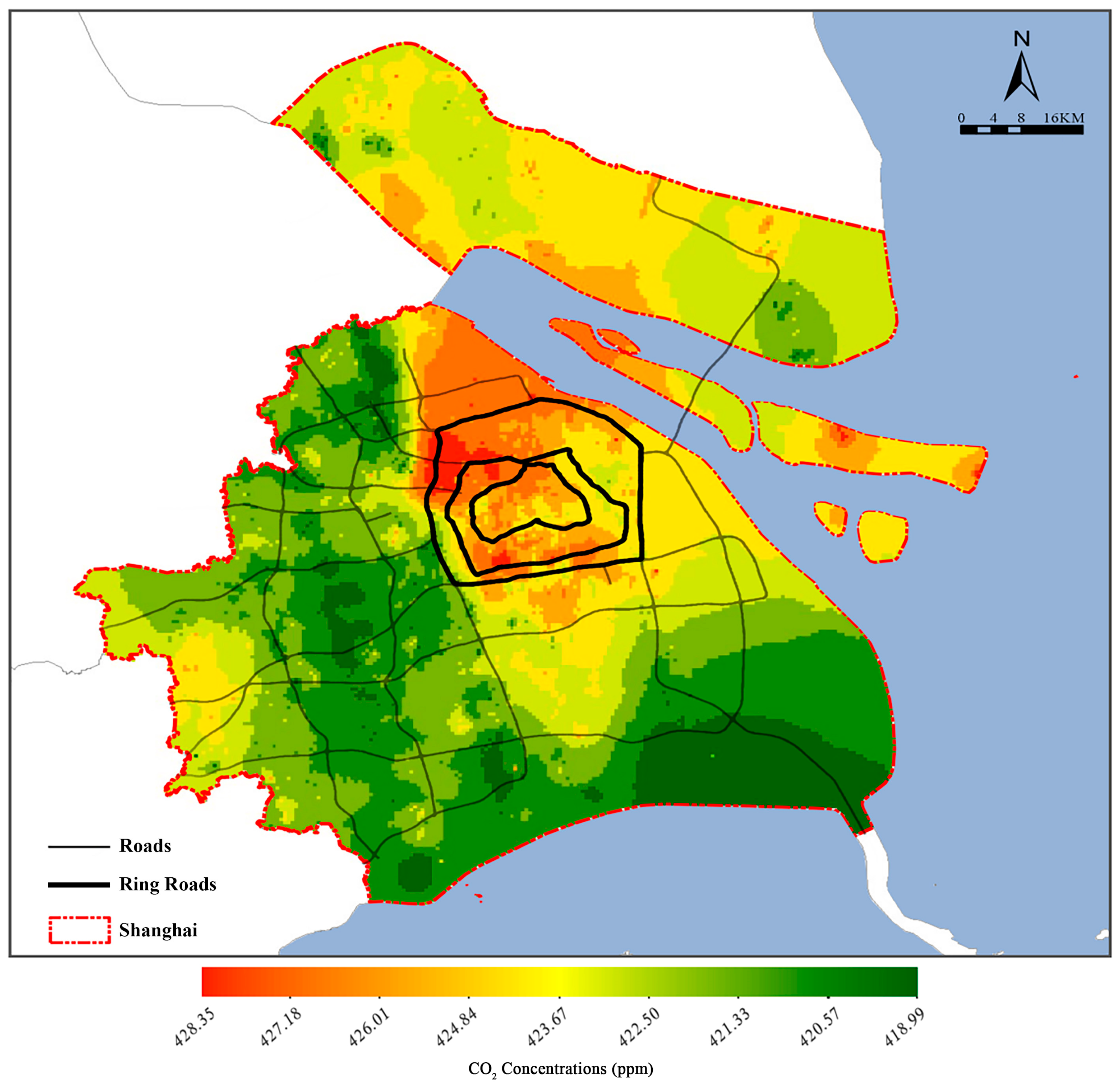
Results obtained through the IDW interpolation indicate that the spatial distribution of CO2 concentrations across Shanghai demonstrates urban–rural disparities (Figure 4). The concentration values range from approximately 418.96 ppm in suburban areas to over 427.30 ppm in urban centers. To verify the accuracy and effectiveness of the interpolation methods, this study employed a cross-validation approach to assess the performance of the interpolation results. Specifically, 80% of the monitoring sites were randomly selected for model training, while the remaining 20% were used to validate the model’s predictive accuracy. Evaluation metrics included the Root Mean Square Error (RMSE) and the relative Root Mean Square Error (rRMSE), where RMSE measures the average deviation between predicted and observed values, and rRMSE standardizes RMSE to eliminate the influence of measurement units, allowing for comparison across different scales. All four interpolation methods yielded highly similar rRMSE values (~0.00358), indicating comparable overall accuracy; consequently, RMSE was used as the primary criterion for model selection. Among the four methods, the second IDW (Inverse Distance Weighting) model produced the lowest RMSE (1.363), and was therefore adopted for the spatial interpolation of CO2 concentrations in this study.
The city center exhibits the highest CO2 concentrations, exceeding 425 ppm, particularly concentrated in the central business districts and densely populated areas. In contrast, suburban and green areas surrounding the urban core show relatively lower CO2 concentrations, typically below 420 ppm. These peripheral areas are characterized by lower levels of urbanization and a more dispersed population. Although the difference between urban and suburban areas may appear modest (approximately 5–10 ppm), such a disparity is considered substantial in CO2 studies, as background concentrations are generally stable, and even small numerical variations can reflect significant differences in local emissions, energy use, and atmospheric mixing processes [1,56].
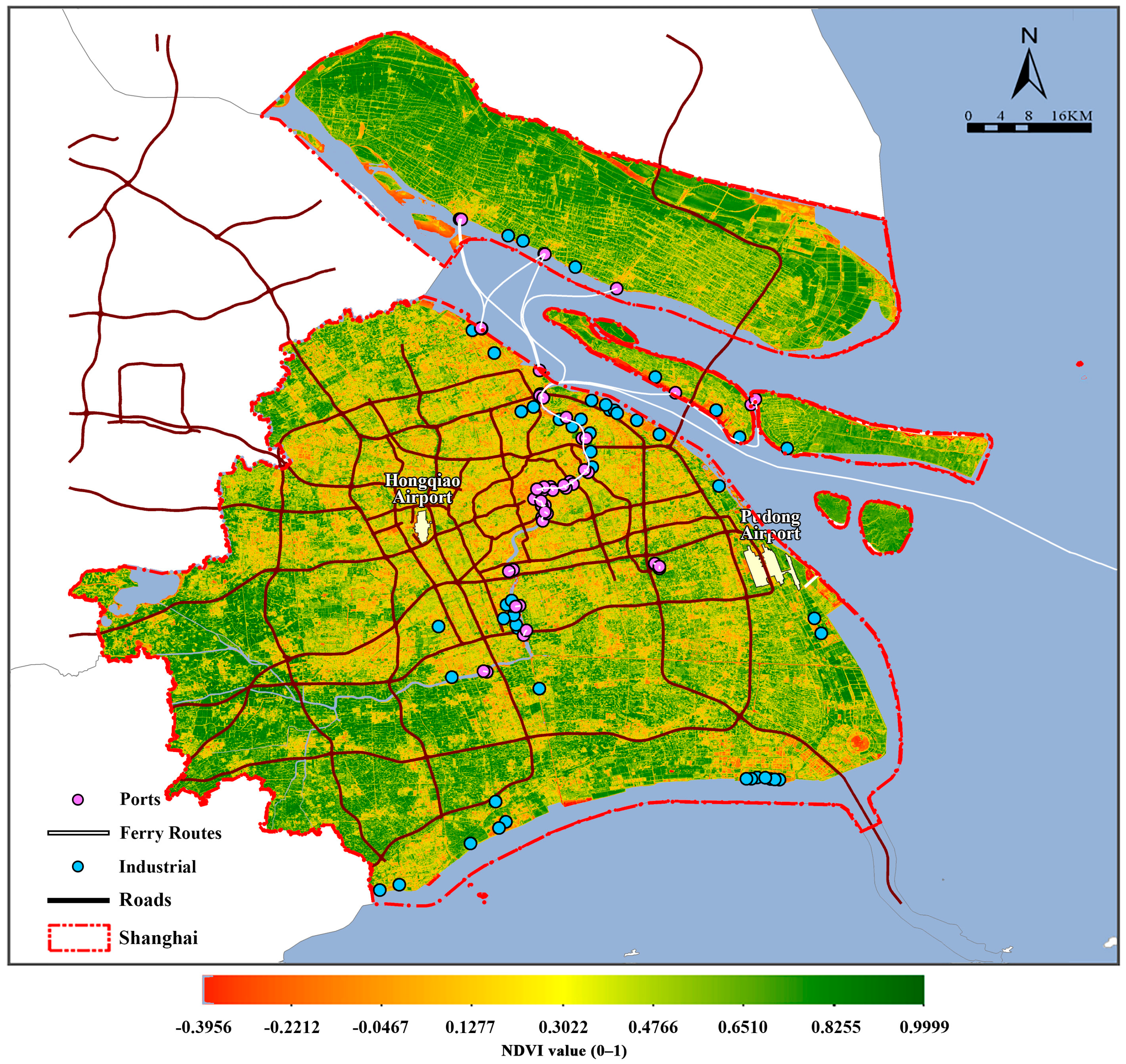
The analysis highlights localized CO2 concentration peaks within the urban zone, aligning with known highly populated areas and transportation hubs, mainly near Hongqiao Airport, the city center, and around the inner and outer ring roads. Conversely, pockets of lower concentrations are observed in suburbs with extensive green spaces, such as parks and forested regions. Such results provide clear evidence of a pronounced urban–rural divide in CO2 concentrations. However, it is worth noting that the CO2 concentrations near the mouth of the Huangpu River and its surrounding areas are higher than in nearby suburban regions. Considering the numerous ports and maritime routes in this area, this result appears reasonable. Hence, when addressing CO2 concentrations, port cities, particularly those with large international ports, should not be overlooked as key regions of focus.
Building on the spatial patterns shown in Figure 4, Figure 5 further compares key emission sources with the NDVI distribution to examine how surrounding environments influence CO2 levels (Figure 5). Areas with concentrated heavy industry generally correspond to higher CO2 concentrations; however, this relationship is not absolute, as vegetation coverage can mitigate emissions locally. For instance, the southern coastal region, although densely industrialized, exhibits relatively low CO2 levels due to extensive vegetation, particularly in the southeastern areas with large parks and green belts. Compared with the impervious surfaces of the city center, these vegetated zones help reduce local concentrations. In addition, CO2 concentrations tend to increase with higher road density, while ports and shipping routes show elevated levels along the coastline. Emissions from ports, ships, and maritime transport are often overlooked, yet they contribute noticeably to CO2 accumulation near the coast.

3.2. CO2 Concentration Urban–Rural and Inter-District Differences in Shanghai

The study finds that the mean CO2 concentration obtained through interpolation across Shanghai (Figure 3) shows evident spatial differences between the districts (Figure 1 & Table 3). Putuo and Jing’an districts have the highest CO2 concentrations, highlighting the characteristic trend of higher CO2 levels in densely populated urban centers. This pattern is also reflected in other districts close to the city center, such as Hongkou, Yangpu, Changning, and Huangpu. In contrast, suburban districts like Jiading, Qingpu, Songjiang, Jinshan, and Fengxian exhibit lower CO2 concentrations, reinforcing the general pattern of higher CO2 levels in urban areas and lower concentrations in suburban regions. These characteristics reflect a degree of urban–rural differences.
Notably, although Pudong New Area contains a core urban area represented by Lujiazui, its overall CO2 concentration remains relatively low. This is likely due to its large geographic area, much of which is located in suburban zones, as well as its proximity to the ocean. On the other hand, Baoshan District, although also located near the ocean and primarily suburban, shows higher CO2 concentrations. This is due to the influence of shipping and port operations at the Yangtze River estuary, which contribute significantly to CO2 emissions. A similar pattern is observed in Chongming District, where CO2 concentrations remain elevated despite its coastal location and distance from the city center. This suggests that factors such as port activities and localized meteorological conditions play a role in maintaining higher CO2 levels in these areas.
Additionally, the quantitative analysis of urban–rural differences using the Mann–Whitney U test for areas inside and outside the Outer Ring Road also indicate the difference in CO2 concentrations between the city center (U = 1,234,567.0000, p = 0.0123) and the suburbs, as p < 0.05. Therefore, we reject the null hypothesis and conclude that there is a statistically significant difference in CO2 concentrations between the two areas. The results further support the idea that CO2 concentrations tend to be higher in urban areas with dense populations, highlighting the spatial differences between urban and rural regions.

3.3. Vertical and Temporal Distribution Patterns of CO2 Concentration in Shanghai

Vertical distribution analysis explores the variation of CO2 concentrations at different heights and the interaction between them and the planetary boundary layer height (PBLH) in Shanghai, providing insights into atmospheric mixing processes and pollutant dispersion.
The vertical distribution of CO2 concentration generally decreases with increasing altitude but shows distinct patterns influenced by the planetary boundary layer height (PBLH) (Figure 5). At lower altitudes, from 30 m to 180 m, CO2 concentrations are relatively high, with values rising from approximately 448 ppm at 30 m to around 467 ppm at 180 m, indicating accumulation near the surface under a shallow PBLH during nighttime. Between 180 m and 580 m, concentrations stabilize with moderate fluctuations, and peaks observed at 180 m, 330 m, and 580 m may result from local meteorological or environmental factors. Above 580 m, CO2 concentration sharply declines, reaching a minimum near 450 ppm at 630 m, showing reduced influence from surface emissions at higher altitudes. These vertical concentration variations are closely linked to the diurnal cycle of PBLH in Shanghai, where the boundary layer remains low and stable at night (around 300 m), trapping emissions near the surface and causing higher CO2 concentrations at low altitudes such as 30 m. During the day, PBLH rapidly increases, exceeding 1000 m around 14:00, promoting turbulent mixing that dilutes near-surface CO2 levels but raises concentrations aloft (e.g., at 250 m and 500 m). This process results in a daytime decrease of about 20 ppm at 30 m, contrasted by a 30–50 ppm increase at higher altitudes, reflecting vertical transport and entrainment of CO2-rich air from above. Consequently, the PBLH modulates the vertical CO2 gradient by controlling the extent of atmospheric mixing and the height of accumulated emissions, explaining the observed concentration patterns across different elevations.
The diurnal variations in CO2 concentrations at different vertical heights exhibit distinct stratification characteristics, with an overall trend of first increasing and then decreasing along the vertical profile (Figure 6). Specifically, in the lower layers below 100 m (30 m and 100 m), CO2 concentrations follow a “morning peak–afternoon trough” pattern: at 30 m, concentrations reach a peak around 09:00, then gradually decline to the lowest point by 16:00. At 100 m, the peak occurs slightly later, around 09:30–10:00, with a weaker fluctuation compared to 30 m.
In contrast, the middle-to-upper layers above 100 m (180–630 m) show the opposite trend. CO2 concentrations remain at lower levels during nighttime and increase continuously during the day as the boundary layer rises, reaching a peak between 16:00 and 19:00 before declining. The peak time at higher elevations (e.g., 330–630 m) is slightly delayed with increasing height. Notably, the vertical distribution of CO2 concentrations follows a “rise-then-fall” pattern, with 100 m serving as a dividing line: below this height (≤100 m), CO2 concentrations are predominantly influenced by surface activities, resulting in significant diurnal fluctuations, whereas above 180 m, variations are closely tied to the diurnal evolution of the boundary layer. Enhanced daytime mixing facilitates the upward transport of CO2 from lower layers, while nighttime boundary layer descent suppresses vertical exchange. This stratification highlights the role of boundary layer dynamics in shaping the vertical distribution of CO2, revealing distinct diurnal variation mechanisms at different height levels.
The analysis of the CO2 time series (Figure 7a,b) reveals remarkable seasonal fluctuations and short-term variability at the monitoring station of Shanghai center in August 2024 (summer) and January 2025 (winter). Overall, CO2 concentrations are consistently higher in January than in August, with more pronounced daily fluctuations. In August, CO2 concentrations remain relatively low (approximately 430–480 ppm) and exhibit stable daily variations with minimal differences across heights. In contrast, January shows significantly higher CO2 concentrations (approximately 440–550 ppm) with a more pronounced vertical gradient. Regardless of the season, CO2 concentrations followed a pattern of being highest at mid-level heights and lower at both extremes, with the highest values observed at 330 m, while concentrations at 30 m and 630 m remained lower. Additionally, the daily fluctuation in January is more significant than in August, with distinct peaks on specific days (e.g., 12–14 January and 22–23 January), whereas August exhibits a more synchronized trend across different heights. Compared to August, the vertical differences in CO2 concentrations are more pronounced in January, indicating a stronger influence of altitude on winter CO2 levels. These results highlight a clear seasonal pattern, with higher and more unevenly distributed CO2 concentrations in winter, while summer concentrations are lower and more uniform across different heights.
From the ACF and PACF plots (Figure 8), it can be observed that carbon dioxide concentrations in Shanghai center are non-stationary, indicating that concentrations change over time and exhibit periodic characteristics. This is reflected in the ACF plot by a trailing pattern and in the PACF plot by a cutoff pattern, suggesting the potential presence of seasonal variations in carbon dioxide concentrations. The concentrations show strong autocorrelation over specific periods, with minimal variation in concentrations over consecutive days. The PACF plot reveals a strong correlation between carbon dioxide concentrations and those of the preceding day, while the relationship with concentrations beyond the third lag diminishes rapidly.

3.4. OLS Model Results for CO2 Concentration and Urban Factors

Ordinary Least Squares (OLS) regression was conducted using the 11 selected variables to quantify their influence on spatial CO2 distribution (Table 4). The model achieved strong explanatory power (R2 = 0.670), indicating that the retained variables collectively account for 67% of the variance in CO2 concentration. Among the predictors, distance to major emission sources emerged as the most influential factor with a substantial negative coefficient (β = −0.750, p < 0.01), confirming that proximity to emissions strongly elevates local CO2 levels. Population density (β = 0.025, p < 0.01) and new housing price (β = 0.029, p < 0.01) were positively associated with CO2 concentration, reflecting the influence of urban demand and affluence. Transportation infrastructure variables, including local road network (β = −0.053, p < 0.01) and highway density (β = −0.023, p < 0.01), also showed significant albeit negative coefficients, suggesting complex interactions potentially driven by spatial allocation rather than traffic volume. Climatic variables such as average wind speed (β = −0.205, p < 0.01) and average temperature (β = 0.183, p < 0.01) exerted strong effects as well, underscoring the meteorological modulation of CO2 dispersion and accumulation. In contrast, NDVI and average precipitation had weaker or non-significant impacts, indicating limited short-term mitigation through green cover and rainfall.

3.5. Random Forest Results for CO2 Driver Importance

The RF analysis results (Figure 9) show clear disparities in the relative importance of the influencing variables. The distance to major emission sources emerged as the dominant factor, with a contribution far exceeding that of other variables. Among meteorological factors, average wind speed and average temperature also showed notable importance, followed by socio-economic indicators such as population density and new housing price, albeit with smaller contributions. Other built environment variables, including impervious surface ratio, road density, and water system density, had only marginal effects.

3.6. SHAP Results for CO2 Driver Mechanisms

The SHAP summary plot (Figure 10) further revealed the mechanisms behind these relationships. The contribution values of the distance to major emission sources were concentrated in the positive range, indicating that greater distance generally increased the predicted CO2 concentration. Average wind speed exhibited both positive and negative effects, reflecting its role in dynamically modulating pollutant dispersion. Average temperature had weaker, more variable effects. New housing price and population density displayed contributions clustered around zero, implying more localized and indirect influences, while impervious surface ratio, road density, and water system density exerted minimal impact.
These results highlight pronounced disparities in the relative importance of influencing factors, with CO2 concentration patterns in Shanghai being shaped primarily by emission source distribution and meteorological dynamics, and secondarily by socio-economic and built environment characteristics. In summary, the analyses identifies a small set of dominant drivers, clarifies their mechanisms of action, and underscores the need to prioritize these key factors in targeted emission reduction strategies.

4. Discussion

We first conduct a general discussion of the spatial, vertical, and temporal distribution characteristics of CO2 concentrations. Then, we provide an detailed discussion on several key features that are relevant to urban environmental development. Finally, we propose a series of recommendations for urban policy-making and urban planning.
The analysis of the spatial interpolation shows the city center of Shanghai has higher CO2 concentrations and broader data ranges, attributed to dense populations, heavy traffic, and concentrated CO2 emissions from buildings [17]. This spatial difference of CO2 concentration also reflects the spatial heterogeneity in emission sources and the mitigating effects of vegetation. The findings underscore the importance of urban planning and green infrastructure in mitigating urban CO2 emissions and enhancing air quality in metropolitan areas like Shanghai [78]. It is clear that increasing the area of green spaces or the coverage of green vegetation is an important way to achieve the goal of reducing CO2 concentrations, especially in city centers and industrial areas, where the impact of green plants on CO2 concentrations within a certain range is decisive [79]. Additionally, multiple outliers in urban stations’ box plots suggest sudden spikes in CO2 concentrations likely caused by traffic congestion, industrial surges, or adverse meteorological conditions such as low wind speed or temperature inversions, which hinder pollutant dispersion [78]. These findings are crucial for developing targeted air quality management strategies, especially in urban areas where air quality fluctuations are significant [80].
Vertical analysis indicates that CO2 concentrations are generally higher at mid-level altitudes (particularly between 180 m and 330 m), showing an overall trend of increasing before decreasing. However, this trend is not absolute, as there is considerable fluctuation within this height range. This stratification suggests that limited atmospheric mixing during certain periods can lead to CO2 accumulation at these heights. For example, during winter, lower temperatures and stable atmospheric conditions often result in temperature inversions that prevent upward diffusion of CO2 [81]. CO2 concentration is closely linked to boundary layer height (PBLH). At night, limited turbulent diffusion leads to CO2 accumulation near the surface. With the onset of daytime heating, the rising PBLH promotes convective mixing and stimulates photosynthetic uptake, reducing near-surface CO2. In the afternoon, intensified turbulence facilitates upward transport, increasing concentrations at higher altitudes. As nocturnal cooling sets in, the PBLH becomes shallow again, restricting CO2 within the surface layer [82,83]. Additionally, the vertical distribution of CO2 also shows seasonal variation, with higher concentrations at mid-level altitudes in winter and more uniform distribution in summer. Such seasonal variations may be driven by changes in atmospheric stability and temperature gradients, which affect vertical air movement and CO2 distribution [84].
The daily variation of CO2 concentration is likely related to plant photosynthesis. Research has shown that the decrease in CO2 concentration from 8 AM to 11 AM aligns with the enhancement of photosynthesis [85]. Meteorological factors such as temperature and humidity may also indirectly influence the temporal characteristics of CO2 concentration by affecting plant photosynthesis and respiration [31]. Studies on Seoul also indicate that the distribution of CO2 concentrations exhibits a similar daily variation pattern, with peaks typically occurring at 7:00 AM and troughs at 4:00 PM [86]. The study also observed that the diurnal variation of CO2 concentrations differs at different heights, with notable distinctions occurring between 100 m and 180 m. This may be related to the nighttime boundary layer decline. During the day, this height range is typically within the boundary layer, but at night, areas above 100 m may extend beyond the boundary layer, leading to distinctly different diurnal variation patterns of CO2 concentrations. These phenomenon suggests that while CO2 concentration variations exhibit similarities across cities, they differ at different heights, though further research is needed to verify this. Additionally, temporal analysis found that CO2 concentration in Shanghai exhibits seasonal variations, with lower levels in summer and higher levels in winter. Considering that Shanghai is located at the southernmost edge of the mid-latitude region in the Northern Hemisphere, and there is no large-scale fossil fuel emissions during the winter, this variation is more likely to be associated with changes in NDVI. From spring to summer, as the photosynthesis of vegetation gradually strengthens and reaches its peak, CO2 concentration decreases and reaches its lowest point. In contrast, with the increase in plant respiration during autumn and winter, the ability of NDVI to absorb CO2 also decreases, leading to a peak in CO2 concentration [24,25].
The OLS regression analysis further elucidates the multifaceted drivers behind the spatial variability of CO2 concentrations in Shanghai, complementing the observed distribution patterns. The significant positive associations between population density and new housing price with CO2 concentration highlight the strong influence of urbanization intensity and economic activity on local carbon emissions. These findings align with previous studies indicating that densely populated and economically developed urban cores tend to experience elevated CO2 levels due to higher energy consumption, vehicular traffic, and building-related emissions [17]. Conversely, the negative coefficients for NDVI and water systems reaffirm the critical role of green and blue infrastructure in mitigating CO2 accumulation, supporting the spatial heterogeneity discussed earlier. Notably, the strong negative effect of distance to major emission sources underscores the localized impact of industrial and traffic-related emissions on urban air quality [87]. The observed negative associations for transportation infrastructure variables, such as local road network and highway density, may reflect complex spatial dynamics where higher road densities coincide with areas that have been urbanized with mitigation measures or where traffic patterns differ, warranting further investigation. Climatic factors, particularly average wind speed and temperature, also exhibited significant effects, consistent with their roles in influencing pollutant dispersion and atmospheric chemistry. Overall, the regression results reinforce the intertwined influence of socioeconomic, environmental, and meteorological factors on urban CO2 distribution, providing actionable insights for integrated urban planning and emission reduction strategies.
Based on the analysis of the research results, our study offers several new directions for policy-making. The first is the monitoring and reduction of CO2 emissions in activity-dense areas of the city center. The city center is characterized by high foot traffic, especially in areas with concentrations of shopping, dining, and office activities, combined with crowded transportation. These areas experience high levels of emissions, which contribute to the elevated CO2 concentrations in urban centers. While background concentrations cannot be influenced, a reduction in activity levels can improve urban CO2 concentrations, thus improving air quality [88,89,90]. Measures such as increasing green spaces, promoting energy-efficient buildings, and optimizing public transportation systems could help reduce CO2 emissions in certain areas [91].
The second measure focuses on traffic-dense areas, particularly elevated roads, where CO2 management should be enhanced. Studies have shown that transportation is a major source of urban CO2 emissions, particularly in large cities like London, Paris and Seoul. CO2 concentrations are closely linked to vehicle emissions, particularly from diesel vehicles. The increase in traffic volume will lead to increased CO2 and affects environmental quality [89,92]. Considering that Shanghai is also a megacity with heavy traffic, strict emission controls should be implemented in high-traffic corridors, such as establishing low-emission zones and promoting electric vehicles, which will help reduce CO2 concentrations.
Next, as an important transportation hub, airports often generate high levels of CO2 emissions [93], which could be a major factor contributing to the increased CO2 concentrations at airports. This issue is becoming more pronounced due to the rise in air traffic, the expansion and construction of airports, which are all driven by urban development. With the civil aviation industry in China ranking among the largest in the world, CO2 emissions from the aviation sector are expected to continue growing [94]. Shanghai, with its two large international airports, faces significant challenges in its efforts to reduce emissions locally. Hence, regardless, stricter CO2 monitoring and reduction measures at airports are crucial. Specifically, promoting sustainable aviation fuels and improving operational efficiency will help reduce CO2 emissions at airports.
Moreover, the ports of large cities are often overlooked as high CO2 concentration areas. Due to their international nature and large-scale transportation activities, ports can result in high CO2 emissions, which considerably affect the distribution of CO2. Some cities, such as Mumbai and Kaohsiung, have already implemented measures to limit CO2 emissions from ports [95,96]. Consequently, policies could include tightening emission standards for port facilities, promoting cleaner fuels, and enhancing cooperation with surrounding cities and countries to reduce CO2 emissions from ports.
Finally, progress in monitoring technology is also essential. Due to some differences between satellite data and surface monitoring stations, satellite data cannot fully reflect surface CO2 concentrations in urban scale and, therefore, monitoring efforts, particularly in underrepresented areas, should be strengthened by expanding the monitoring network and increasing the number of stations to provide more detailed CO2 spatial distribution information [56,61,97]. This would help to better understand local sources and sinks of CO2, allowing for more targeted and effective mitigation strategies.
Based on the above discussion, to comprehensively address CO2 concentrations, urban planning is an essential tool for policymakers, integrating land use, transportation, and green infrastructure to create a low-carbon, resilient urban environment. A well-structured spatial layout promotes compact, mixed-use development, reduces urban sprawl, and balances residential, commercial, and industrial areas to minimize emissions. Transportation planning prioritizes public transit, sidewalks, and cycling infrastructure, while limiting high-emission vehicles in key areas, thereby reducing CO2 emissions from private cars, a major source of emissions. Combining efficient road networks with integrated public transportation systems can significantly reduce transportation-related emissions. At the building and community level, urban design can optimize energy use by improving building orientation, natural ventilation, and material selection, thus reducing heating and cooling demands. Green infrastructure, such as urban forests, parks, and rooftop gardens, provides dual benefits by sequestering carbon and mitigating the urban heat island effect, while also improving air quality and enhancing urban livability. Through efficient land use, sustainable transportation, and green urban design, cities can minimize emissions, enhance energy efficiency, and promote ecological balance, ensuring that CO2 management is not carried out in isolation but is integrated into the broader vision of sustainable urban development.

5. Conclusions

This study provides a comprehensive summary of CO2 concentration patterns in Shanghai, highlighting urban–rural differences, seasonal variation, and vertical distribution. The analysis reveals that CO2 levels are generally higher in urban centers, traffic-dense areas, airports, and ports, whereas suburban and green areas exhibit lower concentrations. Vertically, CO2 initially increases with altitude and stabilizes above approximately 500 m, with moderate fluctuations at intermediate heights. By integrating satellite XCO2 data with ground-based measurements, the study offers a multi-dimensional perspective on urban CO2 dynamics and identifies the main contributors to intra-urban variability. These findings provide a clear basis for prioritizing areas for monitoring and mitigation.
The study makes two main contributions. Academically, it addresses the limited research on intra-urban CO2 concentrations in mega-cities, filling a gap and advancing our understanding of spatial and vertical distribution patterns. Practically, it informs policymakers by highlighting key sources and regions—such as densely populated urban centers, traffic corridors, airports, and ports—that should be targeted for emission reduction. This evidence-based guidance supports urban planning, sustainable transportation, and green infrastructure development to manage CO2 emissions effectively.
Despite these achievements, several limitations should be acknowledged. The study relies on data from a limited number of ground monitoring stations, which may not fully represent the diversity of urban and suburban environments. Vertical measurements contain gaps at certain heights, potentially increasing uncertainty in characterizing the true vertical distribution of CO2. Moreover, satellite data precision within urban scales is limited, constraining detailed analysis. Future research should expand monitoring networks and integrate additional data sources to further improve understanding and support effective CO2 mitigation strategies.

Author Contributions

L.P.: Writing—original draft, Visualization, Methodology, Investigation, Formal analysis, Conceptualization, Writing—review and editing. Q.F.: Resources, Data curation, Writing—review and editing. F.Y.: Resources, Data curation, Writing—review and editing. Y.S.: Visualization, Writing—review and editing. C.L.: Conceptualization, Writing—review and editing, Supervision, Project administration. All authors have read and agreed to the published version of the manuscript.

Funding

This research was funded by the National Key R&D Program of China (Grant No. 2022YFC3800804) and the Science Foundation for the Science and Technology Commission of Shanghai Municipality—Carbon Peaking and Carbon Neutrality Program (Grant No. 22DZ1207800).

Institutional Review Board Statement

Not applicable.

Informed Consent Statement

Not applicable.

Data Availability Statement

The data that support the findings of this study are publicly available. Detailed data sources are provided in the manuscript. Additional data are available from the corresponding author upon reasonable request.

Acknowledgments

The authors wish to thank Yuyan Huang for her literature collection and background research in the early stages of the study.

Conflicts of Interest

The authors declare that they have no known competing financial interests or personal relationships that could have appeared to influence the work reported in this paper.

References

  1. Gao, Y.; Lee, X.; Liu, S.; Hu, N.; Wei, X.; Hu, C.; Liu, C.; Zhang, Z.; Yang, Y. Spatiotemporal Variability of the Near-Surface CO2 Concentration across an Industrial-Urban-Rural Transect, Nanjing, China. Sci. Total Environ. 2018, 631–632, 1192–1200. [Google Scholar] [CrossRef]
  2. United Nations Framework Convention on Climate Change (UNFCCC). Report of the Conference of the Parties on Its Fifteenth Session; United Nations: Copenhagen, Denmark, 2010.
  3. Zhang, J.J.Y.; Sun, L.; Rainham, D.; Dummer, T.J.B.; Wheeler, A.J.; Anastasopolos, A.; Gibson, M.; Johnson, M. Predicting Intraurban Airborne PM1.0-Trace Elements in a Port City: Land Use Regression by Ordinary Least Squares and a Machine Learning Algorithm. Sci. Total Environ. 2022, 806, 150149. [Google Scholar] [CrossRef]
  4. Liu, M.; Meng, Z.; She, Q.; Zhu, X.; Wei, N.; Peng, X.; Xu, Q. Spatial Variability and Determinants of Atmospheric Methane Concentrations in the Metropolitan City of Shanghai, China. Atmos. Environ. 2019, 214, 116834. [Google Scholar] [CrossRef]
  5. Venturi, S.; Cabassi, J.; Tassi, F.; Maioli, G.; Randazzo, A.; Capecchiacci, F.; Vaselli, O. Near-Surface Atmospheric Concentrations of Greenhouse Gases (CO2 and CH4) in Florence Urban Area: Inferring Emitting Sources through Carbon Isotopic Analysis. Urban Clim. 2021, 39, 100968. [Google Scholar] [CrossRef]
  6. Zazzeri, G.; Graven, H.; Xu, X.; Saboya, E.; Blyth, L.; Manning, A.J.; Chawner, H.; Wu, D.; Hammer, S. Radiocarbon Measurements Reveal Underestimated Fossil CH4 and CO2 Emissions in London. Geophys. Res. Lett. 2023, 50, e2023GL103834. [Google Scholar] [CrossRef]
  7. Miller, J.B.; Lehman, S.J.; Verhulst, K.R.; Miller, C.E.; Duren, R.M.; Yadav, V.; Newman, S.; Sloop, C.D. Large and Seasonally Varying Biospheric CO2 Fluxes in the Los Angeles Megacity Revealed by Atmospheric Radiocarbon. Proc. Natl. Acad. Sci. USA 2020, 117, 26681–26687. [Google Scholar] [CrossRef]
  8. Liu, X.; Sweeney, J. Modelling the Impact of Urban Form on Household Energy Demand and Related CO2 Emissions in the Greater Dublin Region. Energy Policy 2012, 46, 359–369. [Google Scholar] [CrossRef]
  9. Focas, C. Travel Behaviour and CO2 Emissions in Urban and Exurban London and New York. Transp. Policy 2016, 46, 82–91. [Google Scholar] [CrossRef]
  10. Grodzicki, T.; Jankiewicz, M. The Impact of Renewable Energy and Urbanization on CO2 Emissions in Europe—Spatio-Temporal Approach. Environ. Dev. 2022, 44, 100755. [Google Scholar] [CrossRef]
  11. Callewaert, S.; Brioude, J.; Langerock, B.; Duflot, V.; Fonteyn, D.; Müller, J.-F.; Metzger, J.-M.; Hermans, C.; Kumps, N.; Ramonet, M.; et al. Analysis of CO2, CH4, and CO Surface and Column Concentrations Observed at Réunion Island by Assessing WRF-Chem Simulations. Atmos. Chem. Phys. 2022, 22, 7763–7792. [Google Scholar] [CrossRef]
  12. Sreenivas, G.; Mahesh, P.; Mahalakshmi, D.V.; Kanchana, A.L.; Chandra, N.; Patra, P.K.; Raja, P.; Sesha Sai, M.V.R.; Sripada, S.; Rao, P.V.N.; et al. Seasonal and Annual Variations of CO2 and CH4 at Shadnagar, a Semi-Urban Site. Sci. Total Environ. 2022, 819, 153114. [Google Scholar] [CrossRef]
  13. Adiya, S.; Gansukh, T.-E.; Batbold, B. Evaluating Seasonal Variations of CO2 Fluxes from Peatland Areas in the Mongolian Permafrost Region. In Proceedings of the Fourth International Conference on Environmental Science and Technology (EST 2023), Ulaanbaatar, Mongolia, 10–11 August 2023; Batdelger, O., Damdinsuren, A., Avirmed, D., Erdenee, B., Eds.; Advances in Engineering Research. Atlantis Press International BV: Dordrecht, The Netherlands, 2023; Volume 224, pp. 7–16, ISBN 978-94-6463-277-4. [Google Scholar]
  14. Fang, S.; Du, R.; Qi, B.; Ma, Q.; Zhang, G.; Chen, B.; Li, J. Variation of Carbon Dioxide Mole Fraction at a Typical Urban Area in the Yangtze River Delta, China. Atmos. Res. 2022, 265, 105884. [Google Scholar] [CrossRef]
  15. Graven, H.; Fischer, M.L.; Lueker, T.; Jeong, S.; Guilderson, T.P.; Keeling, R.F.; Bambha, R.; Brophy, K.; Callahan, W.; Cui, X.; et al. Assessing Fossil Fuel CO2 Emissions in California Using Atmospheric Observations and Models. Environ. Res. Lett. 2018, 13, 065007. [Google Scholar] [CrossRef]
  16. Soegaard, H.; Møller-Jensen, L. Towards a Spatial CO2 Budget of a Metropolitan Region Based on Textural Image Classification and Flux Measurements. Remote Sens. Environ. 2003, 87, 283–294. [Google Scholar] [CrossRef]
  17. Makido, Y.; Dhakal, S.; Yamagata, Y. Relationship between Urban Form and CO2 Emissions: Evidence from Fifty Japanese Cities. Urban Clim. 2012, 2, 55–67. [Google Scholar] [CrossRef]
  18. Henninger, S.; Kuttler, W. Near Surface Carbon Dioxide within the Urban Area of Essen, Germany. Phys. Chem. Earth Parts A/B/C 2010, 35, 76–84. [Google Scholar] [CrossRef]
  19. Chen, Y.; Lu, Y.; Qi, B.; Ma, Q.; Zang, K.; Lin, Y.; Liu, S.; Pan, F.; Li, S.; Guo, P.; et al. Atmospheric CO2 in the Megacity Hangzhou, China: Urban-Suburban Differences, Sources and Impact Factors. Sci. Total Environ. 2024, 926, 171635. [Google Scholar] [CrossRef]
  20. Pan, C.; Zhu, X.; Wei, N.; Zhu, X.; She, Q.; Jia, W.; Liu, M.; Xiang, W. Spatial Variability of Daytime CO2 Concentration with Landscape Structure across Urbanization Gradients, Shanghai, China. Clim. Res. 2016, 69, 107–116. [Google Scholar] [CrossRef]
  21. Liu, C.; Han, W.; Cai, Y.; Wen, Q.; Kong, K.; Guan, W. Near-Surface CO2 Concentration Spatial Distribution and Influencing Factors in Korla. J. Remote Sens. 2020, 24, 79–86. [Google Scholar] [CrossRef]
  22. Yang, Y.; Zhou, M.; Wang, T.; Yao, B.; Han, P.; Ji, D.; Zhou, W.; Sun, Y.; Wang, G.; Wang, P. Spatial and Temporal Variations of CO2 Mole Fractions Observed at Beijing, Xianghe and Xinglong in North China. Atmos. Chem. Phys. 2021, 21, 11741–11757. [Google Scholar] [CrossRef]
  23. Mitchell, L.E.; Lin, J.C.; Bowling, D.R.; Pataki, D.E.; Strong, C.; Schauer, A.J.; Bares, R.; Bush, S.E.; Stephens, B.B.; Mendoza, D.; et al. Long-Term Urban Carbon Dioxide Observations Reveal Spatial and Temporal Dynamics Related to Urban Characteristics and Growth. Proc. Natl. Acad. Sci. USA 2018, 115, 2912–2917. [Google Scholar] [CrossRef]
  24. Lv, Z.; Shi, Y.; Zang, S.; Sun, L. Spatial and Temporal Variations of Atmospheric CO2 Concentration in China and Its Influencing Factors. Atmosphere 2020, 11, 231. [Google Scholar] [CrossRef]
  25. He, Q.; Ye, T.; Chen, X.; Dong, H.; Wang, W.; Liang, Y.; Li, Y. Full-Coverage Mapping High-Resolution Atmospheric CO2 Concentrations in China from 2015 to 2020: Spatiotemporal Variations and Coupled Trends with Particulate Pollution. J. Clean. Prod. 2023, 428, 139290. [Google Scholar] [CrossRef]
  26. Wang, P.; Zhou, W.; Niu, Z.; Xiong, X.; Wu, S.; Cheng, P.; Hou, Y.; Lu, X.; Du, H. Spatio-Temporal Variability of Atmospheric CO2 and Its Main Causes: A Case Study in Xi’an City, China. Atmos. Res. 2021, 249, 105346. [Google Scholar] [CrossRef]
  27. Feng, L.; Palmer, P.I.; Yang, Y.; Yantosca, R.M.; Kawa, S.R.; Paris, J.-D.; Matsueda, H.; Machida, T. Evaluating a 3-D Transport Model of Atmospheric CO2 Using Ground-Based, Aircraft, and Space-Borne Data. Atmos. Chem. Phys. 2011, 11, 2789–2803. [Google Scholar] [CrossRef]
  28. Pickett-Heaps, C.A.; Rayner, P.J.; Law, R.M.; Ciais, P.; Patra, P.K.; Bousquet, P.; Peylin, P.; Maksyutov, S.; Marshall, J.; Rödenbeck, C.; et al. Atmospheric CO2 Inversion Validation Using Vertical Profile Measurements: Analysis of Four Independent Inversion Models. J. Geophys. Res. 2011, 116, D12305. [Google Scholar] [CrossRef]
  29. Li, Y.; Deng, J.; Mu, C.; Xing, Z.; Du, K. Vertical Distribution of CO2 in the Atmospheric Boundary Layer: Characteristics and Impact of Meteorological Variables. Atmos. Environ. 2014, 91, 110–117. [Google Scholar] [CrossRef]
  30. Siabi, Z.; Falahatkar, S.; Alavi, S.J. Spatial Distribution of XCO2 Using OCO-2 Data in Growing Seasons. J. Environ. Manag. 2019, 244, 110–118. [Google Scholar] [CrossRef]
  31. Zheng, W.; Zhou, Y.; Gu, H.; Tian, Z. Seasonal Dynamics and Impact Factors of Urban Forest CO2 Concentration in Harbin, China. J. For. Res. 2017, 28, 125–132. [Google Scholar] [CrossRef]
  32. Mustafa, F.; Bu, L.; Wang, Q.; Shahzaman, M.; Bilal, M.; Aslam, R.W.; Dong, C. Spatiotemporal Investigation of Near-Surface CO2 and Its Affecting Factors Over Asia. IEEE Trans. Geosci. Remote Sens. 2022, 60, 4108316. [Google Scholar] [CrossRef]
  33. Wulff, P. The Climate Legacy of Svante Arrhenius. Icon 2020, 25, 163–169. [Google Scholar]
  34. Keeling, C.D. The Concentration and Isotopic Abundances of Carbon Dioxide in the Atmosphere. Tellus 1960, 12, 200–203. [Google Scholar] [CrossRef]
  35. McNutt, M. Climate Warning, 50 Years Later. Science 2015, 350, 721. [Google Scholar] [CrossRef]
  36. United Nations Framework Convention on Climate Change (UNFCCC). United Nations Framework Convention on Climate Change; United Nations: New York, NY, USA, 1992.
  37. World Meteorological Organization (WMO). World Climate Conference-1 (WCC-1). In Proceedings of the World Climate Conference: A Conference of Experts on Climate and Mankind, Geneva, Switzerland, 12–23 February 1979; World Meteorological Organization, Ed.; Secretariat of the World Meteorological Organization: Geneva, Switzerland, 1979. [Google Scholar]
  38. Mendes, L.; Ogink, N.; Edouard, N.; Van Dooren, H.; Tinôco, I.; Mosquera, J. NDIR Gas Sensor for Spatial Monitoring of Carbon Dioxide Concentrations in Naturally Ventilated Livestock Buildings. Sensors 2015, 15, 11239–11257. [Google Scholar] [CrossRef] [PubMed]
  39. Martin, C.R.; Zeng, N.; Karion, A.; Dickerson, R.R.; Ren, X.; Turpie, B.N.; Weber, K.J. Evaluation and Environmental Correction of Ambient CO2 Measurements from a Low-Cost NDIR Sensor. Atmos. Meas. Tech. 2017, 10, 2383–2395. [Google Scholar] [CrossRef] [PubMed]
  40. Garcia, J.A.; Villen-Guzman, M.; Rodriguez-Maroto, J.M.; Paz-Garcia, J.M. Comparing CO2 Storage and Utilization: Enhancing Sustainability through Renewable Energy Integration. Sustainability 2024, 16, 6639. [Google Scholar] [CrossRef]
  41. Adames, Á.F.; Kim, D.; Sobel, A.H.; Del Genio, A.; Wu, J. Changes in the Structure and Propagation of the M JO with Increasing CO2. J. Adv. Model. Earth Syst. 2017, 9, 1251–1268. [Google Scholar] [CrossRef]
  42. United Nations Framework Convention on Climate Change (UNFCCC). Paris Agreement Under the United Nations Framework Convention on Climate Change; United Nations Framework Convention on Climate Change (UNFCCC): Bonn, Germany, 2015. [Google Scholar]
  43. Holden, P.B.; Edwards, N.R.; Ridgwell, A.; Wilkinson, R.D.; Fraedrich, K.; Lunkeit, F.; Pollitt, H.; Mercure, J.-F.; Salas, P.; Lam, A.; et al. Climate–Carbon Cycle Uncertainties and the Paris Agreement. Nat. Clim. Chang. 2018, 8, 609–613. [Google Scholar] [CrossRef]
  44. Pan, G.; Xu, Y.; Ma, J. The Potential of CO2 Satellite Monitoring for Climate Governance: A Review. J. Environ. Manag. 2021, 277, 111423. [Google Scholar] [CrossRef] [PubMed]
  45. Zheng, Z.; Yang, Z.; Wu, Z.; Marinello, F. Spatial Variation of NO2 and Its Impact Factors in China: An Application of Sentinel-5P Products. Remote Sens. 2019, 11, 1939. [Google Scholar] [CrossRef]
  46. Louet, J.; Bruzzi, S. ENVISAT Mission and System. In Proceedings of the IEEE 1999 International Geoscience and Remote Sensing Symposium. IGARSS’99 (Cat. No.99CH36293), Hamburg, Germany, 28 June–2 July 1999; IEEE: Piscataway, NJ, USA, 2019; Volume 3, pp. 1680–1682. [Google Scholar]
  47. Parkinson, C.L. The Earth-Observing Aqua Satellite Mission: 20 Years and Counting. Earth Space Sci. 2022, 9, e2022EA002481. [Google Scholar] [CrossRef]
  48. Schoeberl, M.R.; Douglass, A.R.; Hilsenrath, E.; Luce, M.; Bamett, J.; Beer, R.; Waters, J.; Gille, J.; Levelt, P.F.; DeCola, P. The EOS Aura Mission. In Proceedings of the IGARSS 2001. Scanning the Present and Resolving the Future. Proceedings. IEEE 2001 International Geoscience and Remote Sensing Symposium (Cat. No.01CH37217), Sydney, NSW, Australia, 9–13 June 2001; IEEE: Piscataway, NJ, USA, 2001; Volume 1, pp. 227–232. [Google Scholar]
  49. August, T.; Klaes, D.; Schlüssel, P.; Hultberg, T.; Crapeau, M.; Arriaga, A.; O’Carroll, A.; Coppens, D.; Munro, R.; Calbet, X. IASI on Metop-A: Operational Level 2 Retrievals after Five Years in Orbit. J. Quant. Spectrosc. Radiat. Transf. 2012, 113, 1340–1371. [Google Scholar] [CrossRef]
  50. Klaes, K.D.; Montagner, F.; Larigauderie, C. Metop-B, the Second Satellite of the EUMETSAT Polar System, in Orbit; Butler, J.J., Xiong, X., Gu, X., Eds.; SPIE: San Diego, CA, USA, 2013; p. 886613. [Google Scholar]
  51. Righetti, P.L.; De Juana Gamo, J.M.; Sancho, F. Metop-C Deployment and Start of Three-Satellite Operations. Aeronaut. J. 2020, 124, 902–916. [Google Scholar] [CrossRef]
  52. Kasuya, M.; Nakajima, M.; Hamazaki, T. Greenhouse Gases Observing Satellite (GOSAT) Program Overview and Its Development Status. Trans. JSASS Space Tech. Japan 2009, 7, To_4_5–To_4_10. [Google Scholar] [CrossRef] [PubMed]
  53. Crisp, D.; Pollock, H.R.; Rosenberg, R.; Chapsky, L.; Lee, R.A.M.; Oyafuso, F.A.; Frankenberg, C.; O’Dell, C.W.; Bruegge, C.J.; Doran, G.B.; et al. The On-Orbit Performance of the Orbiting Carbon Observatory-2 (OCO-2) Instrument and Its Radiometrically Calibrated Products. Atmos. Meas. Tech. 2017, 10, 59–81. [Google Scholar] [CrossRef]
  54. Liu, Y.; Wang, J.; Yao, L.; Chen, X.; Cai, Z.; Yang, D.; Yin, Z.; Gu, S.; Tian, L.; Lu, N.; et al. The TanSat Mission: Preliminary Global Observations. Sci. Bull. 2018, 63, 1200–1207. [Google Scholar] [CrossRef]
  55. Eldering, A.; O’Dell, C.W.; Wennberg, P.O.; Crisp, D.; Gunson, M.R.; Viatte, C.; Avis, C.; Braverman, A.; Castano, R.; Chang, A.; et al. The Orbiting Carbon Observatory-2: First 18 Months of Science Data Products. Atmos. Meas. Tech. 2017, 10, 549–563. [Google Scholar] [CrossRef]
  56. Schwandner, F.M.; Gunson, M.R.; Miller, C.E.; Carn, S.A.; Eldering, A.; Krings, T.; Verhulst, K.R.; Schimel, D.S.; Nguyen, H.M.; Crisp, D.; et al. Spaceborne Detection of Localized Carbon Dioxide Sources. Science 2017, 358, eaam5782. [Google Scholar] [CrossRef]
  57. Kort, E.A.; Frankenberg, C.; Miller, C.E.; Oda, T. Space-based Observations of Megacity Carbon Dioxide. Geophys. Res. Lett. 2012, 39, 2012GL052738. [Google Scholar] [CrossRef]
  58. Wu, D.; Lin, J.C.; Fasoli, B.; Oda, T.; Ye, X.; Lauvaux, T.; Yang, E.G.; Kort, E.A. A Lagrangian Approach towards Extracting Signals of Urban CO2 Emissions from Satellite Observations of Atmospheric Column CO2 (XCO2): X-Stochastic Time-Inverted Lagrangian Transport Model (“X-STILT V1”). Geosci. Model Dev. 2018, 11, 4843–4871. [Google Scholar] [CrossRef]
  59. Ye, X.; Lauvaux, T.; Kort, E.A.; Oda, T.; Feng, S.; Lin, J.C.; Yang, E.G.; Wu, D. Constraining Fossil Fuel CO2 Emissions From Urban Area Using OCO-2 Observations of Total Column CO2. JGR Atmos. 2020, 125, e2019JD030528. [Google Scholar] [CrossRef]
  60. Eldering, A.; Taylor, T.E.; O’Dell, C.W.; Pavlick, R. The OCO-3 Mission: Measurement Objectives and Expected Performance Based on 1 Year of Simulated Data. Atmos. Meas. Tech. 2019, 12, 2341–2370. [Google Scholar] [CrossRef]
  61. Kiel, M.; Eldering, A.; Roten, D.D.; Lin, J.C.; Feng, S.; Lei, R.; Lauvaux, T.; Oda, T.; Roehl, C.M.; Blavier, J.-F.; et al. Urban-Focused Satellite CO2 Observations from the Orbiting Carbon Observatory-3: A First Look at the Los Angeles Megacity. Remote Sens. Environ. 2021, 258, 112314. [Google Scholar] [CrossRef]
  62. Boutayeb, A.; Lahsen-cherif, I.; Khadimi, A.E. A Comprehensive GeoAI Review: Progress, Challenges and Outlooks. arXiv 2024, arXiv:2412.11643. [Google Scholar] [CrossRef]
  63. Li, W.; Arundel, S.; Gao, S.; Goodchild, M.; Hu, Y.; Wang, S.; Zipf, A. GeoAI for Science and the Science of GeoAI. J. Spat. Inf. Sci. 2024, 29, 1–17. [Google Scholar] [CrossRef]
  64. Liu, P.; Biljecki, F. A Review of Spatially-Explicit GeoAI Applications in Urban Geography. Int. J. Appl. Earth Obs. Geoinf. 2022, 112, 102936. [Google Scholar] [CrossRef]
  65. National Bureau of Statistics of China. Population. In China Statistical Yearbook 2024; China Statistics Press: Beijing, China, 2024; Tables 2–5; ISBN 978-7-5230-0486-9. [Google Scholar]
  66. Hersbach, H.; Bell, B.; Berrisford, P.; Biavati, G.; Horányi, A.; Muñoz Sabater, J.; Nicolas, J.; Peubey, C.; Radu, R.; Rozum, I.; et al. ERA5 Hourly Data on Single Levels from 1940 to Present 2023; Climate Data Store (CDS). Available online: https://cds.climate.copernicus.eu/datasets/reanalysis-era5-single-levels?tab=documentation (accessed on 1 November 2025).
  67. Science Computing Facility, J.P.L. OCO-2 Level 2 Geolocated XCO2 Retrievals Results, Physical Model, Retrospective Processing V11r 2017. Available online: https://cmr.earthdata.nasa.gov/search/concepts/C2248652620-GES_DISC.html (accessed on 1 November 2025).
  68. Zhang, L.; Jiang, H.; Zhang, X. Comparison Analysis of the Global Carbon Dioxide Concentration Column Derived from SCIAMACHY, AIRS, and GOSAT with Surface Station Measurements. Int. J. Remote Sens. 2015, 36, 1406–1423. [Google Scholar] [CrossRef]
  69. NOAA National Centers of Environmental Information. Global Surface Summary of the Day—GSOD; National Centers of Environmental Information: Asheville, NC, USA, 1999.
  70. Peng, S.; Ding, Y.; Li, Z. High-Spatial-Resolution Monthly Precipitation Dataset over China during 1901–2017. Earth Syst. Sci. Data Discuss. 2019, 11, 1931–1946. [Google Scholar] [CrossRef]
  71. Peng, S.; Ding, Y.; Li, W.; Li, Z. 1-Km Monthly Mean Temperature Dataset for China (1901–2024). Earth Syst. Sci. Data 2025, 11, 1931–1946. [Google Scholar] [CrossRef]
  72. Yang, J.; Huang, X. The 30 m Annual Land Cover Datasets and Its Dynamics in China from 1985 to 2022. Earth Syst. Sci. Data 2023, 13, 3907–3925. [Google Scholar] [CrossRef]
  73. Gao, J.; Shi, Y.; Zhang, H.; Chen, X.; Zhang, W.; Shen, W.; Xiao, T.; Zhang, Y. China Regional 250m Normalized Difference Vegetation Index Data Set (2000–2024); National Tibetan Plateau Data Center: Beijing, China, 2025. [Google Scholar]
  74. Lebakula, V.; Epting, J.; Moehl, J.; Stipek, C.; Adams, D.; Reith, A.; Kaufman, J.; Gonzales, J.; Reynolds, B.; Basford, S.; et al. LandScan Silver Edition 2024. Available online: https://www.osti.gov/biblio/2574458 (accessed on 1 November 2025).
  75. Juhui Data Shanghai Housing Price 2023. 2023. Available online: https://fangjia.gotohui.com/years/3/2023/ (accessed on 8 August 2025).
  76. Khamdan, S.A.A.; Al Madany, I.M.; Buhussain, E. Temporal and Spatial Variations of the Quality of Ambient Air in the Kingdom of Bahrain during 2007. Environ. Monit. Assess. 2009, 154, 241–252. [Google Scholar] [CrossRef]
  77. McKnight, P.E.; Najab, J. Mann-Whitney U Test. In The Corsini Encyclopedia of Psychology; Weiner, I.B., Craighead, W.E., Eds.; Wiley: Hoboken, NJ, USA, 2010; p. 1. ISBN 978-0-470-17024-3. [Google Scholar]
  78. Aref’ev, V.N.; Kamenogradsky, N.Y.; Kashin, F.V.; Shilkin, A.V. Background Component of Carbon Dioxide Concentration in the Near-Surface Air. Izv. Atmos. Ocean. Phys. 2014, 50, 576–582. [Google Scholar] [CrossRef]
  79. Gurney, K.R.; Liang, J.; O’Keeffe, D.; Patarasuk, R.; Hutchins, M.; Huang, J.; Rao, P.; Song, Y. Comparison of Global Downscaled Versus Bottom-Up Fossil Fuel CO2 Emissions at the Urban Scale in Four U.S. Urban Areas. JGR Atmos. 2019, 124, 2823–2840. [Google Scholar] [CrossRef]
  80. Shao, S.; Yang, L.; Yu, M.; Yu, M. Estimation, Characteristics, and Determinants of Energy-Related Industrial CO2 Emissions in Shanghai (China), 1994–2009. Energy Policy 2011, 39, 6476–6494. [Google Scholar] [CrossRef]
  81. Brunner, D.; Kuhlmann, G.; Marshall, J.; Clément, V.; Fuhrer, O.; Broquet, G.; Löscher, A.; Meijer, Y. Accounting for the Vertical Distribution of Emissions in Atmospheric CO2 Simulations. Atmos. Chem. Phys. 2019, 19, 4541–4559. [Google Scholar] [CrossRef]
  82. Stępalska, D.; Myszkowska, D.; Piotrowicz, K.; Kluska, K.; Chłopek, K.; Grewling, Ł.; Lafférsová, J.; Majkowska-Wojciechowska, B.; Malkiewicz, M.; Piotrowska-Weryszko, K.; et al. High Ambrosia Pollen Concentrations in Poland Respecting the Long Distance Transport (LDT). Sci. Total Environ. 2020, 736, 139615. [Google Scholar] [CrossRef] [PubMed]
  83. Winderlich, J.; Chen, H.; Gerbig, C.; Seifert, T.; Kolle, O.; Lavrič, J.V.; Kaiser, C.; Höfer, A.; Heimann, M. Continuous Low-Maintenance CO2/CH4 /H2 O Measurements at the Zotino Tall Tower Observatory (ZOTTO) in Central Siberia. Atmos. Meas. Tech. 2010, 3, 1113–1128. [Google Scholar] [CrossRef]
  84. Esteki, K.; Prakash, N.; Li, Y.; Mu, C.; Du, K. Seasonal Variation of CO2 Vertical Distribution in the Atmospheric Boundary Layer and Impact of Meteorological Parameters. Int. J. Environ. Res. 2017, 11, 707–721. [Google Scholar] [CrossRef]
  85. Wu, J.; Guan, D.; Zhao, X.; Han, S.; Jin, C.; Yu, G. Characteristic of the energy balance in broad-leaved Korean pine forest of northeastern China. Acta Ecol. Sin. 2005, 25, 2520–2526. [Google Scholar]
  86. Park, C.; Jeong, S.; Park, H.; Sim, S.; Hong, J.; Oh, E. Comprehensive Assessment of Vertical Variations in Urban Atmospheric CO2 Concentrations by Using Tall Tower Measurement and an Atmospheric Transport Model. Urban Clim. 2022, 45, 101283. [Google Scholar] [CrossRef]
  87. Singer, A.M.; Branham, M.; Hutchins, M.G.; Welker, J.; Woodard, D.L.; Badurek, C.A.; Ruseva, T.; Marland, E.; Marland, G. The Role of CO2 Emissions from Large Point Sources in Emissions Totals, Responsibility, and Policy. Environ. Sci. Policy 2014, 44, 190–200. [Google Scholar] [CrossRef]
  88. Park, H.; Jeong, S.; Koo, J.-H.; Sim, S.; Bae, Y.; Kim, Y.; Park, C.; Bang, J. Lessons from COVID-19 and Seoul: Effects of Reduced Human Activity from Social Distancing on Urban CO2 Concentration and Air Quality. Aerosol Air Qual. Res. 2021, 21, 200376. [Google Scholar] [CrossRef]
  89. Hassler, B.; McDonald, B.C.; Frost, G.J.; Borbon, A.; Carslaw, D.C.; Civerolo, K.; Granier, C.; Monks, P.S.; Monks, S.; Parrish, D.D.; et al. Analysis of Long-term Observations of NOx and CO in Megacities and Application to Constraining Emissions Inventories. Geophys. Res. Lett. 2016, 43, 9920–9930. [Google Scholar] [CrossRef]
  90. Hashmi, S.H.; Fan, H.; Habib, Y.; Riaz, A. Non-Linear Relationship between Urbanization Paths and CO2 Emissions: A Case of South, South-East and East Asian Economies. Urban Clim. 2021, 37, 100814. [Google Scholar] [CrossRef]
  91. Zhang, W.; Jiang, L.; Cui, Y.; Xu, Y.; Wang, C.; Yu, J.; Streets, D.G.; Lin, B. Effects of Urbanization on Airport CO2 Emissions: A Geographically Weighted Approach Using Nighttime Light Data in China. Resour. Conserv. Recycl. 2019, 150, 104454. [Google Scholar] [CrossRef]
  92. Kim, K.H.; Woo, D.; Lee, S.-B.; Bae, G.-N. On-Road Measurements of Ultrafine Particles and Associated Air Pollutants in a Densely Populated Area of Seoul, Korea. Aerosol Air Qual. Res. 2015, 15, 142–153. [Google Scholar] [CrossRef]
  93. Edwards, H.A.; Dixon-Hardy, D.; Wadud, Z. Aircraft Cost Index and the Future of Carbon Emissions from Air Travel. Appl. Energy 2016, 164, 553–562. [Google Scholar] [CrossRef]
  94. Zhang, K.; Gong, Y.; Escobedo, F.J.; Bracho, R.; Zhang, X.; Zhao, M. Measuring Multi-Scale Urban Forest Carbon Flux Dynamics Using an Integrated Eddy Covariance Technique. Sustainability 2019, 11, 4335. [Google Scholar] [CrossRef]
  95. Azarkamand, S.; Wooldridge, C.; Darbra, R.M. Review of Initiatives and Methodologies to Reduce CO2 Emissions and Climate Change Effects in Ports. Int. J. Environ. Res. Public Health 2020, 17, 3858. [Google Scholar] [CrossRef]
  96. Super, I.; Denier Van Der Gon, H.A.C.; Visschedijk, A.J.H.; Moerman, M.M.; Chen, H.; Van Der Molen, M.K.; Peters, W. Interpreting Continuous In-Situ Observations of Carbon Dioxide and Carbon Monoxide in the Urban Port Area of Rotterdam. Atmos. Pollut. Res. 2017, 8, 174–187. [Google Scholar] [CrossRef]
  97. Imasu, R.; Tanabe, Y. Diurnal and Seasonal Variations of Carbon Dioxide (CO2) Concentration in Urban, Suburban, and Rural Areas around Tokyo. Atmosphere 2018, 9, 367. [Google Scholar] [CrossRef]
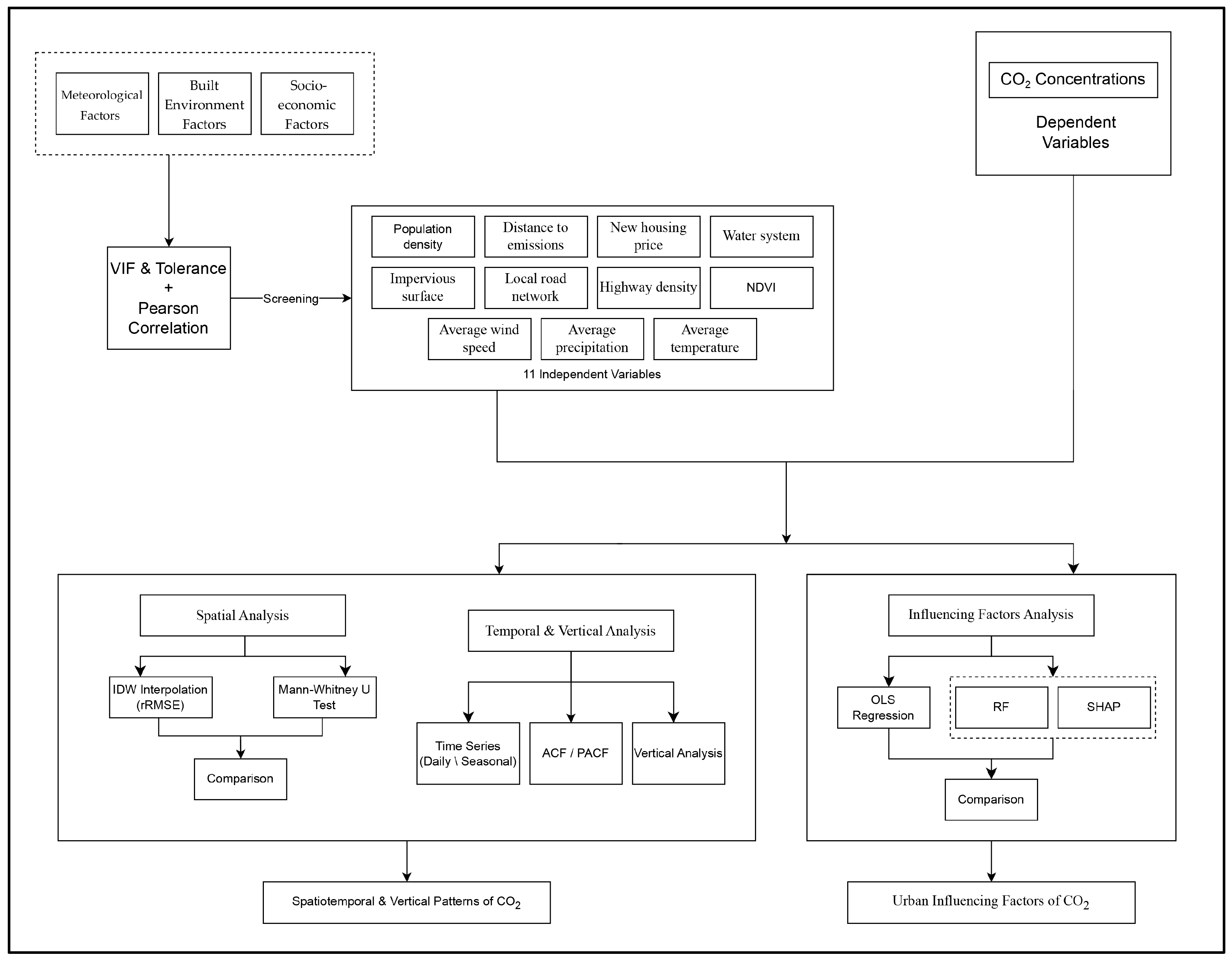
Figure 1. Research Flow Chart.
Sustainability 17 10794 g001
Figure 2. Study Area and Location of the Monitoring Stations.
Sustainability 17 10794 g002
Figure 3. Spatial Distribution of OCO-2 Satellite Paths in Shanghai.
Sustainability 17 10794 g003
Figure 4. Spatial interpolation distribution map of CO2 concentration in Shanghai, 2023.
Sustainability 17 10794 g004
Figure 5. Key Emission Sources and NDVI of Shanghai, 2023.
Sustainability 17 10794 g005
Figure 6. Diurnal Variation of CO2 Concentration and Planetary Boundary Layer Height at Shanghai Center, 2025.
Sustainability 17 10794 g006
Figure 7. Time Series of Daily Average CO2 Concentration (ppm) in Shanghai Center in August 2024 and January 2025. (a) Time Series of Daily Average CO2 Concentration (ppm) in Shanghai Center in August, 2024. (b) Time Series of Daily Average CO2 Concentration (ppm) in Shanghai Center in January, 2025.
Sustainability 17 10794 g007
Figure 8. ACF and PACF of Average CO2 Concentration (ppm) in Shanghai Center.
Sustainability 17 10794 g008
Figure 9. Relative Importance of Influencing Factors on CO2 Concentrations in Shanghai Based on the Random Forest Model.
Sustainability 17 10794 g009
Figure 10. SHAP Summary Plot of Influencing Factors for CO2 Concentrations in Shanghai.
Sustainability 17 10794 g010
Table 1. Overview of PBLH Data.
ParameterData SourceTemporal CoverageSpatial ResolutionLocation
PBLH (Planetary Boundary Layer Height)ERA5 reanalysis dataset, ECMWF August 2024–August 2025,
hourly
0.25° × 0.25°31.25° N, 121.50° E
(SC station at 31.23° N, 121.48° E)
Table 2. Multicollinearity Diagnostics (VIF and Tolerance) for Candidate Variables.
VariableVIFTolerance
Population density1.5200.658
Second-hand housing price4.7960.208
New housing price4.3510.230
Water system1.0630.941
Impervious surface2.6930.371
Distance to emissions3.6030.278
Longitude10.0220.100
Local road network1.4620.684
Highway density1.0780.927
NDVI1.1110.900
Average wind speed3.2000.312
Average precipitation1.9990.500
Average temperature3.8020.263
Note: Bold values indicate VIF > 10.
Table 3. IDW Interpolated CO2 Concentrations Across Districts in Shanghai.
DistrictsMean CO2 (ppm)Std
Putuo (Urban)425.350.295
Jingan (Urban)425.180.565
Baoshan (Urban–Suburban)425.110.559
Hongkou (Urban)424.950.490
Xuhui (Urban)424.741.001
Yangpu (Urban)424.190.298
Huangpu (Urban)424.050.375
Changning (Urban)423.780.583
Chongming (Suburban)423.660.533
Minhang (Urban–Suburban)423.300.776
Pudong (Urban–Suburban)423.240.821
Qingpu (Suburban)422.980.388
Jiading (Suburban)422.850.407
Jinshan (Suburban)422.720.409
Fengxian (Suburban)422.610.587
Songjiang (Suburban)422.580.415
Table 4. OLS Regression Results for CO2 Concentration in Shanghai.
Coef.Std. Coef.Std. Errortp95% CI
Constant423.401-0.497852.7320.000 **422.428~424.374
Population density0.0210.0250.0082.6800.007 **0.006~0.036
New housing price0.0000.0290.0002.8760.004 **0.000~0.000
Water system−0.000−0.0240.000−3.0860.002 **−0.000~−0.000
Impervious surface−0.000−0.1070.000−8.6830.000 **−0.000~−0.000
Distance to emissions−0.000−0.7500.000−59.8440.000 **−0.000~−0.000
Local road network−0.060−0.0530.010−5.7920.000 **−0.081~−0.040
Highway density−0.076−0.0230.026−2.9470.003 **−0.126~−0.025
NDVI−0.217−0.0150.115−1.8810.060−0.443~0.009
Average wind speed−0.168−0.2050.007−23.3750.000 **−0.182~−0.154
Average precipitation0.0120.0170.0071.7600.078−0.001~0.025
Average temperature0.7510.1830.04118.1280.000 **0.670~0.832
R20.670
Adjusted R20.669
FF(11,5615) = 1036.036, p = 0.000
Durbin-Watson0.152
Dependent variable: CO2 concentration, n = 5627; ** p < 0.01.
Disclaimer/Publisher’s Note: The statements, opinions and data contained in all publications are solely those of the individual author(s) and contributor(s) and not of MDPI and/or the editor(s). MDPI and/or the editor(s) disclaim responsibility for any injury to people or property resulting from any ideas, methods, instructions or products referred to in the content.