Article

Enhancing Soil Texture Mapping and Drought Stress Assessment Through Dual-Phase Remote Sensing in Typical Black Soil Regions

1
School of Economics and Management, Jilin Agricultural University, Changchun 130118, China
2
Heilongjiang Province Key Laboratory of Geographical Environment Monitoring and Spatial Information Service in Cold Regions, Harbin Normal University, Harbin 150025, China
3
School of Public Administration and Law, Northeast Agricultural University, Harbin 150030, China
4
State Key Laboratory of Black Soils Conservation and Utilization, Northeast Institute of Geography and Agroecology, Chinese Academy of Sciences, Changchun 130102, China
*
Author to whom correspondence should be addressed.
Sustainability 2025, 17(23), 10793; https://doi.org/10.3390/su172310793
Submission received: 3 October 2025 / Revised: 25 November 2025 / Accepted: 26 November 2025 / Published: 2 December 2025

Abstract

The accurate mapping of soil texture, a key determinant of soil’s hydrological and nutritional behavior, is essential for agricultural drought assessment, yet the application of multi-temporal satellite data for this purpose remains largely unexplored. In this study, we first identified the optimal prediction period by evaluating the performance of single-date imagery (satellite images captured on individual observation dates). Subsequently, dual-phase imagery (DPI) was developed to increase mapping accuracy. Finally, these refined predictions quantified soil texture’s response to drought and its corresponding thresholds. Results demonstrated that: (1) the bare soil period in April provided peak prediction accuracy for all texture fractions (Sand: R2 = 0.617, RMSE = 10.21%; Silt: R2 = 0.606, RMSE = 8.648%; Clay: R2 = 0.604, RMSE = 1.945%); (2) Significant accuracy gain from DPI using April-August imagery fusion (Sand: R2 = 0.677, RMSE = 9.386%; Silt: R2 = 0.660, RMSE = 8.034%; Clay: R2 = 0.658, RMSE = 1.807%); (3) sand content was the most critical factor influencing crop drought stress, with a threshold of 31%. By integrating multi-temporal satellite observations with quantitative drought evaluation for high-resolution soil texture mapping and precision agricultural management in Northeast China’s black soil region.

1. Introduction

Soil texture is a fundamental physical property of soil. It is defined by the relative proportion of mineral particles with different diameters [1]. It is not only an important indicator of the potential productivity of the soil, but also significantly affects the physical, chemical, and biological processes of the soil [2,3]. Soil texture is closely related to a variety of characteristics such as water retention capacity, nutrient uptake capacity, aeration, pH, etc. [4,5]. Soils of different textures have different effects on crop growth and ecosystem services [6,7]. As the main production area for commercial grains in China, the black soil region is prone to drought during the growing season due to geographic and climatic factors [8]. Drought has a significant impact on crop growth, which not only affects food production but may also exacerbate global food security concerns [9,10]. However, few studies have integrated multi-temporal (dual-phase) satellite imagery to improve soil texture mapping accuracy and assess its relationship with drought stress. Therefore, studying the spatial distribution of soil texture and its contribution to drought stress in black soil zones is essential. The findings can provide a scientific basis for precision agriculture and for the protection of black soil resources.
Traditional soil texture determination methods, such as the manual (texture-by-feel) method and international pipette methods, are accurate but costly and time-consuming, making it difficult to meet the needs of large-scale high-resolution mapping [11,12]. Digital soil mapping (DSM) provides an efficient solution for large-area soil texture mapping by predicting soil properties through soil landscape modeling [13,14]. Meng et al. [15] utilized DSM to generate global 30 m spatial resolution soil indicator mapping for Mollisols, while Wang et al. [16], after addressing systematic biases in SOC estimation, achieved spatial distribution predictions of SOC in the Mollisols regions of China and the United States. Wittstruck et al. [17] utilized remote sensing imagery to accomplish high-resolution soil texture prediction for agricultural soils in Germany. The technique is widely used to study the spatial relationship of soil texture with topographic and landscape features [18,19]. With the development of machine learning techniques, models such as support vector machines [20], K-nearest neighbor algorithm [21], extreme gradient boosting [21], and Random Forests are widely used for soil texture prediction. Among them, Random Forests generally perform robustly with large datasets compared to other linear models [22].
Beyond the methodological aspects, soil texture also plays a crucial role in influencing crop growth and water use efficiency [23]. Different soil textures significantly affect the water use efficiency, nutrient uptake capacity, and growth trend of crops [24]. The relationship between crop growth and soil texture shows nonlinear variation, and there is an obvious threshold effect, i.e., when the texture index exceeds a certain threshold, crop growth may change drastically [25,26]. Threshold analysis is key to the development of precision agriculture and drought adaptation measures, but there is still a lack of research on threshold identification between soil texture and crop growth. Segmented linear regression and cubic polynomial regression are commonly used to quantify ecosystem changes in threshold identification studies [26,27]. These methods are able to clarify the non-linear relationship between drivers and ecological effects through regression analysis, providing a basis for threshold definition [28].
Many studies have shown that remote sensing imagery during the bare soil period outperforms other time-phase imagery in the remote sensing prediction of soil indicators [29,30]. However, combining bare soil period imagery with other time-phase imagery to map the spatial distribution of soil metrics with high accuracy is still a challenging research area [31,32]. Therefore, in this study, the Friendship Farm, a typical black soil area in Northeast China, was selected as the study site. We predicted and mapped soil texture using Sentinel-2 multi-temporal imagery with the Random Forest algorithm and analyzed its influence on crop growth under drought stress and the corresponding critical thresholds. The specific objectives are as follows: (1) Prediction of soil texture spatial distribution: To determine the optimal image combination for soil texture prediction by combining single-phase Sentinel-2 images with the Random Forest algorithm, and to explore the effect of dual-phase images on the prediction accuracy, so as to realize high-precision prediction and mapping of soil texture spatial distribution; (2) Analysis of the relationship between soil texture and crop growth: Based on correlation analysis, identify the key indicators of soil texture’s impact on crop growth under drought stress; through elasticity analysis, quantify the drought effect threshold of the key indicators on crop growth, and provide a scientific basis for optimizing crop management and improving agricultural productivity.

2. Materials and Methods

2.1. Study Area

This study was conducted at Youyi Farm, a representative black soil region situated in the Sanjiang Plain of Northeast China (131°27′–132°15′ E, 46°28′–46°59′ N). Encompassing over 1800 km2 (Figure 1), the area features a flat topography with large field plots, conducive to large-scale and highly mechanized cultivation. The region experiences a mesothermal continental monsoon climate, characterized by an average annual temperature of 3.1 °C, precipitation of 514 mm, and a 143-day frost-free period. Agricultural practices follow an annual single-cropping system from April to October, dominated by corn, soybeans, and rice. Post-harvest autumn land preparation typically involves tillage to depths exceeding 20 cm.

2.2. Data Acquisition and Processing

2.2.1. Sample Point Data Acquisition

The cultivated soil samples used in this study were collected during field campaigns from 22 March to 5 April 2021. During this period, the soil was directly exposed on the surface, free from both crop residues and snow cover. GPS positioning was conducted within the study area. Sample points were selected in open areas with relatively flat terrain and homogeneous geological conditions, while also taking into account topographic features and different soil types. A total of 188 field samples were obtained, with their coordinates and topographic information recorded; their distribution is shown in Figure 1b. A stratified random sampling approach was adopted, based on variations in soil type and topography. For each sample, five sub-samples were randomly obtained from a 30 m × 30 m plot and combined into a homogenized 500 g composite sample representing the topsoil. The latitude and longitude of the central point were recorded using a GPS receiver. The collected soil samples were stored in cloth soil bags and transported to the laboratory. Stones, weed roots, and other impurities were removed. Following air-drying at 20 °C for 72 h, the soil samples were weighed, ground, and subsequently passed through a 2 mm sieve. The particle size distribution was then analyzed with a Malvern MS-2000 (Malvern Instruments Co., Ltd., Malvern, UK) laser particle size analyzer, ensuring a measurement deviation of less than 1%.

2.2.2. Image Acquisition and Treatment

The growing availability of cloud platforms offering analytics-ready data and online processing capabilities, including Google Earth Engine (GEE; https://earthengine.google.com/; accessed on 5 November 2025), has greatly facilitated large-scale geospatial analysis [33]. Leveraging its substantial cloud computing power, Google Earth Engine (GEE) facilitates access to and processing of massive Earth observation datasets. A key resource available through GEE is Sentinel-2 imagery, which provides high-resolution multispectral data across 13 spectral bands (10 m, 20 m, and 60 m). The two-satellite configuration of Sentinel-2 ensures a revisit period of just five days, enabling frequent and consistent monitoring [34]. The Sentinel-2 L2A product provides geometrically corrected and atmospherically processed surface reflectance data. The dataset for this study comprised 7 available Sentinel-2 images (Table 1; cloud threshold: <10%) from GEE (Sentinel-2 Level-2A surface reflectance, GEE ID: COPERNICUS/S2_SR). Following cropping and mosaicking in ArcGIS 10.6 (based on the study area’s cultivated land extent) and spatial resampling to 10 m resolution, these images were applied to predict the study area’s soil texture. We subsequently processed the remote sensing images in ENVI 5.3 software. This involved cropping and mosaicking the scenes leveraging the cropland extent from GlobeLand30 2020 (https://www.webmap.cn/; accessed on 5 November 2025), and resampling the spatial resolution of the Sentinel-2 images to 10 m using the bilinear interpolation method.

2.2.3. Determination of Yearly Information

Based on monthly precipitation data for the last 10 years (2013–2023) in the study area, provided by the National Center for Environmental Information (NCEI) under the National Oceanic and Atmospheric Administration (NOAA) (https://www.ncei.noaa.gov/; accessed on 5 November 2025).

2.3. Establishment and Validation of Random Forest Prediction Models

In constructing the Random Forest (RF) model, the key parameters—specifically, the number of regression trees (ntree) and the number of variables considered for splitting at each node (mtry)—were optimized by monitoring the out-of-bag (OOB) error. Through repeated training, ntree was set to 1000 and mtry to one-third of the total input variables, while other parameters remained at default levels. This parameter combination yielded a stable OOB error, indicating a reliable model structure. In this research, an RF-based predictive model for soil texture was developed using 12 bands from multi-temporal Sentinel-2 imagery as input variables. A total of 188 samples were split into training and validation sets at a 9:1 ratio, and ten-fold cross-validation was applied. The coefficient of determination (R2) was employed to evaluate model stability, with values closer to 1 indicating better agreement between predictions and actual measurements. The Root Mean Square Error (RMSE) was used to assess prediction accuracy, where smaller values reflect lower deviation between predicted and observed soil texture values, and hence higher model inversion performance.
R 2 = 1 i = 1 n y i y ^ i 2 i = 1 n y i y ¯ 2
R M S E = 1 n i = 1 n y i y ^ i 2
where n is the number of samples; yi is the observed value of the i-th sampling point; and y ^ i is the measured value of the i-th sampling point. The R2 generally ranges from 0 to 1; the closer the value is to 1, the closer the predicted value is to the actual measured value.

2.4. Correlation Analysis

The influence of soil texture on crop growth is time-dependent and varies by vegetation type [35]. To better understand this relationship, we analyzed the interannual correlations between three soil texture components (silt, clay, and sand) and different crops. In accordance with the sampling guidelines from the Chinese Farmland Protection Department and the local conditions of Youyi Farm, a 500 m × 500 m grid was established. After excluding null values, 4715 sampling points were retained. These points were categorized based on crop zones for each year to examine the association between the normalized difference vegetation index (NDVI) and the predicted values of silt, clay, and sand across multiple years. Correlations were considered statistically significant at p < 0.05.
N D V I = ρ n i r ρ r e d ρ n i r + ρ red
r = i = 1 n ( X i X ¯ ) ( Y i Y ¯ ) i = 1 n ( X i X ¯ ) 2 i = 1 n ( Y i Y ¯ ) 2
where ρ n i r is the surface reflectance in the near-infrared band (B8); and ρ r e d is the surface reflectance in the red band (B4); where r represents Pearson’s correlation coefficient, bounded between −1 and 1. A value of 0 denotes no linear correlation, while values approaching ±1 indicate stronger correlations, with the sign (positive/negative) reflecting the direction of the association. Xi and Yi denote the individual observed values for the two variables. X ¯ and Y ¯ being their respective arithmetic means. The numerator corresponds to the covariance, characterizing the direction of their joint variability. The denominator, the product of both standard deviations, serves to normalize this measure, resulting in a standardized coefficient.

2.5. Elasticity Analysis

To analyze the impact of soil texture on drought stress, the mean NDVI values were derived at 1% increments for each key texture indicator (sand, silt, clay), all of which spanned the full 1–100% range. The relationship was subsequently formulated by defining the soil texture indicator as the independent variable (x) and NDVI as the dependent variable (y). Therefore, the elasticity coefficient was used in this study to determine the threshold. The elasticity coefficient is, for each unit increase in x, the proportional change in y, representing the intensity and efficiency of the effect of x. The threshold at which soil texture begins to significantly influence crop growth was identified by analyzing the elasticity coefficient between soil texture and NDVI. This threshold corresponds to the inflection point of the elasticity coefficient, which was quantified using the following formula:
E = d ( f ( x ) ) d ( x )
where f(x) is the expression function between x and y and E is the elasticity coefficient.

2.6. Analysis of the Effect of Soil Moisture Content on the Accuracy of Soil Texture Prediction

To analyze the effect caused by soil water content on soil texture prediction, in this study Land Surface Water Index (LSWI) was used to represent soil water content and was calculated as:
L S W I = ρ nir ρ swirl ρ nir + ρ swirl
where ρ n i r is the surface reflectance in the near-infrared band (B8); and ρ s w i r l is the surface reflectance in the short-wave infrared 1 band (B11).
The Land Surface Water Index (LSWI) is defined by integrating reflectance from moisture-sensitive shortwave infrared bands. It serves as an indicator for monitoring soil moisture dynamics, where a higher LSWI value corresponds to greater moisture content [36]. The effect of soil water content on the accuracy of soil texture prediction was analyzed by exploring the root mean square error (RMSE) between LSWI and the soil texture prediction process.

2.7. Methods

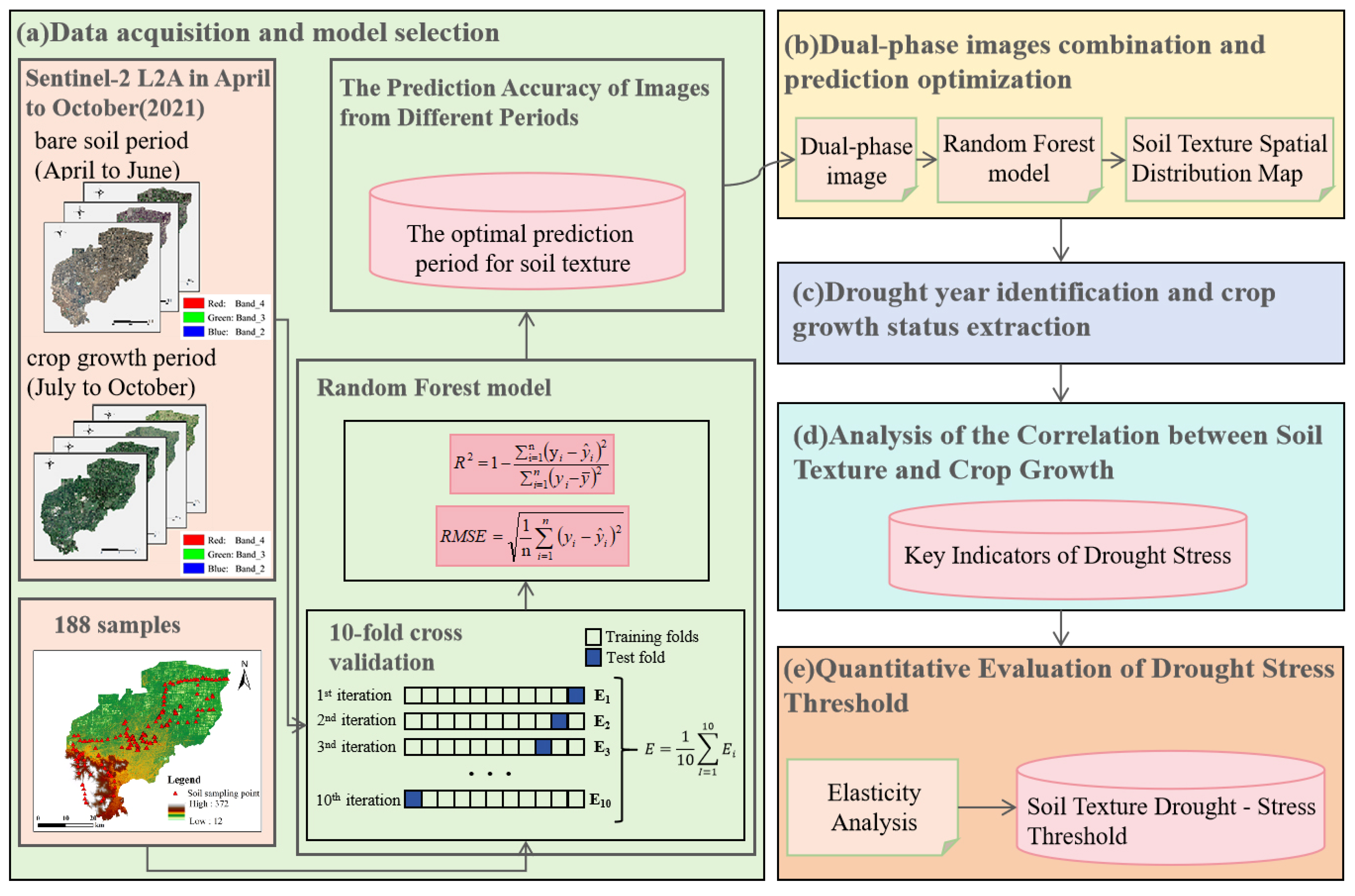
This study aimed to construct an efficient method for predicting the spatial distribution of soil texture and to quantify its threshold effect on crop drought stress by utilizing the multispectral information of Sentinel-2 remote sensing imagery (Figure 2). The specific technical lines are as follows:
  • Data acquisition and model selection
Sentinel-2 remote sensing images were used to acquire spectral data in different timelines, and the prediction performance of single-time-phase images on soil texture was evaluated based on the RF model. The remote sensing images with better prediction performance were screened.
2.
Dual-phase image combination and prediction optimization
The screened images were combined two by two to generate dual-phase images (DPI), which were again input into the RF model for soil texture prediction to analyze the effect of dual time-phase images on the improvement of prediction accuracy and to determine the optimal combination of images to be used for the construction of spatial distribution maps of soil texture.
3.
Drought year identification and crop growth status extraction
Based on multi-year meteorological data, the drought years in the study area were identified, and the crop cropping structure in the study area was determined by visual interpretation in conjunction with remote sensing images of the critical crop growth period. Normalized vegetation index (NDVI) was extracted from the dry year images and masked according to the extent of crop cultivation to obtain the length distribution of soybean and corn.
4.
Analysis of the correlation between Soil texture and crop growth
Using Pearson correlation analysis to correlate the spatial distribution of soil texture with crop growth in drought years to identify key soil texture indicators that dominate crop growth stress. We considered correlations with p < 0.05 as significant.
5.
Quantitative evaluation of drought stress threshold
Using elasticity analysis, quantitatively assess the degree of impact of key soil texture indicators on crop drought stress, identify the range of thresholds that have a significant impact on crop growth, and provide a scientific basis for agricultural management.
Through the above technical route, this study not only optimized the method of predicting the spatial distribution of soil texture but also quantitatively revealed the key effects of soil texture on crop growth in drought years, which provides an important reference for precision agriculture and drought-adaptive management.

3. Results

3.1. Accuracy Analysis of Soil Texture Prediction from Single Time-Phase Remote Sensing Images

The validation accuracies of different temporal images were obtained by using the 12-band reflectance of single-period Sentinel-2 images acquired in 2021 as input variables to predict soil texture using the Random Forest model (Table 2). The results indicated that the prediction accuracy of soil texture exhibited a fluctuating pattern of “increasing-decreasing-increasing-decreasing” throughout the year. Higher accuracy was achieved using bare soil imagery from April to June, with April identified as the optimal period for prediction (sand: R2 = 0.617, RMSE = 10.21%; silt: R2 = 0.606, RMSE = 8.648%; clay: R2 = 0.604, RMSE = 1.945%). During the crop growth season, the image from August demonstrated the best performance.

3.2. Improved Accuracy of Soil Texture Prediction from Dual Time-Phase Remote Sensing Imagery

Based on the accuracy of single-phase images in predicting soil texture, four-phase images with higher accuracy were selected and combined in pairs to form six DPIs. After inputting them into the Random Forest regression model, the prediction accuracy of soil texture was obtained (Table 3). The results show that DPI maps soil texture with higher accuracy compared to single-phase imagery. The highest prediction accuracies were for the DPI combined for April and August (Sand: R2 = 0.677, RMSE = 9.386%; Silt: R2 = 0.660, RMSE = 8.034%; Clay: R2 = 0.658, RMSE = 1.807%).

3.3. Spatial Distribution of Soil Texture in the Study Area

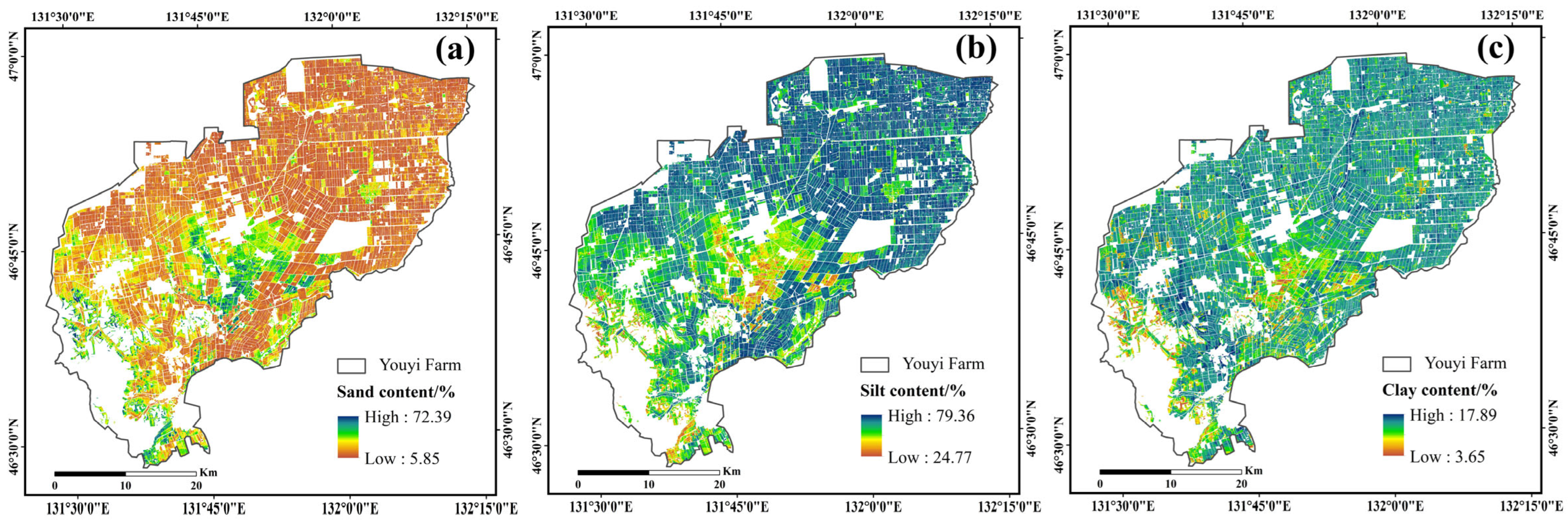
The DPI with the highest mapping accuracy for soil texture was input into a Random Forest regression model to predict its spatial distribution. As the sampling points were exclusively from cropland, the prediction results were masked using the farmland boundaries to generate the final map. The resulting spatial distributions of sand, silt, and clay are presented in Figure 3a–c, respectively. The predictions reveal that silt and clay are predominantly distributed in the northeastern, northern, and southern parts of Youyi Farm, while their contents are lower in the central and southwestern areas. Conversely, sand content shows an opposite pattern, with notably higher concentrations in the central region.

3.4. Influence of Soil Texture on Crop Growth in Dry Years and Identification of Effect Thresholds for Important Indicators

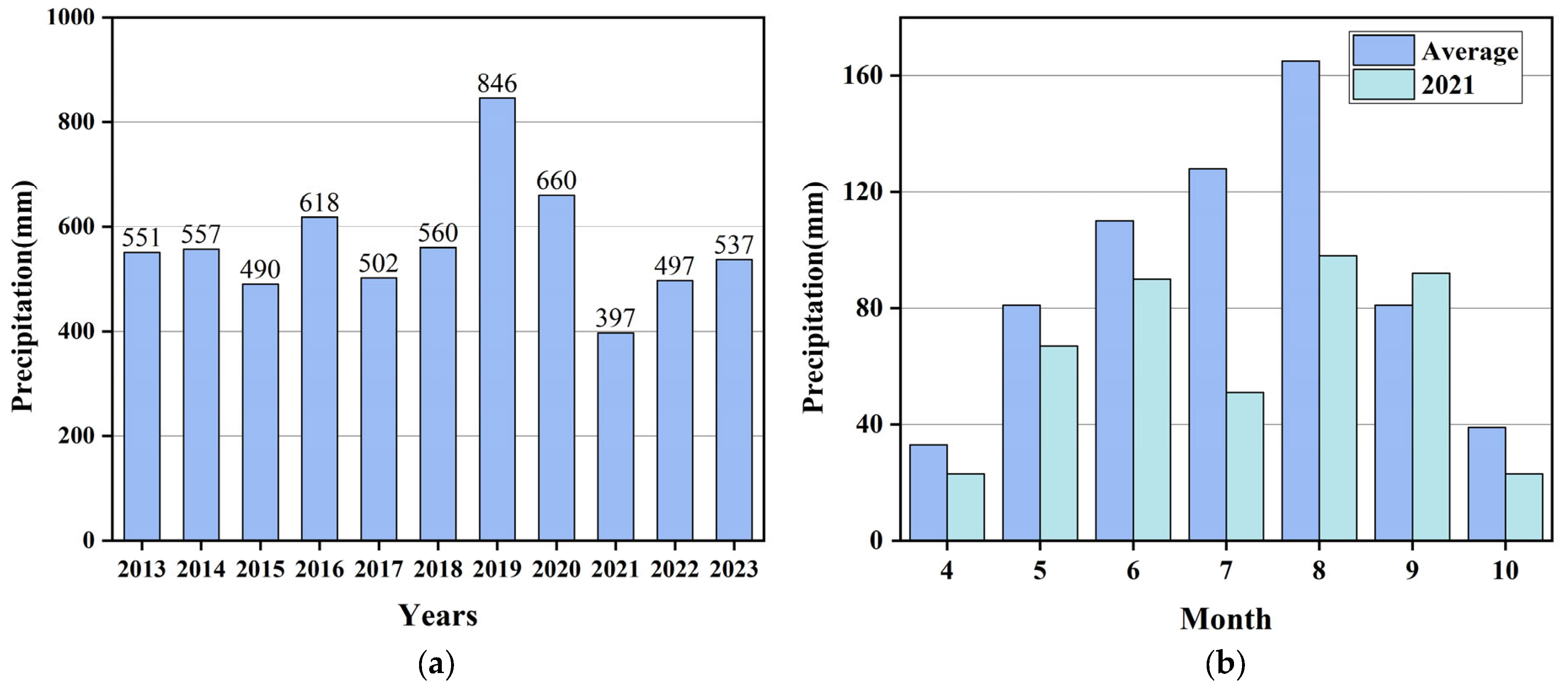
Extracting the cumulative precipitation from 2013 to 2023 for crop growth and development (April to October) in the study area (Figure 4a), the results showed that 2021 had the lowest precipitation of 397 mm, which was significantly lower than the decadal average, and was a typical drought year. Further comparing the average precipitation of each month from 2013 to 2023 with the monthly precipitation of 2021 (Figure 4b), it was found that July and August 2021 had significantly low precipitation, which is the main dry period in Youyi Farm, and also a critical stage for determining crop growth and development. Based on ArcGIS 10.6, visual interpretation of fieldwork and remote sensing imagery was combined to obtain the crop cropping structure of the study area in 2021, with major crops including soybean, corn, and rice. Given the specificity of rice cultivation practices, which are less exposed to drought stress, only soybean and corn growth and development responses to soil texture under drought years were analyzed in this study. NDVI for August 2021 was extracted and cropped for soybean and corn regions based on the extent of crop planting. Correlation analysis was carried out using SPSS (IBM SPSS Statistics 27) to reveal the relationship between soil texture components and crop growth (Table 4). The results of the analysis showed that sand content had the highest correlation with the growth of dryland crops (soybean and maize) under drought years, and thus sand was identified as an important soil texture indicator affecting crop drought stress.
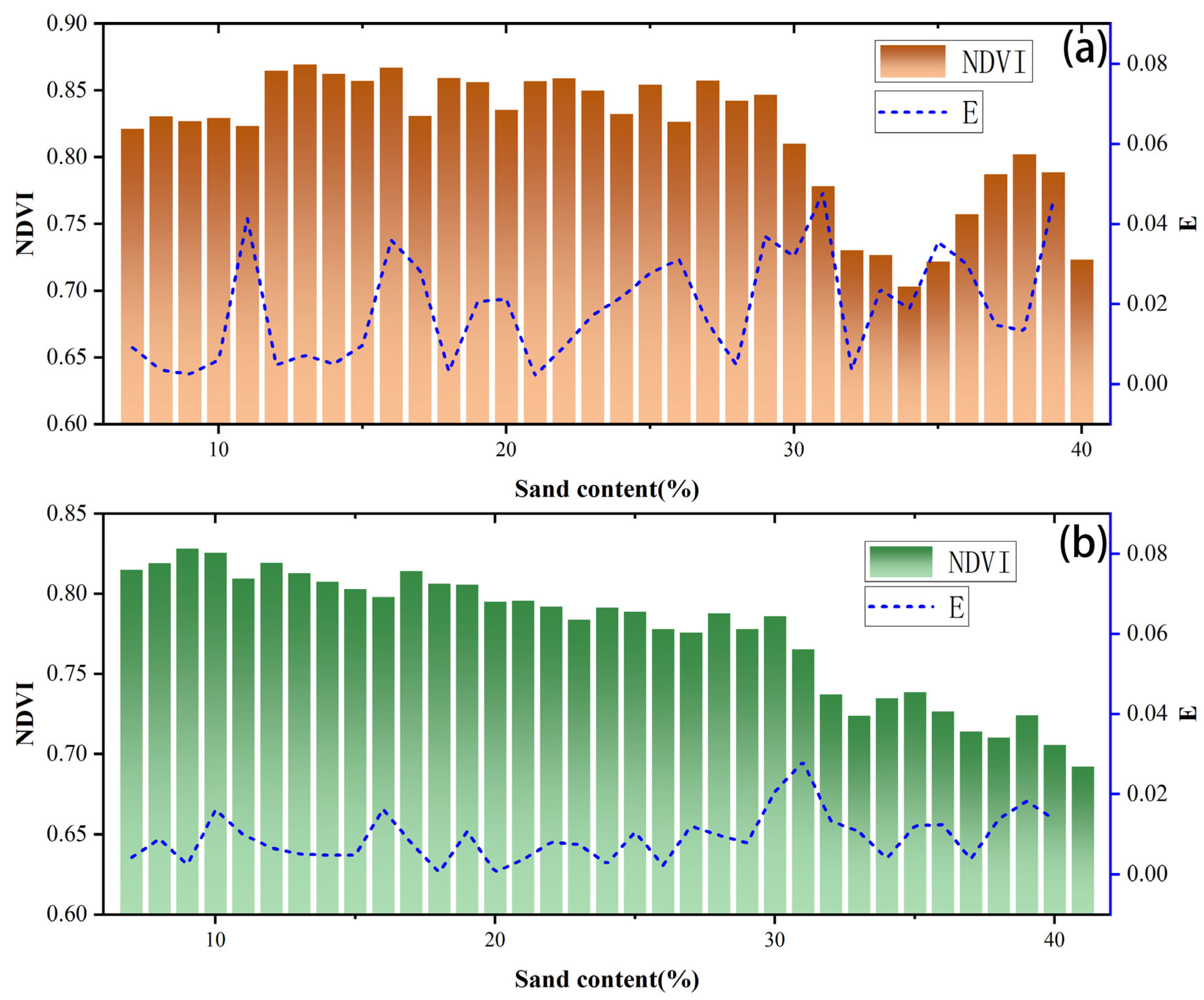
Furthermore, elasticity analysis was employed to quantify the impact of sand content on crop growth and identify its drought effect threshold. As shown in Figure 5, NDVI generally decreased with increasing sand content. The elasticity coefficient (E) peaked at a sand content of approximately 31% for both soybeans and corn, indicating a critical threshold beyond which NDVI changes rapidly. In summary, 31% is identified as the drought stress effect threshold for sand content in the study area’s dry farmland. Investigations into the impact of other soil textures on crop growth have revealed that in temperate grassland ecosystems, the effect threshold of sand content on crop growth is 50% [37]. The variability in this threshold can likely be attributed to differences in soil types. Mollisols, renowned for their high organic matter content [15] and inherent fertility, consequently exhibit a lower drought stress threshold.

4. Discussion

4.1. Reasons Affecting the Accuracy of Soil Texture Mapping

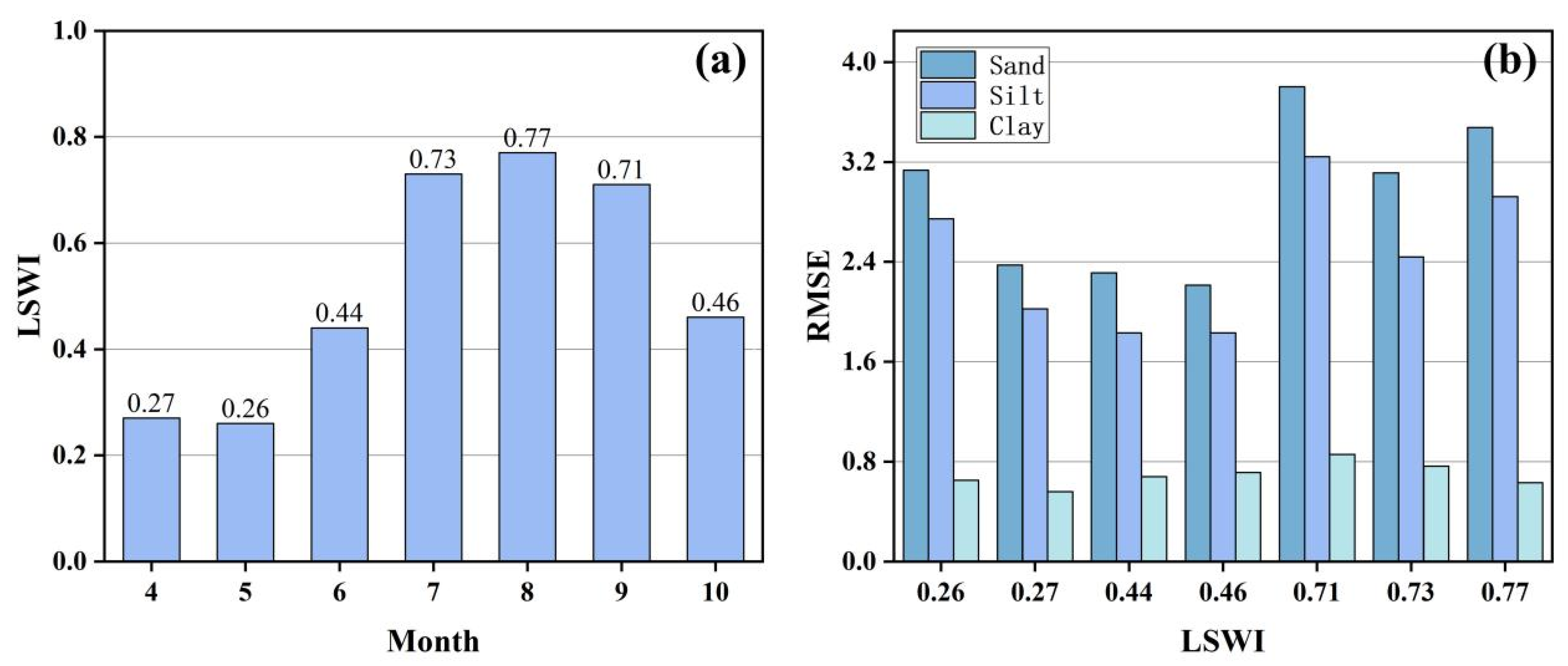
To investigate the relationship between soil texture prediction accuracy and soil moisture content, we extracted the Land Surface Water Index (LSWI) from seven remote sensing images and performed a correlation analysis with the RMSE values from seven single-date prediction models. The results revealed a statistically significant correlation between the LSWI and model prediction errors. The correlation coefficients (r) between sand content, silt content, clay content, and the Land Surface Water Index (LSWI) were 0.749, 0.727, and 0.787, respectively. As shown in Figure 6, the calculation of Land Surface Water Index (LSWI) values based on seven images indicates that the prediction accuracy of powder, clay, and sand grains is all affected by soil water content. The overall increasing trend of RMSE with increasing LSWI values indicates that remote sensing data are less effective in mapping soil texture when soil water content is high. This is consistent with the findings of [38]. Bare soil period images show higher performance in the soil texture prediction process due to their lower soil water content. In addition, according to Table 1 and Table 2, the prediction accuracies of powder and sand grains were overall higher than that of clay grains, which may be due to the higher agglomeration of clay grains, which interfered with the prediction accuracy, as ref. [39] also revealed the correlation between the prediction of soil texture and soil agglomeration.
In summary, soil texture prediction accuracy is jointly governed by soil water content and its spatial aggregation. This study confirms that DPI surpasses single-period imagery, and notably, a model integrating bare soil-period with crop growth-period imagery achieved higher accuracy than using two bare soil periods. This underscores the critical value of multi-temporal remote sensing data, where complementary information from distinct phenological phases substantially enhances prediction [40]. This result is consistent with the study of [41], which found that multi-temporal image fusion outperforms single-temporal bare soil imagery in the prediction of soil metrics.

4.2. The Extent to Which Soil Texture Affects Crop Growth

In recent years, the impact of drought on agricultural production has become increasingly significant. The average annual affected area and direct economic loss in China reached 2.1 × 10⁷ ha and RMB 44 billion, respectively [42,43]. In the northeast, drought is further exacerbated by warming. To reduce the adverse effects of drought on crops, this study analyzed the interaction between soil texture and crop growth, focusing on the mechanism of soil texture on crop growth under drought conditions.
Correlation analysis showed that sand is a key indicator of crop growth in dry years. Based on the elasticity analysis, the drought effect threshold for sand content was set at 31%. This threshold indicates a range within which crop growth is relatively stable; above this value, crops are significantly more affected by drought. Soils with high sand content have good permeability and are easy to till, but have poor capacity to retain fertilizer and water, leading to nutrient loss and thus affecting crop growth and development [44].
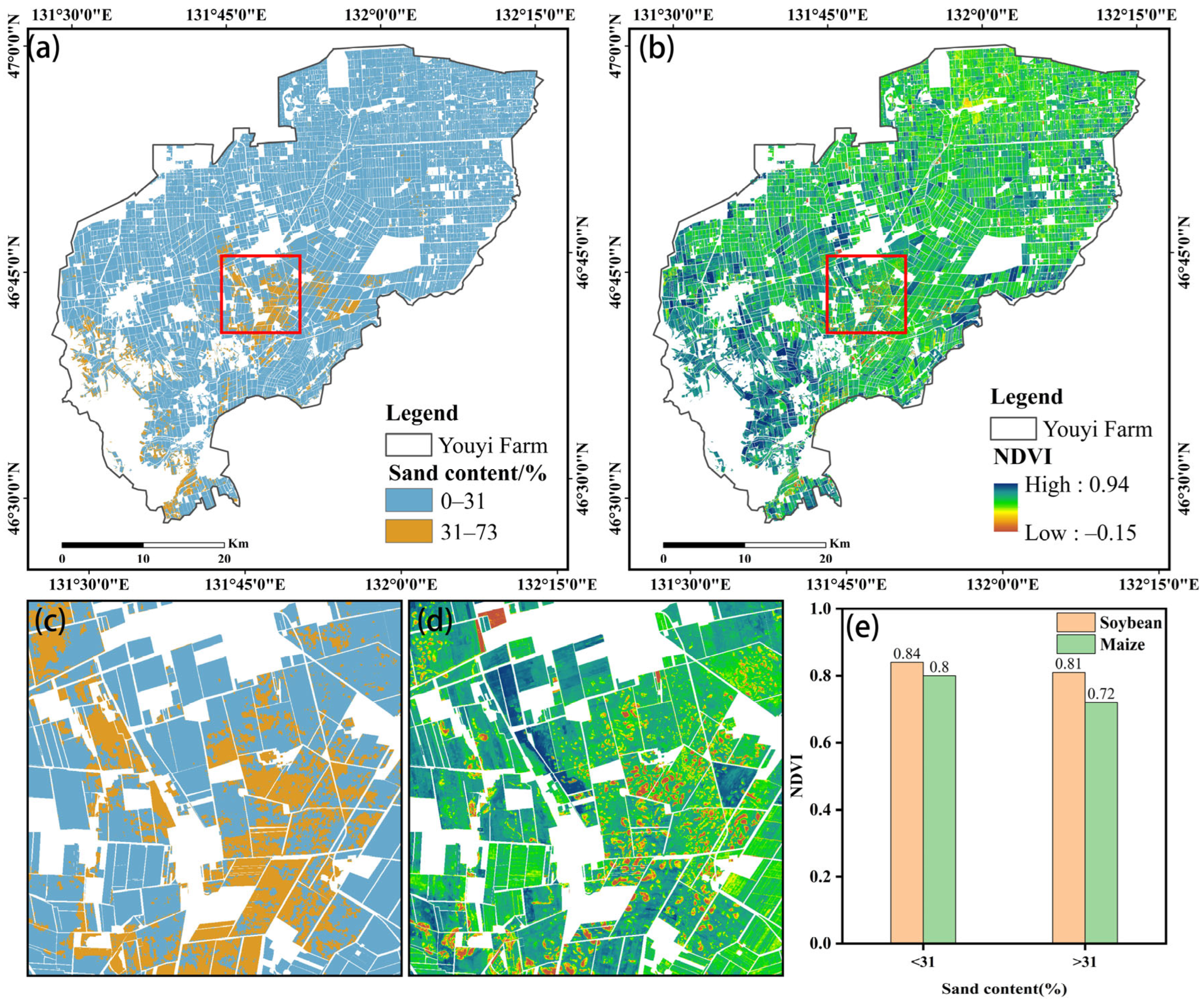
Furthermore, elasticity analysis indicates that the drought effect threshold for sand content in Friendship Farm is 31%. The spatial distribution before and after this threshold is shown in Figure 7a. Areas exceeding the sand content threshold are primarily concentrated in the central part of Friendship Farm, while the overall crop growth performance across the study area (Figure 7b) shows no significant variation. Therefore, a localized analysis of the central region was conducted (Figure 7c,d). The results reveal that when the threshold is exceeded, sand content exacerbates drought stress on soil texture. Additionally, crop growth in typical areas in August exhibits notable differences compared to other regions, further validating the scientific robustness of the drought stress threshold for sand content.

4.3. Limitations and Future Research

This study generated a soil texture distribution map with 10 m spatial resolution to provide data support for the development of environmental protection and agricultural production strategies. The results confirm that soil texture classification based on Sentinel-2 remote sensing imagery is feasible. Future research should integrate multi-source remote sensing data to improve classification accuracy, as high-resolution soil texture data are vital for optimizing agricultural production and environmental protection strategies [41].
Soil texture as a composite variable, the current study only predicts its components individually, and in the future, methods such as multi-task learning (MTL) combined with the SHAP model can be used to realize the simultaneous prediction of multiple soil attributes [45,46]. In addition, the results of resilience analysis in this study indicated that the drought effect threshold for sand was lower than the corresponding node of the International Standard for Soil Texture Classification (ISSC), which may be related to the fertile soils in the study area with low sand content. Future studies could further validate this speculation. The present research is confined to a relatively small area. Future studies will be expanded to encompass larger regions to enhance the model’s generalizability for soil texture prediction [47]. As a critical factor for crop growth, soil temperature data will be incorporated in subsequent research to further elucidate the mechanisms through which soil texture influences crop development [11].
Research on suitable soil texture for different crops is also a key future direction. Precision agriculture requires crop-specific adjustments to cropping structures, and research on optimizing soil texture can provide a scientific basis for this. By improving the model and data sources, it will be more conducive to achieving the goals of sustainable development and environmental protection in agriculture.

5. Conclusions

In this study, we systematically evaluated the performance of soil texture prediction and its contribution to crop drought stress using multi-temporal remote sensing imagery. The results demonstrate the following (1) the optimal prediction time window was consistent across soil texture components (sand, silt, and clay). Dual-phase imagery (DPI) significantly outperformed single-date imagery, with the R2 of prediction models for sand, silt, and clay content increasing by 0.060, 0.054, and 0.054, respectively, underscoring the value of temporal data fusion for improving soil texture mapping accuracy; (2) soil texture exerted a pronounced influence on crop performance under drought conditions, with sand content identified as the most critical indicator. Areas with higher sand content, particularly in the central part of Youyi Farm where it exceeded 31%, were more vulnerable to drought due to a limited capacity to retain water and nutrients, leading to reduced crop growth; (3) elasticity analysis further quantified the drought stress threshold for sand content, providing a benchmark to identify the critical level at which soil texture begins to constrain crop growth.
These findings highlight the necessity of selecting appropriate temporal combinations of satellite imagery for accurate soil texture mapping and emphasize the pivotal role of soil texture in modulating crop responses to drought. This is consistent with the findings of Wankmüller et al. [48]. By establishing a quantitative drought stress threshold, this study contributes to both theoretical understanding and practical decision-making, offering scientific guidance for soil resource management, drought risk assessment, and precision agricultural practices in black soil regions.

Author Contributions

W.Z.: Conceptualization, Methodology, Software, Formal analysis, Data curation, Writing—original draft, Visualization, Investigation, Validation. W.D.: Conceptualization, Methodology. X.L.: Formal analysis, Visualization. L.G.: Supervision, Writing—review and editing, Funding acquisition. C.L.: Resources, Validation, Project administration. All authors have read and agreed to the published version of the manuscript.

Funding

This work was supported by the Science and Technology Development Plan Project of Jilin Province, China (20240602052RC).

Institutional Review Board Statement

Not applicable.

Informed Consent Statement

Not applicable.

Data Availability Statement

The data presented in this study are available on request from the corresponding author.

Conflicts of Interest

The authors declare no conflicts of interest.

References

  1. Wang, F.; Wang, Z.; Zhang, J.; Li, W. Combined effect of different amounts of irrigation and mulch films on physiological indexes and yield of drip-irrigated maize (Zea mays L.). Water 2019, 11, 472. [Google Scholar] [CrossRef]
  2. Amirian-Chakan, A.; Minasny, B.; Taghizadeh-Mehrjardi, R.; Akbarifazli, R.; Darvishpasand, Z.; Khordehbin, S. Some practical aspects of predicting texture data in digital soil mapping. Soil Tillage Res. 2019, 194, 104289. [Google Scholar] [CrossRef]
  3. Dunkl, I.; Ließ, M. On the benefits of clustering approaches in digital soil mapping: An application example concerning soil texture regionalization. Soil 2022, 8, 541–558. [Google Scholar] [CrossRef]
  4. Arora, V.; Singh, C.; Sidhu, A.; Thind, S. Irrigation, tillage and mulching effects on soybean yield and water productivity in relation to soil texture. Agric. Water Manag. 2011, 98, 563–568. [Google Scholar] [CrossRef]
  5. Katerji, N.; Mastrorilli, M. The effect of soil texture on the water use efficiency of irrigated crops: Results of a multi-year experiment carried out in the Mediterranean region. Eur. J. Agron. 2009, 30, 95–100. [Google Scholar] [CrossRef]
  6. Li, C.; Wang, X.; Wang, Q.; Hao, S. Effect of different textural soils on rhizosphere microorganisms and enzyme activities in maize. Sci. Agric. Sin. 2007, 40, 412–418. [Google Scholar]
  7. Zhang, Y.; Li, H.; Zhang, X. Effects of soil texture on soil water movement and transport on slope land. J. Irrig. Drain. 2008, 27, 27–30. [Google Scholar]
  8. Wang, Y.; Wu, Y.; Ji, L.; Zhang, J.; Meng, L. Assessing the Spatial–Temporal Pattern of Spring Maize Drought in Northeast China Using an Optimised Remote Sensing Index. Remote Sens. 2023, 15, 4171. [Google Scholar] [CrossRef]
  9. Du, C.; Chen, J.; Nie, T.; Dai, C. Spatial–temporal changes in meteorological and agricultural droughts in Northeast China: Change patterns, response relationships and causes. Nat. Hazards 2022, 110, 155–173. [Google Scholar] [CrossRef]
  10. Kelley, C.P.; Mohtadi, S.; Cane, M.A.; Seager, R.; Kushnir, Y. Climate change in the Fertile Crescent and implications of the recent Syrian drought. Proc. Natl. Acad. Sci. USA 2015, 112, 3241–3246. [Google Scholar] [CrossRef]
  11. Li, Y.; Wang, W.; Men, Q.; Zhong, X.; Xie, X. Field characters of soil temperature under the wide plastic-mulch. Trans. Chin. Soc. Agric. Eng. 2001, 17, 32–36. [Google Scholar]
  12. Luo, X.; Chen, B.; Zhang, J.; Jiang, P.; Lou, S.; Peng, X.; He, J. Effect of nitrogen applied levels on the dynamics of biomass, nitrogen accumulation of cotton plant on different soil textures. Acta Agric. Boreali Occident. Sin. 2009, 18, 160–166. [Google Scholar]
  13. McBratney, A.B.; Santos, M.M.; Minasny, B. On digital soil mapping. Geoderma 2003, 117, 3–52. [Google Scholar] [CrossRef]
  14. Dharumarajan, S.; Hegde, R.; Janani, N.; Singh, S. The need for digital soil mapping in India. Geoderma Reg. 2019, 16, e00204. [Google Scholar] [CrossRef]
  15. Meng, X.; Bao, Y.; Luo, C.; Zhang, X.; Liu, H. SOC content of global Mollisols at a 30 m spatial resolution from 1984 to 2021 generated by the novel ML-CNN prediction model. Remote Sens. Environ. 2024, 300, 113911. [Google Scholar] [CrossRef]
  16. Wang, C.; Luo, C.; Meng, X.; Wang, C.; Liu, H. Intelligent mapping paradigm to overcome systematic bias in remote sensing SOC estimation: A case study of the black soil region in China and the United States. ISPRS J. Photogramm. Remote Sens. 2025, 230, 644–660. [Google Scholar] [CrossRef]
  17. Wittstruck, L.; Waske, B.; Jarmer, T. Multi-Modal Vision Transformer for high-resolution soil texture prediction of German agricultural soils using remote sensing imagery. Remote Sens. Environ. 2025, 331, 114985. [Google Scholar] [CrossRef]
  18. Gobin, A.; Campling, P.; Feyen, J. Soil-landscape modelling to quantify spatial variability of soil texture. Phys. Chem. Earth Part B Hydrol. Ocean. Atmos. 2001, 26, 41–45. [Google Scholar] [CrossRef]
  19. Zhao, Z.; Chow, T.L.; Rees, H.W.; Yang, Q.; Xing, Z.; Meng, F.-R. Predict soil texture distributions using an artificial neural network model. Comput. Electron. Agric. 2009, 65, 36–48. [Google Scholar] [CrossRef]
  20. Gomez, C.; Dharumarajan, S.; Féret, J.-B.; Lagacherie, P.; Ruiz, L.; Sekhar, M. Use of sentinel-2 time-series images for classification and uncertainty analysis of inherent biophysical property: Case of soil texture mapping. Remote Sens. 2019, 11, 565. [Google Scholar] [CrossRef]
  21. Zhang, M.; Shi, W.; Xu, Z. Systematic comparison of five machine-learning models in classification and interpolation of soil particle size fractions using different transformed data. Hydrol. Earth Syst. Sci. 2020, 24, 2505–2526. [Google Scholar] [CrossRef]
  22. Bousbih, S.; Zribi, M.; Pelletier, C.; Gorrab, A.; Lili-Chabaane, Z.; Baghdadi, N.; Ben Aissa, N.; Mougenot, B. Soil texture estimation using radar and optical data from Sentinel-1 and Sentinel-2. Remote Sens. 2019, 11, 1520. [Google Scholar] [CrossRef]
  23. Ahmed, W.; Ashraf, M.N.; Sanaullah, M.; Maqsood, M.A.; Waqas, M.A.; Rahman, S.U.; Hussain, S.; Ahmad, H.R.; Mustafa, A.; Minggang, X. Soil Organic Carbon and Nitrogen Mineralization Potential of Manures Regulated by Soil Microbial Activities in Contrasting Soil Textures. J. Soil Sci. Plant Nutr. 2024, 24, 3056–3067. [Google Scholar] [CrossRef]
  24. Dou, X.; Shi, H.-B.; Li, R.-P.; Miao, Q.-F.; Tian, F.; Yu, D.-D.; Zhou, L.-Y. Assessing the efficiency of subsurface drain in controlling soil salinization in Hetao Irrigation District. J. Irrig. Drain. 2020, 39, 102–110. [Google Scholar]
  25. Peng, J.; Dan, Y.; Qiao, R.; Liu, Y.; Dong, J.; Wu, J. How to quantify the cooling effect of urban parks? Linking maximum and accumulation perspectives. Remote Sens. Environ. 2021, 252, 112135. [Google Scholar] [CrossRef]
  26. Jianying, X.; Jixing, C.; Yanxu, L. Partitioned responses of ecosystem services and their tradeoffs to human activities in the Belt and Road region. J. Clean. Prod. 2020, 276, 123205. [Google Scholar] [CrossRef]
  27. Peng, J.; Tian, L.; Liu, Y.; Zhao, M.; Hu, Y.N.; Wu, J. Ecosystem services response to urbanization in metropolitan areas: Thresholds identification. Sci. Total Environ. 2017, 607, 706–714. [Google Scholar] [CrossRef] [PubMed]
  28. Francesco Ficetola, G.; Denoël, M. Ecological thresholds: An assessment of methods to identify abrupt changes in species–habitat relationships. Ecography 2009, 32, 1075–1084. [Google Scholar] [CrossRef]
  29. Kong, D.; Luo, C.; Liu, H. Integrative remote sensing and machine learning approaches for SOC and TN spatial distribution: Unveiling C: N ratio in Black Soil region. Soil Tillage Res. 2026, 255, 106809. [Google Scholar] [CrossRef]
  30. Gao, L.; Zhang, Y.; Zang, D.; Yang, Q.; Liu, H.; Luo, C. Using Satellites to Monitor Soil Texture in Typical Black Soil Areas and Assess Its Impact on Crop Growth. Agriculture 2025, 15, 912. [Google Scholar] [CrossRef]
  31. Zhang, Y.; Luo, C.; Zhang, Y.; Gao, L.; Wang, Y.; Wu, Z.; Zhang, W.; Liu, H. Integration of bare soil and crop growth remote sensing data to improve the accuracy of soil organic matter mapping in black soil areas. Soil Tillage Res. 2024, 244, 106269. [Google Scholar] [CrossRef]
  32. Kong, D.; Luo, C.; Liu, H. Enhancing soil organic matter mapping in saline-alkali and black soil areas with prior knowledge and multi-temporal remote sensing. J. Integr. Agric. 2025; in press. [Google Scholar] [CrossRef]
  33. Amani, M.; Ghorbanian, A.; Ahmadi, S.A.; Kakooei, M.; Moghimi, A.; Mirmazloumi, S.M.; Moghaddam, S.H.A.; Mahdavi, S.; Ghahremanloo, M.; Parsian, S. Google earth engine cloud computing platform for remote sensing big data applications: A comprehensive review. IEEE J. Sel. Top. Appl. Earth Obs. Remote Sens. 2020, 13, 5326–5350. [Google Scholar] [CrossRef]
  34. Swain, S.R.; Chakraborty, P.; Panigrahi, N.; Vasava, H.B.; Reddy, N.N.; Roy, S.; Majeed, I.; Das, B.S. Estimation of soil texture using Sentinel-2 multispectral imaging data: An ensemble modeling approach. Soil Tillage Res. 2021, 213, 105134. [Google Scholar] [CrossRef]
  35. Miller, D.L.; Alonzo, M.; Meerdink, S.K.; Allen, M.A.; Tague, C.L.; Roberts, D.A.; McFadden, J.P. Seasonal and interannual drought responses of vegetation in a California urbanized area measured using complementary remote sensing indices. ISPRS J. Photogramm. Remote Sens. 2022, 183, 178–195. [Google Scholar] [CrossRef]
  36. Chen, Y.; Hu, J.; Cai, Z.; Yang, J.; Zhou, W.; Hu, Q.; Wang, C.; You, L.; Xu, B. A phenology-based vegetation index for improving ratoon rice mapping using harmonized Landsat and Sentinel-2 data. J. Integr. Agric. 2024, 23, 1164–1178. [Google Scholar] [CrossRef]
  37. Gao, X.; Li, F.Y. The inverse texture effect of soil on vegetation in temperate grasslands of China: Benchmarking soil texture effect. Geoderma 2023, 438, 116641. [Google Scholar] [CrossRef]
  38. Ding, S.; Zhang, X.; Shang, K.; Xiao, Q.; Wang, W.; Rehman, A.U. Removal of environmental influences for estimating soil texture fractions based on ZY1 satellite hyperspectral images. Catena 2024, 236, 107713. [Google Scholar] [CrossRef]
  39. Zhang, J.; Chen, H.; Fu, Z.; Wang, K. Effects of vegetation restoration on soil properties along an elevation gradient in the karst region of southwest China. Agric. Ecosyst. Environ. 2021, 320, 107572. [Google Scholar] [CrossRef]
  40. Luo, C.; Zhang, W.; Zhang, X.; Liu, H. Mapping of soil organic matter in a typical black soil area using Landsat-8 synthetic images at different time periods. Catena 2023, 231, 107336. [Google Scholar] [CrossRef]
  41. Meng, X.; Bao, Y.; Liu, H.; Zhang, X.; Wang, X. A new digital soil mapping method with temporal-spatial-spectral information derived from multi-source satellite images. Geoderma 2022, 425, 116065. [Google Scholar] [CrossRef]
  42. Dang, Y.; Qin, L.; Huang, L.; Wang, J.; Li, B.; He, H. Water footprint of rain-fed maize in different growth stages and associated climatic driving forces in Northeast China. Agric. Water Manag. 2022, 263, 107463. [Google Scholar] [CrossRef]
  43. Sun, P.; Ma, Z.; Zhang, Q.; Singh, V.P.; Xu, C.-Y. Modified drought severity index: Model improvement and its application in drought monitoring in China. J. Hydrol. 2022, 612, 128097. [Google Scholar] [CrossRef]
  44. Saha, A.; Rattan, B.; Sekharan, S.; Manna, U. Quantifying the interactive effect of water absorbing polymer (WAP)-soil texture on plant available water content and irrigation frequency. Geoderma 2020, 368, 114310. [Google Scholar] [CrossRef]
  45. Zhai, Z.; Chen, F.; Yu, H.; Hu, J.; Zhou, X.; Xu, H. PS-MTL-LUCAS: A partially shared multi-task learning model for simultaneously predicting multiple soil properties. Ecol. Inform. 2024, 82, 102784. [Google Scholar] [CrossRef]
  46. Zhong, L.; Guo, X.; Xu, Z.; Ding, M. Soil properties: Their prediction and feature extraction from the LUCAS spectral library using deep convolutional neural networks. Geoderma 2021, 402, 115366. [Google Scholar] [CrossRef]
  47. Bao, Y.; Yao, F.; Meng, X.; Fan, J.; Zhang, J.; Liu, H.; Mouazen, A.M. Dynamic modeling of topsoil organic carbon and its scenarios forecast in global Mollisols regions. J. Clean. Prod. 2023, 421, 138544. [Google Scholar] [CrossRef]
  48. Wankmüller, F.J.; Delval, L.; Lehmann, P.; Baur, M.J.; Cecere, A.; Wolf, S.; Or, D.; Javaux, M.; Carminati, A. Global influence of soil texture on ecosystem water limitation. Nature 2024, 635, 631–638. [Google Scholar] [CrossRef]
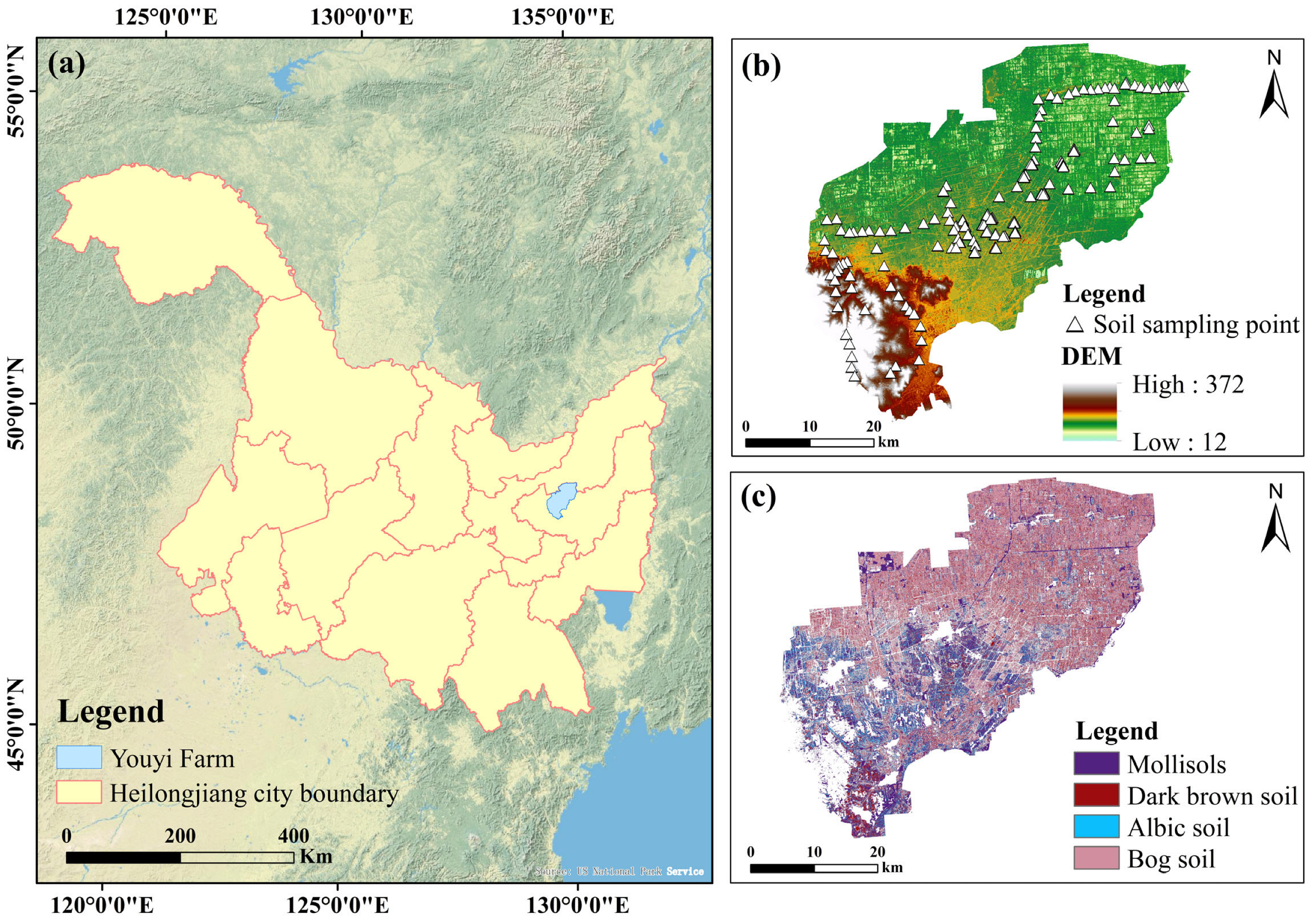
Figure 1. Overview of study sites (a) Geographic location of the study area (b) Elevation of the study area and distribution of sample points (c) Soil type map of the study area.
Sustainability 17 10793 g001
Figure 2. (a) Data acquisition and model selection; (b) Dual-phase image combination; (c) Drought year identification; (d) Soil–crop correlation analysis; (e) Elasticity evaluation of drought stress threshold.
Sustainability 17 10793 g002
Figure 3. Spatial distribution map of soil texture (a) sand (b) silt (c) clay.
Sustainability 17 10793 g003
Figure 4. (a) Accumulated precipitation in Shuangyashan City, April-October 2013–2023 (b) Comparison of the monthly precipitation in 2021 with the average monthly precipitation from 2013 to 2023.
Sustainability 17 10793 g004
Figure 5. Identification of drought-effect thresholds of sand content for (a) soybeans and (b) corn.
Sustainability 17 10793 g005
Figure 6. (a) LSWI at different times (b) Soil texture predicts the relationship between RMSE and LSWI.
Sustainability 17 10793 g006
Figure 7. Soil-Crop Relationship (Detail) (a) Sand Threshold (b) Regional NDVI (c) Subregional Sand (d) Subregional NDVI (e) Crop Growth Trend.
Sustainability 17 10793 g007
Table 1. Acquired time of Sentinel-2 images.
DateSentinel-2 BandsCentral Wavelength (μm)Resolution (m)
19 April 2021
17 May 2021
23 June 2021
18 July 2021
17 August 2021
6 September 2021
1 October 2021
Band1-Coastal aerosol0.44360
Band2-Blue0.49010
Band3-Green0.56010
Band4-Red0.66510
Band5-Vegetation Red Edge0.70520
Band6-Vegetation Red Edge0.74020
Band7-Vegetation Red Edge0.78320
Band8-NIR0.84210
Band8A-Vegetation Red Edge0.86520
Band9-Water vapour0.94560
Band11-SWIR11.61020
Band12-SWIR22.19020
Table 2. Comparison of soil texture prediction accuracy of remote sensing images in different periods.
DateSandSiltClay
R2RMSE (%)R2RMSE (%)R2RMSE (%)
April0.61710.2100.6068.6480.6041.945
May0.58710.6010.5758.9760.5452.084
June0.44612.2880.45210.1930.3182.552
July0.40212.7590.41210.5630.3072.573
August0.48811.8060.5019.7240.3452.501
September0.34113.3990.35411.0680.2402.693
October0.42312.5380.43810.3270.3082.570
Table 3. Comparison of the accuracy of DPI for soil texture prediction.
DPISandSiltClay
R2RMSE (%)R2
Improvement
R2RMSE (%)R2
Improvement
R2RMSE (%)R2
Improvement
April + May0.63210.017+0.0150.6188.516+0.0120.6021.949−0.002
April + June0.62910.050+0.0120.6228.468+0.0160.5901.979−0.014
April + October0.6779.386+0.0600.6608.034+0.0540.6581.807+0.054
May + June0.6349.986+0.0170.6268.417+0.0200.5802.002−0.024
May + October0.6529.734+0.0350.6458.207+0.0390.5702.027−0.034
June + October0.53211.295−0.0850.5349.403−0.0720.4092.375−0.195
Table 4. Correlation coefficients between soil texture indicators and different crops.
SandSiltClay
Soybean−0.163 *0.147 *0.092 *
Maize−0.375 *0.38 *0.247 *
* Correlation significant at p < 0.05.
Disclaimer/Publisher’s Note: The statements, opinions and data contained in all publications are solely those of the individual author(s) and contributor(s) and not of MDPI and/or the editor(s). MDPI and/or the editor(s) disclaim responsibility for any injury to people or property resulting from any ideas, methods, instructions or products referred to in the content.