


Abstract
Introduction: Global crises such as the COVID-19 pandemic have posed a critical challenge to education and have hampered progress towards sustainability in higher education. Therefore, the present study aimed to examine the impact of pandemic crisis management on the sustainability of higher education. Methods: This research was based on a mixed approach and, in terms of the nature of the data, consisted of two qualitative and quantitative phases. Qualitative data based on the grounded theory were collected through semi-structured interviews with 25 university leaders. The statistical population in the quantitative section consisted of 240 employees and faculty members from agricultural faculties in Tehran province, and the resulting data were analyzed using structural equation modeling. Results: Qualitative data were examined through three phases: open, axial, and selective coding, resulting in the identification of 393 open codes, including 98 ideas across eight primary themes. After validating the model obtained from the qualitative phase, all relationships between variables were confirmed through path analysis. The findings indicated the advancement and enhancement of six factors: the creation of laws and regulations, financial resources, infrastructure, communication and collaboration, human resource management, and social capital, which facilitated the promotion of pandemic crisis management. Likewise, pandemic crisis management affects the sustainability of higher education. Discussion: This research helps to document the pandemic crisis management model of agricultural colleges so that the sustainability of higher education can be achieved through understanding the conditions and strategies of pandemic crisis management. Also, this paper expands the knowledge about the management of the pandemic, which necessitates the sustainability of the functioning of the higher education system.
1. Introduction
Recent public health crises (such as COVID-19) have created uncertainty and change on a larger and more pervasive scale than any others in recent history [1,2,3]. This crisis affected the performance of individuals, organizations, and systems, and led to a situation that many individuals and organizations were unprepared to deal with [4]. Although we have seen vast growth in educational methods at all levels and in all corners of the world over the past few years, higher education has been deeply affected by the pandemic, the biggest challenge that most education systems have ever faced [5]. Since the beginning of 2020, educational institutions have quickly switched to emergency distance learning or blended online and face-to-face classes with social distancing requirements and changing protective measures [6].
Kavaric et al. [7] found that the majority of professors encountered difficulties with online teaching. Nenko et al. [8] believe that following the pandemic, gaps in the knowledge and skills required by teachers for effective digital teaching became apparent. Also, professors faced a range of pressures, including organizational demands, emotional strain, and family challenges [9]. Even at universities that suffered tuition revenue losses, the risk of layoffs and unpaid leave sparked fears about the institution’s ability to remain operational [10]. On the other hand, students also faced numerous challenges during the COVID-19 pandemic, including limited familiarity with e-learning platforms, inadequate online education infrastructure, the illness or loss of family members, financial hardships at home, and significant mental and emotional stress [11]. Distance education also highlighted the inequality in access to information resources between students in rural and urban areas [8]. Graduations were canceled or postponed. International students wandered, and teaching and examination processes became more complicated [12].
Beyond its impact on education, the crisis also disrupted other key functions of universities, including research activities, income generation, and social engagement [13]. The non-reimbursement of tuition and loss of income from endowments, charities, conferences, and research posed a threat to the business model of higher education [14]. The COVID-19 epidemic precipitated swift and unforeseen transformations in higher education institutions and posed a significant danger to the attainment of the United Nations Sustainable Development Goals. This was a critical challenge for continued progress toward sustainability in higher education and the provision of sustainable curricula [15]. This crisis seriously led to universities and higher education institutions derailing their social missions, and institutional resources were diverted from main sustainability strategies [16]. The COVID-19 pandemic significantly reversed the progress of attaining sustainable development goals such as poverty reduction, health care, and education, especially in developing countries [17], and led to widespread economic and social upheaval. COVID-19 affected all goals, but not equally. The pandemic exposed the vulnerability and inequity within global higher education systems by intensifying deep social divides and long-standing systemic inequalities [18].
In higher education, the focus on turning the educational method towards online and electronic curricula to enable education during quarantine and emergency distance education led to a decrease in access and adaptation of students and professors [19]. It also moved away from achieving the United Nations Sustainable Development (SDG) goals of “providing inclusive and equitable quality education and promoting lifelong learning opportunities for all” (SDG4) [20]. COVID-19 produced new needs, such as digital technology for learning or single-use plastics, challenging sustainability with higher rates of unsustainable consumption [21]. The widespread and recurring outbreaks of this disease highlighted the alarming potential for more frequent and even more dangerous disease outbreaks in the future [22]. The World Health Organization also cautioned that this pandemic will not be the last public health crisis of its kind [23]. Arora and Mishra [24] argued that the way to deal with future epidemics is to make an all-out effort to achieve sustainability goals. Waltner-Toews [25] also believes that the COVID-19 pandemic is a reminder that human identity is deeply involved with the earth’s ecosystems. The idea that humans are a part of nature and not separate from it is a concept that societies seem to have forgotten.
In general, the outbreak of the COVID-19 pandemic severely affected and disrupted the activities of higher education around the world. However, universities lacked knowledge about global pandemic management [9], and crisis management was needed to develop strategies for damage mitigation, preparedness, response, recovery, and the rebuilding of higher education systems. Therefore, developing a crisis management plan can be helpful. Careful planning for pandemic crisis management can help managers map out potential problems and design strategies to deal with them. Universities should look beyond the crisis in order to create long-term and practical solutions to resolve the situation and maintain their future in normal conditions. Despite the rapid response of higher education institutions globally during the epidemic, implementing significant changes within weeks, the higher education system experienced substantial losses in economic, educational, and social domains due to the absence of a pandemic crisis management framework. Therefore, the main objective of this study is to investigate the impact of pandemic crisis management on the sustainability of higher education. This objective is divided into four sub-objectives as follows:
- Identify and explain the key factors affecting pandemic crisis management in higher education institutions (with an emphasis on agricultural faculties) through qualitative data collection and development of a conceptual model.
- Quantitatively measure and validate the presented conceptual model by examining the causal relationships between the identified factors (including lawmaking, financial resource development, infrastructure promotion, communication and cooperation development, human resource management, and social capital promotion) and pandemic crisis management.
- Assess the impact of pandemic crisis management on achieving sustainability in higher education, focusing on the dimensions of educational sustainability, research sustainability, and university social responsibility.
- Provide an indigenous, flexible, and process-oriented model for crisis management that can be used as an operational framework for universities and higher education centers in the face of similar crises in the future.
Therefore, this study investigated the impact of pandemic crisis management on the sustainability of higher education in agricultural colleges of Tehran province. Agricultural education plays a key role in ensuring food security, sustainable development, natural resource management, and the national economy. In times of global crises such as the COVID-19 pandemic, the sustainability of education in this field directly affects the quality of training specialized human resources and the future of the country’s agricultural sector. Tehran Province has several reputable and active agricultural faculties that provide suitable and reliable conditions for data collection and scientific analysis of the studied phenomenon in terms of human resources, educational and research equipment, and the volume of scientific activities. This focus increases the credibility and generalizability of research findings at the national level.
The present study follows the following sections: Section 2 includes the research literature review and explains the research framework. Section 3 discusses the materials and methods, Section 4 presents the results of the study, Section 5 discusses the findings and compares the findings of this study with other research, and Section 6 is devoted to the conclusions and policy implications.
2. Literature Research
Sustainability is defined as the capacity of a system to continue operating in the long term without degrading its underlying resources. In its broadest sense, sustainability means the capacity of a society, ecosystem, or any existing system to operate long into the future without being undermined by the exhaustion or excessive use of its essential resources [26]. In crises such as the COVID-19 pandemic, the achievement of the Sustainable Development Goals (SDGs), especially Goal 4 (quality education), has faced serious challenges [27]. Studies show that crises are not only threats, but can also be opportunities to rethink traditional models and accelerate the transformation towards resilient systems [28]. For example, Hariram et al. [29] emphasize that the pandemic provided an unprecedented opportunity to rebuild systems based on the principles of sustainability. With the growing recognition of universities’ role in advancing sustainable development and disseminating it to global communities, the sustainability of higher education institutions has become a prominent topic [30,31]. Higher education centers are key drivers of societal change due to their significant influence and ability to initiate and foster sustainable development [32,33].
In order to create the required change in higher education, sustainability principles should be included in the heart of the strategy of higher institutions, such as educational and research programs, operating methods, and organizational culture [34]. According to Mohammadi et al. [35], sustainable universities try to integrate sustainability into their main functions, including education, research, services, and operations. At the educational level, sustainability is the development of educational practices that can be appropriately scaled without depleting resources or excluding certain populations. At the research level, adapting research priorities to society’s needs helps sustainability. At the societal level, higher education is tasked with addressing global health and environmental issues by finding effective solutions [15]. In this regard, universities need to develop sustainability dissemination through education, research, communication with stakeholders, etc. [36].
In addition, each university has its own culture, governance structures, and goals that influence the strategies that most likely lead to sustainable transitions [37]. These strategies involve integrating sustainability elements into existing programs in a structured and educationally appropriate way, developing new courses with interdisciplinary and transdisciplinary sustainability themes, and providing sustainability studies opportunities for all degree programs and specialization paths [32]. Comprehensive and transdisciplinary education that integrates the university’s environmental, social, and economic pillars of sustainability and enables learners to participate in more sustainable societies is essential in addressing the challenges [38].
We live in a world facing multiple global crises: health, economic, financial, and environmental. The next crisis, in any form, is another symptom of unsustainable human production and consumption [39]. Facing unforeseen situations in the functioning of universities is made possible by crisis management. Crisis management includes prior preparation to address disruptions, rapid response to repair damage, and ensuring the continued sustainability of the system [40]. The emergence of the COVID-19 epidemic constituted an immediate catastrophe for higher education, significantly disrupting institutions nationwide [41]. Moreover, lack of practical knowledge in dealing with and managing the pandemic increased the levels of ignorance and uncertainty, introducing another dimension of the crisis [42]. Therefore, higher education institutions must employ crisis management strategies to address and overcome current challenges, minimize the costs associated with these difficult conditions, and prepare for such crises in the future [9]. The COVID-19 crisis provided an excellent opportunity to identify changes that have occurred, to search for smart solutions in order to face the consequences of these changes, and to invent new methods and approaches in order to turn threats into opportunities so that higher education can move from the current situation to a desirable situation [43].
Moon et al. [44], in their study of pandemic crisis management at the University of Sydney from the perspective of educational leaders, highlighted the critical role of communication strategies, the level of collaboration, and adaptation to change for timely engagement and communication. Leal Filho et al. [37] showed that the COVID-19 pandemic, in addition to causing changes in the academic routine, has affected scientific publications in the fields of environmental/sustainability knowledge, leading to an increase in scientific publications despite the restrictions imposed by quarantine and lack of access to knowledge and research facilities. Kuzmina et al. [45] showed that the success of pandemic crisis management depends on the realization of the psychological components of maintaining the mental health of members, providing continuous technical support to members, and strengthening trust between members.
The results of research by Biancardi et al. [46] showed that sustainable societies in the university are based on six pillars: sustainable education, energy (and resource) independence, initiatives aimed at reducing the university’s carbon footprint, subsidy payments in support of the green economy, environmental protection and energy communities, and new green career opportunities.
Crawford & Cifuentes-Faura [15] examined the impact of COVID-19 on the United Nations’ Sustainable Development Goals (SDGs) in the higher education during the pandemic and found that the pandemic affected inclusive and equitable quality education (Goal 4), decent work and economic growth (Goal 8), industry, innovation and infrastructure (Goal 9), and enablement through integrating and embedding sustainability into the curriculum (Goal 12). Rasli et al. [47] reported on the strategies of higher education institutions in the face of uncertainties in the COVID-19 crisis: resilience and change management, digital transformation and online learning, curriculum change, and sustainability.
Interestingly, the reality is that the recent pandemic did not destroy higher education, but exposed its flaws, systemic weaknesses, and unseen vulnerabilities. The pandemic shifted the focus from the ever-expanding trend of higher education to sustainability. Leach et al. [48] believe that COVID-19 provided unprecedented opportunities for redevelopment in accordance with the principles of sustainability. In other words, the sustainability of higher education could be a result of pandemic crisis management. However, Sá and Serpa [49] stated that despite the importance of higher education sustainability practices post-COVID-19, there is ambiguity and volatility in both the science and practice regarding sustainability in higher education. They argued that a more comprehensive approach is needed for pandemic crisis management measures to lead to sustainability in higher education.
A review of the literature showed that some studies focused only on qualitative methods (such as Rasil et al. [47]) and some on quantitative methods (such as Kuzmina et al. [45]). Using a mixed method, this research, while uncovering hidden aspects of phenomena, provides objective and generalizable evidence, provides a deeper understanding of the subject, and adds to the validity of the results. Also, some studies, such as Moon et al. [44] and Rasil et al. [47], examined the factors affecting pandemic crisis management, and some, such as Leal Filho et al. [37] and Kuzmina et al. [45], examined crisis management measures, but did not study the role of pandemic crisis management on the sustainability of higher education. Biancardi et al. [46] reported sustainability in higher education as a result of pandemic crisis management, but did not examine the factors influencing pandemic crisis management and crisis management measures. Each study has pointed to a subset of factors (economic, communication, policy, etc.), but the combination of these factors in effective crisis management has been less explored. Also, although previous studies have mentioned various dimensions of sustainability (economic, environmental, and social), research that systematically analyzes these dimensions in relation to crisis management does not exist. Therefore, there was a lack of research that analyzed crisis management not only reactively, but also strategically and prospectively in relation to the sustainable development goals of universities. By providing a comprehensive model for crisis management in universities, focusing on the impact of pandemic crisis management on the sustainability of higher education, it can help fill the above gaps and, in addition to promoting resilience, can help achieve the sustainable development goals of higher education.
3. Methodology
The current research is an exploratory mixed research conducted in two phases: qualitative and quantitative. The qualitative method was initially used to develop a model related to the sustainability of higher education in the context of the pandemic crisis. Then, quantitative methods were used to validate the model developed from the qualitative phase.
3.1. Qualitative Methods
Sampling and data collection: Using the interview tool, researchers extracted the conditions, strategies, and consequences of higher education sustainability in the context of a pandemic crisis and developed a conceptual model. Strauss and Corbin’s [50] grounded theory approach was employed as the research strategy. The core principle of this strategy is that theory is not derived from pre-existing data but is instead developed or conceptualized from the insights provided by participants who have directly experienced the phenomenon under investigation. The data collection tool in this research was a semi-structured interview with experts. Participants in the qualitative phase of the research included educational leaders from the agricultural colleges of Tehran province who were experts and knowledgeable in this field. The selection of the participants was performed using the purposive sampling method. The number of samples was considered to be 25 based on the principle of theoretical saturation. Educational leaders have been directly involved in major decisions about closing or reopening universities, changing teaching methods, equipping virtual infrastructure, and managing human and financial resources, and the consequences of these actions; therefore, they can provide more comprehensive and credible perspectives.
It is necessary to explain that the reason for choosing the University of Tehran, Tarbiat Modares University, and Islamic Azad University of Science and Research Unit of Tehran is that these three are among the parent universities, and regional crisis management is generally focused on these universities. The selection of Tehran province and agricultural colleges in particular was based on several logical and methodological reasons: (a) Tehran province, as the capital of Iran, has the highest population and academic density in the country. As a result, the impacts and challenges of the COVID-19 pandemic have transformed this province into an information-driven location where research is provided. (b) Since agricultural disciplines are inherently dependent on practical training, fieldwork, laboratories, and field visits, crisis management in agricultural colleges requires more creative strategies.
In fact, Tehran province is a natural laboratory with a high population density. Therefore, if a management strategy works in these difficult and complex conditions, it will most likely work in other regions with less challenging conditions. Additionally, education in agricultural schools is inherently dependent on practical training. Unlike humanities or even some technical-engineering disciplines that have a more theoretical content, it is not possible to completely virtualize education in agriculture in agricultural schools. For example, field work, soil and plant laboratories, objective pest and disease detection, and livestock management require physical presence. This forced the administrators and professors of these schools to develop the most creative and sophisticated integrated strategies (e.g., the use of video recordings of farms and virtual simulators). In fact, selecting these examples for research draws a precise and practical roadmap to navigate the most difficult paths.
Data analysis: In the systematic design of grounded theory, for the analysis of the collected qualitative data, three stages—open coding, axial coding, and selective coding—were conducted to ultimately produce a coherent paradigm or an objective representation of the created theory.
Open coding: This stage is the process of analyzing and naming concepts, classifying them, and discovering their characteristics and dimensions in data through continuous comparison. During the open coding phase, the interview transcripts are reviewed line by line, and a “code” or label is assigned to each meaningful section. Then, the researcher increases the level of abstraction and reveals similarities and differences between the codes by comparing them, and similar codes under a broader label are called concepts.
Axial coding: In axial coding, concepts are placed together based on commonalities or synonymy. In other words, internal connections are established between the concepts that are developed in open coding, and through continuous comparison, similar concepts are integrated and centered on a common axis.
Selective coding: In this stage, a central category is systematically selected and, by relating it to other categories, a theory is developed that provides an abstract explanation for the process studied in the research, and finally, the research model is presented.
After analyzing the data from the interviews, in order to increase the scientific accuracy and validation of the model and research results, four criteria of Guba and Lincoln [51] were used: credibility, dependability, confirmability and transferability. In this study, MAXQDA2018 software was used to document findings, organize, refine, and combine extracted codes, and facilitate the achievement of higher quality theory.
3.2. Quantitative Methods
Sampling and data collection: Using the concepts, categories, and model obtained from the analysis of interviews in the qualitative phase, a questionnaire was developed and used to collect data in the quantitative phase. The reliability of the questionnaire was assessed through a pre-test, and the Cronbach’s alpha coefficient for all constructs was found to be more than 0.70. The face and content validity of the questionnaire were also assessed by a panel of experts and confirmed after making the recommended corrections. The statistical population in the quantitative phase of the research comprised faculty members and staff of agricultural institutions in Tehran province. Cochran’s formula was employed to ascertain a sample size of roughly 240 individuals, picked by the stratified random sampling technique.
Data analysis: The partial least squares method of structural equation modeling and Smart PLS3 software were employed to evaluate the suggested model and elucidate the links among the variables in the intended model.
4. Results
4.1. Qualitative Results
Open coding: First, the text of each interview was read and analyzed sentence by sentence. An appropriate code was assigned to each sentence or set of sentences that contained a specific meaning. For example, the second interviewee mentioned practical training and workshops through online platforms:
I teach a course called “pests of fruit trees” in which I do not conduct any laboratory and take the students outdoors. In the pandemic situation, I told the students that I will post photos and videos of the damages. You also search in your city and take pictures of the damages.
The seventh interviewee emphasized the skill of improvisation in making decisions in critical situations:
Due to not having enough time and documents to make decisions in crises, decisions are usually taken impromptu. In the theory of crisis management, it is said to act first and then make a decision.
The 11th interviewee believed in adapting the content and teaching method to virtual education:
The content and method of teaching changed during the COVID-19 pandemic. For example, we should have used the upside-down teaching method. That is, we told the subject in advance to the student so that he would have the opportunity to study, and then in class he would present his problems and we would explain.
The 13th interviewee also considered reducing environmental pollution and saving fuel consumption as a consequence of pandemic crisis management in the university:
Professors and employees stay in their office and many trips are reduced, and it saves time. Fuel consumption and environmental pollution are reduced.
The analysis result in the first open coding stage produced 393 open codes. The open codes were then placed under a larger concept according to their validity and consistency with other discovered codes, and this process was repeated many times until, after repeated refinements, the open codes were organized into concepts. As a result, 98 concepts were created from the 393 open codes.
Axial coding: In this stage, the concepts were first connected in a network, and then the concepts with common meanings were organized in categories, at a more abstract level than concepts. Next, the researcher chose one of the categories as the core category, explored it under the title of the core phenomenon in the center of the process, and determined its relationship with the other categories. At this stage, the 98 concepts resulting from open coding were placed in 12 main categories and 24 sub-categories.
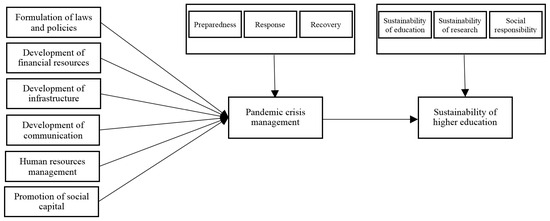
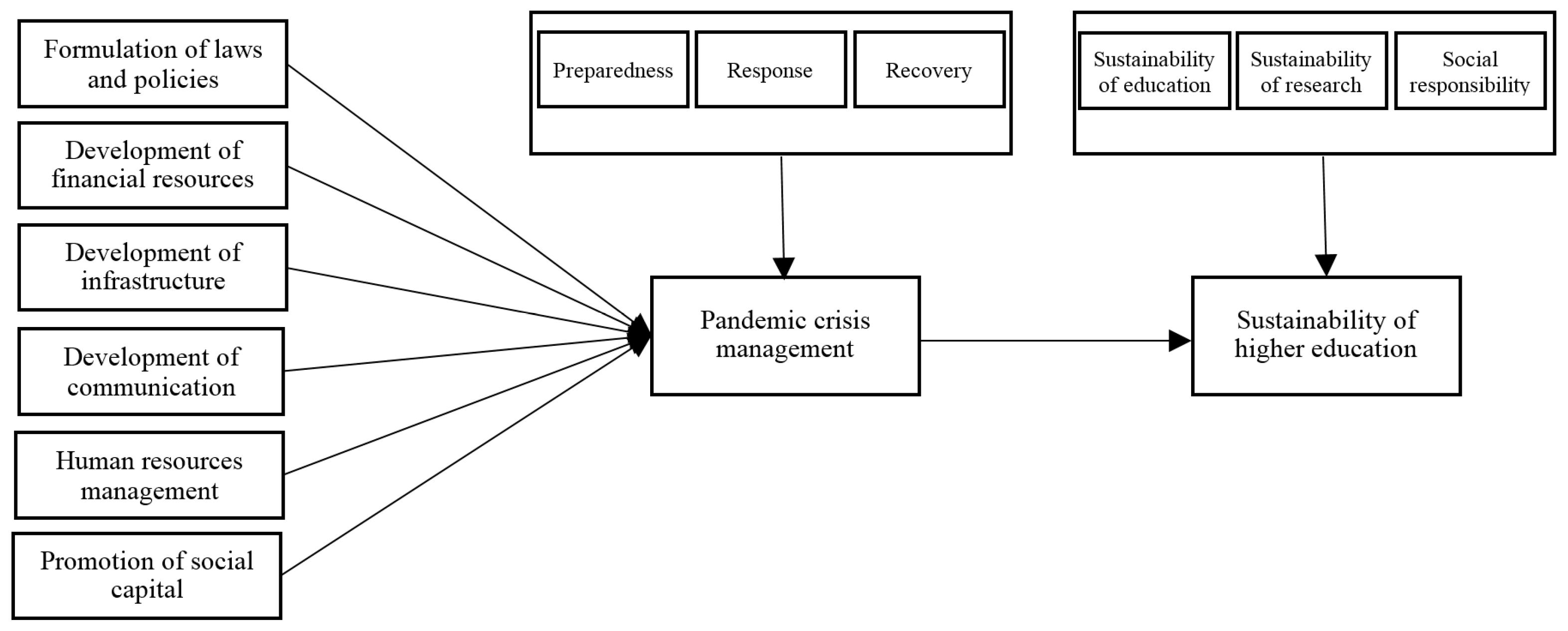
Selective coding: In this stage, the researcher attempts to connect the categories with each other and, based on these connections, create a theory about the subject. Based on this, the theory of pandemic crisis management in agricultural colleges can be expressed as follows: various strategies, such as formulation of laws and policies to protect the performance of agricultural faculties, development and diversification of university financial resources, promotion of social capital and culture, development of communication and cooperation, strengthening university infrastructure, and improving human resource management, have an impact on pandemic crisis management. Also, pandemic crisis management in agricultural colleges with three components of preparedness, response, and recovery can lead to the emergence of higher education sustainability. According to the model presented in Figure 1, which is the result of the qualitative phase of the research, hypotheses were developed about the relationships between variables that were tested in the quantitative phase.
Figure 1.
Conceptual model of pandemic crisis management at the university level.
This study used the technique of long-term engagement, continuous observation, reviewing by participant review, and reviewing by colleague review to achieve credibility. The confirmability was obtained from the complete documentation of each step of the research process and the creation of an audit trail. Another researcher was asked to review and evaluate the research process and results to obtain the dependability index. Thus, two researchers independently coded the transcripts of the fifth and seventh interviews using open coding. Inter-coder reliability was assessed using Cohen’s kappa (K = 0.721), indicating significant agreement. Discrepancies were discussed, and the coding framework was refined before axial and selective coding continued. The tool used to create transferability was rich description, recording, displaying all the key points in the open coding stage, and documenting the concepts.
4.2. Quantitative Results
Structural equation modeling was employed to validate the model developed during the qualitative phase of the research. To test the conceptual model, the accuracy of the relationships within the measurement models was first verified, and then the relationships in the structure were examined and interpreted. During the assessment of the measurement models, items with factor loadings below 0.3 and t-values less than 1.96 were excluded from the analysis. There were items whose factorial load was higher than 0.48 and had a high correlation level. After carefully measuring the hidden variables, this correlation relationship was also found to be significant. Table 1 shows the results of the research.
Table 1.
Load of the Items in the Measurement Model.
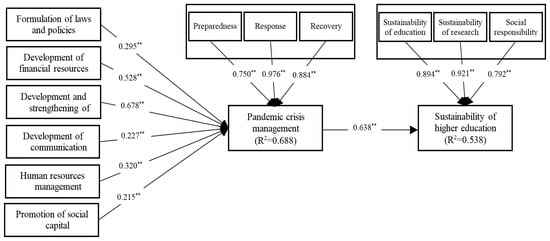
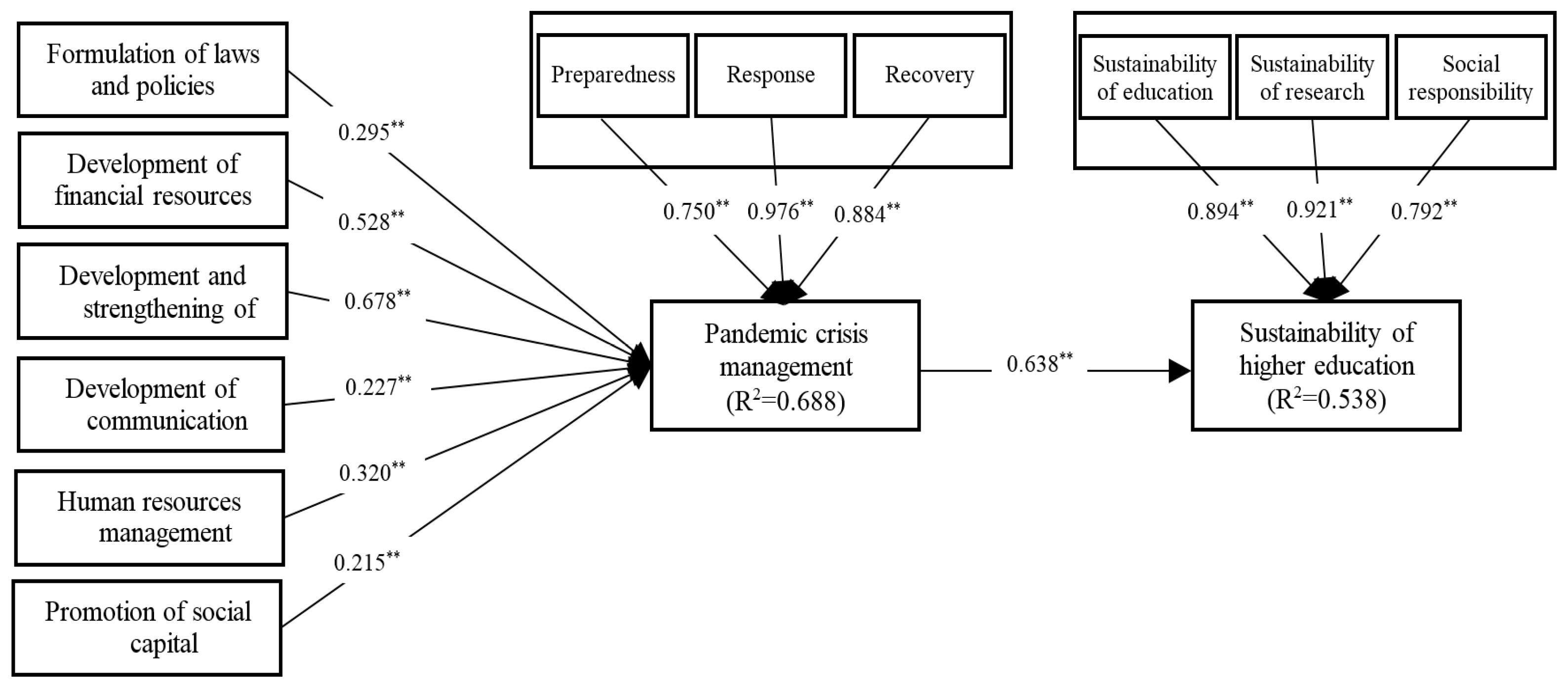
Subsequent to the validation of the measurement models, the structural model of the study was examined. Figure 2 illustrates that, at a 95% confidence level, the anticipated trajectories are significant, hence validating all study hypotheses. The findings indicate that the formulation of laws and policies, with a path coefficient of 0.295, the development of financial resources, with a path coefficient of 0.528, the enhancement of infrastructure, with a path coefficient of 0.678, the advancement of communication and cooperation, with a path coefficient of 0.227, human resource management, with a path coefficient of 0.320, and the promotion of social capital, with a path coefficient of 0.215, exert a positive and significant influence on pandemic crisis management. These factors account for 68.8 percent of the variations associated with the pandemic crisis management variable. The management of the pandemic crisis positively and significantly influenced the sustainability of higher education, evidenced by a path coefficient of 0.638, which accounts for 63.8% of the variance in the sustainability of the higher education variable.
Figure 2.
Structural model of research based on path coefficients. Note: ** denote significance at the 1% levels.
5. Discussion
5.1. Components of Crisis Management
The handling of pandemic crises in higher education is a fundamental component of the suggested paradigm. Crisis management in higher education pertains to the system’s ability to promptly recognize transformations, changes, shocks, disruptions, and unforeseen events, to reduce the probability of their occurrence, to manage them effectively if they arise, to adapt to new circumstances, and to recover rapidly after a shock, in order to achieve objectives [13,50,51]. Pandemic crisis management has three elements: pre-crisis planning, crisis response, and crisis recovery. This parallels the work of Johnson and Thompson [52], who also referenced a three-stage crisis management paradigm.
The pre-crisis stage includes crisis preparation and prevention. In this stage, three key factors were identified by research participants: implementing measures to assess the university’s risks and vulnerabilities during pandemic conditions, establishing a crisis management team, and providing relevant training. The crisis response involves implementing actions during or immediately after a disaster to minimize damage and mitigate its impact [53]. At this stage, actions include scaling down university operations, communicating institutional responses, implementing support measures to sustain educational and research activities, providing financial assistance, and enforcing health and safety protocols to address the crisis. Furiv et al. [54] also mentioned actions such as holding classes and exams virtually, employees working remotely, and reducing costs. Post-crisis recovery encompasses the processes, policies, and procedures required to restore operations and maintain the organization’s essential functions following a crisis [55]. After the crisis, it is necessary to start reconstruction, part of which includes the reconstruction of the social system, and the other part is related to the reconstruction of crisis management defects. Additionally, planning for post-pandemic learning—focusing on understanding the causes of the crisis, improving processes, and strengthening partnerships—is crucial [56].
5.2. Factors Affecting Crisis Management
In this research, communication is one of the influencing factors in crisis management. In general, academic management cannot function successfully in crisis situations without an effective and multi-layered communication strategy. The existence of a strong, transparent, and multi-level communication infrastructure can play a decisive role in reducing vulnerability and increasing the resilience of universities in critical situations. One of the identified indicators is the formation of a national and international university network with the aim of easier exchange of knowledge, material, and human resources. The experience of various universities around the world during the COVID-19 pandemic showed that international communications and cross-border scientific collaborations have played an important role in the rapid development of online education and the continuation of research activities. On the other hand, in critical situations, the university’s connection with the industrial and economic sectors can help provide resources, develop needed technologies, and facilitate the decision-making process. Also, providing quick responses and actions, effective communication with the media, and strengthening intra-organizational communications in universities are vital factors for better coordination between different departments, reducing conflicts, and accelerating the decision-making process in crisis situations. Supportive relations within an educational organization provide an integrated way to move towards ESD. Hyland-Wood et al. [57] have also emphasized the role of external and inter-organizational communications in crisis management.
In addition, the policy-making and management structure of education will contribute to a more efficient PCM plan by formulating policies, programs and providing appropriate implementation solutions that will bring about the continuity of learning. One of the most important identified necessities is the development of a national and indigenous e-learning network, taking into account national and international standards. The COVID-19 experience showed that a lack of integrated infrastructure in the field of virtual education was one of the serious challenges for universities, and the existence of a national network could improve the quality of education and standardize content while ensuring equal access. Also, the development of the university’s strategic document in dealing with crises, especially public health crises, was highlighted in the research results. Such documents should determine the direction of universities in critical situations and facilitate coordination between units. Reviewing educational and research laws and regulations to suit the pandemic conditions and the flexibility of regulations is a key factor in continuing education and research in unusual circumstances. Universities, based on their differences in capacities and capabilities, should have the authority to make decisions tailored to local conditions in order to provide faster and more effective responses in critical situations. The research findings also emphasize the formation of academic alliances and consortia. This approach can provide a platform for resource sharing, experience exchange, and scientific and technological collaborations, and make universities more capable in optimal crisis management.
Based on the results, in the social, economic, infrastructural, and cultural context of Iran, communication factors and social capital have played a decisive role in effective crisis management. In this regard, the main reason for the high importance of communication factors and social capital in Iran has been the structural weakness of the formal system and the centralized decision-making structure, as well as the lack of sustainable financial resources and technology. In addition, informal communication networks and social capital within the academic community have transformed the society into a resilient system by creating trust, solidarity, and participation among individuals. These informal networks and connections have enabled the rapid exchange of information, coordination of local actions, and provision of emotional and practical support. In fact, in the absence of a fully functional formal system, social capital has acted as a “compensatory capital” and has filled the gap caused by structural inadequacies. Therefore, the importance of these factors in Iran cannot be considered simply a cultural preference, but has largely been a necessary and adaptive response to structural challenges and resource constraints. This highlights the need to pay attention to strengthening informal institutions and social capital even after the crisis as a factor in increasing the resilience of the system.
Information and communication technology infrastructures play a crucial role in managing the pandemic crisis and have gained even greater significance due to the widespread adoption of e-learning during this period. Insufficient technical and technological infrastructure poses a major barrier to the effective implementation of online education during crises. Harrison and Johnson considered that the government and government agencies are responsible for providing the necessary infrastructure in order to reduce vulnerability to the pandemic crisis [58]. The findings revealed that human resource management was the key factor influencing the management of the pandemic crisis. Athamneh [59] acknowledges that it is essential to provide knowledge and create skills in human resources to ensure effective performance during a crisis. Therefore, to ensure the organization’s continuity and help employees manage this crisis, human resource management professionals should use the following items: effective structuring and design of job roles, performance management, training and development, ensuring fair and adaptive pay structures, health and safety management, and employee relations.
The development and diversity of financial resources are other factors affecting the performance of pandemic crisis management in the university. The turbulent conditions of the crisis imposed restrictions on higher education systems, reduced universities’ ability to generate income, and cast uncertainty over the current and future stability of educational institutions [60]. Universities were completely unprepared for the interruption of business plans caused by COVID-19 [61], showing that crisis financing needed immediate attention. Exploring new endowment opportunities, securing support from benefactors and private sector partnerships, and strengthening the connection between universities and economic enterprises are effective strategies to diversify university funding sources.
The results also showed that social capital reduces vulnerability to crisis. In times of crisis, social capital in the form of trust among community members leads to greater sharing of information about facts, procedures, or threats to the community. Fraser et al. [62] and Fulkerson et al. [63] also showed that societies with high social capital respond more efficiently in crisis scenarios. The existence of social capital enables the implementation of government programs, especially the closing of various centers and social distancing, and manifests itself in the form of social and emotional support, especially in times of crisis.
5.3. Sustainability of the Higher Education
In this research, the outcome is the sustainability of higher education, which results from the strategies and measures related to pandemic crisis management. Higher education serves a wide range of stakeholders through educational, research, and service functions. Through these functions, higher education directly contributes to the goals of SDG1 (poverty), SDG3 (health and well-being), SDG4 (education), SDG5 (gender equality), SDG8 (decent work and economic growth), SDG12 (consumption and responsible production), SDG13 (Climate Change), SDG16 (Peace, Justice and Strong Institutions) and many features of the “Partnership for Goals” (SDG 17) [41].
To encourage and facilitate sustainable higher education mobility, universities should develop types of policies and programs [64]. High-quality, reputable universities should consider educational marketing beyond advertising and seek effective ways to communicate their value proposition to a variety of stakeholders, especially students. Universities should also support marketing communications from a non-traditional perspective that considers the current needs of university applicants, university students, and the university environment from a social, environmental, and economic sustainability perspective [65]. A university that integrates sustainable practices in its organizational strategy and development goals is equipped with short-term and long-term sustainable strategies, sustainability study programs, student clubs, and events (such as student exhibitions, demonstrations, etc.) with a focus on sustainability [37]. With regard to pandemic crisis management, some of these practices will be incorporated into the higher education institution’s daily operations, which will help meet the SDGs and the global challenges facing humanity. The structure, procedures, and formal communication channels in the crisis planning sequence contribute to the quality of the correct and consistent exchange of information between leaders, ensuring that appropriate decisions are made in emergency and crisis situations, and promoting rapid response to impending crises and crisis containment [66]. Hence, crisis management can directly affect the future and sustainability of the economic and social system of higher education [67].
The pandemic was a social catalyst for a transformation in human behavior, and the post-pandemic environment has become a different society than in 2019. COVID-19 has led to a sector shift towards greater equity and impact in teaching/learning, research/innovation, community service/engagement, and staff/student experience. The pressure of the disruption of COVID-19 and other major global trends affects the business model of higher education institutions, organizational priorities and overall mission, and the important contribution of higher education institutions in achieving sustainable development goals. In this way, higher education highlights its central role in improving and transforming the economy and society and establishes its position in helping to create a fairer and more sustainable future by realizing sustainable development goals.
This new, unexpected and unpredictable context brings new challenges and needs for higher education [68]. Universities have to adapt to the post-COVID-19 reality. The need for change in higher education planning is related to a world that values sustainability in its various forms. Investment in technological learning and quality education is needed to improve access. We also need to reassess physical spaces for a more digital and remote world to ensure a sustainable future. Therefore, universities should embrace flexible work arrangements as a permanent adaptation to reduced on-site operations and evolving business models. Investors no longer see universities as public goods and now demand financial sustainability through income generation and greater self-sufficiency. The answer to these pressures is sustainability.
6. Conclusions
In this study, the proposed model of university higher education quality management was explained using the grounded theory strategy and structural equation modeling. The presented model is a specific model of pandemic crisis management for a university, which, while identifying the conditions, strategies, and consequences related to pandemic crisis management, also shows the relationships and interactions of these categories.
The findings indicate that six factors—formulation of laws and policies, development of financial resources, enhancement of infrastructure, advancement of communication, human resource management, and promotion of social capital—exert a significant and positive influence on pandemic crisis management. Improving these factors results in enhanced management of pandemic crises. Moreover, pandemic crisis management has a positive and significant effect on the sustainability of higher education.
The model presented in this research is a process and linear model that was extracted based on the experiences of the participants in the research and a review of the relevant literature. Other innovations of the model include its flexibility to be used in different universities, taking into account the environmental and cultural conditions (the dynamics of the model), nativeness in details and components, and in the overall shape of the model, and considering sustainability as the ultimate goal of higher education.
6.1. Implications
The contribution of this study to the advancement of knowledge is in providing an integrated and indigenous model based on field data. By integrating six key factors (laws, finance, infrastructure, communication, human resources, social capital), this study has shown crisis management and consequently the sustainability of higher education in a comprehensive and testable causal model. Therefore, this study showed that crisis management is not an end in itself, but rather a powerful tool to achieve a higher goal—the sustainability of higher education. This model can see the consequences of crisis management beyond “getting through the storm” and can link it to the long-term transformation and resilience of the system. Therefore, this study builds a bridge between theory and practice and provides a valuable framework for academic administrators and future researchers.
The key theoretical contribution of this research is the documentation of pandemic crisis management practices in agricultural colleges, providing a foundation for developing a comprehensive model informed by all relevant factors. This model facilitates the implementation of crisis management through the planning process. The practical use of this study will mitigate the impacts of the COVID-19 pandemic and any future pandemics on universities and agricultural institutions. The results of this research can aid policymakers, social partners, educators, students, and other internal and external stakeholders in higher education in mitigating the adverse impacts of the COVID-19 issue. It can also improve the efficient administration of teaching and learning processes, as well as the resilience of higher education during and beyond the COVID-19 era. Pandemic crisis management, emphasizing the sustainability of higher education, not only helps resolve the problems of ensuring student education and how to evaluate and continue research activities, but it also helps return to normal conditions in a shorter time by effective reconfiguration and learning from experiences in crises and using the possible opportunities created to advantage.
6.2. Limitations and Recommendations
This research is based on data collected from higher education professionals during the COVID-19 pandemic in a specific context, and the model proposed in this study is an initial framework based on data collected from these professionals in specific crisis situations. Since, in the qualitative phase, theoretical saturation was achieved and factors beyond these six factors were not significantly repeated or highlighted in the interviews, the six factors identified are the most important and influential factors in this specific context, not all possible factors. The results of the research depend on the crisis situation studied, the sample, and the scope of the research, and other variables may be relevant in other contexts.
This research does not deny the existence of other factors that affect the resilience of higher education and acknowledges that other factors may play a key role in different situations and contexts. The current model is a foundation for future research. Future research should also assess other variables to develop a more comprehensive model of crisis management and sustainability in higher education. It is suggested that future research should comparatively examine the effectiveness of this model in managing other types of crises (such as natural disasters or socio-political crises) in higher education settings. Furthermore, validating and adapting this framework across different crises could lead to the development of a more comprehensive and robust theory for crisis management in universities.
In order to improve the management of education in crisis situations in agricultural universities, it is recommended that resilient digital infrastructure be developed in universities. By creating an integrated virtual education platform with the ability to support interactive content and virtual laboratories, it is possible to implement simulations of practical education in agricultural disciplines. It is also recommended to develop a strategic document for crisis management in designing an operational plan for different crisis scenarios, focusing on providing financial resources, practical education protocols, and establishing communication networks with local institutions to support students in disadvantaged areas.
Author Contributions
Conceptualization, S.F.; Formal analysis, S.F.; Investigation, S.F.; Methodology, S.F.; Project administration, H.A.; Supervision, H.A.; Writing—original draft, S.F.; Writing—review and editing, M.O.N., S.M.M., C.F., B.N.-S., R.V., Y.K.P.A. and H.A. All authors have read and agreed to the published version of the manuscript.
Funding
This research received no external funding.
Institutional Review Board Statement
This study is waived for ethical review, as it involves minimal-risk, interview-based data collection by Islamic Azad University.
Informed Consent Statement
Informed consent for participation was obtained from all subjects involved in the study.
Data Availability Statement
Data are available upon request.
Conflicts of Interest
The authors declare no conflicts of interest.
References
- Bastesen, J.; Kåfjord Lange, B.; Sofus Tranøy, B. Making sense of uncertainty-Interrogating conceptions of the New Normal. Scand. J. Manag. 2025, 41, 101407. [Google Scholar] [CrossRef] [Scilit]
- Piret, J.; Boivin, G. Pandemics Throughout History. Front. Microbiol. 2021, 11, 631736. [Google Scholar] [CrossRef] [Scilit]
- Burkle, F.M., Jr. Challenges of Global Public Health Emergencies: Development of a Health-Crisis Management Framework. Tohoku J. Exp. Med. 2019, 249, 33–41. [Google Scholar] [CrossRef] [Scilit]
- Redbird, B.; Harbridge-Yong, L.; Mersey, R.D. The Social and Political Impact of the COVID-19 Pandemic: An Introduction. RSF Russell Sage Found. J. Soc. 2022, 8, 1–29. [Google Scholar] [CrossRef] [Scilit]
- Daniel, S.J. Education and the COVID-19 Pandemic. Prospects 2020, 49, 91–96. [Google Scholar] [CrossRef] [Scilit] [PubMed]
- Bagheri, F.; Khalajinia, Z. Exploring the Challenges of Clinical Education Medical Student in Pandemic COVID-19. Horiz. Med. Educ. Dev. 2023, 14, 72–84. [Google Scholar] [CrossRef]
- Kavaric, M.; Kavaric, A.; Djokovic, R. Challenges in Online Teaching during the COVID-19 Pandemic: Higher Education Survey in Montenegro. Innov. Educ. Teach. Int. 2023, 60, 163–173. [Google Scholar] [CrossRef] [Scilit]
- Nenko, Y.; Orendarchuk, O.; Rudenko, L.; Lytvyn, A. Anti-Crisis Management in Higher Education Institutions of Ukraine during the COVID-19 Pandemic. Rev. Bras. Educ. Camp. 2021, 6, e12838. [Google Scholar] [CrossRef] [Scilit]
- Oleksiyenko, A.; Mendoza, P.; Riaño, F.E.C.; Dwivedi, O.P.; Kabir, A.H.; Kuzhabekova, A.; Charles, M.; Ros, V.; Shchepetylnykova, I. Global Crisis Management and Higher Education: Agency and Coupling in the Context of Wicked COVID-19 Problems. High. Educ. Q. 2023, 77, 356–374. [Google Scholar] [CrossRef] [Scilit]
- Nash, M.; Churchill, B. Caring during COVID-19: A Gendered Analysis of Australian University Responses to Managing Remote Working and Caring Responsibilities. Gend. Work Organ. 2020, 27, 833–846. [Google Scholar] [CrossRef] [Scilit]
- Saide, S.; Sheng, M.L. Knowledge Exploration–Exploitation and Information Technology: Crisis Management of Teaching–Learning Scenario in the COVID-19 Outbreak. Technol. Anal. Strateg. Manag. 2021, 33, 927–942. [Google Scholar] [CrossRef] [Scilit]
- De Boer, H. COVID-19 in Dutch Higher Education. Stud. High. Educ. 2021, 46, 96–106. [Google Scholar] [CrossRef] [Scilit]
- Meili Monfared, J.; Ashrafi, M.; Baradaran, A.; Javan, M.; Foulad, F.; Raaiatpour, A.; Nekoomanesh, M.; Sajadi, S.; Heidarinasab, M. New Recommendations and Plans to Increase the Level of Resilience of the Higher Education System in the Face of Crises and Adver-Sities, Higher Education Study Working Group in the Corona and Post-Corona Era, Tehran; Ministry of Science, Research and Technology: New Delhi, India, 2020.
- Kim, H.; Krishnan, C.; Law, J.; Rounsaville, T. COVID-19 and US Higher Education Enrollment: Preparing Leaders for Fall; New Jersey: McKinsey & Company: Newark, NJ, USA, 2020. [Google Scholar]
- Crawford, J.; Cifuentes-Faura, J. Sustainability in Higher Education during the COVID-19 Pandemic: A Systematic Review. Sustainability 2022, 14, 1879. [Google Scholar] [CrossRef] [Scilit]
- Leal Filho, W. COVID-19, Sustainable Development and Higher Education: Towards a Recovery Path. Int. J. Sustain. High. Educ. 2021, 22, 138–141. [Google Scholar] [CrossRef] [Scilit]
- OECD. COVID–19 and the Low-Carbon Transition: Impacts and Possible Policy Responses; OECD Publishing: Paris, France, 2020. [Google Scholar]
- Purcell, W.M.; Lumbreras, J. Higher Education and the COVID-19 Pandemic: Navigating Disruption Using the Sustainable Development Goals. Discov. Sustain. 2021, 2, 6. [Google Scholar] [CrossRef] [Scilit]
- Sahu, P. Closure of Universities Due to Coronavirus Disease 2019 (COVID-19): Impact on Education and Mental Health of Students and Academic Staff. Cureus 2020, 12, e7541. [Google Scholar] [CrossRef] [Scilit]
- Hadjeris, F. Revisiting Sustainable Development Goal 4 in the Context of COVID-19 Pandemic: A Case Study of Online Teaching in Algerian Higher Education Institutions. Hum. Behav. Emerg. Technol. 2021, 3, 160–168. [Google Scholar] [CrossRef] [Scilit]
- Anholon, R.; Rampasso, I.S.; Silva, D.A.L.; Leal Filho, W.; Quelhas, O.L.G. The COVID-19 Pandemic and the Growing Need to Train Engineers Aligned to the Sustainable Development Goals. Int. J. Sustain. High. Educ. 2020, 21, 1269–1275. [Google Scholar] [CrossRef] [Scilit]
- Haileamlak, A. Editorial Message. Ethiop. J. Health Sci. 2022, 32, 228. [Google Scholar] [CrossRef] [Scilit]
- Cucinotta, D.; Vanelli, M. WHO Declares COVID-19 a Pandemic. Acta Bio Medica: Atenei Parm. 2020, 91, 157–160. [Google Scholar] [CrossRef] [Scilit]
- Arora, N.K.; Mishra, J. COVID-19 and Importance of Environmental Sustainability. Environ. Sustain. 2020, 3, 117–119. [Google Scholar] [CrossRef] [Scilit]
- Waltner-Toews, D. On Pandemics: Deadly Diseases from Bubonic Plague to Coronavirus; Greystone Books: Vancouver, BC, Cananda, 2020. [Google Scholar]
- Kuhlman, T.; Farrington, J. What is sustainability? Sustainability 2010, 2, 3436–3448. [Google Scholar] [CrossRef] [Scilit]
- Martín-Blanco, C.; Zamorano, M.; Lizárraga, C.; Molina-Moreno, V. The Impact of COVID-19 on the Sustainable Development Goals: Achievements and Expectations. Int. J. Environ. Res. Public Health 2022, 19, 16266. [Google Scholar] [CrossRef] [Scilit]
- Richardson, R. Critical Responses to Global Systemic Risk in an Era of Polycrisis. Int. J. Disaster Risk Sci. 2025, 16, 699–703. [Google Scholar] [CrossRef] [Scilit]
- Hariram, N.P.; Mekha, K.B.; Suganthan, V.; Sudhakar, K. Sustainalism: An Integrated Socio-Economic-Environmental Model to Address Sustainable Development and Sustainability. Sustainability 2023, 15, 10682. [Google Scholar] [CrossRef] [Scilit]
- Wang, J.; Yang, M.; Maresova, P. Sustainable Development at Higher Education in China: A Comparative Study of Students’ Perception in Public and Private Universities. Sustainability 2020, 12, 2158. [Google Scholar] [CrossRef] [Scilit]
- Dlouhá, J.; Henderson, L.; Kapitulčinová, D.; Mader, C. Sustainability-Oriented Higher Education Networks: Characteristics and Achievements in the Context of the UN DESD. J. Clean. Prod. 2018, 172, 4263–4276. [Google Scholar] [CrossRef] [Scilit]
- Hyytinen, H.; Laakso, S.; Pietikäinen, J.; Ratvio, R.; Ruippo, L.; Tuononen, T.; Vainio, A. Perceived Interest in Learning Sustainability Competencies among Higher Education Students. Int. J. Sustain. High. Educ. 2023, 24, 118–137. [Google Scholar] [CrossRef] [Scilit]
- Weiss, M.; Barth, M.; Wiek, A.; Von Wehrden, H. Drivers and Barriers of Implementing Sustainability Curricula in Higher Education-Assumptions and Evidence. High. Educ. Stud. 2021, 11, 42. [Google Scholar] [CrossRef] [Scilit]
- Žalėnienė, I.; Pereira, P. Higher Education For Sustainability: A Global Perspective. Geogr. Sustain. 2021, 2, 99–106. [Google Scholar] [CrossRef] [Scilit]
- Mohammadi, Y.; Monavvarifard, F.; Salehi, L.; Movahedi, R.; Karimi, S.; Liobikienė, G. Explaining the Sustainability of Universities through the Contribution of Students’ Pro-Environmental Behavior and the Management System. Sustainability 2023, 15, 1562. [Google Scholar] [CrossRef] [Scilit]
- Bauer, M.; Rieckmann, M.; Niedlich, S.; Bormann, I. Sustainability Governance at Higher Education Institutions: Equipped to Transform? Front. Sustain. 2021, 2, 640458. [Google Scholar] [CrossRef] [Scilit]
- Leal Filho, W.; Dinis, M.A.P.; Lange Salvia, A.; Fritzen Gomes, B.M.; Vasconcelos, C.R.P.D.; Albrecht, C.F. Influences of the COVID-19 Pandemic on the Impact Factor of a Sample of Environment/Sustainability-Related Journals. Int. J. Sustain. High. Educ. 2024, 25, 306–318. [Google Scholar] [CrossRef] [Scilit]
- Parry, S.; Metzger, E. Barriers to Learning for Sustainability: A Teacher Perspective. Sustain. Earth Rev. 2023, 6, 2. [Google Scholar] [CrossRef] [Scilit]
- Latour, B.; Muecke, S. Protective Measures. Cult. Politics 2021, 17, 11–16. [Google Scholar] [CrossRef] [Scilit]
- Bartusevičienė, I.; Pazaver, A.; Kitada, M. Building a Resilient University: Ensuring Academic Continuity–Transition from Face-to-Face to Online in the COVID-19 Pandemic. WMU J. Marit. Aff. 2021, 20, 151–172. [Google Scholar] [CrossRef] [Scilit]
- Mok, K.H. Impact of COVID-19 on Higher Education. Paper Commissioned for the World Higher Education Conference, 2022, WHEC2022 Background Document, Theme 01, UNESCO. Available online: https://unesdoc.unesco.org/ark:/48223/pf0000389860 (accessed on 4 December 2024).
- Mikušová, M.; Horváthová, P. Prepared for a Crisis? Basic Elements of Crisis Management in an Organisation. Econ. Res.-Ekon. Istraživanja 2019, 32, 1844–1868. [Google Scholar] [CrossRef] [Scilit]
- Hadavand, S. The Analysis of Changes Resulted from the Interaction of the Corona Spread and the Organizational Education Systems. Nama J. Educ. Stud. 2021, 18, 1–15. [Google Scholar]
- Moon, J.; Randell, M.; Zhang, Y.; Li, M. Crisis Management during the COVID-19 Pandemic Response within an Australian Higher Education Institution–a Qualitative Analysis. J. High. Educ. Policy Manag. 2024, 46, 92–106. [Google Scholar] [CrossRef] [Scilit]
- Kuzmina, S.L.; Popova, O.; Bachurina, L. Contemporary Crisis Management in Ukraine’s Higher Education System: A Case Study from the Crises of the Pandemic and the Invasion. Int. J. Educ. Manag. 2024, 38, 413–428. [Google Scholar] [CrossRef] [Scilit]
- Biancardi, A.; Colasante, A.; D’Adamo, I.; Daraio, C.; Gastaldi, M.; Uricchio, A.F. Strategies for Developing Sustainable Communities in Higher Education Institutions. Sci. Rep. 2023, 13, 20596. [Google Scholar] [CrossRef] [Scilit]
- Rasli, A.; Tee, M.; Lai, Y.L.; Tiu, Z.C.; Soon, E.H. Post-COVID-19 Strategies for Higher Education Institutions in Dealing with Unknown and Uncertainties. Front. Educ. 2022, 7, 992063. [Google Scholar] [CrossRef] [Scilit]
- Leach, M.; MacGregor, H.; Scoones, I.; Wilkinson, A. Post-Pandemic Transformations: How and Why COVID-19 Requires Us to Rethink Development. World Dev. 2021, 138, 105233. [Google Scholar] [CrossRef] [Scilit] [PubMed]
- Sá, M.J.; Serpa, S. The COVID-19 Pandemic as an Opportunity to Foster the Sustainable Development of Teaching in Higher Education. Sustainability 2020, 12, 8525. [Google Scholar] [CrossRef] [Scilit]
- Strauss, A.L.; Corbin, J. Basics of Qualitative Research: Techniques and Procedures for Developing Grounded Theory, 2nd ed.; Sage Publications: Thousand Oaks, CA, USA, 1998. [Google Scholar]
- Guba, E.G.; Lincoln, Y.S. Competing Paradigms in Qualitative Research. In Handbook of Qualitative Research; Sage Publications: Thousand Oaks, CA, USA, 1994. [Google Scholar]
- Johnson, M.S.; Thompson, S. COVID-19 Crisis Management at Historically Black Colleges and Universities (HBCUs): A Contemporary Approach to Governance and Leadership. J. Underrepresented Minor. Prog. 2021, 5, 27–46. [Google Scholar] [CrossRef] [Scilit]
- Coombs, W.T. Ongoing Crisis Communication Planning, Managing, and Responding; Sage Publications: Thousand Oaks, CA, USA, 2007. [Google Scholar]
- Furiv, U.; Kohtamäki, V.; Balbachevsky, E.; Virta, S. COVID-19 Crisis Response of Higher Education Institutions: Tampere University (TAU) and University of São Paulo (USP). In Leadership and Management Strategies for Creating Agile Universities; IGI Global Scientific Publishing: Hershey, PA, USA, 2022. [Google Scholar] [CrossRef] [Scilit]
- Dooly, J.; Madden, D. Ireland’s Post-Crisis Recovery, 2012–2019: Was It Pro-Poor? Econ. Socila Rev. 2022, 53, 137–172. [Google Scholar]
- Da’as, R.; Qadach, M.; Schechter, C. Crisis Leadership: Principals’ Metaphors during COVID-19. Educ. Manag. Adm. Leadersh. 2025, 53, 357–379. [Google Scholar] [CrossRef] [Scilit]
- Hyland-Wood, B.; Gardner, J.; Leask, J.; Ecker, U.K.H. Toward Effective Government Communication Strategies in the Era of COVID-19. Humanit. Soc. Sci. Commun. 2021, 8, 30. [Google Scholar] [CrossRef] [Scilit]
- Harrison, S.; Johnson, P. Challenges in the adoption of crisis crowdsourcing and social media in Canadian emergency management. Gov. Inf. 2019, 36, 501–509. [Google Scholar] [CrossRef] [Scilit]
- Athamneh, S. HR Planning for Crisis Management. In Human Resource Planning for the 21st Century; Fahed-Sreih, J., Ed.; InTechOpen: Rijeka, Croatia, 2018. [Google Scholar]
- De Wit, H.; Altbach, P.G. Internationalization in Higher Education: Global Trends and Recommendations for Its Future. Policy Rev. High. Educ. 2021, 5, 28–46. [Google Scholar] [CrossRef] [Scilit]
- Munna, A.S. COVID-19 and Sustainability in Higher Education: Reflective Review. Int. J. Educ. Adm. Manag. Leadersh. 2021, 2, 1–4. [Google Scholar] [CrossRef] [Scilit]
- Fraser, T.; Aldrich, D.P.; Page-Tan, C. Bowling Alone or Distancing Together? The Role of Social Capital in Excess Death Rates from COVID19. Soc. Sci. Med. 2021, 284, 114241. [Google Scholar] [CrossRef] [Scilit] [PubMed]
- Fulkerson, G.; Thomas, A.; Ho, J.-M.; Zians, J.; Seale, E.; McCarthy, M.; Han, S. COVID-19 and Social Capital Loss: The Results of a Campus Outbreak. Soc. Indic. Res. 2023, 165, 867–878. [Google Scholar] [CrossRef] [Scilit] [PubMed]
- Dabija, D.-C.; Campian, V.; Stanca, L.; Tiron-Tudor, A. Generating Students’ Loyalty towards the Sustainable University during the Later COVID-19 Pandemic. Int. J. Sustain. High. Educ. 2023, 24, 1858–1876. [Google Scholar] [CrossRef] [Scilit]
- Bagaric, L.; Ham, M.; Meštrović, D. Embracing sustainable marketing in higher education viewed through service quality: Students’ perspective. Ekon. Vjesn. 2024, 37, 403–418. [Google Scholar] [CrossRef] [Scilit]
- Chiwisa, C. The Role of Leadership in Crisis Management: A Literature Review. J. Hum. Resour. Leadership 2024, 9, 48–65. [Google Scholar] [CrossRef] [Scilit]
- Tokakis, V.; Polychroniou, P.; Boustras, G. Crisis Management in Public Administration: The Three Phases Model for Safety Incidents. Saf. Sci. 2019, 113, 37–43. [Google Scholar] [CrossRef] [Scilit]
- Abad-Segura, E.; González-Zamar, M.-D.; Infante-Moro, J.C.; Ruipérez García, G. Sustainable Management of Digital Transformation in Higher Education: Global Research Trends. Sustainability 2020, 12, 2107. [Google Scholar] [CrossRef] [Scilit]

Disclaimer/Publisher’s Note: The statements, opinions and data contained in all publications are solely those of the individual author(s) and contributor(s) and not of MDPI and/or the editor(s). MDPI and/or the editor(s) disclaim responsibility for any injury to people or property resulting from any ideas, methods, instructions or products referred to in the content. |
© 2025 by the authors. Licensee MDPI, Basel, Switzerland. This article is an open access article distributed under the terms and conditions of the Creative Commons Attribution (CC BY) license (https://creativecommons.org/licenses/by/4.0/).