


Abstract
In partial shading situations, the power–voltage (P–V) characteristics of photovoltaic (PV) systems become more complex due to many local maxima. Hence, traditional maximum power point tracking (MPPT) techniques fail to recognize the global maximum power point (MPP), resulting in a significant drop in the produced power. Global optimization strategies, such as metaheuristic approaches, efficiently address this issue. This work implements the recent “particle swarm optimization through targeted position-mutated elitism” (PSO-TPME) with a reinitialization mechanism on a PV system under partial shading conditions. The fast-converging and global exploration capabilities of PSO-TPME make it appealing for online optimization. PSO-TPME also offers the flexibility of tuning the particle classifier, elitism, mutation level, and mutation probability. This work analyzes several PSO-TPME parameter settings for the MPPT of partially shaded PV systems. Simulations of the PV system under varying shading patterns show that PSO-TPME, with balanced exploitation–exploration settings, outperforms PSO in terms of convergence speed and the amount of captured energy during convergence. Furthermore, simulations of partial shading conditions with fast-varying, smooth, and step-changing irradiance demonstrated that the proposed MPPT technique is capable of dealing with these severe conditions, capturing more than 97.7% and 98.35% of the available energy, respectively.
1. Introduction
Environmental and economic factors urge the energy production industry to move towards renewable energy sources, which are considered clean and reliable sources. International environmental agencies continue to impose stricter emissions standards to limit air pollution [1,2]. Solar energy, which is captured via photovoltaics (PV), is considered an attractive renewable energy source as a result of its compliance with the previously mentioned standards, availability, and low cost [3,4].
Initially, maintaining a PV array at its maximum power point (MPP) is one of the most crucial concerns in the PV field [5]. Under normal circumstances, PV systems have a nonlinear power–voltage characteristic that is impacted by solar irradiance and PV temperature. This nonlinearity has a single global maximum, which makes MPPT a relatively easy task, even for local optimization approaches, such as perturb and observe (P&O) [6,7,8] and hill climbing [9,10,11]. However, partial shading is almost inevitable because clouds, trees, sand, and other objects can easily obscure portions of incident irradiance. The power–voltage characteristic becomes more complicated with multiple local maxima under partial shading situations. Overcoming the problem mandates the implementation of a global optimization strategy, such as metaheuristic algorithms. Recently, several global optimization methods have been combined with deep neural networks to enhance their global exploration capabilities and reduce their computational complexity [12,13]. Particle swarm optimization (PSO) [14,15,16], ant colony optimization (ACO) [17,18,19], firefly algorithm (FA) [20,21,22], artificial bee colony algorithm (ABC) [23,24,25], genetic algorithm (GA) [26,27,28], and grey wolf optimization (GWO) [29,30,31] are all examples of metaheuristic techniques that have been employed in MPPT of PV systems.
The PSO’s low memory demands, simplicity, global exploration capabilities, and relatively fast convergence inspire its employment in the MPPT of PV systems under partial shading conditions. However, significant efforts have been made to improve PSO’s convergence speed and accuracy, such as hybridization with a local optimizer or developing new PSO variants, making PSO favorable for global MPPT [32]. To begin, PSO is being hybridized with other local optimizers, such as P&O, to take advantage of both PSO’s global exploration capabilities and the fast convergence of local optimization techniques. In ref. [33], the authors hybridized PSO with P&O for the MPPT of a PV system, and the P&O method initially identifies the closest local MPP to the search domain boundary. The hybrid technique eventually activates PSO in the reduced search domain, resulting in a significant increase in convergence speed. The authors of [34] also combined PSO with P&O for global MPPT, but in contrast, they first initiated PSO and then activated P&O before the convergence. They reported an enhanced speed of convergence and fewer power fluctuations. In ref. [35], the authors combined modified PSO with P&O for global MPPT, but on the other hand, they employed adaptive switching between the two techniques in the tracking period. The authors reported improved convergence speed and accuracy.
The other approach to improving PSO performance is the modification of the original PSO and the proposal of new PSO variants. A multitude of relevant PSO variations for the global MPPT of PV systems is available in the literature. In ref. [36], the authors modified the original PSO by initializing the particles’ positions at a specific location to accelerate the convergence. The authors of [37] introduced “Enhanced Leader PSO” (EL-PSO) for the global MPPT of PV systems. This PSO variant introduces sequential mutations for all the particles in the swarm; if the mutated position outperforms the current one, it substitutes the current one. They obtained faster convergence compared to the original PSO. In ref. [38], the authors proposed a modified particle velocity-based PSO (MPV-PSO) for the MPPT of a PV system under partial shading conditions. They implemented adaptive acceleration coefficients and removed the random generators in the social and cognitive PSO original model. They reported a mitigation of the power fluctuation and improvement in the exploration. The authors of [39] presented a PSO variant for a multilevel inverter-based PV system under partial shading conditions. This PSO variant introduced the worst-experience social and cognitive components in the original PSO model. The authors reported enhanced convergence speed and global exploration capabilities. In ref. [40], the authors proposed a modified PSO with a swarm size decreased consecutively by excluding worse-fitness particles. They reported enhanced energy production in an experimental PV facility. The authors of [16] introduced an adaptive PSO (APSO) variant for the application of PV systems under partial shading conditions. They mitigated the initialization problem of the original PSO, resulting in faster convergence. In ref. [41], the authors presented improved PSO through velocity-based Levy flight (VPSO-LF) for PV systems under partial shading conditions. The authors reported reduced tuning parameters and faster convergence compared to conventional PSO. The authors of [42] proposed logarithmic PSO for the MPPT of PV systems. This variant relies only on the logarithmic form of the social model and results in less convergence time. In ref. [43], the authors provided improved PSO for PV systems with a jump-out method to avoid trapping in local maxima. Once a particle’s personal best value does not vary after a certain number of iterations, the jump-out mechanism is activated.
The optimal PSO swarm size for a PV system with partial shading is a crucial aspect that influences the convergence speed and accuracy. Generally, a large swarm size reduces the convergence speed but increases the swarm diversity, which increases the convergence accuracy. However, a small swarm size speeds up convergence but reduces swarm diversity, which may lead to falling into local optima. Many earlier studies did not address this issue thoroughly, and there is very little work in the literature that investigates the optimal swarm size. The authors of [14,15,16,44,45] mainly employed PSO swarm sizes equal to the number of peaks in the power–voltage (P–V) characteristics. The authors of [46], on the other hand, utilized swarm sizes larger than the number of peaks in the P–V characteristics.
The necessity for reinitialization is prompted by changes in the global maximum power point as a result of varying operating conditions such as irradiance, temperature, and shading conditions. In comparison to the numerous variants of the PSO approach, PSO reinitialization is perhaps the least investigated [47]. However, due to variable operating conditions causing a change in the maximum power point, reinitialization is inevitable. Hence, there is a crucial need for a fast online global optimization to cope with the frequent reinitialization events, with a fast convergence rate and convergence accuracy to mitigate the power loss in the maximum power point tracking period. Furthermore, this motivates the need for an efficient reinitialization mechanism to detect fast, slow, smooth, and abrupt changes in MPP due to changing conditions such as irradiance, temperature, and shading conditions [45].
The authors of [48] introduced a modified PSO through targeted position-mutated elitism (PSO-TPME) for multi-dimensional problems. Through the TPME operator, this variant improved the conventional PSO’s convergence speed, accuracy, and global exploration capabilities. This operator offers the flexibility of tuning the particle classifier, elitism, mutation level, and mutation probability. The algorithm’s fast-converging characteristic and early exploration capabilities make it an attractive option for online optimization or real-time optimization-based control. This work implements PSO-TPME with a reinitialization mechanism on the PV system under partial shading conditions and compares it with the conventional PSO. This paper proposes two settings of PSO-TPME’s parameters, called TPME1 and TPME2. For high exploitation and fast convergence, TPME1 relies solely on poor particles’ elitism, whereas TPME2 employs targeted position-mutated elitism for balanced exploration and exploitation. This work also investigates several swarm sizes for all the tested algorithms, including swarm sizes equal to the number of peaks of the PV characteristics and larger swarm sizes. As a result, this work will use the best parameter settings to tune PSO-TPME to handle challenging, fast, smooth, and step-changing irradiance conditions for PV systems under partial shading. The paper is organized into sections, covering original PSO and PSO-TPME theory, algorithm reinitialization, PV system modeling, results and discussions, and conclusions.
2. PSO
The authors of [49] were the first to develop metaheuristic particle swarm optimization (PSO). The PSO method mimics the dynamics of biological systems, such as a bird population. The PSO’s minimal memory demands and simplicity of operation encourage its deployment in a variety of multidimensional, sophisticated applications that include optimization, artificial intelligence, data-driven control, and so on.
PSO’s approach produces a population of particles at random points across the solution space that represent potential solutions to an optimization problem. Following that, the particle positions are iterated to achieve a global optimum value. The method then evaluates each particle’s location and records the best solution for each particle, dubbed the “personal best” (). Additionally, PSO records the best solution throughout the swarm for each iteration (), which is known as the “global best” (). The particles’ position (x) and velocity (v) are evaluated for each successive iteration in terms of the global best (the social component), its personal best (the cognitive component), and its former velocity (the memory component). PSO has different versions overall; damped inertia weight particle swarm optimization, often known as DIW-PSO, is one of the fundamental variants of PSO that can be expressed as
where N denotes the number of particles and n denotes the number of dimensions. Subscript ranges from 1 to N, and subscript ranges from 1 to n. The inertia weight is represented by the parameter w, whereas the damping rate of the inertia weight is represented by . The acceleration factors are and , whereas the random generator outputs are and .
2.1. PSO-TPME
The authors of [48] presented a novel PSO variant (PSO-TPME) that improved the traditional PSO’s convergence speed, convergence accuracy, and global exploration capabilities by at least two orders of magnitude. Within the first ten iterations of a high-dimensional problem, they observed considerable improvements in convergence speed, accuracy, and early exploration capabilities. The fast-converging behavior of the algorithm makes it an ideal candidate for online optimization or real-time optimization-based control. Figure 1 and Figure 2 and Algorithm 1 demonstrate the PSO-TPME technique, which has three essential features: classification, mutation, and elitism. PSO-TPME incorporates four more presetting parameters: the classification percentage (p) around the fitness mean of the whole swarm, the iteration number that initiates TPME (), the mutation level (a), and the mutation probability (). The following paragraphs will go through these features in further detail.
| Algorithm 1 PSO-TPME (Maximization). |
| Swarm Initialization Initialize personal best and global best for to do for to N do if then else if then else if then else if then end if if then if then end if end if end for end for |
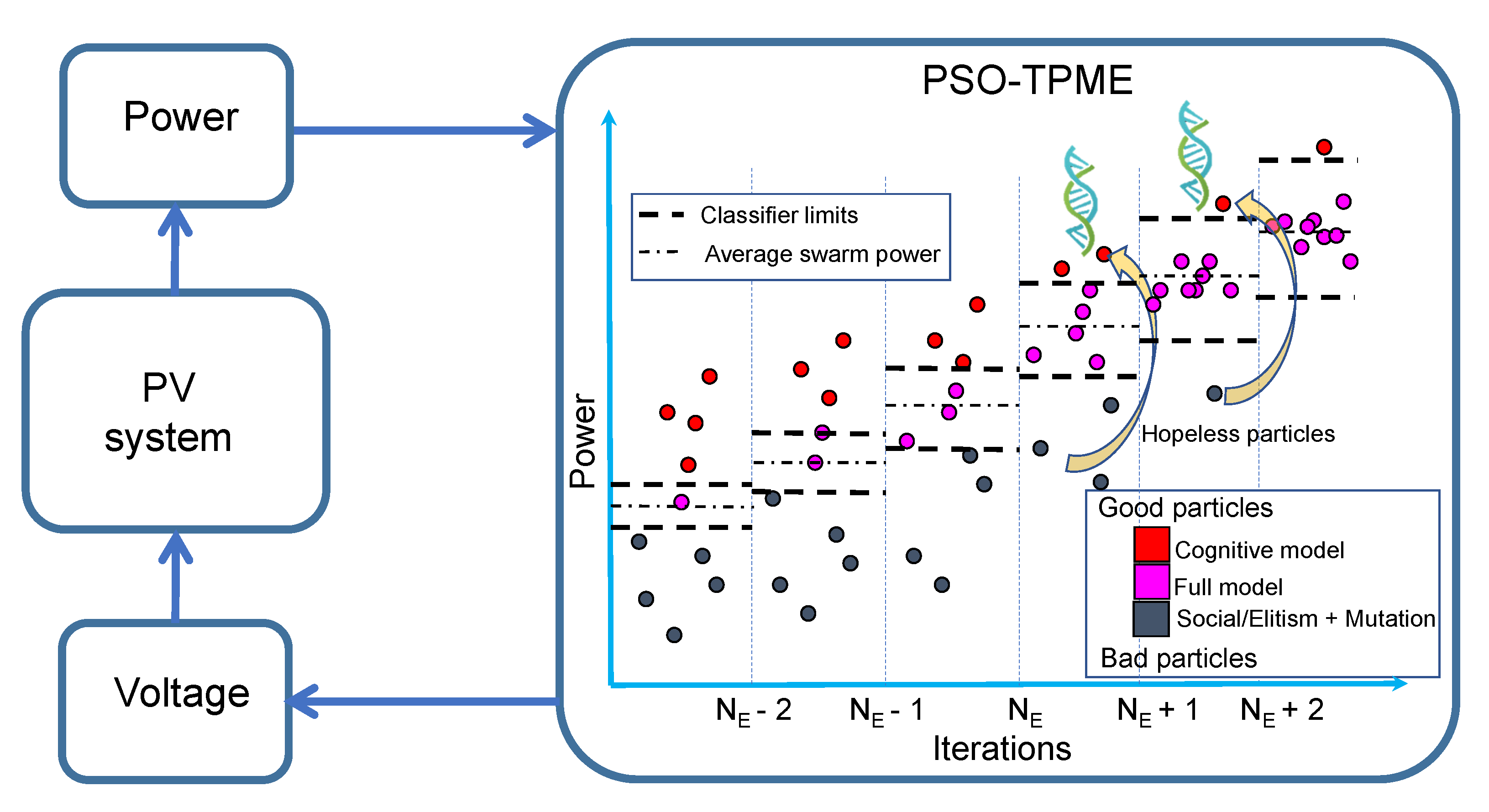
Figure 1.
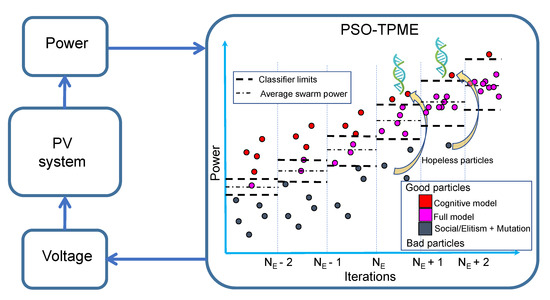
Schematic of the PSO-TPME’s classifier and updating models implemented on PV system.
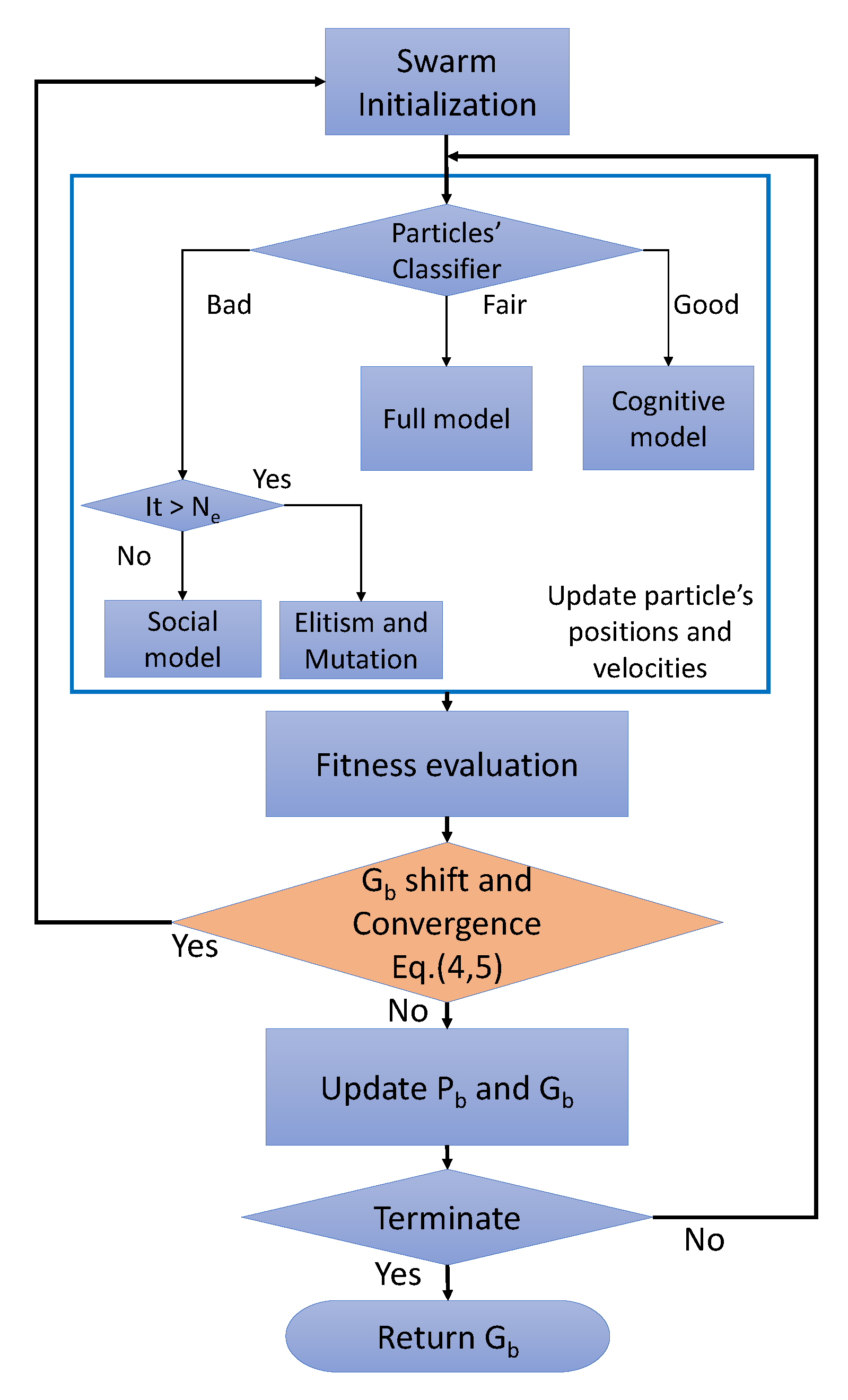
Figure 2.
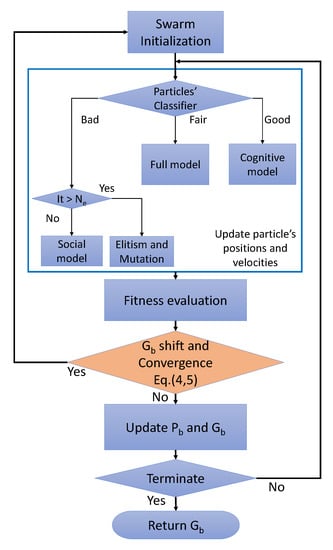
PSO-TPME with reinitialization mechanism (highlighted) for PV system under partial shading conditions.
PSO-TPME counts on fitness-based dynamic classification with intuitive termination based on convergence, as depicted in Figure 1. The approach estimates the swarm’s mean fitness (m) over iterations. Subsequently, depending on a specified percentage (p) around the mean, it creates lower and upper limits that categorize the particles into three classes. Considering a maximization problem, the particles with fitness (f) less than the lower limit, in between the limits, or greater than the upper limit are classified as “bad”, “fair”, or “good”, respectively. In this classifier, most particles will fall into the “fair particles” class after a certain number of iterations. This is because the fitness values of the particles will converge over the course of the iterations, and the particles’ mean fitness will gradually be maximized, thereby extending the limits of the “fair particles” class. Therefore, this classifier is an “automatically terminated classifier”. In PSO-TPME, there are three particle velocity updating models: the cognitive model, the full model, and the social model, as presented by Equation (4),
The algorithm employs the cognitive model to lower the velocities of the “good” particles to enhance their exploitation abilities. On the other hand, PSO-TPME uses the social model to increase the velocities of the “bad” particles to improve their exploration abilities. Additionally, the full model updates the “fair” particles to balance their exploration and exploitation abilities. If the “bad” particles remain categorized as “bad” after several iterations () and fail to advance to a higher class, they are referred to as “hopeless particles”. PSO-TPME initiates the elitism process to deal with “hopeless particles” and accelerate convergence by directing these particles towards the location with the highest fitness (). The particles’ highest fitness position is mutated directly with a specified range (a) to increase swarm diversity, reduce the risk of falling into a local optimum, and improve convergence accuracy. Hence, mutation exclusively targets “bad” particles and takes place directly on the particles’ position rather than indirectly via the global best. It is worth mentioning that PSO-TPME provides a critical parameter, the mutation probability (), which governs the likelihood of activating the TPME operator.
2.2. PSO Reinitialization
For some applications under online optimization, changing operating conditions can change the objective function’s characteristics, including its global maximum, which makes optimization reinitialization inevitable. PV systems under partial shading conditions are a practical application for maximum power point tracking (MPPT) with reinitialization. Because of several local maxima in partial shading situations, the power–voltage (P–V) characteristics become more complicated. These characteristics vary with the shading pattern, including the global maximum magnitude and location, the number of local maxima, and their magnitudes and locations. As a result, fast online global optimization with high convergence accuracy is critical to prevent power loss during the MPPT period in response to frequent reinitialization events. Following [47], the reinitialization is activated if the following conditions are satisfied:
where and denote the convergence coefficient and global best shift, respectively. If conditions (5) and (6) are met, the swarm is reinitialized. Equation (5) guarantees that all particles converge to almost the same position, according to the value of , whereas governs the global best shift sufficient for reinitialization. PSO-TPME with reinitialization (highlighted) is performed as depicted in the flowchart shown in Figure 2.
3. PV Model
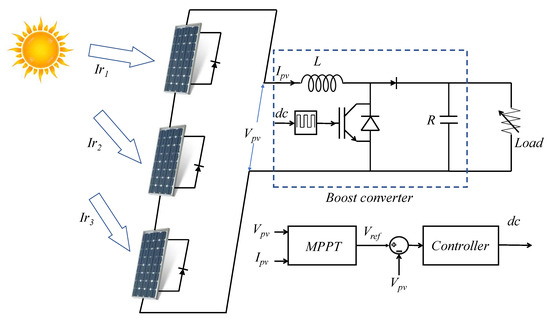
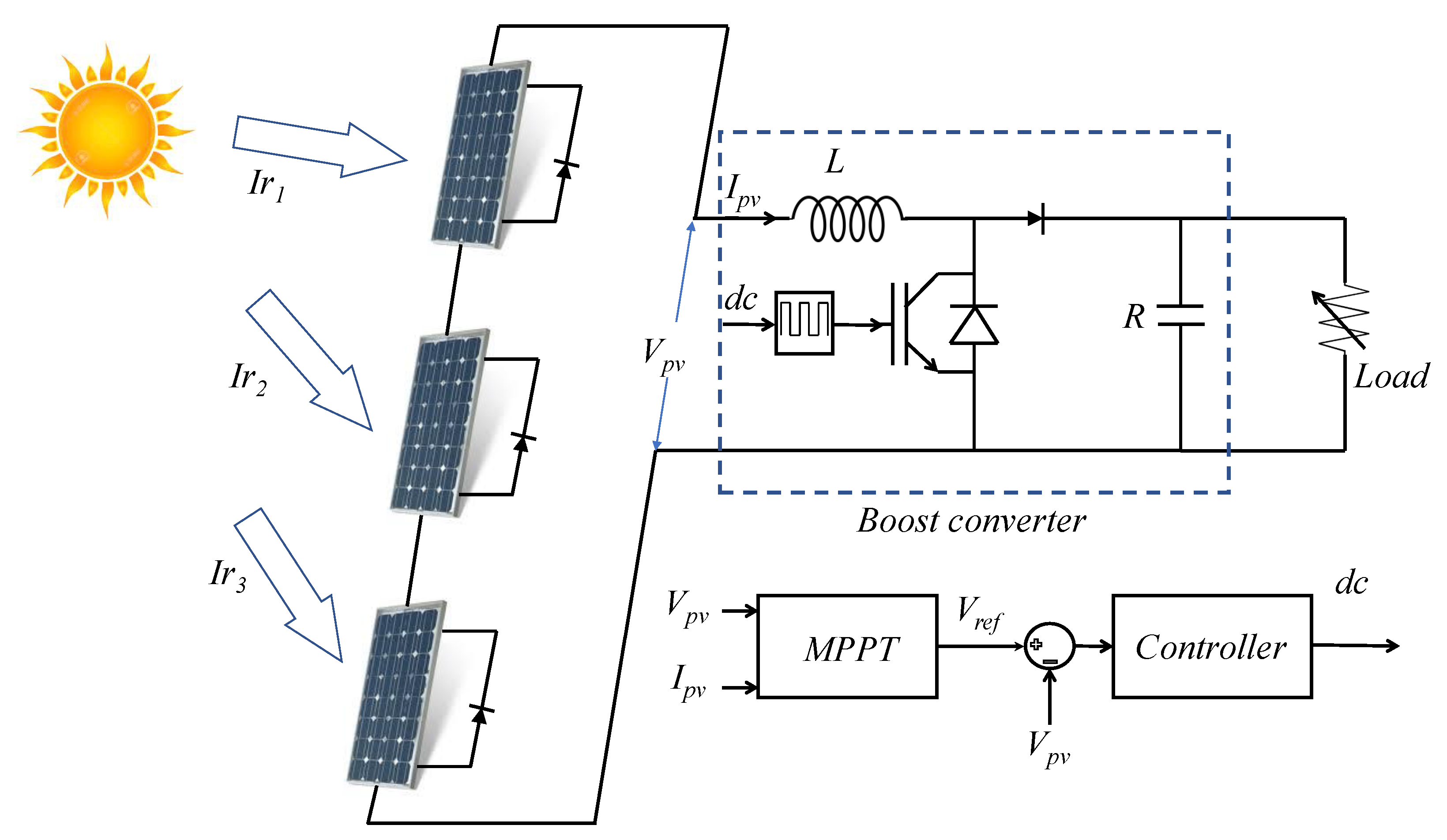
The current PV system consists of 3 PV arrays, built of 10 strings of PV modules connected in parallel, with each module consisting of 60 cells. The 3 PV arrays are connected with 3 bypass diodes as depicted in Figure 3. The PV system supplies a variable direct current (DC) load through a boost converter. This boost converter is controlled by a square signal and a controller that modulates the signal’s duty cycle (dc). The controller computes the duty cycle via processing the error between the instantaneous PV voltage () and the reference voltage (). The latter is the output of the online MPPT algorithm, which is the focus of this work.
Figure 3.
Maximum power point tracking (MPPT) of PV energy system.
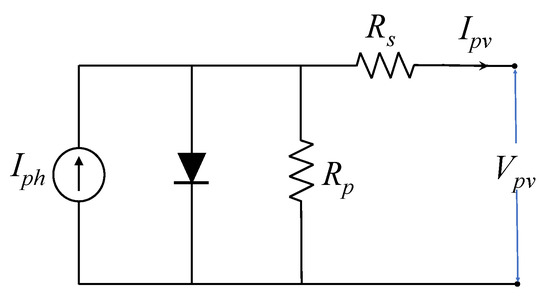
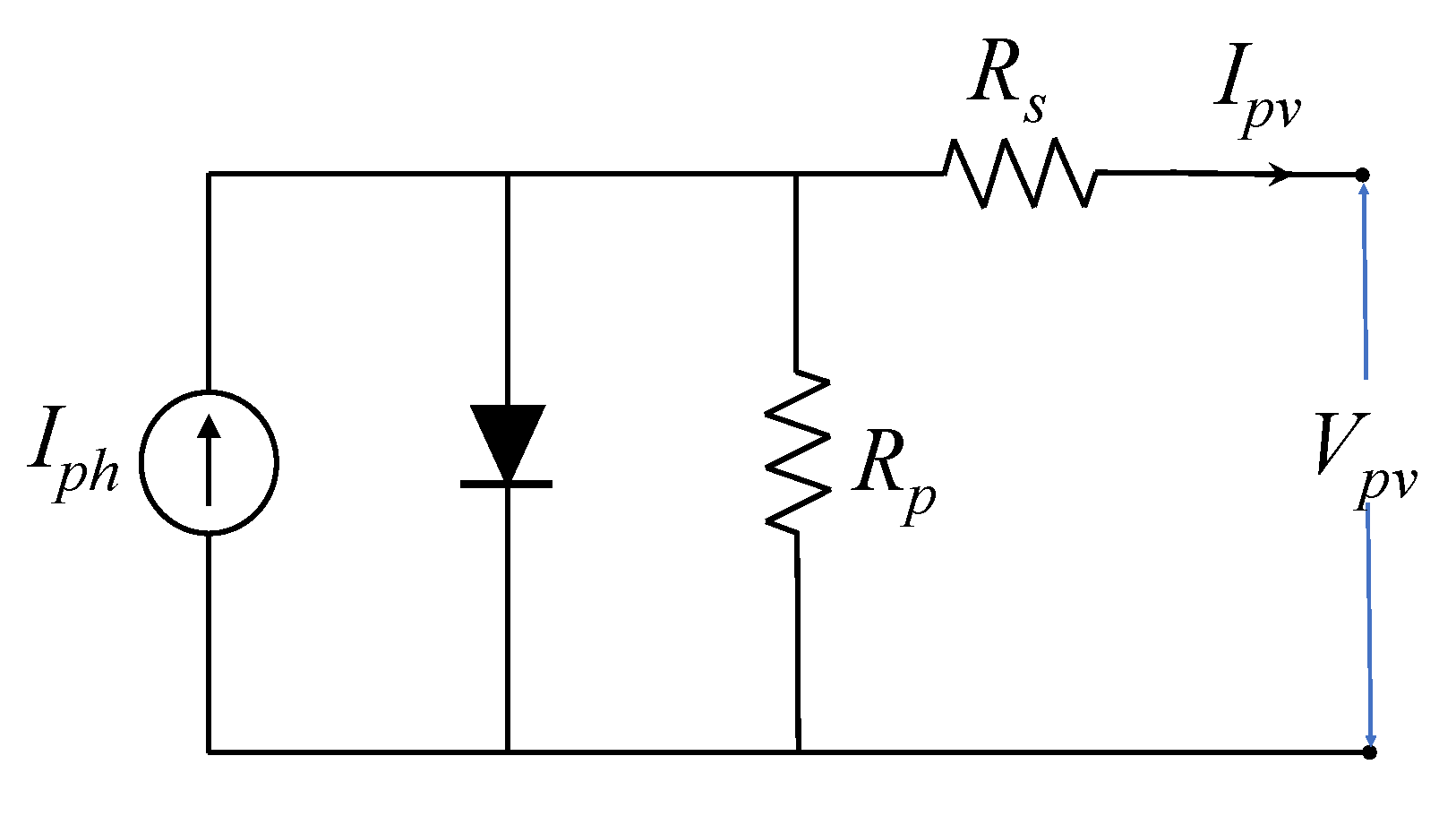
The PV cell equivalent circuit is based on a five-parameter model, as shown in Figure 4, in which represents the light-generated current, and n are the dark saturation current of the PN junction and the diode ideality factor, respectively, is the cell parallel resistance, and is the cell series resistance.
Figure 4.
The five-parameter model of a PV cell.
The five-parameter model shown in Figure 4, based on , , n, and the two resistances and , is described as follows:
where is the thermal voltage, q is the charge of the electron, and T is the cell junction temperature. Following [50], the temperature and solar irradiance () dependence of the saturation current, light diode current, and shunt resistance is expressed as
where the subscript refers to the standard test conditions that are performed at = 1000 W/m and = 25 C, is the temperature coefficient of the short circuit current , is the open circuit voltage, and k is the Boltzmann constant ( eV/K). is the silicon bandgap energy, which varies with temperature and is defined by [51] as
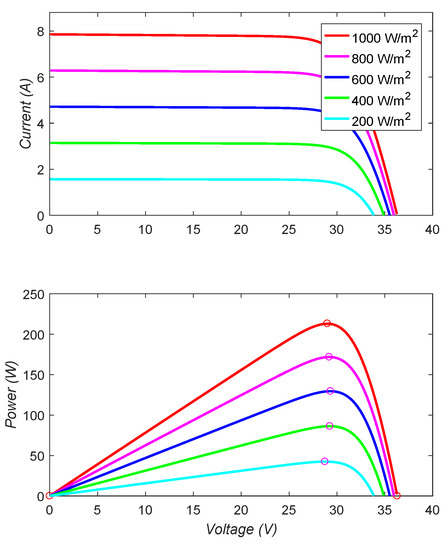
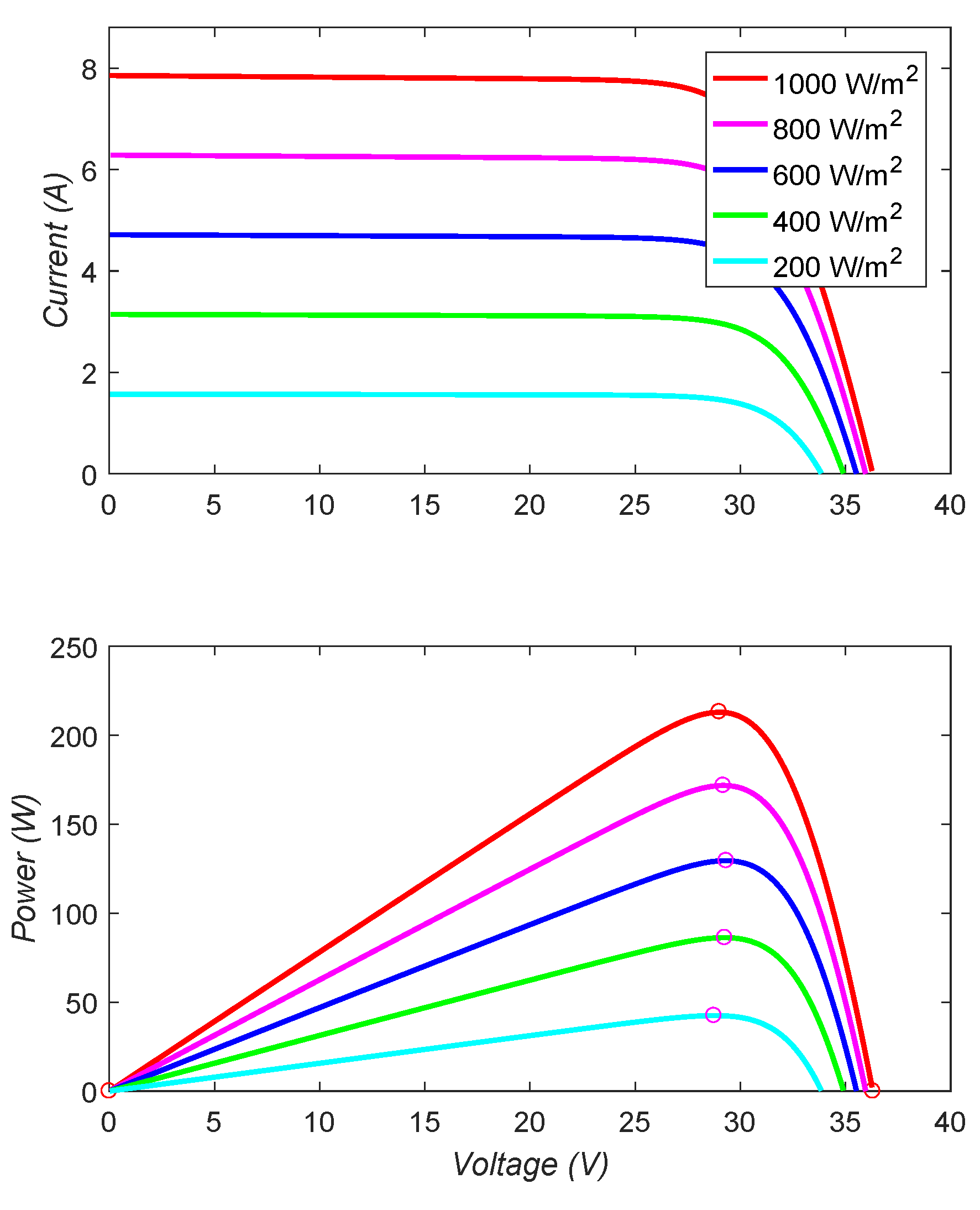
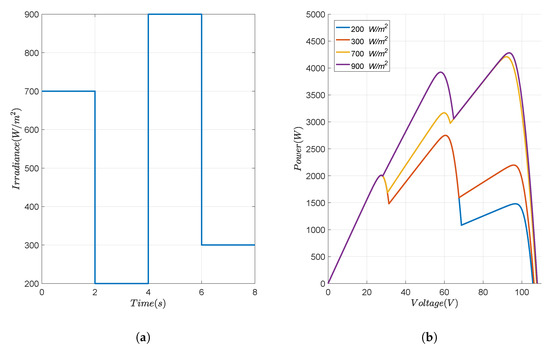
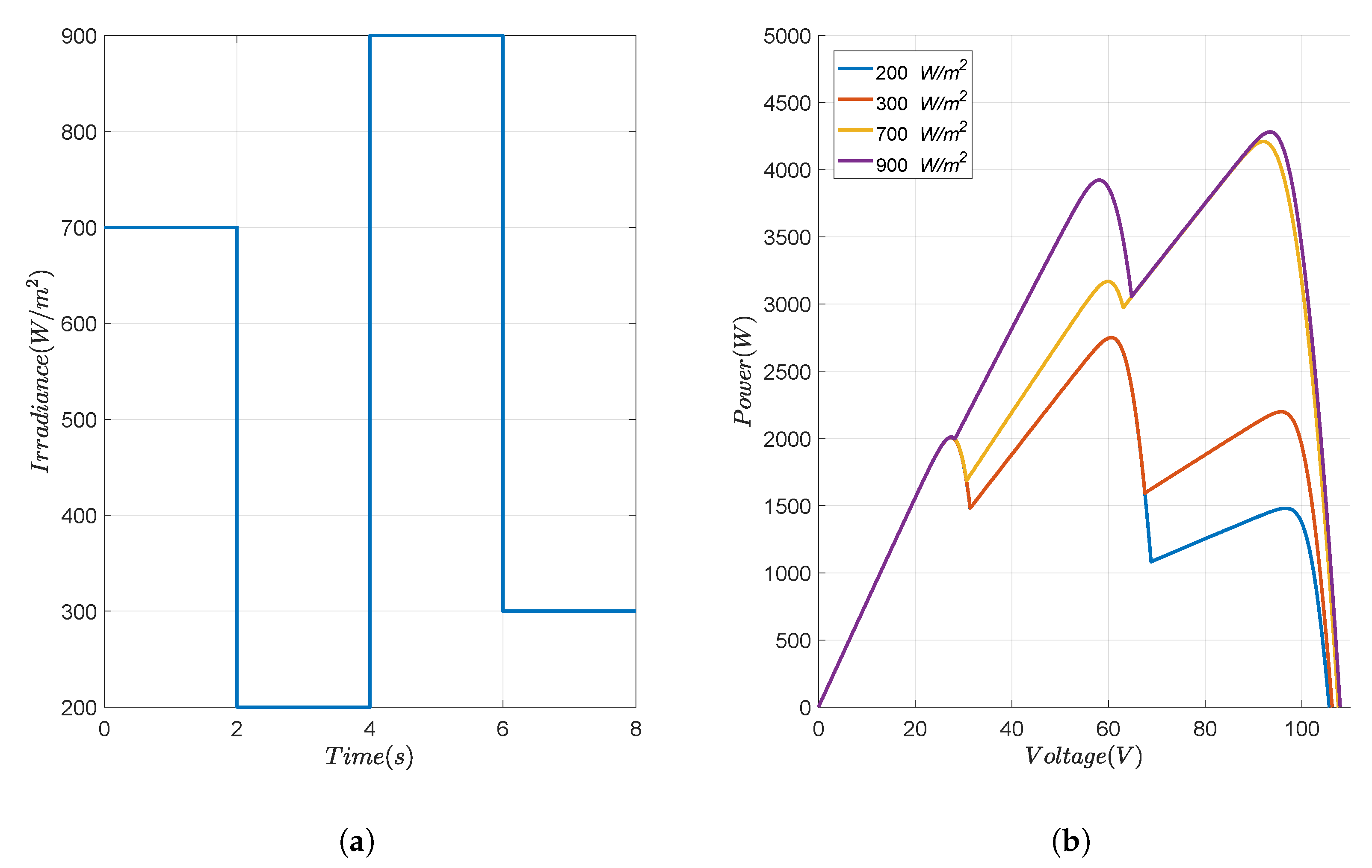
The specifications of a single PV module are listed in Table 1. Figure 5 depicts the current–voltage and power–voltage characteristics for varying irradiance. The figure shows the dependence of the output power and the corresponding voltage of the MPP on the changing irradiance. Furthermore, the varying irradiance has a substantial influence on the short-circuit current value. It is obvious that the short-circuit current is changing linearly with varying irradiance. It is worth mentioning that in partial shading conditions, the power–voltage characteristics become more complex with several local power maxima, as shown in Figure 6b. In order to capture the maximum PV power, it is necessary to manipulate the PV energy system to track the MPP. This manipulation, the so-called “MPPT controller”, is performed when the PV generator is subjected to time-varying operational events such as varying irradiance, temperature, or partial shading conditions.
Table 1.
The specifications of the PV module.
Figure 5.
Current–voltage and power–voltage characteristics of one PV module for different irradiance values.
Figure 6.
Partial shading patterns, varied with fixed = 1000 W/m and = 600 W/m. (a) . (b) P–V characteristics.
3.1. PV under Partial Shading Conditions
Commonly, some PV panels are shaded when portions of incident irradiance on the PV system are obscured by clouds, trees, sand, etc. Therefore, the generated power will vary across the PV panels; the higher the shading, the less power the PV panel will produce. In these conditions, the unshaded panels tend to supply a high current to the shaded panels. According to [52,53], this will create the “hot spot generation” problem that harms the solar panel. This issue is prevented by wiring a bypass diode in parallel with each panel, as seen in Figure 3. As reported by [54,55], under normal conditions, the bypass diodes are reverse-biased and have no impact. Under partial shading conditions, on the other hand, they are forward-biased, and absorb current rather than the shaded panels doing so. The P–V characteristics contain several peaks during the partial shade circumstances, as seen in Figure 6b. These peaks are known as “local MPP”, but only the greatest peak is termed “global MPP”.
In partial shading situations, the P–V characteristic becomes more complex due to the presence of many local maxima. This necessitates the use of a global optimization technique, such as particle swarm optimization (PSO), to solve the problem. This is due to the fact that most standard MPPT approaches are gradient-based approaches and fail to detect the global MPP among all of the local MPPs.
3.2. Tracking Performance Criteria
The power–voltage characteristics vary under partial shading conditions, and the magnitude and location of the MPP will vary accordingly. Normally, in many MPPT algorithms, there is a search period to track the MPP, during which the power will oscillate until it converges to the global MPP. Designing an MPPT algorithm that accurately tracks MPP and achieves fast convergence at a low cost is considered a primary goal in PV systems. Convergence speed can be assessed by calculating the settling time () of the power transients while reaching an MPP. The settling time is the time required for the power to reach and remain within a range of ±2% of the steady-state power. Estimating the convergence speed and accuracy of the global MPPT is not enough to assess the energy produced during the search process because the nature of power oscillations in the search process will vary according to the algorithm type or even the algorithm settings. Equation (13) defines the energy generated compared to the maximum energy percentage (E) during the search process:
where is the initialization time and is the integration time.
4. Results
The simulations of the MPPT of the PV system under partial shading conditions were conducted using the Matlab/Simulink software. For comparison, simulations of the recently published PSO-TPME algorithm and the conventional PSO algorithm were performed. The PV arrays in Figure 3 were modeled in Simulink, and the MPPT code was implemented in Matlab functions in the Simulink environment for both the PSO algorithm and the recent PSO-TPME algorithm. It is worth mentioning that all simulations were conducted on an Intel six-core PC with a 2.2 GHz CPU and 16 GB of RAM.
The PSO algorithm parameters used in simulations are as follows: the swarm size (N) is set to 3, 5, and 10, , , , and . Regarding the reinitialization parameters for all the algorithms, and . PSO-TPME incorporates four more presetting parameters: the classification percentage (p) around the fitness mean of the whole swarm, the iteration number that initiates TPME (), the mutation level (a), and the mutation probability (). The execution time of PSO-TPME is very similar to that of standard PSO on the aforementioned PC, which is 0.00033, 0.00053, and 0.0011 s for one iteration for swarm sizes of 3, 5, and 10 particles, respectively; this infers linear time complexity of the code with the number of particles. Additionally, the memory usage for PSO-TPME is very low, approximately 7 KB, 9 KB, and 13 KB for swarm sizes of 3, 5, and 10 particles, respectively. The low mutation level and probability were recommended by [48] for low-dimensional, online optimization applications. Two sets of PSO-TPME parameters were used in the simulations, called TPME1 and TPME2. TPME1 is intended for high exploitation and fast convergence via turning off the mutation by applying , whereas the mutation probability is 100%, which is controlling elitism only in this case. TPME2 is intended for balanced exploration and exploitation with mutation level and initial mutation probability . The mutation probability in TPME2 linearly decreases with the course of iterations to enhance convergence. For both TPME1 and TPME2, the classification percentage , while several TPME initiation iterations are tested in these simulations: = 2, 3, and 4. As a result, for both settings, particles with fitness in the range of 2% around the mean particle fitness value are categorized as fair particles. The percentage of captured energy (E) during the search process is calculated for each shading pattern using the formula in (13), where the integration time is 0.5 s. The settling time () is also calculated from the reinitialization to the convergence for each shading pattern. For consistency, the percentage of captured energy and the settling time were averaged over the four shading patterns and denoted as and , respectively. For all the simulations, the results are listed in Table 2, which summarizes the average settling time, percentage of captured energy, and maximum attained power in all shading conditions. It is important to note that all simulations were repeated ten times in order to validate the algorithm’s stability and reduce the performance’s statistical errors.
Table 2.
Average settling time, percentage of captured energy, and maximum attained power in all shading conditions for all the simulations with different swarm size and different TPME initiation iteration. The table highlights the best-performing (red) and trapped at the local maximum (blue) algorithms.
A PV system consisting of three PV arrays having three irradiance inputs, , , and , is used for verification, as seen in Figure 3. The shading patterns are designed to produce the power–voltage characteristics depicted in Figure 6b. These P–V characteristics are achieved by varying while maintaining and constant at 1000 W/m and 600 W/m, respectively. Referring to Figure 6a, for a sequence of two seconds periods, the irradiance is held constant at W/m, with the corresponding global maximum power points of MPP W, respectively. The two patterns with of 200 and 300 W/m have a middle higher peak that is intentionally designed. On the other hand, the other two patterns with of 700 and 900 W/m have a rightmost higher peak.
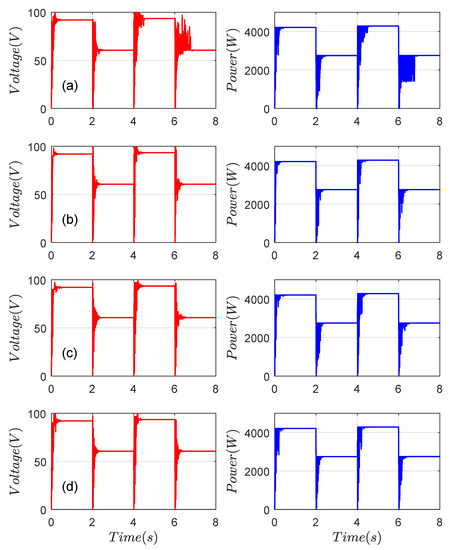
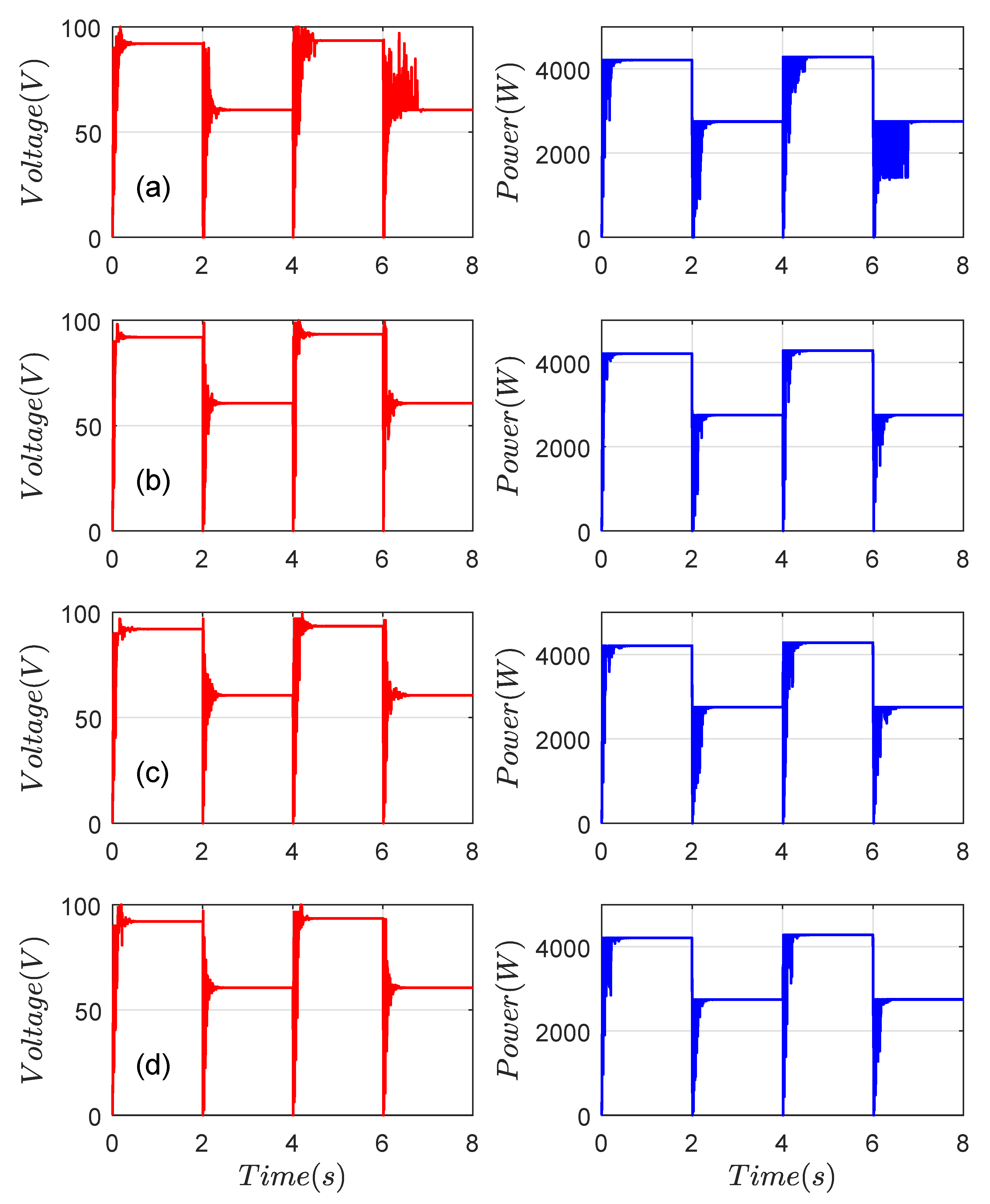
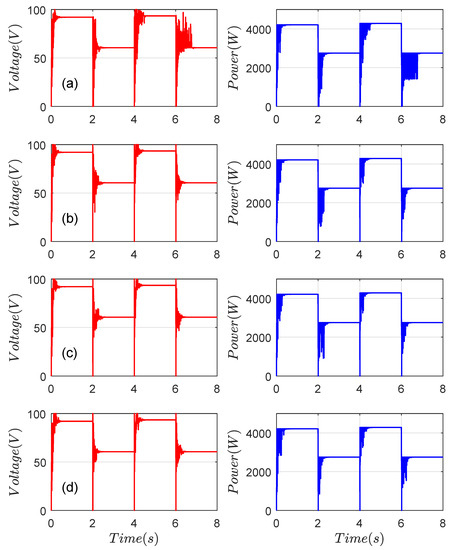
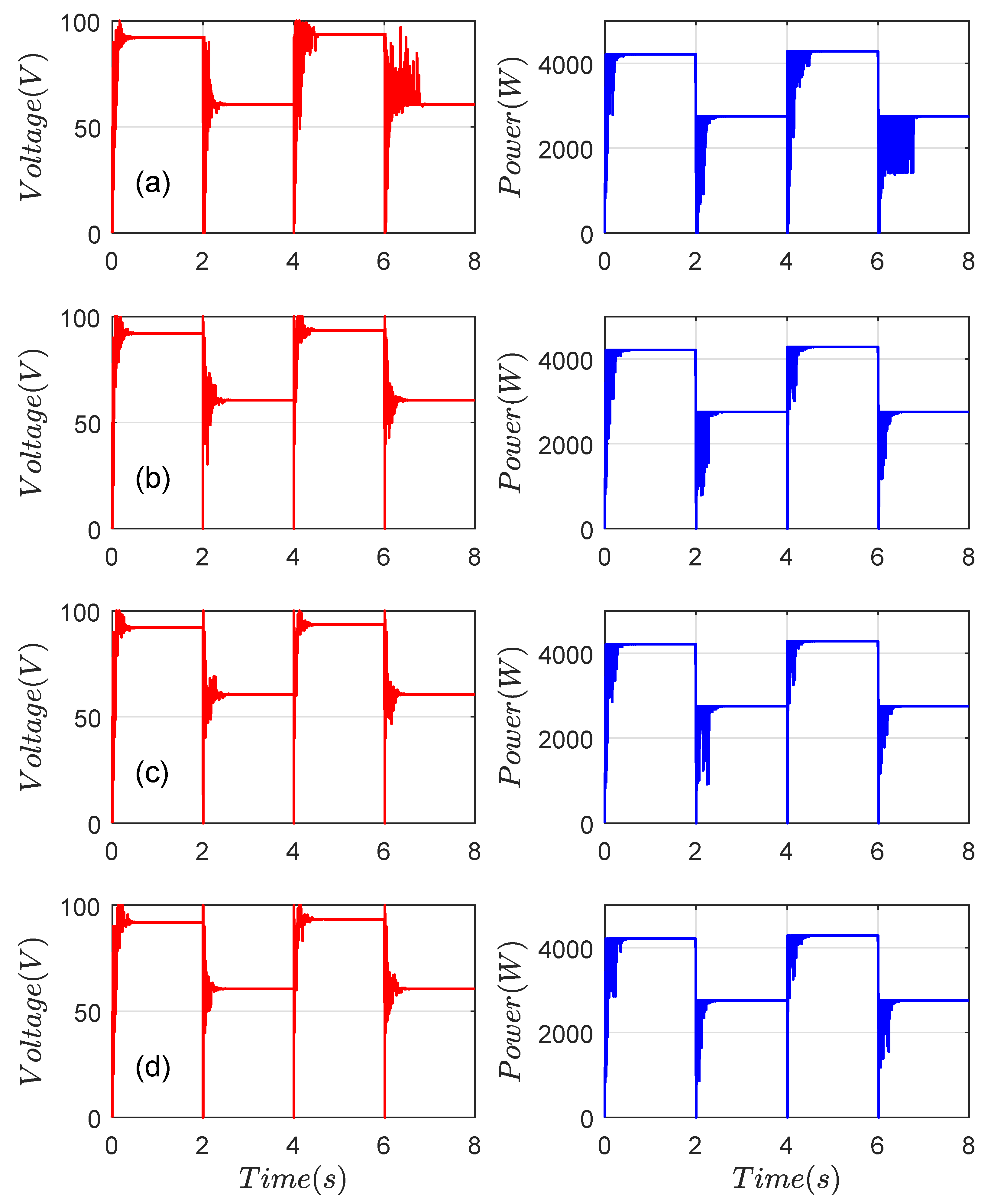
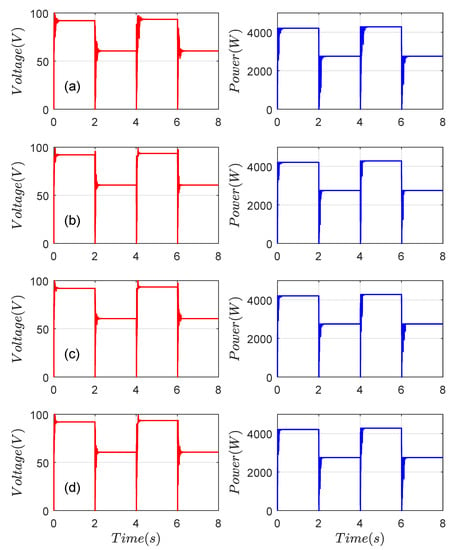
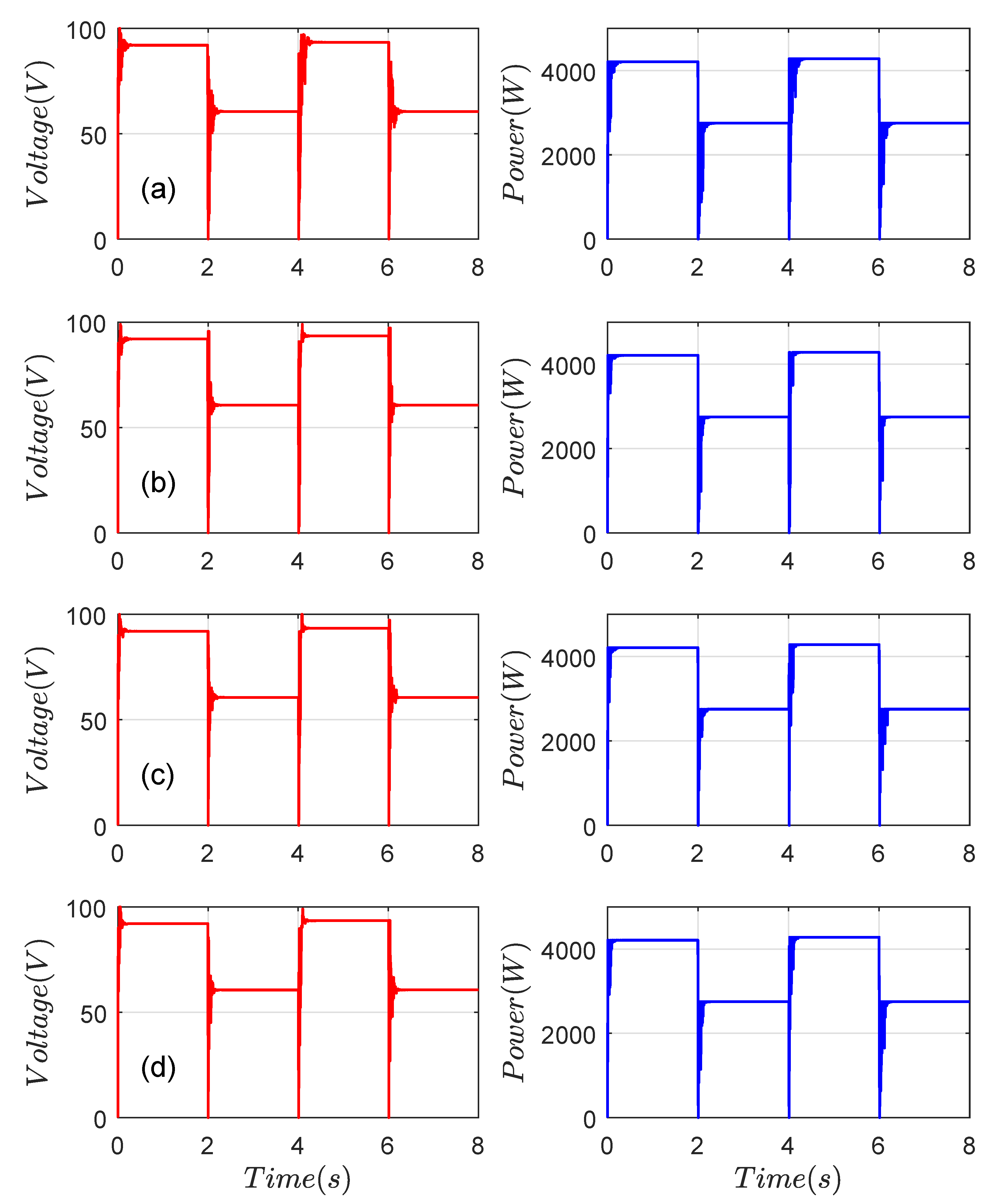
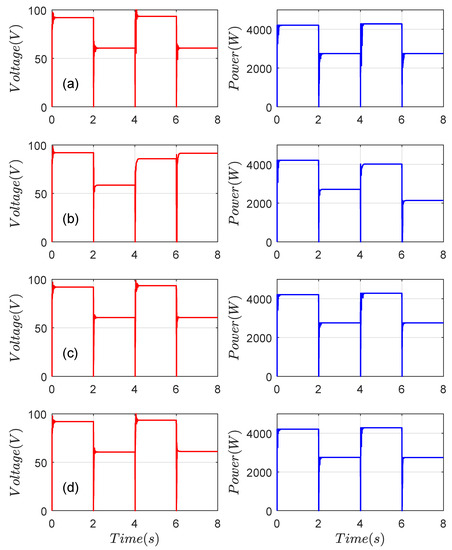
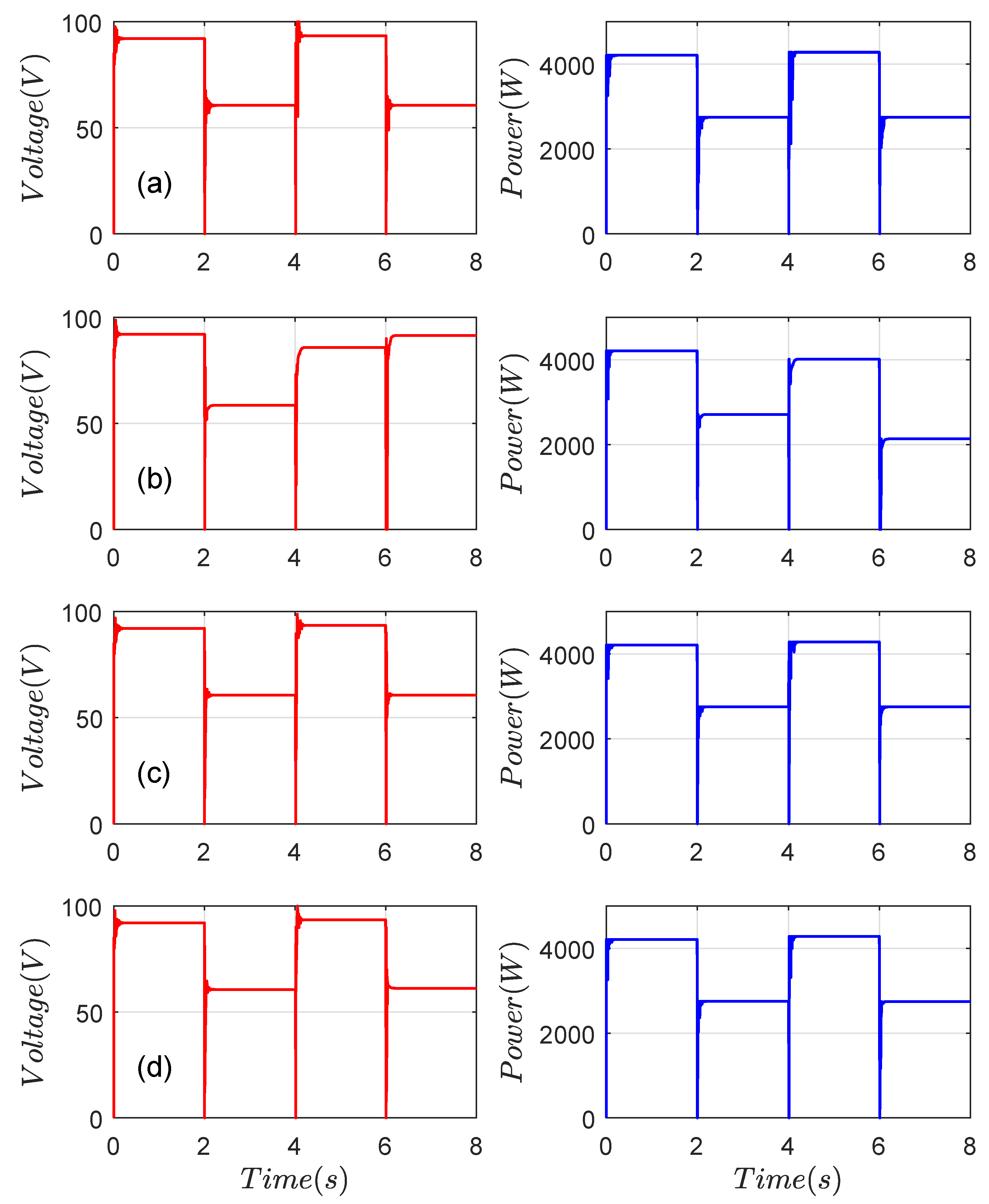
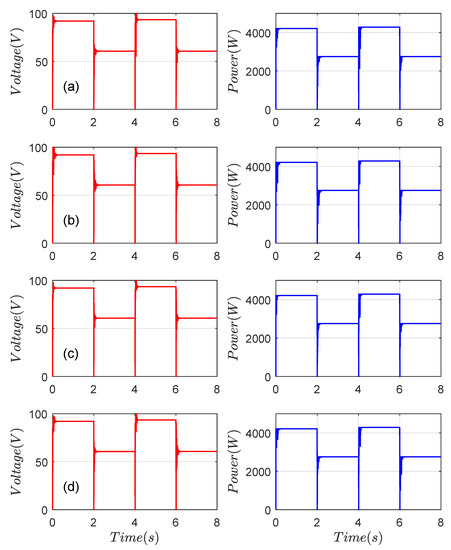
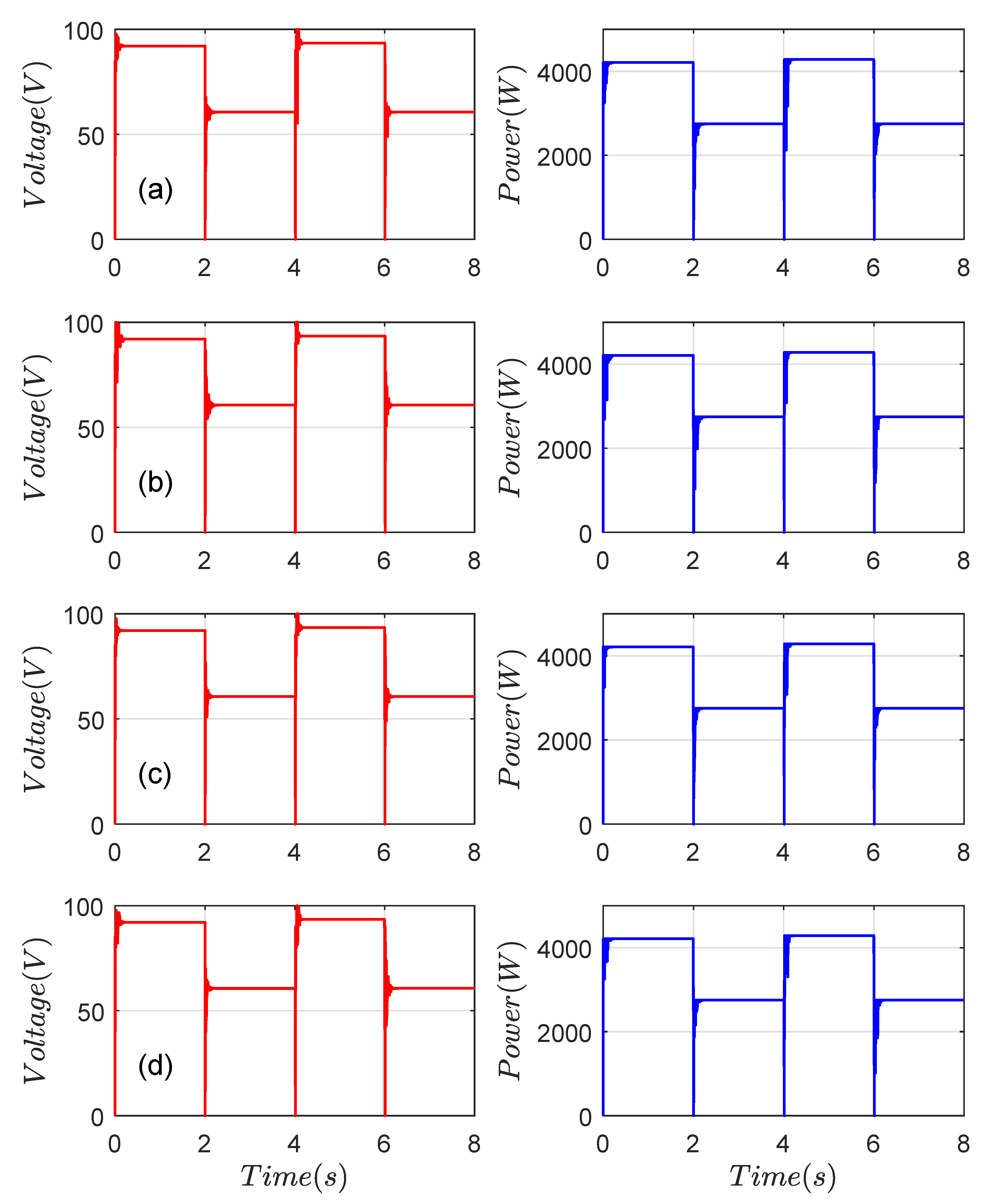
The PV system under partial shading conditions, presented in Figure 6, is simulated with two MPPT techniques: PSO and PSO-TPME. The latter is simulated with the two previously mentioned settings, TPME1 and TPME2. All the MPPT techniques are tested with several numbers of particles, 10, 5, and 3, to assess the effect of the number of particles on the speed of convergence and the amount of captured energy. In Figure 7 and Figure 8, PSO is compared with the PSO-TPME of the settings TPME1 and TPME2, respectively, where the particle size is set to 10 particles and several TPME initiation iterations are tested in these simulations: = 2, 3, and 4. Figure 7 and Figure 8 depict the PV system’s output power and voltage for four shading patterns. According to these figures, it is clear that both PSO and PSO-TMPE have succeeded in achieving global MPP and reinitializing the algorithm when the shading conditions change. Although the PSO algorithm managed to converge to the MPP within an average settling time s and average energy percentage , the PSO-TPME with TPME1 setting and was successful in converging within s and had an average energy percentage . Furthermore, with the TPME2 setting and , the PSO-TPME was able to achieve convergence in s and an average energy percentage . It is evident that PSO-TPME with TPME1 outperformed the other algorithms in settling time and capturing energy during convergence, which can be explained by the fact that the TPME1 setting is tuned for maximum exploitation to achieve the fastest convergence.
Figure 7.
PV voltage and output power using PSO and PSO-TPME, with swarm size of 10, under partial shading conditions, varied with fixed = 1000 W/m and = 600 W/m, (a) PSO wit , (b) TPME1 with and , (c) TPME1 with and , (d) TPME1 with and .
Figure 8.
PV voltage and output power using PSO and PSO-TPME, with swarm size of 10, under partial shading conditions, varied with fixed = 1000 W/m and = 600 W/m, (a) PSO with , (b) TPME2 with and , (c) TPME2 with and , (d) TPME2 with and .
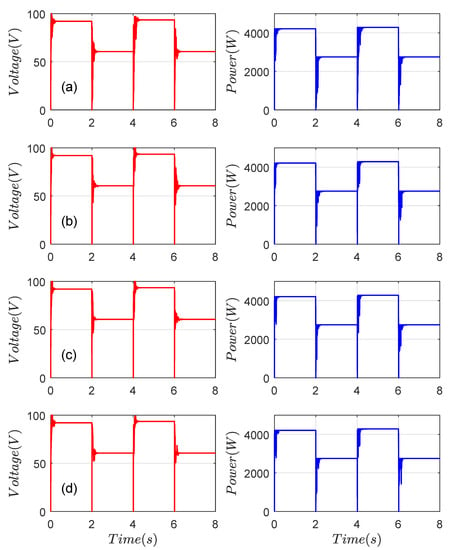
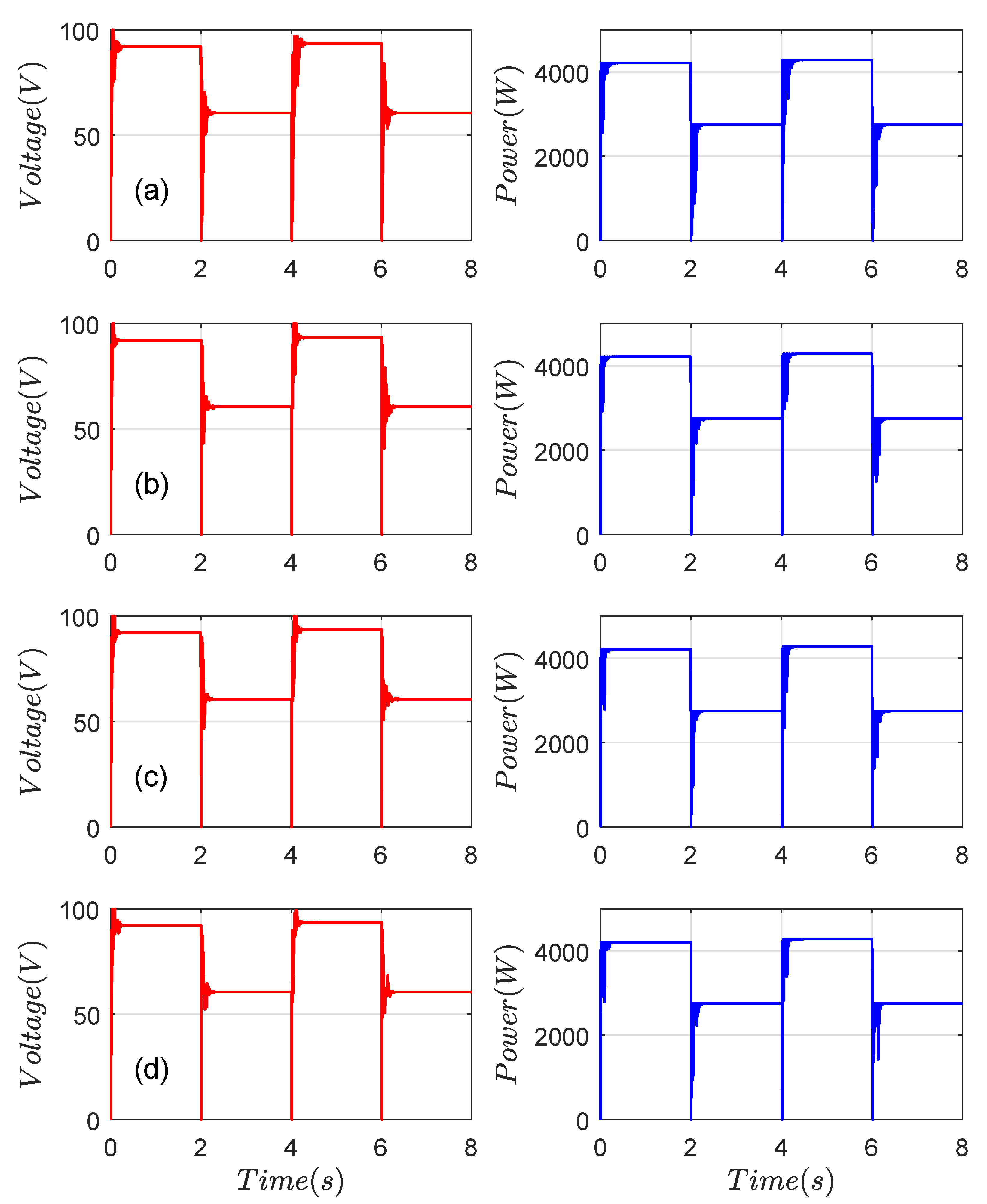
With a swarm size of 5, PSO is contrasted with the PSO-TPME of the settings TPME1 and TPME2, respectively, in Figure 9 and Figure 10, where several TPME initiation iterations are tested in these simulations: = 2, 3, and 4. Figure 9 and Figure 10 show the output power and voltage of the PV system for four shading patterns. These results show that both PSO and PSO-TMPE were successful in establishing global MPP and reinitializing the algorithm when the shading conditions changed. The PSO algorithm handled the convergence to the MPP with an average settling time of s and an average energy percentage of . PSO-TPME with TPME1 and achieved convergence in s with an average energy percentage of . Furthermore, with the TPME2 setting and , the PSO-TPME achieved convergence in s and an average energy percentage of . PSO-TPME with TPME1 surpassed the other algorithms in settling time, whereas PSO-TPME with TPME2 surpassed the other algorithms in captured energy during convergence.
Figure 9.
PV voltage and output power using PSO and PSO-TPME, with swarm size of 5, under partial shading conditions, varied with fixed = 1000 W/m and = 600 W/m, (a) PSO with , (b) TPME1 with and , (c) TPME1 with and , (d) TPME1 with and .
Figure 10.
PV voltage and output power using PSO and PSO-TPME, with swarm size of 5, under partial shading conditions, varied with fixed = 1000 W/m and = 600 W/m, (a) PSO with , (b) TPME2 with and , (c) TPME2 with and , (d) TPME2 with and .
For a swarm size of 3, PSO is compared with PSO-TPME of the settings TPME1 and TPME2, respectively, in Figure 11 and Figure 12, where several TPME initiation iterations are tested in these simulations: = 2, 3, and 4. Figure 11 and Figure 12 show the output power and voltage of the PV system for four shading patterns. The PSO algorithm achieved convergence to the MPP with an average settling time of s and an average energy percentage of . PSO-TPME with TPME1 and did not converge to MPP2, MPP3, and MPP4, which can be explained by the fact that the swarm size of 3 has less particle diversity, and with TPME1, the diversity of particles is further reduced, which leads to falling to local maxima. On the other hand, with the TPME2 setting and , the PSO-TPME achieved convergence in s and an average energy percentage of . PSO-TPME with TPME2 outperformed the other algorithms in capturing energy during convergence, with a settling time very close to the minimum achieved by TPME1. This can be explained by the fact that the TPME2 setting is tuned for balanced exploitation and exploration that works better with a low diversity swarm size.
Figure 11.
PV voltage and output power using PSO and PSO-TPME, with swarm size of 3, under partial shading conditions, varied with fixed = 1000 W/m and = 600 W/m, (a) PSO with , (b) TPME1 with and , (c) TPME1 with and , (d) TPME1 with and .
Figure 12.
PV voltage and output power using PSO and PSO-TPME, with swarm size of 3, under partial shading conditions, varied with fixed = 1000 W/m and = 600 W/m, (a) PSO with , (b) TPME2 with and , (c) TPME2 with and , (d) TPME2 with and .
It is clear from previous simulations that PSO-TPME outperformed PSO in terms of settling time and the amount of captured energy from the events of reinitialization to the events of convergence to the MPP. It was noted that for all the algorithms, smaller swarm sizes exhibit fast convergence and capture more energy during the search process. However, they have less swarm diversity, which imposes the risk of stagnation to local maxima, especially if the algorithm setting is inclined more toward exploitation (TPME1) for faster convergence. Therefore, TPME2 with balanced exploitation–exploration is better for small swarm sizes. On the other hand, larger swarm sizes are better for exploration since the swarm has better diversity. However, it exhibits slow convergence and relatively low captured energy during the search process. In this case, TPME1 is better in terms of enhancing the speed of convergence, while the swarm is diverse enough to enhance exploration. The results also show that PSO-TPME with the TMPE1 settings perform better with ; it achieved a 48% and 45% reduction in the convergence time compared to PSO for the swarm sizes 10 and 5, respectively, whereas it did not converge to all MPPs for the swarm size of 3. Moreover, the TPME2 settings perform better with ; it achieved a 34%, 25%, and 18% reduction in the convergence time compared to PSO for the swarm sizes 10, 5, and 3, respectively.
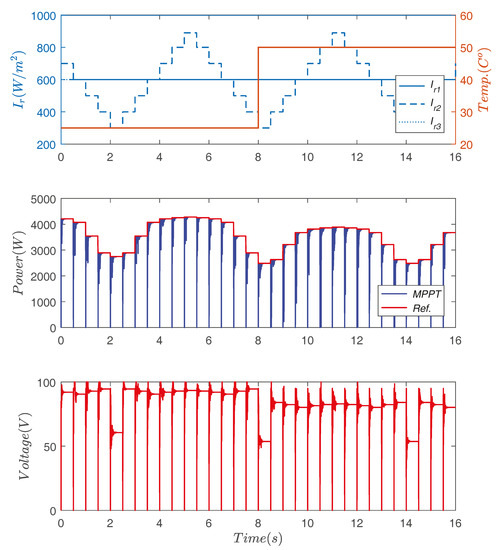
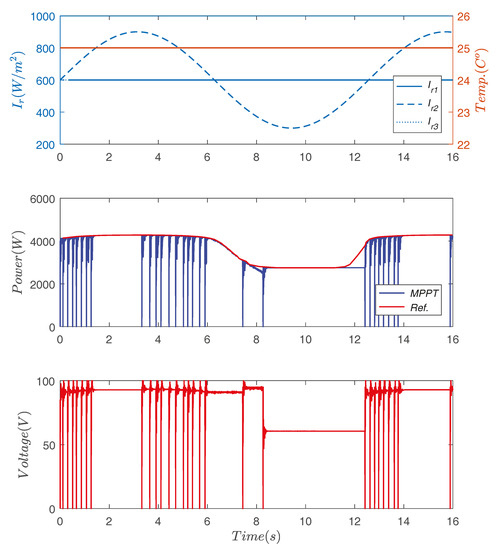
The former analysis is intended to properly tune the PSO-TPME for the MPPT of PV systems under partial shading conditions. The comparisons demonstrated that a swarm of three particles is sufficient to track the global MPP with the shortest convergence time and maximum amount of captured energy, of course, by using balanced exploitation–exploration settings such as TPME2. Table 2 shows that PSO-TPME with the TPME2 settings outperformed standard PSO in terms of convergence time and amount of captured energy when initiated at for all tested swarm sizes. As a result, in the following analysis, the TPME2 settings initiated at with a swarm size of 3 will be used for PSO-TPME. The subsequent analysis comprises two challenging partial shading conditions: a fast gradual step change in the irradiance with a step change in the temperature and a fast smoothly varying irradiance. Both tests are challenging for PSO-TPME since they require fast convergence. On the other hand, the reinitialization process can easily detect a step-changing irradiance, but the smoothly varying irradiance is a specifically more challenging problem for the reinitialization mechanism to detect.
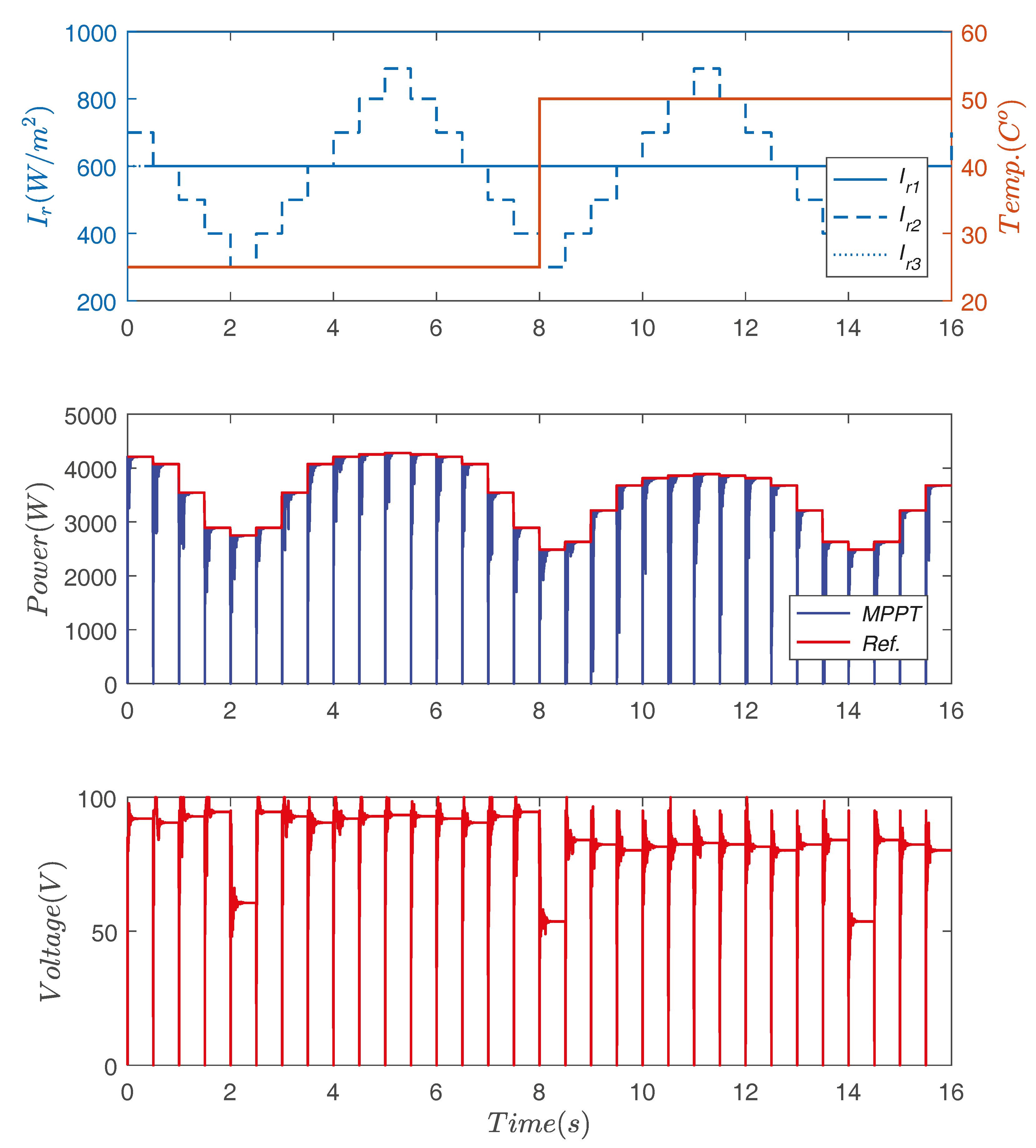
As shown in Figure 13, the irradiance increases and decreases with gradual step changes from 300 to 900 W/m throughout the simulation, and at t = 8 s, there is a sudden change in the temperature from 25 to 50 C to analyze the influence of gradual step irradiance changes and sudden temperature changes on the PSO-TPME performance. The reinitialization mechanism successfully coped with all the step changes in irradiance. Consequently, the output power effectively tracked the global MPP in all cases, capturing more than 98.35% of the available energy. The temperature step change did not affect the efficiency of the proposed MPPT, as it successfully dealt with the change in P–V characteristics due to the temperature change. This is demonstrated in the shift in the converged voltage before and after the temperature change for the same irradiance value. The figure clearly shows how the power is slightly reduced after t = 8 s, which is clearly due to the large increase in temperature.
Figure 13.
PV voltage and output power using PSO-TPME with TPME2 settings, with swarm size of 3, under partial shading conditions with gradual step changes in (increasing and decreasing) and with temperature step change.
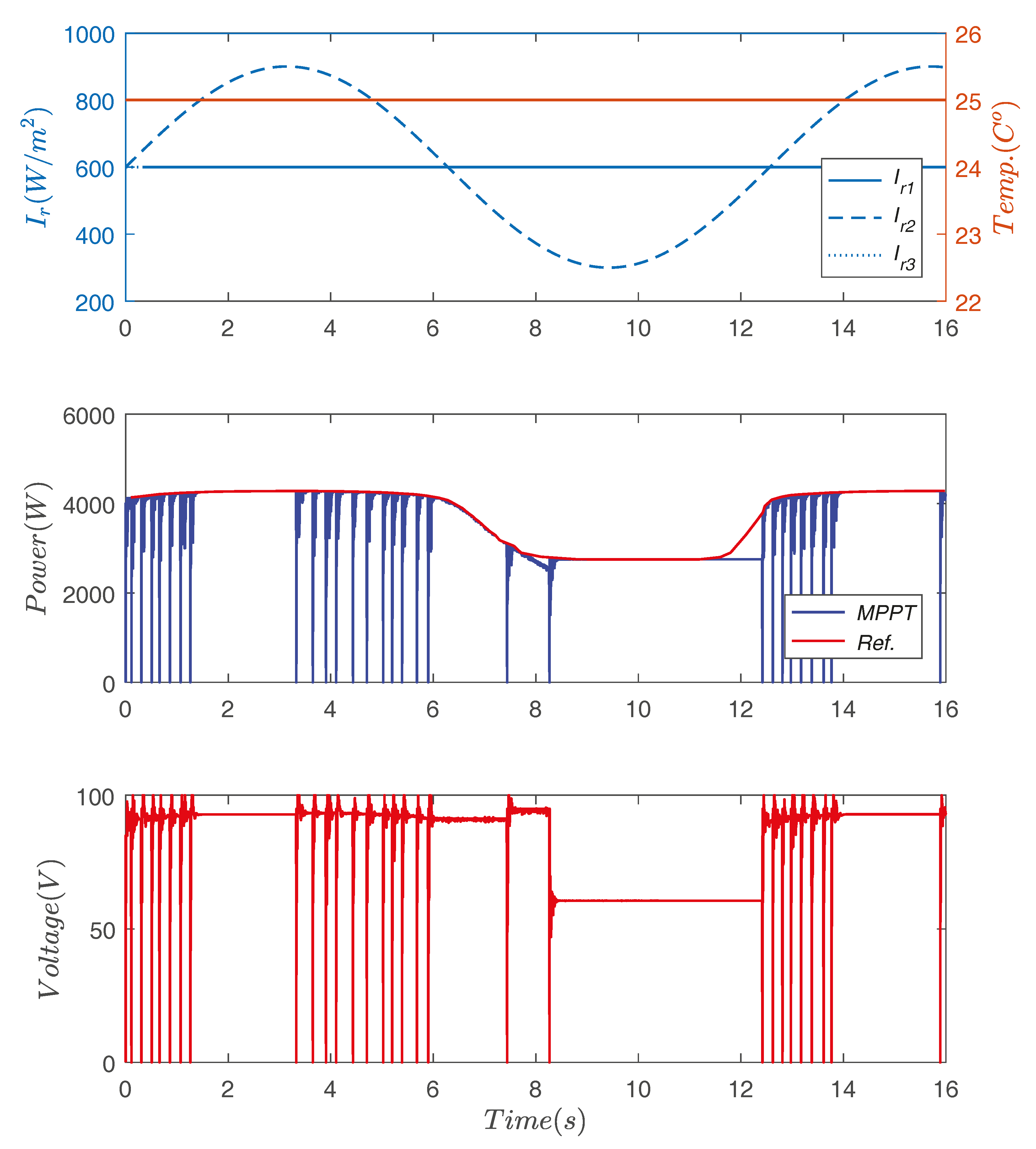
In Figure 14, a smooth sinusoidal variable irradiance is introduced to the simulation to evaluate a more challenging variable irradiance for this type of reinitialization mechanism. The proposed MPPT successfully tracked the global MPP for the entire period. Although the reinitialization mechanism was successful in tracking the global best changes for most of the entire simulation, it did not promptly detect the change at t = 12 s. This is because the smooth change in the global best is smaller than the global best shift () of the reinitialization mechanism. Decreasing the global best shift can mitigate this problem, but it can introduce unnecessary reinitializations that can induce power loss during convergence. However, integrating the output power and comparing it to the reference power, as shown in the figure, reveals that this MPPT technique captured more than 97.7% of the available power.
Figure 14.
PV voltage and output power using PSO-TPME with TPME2 settings, with swarm size of 3, under partial shading conditions with smooth sinusoidal variable irradiance .
5. Conclusions
PV panels are commonly shaded when portions of incident irradiance on the PV system are obscured by clouds, trees, sand, etc. The P–V characteristics of partially shaded PV systems are multimodal and difficult to optimize with the traditional MPPT algorithms. These algorithms are mostly gradient-based optimizers that might fall to a local MPP, resulting in a significant loss in power. This motivates the employment of global optimization techniques such as metaheuristic approaches. This paper implements the new PSO-TPME on a PV system with partial shading. To cope with frequent varying irradiance and shading conditions, PSO-TPME is employed with a reinitialization mechanism.
PSO-TPME is well-suited for online optimization owing to its fast convergence and global exploration capabilities. PSO-TPME additionally allows tuning the particle classifier, elitism, mutation level, and mutation probability. Hence, we propose two PSO-TPME parameter settings for the mutation level and mutation probability: TPME1 for high exploitation and fast convergence, and TPME2 for balanced exploration and exploitation. To further tune PSO-TPME, this work investigates several swarm sizes and several TPME activation iterations. The simulations show that PSO-TPME, with the proper TPME activation iteration, outperforms PSO in terms of convergence speed and the amount of captured energy during convergence. TPME1 has a shorter convergence time than PSO by almost 45%, and also has faster convergence than TPME2, but it sometimes falls into local maxima for small swarm sizes (). On the other hand, TPME2 has better exploration and does not fall into local maxima, even for small swarm sizes, and has faster convergence and better captured energy than the original PSO. The simulations also confirm that small swarm sizes have faster convergence but are less diverse, which requires high exploration settings. Additionally, large swarm sizes are more diverse and have slower convergence, which requires high exploitation settings by employing less mutated elitism. Therefore, TPME1 is favorable for large swarm sizes, whereas TPME2 is better for small swarm sizes.
To conclude, two more challenging partial shading conditions were simulated using PSO-TPME of 3 particles with TPME2 settings initiated at , a fast gradual step change in the irradiance with a step change in the temperature, and a fast smoothly varying irradiance. They are both challenging for the optimizer, whereas the latter makes more difficult for the reinitialization mechanism to detect the irradiance’s smooth variation. Hence, simulations of partial shading conditions with fast varying irradiance, smooth and step-changing, demonstrated that the proposed MPPT approach is capable of coping with these severe conditions, capturing more than 97.7% and 98.35% of the available energy, respectively. Fast-convergence and low-memory global optimization algorithms such as PSO-TPME are highly beneficial for optimization-based multi-input multi-output (MIMO) control.
Funding
This research received no external funding.
Data Availability Statement
The data presented in this study are available on request from the corresponding author.
Acknowledgments
The author thanks the anonymous referees for their insightful suggestions and constructive feedback.
Conflicts of Interest
The author declares no conflict of interest.
References
- Qin, Y.; Xu, Z.; Wang, X.; Škare, M. Green energy adoption and its determinants: A bibliometric analysis. Renew. Sustain. Energy Rev. 2022, 153, 111780. [Google Scholar] [CrossRef] [Scilit]
- Stucki, T. Which firms benefit from investments in green energy technologies?–The effect of energy costs. Res. Policy 2019, 48, 546–555. [Google Scholar] [CrossRef] [Scilit]
- Islam, H.; Mekhilef, S.; Shah, N.B.M.; Soon, T.K.; Seyedmahmousian, M.; Horan, B.; Stojcevski, A. Performance evaluation of maximum power point tracking approaches and photovoltaic systems. Energies 2018, 11, 365. [Google Scholar] [CrossRef] [Scilit]
- Fan, S.; Liang, W.; Wang, G.; Zhang, Y.; Cao, S. A novel water-free cleaning robot for dust removal from distributed photovoltaic (PV) in water-scarce areas. Sol. Energy 2022, 241, 553–563. [Google Scholar] [CrossRef] [Scilit]
- Zhong, C.; Zhou, Y.; Chen, J.; Liu, Z. DC-side synchronous active power control of two-stage photovoltaic generation for frequency support in Islanded microgrids. Energy Rep. 2022, 8, 8361–8371. [Google Scholar] [CrossRef] [Scilit]
- Bounechba, H.; Bouzid, A.; Nabti, K.; Benalla, H. Comparison of perturb & observe and fuzzy logic in maximum power point tracker for PV systems. Energy Procedia 2014, 50, 677–684. [Google Scholar]
- López-Erauskin, R.; González, A.; Petrone, G.; Spagnuolo, G.; Gyselinck, J. Multi-variable perturb and observe algorithm for grid-tied PV systems with joint central and distributed MPPT configuration. IEEE Trans. Sustain. Energy 2020, 12, 360–367. [Google Scholar] [CrossRef] [Scilit]
- Abdelwahab, S.A.M.; Hamada, A.M.; Abdellatif, W.S. Comparative analysis of the modified perturb & observe with different MPPT techniques for PV grid connected systems. Int. J. Renew. Energy Res. 2020, 10, 55–164. [Google Scholar]
- Xiao, W.; Dunford, W.G. A modified adaptive hill climbing MPPT method for photovoltaic power systems. In Proceedings of the 2004 IEEE 35th Annual Power Electronics Specialists Conference (IEEE Cat. No. 04CH37551), Aachen, Germany, 20–25 June 2004; IEEE: New York, NY, USA, 2004; Volume 3, pp. 1957–1963. [Google Scholar]
- Liu, F.; Kang, Y.; Zhang, Y.; Duan, S. Comparison of P&O and hill climbing MPPT methods for grid-connected PV converter. In Proceedings of the 2008 3rd IEEE Conference on Industrial Electronics and Applications, Singapore, 3–5 June 2008; IEEE: New York, NY, USA, 2008; pp. 804–807. [Google Scholar]
- Rawat, R.; Chandel, S. Hill climbing techniques for tracking maximum power point in solar photovoltaic systems—A review. Int. J. Sustain. Dev. Green Econ. (IJSDGE) 2013, 2, 90–95. [Google Scholar]
- Li, R.; Yu, N.; Wang, X.; Liu, Y.; Cai, Z.; Wang, E. Model-based synthetic geoelectric sampling for magnetotelluric inversion with deep neural networks. IEEE Trans. Geosci. Remote Sens. 2020, 60, 1–14. [Google Scholar] [CrossRef] [Scilit]
- Li, R.; Wu, X.; Tian, H.; Yu, N.; Wang, C. Hybrid Memetic Pretrained Factor Analysis-Based Deep Belief Networks for Transient Electromagnetic Inversion. IEEE Trans. Geosci. Remote Sens. 2022, 60, 1–20. [Google Scholar] [CrossRef] [Scilit]
- Farh, H.M.; Eltamaly, A.M.; Al-Saud, M.S. Interleaved boost converter for global maximum power extraction from the photovoltaic system under partial shading. Int. Renew. Power Gener. 2019, 13, 1232–1238. [Google Scholar] [CrossRef] [Scilit]
- Farzaneh, J.; Keypour, R.; Karsaz, A. A novel fast maximum power point tracking for a PV system using hybrid PSO-ANFIS algorithm under partial shading conditions. Int. J. Ind. Electron. Control Optim. 2019, 2, 47–58. [Google Scholar]
- Eltamaly, A.M.; Al-Saud, M.; Abokhalil, A.G.; Farh, H.M. Simulation and experimental validation of fast adaptive particle swarm optimization strategy for photovoltaic global peak tracker under dynamic partial shading. Renew. Sustain. Energy Rev. 2020, 124, 109719. [Google Scholar] [CrossRef] [Scilit]
- Jiang, L.L.; Maskell, D.L.; Patra, J.C. A novel ant colony optimization-based maximum power point tracking for photovoltaic systems under partially shaded conditions. Energy Build. 2013, 58, 227–236. [Google Scholar] [CrossRef] [Scilit]
- Krishnan G, S.; Kinattingal, S.; Simon, S.P.; Nayak, P.S.R. MPPT in PV systems using ant colony optimisation with dwindling population. IET Renew. Power Gener. 2020, 14, 1105–1112. [Google Scholar] [CrossRef] [Scilit]
- Phanden, R.K.; Sharma, L.; Chhabra, J.; Demir, H.İ. A novel modified ant colony optimization based maximum power point tracking controller for photovoltaic systems. Mater. Today Proc. 2021, 38, 89–93. [Google Scholar] [CrossRef] [Scilit]
- Zhang, M.; Chen, Z.; Wei, L. An immune firefly algorithm for tracking the maximum power point of PV array under partial shading conditions. Energies 2019, 12, 3083. [Google Scholar] [CrossRef] [Scilit]
- Abo-Khalil, A.G.; Alharbi, W.; Al-Qawasmi, A.R.; Alobaid, M.; Alarifi, I.M. Maximum power point tracking of PV systems under partial shading conditions based on opposition-based learning firefly algorithm. Sustainability 2021, 13, 2656. [Google Scholar] [CrossRef] [Scilit]
- Farayola, A.M.; Sun, Y.; Ali, A. Global maximum power point tracking and cell parameter extraction in Photovoltaic systems using improved firefly algorithm. Energy Rep. 2022, 8, 162–186. [Google Scholar] [CrossRef] [Scilit]
- Benyoucef, A.s.; Chouder, A.; Kara, K.; Silvestre, S.; Ait sahed, O. Artificial bee colony based algorithm for maximum power point tracking (MPPT) for PV systems operating under partial shaded conditions. Appl. Soft Comput. 2015, 32, 38–48. [Google Scholar] [CrossRef] [Scilit]
- González-Castaño, C.; Restrepo, C.; Kouro, S.; Rodriguez, J. MPPT algorithm based on artificial bee colony for PV system. IEEE Access 2021, 9, 43121–43133. [Google Scholar] [CrossRef] [Scilit]
- Gong, L.; Hou, G.; Huang, C. A two-stage MPPT controller for PV system based on the improved artificial bee colony and simultaneous heat transfer search algorithm. ISA Trans. 2023, 132, 428–443. [Google Scholar] [CrossRef] [Scilit]
- Daraban, S.; Petreus, D.; Morel, C. A novel MPPT (maximum power point tracking) algorithm based on a modified genetic algorithm specialized on tracking the global maximum power point in photovoltaic systems affected by partial shading. Energy 2014, 74, 374–388. [Google Scholar] [CrossRef] [Scilit]
- Hadji, S.; Gaubert, J.P.; Krim, F. Real-time genetic algorithms-based MPPT: Study and comparison (theoretical an experimental) with conventional methods. Energies 2018, 11, 459. [Google Scholar] [CrossRef] [Scilit]
- Hassan, A.; Bass, O.; Masoum, M.A. An improved genetic algorithm based fractional open circuit voltage MPPT for solar PV systems. Energy Rep. 2023, 9, 1535–1548. [Google Scholar] [CrossRef] [Scilit]
- Mohanty, S.; Subudhi, B.; Ray, P.K. A new MPPT design using grey wolf optimization technique for photovoltaic system under partial shading conditions. IEEE Trans. Sustain. Energy 2015, 7, 181–188. [Google Scholar] [CrossRef] [Scilit]
- Guo, K.; Cui, L.; Mao, M.; Zhou, L.; Zhang, Q. An improved gray wolf optimizer MPPT algorithm for PV system with BFBIC converter under partial shading. IEEE Access 2020, 8, 103476–103490. [Google Scholar] [CrossRef] [Scilit]
- Motahhir, S.; Chtita, S.; Chouder, A.; El Hammoumi, A. Enhanced energy output from a PV system under partial shaded conditions through Grey wolf optimizer. Clean. Eng. Technol. 2022, 9, 100533. [Google Scholar] [CrossRef] [Scilit]
- Eltamaly, A.M.; Farh, H.M.; Al-Saud, M.S. Grade point average assessment for metaheuristic GMPP techniques of partial shaded PV systems. IET Renew. Power Gener. 2019, 13, 1215–1231. [Google Scholar] [CrossRef] [Scilit]
- Lian, K.; Jhang, J.; Tian, I. A maximum power point tracking method based on perturb-and-observe combined with particle swarm optimization. IEEE J. Photovolta. 2014, 4, 626–633. [Google Scholar] [CrossRef] [Scilit]
- Sundareswaran, K.; Palani, S.; Vignesh kumar, V. Application of a combined particle swarm optimization and perturb and observe method for MPPT in PV systems under partial shading conditions. Renew. Energy 2015, 75, 308–317. [Google Scholar] [CrossRef] [Scilit]
- Mathi, D.K.; Chinthamalla, R. A hybrid global maximum power point tracking method based on butterfly particle swarm optimization and perturb and observe algorithms for a photovoltaic system under partially shaded conditions. Int. Trans. Electr. Energy Syst. 2020, 30, e12543. [Google Scholar] [CrossRef] [Scilit]
- Babu, T.S.; Rajasekar, N.; Sangeetha, K. Modified particle swarm optimization technique based maximum power point tracking for uniform and under partial shading condition. Appl. Soft Comput. 2015, 34, 613–624. [Google Scholar] [CrossRef] [Scilit]
- Gavhane, P.S.; Krishnamurthy, S.; Dixit, R.; Ram, J.P.; Rajasekar, N. EL-PSO based MPPT for solar PV under partial shaded condition. Energy Procedia 2017, 117, 1047–1053. [Google Scholar] [CrossRef] [Scilit]
- Sen, T.; Pragallapati, N.; Agarwal, V.; Kumar, R. Global maximum power point tracking of PV arrays under partial shading conditions using a modified particle velocity-based PSO technique. IET Renew. Power Gener. 2018, 12, 555–564. [Google Scholar] [CrossRef] [Scilit]
- Panda, K.P.; Anand, A.; Bana, P.R.; Panda, G. Novel PWM control with modified PSO-MPPT algorithm for reduced switch MLI based standalone PV system. Int. J. Emerg. Electr. Power Syst. 2018, 19, 116469225. [Google Scholar] [CrossRef]
- Gopalakrishnan, S.K.; Kinattingal, S.; Simon, S.P.; Ark Kumar, K. Enhanced energy harvesting from shaded PV systems using an improved particle swarm optimisation. IET Renew. Power Gener. 2020, 14, 1471–1480. [Google Scholar] [CrossRef] [Scilit]
- Motamarri, R.; Nagu, B. GMPPT by using PSO based on Lévy flight for photovoltaic system under partial shading conditions. IET Renew. Power Gener. 2020, 14, 1143–1155. [Google Scholar] [CrossRef] [Scilit]
- Makhloufi, S.; Mekhilef, S. Logarithmic PSO-Based Global/Local Maximum Power Point Tracker for Partially Shaded Photovoltaic Systems. IEEE J. Emerg. Sel. Top. Power Electron. 2021, 10, 375–386. [Google Scholar] [CrossRef] [Scilit]
- Madhavan, K.; Ansari, I.A. Maximum Power Point Tracking of Partially Shaded PV System with Improved PSO Strategy. In Soft Computing: Theories and Applications; Springer Nature: Singapore, 2022; pp. 893–903. [Google Scholar]
- Dileep, G.; Singh, S. An improved particle swarm optimization based maximum power point tracking algorithm for PV system operating under partial shading conditions. Sol. Energy 2017, 158, 1006–1015. [Google Scholar] [CrossRef] [Scilit]
- Eltamaly, A.M.; Farh, H.M. Dynamic global maximum power point tracking of the PV systems under variant partial shading using hybrid GWO-FLC. Sol. Energy 2019, 177, 306–316. [Google Scholar] [CrossRef] [Scilit]
- Li, H.; Yang, D.; Su, W.; Lü, J.; Yu, X. An overall distribution particle swarm optimization MPPT algorithm for photovoltaic system under partial shading. IEEE Trans. Ind. Electron. 2018, 66, 265–275. [Google Scholar] [CrossRef] [Scilit]
- Shaqarin, T. A Modified Reinitialization Mechanism for Particle Swarm Optimization Based Control, Case Study: PV System. In Proceedings of the 1st International Conference on Automation, Robotics & Communications for Industry 4.0 (ARCI), Chamonix-Mont-Blanc, France, 3–5 February 2021; IFSA: Barcelona, Spain, 2021; p. 86. [Google Scholar]
- Shaqarin, T.; Noack, B.R. A fast-converging particle swarm optimization through targeted, position-mutated, elitism (PSO-TPME). Int. J. Comput. Intell. Syst. 2023, 16, 6. [Google Scholar] [CrossRef] [Scilit]
- Kennedy, J.; Eberhart, R. Particle swarm optimization. In Proceedings of the ICNN’95-International Conference on Neural Networks, Perth, WA, Australia, 27 November–1 December 1995; IEEE: New York, NY, USA, 1995; Volume 4, pp. 1942–1948. [Google Scholar]
- De Soto, W.; Klein, S.A.; Beckman, W.A. Improvement and validation of a model for photovoltaic array performance. Sol. Energy 2006, 80, 78–88. [Google Scholar] [CrossRef] [Scilit]
- Dolara, A.; Leva, S.; Manzolini, G. Comparison of different physical models for PV power output prediction. Sol. Energy 2015, 119, 83–99. [Google Scholar] [CrossRef] [Scilit]
- Karatepe, E.; Hiyama, T. Artificial neural network-polar coordinated fuzzy controller based maximum power point tracking control under partially shaded conditions. IET Renew. Power Gener. 2009, 3, 239–253. [Google Scholar]
- Pathy, S.; Subramani, C.; Sridhar, R.; Thamizh Thentral, T.; Padmanaban, S. Nature-inspired MPPT algorithms for partially shaded PV systems: A comparative study. Energies 2019, 12, 1451. [Google Scholar] [CrossRef] [Scilit]
- Tey, K.S.; Mekhilef, S.; Yang, H.T.; Chuang, M.K. A differential evolution based MPPT method for photovoltaic modules under partial shading conditions. Int. J. Photoenergy 2014, 2014, 945906. [Google Scholar] [CrossRef] [Scilit]
- Rezk, H.; Fathy, A.; Abdelaziz, A.Y. A comparison of different global MPPT techniques based on meta-heuristic algorithms for photovoltaic system subjected to partial shading conditions. Renew. Sustain. Energy Rev. 2017, 74, 377–386. [Google Scholar] [CrossRef] [Scilit]

Disclaimer/Publisher’s Note: The statements, opinions and data contained in all publications are solely those of the individual author(s) and contributor(s) and not of MDPI and/or the editor(s). MDPI and/or the editor(s) disclaim responsibility for any injury to people or property resulting from any ideas, methods, instructions or products referred to in the content. |
© 2023 by the author. Licensee MDPI, Basel, Switzerland. This article is an open access article distributed under the terms and conditions of the Creative Commons Attribution (CC BY) license (https://creativecommons.org/licenses/by/4.0/).