


Abstract
In a transdisciplinary field experiment in two Swiss university canteens over 12 weeks, how customers respond to a revised menu choice of meat dishes and ovo-lacto-vegetarian or vegan dishes was investigated. Several interventions were implemented: the vegetarian menu line was abolished, the meat and veg-dishes were randomly distributed across the three menu lines, vegetarian and vegan dishes (veg-dishes) were not labelled or marketed as such, and in the 6 ‘intervention weeks’ the share of veg-dishes was increased compared to the 6 ‘base weeks’. Based on the lunchtime eating habits in the canteen, regular canteen visitors were categorised into either seven or five different ‘lunch types’. During the intervention weeks, the share of meat dishes decreased for every lunch type, although with different response patterns. It is particularly noteworthy that customers with meat-oriented lunchtime eating habits ate in the canteen more frequently. This indicates that the usual choices in the two canteens are more appealing for meat-eaters. Overall, the data show a clear potential to reduce meat consumption in canteens by increasing the range of attractive veg-dishes without explicitly marketing them as vegetarian or vegan. We conclude this also to be an economically profitable strategy, as it provides a chance to attract customers with veg-oriented lunchtime eating habits without either losing meat eaters or meat lovers.
1. Introduction
Reducing meat consumption, especially in industrialised countries, can contribute not only to reaching climate targets, but also to addressing public health problems and protecting animals [1]. Past research has provided enough evidence to show the many advantages of more plant-based diets [2,3,4,5]. Reducing meat consumption has benefits for public health (risk reduction of non-communicable diseases) and the environment (reduction of GHG emissions, land required, biodiversity impact), and is therefore a promising concept [2,4,6,7].
The demand for meat is rising [8,9], especially in developing economies, and in high-income countries meat intake also remains at a high level [2]. It appears, however, that some of today’s Western consumers are willing to limit their meat consumption [10,11]. This part-time meat reduction is called flexitarianism. A flexitarian abstains from eating meat occasionally without abandoning meat totally [12,13]. Vegetarians, on the other hand, follow a strict meat-free diet, and vegans abstain from consuming any animal-based products [11]. Recent studies refer to the fact that a flexitarian diet can reduce the environmental footprint of the food system and can contribute to healthy eating patterns [6,7,13].
The present study investigates lunchtime eating habits through a field experiment carried out in two university canteens. It identifies and categorises ‘lunch types’ (e.g., flexitarians), and analyses how different lunch types respond to a revised choice of meat and ovo-lacto-vegetarian or vegan dishes (the latter are, henceforth, collectively known as ‘veg-dishes’) and whether there are differences relating to age, gender, university affiliation (student, staff) or frequency of canteen visits. These questions were part of the research project ‘Innovations for future-oriented consumption and animal production’ (NOVANIMAL) that builds on an action-oriented, inter- and transdisciplinary sustainability research approach [14,15]. The project was conducted with industry partners, the most important of which was SV Schweiz, one of the largest gastronomy companies in Switzerland [16].
2. Materials and Methods
2.1. Experimental Design and Interventions
The transdisciplinary field experiment was conducted in two university canteens in Switzerland over a 12-week period in the autumn semester of 2017. The experimental design and interventions do not rely on a specific theoretical and methodological framework, but were developed together with the catering company based on both their experiences and their economic and practical requirements. Selected interventions were simultaneously implemented and tested: the vegetarian menu line was abolished, meat and veg-dishes were integrated into all three menu lines, veg-dishes were not labelled or marketed as such, and the share of veg-dishes was increased. We deliberately refrained from explicitly promoting veg-dishes and instead declared them discreetly as other ingredients because the culinary image of vegetarian, and especially vegan, cuisine is generally not so positive in Switzerland. The dishes should speak for themselves.
Following the experimental design, 6 so-called ‘base weeks’ (A), where the usual share of 66% meat and 33% vegetarian dishes was planned, alternated weekly with 6 ‘intervention weeks’ (B), during which the share of veg-dishes was increased (plan: 33% meat, 33% ovo-lacto-vegetarian, 33% vegan dishes). Canteen visitors could choose between a meat or a veg-dish at any time; this was to prevent reactance [17]. An example of reactance is given by the introduction of a ‘veg day’ at all schools in Helsinki: initially, canteen visitors did not adhere to the prescribed veg day and, more often than not, leftovers remained on their plates [18].
The nonrandomised experimental design [19] covered two meal cycles of 6 weeks each, i.e., the planned dishes were offered twice, corresponding to the experiment being repeated once. The first meal cycle started with a base week and the sequence ABABAB, while the second meal cycle started with an intervention week and the reverse sequence BABABA. The meat, fish, ovo-lacto-vegetarian and vegan dishes were randomly distributed among the three menu lines ‘Favourite’, ‘World’, and ‘Kitchen’. The canteen visitors also had the option of choosing from the (mostly vegetarian) ‘Hot & Cold’ buffet, which had already been available previously. The ‘Favourite’ and ‘World’ menu lines were more affordable than either the ‘Kitchen’ menu line or the ‘Hot & Cold’ buffet option (where the cost depended on the weight) [20].
From a total of 90 planned dishes (=3 dishes per day × 5 days × 6 weeks) or 93 dishes on offer (in the second meal cycle, 3 dishes had to be replaced because they were not vegan), 39 contained meat (42%), 7 contained fish (8%), 30 were ovo-lacto-vegetarian (32%) and 17 were vegan (18%), of which 10 were authentically vegan (e.g., lentil vegetable curry) and 7 were vegan with meat substitutes (e.g., quorn ragout with potatoes). However, the actual choice differed from the experimental design. On most days, supplementary dishes were offered in limited amounts. These adjustments were made by the caterer to avoid food waste and financial losses.
2.2. Real-World Laboratory Approach
The goal of the real-world laboratory experiment [21] was to merge the strengths of laboratory settings with the advantages of conducting research in the real world [22]. The planning phase for this field experiment, however, took time (around 1 year), and led to a memorandum of understanding between the project partners involved (scientists and facility management at the ZHAW, and the catering company SV Schweiz, Dübendorf, Switzerland). Communication with industry partners before, during and after the field experiment was demanding yet productive. Before the start of the field experiment, members of the university (students, staff) were informed via email that a research project would be carried out at the two university canteens during the autumn semester of 2017. During the field phase, the canteen visitors were informed via displays placed next to the cash registers in the canteens that personal data (gender, age and university affiliation) would be collected and analysed anonymously. The canteen visitors had the option of paying cash at any time if they did not want their data to be recorded, i.e., discounts were still granted. In the last week of the field research project, the canteen visitors were informed that the project was complete.
2.3. Data Collection
If canteen visitors paid with their Campus Card (CC), information regarding their gender, age and university affiliation was collected anonymously. The CC is a mandatory, multi-function access card for entry into all of the University’s campuses, printing, borrowing books at the university library, paying in the canteen and much more. To obtain point of sale data (POS data) with the information from the CC, data from the system of the caterer and data from the university were pseudonymised and merged by the gastronomy partner. Each person was given a pseudonymised identification number so that no conclusions could be drawn about that person. This data set only contained meal purchases that could be clearly assigned to a specified canteen visitor, characterized by age, gender or university affiliation. Therefore, customers with multiple meal purchases a day were excluded. The final data set in this study is a sub-sample and consists of a total of 21,831 transactions from 1552 guests, which corresponds to 82.9% of the total meals sold (82.9% = 21,831/26,340) [23]. All analyses were carried out with the statistics programme R (version 4.1.2) [24]. Corresponding data sets and scripts are openly available on the repositories Zenodo and GitHub.
2.4. Statistical Analyses
When evaluating the POS data, the focus was on in-depth, descriptive and explorative data analyses, with the goal of ‘pattern recognition’ [25]. Results are communicated most preferably by graphical illustration. The calculation of statistical p-values was deliberately omitted as they are not required in this case study because the totality of the pseudonymised sales data was analysed. Moreover, we wanted to avoid misconceptions: p-values are often misinterpreted to provide information about effect size while, in fact, they provide information concerning whether, in the basic population, there is any effect at all [26,27]. All evaluations ultimately refer to and are valid for the totality of the pseudonymised meal sales in the autumn semester of 2017 for these two canteens.
3. Results
As a result of the interventions, on the aggregate level, the share of purchased meat dishes decreased from 56% in the base weeks to 42% in the intervention weeks, though there were clear differences associated with gender: for men, the share of meat dishes decreased from 65% to 50%, and for women, from 40% to 28% (Figure S1). The aggregate data analyses conceal the different responses of canteen visitors depending on their preferences and lunchtime eating habits. Therefore, a sub-sample of regular canteen visitors was defined and classified into specific lunch types. After describing the differences between lunch types, associated with age, gender and university affiliation, the different reactions to a higher share of veg-dishes in the intervention weeks compared to base weeks are presented.
3.1. Classification of Lunch Type
On average, 1496 canteen visitors (56 persons were excluded because of the missing information about either age, gender or university affiliation) ate in the canteen 11 times during the 12 weeks of the field experiment, i.e., approximately once a week. The 990 customers (66%) who bought a meal in the canteen at least six times during the 12 weeks were defined as regular canteen visitors. They account for a total of 75% of all meal purchases (75% = 19,761/26,340). Based on the frequency of choosing a meat dish, they were further categorised into seven so-called lunch types, of which four were veg-oriented and three were meat-oriented (Figure S2, Table 1). In total, 45% of the regular canteen visitors belong to the veg-oriented lunch types and 55% to the meat-oriented.
Table 1.
Description of the regular canteen visitors by lunch type.
The four veg-oriented lunch types are ‘Buffetarian’, ‘Never meat’, ‘Vegetarian-flexitarian’ and ‘Meat-flexitarian’. The few customers of the type ‘Buffetarian’ (2%) always chose from the buffet (’Hot & Cold’). Another small group of the lunch type ‘Never Meat’ (2%) bought a veg-dish each time. ‘Buffetarians’ are typically female (F/M = 79%/21%), while ’Never meat’ has no ‘gender’ (F/M = 50%/50%) and consists virtually solely of students (students/staff = 95%/5%). A total of 22% of the regular canteen visitors of the lunch type ‘Vegetarian-flexitarian’ rarely bought meat dishes; meat accounted for less than 25%; 65% of these are women, and 35% men. The fourth veg-oriented lunch type ‘Meat-flexitarian’ bought a meal containing meat more often, but the share of meat dishes was lower than 50%. This lunch type has no ‘gender’ (F/M = 50%/50%).
The three meat-oriented lunch types are ‘Meat eater’, ‘Meat lover’ and ‘Always meat’. Only a small group of the regular canteen visitors belong to the lunch type ‘Always meat’ (2%), who chose a meat dish every time. The two remaining lunch types, ‘Meat eater’ and ‘Meat lover’, regularly bought dishes containing meat (Table 1). The largest group, ‘Meat eater’, includes 33% of regular customers, of which 34% are women and 66% men. In total, 21% of the regular canteen visitors accounted for the lunch type ‘Meat lover’, of which the majority are male (M/F = 87%/13%).
3.2. Lunchtime Eating Habit by Gender
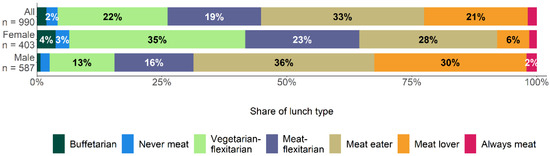
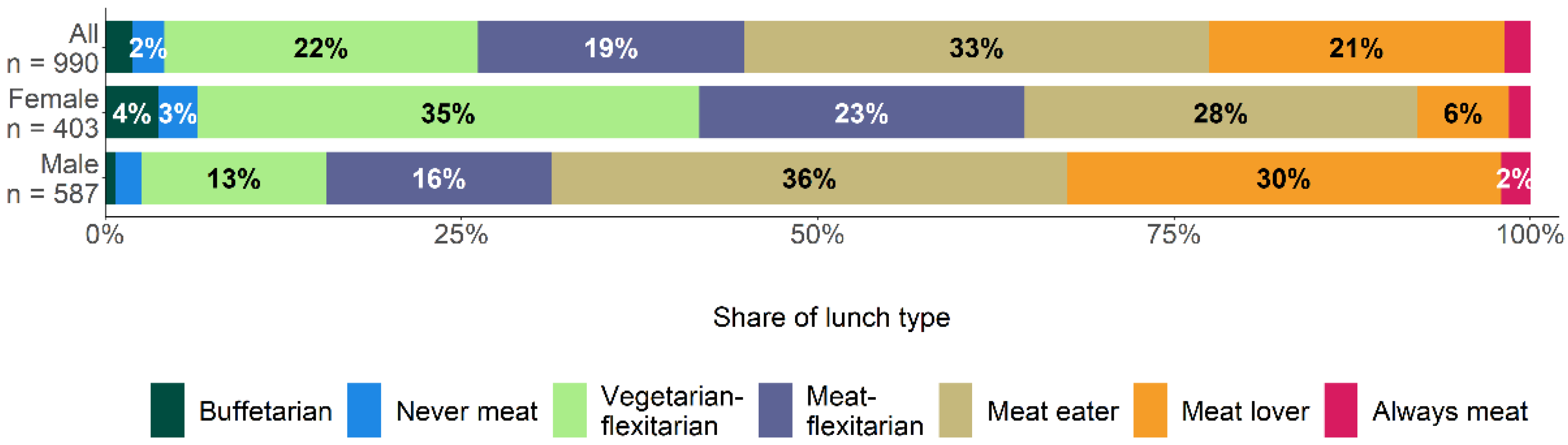
Men and women clearly differ in their lunchtime eating habits. While male students are more likely to be regular canteen visitors, this is less likely for female students (Table S1). In addition, if and when women did eat at the canteen, they chose a meat meal less often: 65% of women have veg-oriented lunch types compared to 31% of men (Figure 1). This difference became even more apparent at the other end of the scale: while 30% of men belong to the ‘Meat lover’ lunch type, this is true for only 6% of women; men are, thus, five times more likely to be ‘Meat lover’.
Figure 1.
Lunch types by gender.
3.3. Lunch Types by Gender and University Affiliation
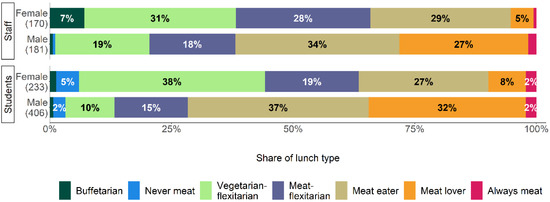
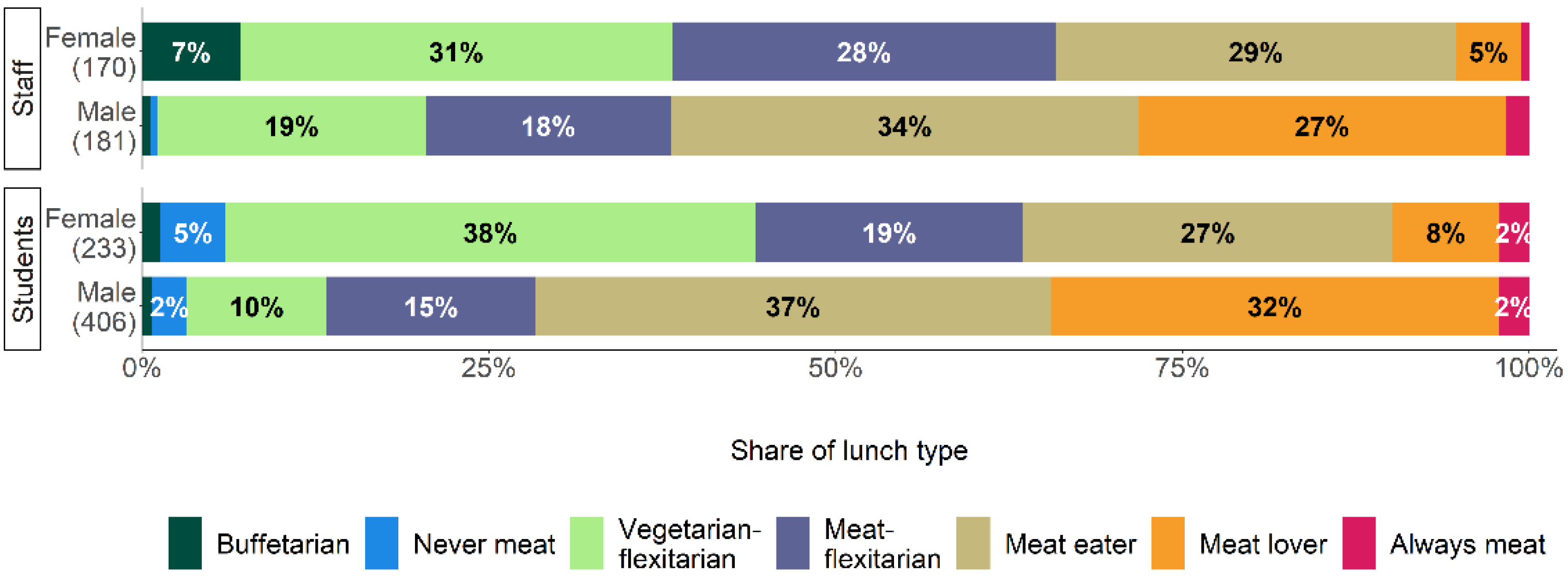
Lunch types differ in relation to university affiliation (i.e., staff or student) and gender (Figure 2): male staff exhibit meat-oriented lunch habits almost twice as often as female staff (M: 61.9% vs. F: 34.1%). Similarly, male students are almost twice as likely to show meat-oriented lunch habits than female students (M: 71.1% vs. F: 36.5%). Flexitarian lunch habits show a corresponding pattern: 59.9% of female staff and 56.8% of female students show ‘Vegetarian-flexitarian’ or ‘Meat-flexitarian’ habits compared to 40.1% of male staff and 43.2% of male students. It is noteworthy that among female staff, the rare lunch habit ‘Buffetarian’ is much more frequent than in any other group.
Figure 2.
Lunch types by university affiliation and gender.
3.4. Lunch Types by Gender and Age Groups
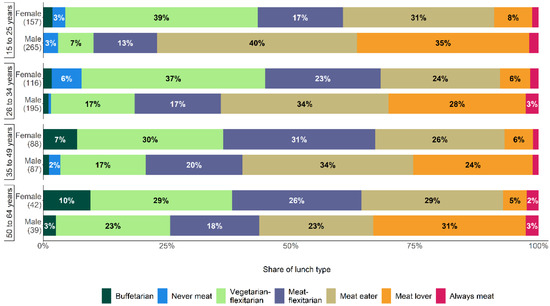
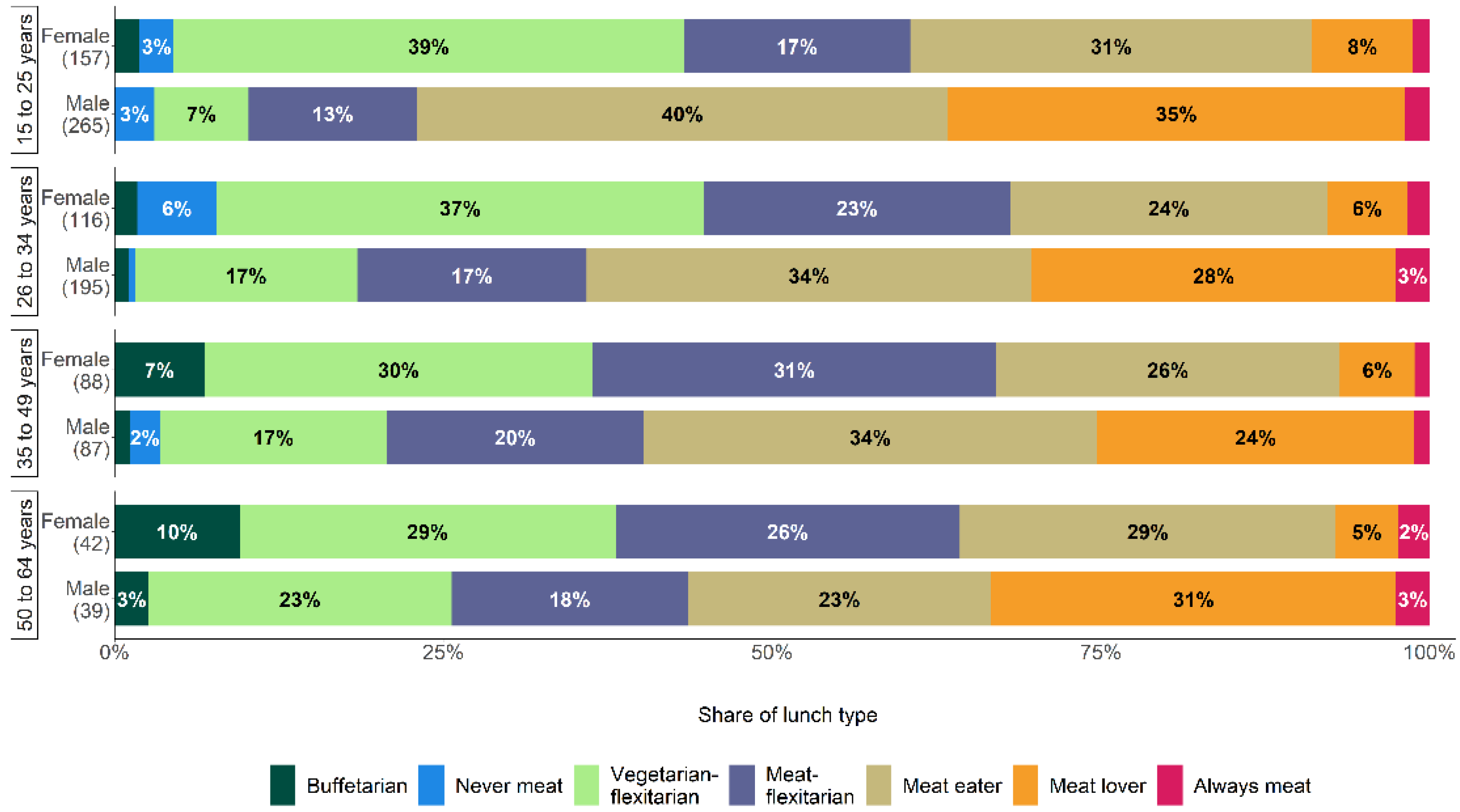
The association between lunch type, university affiliation and gender reflects the connection between age and university affiliation. Overall, the meat-oriented lunch types consist of 73.8% men and 26.2% women. While the percentage of meat-oriented lunch types for women varies little by age, for men the percentage decreases with increasing age (Figure 3). As a consequence, the difference between the genders narrows with age. The difference between women and men is greatest in the youngest age group: the youngest men (77.0%) are approximately twice as likely to show meat-oriented lunchtime eating habits than the youngest women (39.5%). The percentage of ‘Buffetarian’ increases as people get older, with the difference between women and men remaining.
Figure 3.
Lunch types by age group and gender.
3.5. Lunch Types by Gender and Intervention Week
Before analysing the responses to the revised meal options, the seven lunch types were reduced to five: the two lunch types ‘Buffetarian’ and ‘Never meat’ were merged because each consisted of only a few members (19 and 22, respectively), and the lunch types ‘Meat lover’ and ‘Always meat’ were merged because they differ minimally and there were only 18 members of the lunch type ‘Always meat’.
For the total of veg-oriented lunch types (‘Buffetarian & Never meat’, ‘Vegetarian-flexitarian’ and ‘Meat-flexitarian’), the share of meat dishes declined from 24.6% in the base weeks to 14.3% in the intervention weeks, and from 77.8% to 61.4% for the meat-oriented lunch types ‘Meat eater’ and ‘Meat lover & Always meat’.
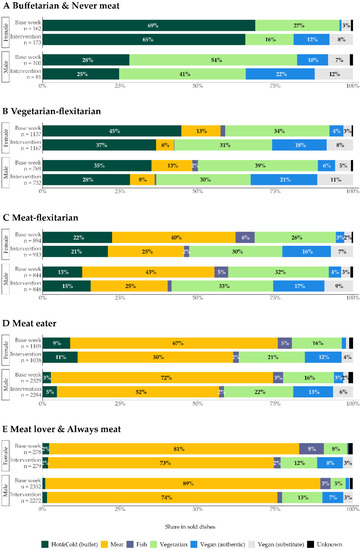
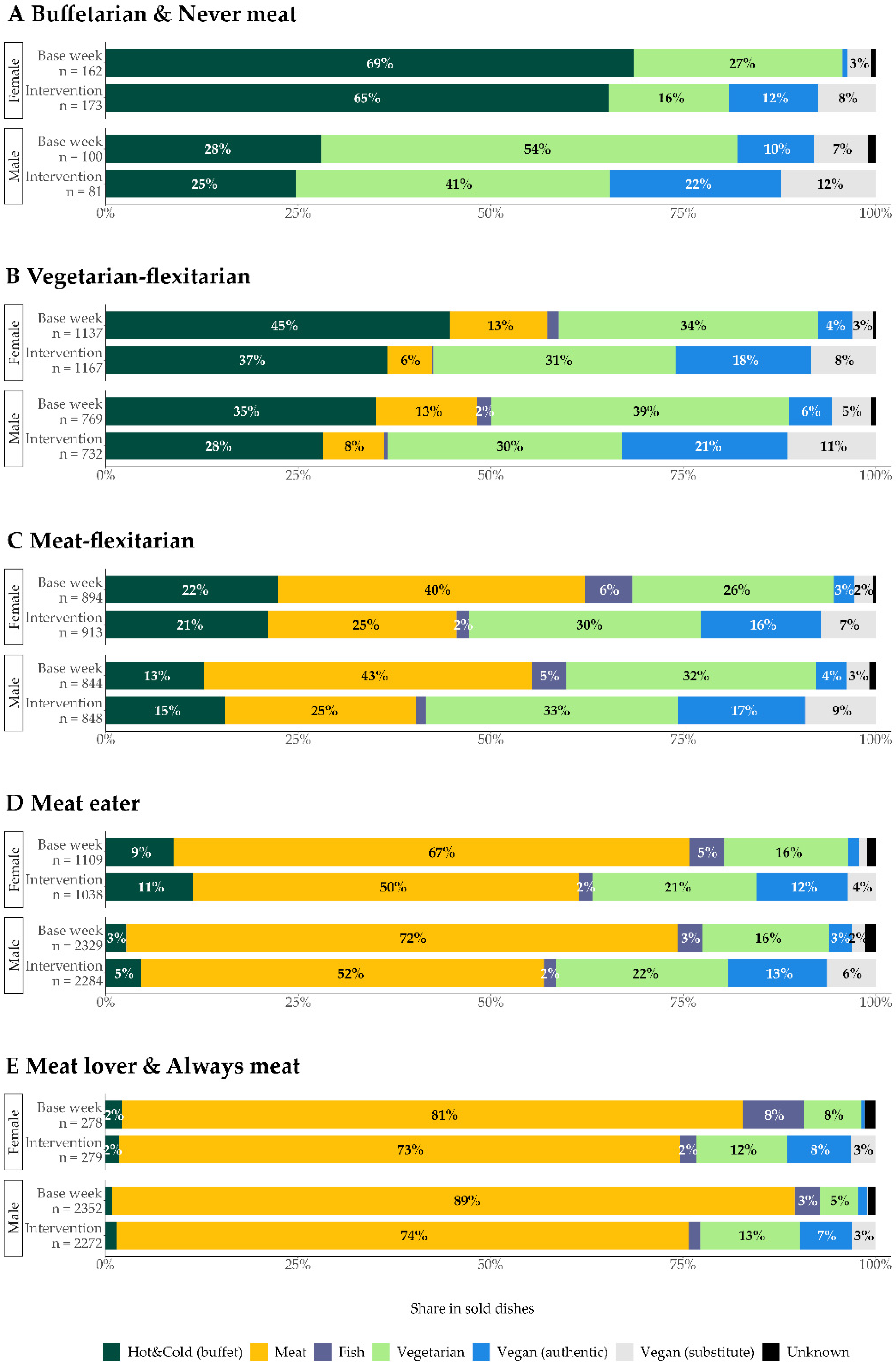
Meal purchases differed between the base and intervention weeks for all lunch types, and within a lunch type between men and women (Figure 4). Apart from the percentage of meat dishes that increased from ‘Buffetarian & Never meat’ to ‘Meat lover & Always meat’ (as per the definition), the most obvious difference between the lunch types concerns the decreasing percentage of ’Hot & Cold’ for men as well as for women. At the same time, women showed a higher preference for ’Hot & Cold’ for all lunch types. However, the percentage of ’Hot & Cold’ developed in opposite directions from the base to the intervention weeks depending on the lunch type: while the percentage of ’Hot & Cold’ decreased slightly for the veg-oriented lunch types ‘Buffetarian & Never meat’ and ‘Vegetarian-flexitarian’, it showed a slight increase for the meat-oriented lunch types ‘Meat eater’ and ‘Meat lover & Always meat’.
Figure 4.
Lunch types by gender, experimental week and dish content. The sub-sample of 990 regular canteen visitors bought 19,761 dishes in total, whereas the percentage of dishes bought per lunch type is (A) 2.6% for Buffetarian & Never meat, (B) 19.3% for Vegetarian-flexitarian, (C) 17.7% for Meat-flexitarian, (D) 34.2% for Meat eater and (E) 26.2% for Meat lover & Always meat.
Further, the increase in the percentage of veg-dishes results more from an increase of vegan dishes, in particular vegan authentic dishes, than from an increase of ovo-lacto-vegetarian dishes, with men tending to opt for the vegan choice even more frequently. For the veg-oriented lunch types ‘Buffetarian & Never meat’ and ‘Vegetarian-flexitarian’, the percentage of ovo-lacto-vegetarian dishes even decreased in favour of vegan dishes (Figure 4A,B).
In the small group with the lunch type ‘Buffetarian & Never meat’ (n = 41), women were more than twice as likely than men to choose the ’Hot & Cold’ option in the base and intervention weeks (Figure 4A). At the same time, both women and men responded to the interventions: they chose—at the expense of vegetarian dishes—vegan dishes more often during the intervention weeks.
Customers of the lunch type ‘Vegetarian-flexitarian’ (n = 218) also clearly responded to the interventions (Figure 4B): both men and women chose a vegan dish more often, not only at the expense of meat dishes, with a reduction of 13% in the base weeks to 6% (women)/8% (men) in the intervention weeks, but also ovo-lacto-vegetarian and the ’Hot & Cold’ options.
Males and females of the type ‘Meat-flexitarian’ (n = 185) differ minimally: women and men reduced the proportion of meat dishes from 40% (F) and 43% (M) to 25% (F: −38.4%: M: −41.5%) (Figure 4C). This decrease in the percentage of meat dishes occurred primarily in favour of vegan dishes and applies to both women and men. The share of ‘Hot & Cold’ buffet options selected, on the other hand, hardly changed.
Apart from the ‘Hot & Cold’ buffet, female and male ‘Meat Eaters’ (n = 323) differ minimally (Figure 4D): women and men reduced the percentage of meat dishes from around 70% to approximately 50%, with men responding slightly more (M: −26.9%, F: −25.1%). This reduction in the percentage of meat dishes is primarily in favour of vegan dishes, followed by ovo-lacto-vegetarian dishes and then, by a slight increase, ’Hot & Cold’ options, and applies to both women and men.
Customers of the lunch type ‘Meat lover & Always meat’ (n = 223) differ from all other lunch types, not only in the high proportion of meat dishes, but also in the small percentage of ‘Hot & Cold’ buffet options selected (Figure 4E). The largest difference between women and men concerns fish: female ‘Meat lover & Always meat’ were more than twice as likely to buy fish dishes than their male counterparts. Even so, the lunch type ‘Meat lover & Always meat’ also responded to the changed offer and reduced the consumption of meat dishes in favour of ovo-lacto-vegetarian and vegan dishes, women somehow less so than men (M: −16.1%, F: −9.7%).
3.6. Frequency of Canteen Visit by Lunch Type
Regular canteen visitors belonging to the meat-oriented lunch type eat in the canteen more often (Table 2): while 42.6% of customers of the lunch type ‘Meat lover & Always meat’ and 37.2% of customers of the lunch type ‘Meat eater’ ate in the canteen on average at least twice per week (at least 24 times), this is true for only 9.7% of the type ‘Buffetarian & Never meat’, 25.3% of the type ‘Vegetarian-flexitarian’ and 31.4% of the type ‘Meat-flexitarian’.
Table 2.
Frequency of canteen visit by lunch type over 12 weeks.
4. Discussion
The principal aim of this study was to investigate how customers with different lunchtime eating habits concerning their preference for meat responded to a revised choice of meat and lacto-vegetarian or vegan dishes (veg-dishes). To the authors’ knowledge, there are hardly any studies that have analysed the revealed preferences for meat dishes based on real POS data [28]. To explore this research question, data from the field experiment in two Swiss university canteens in the autumn semester of 2017 were used.
Over the 12-week period, 26,340 dishes were sold, of which 82.9% could be individually assigned to a customer with pseudonymised information about age, gender and university affiliation (student, staff). In total, 66.2% of customers who bought at least six dishes during the 12 weeks were identified as ‘regular canteen visitors’ (n = 990). Depending on the percentage of meat dishes bought, these 990 regular canteen visitors were categorised into either five or seven different lunch types; three of these are veg-oriented (‘Buffetarian & Never meat’, ‘Vegetarian-flexitarian’, ‘Meat-flexitarian’), i.e., they choose a meat dish less than 50% of the time, while two lunch types are meat-oriented (‘Meat eater’, ‘Meat lover & Always meat’).
4.1. Lunchtime Eating Habits by Gender
Differences between men and women concerning lunchtime eating habits are evident. While 45% of customers belong to veg-oriented lunch types overall, this applies for 65% of female and 31% of male customers. This finding is comparable with the first national nutrition survey in Switzerland in 2014/15 (n = 2085) [29], which revealed that 41% of the participants (54% of females and 24% of males) declared that they ate, on average, less than 50g of meat per day. Further studies confirm that men are more likely to have meat-oriented eating habits (i.e., omnivores) than women [30,31,32,33,34,35,36], and that across Western societies, women are twice as likely as men to be vegan or vegetarian, e.g., [32]. Further, in this field experiment, the typical profile of a regular canteen visitor is a male student choosing a meat dish. Other studies confirm that men use canteen services more often than women [37].
Differences associated with gender are also revealed when comparing male and female staff or male and female students: male staff or male students are nearly twice as likely to have meat-oriented lunchtime eating habits than female staff or female students. However, while female staff and students differ minimally (staff 34.1% vs. students 36.5%), male staff show meat-oriented lunchtime eating habits less often than male students (staff 61.9% vs. students 71.1%). This can be explained by age: men showed meat-oriented lunchtime eating habits more often than women in all age categories, but with increasing age the differences become smaller as men exhibited fewer meat-oriented lunch habits (15–25 years: 77.0%, 26–34 years: 65%, 35–49 years: 59%, 50–64 years: 57%). In addition, this finding is comparable with the first national survey in Switzerland, where gender-related differences in self-declared meat consumption become smaller with increasing age [29].
4.2. Response of Lunch Type to an Increased Choice of Veg-Dishes
Considering total meal sales, the percentage of meat dishes decreased from 56% in the base weeks to 42% in the intervention weeks. A decrease, per se, is no surprise, as it seems the logical consequence of the increased choice of veg-dishes. Yet, the aggregate results conceal individually differing responses. In this study, it was shown that regular canteen visitors show different response patterns depending on their lunchtime meat eating habits: visitors with veg-oriented or flexitarian lunchtime eating habits decreased the share of meat-dishes proportionally more than visitors with meat-oriented lunch types. Further, they did not only decrease the share of meat-dishes but also of ’Hot & Cold’ and ovo-lacto-vegetarian dishes in favour of vegan dishes. Meat-oriented visitors, on the other hand, decreased the share of meat dishes in favour of vegan and ovo-lacto-vegetarian dishes.
Concerning the relative increase of veg-dishes, meat-oriented customers reacted more to the revised menu choice: ‘Meat lover’ more than doubled the share of veg-dishes, but from a lower starting point. This result corresponds to a study by Garnett et al. (2019) [28], where diners also responded to a higher availability of vegetarian dishes, with the largest effects in the quartile of participants who were previously least likely to buy a vegetarian meal.
4.3. Vegan Dishes Were Surprisingly Successful
Vegan dishes were chosen by students and staff in all age groups and by all lunch types. Vegan dishes were even accepted in the lunch type ‘Meat lover & Always meat’ by both women (11%) and men (10%). Particularly, the authentic vegan dishes were met with approval more often than those with meat substitutes. This result is in line with findings from other studies indicating that meat substitutes are comparatively less accepted [38,39]. With the exception of consumers who have a vegan diet and lifestyle, most consumers do not perceive meat substitutes to be a true alternative to meat [40]. Further, meat substitutes are considered unhealthy, unusual, tasteless [41] and ‘disgusting’ [42]. This success of vegan dishes was rather unexpected because many recipes were unfamiliar and new for the canteen, and food neophobia is a known phenomenon [43]. The more remarkable finding is that for all lunch types, men chose a vegan dish either more than or equally as often as women. It could be that men in this study are less food neophobic than women. On the other hand, several studies did not find gender differences with respect to neophobia scores [44].
4.4. Limitations
In a real-world laboratory, research conditions cannot be totally controlled. In this field experiment, several interventions were applied simultaneously. The results reflect the customers’ responses to simultaneous changes in conditions. Which intervention had which effect cannot be assessed.
An ongoing challenge was that the daily demand for lunch is influenced by many factors that cannot be foreseen, for instance, the weather or student events. For the caterer, visitor satisfaction comes first, and financial losses, such as through food waste, should be avoided. Consequently, the experimental design was modified throughout the 12 weeks of the field experiment because of the caterer’s practical needs. The actual choices often deviated from those which were planned: on most days, supplementary dishes were offered in limited amounts which led, for example, to more meat dishes in the intervention weeks.
Lunch types were defined by only one dimension, the percentage of meat dishes. Other statistical methods using more information, e.g., clustering or classification, were not applied.
The POS data of regular canteen visitors that was used to analyse lunch type responses is not a random sample; it includes 66% of students and staff visiting the university canteens and 75% of meals sold. All analyses refer to the population of these 990 ‘regular’ canteen visitors who bought 19,761 meals in the autumn semester of 2017 and are valid for this population only.
The regular visitors to the two university canteens do not represent the Swiss population nor the customer base of cafeterias or restaurants in Switzerland. They are younger, better educated (higher share of tertiary education) and, therefore, may be more aware of nutrition, the environment and their health than customers in a different setting. This might explain the relatively high share of canteen visitors with veg-oriented or flexitarian lunchtime eating habits, as well as the relatively pronounced response to the revised choices.
5. Conclusions
Canteen visitors with meat-oriented lunchtime eating habits ate more frequently in the canteen. This indicates that the usual menu choices are more appealing to meat-eaters than for customers with flexitarian, vegetarian or vegan eating habits. However, the field experiment demonstrated that most regular canteen visitors were open to choosing a meat dish less often (women more compared to men, veg-oriented/flexitarian customers more compared to those with meat-oriented lunchtime meal eating habits). Even those belonging to the lunch type ‘Meat lover’ were open to choosing a veg-dish occasionally. We hypothesise that an important explanation for this result is that customers were not affected by moral suasion or any form of enforcement but by a competitive choice of veg-dishes relative to meat dishes. We, therefore, conclude that investing in more plant-based meal choices is an economically viable, and possibly also profitable, strategy as it is a chance to attract customers with veg-oriented lunchtime eating habits without losing meat eaters and meat lovers.
Although the share of flexitarian visitors in university canteens is possibly greater than in the population as a whole, we expect that the catering industry has a clear potential to reduce meat consumption by revising meal choices. However, it is not enough to increase the number and the share of veg-dishes. Additionally, ovo-lacto-vegetarian and vegan dishes should not be labelled or marketed as such because in food cultures centring around meat as is the case, for instance, in Swiss food culture, veg-cuisine has more of a negative image, and vegan dishes even more so. All the more remarkable is the frequency with which vegan dishes were chosen during the field-experiment, with vegan-authentic dishes being more in demand than vegan dishes with meat substitutes. Admittedly, preparing veg-dishes of a high culinary standard, which are also comparable with traditional meat dishes, is a challenge to most chefs and kitchen staff.
The results of the lunch type analyses cannot be generalised. The conclusions apply directly to the regular visitors of the two Swiss university canteens but, moreover, they give empirical evidence in order to derive hypotheses regarding how, in other settings such as canteens or restaurants, different lunch types might respond to a revised choice of meat and ovo-lacto-vegetarian or vegan dishes.
Supplementary Materials
The following are available online at https://www.mdpi.com/article/10.3390/su14063296/s1, Figure S1: meal sales by experimental week and dish content, Figure S2: lunch types, Table S1: comparison of regular canteen visitors with university population.
Author Contributions
Conceptualisation, G.-A.E. and P.B.; methodology, P.B. and G.-A.E.; investigation, G.-A.E. and P.B.; visualization, G.-A.E.; funding acquisition, P.B.; project administration, P.B. and G.-A.E.; supervision, P.B.; writing—original draft, G.-A.E. and P.B.; writing—review and editing, G.-A.E. and P.B. All authors have read and agreed to the published version of the manuscript.
Funding
This research was supported by the Swiss National Science Foundation SNSF, National Research Program (NRP 69), Healthy Nutrition and Sustainable Food Production (406940_166764).
Institutional Review Board Statement
Ethical review and approval were not required when preparing and conducting the field experiment (2016–2017), but we elaborated a memorandum of understanding (MoU) between the project partners involved: ZHAW Finances and Services, ZHAW department of Life Sciences and Facility Management, the head of the research project and the catering company SV Schweiz.
Informed Consent Statement
Informed consent was not explicitly obtained from all subjects involved in the study, but we communicated transparently about the project, and students and staff who did not consent did not participate. Before the start of the field experiment, members of the university (students, staff) were informed via email that a research project would be carried out at the two university canteens during the autumn semester of 2017. During the field phase, the canteen visitors were informed, via displays placed next to the cash registers in the canteens, that personal data (gender, age and university affiliation) would be collected and analysed anonymously. The canteen visitors had the option of paying cash at any time if they did not want their data to be recorded. In the last week of the field research project, the canteen visitors were informed that the project was complete.
Data Availability Statement
The data described in this article are openly available in the Open Science Framework Zenodo at https://doi.org/10.5281/zenodo.3890949 (accessed on 2 February 2022) and https://doi.org/10.5281/zenodo.3890931 (accessed on 2 February 2022). All R codes for the analyses and the plots are published in GitHub at https://github.com/gaegeler/pub_lunch_types (accessed on 2 February 2022).
Acknowledgments
We are extremely grateful to the SV Group for participating in the transdisciplinary field-experiment. In particular, we are grateful to Michael Jegge (Area Manager), Michael Krauer (Restaurant Manager), Reto Benz (Assistant Restaurant Manager), Andy Pfiffner (Sous-chef) and the whole cuisine team, Bruno Petrino (Cash Strategy), Manuela Stockmeyer (Group Communications Manager) and Dörte Bachmann (Sustainability Manager). Without their committed cooperation at every stage, the project would have been impossible. Moreover, we extend our thanks to the ZHAW Facility Management team, in particular Patrick Buenter (Information and Communication Technology) and Markus Loeffler (Shared Service Center FM), as well as Reto Schnellmann (Director, ZHAW Finance & Services). Further, we are grateful to Joachim Scholderer, 2015-2017 Research Director of the Center for Corporate Responsibility and Sustainability, Zurich, who advised preparing the experiment in the initial phase. Last but not least, we wish to thank Caroline Hyde-Simon, who helped to improve the English in this paper.
Conflicts of Interest
The authors declare no conflict of interest.
References
- Mathur, M.B.; Robinson, T.N.; Reichling, D.B.; Gardner, C.D.; Nadler, J.; Bain, P.A.; Peacock, J. Reducing Meat Consumption by Appealing to Animal Welfare: Protocol for a Meta-Analysis and Theoretical Review. Syst. Rev. 2020, 9, 3. [Google Scholar] [CrossRef] [Scilit]
- Godfray, H.C.J.; Aveyard, P.; Garnett, T.; Hall, J.W.; Key, T.J.; Lorimer, J.; Pierrehumbert, R.T.; Scarborough, P.; Springmann, M.; Jebb, S.A. Meat Consumption, Health, and the Environment. Science 2018, 361, eaam5324. [Google Scholar] [CrossRef] [Scilit] [PubMed]
- Poore, J.; Nemecek, T. Reducing Food’s Environmental Impacts through Producers and Consumers. Science 2018, 360, 987–992. [Google Scholar] [CrossRef] [Scilit] [PubMed]
- Springmann, M.; Clark, M.; Mason-D’Croz, D.; Wiebe, K.; Bodirsky, B.L.; Lassaletta, L.; de Vries, W.; Vermeulen, S.J.; Herrero, M.; Carlson, K.M.; et al. Options for Keeping the Food System within Environmental Limits. Nature 2018, 562, 519–525. [Google Scholar] [CrossRef] [Scilit] [PubMed]
- Willett, W.; Rockström, J.; Loken, B.; Springmann, M.; Lang, T.; Vermeulen, S.; Garnett, T.; Tilman, D.; DeClerck, F.; Wood, A.; et al. Food in the Anthropocene: The EAT–Lancet Commission on Healthy Diets from Sustainable Food Systems. Lancet 2019, 393, 447–492. [Google Scholar] [CrossRef] [Scilit]
- Hallström, E.; Carlsson-Kanyama, A.; Börjesson, P. Environmental Impact of Dietary Change: A Systematic Review. J. Clean. Prod. 2015, 91, 1–11. [Google Scholar] [CrossRef] [Scilit]
- Westhoek, H.; Lesschen, J.P.; Rood, T.; Wagner, S.; De Marco, A.; Murphy-Bokern, D.; Leip, A.; van Grinsven, H.; Sutton, M.A.; Oenema, O. Food Choices, Health and Environment: Effects of Cutting Europe’s Meat and Dairy Intake. Glob. Environ. Chang. 2014, 26, 196–205. [Google Scholar] [CrossRef] [Scilit]
- Resare Sahlin, K.; Röös, E.; Gordon, L.J. ‘Less but Better’ Meat Is a Sustainability Message in Need of Clarity. Nat. Food 2020, 1, 520–522. [Google Scholar] [CrossRef] [Scilit]
- Whitnall, T.; Pitts, N. Global Trends in Meat Consumption. Agric. Commod. 2020, 9, 96–99. [Google Scholar] [CrossRef]
- Griesoph, A.; Hoffmann, S.; Merk, C.; Rehdanz, K.; Schmidt, U. Guess What …?—How Guessed Norms Nudge Climate-Friendly Food Choices in Real-Life Settings. Sustainability 2021, 13, 8669. [Google Scholar] [CrossRef] [Scilit]
- Dagevos, H. Finding Flexitarians: Current Studies on Meat Eaters and Meat Reducers. Trends Food Sci. Technol. 2021, 114, 530–539. [Google Scholar] [CrossRef] [Scilit]
- Dagevos, H. Flexibility in the Frequency of Meat Consumption—Empirical Evidence from The Netherlands. EuroChoices 2014, 13, 40–45. [Google Scholar] [CrossRef] [Scilit]
- Dagevos, H. Exploring Flexitarianism: Meat Reduction in a Meat-Centred Food Culture. Available online: https://www.igi-global.com/chapter/exploring-flexitarianism/www.igi-global.com/chapter/exploring-flexitarianism/139629 (accessed on 29 October 2021).
- Minsch, J.; Mogalle, M. Wie ist Transdisziplinarität möglich? Der Bedürfnisfeldansatz in der Nachhaltigkeitsforschung. Ökologisches Wirtsch. 1998, 1, 11–13. [Google Scholar] [CrossRef] [Scilit]
- Mogalle, M. Der Bedürfnisfeld-Ansatz. Ein handlungsorientierter Forschungsansatz für eine transdisziplinäre Nachhaltigkeitsforschung. GAIA-Ecol. Perspect. Sci. Soc. 2000, 9, 204–210. [Google Scholar] [CrossRef] [Scilit]
- SV (Schweiz) AG SV Schweiz. 2021. Available online: https://www.sv-group.ch/de/ (accessed on 2 February 2022).
- Brehm, S.S.; Brehm, J.W. Psychological Reactance: A Theory of Freedom and Control; Academic Press, Inc.: London, UK, 1981; ISBN 978-1-4832-6489-9. [Google Scholar]
- Lombardini, C.; Lankoski, L. Forced Choice Restriction in Promoting Sustainable Food Consumption: Intended and Unintended Effects of the Mandatory Vegetarian Day in Helsinki Schools. J. Consum. Policy 2013, 36, 159–178. [Google Scholar] [CrossRef] [Scilit]
- Shadish, W.R. Randomized Controlled Studies and Alternative Designs in Outcome Studies: Challenges and Opportunities. Res. Soc. Work Pract. 2011, 21, 636–643. [Google Scholar] [CrossRef] [Scilit]
- Egeler, G.-A.; von Rickenbach, F.; Baur, P. Menüwahl in der Hochschulmensa: Design & Durchführung Feldexperiment; NOVANIMAL Kurzbericht; ZHAW Zürcher Hochschule für Angewandte Wissenschaften: Wädenswil, Switzerland, 2020. [Google Scholar] [CrossRef]
- Schäpke, N.; Stelzer, F.; Caniglia, G.; Bergmann, M.; Wanner, M.; Singer-Brodowski, M.; Loorbach, D.; Olsson, P.; Baedeker, C.; Lang, D.J. Jointly Experimenting for Transformation? Shaping Real-World Laboratories by Comparing Them. GAIA-Ecol. Perspect. Sci. Soc. 2018, 27, 85–96. [Google Scholar] [CrossRef] [Scilit]
- Caniglia, G.; Schäpke, N.; Lang, D.J.; Abson, D.J.; Luederitz, C.; Wiek, A.; Laubichler, M.D.; Gralla, F.; von Wehrden, H. Experiments and Evidence in Sustainability Science: A Typology. J. Clean. Prod. 2017, 169, 39–47. [Google Scholar] [CrossRef] [Scilit]
- Egeler, G.-A. Menüwahl in der Hochschulmensa: Dokumentation der Kassendaten; NOVANIMAL Kurzbericht; ZHAW Zürcher Hochschule für Angewandte Wissenschaften: Wädenswil, Switzerland, 2020. [Google Scholar] [CrossRef]
- R Core Team. A Language and Environment for Statistical Computing. R Foundation for Statistical Computing; R Core Team: Vienna, Austria, 2021; Available online: https://www.R-project.org/ (accessed on 2 February 2022).
- Von Hayek, F.A. The Theory of Complex Phenomena: A Precocious Play on the Epistemology of Complexity; Routledge: London, UK, 2010. [Google Scholar]
- Nuzzo, R. Statistical Errors: P Values, the’gold Standard’of Statistical Validity, Are Not as Reliable as Many Scientists Assume. Nature 2014, 506, 150–153. [Google Scholar] [CrossRef] [Scilit]
- Simmons, J.P.; Nelson, L.D.; Simonsohn, U. False-Positive Psychology: Undisclosed Flexibility in Data Collection and Analysis Allows Presenting Anything as Significant. Psychol. Sci. 2011, 22, 1359–1366. [Google Scholar] [CrossRef] [Scilit]
- Garnett, E.E.; Balmford, A.; Sandbrook, C.; Pilling, M.A.; Marteau, T.M. Impact of Increasing Vegetarian Availability on Meal Selection and Sales in Cafeterias. Proc. Natl. Acad. Sci. USA 2019, 116, 20923–20929. [Google Scholar] [CrossRef] [Scilit] [PubMed]
- Bochud, M.; Chatelan, A.; Blanco, J.-M.; Beer-Borst, S. Anthropometric Characteristics and Indicators of Eating and Physical Activity Behaviors in the Swiss Adult Population: Results from menuCH 2014–2015; Federal Office of Public Health and the Food Safety and Veterinary Office: Bern, Switzerland, 2017. [Google Scholar]
- Wozniak, H.; Larpin, C.; de Mestral, C.; Guessous, I.; Reny, J.-L.; Stringhini, S. Vegetarian, Pescatarian and Flexitarian Diets: Sociodemographic Determinants and Association with Cardiovascular Risk Factors in a Swiss Urban Population. Br. J. Nutr. 2020, 124, 844–852. [Google Scholar] [CrossRef] [Scilit] [PubMed]
- Hagmann, D.; Siegrist, M.; Hartmann, C. Meat Avoidance: Motives, Alternative Proteins and Diet Quality in a Sample of Swiss Consumers. Public Health Nutr. 2019, 22, 2448–2459. [Google Scholar] [CrossRef] [Scilit]
- Rothgerber, H. Real Men Don’t Eat (Vegetable) Quiche: Masculinity and the Justification of Meat Consumption. Psychol. Men Masc. 2013, 14, 363–375. [Google Scholar] [CrossRef] [Scilit]
- Rosenfeld, D.L. Gender Differences in Vegetarian Identity: How Men and Women Construe Meatless Dieting. Food Qual. Prefer. 2020, 81, 103859. [Google Scholar] [CrossRef] [Scilit]
- Modlinska, K.; Adamczyk, D.; Maison, D.; Pisula, W. Gender Differences in Attitudes to Vegans/Vegetarians and Their Food Preferences, and Their Implications for Promoting Sustainable Dietary Patterns–A Systematic Review. Sustainability 2020, 12, 6292. [Google Scholar] [CrossRef] [Scilit]
- Rudy, K. Locavores, Feminism, and the Question of Meat. J. Am. Cult. 2012, 35, 26–36. [Google Scholar] [CrossRef] [Scilit]
- Browarnik, B. Attitudes toward Male Vegetarians: Challenging Gender Norms through Food Choices. Available online: https://digitalcommons.conncoll.edu/psychhp/25/ (accessed on 2 February 2022).
- Kjøllesdal, M.R.; Holmboe-Ottesen, G.; Wandel, M. Frequent Use of Staff Canteens Is Associated with Unhealthy Dietary Habits and Obesity in a Norwegian Adult Population. Public Health Nutr. 2011, 14, 133–141. [Google Scholar] [CrossRef] [Scilit]
- Hoek, A.C. Will Novel Protein Foods Beat Meat? Consumer Acceptance of Meat Substitutes—A Multidisciplinary Research Approach; Wageningen University and Research: Wageningen, The Netherlands, 2010; ISBN 978-90-8585-536-1. [Google Scholar]
- De Boer, J.; Aiking, H. On the Merits of Plant-Based Proteins for Global Food Security: Marrying Macro and Micro Perspectives. Ecol. Econ. 2011, 70, 1259–1265. [Google Scholar] [CrossRef] [Scilit]
- Hoek, A.C.; Luning, P.A.; Stafleu, A.; de Graaf, C. Food-Related Lifestyle and Health Attitudes of Dutch Vegetarians, Non-Vegetarian Consumers of Meat Substitutes, and Meat Consumers. Appetite 2004, 42, 265–272. [Google Scholar] [CrossRef] [Scilit] [PubMed]
- Tosun, P.; Yanar, M.; Sezgin, S.; Uray, N. Meat Substitutes in Sustainability Context: A Content Analysis of Consumer Attitudes. J. Int. Food Agribus. Mark. 2021, 33, 541–563. [Google Scholar] [CrossRef] [Scilit]
- Michel, F.; Hartmann, C.; Siegrist, M. Consumers’ Associations, Perceptions and Acceptance of Meat and Plant-Based Meat Alternatives. Food Qual. Prefer. 2021, 87, 104063. [Google Scholar] [CrossRef] [Scilit]
- van den Heuvel, E.; Newbury, A.; Appleton, K.M. The Psychology of Nutrition with Advancing Age: Focus on Food Neophobia. Nutrients 2019, 11, 151. [Google Scholar] [CrossRef] [Scilit] [PubMed]
- Meiselman, H.L.; King, S.C.; Gillette, M. The Demographics of Neophobia in a Large Commercial US Sample. Food Qual. Prefer. 2010, 21, 893–897. [Google Scholar] [CrossRef] [Scilit]

Publisher’s Note: MDPI stays neutral with regard to jurisdictional claims in published maps and institutional affiliations. |
© 2022 by the authors. Licensee MDPI, Basel, Switzerland. This article is an open access article distributed under the terms and conditions of the Creative Commons Attribution (CC BY) license (https://creativecommons.org/licenses/by/4.0/).