Article

The Impacts of Transportation Sustainability on Higher Education in China
1
School of Foreign Studies, China University of Mining and Technology (Xuzhou), Xuzhou 221116, China
2
Department of Regional and Urban Planning, Zhejiang University, Hangzhou 310058, China
*
Author to whom correspondence should be addressed.
Sustainability 2021, 13(22), 12579; https://doi.org/10.3390/su132212579
Submission received: 15 September 2021 / Revised: 10 November 2021 / Accepted: 12 November 2021 / Published: 15 November 2021

Abstract

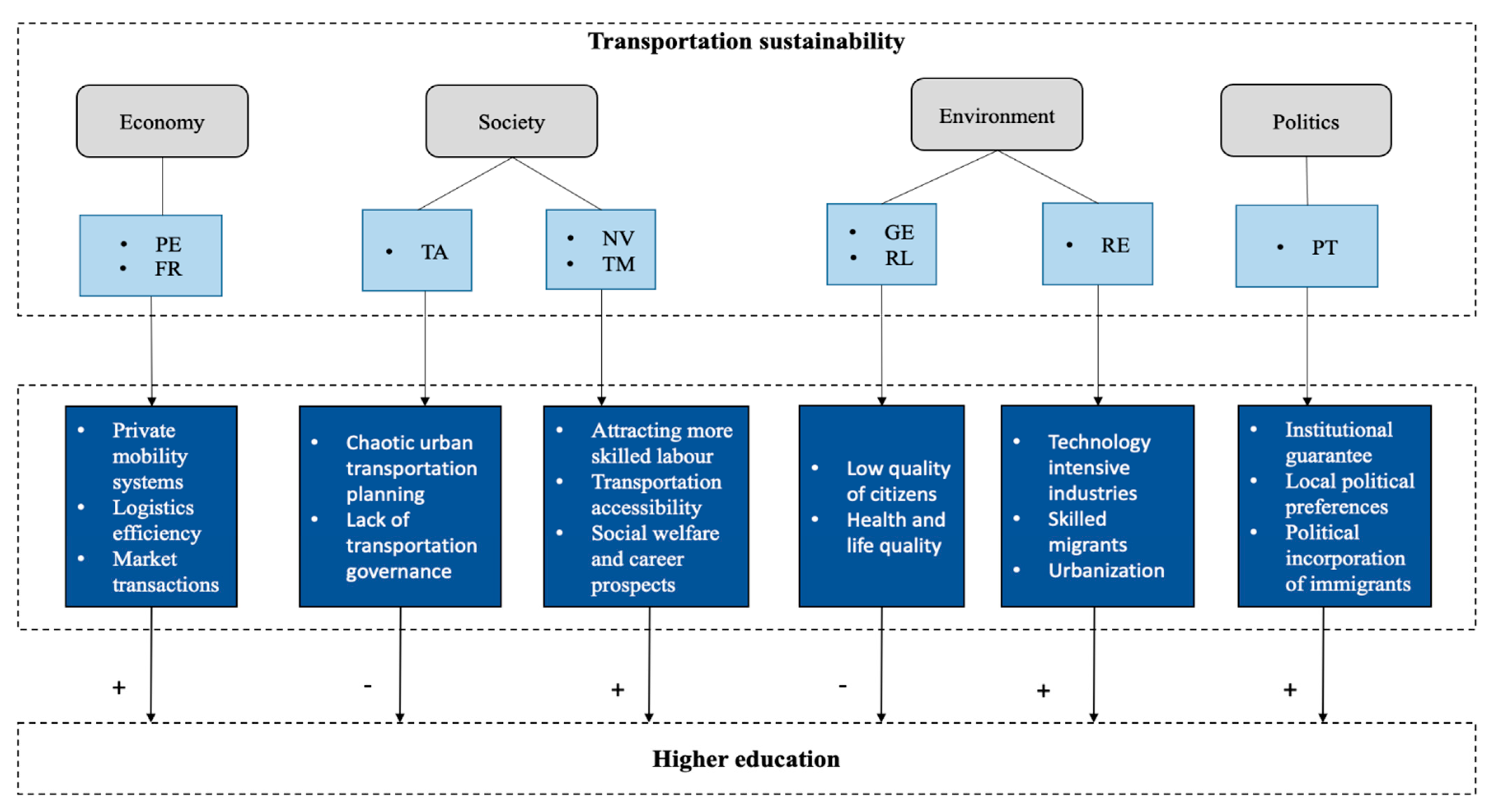
Improving transportation sustainability serves as a means of reducing the perceived and real distance, thereby contributing to the city and higher education development. In this paper, the complexity of transport sustainability is measured via four different dimensions: economy, society, environment and politics. The variables are designed by the four dimensions. The higher education development is measured via the ratio of higher education degree holders, reflecting the skilled work mobility. Over the last 30 years, university students moving to cities for study and work purposes have become an important part of rural–urban transition mobility. However, few studies have explored the impacts of transportation sustainability on higher education development in China. The economic, environmental, social and political dimensions in transportation sustainability can boost China’s higher education attainment in different ways. Against this background, this study, drawing on the panel data and employing the spatial multilevel model, investigated the impacts of transportation sustainability on higher education in China, adding new empirical evidence for China’s higher education development. A panel analysis revealed that the increase in transportation sustainability induces the growth of higher education. Moreover, higher education attainment showed significant spatial dependence at the county level and had significant spatial clustering of county-level higher education attainment across provinces. Furthermore, modeled test results showed that the spatial multilevel model was more suitable for our study than traditional regression models. By identifying transport sustainability variables that have an effect on higher education, this study is the first to uncover the complexity of transportation sustainability and contributes to the latest policy implications for promoting higher education attainment through sustainable transportation.
Keywords: transportation sustainability; higher education; university students; skilled work; spatial multilevel analysis transportation sustainability; higher education; university students; skilled work; spatial multilevel analysis