


Soil-Applied Boron Combined with Boron-Tolerant Bacteria (Bacillus sp. MN54) Improve Root Proliferation and Nodulation, Yield and Agronomic Grain Biofortification of Chickpea (Cicer arietinum L.)
 ,
,  ,
,
Abstract
1. Introduction
2. Materials and Methods
2.1. Experimental Material
2.2. Experimental Site
2.3. Plant Material and Crop Husbandry
2.4. Data Collection
2.4.1. Nodules Population, Allometric and Roots Related Traits
2.4.2. Yield-Related Attributes
2.4.3. Grain Boron Contents
2.5. Statistical Analysis
3. Results
3.1. Root Nodulation, Root System and Growth Parameters
3.2. Yield-Related Traits
4. Discussion
5. Conclusions
Author Contributions
Funding
Institutional Review Board Statement
Informed Consent Statement
Data Availability Statement
Acknowledgments
Conflicts of Interest
References
- Sawan, Z.M.; Hafez, S.A.; Basyony, A.E. Effect of phosphorus fertilization and foliar application of chelated zinc and calcium on seed, protein and oil yields and oil properties of cotton. J. Agric. Sci. 2001, 136, 191–198. [Google Scholar] [CrossRef] [Scilit]
- Warington, K. The effect of boric acid and borax on the broad bean and certain other plants. Ann. Bot. 1923, 37, 629–672. [Google Scholar] [CrossRef] [Scilit]
- Nielsen, F.H. Is boron nutritionally relevant? Nutr. Rev. 2008, 66, 183–191. [Google Scholar] [CrossRef] [Scilit] [PubMed]
- Devirian, T.A.; Volpe, S.L. The physiological effects of dietary boron. Crit. Rev. Food Sci. Nutr. 2003, 43, 219–231. [Google Scholar] [CrossRef] [Scilit] [PubMed]
- Bonilla, I.; Garcia-González, M.; Mateo, P. Boron requirement in Cyanobacteria. Plant Physiol. 1990, 94, 1554–1560. [Google Scholar] [CrossRef] [Scilit] [PubMed]
- Wimmer, M.A.; Lochnit, G.; Bassil, E.; Mühling, K.H.; Goldbach, H.E. Membrane-associated, boron-interacting proteins isolated by boronate affinity chromatography. Plant Cell Physiol. 2009, 50, 1292–1304. [Google Scholar] [CrossRef] [Scilit]
- Ahmad, S.; Ahmad, A.; Zia-ul-Haq, M.; Ali, H.; Khaliq, T.; Anjum, M.A.; Khan, M.A.; Hussain, A.; Hoogenboom, G. Resources use efficiency of field grown transplanted rice (Oryza sativa L.) under irrigated semiarid environment. J. Food Agric. Environ. 2009, 7, 487–492. [Google Scholar]
- Flores, R.A.; da Silva, R.G.; da Cunha, P.P.; Damin, V.; de Abdala, K.O.; Arruda, E.M.; Rodrigues, R.A.; Maranhão, D.D.C. Economic viability of Phaseolus vulgaris (BRS Estilo) production in irrigated system in a function of application of leaf boron. Acta Agric. Scand. Sect. B Soil Plant Sci. 2017, 67, 697–704. [Google Scholar] [CrossRef] [Scilit]
- Hussain, M.; Khan, M.A.; Khan, M.B.; Farooq, M.; Farooq, S. Boron application improves growth, yield and net economic return of rice. Rice Sci. 2012, 19, 259–262. [Google Scholar] [CrossRef] [Scilit]
- Rehman, S.U.; Hussain, N.; Tariq, M.; Hussain, M.; Nasir, M.; Ayaz, M. Response of wheat to exogenous boron supply at various growth stages. Sarhad J. Agric 2012, 28, 411–414. [Google Scholar]
- Silva, C.A.T.; Cagol, A.; Silva, T.R.B.; Nobrega, L.H.P. Boron application before sowing of sunflower hybrid. J. Food Agric. Environ. 2011, 9, 580–583. [Google Scholar]
- Kanwal, S.; Rahmatullah, A.M.R.; Ahmad, R. Zinc partitioning in maize grain after soil fertilization with zinc sulfate. Int. J. Agric. Biol. 2010, 12, 299–302. [Google Scholar]
- Panhwar, Q.A.; Radziah, O.; Khanif, Y.M.; Naher, U.A. Application of boron and zinc in the tropical soils and its effect on maize (Zea mays) growth and soil microbial environment. Aust. J. Crop Sci. 2011, 5, 1649–1654. [Google Scholar]
- Tariq, M.; Mott, C.J.B. Effect of boron supply on the uptake of micronutrients by radish (Raphanus sativus L.). J. Agric. Biol. Sci. 2006, 1, 1–8. [Google Scholar]
- Zhao, D.; Oosterhuis, D.M. Cotton growth and physiological responses to boron deficiency. J. Plant Nutr. 2003, 26, 855–867. [Google Scholar] [CrossRef] [Scilit]
- Oosterhuis, D.M.; Zhao, D. Effect of boron deficiency on the growth and carbohydrate metabolism of cotton. In Plant Nutrition; Springer: Berlin/Heidelberg, Germany, 2001; pp. 166–167. [Google Scholar]
- Rashidi, M.; Gholami, M. Interactive effect of nitrogen and boron fertilizers on yield and yield components of cotton (Gossypium hirsutum L.). Libyan Agric. Res. Cent. J. Int. 2011, 1, 33–38. [Google Scholar]
- Haider, M.U.; Hussain, M.; Farooq, M.; Nawaz, A. Soil application of zinc improves the growth, yield and grain zinc biofortification of mungbean. Soil Environ. 2018, 37, 123–128. [Google Scholar] [CrossRef]
- Cartwright, B.; Zarcinas, B.A.; Mayfield, A.H. Toxic concentrations of boron in a red-brown earth at Gladstone, South Australia. Soil Res. 1984, 22, 261–272. [Google Scholar] [CrossRef] [Scilit]
- Rashid, A.; Ryan, J. Micronutrient constraints to crop production in soils with Mediterranean-type characteristics: A review. J. Plant Nutr. 2004, 27, 959–975. [Google Scholar] [CrossRef] [Scilit]
- Rashid, A.; Rafique, E.; Bhatti, A.U.; Ryan, J.; Bughio, N.; Yau, S.K. Boron deficiency in rainfed wheat in Pakistan: Incidence, spatial variability and management strategies. J. Plant Nutr. 2011, 34, 600–613. [Google Scholar] [CrossRef] [Scilit]
- Karim, M.R.; Zhang, Y.; Zhao, R.; Chen, X.; Zhang, F.; Zou, C. Alleviation of drought stress in winter wheat by late foliar application of zinc, boron, and manganese. J. Plant Nutr. Soil Sci. 2012, 175, 142–151. [Google Scholar] [CrossRef] [Scilit]
- Özkan, A.; Kafadar, F.N.; Can, C.; Kar, Y.; Mart, D.; Ceyhan, E. Genetic and biochemical properties of Cicer spp reveal distinction between wild and cultivated chickpea genotypes. Legum. Res.-AN Int. J. 2018, 42, 1–9. [Google Scholar] [CrossRef] [Scilit]
- Rokhzadi, A.; Toashih, V. Nutrient uptake and yield of chickpea (Cicer arietinum L.) inoculated with plant growth-promoting rhizobacteria. Aust. J. Crop Sci. 2011, 5, 44–48. [Google Scholar]
- Gunes, A.; Inal, A.; Adak, M.S.; Alpaslan, M.; Bagci, E.G.; Erol, T.; Pilbeam, D.J. Mineral nutrition of wheat, chickpea and lentil as affected by mixed cropping and soil moisture. Nutr. Cycl. Agroecosyst. 2007, 78, 83–96. [Google Scholar] [CrossRef] [Scilit]
- Merga, B.; Haji, J. Economic importance of chickpea: Production, value, and world trade. Cogent Food Agric. 2019, 5, 1615718. [Google Scholar] [CrossRef] [Scilit]
- Pakistan, G. Economic Survey of Pakistan; Economic Adviser’s Wing, Finance Division, Government of Pakistan: Islamabad, Pakistan, 2020.
- Upadhyaya, H.D.; Dwivedi, S.L.; Gowda, C.L.L.; Singh, S. Identification of diverse germplasm lines for agronomic traits in a chickpea (Cicer arietinum L.) core collection for use in crop improvement. Field Crop. Res. 2007, 100, 320–326. [Google Scholar] [CrossRef] [Scilit]
- Jha, U.C.; Chaturvedi, S.K.; Bohra, A.; Basu, P.S.; Khan, M.S.; Barh, D. Abiotic stresses, constraints and improvement strategies in chickpea. Plant Breed. 2014, 133, 163–178. [Google Scholar] [CrossRef] [Scilit]
- Garg, N.; Pandey, R. Effectiveness of native and exotic arbuscular mycorrhizal fungi on nutrient uptake and ion homeostasis in salt-stressed Cajanus cajan L. (Millsp.) genotypes. Mycorrhiza 2015, 25, 165–180. [Google Scholar] [CrossRef] [Scilit]
- Mahmood, K.; Munir, M.; Rafique, S. Rainfed farming systems and socio-economic aspects in Kalat Division (Highland Balochistan). Pak. J. Agric. Soc. Sci. 1991, 5, 15–20. [Google Scholar]
- El-Naggar, A.H.; Usman, A.R.A.; Al-Omran, A.; Ok, Y.S.; Ahmad, M.; Al-Wabel, M.I. Carbon mineralization and nutrient availability in calcareous sandy soils amended with woody waste biochar. Chemosphere 2015, 138, 67–73. [Google Scholar] [CrossRef] [Scilit]
- Kumar, A.; Choudhary, A.K.; Pooniya, V.; Suri, V.K.; Singh, U. Soil factors associated with micronutrient acquisition in crops-biofortification perspective. In Biofortification of Food Crops; Springer: New Delhi, India, 2016; ISBN 9788132227168. [Google Scholar]
- Haider, M.U.; Hussain, M.; Farooq, M.; Ul-Allah, S.; Ansari, M.J.; Alwahibi, M.S.; Farooq, S. Zinc biofortification potential of diverse mungbean [Vigna radiata (L.) Wilczek] genotypes under field conditions. PLoS ONE 2021, 16, e0253085. [Google Scholar] [CrossRef] [Scilit] [PubMed]
- Sadeghzadeh, B. A review of zinc nutrition and plant breeding. J. Soil Sci. Plant Nutr. 2013, 13, 905–927. [Google Scholar] [CrossRef] [Scilit]
- White, P.J.; Broadley, M.R. Biofortification of crops with seven mineral elements often lacking in human diets–iron, zinc, copper, calcium, magnesium, selenium and iodine. New Phytol. 2009, 182, 49–84. [Google Scholar] [CrossRef] [Scilit] [PubMed]
- Mao, H.; Wang, J.; Wang, Z.; Zan, Y.; Lyons, G.; Zou, C. Using agronomic biofortification to boost zinc, selenium, and iodine concentrations of food crops grown on the loess plateau in China. J. Soil Sci. Plant Nutr. 2014, 14, 459–470. [Google Scholar] [CrossRef] [Scilit]
- Singh, M.V. Micronutrient nutritional problems in soils of India and improvement for human and animal health. Indian J. Fertil. 2009, 5, 11–56. [Google Scholar]
- Majeed, A.; Minhas, W.A.; Mehboob, N.; Farooq, S.; Hussain, M.; Alam, S.; Rizwan, M.S. Iron application improves yield, economic returns and grain-Fe concentration of mungbean. PLoS ONE 2020, 15, e0230720. [Google Scholar] [CrossRef] [Scilit] [PubMed]
- Haider, M.U.; Hussain, M.; Farooq, M.; Nawaz, A. Optimizing zinc seed priming for improving the growth, yield and grain biofortification of mungbean (Vigna radiata (L.) wilczek). J. Plant Nutr. 2020, 43, 1438–1446. [Google Scholar] [CrossRef] [Scilit]
- Haider, M.U.; Hussain, M.; Farooq, M.; Nawaz, A. Zinc nutrition for improving the productivity and grain biofortification of mungbean. J. Soil Sci. Plant Nutr. 2020, 20, 1321–1335. [Google Scholar] [CrossRef] [Scilit]
- Hussain, M.; Mehboob, N.; Naveed, M.; Shehzadi, K.; Yasir, T.A. Optimizing boron seed coating level and boron-tolerant bacteria for improving yield and biofortification of chickpea. J. Soil Sci. Plant Nutr. 2020, 20, 2471–2478. [Google Scholar] [CrossRef] [Scilit]
- Mehboob, N.; Minhas, W.; Naeem, M.; Yasir, T.; Naveed, M.; Farooq, S.; Hussain, M. Seed priming with boron and Bacillus sp. MN54 inoculation improves chickpea productivity and grain boron concentrations. Crop Pasture Sci. 2021. In Press. [Google Scholar]
- Khan, M.I.; Afzal, M.J.; Bashir, S.; Naveed, M.; Anum, S.; Cheema, S.A.; Wakeel, A.; Sanaullah, M.; Ali, M.H.; Chen, Z. Improving nutrient uptake, growth, yield and protein content in chickpea by the co-addition of phosphorus fertilizers, organic manures, and bacillus sp. Mn-54. Agronomy 2021, 11, 436. [Google Scholar] [CrossRef] [Scilit]
- Qiu, Z.; Egidi, E.; Liu, H.; Kaur, S.; Singh, B.K. New frontiers in agriculture productivity: Optimised microbial inoculants and in situ microbiome engineering. Biotechnol. Adv. 2019, 37, 107371. [Google Scholar] [CrossRef] [Scilit] [PubMed]
- Samreen, T.; Zahir, Z.A.; Naveed, M.; Asghar, M. Boron tolerant phosphorus solubilizing Bacillus spp. MN-54 improved canola growth in alkaline calcareous soils. Int. J. Agric. Biol. 2019, 21, 538–546. [Google Scholar] [CrossRef] [Scilit]
- Afzal, M.J.; Khan, M.I.; Cheema, S.A.; Hussain, S.; Anwar-ul-Haq, M.; Ali, M.H.; Naveed, M. Combined application of Bacillus sp. MN-54 and phosphorus improved growth and reduced lead uptake by maize in the lead-contaminated soil. Environ. Sci. Pollut. Res. 2020, 27, 44528–44539. [Google Scholar] [CrossRef] [Scilit]
- Abubakar, M.; Naveed, M.; Ahmad, Z.; Cheema, S.A.; Khan, A.S.; Park, H.Y.; Kwon, C.H. Ameliorative Effect of Bacillus sp. MN-54 and Organic Amendments Combination on Maize Plants Growth and Physiology Under Chromium Toxicity. J. Agric. Sci. 2020, 12. [Google Scholar] [CrossRef] [Scilit]
- Ahmed, I.; Fujiwara, T. Mechanism of boron tolerance in soil bacteria. Can. J. Microbiol. 2010, 56, 22–26. [Google Scholar] [CrossRef] [Scilit] [PubMed]
- Philippot, L.; Raaijmakers, J.M.; Lemanceau, P.; Van Der Putten, W.H. Going back to the roots: The microbial ecology of the rhizosphere. Nat. Rev. Microbiol. 2013, 11, 789–799. [Google Scholar] [CrossRef] [Scilit]
- Berg, G. Plant–microbe interactions promoting plant growth and health: Perspectives for controlled use of microorganisms in agriculture. Appl. Microbiol. Biotechnol. 2009, 84, 11–18. [Google Scholar] [CrossRef] [Scilit]
- Adesemoye, A.O.; Kloepper, J.W. Plant–microbes interactions in enhanced fertilizer-use efficiency. Appl. Microbiol. Biotechnol. 2009, 85, 1–12. [Google Scholar] [CrossRef] [Scilit]
- Edwards, U.; Rogall, T.; Blöcker, H.; Emde, M.; Böttger, E.C. Isolation and direct complete nucleotide determination of entire genes. Characterization of a gene coding for 16S ribosomal RNA. Nucleic Acids Res. 1989, 17, 7843–7853. [Google Scholar] [CrossRef] [Scilit]
- Naveed, M.; Mitter, B.; Yousaf, S.; Pastar, M.; Afzal, M.; Sessitsch, A. The endophyte Enterobacter sp. FD17: A maize growth enhancer selected based on rigorous testing of plant beneficial traits and colonization characteristics. Biol. Fertil. Soils 2014, 50, 249–262. [Google Scholar] [CrossRef] [Scilit]
- Shabaan, M.; Asghar, H.N.; Akhtar, M.J.; Ali, Q.; Ejaz, M. Role of plant growth promoting rhizobacteria in the alleviation of lead toxicity to Pisum sativum L. Int. J. Phytoremed. 2021, 23, 837–845. [Google Scholar] [CrossRef] [Scilit]
- Chapman, H.D.; Pratt, P.F. Methods of analysis for soils, plants and waters. Soil Sci. 1962, 93, 68. [Google Scholar] [CrossRef] [Scilit]
- Steel, R.; Torrei, J.; Dickey, D. Principles and Procedures of Statistics A Biometrical Approach; McGraw-Hill: New York, NY, USA, 1997. [Google Scholar]
- IBM Corporation; IBM SPSS Inc. SPSS Statistics for Windows (Version 20); IBM Corporation: Armonk, NY, USA, 2012; pp. 1–8. [Google Scholar]
- Pandey, N.; Gupta, B. The impact of foliar boron sprays on reproductive biology and seed quality of black gram. J. Trace Elem. Med. Biol. 2013, 27, 58–64. [Google Scholar] [CrossRef] [Scilit]
- Bayrak, H.; Önder, M.; Gezgin, S. Effects on yield and some yield components of boron application in chickpea (Cicer arietinum L.) varieties. Selcuk Univ. J. Fac. Agric. 2005, 19, 66–74. [Google Scholar]
- Ceyhan, E.; Önder, M.; Öztürk, Ö.; Harmankaya, M.; Hamurcu, M.; Gezgin, S. Effects of application boron on yields, yield component and oil content of sunflower in boron-deficient calcareous soils. Afr. J. Biotechnol. 2008, 7, 2854–2861. [Google Scholar]
- Agarwala, S.C.; Sharma, C.P. Recognising Micronutrient Disorders of Crop Plants on the Basis of Visible Symptoms and Plant Analysis; Lucknow University: Lucknow, India, 1979; p. 72. [Google Scholar]
- Srivastava, S.P.; Yadav, C.R.; Rego, T.J.; Johansen, C.; Saxena, N.P.; Ramakrishna, A. Diagnosis of boron deficiency as a cause of flower abortion and failure of pod set in chickpea in Nepal. Int. Chickpea Newsl. 1996, 3, 29–30. [Google Scholar]
- Ullah, A.; Farooq, M.; Nadeem, F.; Rehman, A.; Hussain, M.; Nawaz, A.; Naveed, M. Zinc application in combination with zinc solubilizing Enterobacter sp. MN17 improved productivity, profitability, zinc efficiency, and quality of desi chickpea. J. Soil Sci. Plant Nutr. 2020, 20, 2133–2144. [Google Scholar] [CrossRef] [Scilit]
- Dey, R.; Pal, K.K.; Bhatt, D.M.; Chauhan, S.M. Growth promotion and yield enhancement of peanut (Arachis hypogaea L.) by application of plant growth-promoting rhizobacteria. Microbiol. Res. 2004, 159, 371–394. [Google Scholar] [CrossRef] [Scilit]
- Khan, A.; Zhao, X.Q.; Javed, M.T.; Khan, K.S.; Bano, A.; Shen, R.F.; Masood, S. Bacillus pumilus enhances tolerance in rice (Oryza sativa L.) to combined stresses of NaCl and high boron due to limited uptake of Na+. Environ. Exp. Bot. 2016, 124, 120–129. [Google Scholar] [CrossRef] [Scilit]
- Srivastava, S.P.; Yadav, C.R.; Rego, T.J.; Johansen, C.; Saxena, N.P. Diagnosis and alleviation of boron deficiency causing flower and pod abortion in chickpea (Cicer arietinum L.) in Nepal. In Boron in Soils and Plants; Springer: Berlin/Heidelberg, Germany, 1997; pp. 95–99. [Google Scholar]
- Dar, W.D. Macro-benefits from micronutrients for grey to green revolution in agriculture. In Proceedings of the IFA International Symposium On Micronutrients, New Delhi, India, 23–25 February 2004; pp. 1–13. [Google Scholar]
- Singh, A.L.; Jat, R.S.; Chaudhari, V.; Bariya, H.; Sharma, S.J. Toxicities and tolerance of mineral elements boron, cobalt, molybdenum and nickel in crop plants. Plant Stress 2010, 4, 31–56. [Google Scholar]
- Hayat, R.; Ali, S.; Amara, U.; Khalid, R.; Ahmed, I. Soil beneficial bacteria and their role in plant growth promotion: A review. Ann. Microbiol. 2010, 60, 579–598. [Google Scholar] [CrossRef] [Scilit]
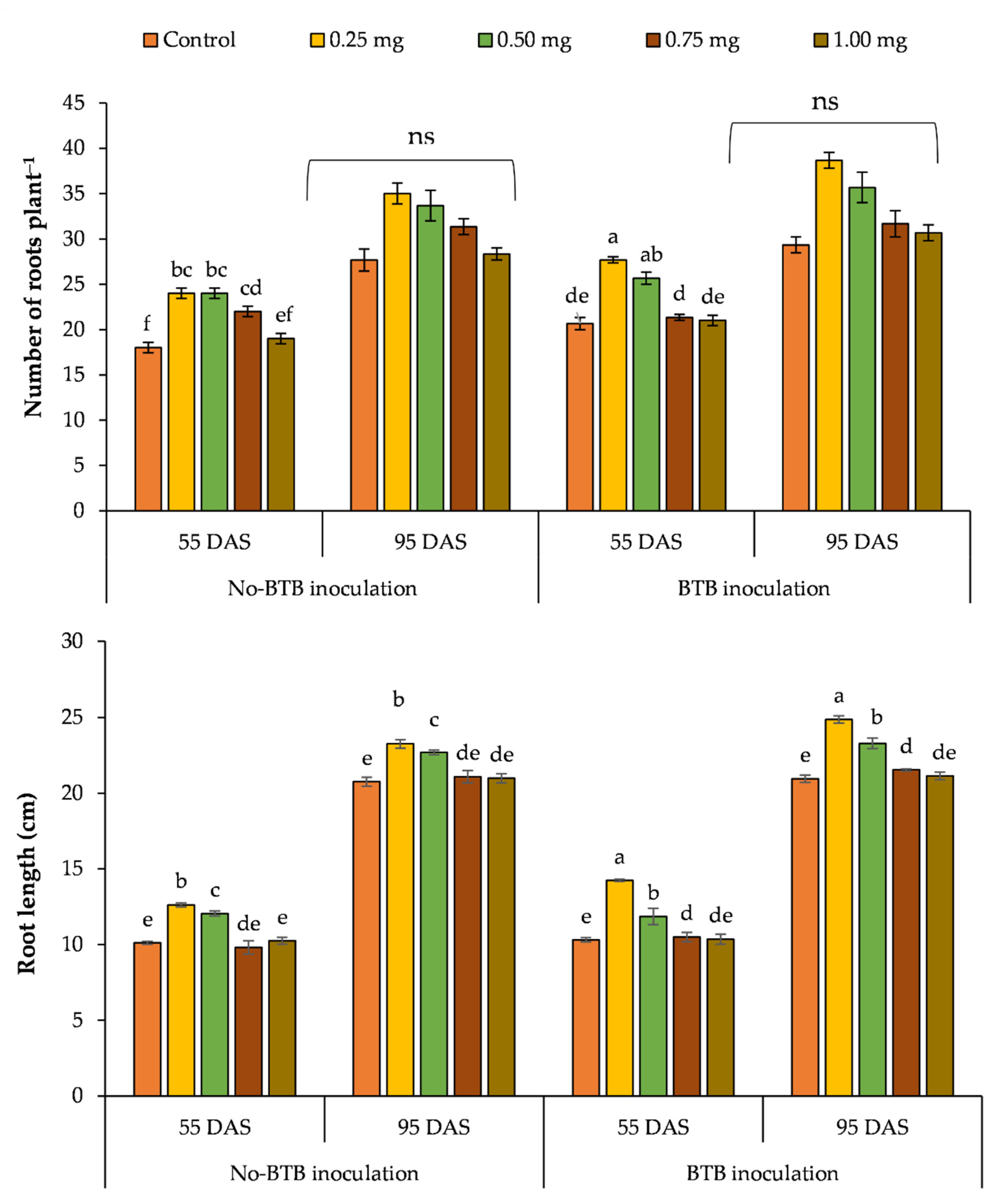
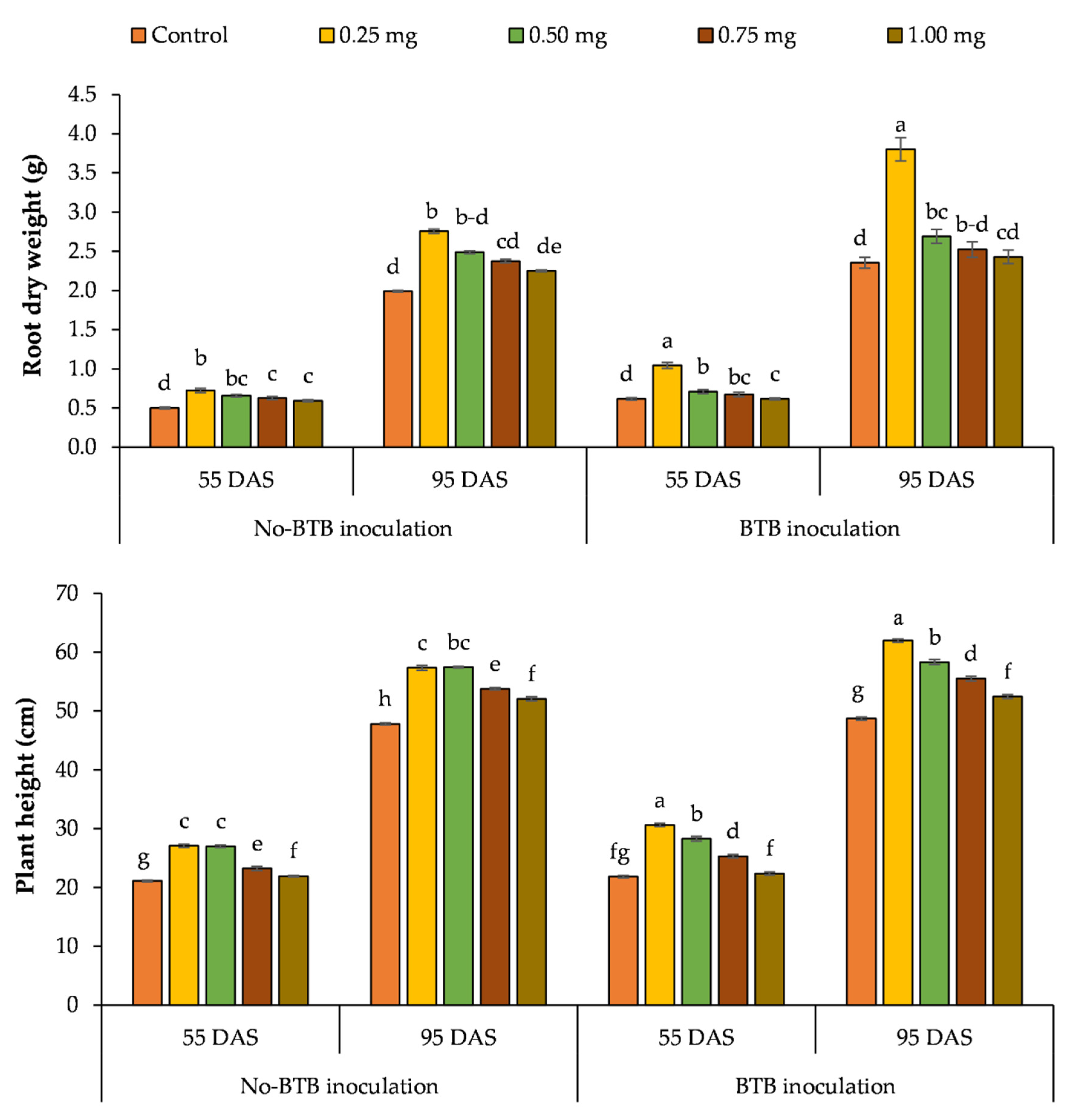
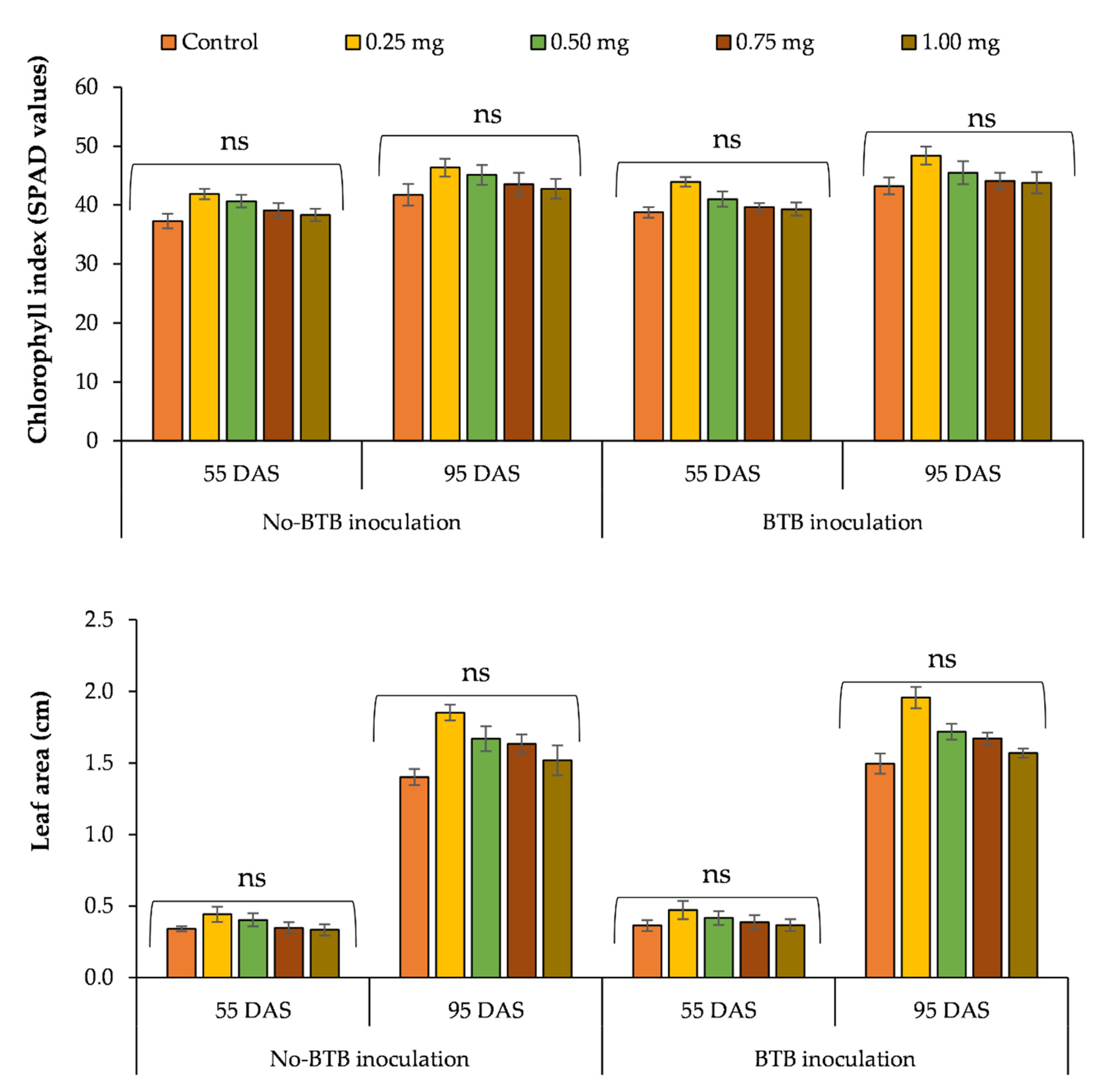

| Treatment | Soil B Application (B) | BTB Inoculation (BTB) | B × BTB |
|---|---|---|---|
| Number of roots plant−1 at 55 DAS | 0.001 | 0.001 | 0.000 |
| Number of roots plant−1 at 95 DAS | 0.003 | 0.002 | NS |
| Root length at 55 DAS | 0.004 | 0.000 | 0.000 |
| Root length at 95 DAS | 0.002 | 0.000 | 0.002 |
| Root dry weight at 55 DAS | 0.001 | 0.000 | 0.000 |
| Root dry weight at 95 DAS | 0.000 | 0.003 | 0.000 |
| Plant height at 55 DAS | 0.000 | 0.002 | 0.000 |
| Plant height at 95 DAS | 0.001 | 0.000 | 0.001 |
| Chlorophyll index at 55 DAS | 0.000 | 0.001 | NS |
| Chlorophyll index at 95 DAS | 0.001 | 0.000 | NS |
| Leaf area at 55 DAS | 0.001 | NS | NS |
| Leaf area 95 DAS | 0.002 | 0.000 | NS |
| Nodules population plant−1 | 0.000 | 0.001 | 0.002 |
| Number of branches plant−1 | 0.000 | 0.001 | NS |
| Number of pods plant−1 | 0.003 | 0.002 | 0.001 |
| Number of grains pod−1 | 0.001 | 0.000 | NS |
| Number of grains plant−1 | 0.001 | 0.000 | 0.000 |
| 100-grains weight (g) | 0.000 | 0.000 | NS |
| Grain yield (g plant−1) | 0.002 | 0.002 | 0.000 |
| Biological yield (g plant−1) | 0.001 | 0.000 | 0.000 |
| Harvest index (%) | NS | NS | NS |
| B-grain concentration (%) | 0.000 | 0.000 | 0.001 |
| B Soil Application (mg kg−1 of Soil) | Number of Branches per Plant−1 | Number of Grains per Pod−1 | 100-Grains Weight (g) |
|---|---|---|---|
| Boron soil application (B) | |||
| 0.00 | 4.33 ± 0.46 C | 1.35 ± 0.06 D | 41.31 ± 0.53 C |
| 0.25 | 7.17 ± 0.46 A | 1.87 ± 0.03 A | 50.12 ± 0.66 A |
| 0.50 | 5.83 ± 0.33 B | 1.72 ± 0.05 B | 48.76 ± 0.50 A |
| 0.75 | 5.17 ± 0.33 BC | 1.58 ± 0.05 C | 43.75 ± 0.91 B |
| 1.00 | 5.17 ± 0.17 BC | 1.47 ± 0.05 CD | 37.60 ± 0.75 C |
| LSD at p ≤ 0.01 | 1.09 | 0.13 | 2.20 |
| Bacillus sp. MN54 inoculation (BTB) | |||
| No-BTB inoculation | 5.00 ± 0.36 B | 1.51 ± 0.04 B | 43.96 ± 0.72 B |
| BTB inoculation | 6.07 ± 0.33 A | 1.68 ± 0.05 A | 45.46 ± 0.62 A |
| LSD at p ≤ 0.01 | 0.69 | 0.08 | 1.40 |
| B × BTB | NS | NS | NS |
| B Soil Application (mg kg−1 of Soil) | Nodule Population per Plant−1 | Number of Pods per Plant−1 | Number of Grains per Plant−1 | |||
|---|---|---|---|---|---|---|
| No-BTB Inoculation | BTB Inoculation | No-BTB Inoculation | BTB Inoculation | No-BTB Inoculation | BTB Inoculation | |
| 0.00 | 1.67 ± 0.3 e | 2.33 ± 0.3 de | 12.33 ± 0.3 fg | 13.00 ± 0.6 f | 14.80 ± 0.8 f | 19.53 ± 1.4 de |
| 0.25 | 5.00 ± 0.6 bc | 9.00 ± 0.6 a | 17.33 ± 0.3 b | 20.00 ± 0.6 a | 30.63 ± 1.0 b | 39.30 ± 0.7 a |
| 0.50 | 4.33 ± 0.9 b-d | 6.00 ± 0.6 b | 15.33 ± 0.3 cd | 16.33 ± 0.3 bc | 25.03 ± 0.5 c | 29.37 ± 0.5 b |
| 0.75 | 3.33 ± 0.3 c-e | 4.00 ± 0.6 b-d | 14.67 ± 0.3 de | 13.67 ± 0.3 ef | 23.00 ± 1.0 c | 21.9 ± 1.3 cd |
| 1.00 | 2.33 ± 0.3 de | 1.67 ± 0.3 e | 11.00 ± 0.6 gh | 10.67 ± 0.3 h | 15.37 ± 0.7 f | 16.37 ± 0.8 ef |
| LSD at p ≤ 0.01 | 2.04 | 1.59 | 3.20 | |||
| B Soil Application (mg kg−1 of Soil) | Grain Yield (g plant−1) | Biological Yield (g plant−1) | Grain B Concentration (mg kg−1) | |||
|---|---|---|---|---|---|---|
| No-BTB Inoculation | BTB Inoculation | No-BTB Inoculation | BTB Inoculation | No-BTB Inoculation | BTB Inoculation | |
| 0.00 | 3.47 ± 0.1 e | 3.78 ± 0.1 de | 9.04 ± 0.2 g | 9.52 ± 0.2 fg | 18.47 ± 0.6 e | 22.8 ± 0.4 e |
| 0.25 | 4.98 ± 0.2 b | 6.58 ± 0.2 a | 13.25 ± 0.5 c | 18.02 ± 0.4 a | 50.8 ± 3.1 d | 51.91 ± 2.2 d |
| 0.50 | 4.79 ± 0.1 bc | 5.39 ± 0.1 b | 12.96 ± 0.5 c | 15.02 ± 0.2 b | 65.99 ± 0.8 c | 66.73 ± 0.6 c |
| 0.75 | 4.26 ± 0.1 cd | 4.00 ± 0.3 de | 11.92 ± 0.5 cd | 11.17 ± 0.2 de | 67.70 ± 0.7 c | 76.26 ± 0.5 b |
| 1.00 | 4.08 ± 0.2 d | 3.82 ± 0.2 de | 10.52 ± 0.6 ef | 9.95 ± 0.5 e-g | 77.9 ± 0.6 ab | 82.68 ± 0.6 a |
| LSD at p ≤ 0.01 | 0.61 | 1.35 | 5.30 | |||
| Crop Traits | Grain Yield (g Plant−1) | Grains B-Concentration (mg kg−1) | ||
|---|---|---|---|---|
| No-BTB Inoculation | BTB Inoculation | No-BTB Inoculation | BTB Inoculation | |
| Number of nodules per plant−1 | 0.98 ** | 0.97 ** | 0.33NS | −0.06NS |
| Number of branches per plant−1 | 0.94 ** | 0.96 ** | 0.46NS | 0.09NS |
| Number of pods per plant−1 | 0.82 * | 0.86 * | 0.00NS | −0.23NS |
| Number of seeds per pod−1 | 0.98 ** | 0.99 ** | 0.48NS | 0.03NS |
| Number of seeds per plant−1 | 0.92 ** | 0.98 ** | 0.20NS | −0.15NS |
| 100-grains weight (g) | 0.90 ** | 0.94 ** | 0.10NS | −0.10NS |
| Biological yield (g plant−1) | 0.98 ** | 0.99 ** | 0.50NS | 0.01NS |
Publisher’s Note: MDPI stays neutral with regard to jurisdictional claims in published maps and institutional affiliations. |
© 2021 by the authors. Licensee MDPI, Basel, Switzerland. This article is an open access article distributed under the terms and conditions of the Creative Commons Attribution (CC BY) license (https://creativecommons.org/licenses/by/4.0/).
Share and Cite
Mehboob, N.; Hussain, M.; Minhas, W.A.; Yasir, T.A.; Naveed, M.; Farooq, S.; Alfarraj, S.; Zuan, A.T.K. Soil-Applied Boron Combined with Boron-Tolerant Bacteria (Bacillus sp. MN54) Improve Root Proliferation and Nodulation, Yield and Agronomic Grain Biofortification of Chickpea (Cicer arietinum L.). Sustainability 2021, 13, 9811. https://doi.org/10.3390/su13179811
Mehboob N, Hussain M, Minhas WA, Yasir TA, Naveed M, Farooq S, Alfarraj S, Zuan ATK. Soil-Applied Boron Combined with Boron-Tolerant Bacteria (Bacillus sp. MN54) Improve Root Proliferation and Nodulation, Yield and Agronomic Grain Biofortification of Chickpea (Cicer arietinum L.). Sustainability. 2021; 13(17):9811. https://doi.org/10.3390/su13179811
Chicago/Turabian StyleMehboob, Noman, Mubshar Hussain, Waqas Ahmed Minhas, Tauqeer Ahmad Yasir, Muhammad Naveed, Shahid Farooq, Saleh Alfarraj, and Ali Tan Kee Zuan. 2021. "Soil-Applied Boron Combined with Boron-Tolerant Bacteria (Bacillus sp. MN54) Improve Root Proliferation and Nodulation, Yield and Agronomic Grain Biofortification of Chickpea (Cicer arietinum L.)" Sustainability 13, no. 17: 9811. https://doi.org/10.3390/su13179811
APA StyleMehboob, N., Hussain, M., Minhas, W. A., Yasir, T. A., Naveed, M., Farooq, S., Alfarraj, S., & Zuan, A. T. K. (2021). Soil-Applied Boron Combined with Boron-Tolerant Bacteria (Bacillus sp. MN54) Improve Root Proliferation and Nodulation, Yield and Agronomic Grain Biofortification of Chickpea (Cicer arietinum L.). Sustainability, 13(17), 9811. https://doi.org/10.3390/su13179811

