


Abstract
The objective of this study is to analyze the main factors influencing research on the concept of ‘circular economy’ (CE) by focusing on authors, institutions, and countries and emphasizing the documents that deal both with CE and SMEs. The Web of Science (WoS) includes 1711 documents related to CE, with the first publication dated 2006. The graphical analyses use the WoS Core Collection database and visualization of similarities (VOS) viewer software. We also employ several bibliometric techniques including co-citation and bibliographic coupling. The results of the analysis indicate that the field of CE research has broad readership and includes internationally authored papers although China seems to be the leader in this research area.
1. Introduction
Circular economy (CE) is receiving more and more attention worldwide as a way to overcome the current production and consumption (based on continuous growth) model. CE is intended to increase the use efficiency of resources, with special attention to urban and industrial waste, to achieve a better balance between the economy, environment, and society by promoting certain adoption production patterns within the economic system [1].
CE implementation worldwide is still in its early stages and is focused more on recycling than reuse. Some significant results have been achieved in areas such as waste management, for example. CE implies the adoption of cleaner production patterns at the firm level, increased responsibility and awareness among producers and consumers, use of renewable technologies and materials (wherever possible), and the adoption of appropriate policies and stable tools [1].
The number of publications on CE has been growing exponentially in recent years and identify the most productive and influential researchers in the field, the major journals publishing on CE, and the universities leading developments in this discipline. Bibliometrics is a popular analytical method and has contributed much to the state of the art of the research in this field. Bibliometrics is used for quantitative analyses in management [2], entrepreneurship [3], innovation [4], and psychology [5] among other fields. It is an appropriate method for in-depth analysis of single journals to obtain a broad picture of leading trends. Bibliometrics has been applied to several journals, including Technovation [6,7], Journal of Knowledge Management [8], and Accounting Review [9]. It has been used also for in-depth analyses of regions [10], countries [11], institutions, and authors [12] favored by a particular publication.
Bibliometrics is a research method which analyzes bibliographic material using quantitative and statistical methods [13,14]. It has been employed for quantitative analysis of the bibliographic material in a particular field. In this research, it is applied to work (articles, reviews, letters, notes) included in the WoS database. The main bibliometric indicators are the number of publications, the number of citations, and h-index [12].
Some common bibliometric methods include mapping techniques [15,16]. In the present study, we analyze authors, institutions, countries, and keywords related to CE research using WoS data and VOS viewer software [17,18].
The aim is to examine the main factors influencing CE research by focusing on authors, institutions, and countries. The WoS includes 1711 documents related to CE. The concept was proposed by Chinese academics in 1998 [19] and was adopted formally by the Chinese government in 2002. It was seen as reducing the contradiction between rapid economic growth and shortage of raw materials and energy [20]. The first publications in ISCI indexed journals were recorded in 2006.
The present article is structured as follows. Section 2 provides a brief review of the CE literature. Section 3 describes the methodology, Section 4 presents the results of the bibliometric analysis based on leading authors, institutions, and countries, and provides a graphical analysis highlighting co-citations and bibliographic couplings. The paper concludes in Section 5 with a discussion.
2. Literature Review
The origins of CE are mainly the economy and the environmental sector. The notion of CE emerged from different types of thinking. Environmental economists, Pearce and Turner [21], proposed the concept of a circular ecological system drawing on the work of the ecological economist Boulding [22]. According to some authors [23,24], CE emerged from the idea of an ecological industry and analysis of the operation of industrial systems (industrial metabolism) and optimization, and extended them to the entire economic system to propose a new model of economic development, production, distribution, and product recovery.
There is no finite definition of CE but at its core is the idea of production process loops which reduce inputs and reuse or recycle products and waste to increase the quality of life through greater resources efficiency. In practice, this includes the creation of optimized resources flow networks among companies, eco-industrial parks, and the regional infrastructure. CE is considered a new business model which is expected to lead to more sustainable and greater social development [25,26,27,28].
The complexity involved in the idea of sustainable development means that most of the time, its implementation needs to be supported by innovation designers that provide services to achieve appropriate radical change to policy and decision-making processes [29,30]. CE could become the solution to the need to reduce the environmental impact of current economic systems.
In China, CE is promoted as a top-down national policy, while in other areas and countries such as the European Union, Japan, and the United States it is considered a tool for designing environmental and waste management policies from the bottom up. The ultimate goal of CE is to ease the pressure on the environment from economic growth [1].
One example of a CE implementation is rechargeable batteries, which have led to the emergence of electric cars and renewable energy. To minimize the environmental impact associated with the new reusable products, we need to integrate sustainable materials into rechargeable batteries, choosing chemical products with minimum environmental impacts which are easily recyclable or are integrated within a complete CE cycle. require to significantly Increasing battery life requires the solution to sustainability and cost-related problems and continuous monitoring of battery status during operation to minimize their degradation [31].
CE requires greater implementation of green technologies, and broader and more complete design of alternative solutions throughout the life cycle of processes, combined with how these processes interact with their environment and the relevant economy. Regeneration involves not just material or energy recovery but also an improved economic model compared to the current economic model [29,30].
3. Method
Bibliometrics can be employed in various ways. Some bibliometric studies focus on author or university productivity based on the number of publications [32]. Bibliometrics can be used for citation analysis which is a useful way to evaluate research based on measuring the influence of sets of articles, by institutions or authors [33,34,35]. The h-index identifies the number of studies X which received Y or more citations [36,37,38]. Thus, the h-index is based on a combination of articles and citations: If a group of publications (by an author, institution, etc.) has an h-index of 10 this means that the articles included in this group of publications have received at least 10 citations [39]. This study focuses on academic research on the CE, which is an evolving field of study that is attracting increased interest from academia. The bibliometric analysis uses WoS data.
Table 1 presents publications and citations structure related to work on the CE between 2006 and 2018. We consider several citation thresholds based on the number of articles receiving a specific minimum number of citations: 200, 100, 50, 25, 10, 5 and 1.
Table 1.
Annual citation structure.
The first work on the CE was published in 2006 which makes it a modern concept. The first papers were published in Chinese Geographical Science, Journal of Central South University of Technology and Journal of Cleaner Production and discuss ecological and sustainable development. Since 2016, the number of papers has increased hugely from 87 in 2015 to 809 in 2018, while the number of citations has increased from less than a hundred in 2014 to 3232 in 2017. The seeming smaller number of citations in 2018 is because there has not been sufficient time for the most recent papers to be cited.
4. Results
This section presents the results of the study. We focus first on authors, followed by institutions and then countries.
Table 2 presents the 50 most frequently cited documents on CE and shows that five papers received more than 200 citations. The paper that has received the highest number of citations (340) is “China’s growing CO(2) emissions—A race between increasing consumption and efficiency gains” which was published in 2007 in Environmental Science & Technology and was authored by Peters, Weber, Guan and Hubacek (2007) [40]. This research discusses the opportunities in the context of China’s rapid development for the implementation of CE and other policies. Adopting a CE approach should help China to avoid the high levels of emissions typical of contemporary developed countries.
Table 2.
The 50 most cited documents.
The second most cited paper is “A review on circular economy: The expected transition to a balanced interplay of environmental and economic systems”, authored by Ghisellini et al. and published in 2016 [1] in the Journal of Cleaner Production. It has received 286 citations. This paper provides a review of the literature on CE up to 2016. The authors consider that the implementation of CE is in its early stages and is focused mainly on recycling rather than reuse. However, some sectors have made important changes in the area of waste management, with high waste recycling rates being achieved in some selected developed countries. CE implies adoption of cleaner production patterns at the firm level, use of renewable technologies and materials, increased responsibility of producers and consumers, and adoption of appropriate, clear, and balanced policies and tools. This paper has received fewer citations but was published only in 2016. Therefore, in relative terms, it is the most frequently cited paper having been cited over 71 times in a year compared to 26 times for the paper that was published in Environmental Science & Technology.
The third most cited paper in our list is “Product services for a resource-efficient and CE—A review” authored by Tukker and published in 2015 [41,42] in Journal of Cleaner Production. It reviews the published work on product service systems and compares it to the review published in 2006 in the same journal.
Among the top 50 publications, 16 are focused on China or a Chinese region. China has adopted CE as an economic rather than just an environmental strategy. China’s government is promoting development of its economy and society together with sustainable environmental protection.
Moreover, according to the WoS, there are just 26 documents that merge the CE research with SMEs. The most cited one (88 citations) is “Evaluating green supply chain management among Chinese manufacturers from the ecological modernization perspective” by Zhu, Geng, Sarkis and Lai in 2011 in Transportation Research Part E-Logistics and Transportation Review. This paper deals with whether Chinese manufacturer clusters (form by SMEs) varying in their extent of implementing green supply chain management. The second most cited document is entitled “Implementation of Circular Economy Business Models by Small and Medium-Sized Enterprises (SMEs): Barriers and Enablers” (2016), published in Sustainability and it deals with the barriers and enablers experienced by SMEs when implementing circular economy business models. The third most cited document is “Circular Economy in Spanish SMEs: Challenges and opportunities”, published in Journal of Cleaner Production. This research focuses on exploring the potential for implementation of the CE in SMEs and their barriers and opportunities.
It is necessary to evaluate more than one indicator to estimate the global contribution of an author or institution. Table 2 presents total publications (TP), total citations (TC), h-index, and relative number of TC/TP. Table 3 presents the 50 leading authors in CE research based on number of publications and impact.
Table 3.
Top 50 leading authors.
Table 3 shows that Yong Geng from Shanghai Jiao Tong University is the leading author with 42 publications. Yong Geng’s work also received the highest number of citations (1483) followed by Qinghua Zhu (Shanghai Jiao Tong University—515 citations), Joseph Sarkis (Worcester Polytechnic Institute—497 citations), and Tsuyoshi Fujita (National Institute for Environmental Studies—472 citations). In relative terms, Bing Xue (Chinese Academy of Sciences), Joseph Sarkis (Worcester Polytechnic Institute), and Conny Bakker (Delft University of Technology) have the most citations per publication (almost 50 citations to each of their published papers).
Table 3 also shows that China is the country with the strongest focus on CE research with 18 among the top 50 authors located in China. This is in line with the results in Table 2 for publications from China and Chinese regions.
According to Cole and Cole [43], there are four categories of academics based on productivity and the number of citations received. The prolific category includes authors with high numbers of papers and citations, mass producer includes authors with a high number of publications but a lower number of citations, perfectionist includes highly cited authors with only a few published papers, and the silent category includes the least productive and least cited authors. Yong Geng from Shanghai Jiao Tong University is ranked top with more than 40 publications and 1483 citations, so it is categorized as prolific.
Martyn (1964, p. 236) defines bibliographic coupling as “two papers that share one reference contain one unit of coupling, and the value of a relationship between two papers having one or more references in common is stated as being of strength one, two, etc., depending on the number of shared references” [44].
Information on bibliographic coupling is derived from the similarities between two documents, authors, institutions, or countries based on citations. Thus, bibliographic coupling highlights documents, authors, institutions, or countries which simultaneously cite a third document, author, institution, and country in their reference lists. On this basis, we can create clusters of authors, institutions, and countries involved in similar research.
Bibliographic coupling of authors (Figure 1) occurs when two authors reference the same third author in their publications. The strength of the bibliographic coupling is determined by the total number of references or citations to the same other third documents. There is a large bibliographic coupling cluster on the CE around Yong Geng (leading author for the number of publications—see Table 3). This author is coupled to Angel Irabien (number 15 Table 3), Phil Purnell (number 17 Table 3), and Joanna Kulczycka (number 22 Table 3).
Figure 1.
Bibliographic coupling of authors publishing on circular economy (CE): Minimum publication threshold of four documents and 75 links.
The leading authors are from China. China has become one of the world’s fastest-growing economies with an annual growth rate of 9.7% GDP. This economic success has affected the quality of life of its population. It is predicted that China will become the largest CO2 emitter in the world [40], and China’s rapid economic growth is creating serious global and local environmental problems. Knowing how to recognize the key factors that drive energy consumption and CO2 emissions in China is essential for the development of global climate policies, these factors also provide information on how other emerging economies can develop and also keep emissions at low levels. China has improved its energy efficiency, which is reducing its CO2 emissions. The Chinese government is supporting structural improvements to production systems as part of a CE political policy.
Table 4 presents the 50 most productive and influential institutions publishing work on CE, ranked according to the number of publications. Delft University of Technology leads with 49 publications, and the Chinese Academy of Sciences (48 publications) has the highest number of citations (1484) and the highest h-index (23). Note that the total number of publications and the total number of citations are absolute values, while h-index and the citations to publications ratio considers both the number of publications and the number of citations. The citations to publications ratio favors institutions with fewer publications, but more citations, and the h-index is advantageous for institutions with high numbers of publications but fewer citations to them.
Table 4.
The most productive and influential institutions.
Overall, this ranking is dominated by China (9) and the United Kingdom (8), followed by Spanish (5), Netherlands (4) and Danish (4) institutions.
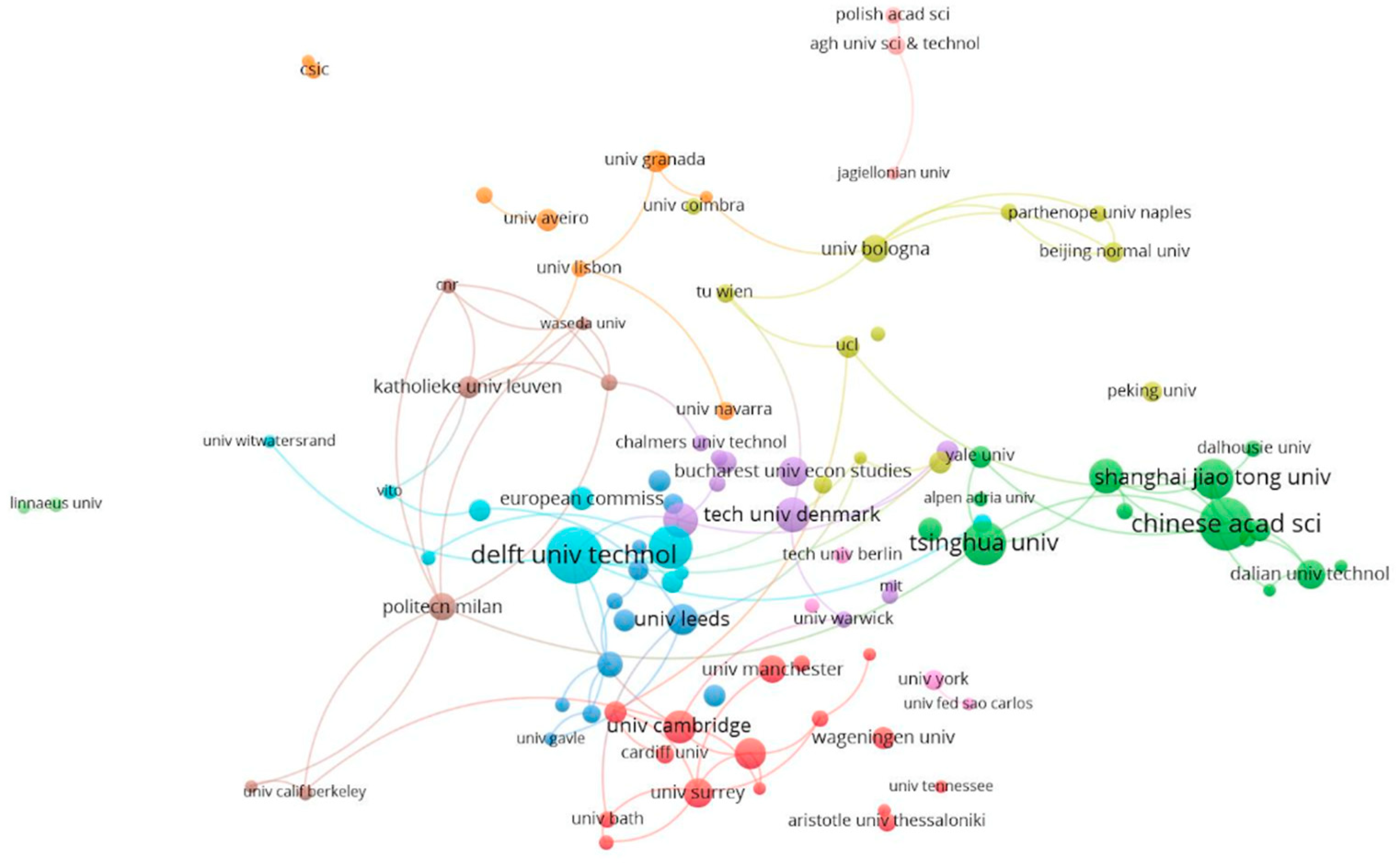
Bibliographic coupling of institutions occurs when the publications of two institutions reference the same third institution. Figure 2 shows that five institutions dominate: Delft University of Technology, Chinese Academy of Sciences, Tsinghua University, Shanghai Jiao Tong University, and Technical University of Denmark. All are in the top 10 most influential institutions for CE research. According to this bibliographic coupling analysis, these five institutions have similar numbers of citations, although they belong to four different clusters.
Figure 2.
Bibliographic coupling of institutions publishing on CE: minimum publication threshold of five documents and 100 links.
A large number of studies reference implementation of CE in China. This country seems strongly committed and attracted to CE due to the enormous environmental, human health, and social problems posed by its rapid and continued economic development pattern [45,46,47]. As China’s speedy development continues, there will be opportunities to implement and extend policies such as CE which could help China avoid the high levels of emissions in the developed countries [40].
Table 5 presents the most productive and influential countries in the field of CE research based on the indicators used above but including the national population to provide a productivity per million inhabitants number.
Table 5.
The most productive and influential countries.
Again, China leads the ranking for both total publications and total citations, followed by the United Kingdom, Italy, Spain, and the Netherlands. However, in relative numbers (total citations per total publications) Norway is ranked first with more than 45 citations per publication while Spain which is in the top five has less than five citations per publication. Thus, the leading countries for total citations per total population are Norway (45.95), Japan (23.37), South Korea (22.14), South Africa (21.09), USA (17.73), and the Netherlands (17.66).
In terms of total publications per population, Finland (13.97), Denmark (11.09), and Sweden (10.03) are the leaders. For total citations per population, Norway (165.27), Netherlands (147.44), Sweden (120.19), and Denmark (103.65) are the most influential countries.
Table 6 shows that Europe is the region with the highest number of publications and citations in the field of CE while Northern Europe (Norway, Sweden, Denmark, etc.) is the region with the most publications and the most citations.
Table 6.
Productivity by supranational regions.
The most influential journal on CE field of research is Journal of Cleaner Production with 267 publications and 4735 citations (Table 7). This journal also has the highest impact factor (IF: 5.651). The next ranked are Sustainability and Resources Conservation and Recycling. Although Sustainability accounts for a higher number of publications (123 vs. 105). Resources Conservation and Recycling has more citations (1172 vs. 476). That is, Resources Conservation and Recycling has published fewer papers on the circular economy, but these publications have been highly cited, and thus, are more influential. Similarly. Environmental Science Technology has 13 publications but 499 citations—a relative number of total citations per total publications of 38.38, the Journal of Industrial Ecology has 42 publications and 98 citations (TC/TP: 23.76), and Renewable Sustainable Energy Reviews has 17 publications and 343 citations (TC/TP: 20.18). So, in relative terms, the journal ranking is led by: Journal of Cleaner Production, Journal of Industrial Ecology, Bioresource Technology, Renewable Sustainable Energy Reviews, Environmental Science Technology, Green Chemistry.
Table 7.
Journals publishing in the field of ‘circular economy’.
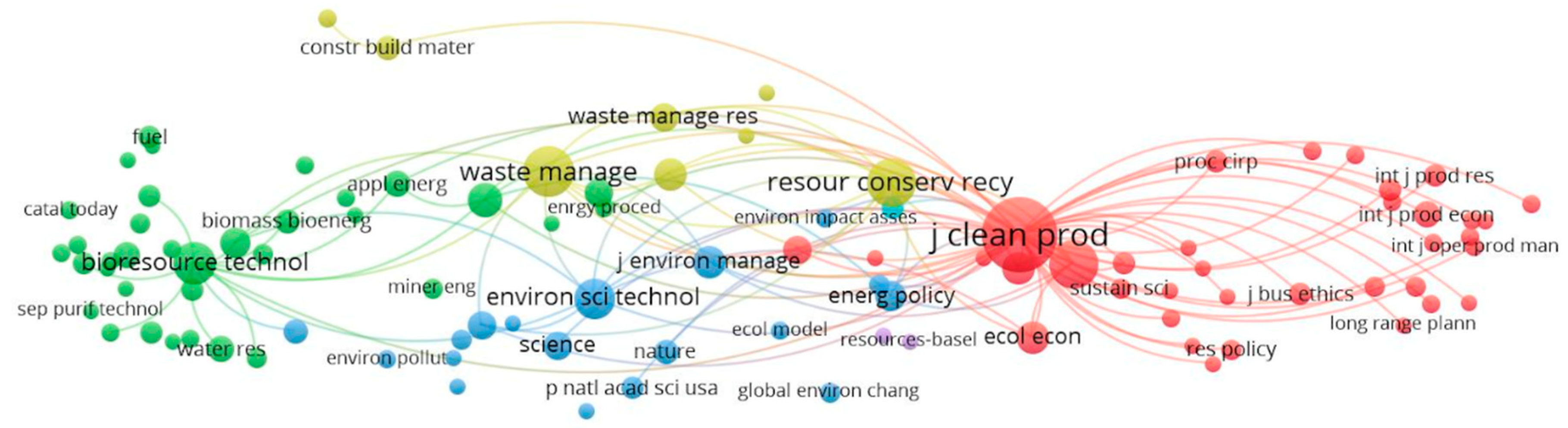
Co-citation is defined as two documents which are cited by the same third document [48]. Figure 3 presents the co-citation mapping of journals publishing in CE. There are three clusters: One led by the Journal of Cleaner Production. a top journal in cleaner production, environmental, and sustainability research with an impact factor of 5.651, one led by Resources Conservation and Recycling, also a top journal with an impact factor of 5.12, and one led by Journal of Environmental Management (IF: 4.005), Environmental Science Technology (IF: 6.653), and Energy Policy (IF: 5.45).
Figure 3.
Co-citation of journals in circular economy: Minimum citation threshold of 90 and 100 links.
5. Discussion and Conclusions
This paper provides a bibliometric overview of the leading trends in the field of CE. We examined authors, institutions, and countries relying on bibliographic information from the WoS Core Collection database. We provide a mix of descriptive results and graphical analyses.
CE offers good prospects for a gradual improvement of current production and consumption models, which are no longer adequate due to the environmental reality and current social inequality. CE is a clear indicator of inefficiency in the use of resources [1].
Among the most cited publications and most influential countries based on the top 50 publications, 16 are focused on China or a Chinese region. At the macro level, CE developments at the eco-city, eco-municipality, and eco-province levels are among the most prominent environmental movements in China. The Chinese government is encouraging Chinese companies to design more environmentally-friendly products and to adopt cleaner technology in their manufacturing processes [20] to develop eco-industry clusters which simultaneously promote economic growth and environmental health. It is focusing on circular economy strategies to improve resources productivity and eco-efficiency, reform environmental management, and achieve sustainable development [20].
The most productive and influential authors are linked to Chinese institutions. The leading author, Yong Geng is from the Shanghai Jiao Tong University and has the highest numbers of publications and citations (more than 40 publications and 1483 citations).
The most influential journal, Journal of Cleaner Production has an impact factor of 5.651. It considers the concept of cleaner production as contributing to reducing the production of waste while making more efficient use of energy, water, resources, and human capital. The circular economy is one of its main fields of interest.
Regarding the future lines of research proposed by the latest manuscripts on CE, Grey and Tarascon [49] state that future research is plenty of opportunities, related to ambitious multidisciplinary research. For example, a new analytical method for optimization of battery chemistries is needed, in order to bring new technologies to the market and social demands. Geissdoerfer et al. [50] think that there are two main critical areas where the research on CE must focus: (1) The relation between companies and policy makers, “the linkage between Circular Economy and emerging concepts such as the Performance Economy Sharing Economy, and new business forms such as benefit corporations could be investigated” and (2) the relation between circular economy, sustainability and performance (of supply chains, business models, and innovation systems). Sheldon [51] also states two main future research areas. “First, the change from a fossil-based to a renewable bio-based manufacture of existing commodity chemicals and new materials which are biocompatible and biodegradable. Second, the transition from an unsustainable linear economy to a circular one which designs products and processes with conservation of resources and elimination of waste in mind, a truly green economy.”
Focusing on the future research in the field of CE within SMEs, Ormazabal et al. [52] state that there are opportunities in the research of Industrial Associations (IA) and the implementation of CE, because most of the SMEs belong, according to this authors, to a IA. Moreover, another recommendation is to study the opportunities that the implementation of CE can provide when SMEs Inco pore it in their corporate strategy [53,54,55,56].
We have provided a general overview of the leading authors, institutions, and countries publishing CE research. This approach provides a snapshot of the main drivers of this field of research and has some limitations. First, we use WoS Core Collection data, therefore, the limitations that apply to these data also apply to our study. For example, WoS uses full counts giving one unit to each co-author of a paper. This benefits articles with several co-authors. To account for this, we use fractional counting in the mapping process with VOS viewer, so each paper has one unit which is fractioned according to the number of co-authors. Therefore, we present our findings for both full and fractional counting and show that there are no significant deviations between these two methods. Another limitation is that the number of papers published over the last five years has increased so authors, institutions, and countries that have performed better during these years, are higher ranked in the tables.
Author Contributions
A.M.-T. and M.G. designed and performed the bibliometric analysis; A.M.-T. and A.C. wrote the paper.
Funding
This research received no external funding.
Conflicts of Interest
The authors declare no conflict of interest.
References
- Ghisellini, P.; Cialani, C.; Ulgiati, S. A review on circular economy: The expected transition to a balanced interplay of environmental and economic systems. J. Clean. Prod. 2016, 114, 11–32. [Google Scholar] [CrossRef] [Scilit]
- Podsakoff, P.M.; MacKenzie, S.B.; Podsakoff, N.P.; Bachrach, D.G. Scholarly Influence in the Field of Management: A Bibliometric Analysis of the Determinants of University and Author Impact in the Management Literature in the Past Quarter Century. J. Manag. 2008, 34, 641–720. [Google Scholar] [CrossRef] [Scilit]
- Landström, H.; Harirchi, G.; Åström, F. Entrepreneurship: Exploring the knowledge base. Res. Policy 2012, 41, 1154–1181. [Google Scholar] [CrossRef] [Scilit]
- Fagerberg, J.; Fosaas, M.; Sapprasert, K. Innovation: Exploring the knowledge base. Res. Policy 2012, 41, 1132–1153. [Google Scholar] [CrossRef] [Scilit]
- Tur-Porcar, A.; Mas-Tur, A.; Merigó, J.M.; Roig-Tierno, N.; Watt, J. A Bibliometric History of the Journal of Psychology between 1936 and 2015. J. Psychol. 2018, 152, 199–225. [Google Scholar] [CrossRef] [Scilit]
- Merino, M.T.G.; Do Carmo, M.L.P.; Alvarez, M.V.S. 25 Years of Technovation: Characterisation and evolution of the journal. Technovation 2006, 26, 1303–1316. [Google Scholar] [CrossRef] [Scilit]
- Thongpapanl, N. The changing landscape of technology and innovation management: An updated ranking of journals in the field. Technovation 2012, 32, 257–271. [Google Scholar] [CrossRef] [Scilit]
- Gaviria-Marin, M.; Merigo, J.M.; Popa, S. Twenty years of the Journal of Knowledge Management: A bibliometric analysis. J. Knowl. Manag. 2018, 22, 1655–1687. [Google Scholar] [CrossRef] [Scilit]
- Heck, J.L.; Bremser, W.G. Six decades of The Accounting Review: A summary of author and institutional contributors. Account. Rev. 1986, 61, 735–744. [Google Scholar]
- Bonilla, C.A.; Merigó, J.M.; Torres-Abad, C. Economics in Latin America: A bibliometric analysis. Scientometrics 2015, 105, 1239–1252. [Google Scholar] [CrossRef] [Scilit]
- Merigó, J.M.; Cancino, C.A.; Coronado, F.; Urbano, D. Academic research in innovation: A country analysis. Scientometrics 2016, 108, 559–593. [Google Scholar] [CrossRef] [Scilit]
- Coupé, T. Revealed Performances: Worldwide Rankings of Economists and Economics Departments, 1990–2000. J. Eur. Econ. Assoc. 2003, 1, 1309–1345. [Google Scholar] [CrossRef] [Scilit]
- Broadus, R.N. Toward a definition of “bibliometrics”. Scientometrics 1987, 12, 373–379. [Google Scholar] [CrossRef] [Scilit]
- Pritchard, A. Statistical bibliography or bibliometrics. J. Doc. 1969, 25, 348–349. [Google Scholar]
- Cancino, C.A.; Merigó, J.M.; Torres, J.P.; Díaz, D. A bibliometric analysis of venture capital research. J. Econ. Financ. Adm. Sci. 2018, 23, 182–195. [Google Scholar] [CrossRef] [Scilit]
- Cobo, M.J.; López-Herrera, A.G.; Herrera-Viedma, E.; Herrera, F. Science mapping software tools: Review, analysis, and cooperative study among tools. J. Assoc. Inf. Sci. Technol. 2011, 62, 1382–1402. [Google Scholar] [CrossRef] [Scilit]
- Small, H. Visualizing science by citation mapping. J. Am. Soc. Inf. Sci. 1999, 50, 799–813. [Google Scholar] [CrossRef]
- Van Eck, N.J.; Waltman, L. Text mining and visualization using VOSviewer. arXiv 2011, arXiv:1109.2058. 2011. [Google Scholar]
- Zhu, D.J. Sustainable development calls for circular economy. Sci. Technol. J. 1998, 39–42. [Google Scholar]
- Yuan, Z.; Bi, J.; Moriguichi, Y. The circular economy: A new development strategy in China. J. Ind. Ecol. 2006, 10, 4–8. [Google Scholar] [CrossRef] [Scilit]
- Pearce, D.W.; Turner, R.K. Economics of Natural Resources and the Environment; Hemel Hempstead, Harvester Wheatsheaf: London, UK, 1989. [Google Scholar]
- Boulding, K.E. The Economics of the Coming Spaceship Earth; Johns Hopkins University Press: New York, NY, USA, 1966. [Google Scholar]
- Chiaroni, D.; Chiesa, V.; Colasanti, L.; Cucchiella, F.; D’Adamo, I.; Frattini, F. Evaluating solar energy profitability: A focus on the role of self-consumption. Energy Convers. Manag. 2014, 88, 317–331. [Google Scholar] [CrossRef] [Scilit]
- Iung, B.; Levrat, E. Advanced Maintenance Services for Promoting Sustainability. Procedia CIRP 2014, 22, 15–22. [Google Scholar] [CrossRef] [Scilit]
- Preston, F. A Global Redesign? Shaping the Circular Economy. 2012 Briefing Paper. Available online: http://www.chathamhouse.org/sites/default/files/public/Research/Energy%20Environment%20and%20Development/bp0312_preston.pdf (accessed on 2 January 2019).
- Su, B.; Heshmati, A.; Geng, Y.; Yu, X. A review of the circular economy in China: Moving from rethoric to implementation. J. Clean. Prod. 2013, 42, 215–277. [Google Scholar] [CrossRef] [Scilit]
- Lett, L.A. Las amenazas globales, el reciclaje de residuos y el concepto de economía circular. Rev. Argent. Microbiol. 2014, 46, 1–2. [Google Scholar] [CrossRef] [Scilit]
- Naustdalslid, J. Circular economy in China e the environmental dimension of the harmonious society. Int. J. Sustain. Dev. World Ecol. 2014, 21, 303–313. [Google Scholar] [CrossRef] [Scilit]
- Golinska, P.; Kosacka, M.; Mierzwiak, R.; Werner-Lewandowska, K. Grey Decision Making as a tool for the classification of the sustainability level of remanufacturing companies. J. Clean. Prod. 2015, 105, 28–40. [Google Scholar] [CrossRef] [Scilit]
- Küçüksayraç, E.; Keskin, D.; Brezet, H. Intermediaries and innovation support in the design for sustainability field: Cases from the Netherlands, Turkey and the United Kingdom. J. Clean. Prod. 2015, 101, 38–48. [Google Scholar] [CrossRef] [Scilit]
- Walker, W.; Giordani, V.; Uddin, J.; Bryantsev, V.S.; Chase, G.V.; Addison, D. A rechargeable Li−O2 battery using a lithium nitrate/N,Ndimethylacetamide electrolyte. J. Am. Chem. Soc. 2013, 135, 2076–2079. [Google Scholar] [CrossRef] [Scilit]
- Trieschmann, J.S.; Dennis, A.R.; Northcraft, G.B.; Nieme, A.W., Jr. Serving constituencies in business schools: MBA program versus research performance. Acad. Manag. J. 2000, 43, 1130–1141. [Google Scholar]
- Podsakoff, P.M.; MacKenzie, S.B.; Bachrach, D.G.; Podsakoff, N.P. The influence of management journals in the 1980s and 1990s. Strateg. Manag. J. 2005, 26, 473–488. [Google Scholar] [CrossRef] [Scilit]
- Blanco-Mesa, F.; Gil-Lafuente, A.M.; Merigó, J.M. Fuzzy decision making: A bibliometric-based review. J. Intell. Fuzzy Syst. 2017, 32, 2033–2050. [Google Scholar] [CrossRef] [Scilit]
- Merigó, J.M.; Mas-Tur, A.; Roig-Tierno, N.; Ribeiro-Soriano, D. A bibliometric overview of the Journal of Business Research between 1973 and 2014. J. Bus. Res. 2015, 68, 2645–2653. [Google Scholar] [CrossRef] [Scilit]
- Hirsch, J.E. An index to quantify an individual’s scientific research output. Proc. Natl. Acad. Sci. USA 2005, 102, 16569–16572. [Google Scholar] [CrossRef] [Scilit]
- Alonso, S.; Cabrerizo, F.J.; Herrera-Viedma, E.; Herrera, F. h-Index: A review focused in its variants, computation and standardization for different scientific fields. J. Inf. 2009, 3, 273–289. [Google Scholar] [CrossRef] [Scilit]
- Sánchez-Villegas, A.; Martínez-González, M.Á.; Faulín Fajardo, F.J.; Toledo Atucha, E. Bioestadística Amigable; Elsevier: Barcelona, Spain, 2014. [Google Scholar]
- Merigó, J.M.; Gil-Lafuente, A.M.; Yager, R.R. An overview of fuzzy research with bibliometric indicators. Appl. Soft Comput. 2015, 27, 420–433. [Google Scholar] [CrossRef] [Scilit]
- Peters, G.P.; Weber, C.L.; Guan, D.; Hubacek, K. China’s growing CO2 emissions—A race between increasing consumption and efficiency gains. Environ. Sci. Technol. 2007, 41, 5939–5944. [Google Scholar] [CrossRef] [Scilit]
- Ghisellini, P.; Protano, G.; Viglia, S.; Gaworski, M.; Setti, M.; Ulgiati, S. Integrated agricultural and dairy production within a circular economy framework. A comparison of Italian and Polish farming systems. J. Environ. Account. Manag. 2014, 2, 367–384. [Google Scholar] [CrossRef] [Scilit]
- Tukker, A. Product services for a resource-efficient and circular economy—A review. J. Clean. Prod. 2015, 97, 76–91. [Google Scholar] [CrossRef] [Scilit]
- Cole, S.; Cole, J. Social Stratification in Science; University of Chicago Press: Chicago, IL, USA, 1973. [Google Scholar]
- Martyn, J. Bibliographic coupling. J. Doc. 1964, 20, 236. [Google Scholar] [CrossRef] [Scilit]
- Feng, Z.; Yan, N. Putting a circular economy into practice in China. Sustain. Sci. 2007, 2, 95–101. [Google Scholar]
- Figge, F.; Young, W.; Barkemeyer, R. Sufficiency or efficiency to achieve lower consumption and emissions? The role of rebound effect. J. Clean. Prod. 2014, 69, 216–224. [Google Scholar] [CrossRef] [Scilit]
- Charonis, G. Degrowth, steady state economics and the circular economy: Three distinct yet increasingly converging alternative discourses to economic growth for achieving environmental sustainability and social equity. In Proceedings of the World Economic Association Sustainability Conference, 24 September–21 October 2012; Available online: http://sustainabilityconference2012.worldeconomicsassociation.org/wp-content/uploads/WEASustainabilityConference2012_Charonis_Alternative-Discoursesto-Economic-Growth.pdf (accessed on 2 January 2019).
- Cancino, C.; Merigó, J.M.; Coronado, F.; Dessouky, Y.; Dessouky, M. Forty years of Computers & Industrial Engineering: A bibliometric analysis. Comput. Ind. Eng. 2017, 113, 614–629. [Google Scholar]
- Grey, C.P.; Tarascon, J.M. Sustainability and in situ monitoring in battery development. Nat. Mater. 2017, 16, 45–56. [Google Scholar] [CrossRef] [Scilit]
- Geissdoerfer, M.; Savaget, P.; Bocken, N.M.; Hultink, E.J. The Circular Economy—A new sustainability paradigm? J. Clean. Prod. 2017, 143, 757–768. [Google Scholar] [CrossRef] [Scilit]
- Sheldon, R.A. The E factor 25 years on: The rise of green chemistry and sustainability. Green Chem. 2017, 19, 18–43. [Google Scholar] [CrossRef] [Scilit]
- Ormazabal, M.; Prieto-Sandoval, V.; Puga-Leal, R.; Jaca, C. Circular economy in Spanish SMEs: Challenges and opportunities. J. Clean. Prod. 2018, 185, 157–167. [Google Scholar] [CrossRef] [Scilit]
- Vallaster, C.; Kraus, S.; Kailer, N.; Baldwin, B. Responsible entrepreneurship: Outlining the contingencies. Int. J. Entrep. Behav. Res. 2019, 25, 538–553. [Google Scholar] [CrossRef] [Scilit]
- Kraus, S.; Burtscher, J.; Vallaster, C.; Angerer, M. Sustainable Entrepreneurship Orientation: A Reflection on Status-Quo Research on Factors Facilitating Responsible Managerial Practices. Sustainability 2018, 10, 444. [Google Scholar] [CrossRef] [Scilit]
- Kraus, S.; Burtscher, J.; Niemand, T.; Roig-Tierno, N.; Syrjä, P. Configurational Paths to Social Performance in SMEs: The Interplay of Innovation, Sustainability, Resources and Achievement Motivation. Sustainability 2017, 9, 1828. [Google Scholar] [CrossRef] [Scilit]
- Ferreira, J.J.; Fernandes, C.I.; Kraus, S. Entrepreneurship research: Mapping intellectual structures and research trends. Rev. Manag. Sci. 2019, 13, 181–205. [Google Scholar] [CrossRef] [Scilit]



© 2019 by the authors. Licensee MDPI, Basel, Switzerland. This article is an open access article distributed under the terms and conditions of the Creative Commons Attribution (CC BY) license (http://creativecommons.org/licenses/by/4.0/).