


Abstract
Despite the undisputable ecosystem importance of honeybees, human activities have a substantial impact on their health. Since foraging is directly linked to a wide range of crops and bee-attracting flowers, plant protection products are at the forefront of chemical scrutiny, along with contamination of pollen, nectar, beehive components and water by other xenobiotics. In this study, a non-targeted Liquid Chromatography-High-Resolution Mass Spectrometry (LC-HRMS) screening was applied to 25 honeybee samples collected after reported death incidents in Greece. This approach led to the tentative annotation of over 50 compounds across various chemical classes, including pesticides, PFAS candidates not included in the EFSA “PFAS-4”, pharmaceuticals, antibiotics, industrial chemicals, and natural product constituents. In parallel, targeted pesticide residue analysis using liquid and gas chromatography coupled to tandem mass spectrometry (LC-MS/MS and GC-MS/MS) was performed, covering more than 250 active substances and providing direct quantitative results, revealing 11 active substances in concentrations ranging from <limit of quantification (LOQ) to 0.95 mg/kg, overlapping substantially with the HRMS detection. Overall, this study does not allow concrete causal attribution of mortality to specific chemicals; however, it documents complex co-occurrence patterns (pesticides together with other xenobiotics and plant bioactives), not excluding sublethal and mixture-toxicity effects. Quantified pesticide concentrations were below acute LD50-based thresholds, yet selected samples combined neonicotinoid/pyrethroid/fungicide signatures and other contaminants, supporting the need for mixture-toxicity frameworks and effect-based follow-ups.
1. Introduction
Honeybees are indispensable contributors to both natural ecosystems and agricultural production, particularly as pollinators of a wide range of plants and crops that are essential for food production and biodiversity. The cultivation of 84% of crop species in Europe relies directly on insect pollinators, with bees playing a crucial role [1]. Klein et al. (2007) found that 87 crops, representing 70% of the 124 major crops used directly for human consumption worldwide, are reliant on pollinators [2]. Hence, the economic value of insect pollination, with bees constituting the main pollinators of plants, has been estimated to be billions of dollars annually [3,4].
Despite their ecological and economic importance, honeybee populations have been declining due to various stressors, including habitat loss, pesticide exposure, climate change, and pathogen infections [5,6]. Because honeybees forage on a wide range of crops and flowering plants, they are frequently exposed to plant protection products and other environmental contaminants [7]. Plant protection products are widely used in agriculture to protect crops, but some active substances (a.s.) have detrimental effects on non-target organisms, including bees. Several studies suggest that pesticide exposure can interfere with honeybees’ ability to forage efficiently, disrupt colony development, and, in severe cases, contribute to colony collapse [8].
While foraging, honeybees are exposed to multiple contaminants and pathogens, which they transport back to their hives, where these substances can be identified and measured in hive materials, including honey, wax, and stored pollen [9]. By analyzing the chemical composition of these products, researchers gain insights into the quality and chemical burden of the surrounding environment. For example, bees and honey have long been used to monitor heavy metal contamination in different areas, as the presence of metals can indicate environmental pollution [10,11,12]. Due to the complexity of environmental exposures, advanced analytical techniques such as mass spectrometry are increasingly used to detect and quantify chemical contaminants in honeybees and their products [13,14,15]. Additionally, chemical markers present in bee products can serve as indicators of the health and stress levels of bee colonies, providing an early warning system for environmental or pathological threats [16].
High-Resolution Mass Spectrometry (HRMS) has emerged as a powerful tool for the comprehensive analysis of environmental contaminants, metabolic changes, and biomarkers in honeybee-related studies [17]. It enables untargeted and suspect screening of xenobiotics and secondary metabolites in honey, propolis, and bee tissue [18,19,20]. Compared to traditional analytical methods, it also provides high accuracy, sensitivity, and the ability to detect unknown compounds by utilizing spectral databases and computational tools [21]. Profiling the honeybee metabolome can provide insight into physiological responses to environmental stressors and diseases [17,22,23]. To better link death incidents with analytical data interpretation, it is noted that mortality events may reflect acute poisoning. They may also be associated with sublethal effects of individual compounds or chemical mixtures. Complex exposures and mixture effects may contribute to colony-level impacts even when individual compounds do not exceed toxicological thresholds. Therefore, a wide-scope analytical profiling of honeybee samples is informative, primarily for reconstructing the exposure fingerprint and contributing to overcoming the limitations of single-compound toxicology. Similarly, it prioritizes hypotheses for follow-up experimentation needed to derive toxicological data, rather than proving in all incidents a straightforward chemical causality (unless median lethal dose (LD50) exceedances are observed). Consequently, there is a growing need for advanced analytical methods such as LC-HRMS to provide accurate and comprehensive chemical profiling of the plethora of organic chemicals that enter honeybee bodies.
In the present study, a non-targeted screening (NTS) analysis employing LC-HRMS methodology was performed to reveal the chemical context of honeybees after reported death incidents. To our knowledge, it is the first report on the application of LC-HRMS in the elucidation of the chemical profile of honeybees, despite the unambiguous use of HRMS platforms in the exploration of honeybee products in chemical markers exploitation, metabolomics, and authenticity studies [14,20,24,25]. This approach can serve as a recommended strategy for laboratories equipped with advanced equipment to integrate it into their workflow, regardless of the targeted methods, also emphasizing the potential retrospective use and interpretation of raw data. In parallel, targeted pesticide multiresidue methods were applied to provide quantitative results on pesticides that could aid in the elucidation of honeybee death incidents. By leveraging HRMS methodologies, this study seeks to contribute valuable insights into honeybee health, enabling the detection of emerging contaminants, beyond intensively investigated pesticides, with the capacity to serve as an early warning system for ecosystem health.
Given the complexity of honeybee exposure to multiple environmental contaminants, this study was designed as an exploratory investigation to address the following research questions: (i) What is the chemical exposure profile of honeybees collected after reported death incidents, beyond conventionally monitored pesticides? (ii) To what extent can non-targeted LC-HRMS complement targeted pesticide analysis in revealing additional contaminants? (iii) Does the observed co-occurrence patterns of xenobiotics provide indications of mixture and sublethal exposure scenarios relevant to honeybee health?
Overall, considering the observational nature of this study, the aim was not to establish causality but to provide a comprehensive characterization of chemical exposures associated with honeybee mortality incidents.
2. Materials and Methods
2.1. Chemicals and Reagents
Methanol (MeOH) and formic acid for liquid chromatography-mass spectrometry (LC-MS) were obtained from Merck (Darmstadt, Germany), and ammonium formate (AF) was purchased from Sigma-Aldrich (St. Louis, MO, USA). Ultrapure water (H2O) was produced from the SG Millipore apparatus (Singapore). All reagents and chemicals were of analytical grade. Pesticide analytical standards were obtained as mixtures from Restek Corporation (Bellefonte, PA, USA), Restek GC MIX: STD #1–9 cat.#32563–32571, Restek LC MIX: STD #1–10 cat.#31972–31981)]. Yet, a multitude of active pesticide substances were available in the analytical standards repository of the Laboratory of Pesticides’ Toxicology as individual standards and used for verification purposes. Chrysin, daidzein, sakuranetin, kaempferitrin, genistein, ursolic acid were obtained from ExtraSynthese (Genay Cedex, France), and nicotine, L-tyrosine, (−)-caryophyllene oxide, and warfarin from Sigma Aldrich (Steinheim, Germany).
2.2. Samples
Samples were collected from beehives following reported bee deaths in Greece. Each sample represented one mortality/incident case. Sample collection was performed either by beekeepers themselves or in collaboration with regional veterinary authorities. Samples were collected from the Peloponnese prefecture (n = 5, divided as: Argolida (n = 1), Arkadia (n = 2), and Lakonia (n = 2) regions), Crete (n = 4), Evia (n = 2), Chios (n = 2), Lesvos (n = 1) and Lefkada (n = 2) islands, Thessaly prefecture (Karditsa region, n = 2), Northern Greece (Evros prefecture, Thrace region, n = 4), Central Greece (Karpenisi region, n = 1) and Attica prefecture (n = 2). Specifically, when the researchers were contacted before sampling, they advised the sampling personnel to wear nitrile gloves (single-use) or clean cotton gloves and use precleaned metal tweezers to collect bees. In the absence of metal tweezers, the collection was instructed to be performed using a clean metal spoon. The bees (more than 50) were placed inside a glass container. Samples collected in urine caps were not incorporated in this study to avoid cross-contamination in the LC-HRMS analysis because of the chemical components of the plastic urine caps. After collecting the samples, if the collection area was near the laboratory (distance of 2–3 h), they were dispatched the same day in a cool box containing two ice packs. Otherwise, samples were stored at −20 °C and sent to the laboratory the next day, following the same procedure. Upon arrival, if not treated the same day, the samples were stored at −20 °C and treated within 2 days. As controls and samples for fortification experiments and baseline comparison, honeybee samples from the laboratory repository, previously assessed for pesticide residues (blank for pesticides within the targeted scope of the method), were used to facilitate accurate determination of positive findings.
2.3. Sample Preparation for UHPLC-HRMS/MS Analysis
The extraction and clean-up of the honeybee extracts were principally based on a modified QuEChERS method, previously published by our group [26,27] for LC and GC-MS/MS analysis, excluding the use of n-hexane in the first step (see Supplementary Materials respective section). To achieve the desired mass of bees, approximately 10–12 honeybees (average weight of 0.1 g per bee) were weighed. Briefly, after homogenization of 1 g of bees in water and the addition of acetonitrile, the homogenate was partitioned (phase-separated) using MgSO4 and sodium acetate (acting as a buffering agent). Then, after centrifugation, the supernatant layer was cleaned up using PSA and MgSO4 and split into two parts for LC and GC analysis.
2.4. UHPLC-HRMS/MS Analysis
The chemical profiling of honeybee extracts was determined using a Dionex Ultimate 3000 UHPLC system (Thermo Scientific, Karlsruhe, Germany) with a Q-Exactive Orbitrap mass spectrometer (Thermo Scientific, Karlsruhe, Germany). A Fortis (Cheshire, UK) Speedcore C18 reverse-phase column (2.6 μm, 100 × 2.1 mm) was employed for UHPLC separation, with the column oven maintained at 25 °C. The mobile phases were MeOH (B) and water (A) with 0.1% formic acid and 5 mM ammonium formate for negative and positive ion mode, respectively. The chromatographic separation was carried out over a 24 min analysis using the following gradient elution program for the mobile phases: T = 0 min, 2%B; T = 2 min, 2%B; T = 17 min, 100%B, T = 21 min, 100%B, T = 21.2 min, 2%B, T = 24 min, 2%B, with a flow rate of 0.22 mL/min, and the injection volume was 5 μL. The MS1 system settings were m/z = 120–1000 (mass range), resolution = 70,000, and AGC target = 5 × 10⁵, and the MS2 system settings were resolution = 17,500, AGC target = 1 × 10⁵, and (N)CE = 40, 60, and 100. The analysis was performed in negative and positive ionization mode, with a sheath gas flow rate of 40 arbitrary units, auxiliary gas flow rate of 5 arbitrary units, spray voltages of 2.7 kV (for negative ionization) and 4 kV (for positive ionization), capillary temperature of 350 °C, S-lens RF level of 50, and auxiliary gas heater temperature of 50 °C. Data-dependent acquisition was applied allowing for MS/MS fragmentation of the six most intense ions of every peak, applying a 5 s dynamic exclusion. During the analysis, solvent blanks, procedural blanks, and instrument blanks were included, along with duplicate injections and calibration checks, to ensure reliability of detection and to minimize background contamination.
2.5. Data Post-Processing Analysis
Raw data were exported to Compound Discoverer v3.3.3 (Thermo Fisher Scientific Inc., San Jose, CA, USA) for peak detection, deconvolution, deisotoping, and composition prediction procedures. The parameters introduced in the workflow analysis were to detect compounds with mass tolerance of 3 ppm and min peak area intensity 106; merge features with mass tolerance of 3 ppm and RT tolerance of ±0.2 min; group compounds with mass tolerance of 3 ppm and RT tolerance of ±0.2 min; align peaks to true; and mark background compounds with S/N threshold of 1.5 and max sample/blank ratio of 5. Compound tentative identification relied on spectral library searches and in silico fragmentation tools. Specifically, for the identification of the compounds, the mzCloud (https://www.mzcloud.org, accessed on 30 June 2024) and the NIST/EPA/NIH Mass Spectra Library 2020 databases were used applying m/z tolerance of 3 ppm, taking into consideration the isotope distribution similarity and MS/MS fragmentation pattern. Compound identification confidence levels were assigned to the criteria described by a recent work of Alygizakis et al. [28], also considering the earlier work by Schymanski and colleagues [29]. For the compounds for which there was no record, the MetFrag in silico fragmentation tool [30] was used, applying 3 ppm search tolerance and 0.001 mass deviation to match generated fragments against MS/MS peaks. For the MetFrag workflow, the candidate structures were retrieved from the Kegg database. For the compounds that overlapped with the targeted pesticide analysis, confirmation was performed using authentic reference standards. In these cases, retention time alignment together with matching MS/MS fragmentation patterns against the reference compounds ensured confident structural identification. For the tentative identification of Per- and Polyfluoroalkyl Substances (PFAS) in honeybee extracts, a dedicated workflow for unknown PFAS identification using database searches was applied within Compound Discoverer v3.3.3. In the Compound Class Scoring node, the databases PFAS Fine Structure Fragment Library and PFAS General from the FluoroMatch Suite were used, applying mass accuracy tolerances of ±5 ppm (high) and ±10 ppm (low), respectively. The signal-to-noise (S/N) threshold was set to 1. In the Search Mass Lists node, the following suspect lists were queried, all with a mass tolerance of 5 ppm: PFAS_Neg, PFAS_NIST, PFAS_suspectDB_Duke, and the PFASSTRUCT-2022-04-20 chemical list. For MS/MS spectral interpretation, the MetFrag web tool was employed to compare experimental fragmentation spectra with theoretical spectra generated via in silico fragmentation. The PubChem_OECDPFAS_largerPFASparts_20250125 database was used as a compound source, which contains larger structural PFAS subunits aligned with recent OECD PFAS classifications. A search tolerance of 3 ppm and a matching deviation of 0.001 Da were applied.
To this end, the LC-HRMS analysis was applied as a non-targeted screening tool to qualitatively explore the chemical composition of the samples and identify unexpected or emerging contaminants; therefore, the workflow was not intended for compound-specific quantification, which, for pesticides, was addressed separately by validated LC, GC-MS/MS methods.
2.6. LC, GC-MS/MS Analysis
LC/MSMS analysis was conducted on a Shimadzu 8060NX triple quadrupole system (Shimadzu Corporation, Kyoto, Japan). Chromatographic conditions were the same as published in previous work of our group. Mass spectrometer functioned in the electrospray ionization (ESI) mode, with MS parameters optimized for the quantification and qualification ions, the respective energies Q1 pre bias (V), collision energy (CE) and Q3 pre bias (V). Standard solutions (at 100 ng/mL) were used for the optimization. GC-MS/MS analysis was performed in a Shimadzu GCMS-TQ8040 NX triple quadrupole (Shimadzu Corporation, Kyoto, Japan). Data acquisition and processing were conducted by LabSolutions GCMS solution software, version 4.52. Samples were injected using a PTV injector inlet in splitless mode, through a Shimadzu ultra-inert inlet liner with glass wool frit (Shimadzu Corporation, Kyoto, Japan). The injection volume was 2 µL. The injector temperature was kept at 250 °C. A MEGA 5-HT (MEGA S.r.l., Legnano, Italy) column (30 m length × 0.25 mm i.d. × 0.25 µm film thickness) was used.
The oven temperature program was as follows: Starting from 50 °C (held for 1 min), increased to 100 °C at 20 °C/min, ramped linearly to 200 °C at 5 °C/min, increased to 280 °C at 5 °C/min (held for 5 min), finally reaching 300 °C with a rate of 5 °C/min and held at this temperature for 10 min. The total running time was 58.5 min. The instrument worked at a constant flow of 1.69 mL/min, using the (multiple reaction monitoring) MRM mode, acquiring the transitions in a ±0.2 min window from the retention time of each analyte. Helium (99.999% purity) was used as the carrier gas and argon (99.999% purity) as the collision gas. The transfer line and the ion source—operated in electron ionization— were maintained at 250 °C and 230 °C, respectively. The detector voltage was set at 0.6 kV (relative to the tuning result). The quadrupole analyzer temperature was fixed at 150 °C. The solvent delay (cut time) was 1.5 min. MRM conditions for LC, GC-MS/MS methods are presented in the Supplementary Materials (Excel file).
2.7. Analytical Method Validation
Validation of the analytical method was grounded on the SANTE guideline [31]. For 146 active substances (parent compounds and metabolites) not included in the previous works of our group (in bees [26,27,32]), a thorough validation of the method was performed (at LOQ, 10× LOQ, and 100× LOQ). For 38 substances (previously dealt for bees), sensitivity was improved, and updated validation metrics are also depicted. In total, more than 250 a.s. were monitored (an indicative TIC MRM chromatogram is presented in Figure S1; for validation of the method see the Supplementary Materials). To avoid false-positive results, emphasis was given to the consistency of the ion ratio of the MRM transitions in the actual samples (shown in Table S1, ±30% relative) to those of the spiked and analytical standard solutions.
2.8. In Silico Calculations for Toxicological Assessment
For ecotoxicity in silico explorations, the open-access online resource “cropCSM: identifying safe and potent herbicides” [33] was used by incorporating the simplified molecular-input line-entry system (SMILES) string for the studied compounds.
2.9. Honeybee Health Risk Assessment
To assess the risk of pesticides to bees, the European Food Safety Authority (EFSA) bee guidance document and its revision were regarded [34,35] along with the recommendations by the United States Environmental Protection Agency (US-EPA) [36]. Consequently, the concentration-based risk quotient approach (as RQ bees) was implemented by dividing the actual pesticide residues detected in honeybees by their LD50 values (oral and contact). The RQbees threshold-limit of concern value was set to 0.1, assuming a one-day consumption based on the EFSA recommendation [34], and for acute lethality was established by US-EPA at 0.4 [36]. According to this approach, RQ values exceeding 0.1 indicate a potential risk for honeybees, while RQ values above 0.4 indicate a high risk of acute toxicity.
3. Results and Discussion
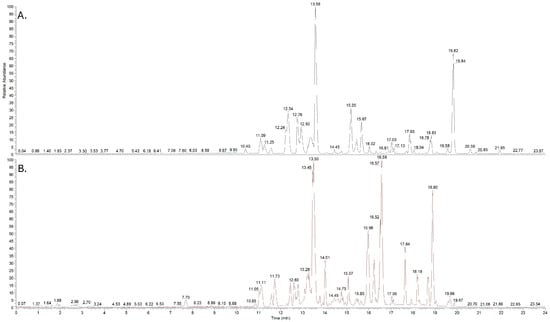
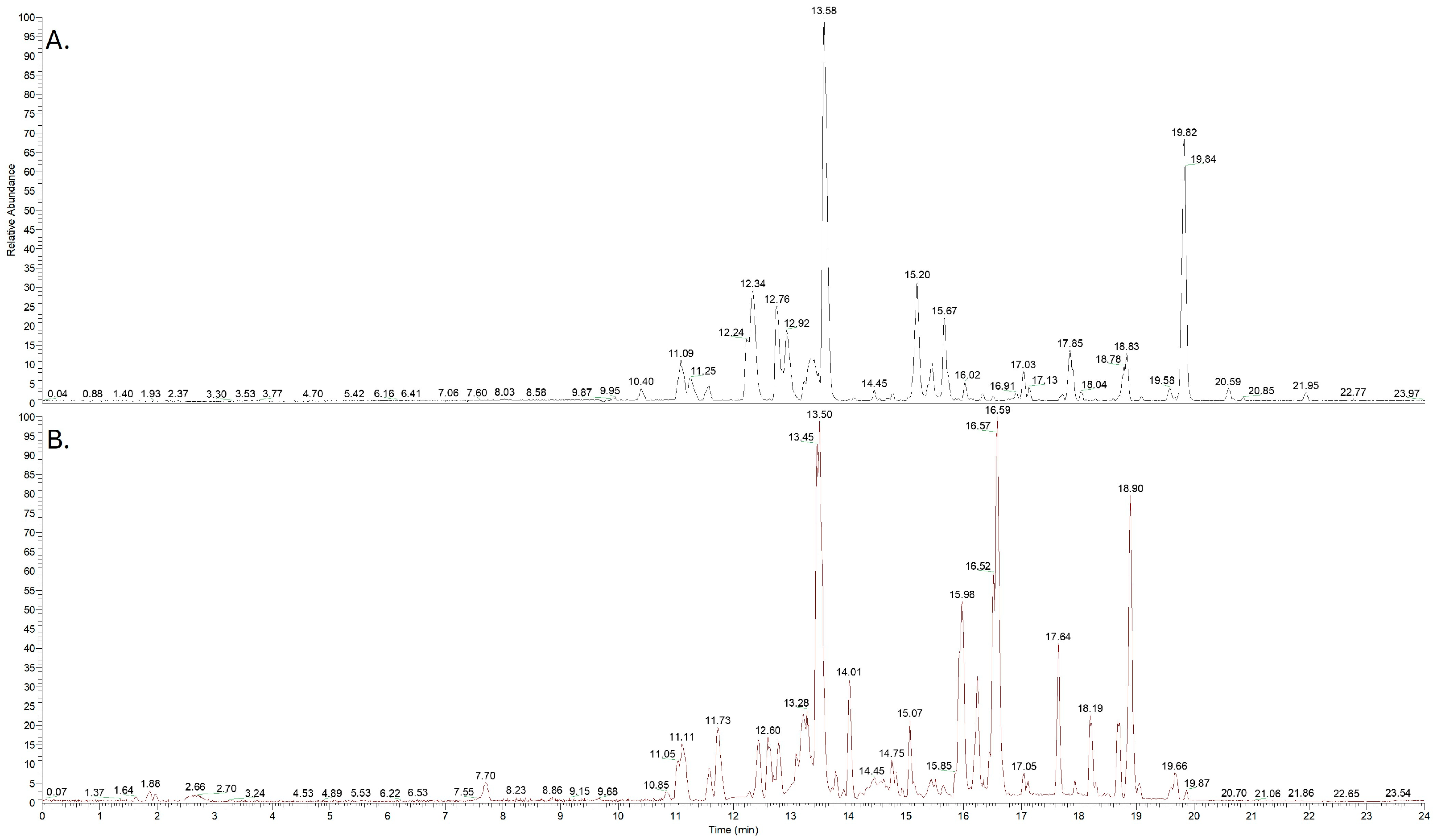
An NTS workflow based on HRMS was employed to investigate chemical exposure in honeybees. This approach enabled the comprehensive detection and characterization of a wide range of chemical compounds (more than 50; a series of indicative chromatograms are presented in Figure 1 and in Supplementary Materials, Figures S2–S26). Utilizing the sensitivity and resolution of HRMS, we identified potential contaminants and bioactive substances, enabling characterization of the chemical profile of honeybee extracts. Table 1 summarizes the detected compounds, including their monoisotopic mass, MS/MS fragment ions, and molecular formula. As this part of the study employed a non-targeted exploratory screening approach, statistical comparative analysis was not within its intended scope. Nevertheless, the detection frequency across the analyzed samples, expressed as % percentage, was calculated (Table 1). Similarly, the random character and the limited number of incidents restricted any statistical attempt to correlate geographic origin and sources of contaminants.
Figure 1.
Representative chromatograms of honeybee extracts after UHPLC-HRMS analyses in positive (A) and negative (B) ionization modes.
Table 1.
Contaminants and bioactive substances detected on honeybee extracts, employing HRMS analysis and a non-targeted screening (NTS) workflow.
The HRMS analysis not only disclosed the presence of chemicals apart from pesticides but also revealed the presence of additional pesticide a.s. that were not within the scope of the targeted LC-MS/MS methods.
3.1. Pesticides Detection
It is acknowledged that use of pesticides in agricultural settings can affect bee populations by altering the availability of foraging plants or by contaminating nectar and pollen [37]. In this work, both targeted and untargeted chemical analysis disclosed the presence of 15 pesticide a.s. and one hydrolysis product of carbaryl (1-naphthol, detected in the same sample with carbaryl). Specifically, HRMS along with an in silico fragmentation (an approach with a multitude of applications [38,39]) unveiled the a.s., propoxur (insecticide), fenobucarb (insecticide), bifenazate (insecticide) and acequinocyl (acaricide) (that were not within the scope of the targeted method). The latter can be valuable in cases of bee death incidents, as the disclosure of additional compounds with relatively high signals (and subsequent abundance) may facilitate their interpretation. In our case, due to the relatively low signal and high LD50 values of the tentatively identified pesticides, quantification (or semi-quantification) of these substances was not pursued. Specifically, due to the relatively low signal intensity and lack of reference standards, quantitative or semi-quantitative determination of these tentatively identified compounds was not performed.
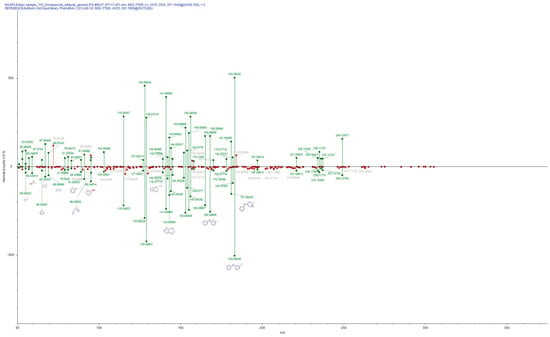
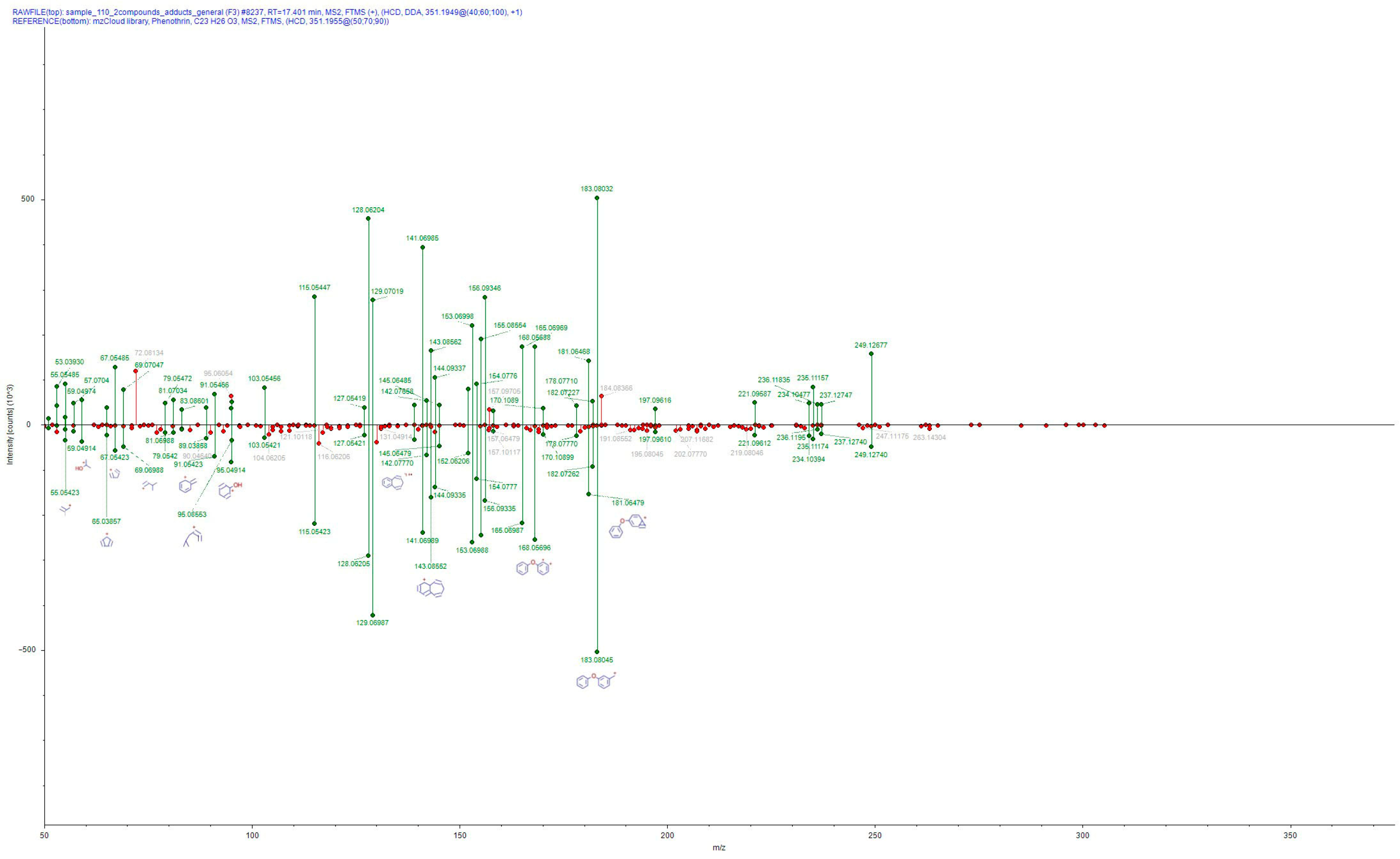
In the same context, LC, GC-MS/MS revealed the presence of additional pesticide a.s. (see Table 2), some of them not identified by LC-HRMS, possibly due to their better amenability to gas chromatography, and sensitivity features of the HRMS system compared to the triple quadrupole. Among these compounds were the pyrethroids λ-cyhalothrin, bifenthrin and permethrin. Physicochemical properties of pyrethroids have been long known to favor GC determination due to enhancement in sensitivity and specificity [40]. For tau-fluvalinate, phenothrin (phenothrin’s annotation is shown in Figure 2 and MRM chromatogram in Figure S27), and propiconazole, both LC-HRMS and LC, GC-MS/MS verified their presence (a marginal-low identification score HRMS identification of imidacloprid was attributed to its low concentration that was not an obstacle in triple quadrupole analysis). Tau-fluvalinate was the predominant compound among positive findings (n = 3), followed by fluopyram, phenothrin, and propiconazole. Overall, pesticide detections were not uniform across samples, and no single active substance emerged as a consistent marker across all mortality cases. Instead, selected samples exhibited combinations of insecticides and fungicides, underscoring the heterogeneity of exposure scenarios potentially associated with reported honeybee death incidents.
Table 2.
Pesticide detections and concentrations (mg/kg) in honeybee samples using LC, GC-MS/MS.
Figure 2.
Phenothrin annotation based on MS/MS fragmentation pattern using mzCloud database. The top panel is the MS/MS pattern of the honeybee extract, whereas the bottom panel is the MS/MS pattern of phenothrin from the mzCloud database.
From a method validation perspective, targeted chemical analysis validation criteria complied with the guideline’s requirements [31]. Sufficient LOQs were demonstrated in the range of 0.0005 to 0.005 mg/kg (related to concentrations provoking sublethal effects) with overall recoveries fluctuating from 63 to 119%, exhibiting acceptable RSD% not higher than 17% and moderate matrix effects for most of the analytes (for detailed validation data see Supplementary Materials, respective paragraph and Table S1). Precision, as portrayed by the repeatability and reproducibility RSD% values at the three concentration levels, was satisfactory (≤20%, Table S1).
3.2. Neuroactive Compounds and Bee Behavior
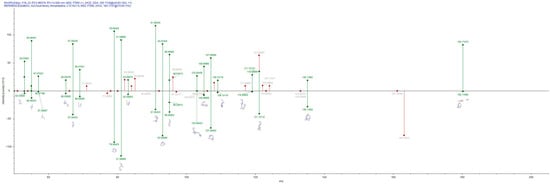
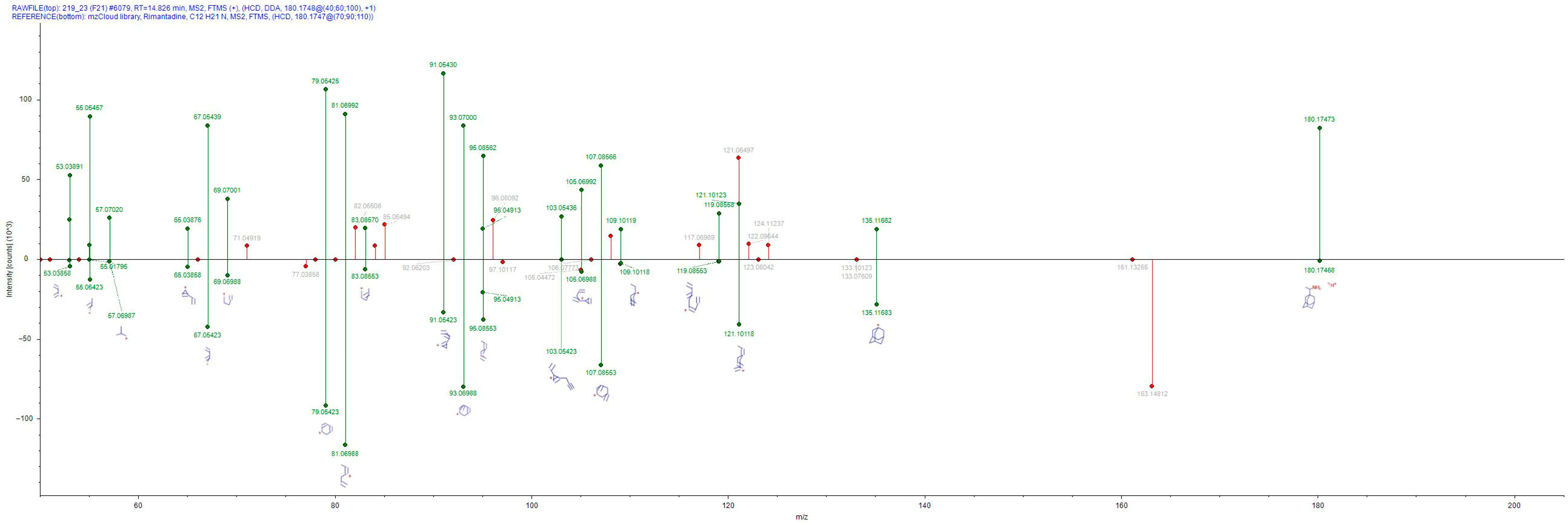
Compounds such as nicotine, gabapentin and rimantadine (annotation in Figure 3) affect neural pathways and cognitive functions in honeybees. More specifically, the presence of nicotine in bee extracts may indicate exposure to environmental pollutants, such as nicotine-containing pesticides [41]. However, nicotine is also naturally found in some plant nectars [42]. Additionally, a decrease in the consumption of nicotine-containing food may influence response levels during learning and memory assessments [43]. Interestingly, rimantadine’s identification, though not anticipated (is an oral antiviral drug), is partly in line with the work of Wang and coworkers, who detected rimantadine with a substantially low rate (0.18%) in honey [44].
Figure 3.
Rimantadine annotation based on MS/MS fragmentation pattern using mzCloud database. The top panel is the MS/MS pattern of the bee extract, whereas the bottom panel is the MS/MS pattern of rimantadine from the mzCloud database.
3.3. Tentative Identification of PFAS in Honeybee Extracts
In silico prediction tools are known for their capacity to identify xenobiotic metabolites [45]. In this work, in silico fragmentation along with NTS suggested the presence of 15 PFAS (Table S2). PFAS were specifically targeted due to their persistence, bioaccumulation potential and emerging relevance as environmental contaminants of concern. However, their structural diversity combined with the limited availability of reference standards and mass spectrometry data constrain confidence identification. For this reason, PFAS-related signals detected in this study are interpreted conservatively at the level of fluorinated formula candidates rather than specific chemical structure. Notably, neither of these compounds belongs to the 4 PFAS elaborated by EFSA and for which a tolerable weekly intake has been established, nor to the extended list currently being investigated in various matrices [46,47]. In addition, more than 35 a.s. that are currently approved have been reported to fall under specific structural definitions of PFAS [48] (in this work, bifenthrin, λ-cyhalothrin, and tau-fluvalinate); however, reports indicate that despite concerns about PFAS, these chemicals may still be present in pesticide formulations or may originate from leaching of fluorinated containers [49].
From an ecotoxicology point of view, the open-access cropCSM online resource, designed for the toxicological assessment of small molecules (driven by herbicides), including honeybee toxicity (as a categorical yes/no), was pilot-contemplated for the 15 PFAS. Despite the limitations of the cropCSM tool (not designed for a broad range of chemicals) and the resulting uncertainty in predictions (which do not constitute concrete evidence of adverse effects in honeybees), assigning potential chemical structures identified two plausible PFAS as potentially toxic to honeybees. More specifically, for both compounds (2 and 14), the common alicyclic hydrocarbon system (in Figure S28, see their potential chemical structures) might play a role in the estimated toxicity to bees. The literature designated that exposure of honeybees to environmentally relevant PFOS concentrations led to bee mortality and hampered brood development [50]. In the same context, greenhouse experiments using Cannabis sativa L. as a medium to remediate PFAS-contaminated soil verified PFAS uptake by pollen [51] and the potential exposure of bees to these chemicals via pollen consumption. Consequently, the tentative identification of less-known PFAS analogs should not be overlooked, as they may affect bees’ physiological behavior, although no direct contribution to mortality can be demonstrated within the scope of this study.
3.4. Other Environmental Contaminants
Industrial chemicals are increasingly being detected in honeybee habitats [19] due to agricultural and industrial activities. A recent publication documented their prevalence in agricultural soils as a result of conventional and biodegradable plastic mulches [52], while bee pollen is also a matrix with reported occurrence of such chemicals [53]. Among phthalates, both dimethyl phthalate and diisobutyl phthalate were tentatively identified. Dewaele and Cuvillier confirmed that bumblebees exhibited high phthalate contamination, with gene expression analysis revealing endocrine-disrupting effects on these wild bees [54]. Interestingly, the identification of triisopropanolamine might postulate the use of acidic herbicides containing it as a neutralizing agent [55], without excluding other uses (e.g., cosmetics) due to its emulsifying potential [56].
3.5. Plant-Derived Alkaloids and Their Effects
Scopolamine, a muscarinic antagonist, has been shown to impair bees’ ability to recognize nestmates, leading to increased aggression toward both familiar and unfamiliar individuals, highlighting the importance of muscarinic signaling in olfactory-based social recognition [57]. Moreover, a study by Sculfort et al. examined how certain floral compounds, including scopolamine, affect buff-tailed bumblebees (Bombus terrestris) [58]. According to their results, at the individual level, bumble bees consuming the 50% scopolamine diet exhibited notable digestive tract damage, indicating that while colonies may appear resilient, individual bees can suffer adverse effects that could influence overall colony health.
3.6. Cannabinoids and Their Potential Effects
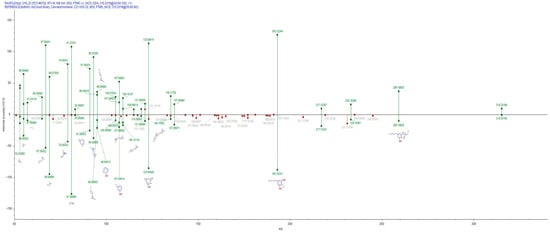
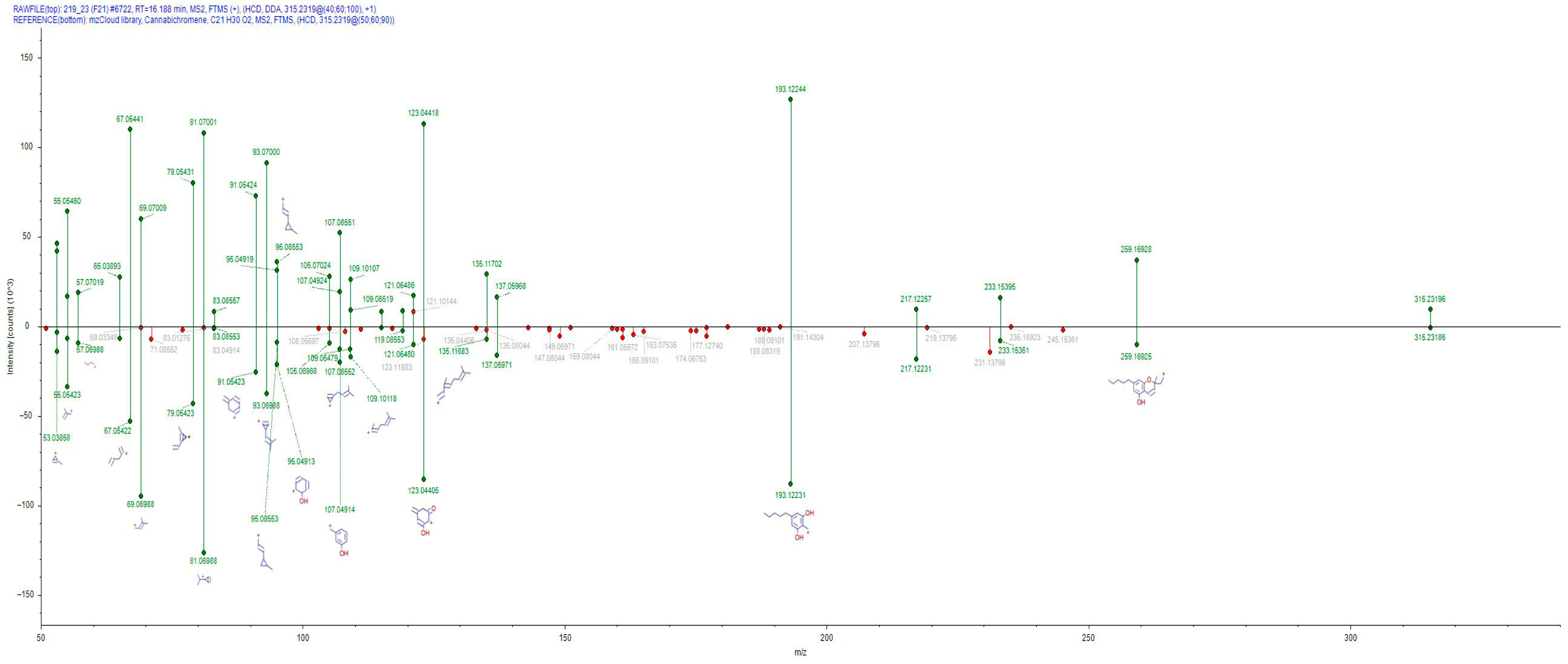
HRMS revealed the presence of two cannabinoids—cannabichromene (annotation depicted in Figure 4) and cannabidiolic acid—in honeybee-derived extracts. Experimental supplementation with hemp extract has been shown to increase total protein levels and enhance protease inhibitors’ activity, which are essential components of the insect innate immune response [59]. From another viewpoint, though cannabis is wind-pollinated, the confirmation of cannabinoids in honeybees may indicate that they collect pollen from cannabis [60,61].
Figure 4.
Cannabichromene annotation based on MS/MS fragmentation pattern using mzCloud database. The top panel is the MS/MS pattern of the honeybee extract, whereas the bottom panel is the MS/MS pattern of Cannabichromene from the mzCloud database.
3.7. Other Bioactive Compounds
Secondary metabolites present in floral resources can influence key aspects of honeybee health, including immunity, detoxification, gut microbiota, and behavior [62]. Protective effects of flavonoids such as rutin and other bioactive compounds were reported when bees were exposed to the highly toxic insecticide fipronil [63]. In the study by Li et al. [64], metabolomic analyses revealed that royal jelly produced by bees fed soybean meal-based diets contained elevated levels of the isoflavones daidzein and genistein (detected in three of the bee samples evaluated herein). This finding is of particular interest since royal jelly constitutes a pivotal food for honeybee larvae. The complex flavonoid glycoside kaempferitrin, found in certain medicinal plants visited by bees, exhibits free radical scavenging capacity and may assist in mitigating oxidative damage, especially in bees exposed to pesticide residues [65]. Finally, the identification of 1-naphthalene acetic acid (a plant growth regulator) is logical, given its documented use in agriculture and subsequent attention paid in its risk assessment by EFSA [66].
3.8. Fatty Acids and Their Role in Honeybee Physiology
Dietary supplementation with arachidonic acid (tentatively identified in this work) has been associated with enhanced larval growth and improved immune parameters in Apis mellifera ligustica, as well as enhanced overall survival and resilience to pathogenic stress [67]. Εthyl oleate (EO), another fatty acid ester detected in bees’ extracts, is a primer pheromone that delays the onset of foraging behavior in younger worker bees, thus helping the colony maintain a balanced distribution of tasks across age groups. It should also be noted that these compounds are well-known endogenous metabolites in honeybees, involved in physiological and signaling processes. However, their presence may also be influenced by environmental or dietary sources, and their origin cannot be clearly determined within the scope of this study.
3.9. Volatile (And Semi-Volatiles) Organic Compounds and Bee Attraction
Several compounds, such as acetophenone (see Figure S5 for its annotation), methyl eugenol, and trans-cinnamaldehyde, play a central role in plant–pollinator interactions. Floral scents are crucial for guiding bees to nectar and pollen sources, thereby aiding in efficient pollination [68]. Methyl eugenol, a phenylpropanoid found in many plant species, is known for its ability to attract certain pollinators [69]. Eugenol has been shown to exhibit insecticidal properties, which could be beneficial for bees in controlling harmful pests [70]. However, at higher concentrations, these compounds could pose toxicity risks to bees [71].
3.10. Honeybee Health Risk Assessment
Among the bee death incidents investigated in this study, we did not observe exceedances of the LD50 values. Nevertheless, there was one case in which imidacloprid was detected at a concentration within a range reported to provoke sublethal effects on bees [72]. In the same sample, the pyrethroids permethrin, fungicide propiconazole, insecticide carbaryl, stylopine and triphenyl phosphate were also detected, suggesting potential mixture effects on honeybees and standalone sublethal effects based on the detected levels (indicatively see [73]). Notably, in this sample, 1-naphthol, a metabolite of carbaryl [74] was also detected via HRMS analysis, corroborating the analytical capability of the HRMS methodology. It is also noteworthy that ergosterol biosynthesis-inhibiting fungicides, such as propiconazole, act synergistically, substantially lowering the LD50 of the pyrethroid λ-cyhalothrin [75]. Gil and coworkers demonstrated that exposure of bumblebees to field-realistic levels of neonicotinoids and pyrethroids impacted foraging behavior and increased worker mortality, leading to notable decreases in brood development and colony well-being [8]. Wang and coworkers showed that thiamethoxam in combination with pyrethroids (exemplified by λ-cyhalothrin) exerted synergistic toxic effects on Apis mellifera ligustica honeybees [76]. In the same context, mixtures (ternary or more) containing neonicotinoids and pyrethroids exhibited both synergistic and additive effects on bees [64]. Consequently, analogous effects cannot be excluded in the presented study.
The broadly used fungicides boscalid and fluopyram were also detected at levels substantially lower than their LD50 values. For boscalid, higher concentrations (than those herein presented), but environmentally relevant, were reported to affect the reproduction of immature queen bees [77]. Fluopyram in combination with another fungicide, tebuconazole, induces oxidative stress and affects honeybee survival [78], but at much higher concentrations compared to those herein evidenced.
To move a step further from “simplistic” comparisons and literature quotation, the RQs and the respective “no concern level, NCL” introduced by EFSA [35] were calculated for the detected active substances and are portrayed in Table 3. NCLs correspond to exposure levels in bees (mg/kg bw) that are not expected to affect their foraging behavior. As actual exposure levels for both oral and contact ratio calculations, the maximum concentrations of the respective a.s. in bees were considered. The latter was decided due to the low number of detections (n = 2) for relatively toxic insecticides (in bold, Table 3); hence, the distribution of concentrations (i.e., the 90th percentile) cannot be applied for risk assessment calculations and comparisons with the RQ and NCL thresholds. The RQ values for most substances were far below the threshold values of 0.1 and 0.4 set by EFSA and US-EPA, respectively, except for permethrin and phenothrin, which surpassed them, indicating a potential risk.
Table 3.
Risk quotients, no-concern levels, and maximum concentrations of quantified pesticides.
To provide further insight into sublethal assessment, the NCLs (oral and contact) of the detected pesticides were determined by dividing the corresponding LD50 values by 50, and the maximum concentrations exceeding this value are juxtaposed. For pyrethroids and imidacloprid, maximum detected concentrations exceed NCLs, corroborating the RQ assessment for pyrethroids and, in parallel, supporting the documented sublethal effects of these pesticide categories. Nevertheless, in risk calculations and subsequent conclusions, the uncertainty arising from potential chemicals’ decomposition in the field before sampling should be considered, and in some instances, additional information can be pursued from beekeepers and veterinary authorities. In the Mediterranean area in particular, beekeeping is largely nomadic (beekeepers are not always in proximity to their apiaries), and several days can pass between the incident and sampling.
An informative meta-analysis on binary mixture toxicity to bees was published by Carnesecchi et al. (2019) in which, in addition to dominant pesticides, other chemicals are implicated in such effects [79]. Among them are the flavonoid quercetin and the antibiotics oxytetracycline, ivermectin and tylosin. Interestingly, tau-fluvalinate, detected in this work, is among the pesticides exhibiting combined toxicity with a variety of chemicals, including pharmaceuticals (i.e., salicylic acid, xanthotoxin), antibiotics (such as fumagillin, tylosine, oxytetracycline), and NPCs (such as quercetin) [79]. In this sense, it is characteristic that in the presented work the sample most contaminated with tau-fluvalinate simultaneously contained 12 chemicals (namely trans-cinnamaldehyde, (−)-caryophyllene oxide, chrysin, diisobutyl phthalate, ethyl oleate, triphenyl phosphate, cannabidiolic acid, dimethyl phthalate, carbaryl, oxabetrinil, warfarin and betulinic acid methyl ester). The most prevalent chemical combination (observed in 25% of samples) was ethyl oleate with (−)-caryophyllene oxide. Other common patterns were observed in pairs of two or more samples. The first consisted of genistein, ethyl oleate, and triphenyl phosphate, while other binary combinations were (−)-caryophyllene oxide with isobornyl methacrylate (and with chrysin).
Consequently, even if different co-occurring chemicals as those described in the literature are evidenced, the detection pattern can provide “realistic” assumptions for such combined (additive, synergistic) toxicity effects, apart from the risk due to exposure to a single pesticide active substance. In the same context, not-approved pesticides are still detected (in this work, 53% of pesticides detected) in the environment, a fact that should be dealt with caution by the beekeepers, veterinary and related authorities. Compared to previous work by our group [27,32], the positive honeybee samples in pesticides are decreased, which underpins the implementation of risk management measures in the specific beehive areas, though the pilot character of this study and the restricted number of samples cannot be used for generic conclusions. With regard to the other detected chemicals (apart from pesticides), their ecological relevance cannot be readily assessed due to the lack of a) quantitative (concentration) data (outside the scope of the presented work) and b) toxicological endpoint values (e.g., LD50).
Based on the findings presented, honeybees are exposed to a chemical arsenal comprising a multitude of contaminants and other bioactive compounds. Importantly, the available data does not allow causal attribution of mortality to specific chemicals. Instead, they indicate that honeybees are exposed to complex mixtures of contaminants and bioactive compounds, highlighting the limitations of single-compound risk assessment and suggesting that the concomitant presence of potentially beneficial substances may contribute to resilience against xenobiotic stress. Selected cases combined neonicotinoid/pyrethroid/fungicide signatures together with other contaminants, a pattern repeatedly discussed in the mixture-toxicity literature as potentially relevant for behavior, toxicological effects, detoxification burden, and colony performance. As indicated above, a partial limitation of the present study is the lack of a biological association with the results, which limits the direct ecotoxicological interpretation of the findings. Future studies should integrate chemical analysis with effect-based approaches, including behavioral, physiological, or molecular biomarkers, to better link exposure patterns with biological responses in honeybees.
Overall, while the present dataset lacks effect measures and therefore cannot test these hypotheses, it provides an evidence-based chemical exposure map to prioritize targeted mixture experiments and effect-based monitoring in future incident investigations.
4. Conclusions
Honeybees are critical to the functioning of ecosystems and agriculture. Therefore, the chemical investigation of mortality incidents is essential for understanding the impact of environmental stressors on their health, behavior, and survival. In this work, LC-HRMS non-targeted screening of 25 honeybee extracts identified more than 50 chemicals across multiple compound classes, including industrial chemicals/plasticizers, pharmaceuticals, and fluorinated PFAS candidates not included in the EFSA “PFAS-4” list, expanding knowledge beyond pesticides. In parallel, LC, GC-MS/MS targeted methods provided quantitative insights into pesticides, with quantified concentrations not exceeding the acute LD50 thresholds. The produced dataset, though highly informative, does not allow a straightforward causal attribution of mortality to any single compound or combination. Nevertheless, the co-occurrence patterns (i.e., pesticides plus other xenobiotics and bioactives) underscore the potential importance of mixture effects and sublethal exposures which may contribute to honeybee death incidents.
Moreover, the relatively limited sample size and the absence of a harmonized–stratified sampling design limit the possibility of statistical comparisons and generalization of the findings; therefore, the results should be interpreted as indicative of exposure patterns rather than representative of broader honeybee population-level trends.
Future work should integrate chemical profiles with effect-based endpoints (behavioral/physiological biomarkers), bee-relevant mixture experiments, and harmonized confidence reporting for NTS to strengthen inference of incident causality.
Finally, research directions may include the integration of HRMS data with advanced data analysis approaches to deepen understanding of honeybee health and conservation strategies, aiming to develop early-warning systems and effective risk management.
Supplementary Materials
The following supporting information can be downloaded at: https://www.mdpi.com/article/10.3390/jox16020064/s1. Table S1: Method performance and validation for the newly validated active substances: Limits of Quantification (LOQ), ME (%), Recoveries (%), Repeatability (RSD%) and Inter-day (Inter-d) precision (RSD%) obtained in honey bees; Table S2: PFAS tentatively identified via in silico fragmentation using MetFrag Web tool in the honeybee samples; Figure S1: TIC MRM chromatogram of a standard mix solution of pesticides at 50 ng/mL in LC-ESI-MS/MS; Figure S2: Triisopropanolamine annotation based on MS/MS fragmentation pattern using mzCloud database. The top panel is the MS/MS pattern of the honey bee extract, whereas the bottom panel is the MS/MS pattern of Triisopropano-lamine from the mzCloud database; Figure S3: Acetophenone annotation based on MS/MS fragmentation pattern using mzCloud database. The top panel is the MS/MS pattern of the honey bee extract, whereas the bottom panel is the MS/MS pattern of Rimantadine from the mzCloud database; Figure S4: 1,5-Isoquinolinediol annotation based on MS/MS fragmentation pattern using mzCloud database. The top panel is the MS/MS pattern of the honey bee extract, whereas the bottom panel is the MS/MS pattern of 1,5-Isoquinolinediol from the mzCloud database; Figure S5: 1-Naphthol annotation based on MS/MS fragmentation pattern using mzCloud database. The top panel is the MS/MS pattern of the honey bee extract, whereas the bottom panel is the MS/MS pattern of 1-Naphthol from the mzCloud database; Figure S6: 2,2-Methylenebis(4-ethyl-6-tert-butylphenol) annotation based on MS/MS fragmentation pattern using mzCloud database. The top panel is the MS/MS pattern of the honey bee extract, whereas the bottom panel is the MS/MS pattern of 2,2-Methylenebis(4-ethyl-6-tert-butylphenol) from the mzCloud database; Figure S7: 2-Amino-6-methylmercaptopurine annotation based on MS/MS fragmentation pattern using mzCloud data-base. The top panel is the MS/MS pattern of the honey bee extract, whereas the bottom panel is the MS/MS pattern of 2-Amino-6-methylmercaptopurine from the mzCloud database; Figure S8: Arachidonic acid annotation based on MS/MS fragmentation pattern using mzCloud database. The top panel is the MS/MS pattern of the honey bee extract, whereas the bottom panel is the MS/MS pattern of Arachidonic acid from the mzCloud database; Figure S9: Betulinic acid methyl ester annotation based on MS/MS fragmentation pattern using mzCloud database. The top panel is the MS/MS pattern of the honey bee extract, whereas the bottom panel is the MS/MS pattern of Betulinic acid methyl ester from the NIST database; Figure S10: Deoxylimonin annotation based on MS/MS fragmentation pattern using mzCloud database. The top panel is the MS/MS pattern of the honey bee extract, whereas the bottom panel is the MS/MS pattern of Deoxylimonin from the mzCloud database; Figure S11: Diisobutylphthalate annotation based on MS/MS fragmentation pattern using mzCloud database. The top panel is the MS/MS pattern of the honey bee extract, whereas the bottom panel is the MS/MS pattern of Diisobu-tylphthalate from the mzCloud database; Figure S12: Dimethyl sebacate annotation based on MS/MS fragmentation pattern using mzCloud database. The top panel is the MS/MS pattern of the honey bee extract, whereas the bottom panel is the MS/MS pattern of Dimethyl seba-cate from the mzCloud database; Figure S13: D-Panthenol annotation based on MS/MS fragmentation pattern using mzCloud database. The top panel is the MS/MS pattern of the honey bee extract, whereas the bottom panel is the MS/MS pattern of D-Panthenol from the mzCloud database; Figure S14: Ethyl oleate annotation based on MS/MS fragmentation pattern using mzCloud database. The top panel is the MS/MS pattern of the honey bee extract, whereas the bottom panel is the MS/MS pattern of Ethyl oleate from the mzCloud database; Figure S15: Fenbendazole annotation based on MS/MS fragmentation pattern using mzCloud database. The top panel is the MS/MS pattern of the honey bee extract, whereas the bottom panel is the MS/MS pattern of Fenbendazole from the mzCloud database; Figure S16: Gabapentin annotation based on MS/MS fragmentation pattern using mzCloud database. The top panel is the MS/MS pattern of the honey bee extract, whereas the bottom panel is the MS/MS pattern of Gabapentin from the mzCloud database; Figure S17: Icaridin annotation based on MS/MS fragmentation pattern using mzCloud database. The top panel is the MS/MS pattern of the honey bee extract, whereas the bottom panel is the MS/MS pattern of Icaridin from the mzCloud database; Figure S18: Isobornyl methacrylate annotation based on MS/MS fragmentation pattern using mzCloud database. The top panel is the MS/MS pattern of the honey bee extract, whereas the bottom panel is the MS/MS pattern of Isobornyl methacrylate from the mzCloud database; Figure S19: Limonin annotation based on MS/MS fragmentation pattern using mzCloud database. The top panel is the MS/MS pattern of the honey bee extract, whereas the bottom panel is the MS/MS pattern of Limonin from the mzCloud database; Figure S20: N-Butylbenzenesulfonamide annotation based on MS/MS fragmentation pattern using mzCloud database. The top panel is the MS/MS pattern of the honey bee extract, whereas the bottom panel is the MS/MS pattern of N-Butylbenzenesulfonamide from the mzCloud database; Figure S21: Noscapine annotation based on MS/MS fragmentation pattern using mzCloud database. The top panel is the MS/MS pattern of the honey bee extract, whereas the bottom panel is the MS/MS pattern of Noscapine from the mzCloud database; Figure S22: Scopolamine annotation based on MS/MS fragmentation pattern using mzCloud database. The top panel is the MS/MS pattern of the honey bee extract, whereas the bottom panel is the MS/MS pattern of Scopolamine from the mzCloud database; Figure S23: Skatole annotation based on MS/MS fragmentation pattern using mzCloud database. The top panel is the MS/MS pattern of the honey bee extract, whereas the bottom panel is the MS/MS pattern of Skatole from the mzCloud database; Figure S24: Stylopine annotation based on MS/MS fragmentation pattern using mzCloud database. The top panel is the MS/MS pattern of the honey bee extract, whereas the bottom panel is the MS/MS pattern of Stylopine from the NIST da-tabase; Figure S25: Syringate annotation based on MS/MS fragmentation pattern using mzCloud database. The top panel is the MS/MS pattern of the honey bee extract, whereas the bottom panel is the MS/MS pattern of Syringate from the NIST da-tabase; Figure S26: Trans-Cinnamaldehyde annotation based on MS/MS fragmentation pattern using mzCloud database. The top panel is the MS/MS pattern of the honey bee extract, whereas the bottom panel is the MS/MS pattern of trans-Cinnamaldehyde from the mzCloud database; Figure S27: MRM chromatograms of phenothrin detection in bee sample (108-23); Figure S28: Potential chemical structures for PFAS compounds 2 and 14; Excel file: MRM EXCEL_Bees_paper. Reference [80] is cited in the Supplementary Materials.
Author Contributions
Conceptualization: K.M. and K.M.K.; Data Curation: E.B., E.N.T., E.M.-K. and K.M.K.; Formal Analysis: E.B., E.N.T. and K.M.K.; Funding Acquisition: K.M. and K.M.K.; Investigation: E.B., E.N.T., E.M.-K., K.M. and K.M.K.; Methodology: E.B., E.N.T. and K.M.K.; Project Administration: K.M.K.; Resources: K.M. and K.M.K.; Software: E.B., E.N.T., E.M.-K. and K.M.K.; Supervision: K.M.K.; Validation: E.B., E.N.T. and E.M.-K.; Visualization: E.B., E.N.T. and E.M.-K.; Writing—Original Draft: E.B. and K.M.K.; Writing—Review and Editing: E.B. and K.M.K. All authors have read and agreed to the published version of the manuscript.
Funding
This work was supported by internal funding of Benaki Phytopathological Institute.
Institutional Review Board Statement
Not applicable.
Informed Consent Statement
Not applicable.
Data Availability Statement
The original contributions presented in this study are included in the article/Supplementary Materials. Further inquiries can be directed to the corresponding authors.
Acknowledgments
The authors express their gratitude to the beekeepers and relevant authorities for sending honeybee samples.
Conflicts of Interest
The authors declare no conflicts of interest.
Abbreviations
The following abbreviations are used in this manuscript:
| LC-HRMS | liquid chromatography-high-resolution mass spectrometry |
| HRMS | High-Resolution Mass Spectrometry |
| LC, GC-MS/MS | liquid and gas chromatographic tandem mass spectrometry |
| PFAS | Per- and Polyfluoroalkyl Substances |
| LOQ | limit of quantification |
| NTS | non-targeted screening |
References
- Williams, I.H. The dependence of crop production within the European Union on pollination by honey bees. Agric. Zool. Rev. 1994, 6, 229–257. [Google Scholar]
- Klein, A.-M.; Vaissière, Β.Ε.; Cane, J.H.; Stefan-Dewenter, I.; Cunningham, S.A.; Kremen, C.; Tscharntke, T. Importance of pollinators in changing landscapes for world crops. Proc. Biol. Sci. 2007, 274, 303–313. [Google Scholar] [CrossRef] [Scilit] [PubMed]
- Basualdo, M.; Cavigliasso, P.; Samuel de Avila, R., Jr.; Aldea-Sánchez, P.; Correa-Bénitez, A.; Martínez Harms, J.; Ramos, A.K.; Rojas-Bravo, V.; Salvarrey, S. Current status and economic value of insect-pollinated dependent crops in Latin America. Ecol. Econ. 2022, 196, 107395. [Google Scholar] [CrossRef] [Scilit]
- Gallai, N.; Salles, J.-M.; Settele, J.; Vaissiére, B.E. Economic valuation of the vulnerability of world agriculture confronted with pollinator decline. Ecol. Econ. 2009, 68, 810–821. [Google Scholar] [CrossRef] [Scilit]
- Potts, S.G.; Biesmeijer, J.C.; Kremen, C.; Neumann, P.; Schweiger, O.; Kunin, W.E. Global pollinator declines: Trends, impacts and drivers. Trends Ecol. Evol. 2010, 25, 345–353. [Google Scholar] [CrossRef] [Scilit]
- Requier, F.; Leyton, M.S.; Morales, C.L.; Garibaldi, L.A.; Giacobino, A.; Porrini, M.P.; Rosso-Londoño, J.M.; Velarde, R.A.; Aignasse, A.; Aldea-Sánchez, P.; et al. First large-scale study reveals important losses of managed honey bee and stingless bee colonies in Latin America. Sci. Rep. 2024, 14, 10079. [Google Scholar] [CrossRef] [Scilit]
- Drivdal, L.; van der Sluijs, J.P. Pollinator conservation requires a stronger and broader application of the precautionary principle. Curr. Opin. Insect Sci. 2021, 46, 95–105. [Google Scholar] [CrossRef] [Scilit]
- Gill, R.J.; Ramos-Rodríguez, O.; Raine, N.E. Combined pesticide exposure severely affects individual- and colony-level traits in bees. Nature 2012, 491, 105–108. [Google Scholar] [CrossRef] [Scilit] [PubMed]
- Cunningham, M.M.; Tran, L.; McKee, C.G.; Polo, R.O.; Newman, T.; Lansing, L.; Griffiths, J.S.; Bilodeau, G.J.; Rott, M.; Guarna, M.M. Honey bees as biomonitors of environmental contaminants, pathogens, and climate change. Ecol. Indic. 2022, 134, 108457. [Google Scholar] [CrossRef] [Scilit]
- Conti, M.E.; Botrè, F. Honeybees and their products as potential bioindicators of heavy metals contamination. Environ. Monit. Assess. 2001, 69, 267–282. [Google Scholar] [CrossRef] [Scilit]
- Perugini, M.; Manera, M.; Grotta, L.; Abete, M.C.; Tarasco, R.; Amorena, M. Heavy Metal (Hg, Cr, Cd, and Pb) Contamination in Urban Areas and Wildlife Reserves: Honeybees as Bioindicators. Biol. Trace Elem. Res. 2011, 140, 170–176. [Google Scholar] [CrossRef] [Scilit] [PubMed]
- Ruschioni, S.; Riolo, P.; Minuz, R.L.; Stefano, M.; Cannella, M.; Porrini, C.; Isidoro, N. Biomonitoring with Honeybees of Heavy Metals and Pesticides in Nature Reserves of the Marche Region (Italy). Biol. Trace Elem. Res. 2013, 154, 226–233. [Google Scholar] [CrossRef] [Scilit]
- Díaz, M.A.; O’Connell, D.P.; Jordan, S.; O’Connor, C.; Martin, P.; Jones, J.C.; Garvey, J. Analysis of Pesticide Levels in Honey and Pollen from Irish Honey Bee Colonies Using a Modified Dutch Mini-Luke Method with Gas and Liquid Chromatography-Tandem Mass Spectrometry Detection. J. Agric. Food. Chem. 2023, 71, 12657–12667. [Google Scholar] [CrossRef] [Scilit]
- Kasiotis, K.M.; Baira, E.; Iosifidou, S.; Manea-Karga, E.; Tsipi, D.; Gounari, S.; Theologidis, I.; Barmpouni, T.; Danieli, P.P.; Lazzari, F.; et al. Fingerprinting Chemical Markers in the Mediterranean Orange Blossom Honey: UHPLC-HRMS Metabolomics Study Integrating Melissopalynological Analysis, GC-MS and HPLC-PDA-ESI/MS. Molecules 2023, 28, 3967. [Google Scholar] [CrossRef] [Scilit]
- Kasiotis, K.M.; Zafeiarki, E.; Manea-Karga, E.; Anastasiadou, P.; Machera, K. Pesticide Residues and Metabolites in Greek Honey and Pollen: Bees and Human Health Risk Assessment. Foods 2023, 12, 706. [Google Scholar] [CrossRef] [Scilit] [PubMed]
- Badiou-Bénéteau, A.; Benneveau, A.; Géret, F.; Delatte, H.; Becker, N.; Brunet, J.L.; Reynaud, B.; Belzunces, L.P. Honeybee biomarkers as promising tools to monitor environmental quality. Environ. Int. 2013, 60, 31–41. [Google Scholar] [CrossRef] [Scilit] [PubMed]
- Wang, L.; Meeus, I.; Rombouts, C.; Van Meulebroek, L.; Van Haecke, L.; Smagghe, G. Metabolomics-based biomarker discovery for bee health monitoring: A proof of concept study concerning nutritional stress in Bombus terrestris. Sci. Rep. 2019, 9, 11423. [Google Scholar] [CrossRef] [Scilit]
- Cotton, J.; Leroux, F.; Broudin, S.; Marie, M.; Corman, B.; Tabet, J.C.; Ducruix, C.; Junot, C. High-resolution mass spectrometry associated with data mining tools for the detection of pollutants and chemical characterization of honey samples. J. Agric. Food. Chem. 2014, 62, 11335–11345. [Google Scholar] [CrossRef] [Scilit]
- Gómez-Ramos, M.M.; Ucles, S.; Ferrer, C.; Fernandez-Alba, A.R.; Hernando, M.D. Exploration of environmental contaminants in honeybees using GC-TOF-MS and GC-Orbitrap-MS. Sci. Total. Environ. 2019, 647, 232–244. [Google Scholar] [CrossRef] [Scilit]
- Stavropoulou, M.I.; Termentzi, A.; Kasiotis, K.M.; Cheilari, A.; Stathopoulou, K.; Machera, K.; Aligiannis, N. Untargeted Ultrahigh-Performance Liquid Chromatography-Hybrid Quadrupole-Orbitrap Mass Spectrometry (UHPLC-HRMS) Metabolomics Reveals Propolis Markers of Greek and Chinese Origin. Molecules 2021, 26, 456. [Google Scholar] [CrossRef] [Scilit]
- Zarrouk, E.; Lenski, M.; Bruno, C.; Thibert, V.; Contreras, P.; Privat, K.; Ameline, A.; Fabresse, N. High-resolution mass spectrometry: Theoretical and technological aspects. Toxicol. Anal. Clin. 2022, 34, 3–18. [Google Scholar] [CrossRef] [Scilit]
- Mayack, C.; Macherone, A.; Zaki, A.G.; Filiztekin, E.; Ozkazanc, B.; Koperly, Y.; Schick, S.J.; Eppley, E.J.; Deb, M.; Ambiel, N.; et al. Environmental exposures associated with honey bee health. Chemosphere 2022, 286, 131948. [Google Scholar] [CrossRef] [Scilit]
- Shi, T.; Burton, S.; Wang, Y.; Xu, S.; Zhang, W.; Yu, L. Metabolomic analysis of honey bee, Apis mellifera L. response to thiacloprid. Pestic. Biochem. Physiol. 2018, 152, 17–23. [Google Scholar] [CrossRef] [Scilit]
- Kasiotis, K.M.; Baira, E.; Iosifidou, S.; Bergele, K.; Manea-Karga, E.; Theologidis, I.; Barmpouni, T.; Tsipi, D.; Machera, K. Characterization of Ikaria Heather Honey by Untargeted Ultrahigh-Performance Liquid Chromatography-High Resolution Mass Spectrometry Metabolomics and Melissopalynological Analysis. Front. Chem. 2022, 10, 924881. [Google Scholar] [CrossRef] [Scilit]
- Paiano, V.; Breidbach, A.; Lörchner, C.; Zdiniakova, T.; De Rudder, O.; Maquet, A.; Alvarellos, L.; Ulberth, F. Detection of Honey Adulteration by Liquid Chromatography-High-Resolution Mass Spectrometry: Results from an EU Coordinated Action. Separations 2025, 12, 47. [Google Scholar] [CrossRef] [Scilit]
- Kasiotis, K.M.; Tzouganaki, Z.D.; Machera, K. Chromatographic determination of monoterpenes and other acaricides in honeybees: Prevalence and possible synergies. Sci. Total. Environ. 2018, 625, 96–105. [Google Scholar] [CrossRef] [Scilit]
- Kasiotis, K.M.; Zafeiraki, E.; Kapaxidi, E.; Manea-Karga, E. Pesticides residues and metabolites in honeybees: A Greek overview exploring Varroa and Nosema potential synergies. Sci. Total Environ. 2021, 769, 145213. [Google Scholar] [CrossRef] [Scilit] [PubMed]
- Alygizakis, N.; Lestremau, F.; Gago-Ferrero, P.; Gil-Solsona, R.; Arturi, K.; Hollender, J.; Schymanski, E.L.; Dulio, V.; Slobodnik, J.; Thomaidis, N.S. Towards a harmonized identification scoring system in LC-HRMS/MS based non-target screening (NTS) of emerging contaminants. Trends Anal. Chem. 2023, 159, 116944. [Google Scholar] [CrossRef] [Scilit]
- Schymanski, E.L.; Jeon, J.; Gulde, R.; Fenner, K.; Ruff, M.; Singer, H.P.; Hollender, J. Identifying Small Molecules via High Resolution Mass Spectrometry: Communicating Confidence. Environ. Sci. Technol. 2014, 48, 2097–2098. [Google Scholar] [CrossRef] [Scilit] [PubMed]
- Wolf, S.; Schmidt, S.; Muller-Hannemann, M.; Neumann, S. In silico fragmentation for computer assisted identification of metabolite mass spectra. BMC Bioinform. 2010, 11, 148. [Google Scholar] [CrossRef] [Scilit]
- SANTE/11312/2021v2; Guidance Document on Analytical Quality Control and Method Validation Procedures for Pesticides Residues Analysis in Food and Feed. Available online: https://www.eurl-pesticides.eu/userfiles/file/EurlALL/SANTE-11312_2021-V2.pdf (accessed on 2 June 2025).
- Kasiotis, K.M.; Anagnostopoulos, C.; Anastasiadou, P.; Machera, K. Pesticide residues in honeybees, honey and bee pollen by LC-MS/MS screening: Reported death incidents in honeybees. Sci. Total Environ. 2014, 485–486, 633–642. [Google Scholar] [CrossRef] [Scilit]
- cropCSM. Available online: https://biosig.lab.uq.edu.au/crop_csm/ (accessed on 20 August 2025).
- EFSA-Guidance. EFSA Guidance Document on the risk assessment of plant protection products on bees (Apis mellifera, Bombus spp. and solitary bees). EFSA J. 2013, 11, 3295. [Google Scholar] [CrossRef] [Scilit]
- EFSA-Guidance. Revised guidance on the risk assessment of plant protection products on bees (Apis mellifera, Bombus spp. and solitary bees). EFSA J. 2023, 21, 7989. [Google Scholar] [CrossRef] [Scilit]
- US-EPA-2012, White Paper in Support of the Proposed Risk Assessment Process for Bees. Office of Chemical Safety and Pollution Prevention Office of Pesticide Programs Environmental Fate and Effects Division. Available online: https://share.google/Yr7hIM0iwhEJzRq0h (accessed on 5 December 2025).
- Richman, S.K.; Maalouf, I.M.; Smilanich, A.M.; Sanchez, D.M.; Miller, S.Z.; Leonard, A.S. A neonicotinoid pesticide alters how nectar chemistry affects bees. Funct. Ecol. 2022, 36, 1063–1073. [Google Scholar] [CrossRef] [Scilit]
- Su, Q.Z.; Vera, P.; Nerín, C. Combination of Structure Databases, In Silico Fragmentation, and MS/MS Libraries for Untargeted Screening of Non-Volatile Migrants from Recycled High-Density Polyethylene Milk Bottles. Anal. Chem. 2023, 95, 8780–8788. [Google Scholar] [CrossRef] [Scilit]
- Zhu, B.J.; Li, Z.H.; Jin, Z.H.; Zhong, Y.; Lv, T.H.; Ge, Z.W.; Li, H.R.; Wang, T.H.; Lin, Y.G.; Liu, H.H.; et al. Knowledge-based in silico fragmentation and annotation of mass spectra for natural products with MassKG. Comput. Struct. Biotechnol. 2024, 23, 3327–3341. [Google Scholar] [CrossRef] [Scilit] [PubMed]
- Goh, D.; Abdull Razis, A.F.; Yusof, N.A.; Mazlan, N.; Nordin, N.; Yu, C.Y. A review of emerging techniques for pyrethroid residue detection in agricultural commodities. Heliyon 2025, 11, e41154. [Google Scholar] [CrossRef] [Scilit]
- Rana, R.; Singh, G.; Kumar, R. A Review on the Use of Nicotine Based Insecticides in Insect Pest Management. J. Plant Devel. Sci. 2015, 7, 539–542. [Google Scholar]
- Kessler, D.; Bhattacharya, S.; Diezel, C.; Rothe, E.; Gase, K.; Schottner, M.; Baldwin, I.T. Unpredictability of nectar nicotine promotes outcrossing by hummingbirds in Nicotiana attenuata. Plant J. 2012, 71, 529–538. [Google Scholar] [CrossRef] [Scilit] [PubMed]
- Mustard, J.A.; Dobb, R.; Wright, G.A. Chronic nicotine exposure influences learning and memory in the honey bee. J. Insect Physiol. 2023, 151, 104582. [Google Scholar] [CrossRef] [Scilit]
- Wang, Z.D.; Wang, X.R.; Wang, Y.H.; Wu, C.L.; Zhou, J.H. Simultaneous determination of five antiviral drug residues and stability studies in honey using a two-step fraction capture coupled to liquid chromatography tandem mass spectrometry. J. Chromatogr. A 2021, 1638, 461890. [Google Scholar] [CrossRef] [Scilit]
- Boyce, M.; Favela, K.A.; Bonzo, J.A.; Chao, A.; Lizarraga, L.E.; Moody, L.R.; Owens, E.O.; Patlewicz, G.; Shah, I.M. Identifying xenobiotic metabolites with in silico prediction tools and LCMS suspect screening analysis. Front. Toxicol. 2023, 5, 1051483. [Google Scholar] [CrossRef] [Scilit]
- Belay, M.H.; Robotti, E.; Ghignone, A.; Fabbris, A.; Brandi, J.; Cecconi, D.; Masini, M.A.; Dondero, F.; Marengo, E. Sensitive and accurate determination of 32 PFAS in human serum using online SPE-UHPLC-HRMS. J. Hazard. Mater. 2025, 485, 136780. [Google Scholar] [CrossRef] [Scilit]
- Brumovsky, M.; Becanova, J.; Karaskova, P.; Nizzetto, L. Retention performance of three widely used SPE sorbents for the extraction of perfluoroalkyl substances from seawater. Chemosphere 2018, 193, 259–269. [Google Scholar] [CrossRef] [Scilit]
- PFAS-PAN-Europe. Available online: https://www.pan-europe.info/resources/reports/2023/11/europes-toxic-harvest-unmasking-pfas-pesticides-authorities-europe (accessed on 5 August 2025).
- Donley, N.; Cox, C.; Bennett, K.; Temkin, A.M.; Andrews, D.Q.; Naidenko, O. Forever Pesticides: A Growing Source of PFAS Contamination in the Environment. Environ. Health Perspect. 2024, 132, 075003. [Google Scholar] [CrossRef] [Scilit] [PubMed]
- Sonter, C.A.; Rader, R.; Stevenson, G.; Stavert, J.R.; Wilson, S.C. Biological and behavioral responses of European honey bee (Apis mellifera) colonies to perfluorooctane sulfonate exposure. Integr. Environ. Assess. Manag. 2021, 17, 673–683. [Google Scholar] [CrossRef] [Scilit]
- Wright, T.; Crompton, M.; Bishop, D.; Currell, G.; Suwal, L.; Turner, B.D. Phytoremediation evaluation of forever chemicals using hemp (Cannabis sativa L.): Pollen bioaccumulation and the risk to bees. Chemosphere 2025, 370, 143859. [Google Scholar] [CrossRef] [Scilit] [PubMed]
- Scopetani, C.; Pellinen, J.; Selonen, S. Phthalates and other organic chemicals in agricultural soils after use of different types of conventional and biodegradable plastics. Environ. Res. 2024, 255, 119177. [Google Scholar] [CrossRef] [Scilit]
- Martín-Gómez, B.; Valverde, S.; Bernal, J.; Ares, A.M. Development and validation of a new analytical method for the determination of plasticizers in bee pollen. Microchem. J. 2024, 205, 111404. [Google Scholar] [CrossRef] [Scilit]
- Dewaele, J.; Cuvillier, V. Wild bees and ubiquitous anthropogenic pollutants: Contamination rates and multilevel effects. Ann. Endocrinol. 2025, 86, 101770. [Google Scholar] [CrossRef] [Scilit]
- Triisopropanolamine-SITEM. Available online: https://sitem.herts.ac.uk/aeru/ppdb/en/Reports/1338.htm (accessed on 19 July 2025).
- Cosmetic-Ingredient-Review. Final Report on the Safety Assessment of Diisopropanolamine, Triisopropanolamine, Isopropanolamine, and Mixed Isopropanolamine. J. Am. Coll. Toxicol. 1987, 6, 53–76. [CrossRef] [Scilit]
- Ismail, N.; Christine, S.; Robinson, G.E.; Fahrbach, S.E. Pilocarpine improves recognition of nestmates in young honey bees. Neurosci. Lett. 2008, 439, 178–181. [Google Scholar] [CrossRef] [Scilit]
- Sculfort, O.; Gérard, M.; Gekière, A.; Nonclercq, D.; Gerbaux, P.; Duez, P.; Vanderplanck, M. Specialized Metabolites in Floral Resources: Effects and Detection in Buff-Tailed Bumblebees. Front. Ecol. Evol. 2021, 9, 669352. [Google Scholar] [CrossRef] [Scilit]
- Skowronek, P.; Gérard, M.; Gekière, A.; Nonclercq, D.; Gerbaux, P.; Duez, P.; Vanderplanck, M. Cannabis Extract Has a Positive-Immunostimulating Effect through Proteolytic System and Metabolic Compounds of Honey Bee (Apis mellifera) Workers. Animals 2021, 11, 2190. [Google Scholar] [CrossRef] [Scilit]
- Paris, M.; Boucher, F.; Cosson, L. The constituents of Cannabis sativa pollen. Econ. Bot. 1975, 29, 245–253. [Google Scholar] [CrossRef] [Scilit]
- Ross, S.A.; ElSohly, M.A.; Sultana, G.N.; Mehmedic, Z.; Hossain, C.F.; Chandra, S. Flavonoid glycosides and cannabinoids from the pollen of Cannabis sativa L. Phytochem. Anal. 2005, 16, 45–48. [Google Scholar] [CrossRef] [Scilit]
- Cianciosi, D.; Forbes-Hernández, T.Y.; Afrin, S.; Gasparrini, M.; Reboredo-Rodriguez, P.; Manna, P.P.; Zhang, J.J.; Lamas, L.B.; Florez, S.M.; Toyos, P.A.; et al. Phenolic Compounds in Honey and Their Associated Health Benefits: A Review. Molecules 2018, 23, 2322. [Google Scholar] [CrossRef] [Scilit] [PubMed]
- Garcia, L.M.; Caicedo-Garzon, V.; Riveros, A.J. Oral administration of phytochemicals protects honey bees against cognitive and motor impairments induced by the insecticide fipronil. PLoS ONE 2024, 19, e0300899. [Google Scholar] [CrossRef] [Scilit]
- Li, W.; Lv, L.; Wang, Y.; Zhu, Y.C. Mixture effects of thiamethoxam and seven pesticides with different modes of action on honey bees (Apis mellifera). Sci. Rep. 2023, 13, 2679. [Google Scholar] [CrossRef] [Scilit] [PubMed]
- Zhou, S.; Zhang, H.; Li, J.; Li, W.; Su, M.; Ren, Y.; Ge, F.; Zhang, H.; Shang, H. Potential anti-liver cancer targets and mechanisms of kaempferitrin based on network pharmacology, molecular docking and experimental verification. Comput. Biol. Med. 2024, 178, 108693. [Google Scholar] [CrossRef] [Scilit] [PubMed]
- EFSA Conclusion. Conclusion on the peer review of the pesticide risk assessment of the active substance 1-naphthylacetic acid. EFSA J. 2011, 9, 2019. [Google Scholar] [CrossRef] [Scilit]
- Yu, J.; Zhang, W.; Chi, X.; Chen, W.; Li, Z.; Wang, Y.; Liu, Z.; Wang, H.; Xu, B. The dietary arachidonic acid improved growth and immunity of honey bee (Apis mellifera ligustica). Bull. Entomol. Res. 2022, 112, 261–270. [Google Scholar] [CrossRef] [Scilit] [PubMed]
- Dötterl, S.; Vereecken, N.J. The chemical ecology and evolution of bee-flower interactions: A review and perspectives. Can. J. Zool. 2010, 88, 668–697. [Google Scholar] [CrossRef] [Scilit]
- Tan, K.H.; Nishida, R. Methyl eugenol: Its occurrence, distribution, and role in nature, especially in relation to insect behavior and pollination. J. Insect Sci. 2012, 12, 56. [Google Scholar] [CrossRef] [Scilit]
- Fernandes, M.J.G.; Pereira, R.B.; Pereira, D.M.; Fortes, A.G.; Castanheira, E.M.S.; Gonçalves, M.S.T. New Eugenol Derivatives with Enhanced Insecticidal Activity. Int. J. Mol. Sci. 2020, 21, 9257. [Google Scholar] [CrossRef] [Scilit]
- Ebert, T.A.; Kevan, P.G.; Bishop, B.L.; Kevan, S.D.; Downer, R.A. Oral toxicity of essential oils and organic acids fed to honey bees (Apis mellifera). J. Apicult. Res. 2007, 46, 220–224. [Google Scholar] [CrossRef] [Scilit]
- Meikle, W.G.; Adamczyk, J.J.; Weiss, M.; Gregorc, A.; Johnson, D.R.; Stewart, S.D.; Zawislak, J.; Carroll, M.J.; Lorenz, G.M. Sublethal Effects of Imidacloprid on Honey Bee Colony Growth and Activity at Three Sites in the U.S. PLoS ONE 2016, 11, e0168603. [Google Scholar] [CrossRef] [Scilit]
- Cox, R.L.; Wilson, W.T. Effects of Permethrin on the Behavior of Individually Tagged Honey Bees, Apis-mellifera L (Hymenoptera, Apidae). Environ. Entomol. 1984, 13, 375–378. [Google Scholar] [CrossRef] [Scilit]
- 1-Naphthol-SITEM. Available online: https://sitem.herts.ac.uk/aeru/ppdb/en/Reports/714.htm (accessed on 5 June 2025).
- Pilling, E.D.; Jepson, P.C. Synergism between Ebi Fungicides and a Pyrethroid Insecticide in the Honeybee (Apis-mellifera). Pestic. Sci. 1993, 39, 293–297. [Google Scholar] [CrossRef] [Scilit]
- Wang, Y.F.; Zhang, W.X.; Shi, T.F.; Xu, S.Y.; Lu, B.Z.; Qin, H.W.; Yu, L.S. Synergistic toxicity and physiological impact of thiamethoxam alone or in binary mixtures with three commonly used insecticides on honeybee. Apidologie 2020, 51, 395–405. [Google Scholar] [CrossRef] [Scilit]
- Pineaux, M.; Grateau, S.; Lirand, T.; Aupinel, P.; Richard, F.J. Honeybee queen exposure to a widely used fungicide disrupts reproduction and colony dynamic. Environ. Pollut. 2023, 322, 121131. [Google Scholar] [CrossRef] [Scilit]
- Saeed, N.S.; Ahmed, S.A.; Ahmed, Z.H.; Amro, A.M.; Mohamed, I.A. Mixture toxicity of tebuconazole and fluopyram to honeybee (Apis mellifera L.): Effects on survival, feeding and antioxidant defenses. J. Plant Protect. Res. 2025, 65, 211–222. [Google Scholar] [CrossRef] [Scilit]
- Carnesecchi, E.; Svendsen, C.; Lasagni, S.; Grech, A.; Quignot, N.; Amzal, B.; Toma, C.; Tosi, S.; Rortais, A.; Cortinas-Abrahantes, J.; et al. Investigating combined toxicity of binary mixtures in bees: Meta-analysis of laboratory tests, modelling, mechanistic basis and implications for risk assessment. Environ. Int. 2019, 133, 105256. [Google Scholar] [CrossRef] [Scilit] [PubMed]
- Matuszewski, B.K.; Constanzer, M.L.; Chavez-Eng, C.M. Strategies for the assessment of matrix effect in quantitative bioanalytical methods based on HPLC-MS/MS. Anal. Chem. 2003, 75, 3019–3030. [Google Scholar] [CrossRef] [Scilit] [PubMed]

Disclaimer/Publisher’s Note: The statements, opinions and data contained in all publications are solely those of the individual author(s) and contributor(s) and not of MDPI and/or the editor(s). MDPI and/or the editor(s) disclaim responsibility for any injury to people or property resulting from any ideas, methods, instructions or products referred to in the content. |
© 2026 by the authors. Licensee MDPI, Basel, Switzerland. This article is an open access article distributed under the terms and conditions of the Creative Commons Attribution (CC BY) license.