

You are currently viewing a new version of our website. To view the old version click .

Journal of Xenobiotics, Volume 13, Issue 4

December 2023 - 16 articles

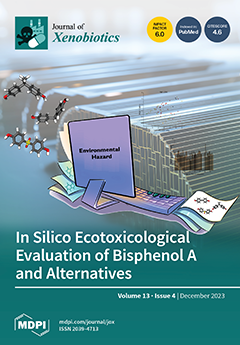
Cover Story: Bisphenol A (BPA), widely used in plastics, resins, and thermal paper, poses environmental and health concerns due to its ubiquity in daily items. Linked to various health issues, there is a need for safer alternatives. While substitutes like BPS and BPF exist, their structural similarity to BPA raises questions about their safety and environmental impact. This study aims to assess the ecotoxicological properties of BPA and its alternatives using in silico tools, focusing on the environmental impact of these compounds, and considering regulatory perspectives. The results of this study highlight specific compounds of potential environmental concern and underscore the need to develop more specific models for BPA alternatives that will allow for more accurate and reliable assessment. View this paper
  • Issues are regarded as officially published after their release is announced to the table of contents alert mailing list .
  • You may sign up for email alerts to receive table of contents of newly released issues.
  • PDF is the official format for papers published in both, html and pdf forms. To view the papers in pdf format, click on the "PDF Full-text" link, and use the free Adobe Reader to open them.

Articles (16)

  • Review
  • Open Access
31 Citations
9,270 Views
36 Pages

Bisphenol A (BPA) and Cardiovascular or Cardiometabolic Diseases

  • Jeong-Hun Kang,
  • Daisuke Asai and
  • Riki Toita

5 December 2023

Bisphenol A (BPA; 4,4′-isopropylidenediphenol) is a well-known endocrine disruptor. Most human exposure to BPA occurs through the consumption of BPA-contaminated foods. Cardiovascular or cardiometabolic diseases such as diabetes, obesity, hyper...

  • Article
  • Open Access
10 Citations
3,324 Views
14 Pages

Micro and Nanoplastic Contamination and Its Effects on Freshwater Mussels Caged in an Urban Area

  • François Gagné,
  • Eva Roubeau-Dumont,
  • Chantale André and
  • Joëlle Auclair

5 December 2023

Plastic-based contamination has become a major cause of concern as it pervades many environments such as air, water, sediments, and soils. This study sought to examine the presence of microplastics (MPs) and nanoplastics (NPs) in freshwater mussels p...

  • Review
  • Open Access
8 Citations
3,614 Views
21 Pages

1 December 2023

Carbon nanotubes and graphene are two types of nanomaterials that have unique properties and potential applications in various fields, including biomedicine, energy storage, and gas sensing. However, there is still a debate about the safety of these...

  • Article
  • Open Access
6 Citations
5,097 Views
21 Pages

23 November 2023

Bisphenol A (BPA), a compound widely used in industrial applications, has raised concerns due to its environmental impact. As a key component in the manufacture of polycarbonate plastics and epoxy resins used in many consumer products, concerns about...

  • Article
  • Open Access
6 Citations
5,135 Views
15 Pages

Chemical Intolerance and Mast Cell Activation: A Suspicious Synchronicity

  • Raymond F. Palmer,
  • Tania T. Dempsey and
  • Lawrence B. Afrin

12 November 2023

Background: Chemical Intolerance (CI) is characterized by intolerances for chemicals, foods, and drugs with multi-system symptoms. As yet, the biomechanism remains unclear. One study reported converging lines of evidence supporting a substantive asso...

  • Article
  • Open Access
8 Citations
2,997 Views
19 Pages

Anthropogenic Microparticles in Sea-Surface Microlayer in Osaka Bay, Japan

  • Mi Zhou,
  • Hirofumi Yanai,
  • Chee Kong Yap,
  • Christina Emmanouil and
  • Hideo Okamura

7 November 2023

The abundance, distribution, and composition of microparticles (MPs) in the sea-surface microlayer (S-SML, less than 100 μm of sea surface in this experiment) and in bulk water (1 m under the sea surface) were investigated to evaluate the pollutio...

  • Article
  • Open Access
7 Citations
2,325 Views
23 Pages

7 November 2023

Titanium oxide nanoparticles can penetrate the blood–brain barrier, infiltrate the central nervous system, and induce neurotoxicity. One of the most often utilized nanoparticles has been investigated for their neurotoxicity in many studies. Non...

  • Communication
  • Open Access
3 Citations
2,096 Views
9 Pages

The Cellular Accumulation of Vehicle Exhaust Particulates Changes the Acidic pH Environment of Lysosomes in BEAS-2B Airway Epithelial Cells

  • Akira Onodera,
  • Takuya Shimomura,
  • Hirohisa Ochi,
  • Ryuto Sunada,
  • Eiko Fukutomi,
  • Koushi Hidaka and
  • Yuichi Kawai

1 November 2023

Many people are exposed every day to vehicle exhaust particulates (VEPs), which are thought to be taken up by epithelial cells that are the first barrier in our biological defense. The study aim was to investigate how VEPs are processed in the lysoso...

  • Article
  • Open Access
2 Citations
3,127 Views
12 Pages

Baccharis Species Essential Oils: Repellency and Toxicity against Yellow Fever Mosquitoes and Imported Fire Ants

  • Abbas Ali,
  • Farhan Mahmood Shah,
  • Jane Manfron,
  • Luciane M. Monteiro,
  • Valter P. de Almeida,
  • Vijayasankar Raman and
  • Ikhlas A. Khan

27 October 2023

Essential oils from five Baccharis species were screened for their toxicity and biting deterrence/repellency against yellow fever mosquito, Aedes aegypti (L.), and imported fire ants, including Solenopsis invicta Buren (RIFA), Solenopsis richteri For...

  • Article
  • Open Access
7 Citations
3,366 Views
16 Pages

Plastic Contamination in Seabass and Seabream from Off-Shore Aquaculture Facilities from the Mediterranean Sea

  • Giacomo Mosconi,
  • Sara Panseri,
  • Stefano Magni,
  • Renato Malandra,
  • Alfonsina D’Amato,
  • Marina Carini,
  • Luca Chiesa and
  • Camilla Della Torre

25 October 2023

We characterized the presence of plastics in different organs of the gilthead seabream (Sparus aurata) and European seabass (Dicentrarchus labrax) from some off-shore aquaculture facilities of the Mediterranean Sea. Plastics were detected in 38% of a...

of 2

Get Alerted

Add your email address to receive forthcoming issues of this journal.

XFacebookLinkedIn
J. Xenobiot. - ISSN 2039-4713