


Abstract
Background/Objectives: Despite recommendations that all hospitalized older adults receive tailored fall-prevention education, studies suggest that many patients at risk of falling do not receive such education. Furthermore, some patients may not recognize having received fall-prevention instructions, potentially limiting their effectiveness. This study examined the proportion of older patients who reported recognizing that they had received fall-prevention instructions from nurses and the characteristics associated with this recognition. Methods: A nationwide online survey was conducted among Japanese adults aged ≥60 years who were currently hospitalized or had been discharged within the previous year. Fall-risk recognition and recognition of fall-prevention instructions received from nurses were assessed by self-report. Latent class analysis identified two fall-risk profile groups, and logistic regression was used to examine factors associated with reported receipt of these instructions. Results: Among 3608 participants, more than 40% reported that they had not recognized receiving fall-prevention instructions. After excluding 395 participants without identified fall-risk factors, fall-risk profile and age were associated with self-reported recognition. Participants with mobility impairment and other risk factors more frequently reported recognizing receipt of instructions than those with other risk factors but no mobility impairment. Conclusions: Whether participants’ reports reflect a lack of instruction provision or poor recall remains unclear. Failure to recognize or receive fall-prevention instructions may limit patients’ ability to implement preventive behaviors. Enhancing nurses’ awareness of fall-risk profiles and providing consistent patient education may improve recognition of fall-prevention instructions and support fall prevention in hospital settings.
1. Introduction
Falls are among the most frequently reported adverse events in healthcare settings worldwide. The Japan Hospital Association reported a fall rate of 2.95 per 1000 patient-days in 2024, with rates of minor and major injurious falls of 0.85 and 0.06 per 1000 patient-days, respectively [1]. Falls occur more frequently among older patients, as reflected in a fall rate of 3.33 per 1000 patient-days in Japan [1]. Other risk factors include a history of falls, impaired motor function or mobility, increased care dependency, mental or behavioral disorders, intravenous lines or tubes, and frequent toileting needs [2,3]. The consequences of falls range from psychological burden (e.g., anxiety and fear of falling again) [4,5] to severe physical injuries (e.g., spinal cord injury and intracranial hemorrhage) and death [6]. Adults aged 60 years and older account for the highest number of fatal falls [7].
1.1. Background
Fall prevention is of paramount importance in healthcare settings, where the risk of life-threatening fall-related injuries is higher than in community settings due to patients’ impaired health status [8]. To reduce falls, clinical guidelines recommend conducting comprehensive fall-risk assessments followed by the implementation of multicomponent, person-tailored interventions, such as exercise programs, medication review, and patient education, in conjunction with universal fall precautions [9,10,11,12]. Among these interventions, patient education has been associated with reductions in fall rates and the odds of falling [13]. Accordingly, the World Guidelines for Falls Prevention and Management for Older Adults strongly recommend providing all hospitalized older adults with tailored fall-prevention education [14]. The Japan Medical Association’s Fall Prevention Manual also recommends providing fall-prevention education to patients and their families, seeking their cooperation, and adapting fall-prevention strategies based on their feedback [15]. However, although patient education is recommended and associated with favorable outcomes, its effectiveness presupposes that patients recognize and internalize the instructions provided.
Nurses play a key role in multidisciplinary efforts to prevent inpatient falls because most falls occur during patients’ daily activities. In Japanese hospitals, fall-prevention education may be provided through written materials, such as brochures, and communication between nurses and patients. However, fall-prevention interventions and education are often inconsistently implemented in nursing care [16,17]. For example, one study conducted in Australia found that of patients identified as being at high risk of falling (60.8%), only 53.7% received fall-prevention nursing care, and just 17.5% received fall-prevention brochures [18]. This gap may partly reflect the lack of systematic integration of fall-prevention education into routine nursing care [19], despite patient education being considered a cost-effective intervention for preventing inpatient falls.
Further complicating this issue is patients’ recognition of fall-prevention education. Recognition involves identifying a particular item or event, which requires the capacity to reidentify it over time [20]. Accordingly, in the present study, recognition is defined as patients’ self-reported identification of having received fall-prevention instructions from nurses. This self-reported recognition reflects, from the patients’ perspective, whether they identify having received fall-prevention education. Conversely, non-recognition may reflect either the absence of education delivery, patients’ failure to notice or recall the education provided, or both. Even when education is delivered, patients may not attend to the information, process it, and encode it (i.e., incorporate it into existing memory structures), thereby limiting its storage in memory [21]. Recognition may therefore be an important step through which educational information may become available for later retention and application. If patients do not recognize that they have received fall-prevention instructions, they may be less able to retain and act on the recommendations. Previous studies have shown that many patients do not recall having conversations with nurses about fall prevention [22] and demonstrate poor retention of educational content [17,23]. These findings highlight the possibility that patients may not always recognize that fall-prevention education has been provided and may experience difficulties retaining its content. Given that approximately 80% of inpatient falls occur in the absence of nurses [6], effective fall prevention in hospital settings largely depends on the extent to which patients recognize and adhere to the fall-prevention education provided by nurses [23].
Despite the importance of understanding patients’ recognition of fall-prevention education, few studies, such as those in the United States and Australia (e.g., [17,22,24]), have examined this issue. Existing studies tend to explore the patients’ perceptions, experiences and evaluation of the content of fall-prevention education they have received [17,25], rather than whether they recognized having received it in the first place. Moreover, even though patients’ recognition has been examined, many of these studies have primarily employed qualitative designs, and their limited sample sizes constrain the generalizability of the findings. Consequently, little is known about patients’ recognition of fall-prevention instructions, particularly in relation to their fall-risk characteristics during hospitalization. Understanding the proportion of patients who recognize fall-prevention instructions provided by nurses, and also their risk characteristics, is essential. This knowledge enables nurses to identify patients who may be left without fall-prevention interventions or who poorly recognize such instructions, thereby helping to prioritize, deliver, and reinforce education in routine care.
1.2. The Study
This study examined the proportion of older patients who recognized that they had received fall-prevention instructions from nurses, and the characteristics associated with this recognition. Specifically, we examined whether recognition of these instructions differed according to patients’ fall-risk profiles, while adjusting for demographic and hospitalization characteristics.
2. Materials and Methods
2.1. Design
A nationwide cross-sectional survey design was used. This study is part of a larger study examining factors associated with patients’ adherence to fall-prevention instructions provided by nurses. The dataset for the present study was derived from a screening survey conducted to identify participants eligible for the main study. Participants who met the eligibility criteria for the main study were subsequently invited to complete an additional survey, the results of which have been published elsewhere [26].
2.2. Sampling and Recruitment
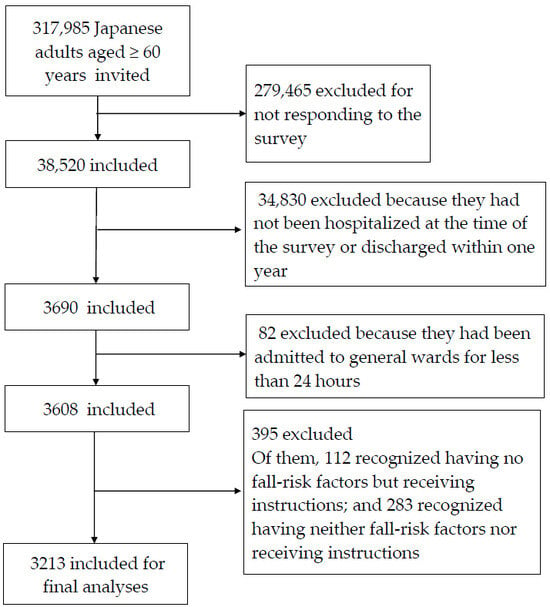
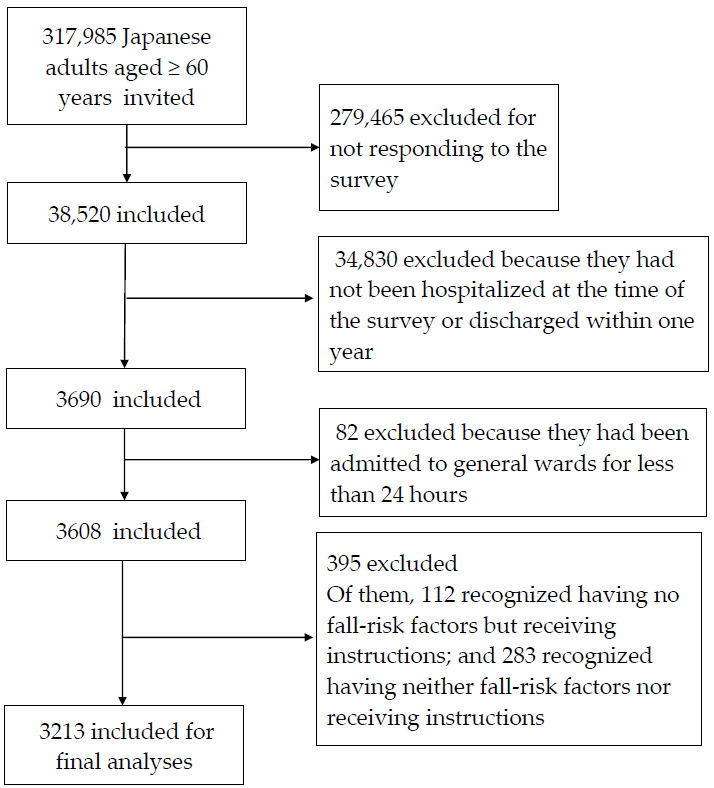
Access to hospitalized patients is often challenging for researchers outside the institution. Therefore, a convenience sample of 317,985 Japanese adults aged 60 years and older who were registered with a survey company was invited to participate in a study examining factors associated with patients’ adherence to fall-prevention instructions provided by nurses. This meant that individuals who were unable to register with the company or complete the questionnaires because of cognitive impairment or blindness were excluded from the study. A total of 38,520 older adults completed a preliminary screening survey to assess eligibility for the main study (response rate: 12.1%). Among those who participated in the screening survey, data from participants who met the following criteria were included in the present analysis:
- Aged 60 years or older;
- Hospitalized at the time of the survey or discharged within one year;
- Admitted to general wards (participants admitted exclusively to intensive care units, coronary care units, high care units, or emergency departments were excluded);
- Had been admitted to general wards for at least 24 h.
Recruitment was conducted in September 2025 through a survey company, which distributed email invitations containing a link to the online survey. The survey company then screened responses for duplicates based on participant-identifying information and removed low-quality responses, including those with the same response option selected consecutively across multiple questions, inappropriate or implausible responses, and responses that were inconsistent with other responses. The company subsequently provided the de-identified dataset to the first author.
2.3. Sample Size and Power
As described below, the present study employed latent class analysis (LCA) and logistic regression analysis. For LCA, simulation studies recommended a sample size of at least 500 to ensure stable class enumeration and parameter estimation [27]. For the logistic regression analysis, the required sample size ranged from 267 to 314 under the assumptions that the odds ratio for the primary independent variable (i.e., risk-profile groups derived from LCA, assuming two groups) was 2.0, the odds ratios for other covariates were 1.0, the intercepts were set at −0.5, 0, and 0.5, the statistical power was 80%, and the significance level was 0.05. Accordingly, a sample size of 500 or more was considered sufficient to perform the analyses described below.
2.4. Instruments
The following questions were administered via an online survey (see Supplementary File Table S1). Participants were instructed to answer the questions based on their most recent hospitalization. A pilot test was not conducted because the items were written in plain language, with vocabulary and expressions consistent with those used in patient-completed questionnaires in Japanese hospitals and the self-rated Fall Risk Questionnaire (FRQ) for older adults [28]. The clarity of the items was further assessed by nursing professionals, as described below.
2.4.1. Demographic Characteristics
Participants were asked to provide demographic information, including sex and age, as well as hospitalization characteristics, including length of stay (one night/two days, two nights/three days, or more than three days) and hospitalization status (currently hospitalized or discharged within the past 3, 6, 9, or 12 months). All questions used a single-answer format, and participants were instructed to select one response that best described their circumstances.
2.4.2. Fall-Risk Factors
Fall-risk factors were defined as factors that increase the risk of falling and that participants reported experiencing during hospitalization. Participants were asked to select all conditions applicable to their physical, mental, and treatment-related status during hospitalization from a predefined list of fall-risk factors (e.g., history of falls, presence of comorbidities, ability to ambulate; see Supplementary File Table S1). The list of fall-risk factors was developed through an extensive literature review, including major causes of inpatient falls reported to Japan’s national incident reporting registry [6] and fall-risk factors considered important by Japanese nurses [29]. The list was also informed by the existing fall-risk assessment scales, including the Morse Fall Scale [30] and STRATIFY Risk Assessment Tool [31]. In addition, three nursing professionals with more than 30 years of clinical experience, including experience in roles as Nurse Unit Managers and Director of Nursing, reviewed the items for relevance, clarity, and ease of response. Exploratory factor analysis was conducted to examine the construct validity of the questionnaire, yielding a two-factor structure: mobility-related issues and other issues (see Supplementary File Table S2). McDonald’s omega was 0.63.
2.4.3. Fall-Prevention Instructions Provided by Nurses
Fall-prevention instructions were defined as those participants self-reported recognizing as having received from nurses during hospitalization. Participants were asked to select all fall-prevention instructions they believed they had received from nurses during hospitalization from a predefined list (e.g., call nurses for assistance, use walking aids: see Supplementary File Table S1). This list was developed through a literature review and refined based on input from three nursing professionals and six additional nursing professionals, each with more than 20 years of clinical experience, managerial experience, and expertise in risk management. These individuals were identified as appropriate contributors by the Director of Nursing of a tertiary hospital. Exploratory factor analysis was conducted to examine the construct validity of the questionnaire and supported a one-factor solution (see Supplementary File Table S3). McDonald’s omega was 0.73.
2.5. Data Analysis
Descriptive statistics were calculated to summarize participants’ fall-risk factors and their recognition of fall-prevention instructions. To examine the association between participants’ recognition of fall-prevention instructions and their fall-risk characteristics, while accounting for demographic and hospitalization characteristics, a three-step analytic approach was used. First, LCA was conducted to classify participants into homogeneous risk-profile groups. This approach was adopted because nurses’ provision of patient education may vary according to patients’ fall-risk characteristics, and patients often present with multiple risk factors simultaneously. Prior to the LCA, the frequencies of fall-risk factors were examined, and factors with prevalences below 10% were excluded in accordance with the recommendation of Sinha et al. [27]. This recommendation is based on the concern that a very small category can sometimes create an artificial class, with the analysis simply separating the few people who belong to that unusual category. Next, multicollinearity was assessed. None of the correlations among the remaining risk factors exceeded 0.80, and all variance inflation factors (VIFs) were below 5. LCA models with progressively increasing numbers of classes were then fitted, and model selection was guided by the Bayesian information criterion (BIC), Akaike information criterion (AIC), Lo–Mendell–Rubin adjusted likelihood ratio test (LMR-LRT), and entropy. Lower AIC and BIC values and a significant LMR-LRT were considered evidence favoring a model with more classes, while entropy above 0.80 indicated good classification precision. Class membership probabilities and class-specific item-response probabilities were also estimated.
Second, logistic regression analysis was performed to examine whether recognition of receiving fall-prevention instructions differed according to identified risk-profile groups, while adjusting for demographic and hospitalization characteristics. In addition, chi-square tests were conducted to compare recognition of fall-prevention instructions between the risk-profile groups across different hospitalization status categories. Prior to conducting the analyses, the assumptions underlying the logistic regression and chi-squared tests were assessed. For the logistic regression analysis, no evidence of multicollinearity was observed, with tetrachoric and point-biserial correlation coefficients below 0.80, and VIFs below 5. Linearity in the logit was confirmed for the continuous independent variable. No strongly influential observations were identified, as there were no outlying Pregibon’s delta-beta values, and all leverage values were below three times the average leverage. For the chi-squared tests, all expected cell frequencies were greater than 5.
Third, the specific fall-prevention instructions that participants reported recognizing as having received were examined and compared across risk-profile groups. All analyses were conducted using Stata version 19 (StataCorp, College Station, TX, USA). The significance level was set at 0.05 (two-tailed) for all analyses.
2.6. Ethical Considerations
This study was approved by the Ethics Committee of Yasuda Women’s University (Approval No. 250008) and adhered to standard ethical principles. The purpose and procedures of the study were explained to participants, and all provided informed consent to participate in the study by checking the “Agree to participate” box in the survey questionnaire. The participants remained anonymous and took part voluntarily, receiving small incentives for their involvement (approximately US $0.01).
3. Results
A total of 3608 participants met the inclusion criteria and completed the survey. No participants were excluded because of missing data. Of these, 1310 (36.31%) reported that they had recognized having fall-risk factors but had not recognized receiving fall-prevention instructions from nurses, whereas 1903 (52.74%) reported that they had recognized both having fall-risk factors and receiving instructions. In addition, 112 (3.10%) reported that they had recognized receiving instructions despite not recognizing any fall-risk factors, and 283 (7.84%) reported that they had recognized neither having fall-risk factors nor receiving instructions. Overall, 1593 (44.15%) participants reported that they had not recognized receiving any fall-prevention instructions. Participants who reported no fall-risk factors were excluded from the LCA and subsequent analyses because the analysis aimed to examine whether recognition of fall-prevention instructions differed according to patients’ fall-risk characteristics. After excluding the no-risk group, the final analytic sample comprised 3213 participants (Figure 1).
Figure 1.
Participant flow diagram.
Participant demographic characteristics are presented in Table 1. The sample was predominantly male (74.51%), with a mean age of 70.61 years. Only a small proportion of participants (2.15%) were hospitalized at the time of the survey, reflecting the difficulty of responding during active treatment. Most participants (77.47%) had hospital stays longer than three days. On average, participants reported 2.76 fall-risk factors (SD = 1.91, range: 1–11) and recognized having received 1.82 fall-prevention instructions (SD = 2.34, range: 0–12).
Table 1.
Demographic variables of the participants.
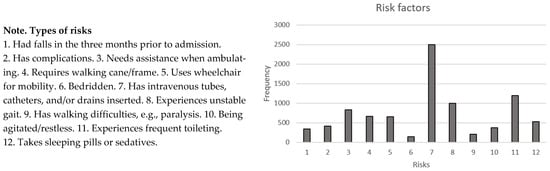
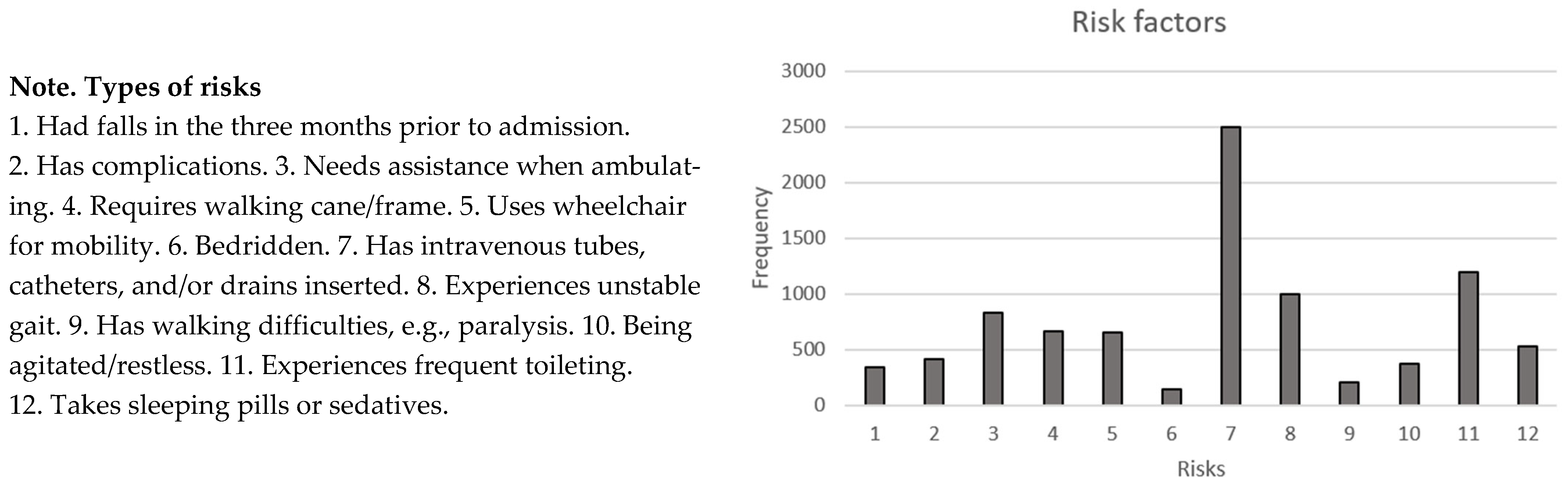
As shown in Figure 2, most participants (77.9%) reported having intravenous tubes, catheters, and/or drains inserted during hospitalization. The second-most frequently recognized risk factor was frequent toileting (37.3%). Mobility-related issues were also frequently reported, including an unstable gait (31.0%), needing assistance when walking (25.9%), and using a cane or frame (20.6%) or a wheelchair (20.4%). In contrast, only 10.5% of participants reported having experienced a fall in the three months before admission.
Figure 2.
Frequencies of types of risks recognized.
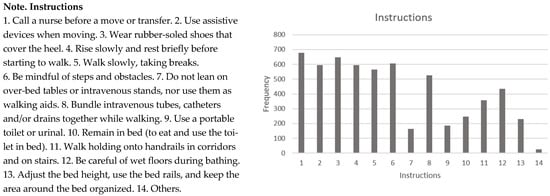
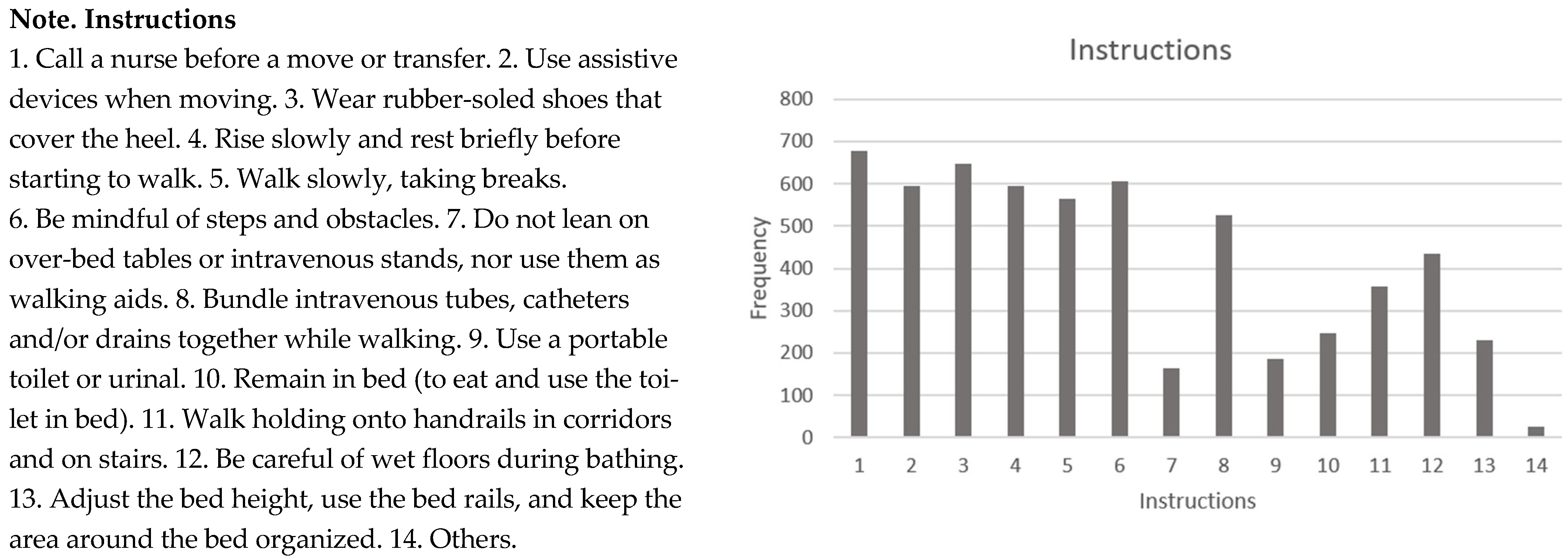
The most frequently recognized instruction from nurses was to call a nurse before moving or transferring (21.1%). Other commonly recognized instructions concerned safe ambulation, including wearing rubber-soled shoes that cover the heel (20.1%), watching for steps and obstacles (18.9%), rising slowly and resting briefly before walking (18.5%), and using walking aids when moving (18.5%) (Figure 3).
Figure 3.
Frequencies of instructions recognized.
LCA was conducted to identify distinct participant groups based on fall-risk factors. Prior to analysis, fall-risk factors with prevalences below 10%—including being bedridden, and walking difficulties (e.g., paralysis)—were excluded. Models specifying one to three latent classes were estimated and compared using the AIC, BIC, entropy, and the LMR-LRT (Table 2). Model fit improved substantially from the one-class to the two-class solution, as indicated by lower AIC and BIC values and a significant LMR-LRT (p < 0.001). Although the three-class solution had lower AIC and BIC values and a significant LMR-LRT, the reductions in AIC and BIC from the two-class to the three-class solution were small compared with the marked reductions from the one-class to the two-class solution. Moreover, the two-class solution showed better classification quality, as indicated by its higher entropy (0.826 vs. 0.719). The two-class solution yielded clinically interpretable and distinct fall-risk profiles, whereas the additional class in the three-class solution did not represent a sufficiently distinct clinical pattern. Therefore, the two-class solution was retained for subsequent analyses. The remaining LCA results are presented in Supplementary File Table S4.
Table 2.
Comparison of latent class models used to identify fall-risk profile groups.
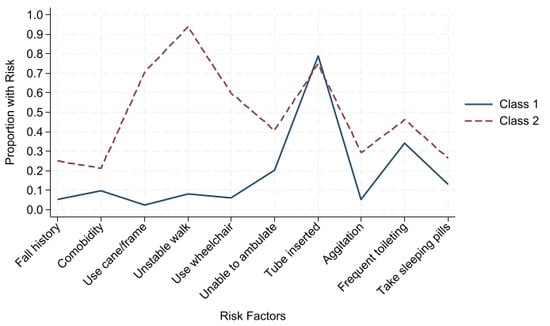
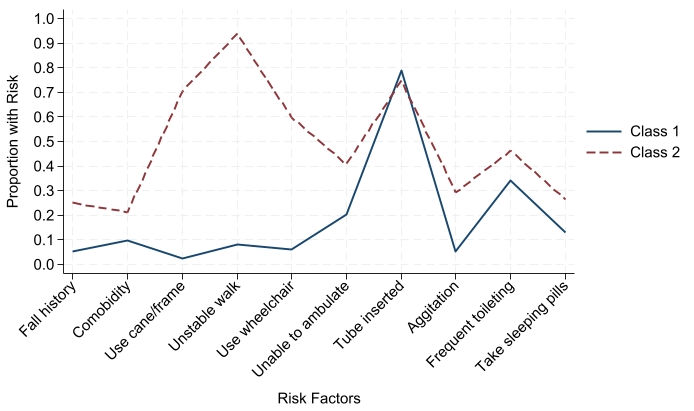
Latent class marginal probability of Class 1 was 0.724 (Delta-method standard error = 0.011, 95% CI = [0.702, 0.745]), while that of Class 2 was 0.276 (Delta-method standard error = 0.011, 95% CI = [0.255, 0.298]). The identified classes reflected distinct fall-risk profiles. In Class 1 (N = 2355), most participants had intravenous tubes, catheters and/or drains in situ, and approximately 30% reported frequent voiding. In Class 2 (N = 858), participants commonly had intravenous tubes, catheters and /or drains, and reported frequent toileting. In addition, the majority of participants in Class 2 recognized mobility-related issues, such as unstable gait and the use of a cane or wheelchair (Figure 4).
Figure 4.
Two-class solution of LCA based on risk factors.
Because being bedridden and having difficulty walking (e.g., due to paralysis) were excluded from the LCA, a sensitivity analysis was conducted to examine whether their exclusion affected the findings. To avoid creating an artificial class comprising only a small number of participants, these risk factors were combined with unstable gait to form a new category, “mobility issues,” as recommended by Sinha et al. [27]. The LCA was then repeated using this revised category. The results are presented in Supplementary File Table S5 and Figure S1. The class profiles and distribution of participants across classes were almost identical to those obtained in the original analysis. The findings suggest that excluding these risk factors had little impact on the results. Therefore, subsequent analyses were conducted using the original LCA classification.
Logistic regression analysis examined whether participants’ recognition of fall-prevention instructions differed between the two risk-profile classes, while adjusting for demographic and hospitalization characteristics (Table 3). Membership in Class 2 was associated with substantially higher odds of recognizing receipt of fall-prevention instructions compared with Class 1 (OR = 10.488, 95% CI = [8.194, 13.423]). Age was also positively associated with recognition, with each additional year corresponding to a modest increase in odds (OR = 1.014, 95% CI = [1.002, 1.026]). Hospitalization status and length of hospitalization were not associated with recognition of fall-prevention instructions. The model showed a McFadden’s pseudo-R2 of 0.131, indicating moderate improvement in fit over the null model.
Table 3.
Results of logistic regression analysis.
Chi-square tests further indicated significant differences between the two classes. Overall, 1231 participants (52.27%) in Class 1 did not recognize having received instructions, compared with 79 (9.21%) in Class 2 (χ2(1) = 482.96, p < 0.001). This pattern was observed regardless of participants’ hospitalization status. Chi-square tests were conducted separately for each hospitalization status, with Bonferroni correction applied to the five comparisons. Among currently hospitalized participants, 44.68% of those in Class 1 reported not recognizing having received fall-prevention instructions, compared with 9.09% of those in Class 2 (χ2(1) = 8.54, Bonferroni-corrected p = 0.017). Similar findings were observed among participants discharged within the previous 3 months (53.56% vs. 6.53%; χ2(1) = 139.28, Bonferroni-corrected p < 0.001), 6 months (53.97% vs. 11.52%; χ2(1) = 102.82, Bonferroni-corrected p < 0.001), 9 months (51.99% vs. 8.87%; χ2(1) = 68.45, Bonferroni-corrected p < 0.001), and 12 months (50.62% vs. 9.63%; χ2(1) = 162.42, Bonferroni-corrected p < 0.001).
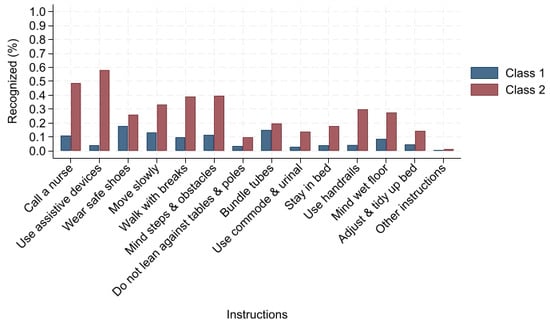
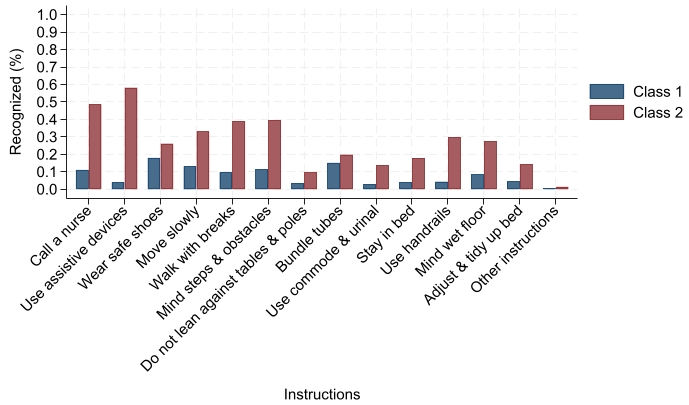
Figure 5 illustrates the proportions of participants in each class who reported recognizing specific fall-prevention instructions. Approximately 60% of participants in Class 2 recognized having received instructions on using assistive devices. Nearly 50% also recognized instructions to call nurses before moving or transferring. Approximately 40% recognized having received instructions to take breaks while walking and to watch for steps and obstacles. In Class 1, the most frequently recognized instruction was to wear rubber-soled shoes that cover the heel (safer footwear). Although most participants in both classes had intravenous tubes, catheters and/or drains, only 10–20% recognized having received instructions to bundle these devices.
Figure 5.
Proportion of participants who reported recognizing that they had received fall-prevention instructions from nurses across the risk-profile groups.
4. Discussion
This study examined patients’ recognition of fall-prevention instructions provided by nurses in relation to their fall-risk profiles. Several findings deserve attention. First, participants reported recognizing multiple fall-risk factors and receiving multiple fall-prevention instructions. Although previous studies have not reported the number of fall-prevention instructions provided to individual patients, they have consistently shown that hospitalized patients often present with multiple fall-risk factors. For example, Silva et al. [32] reported that 59.2% of patients who experienced a fall had two or more fall-risk factors. Similarly, Hendrich et al. [33] found that 36% of patients had multiple fall-risk factors, as indicated by Hendrich II Fall Risk Model scores of ≥5, suggesting that these risks may not be adequately managed during hospitalization. Thus, the multiple instructions reported by participants may reflect the need to address multiple fall-risk factors.
Furthermore, the present study found that the most frequently recognized fall-risk factor was the presence of intravenous tubes, catheters and/or drains, followed by frequent toileting and an unstable gait. These factors have consistently been identified as important contributors to inpatient falls [34,35]. Notably, one previous study reported that patients with an intravenous injection site had a fall rate 124.03 times higher than those without an intravenous injection site. This association may reflect the greater likelihood of intravenous therapy among patients with more severe conditions, as well as the potential for intravenous pole stands to pose tripping hazards during ambulation [36]. Given that 70–80% of participants in the present study had at least one tube or catheter in place, along with advanced age and other fall-risk factors, their potential risk of falls should not be overlooked.
Nevertheless, the findings indicated that more than 40% of the 3608 participants reported that they had not recognized receiving fall-prevention instructions from nurses. An Australian study (n = 11) reported that fewer than half of the patients described receiving verbal advice or instructions from staff, usually nurses [17]. A US study reported that 9 of 10 patients (n = 10) did not recognize having received fall-prevention education [24]. Although the proportions varied across studies, the findings of the present study were consistent with those of the Australian study. In all the studies, it remains unclear whether the lack of recognition reflects the absence of instruction or participants’ failure to recall or notice it. Regardless of the reason, such a situation may increase fall risk, as patients in hospital settings—who are indispensable partners in hospital fall-prevention strategies—are unable to implement necessary precautions [23]. To increase patients’ recognition of having received fall-prevention instructions, interventions should target both nurses and patients.
First, support for nurses should emphasize education on evidence-based fall-risk factors and the selection of appropriate fall-prevention strategies. The findings showed that while 90% of participants with mobility impairment recognized that they had received fall-prevention instructions, only about half of those without mobility impairment did so. This disparity may reflect nurses’ stronger focus on mobility-related risks compared with other risk factors, such as the presence of intravenous tubes or frequent toileting. Given that mobility impairment has been consistently identified as a major contributor to patient falls [2,3], nurses may have classified participants in Class 2 as a high-risk group. However, patients requiring only minimal assistance with transfers still experience falls [37], and because these relatively independent patients tend to engage in higher levels of activity than those with lower transfer ability, they are more likely to sustain severe injuries [37]. Moreover, Montero-Odasso et al. [38] reported that although fall rates were higher among at-risk patients, the larger number of patients classified as no-risk resulted in more frequent falls in this group overall. Therefore, regardless of the presence or type of fall risk, universal fall precautions are warranted [12]. In particular, tailored fall-prevention education for older adults is essential [14], and these considerations should be incorporated into nursing education on fall-prevention interventions.
Healthcare organizations should also support nurses in delivering fall-prevention education. Heng et al. [16] identified staff attitudes toward evidence implementation, limited interprofessional collaboration, and time constraints as barriers to nurses’ delivery of fall-prevention education. Although length of hospital stay was not associated with participants’ recognition of having received fall-prevention instructions, participants in Class 1 may have had shorter hospital stays. This may have left nurses with less time to provide fall-prevention education. Therefore, healthcare organizations should prioritize system-level strategies. These include allocating protected time, and standardizing brief fall-prevention education—to ensure that even low-risk older adults/patients receive timely instruction.
In addition, it is important to help patients attend to and retain fall-prevention instructions provided by nurses. Individuals do not process all the information presented to them. Instead, they selectively attend to certain information to avoid cognitive overload, potentially missing other information [39]. During hospitalization, patients receive substantial amounts of information, which may make it difficult for them to attend to all relevant details. In particular, when individuals perceive a threat and experience anxiety or stress, their attentional control [40] and ability to retrieve information [41] may be impaired. Consequently, some patients may not have recognized the fall-prevention instructions provided by nurses.
Previous studies have consistently shown that patients often have poor retention of educational content [17,23] and may not recall discussions with nurses about fall prevention [22]. Older patients, in particular, are more likely to experience age-related declines in memory, while inconsistent instructions from different nurses may further reduce their understanding and recall. Communication breakdowns between patients and nurses may also prevent patients from recognizing fall-prevention interventions. For example, Yanan et al. [42] reported that nurses had implemented fall-prevention strategies without patients’ knowledge because the purpose of these interventions had not been explained. Similarly, instructions such as “Bundle intravenous tubes, catheters and/or drains together while walking” may not be recognized by patients as fall-prevention advice unless nurses explicitly explain their preventive purpose. Furthermore, patients prefer fall-prevention education to be delivered through face-to-face discussions with nurses that provide opportunities to ask questions [24]. Such an approach may enhance patients’ recognition and retention of fall-prevention education by facilitating interactive communication. Therefore, ongoing patient education, clear explanations of the purpose of fall-prevention interventions, and consistent, discussion-based communication are essential for improving patients’ recognition of fall-prevention instructions.
Patients’ recognition of fall-prevention instructions is a prerequisite for engaging in the recommended preventive behaviors. Without recognizing these instructions, patients are unlikely to implement them, limiting the potential effectiveness of nurses’ fall-prevention efforts. However, recognition alone is insufficient. To engage in the recommended behaviors, patients must also be motivated to follow the instructions. In our main study, patients’ perceptions of the effectiveness of fall-prevention instructions and their self-efficacy in performing recommended behaviors were key factors associated with protection motivation, while self-efficacy and protection motivation were positively associated with the adoption of fall-preventio n behaviors [26]. In particular, higher self-efficacy may help patients cope with the challenges of implementing these behaviors in everyday situations [26]. Therefore, nurses should not only ensure that patients recognize fall-prevention instructions but should also provide ongoing encouragement to strengthen patients’ self-efficacy and motivation to implement the recommended behaviors.
Limitations
This study has several limitations. First, the sample was predominantly male, whereas national data from Japan indicate no substantial gender imbalance among older hospitalized patients [43]. This was likely because the survey company’s pool of registrants aged ≥60 years was predominantly male, resulting in a corresponding predominance of male participants in our sample. In addition, the study included only participants who were able to complete an online survey, thereby excluding those with severe cognitive impairment. Consequently, the sample may not be representative of the broader population of older hospitalized patients in Japan, thereby limiting the generalizability of the findings.
Second, this study examined participants’ recognition of fall-prevention instructions provided by nurses. Because the participants were aged 60 years and older, the findings may be susceptible to recall bias. As discussed earlier, patients often have poor retention of fall-prevention education; therefore, some instructions recognized during hospitalization may have been forgotten after discharge. However, the influence of recall bias may have been limited because hospitalization status (i.e., currently hospitalized or discharged) was not associated with participants’ recognition of fall-prevention instructions.
Third, participants’ self-identification of fall-risk factors may not accurately reflect their actual status. For example, their responses may have been influenced by overconfidence and social desirability bias. Previous studies have shown that older adults often overestimate their physical abilities and consequently underestimate their risk of falling [44]. Some patients may also underreport their fall risks due to social desirability. As a result, some participants classified in Class 1 may have been more appropriately classified in Class 2. Moreover, the questionnaire may not have captured all fall risks experienced during hospitalization. To reduce the burden of completing the questionnaire, the number and types of items were limited to major fall-risk factors that participants could report based on their own experiences (e.g., unsteady walking and frequent toileting). In addition, two items were removed during factor analysis because of multicollinearity or low factor loadings. Consequently, participants’ fall risks may have been underrepresented. Furthermore, the questionnaire was not pilot-tested, and some participants may therefore have experienced difficulties understanding or answering certain questions.
Fourth, the internal consistency of the fall risk questionnaire was moderate. However, this does not necessarily indicate that the questionnaire lacks validity. Rather, it may reflect the heterogeneous nature of fall-risk factors, some of which are not necessarily associated with one another, whereas others may be intercorrelated. For example, the item “having intravenous tubes, catheters and/or drains inserted” was weakly and negatively correlated with the other items, thereby reducing inter-item correlations. This finding may be partly explained by the distribution of the reported risks: most participants had tubes, catheters, and/or drains inserted, whereas only a small proportion reported other risk factors, such as mobility-related difficulties. Therefore, additional reliability testing, such as test–retest reliability, may be necessary to further establish the questionnaire’s reliability.
Fifth, this study examined whether recognition of the instructions differed according to participants’ fall-risk profiles, while adjusting for demographic and hospitalization characteristics. Given that the study used a cross-sectional design, the findings establish only associations and do not support causal inferences. Moreover, other potential confounding variables may have influenced the observed association between patients’ fall-risk profiles and their recognition of receiving these instructions. For instance, patients’ recognition of fall-prevention instructions may vary according to their cognitive status, comorbidities, experience of falls during hospitalization, and reasons for hospitalization. Therefore, the possibility that some confounding effects remained after adjustment cannot be excluded, and the findings should be interpreted with caution.
Finally, this study cannot determine whether participants’ recognition of not receiving fall-prevention instructions reflects the absence of education, a failure to notice or remember the education provided, or a combination of both. Distinguishing these underlying reasons is important because it would allow nurses to identify patients who received fall-prevention education but did not recognize it and to provide additional education or clarification as needed. Future research should examine the proportion of patients who actually receive fall-prevention instructions from nurses and the extent to which patients recognize having received them. It would also be valuable to investigate which educational modalities (e.g., verbal instructions, written materials, or videos) are associated with greater patient recognition. Moreover, identifying factors associated with patients’ failure to notice or recognize fall-prevention education is essential. Such evidence could help nurses identify patients at risk of non-recognition and develop strategies to improve the effectiveness of fall-prevention education.
5. Conclusions
Although patient education is effective in preventing inpatient falls, a substantial proportion of older adults with recent hospitalization experience did not recognize that they had received such education. Although causal relationships cannot be established, this lack of recognition was particularly evident among patients without mobility impairment. Enhancing nurses’ awareness of fall risks, strengthening organizational system-level strategies, and delivering continuous and consistent patient education may improve patients’ recognition of fall-prevention instructions and help reduce fall risk. Because recognizing fall-prevention instructions is a prerequisite for patients to act on them, improving recognition should be considered an integral component of patient-centered fall-prevention programs.
Supplementary Materials
The following supporting information can be downloaded at https://www.mdpi.com/article/10.3390/nursrep16110397/s1. Table S1: Survey questions included in this study; Table S2: Exploratory factor analysis of the fall-risk factor questionnaire; Table S3: Exploratory factor analysis of the fall-prevention instruction questionnaire; Table S4: Logit estimates and estimated item-response probabilities; Table S5: Sensitivity analysis of latent class analysis (LCA) combining being bedridden, having difficulty walking (e.g., due to paralysis), and having an unstable gait into a single risk category (“mobility issues”); Figure S1: Two-class solution of LCA based on the sensitivity analysis.
Author Contributions
Conceptualization, M.T.; methodology, M.T.; formal analysis, M.T.; investigation, M.T., N.K., Y.S.; data curation, M.T.; writing—original draft preparation, M.T.; writing—review and editing, N.K., Y.S., M.Y.; project administration, M.T.; funding acquisition, M.T. All authors have read and agreed to the published version of the manuscript.
Funding
This study was funded by the Japan Society for the Promotion of Science (JSPS KEKENHI), Grants-in-Aid for Scientific Research, grant number 22K10749.
Institutional Review Board Statement
The study was conducted in accordance with the Declaration of Helsinki, and approved by the Ethics Committee of Yasuda Women’s University (protocol code 250008 approved on 29 July 2025).
Informed Consent Statement
Digital informed consent was obtained from all subjects involved in the study.
Data Availability Statement
The datasets presented in this article are not readily available because the participants were assured raw data would remain confidential and would not be shared.
Conflicts of Interest
The authors declare no conflicts of interest. The funders had no role in the design of the study; in the collection, analyses, or interpretation of data; in the writing of the manuscript; or in the decision to publish the results.
Public Involvement Statement
No public involvement in any aspect of this research.
Guidelines and Standards Statement
This manuscript was drafted against the Strengthening the Reporting of Observational Studies in Epidemiology (STROBE) reporting guideline for cross-sectional studies.
Use of Artificial Intelligence
During the preparation of this manuscript, the authors used ChatGPT (GPT-6, OpenAI, CA, USA) to improve the English language and enhance the readability and clarity of the text through minor rephrasing. The tool was used solely for language editing and was not used to generate or add scientific content. After using this tool, the authors carefully reviewed and edited the manuscript as necessary and take full responsibility for its content. The final manuscript was also reviewed by a native English-speaking professional proofreader.
Abbreviations
The following abbreviations are used in this manuscript:
| LCA | Latent class analysis |
| BIC | Bayesian information criterion |
| AIC | Akaike information criterion |
| LMR-LRT | Lo–Mendell–Rubin adjusted likelihood ratio test |
| OR | Odds ratio |
| CI | Confidence interval |
| VIF | Variance inflation factor |
References
- Japan Hospital Association. QI Project Report; Japan Hospital Association: Tokyo, Japan, 2024. [Google Scholar]
- Bernet, N.S.; Everink, I.H.; Schols, J.M.; Halfens, R.J.; Richter, D.; Hahn, S. Hospital performance comparison of inpatient fall rates; the impact of risk adjusting for patient-related factors: A multicentre cross-sectional survey. BMC Health Serv. Res. 2022, 22, 225. [Google Scholar] [CrossRef] [Scilit]
- Satoh, M.; Miura, T.; Shimada, T. Development and evaluation of a simple predictive model for falls in acute care setting. J. Clin. Nurs. 2023, 32, 6474–6484. [Google Scholar] [CrossRef] [Scilit]
- Miake-Lye, I.M.; Hempel, S.; Ganz, D.A.; Shekelle, P.G. Inpatient fall prevention programs as a patient safety strategy: A systematic review. Ann. Inter. Med. 2013, 158, 390–396. [Google Scholar] [CrossRef] [Scilit]
- World Health Organization. WHO Global Report on Falls Prevention in Older Age. 2007. Available online: https://www.who.int/publications/i/item/9789241563536 (accessed on 03 March 2026).
- Takase, M. Falls as the result of interplay between nurses, patient and the environment: Using text-mining to uncover how and why falls happen. Int. J. Nurs. Sci. 2023, 10, 30–37. [Google Scholar] [CrossRef] [Scilit]
- World Health Organization. Falls. Available online: https://www.who.int/news-room/fact-sheets/detail/falls#:~:text=Key%20facts,greatest%20number%20of%20fatal%20falls (accessed on 10 April 2026).
- Johal, K.S.; Boulton, C.; Moran, C.G. Hip fractures after falls in hospital: A retrospective observational cohort study. Injury 2009, 40, 201–204. [Google Scholar] [CrossRef] [Scilit]
- Schoberer, D.; Breimaier, H.E.; Zuschnegg, J.; Findling, T.; Schaffer, S.; Archan, T. Fall prevention in hospitals and nursing homes: Clinical practice guideline. Worldviews Evid. Based Nurs. 2022, 19, 86–93. [Google Scholar] [CrossRef] [Scilit]
- Registered Nurses’ Association of Ontario. Preventing Falls and Reducing Injury from Falls; Registered Nurses’ Association of Ontario: Toronto, ON, Canada, 2017. [Google Scholar]
- National Institute for Health and Care Excellence. Falls: Assessment and Prevention in Older People and in People 50 and over at Higher Risk; National Institute for Health and Care Excellence: Manchester, UK, 2025. [Google Scholar]
- Agency for Healthcare Research and Quality. Preventing Falls in Hospitals: A Toolkit for Improving Quality of Care. Available online: https://www.ahrq.gov/sites/default/files/publications/files/fallpxtoolkit_0.pdf (accessed on 24 March 2026).
- Morris, M.E.; Webster, K.; Jones, C.; Hill, A.M.; Haines, T.; McPhail, S.; Kiegaldie, D.; Slade, S.; Jazayeri, D.; Heng, H.; et al. Interventions to reduce falls in hospitals: A systematic review and meta-analysis. Age Ageing 2022, 51, afac077. [Google Scholar] [CrossRef] [Scilit]
- Montero-Odasso, M.; van der Velde, N.; Martin, F.C.; Petrovic, M.; Tan, M.P.; Ryg, J.; Aguilar-Navarro, S.; Alexander, N.B.; Becker, C.; Blain, H.; et al. World guidelines for falls prevention and management for older adults: A global initiative. Age Ageing 2022, 51, 1501. [Google Scholar] [CrossRef] [Scilit]
- Japan Medical Association. For Healthcare Professionals: A Manual on Patient Safety Measures; Japan Medical Association: Tokyo, Japan, 2007. [Google Scholar]
- Heng, H.; Kiegaldie, D.; Shaw, L.; Jazayeri, D.; Hill, A.M.; Morris, M.E. Implementing patient falls education in hospitals: A mixed-methods trial. Healthcare 2022, 10, 1298. [Google Scholar] [CrossRef] [Scilit]
- Heng, H.; Slade, S.C.; Jazayeri, D.; Jones, C.; Hill, A.M.; Kiegaldie, D.; Shorr, R.I.; Morris, M.E. Patient perspectives on hospital falls prevention education. Front. Public Health 2021, 9, 592440. [Google Scholar] [CrossRef] [Scilit]
- Yasan, C.; Burton, T.; Tracey, M. Nurses’ documentation of falls prevention in a patient centred care plan in a medical ward. Aust. J. Adv. Nurs. 2020, 37, 19–24. [Google Scholar] [CrossRef] [Scilit]
- Loo, C.Y.; Coulter, S.; Watson, C.; Vaz, S.; Morris, M.E.; Flicker, L.; Weselman, T.; Hill, A.M. Patient safety is our business! Staff perspectives on implementing hospital falls prevention education. Health Promot. Int. 2025, 40, daae200. [Google Scholar] [CrossRef] [Scilit]
- Strawson, P.F. Individuals: An Essay in Descriptive Metaphysics; Methuen & Co LTD: London, UK, 1959. [Google Scholar]
- Gurbin, T. Enlivening the machinist perspective: Humanising the information processing theory with social and cultural influences. Procedia Soc. Behav. Sci. 2015, 197, 2331–2338. [Google Scholar] [CrossRef] [Scilit]
- Shuman, C.; Liu, J.; Montie, M.; Galinato, J.G.; Todd, M.A.; Hegstad, M.; Titler, M. Patient perceptions and experiences with falls during hospitalization and after discharge. Appl. Nurs. Res. 2016, 31, 79–85. [Google Scholar] [CrossRef] [Scilit]
- Lim, M.L.; Ang, S.G.M.; Teo, K.Y.; Wee, Y.H.C.; Yee, S.P.; Lim, S.H.; Ang, S.Y. Patients’ experience after a fall and their perceptions of fall prevention: A qualitative study. J. Nurs. Care Qual. 2018, 33, 46–52. [Google Scholar] [CrossRef] [Scilit]
- Collins, C.E.; Schultz, K.; Mathew, P.; Chandra, A.; Nguyen, B.; Chen, T.; Renshaw, S.; Rose, K.M.; Santry, H.P. A personalized approach empowering successful aging: Patient perspective on fall prevention education. PM&R 2022, 14, 786–792. [Google Scholar] [CrossRef] [Scilit]
- Kiyoshi-Teo, H.; Northrup-Snyder, K.; Robert Davis, M.; Garcia, E.; Leatherwood, A.; Izumi, S. Qualitative descriptions of patient perceptions about fall risks, prevention strategies and self-identity: Analysis of fall prevention Motivational Interviewing conversations. J. Clin. Nurs. 2020, 29, 4281–4288. [Google Scholar] [CrossRef] [Scilit]
- Takase, M. Decoding why patients follow-or do not follow-fall-prevention instructions using the revised protection motivation theory: A cross-sectional study employing partial least squares structural equation modelling. Int. J. Nurs. Stud. 2026, 179, 105535. [Google Scholar] [CrossRef] [Scilit]
- Sinha, P.; Calfee, C.S.; Delucchi, K.L. Practitioner’s guide to latent class analysis: Methodological considerations and common pitfalls. Crit. Care Med. 2021, 49, e63–e79. [Google Scholar] [CrossRef] [Scilit]
- Rubenstein, L.Z.; Vivrette, R.; Harker, J.O.; Stevens, J.A.; Kramer, B.J. Validating an evidence-based, self-rated fall risk questionnaire (FRQ) for older adults. J. Saf. Res. 2011, 42, 493–499. [Google Scholar] [CrossRef] [Scilit]
- Takase, M.; Kisanuki, N.; Sato, Y.; Mitsunaka, K.; Yamamoto, M. Cognitive biases and contextual factors explaining variability in nurses’ fall risk judgements: A multi-centre cross-sectional study. Int. J. Nurs. Stud. Adv. 2025, 8, 100356. [Google Scholar] [CrossRef] [Scilit]
- Morse, J.M.; Morse, R.M.; Tylko, S.J. Development of a scale to identify the fall-prone patient. Can. J. Aging 1989, 8, 366–377. [Google Scholar] [CrossRef] [Scilit]
- Oliver, D.; Britton, M.; Seed, P.; Martin, F.C.; Hopper, A.H. Development and evaluation of evidence based risk assessment tool (STRATIFY) to predict which elderly inpatients will fall: Case-control and cohort studies. BMJ (Clin. Res. Ed.) 1997, 315, 1049–1053. [Google Scholar] [CrossRef] [Scilit]
- Silva, A.K.M.; Costa, D.; Reis, A.M.M. Risk factors associated with in-hospital falls reported to the Patient Safety Commitee of a teaching hospital. Einstein 2019, 17, eAO4432. [Google Scholar] [CrossRef] [Scilit]
- Hendrich, A.L.; Bufalino, A.; Groves, C. Validation of the Hendrich II Fall Risk Model: The imperative to reduce modifiable risk factors. Appl. Nurs. Res. 2020, 53, 151243. [Google Scholar] [CrossRef] [Scilit]
- Bian, W.-F.; Liu, X.-J.; Wang, L.-Y.; Zhao, W.; Ye, H. Identifying Risk Factors for Fall-Related Injuries Among Inpatients at a Tertiary Hospital in China: A Retrospective Cohort Study. Nurs. Open 2026, 13, e70522. [Google Scholar] [CrossRef] [Scilit]
- Lee, Y.S.; Choi, E.J.; Kim, Y.H.; Park, H.A. Factors Influencing Falls in High- and Low-Risk Patients in a Tertiary Hospital in Korea. J. Patient Saf. 2020, 16, e376–e382. [Google Scholar] [CrossRef] [Scilit]
- Kwon, E.; Chang, S.J.; Kwon, M. A Clinical Data Warehouse Analysis of Risk Factors for Inpatient Falls in a Tertiary Hospital: A Case-Control Study. J. Patient Saf. 2023, 19, 501–507. [Google Scholar] [CrossRef] [Scilit]
- Kato, Y.; Kitamura, S.; Katoh, M.; Hirano, A.; Senjyu, Y.; Ogawa, M.; Maeda, H.; Mukaino, M.; Hirano, S.; Sakurai, H.; et al. Stroke patients with nearly independent transfer ability are at high risk of falling. J. Stroke Cerebrovasc. Dis. 2022, 31, 106169. [Google Scholar] [CrossRef] [Scilit]
- Montero-Odasso, M.; Pieruccini-Faria, F.; Son, S.; Carvalho de Abreu, D.C.; Hunter, S.; Liu, J.Q.; Moore, M.; Hezam, A.; van der Velde, N.; Masud, T.; et al. Fall risk stratification in older adults: Low and not-at-risk status still associated with falls and injuries. Age Ageing 2025, 54, afaf064. [Google Scholar] [CrossRef] [Scilit]
- Myers, D.G. Psychology, 8th ed.; Worth Publishers: New York, NY, USA, 2007. [Google Scholar]
- Eysenck, M.W.; Derakshan, N.; Santos, R.; Calvo, M.G. Anxiety and cognitive performance: Attentional control theory. Emotion 2007, 7, 336–353. [Google Scholar] [CrossRef] [Scilit]
- Shields, G.; Sazma, M.; McCullough, A.; Yonelinas, A. The effects of acute stress on episodic memory: A meta-analysis and integrative review. Psychol. Bull. 2017, 143, 636–675. [Google Scholar] [CrossRef] [Scilit]
- Yasan, C.; Pretto, G.; Burton, P. A High Fall Risk Patient Perspective—Reducing Safety Challenges in an Acute Care Hospital. Nurs. Open 2025, 12, e70161. [Google Scholar] [CrossRef] [Scilit]
- Ministry of Health, Labour and Welfare (Japan). Summary of Patient Survey, 2023; Ministry of Health, Labour and Welfare (Japan): Tokyo, Japan, 2024.
- Dolan, H.; Slebodnik, M.; Taylor-Piliae, R. Older adults’ perceptions of their fall risk in the hospital: An integrative review. J. Clin. Nurs. 2022, 31, 2418–2436. [Google Scholar] [CrossRef] [Scilit]

Disclaimer/Publisher’s Note: The statements, opinions and data contained in all publications are solely those of the individual author(s) and contributor(s) and not of MDPI and/or the editor(s). MDPI and/or the editor(s) disclaim responsibility for any injury to people or property resulting from any ideas, methods, instructions or products referred to in the content. |
© 2026 by the authors. Licensee MDPI, Basel, Switzerland. This article is an open access article distributed under the terms and conditions of the Creative Commons Attribution (CC BY) license.