


Abstract
Background: Empathy is widely recognised as a core professional value in nursing, underpinning high-quality, person-centred care and therapeutic relationships in a profession characterised by sustained interaction with patients and families. However, few studies have followed the same nursing students throughout their entire undergraduate programme. Objectives: To examine longitudinal changes in clinical empathy and its dimensions among Spanish nursing students throughout the four-year undergraduate nursing degree and to explore associations between empathy scores and selected sociodemographic characteristics. Methods: A prospective longitudinal cohort study included four annual assessments (2020–2023) at a Spanish public university. Clinical empathy was measured with the Jefferson Scale of Empathy–Health Professions Students (JSE-HPS). Spearman rank correlations assessed score stability; adjusted linear mixed-effects models evaluated changes over time and sociodemographic associations, followed by Tukey-adjusted comparisons. Results: Of 150 eligible students, 126 participated at baseline (84.0%). The mean total score fell from 117.37 at the first assessment to 87.75 at the second and remained relatively stable thereafter. Assessment time was significantly associated with the total score and all three dimensions (all p ≤ 0.003). Total, Compassionate Care, and Standing in the Patient’s Shoes scores were higher at the first than at all subsequent assessments; Perspective Taking differed only between the second and fourth assessments. Age was positively associated only with Compassionate Care (β = 0.15; p = 0.039), but this finding should be considered exploratory given the number of outcomes examined; other covariates showed no associations. Conclusions: Self-reported empathic orientation declined mainly between the first and second academic years and changed little thereafter, although the dimensions followed distinct trajectories. These findings support monitoring empathy and suggest attention to educational support early in nursing education.
1. Introduction
Empathy is widely recognised as an important component of high-quality, person-centred healthcare. By helping healthcare professionals understand patients’ experiences, concerns, and needs, empathy may facilitate responses that are aligned with patients’ individual perspectives and care priorities [1]. Higher levels of empathy have been associated with more effective patient–professional communication, greater patient satisfaction and treatment adherence, and improved clinical outcomes [2,3,4]. Empathy has also been associated with professional well-being, although this relationship appears to vary according to the specific dimensions of empathy and aspects of burnout examined [5]. In nursing, where care involves sustained interaction with patients and families, empathy is considered a core professional value underpinning person-centred care and therapeutic relationships [6].
Despite its acknowledged importance, empathy remains a complex construct for which no universally accepted definition exists. General psychological models commonly distinguish between cognitive and emotional empathy. Smith [7] described these as two separable but complementary systems: cognitive empathy involves understanding another person’s mental state and adopting their perspective, whereas emotional empathy refers to the vicarious sharing of another person’s emotional experience. Within patient care, however, a more specific professional definition is needed. Hojat et al. defined clinical empathy as a predominantly cognitive attribute involving an understanding of patients’ experiences, concerns, and perspectives, together with the capacity to communicate that understanding and an intention to help [8,9]. This definition emphasises understanding rather than emotional sharing and distinguishes clinical empathy from sympathy and emotional contagion.
To operationalise this construct within health professions education and patient care, the Jefferson Scale of Empathy was developed [10]. Its version for health professions students (JSE-HPS) assesses orientation towards empathic patient care through three related but distinct dimensions: Perspective Taking, representing the core cognitive component of empathy and the effort to understand the patient’s viewpoint; Compassionate Care, reflecting attitudes towards caring for patients, concern for their welfare, and the intention to help; and Standing in the Patient’s Shoes, referring to the ability to consider the patient’s experience from their position [11]. This framework was adopted in the present study because it enabled both overall empathic orientation and the distinct trajectories of its dimensions to be examined throughout undergraduate nursing education.
Findings regarding empathy trajectories during health professions education remain inconsistent. Several studies have reported reductions as students progress through their training, with some suggesting that this decline may become particularly apparent after entering clinical settings [12,13]. Other investigations, however, have reported stable levels or increases in empathy over time [14,15]. These discrepancies may reflect heterogeneity in educational approaches, cultural contexts, clinical learning environments, exposure to patient suffering, as well as variations in study design, follow-up duration, and empathy measurement approaches.
Importantly, this body of research has several methodological limitations. Most studies have used cross-sectional designs to compare groups at different stages of their education [16,17]. Although informative, these designs cannot establish whether patterns observed across academic years reflect genuine within-person change or cohort effects. A small number of studies have assessed empathy repeatedly over several years [15,18] but they differ in duration, measurement approaches, and educational contexts. Following the same individuals throughout the entire undergraduate programme is therefore needed to characterise how empathy scores evolve over time.
In Spain, evidence on empathy trajectories among nursing students remains limited and derives primarily from cross-sectional comparisons by year of study or from studies evaluating empathy after specific educational activities [19,20,21,22]. To the best of our knowledge, no previous study has examined within-person changes across all four years of the undergraduate nursing degree. Consequently, it remains unclear whether scores for the three dimensions follow similar or distinct patterns throughout training.
Therefore, the aim of this study was to examine longitudinal changes in clinical empathy and its dimensions, as assessed by the JSE-HPS, among Spanish nursing students throughout the four-year undergraduate nursing degree and to explore associations between empathy scores and selected sociodemographic characteristics.
2. Materials and Methods
2.1. Study Design
A prospective longitudinal cohort study was conducted between May 2020 and June 2023 at a public university in Spain. Four annual assessments were conducted in May of each academic year, corresponding to the end of the 2019–2020 (T1), 2020–2021 (T2), 2021–2022 (T3), and 2022–2023 (T4) academic years. This design enabled within-person changes in empathy to be examined across the four-year degree. The study was reported in accordance with the Strengthening the Reporting of Observational Studies in Epidemiology (STROBE) Statement for cohort studies (Supplementary Material) [23].
2.2. Study Context and Clinical Training
In Spain, the undergraduate nursing degree combines theoretical instruction with clinical training over four academic years and comprises 240 European Credit Transfer and Accumulation System (ECTS) credits. At the participating institution, students complete 1565 h of clinical training across six practicum modules distributed throughout the degree. Practicum I, comprising 112 h, is completed in the first year; Practicum II, comprising 350 h, in the second year; Practicum III and IV, comprising 231 h each, in the third year; and Practicum V and VI, comprising 231 and 410 h, respectively, in the fourth year.
Depending on the practicum module, students may undertake clinical rotations in primary care centres, geriatric care facilities, paediatric, maternal and child health, and medical–surgical hospital units, intensive care units, and hospital emergency departments. During these placements, they are supervised by experienced professionals in each clinical area. They also receive support from nurse tutors who work at the placement institution and simultaneously hold teaching positions at the university.
Clinical placements were temporarily suspended during the COVID-19 lockdown, from 15 March to 29 June 2020. However, first-year students had completed all the clinical training scheduled for that academic year before the interruption. Consequently, the required curricular changes affected only the remaining theoretical instruction, which was delivered online via Microsoft Teams. No modifications to the study procedures were required; however, the potential influence of the pandemic was considered when interpreting the results.
2.3. Participants
A total population sampling approach was used. All 150 undergraduate nursing students enrolled in the first year of the nursing programme during the 2019–2020 academic year were invited to participate. Eligibility criteria were enrolment in the original academic cohort and completion of the clinical placements scheduled for the corresponding academic year at the time of each assessment. Those who provided written informed consent at baseline constituted the longitudinal cohort and were approached for follow-up at each subsequent annual assessment. Because the sampling strategy encompassed the entire eligible cohort, no a priori sample size calculation was performed.
2.4. Data Collection
Data were collected annually at the end of each academic year, following completion of the corresponding clinical placements. At each assessment point, questionnaires were administered in paper format immediately after a compulsory teaching session held before the final examination period. Although attendance at the teaching session was compulsory, participation in the study was entirely voluntary. At T1, students received verbal and written information about the study aims and procedures and were informed that declining to participate would have no academic consequences. Those who agreed to participate provided written informed consent before completing the questionnaire. The same questionnaire administration procedure was followed at T2, T3, and T4.
To enable longitudinal follow-up, each participant was assigned a unique alphanumeric identification code at baseline, which was used throughout the four-year study to link responses across assessment points. Data were therefore pseudonymised throughout collection and analysis. The file linking participants’ identities to their study codes was stored securely and separately from the research dataset and was accessible only to a designated member of the research team, who reminded participants of their codes before each annual data collection session. This researcher was not involved in questionnaire data entry or statistical analysis. Completed questionnaires and the analytical dataset contained only study codes and no direct personal identifiers.
2.5. Instruments
The study questionnaire comprised two sections. The first section gathered sociodemographic information on sex, age, relationship status, having children or other dependants, employment status, and previous experience in the healthcare sector. The second included the Spanish version of the Jefferson Scale of Empathy–Health Professions Students (JSE-HPS), one of the most widely used instruments for assessing empathy among health professions education. This version had previously been used in Spanish nursing undergraduates and was subsequently validated for this population [24,25].
The JSE-HPS consists of 20 items rated on a 7-point Likert scale (1 = strongly disagree; 7 = strongly agree). Negatively worded items were reverse-scored according to the instrument guidelines. The 20 items are grouped into three theoretically related but distinct dimensions: Perspective Taking (10 items; score range, 10–70), Compassionate Care (8 items; score range, 8–56) and Standing in the Patient’s Shoes (2 items; score range, 2–14). Total scores range from 20 to 140, with higher scores indicating greater orientation towards empathic patient care. In accordance with the instrument scoring algorithm, questionnaires with fewer than 16 completed items were excluded. When one to four items were missing, each missing response was replaced with the participant’s mean score across the completed items before calculating the total and dimension scores.
2.6. Data Analysis
Descriptive statistics were calculated for all study variables. Categorical variables were summarised as frequencies and percentages, whereas continuous variables were described using means, standard deviations, and ranges. Response rates were calculated for each assessment point, and descriptive analyses were based on all available responses at each measurement occasion. Internal consistency was assessed separately at each assessment point for the JSE-HPS total score and each of its three dimensions using Cronbach’s alpha and McDonald’s omega, together with their 95% confidence intervals. Spearman’s rank correlation coefficients were calculated between the scores obtained at the different assessment points to examine their stability over time. Correlation analyses were restricted to participants with available data at the corresponding pair of assessment points.
Longitudinal changes in the JSE-HPS total score and each of its three dimensions were examined using separate linear mixed-effects models. Assessment time was included as a categorical fixed effect, with T1 as the reference category. Age, sex, employment status, and relationship status were included as fixed-effect covariates. These covariates were modelled using the values reported at baseline. A participant-specific random intercept was incorporated to account for the correlation between repeated measurements from the same student. This modelling approach also allowed the inclusion of participants with incomplete outcome data.
The adjusted models included 397 observations from 105 participants with complete information on the selected sociodemographic covariates. The validity of the mixed-effects model estimates relies on the assumption that missing outcome data were missing at random. All available empathy measurements from these participants were retained, including those from participants with a missing assessment at T3. Therefore, the mixed-effects analyses were not restricted to participants with complete outcome data at all four assessment points.
The overall effects of time and the sociodemographic covariates were evaluated using Type III F-tests with the Kenward–Roger approximation for degrees of freedom. Pairwise comparisons between all assessment points were based on estimated marginal means. The Tukey method was used to adjust p-values and 95% confidence intervals for multiple comparisons. Fixed-effect coefficients were reported with their corresponding standard errors and p-values, whereas pairwise mean differences were reported with Tukey-adjusted 95% confidence intervals. Intraclass correlation coefficients were calculated from the random-intercept models to estimate the proportion of variance attributable to differences between participants.
All analyses were conducted using R version 4.6.0 (R Foundation for Statistical Computing, Vienna, Austria). All statistical tests were two-sided, and statistical significance was set at p < 0.05.
3. Results
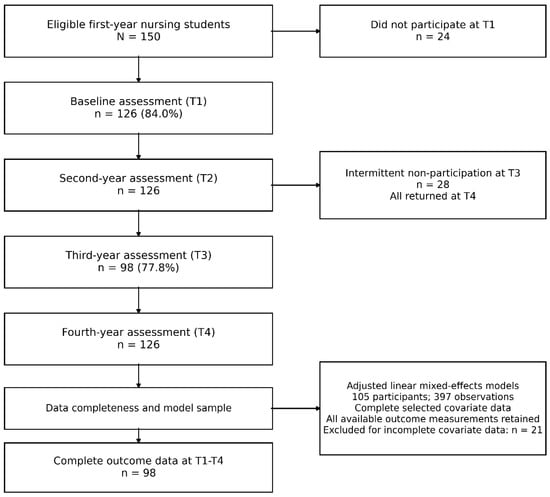
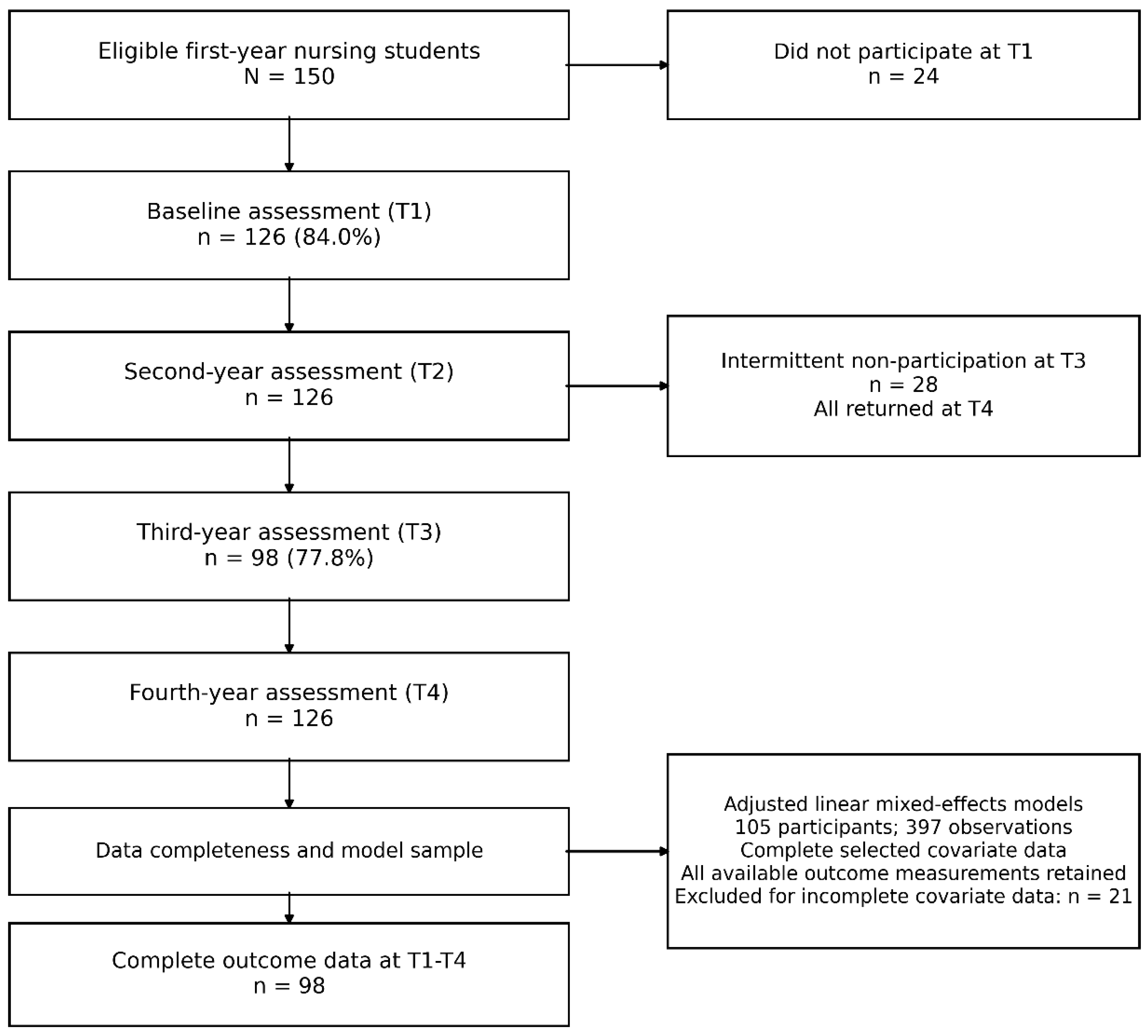
Of the 150 eligible students, 126 participated at T1, corresponding to a baseline participation rate of 84.0%. All 126 baseline participants completed the T2 and T4 assessments, whereas 98 (77.8%) completed the T3 assessment. Thus, 28 participants (22.2%) had intermittent missing outcome data at T3; however, all returned at T4 and were therefore not considered lost to follow-up. The reasons for non-participation at T3 were not documented. Complete outcome data across all four assessments were available for 98 participants. The adjusted linear mixed-effects models included 105 participants with complete data on the selected sociodemographic covariates and 397 available outcome observations; 21 participants were excluded because of incomplete covariate data (Figure 1).
Figure 1.
Flow of participants through the four annual assessments and derivation of the analytical samples.
Baseline characteristics and empathy scores were broadly comparable between participants included in the adjusted analyses and those excluded because of incomplete covariate data (Supplementary Table S1). Similar descriptive patterns were observed when comparing participants with and without missing third-year outcome data. Nevertheless, these descriptive similarities do not rule out potential selection bias associated with missing data.
At baseline, 111 participants were female (88.1%), and the mean age was 20.04 years (SD = 4.78; range: 18–43). Seventy-eight participants (61.9%) were not in a relationship, six (4.8%) had children, and one (0.8%) had dependants. In terms of employment, 18.8% of respondents were employed at the time of the survey, and ten participants had prior experience in the healthcare sector (Table 1).
Table 1.
Baseline sociodemographic characteristics and JSE-HPS scores across assessment points.
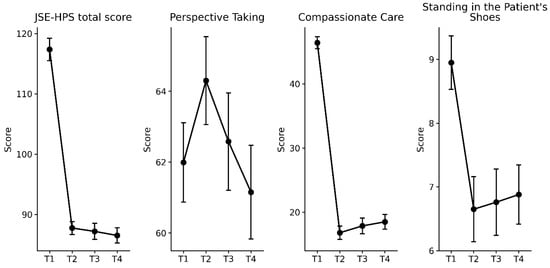
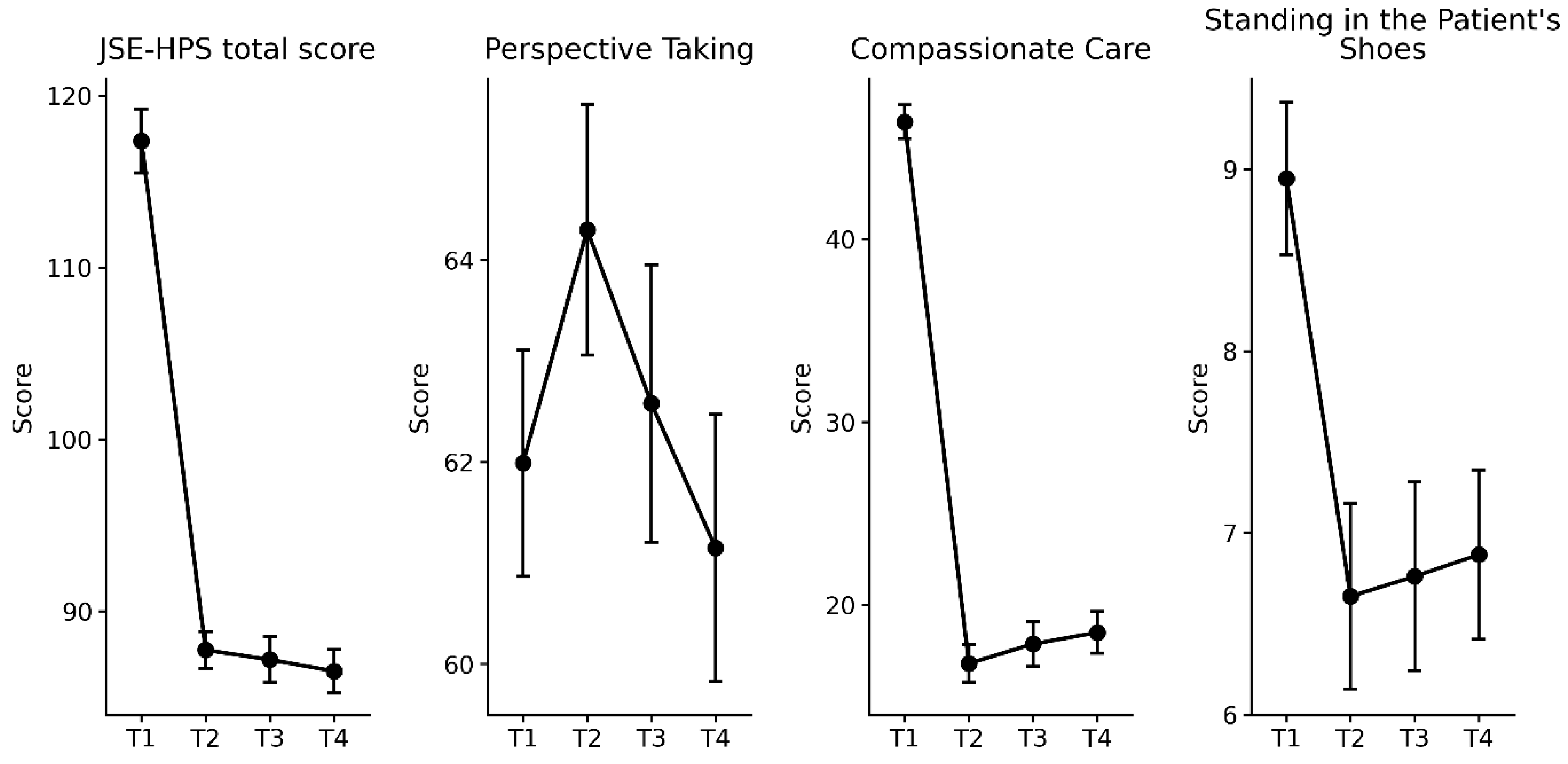
The mean JSE-HPS total score decreased markedly between T1 (117.37 ± 10.56) and T2 (87.75 ± 6.14) and remained relatively stable at T3 and T4. The dimensions showed different descriptive patterns: Perspective Taking reached its highest mean score at T2 and subsequently declined, whereas Compassionate Care and Standing in the Patient’s Shoes decreased between T1 and T2 and remained broadly stable thereafter (Table 1, Figure 2).
Figure 2.
Mean JSE-HPS total and dimension scores across the four annual assessment points. Error bars represent 95% confidence intervals.
Internal consistency estimates for the JSE-HPS total score and its dimensions at each assessment point are presented in Table 2. For the total score, Cronbach’s alpha ranged from 0.79 to 0.86 and McDonald’s omega from 0.87 to 0.91, indicating adequate internal consistency throughout the study period. Perspective Taking also showed consistently adequate estimates. Greater variability was observed for the other dimensions: Compassionate Care showed a lower Cronbach’s alpha at T1 (α = 0.59), although its McDonald’s omega was higher (ω = 0.74), while Standing in the Patient’s Shoes showed lower coefficients at T3 and T4.
Table 2.
Internal consistency estimates for the JSE-HPS total score and dimensions at each assessment point.
Spearman correlations between scores at the different assessment points were generally weak and showed no consistent directional pattern (Table 3). For the total JSE-HPS score, coefficients ranged from ρ = −0.12 between T1 and T3 to ρ = 0.23 between T2 and T3. Correlations ranged from −0.16 to 0.15 for Perspective Taking, from −0.13 to 0.34 for Compassionate Care, and from −0.20 to 0.14 for Standing in the Patient’s Shoes. These findings suggest limited rank-order stability in participants’ relative positions within the cohort across assessments (Table 3).
Table 3.
Spearman rank correlations between JSE-HPS scores across assessment points.
The linear mixed-effects models, adjusted for age, sex, employment status, and relationship status showed an overall effect of time on the JSE-HPS total score, F(3, 298.48) = 437.17, p < 0.001, as well as on Perspective Taking, F(3, 298.70) = 4.67, p = 0.003, Compassionate Care, F(3, 298.26) = 617.68, p < 0.001, and Standing in the Patient’s Shoes, F(3, 298.70) = 20.84, p < 0.001 (Table 4). Among the sociodemographic characteristics examined, age was positively associated only with Compassionate Care scores (β = 0.15; SE = 0.07; p = 0.039), corresponding to an average increase of 0.15 points per additional year of age. Given the number of outcomes and statistical tests performed, this association should be considered exploratory. No statistically significant associations were found for sex, employment status, or relationship status in any of the four models. The adjusted intraclass correlation coefficients were 0.009 for the total score and 0.017 for Compassionate Care, indicating minimal between-participant variability relative to the total variance. For Perspective Taking and Standing in the Patient’s Shoes, the participant-level random-intercept variance was estimated as zero (Table 4).
Table 4.
Adjusted linear mixed-effects models of longitudinal changes in JSE-HPS total and dimension scores.
Tukey-adjusted pairwise comparisons showed that the total JSE-HPS score was significantly higher at T1 than at all subsequent assessments (all p < 0.001), whereas no significant differences were found between T2, T3, and T4 (Table 5). For Perspective Taking, the only statistically significant pairwise difference was observed between T2 and T4, with higher scores at T2 (p = 0.002). Compassionate Care and Standing in the Patient’s Shoes scores were significantly higher at T1 than at all subsequent assessments (all p < 0.001), whereas no significant differences were found between T2, T3, and T4 for either dimension (Table 5).
Table 5.
Tukey-adjusted pairwise comparisons of JSE-HPS total and dimension scores across assessment points.
4. Discussion
This longitudinal study identified a marked decline in self-reported empathic orientation among nursing students between the first-year assessment (T1) and the second-year assessment (T2), as measured by the JSE-HPS total score, with little variation at the third-year (T3) and fourth-year (T4) assessments. The dimensions did not change uniformly: Compassionate Care and Standing in the Patient’s Shoes declined after the first year, whereas Perspective Taking reached its highest level in the second year, although the only significant pairwise difference was between the second and fourth years. Age was positively associated with Compassionate Care, while no other sociodemographic associations were identified. The main changes therefore occurred early in the degree, and examination of the total score alone did not fully capture the distinct trajectories of the three dimensions.
4.1. Interpretation of the Findings
Correlations between assessment points were generally weak, and the adjusted intraclass correlation coefficients were close to zero. These findings suggest that, despite clear changes in mean scores at the group level, participants’ relative positions within the cohort were not stable across assessments. This limited rank-order stability may reflect genuine individual fluctuations, restricted variability at some assessment points, measurement error, shifts in response patterns over time, or a combination of these factors. Consequently, estimates from the mixed-effects models should be interpreted as group-level trends rather than as evidence of uniform individual trajectories.
Previous studies following nursing students over time have produced heterogeneous findings. Ward et al. [13] reported a decline over one academic year, particularly among those with greater exposure to patient encounters. By contrast, Ferri et al. [15] observed an overall increase in emotional empathy during a three-year nursing programme, while Cunico et al. [18] found that additional communication and empathy training was associated with improvement, particularly among women. Differences in the instruments used, dimensions assessed, follow-up periods, educational interventions, and clinical contexts may partly account for these discrepancies and limit direct comparisons between studies.
In Spain, previous research has associated empathy with positive mental health [22], agreeableness, and conscientiousness, but not resilience [20], and described students’ verbal empathy and perceived benefits of experiential learning [19,21]. None, however, established how self-reported empathy evolved within the same participants across the entire degree.
The largest change in the present study occurred between the first and second assessments, during the broader context of the COVID-19 pandemic. Social isolation, the transition to online teaching, and disruptions to healthcare education may have affected students’ educational and emotional experiences [26,27], but their contribution to the observed trajectory cannot be established. Compassionate Care scores declined sharply from the first (M = 46.43) to the second year (M = 16.79), and remained significantly lower at T3 and T4, with only a small descriptive increase after T2. Although this finding was consistent across subsequent analyses, the magnitude of this reduction warrants cautious interpretation. Emotional distancing has been proposed as a protective response to emotional overload [28,29], while neither emotional burden nor coping responses were assessed. This explanation should therefore be regarded as speculative and cannot be directly evaluated using the present data. The results for Perspective Taking may indicate that the cognitive orientation captured by this dimension followed a distinct trajectory from those of Compassionate Care and Standing in the Patient’s Shoes. These variations may also reflect unmeasured contextual influences or changes in response patterns. Accordingly, the marked decline observed between T1 and T2 should not be interpreted as unequivocal evidence of a true decline in empathy, as measurement-related and contextual explanations cannot be fully excluded.
The adjusted models showed no associations of sex, employment status, or relationship status with either total empathy or any of its dimensions. Older age was modestly associated with higher Compassionate Care scores (β = 0.15; p = 0.039), but not with total empathy or the other dimensions. Previous findings regarding sociodemographic correlates have also been inconsistent: Nasiri et al. reported higher total empathy among female medical students but found no significant differences according to age or marital status [30]. The contrast with our findings may be explained by variations in study populations, educational contexts, age distributions, and measurement approaches. Nevertheless, the association with age should be interpreted cautiously given its modest magnitude, the sociodemographic homogeneity of the cohort, and the fact that multiple outcomes and statistical tests were performed. Accordingly, this finding should be considered exploratory and requires confirmation in independent studies. More broadly, variation in empathy across geosociocultural settings further limits the generalisability of these findings [31].
4.2. Educational Implications
From an educational perspective, these findings underscore the potential value of structured strategies to foster clinical empathy throughout nursing education. A recent scoping review identified simulation, role-play, virtual reality, ageing-simulation activities, and guided reflection as promising strategies [32]. Subsequent studies have reported favourable post-intervention outcomes following social–emotional learning, simulation-based spiritual care training with standardised patients, and online empathy training during the pandemic [26,33,34]. Structured communication role-playing has also been associated with greater humanisation among Spanish nursing students, but the cross-sectional design of that study precludes causal interpretation [35]. Taken together, these findings support consideration of experiential practice, guided reflection, and feedback within the curriculum, while future controlled studies are needed to determine whether any gains are sustained and transferred to clinical practice. Empathy development should also be viewed in relation to the clinical learning environment, professional role modelling, mentoring, and reflective supervision rather than addressed solely through isolated curricular activities [36,37].
4.3. Strengths and Limitations
A key strength of this study is its longitudinal design, which enabled empathy to be assessed repeatedly within the same individuals across the four-year undergraduate nursing degree, reducing the influence of cohort effects inherent in cross-sectional comparisons. As far as we are aware, this is the first study in Spain to track clinical empathy across all four years of undergraduate nursing education. Additional strengths include the use of the validated and widely recognised JSE-HPS and the relatively high baseline participation rate (126/150; 84.0%).
Some limitations should nevertheless be considered. The study was conducted at a single public university, and institutional culture, curriculum structure, clinical learning environments, and local sociocultural characteristics may have influenced the results. Participation was voluntary, and although all students in the eligible cohort were invited to participate, some degree of self-selection, non-response, or selection bias cannot be excluded. The cohort also consisted predominantly of young female participants, with relatively small numbers in some sociodemographic categories. This limits generalisability to more diverse populations and reduces the ability to detect subgroup associations. Another limitation concerns missing data. The mixed-effects models retained all available outcome measurements but excluded 21 participants with incomplete covariate data. As the reasons for missing third-year data were not documented, the missing-at-random assumption could not be assessed, and some bias cannot be excluded. Interpretation of the observed trajectories is also constrained by the absence of information on potentially relevant time-varying factors. Individual clinical exposure, academic workload, psychological distress, coping strategies, and differences in teaching or supervision were not systematically assessed; consequently, these trends cannot be attributed specifically to academic progression or clinical training. This limitation is particularly relevant because the study coincided with the COVID-19 pandemic. Without a pre-pandemic baseline or an unaffected comparison cohort, the potential influence of the pandemic could not be disentangled from academic progression or other current factors.
Finally, measurement-related limitations should be acknowledged. Internal consistency estimates were adequate at all assessment points for the JSE-HPS total score and Perspective Taking, whereas estimates for Compassionate Care and Standing in the Patient’s Shoes were more variable, including lower internal consistency for Compassionate Care at T1 (Cronbach’s α = 0.59). While differences in internal consistency cannot account for the observed shifts in mean scores per se, they introduce additional uncertainty into the interpretation of dimension-specific trajectories.
Moreover, the JSE-HPS is a self-report instrument that assesses students’ orientation towards empathic patient care rather than their behaviour during actual clinical encounters. Responses may therefore have been influenced by social desirability, self-perception, or evolving response patterns over time. Because both the sociodemographic characteristics and empathy outcomes were collected using self-report questionnaires, common-method bias also cannot be completely excluded.
Furthermore, longitudinal measurement invariance was not assessed. Although item coding and reverse-scoring procedures were rechecked and verified across all assessments, their correct application does not establish measurement equivalence. Accordingly, it cannot be determined whether the observed differences in scores exclusively reflect changes in the underlying construct over time.
This limitation is particularly relevant to Compassionate Care, as it cannot be ruled out that part of the observed decline reflected inconsistencies in item interpretation or functioning across assessments. In addition, reliance on a single self-report instrument limited the ability to capture the multifaceted nature of clinical empathy.
The decline in Compassionate Care between the first- and second-year assessments was substantially larger than the variations observed in the other dimensions. This finding should therefore be interpreted cautiously and should not be taken as definitive evidence of a corresponding reduction in actual empathy. Replication in independent cohorts, ideally including formal tests of measurement invariance, is needed to better understand this result.
5. Conclusions
This study identified a marked decline in nursing students’ self-reported empathic orientation between the first and second academic years, with limited change thereafter and distinct trajectories across the three JSE-HPS dimensions. These findings highlight the importance of monitoring empathy throughout undergraduate nursing education and suggest that opportunities for experiential learning, guided reflection, feedback, and mentoring may merit further consideration during the early years of training. Future multicentre longitudinal studies incorporating self-report, observational, patient-reported, and qualitative measures are needed to confirm these trajectories and better understand the factors influencing empathy development during nursing education.
Supplementary Materials
The following supporting information can be downloaded at: https://www.mdpi.com/article/10.3390/nursrep16110396/s1; Supplementary material: STROBE Statement for cohort studies; Supplementary Table S1: Baseline characteristics of participants included and excluded from the adjusted analyses.
Author Contributions
Conceptualization, M.S.-Z. and M.-P.M.-D.; methodology, A.M.-G. and M.S.-Z.; data curation, A.M.-G.; writing—original draft preparation, A.M.-G. and M.S.-Z.; writing—review and editing, D.Z.-R.; visualization, M.-P.M.-D.; supervision, M.-P.M.-D. and D.Z.-R. All authors have read and agreed to the published version of the manuscript.
Funding
This research received no external funding.
Institutional Review Board Statement
The study was conducted in accordance with the Declaration of Helsinki, the Belmont Report, and the International Ethical Guidelines for Health-related Research Involving Humans (CIOMS). Ethical approval was granted by the Regional Research Ethics Committee (reference no. 2020/043, 30 January 2020). Permission to use the validated Spanish version of the JSE-HPS was obtained from one of the authors of the Spanish validation study.
Informed Consent Statement
Before study enrolment, all participants received detailed information regarding the aims and procedures of the study and provided written informed consent. Participation was voluntary and independent of academic assessment. Data were pseudonymised throughout collection and analysis through the use of unique study codes. The document linking participant identities to study codes was stored securely and separately from the research dataset and was accessible only to a designated member of the research team. All data were handled in accordance with applicable data protection regulations.
Data Availability Statement
The individual-level data supporting the findings of this study are unavailable due to privacy and ethical restrictions related to participant confidentiality.
Public Involvement Statement
There was no public involvement in any aspect of this research.
Guidelines and Standards Statement
This manuscript was prepared in accordance with the Strengthening the Reporting of Observational Studies in Epidemiology (STROBE) Statement for cohort studies.
Use of Artificial Intelligence
During the preparation of this manuscript, the authors used ChatGPT (GPT-5.5 Thinking; OpenAI) solely to support English-language editing, including grammatical correction and stylistic refinement. All AI-assisted text was critically reviewed, revised, and verified by the authors, who take full responsibility for the final content.
Conflicts of Interest
The authors declare no conflicts of interest.
References
- Byrne, M.; Campos, C.; Daly, S.; Lok, B.; Miles, A. The Current State of Empathy, Compassion and Person-Centred Communication Training in Healthcare: An Umbrella Review. Patient Educ. Couns. 2024, 119, 108063. [Google Scholar] [CrossRef] [Scilit] [PubMed]
- Keshtkar, L.; Madigan, C.D.; Ward, A.; Ahmed, S.; Tanna, V.; Rahman, I.; Bostock, J.; Nockels, K.; Wang, W.; Gillies, C.L.; et al. The Effect of Practitioner Empathy on Patient Satisfaction: A Systematic Review of Randomized Trials. Ann. Intern. Med. 2024, 177, 196–209. [Google Scholar] [CrossRef] [Scilit] [PubMed]
- Nembhard, I.M.; David, G.; Ezzeddine, I.; Betts, D.; Radin, J. A Systematic Review of Research on Empathy in Health Care. Health Serv. Res. 2023, 58, 250–263. [Google Scholar] [CrossRef] [Scilit] [PubMed]
- Zhang, X.; Li, L.; Zhang, Q.; Le, L.H.; Wu, Y. Physician Empathy in Doctor-Patient Communication: A Systematic Review. Health Commun. 2024, 39, 1027–1037. [Google Scholar] [CrossRef] [Scilit] [PubMed]
- Delgado, N.; Delgado, J.; Betancort, M.; Bonache, H.; Harris, L.T. What Is the Link Between Different Components of Empathy and Burnout in Healthcare Professionals? A Systematic Review and Meta-Analysis. Psychol. Res. Behav. Manag. 2023, 16, 447–463. [Google Scholar] [CrossRef] [Scilit] [PubMed]
- International Council of Nurses. The ICN Code of Ethics for Nurses; International Council of Nurses: Geneva, Switzerland, 2021; p. 32. [Google Scholar]
- Smith, A. Cognitive Empathy and Emotional Empathy in Human Behavior and Evolution. Psychol. Rec. 2006, 56, 3–21. [Google Scholar] [CrossRef] [Scilit]
- Hojat, M.; Gonnella, J.S.; Nasca, T.J.; Mangione, S.; Vergare, M.; Magee, M. Physician Empathy: Definition, Components, Measurement, and Relationship to Gender and Specialty. Am. J. Psychiatry 2002, 159, 1563–1569. [Google Scholar] [CrossRef] [Scilit] [PubMed]
- Hojat, M.; Maio, V.; Pohl, C.A.; Gonnella, J.S. Clinical Empathy: Definition, Measurement, Correlates, Group Differences, Erosion, Enhancement, and Healthcare Outcomes. Discov. Health Syst. 2023, 2, 8. [Google Scholar] [CrossRef] [Scilit]
- Hojat, M.; Mangione, S.; Nasca, T.J.; Cohen, M.J.M.; Gonnella, J.S.; Erdmann, J.B.; Veloski, J.; Magee, M. The Jefferson Scale of Physician Empathy: Development and Preliminary Psychometric Data. Educ. Psychol. Meas. 2001, 61, 349–365. [Google Scholar] [CrossRef] [Scilit]
- Fields, S.K.; Mahan, P.; Tillman, P.; Harris, J.; Maxwell, K.; Hojat, M. Measuring Empathy in Healthcare Profession Students Using the Jefferson Scale of Physician Empathy: Health Provider–Student Version. J. Interprofessional Care 2011, 25, 287–293. [Google Scholar] [CrossRef] [Scilit] [PubMed]
- Hojat, M.; Shannon, S.C.; DeSantis, J.; Speicher, M.R.; Bragan, L.; Calabrese, L.H. Does Empathy Decline in the Clinical Phase of Medical Education? A Nationwide, Multi-Institutional, Cross-Sectional Study of Students at DO-Granting Medical Schools. Acad. Med. 2020, 95, 911–918. [Google Scholar] [CrossRef] [Scilit] [PubMed]
- Ward, J.; Cody, J.; Schaal, M.; Hojat, M. The Empathy Enigma: An Empirical Study of Decline in Empathy Among Undergraduate Nursing Students. J. Prof. Nurs. 2012, 28, 34–40. [Google Scholar] [CrossRef] [Scilit] [PubMed]
- Blanco, J.M.; Caballero, F.; Álvarez, S.; Plans, M.; Monge, D. Searching for the Erosion of Empathy in Medical Undergraduate Students: A Longitudinal Study. BMJ Open 2020, 10, e041810. [Google Scholar] [CrossRef] [Scilit] [PubMed]
- Ferri, P.; Rovesti, S.; Bonetti, L.; Stifani, S.; Panzera, N.; Di Lorenzo, R. Evaluation of Empathy among Undergraduate Nursing Students: A Three-Year Longitudinal Study. Acta Bio Medica Atenei Parm. 2019, 90, 98–107. [Google Scholar] [CrossRef] [Scilit] [PubMed]
- Jia-Ru, J.; Yan-Xue, Z.; Wen-Nv, H. Empathy Ability of Nursing Students: A Systematic Review and Meta-Analysis. Medicine 2022, 101, e30017. [Google Scholar] [CrossRef] [Scilit] [PubMed]
- Juniarta; Eka, N.G.A.; Ferawati Sitanggang, Y. Empathy in Nursing Students: A Scoping Review. J. Holist. Nurs. 2024, 42, S59–S86. [Google Scholar] [CrossRef] [Scilit] [PubMed]
- Cunico, L.; Sartori, R.; Marognolli, O.; Meneghini, A.M. Developing Empathy in Nursing Students: A Cohort Longitudinal Study. J. Clin. Nurs. 2012, 21, 2016–2025. [Google Scholar] [CrossRef] [Scilit] [PubMed]
- Carballedo-Pulido, J.; Farrés-Tarafa, M.; Roldán-Merino, J.; Hurtado-Pardos, B.; Berenguer-Poblet, M.; Tomás-Jiménez, M.; Otero-Arús, C.; Domínguez-del-Campo, M.; Fernández-Gibert, I.; Santos-Ruiz, S. Therapeutic Communication in Nursing Students: A Cross-Sectional Study of Personal, Educational, and Contextual Factors. PLoS ONE 2026, 21, e0345109. [Google Scholar] [CrossRef] [Scilit] [PubMed]
- De Benito, S.P.; Herrera-Peco, I.; García-Nieto, L.M.; Ruíz-Núñez, C.; García-Notario, A.; Campos-Soler, S.M.; Mata-González, G.; López-Espuela, F. Clinical Empathy, Personality Traits, and Resilience in Advanced Nursing Students: A Cross-Sectional Secondary Analysis. Healthcare 2026, 14, 1454. [Google Scholar] [CrossRef] [Scilit] [PubMed]
- Malumbres-Talavera, J.; Bonet, A.; Bazo-Hernández, L.; Cuesta, M.R.; Vives-Espelta, J.; Raventós-Torner, R. Nursing Student’s Experiences of Taking Part in a Death Café: A Qualitative Study. Palliat. Care Soc. Pract. 2026, 20. [Google Scholar] [CrossRef] [Scilit] [PubMed]
- Sanromà-Ortiz, M.; Roca, J.; Torné-Ruiz, A.; Medel, D.; Tort-Nasarre, G.; Bonet, A. Self-Compassion, Positive Mental Health, and Empathy in Nursing Students: A Structural Equation Modelling Approach. Nurse Educ. Today 2026, 164, 107137. [Google Scholar] [CrossRef] [Scilit] [PubMed]
- Von Elm, E.; Altman, D.G.; Egger, M.; Pocock, S.J.; Gøtzsche, P.C.; Vandenbroucke, J.P.; for the STROBE Initiative. The Strengthening the Reporting of Observational Studies in Epidemiology (STROBE) Statement: Guidelines for Reporting Observational Studies. PLoS Med. 2007, 4, e296. [Google Scholar] [CrossRef] [Scilit] [PubMed]
- Díaz Valentín, M.J.; Garrido Abejar, M.; Fuentes Chacón, R.M.; Serrano Parra, M.D.; Larrañaga Rubio, M.E.; Yubero Jiménez, S. Validation to the Spanish of the Jefferson Empathy Scale Health Professions Students Version and Its Psychometric Properties in Nursing Students. Nurse Educ. Pract. 2019, 40, 102629. [Google Scholar] [CrossRef] [Scilit] [PubMed]
- Domínguez, V.; San-Martín, M.; Vivanco, L. Relaciones familiares, soledad y empatía en el cuidado del paciente en estudiantes de enfermería. Aten. Primaria 2017, 49, 56–57. [Google Scholar] [CrossRef] [Scilit] [PubMed][Green Version]
- Kesbakhi, M.S.; Arab, S.; Tabaghdehi, L.H.; Rohani, C. Impact of a Training Programme on the Empathy Skills of Nursing Students During the COVID-19 Pandemic: A Quasi-Experimental Study. Nurs. Open 2025, 12, e70223. [Google Scholar] [CrossRef] [Scilit] [PubMed]
- Pontón, Y.D.; Narváez, V.P.D.; Andrade, B.M.; Terán, J.J.L.; Reyes-Reyes, A.; Calzadilla-Núñez, A. La empatía de los enfermeros con los pacientes en los hospitales públicos. Rev. Lat.-Am. Enferm. 2023, 31, e3968. [Google Scholar] [CrossRef] [Scilit] [PubMed]
- Decety, J.; Jackson, P.L. The Functional Architecture of Human Empathy. Behav. Cogn. Neurosci. Rev. 2004, 3, 71–100. [Google Scholar] [CrossRef] [Scilit] [PubMed]
- Pérez-Chacón, M.; Chacón, A.; Borda-Mas, M.; Avargues-Navarro, M. Sensory Processing Sensitivity and Compassion Satisfaction as Risk/Protective Factors from Burnout and Compassion Fatigue in Healthcare and Education Professionals. Int. J. Environ. Res. Public Health 2021, 18, 611. [Google Scholar] [CrossRef] [Scilit] [PubMed]
- Nasiri, M.; Amini, M.; Mani, A.; Delavari, S.; Kiani, M.; Sagheb, M.M.; Tabari, P. Assessing Empathy in Final-Year Medical Students Using the Persian Version of the Jefferson Scale of Physician Empathy. J. Educ. Health Promot. 2021, 10, 310. [Google Scholar] [CrossRef] [Scilit] [PubMed]
- Balbinot, F.; Voirol, L.; Guerrier, S.; Karemera, M.; Feser, R.; Baroffio, A.; Gerbase, M.W. Unveiling Empathy Determinants across Borders: A Comparative Analysis of Medical Students from Two Geo-Sociocultural Backgrounds. BMC Med. Educ. 2025, 25, 554. [Google Scholar] [CrossRef] [Scilit] [PubMed]
- Peisachovich, E.H.; Sombilon, E.V.; Graham, N.; Ladha, N.; Silva, C.D. Evaluating the Effectiveness of Empathy-Based Education in Undergraduate Nursing: A Scoping Review. J. Nurs. Educ. 2024, 63, 367–371. [Google Scholar] [CrossRef] [Scilit] [PubMed]
- Cheng, J.; Cheng, Q.; Wu, Y.; Huang, L.; Wu, Y. Integrating Social–Emotional Learning into Community Nursing Curriculum: A Quasi-Experimental Study on Enhancing Emotional Competence and Professional Readiness in Nursing Students. Front. Med. 2026, 13, 1837342. [Google Scholar] [CrossRef] [Scilit] [PubMed]
- Koroglu Gokbel, S.; Kılıçkıran Doğan, H.; Durat, G. Effects of Simulation-Based Spiritual Care Training Using Standardized Patients on Nursing Students’ Competence, Empathy, and Stress: A Mixed-Methods Study. Clin. Simul. Nurs. 2026, 118, 102043. [Google Scholar] [CrossRef] [Scilit]
- Guzmán-De Santa Ana, P.; Serna-Menor, A.; Martínez-García, A.; Moreno-Sánchez, R.; Ruíz-Núñez, C.; García-Notario, A.I.; Hervás-Pérez, J.P.; Herrera-Peco, I. Humanization and Communication Skills: A Cross-Sectional Study in Spanish Nursing Students. Nurs. Rep. 2026, 16, 171. [Google Scholar] [CrossRef] [Scilit] [PubMed]
- Levett-Jones, T.; Cant, R. The Empathy Continuum: An Evidenced-based Teaching Model Derived from an Integrative Review of Contemporary Nursing Literature. J. Clin. Nurs. 2020, 29, 1026–1040. [Google Scholar] [CrossRef] [Scilit] [PubMed]
- Neumann, M.; Edelhäuser, F.; Tauschel, D.; Fischer, M.R.; Wirtz, M.; Woopen, C.; Haramati, A.; Scheffer, C. Empathy Decline and Its Reasons: A Systematic Review of Studies with Medical Students and Residents. Acad. Med. 2011, 86, 996–1009. [Google Scholar] [CrossRef] [Scilit] [PubMed]

Disclaimer/Publisher’s Note: The statements, opinions and data contained in all publications are solely those of the individual author(s) and contributor(s) and not of MDPI and/or the editor(s). MDPI and/or the editor(s) disclaim responsibility for any injury to people or property resulting from any ideas, methods, instructions or products referred to in the content. |
© 2026 by the authors. Licensee MDPI, Basel, Switzerland. This article is an open access article distributed under the terms and conditions of the Creative Commons Attribution (CC BY) license.