


Abstract
Effective utilization of plant genetic resources requires agro-morphological evaluation of collections across diverse growing regions. The objectives of this study are to assess genetic diversity and estimate genetic parameters through morphological traits of Bambara groundnut. The study was conducted over two growing seasons at the SUSTLIVES project site in Gampela (Central Burkina Faso) using an RCBD with three replicates. A total of eight qualitative and eight quantitative traits were used to estimate variability within a collection of 153 landraces. The results revealed a substantial variability in all the qualitative traits, with the number of modalities ranging from 2 to 10, seed color being the variable trait. Based on qualitative traits related to seed, the landraces were grouped into 12 morpho-groups. The analysis of variance showed the presence of significant variation between landraces and across years and their interactions for all of the quantitative traits. The heritability values ranged from 46.12% (seed weight per plant) to 88.66% (days to 90% maturity). The landraces KKou4, KKou2, ODap3, ODap4, KLay68, BPle2, KTog6, KSag11, ZMag4 and ODap1 were identified as high-yielding landraces. Future selection efforts for Bambara groundnut should therefore continue to evaluate the genotypes that have a high potential for grain yield under various pedoclimatic environments of the country.
1. Introduction
Legumes of the Fabaceae family are characterized by very high interspecific variability, comprising edible, forage, and agroforestry species [1,2,3]. Legumes have the capacity to fix atmospheric nitrogen and improve the physicochemical properties of the soil through legume-rhizobium symbiosis [4,5,6]. The seeds of edible legumes constitute an important source of macronutrients, such as proteins, carbohydrates, and dietary fibers, for human and animal consumption [7,8]. Thus, due to their nutritional value and their ability to thrive in poor soils without fertilizer application, legumes can be considered resilient crops in the fight against undernourishment and malnutrition. They are cultivated in crop rotation systems after cereals (maize, sorghum, millet, etc.) or in mixed cropping systems with the same cereals [9,10,11]. Among these legumes is the species Vigna subterranea (L.) Verdcourt, commonly known as Bambara groundnut.
Native to Africa, Bambara groundnut is cultivated for its seeds, which are eaten fresh or dried in various forms [12,13]. In West Africa, it ranks as the third most widely cultivated legume after cowpea (Vigna unguiculata L.) and peanut (Arachis hypogaea L.). Bambara groundnut is a crop with high nutritional value. It is resistant to diseases and pests. Typically grown on poor soils without fertilizer application, it enhances soil fertility through biological nitrogen fixation [13,14,15]. According to Siwale et al. [16], Bambara groundnut has the potential to address food security and can significantly contribute to climate-smart agriculture. Nutritionally, Bambara groundnut seeds are rich in proteins, carbohydrates, minerals (such as calcium, magnesium, potassium, iron, and zinc), and vitamins (B2, B3, B5, B6, B9) [13,17,18]. Their protein content includes essential amino acids like methionine, leucine, isoleucine, lysine, phenylalanine, threonine, valine, and tryptophan [7,19]. Combining Bambara groundnut seeds with cereals provides a nutritional supplement for populations with limited access to animal protein [17,20]. Due to its ability to grow in degraded soils and its high nutritional value, Bambara groundnut is a key crop for resilience, food security, and nutritional security [7,13,21]. In addition to its role as food, the leaves and tops serve as excellent fodder for livestock [22].
Despite its socio-economic and nutritional importance, Bambara groundnut remains a neglected and underutilized crop [13,23]. Although it originated in Africa and African countries are the main producers, research on Bambara groundnut remains limited [13,24]. In Burkina Faso, increasing interest in these neglected and underutilized species has emerged because of their strong potential to contribute to climate resilience, food security, nutrition, and economic development [13,21]. Recently, research projects focusing on neglected and underutilized species (NUS) have been funded by governments and international organizations. For instance, as part of the SUSTLIVES project (funded by the European Union within the initiative DeSIRA–Development Smart Innovation through Research in Agriculture), over 200 landraces of Bambara groundnut were collected from several villages in Burkina Faso and neighboring countries. However, for the effective use of genetic resources, these collections should be characterized [21]. Genetic diversity is the most important resource for breeders, and knowledge of existing variability can offer up new opportunities for conservation and breeding programs. This study has aimed to contribute to more effective genetic resource conservation of the Bambara groundnut. Its objectives are to: (i) describe the phenotypic variability of landraces collected, (ii) identify high seed-yielding landraces and (iii) determine the genetic parameters of the quantitative traits under study.
2. Materials and Methods
2.1. Description of the Experimental Site
The trials were conducted over two years (2023 and 2024) during the rainy season, from July to November, at the research station of the University Nazi BONI in Gampela. Geographically, Gampela is located in the Sudan–Sahelian zone of Burkina Faso. The geographic coordinates of the site are 12°41′ N latitude and 1°35′ W longitude. The site soil has a predominantly silty–sandy texture (82.35% sand and 13.73% silt) and a slightly acidic pH of 5.7 [25,26]. In the 2023 cropping season, with an average temperature of 29.282 °C, total rainfall of 634.1 mm was recorded in 48 days, while the average temperature in 2024 was 28.316 °C and total rainfall was 807.5 mm during 58 days.
2.2. Plant Materials
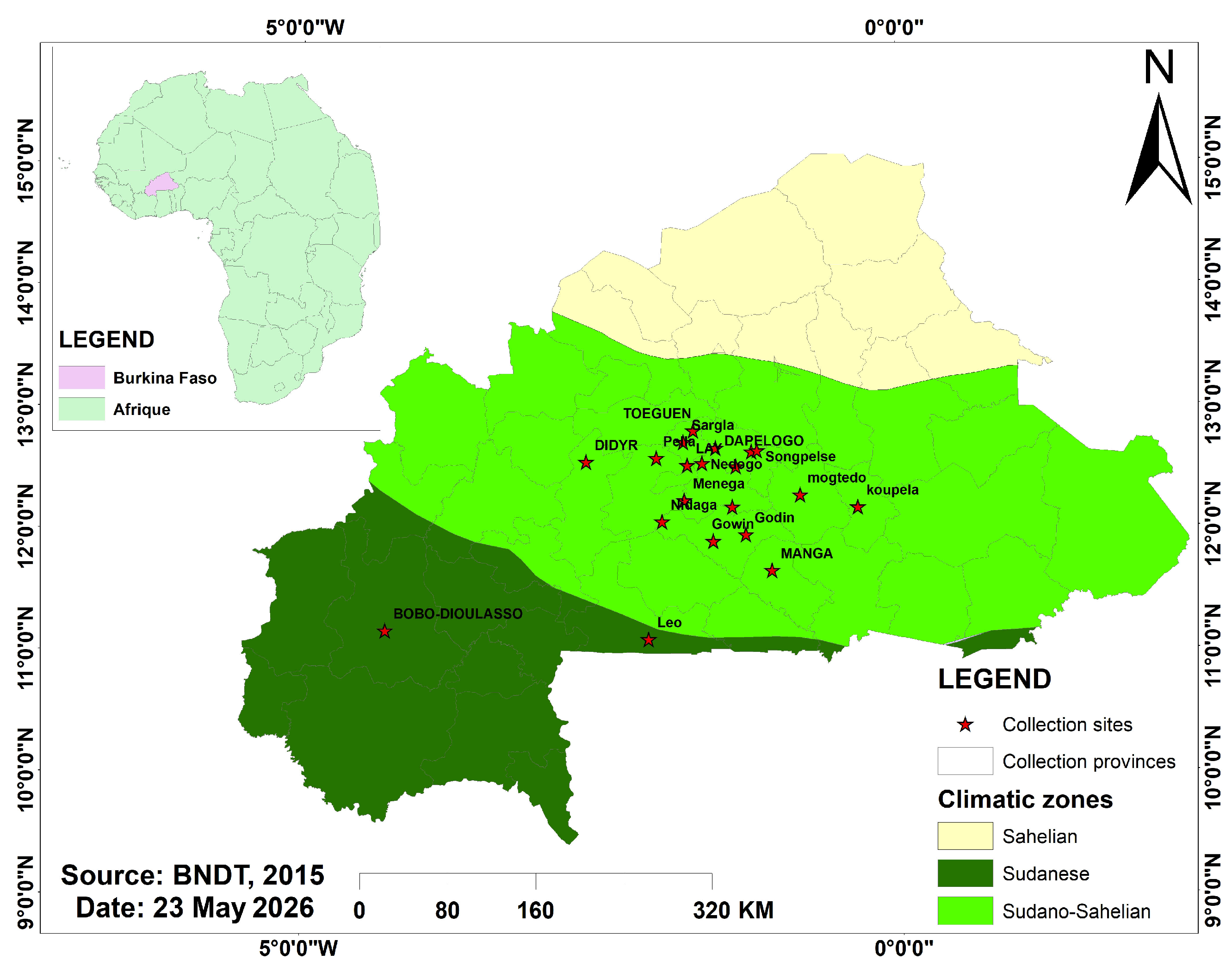
One hundred and fifty-three (153) over two hundred (200) Bambara groundnut landraces from Burkina Faso (149) and Niger (4) were used in this study. In fact, the 153 accessions were selected based on the quantity of seed availability for the field trial. Bambara groundnut landraces from Burkina Faso were collected in 2022 in 11 provinces covering 6 regions of the country. Figure 1 represents the map of Burkina Faso with the collection sites.
Figure 1.
Illustration of the map of Burkina Faso with the collection sites of local landraces of Bambara groundnut used in this study.
2.3. Experimental Design
The experimental design used was a randomized complete block design (RCBD) with three replications. Sowing was carried out on a flat seedbed, with one seed sown per planting hole. In each replication, each accession was represented by a 5 m row comprising 11 plants. The distances between plants and between rows were 30 cm and 50 cm, respectively. Weeds were controlled by weeding, and organic fertilizer (5 t/ha) was applied in both seasons.
2.4. Data Collection
Sixteen (16) phenotypic traits, including eight qualitative and eight quantitative, were used for describing the agro-morphological variability. Trait-related data were collected based on previous work by Kiebre et al. [25] and Xulu et al. [27]. The qualitative traits included dark pigmentation stem, dark pigmentation leaf, terminal leaflet shape, pod shape, seed color, seed shape, seed eye, and eye color and shape. Regarding these qualitative traits, the observations were carried out on all the plants in the entire row. Table 1 presents the qualitative traits and codes used for the characterization of Bambara groundnut landraces.
Table 1.
List of the qualitative traits, with their code, description, and phenotypic scores used for the characterization of Bambara groundnut landraces.
The quantitative data were collected during the pre-harvest and post-harvest growth stages of the crop. Two quantitative traits (days to 50% flowering and days to 95% maturity) were measured on the entire row. In contrast, the other quantitative traits were measured on five randomly selected plants per row. The methods and procedures used for collecting data are described in Table 2.
Table 2.
List of the quantitative traits that were collected and the methods or procedures used.
2.5. Data Analyses
2.5.1. Frequency and Shannon–Weaver Diversity Index
Qualitative morphological data were used to calculate the frequency of the phenotypic traits. Shannon–Weaver diversity index was calculated from the phenotypic frequencies to analyze the phenotypic diversity for each trait [28].
where Pi is the proportion of landraces in the ith class of an n-class descriptor and n is a phenotypic class for a descriptor. S is the number of trait categories in a qualitative Bambara groundnut landrace.
The classification scheme for the Shannon diversity index (H′) is as follows: very high if H′ > 3.5, high if 3 > H′ > 3.49, moderate if 2.5 > H′ > 2.99, low if 2 >H′ > 2.49, and very low H′ ˂ 1.99 [29,30].
The morpho-groups were defined by the combination of four qualitative traits related to the seed (seed color, seed shape, seed eye and eye color and shape). Indeed, these variables have been identified in previous studies [21,31] as key criteria for the description and classification of the local Bambara groundnut landraces.
2.5.2. Analysis of Variance (ANOVA)
Type-II Analysis-of-Variance (ANOVA) was used to test the year effect, genotype effect and year × genotype interaction for all quantitative traits. For these models, sum squares, mean squares, and F-tests are calculated for each quantitative trait. The Student–Newman–Keuls (SNK) test was used to make pairwise comparisons among landrace means. It helped to identify the best average performance of the top ten seed-yielding landraces. Then, a comparative analysis of the average performance was realized among the ten best-yielding landraces with that of the ten lowest-yielding landraces, the population means, and the landrace from Niger. The analysis was realized by using R statistical software, version 4.5.3. Type II ANOVAs were calculated using the Anova () function from the car package in R.
2.5.3. Estimates of Genetic Parameters
The mean, phenotypic and genotypic, and coefficient of variation were measured to evaluate the population’s level of diversity. Estimation of variance components was done by combining the RCBD model across the two experimental years (2023 and 2024), where genotype, year, genotype × year interaction, and error terms were partitioned according to the expected mean squares.
The coefficients of variation were calculated for classification purposes as follows: phenotypic coefficient of variation (PCV) and genotypic coefficient of variation (GCV) values are considered high if PCV or GCV > 20%, moderate if 15% < PCV or GCV < 20%, and low if PCV or GCV < 15% [32]. Heritability in the broad sense was calculated in percentage and categorized as low (0–30%), medium (30–60%), and high (>60%) [33,34]. The expected genetic advance (GA%) was estimated using the method of Johnson et al. [35]. The values used for classification are as follows: <25% = low genetic gain, 25–40% = moderate genetic gain, >40% = high genetic gain. The formulas used to estimate genetic parameters are listed in Table 3.
Table 3.
Formulas used to estimate genetic parameters.
3. Results
3.1. Description of the Collection Using Qualitative Traits
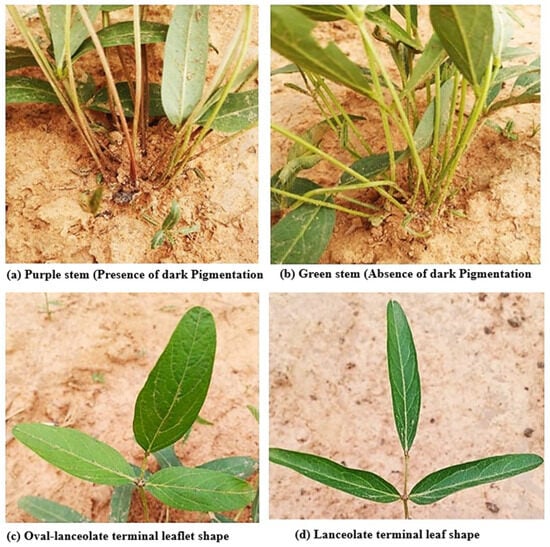
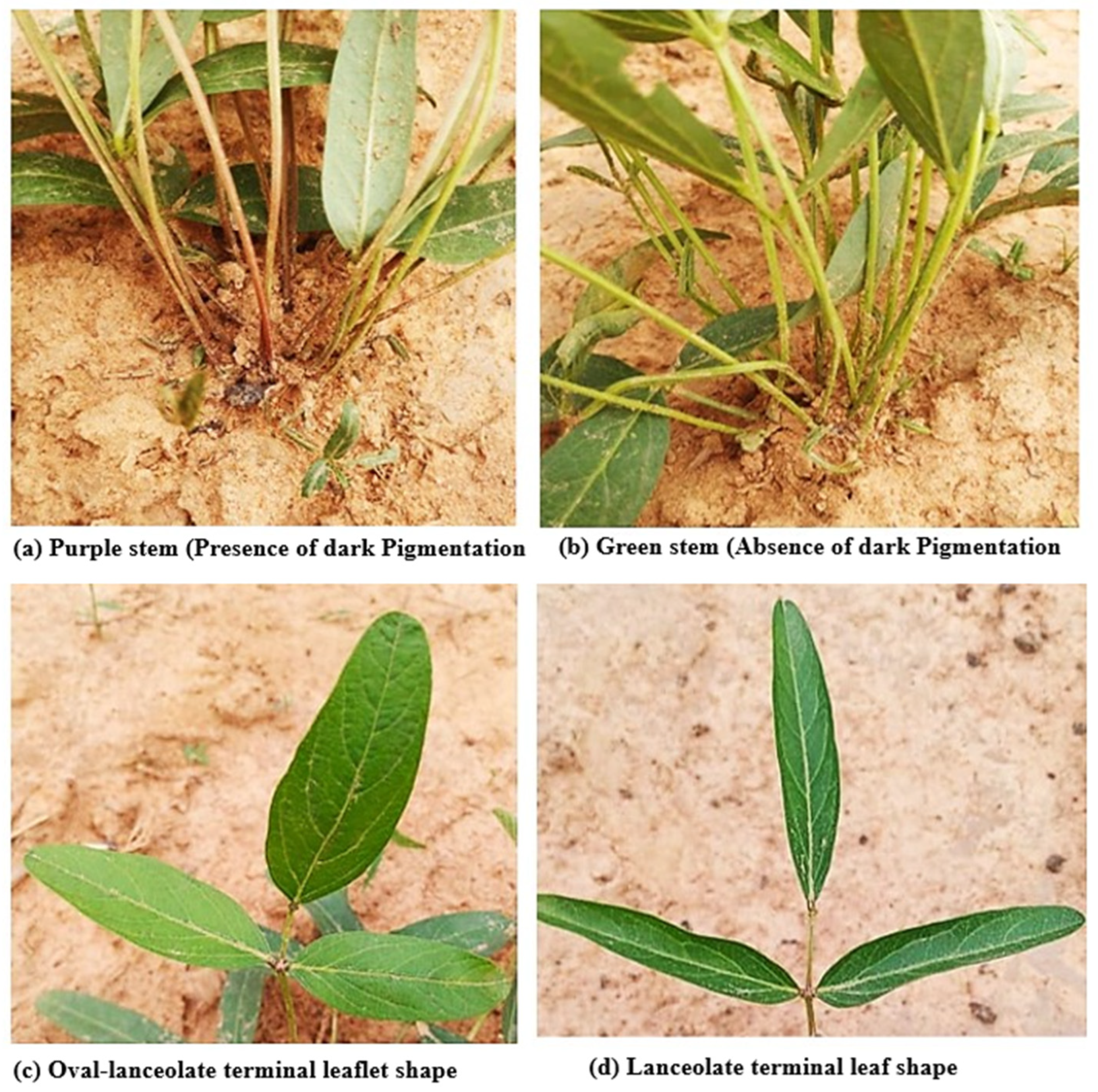
The results showed that there was a high variability of all the qualitative traits, with modalities ranging from 2 for the dark pigmentation stem, dark pigmentation leaf, terminal leaflet shape, seed shape, and seed eye to 10 for the seed color (Table 4). Related to the dark pigmentation of the stem and the dark pigmentation of the leaves, 56.58% and 56.95% of the landraces exhibited pigmentation on the stem and leaves, respectively (Figure 2a,b). Referring to the terminal leaflet shape, most of the landraces (88.24%) exhibited an oval-lanceolate terminal leaflet shape. In contrast, the minority (11.76%) exhibited a lanceolate terminal leaf (Figure 2c,d). Compared to all of the qualitative traits studied, seed color was the most polymorphic. According to seed color, most of the landraces exhibited uniform seed color with 58.82% cream, 4.58% black, 0.65% red, and 0.65% dark red. The other landraces showed composite seed color with 28.10% gray spots on a cream background. Fifty-four-point twenty-five percent (54.25%) of landraces produced seeds with eyes and produced no-eye seeds. Among the landraces that produce seeds with eyes, 43.79% have a gray, butterfly-shaped eye, 1.31% a black, butterfly-shaped eye, and 0.65% a gray, triangular-shaped eye.
Table 4.
Specific qualitative morphological traits, their scores and equivalent phenetic characters.
Figure 2.
Illustration of dark pigmentation stem and terminal leaflet shape.
The estimated Shannon–Weaver diversity index (H′) for the Bambara groundnut qualitative traits is shown in Table 5. Except for the terminal leaflet shape (0.362), the Shannon–Weaver diversity index (H′) is generally high for the other qualitative traits. Thus, the lowest genetic diversity (0.362) was observed for the terminal leaflet shape. In contrast, a high polymorphism was observed for seed color (1.062). The average diversity index (H′) of individual characters across collection provinces showed a low genetic diversity ranging from 0.161 (for pod shape) to 0.241 (for seed color) with an overall mean value of 0.209.
Table 5.
Qualitative traits, their Shannon–Weaver diversity indices, and maximum Shannon–Weaver diversity indices for 8 qualitative traits during the analysis of 153 landraces.
3.2. Organization of Agro-Morphological Variability Using Qualitative Traits
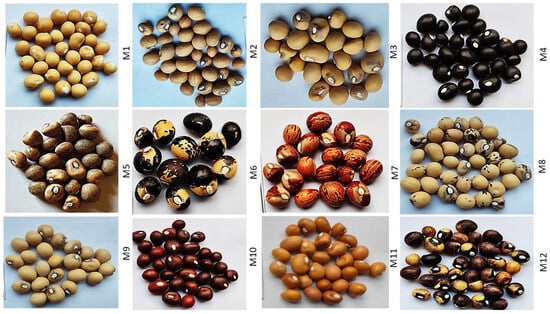
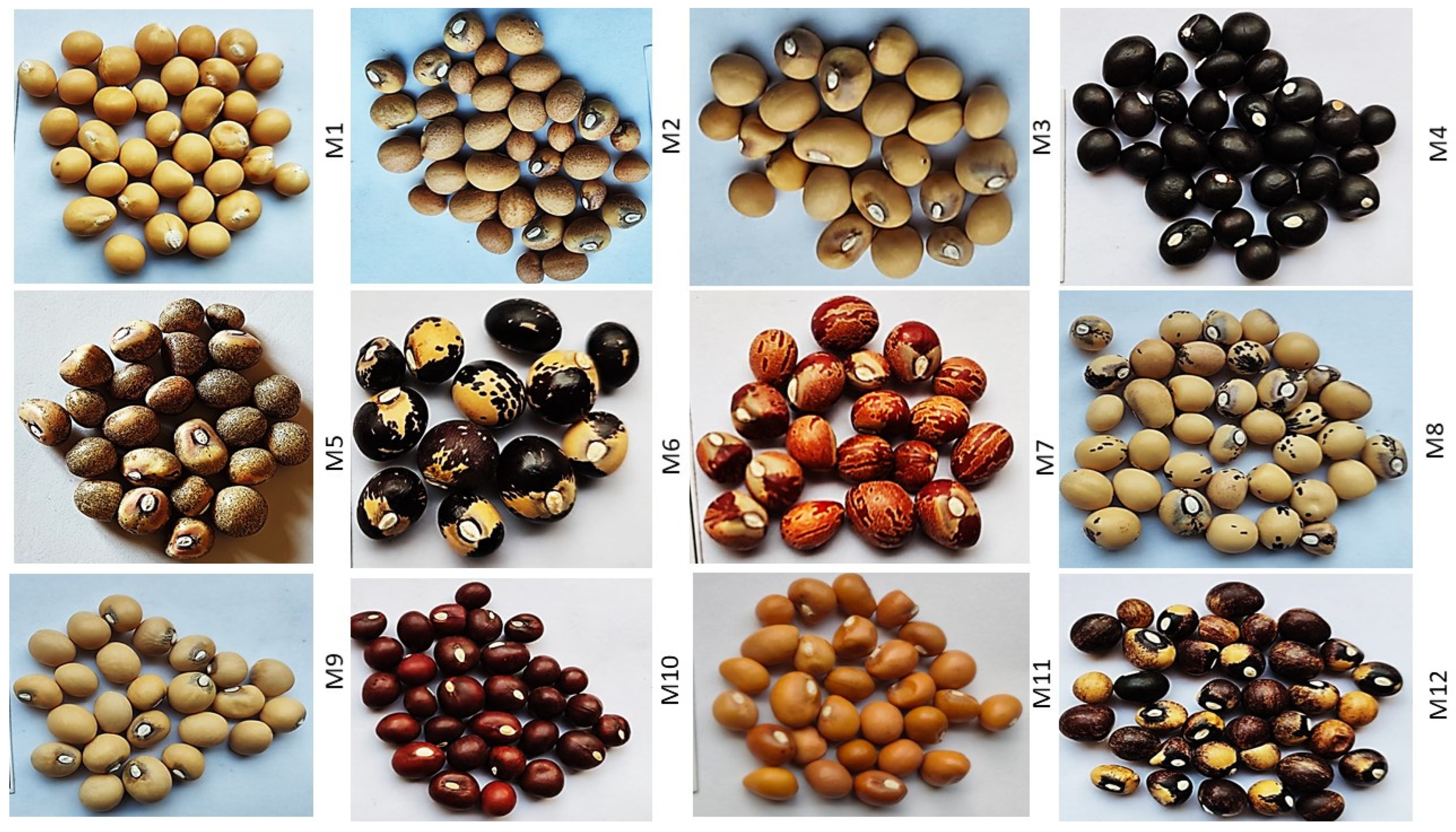
Based on seed characteristics such as seed shape, seed color, seed eye, and eye color and shape, the 153 landraces were grouped into 12 morpho-groups/morphotypes (Table 6 and Table 7). The M1 morphotype, characterized by eyeless, round, cream-colored seeds, was the most representative (49.67%) within the collection. It is followed by morpho-groups M2 (26.797%), M3 (9.804%), M4 (4.575%), M5 (2.614%), M6 (1.961%) and M7 (1.307%). Other morphotypes are very poorly represented (0.65). Figure 3 shows the morphological traits of 153 landraces of Bambara groundnut.
Table 6.
Characteristics of the morpho-groups of Bambara groundnut.
Table 7.
Distribution of landraces of Bambara groundnut by morpho-groups.
Figure 3.
Illustration of seeds of 12 morpho-groups in the collection of Bambara groundnut.
3.3. Description of the Collection Using Quantitative Traits
The results of the analysis of variance (Table 8) show that for the following quantitative traits, days to 90% maturity (DM), plant height (PH), seed length (SL), seed width (SW), dry pod weight per plant (PW), seed weight per plant (SWP), and seed yield (SY) the mean squares resulting from landraces differed significantly (p ≤ 0.01). This indicates the existence of agro-morphological variability within the landraces. Except for the seed width (SW), for which the difference was not significant, the effect of the cropping season was significant (p ≤ 0.5) for seed weight per plant (SWP) and seed yield (SY) and highly significant (p ≤ 0.001) for the five other quantitative morphological markers evaluated. In addition, a highly significant interaction between landraces and years was observed for all eight agronomic traits.
Table 8.
Combined analysis of variance (over the year) for quantitative morphological markers evaluated in 153 Bambara groundnut landraces in the 2023 and 2024 cropping seasons.
3.4. Effect of Cropping Seasons on the Agro-Morphological Traits of Bambara Groundnut
The cropping season significantly influenced the average performance of quantitative traits in Bambara groundnut landraces (Table 9). Thus, with 50% flowering reached at 36 days in 2023, the landraces exhibited an earlier growth cycle compared to 2024, when 50% flowering occurred 44 days after sowing. Regarding the number of days to maturity, the landraces completed their cycle earlier in 2023 (80 days) than in 2024. With a grain weight per plant (17.34 g) and a yield (2.81 t/ha), these landraces performed better in 2024.
Table 9.
Average performance of the agro-morphological characteristics of the landraces during the two growing seasons.
3.5. Mean Performance of Agro-Morphological Traits of Bambara Groundnut
The top ten seed-yielding landraces are all from Burkina Faso (Table 10). The ANOVA showed highly significant variation among the top seed-yielding landraces for the traits plant height (PH), seed length (SL), and seed width (SW). Based on the three traits, the results revealed that ODap1 obtained the lowest performance with a plant height of 17.5 cm and seed length and width of 10. 22 and 8.675 mm, respectively. Whereas ZMag4 has performed the best with a plant height of 23.45 cm and seed length and width of 12.62 and 10.10 mm, respectively. KKou4 had the highest seed yield (3.34 t/ha) with a plant height of 22.20 cm, seed length and width of 11.58 and 9. 37 mm, respectively.
Table 10.
Mean performance of top ten seed-yielding landraces for quantitative traits.
The results of the comparative analysis of the average performances (Table 11) of the ten best seed-yielding landraces (A) with that of the bottom ten seed-yielding landraces (B), the population means (C), and the landraces from Niger (D), show variability among these subgroups. Thus, except for the 50% flowering, a highly significant (p ≤ 0.001) difference was obtained between these two clusters for the other quantitative traits. Similarly, a highly significant (p ≤ 0.001) difference was obtained, with the lowest grain yield landraces except for variables related to the cycle. Between the ten best seed-yielding landraces (A) and the landraces from Niger (D), a highly significant (p ≤ 0.001) difference was observed for the traits plant height (PH) and seed length (SL). Thus, with a difference of 2.78 cm for plant height (PH) and 0.34 mm for seed length, the ten best seed-yielding landraces (A) had the highest plant height (31.60 mm) and seed length (11.3 mm) compared to Niger’s landraces. For the other quantitative traits, the differences were not significant.
Table 11.
Comparison of the mean performance of landraces during the 2023 and 2024 cropping seasons.
3.6. Genetic Parameters
Estimates of genetic parameters for all quantitative traits are presented in Table 12. The results indicate that genotypic variance (σ2g) ranged from 0.26 for seed yield to 50 for dry pod weight per plant. For phenotypic variance (σ2p), the results also showed that the lowest value was for seed yield (0.99), while the highest value was for dry pod weight per plant (162.99). For the phenotypic coefficient of variation (CV) and coefficient of environmental variation (ECV), the highest values (>20%) were recorded in dry pod weight per plant (PW), seed weight per plant (SWP), and seed yield (SY). In addition, for all variables, the value of the PCV was higher than that of the ECV. In contrast, for the GCV, seed weight per plant (30.41%) and pod weight showed a high value (24.69%). The other traits showed a low GCV (20%). The heritability values ranged from 46.12% (SWP) to 88.66% (95% DM). Medium values (30% < H2 < 60%) were obtained for the seed weight per plant (46.12%) and seed yield (51.25%). For the other quantitative traits, broad sense heritability was high (>60%). High heritability associated with genetic advances was obtained for quantitative traits such as seed length (H2 = 88.11% and GA% = 68.41%) and seed width (H2 = 81.41% and GA% = 68.71%).
Table 12.
Components of variance, coefficient of variation, heritability and genetic advance for 8 traits of 153 Bambara groundnut landraces grown in the 2023 and 2024 cropping seasons.
4. Discussion
The analysis revealed a high degree of variability, characterized by the presence of several discriminating traits such as seed color, eye shape and color, growth cycle, plant height, and seed yield. Similar results were obtained by numerous scholars [23,25,27,31]. These results provide a database for designing a breeding program to create new Bambara groundnut varieties with desired characteristics. Indeed, this phenotypic variability suggests the existence of several genes controlling the expression of these traits. According to Yeshitila et al. [38], assessing the genetic diversity of a cultivated species is an excellent starting point for crop improvement, as it provides a framework and roadmap for selecting parental lines and designing a breeding program. In addition, the very high variability of seed-related characteristics suggests that these traits can be considered as selection criteria for the description, classification, and identification of morphotypes, with a view to better management for their conservation and use in breeding programs. Furthermore, the variability in seed color suggests the existence of several genes involved in the synthesis of polyphenolic pigments (anthocyanins and flavonoids) responsible for seed coloration. According to Tsamo et al. [39] and Palamae et al. [40], anthocyanins are major polyphenolic pigments responsible for the variability in color and biochemical composition of Bambara groundnut (Vigna subterranea) seeds.
High variability observed in this study can be justified by the central role that the local community has in maintaining variability within crop species through seed exchanges and selection criteria generally based on the sociocultural and/or commercial value attributed to a local variety. Previous studies [21,41,42] have also reported that factors such as seed exchange among local communities, phenotypic plasticity, and selection pressure exerted by farmers contribute to significant diversity in qualitative traits by creating or maintaining polymorphism. The high proportion of landraces with cream-colored seeds thus suggests that selection has been oriented toward these seeds due to high market demand and their commercial value. In an international collection, Mohammed et al. [31] also reported a high proportion of landraces with cream-colored seeds. However, the preservation of certain local varieties may be justified by their cultural value within certain communities. Indeed, landraces with dark-colored seeds (black, brown, and dark red) are generally used in some traditional ceremonies [25]. In addition, the low proportion (0.65%) of morphotypes M8, M9, M10, M11 and M12 indicates that these are increasingly being abandoned in favor of morphotype M1. However, these morphotypes at risk of extinction may have genes of potential interest that could be used to select varieties adapted to local environmental conditions and the needs of stakeholders in the value chain. According to Johnson et al. [35] the rare variants will bear equally useful genetic information that can be exploited through breeding. Consequently, special attention should be given to the conservation of these highly endangered morphotypes in order to prevent genetic erosion within the species.
The organization of phenotypic variability based on seed-related characteristics into twelve (12) morpho-groups has allowed for a better appreciation of existing variability and its current structure. This database can contribute to improved management of Bambara groundnut in Burkina Faso. Indeed, the structuring of genetic variability and the establishment of core collections provide important information that can contribute to resolving problems related to conservation and facilitate its use in research programs [25,41]. In addition, the top ten landraces identified based on seed yield could be used as parental lines in future research for the selection of varieties with high yield potential. Indeed, the average yield (2.86 t/ha) of these landraces is significantly higher than Burkina Faso’s national average over the past three years: 2021 (0.648 t/ha), 2022 (0.760 t/ha), and 2023 (0.824 t/ha). Consequently, these landraces can be offered to farmers while improved varieties are being developed. In addition to their yield, certain landraces, such as ODap3, characterized by cream-colored seeds without an eye and with a short cycle, exhibit characteristics of great interest to all stakeholders in the value chain. Indeed, in a previous study on participatory selection conducted by Kiebre et al. [25], the ODap3 landrace was selected by all stakeholders in the value chain.
The highly significant differences (p ≤ 0.01) observed for all quantitative traits across the accession factor suggest that the landraces studied are genetically distinct. Consequently, hybridization between these genetically distant landraces can result in a high level of genetic recombination in the progenies and optimize genetic gain during variety development and selection. However, the significant effect of the growing year on all quantitative traits indicates that climatic conditions have a great influence on phenotypic plasticity. In fact, various soil and climate factors such as soil fertility, precipitation, temperature, and day length can influence the majority of quantitative variables in complex ways [43,44]. Thus, the single-plant seed weight was higher in 2024 than in 2023, explained by well-distributed rainfall in 2024 (807.5 mm in 58 days), compared with 613 mm over 48 days in 2023. These conditions allowed high productivity and seed filling during the physiological maturity stage. According to Wei et al. [45], grain yield is significantly associated with seed filling.
In addition, the highly significant accession-year interaction for all quantitative traits indicates that the landraces studied responded differently to fluctuations in temperature and rainfall during the two growing years. A significant interaction effect also was observed between accession and location for grain yield and associated traits [16]. According to Chipeta and Gimode [46], significant interaction effects reflect complex genetic control with low additive effects. Moreover, this specific response of the landraces could be explained by the fact that local varieties exhibit high physiological plasticity and adaptability, allowing them to adjust growth and allocation patterns in response to growing in very contrasting climatic issues [47]. This presents an opportunity for plant breeders to select varieties suitable for different agroclimatic zones across the country. However, as the evaluation of landraces was conducted at only one location, future breeding for Bambara groundnut should therefore continue to identify high-performing and stable varieties through multi-site and multi-year trials.
The estimation of genetic parameters made it possible to assess the contribution of environmental factors to the observed variability and to envisage possibilities for direct selection based on the phenotype. The moderate (50% < H2 < 70%) to high (H2 < 50%) heritability suggests that phenotypic variability may be due to genetic factors rather than environmental factors. In addition, high heritability associated with genetic advance obtained for quantitative traits, seed length (H2 = 88.11% and GA% = 68.41%) and seed width (H2 = 81.41% and GA% = 68.71%), indicates a possibility of direct selection based on these two traits. Indeed, the effectiveness of variety selection for improving a trait depends on a high genotypic coefficient of variation (CVG) value, heritability (H2 < 70%), and genetic advance of the mean (GAM) [16,48]. In other words, in addition to the observed variability, the success of selection for trait improvement also depends on the degree of heritability of that variability. However, the low genetic gains for the other traits suggest that non-additive genetic variance significantly influenced genotypic effects. In fact, direct selection based on the genetic effect of these traits would be very difficult.
5. Conclusions
This study showed highly significant differences among Bambara groundnut landraces for all traits. Regarding qualitative traits, seed color was the most discriminating variable, with 10 modalities. However, landraces with cream-colored seeds (58.82%) and the M1 morphotype (49.67%), characterized by cream-colored, oval-shaped seeds and an eye, were well represented in the collection. In addition, the high-yielding Bambara groundnut landraces KKou4, KKou2, ODap3, ODap4, KLay68, BPle2, KTog6, KSag11, ZMag4 and ODap1 were identified and can be recommended for direct use for Bambara groundnut production by farmers in Burkina Faso. These landraces can also be used as potential parents in a breeding program to improve high-yielding varieties. However, a highly significant effect of the trial year and the accession-year interaction was observed for all the traits evaluated. In addition, the estimation of genetic parameters revealed low heritability for the quantitative traits studied.
This study could be the basis for research programs for developing new varieties of Bambara groundnut with desirable characteristics such as high yield and adaptation to diverse agroclimatic zones in Burkina Faso and the Sahel region as a whole. However, the study was conducted at a single site, which represents a limitation. For better exploitation of existing variability, multi-year, multi-site evaluations will allow us to identify genotypes with high stability and adaptability in terms of yield and associated traits.
Author Contributions
Conceptualization, Z.K., R.K.N. and M.K.; methodology, M.K.; software, M.K. and J.O.; validation, Z.K., H.E.B. and R.K.N.; formal analysis, M.K., J.O. and I.T.; investigation, J.W.O., I.T. and C.Z.; resources, Z.K. and M.K.; data curation, M.K., I.T. and J.O.; writing—original draft preparation, M.K., J.O., F.R.S.T., J.W.O. and I.T.; writing—review and editing, Z.K., M.K., R.K.N., F.R.S.T., I.T., C.Z., J.O., J.W.O., H.E.B., F.A. and J.N.; visualization, M.K.; supervision, H.E.B., F.A. and J.N.; project administration, H.E.B., F.A. and J.N.; funding acquisition, H.E.B., F.A. and J.N. All authors have read and agreed to the published version of the manuscript.
Funding
This research was funded by the DeSIRA initiative (Development Smart Innovation through Research in Agriculture) of the European Union (contribution agreement FOOD/2021/422-681).
Data Availability Statement
The original contributions presented in this study are included in the article. Further inquiries can be directed to the corresponding author.
Acknowledgments
This work was carried out within the project SUSTLIVES (SUSTaining and improving local crop patrimony in Burkina Faso and Niger for better LIVes and EcoSystems—https://www.sustlives.eu).
Conflicts of Interest
The authors declare no conflicts of interest.
References
- Polhill, R.M.; Raven, P.H.; Stirto, C.H. Evolution and Systematics of the Leguminosae. In Advances in Legume Systematics, Part I; Polhill, R.M., Raven, P.H., Eds.; Royal Botanic Garden, Kew: London, UK, 1981; 26p. [Google Scholar]
- Graham, P.H.; Vance, C.P. Legumes: Importance and Constraints to Greater Use. Plant Physiol. 2003, 131, 872–877. [Google Scholar] [CrossRef] [Scilit] [PubMed]
- Abobatta, W.F.; El-Hashash, E.F.; Hegab, R.H. Challenges and opportunities for the global cultivation and adaption of legumes. J. Appl. Biotechnol. Bioeng. 2021, 8, 160–172. [Google Scholar] [CrossRef] [Scilit]
- Muoni, T.P.; Barnes, A.; Oborn, I.; Watson, C.A.; Bergkvist, G.; Shiluli, M.; Duncan, A.J. Famer perceptions of legumes and their functions in smallholder farming systems in East Africa. Int. J. Agric. Sustain. 2019, 17, 205–218. [Google Scholar] [CrossRef] [Scilit]
- Snapp, S.; Rahmanian, M.; Batello, C. Légumes secs et Exploitations Durables en Afrique Subsaharienne; FAO: Rome, Italy, 2018. [Google Scholar]
- Sierra, J.; Tournebize, R. Fixation Symbiotique d’azote par les Legumineuses en Association. Résultats Obtenus en Guadeloupe; Unité Agrosystèmes Tropicaux: Guadeloupe, France, 2019; 12p, Available online: https://hal.science/hal-02373208v1 (accessed on 21 January 2026).
- Yao N’Dri, D.; Kouassi, K.N.; Erba, D.; Scazzina, F.; Pellegrini, N.; Casiraghi, M.C. Nutritive Evaluation of the Bambara Groundnut Ci1 Landrace [Vigna subterranea (L.) Verdc. (Fabaceae)] Produced in Côte d’Ivoire. Int. J. Mol. Sci. 2015, 16, 21428–21441. [Google Scholar] [CrossRef] [Scilit] [PubMed]
- Wolkaro, T.; Tesfaye, G. Role of Forage Legumes in Enhancing Soil Fertility and Livestock Nutrition in Ethiopia. Am. J. Appl. Sci. Res. 2025, 11, 145–151. [Google Scholar] [CrossRef] [Scilit]
- Preissel, S.; Reckling, M.; Schläfke, N.; Zander, P. Magnitude and farm economic value of grain-legume pre-crop benefits in Europe: A review. Field Crops Res. 2015, 175, 64–79. [Google Scholar] [CrossRef] [Scilit]
- Akedrin, T.N.; N’guessa, K.; Ake-Assi, E.; Ake, S. Effet de légumineuses herbacées ou subligneuses sur la productivité du maïs. J. Anim. Plant Sci. 2010, 8, 953–963. [Google Scholar]
- Fofana, I.B.; Koua, D.K.; Ebou, E.T.A.; Brou, Y.C. Effet additif des légumineuses des systèmes multi-espèces sur la productivité du maïs, la fertilité des terres surexploitées et la rentabilité économique. Int. J. Innov. Appl. Stud. 2023, 40, 258–270. Available online: https://ijias.issr-journals.org/abstract.php?article=IJIAS-23-188-17 (accessed on 8 July 2026).
- Touré, Y.; Koné, M.; Silué, S.; Kouadio, Y.J. Prospection, collecte et caracterisation agromorphologique des morphotypes de Bambara groundnut [Vigna subterranea (L.) Verdc. (fabaceae)] de la zone savanicole en Côte d’Ivoire. Eur. Sci. J. 2013, 9, 308–325. [Google Scholar] [CrossRef] [Scilit]
- El Bilali, H.; Kiebre, Z.; Nanema, R.K.; Guimbo, I.D.; Rokka, V.-M.; Gonnella, M.; Tietiambou, S.R.F.; Dambo, L.; Nanema, J.; Grazioli, F.; et al. Mapping research on Bambara groundnut (Vigna subterranea (L.) Verdc.) in Africa: Bibliometric, geographical, and topical perspectives. Agriculture 2024, 14, 1541. [Google Scholar] [CrossRef] [Scilit]
- Mayes, S.; Ho, W.K.; Chai, H.H.; Gao, X.; Kundy, A.C.; Mateva, K.I.; Zahrulakmal, M.; Hahiree, M.K.I.M.; Kendabie, P.; Licea, L.C.S. Bambara Groundnut: An Exemplar Underutilised Legume for Resilience under Climate Change. Planta 2019, 250, 803–820. [Google Scholar] [CrossRef] [Scilit] [PubMed]
- Peoples, M.B.; Giller, K.E.; Jensen, E.S.; Herridge, D.F. Quantifying Country-to-Global Scale Nitrogen Fixation for Grain Legumes: Reliance on Nitrogen Fixation of Soybean, Groundnut and Pulses. Plant Soil 2021, 469, 1–14. [Google Scholar] [CrossRef] [Scilit]
- Siwale, J.; Labuschagne, M.; Gerrano, A.S.; Mbuma, N.W. Phenotypic Diversity and Characterization of the Southern African Bambara Groundnut Germplasm Collection for Grain Yield and Yield Components. Agronomy 2022, 12, 1811. [Google Scholar] [CrossRef] [Scilit]
- Diallo, K.S.; Koné, K.Y.; Soro, D.; Assidjo, N.E.; Yao, K.B.; Gnakri, D. Caractérisation biochimique et fonctionnelle des graines de sept cultivars de Bambara groundnut [Vigna subterranea (L.) Verdc. Fabaceae] cultivés en Côte d’Ivoire. Eur. Sci. J. 2015, 11, 249–258. [Google Scholar]
- Mandizvo, T.; Odindo, A.O. Seed mineral reserves and vigour of Bambara groundnut (Vigna subterranea L.) landraces differing in seed coat colour. Heliyon 2019, 5, e01635. [Google Scholar] [CrossRef] [Scilit] [PubMed]
- Amarteifio, J.O.; Tibe, O.; Njogu, R.M. The mineral composition of bambara groundnut (Vigna subterranea (L) Verdc) grown in Southern Africa. Afr. J. Biotechnol. 2006, 5, 2408–2411. [Google Scholar]
- Massawe, F.J.; Mwale, S.S.; Azam-Ali, S.N.; Roberts, J.A. Breeding in Bambara groundnut (Vigna subterranea L. Verdc.): Strateg. Considerations. Afr. J. Biotechnol. 2005, 4, 463–471. [Google Scholar]
- Kiebre, Z.; Kiebre, M.; Nanema, R.K.; Tietiambou, F.R.S.; Zerbo, C.; Tonde, I.; De Muro, P.; El Bilali, H.; Acaston, F.; Nanema, J. Participatory Selection of Bambara Groundnut Landraces in Burkina Faso: Effects of Gender and Participant Diversity. Agriculture 2025, 15, 1769. [Google Scholar] [CrossRef] [Scilit]
- Ouoba, A.; Ouedraogo, M.; Sawadogo, M.; Nadembega, S. Aperçu de la culture du Bambara groundnut (Vigna subterranea L.) Verdcourt au Burkina Faso: Enjeux et Perspectives d’amélioration de sa productivité. Int. J. Biol. Chem. Sci. 2016, 10, 652–665. [Google Scholar] [CrossRef] [Scilit]
- Kiebre, Z.; Kiebre, M.; Nanema, R.K.; Tietiambou, F.R.S.; Traore, K.A.; Banazaro, P.; Rokka, V.M.; El Bilali, H.; Acasto, F.; Nanema, J. On-station and on-farm participatory evaluation and selection of stable and high-yielding Bambara groundnut in Burkina Faso. Front. Sustain. Food Syst. 2026, 10, 1748207. [Google Scholar] [CrossRef] [Scilit]
- Bonny, S.K.; Seka, D.; Adjoumani, K.; Koffie, K.G.; Kouonon, L.C.; Sie, R.S. Evaluation of the diversity in qualitative traits of Bambara groundnut germplasm (Vigna subterranean (L.) Verdc.) of Côte d’Ivoire. Afr. J. Biotechnol. 2019, 18, 23–36. [Google Scholar] [CrossRef] [Scilit]
- Kiebre, Z.; Kiebre, M.; Nanema, K.R.; Tietiambou, F.S.R.; Rokka, V.M.; El Bilali, H.; Acasto, F.; Nanema, J. Germplasm collections of neglected and underutilized species as research and conservation platforms for their valorization. In Proceedings of the International Scientific Agricultural Symposium (Agrosym 2025), Jahorina, Bosnia and Herzegovina, 6–9 October 2025. [Google Scholar]
- Zerbo, C.; Nanema, K.R.; Kiebre, Z.; Kiebre, M.; Tietiambou, F.R.S.; El Bilali, H.; Acasto, F.; Nanema, J.; Sawadogo, M. Participatory selection of Hibiscus sabdariffa L. landraces in Burkina Faso: Characteristics of interest and selection criteria for leaves. Front. Hortic. 2026, 4, 1740404. [Google Scholar] [CrossRef] [Scilit]
- Xulu, S.E.; Gerrano, A.S.; Mavengahama, S. Assessment of morphological and chlorophyll content traits in Bambara groundnut (Vigna subterannea [verdc L.]). J. Underutil. Crops Res. 2024, 3, 6. [Google Scholar] [CrossRef] [Scilit]
- Zavinon, F.; Adoukonou-Sagbadja, S.; Bossikponnon, A.; Dossa, H.; Ahanhanzo, C. Phenotypic diversity for agro-morphological traits in pigeon pea landraces [(Cajanus cajan L.) Millsp.] cultivated in Southern Benin. Open Agric. 2019, 4, 487–499. [Google Scholar] [CrossRef] [Scilit]
- Fernando, E.S. Forest Formations and Flora in the Philippines: Handout in FBS 21; University of the Philippines College of Forestry and Natural Resources: Los Baños, Philippines, 1998; unpublished. [Google Scholar]
- Baliton, R.S.; Wulandari, C.; Landicho, L.D.; Budiono, P.; Herwanti, S.; Rusita, R.; Paelmo, R.; Cabahug, R.E.; Comia, R.A.; Visco, R.A.; et al. Ecological services of agroforestry landscapes in selected watershed areas in the Philippines and Indonesia. Biotropia 2017, 24, 71–84. [Google Scholar] [CrossRef] [Scilit]
- Mohammed, M.S.; Shimelis, H.A.; Laing, M.D. Phenotypic characterization of diverse Bambara groundnut (Vigna subterranea [L.] Verdc.) germplasm collections through seed morphology. Genet. Resour. Crop Evol. 2026, 63, 889–899. [Google Scholar] [CrossRef] [Scilit]
- Shivasubramanian, S.; Menon, M. Heterosis and inbreeding depression in rice. Madras Agric. J. 1973, 60, 1139. [Google Scholar]
- Afolayan, G.; Aladele, S.E.; Deshpande, S.P.; Kolawole, A.O.; Nwosu, D.J.; Michae, C.; Blay, E.T.; Danquah, E.Y. Genetic Variation for Striga hermonthica Resistance and Yield Among Sorghum Landraces in Nigeria. J. Agric. Sci. 2020, 12, 192–202. [Google Scholar] [CrossRef] [Scilit]
- Robinson, H.; Comstock, R.E.; Harvey, P. Estimates of heritability and the degree of dominance in corn. Agron. J. 1949, 41, 353–359. [Google Scholar] [CrossRef] [Scilit]
- Johnson, H.W.; Robinson, H.F.; Comstock, R.E. Estimation of genetic and environmental variability in Soybean. Agron. J. 1955, 47, 314–318. [Google Scholar] [CrossRef] [Scilit]
- Burton, G.W.; DeVane, E.H. Estimating Heritability in Tall Fescue (Festuca arundinacea) from Replicated Clonal Material. Agron. J. 1953, 45, 478–481. [Google Scholar] [CrossRef] [Scilit]
- Hanson, C.H.; Robinson, H.F.; Comstock, R.E. Biometrical studies of yield in segregating population of Korean Lespedeza. Agron. J. 1956, 48, 268–272. [Google Scholar] [CrossRef] [Scilit]
- Yeshitila, M.; Andargachew, G.; Bizuayehu, T.; Hewan, D.D. Agro-morphological genetic diversity assessment of Amaranthus genotypes from Ethiopia based on qualitative traits. CABI Agric. Biosci. 2024, 5, 95. [Google Scholar] [CrossRef] [Scilit]
- Tsamo, A.T.; Ndibewu, P.P.; Dakora, F.D. Phytochemical Profile of Seeds from 21 Bambara Groundnut Landraces via UPLC-qTOFMS. Food Res. Int. 2018, 112, 160–168. [Google Scholar] [CrossRef] [Scilit] [PubMed]
- Palamae, S.; Suyapoh, W.; Boonrat, O.; Zhang, B.; Amin, M.; Buatong, J.; Benjakul, S. Activity of Bambara Groundnut Seed Coat Extract Against Shewanella Species: Efficacy and Mechanisms of Action. Foods 2024, 13, 3516. [Google Scholar] [CrossRef] [Scilit] [PubMed]
- Unigwe, A.E.; Gerrano, A.S.; Adebola, P.; Pillay, M. Morphological Variation in Selected Landraces of Bambara Groundnut (Vigna subterranea L. Verdc) in South Africa. J. Agric. Sci. 2016, 8, 69. [Google Scholar] [CrossRef] [Scilit]
- Naino, J.A.K.; Kiebre, Z.; Ba, M.; Banazaro, P.; Grazioli, F.; El Bilali, H. Custodian farmers of Bambara groundnut and Sorrel seeds in Mossi area of Burkina Faso: Profile, Diversity and conservation methods. AGROFOR Int. J. 2023, 8, 77–85. [Google Scholar] [CrossRef]
- Mabhaudhi, T.; Modi, A.T.; Beletse, Y.G. Growth, phenological, and yield responses of a Bambara groundnut (Vigna subterranea L. Verdc) landrace to imposed water stress: II. Rain shelter conditions. Water SA 2013, 39, 191–198. [Google Scholar] [CrossRef] [Scilit]
- Olanrewaju, O.S.; Oyatomi, O.; Babalola, O.O.; Abberton, M. Genetic Diversity and Environmental Influence on Growth and Yield Parameters of Bambara Groundnut. Front. Plant Sci. 2021, 12, 796352. [Google Scholar] [CrossRef] [Scilit] [PubMed]
- Wei, H.; Zuo, B.; Zhu, J.; Ma, W.; Zhang, X.; Wang, L.; Geng, X.; Chen, Y.; Meng, T.; Dai, Q. Grain-Filling Characteristics and Yield Formation of Rice at Saline Field. Agronomy 2024, 14, 2687. [Google Scholar] [CrossRef] [Scilit]
- Chipeta, M.M.; Gimode, D. Genetic variation in Bambara groundnuts as revealed by agro-morphological and DArTseq markers and selection for improved yield performance. Plant Genet. Resour. Charact. Util. 2023, 21, 123–130. [Google Scholar] [CrossRef] [Scilit]
- Linda, C.A.; Mandizvo, T.; Odindo, A.; Mafongoya, P. Phenotyping Root and Shoot Traits for Drought Response in Bambara Groundnut (Vigna subterranea (L.) Verdc.). Plants 2026, 15, 1138. [Google Scholar] [CrossRef] [Scilit] [PubMed]
- Bhasker, K.; Shashibhushan, D.; Murali, K.K.; Bhave, M. Genetic variability, heritability and genetic advance of grain yield in pearl millet [Pennisetum glacum (L) R.Br.]. Pure App. Biosci. 2017, 5, 1228–1231. [Google Scholar] [CrossRef] [Scilit]

Disclaimer/Publisher’s Note: The statements, opinions and data contained in all publications are solely those of the individual author(s) and contributor(s) and not of MDPI and/or the editor(s). MDPI and/or the editor(s) disclaim responsibility for any injury to people or property resulting from any ideas, methods, instructions or products referred to in the content. |
© 2026 by the authors. Licensee MDPI, Basel, Switzerland. This article is an open access article distributed under the terms and conditions of the Creative Commons Attribution (CC BY) license.