


Abstract
Entomopathogenic fungi (EPF) are important microbial agents for sustainable pest management. However, their effectiveness depends on compatible formulations that preserve conidial viability and biological activity. Hirsutella citriformis Speare produces an extracellular gum with potential application as a microbial formulation component. The present study evaluated its short-term compatibility with Beauveria bassiana (Balsamo) Vuillemin and Metarhizium brunneum (Petch) conidia, together with mortality associated with gum-based treatments against Bactericera cockerelli (Šulc), under greenhouse conditions. Conidia were formulated in 0.5% (w/v) gum and applied at 1 × 10⁷ conidia mL−1. Conidial germination remained above 90% and was not affected by gum exposure. Significant treatment effects on mortality were detected for adults and nymphs, using binomial generalized linear models. B. bassiana formulation produced 75.0% and 93.56%, whereas M. brunneum produced 65.2% and 78.2% adult and nymph mortality, respectively. The gum-containing treatment, which included Tween 80, was associated with 44.9% adult and 63.0% nymph mortality. H. citriformis gum therefore showed short-term compatibility with both fungi. However, because we did not include a Tween alone control, mortality may not be specifically attributed to the gum. Further studies will evaluate the basis of this mortality and formulation performance, under storage and field conditions.
1. Introduction
Tomato (Solanum lycopersicum L.) is one of the most economically important vegetable crops worldwide, representing a major component of protected and open-field agricultural systems [1,2]. However, tomato production is threatened by numerous insect pests and associated plant pathogens that may significantly reduce yield and fruit quality. Among these pests, the potato psyllid B. cockerelli has emerged as a major constraint for tomato cultivation in North and Central America due to direct feeding damage and its role as a vector of pathogens associated with severe plant diseases [3,4,5]. In addition to causing physiological disorders, infestations by B. cockerelli have been linked to substantial economic losses in solanaceous crops, highlighting the need for sustainable and effective management strategies [3,5]. In this regard, B. cockerelli management has largely depended on chemical insecticides. However, intensive use of these products has raised concerns regarding environmental impact, non-target effects, and the development of insecticide resistance [6,7]. Consequently, biological control strategies have gained increasing attention as components of integrated pest management programs. Among these, entomopathogenic fungi (EPF) such as B. bassiana and Metarhizium spp. have demonstrated pathogenicity against B. cockerelli and other hemipteran pests, under laboratory, greenhouse, and field conditions [8,9,10]. Previous studies have reported significant reductions in psyllid populations following applications of fungal biocontrol agents, supporting their potential as sustainable alternatives to conventional insecticides [8,9,10,11,12,13]. Despite these advances, the compatibility of formulation components with fungal propagules remains an important consideration to ensure that fungal viability and biological activity are maintained during application [12,13,14].
The successful implementation of EPF as biological control agents depends not only on their pathogenicity but also on the compatibility of formulation components with fungal propagules, since these materials should not adversely affect conidial germination or biological activity prior to application. Consequently, considerable efforts have been directed toward identifying materials that are compatible with fungal propagules, maintaining their infectivity and biological activity.
Environmental factors such as temperature, humidity, ultraviolet radiation, and interactions with formulation components may significantly affect fungal performance [14,15]. Thus, considerable efforts have been directed toward the identification of compatible materials that do not adversely affect conidial germination or infectivity, maintaining fungal biological activity [12]. Previous studies have demonstrated the importance of formulation composition that retains the biological activity of fungal propagules, highlighting compatibility as a key factor for selecting formulation components suitable for EPF [12]. Species of the genus Hirsutella are known to produce extracellular mucilaginous materials that play important roles in environmental adaptation, host adhesion, and pathogenicity [16]. In H. citriformis, this mucilaginous material forms an extracellular gum surrounding the conidia, although its biological functions have not yet been elucidated [17]. In addition, exudates produced during fungal growth have been shown to affect the behavior and reproduction of arthropod hosts, suggesting that fungal-derived extracellular products may contribute to biological control beyond direct infection processes [17]. These exudates contain polysaccharides and proteins that have been associated with fungal adhesion, virulence, and interactions with arthropod hosts [18]. Among these fungi, H. citriformis has attracted increasing attention as a promising entomopathogen for pest management programs [18]. Furthermore, members of this genus produce extracellular polysaccharides with biological activity, indicating their potential use as components of microbial formulations [19].
Despite the growing interest in H. citriformis as an entomopathogenic fungus and the increasing evidence supporting the biological activity of its extracellular products [18,20], information regarding the use of H. citriformis gum as a component of microbial formulations remains limited. Previous studies have suggested that extracellular gums may serve as compatible formulation components. However, information regarding the interaction of H. citriformis gum with conidia of other entomopathogenic fungi and its potential contribution to insecticidal activity remains scarce [21]. Evaluating these interactions is an important first step toward determining the suitability of this extracellular gum as a multifunctional component of microbial formulations. Therefore, the aim of this study was to evaluate the insecticidal activity of H. citriformis gum and its short-term compatibility with selected isolates of B. bassiana and M. brunneum, together with the efficacy of gum-based fungal formulations against B. cockerelli, under greenhouse conditions.
2. Materials and Methods
2.1. Fungal Isolates and Culture Conditions
H. citriformis strain OP-Hir-9, B. bassiana strain OP-BbSy-35, and M. brunneum strain OP-Mbg-1 were obtained from the fungal collection of the Facultad de Ciencias Biológicas, Universidad Autónoma de Nuevo León, México. The isolates were originally recovered from parasitized insects collected in the municipality of Othón P. Blanco, Quintana Roo (OP-Hir-9), and soil samples collected in Yucatán (21°16′23.93″ N, 89°39′05.55″ W) and Guanajuato (21°07′53.90″ N, 100°53′29.57″ W), respectively.
The taxonomic identity of the fungal isolates was confirmed by molecular characterization. Genomic DNA was extracted from fungal mycelium (Wizard® HMW DNA Extraction Kit, Promega, Madison, WI, USA), using the cetyltrimethylammonium bromide (CTAB) method followed by phenol–chloroform–isoamyl alcohol purification. The LSU (28S rDNA) region was amplified using primers LS1 (5′-AGTACCCGCTGAACTTAAG-3′) and LR5 (5′-CCTGAGGGAAACTTCG-3′) for B. bassiana and H. citriformis, whereas the β-tubulin gene was amplified using primers TUB-F (5′-TGGGCYAARGGYCACTACACYGA-3′) and TUB-R (5′-TCAGTGAACTCCATCTCRTCCAT-3′) for M. brunneum. PCR products were purified using the Wizard SV Gel and PCR Clean-Up System Kit (Promega), sequenced at the DNA Synthesis and Sequencing Unit (Cuernavaca, Morelos, México), and compared with GenBank sequences using BLASTn (NCBI). Sequence analyses confirmed the identity of the isolates as B. bassiana (100% identity), M. brunneum (99.79% identity), and H. citriformis (99.75% identity). Nucleotide sequences were deposited in the GenBank, under accession numbers PZ675718 (B. bassiana), PZ718918 (M. brunneum), and PZ741697 (H. citriformis).
Stock cultures were maintained in 10% glycerol and routinely cultured on potato dextrose agar, supplemented with 1% yeast extract (PDAY; Difco Laboratories, Detroit, MI, USA) at 28 ± 2 °C for three weeks to promote conidial production. Conidia were harvested and quantified in a Neubauer hemocytometer (Marienfeld, Germany). Conidial viability was determined prior to each experiment, and only suspensions exhibiting germination rates greater than 90% were used in subsequent assays.
2.2. Production of Hirsutella citriformis Gum
H. citriformis gum (extracellular mucilaginous exudate) was produced following a previously described procedure [21]. Briefly, the fungus was cultured in potato dextrose broth supplemented with 1% yeast extract (PDBAY; Difco Laboratories, Detroit, MI, USA). Flasks containing the culture medium were inoculated with 3 cm2 agar plugs obtained from actively growing fungal colonies and incubated at 25 ± 2 °C and 180 rpm for 14 d.
Following incubation, fungal biomass was removed by centrifugation at 10,000 rpm for five minutes. The extracellular gum present in the supernatant was recovered by precipitation with isopropanol at a 3:1 (v/v) ratio and stored overnight. The resulting mucilaginous fraction was separated by decantation and dried at 70 °C overnight in a convection oven (Heratherm OMH180, Thermo Fisher Scientific, Waltham, MA, USA). The dried material was subsequently ground by a mortar and pestle and stored at room temperature in sterile sealed containers, until used in formulation assays. Extracellular gum was used after recovery and drying, without chemical purification or compositional characterization.
2.3. Compatibility of Hirsutella Gum with Fungal Conidia
The compatibility of H. citriformis gum with conidia of B. bassiana OP-BbSy-35 and M. brunneum OP-Mbg-1 was evaluated using two independent germination assays designed to assess the short-term effect of the gum on conidial germination. In the first assay, 100 μL of a conidial suspension (1 × 10⁵ conidia mL−1) from each fungal isolate was spread onto potato dextrose agar supplemented with 1% PDAY, containing 0.5% (w/v) H. citriformis gum. Plates containing PDAY without gum served as controls. Cultures were incubated at 25 ± 2 °C for 24 h.
In the second assay, conidial suspensions (1 × 10⁵ conidia mL−1) were prepared in sterile distilled water containing 0.5% (w/v) H. citriformis gum and 0.02% (v/v) Tween 80. Suspensions were vortexed for 20 s at 1600 rpm and maintained at 25 ± 2 °C for 24 h. Next, 100 μL aliquots were transferred to PDAY plates and incubated for additional 24 h, under the same conditions.
Following incubation, conidia were stained with lactophenol cotton blue and examined under a light microscope. Conidia were considered germinated when the germ tube length equaled or exceeded the diameter of the conidium. Three independent Petri dishes were evaluated per treatment and fungal species. For each replicate, 200 conidia were examined and classified as germinated or non-germinated according to the germ tube criteria described above. Conidial germination was expressed as the percentage of germinated conidia relative to the total number of conidia evaluated.
2.4. Preparation of Gum-Based Conidial Suspensions
Fungal formulations were prepared by dissolving 0.5% (w/v) H. citriformis gum and 0.02% (v/v) Tween 80 in sterile distilled water. The mixture was vortexed for 20 s at 1600 rpm to obtain a homogeneous suspension and sterilized by autoclaving at 121 °C and 15 psi for 15 min. Following sterilization, the suspension was allowed to cool at room temperature before the addition of fungal conidia to avoid thermal damage to the propagules. After cooling to room temperature, conidia of B. bassiana OP-BbSy-35 or M. brunneum OP-Mbg-1 were added to obtain a final concentration of 1 × 10⁷ conidia mL−1. Formulations were prepared in the morning on the day of application and maintained under laboratory conditions, until used in greenhouse bioassays in the afternoon. No storage period was included, and all formulations were applied within the same day of preparation.
2.5. Greenhouse Evaluation Against Bactericera cockerelli Adults
The efficacy of B. bassiana OP-BbSy-35 and M. brunneum OP-Mbg-1 formulations against adult B. cockerelli was evaluated under greenhouse conditions at the Facultad de Agronomía, Universidad Autónoma de Nuevo León, México (25°47′05″ N, 100°17′07″ W). Saladette tomato plants (Solanum lycopersicum) naturally infested with B. cockerelli were used in the experiment.
Five shoots per treatment were selected and individually infested with 10 unsexed adults (10 d–15 d post-emergence), which were confined using mesh bags (5 cm height × 28 cm width). Treatments consisted of (i) untreated control (TA), (ii) gum control containing 0.5% H. citriformis gum and 0.02% Tween 80 (TGH), (iii) B. bassiana formulation, and (iv) M. brunneum formulation. Formulations were applied using a handheld sprayer at a rate of three milliliters per shoot. Treatment allocation to shoots was randomized.
B. cockerelli adult mortality was recorded 10 d after application. Adult insects were initially classified as alive or dead. Dead insects from the fungal treatments were subsequently transferred to humid chambers (25 ± 2 °C and 90% RH) for 10 d to confirm mycosis based on fungal outgrowth. Temperature and relative humidity were monitored daily using a digital datalogger (RC-4HC, Elitech Technology Inc., San Jose, CA, USA) positioned at canopy level. During the bioassay, the mean greenhouse temperature was 27.7 °C (range: 20.7–34.4 °C), and the mean relative humidity was 52.5% (range: 21–90%). The experiment consisted of four treatments with five independent replicates per treatment. Each tomato shoot, containing ten confined adult insects, was considered one experimental unit. Individual insects within the same shoot were not considered independent experimental replicates.
2.6. Greenhouse Evaluation Against B. cockerelli Nymphs
The efficacy of B. bassiana OP-BbSy-35 and M. brunneum formulations against B. cockerelli nymphs was evaluated under the same greenhouse conditions described for the adult bioassay. Five shoots per treatment were selected, each containing fifteen third- and fourth-instar nymphs. Treatments consisted of the untreated control (TA), gum control (TGH), B. bassiana formulation, and M. brunneum formulation.
Each shoot received three milliliters of the corresponding formulation using a handheld sprayer. Treatment allocation to shoots was randomized. Nymph mortality was assessed 10 d after application by recording the number of live and dead individuals. The experiment consisted of four treatments with five independent replicates per treatment. Each tomato shoot, containing fifteen third- and fourth-instar nymphs, was considered one experimental unit. Individual nymphs within the same shoot were not considered independent experimental replicates. Environmental conditions (temperature and relative humidity) were the same as those described for the adult greenhouse bioassay.
2.7. Statistical Analysis
Conidial germination data were analyzed separately for each fungal species, using generalized linear models (GLMs) with a binomial error distribution and logit link function. The numbers of germinated and non-germinated conidia per experimental replicate (Petri dish) were used as the response variables, with treatment included as a fixed effect. Mortality data from adult and nymph bioassays were also analyzed using GLMs with a binomial error distribution and logit link function. For mortality analyses, the numbers of dead and live insects per experimental unit (shoot) were used as the response variables, with treatment included as a fixed effect. When significant treatment effects were detected, pairwise comparisons of estimated marginal means were performed using Tukey-adjusted comparisons at a significance level of α = 0.05. Abbott’s correction was applied only when mortality in the untreated control exceeded 5%. Statistical analyses were performed in R version 4.6.1 (R Foundation for Statistical Computing, Vienna, Austria). Germination results are presented as mean ± SEM, whereas mortality results are presented as estimated marginal means ± SEM, unless otherwise indicated.
2.8. Generative Artificial Intelligence Statement
The authors reviewed, edited, and approved all generated content and assumed full responsibility for the final version of the manuscript. GenAI was not used for study design, data collection, data analysis, data interpretation, or generation of scientific results.
3. Results
3.1. Compatibility of Hirsutella citriformis Gum with Entomopathogenic Fungal Conidia
The effect of H. citriformis gum on the germination of B. bassiana and M. brunneum conidia was evaluated using two independent assays, (1) conidia cultured on PDAY supplemented with 0.5% gum and (2) conidia maintained for 24 h in aqueous gum suspensions prior to plating. Conidial germination remained above 90% for both fungal species, under all experimental conditions (Table 1).
Table 1.
Percent conidial germination of Beauveria bassiana and Metarhizium brunneum following exposure to Hirsutella citriformis gum, under different experimental conditions.
For B. bassiana, germination percentages were 96.67% ± 0.33% in the control group, 96.67% ± 0.33% on gum-supplemented PDAY, and 96.33% ± 0.33%, following incubation in gum suspensions. Similarly, M. brunneum exhibited germination values of 91.00% ± 0.58%, 90.33% ± 0.33%, and 90.33% ± 0.33% for the control, gum-supplemented PDAY, and gum suspension treatments, respectively.
We did not observe significant differences in conidial germination among treatments for fungal species (Table 1). These results indicated that exposure to H. citriformis gum under the conditions evaluated did not affect conidial germination.
3.2. Greenhouse Evaluation Against Adult Bactericera cockerelli
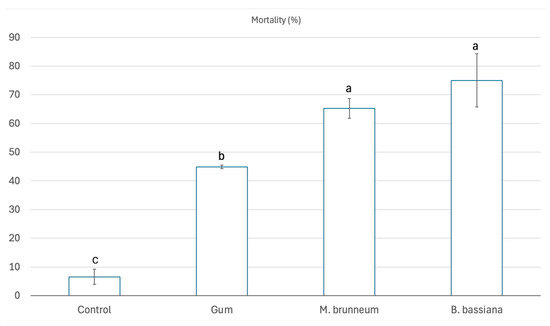
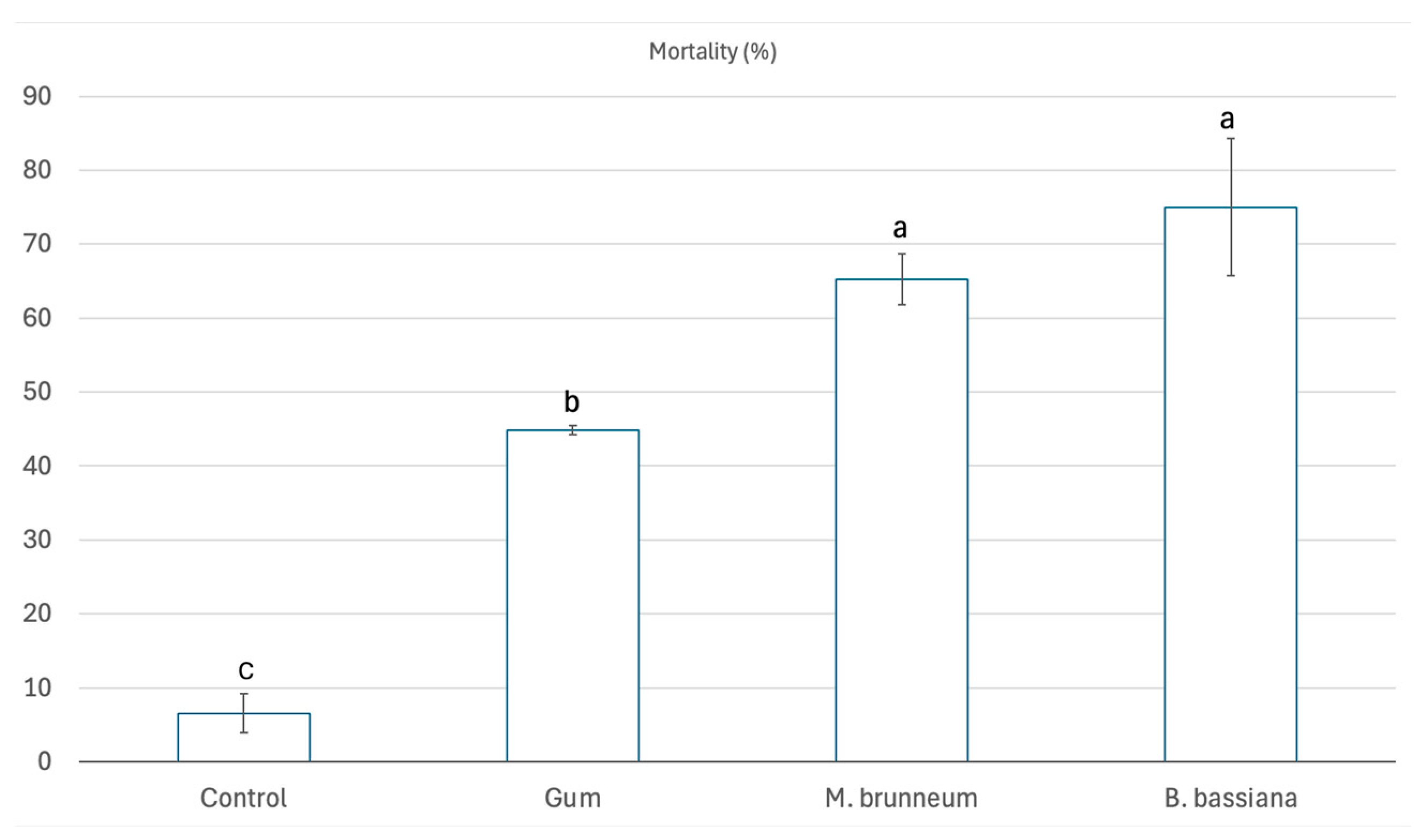
Adult mortality differed significantly among treatments according to the generalized linear model with a binomial error distribution and logit link function (likelihood ratio χ2 = 77.17, df = 3, p < 0.001) (Figure 1). Mortality ranged from 6.56% ± 2.69% in the untreated control (TA) to 75.00% ± 9.30% in plants treated with the B. bassiana formulation (OP-BbSy-35).
Figure 1.
Percent mortality of adult Bactericera cockerelli, following application of Hirsutella citriformis gum and fungal formulations under greenhouse conditions. Bars represent the observed mean ± SEM (n = 5). Different letters indicate significant differences among treatments based on pairwise comparisons of estimated marginal means obtained from a generalized linear model with binomial error distribution and Tukey-adjusted comparisons (p < 0.05).
The gum control (TGH), consisting of Hirsutella citriformis gum and Tween 80 without fungal conidia, produced 44.86% ± 0.64% adult mortality, which was significantly greater than that observed in the untreated control (p < 0.05). This treatment produced an intermediate level of mortality between the untreated control and the fungal formulations.
Among the fungal treatments, the B. bassiana formulation (OP-BbSy-35) produced the highest observed adult mortality (75.00% ± 9.30%), followed by the M. brunneum formulation (OP-Mbg-1), which reached 65.22% ± 3.44% mortality. Pairwise comparisons of estimated marginal means indicated that both fungal formulations caused significantly higher mortality than the untreated control and the gum treatment, whereas no significant differences were detected between the two fungal formulations (p > 0.05) (Figure 1).
Overall, these results demonstrated that formulations containing B. bassiana or M. brunneum significantly increased adult mortality under greenhouse conditions. Although H. citriformis gum alone exhibited a significant insecticidal effect, both fungal formulations produced the highest mortality.
3.3. Greenhouse Evaluation Against Bactericera cockerelli Nymphs
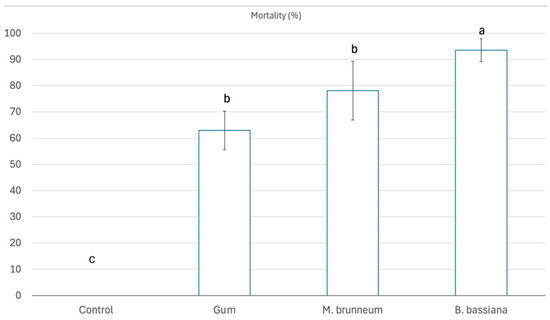
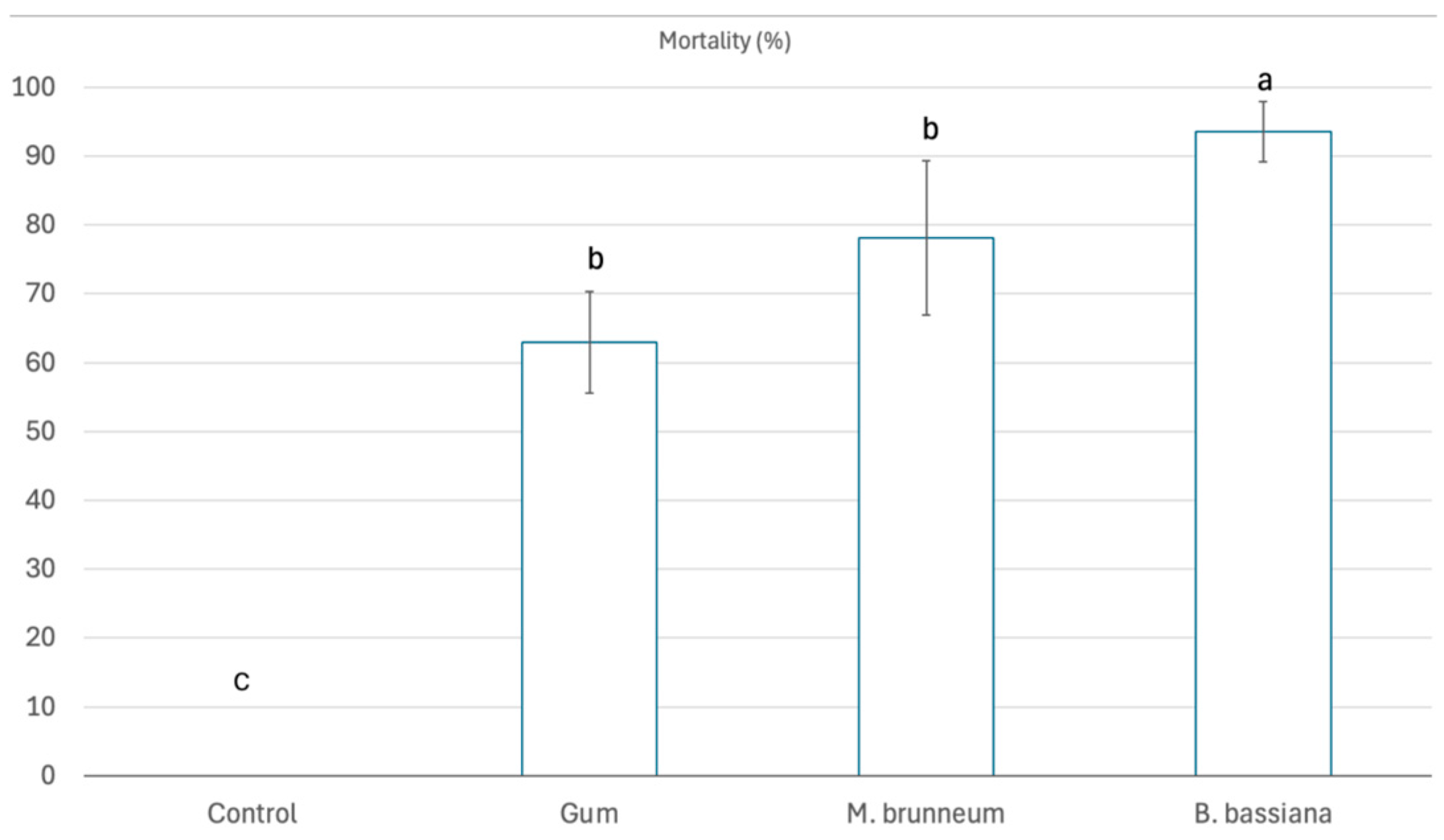
Nymph mortality significantly (likelihood ratio χ2 = 113.42, df = 3, p < 0.001) differed among treatments, according to the generalized linear model with a binomial error distribution and logit link function (Figure 2). Mortality ranged from 0% in the untreated control (TA) to 93.56% ± 4.39% in plants treated with the B. bassiana formulation (OP-BbSy-35).
Figure 2.
Percent mortality of Bactericera cockerelli nymphs following application of Hirsutella citriformis gum and fungal formulations under greenhouse conditions. Bars represent mean ± SEM (n = 5). Different letters indicate significant differences among treatments based on Tukey-adjusted pairwise comparisons of estimated marginal means following a binomial generalized linear model (GLM) with a logit link function (p < 0.05).
B. bassiana formulation (OP-BbSy-35) produced the highest observed nymph mortality (93.56% ± 4.39%), followed by the M. brunneum formulation (OP-Mbg-1), which resulted in 78.16% ± 11.20% mortality. The gum control (TGH), consisting of H. citriformis gum and Tween 80 without fungal conidia, produced 63.00% ± 7.39% mortality, whereas no mortality was observed in the untreated control.
Pairwise comparisons indicated that OP-BbSy-35 produced significantly higher mortality than OP-Mbg-1 and TGH (p < 0.05), whereas mortality caused by OP-Mbg-1 did not significantly (p > 0.05) differ from that observed with TGH. All three treatments produced significantly (p < 0.001) higher mortality than that of the untreated control (Figure 2).
Overall, these results demonstrated a marked treatment effect on B. cockerelli nymph mortality, with the highest mortality associated with the B. bassiana formulation. The mortality observed with the gum-only treatment further supports the insecticidal activity of H. citriformis extracellular gum in the absence of fungal conidia.
3.4. Comparative Performance of Gum and Fungal Formulations
A descriptive comparison of treatment performance against adult and nymphal stages of B. cockerelli is presented in Table 2. The untreated control exhibited the lowest mortality in both developmental stages, whereas the fungal formulations produced the highest mortality values. Overall, mortality associated with the fungal treatments was higher in nymphs than in adults.
Table 2.
Comparative mortality percent of adult and nymphal Bactericera cockerelli exposed to Hirsutella citriformis gum and fungal formulations under greenhouse conditions.
The H. citriformis gum treatment produced mortality in both developmental stages, with a higher observed mean mortality in nymphs (63.00% ± 7.39%) than in adults (44.86% ± 0.64%). Similarly, both fungal formulations showed higher observed mortality in nymphs than in adults. Mortality associated with M. brunneum increased from 65.22% ± 3.44% in adults to 78.16% ± 11.20% in nymphs, whereas mortality associated with B. bassiana increased from 75% ± 9.30% in adults to 93.56% ± 4.39% in nymphs.
Among the evaluated treatments, B. bassiana exhibited the highest observed mortality in both developmental stages, followed by M. brunneum and the H. citriformis gum treatment (Table 2).
4. Discussion
The development of effective microbial formulations requires the incorporation of components that preserve conidial viability, providing suitable physicochemical and functional properties [12]. In the present study, the addition of H. citriformis gum did not adversely affect the germination of either B. bassiana or M. brunneum conidia, as germination remained above 90% under all evaluated conditions. This finding indicates that the gum is compatible with both fungal species and does not interfere with the physiological processes associated with conidial germination. Similar observations have been reported for formulations containing H. citriformis gum, in which conidial viability remained stable during formulation development and storage [22]. Compatibility between formulation components and fungal propagules is particularly important because reductions in germination may negatively affect infectivity and subsequent performance [12]. In addition to maintaining conidial viability, formulation components may contribute to product stability, handling characteristics, and persistence after application [21,22]. Thus, the high germination rates observed here support the potential use of H. citriformis gum as a formulation ingredient for EPF.
An especially relevant finding was the mortality observed in the H. citriformis gum treatment in the absence of fungal conidia. Previous studies have demonstrated the effectiveness of EPF against B. cockerelli, with mortality generally associated with fungal infection following conidial application [10,23,24]. However, in the present study gum treatment resulted in 44.86% and 63.00% mortality in adults and nymphs, respectively. This demonstrates that the mortality observed in the formulations cannot be explained exclusively by fungal infection and indicates mortality-associated biological activity of the gum-containing treatment. Biological activity associated with H. citriformis gum has also been reported against adults of Diaphorina citri Kuwayama (Hemiptera: Liviidae), indicating that its effects may not be restricted to a single hemipteran species [20,22].
Although the mechanism responsible for the mortality associated with the gum-containing treatment was not investigated in the present study, exudates, mucilage, and extracellular metabolites produced by species of Hirsutella have previously been reported to exhibit biological activity against arthropods [16,17,18]. Such extracellular products may contain bioactive compounds with potential to affect insect survival, reproduction, or development. The mortality observed following application of the gum-containing treatment may therefore involve biological activity associated with the extracellular material. However, because Tween alone control was not included, the relative contribution of the gum and other formulation components cannot be determined from the present experiment. Consequently, identification of the factors responsible for the observed mortality and determination of their specific mode of action will require further investigation. From an applied perspective, these observations are particularly interesting. H. citriformis gum was compatible with the fungal propagules and the gum-containing treatment was also associated with substantial insect mortality. Previous studies have also indicated that formulations containing H. citriformis gum may contribute to conidial stability and improved shelf life, maintaining biological activity [21,22]. Taken together, these properties support further investigation of H. citriformis gum as a component of microbial formulations for pest management.
Both fungal formulations produced substantial mortality against B. cockerelli, under greenhouse conditions. The formulation containing B. bassiana OP-BbSy-35 resulted in observed mortalities of 75.00% in adults and 93.56% in nymphs, whereas M. brunneum OP-Mbg-1 produced 65.22% and 78.16% mortality in adults and nymphs, respectively. These findings are consistent with previous studies demonstrating the potential of EPF for the biological control of B. cockerelli [23,24,25,26]. Species of Beauveria and Metarhizium have been reported to reduce potato psyllid populations under laboratory, greenhouse, and field conditions [8,9,10,23,24], supporting their potential incorporation into integrated pest management programs [10,14].
The binomial GLM analyses further demonstrated significant treatment effects for both developmental stages. In adults, B. bassiana produced the highest mortality, followed by M. brunneum and the gum treatment, whereas the untreated control showed the lowest mortality. A similar pattern was observed in nymphs, with B. bassiana again producing the highest mortality. However, the statistical grouping of treatments differed between developmental stages, emphasizing that treatment performance should be interpreted within each bioassay rather than solely from the numerical differences in mortality percentages. Differences in efficacy among entomopathogenic fungal species may reflect variation in host–pathogen interactions, infection efficiency, environmental adaptation, and the production of biologically active secondary metabolites involved in the infection process [13,15,25,26].
The mortality produced by the fungal formulations must also be considered in the context of the mortality observed with the gum-containing treatment. Substantial mortality was also observed in the gum-containing treatment, particularly in nymphs. Therefore, the effects observed with the complete formulations cannot be attributed exclusively to fungal infection. Rather, the resulting mortality may reflect the combined contribution of the entomopathogenic fungus and the formulation matrix. The present experimental design does not allow these contributions to be separated mechanistically or to establish whether their interaction is additive or synergistic. Nevertheless, the combination of high conidial viability, mortality associated with the gum-containing treatment, and high mortality produced by the fungal formulations represents a potentially valuable set of characteristics for the development of microbial products against B. cockerelli and other hemipteran pests [21,27].
A descriptive comparison between developmental stages showed higher observed mortality in nymphs than in adults for the gum and both fungal formulations. The difference was particularly evident for B. bassiana, for which mortality increased from 75% in adults to 93.56% in nymphs, whereas that for M. brunneum increased from 65.22% to 78.16%. The gum treatment likewise showed higher observed mortality in nymphs (63.00%) than in adults (44.86%). Differences in susceptibility among developmental stages have been described for insect pests and may be associated with physiological, morphological, and behavioral characteristics, including mobility, feeding behavior, cuticular development, and other life-history traits [3,28]. Stage-dependent responses have also been reported in hemipteran pests exposed to EPF and their extracellular products [18].
Since adults and nymphs were analyzed in separate bioassays and no factorial analysis evaluating the effect of developmental stage or the treatment × stage interaction was performed, these numerical differences should not be interpreted as demonstrating statistically higher susceptibility of nymphs. They instead identify a pattern that warrants further investigation. Differences in host–pathogen interactions, fungal virulence, and the activity of fungal secondary metabolites may potentially contribute to stage-associated variation in mortality [18,28,29]. Recent studies have also highlighted the complexity of fungal strategies involved in overcoming insect immune defenses, including mechanisms associated with the evasion of host cellular responses [30]. Although such mechanisms were not investigated in the present study, their potential contribution to developmental stage-associated differences in susceptibility warrants further investigation. Previous studies demonstrated successful suppression of potato psyllid populations with EPF, providing additional support for investigating developmental stage as a factor affecting treatment performance [23].
Overall, the present findings indicate that H. citriformis gum is compatible with the conidial germination of B. bassiana and M. brunneum, whereas the gum-containing treatment was associated with substantial mortality against B. cockerelli. Both fungal formulations produced high mortality under greenhouse conditions, with B. bassiana OP-BbSy-35 showing the highest observed mortality in both developmental stages. The combination of viable fungal propagules and the mortality-associated effects observed with the formulation matrix may therefore represent a promising approach for future investigation in the development of fungal-based biocontrol products. Further studies should determine the basis of the mortality associated with the gum-containing treatment, including the relative contributions of H. citriformis gum and other formulation components, evaluate the interaction between gum and fungal infection, and assess formulation performance under field conditions. Such studies would help establish the potential of these formulations as environmentally compatible tools for sustainable crop protection and integrated pest management [10,14].
5. Conclusions
H. citriformis gum was compatible with B. bassiana and M. brunneum conidia, maintaining germination above 90% under all evaluated conditions. In addition, substantial mortality of B. cockerelli adults and nymphs was observed with the gum-containing treatment. Because this treatment also contained Tween 80 and we did not include a Tween alone control, the observed mortality cannot be specifically attributed to the gum.
Formulations containing B. bassiana OP-BbSy-35 and M. brunneum OP-Mbg-1 produced high mortality against B. cockerelli under greenhouse conditions and in particular, B. bassiana formulation showed the highest observed mortality in both developmental stages. Higher mortality was observed in nymphs than in adults for the gum-containing treatment and both fungal formulations. However, these differences between developmental stages were descriptive and were not statistically evaluated.
Overall, the compatibility of H. citriformis gum with entomopathogenic fungal conidia, together with the mortality associated with the gum-containing treatment, supports future investigation of the gum as a component of microbial biocontrol formulations. Further studies will determine the basis of the observed mortality, including the relative contributions of H. citriformis gum and other formulation components, and evaluate the interaction between the gum and fungal infection, and the performance of these formulations under field conditions.
6. Patents
The formulation technology evaluated in this study is related to the Mexican patent application MX-a-2024-003493, entitled “Formulación de control biológico a base de conidios y goma de Hirsutella citriformis y su uso como agente de biocontrol de plagas agrícolas”, submitted to the Mexican Institute of Industrial Property (IMPI) on 20 March 2024 (Application No. MX/E/2024/020451). The patent application is currently under review.
Author Contributions
Conceptualization, O.P.-G., P.T.-G., R.G.-F. and S.H.C.-B.; methodology, A.E.A.-R., C.I.R.-S., E.O.-S., O.P.-G., P.T.-G., R.A.F.-V., S.H.C.-B. and V.E.A.-A.; software, C.I.R.-S., E.O.-S. and V.E.A.-A.; validation, A.E.A.-R., C.I.R.-S., O.P.-G., P.T.-G., R.G.-F., S.H.C.-B. and V.E.A.-A.; formal analysis, E.O.-S., O.P.-G., P.T.-G. and V.E.A.-A.; investigation, A.E.A.-R., C.I.R.-S., E.O.-S., O.P.-G., P.T.-G., R.A.F.-V., R.G.-F., S.H.C.-B. and V.E.A.-A.; resources, O.P.-G., P.T.-G. and V.E.A.-A.; data curation, O.P.-G., R.A.F.-V. and V.E.A.-A.; writing—original draft preparation, A.E.A.-R., E.O.-S., O.P.-G., R.A.F.-V., R.G.-F. and V.E.A.-A.; writing—review and editing, O.P.-G., P.T.-G., R.G.-F. and V.E.A.-A.; visualization, O.P.-G., R.A.F.-V. and S.H.C.-B.; supervision, C.I.R.-S., O.P.-G., P.T.-G., R.G.-F. and V.E.A.-A.; project administration, O.P.-G., P.T.-G., R.G.-F. and V.E.A.-A.; funding acquisition, O.P.-G. and P.T.-G. All authors have read and agreed to the published version of the manuscript.
Funding
This research was funded by Secretaría de Ciencia, Humanidades, Tecnología e Innovación (SECIHTI, México) through scholarship grants 789943 to A.E.A.-R. and 780422 to R.A.F.-V. The authors also acknowledge the support provided by the National System of Researchers (Sistema Nacional de Investigadoras e Investigadores, SNII-SECIHTI, México) through researcher memberships SNII-9942 to R.G.-F., SNII-49531 to V.E.A.-A., SNII-665130 to S.H.C.-B., SNII-445572 to C.I.R.-S., SNII-16614 to P.T.-G., and SNII-419628 to O.P.-G.
Institutional Review Board Statement
Not applicable.
Informed Consent Statement
Not applicable.
Data Availability Statement
The datasets generated and analyzed during the current study are available from the corresponding author upon reasonable request.
Acknowledgments
During the preparation of this manuscript, the authors used ChatGPT (OpenAI, GPT-5.5) for language editing and improvement of scientific writing. All generated content was reviewed, edited, and verified by the authors, who take full responsibility for the final content of this publication.
Conflicts of Interest
The authors declare that part of the technology evaluated in this study is related to Mexican patent application MX-a-2024-003493. The authors declare there are no other conflicts of interest.
Correction Statement
This article has been republished with a minor correction to the existing affiliation information. This change does not affect the scientific content of the article.
References
- Waheed, K.; Nawaz, H.; Hanif, M.A.; Rehman, R. Tomato. In Medicinal Plants of South Asia; Hanif, M.A., Nawaz, H., Khan, M.M., Byrne, H.J., Eds.; Elsevier: Amsterdam, The Netherlands, 2020; pp. 631–644. [Google Scholar] [CrossRef] [Scilit]
- Reséndiz-Castro, M.; Jiménez-Martínez, C.; Corzo-Ríos, L.J.; Zepeda-Bautista, R.; Rodríguez-Ramírez, N.E. Framework for training small greenhouse tomato farmers toward sustainable food production: Fruit processing. ProQuest Humanit. Soc. Sci. Commun. 2025, 12, 1871. [Google Scholar] [CrossRef] [Scilit]
- Wenninger, E.J.; Rashed, A. Biology, ecology, and management of the potato psyllid, Bactericera cockerelli (Hemiptera: Triozidae), and zebra chip disease in potato. Annu. Rev. Entomol. 2024, 69, 139–157. [Google Scholar] [CrossRef] [Scilit] [PubMed]
- Garzón-Tiznado, J.A.; Melgoza-Villagómez, C.M.; López-Orona, C.A.; Castro-Espinoza, L.; Velarde-Félix, S.; Figueroa-Pérez, M.G.; Retes-Manjarrez, J.E. Resistance to Candidatus Liberibacter solanacearum haplotype B in tomato landraces from México. J. Phytopathol. 2020, 168, 632–640. [Google Scholar] [CrossRef] [Scilit]
- Garzón-Tiznado, J.A.; Cárdenas-Valenzuela, O.G.; Bujanos-Muñiz, R.; Marín-Jarillo, A.; Becerra-Flora, A.; Velarde-Felix, S.; Reyes-Moreno, C.; González-Chavira, M.; Martínez-Carrillo, J.L. Asociación de Hemiptera: Triozidae con la enfermedad ‘permanente del tomate’ en México. Agric. Téc. Méx. 2009, 35, 61–72. Available online: https://www.scielo.org.mx/pdf/agritm/v35n1/v35n1a6.pdf (accessed on 12 August 2026). (In Spanish)
- Gharalari, A.H.; Nansen, C.; Lawson, D.S.; Gilley, J.; Munyaneza, J.E.; Vaughn, K. Knockdown mortality, repellency, and residual effects of insecticides for control of adult Bactericera cockerelli (Hemiptera: Psyllidae). J. Econ. Entomol. 2009, 102, 1032–1038. [Google Scholar] [CrossRef] [Scilit] [PubMed]
- Cerna-Chavez, C.; Aguirre, C.L.; Flores, M.; Guervara, L.; Landeros-Flores, J.; Ochoa-Fuentes, Y. Susceptibility to Bactericera cockerelli (Sulc) (Hemiptera: Triozidae) to insecticides in the State of Nuevo Leon, México. Resist. Pest Manag. Newsl. 2010, 19, 14–17. [Google Scholar]
- Lacey, L.A.; Liu, T.X.; Buchman, J.L.; Munyaneza, J.E.; Goolsby, J.A.; Horton, D.R. Entomopathogenic fungi (Hypocreales) for control of potato psyllid, Bactericera cockerelli (Sulc.) (Hemiptera: Triozidae) in an area endemic for zebra chip disease of potato. Biol. Control 2011, 56, 271–278. [Google Scholar] [CrossRef] [Scilit]
- Villegas-Rodríguez, F.; Marín-Sánchez, J.; Delgado-Sánchez, P.; Torres-Castillo, J.A.; Alvarado-Gómez, O.G. Management of Bactericera cockerelli (Sulc.) (Hemiptera: Triozidae) in greenhouses with entomopathogenic fungi (Hypocreales). Southwest. Entomol. 2014, 39, 613–624. [Google Scholar] [CrossRef] [Scilit]
- Tamayo-Mejia, F.; Tamez-Guerra, P.; Guzman-Franco, A.W.; Gomez-Flores, R. Can Beauveria bassiana Bals. (Vuill) (Ascomycetes: Hypocreales) and Tamarixia triozae (Burks) (Hymenoptera: Eulophidae) be used together for improved biological control of Bactericera cockerelli (Hemiptera: Triozidae)? Biol. Control 2015, 90, 42–48. [Google Scholar] [CrossRef] [Scilit]
- Cárdenas-Huamán, G.; Morocho-Romero, H.; Casas-Niño, S.; Vilchez-Navarro, S.; Velarde-Apaza, L.D.; Ramirez-Rojas, M.; Cruz, J.; Lozano-Isla, F. Efficacy of biological and chemical control agents against the potato psyllid (Bactericera cockerelli Šulc) under field conditions. Int. J. Plant Biol. 2025, 16, 136. [Google Scholar] [CrossRef] [Scilit]
- Garcia-Riaño, J.L.; Torres-Torres, L.A.; Santos-Díaz, A.M.; Grijalba-Bernal, E.P. In vitro compatibility with soybean agro-chemicals and storage stability studies of the Beauveria bassiana biopesticide. Biocatal. Agric. Biotechnol. 2022, 39, 102275. [Google Scholar] [CrossRef] [Scilit]
- Mishra, S.; Kumar, P.; Malik, A. Effect of temperature and humidity on pathogenicity of native Beauveria bassiana isolate against Musca domestica L. J. Parasit. Dis. 2015, 39, 697–704. [Google Scholar] [CrossRef] [Scilit] [PubMed]
- Veronesi, E.R.; Thompson Christopher, J.; Goldson Stephen, L. Insect biological control of the tomato-potato psyllid Bactericera cockerelli a review. N. Z. J. Crop. Hortic. Sci. 2025, 53, 795–811. [Google Scholar] [CrossRef] [Scilit]
- Agbessenou, A.; Akutse, K.S.; Yusuf, A.A.; Wekesa, S.W.; Khamis, F.M. Temperature-dependent modelling and spatial prediction reveal suitable geographical areas for deployment of two Metarhizium anisopliae isolates for Tuta absoluta management. Sci. Rep. 2021, 11, 23346. [Google Scholar] [CrossRef] [Scilit] [PubMed]
- Qu, J.; Zou, X.; Yu, J.; Zhou, Y. The conidial mucilage, natural film coatings, is involved in environmental adaptability and pathogenicity of Hirsutella satumaensis Aoki. Sci. Rep. 2017, 7, 1301. [Google Scholar] [CrossRef] [Scilit] [PubMed]
- Rosas-Acevedo, J.L.; Boucias, D.G.; Lezama, R.; Sims, K.; Pescador, A. Exudate from sporulating cultures of Hirsutella thompsonii Fisher inhibit oviposition by the two-spotted spider mite Tetranychus urticae Koch. Exp. Appl. Acarol. 2003, 29, 213–222. [Google Scholar] [CrossRef] [Scilit] [PubMed]
- Pérez-González, O.; Gomez-Flores, R.; Tamez-Guerra, P. Insight into biological control potential of Hirsutella citriformis against Asian citrus psyllid as a vector of citrus Huanglongbing disease in America. J. Fungi 2022, 8, 573. [Google Scholar] [CrossRef] [Scilit] [PubMed]
- Li, R.; Jiang, X.; Guan, H. Optimization of mycelium biomass and exopolysaccharides production by Hirsutella sp. in submerged fermentation and evaluation of exopolysaccharides antibacterial activity. Afr. J. Biotechnol. 2010, 9, 195–202. [Google Scholar] [CrossRef]
- Cantú-Bernal, S.H.; Gomez-Flores, R.; Flores-Villarreal, R.A.; Orozco-Flores, A.A.; Romo-Sáenz, C.I.; Montesinos-Matías, R.; Mellín-Rosas, M.A.; Sánchez-González, J.A.; Pérez-González, O.; Tamez-Guerra, P. Adult Diaphorina citri biocontrol using Hirsutella citriformis strains and gum formulations. Plants 2023, 12, 3184. [Google Scholar] [CrossRef] [Scilit] [PubMed]
- Flores-Villarreal, R.A.; Orozco-Flores, A.A.; Cantú-Bernal, S.H.; Gomez-Flores, R.; Pérez-González, O.; Tamez-Guerra, P. Increased Hirsutella citriformis conidia shelf life in Acacia and Hirsutella gum formulations. Appl. Sci. 2023, 13, 7912. [Google Scholar] [CrossRef] [Scilit]
- Pérez-González, O.; Tamez-Guerra, P.; Gomez-Flores, R.; Cantú-Bernal, S.H.; Flores-Villarreal, R.A. Formulación de control biológico a base de conidios y goma de Hirsutella citriformis y su uso como agente de biocontrol de plagas agrícolas. Mexican Patent MX-a-2024-003493, 20 March 2024. [Google Scholar]
- Mauchline, N.A.; Stannard, K.A.; Zydenbos, S.M. Evaluation of selected entomopathogenic fungi and bioinsecticides against Bactericera cockerelli (Hemiptera). N. Z. Plant Prot. 2013, 66, 324–332. [Google Scholar] [CrossRef] [Scilit]
- Villegas-Rodríguez, F.; Díaz-Gómez, O.; Casas-Flores, J.S.; Monreal-Vargas, C.T.; Tamayo-Mejía, F.; Aguilar-Medel, S. Actividad de dos hongos entomopatógenos, identificados molecularmente, sobre Bactericera Cockerelli. Rev. Colomb. Entomol. 2017, 43, 27–33. [Google Scholar] [CrossRef] [Scilit]
- Zimmermann, G. Review on safety of the entomopathogenic fungi Beauveria bassiana and Beauveria brongniartii. Biocontrol Sci. Technol. 2007, 17, 553–596. [Google Scholar] [CrossRef] [Scilit]
- Zimmermann, G. Review on safety of the entomopathogenic fungus Metarhizium anisopliae. Biocontrol Sci. Technol. 2007, 17, 879–920. [Google Scholar] [CrossRef] [Scilit]
- Baron, N.C.; Rigobelo, E.C. Endophytic fungi: A tool for plant growth promotion and sustainable agriculture. Mycology 2022, 13, 39–55. [Google Scholar] [CrossRef] [Scilit] [PubMed]
- Butler, C.D.; Trumble, J.T. The potato psyllid, Bactericera cockerelli (Sulc) (Hemiptera: Triozidae): Life history, relationship to plant diseases, and management strategies. Terr. Arthropod Rev. 2012, 5, 87–111. [Google Scholar] [CrossRef] [Scilit]
- Granados-Echegoyen, C.A.; Calderón-Cortés, N.; Vásquez-López, A.; de Gives, P.M.; Reyes-Estebanez, M.; Sarmiento-López, L.G.; Vera-Reyes, I.; Gómez-Domínguez, N.S.; Landero-Valenzuela, N.; Loera-Alvarado, E.; et al. Pest control strategies using secondary metabolites of entomopathogenic fungi. In The Role of Entomopathogenic Fungi in Agriculture; CRC Press: Boca Raton, FL, USA, 2025; pp. 267–297. [Google Scholar]
- Wei, J.; Zhang, Y.; Xu, L. Uncovering the immune evasion mechanism of microbial pathogens: Lessons from anti-encapsulation strategies adopted by a fungus. Integr. Zool. 2024, 19, 1229–1232. [Google Scholar] [CrossRef] [Scilit] [PubMed]

Disclaimer/Publisher’s Note: The statements, opinions and data contained in all publications are solely those of the individual author(s) and contributor(s) and not of MDPI and/or the editor(s). MDPI and/or the editor(s) disclaim responsibility for any injury to people or property resulting from any ideas, methods, instructions or products referred to in the content. |
© 2026 by the authors. Licensee MDPI, Basel, Switzerland. This article is an open access article distributed under the terms and conditions of the Creative Commons Attribution (CC BY) license.