


Abstract
Staphylococcus aureus is one of the leading causes of both community- and healthcare-associated infections. Nasal colonization constitutes the primary reservoir for subsequent infection and transmission, while methicillin-resistant Staphylococcus aureus (MRSA) remains a major public health concern because of its resistance to multiple antimicrobial agents. However, data regarding community nasal colonization in rural Portuguese populations remain scarce. The BI-STAPH Project was established to address this knowledge gap through systematic surveillance of rural communities in inland Portugal. To estimate the prevalence of presumptive nasal colonization by Staphylococcus aureus and MRSA among adults living in the municipality of Fundão, Portugal, and to explore potential associations between colonization and demographic, behavioural, occupational, and environmental characteristics. A prospective community-based cross-sectional study was conducted as the second phase of the BI-STAPH Project. A total of 200 adults were recruited from different parishes of the municipality of Fundão. Bilateral nasal swabs were collected and processed using standardized microbiological methods for the presumptive identification of S. aureus. Presumptive MRSA isolates were investigated using a PBP2′ latex agglutination assay. Sociodemographic and exposure-related information was obtained through structured questionnaires. Associations between presumptive colonization and participant characteristics were evaluated using Pearson’s chi-square or Fisher’s exact tests, as appropriate. Presumptive S. aureus nasal colonization was identified in 56 of 200 participants, corresponding to a prevalence of 28.0% (95% CI: 21.8–34.2%). No presumptive MRSA-positive isolates were identified, corresponding to an observed prevalence of 0% (95% CI: 0.0–1.8%). Colonization prevalence was 29.5% among females and 26.8% among males, and ranged from 25.8% to 31.1% across age groups; neither sex nor age was significantly associated with colonization. Participants reporting daily animal contact had a colonization prevalence of 32.3%, compared with 20.5% among those without animal contact, but this difference was not statistically significant (p = 0.075). Overall, no statistically significant associations were identified between presumptive S. aureus colonization and the demographic, behavioural, occupational, or environmental variables evaluated. Presumptive S. aureus nasal colonization was common among adults living in the rural municipality of Fundão, Portugal, whereas no presumptive MRSA-positive isolates were identified in this study population. No statistically significant associations were observed between colonization and the characteristics evaluated. These findings expand the epidemiological evidence generated by the BI-STAPH Project and support continued community-based surveillance of S. aureus in rural Portugal. Future multicentre studies incorporating molecular confirmation, antimicrobial susceptibility testing, and larger populations will be important to better characterize circulating strains and transmission patterns within a One Health framework.
1. Introduction
Staphylococcus aureus remains one of the most important human bacterial pathogens, causing a broad spectrum of diseases ranging from mild skin and soft tissue infections to severe invasive conditions such as bacteremia, infective endocarditis, osteomyelitis, pneumonia, and sepsis mortality [1,2,3]. Beyond its role in clinical infections, S. aureus is also a common colonizer of healthy individuals, with the anterior nares representing its principal ecological niche. Nasal carriage plays a pivotal role in the epidemiology of S. aureus, serving as an important reservoir for both autoinfection and transmission within households, healthcare settings, and the community [4,5,6].
The emergence and worldwide dissemination of methicillin-resistant Staphylococcus aureus (MRSA) have considerably increased the public health burden associated with this microorganism [6,7,8]. Although historically regarded as a hospital-associated pathogen, MRSA has progressively expanded into community settings and has also been identified in livestock, companion animals, and environmental reservoirs. This epidemiological transition has reinforced the importance of the One Health concept, recognizing the close interaction between human, animal, and environmental health in the dissemination of antimicrobial-resistant bacteria [9,10].
The prevalence of nasal colonization by S. aureus varies considerably among populations, generally ranging from 20% to 30% in healthy adults, whereas community-associated MRSA carriage remains relatively uncommon in most European countries [11,12,13,14]. Colonization is influenced by numerous host, environmental, and behavioral factors, including age, sex, smoking habits, previous antibiotic exposure, healthcare contact, occupational activities, and animal exposure. Rural populations may present distinctive epidemiological characteristics because of their greater involvement in agriculture, livestock farming, and frequent contact with domestic and production animals [13,15,16,17].
Antimicrobial resistance remains an important public health concern in Portugal, as in other European countries [18,19]. Although several studies have characterized MRSA epidemiology in hospital settings, information regarding nasal colonization in community populations remains limited, particularly in rural inland regions [20,21]. Most available Portuguese studies have focused on urban populations, hospitalized patients, healthcare workers, or specific occupational groups, leaving important gaps in the understanding of community transmission dynamics.
In recent years, several epidemiological studies conducted in inland Portugal have highlighted the importance of community-based surveillance for monitoring chronic diseases, infectious diseases, and antimicrobial resistance. These investigations have demonstrated the value of regional population studies in identifying local health challenges and supporting evidence-based public health strategies [22,23,24]. Nevertheless, community-based data regarding nasal colonization by Staphylococcus aureus remain scarce, particularly in rural municipalities of the Beira Interior region.
To address this knowledge gap, the BI-STAPH Project was established as a community surveillance initiative designed to evaluate the epidemiology of S. aureus and MRSA colonization across municipalities in the Beira Interior region of Portugal. The first phase of the BI-STAPH Project, conducted in the municipality of Sertã, used standardized microbiological methods for the presumptive identification of S. aureus and reported an overall colonization prevalence of 19.9% [25].
The municipality of Fundão represents a distinct rural setting within the Beira Interior region, characterized by marked agricultural activity, livestock production, and an ageing population [26]. These demographic and environmental characteristics may influence the epidemiology of S. aureus colonization and justify continued community surveillance within the framework of the BI-STAPH Project.
Despite the epidemiological importance of S. aureus carriage, data on community nasal colonization in rural and predominantly ageing populations in inland Portugal remain limited. This gap is particularly relevant because rural communities may present distinctive patterns of healthcare access, occupational exposure, human–animal interaction, and antimicrobial use that can influence bacterial transmission and colonization. Moreover, epidemiological patterns may vary between geographically close municipalities, making locally generated surveillance data important for understanding regional heterogeneity. The first phase of the BI-STAPH Project, conducted in the municipality of Sertã, provided baseline data on S. aureus and MRSA carriage in a rural Portuguese population [25]. The present second phase extends this surveillance approach to the municipality of Fundão, using a comparable community-based design and microbiological workflow. This approach allows the characterization of local carriage patterns and provides complementary evidence for the development of a broader regional surveillance framework for S. aureus in inland Portugal.
Therefore, the objective of this second phase of the BI-STAPH Project was to estimate the prevalence of nasal S. aureus and MRSA carriage among adults living in the municipality of Fundão, Portugal, and to explore possible associations between S. aureus colonization and selected demographic, behavioural, occupational, and environmental characteristics. By extending the project to a second rural municipality, this study also aimed to contribute additional evidence to the characterization of S. aureus carriage patterns in inland Portugal and to support the development of community-based regional surveillance.
2. Materials and Methods
2.1. Study Design and Population
A prospective community-based cross-sectional study was conducted as the second phase of the BI-STAPH Project to investigate nasal colonization by Staphylococcus aureus and methicillin-resistant S. aureus (MRSA) among adults living in the municipality of Fundão, Central Portugal. Participant recruitment and biological sampling were conducted in February and May 2026.
The study was conducted across different parishes of the municipality of Fundão. Participants were approached directly in community settings, including public streets, local fairs, markets, and other community gatherings. The recruitment strategy was designed to facilitate access to adults from different geographical areas of the municipality and to extend the community-based surveillance approach previously implemented during Phase 1 of the BI-STAPH Project in the municipality of Sertã [25].
2.2. Participant Recruitment and Eligibility
Adults aged ≥18 years who were residents of the municipality of Fundão were eligible for participation. Recruitment was based on convenience sampling, with participants approached directly by the research team in community settings, including streets, fairs, markets, and local community gatherings. Individuals were informed about the objectives and procedures of the study and were invited to participate voluntarily.
A total of 200 adults were enrolled. Fewer than 10% of the individuals approached declined participation. Because recruitment was based on convenience rather than probability sampling, the study sample cannot be considered statistically representative of the adult population of the municipality of Fundão. In particular, recruitment in public and community settings may have underrepresented individuals with limited mobility or those who spend more time at home. Potential selection bias was therefore considered when interpreting the prevalence estimates.
The inclusion of 200 participants was also constrained by the feasibility of community-based recruitment during the predefined study period. No formal population-based sampling frame was available.
2.3. Sample Size
No formal a priori sample-size calculation was performed before recruitment. The target sample of 200 participants was defined according to the feasibility of community-based recruitment during the study period and the objective of obtaining an initial epidemiological characterization of S. aureus carriage in the municipality of Fundão. Accordingly, the study should be considered an exploratory community surveillance study, and the sample size was not specifically powered to detect associations between colonization and individual risk factors.
2.4. Questionnaire and Exposure Variables
Participants completed a structured questionnaire collecting information on demographic and behavioural characteristics, including sex, age group, place of residence, smoking status, occupational activity, occupational risk category, healthcare-professional status, and daily contact with animals.
Animal exposure was classified according to contact with domestic animals, non-domestic/production animals, or both. Occupational risk was categorized as low, moderate, or high according to predefined criteria established during Phase 1 of the BI-STAPH Project [25]. Briefly, low-risk occupations were those without regular exposure to healthcare environments, livestock, animals, or intensive interpersonal contact; moderate-risk occupations included activities involving regular interpersonal or environmental exposure; and high-risk occupations included occupations with frequent direct exposure to healthcare settings, livestock/animals, or other potentially relevant sources of bacterial transmission. The same classification framework was applied in the present study to maintain methodological consistency with Phase 1.
All questionnaire information was collected at the time of participant enrolment. Participants were not followed longitudinally.
2.5. Microbiological Sampling and Identification
Bilateral anterior nasal swabs were collected from each participant at the time of enrolment using sterile sampling swabs. Samples were processed using standard microbiological procedures for the isolation and presumptive identification of S. aureus.
Nasal specimens were cultured on a selective/differential chromogenic medium for the detection of S. aureus (bioMérieux, Marcy-l’Étoile, France), according to the manufacturer’s instructions. Suspected colonies were evaluated based on colony morphology and Gram staining characteristics. Colonies displaying morphology compatible with S. aureus and Gram-positive cocci in clusters were classified as presumptive S. aureus isolates.
The present study did not include molecular confirmation of species identification, coagulase testing, MALDI-TOF mass spectrometry, or PCR targeting the nuc gene. Therefore, the reported prevalence should be interpreted as the prevalence of presumptively identified S. aureus nasal colonization based on the microbiological workflow used in the study.
2.6. MRSA Screening and Identification
Presumptive S. aureus isolates were further evaluated for methicillin resistance using a latex agglutination assay targeting penicillin-binding protein 2a (PBP2a). The assay used was the MASTALEX™ MRSA Latex Kit for PBP2′ (Penicillin Binding Protein 2′) and Confirmation of Methicillin-Resistant Staphylococcus aureus (MAST Group, Bootle, UK), performed according to the manufacturer’s instructions.
The assay detects PBP2a/PBP2′, the altered penicillin-binding protein associated with methicillin resistance in S. aureus. A positive latex reaction was interpreted as evidence supporting methicillin-resistant S. aureus. No cefoxitin or oxacillin susceptibility testing was performed, and no molecular detection of mecA or mecC was undertaken. Antimicrobial susceptibility testing was not performed in this study.
The MASTALEX™ assay was used as the sole phenotypic method for MRSA screening. Accordingly, the absence of a positive latex reaction was interpreted as no MRSA detected by the method used rather than as definitive evidence of absence of methicillin-resistant strains in the study population.
2.7. Statistical Analysis
Categorical variables were summarized using absolute and relative frequencies. The prevalence of S. aureus nasal colonization was calculated as the proportion of participants with presumptive S. aureus carriage among all participants tested, and the corresponding 95% confidence interval (CI) was calculated using the exact binomial method. For the observed prevalence of MRSA, the exact binomial 95% CI was also calculated.
Associations between S. aureus colonization and categorical participant characteristics were assessed using Pearson’s chi-square test or Fisher’s exact test, as appropriate according to the expected cell frequencies. For variables with more than two categories, the overall test was used to assess whether the observed proportions differed across categories.
In addition, pairwise differences between independent proportions were examined where appropriate using a two-sided test for equality of proportions. The maximum absolute difference between category-specific proportions was reported descriptively, together with the corresponding statistical test. Because the study was exploratory and the number of colonized participants was limited, these analyses were considered unadjusted exploratory comparisons.
Multivariable logistic regression was not performed because the number of S. aureus-positive participants was limited (n = 56) and several explanatory variables contained very small subgroups, which would have resulted in unstable estimates and an excessive number of parameters relative to the number of outcome events. Therefore, the analyses were intended to explore possible associations rather than identify independent risk factors.
All statistical tests were two-sided, and statistical significance was defined as p < 0.05. Statistical analyses were performed using IBM SPSS Statistics version 21.0 (IBM Corp., Armonk, NY, USA).
2.8. Ethical Considerations
The study was conducted in accordance with the ethical principles of the Declaration of Helsinki and was approved by the appropriate institutional Ethics Committee (approval number: CE-UBI-Pj-2023-054).
All participants provided written informed consent before enrolment. Participant confidentiality and anonymity were guaranteed throughout all stages of the study, and all collected data were analysed anonymously.
3. Results
3.1. Population Characteristics
A total of 200 adult participants from different parishes of the municipality of Fundão were included in the study.
The study population consisted predominantly of males (56.0%, n = 112), whereas females represented 44.0% (n = 88). Participants aged 35–59 years constituted the largest age group (44.5%), followed by individuals aged ≥60 years (33.0%) and those aged 18–34 years (22.5%).
Regarding geographical distribution, most participants resided in the Cova da Beira Valley (70.0%), while the remaining individuals were distributed across the East Gardunha, West Gardunha, and South Gardunha regions.
Concerning smoking habits, 59.0% of participants were non-smokers (n = 118), 26.0% were current smokers (n = 52), and 15.0% were former smokers (n = 30).
Most occupations were classified as low occupational risk (70.0%, n = 140), followed by moderate-risk (26.5%, n = 53) and high-risk occupations (3.5%, n = 7). Daily contact with animals was reported by 63.5% of participants (n = 127). Among participants reporting animal exposure, contact with domestic animals was the most frequently reported type of exposure (58.3%, n = 74), followed by contact with both domestic and non-domestic/production animals (26.8%, n = 34), whereas exclusive contact with non-domestic/production animals was the least common (15.0%, n = 19).
3.2. Prevalence of Staphylococcus aureus and MRSA
Presumptive nasal colonization by Staphylococcus aureus was identified in 56 of the 200 participants, corresponding to an overall prevalence of 28.0% (95% CI: 21.8–34.2%). No MRSA-positive isolates were detected among the participants, corresponding to an observed prevalence of 0% (95% CI: 0.0–1.8%).
The distribution of presumptive S. aureus colonization according to participant characteristics is presented in Table 1. No statistically significant associations were identified between presumptive S. aureus colonization and the demographic, behavioural, occupational, or environmental variables evaluated (all p > 0.05).
Table 1.
Distribution of presumptive Staphylococcus aureus nasal colonization according to demographic, behavioural, occupational, and environmental characteristics of the study population. Values are presented as n and percentage of participants with presumptive S. aureus colonization within each category. p-values were calculated using Pearson’s chi-square test or Fisher’s exact test, as appropriate.
Presumptive colonization prevalence was 26.8% among males and 29.5% among females, with no statistically significant difference between the groups (p = 0.666). Across age groups, prevalence was 31.1% among participants aged 18–34 years, 28.1% among those aged 35–59 years, and 25.8% among those aged ≥60 years; the overall comparison was not statistically significant (p = 0.827).
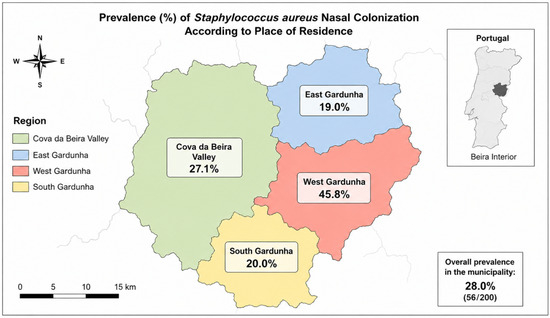
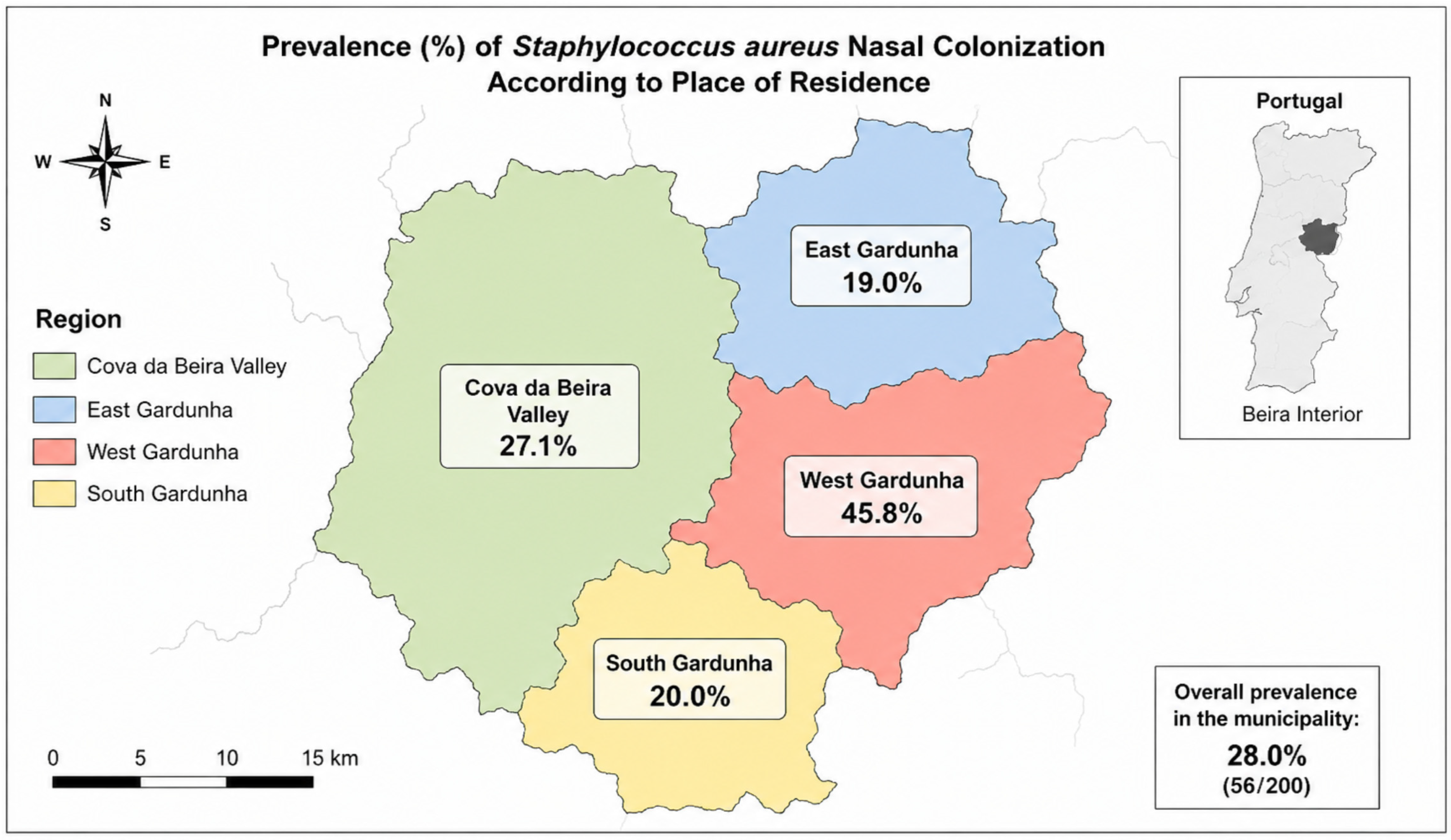
According to place of residence, the prevalence of presumptive S. aureus colonization ranged from 19.0% in East Gardunha to 45.8% in West Gardunha (Figure 1). The overall comparison between geographical areas was not statistically significant (p = 0.161).
Figure 1.
Geographical distribution of the prevalence of Staphylococcus aureus nasal colonization according to participants’ place of residence in the municipality of Fundão. The percentages represent the proportion of colonized individuals within each geographical region. The number of participants in each area was: Cova da Beira Valley (n = 140), East Gardunha (n = 21), West Gardunha (n = 24), and South Gardunha (n = 15).
Presumptive S. aureus colonization was identified in 32.3% of participants reporting daily contact with animals and in 20.5% of those reporting no daily animal contact. This comparison was not statistically significant (p = 0.075). According to type of animal exposure, prevalence ranged from 15.8% among participants reporting exclusive contact with non-domestic/production animals to 36.5% among those reporting contact with domestic animals; the overall comparison was not statistically significant (p = 0.227).
According to smoking status, prevalence ranged from 19.2% among current smokers to 33.3% among former smokers, with no statistically significant association (p = 0.250).
Healthcare professionals had a presumptive S. aureus colonization prevalence of 42.9% compared with 27.5% among non-healthcare professionals. This difference was not statistically significant (p = 0.373) and was based on a very small number of healthcare professionals (n = 7).
According to occupational risk, prevalence ranged from 26.4% among participants with moderate-risk occupations to 42.9% among those classified as high occupational risk. No statistically significant association was observed (p = 0.659).
Overall, none of the demographic, behavioural, geographical, occupational, or animal-exposure variables evaluated showed a statistically significant association with presumptive S. aureus nasal colonization.
Because no MRSA-positive isolates were detected using the screening method employed, no further inferential analyses regarding factors associated with MRSA carriage were performed.
4. Discussion
In this second phase of the BI-STAPH Project, we assessed nasal carriage of S. aureus among adults living in the municipality of Fundão and generated additional epidemiological data on presumptive S. aureus colonization in a rural community of inland Portugal. By applying a broadly consistent community-based study design and microbiological approach to that used in the first phase conducted in the municipality of Sertã, the project contributes to the development of a regional evidence base for S. aureus carriage and supports the feasibility of community-level surveillance in rural populations.
The overall prevalence of presumptive S. aureus nasal colonization in the present study was 28.0% (95% CI: 21.8–34.2%). This estimate is compatible with carriage frequencies reported among healthy adult populations in Europe [5,26,27,28,29]. Nasal carriage remains epidemiologically relevant because colonized individuals may represent an endogenous source of infection and a potential reservoir for interpersonal transmission [20,30,31,32,33]. However, the present estimate should be interpreted as a prevalence of presumptive S. aureus colonization, given that species identification was based on culture characteristics, colony morphology, and Gram staining without molecular confirmation or MALDI-TOF identification.
The prevalence observed in Fundão was numerically higher than that reported during Phase 1 of the BI-STAPH Project in Sertã (28.0% vs. 19.9%) [25]. However, the present study was not designed or statistically powered to perform a formal comparison between the two municipalities, and the difference should therefore be regarded as descriptive rather than as evidence of a statistically demonstrated difference in colonization prevalence. Differences in population composition, recruitment characteristics, environmental exposure, temporal factors, or sampling variability may contribute to variation between study sites. The same caution applies to the geographical differences observed within Fundão. Although colonization prevalence varied descriptively between the four geographical areas, the overall comparison was not statistically significant (p = 0.161), and the relatively small number of participants in some areas limits the precision of these estimates. These observations may nevertheless provide useful hypotheses for future regional studies with larger and more representative samples.
No statistically significant associations were identified between presumptive S. aureus colonization and sex, age group, smoking status, geographical area, healthcare-professional status, occupational risk, daily animal contact, or type of animal exposure. These findings are consistent with the multifactorial nature of S. aureus nasal carriage, which may reflect the combined influence of host characteristics, environmental exposure, behavioural factors, and bacterial determinants rather than a single readily identifiable factor [34,35,36]. Nevertheless, the absence of statistically significant associations should not be interpreted as evidence that these factors have no effect. The relatively small number of colonized participants and the very small size of some subgroups substantially limited the statistical power of the study to detect modest associations.
Animal exposure is of particular interest from a One Health perspective. Participants reporting daily animal contact had a higher descriptive prevalence of presumptive S. aureus colonization than those without reported daily contact (32.3% vs. 20.5%); however, this difference did not reach statistical significance (p = 0.075). Similarly, differences according to the type of animal exposure were descriptive and were not statistically significant (p = 0.227 for the overall comparison). These findings should therefore not be interpreted as evidence of an association between animal contact and S. aureus carriage. Nevertheless, human–animal interactions remain epidemiologically relevant because livestock and companion animals can act as reservoirs of S. aureus, including livestock-associated MRSA lineages [37,38,39]. Future studies with larger samples and molecular characterization of isolates may help determine whether specific animal-associated lineages circulate within rural communities and whether particular exposure pathways contribute to transmission.
Occupational characteristics likewise showed no statistically significant association with presumptive S. aureus colonization. Although healthcare professionals and participants classified as having high occupational risk presented higher descriptive prevalence estimates, these groups comprised only seven participants each, substantially limiting the reliability of these estimates. Previous studies have associated occupational settings involving healthcare, agriculture, livestock farming, and frequent interpersonal contact with S. aureus carriage [40,41]. The present findings therefore do not exclude a possible role of occupational exposure but indicate that larger studies with sufficient numbers within specific occupational categories are needed to evaluate such relationships reliably.
The absence of MRSA-positive isolates in the present sample is an important finding but requires cautious interpretation. No MRSA was detected among the 200 participants using the PBP2a latex agglutination assay applied to the presumptive S. aureus isolates. The observed prevalence was therefore 0%, with a corresponding 95% confidence interval of 0.0–1.8%. This result does not demonstrate that MRSA is absent from the wider Fundão community; rather, it indicates that no MRSA was detected in the sampled population using the methodology employed. The absence of antimicrobial susceptibility testing, molecular detection of mecA or mecC, and additional phenotypic confirmation limits the strength of the negative MRSA finding. In particular, PBP2a-based detection may not identify all methicillin-resistant isolates, including strains associated with alternative resistance mechanisms. Accordingly, the present result should be interpreted as an absence of detected MRSA rather than proof of zero community prevalence.
The finding also differs from Phase 1 of the BI-STAPH Project in Sertã, in which MRSA was detected in 4.8% of participants [25]. Given the methodological limitations described above and the absence of a formally powered comparison between the two populations, this numerical difference should not be interpreted as evidence of a true difference in MRSA prevalence between municipalities. Local antimicrobial exposure, healthcare contact, livestock-associated transmission, population characteristics, temporal variation, and stochastic sampling variation may all contribute to differences between study populations [32,33]. Future phases of the BI-STAPH Project should therefore incorporate antimicrobial susceptibility testing and molecular confirmation of methicillin resistance, ideally including detection of mecA and mecC, to provide a more robust assessment of community MRSA carriage.
The absence of antimicrobial susceptibility profiling is an additional limitation of the present study. Consequently, the study cannot provide a comprehensive assessment of antimicrobial resistance among the S. aureus isolates. The relevance of continued antimicrobial-resistance surveillance is nevertheless underscored by recent investigations conducted in Central Portugal, which have documented multidrug resistance among Gram-negative uropathogens [42,43,44,45]. These findings support the value of integrated microbiological surveillance extending across community and healthcare settings, while the present study should not be interpreted as providing a complete antimicrobial-resistance profile of S. aureus in Fundão.
The study also has several limitations that should be considered when interpreting its findings. First, the convenience-based recruitment strategy, involving direct approaches in streets, markets, fairs, and other community settings, may have introduced selection bias. The sample may not be fully representative of the adult population of Fundão, particularly individuals who are homebound, have limited mobility, or are less likely to participate in community activities. This issue is relevant when interpreting prevalence estimates, particularly in an ageing rural population. Second, the cross-sectional design and single sampling occasion prevent assessment of temporal changes and do not distinguish persistent from intermittent nasal carriage. Third, only the anterior nares were sampled; therefore, colonization at other anatomical sites, including the throat, skin, or perineal region, was not assessed. Fourth, the absence of molecular confirmation and antimicrobial susceptibility testing limits the microbiological characterization of the isolates. Fifth, some analytical subgroups were very small, reducing statistical precision and limiting the ability to identify modest associations. Finally, only univariate analyses were performed. Given the limited number of colonized participants and the small size of several subgroups, multivariable logistic regression was not considered sufficiently reliable for the present dataset. The study should therefore be regarded as exploratory and hypothesis-generating rather than as an investigation designed to establish independent risk factors for colonization.
Despite these limitations, the study provides useful baseline information on presumptive S. aureus nasal colonization in a rural Portuguese population and demonstrates the feasibility of community-based surveillance in inland Portugal. The second phase also extends the geographic scope of the BI-STAPH Project and provides data from a municipality not previously characterized within this surveillance initiative. The comparison with Sertã should be interpreted primarily as descriptive and hypothesis-generating, but the availability of data generated using broadly comparable approaches creates an important foundation for future multicentre studies. Such studies should use larger and more representative samples, standardized antimicrobial susceptibility testing, molecular confirmation and typing, and, where feasible, longitudinal follow-up to better characterize carriage dynamics and transmission pathways.
Overall, the present findings support continued community-based surveillance of S. aureus in rural Portugal while highlighting the need for methodological strengthening in subsequent phases of the BI-STAPH Project. In particular, molecular characterization of isolates and systematic antimicrobial susceptibility testing will be essential to determine the extent and nature of MRSA and other resistance determinants in rural communities and to better integrate community surveillance within a One Health framework.
5. Conclusions
This second phase of the BI-STAPH Project provides additional epidemiological data on presumptive Staphylococcus aureus nasal colonization among adults living in the rural municipality of Fundão, Portugal. Presumptive S. aureus colonization was observed in 28.0% of participants, whereas no presumptive MRSA-positive isolates were detected using the PBP2a latex agglutination assay applied in this study. These findings provide useful baseline information on community carriage in an inland Portuguese rural population, while the absence of detected MRSA should not be interpreted as evidence that MRSA is absent from the wider community.
No statistically significant associations were identified between presumptive S. aureus colonization and the demographic, behavioural, occupational, geographical, or animal-exposure variables evaluated. The descriptive differences observed across some population subgroups should therefore be interpreted cautiously and considered hypothesis-generating rather than evidence of specific risk factors.
Overall, the findings reinforce the value of community-based surveillance for monitoring S. aureus carriage in rural populations and contribute to the expanding regional evidence generated by the BI-STAPH Project. Future multicentre studies involving larger and more representative populations, longitudinal follow-up, antimicrobial susceptibility testing, and molecular characterization of isolates will be important to clarify colonization and transmission dynamics and to strengthen surveillance of S. aureus and antimicrobial resistance within a One Health framework.
Author Contributions
Conceptualization: S.M. and P.C.; methodology: A.F.C. and F.F.; software: C.S. and F.R.; validation: F.R., P.C. and S.M.; formal analysis: J.B. and F.F.; investigation: J.M. and R.C.; data curation: P.C. and S.M.; writing—preparation of the original draft: S.M. and P.C.; writing—review and editing: F.R.; visualization: P.C. and F.R.; supervision: S.M.; project coordination: F.R. and M.C.B. All authors have read and agreed to the published version of the manuscript.
Funding
SPRINT: Sport Physical Activity and Health Research & Innovation Center; Centro de Investigação & Inovação em Desporto Atividade Física e Saúde; Portugal; FCT: Fundação para a Ciência e a Tecnologia; Portuguese Foundation for Science and Technology; UID/06185/2025 (https://doi.org/10.54499/UID/06185/2025); UID/PRR/06185/2025 (https://doi.org/10.54499/UID/PRR/06185/2025); UID/PRR2/06185/2025.
Institutional Review Board Statement
This study has the approval of the Ethics Committee of the University of Beira Interior, code no. CE-UBI-Pj-2023-054, approved on 16 January 2024, ensuring that all procedures adopted comply with the established ethical and scientific guidelines.
Informed Consent Statement
Written informed consent was obtained from all participants before enrolment in the study. Participants were informed about the study objectives, procedures, and their voluntary participation. Confidentiality and anonymity of the collected data were ensured throughout the study.
Data Availability Statement
The datasets generated and analysed during the current study are not publicly available because they contain information that could compromise participant confidentiality but are available from the corresponding author upon reasonable request for academic and research purposes.
Acknowledgments
SPRINT—Sport Physical Activity and Health Research & Innovation Centre (UID/PRR/06185/2025; DOI: 10.54499/UID/PRR/06185/2025).
Conflicts of Interest
The authors declare no conflicts of interest.
References
- Cheung, G.Y.C.; Bae, J.S.; Otto, M. Pathogenicity and virulence of Staphylococcus aureus. Virulence 2021, 12, 547–569. [Google Scholar] [CrossRef] [Scilit] [PubMed]
- Costa, F.G.; Mills, K.B.; Crosby, H.A.; Horswill, A.R. The Staphylococcus aureus regulatory program in a human skin-like environment. mBio 2024, 15, e0045324. [Google Scholar] [CrossRef] [Scilit] [PubMed]
- Stange, E.L.; Rademacher, F.; Drerup, K.A.; Heinemann, N.; Möbus, L.; Gläser, R.; Harder, J. Staphylococcus aureus Activates the Aryl Hydrocarbon Receptor in Human Keratinocytes. J. Innate Immun. 2022, 14, 582–592. [Google Scholar] [CrossRef] [Scilit] [PubMed]
- Hirose, M.; Aung, M.S.; Fujita, Y.; Kato, T.; Hirose, Y.; Yahata, S.; Fukuda, A.; Saitoh, M.; Urushibara, N.; Kobayashi, N. Genetic Characterization of Staphylococcus aureus, Staphylococcus argenteus, and Coagulase-Negative Staphylococci Colonizing Oral Cavity and Hand of Healthy Adults in Northern Japan. Pathogens 2022, 11, 849. [Google Scholar] [CrossRef] [Scilit] [PubMed]
- Rosenstein, R.; Torres Salazar, B.O.; Sauer, C.; Heilbronner, S.; Krismer, B.; Peschel, A. The Staphylococcus aureus-antagonizing human nasal commensal Staphylococcus lugdunensis depends on siderophore piracy. Microbiome 2024, 12, 213. [Google Scholar] [CrossRef] [Scilit] [PubMed]
- Cole, A.L.; Marzahn, M.R.; Valdespino, E.L.; Patel, R.; Cole, A.M. Nasal microbiome inhabitants with anti-Staphylococcus aureus activity. Microbiol. Spectr. 2025, 13, e0102425. [Google Scholar] [CrossRef] [Scilit] [PubMed]
- Mohamad Farook, N.A.; Argimón, S.; Abdul Samat, M.N.; Salleh, S.A.; Sulaiman, S.; Tan, T.L.; Periyasamy, P.; Lau, C.L.; Ismail, Z.; Azami, N.A.M.; et al. Diversity and Dissemination of Methicillin-Resistant Staphylococcus aureus (MRSA) Genotypes in Southeast Asia. Trop. Med. Infect. Dis. 2022, 7, 438. [Google Scholar] [CrossRef] [Scilit] [PubMed]
- Huang, Y.C.; Chen, C.J.; Kuo, A.J.; Hwang, K.-R.; Chien, C.-C.; Lee, C.-Y.; Wu, T.-H.; Ko, W.-C.; Hsueh, P.-R. Dissemination of meticillin-resistant Staphylococcus aureus sequence type 8 (USA300) in Taiwan. J. Hosp. Infect. 2024, 149, 108–118. [Google Scholar] [CrossRef] [Scilit] [PubMed]
- Machado da Silva, I.N.; Bemvindo-Souza, M.; Camilo-Cotrim, C.F.; Romeiro Dos Santos, I.; Madureira de Almeida, L.; Bailão, E.F.L.C. Environmental and animal reservoirs of methicillin-resistant Staphylococcus aureus (MRSA): A One Health challenge. J. Toxicol. Env. Health B Crit. Rev. 2026, 29, 329–357. [Google Scholar] [CrossRef] [Scilit] [PubMed]
- Kasela, M.; Ossowski, M.; Dzikoń, E.; Ignatiuk, K.; Wlazło, Ł.; Malm, A. The Epidemiology of Animal-Associated Methicillin-Resistant Staphylococcus aureus. Antibiotics 2023, 12, 1079. [Google Scholar] [CrossRef] [Scilit] [PubMed]
- Locke, T.E.; Keeley, A.J.; Laundy, N.; Keil, C.; Hamilton, J.; Pandor, A.; I de Silva, T.; Darton, T.C. Prevalence and risk factors for Staphylococcus aureus colonisation among healthy individuals in low- and middle-income countries: A systematic review and meta-analysis. J. Infect. 2025, 90, 106462. [Google Scholar] [CrossRef] [Scilit] [PubMed]
- Qi, C.; Luo, X.; Huang, J.; Kong, D.; Zhang, Y.; Zou, M.; Zhou, H. Prevalence of S. aureus and/or MRSA in hospitalized patients with diabetic foot and establishment of LAMP methods for rapid detection of the SCCmec gene. BMC Microbiol. 2024, 24, 36. [Google Scholar] [CrossRef] [Scilit] [PubMed]
- Congdon, S.T.; Guaglione, J.A.; Ricketts, O.M.A.; Murphy, K.V.; Anderson, M.G.; Trowbridge, D.A.; Al-Abduladheem, Y.; Phillips, A.M.; Beausoleil, A.M.; Stanley, A.J.; et al. Prevalence and antibiotic resistance of Staphylococcus aureus associated with a college-aged cohort: Life-style factors that contribute to nasal carriage. Front. Cell Infect. Microbiol. 2023, 13, 1195758. [Google Scholar] [CrossRef] [Scilit] [PubMed]
- Phiri, B.S.J.; Hang’ombe, B.M.; Mulenga, E.; Mubanga, M.; Maurischat, S.; Wichmann-Schauer, H.; Schaarschmidt, S.; Fetsch, A. Prevalence and diversity of Staphylococcus aureus in the Zambian dairy value chain: A public health concern. Int. J. Food Microbiol. 2022, 375, 109737. [Google Scholar] [CrossRef] [Scilit] [PubMed]
- Kleine, L.M.; Kanu, E.M.; Grebe, T.; Sesay, D.M.; Loismann, H.; Sesay, M.; Theiler, T.; Rudolf, V.; Mellmann, A.; Kalkman, L.C.; et al. Nasopharyngeal carriage of Staphylococcus aureus in a rural population, Sierra Leone. Int. J. Med. Microbiol. 2025, 318, 151643. [Google Scholar] [CrossRef] [Scilit] [PubMed]
- Liu, L.; Wang, S.; Chen, Y.; Xian, X.; Yu, X.; Li, Y.; Chen, Y.; Sun, G.; Cheng, L.; Liu, T.; et al. Nasal carriage of Staphylococcus aureus in rural China: Molecular epidemiology and antimicrobial susceptibility. J. Glob. Antimicrob. Resist. 2025, 45, 41–46. [Google Scholar] [CrossRef] [Scilit] [PubMed]
- Thomas, S.; Tropper, D.G.; Knight, B.; Sheppard, D.; Lary, T.; Mackenzie, J.; German, G.; Frenette, C.; Bush, K.; Ellison, J.; et al. Prevalence of antimicrobial-resistant organisms in smaller Canadian hospitals: Community, Rural, and Northern Acute Care Point Prevalence (CNAPP-19) Survey, 2019. Can. Commun. Dis. Rep. 2022, 48, 559–570. [Google Scholar] [CrossRef] [Scilit] [PubMed]
- Bertagnolio, S.; Dobreva, Z.; Centner, C.M.; Olaru, I.D.; Donà, D.; Burzo, S.; Huttner, B.D.; Chaillon, A.; Gebreselassie, N.; Wi, T.; et al. WHO global research priorities for antimicrobial resistance in human health. Lancet Microbe 2024, 5, 100902. [Google Scholar] [CrossRef] [Scilit] [PubMed]
- Gil-Serna, J.; Antunes, P.; Campoy, S.; Cid, Á.; Cobo-Molinos, A.; Durão, P.; Fajardo, C.; Fouz, B.; Freitas, A.R.; Grosso, F.; et al. Citizen Science to Raise Antimicrobial Resistance Awareness in the Community: The MicroMundo Project in Spain and Portugal. Microb. Biotechnol. 2025, 18, e70123. [Google Scholar] [CrossRef] [Scilit] [PubMed]
- Popovich, K.J.; Aureden, K.; Ham, D.C.; Harris, A.D.; Hessels, A.J.; Huang, S.S.; Maragakis, L.L.; Milstone, A.M.; Moody, J.; Yokoe, D.; et al. SHEA/IDSA/APIC Practice Recommendation: Strategies to prevent methicillin-resistant Staphylococcus aureus transmission and infection in acute-care hospitals: 2022 Update. Infect. Control Hosp. Epidemiol. 2023, 44, 1039–1067. [Google Scholar] [CrossRef] [Scilit] [PubMed]
- Vittorakis, E.; Vica, M.L.; Zervaki, C.O.; Vittorakis, E.; Maraki, S.; Mavromanolaki, V.E.; Schürger, M.E.; Neculicioiu, V.S.; Papadomanolaki, E.; Junie, L.M. A Comparative Analysis of MRSA: Epidemiology and Antibiotic Resistance in Greece and Romania. Int. J. Mol. Sci. 2024, 25, 7535. [Google Scholar] [CrossRef] [Scilit] [PubMed]
- Lindo, J.; Coelho, P.; Gavinhos, C.; Martins, M.; Liberal, J.; Ferreira, A.J.; Gonçalves, T.; Rodrigues, F. Health Status and COVID-19 Epidemiology in an Inland Region of Portugal: A Retrospective Study. Int. J. Environ. Res. Public Health 2024, 21, 1033. [Google Scholar] [CrossRef] [Scilit] [PubMed]
- Rodrigues, F.; Mascarenhas, K.; Rodrigues, J.; Coelho, P. Cardiovascular Risk Profile on the Island of Santiago-Cabo Verde (PrevCardio.CV Study). Life 2024, 14, 966. [Google Scholar] [CrossRef] [Scilit] [PubMed]
- Coelho, P.; Figueiredo, A.; Mateus, S.; Furtado, G.E.; Rodrigues, F.J.B. Early Cardiovascular Risk Indicators in School-Aged Children from Inland Portugal: Elevated Blood Pressure at Screening and the Coexistence of Underweight and Excess Weight. Obesities 2026, 6, 16. [Google Scholar] [CrossRef] [Scilit]
- Cordero, A.; Ferreira, F.; Coelho, P.; Belo, J.; Metello, J.; Santos, C.; Mateus, S.; Castelo-Branco, M.; Rodrigues, F.J.B. Community Surveillance of MRSA and Staphylococcus aureus in Rural Portugal: The BI-STAPH Project—Phase 1: Sertã. Bacteria 2025, 4, 54. [Google Scholar] [CrossRef] [Scilit]
- Instituto Nacional de Estatística. 2021 Census Database: Resident Population—Municipality of Fundão; Statistics Portugal (INE): Lisbon, Portugal, 2022.
- Shah, P.; Sah, R.; Sharma, A.; Khanal, B.; Bhattarai, N.R. Evaluation of Latex Agglutination Test for Rapid Identification of Staphylococcus aureus Isolated from Pyogenic Wound Infections at a Tertiary Care Hospital. Kathmandu Univ. Med. J. KUMJ 2023, 21, 13–16. [Google Scholar] [CrossRef] [Scilit]
- Clegg, J.; Mnich, M.E.; Carignano, A.; Cova, G.; Tavarini, S.; Sammicheli, C.; Clemente, B.; Smith, M.; Siena, E.; Bardelli, M.; et al. Staphylococcus aureus-specific TIGIT+ Treg are present in the blood of healthy subjects—A hurdle for vaccination? Front. Immunol. 2025, 15, 1500696. [Google Scholar] [CrossRef] [Scilit] [PubMed]
- Tanriverdi, E.S.; Yakupogullari, Y.; Memisoglu, F.; Otlu, B. Transmission of Staphylococcus aureus from an outpatient to an inpatient: Implications for infection control. J. Hosp. Infect. 2026, 167, 256–257. [Google Scholar] [CrossRef] [Scilit] [PubMed]
- García-Cobos, S.; Seco Alberca, N.; Bravo-Queipo-de-Llano, B.; Casquero-García, V.; de Arellano, E.R.; Calvo, C.; Ruíz-Carrascoso, G.; Falces-Romero, I.; Escartín, N.L.; Viñado-Perez, B.; et al. Genomic analysis of community-associated methicillin-resistant Staphylococcus aureus (CA-MRSA) causing infections in children-a Spanish multicenter study. Front. Microbiol. 2025, 16, 1534840. [Google Scholar] [CrossRef] [Scilit]
- Kekki, J.; Thegel, A.; Stenmark, B.; Söderquist, B. Evolution of community-associated MRSA: A 20-year genomic and epidemiological study in Region Örebro County, Sweden. Front. Microbiol. 2024, 15, 1504860. [Google Scholar] [CrossRef] [Scilit] [PubMed]
- Wiese-Posselt, M.; Saydan, S.; Schwab, F.; Behnke, M.; Kola, A.; Kramer, T.S.; Gastmeier, P.; Maechler, F. Screening for Methicillin-Resistant Staphylococcus aureus. Dtsch. Arztebl. Int. 2023, 120, 447–453. [Google Scholar] [CrossRef] [Scilit] [PubMed]
- Campaña-Burguet, A.; Latorre-Fernández, J.; Eguizábal, P.; Bellés-Bellés, A.; Mormeneo-Bayo, S.; Alonso, C.A.; Arregui, I.; López-Calleja, A.I.; Rezusta, A.; Seral, C.; et al. Changing epidemiology of MRSA-CC398 in Spanish hospitals located in areas with different pig farming densities: A 2023 multicentre study. J. Antimicrob. Chemother. 2025, 80, 1577–1586. [Google Scholar] [CrossRef] [Scilit] [PubMed]
- Piewngam, P.; Otto, M. Staphylococcus aureus colonisation and strategies for decolonisation. Lancet Microbe 2024, 5, e606–e618. [Google Scholar] [CrossRef] [Scilit] [PubMed]
- Huang, S.S.; Septimus, E.J.; Kleinman, K.; Heim, L.T.; Moody, J.A.; Avery, T.R.; McLean, L.; Rashid, S.; Haffenreffer, K.; Shimelman, L.; et al. Nasal Iodophor Antiseptic vs Nasal Mupirocin Antibiotic in the Setting of Chlorhexidine Bathing to Prevent Infections in Adult ICUs: A Randomized Clinical Trial. JAMA 2023, 330, 1337–1347. [Google Scholar] [CrossRef] [Scilit] [PubMed]
- Aggarwal, D.; Bellis, K.L.; Blane, B.; de Goffau, M.C.; Wagner, J.; Ng, D.Y.K.; Raven, K.E.; Naydenova, P.; Kaptoge, S.; Burton, S.; et al. Large-scale characterisation of the nasal microbiome redefines Staphylococcus aureus colonisation status. Nat. Commun. 2025, 16, 10415. [Google Scholar] [CrossRef] [Scilit] [PubMed]
- Fenta, M.D.; Bitew, A.B.; Demisse, B.W.; Abey, S.L.; Mengistu, B.A.; Kinde, M.Z.; Getnet, K.; Demessie, Y.; Mekasha, Y.T.; Feleke, M.G.; et al. Systematic review and meta-analysis of Staphylococcus aureus at the human-animal-environment Interface in eastern Africa: Prevalence, virulence genes, and antimicrobial resistance profile. One Health 2025, 21, 101229. [Google Scholar] [CrossRef] [Scilit] [PubMed]
- Mengistu, B.A.; Getnet, K.; Mebratu, A.S.; Fenta, M.D. Occurrence, multidrug resistance and potential risk factors for Staphylococcus aureus infection at worker-animal and working equipment interfaces: A systematic review and meta-analysis of the Ethiopian literature. Front. Public Health 2024, 12, 1403012. [Google Scholar] [CrossRef] [Scilit] [PubMed]
- Werner, G.; Abu Sin, M.; Bahrs, C.; Brogden, S.; Feßler, A.T.; Hagel, S.; Kaspar, H.; Köck, R.; Kreienbrock, L.; Krüger-Haker, H.; et al. Therapierelevante Antibiotikaresistenzen im One-Health-Kontext [Therapy-relevant antibiotic resistances in a One Health context]. Bundesgesundheitsblatt Gesundheitsforschung Gesundheitsschutz 2023, 66, 628–643. [Google Scholar] [CrossRef] [Scilit] [PubMed]
- Sun, P.; Xu, P.; Chen, L.; Chen, F.; Zhang, B.; Wu, L. Assessing the risk of Staphylococcus aureus contamination and occupational exposure on high-frequency contact surfaces in funeral venues. Front. Public Health 2026, 14, 1823786. [Google Scholar] [CrossRef] [Scilit] [PubMed]
- Ababneh, Q.; Jaradat, Z.; Khanfar, M.; Alnohoud, R.; Alzu’bi, M.; Makahleh, S.; Abulaila, S. Methicillin-resistant Staphylococcus aureus contamination of high-touched surfaces in a university campus. J. Appl. Microbiol. 2022, 132, 4486–4500. [Google Scholar] [CrossRef] [Scilit] [PubMed]
- Branco, M.C.; Coelho, P.; Rodrigues, F. Urinary Tract Infections in a Single Hospital in Central Portugal, a 5-Year Analysis. Microbiol. Res. 2024, 15, 850–863. [Google Scholar] [CrossRef] [Scilit]
- Rodrigues, F.; Coelho, P.; Mateus, S.; Caseiro, A.; Eideh, H.; Gonçalves, T.; Branco, M.C. Decoding Urinary Tract Infection Trends: A 5-Year Snapshot from Central Portugal. Clin. Pract. 2025, 15, 14. [Google Scholar] [CrossRef] [Scilit] [PubMed]
- Okeke, I.N.; de Kraker, M.E.A.; Van Boeckel, T.P.; Kumar, C.K.; Schmitt, H.; Gales, A.C.; Bertagnolio, S.; Sharland, M.; Laxminarayan, R. The scope of the antimicrobial resistance challenge. Lancet 2024, 403, 2426–2438. [Google Scholar] [CrossRef] [Scilit] [PubMed]
- Baird, R.; Dewé, T.; Glennie, A.; Kirby, A.; Light, E.; Healey, K.; Brown, C.; Martelli, F.; Papadopoulou, A.; Haynes, E.; et al. One Health antimicrobial resistance surveillance roundtable. J. Med. Microbiol. 2025, 74, 002099. [Google Scholar] [CrossRef] [Scilit] [PubMed]

Disclaimer/Publisher’s Note: The statements, opinions and data contained in all publications are solely those of the individual author(s) and contributor(s) and not of MDPI and/or the editor(s). MDPI and/or the editor(s) disclaim responsibility for any injury to people or property resulting from any ideas, methods, instructions or products referred to in the content. |
© 2026 by the authors. Licensee MDPI, Basel, Switzerland. This article is an open access article distributed under the terms and conditions of the Creative Commons Attribution (CC BY) license.