


Abstract
The growing demand for sustainable crop protection has intensified interest in biological control agents. This study characterized a Trichoderma asperellum strain (IDE-10) to assess its suitability for integrated pest and disease management. Key ecophysiological traits, including temperature, pH, and ultraviolet (UV) tolerance, were evaluated, along with compatibility with commonly used fungicides and insecticides. The strain exhibited optimal growth at 28.28 °C and sustained high growth rates up to 35 °C, with a maximum threshold of 39.21 °C, indicating strong adaptation to warm climates. Sporulation was enhanced between 25 and 35 °C, with no growth at 5 °C, and soil viability remained stable from 7 to 21 °C. The IDE-10 strain demonstrated broad pH tolerance (3–7) and high resistance to UV-A and UV-B radiation, distinguishing it from commercial strains. Insecticides had no significant adverse effects, while fungicide compatibility varied, with IDE-10 being compatible with metalaxyl- and copper-based formulations. These findings highlight the robustness and adaptability of T. asperellum IDE-10, supporting its potential as a biocontrol agent for sustainable crop protection strategies, particularly in Mediterranean agricultural systems.
1. Introduction
In the current global context marked by continuous population growth and climate change impacts, ensuring high crop yields requires the implementation of sustainable and efficient agricultural strategies [1]. Agricultural losses caused by insect pests and plant pathogens are estimated to be 20–30% of potential yields and can reach up to 40% in some crops [2,3]. Intensive reliance on synthetic fungicides has led to concerns regarding human health, environmental contamination, and the rapid development of fungicide resistance. In response to these limitations, recent studies have highlighted beneficial microorganisms, including bacteria and fungi associated with roots and foliage, as central alternatives that can be used as biopesticides to suppress insect pests and plant pathogens [4,5].
Numerous soil-dwelling and plant-associated microorganisms function as effective biocontrol agents or biopesticides. In particular, fungi represent a diverse group of microorganisms with numerous applications in biotechnology and industry; in agriculture, fungal mycopesticides have emerged as significant alternatives to chemical pesticides [6]. Approximately 90% of fungal biocontrol agents targeting phytopathogenic microorganisms are Trichoderma strains [7,8,9]. Trichoderma spp. possesses several characteristics that explain their effectiveness: a high capacity for mass production, stress resistance, efficient rhizosphere-nutrient exploitation, aggressiveness against phytopathogenic fungi, plant growth-promoting effects, ability to induce plant defense mechanisms, and the production of secondary metabolites [10], enzymes [11], and proteins [12]. The potential of Trichoderma spp. as a biocontrol agent in the management of plant diseases was first identified in the early 1920s [13] and since then, their efficacy in controlling numerous diseases has been documented [14]. Various Trichoderma species present in the soil microbiome produce enzymes that degrade specific pathogenic fungi or generate toxic compounds that restrict their development. The antagonistic properties of Trichoderma spp. involve multiple mechanisms, including mycoparasitism and indirect action as plant endophytes through activation of systemic responses, attraction of natural enemies, or parasitism of insect-associated symbiotic microorganisms [15,16,17].
Among Trichoderma spp., T. asperellum has been increasingly attracting research attention due to its biocontrol activity against a broad range of fungal and oomycete plant pathogens [18]. Numerous studies have shown that treating host plants with T. asperellum can suppress diseases caused by Phytophthora ramorum [19], P. infestans [20], P. cinnamomi [21], Fusarium oxysporum [22,23], Verticillium sp. [24], Sclerotium cepivorum [25], and Colletotrichum gloeosporioides [24,26]. Disease suppression has been associated with both competitive interactions and mycoparasitism through the secretion of lytic enzymes [27]. The T. asperellum IDE-10 strain was previously tested in preliminary experiments at Ideagro, which demonstrated its ability to control some pathogens, such as Venturia oleaginea (data not published).
The use of Trichoderma spp. as a bioinsecticide has increased in recent years. Beyond classical mycoparasitism, several Trichoderma strains display direct and indirect activity against insect pests, reflecting an evolutionary history linked to entomoparasitic ancestors [28]. Trichoderma spp. act directly as entomopathogens through parasitism and the production of insecticidal secondary metabolites, antifeedant compounds, and repellent metabolites [29,30,31], or by secreting cell wall-degrading enzymes that affect insect cuticle and peritrophic matrices [32]. As a biocontrol agent against pests, T. asperellum is currently recognized as an emerging entomopathogen with high efficacy against a wide range of arthropods of agricultural relevance [33]. In agricultural systems, T. asperellum can cause rapid mortality of herbivorous mites and insects (e.g., Ostrinia furnacalis, Bemisia tabaci, and Xylosandrus germanus), which is linked to both the production of volatile compounds such as 6-pentyl-α-pyrone and to the disruption of insect gut integrity and microbiota [34,35,36,37]. Some preliminary trials with the T. asperellum IDE-10 strain showed promising results in relation to its use as an entomopathogen [38,39].
To determine if a Trichoderma strain is a suitable candidate for the development of a biological control product, several aspects must be considered, including the type of propagule produced, the optimal conditions for generating infective propagules, and the formulation strategy. These factors ultimately determine the ability of the agent to control the target pest and to persist under the environmental conditions prevailing in the cropping system. Trichoderma spp. generates three propagule types: hyphae, chlamydospores, and conidia [40]. Although hyphae are the primary propagules, they are not resilient to drying and rapidly lose viability upon dehydration. Chlamydospores and conidia therefore constitute the active components in most Trichoderma-based products [41,42]. Propagules can be produced through liquid or solid-state fermentation, where reducing substrate costs while maximizing yield is crucial. During inoculum production, culture medium pH is a key factor influencing mycelial growth, biomass accumulation, and conidial production; in general, pH values between 4.5 and 7.5 favor biomass formation and sporulation in several Trichoderma species, including T. asperellum [43,44,45]. In addition, thermal stress is one of the main factors affecting conidial survival during inoculum production, drying, and storage, and thus must be carefully controlled to ensure an adequate shelf life and field performance of the final formulation [46,47]. The choice of formulation method often depends on the intended use. Common application methods for Trichoderma spp. spores include pre-planting seed or propagation material treatments, incorporation into the soil during planting or transplanting, application via irrigation, or root drench or dip techniques. The highest colonization success rates are observed when spores are directly applied to seeds and roots [48]. However, in their role as a pest and disease control agent, Trichoderma-based products are also being increasingly applied to foliage. In this context, ultraviolet (UV) radiation is regarded as one of the most detrimental environmental factors for fungal propagules, causing rapid declines in conidial germination and viability on exposed plant surfaces [49]. Studies on antagonistic fungi, including Trichoderma spp., have likewise reported strong reductions in conidial survival under UV exposure, underscoring the need to select strains and application strategies that mitigate this constraint [50]. For Trichoderma-based products, recent formulation research has further highlighted the role of carrier substances and encapsulation technologies in enhancing propagule protection, viability, and shelf life, including under light and radiation stress [51].
Integrated pest and disease management (IPM) promotes the combined use of all available control methods to achieve effective and environmentally sound crop protection [52]. Within this framework, Trichoderma-based products are being increasingly incorporated as key biopesticidal tools, but in most production systems, they are applied alongside fungicides and insecticides rather than as stand-alone interventions. Consequently, their successful deployment requires that the selected Trichoderma strain be compatible with the agrochemicals commonly used on the target crop, since several active ingredients can markedly inhibit fungal growth and sporulation [53]. Recent studies in Mediterranean agroecosystems have further demonstrated the value of locally adapted Trichoderma strains in managing diseases in citrus [54], solanaceous crops [55], and vegetable systems [56], underscoring the need to characterize the ecophysiological fitness of candidate strains under the specific thermal, UV, and agrochemical conditions prevalent in these regions.
Thus, the main objective of this study was to characterize a Trichoderma asperellum strain with proven efficacy in preliminary assays, by determining its ecophysiological requirements (temperature and pH) for growth and conidial viability, its tolerance to UV radiation, and its compatibility with fungicides and insecticides commonly used in integrated pest and disease management programs.
2. Materials and Methods
2.1. Trichoderma asperellum IDE-10 Strain
The T. asperellum strain (IDE-10) used in this study was obtained from the collection of the Ideagro S.L.U. company (Lorquí, Spain); it was originally isolated from an irrigation water sample. Molecular identification of strain IDE-10 was previously performed using PCR amplification of the internal transcribed spacer (ITS) region of the 18S rRNA gene with the primers ITS1F (5′-CTTGGTCATTTAGAGGAAGTAA-3′) and ITS4 (5′-TCCTCCGCTTATTGATATGC-3′). The resulting sequence was compared against the NCBI GenBank database using the BLASTn algorithm, yielding 100% sequence identity with reference sequences of T. asperellum, thus confirming the taxonomic assignment of the strain. The ITS sequence of T. asperellum IDE-10 has been deposited in the GenBank database under accession number PZ713279. The strain was cultured on Potato Dextrose Agar (PDA), Sabouraud chloramphenicol agar, and potato dextrose broth as required by the experimental design. For short-term storage, Trichoderma was maintained under refrigeration in Petri plates containing purified, sporulating mycelia. For medium-term preservation, cultures were stored at −20 °C in 10–15% glycerol, whereas for long-term preservation, after obtaining the restricted reservoir of the strain, the culture was freeze-dried and stored.
2.2. Characterization of Strain
To characterize the IDE-10 strain, a series of laboratory assays were conducted to evaluate the effects of temperature on growth and germination in plates and in soil, as well as the effects of ultraviolet radiation and pH.
2.2.1. Effect of Temperature on T. asperellum In Vitro Viability
Fungal cultures were incubated at 5, 15, 25, and 35 °C. Circular plugs with a diameter of 8 mm were excised from non-sporulating mycelia of 3-day-old cultures using a cork borer, and a single plug was placed in an inverted position in the center of a new Petri plate (45 mm diameter) containing PDA medium. The ten replicates used in the thermal profiling assay were prepared from a single sporulating colony of T. asperellum IDE-10, ensuring uniform inoculum origin and minimizing within-strain variability, and were prepared for each temperature treatment. The radial growth was measured at 1, 2, 3, 7, and 13 days. Only the first three days were used to model growth, as growth rates at the different temperatures converged thereafter. Radial growth was evaluated daily over a 3-day period and was modeled with a generalized beta function. The effect of temperature on the fungal growth rates (V) was evaluated using a nonlinear model ß according to [57]:
where V(T) is the dependent variable (fungal growth in mm per day), and T is the independent variable (incubation temperature). Tmin, Tmax, and Topt are, respectively, the lowest, highest, and optimal temperatures for fungal growth. TYopt is the fungal growth at the optimal temperature (Topt). TB is the shape parameter that influences the temperature range around Topt in which the curve remains near TYopt. Tmin was fixed at 5 °C. Consequently, a better fit was achieved, and the standard error estimation of the other parameters was also improved. The nonlinear model ß and the estimation of parameters along with their standard errors were performed using five values of V obtained (mm/day) from five repetitions at each temperature. Tmax, Topt, TYopt, and TB values were estimated using the Newton method.
Sporulation was evaluated during fungal growth in Petri dishes containing PDA culture medium. Sporulation was evaluated at 1, 2, 3, 7, and 13 days and was given a value based on the percentage: 1 (<25% sporulation), 2 (26–50% sporulation), 3 (51–75% sporulation), 4 (76–90% sporulation), and 5 (100% sporulation).
2.2.2. Effect of Temperature on Strain Viability in Sterile Soil Microcosm
The experiment was conducted in soil from the Ideagro experimental station. First, 10 g of soil was transferred to borosilicate bottles, with three bottles per treatment (3 repetitions), which were autoclaved at 121 °C for 60 min on three consecutive days. Then, 1 mL of fungal suspension (1 × 10⁸ conidia mL−1) was added to each bottle and incubated at 7, 14, and 21 °C for 7 days. After incubation, the number of colony-forming units (CFU) of T. asperellum per g of soil was determined.
2.2.3. Effect of Ultraviolet Radiation on Strain Viability
The IDE-10 strain was grown in PDA medium in darkness at 25 °C for 10 days. The conidia were collected and used to make a 2.3 × 10⁷ conidia mL−1 suspension. Sterile plates containing the fungal suspension, with four repetitions per treatment (1 plate per repetition), were exposed to UV-A and UV-B radiation for 0, 0.5, 3, and 24 h using a 15 W tube (LuckyHerp, Changzhou, China) at a distance of 20 cm. Afterwards, serial dilutions were performed (1:10−1 to 1:10−7 conidia mL−1) and 500 µL of dilution was plated and incubated in darkness at 25 °C for 3 days. The effect was assessed by measuring the CFU mL−1 in each plate.
2.2.4. Effect of Medium pH on Strain Viability
To determine the optimal pH for isolate growth, sterile peptone–water solutions with a pH ranging from 3 to 9 were prepared. The pH was adjusted using 1 N NaOH and 1 N HCl, and the solutions were sterilized at 121 °C for 20 min. Then, 100 mL of the sterile solutions was homogenized for 1 h with 1 mL of the strain (1 × 10⁸ CFU mL−1) in sterile cylindrical polypropylene containers at room temperature in darkness. Three repetitions were performed (1 container per repetition). pH solutions were prepared without buffering agents in order to replicate the conditions typically encountered during field application. Afterwards, the treatments were incubated in darkness at 25 °C for 24 h. The viability of the strain was determined by measuring the CFU mL−1 of each pH treatment.
2.3. Compatibility of the Strain with Fungicides
The fungicides selected for this study are among the most widely used active ingredients in Mediterranean horticultural and permanent crops (e.g., solanaceous vegetables, cucurbits, grapevine, olive, and citrus). They represent contrasting modes of action, including multi-site contact inhibitors (copper oxychloride, metiram, and cupric calcium sulfate), systemic fungicides (metalaxyl and fosetyl-Al), DMI fungicides (difenoconazole), and SDHI + QoI mixtures (boscalid + pyraclostrobin), and cover the main chemical families routinely applied in IPM programs in southern Spain, where co-application with biocontrol agents is becoming increasingly common. The maximum authorized dose (MAD) of each fungicide was used in the current work; the fertigation solutions are presented in Table 1. To prepare the experimental doses, 1 mL of the fungal suspension (1 × 10⁸ CFU mL−1) was added. The mixtures were homogenized for 1 h at 150 rpm in sterile cylindrical polypropylene containers. Three repetitions were performed (1 container per repetition). The data are expressed as the percentage of inhibition with respect to the control.
Table 1.
Fungicides used in the compatibility assay.
2.4. Compatibility of the Strain with Insecticides
The insecticides selected for the compatibility assay represent the main chemical classes used against key arthropod pests in Mediterranean crops (e.g., citrus, grapevine, and vegetables) (Table 2). Their inclusion reflects the realistic co-application scenarios faced by growers integrating Trichoderma-based products into IPM programs. To prepare the experimental doses, 50 mL of T. asperellum conidial suspension (1 × 10⁷ CFU mL−1) was added to sterile cylindrical polypropylene containers with sterile distilled water. Three repetitions were performed (1 container per repetition). An appropriate insecticide amount was added to achieve the required dose and the mixture was incubated for 1 h at 150 rpm under RT laboratory conditions (23 °C) in darkness. Afterward, serial dilutions were performed (1:10−1 to 1:10−7 conidia mL−1) and 100 µL of dilution was plated and incubated in darkness at 25 °C for 3 days. The effect was assessed by measuring the CFU mL−1 in each plate. The data are expressed as the percentage variation with respect to the control.
Table 2.
Insecticides used in the compatibility assay.
2.5. Statistical Analysis
First, the normality and homoscedasticity of the data were checked using the Shapiro–Wilk and Levene’s tests, respectively. Statistical analyses were performed using IBM SPSS Statistics v.26 (IBM Corp., Armonk, NY, USA). Analysis of variance (ANOVA) was used to compare the means of the different treatment groups when the data were normal and homoscedastic, using different post hoc tests depending on the data characteristics. LSD or Tukey’s b tests were used for homoscedastic data, while T2 Tamhane tests were used for heteroscedastic data. When the data did not have a normal distribution (non-parametric data), the Kruskal–Wallis test was used for multiple-median comparisons, and the Mann–Whitney U test was used for paired comparisons. The JMP student edition version 18 software (JMP Statistical Discovery LLC, Cary, NC, USA) was used to develop the thermal growth model.
3. Results
3.1. Characterization of the Strain
3.1.1. Effect of Temperature on T. asperellum In Vitro Viability
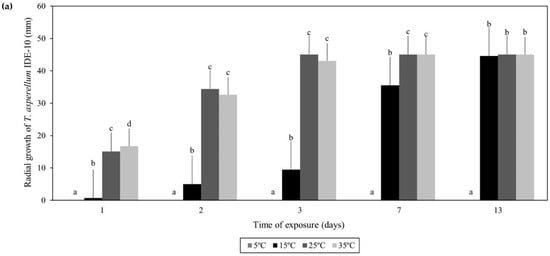
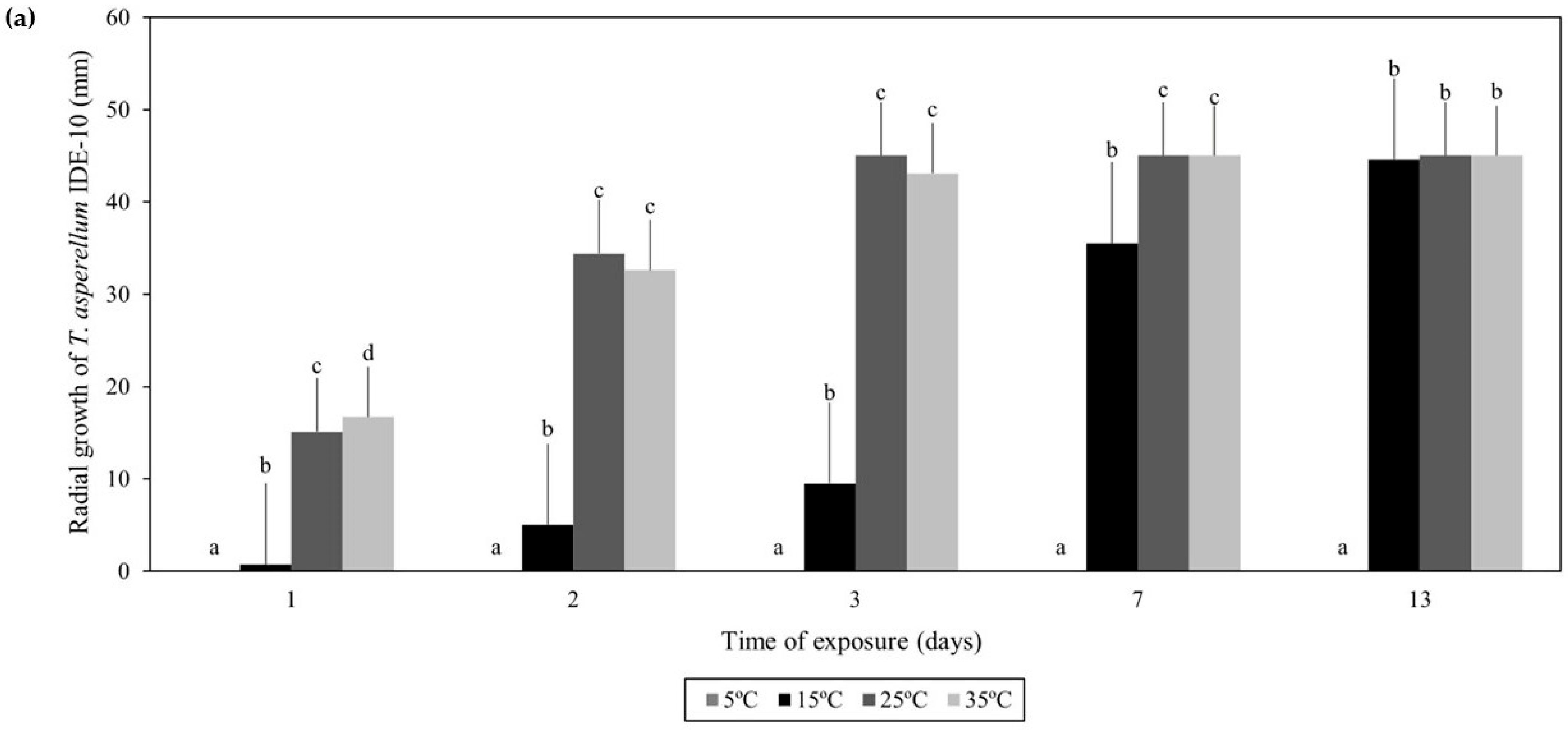
Fungal growth was significantly influenced by temperature (after 7 days; ꭓ2: 0.000) (Figure 1a). The T. asperellum IDE-10 strain was unable to grow at 5 °C, but at 15 °C, fungal growth began on day 1, reaching approximately 35 mm by day 7, and attaining a maximum of 45 mm at day 13. The growth at 25 °C and 35 °C did not show a significant difference; these temperatures had the greatest influence on fungal growth, supporting rapid and extensive fungal development, with maximum radial growth (45 mm) reached by day 3 and maintained through to day 13.
Figure 1.
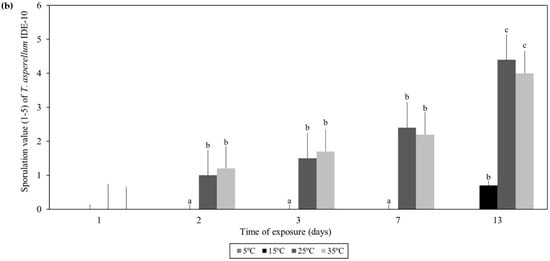
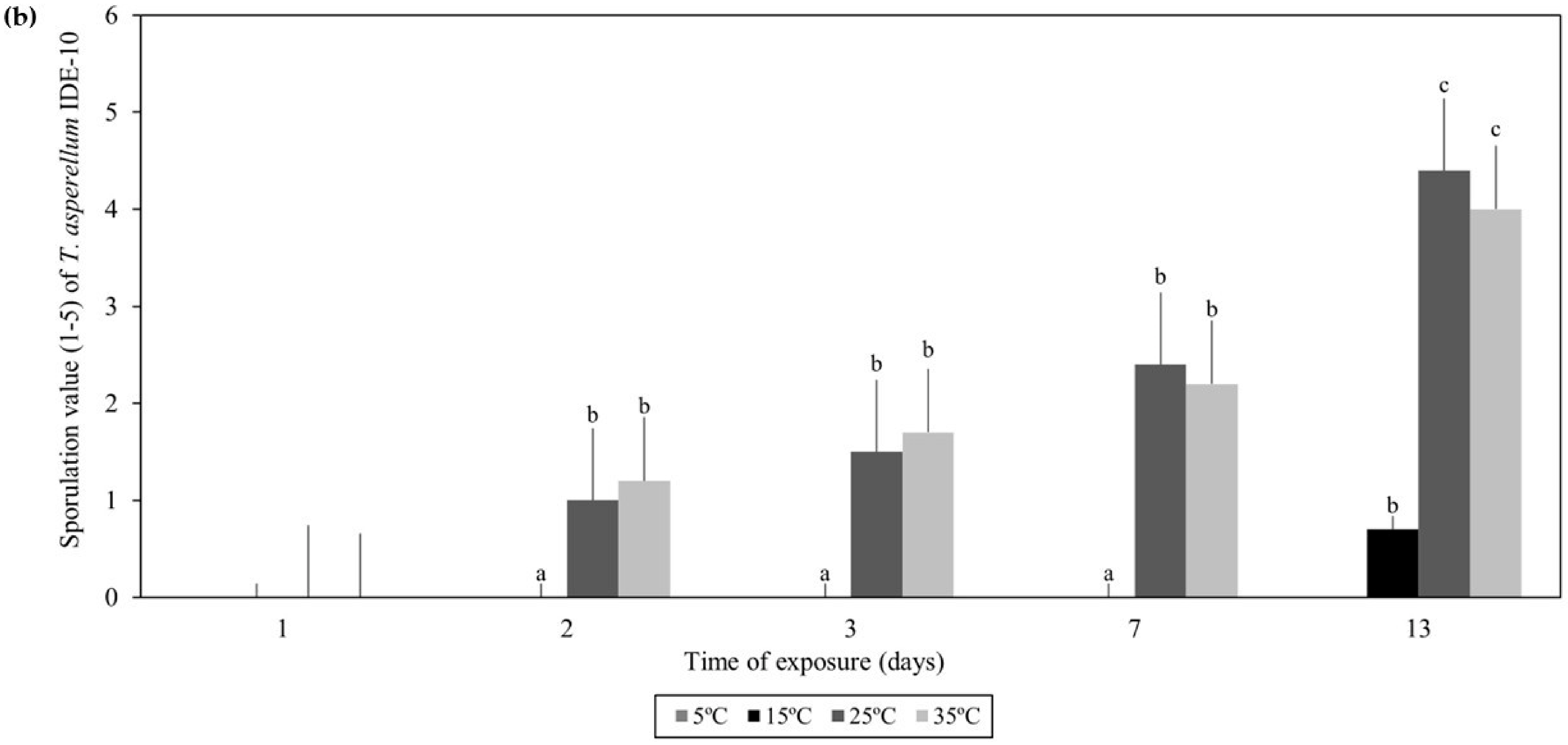
(a) Radial growth and (b) sporulation values (1–5 scale) of T. asperellum IDE-10 strain grown at different temperatures for 13 days. Values are the mean ± SE (n = 10). Different letters indicate statistical differences (p < 0.05, Kruskal–Wallis test with post hoc Mann–Whitney U) between temperatures at the same time point.
Figure 1b illustrates the sporulation value (1–5 scale) of the T. asperellum IDE-10 strain at 5, 15, 25, and 35 °C over a 13-day period. T. asperellum IDE-10 was unable to sporulate at 5 °C throughout the evaluation period. However, at 15 °C, sporulation initiated slowly, reaching less than 25% sporulation (value of 1) by day 3 and gradually increasing to approximately 50% sporulation (value of 2) by day 13. Statistical analysis revealed significant differences between 15 °C and the optimal temperatures (25 °C and 35 °C), indicating that 15 °C markedly restricts the sporulation capacity of the fungus. In contrast, both 25 °C and 35 °C supported rapid and robust sporulation, with sporulation increasing steadily and reaching 100% (value of 5) by day 13.
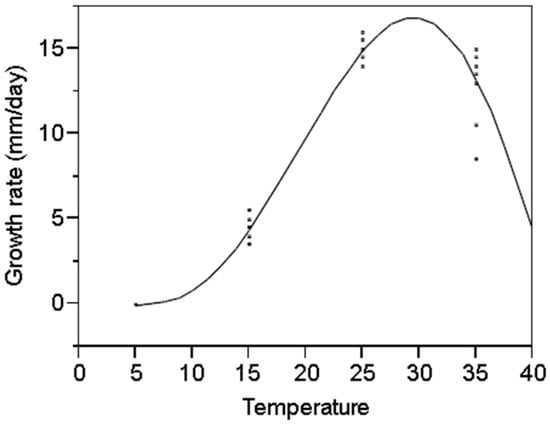
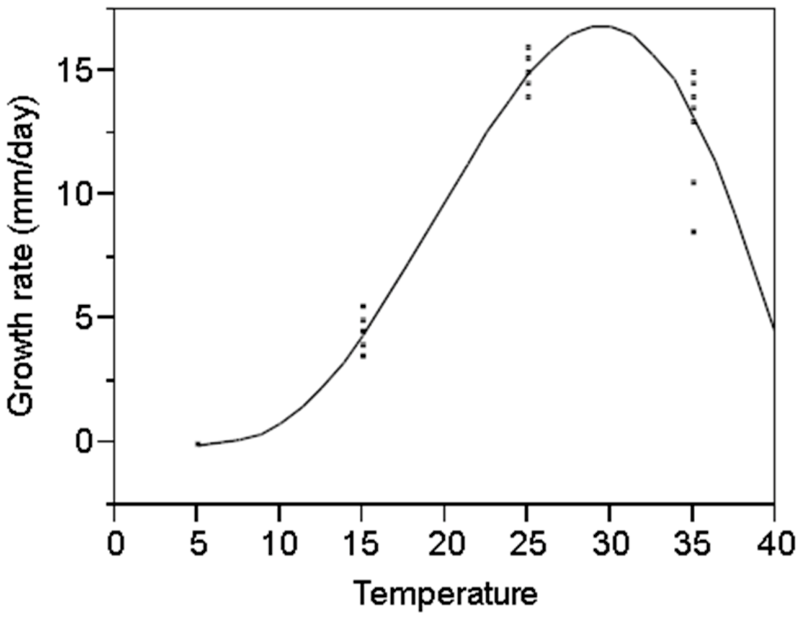
As most of the plates incubated at 25 °C and 35 °C reached maximum growth by the third day, the fungal growth model was constructed based solely on the first three days of incubation. The radial measurements from the 1st to the 3rd day fit a linear model (Figure 2). The fungal isolate grew at 15, 25, and 35 °C, but not at 5 °C. The fixed regression lines indicate that the maximum growth rate was reached at 28.28 °C (Topt), with an optimum fungal growth rate (TYopt) of 13.84 mm/day (Table 3). The maximum temperature for fungal growth (Tmax) was 39.21 °C (Table 3).
Figure 2.
Model prediction for the effect of temperature on the growth rate of T. asperellum IDE-10. The line represents fitted curves obtained using the generalized β function, which was modified according to [57].
Table 3.
Estimated parameters (±SE) of the generalized β function (modified according to [57]), which was fitted to the vegetative growth data of T. asperellum IDE-10.
The generalized β function is given by V(T) = TYopt × [(T − Tmin)/(Topt − Tmin)]^{TB × [(Topt − Tmin)/(Tmax − Topt)]}/[(Tmax − T)/(Tmax − Topt)]^TB, where V(T) is the fungal growth in mm per day (dependent variable) and T is the incubation temperature (independent variable). Tmin, Tmax, and Topt are, respectively, the lowest, highest, and optimal temperatures for fungal growth. TYopt is the fungal growth at the optimal temperature Topt and TB is the shape parameter.
3.1.2. Effect of Different Factors (Temperature of Soil Microcosm, Ultraviolet Radiation Exposure, and pH Level) on Strain Viability
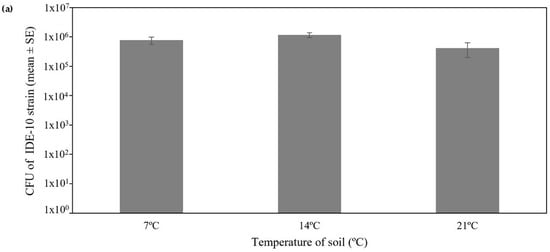
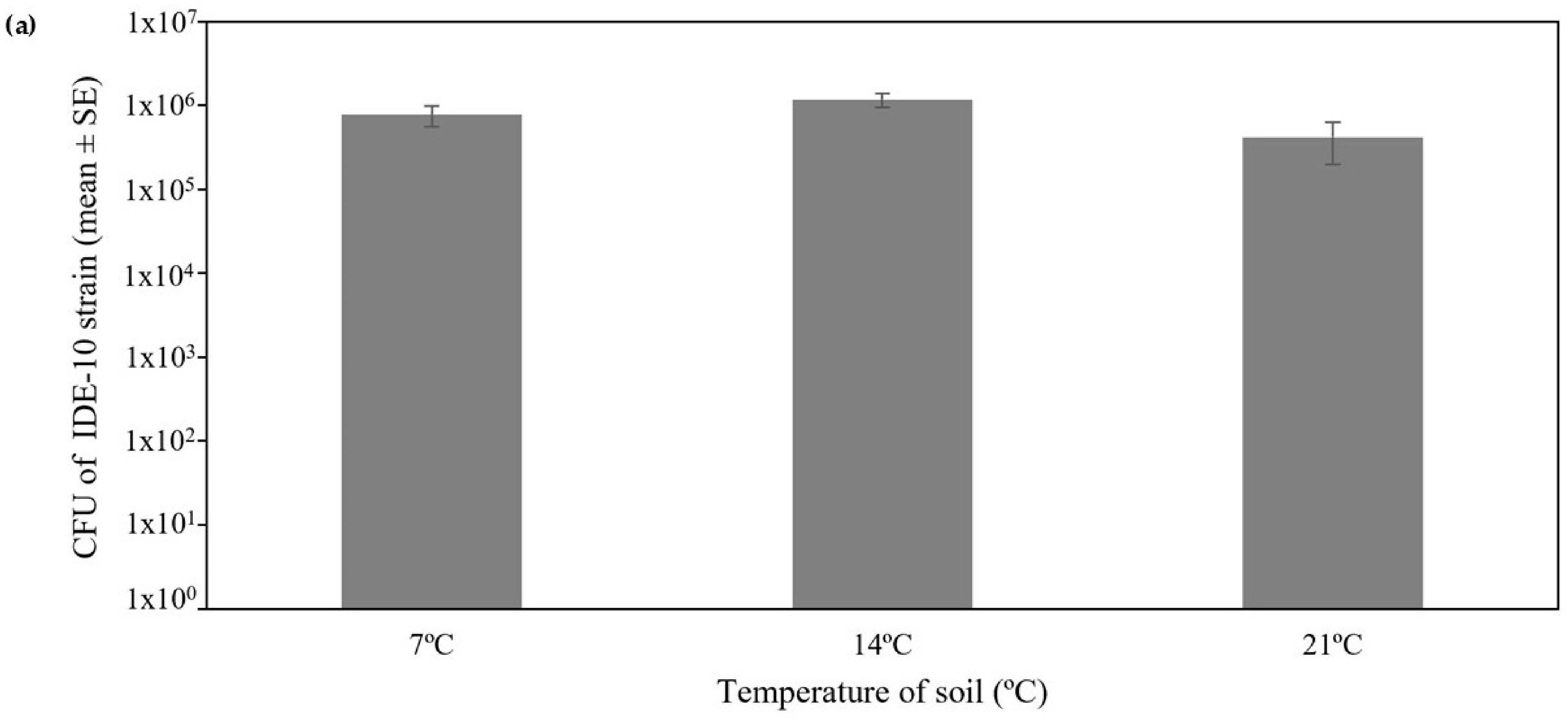
There were no significant differences in T. asperellum IDE-10 growth among the three soil microcosm temperatures evaluated (7, 14, and 21 °C) (F = 2.571; p = 0.156). Despite that, the highest CFU g−1 concentration was found in the soil microcosm incubated at 14 °C (7.19 × 10⁵ CFU g−1 soil), followed by that incubated at 7 °C (4.96 × 10⁵ CFU g−1 soil) and at 21 °C (3.15 × 10⁵ CFU g−1 soil) (Figure 3a).
Figure 3.
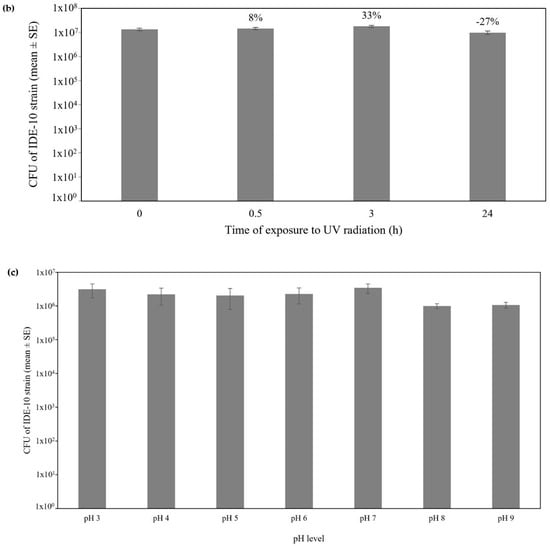
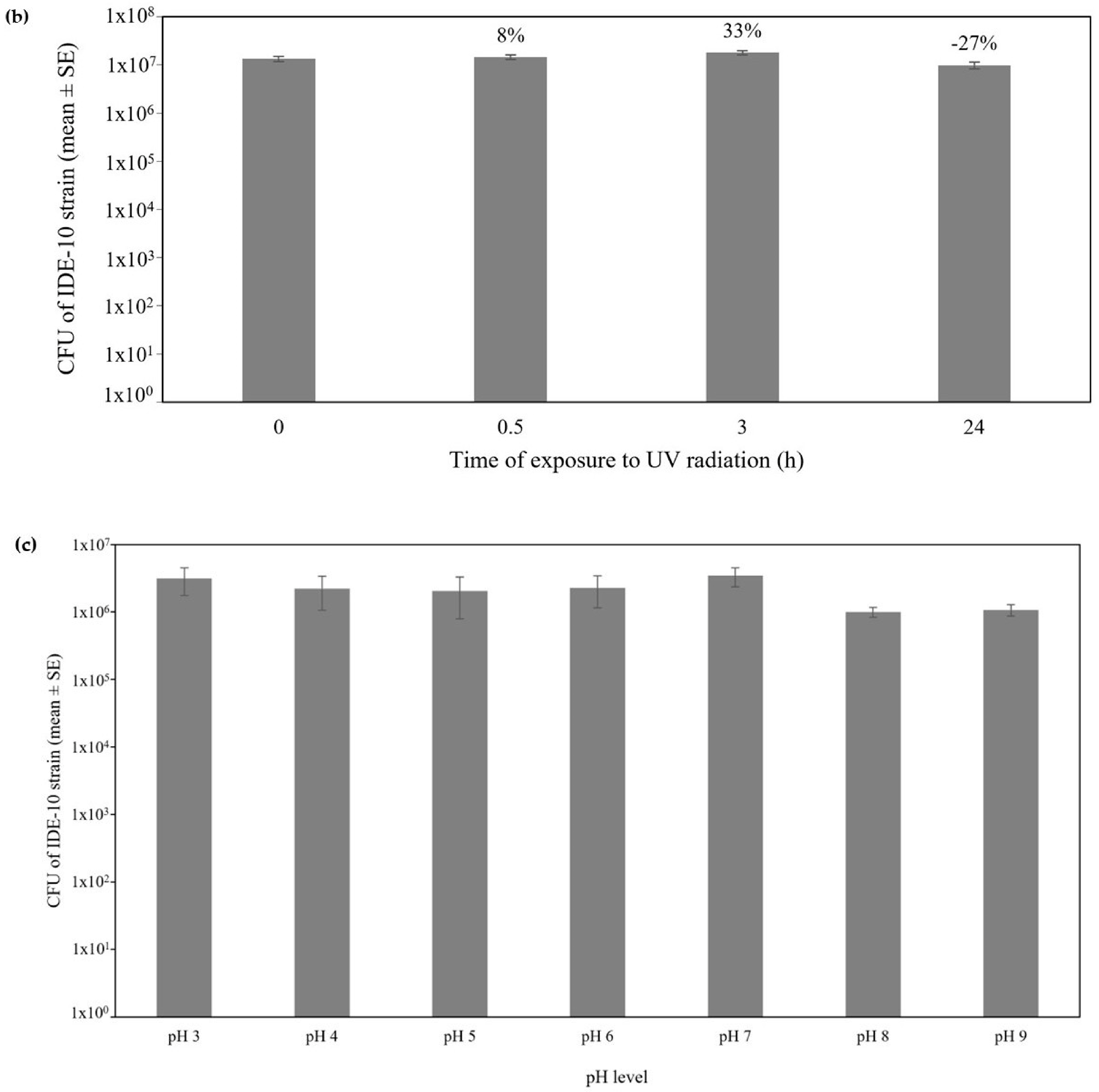
Effect of different factors on T. asperellum IDE-10 strain viability: (a) soil temperature; (b) ultraviolet radiation exposure; and (c) pH. Values are the mean ± SE. No significant differences were observed among the different temperatures, UV-B radiation exposure durations, or pH levels.
No statistically significant differences in viability were observed between the UV radiation exposure durations evaluated (0, 0.5, 3, and 24 h). The CFU mL−1 concentration remained relatively stable throughout the experiment (F = 1.933; p = 0.178). Despite that, the highest CFU mL−1 was recorded after 3 h of exposure (1.79 × 10⁷ CFU g−1 soil), followed by 0 (1.35 × 10⁷ CFU g−1 soil) and 0.5 h (1.46 × 10⁷ CFU g−1 soil) and, finally, 24 h (9.88 × 10⁶ CFU g−1 soil) (Figure 3b).
No significant differences were observed in viability at the pH levels evaluated (pH 3, 4, 5, 6, 7, 8, and 9) (ꭓ2: 4.411). The CFU concentration remained relatively high in the pH range of 3 to 7, with values close to 2.03 × 10⁶ and 3.44 × 10⁶ CFU g−1 of soil. pH 3 and 7 showed the highest CFU concentrations (3.14 × 10⁶ and 3.44 × 10⁶ CFU g−1, respectively), while pH 8 and 9 showed the lowest concentrations (1.0 × 10⁶ and 1.08 × 10⁶ CFU g−1, respectively) (Figure 3c).
3.2. Compatibility of the Strain with Fungicides and Insecticides
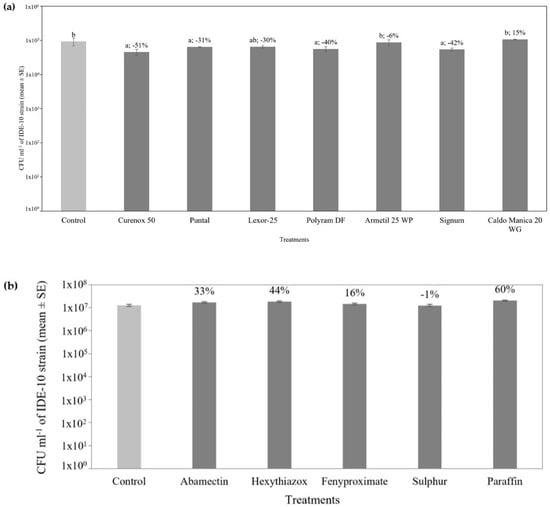
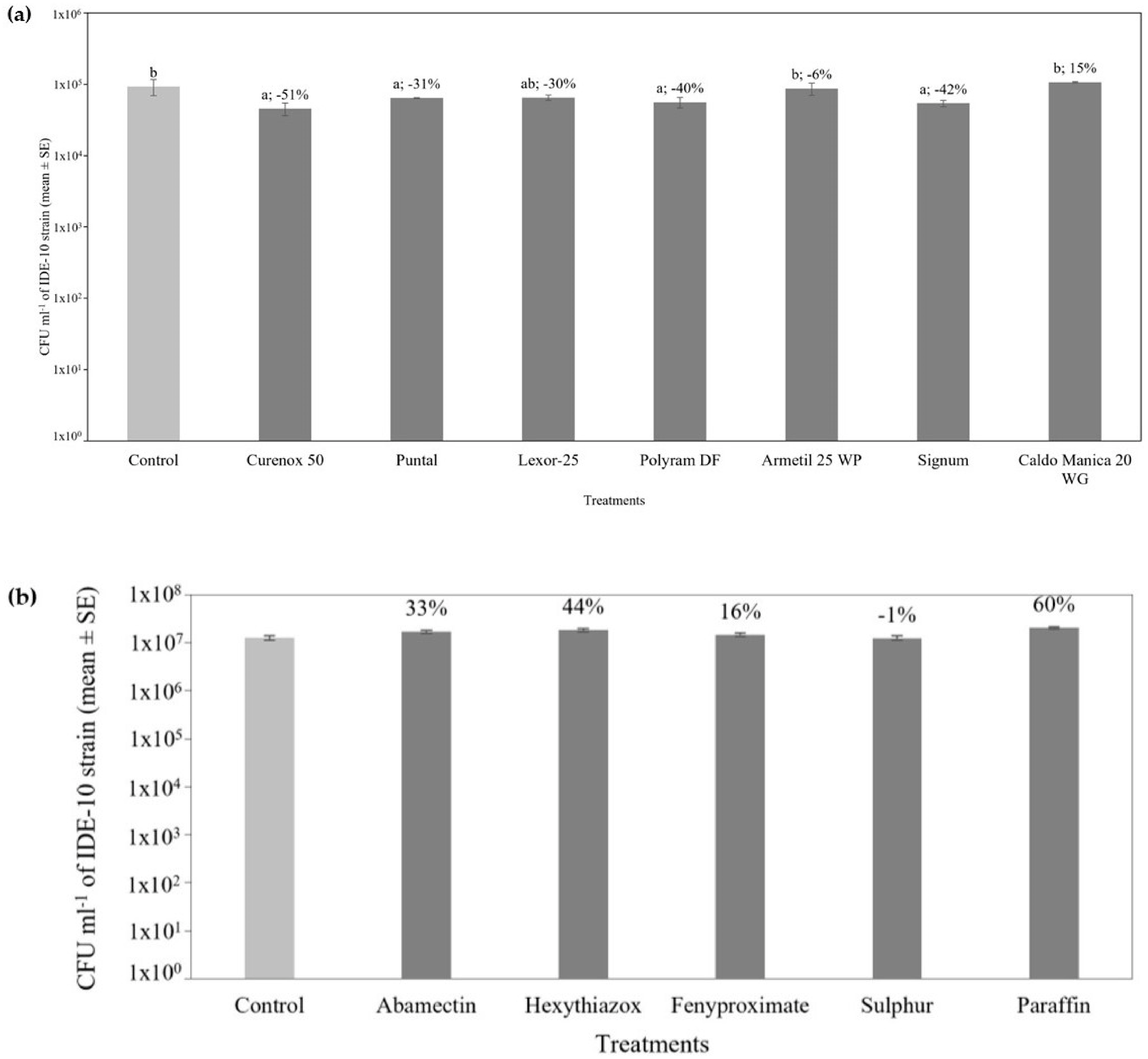
The evaluation of the impact of various fungicide treatments on the viability of the T. asperellum IDE-10 strain revealed significant differences (ꭓ2 = 16.104; p = 0.024). As shown in Figure 4a, the control group, which received no treatment, maintained a CFU concentration of approximately 9.28 × 10⁴ CFU mL−1. This level of viability was statistically similar to the Caldo Manica 20 WG (1.07 × 10⁵ CFU mL−1), Armetil 25 WP (8.69 × 10⁴ CFU mL−1), and Lexor-25 (6.49 × 10⁴ CFU mL−1) treatments, suggesting that these fungicides do not have a significant detrimental effect on the T. asperellum IDE-10 strain under the evaluated conditions.
Figure 4.
Compatibility of T. asperellum IDE-10 strain with fungicides and insecticides. Values are mean ± SE (CFU mL−1). Percentage change relative to the control group was included inside each bar. (a) With fungicides, significant differences were detected. Different letters indicate statistical differences (χ2 = 16.104; p = 0.024, Kruskal–Wallis test). (b) With insecticides, no significant differences were observed (F = 0.828; p = 0.553, one-way ANOVA).
On the other hand, the Curenox 50 (4.54 × 10⁴ CFU mL−1), Puntal (6.43 × 10⁴ CFU mL−1), Polyram DF (5.59 × 10⁴ CFU mL−1), and Signum (5.40 × 10⁴ CFU mL−1) treatment groups showed significantly lower CFU concentrations than the control group, implying a reduction in the viability of the strain. These findings are crucial for the selection of fungicides compatible with biological control strategies involving T. asperellum IDE-10, highlighting the importance of evaluating the selectivity of plant protection products to preserve the efficacy of biocontrol agents.
No significant differences in the viability of the T. asperellum IDE-10 strain were detected between the different insecticide treatments evaluated (control, abamectin, hexythiazox, fenpyroximate, sulfur, and paraffin) (F = 0.828; p = 0.553). In general, the CFU concentration remained high and fairly stable in all cases, with values ranging from approximately 1.26 × 10⁷ to 2.05 × 10⁷ CFU mL−1.
The paraffin treatment showed the highest concentration, close to 2.05 × 10⁷ CFU g−1 of soil, followed by abamectin and hexythiazox, both with values around 1.78 × 10⁷ CFU g−1 of soil. The control, fenpyroximate, and sulfur groups showed slightly lower concentrations, with 1.28 × 10⁷, 1.48 × 10⁷, and 1.26 × 10⁷ CFU mL−1, respectively (Figure 4b).
4. Discussion
The characterization of the Trichoderma asperellum IDE-10 strain in this study revealed its ecophysiological traits and compatibility with agrochemicals, which position it as a promising biological control agent in agricultural systems, particularly under the challenging environmental conditions typical of the Mediterranean region. The results regarding its tolerance to different temperatures, pH levels, and ultraviolet radiation, and its compatibility with fungicides and insecticides provide essential insights into its potential application within integrated pest management programs.
Regarding the effect of temperature, the T. asperellum IDE-10 strain showed optimal growth at 28.28 °C (Topt) and a maximum growth temperature (Tmax) of 39.21 °C. This thermal range is consistent with the expected adaptations for a microorganism with potential application in warm areas. Previous studies on T. asperellum have reported optimal growth temperatures in a similar range, generally between 25 °C and 30 °C [58]. The ability of the IDE-10 strain to maintain robust growth at 35 °C and its relatively high Tmax suggest a competitive advantage in warm climates, which is particularly relevant for agriculture in southern Spain, where summer temperatures can be high. Some studies even indicate that high temperatures, such as 36 °C, can enhance the germination rate of certain T. asperellum strains [59], which could be a factor to explore in future research with T. asperellum IDE-10. From a biosafety perspective, although mycelial growth was not experimentally evaluated at 37 °C in this study, the fitted beta model predicts a substantially reduced growth rate at this temperature compared to the optimum, which is consistent with the classification of T. asperellum as a biosafety level 1 (BSL-1) organism with low pathogenic risk to immuno-competent humans. Nevertheless, dedicated experimental validation at 37 °C is recommended as part of a full safety evaluation for commercial registration of IDE-10-based products. Moreover, the marked tolerance to elevated temperatures makes this strain a strong candidate for the development of commercial formulations, as thermal stability is a key parameter in product design and manufacturing [40].
The viability of the strain under different soil conditions and its pH tolerance determine its establishment and persistence when used as a biocontrol agent. The T. asperellum IDE-10 strain demonstrated remarkable stability over a wide pH range (3 to 7), with a slight decrease under more alkaline conditions (pH 8–9). This plasticity is fundamental, as agricultural soils can vary considerably in pH. While Trichoderma spp. is often associated with acidic soils, the existence of strains adapted to alkaline conditions has been documented [60], which is a desirable characteristic for their use in neutral to slightly alkaline soils. Our results are consistent with the optimal range reported for commercial Trichoderma isolates, typically between pH 5 and 7 [53]. Notably, IDE-10 remains active under more acidic conditions than those commonly evaluated (pH 4.1–8.6 for Trichoderma spp. and 5.5–7.5 for T. viride isolates), suggesting an extended functional window towards low-pH environments that may be advantageous in acidic soils [45,53]. The ability of T. asperellum IDE-10 to survive at soil temperatures of 7, 14, and 21 °C without significant loss of performance complements previous findings for T. asperellum MSCL 309, which focused on long-term viability in peat at 15 and 30 °C [58], and indicates that IDE-10 has an enhanced capacity to remain active under cooler soil conditions.
Although IDE-10 was originally isolated from irrigation water collected in a tomato cropping system, this does not by itself prove the strain’s rhizosphere competence or root colonization ability. The isolation of Trichoderma spp. from irrigation water and aquatic environments is well documented, and water systems can act as natural dispersal routes connecting soil and rhizosphere compartments [55,56]. However, persistence in a water matrix is ecologically distinct from active rhizosphere colonization, which requires a competitive saprophytic ability, root surface attachment, and tolerance to root exudate chemistry [61,62]. Our data indicate that IDE-10 has a favorable ecophysiological profile, including broad pH tolerance and thermal stability in soil, that may support its establishment and persistence in rhizosphere environments. These characteristics are considered key prerequisites for rhizosphere competence in Trichoderma spp. Nevertheless, dedicated root colonization assays and rhizosphere competence studies under controlled and field conditions will be required to confirm this potential.
A critical aspect for the efficacy of foliar-applied biological control agents is their resistance to ultraviolet radiation. The T. asperellum IDE-10 strain exhibited high tolerance to UV exposure, maintaining viability even after 24 h. Sametz-Baron, Berrocal, Amit, Herrera-Estrella, and Horwitz [50] reported a strong UVC sensitivity for T. harzianum conidia, where germination was severely inhibited and survival largely depended on subsequent photoreactivation by visible/UVA light. The high UV tolerance of the IDE-10 strain suggests that it possesses more effective intrinsic protective mechanisms against UV-induced damage, potentially enhancing its persistence and efficacy when applied on exposed surfaces. This finding is of great importance, as UV radiation is a primary abiotic factor limiting the persistence of many biopesticides in the field [63]. The intrinsic UV tolerance observed in vitro suggests that IDE-10 may require less protective encapsulation than UV-sensitive strains; however, field persistence studies under real agronomic conditions are needed to confirm this hypothesis [64,65].
The majority of T. asperellum strains described in the literature display an optimal growth temperature (Topt) between 25 and 30 °C and a maximum temperature (Tmax) in the range of 35–37 °C, beyond which growth ceases [66,67]. The modeled Tmax of IDE-10 near 39 °C exceeds this range, suggesting a thermal tolerance profile comparable to the most thermotolerant T. asperellum strains reported to date, such as TaDOR7316 [67]. Commercially registered strains such as T. atroviride T11, T. asperellum T25 and TV1, and T. viride ICC080 have been characterized under temperate climate conditions, with growth temperatures ranging from 10 to 35 °C and an optimal pH range of 4.5–6.0. In contrast, strain IDE-10 was predicted to grow at temperatures up to 39.21 °C and exhibited vigorous growth across a pH range of 3–7, representing a broader ecophysiological window than those of the aforementioned commercial strains. Furthermore, neither T11, T25, nor TV1 has published data on UV radiation tolerance [68,69], whereas IDE-10 maintained complete conidial viability after 24 h of continuous UV exposure, a key advantage for foliar applications in high-radiation Mediterranean environments.
The ecophysiological profile of IDE-10 has direct implications for the selection of suitable formulation strategies. Its thermal stability and broad pH tolerance (pH 3–7) suggest compatibility with wettable powder (WP) and water-dispersible granule (WG) formulations, which are the most common commercial formats for Trichoderma-based products and typically require conidial survival across a wide range of storage and application conditions [51]. Published shelf-life data for registered T. asperellum WP formulations indicate viability maintenance for up to 2 years at 4 °C and 6–8 months at 15–25 °C [51], values that serve as benchmarks against which IDE-10 stability data should be evaluated. The high intrinsic UV tolerance of the IDE-10 strain further reduces the need for costly protective additives such as UV-absorbing photoprotectants or microencapsulation technologies, substantially reducing production costs [70]. Oil-based formulations have also been shown to provide superior UV protection for Trichoderma conidia compared to aqueous suspensions, improving post-UV viability from 8–12% (water) to 56–63% (vegetable oil emulsion) [51], suggesting that oil-dispersion formats could further enhance the field persistence of IDE-10 without requiring encapsulation.
Compatibility with fungicides and insecticides is a fundamental pillar for integrating biological control agents into integrated pest management programs. The results showed that the T. asperellum IDE-10 strain is compatible with fungicides such as Armetil 25 WP (metalaxyl), Lexor-25, and Caldo Manica 20 WG (copper), allowing for co-application or sequential application without significant loss of viability, which is consistent with previous reports of low inhibition of T. asperellum by metalaxyl-based formulations such as Ridomil Gold and tolerance to mancozeb at agronomic doses [71]. However, other fungicides such as Curenox 50 (copper), Puntal, Polyram DF, and Signum showed an inhibitory effect, which is in line with studies showing that several active ingredients (e.g., carbendazim, propiconazole, and fludioxonil) can strongly suppress the mycelial growth or conidial viability of Trichoderma spp., and that compatibility is highly dependent on the specific formulation and dose of each product [53]. Several physicochemical factors could explain the differential response of IDE-10 to Curenox 50 (copper oxychloride) versus Caldo Manica 20 WG (cupric calcium sulfate): (i) fungitoxicity is primarily determined by free Cu2+ activity in solution and the bioavailability of cupric ions (Cu2+) differs markedly between formulations, being considerably lower in sparingly soluble oxychlorides than in more soluble copper sulfate-based products [72]; (ii) the pH of the spray solution influences copper speciation, with lower pH values increasing Cu2+ solubility and thus fungitoxicity [73]; and (iii) adjuvants, wetting agents, and carrier substances present in each commercial formulation alter the physical contact between the active ingredient and fungal conidia, modulating the effective dose reaching the conidial surface [74,75]. It is encouraging to observe the IDE-10 strain’s high compatibility with all evaluated insecticides (abamectin, hexythiazox, fenpyroximate, sulfur, and paraffin), which is consistent with the literature generally reporting lower toxicity of insecticides to Trichoderma compared to fungicides [71,76]. This characteristic is vital for the development of biological control strategies that can coexist with the use of insecticides in agricultural pest management.
The compatibility data obtained for IDE-10 have direct practical implications for its integration into IPM programs in Mediterranean cropping systems. The results confirm that metalaxyl, difenoconazole, and cupric calcium sulfate can be tank-mixed or applied sequentially with IDE-10 without significant loss of conidial viability, facilitating their co-use during critical disease windows in horticultural and permanent crops. Conversely, fungicides that show inhibitory effects should preferably be applied sequentially rather than as tank mixes, with an appropriate interval between the chemical and biological applications to allow for recovery of conidial populations [77]. This sequential strategy has been validated in field trials where the combination of Trichoderma spp. with low doses of incompatible fungicides, applied separately, achieved greater disease suppression than either treatment alone [78,79], suggesting that the two approaches can be complementary rather than mutually exclusive when application timing is carefully managed. The full compatibility with all five insecticides tested (abamectin, hexythiazox, fenpyroximate, sulfur, and paraffin oil) further simplifies the integration of IDE-10 into spray programs targeting key Mediterranean arthropod pests, as tank mixes with these products pose no apparent risk to biocontrol efficacy [78].
Despite the promising ecophysiological profile of IDE-10 demonstrated under controlled laboratory conditions, several limitations of this study must be acknowledged. First, all assays were conducted in vitro, and the translation of these results to field conditions, where multiple stresses act simultaneously, soil microbiome competition is present, and agrochemical exposure occurs in complex mixtures, remains to be validated. Second, the compatibility assays were performed at the maximum authorized doses, which represent worst-case scenarios; sub-lethal field concentrations may result in higher compatibility than those reported here. Third, formal demonstration of the rhizosphere competence and root colonization ability of IDE-10 has not been conducted, which is a prerequisite for deployment as a soil-applied biocontrol agent. Future research should therefore prioritize (i) field efficacy trials in representative Mediterranean cropping systems under the thermal and UV conditions characterized here; (ii) investigation of the molecular mechanisms underlying the thermal and UV tolerance of IDE-10; and (iii) rhizosphere competence assays and root colonization studies to confirm the capacity of IDE-10 to establish and persist in agricultural soils.
5. Conclusions
The Trichoderma asperellum IDE-10 strain was shown to be a robust and adaptable biological control agent, with ecophysiological and compatibility characteristics that make it highly promising for use in agriculture. Its optimal growth at elevated temperatures, broad pH tolerance, and remarkable resistance to UV radiation are key attributes that favor its establishment and persistence in agricultural environments, especially in regions with warm climates and high insolation. Compatibility with a significant range of insecticides and specific fungicides opens the door to its effective integration into integrated pest management programs, maximizing the efficacy of biological control without compromising other agricultural practices. Future research should focus on evaluating this strain’s field efficacy against specific insect and plant pathogens and on developing formulations that optimize its application and persistence under the agroclimatic conditions of the region.
Author Contributions
Conceptualization, D.M.-M. and I.G.-J.; methodology, A.V.S.-R. and V.A.; formal analysis, D.M.-M., I.G.-J., A.V.S.-R. and V.A.; investigation, D.M.-M., I.G.-J., A.V.S.-R. and V.A.; resources, P.P.; writing—original draft preparation, D.M.-M.; writing—review and editing, D.M.-M., I.G.-J., A.V.S.-R., V.A. and P.P.; supervision, I.G.-J.; project administration, P.P. All authors have read and agreed to the published version of the manuscript.
Funding
This research was funded by the State Plan for Scientific and Technical Research and Innovation 2017–2020 (Call 2020-DIN2020-011221) and the Spanish Ministry of Science and Innovation and Spanish State Research Agency through the Severo Ochoa and María de Maeztu Program for Centers and Units of Excellence in R&D (Ref. CEX2019-000968-M).
Institutional Review Board Statement
Not applicable.
Informed Consent Statement
Not applicable.
Data Availability Statement
The original contributions presented in the study are included in the article; further inquiries can be directed to the corresponding author.
Conflicts of Interest
Authors David Montes-Moreno, Verónica Alacid, Antonio V. Sanz-Ros and Pedro Palazón were employed by the company Ideagro. The remaining authors declare that the research was conducted in the absence of any commercial or financial relationships that could be construed as a potential conflict of interest.
Abbreviations
The following abbreviations are used in this manuscript:
| ANOVA | Analysis of variance |
| CFU | Colony-forming unit |
| IPM | Integrated pest and disease management |
| MAD | Maximum authorized dose |
| PDA | Potato dextrose agar |
| UV | Ultraviolet |
References
- Ingram, J. A food systems approach to researching food security and its interactions with global environmental change. Food Secur. 2011, 3, 417–431. [Google Scholar] [CrossRef] [Scilit]
- Savary, S.; Willocquet, L.; Pethybridge, S.J.; Esker, P.; McRoberts, N.; Nelson, A. The global burden of pathogens and pests on major food crops. Nat. Ecol. Evol. 2019, 3, 430–439. [Google Scholar] [CrossRef] [Scilit] [PubMed]
- Kashyap, A.S.; Manzar, N.; Sharma, P.K. Unravelling the wheat leaf blight pathobiome: A shift beyond the one pathogen–one disease paradigm. J. Plant Pathol. 2026, 108, 343–357. [Google Scholar] [CrossRef] [Scilit]
- Ab Rahman, S.F.S.; Singh, E.; Pieterse, C.M.; Schenk, P.M. Emerging microbial biocontrol strategies for plant pathogens. Plant Sci. 2018, 267, 102–111. [Google Scholar] [CrossRef] [Scilit] [PubMed]
- Adkar-Purushothama, C.R.; Chettimada, A.; Murali, T.S.; Muthusamy, A.; Bouarab, K.; Perreault, J.-P. Non-chemical control of fungal pathogens in crops: A one-health perspective on strategies, mechanisms, and future directions. Front. Plant Sci. 2025, 16, 1746521. [Google Scholar] [CrossRef] [Scilit] [PubMed]
- Manivel, S.B.; Rajkumar, G.S. Mycopesticides: Fungal based pesticides for sustainable agriculture. In Fungi and Their Role in Sustainable Development: Current Perspectives; Springer: Singapore, 2018; pp. 183–203. [Google Scholar]
- Hermosa, R.; Viterbo, A.; Chet, I.; Monte, E. Plant-beneficial effects of Trichoderma and of its genes. Microbiology 2012, 158, 17–25. [Google Scholar] [CrossRef] [Scilit] [PubMed]
- Kashyap, A.S.; Manzar, N. Molecular characterization and biocontrol potential of rhizospheric Trichoderma and Bacillus spp. from Indo-Gangetic plains with botanical applications against Bipolaris sorokiniana in wheat. Physiol. Mol. Plant Pathol. 2025, 136, 102567. [Google Scholar] [CrossRef] [Scilit]
- Kashyap, A.S.; Kannojia, P.; Manzar, N.; Srivastava, D.; Malaviya, D.; Singh, U.B.; Sharma, P.K. Development of a Trichoderma–Bacillus biofilm inoculant for plant growth promotion and biocontrol of Sclerotium and Fusarium in chickpea. Discov. Sustain. 2026, 7, 301. [Google Scholar] [CrossRef] [Scilit]
- Abbey, J.A.; Percival, D.; Abbey, L.; Asiedu, S.K.; Prithiviraj, B.; Schilder, A. Biofungicides as alternative to synthetic fungicide control of grey mould (Botrytis cinerea)—Prospects and challenges. Biocontrol Sci. Technol. 2019, 29, 207–228. [Google Scholar] [CrossRef] [Scilit]
- Elad, Y. Biological control of foliar pathogens by means of Trichoderma harzianum and potential modes of action. Crop Prot. 2000, 19, 709–714. [Google Scholar] [CrossRef] [Scilit]
- Yadav, M.; Dubey, M.K.; Upadhyay, R.S. Systemic resistance in chilli pepper against anthracnose (caused by Colletotrichum truncatum) induced by Trichoderma harzianum, Trichoderma asperellum and Paenibacillus dendritiformis. J. Fungi 2021, 7, 307. [Google Scholar] [CrossRef] [Scilit] [PubMed]
- Tjamos, E.C.; Papavizas, G.C.; Cook, R.J. Biological Control of Plant Diseases: Progress and Challenges for the Future; Plenum Press: New York, NY, USA, 1992; p. 222. [Google Scholar]
- Tyśkiewicz, R.; Nowak, A.; Ozimek, E.; Jaroszuk-Ściseł, J. Trichoderma: The current status of its application in agriculture for the biocontrol of fungal phytopathogens and stimulation of plant growth. Int. J. Mol. Sci. 2022, 23, 2329. [Google Scholar] [CrossRef] [Scilit] [PubMed]
- Contreras-Cornejo, H.A.; Viveros-Bremauntz, F.; Del-Val, E.; Macías-Rodríguez, L.; López-Carmona, D.A.; Alarcón, A.; González-Esquivel, C.E.; Larsen, J. Alterations of foliar arthropod communities in a maize agroecosystem induced by the root-associated fungus Trichoderma harzianum. J. Pest Sci. 2021, 94, 363–374. [Google Scholar] [CrossRef] [Scilit]
- Kushiyev, R.; Tuncer, C.; Erper, I.; Özer, G. The utility of Trichoderma spp. isolates to control of Xylosandrus germanus Blandford (Coleoptera: Curculionidae: Scolytinae). J. Plant Dis. Prot. 2020, 128, 153–160. [Google Scholar] [CrossRef] [Scilit]
- Lopez, E.; Orduz, S. Metarhizium anisopliae and Trichoderma viride for control of nests of the fungus-growing ant, Atta cephalotes. Biol. Control 2003, 27, 194–200. [Google Scholar] [CrossRef] [Scilit]
- Manzar, N.; Kashyap, A.S.; Goutam, R.S.; Rajawat, M.V.S.; Sharma, P.K.; Sharma, S.K.; Singh, H.V. Trichoderma: Advent of versatile biocontrol agent, its secrets and insights into mechanism of biocontrol potential. Sustainability 2022, 14, 12786. [Google Scholar] [CrossRef] [Scilit]
- Widmer, T.L. Screening Trichoderma species for biological control activity against Phytophthora ramorum in soil. Biol. Control 2014, 79, 43–48. [Google Scholar] [CrossRef] [Scilit]
- Kariuki, W.; Mungai, N.; Otaye, D.; Thuita, M.; Muema, E.; Korir, H.; Masso, C. Antagonistic effects of biocontrol agents against Phytophthora infestans and growth stimulation in tomatoes. Afr. Crop Sci. J. 2020, 28, 55–70. [Google Scholar] [CrossRef] [Scilit]
- Andrade-Hoyos, P.; Silva-Rojas, H.V.; Romero-Arenas, O. Endophytic Trichoderma species isolated from Persea americana and Cinnamomum verum roots reduce symptoms caused by Phytophthora cinnamomi in avocado. Plants 2020, 9, 1220. [Google Scholar] [CrossRef] [Scilit] [PubMed]
- Díaz-Gutiérrez, C.; Arroyave, C.; Llugany, M.; Poschenrieder, C.; Martos, S.; Peláez, C. Trichoderma asperellum as a preventive and curative agent to control Fusarium wilt in Stevia rebaudiana. Biol. Control 2021, 155, 104537. [Google Scholar] [CrossRef] [Scilit]
- Win, T.T.; Bo, B.; Malec, P.; Khan, S.; Fu, P. Newly isolated strain of Trichoderma asperellum from disease suppressive soil is a potential bio-control agent to suppress Fusarium soil borne fungal phytopathogens. J. Plant Pathol. 2021, 103, 549–561. [Google Scholar] [CrossRef] [Scilit]
- Yu, Z.; Liu, Z.; Zhang, Y.; Wang, Z. The disease resistance potential of Trichoderma asperellum T-Pa2 isolated from Phellodendron amurense rhizosphere soil. J. For. Res. 2022, 33, 321–331. [Google Scholar] [CrossRef] [Scilit]
- Rivera-Méndez, W.; Obregón, M.; Morán-Diez, M.E.; Hermosa, R.; Monte, E. Trichoderma asperellum biocontrol activity and induction of systemic defenses against Sclerotium cepivorum in onion plants under tropical climate conditions. Biol. Control 2020, 141, 104145. [Google Scholar] [CrossRef] [Scilit]
- De la Cruz-Quiroz, R.; Roussos, S.; Rodríguez-Herrera, R.; Hernandez-Castillo, D.; Aguilar, C.N. Growth inhibition of Colletotrichum gloeosporioides and Phytophthora capsici by native Mexican Trichoderma strains. Karbala Int. J. Mod. Sci. 2018, 4, 237–243. [Google Scholar] [CrossRef] [Scilit]
- Wang, C.; Zeng, Z.-Q.; Zhuang, W.-Y. Comparative molecular evolution of chitinases in ascomycota with emphasis on mycoparasitism lifestyle. Microb. Genom. 2021, 7, 000646. [Google Scholar] [CrossRef] [Scilit] [PubMed]
- Monte, E. The sophisticated evolution of Trichoderma to control insect pests. Proc. Natl. Acad. Sci. USA 2023, 120, e2301971120. [Google Scholar] [CrossRef] [Scilit] [PubMed]
- Anwar, W.; Subhani, M.N.; Haider, M.S.; Shahid, A.A.; Mushatq, H.; Rehman, M.Z.; Hameed, U.; Javed, S. First record of Trichoderma longibrachiatum as entomopathogenic fungi against Bemisia tabaci in Pakistan. Pak. J. Phytopathol. 2016, 28, 287–294. [Google Scholar]
- Kaushik, N.; Díaz, C.E.; Chhipa, H.; Julio, L.F.; Andrés, M.F.; González-Coloma, A. Chemical composition of an aphid antifeedant extract from an endophytic fungus, Trichoderma sp. EFI671. Microorganisms 2020, 8, 420. [Google Scholar] [CrossRef] [Scilit] [PubMed]
- Nawaz, A.; Gogi, M.D.; Naveed, M.; Arshad, M.; Sufyan, M.; Binyameen, M.; Islam, S.U.; Waseem, M.; Ayyub, M.B.; Arif, M.J.; et al. In vivo and in vitro assessment of Trichoderma species and Bacillus thuringiensis integration to mitigate insect pests of brinjal (Solanum melongena L.). Egypt. J. Biol. Pest Control 2020, 30, 60. [Google Scholar] [CrossRef] [Scilit]
- da Silveira, A.A.; Andrade, J.S.P.; Guissoni, A.C.P.; da Costa, A.C.; de Carvalho e Silva, A.; da Silva, H.G.; Brito, P.; de Souza, G.R.L.; Fernandes, K.F. Larvicidal potential of cell wall degrading enzymes from Trichoderma asperellum against Aedes aegypti (Diptera: Culicidae). Biotechnol. Prog. 2021, 37, e3182. [Google Scholar] [CrossRef] [Scilit] [PubMed]
- Podder, D.; Ghosh, S.K. A new application of Trichoderma asperellum as an anopheline larvicide for eco friendly management in medical science. Sci. Rep. 2019, 9, 1108. [Google Scholar] [CrossRef] [Scilit] [PubMed]
- Batool, R.; Umer, M.J.; Wang, Y.; He, K.; Zhang, T.; Bai, S.; Zhi, Y.; Chen, J.; Wang, Z. Synergistic effect of Beauveria bassiana and Trichoderma asperellum to induce maize (Zea mays L.) defense against the Asian corn borer, Ostrinia furnacalis (Lepidoptera, Crambidae) and larval immune response. Int. J. Mol. Sci. 2020, 21, 8215. [Google Scholar] [CrossRef] [Scilit] [PubMed]
- Di Lelio, I.; Forni, G.; Magoga, G.; Brunetti, M.; Bruno, D.; Becchimanzi, A.; De Luca, M.G.; Sinno, M.; Barra, E.; Bonelli, M. A soil fungus confers plant resistance against a phytophagous insect by disrupting the symbiotic role of its gut microbiota. Proc. Natl. Acad. Sci. USA 2023, 120, e2216922120. [Google Scholar] [CrossRef] [Scilit] [PubMed]
- Jafarbeigi, F.; Samih, M.; Alaei, H.; Shirani, H. Induced tomato resistance against Bemisia tabaci triggered by salicylic acid, β-aminobutyric acid, and Trichoderma. Neotrop. Entomol. 2020, 49, 456–467. [Google Scholar] [CrossRef] [Scilit] [PubMed]
- Sholla, S.; Kottb, M.R. Bioactivity of Trichoderma (6-Pentyl α-pyrone) against Tetranychus urticae Koch (Acari: Tetranychidae). Egypt. Acad. J. Biol. Sci. 2017, 10, 29–34. [Google Scholar] [CrossRef] [Scilit]
- Montes-Moreno, D.; López-Herreros, M.; Valdés, R.; Palazón, P.; Garrido-Jurado, I. Eficacia de Una Cepa de Trichoderma Spp. (IDE-10) Frente a Tetranychus urticae En Cítricos; Jornadas de Ciencias Hortícolas: Cartagena, Spain, 2024. [Google Scholar]
- Montes-Moreno, D.; Garrido-Jurado, I.; López-Herreros, M.; Valdés, R.; Palazón, P. Potential of Trichoderma spp. (IDE-10) as a biological control agent against Polyphagotarsonemus latus in tomato crop under greenhouse. In Proceedings of the XIII Congreso Nacional de Entomología Aplicada, Gijón, Spain, 7–11 October 2024. [Google Scholar]
- Papavizas, G. Trichoderma and Gliocladium: Biology, ecology, and potential for biocontrol. Annu. Rev. Phytopathol. 1985, 23, 23–54. [Google Scholar] [CrossRef]
- Harman, G.; Jin, X.; Stasz, T.; Peruzzotti, G.; Leopold, A.; Taylor, A. Production of conidial biomass of Trichoderma harzianum for biological control. Biol. Control 1991, 1, 23–28. [Google Scholar] [CrossRef] [Scilit]
- Jin, X.; Harman, G.; Taylor, A. Conidial biomass and desiccation tolerance of Trichoderma harzianum produced at different medium water potentials. Biol. Control 1991, 1, 237–243. [Google Scholar] [CrossRef] [Scilit]
- Ajam, M.R.; Devi, S.; Sinha, B.; Singh, L.; Singh, N.; Singh, K.I.; Khwairakpam, N.; Chanu, M.V.; Yaiphabee, O.; Soibam, N. Growth promotion of native Trichoderma asperellum on pH, temperature and sugar concentration. Pharma Innov. J. 2023, 12, 21–33. [Google Scholar] [CrossRef] [Scilit]
- Mamo, Z.; Alemu, T. Evaluation and optimization of agro-industrial wastes for conidial production of Trichoderma isolates under solid state fermentation. J. Appl. Biosci. 2012, 54, 3870–3879. [Google Scholar]
- Maurya, M.; Srivastava, M. Harshita Effect of various pH levels on the growth and sporulation of Trichoderma viride isolates and assessing their antagonistic activity against soil-borne pathogens. J. Pure Appl. Microbiol. 2024, 18, 2516–2527. [Google Scholar] [CrossRef] [Scilit]
- Fernández-Sandoval, M.; Ortiz-García, M.; Galindo, E.; Serrano-Carreón, L. Cellular damage during drying and storage of Trichoderma harzianum spores. Process Biochem. 2012, 47, 186–194. [Google Scholar] [CrossRef] [Scilit]
- Martinius, M. Viability and Temperature Effect to conidia germination of Trichoderma spp. indigenous banana rhizosphere in West Sumatera Indonesia. Res. J. Pharm. Biol. Chem. Sci. 2017. Available online: https://rjpbcs.com/pdf/2017_8(3)/[41].pdf (accessed on 7 May 2026).
- Woo, S.L.; Ruocco, M.; Vinale, F.; Nigro, M.; Marra, R.; Lombardi, N.; Pascale, A.; Lanzuise, S.; Manganiello, G.; Lorito, M. Trichoderma-based products and their widespread use in agriculture. Open Mycol. J. 2014, 8, 71–126. [Google Scholar] [CrossRef] [Scilit]
- Fernandes, É.K.; Rangel, D.E.; Braga, G.U.; Roberts, D.W. Tolerance of entomopathogenic fungi to ultraviolet radiation: A review on screening of strains and their formulation. Curr. Genet. 2015, 61, 427–440. [Google Scholar] [CrossRef] [Scilit] [PubMed]
- Sametz-Baron, L.; Berrocal T., G.M.; Amit, R.; Herrera-Estrella, A.; Horwitz, B.A. Photoreactivation of UV-inactivated spores of Trichoderma harzianum. Photochem. Photobiol. 1997, 65, 849–854. [Google Scholar] [CrossRef] [Scilit]
- Martinez, Y.; Ribera, J.; Schwarze, F.W.; De France, K. Biotechnological development of Trichoderma-based formulations for biological control. Appl. Microbiol. Biotechnol. 2023, 107, 5595–5612. [Google Scholar] [CrossRef] [Scilit] [PubMed]
- Dent, D. Principles of integrated pest. In Integrated Pest Management; Chapman & Hall: London, UK, 1995; pp. 8–46. [Google Scholar]
- Alves Cavalcante, A.L.; Paiva Negreiros, A.M.; de Assis Melo, N.J.; Queiroz Santos, F.J.; Azevêdo Soares Silva, C.S.; Lima Pinto, P.S.; Khan, S.; Mendes Sales, I.M.; Sales Júnior, R. Adaptability and sensitivity of Trichoderma spp. isolates to environmental factors and fungicides. Microorganisms 2025, 13, 1689. [Google Scholar] [CrossRef] [Scilit] [PubMed]
- Leonardi, G.R.; Polizzi, G.; Vitale, A.; Aiello, D. Efficacy of biological control agents and resistance inducer for control of mal secco disease. Plants 2023, 12, 1735. [Google Scholar] [CrossRef] [Scilit] [PubMed]
- Napolitano, A.; Senatore, M.; Coluccia, S.; Palomba, F.; Castaldo, M.; Spasiano, T.; Avino, A.G.; Vitale, A.; Bonfante, A.; Sacco, A.; et al. Development and evaluation of a Trichoderma-based bioformulation for enhancing sustainable potato cultivation. Horticulturae 2024, 10, 664. [Google Scholar] [CrossRef] [Scilit]
- D’Errico, G.; Greco, N.; Vinale, F.; Marra, R.; Stillittano, V.; Davino, S.W.; Woo, S.L.; D’Addabbo, T. Synergistic effects of Trichoderma harzianum, 1,3 dichloropropene and organic matter in controlling the root-nnot nematode Meloidogyne incognita on tomato. Plants 2022, 11, 2890. [Google Scholar] [CrossRef] [Scilit] [PubMed]
- Bassanezi, R.B.; Amorim, L.; Bergamin Filho, A.; Hau, B. Effects of bean line pattern mosaic virus on the monocyclic components of rust and angular leaf spot of Phaseolus bean at different temperatures. Plant Pathol. 1998, 47, 289–298. [Google Scholar] [CrossRef] [Scilit]
- Rimkus, A.; Namina, A.; Dzierkale, M.T.; Grigs, O.; Senkovs, M.; Larsson, S. Impact of growth conditions on the viability of Trichoderma asperellum during storage. Microorganisms 2023, 11, 1084. [Google Scholar] [CrossRef] [Scilit] [PubMed]
- Qiu, Z.; Wu, X.; Zhang, J.; Huang, C. High temperature enhances the ability of Trichoderma asperellum to infect Pleurotus ostreatus mycelia. PLoS ONE 2017, 12, e0187055. [Google Scholar] [CrossRef] [Scilit] [PubMed]
- Cabral-Miramontes, J.P.; Olmedo-Monfil, V.; Lara-Banda, M.; Zúñiga-Romo, E.R.; Aréchiga-Carvajal, E.T. Promotion of plant growth in arid zones by selected Trichoderma spp. strains with adaptation plasticity to alkaline pH. Biology 2022, 11, 1206. [Google Scholar] [CrossRef] [Scilit] [PubMed]
- Cecchi, G.; Manzi, D.; Di Piazza, S.; Sacchi, R.; Zotti, M.; Picco, A.M. Fungi in rice field open irrigation system: Ecological implications and biosecurity. Curr. Microbiol. 2023, 80, 316. [Google Scholar] [CrossRef] [Scilit] [PubMed]
- Fernandes Sousa, T.; Gwinner, R.; Santos da Silva, I.J.; dos Santos Castro, G.; Vasconcelos da Costa, G.; de Filippi, M.C.C.; Athayde Sobrinho, C.; Yamagishi, M.E.B.; Eiji Hanada, R.; Muniz, A.W.; et al. Isolation and characterization of Trichoderma from Amazonian white-water river sediments with descriptions of five new species and new records from Brazil. Front. Microbiol. 2026, 17, 1778622. [Google Scholar] [CrossRef] [Scilit] [PubMed]
- Qi, Q.; Fan, C.; Wu, H.; Sun, L.; Cao, C. Preparation of Trichoderma asperellum microcapsules and biocontrol of cucumber powdery mildew. Microbiol. Spectr. 2023, 11, e0508422. [Google Scholar] [CrossRef] [Scilit] [PubMed]
- Elshahawy, I.; Saied, N.; Abd-El-Kareem, F.; Abd-Elgawad, M. Enhanced activity of Trichoderma asperellum introduced in solarized soil and its implications on the integrated control of strawberry-black root rot. Heliyon 2024, 10, e36795. [Google Scholar] [CrossRef] [Scilit] [PubMed]
- Rossouw, S.; Mathulwe, L.L.; Stokwe, N.F.; Malan, A.P. Effect of visible light and ultraviolet light on the pathogenicity of entomopathogenic fungi to false codling moth, Thaumatotibia leucotreta (Lepidoptera: Tortricidae) larvae. Afr. Entomol. 2023, 31, 1–8. [Google Scholar] [CrossRef] [Scilit]
- Begoude, B.A.D.; Lahlali, R.; Friel, D.; Tondje, P.R.; Jijakli, M.H. Response surface methodology study of the combined effects of temperature, pH, and aw on the growth rate of Trichoderma asperellum. J. Appl. Microbiol. 2007, 103, 845–854. [Google Scholar] [CrossRef] [Scilit] [PubMed]
- Poosapati, S.; Ravulapalli, P.D.; Tippirishetty, N.; Vishwanathaswamy, D.K.; Chunduri, S. Selection of high temperature and salinity tolerant Trichoderma isolates with antagonistic activity against Sclerotium rolfsii. SpringerPlus 2014, 3, 641. [Google Scholar] [CrossRef] [Scilit] [PubMed]
- Sanco, D.G.; European Commission; Health and Consumer Protection Directorate-General. Review Report for the Active Substance Trichoderma atroviride (Formerly T. harzianum) T-11. Finalised in the Standing Committee on the Food Chain and Animal Health at Its Meeting on 11 July 2008 in View of the Inclusion of Trichoderma atroviride (Formerly T. harzianum) T-11 in Annex I of Directive 91/414/EEC. SANCO/1841/08—Rev. 6; European Commission: Brussels, Belgium, 2014. [Google Scholar]
- Sanco, D.G.; European Commission; Health and Consumer Protection Directorate-General. Review Report for the Three Active Substances Trichoderma gamsii ICC080 (Formerly Trichoderma viride Strain ICC080), Trichoderma asperellum T25* (Formerly Identified as Trichoderma viride Strain T-25) and Trichoderma asperellum TV1 (Formerly Identified as Trichoderma viride Strain TV1). Finalised in the Standing Committee on the Food Chain and Animal Health at Its Meeting on 11 July 2008 in View of the Inclusion of Trichoderma gamsii ICC080 (Formerly Trichoderma viride Strain ICC080), Trichoderma asperellum T25 (Formerly Identified as Trichoderma viride Strain T-25) and Trichoderma asperellum TV1 (Formerly Identified as Trichoderma viride Strain TV1) in Annex I of Directive 91/414/EEC. SANCO/1868/08—Rev. 6; European Commission: Brussels, Belgium, 2014. [Google Scholar]
- Arias-Chavarría, L.D.; Batista-Menezes, D.; Orozco-Cayasso, S.; Vargas-Martínez, A.; Vega-Baudrit, J.R.; Montes de Oca-Vásquez, G. Evaluation of the viability of microencapsulated Trichoderma longibrachiatum conidia as a strategy to prolong the shelf life of the fungus as a biological control agent. Front. Microbiol. 2025, 12, 1473217, Erratum in Front. Chem. 2025, 13, 1562696. https://doi.org/10.3389/fchem.2025.1562696. [Google Scholar] [CrossRef] [Scilit] [PubMed]
- Kumar, T.V.; Veena, S.S.; Karthikeyan, S.; Sreekumar, J. Compatibility of Trichoderma asperellum with fungicides, insecticides, inorganic fertilizers and bio-pesticides. J. Root Crops 2017, 43, 68–75. [Google Scholar]
- Borkow, G.; Gabbay, J. Copper as a biocidal tool. Curr. Medic. Chem. 2005, 12, 2163–2175. [Google Scholar] [CrossRef] [Scilit]
- Chaignon, V.; Sanchez-Neira, I.; Herrmann, P.; Jaillard, B.; Hinsinger, P. Copper bioavailability and extractability as related to chemical properties of contaminated soils from a vine-growing area. Environ. Pollut. 2003, 123, 229–238. [Google Scholar] [CrossRef] [Scilit] [PubMed]
- Widmer, T.L. Compatibility of Trichoderma asperellum isolates to selected soil fungicides. Crop Prot. 2019, 120, 91–96. [Google Scholar] [CrossRef] [Scilit]
- Hollomon, D.W. Fungicide resistance: 40 years on and still a major problem. In Fungicide Resistance in Plant Pathogens: Principles and a Guide to Practical Management; Springer: Tokyo, Japan, 2015; pp. 3–11. [Google Scholar]
- Kumari, N.; Yadav, D.L.; Bochalya, R.K.; Sharma, S.; Meena, C.B.; Gautam, C. Compatibility of Trichoderma asperellum with different fungicides. J. Adv. Microbiol. 2025, 25, 1–7. [Google Scholar] [CrossRef] [Scilit]
- Mayo-Prieto, S.; Squarzoni, A.; Carro-Huerga, G.; Porteous-Álvarez, A.J.; Gutiérrez, S.; Casquero, P.A. Organic and conventional bean pesticides in development of autochthonous Trichoderma strains. J. Fungi 2022, 8, 603. [Google Scholar] [CrossRef] [Scilit] [PubMed]
- Ruano-Rosa, D.; Arjona-Girona, I.; López-Herrera, C.J. Integrated control of avocado white root rot combining low concentrations of fluazinam and Trichoderma spp. Crop Prot. 2018, 112, 363–370. [Google Scholar] [CrossRef] [Scilit]
- Abd-El-Khair, H.; Elshahawy, I.E.; Haggag, H.K. Field application of Trichoderma spp. combined with thiophanate-methyl for controlling Fusarium solani and Fusarium oxysporum in dry bean. Bull. Natl. Res. Cent. 2019, 43, 19. [Google Scholar] [CrossRef] [Scilit]

Disclaimer/Publisher’s Note: The statements, opinions and data contained in all publications are solely those of the individual author(s) and contributor(s) and not of MDPI and/or the editor(s). MDPI and/or the editor(s) disclaim responsibility for any injury to people or property resulting from any ideas, methods, instructions or products referred to in the content. |
© 2026 by the authors. Licensee MDPI, Basel, Switzerland. This article is an open access article distributed under the terms and conditions of the Creative Commons Attribution (CC BY) license.