


Abstract
Fish are nutritionally valuable foods but are also highly perishable, representing a major research focus for the development of effective preservation strategies to delay spoilage while maintaining microbiological acceptability. In this context, edible coatings have gained increasing attention as clean-label tools to extend the shelf life of perishable foods. In this study, an alginate-based emulsion containing oregano essential oil (OEO) was applied to commercial frozen–thawed ready-to-cook (RTC) hake fillets, intentionally selected as a reproducible model system to evaluate coating performance under refrigerated conditions. Coated and uncoated fillets, stored at 4 °C for up to 7 days, were monitored over time for microbiological and physicochemical parameters, including microbial loads, pH, weight loss, and lipid oxidation (TBARS). Compared to uncoated samples, fillets treated with the alginate–OEO emulsion exhibited a marked delay in spoilage-related microbial growth, with a consistent inhibition of Pseudomonas spp. throughout the experimental period, while maintaining microbiological acceptability. Emulsion-based coated fillets also exhibited reduced lipid oxidation, a more uniform surface appearance with only minor visible color changes, and the absence of unpleasant off odors during the refrigerated storage. Overall, the results demonstrate that the alginate–OEO coating could represent an effective strategy for improving the microbiological and oxidative stability of RTC fish fillets under refrigerated conditions, with potential implications for extended shelf life and a reduction in food waste.
1. Introduction
Fish and seafood are increasingly valued not only for their nutritional role but also for their high content of long-chain omega-3 polyunsaturated fatty acids (PUFAs), which are associated with cardiovascular and cognitive health [1,2]. Despite these advantages, fresh fish remains one of the most perishable foods, owing to its high moisture content, near-neutral pH, and nutrient-rich composition. These characteristics create ideal conditions for rapid microbial growth and quality deterioration [3].
With changes in consumer lifestyles, the demand for convenience-oriented seafood products such as Ready-to-Cook (RTC) fish fillets continues to rise. Menozzi and coauthors [4] reported that consumers increasingly prefer RTC seafood over whole fish when convenience and ease of preparation represent key purchasing drivers. Recent literature consistently reports that time scarcity, urbanization, and changes in household organization have markedly increased consumer demand for RTC fish and seafood products. These products are perceived as convenient while remaining closer to fresh foods compared to highly processed ready-to-eat (RTE) alternatives [4]. In particular, studies on RTC fish products highlight that consumers value freshness, nutritional quality, and minimal processing, while expecting extended shelf life under refrigerated storage conditions [5]. However, RTC fillets are intrinsically more perishable than whole fish. Filleting increases the exposed surface area, disrupts muscle structure, and enhances oxygen availability, thereby favoring contamination by foodborne pathogens and spoilage microorganisms. As a consequence, microbial growth is accelerated, leading to safety loss and sensory deterioration [3,6,7]. RTC seafood products are therefore particularly susceptible to rapid spoilage during refrigerated storage.
Edible coating technologies are receiving considerable appreciation in the food industry sector [3,8,9,10,11]. These coatings represent a promising strategy to extend the shelf life of perishable foods by acting as semipermeable barriers, reducing moisture loss, slowing oxidative and enzymatic reactions, and limiting microbial growth [3,8,9,10]. Despite the well-established use of edible coatings in fruit and vegetable preservation [9,10,11,12], their application to fish and seafood products has received relatively less exploration. This is particularly relevant given the high perishability of these matrices and the growing demand for minimally processed, “clean-label” solutions. Beyond preservation, edible coatings and films may improve appearance, safety, convenience, and overall quality of food packaging while also reducing environmental impact [13,14]. However, there are still several aspects that require further investigation.
Edible coatings are typically formulated using food-grade hydrophilic biopolymers, which form colloidal suspensions (hydrocolloids) when dispersed in water. Among these, polysaccharides, proteins, and lipids can be used alone or in combination to exploit complementary functional properties. Emulsions, defined as heterogeneous systems composed of at least two immiscible phases, typically water and oil, are widely used in food, pharmaceutical, and biotechnological applications to incorporate hydrophobic compounds into aqueous matrices [12,15,16,17,18]. In edible coating formulations, emulsion systems allow the homogeneous dispersion and controlled release of lipophilic bioactive compounds, thereby improving their stability and functionality.
Sodium alginate, the salt of alginic acid extracted from brown algae, is a linear, anionic, water-soluble polysaccharide consisting of monomeric units of 1–4 linked β-D-mannuronate and α-L-guluronate. Alginate is non-toxic, biodegradable, biocompatible, food-grade, and low cost. In addition, it exhibits interesting film-forming and oxygen barrier properties, making it particularly suitable for edible coating applications [12,19]. It is widely used in food formulations as a thickening and gelling agent, and recent studies by our group have demonstrated the effectiveness of alginate-based emulsions as edible coatings for different food matrices, including apples, salads, and bananas [8,9,10].
The incorporation of natural antimicrobial compounds into edible coatings has attracted growing interest as a sustainable alternative to synthetic preservatives. Essential oils (EOs) are aromatic hydrophobic liquids obtained from plants and are recognized for their antimicrobial and antioxidant properties, as well as for their alignment with consumer demand for natural ingredients [20]. Numerous studies have demonstrated that EOs, when embedded in biodegradable films or coatings, can significantly inhibit spoilage and pathogenic microorganisms, delay lipid oxidation, and preserve the sensory quality of perishable foods [21]. This is particularly relevant given the high perishability of fish products and the growing consumer demand for minimally processed, clean-label seafood, which together highlight the need for effective preservation strategies.
Among the various essential oils, oregano essential oil (OEO) is particularly suitable for seafood products, as its aromatic profile complements Mediterranean culinary traditions while providing potent bioactive effects. OEO has been widely validated for its antimicrobial, antiviral, and antifungal properties. Recent evidence shows that these compounds are potent antioxidant, anti-inflammatory, antidiabetic, and cancer suppressor agents [22]. The high concentrations of phenolic compounds, such as carvacrol and thymol [21,22,23,24], are responsible for strong efficacy against various foodborne pathogens [25] and fish spoilage microorganisms [26]. However, the intense aroma and flavor of OEO represent a major limitation for its direct application, as high concentrations may negatively affect the organoleptic properties of fish products. For this reason, strategies capable of modulating its release and minimizing sensory impact are required. The incorporation of OEO into polysaccharide-based edible coatings represents an effective approach to overcome these limitations. Alginate-based emulsion coatings can act as carriers for essential oils, enabling their controlled release at the food surface while reducing volatility and sensory impact [27].
Within this framework, this study aims to contribute to the development of natural, clean-label, and sustainable preservation strategies for highly perishable seafood products. To evaluate the effectiveness of antimicrobial edible coatings, the adoption of model food systems is often necessary to reduce biological variability while maintaining relevant product characteristics. Frozen–thawed fish fillets were adopted in this study as a model system to ensure a standardized and reproducible matrix, while maintaining key quality attributes relevant to real industrial scenarios [28]. After thawing, these products remain highly susceptible to microbial growth and spoilage, even under refrigerated conditions, making them an appropriate model to assess the effectiveness of antimicrobial edible coatings.
In this context, frozen–thawed fish fillets were deliberately selected as a model system. Fresh fish is characterized by a highly complex and variable microbiota, strongly influenced by capture conditions, handling practices, seasonality, and batch-to-batch variability [6,7,28]. This intrinsic biological variability may hinder the clear and reproducible evaluation of preservation strategies, particularly when the aim is to assess the specific contribution of a coating formulation.
The use of frozen–thawed fillets allows a partial reduction in the native microbiota complexity and a more homogeneous initial microbial load. This approach enables a clearer assessment of the antimicrobial and antioxidant effectiveness of alginate-based coatings incorporating oregano essential oil, without the confounding effects associated with highly variable fresh fish matrices.
With this aim, the present study was designed to evaluate the effectiveness of an alginate-based emulsion edible coating containing OEO in extending the shelf life of frozen–thawed fish fillets.
2. Materials and Methods
2.1. Materials
Commercial frozen hake fillets were purchased from a local supermarket (Campobasso, Italy). Oregano, lemon, and sweet orange essential oils were purchased from Flora Srl (Lorenzana, Pisa, Italy). Sodium alginate was food grade and purchased from Farmalabor, (Canosa di Puglia, Italy). All chemicals were of analytical grade and were obtained from C. Erba and supplied by Vetrochimica Srl (Casandrino, Naples, Italy). Microbiological media were purchased from Oxoid (Milan, Italy). Microbial strains were obtained from the DSMZ—German Collection of Microorganisms and Cell Cultures (Braunschweig, Germany).
2.2. Edible Coating Preparation
The emulsion used as an edible coating was prepared as reported before [8,9,11]. In short, a suspension of sodium alginate was obtained by dissolving the polymer in ultrapure water at 70 °C under constant stirring for approximately 2 h. The stock emulsion was prepared by homogenizing the alginate suspension in the presence of 5% w/w Tween 80 and 5% w/w oregano essential oil using a laboratory T25 digital Ultra-Turrax mixer (IKA, Staufen, Germany) with an S25N-8G probe, working at 24,000 rpm for 4 min. After the homogenization, the samples were sonicated (Ultrasonic Homogenizer Model 300 VT, BioLogics Inc., Manassas, VA, USA) for 1 min at 120 W with 50% pulsed frequency (1 s on/1 s off). The so-obtained stock emulsion was then diluted with the same continuous phase, mixed through homogenization for 2 min with an S25N-18G probe to obtain emulsions with a final EO concentration of 1% (w/w) and a final Tween 80 concentration of 1% (w/w).
2.3. In Vitro Antimicrobial Activity
The following EOs, oregano (OEO), lemon (LEO), and orange (AEO), solubilized in a hydroalcoholic ethanol solution (10:90, v/v) were evaluated at concentrations of 0.5, 1.0, 1.5, and 2.0% for their antimicrobial activity against Pseudomonas fragi DSMZ 3456T, Pseudomonas putida DSMZ 291, and Listeria innocua ATCC 7644. Pseudomonas strains and L. innocua were revitalized at 28 °C in Nutrient Broth (NB) and in Brain Heart Infusion (BHI), respectively.
The antimicrobial activity of the EOs was assessed by an agar well diffusion assay according to Tremonte et al. (2016) [29] as modified by Sorrentino et al. (2018) [30]. Briefly, 1 mL of an overnight culture of each strain, containing approximately 5 log CFU/mL, was inoculated into 20 mL of the proper soft medium (0.7% agar), Nutrient Agar for Pseudomonas spp. and BHI agar for L. innocua. The inoculated media were gently mixed and poured into Petri dishes, allowing them to solidify. Wells of 3 mm diameter were then aseptically punched into the agar, and 70 μL of each EO solution at the tested concentrations were dispensed into the wells. The hydroalcoholic solution without EOs served as a negative control, while a tetracycline disk (30 μg) was used as a positive control. After incubation at 28 °C for 24–48 h, a Calibrated Densitometer (GS-800, BioRad, Hercules, CA, USA) was used for plate image acquisition, and inhibition halo diameters were measured using Adobe Photoshop CC v25.7. Based on halo diameter, the inhibitory activity was described as low (L; halo ≤ 1 cm), moderate (M; 1 < halo < 1.5 cm), or strong (S; halo > 1.5 cm). The absence of a halo was considered no inhibition and indicated as “N” [31]. Five independent replicates were performed. The same agar well diffusion assay was subsequently performed to evaluate the antimicrobial activity of the emulsion used for the edible coating, namely the alginate-based emulsion without essential oil (ALG) and the alginate-based emulsion containing 1% of OEO (EMU).
2.4. Fish Fillet Sample Preparation
Frozen–thawed hake fillets were adopted as a standardized and reproducible model matrix. Fillets were defrosted at room temperature for 2 h under a laminar flow hood. All utensils and materials used during sample preparation (knives, grids, cutting boards, etc.) were previously sanitized. From each fillet, samples of approximately 10 g were obtained and used in the subsequent experiments. Two different experiments were conducted on untreated and treated fillet samples: the in situ antimicrobial activity test and the storage test. For both experiments, treatments were applied by dipping, while untreated samples were handled under the same conditions without any treatment.
2.5. In Situ Antimicrobial Activity
For the in situ antimicrobial activity, the fillet samples were immersed for 2 min in the following treatment solutions: OEO at 1% dissolved in 10% v/v ethanol (OEO1%) and a 1% (w/w) alginate suspension (ALG1%). Untreated samples were used as control (CTRL). Once dried, the samples were placed in polyethylene terephthalate (PET) containers with lids and stored at 4 °C.
Microbiological analyses were conducted on days 0, 4, and 7 of the experimental period. At each sampling time, samples were aseptically collected and analyzed for total mesophilic count (TMC) and Pseudomonas spp.
2.6. Storage Test
For the storage test, the same immersion procedure was used to obtain fillet samples coated with the alginate-based emulsion containing 1% OEO (EMU). All coated samples were left to dry at room temperature under a laminar flow hood. Untreated fillet samples were handled under the same conditions and used as a control (CTRL). Once dried, the samples were placed in polyethylene terephthalate (PET) containers with lids and stored at 4 °C.
Frozen–thawed ready-to-cook hake fillets were used as a controlled model system to reduce the variability associated with fresh fish and to allow a reproducible evaluation of the coating effectiveness during refrigerated storage at 4 °C for 7 days.
Analyses on uncoated (CTRL) and coated (EMU) fillet samples were performed on day 0 and after 2, 4, and 7 days of storage. At each sampling time, samples were aseptically collected and evaluated for pH, weight loss, lipid oxidation, microbiological quality, and qualitative sensory attributes. Analyses were carried out according to the procedures described in the corresponding sections.
2.7. Analyses on Fillet Samples
2.7.1. Weight Loss
Weight loss was determined by measuring the variation in sample weight during storage and was expressed as a percentage relative to the initial weight. Weight loss was calculated by comparing the weight measured at each sampling time with the corresponding initial weight at day 0, according to the following equation:
where W0 is the initial total weight of the samples and Wt is the total weight at the selected sampling time. Weight loss measurements were performed by weighing together four fillet samples per treatment and sampling time.
2.7.2. Microbiological Analyses
From each batch, 2 samples were aseptically collected and homogenized in sterile 0.1% peptone water to prepare a 1:10 decimal dilution in sterile bags using a Stomacher 400 Lab-blender (Seward Ltd.—Easting Close Worthing West Sussex, UK). The resulting homogenate was used to perform serial tenfold dilutions. Microbiological analyses were performed as reported by Reale et al. [32] with some modifications. Briefly, the microbial load of total mesophilic count (TMC) was determined on Plate Count Agar, incubated for 48 h at 30 °C, Pseudomonas spp. were enumerated on Pseudomonas Agar Base supplemented with SR102E, incubated at 25 °C for 48 h, and Lactic acid bacteria (LAB) were counted on MRS agar incubated at 28 °C for 48 h under anaerobic conditions. All microbiological analyses were performed in triplicate.
2.7.3. pH
For pH value measurement, 2 g of each sample was homogenised with 20 mL of distilled water using an Ultra Turrax (IKA, Staufen, Germany) for 30 s. The resulting mixture was then filtered, and the pH value of the homogenate was measured using a Crison Basic 20 pH meter (Crison Instruments, Barcelona, Spain).
2.7.4. Lipid Oxidation (TBARS)
Lipid oxidation was measured as the equivalent of malondialdehyde (MDA) using thiobarbituric acid, with some modifications [33]. The fish samples (5 g) and 10 mL of TCA solution (trichloroacetic acid 7.5%) were mixed and homogenized at 9000 rpm for one minute using an Ultra Turrax, after which the mixture was centrifuged for 15 min at 2000 rpm. The solution was filtered and mixed (1:1 v/v) with a TBA solution (thiobarbituric acid, 0.02 M). The mixture was then incubated at 90 °C for 40 min, cooled and the absorbance was measured at 532 nm using a UV–vis spectrophotometry (Cary Bio 100-Varian, Agilent, CA, USA). MDA concentrations were calculated using a malondialdehyde standard curve and the results were expressed as mg MDA/kg of fish.
2.7.5. Qualitative Sensory Evaluation
A qualitative sensory evaluation was conducted during the refrigerated storage period at each sampling time to assess visual appearance and odor differences among the different treatments. Visual inspection focused on changes in surface color, brightness, and overall appearance of the fillets, and representative photographs were taken at each sampling time to document visual changes. Odor perception was evaluated immediately after package opening.
The qualitative assessment was performed by five evaluators (faculty members, laboratory technicians, and PhD students) under controlled laboratory conditions. Observations focused on the presence of unpleasant off odors associated with spoilage phenomena and on the perception of aromatic notes attributable to oregano essential oil. Sensory observations were recorded descriptively, without the use of structured sensory scales or statistical analysis, and were intended to provide qualitative support for the microbiological and physicochemical results.
2.8. Data Analysis
Each experiment was performed on two independent biological replicates per treatment and sampling time. Microbiological analyses were conducted in triplicate as technical replicates, whereas all other analyses were performed in duplicate as technical replicates. Statistical analysis was carried out using SPSS software (version 23.0, IBM SPSS Statistics, Armonk, NY, USA), with repeated-measures ANOVA followed by a Bonferroni post hoc test (p-value < 0.05).
3. Results and Discussion
3.1. In Vitro Antimicrobial Activity
The selection of target microorganisms and EOs for the in vitro antimicrobial screening was based on their relevance to fish spoilage and food safety in RTC fish products. P. fragi and P. putida were chosen as representative psychrotrophic Gram-negative spoilage bacteria commonly associated with the deterioration of refrigerated and aerobically stored seafood, meat, and other highly perishable foods [3,31,34]. In particular, P. fragi is widely recognized as a key specific spoilage organism responsible for shelf life reduction in refrigerated fish, dairy, and meat products due to its strong proteolytic and lipolytic activity at low temperatures [35].
L. monocytogenes is a major human foodborne pathogen and represents one of the most critical hazards for the food industry. Although listeriosis is relatively rare, the disease is severe, especially in vulnerable individuals such as pregnant women, the elderly, newborns, and immunosuppressed patients, with clinical outcomes ranging from septicemia and meningitis to abortion and death [34]. For safety reasons, L. innocua was included as a non-pathogenic surrogate of L. monocytogenes, given its similar physiological behavior and its frequent use in food microbiology to evaluate antimicrobial strategies under laboratory and pilot-scale conditions [36,37,38]. The inclusion of both spoilage-associated and hygiene-indicator microorganisms allowed a comprehensive preliminary evaluation of the antimicrobial potential of the tested EOs.
Regarding the choice of EOs, oregano (Origanum vulgare), lemon (Citrus limon), and orange (Citrus sinensis) essential oils were selected based on their documented antimicrobial properties and their potential applicability in seafood preservation. Citrus EOs were included due to their widespread availability, pleasant sensory profile, and previously reported activity against fish spoilage bacteria, making them attractive candidates for clean-label preservation strategies [3]. OEO was selected not only for its aromatic compatibility with fish products, but also for its well-established broad-spectrum antimicrobial activity, mainly attributed to its high content of phenolic compounds such as carvacrol and thymol, which are known to be effective against psychrotrophic spoilage bacteria commonly associated with fish and meat products [23,39,40,41]. The concentration range tested for the EOs was additionally constrained by preliminary formulation trials aimed at optimizing their dispersion within the alginate matrix.
On this basis, a preliminary in vitro screening was carried out to identify the most effective EO and the appropriate concentration range to be further applied in emulsified edible coating formulations. The in vitro antimicrobial activity of the tested EOs was evaluated by an agar well diffusion assay against P. fragi, P. putida, and L. innocua, with the aim of identifying the most effective EO and defining an appropriate concentration range. Among the EOs tested, OEO was the only one showing detectable antimicrobial activity against all target microorganisms, exhibiting a clear concentration-dependent inhibitory effect (Table 1). At lower concentrations, OEO displayed no or low inhibitory activity, whereas increasing concentrations resulted in moderate to strong inhibition, with the most pronounced effect observed against L. innocua and P. fragi.
Table 1.
Antimicrobial activity against P. fragi, P. putida, and L. innocua was evaluated using OEO at different concentrations (0.5, 1, 1.5 and 2%), as well as alginate 1% (ALG) and the emulsion containing alginate (1%), Tween 80 (1%), and OEO (1%) (EMU).
In contrast, AEO and LEO did not exhibit any inhibitory activity at the tested concentrations, regardless of the target microorganism The lack of inhibition observed for lemon and orange essential oils under the tested conditions may reflect, at least in part, a dose- and method-dependent effect. Recent work on fish spoilage bacteria showed that lemon and orange EOs can exert dose-dependent antibacterial activity, with marked differences between solid- and vapor-phase applications, suggesting that activity may be underestimated in agar diffusion formats for highly hydrophobic and volatile compounds [37]. In addition, citrus EOs are frequently dominated by limonene, and members of the genus Pseudomonas spp. have been reported to biotransform limonene, which could further contribute to reduced susceptibility in limonene-rich systems [42].
Based on these preliminary results, OEO was selected as the most suitable EO for further formulation.
Alginate (1%) showed no antimicrobial activity, confirming that the polymer matrix alone does not exert a direct inhibitory effect on microbial growth (Table 1). Following the selection of OEO, its incorporation into an alginate-based emulsion (EMU) was also evaluated in vitro. In this formulation, OEO was used at a fixed concentration of 1%, deliberately chosen to limit the potential impact on sensory properties while maintaining antimicrobial efficacy. Notably, at this concentration, the antimicrobial activity of OEO was preserved and appeared functionally enhanced when incorporated into the emulsified system, as demonstrated by the inhibitory patterns observed for all tested microorganisms (Table 1). Interestingly, the emulsified formulation (EMU), containing OEO at the same concentration (1%), exhibited higher inhibitory activity than free OEO against all tested microorganisms, indicating that incorporation into the alginate-based emulsion may improve the antimicrobial effectiveness of OEO. Other authors have reported that the incorporation of EOs into polymeric or emulsified systems can optimize their antimicrobial performance while reducing the amount of active compound required, thereby improving their applicability in food systems [43,44].
The in vitro results indicate that OEO is the only essential oil among those tested capable of inhibiting both spoilage and pathogenic bacteria. Moreover, the successful incorporation of OEO into an alginate-based emulsion at 1% confirms that the emulsified formulation represents an effective strategy to modulate and enhance the antimicrobial functionality of OEO while minimizing potential sensory drawbacks, thereby justifying its subsequent application in situ antimicrobial activity assays on fish fillets.
3.2. In Situ Antimicrobial Activity
Although in vitro antimicrobial assays represent a necessary preliminary step to screen the activity of natural antimicrobials, their predictive value for real food systems is limited. Food matrices are highly complex environments characterized by heterogeneous composition, structured microenvironments, and diverse microbial consortia, where a multiplicity of ecological and physicochemical factors can markedly influence, and in some cases reduce, the antimicrobial activity observed under laboratory conditions. Several studies have highlighted that antimicrobial effects expressed in vitro may not be directly reproduced in real food matrices due to interactions between bioactive compounds and food components that can reduce antimicrobial efficacy. For these reasons, in situ evaluation on the target food matrix is considered an essential validation step for the realistic assessment of preservation strategies [31,45,46,47]. In the context of seafood products, recently Lin et al. [38] demonstrated that the antimicrobial activity of EOs can vary depending on the application method and the characteristics of the fish matrix, with results obtained in agar-based assays not always correlating with those observed directly on fish tissues.
Therefore, in situ antimicrobial activity tests were performed in the present study to evaluate the effectiveness of the single ingredients, such as alginate (ALG 1%) and OEO (OEO 1%), directly on fish fillets, under conditions that better reflect the complexity of real food systems. Frozen–thawed hake fillets were adopted as a standardized and reproducible model matrix, representative of RTC products and highly susceptible to rapid microbial development after thawing. In this context, frozen–thawed fish fillets proved to be a reliable and reproducible model for evaluating preservation strategies under conditions closely resembling real storage scenarios.
At day 0, all samples showed microbial counts below the detection limit, confirming good hygienic conditions during thawing and sample preparation (Table 2). During the experimental period at 4 °C, TMC and Pseudomonas spp. exhibited distinct behaviors among the different batches. After 4 days, both microbial groups were detected only in the control samples (CTRL) and, to a lesser extent, in fillets coated with alginate at 1% (ALG 1%). Over time, microbial loads continued to increase in these two batches, reaching higher levels in the control batch compared with the ALG1%.
Table 2.
Microbiological analysis of hake fillet during 7-day experimental period at 4 °C. Results were expressed as log CFU/g; values represent mean ± SD from two biological replicates per treatment, each performed in triplicate. Means with the same letters (lowercase: different treatments at the same sampling time; uppercase: different sampling times within the same treatment) are not significantly different (p > 0.05). Values below the detection limit were not included in the statistical analysis.
In contrast, both TMC and Pseudomonas spp. remained below the detection limit throughout the entire experimental period in samples treated with 1% OEO. These results indicate that OEO at 1% exerted a strong inhibitory effect, completely suppressing the growth of TMC and Pseudomonas spp. under the tested conditions. This outcome is consistent with the antimicrobial activity observed for OEO during the in vitro screening.
The partial inhibition of microbial growth observed in fillets coated with alginate alone (ALG1%) can be attributed to the barrier properties of the polysaccharide matrix. Although alginate did not show antimicrobial activity, as confirmed by in vitro assays, its ability to form a semipermeable film on the fish surface, limiting oxygen diffusion and moisture exchange [10], can exert a bacteriostatic effect toward aerobic spoilage microorganisms such as Pseudomonas spp. and other psychrotrophic bacteria. This effect, which was not appreciable under in vitro conditions, becomes evident only when the coating is applied directly to the food matrix, where gas transfer and the surface microenvironment play a critical role in microbial development.
Similar barrier-mediated effects of alginate-containing films have been described in refrigerated meat systems, where the polysaccharide matrix contributes to surface protection and microenvironmental modulation rather than direct antimicrobial action, indirectly influencing microbial growth [45]. This supports the interpretation that the lower microbial loads observed in ALG 1% samples compared to the untreated control are mainly due to physical barrier effects. Based on the presented results, it can be inferred that while alginate alone only slightly retarded microbial growth through indirect barrier effects that were not detectable in vitro, the presence of OEO was essential to achieve complete microbial inhibition. These findings confirm that an alginate–OEO coating made of active ingredients may be effective in controlling spoilage microbiota in RTC fish fillets and provides a solid basis for subsequent shelf life evaluation.
The experimental design also allowed the individual contribution of alginate and oregano essential oil to be assessed in situ (ALG 1% and OEO 1%), clarifying that the complete inhibition observed requires the presence of the active component (OEO). Based on these findings, the storage test was subsequently focused on the combined formulation (EMU) as an application-oriented scenario for RTC fish products.
3.3. Storage Test
Beyond the evaluation of in situ antimicrobial activity, the effectiveness of edible coatings for fish fillet preservation must be assessed through comprehensive monitoring of quality parameters under refrigerated experimental conditions. Indeed, as also recently highlighted by several authors [31,48], the reproducibility in real food matrices of antimicrobial efficacy demonstrated in vitro remains a major challenge for the food industry, due to the intrinsic complexity of food systems. Microbial inhibition alone appears, therefore, not to be sufficient to define the suitability of a preservation strategy, as physicochemical and oxidative changes occurring in fish muscle strongly influence product quality, consumer acceptability, and shelf life.
In fact, fish fillets belong to a food category susceptible to quality deterioration under refrigerated experimental conditions due to the combined effects of microbial and enzymatic activity and physical changes affecting muscle structure and composition. For this reason, a storage test was conducted to evaluate the performance of the alginate-based emulsion containing OEO (EMU) through the simultaneous monitoring of microbial loads, evolution of pH values, weight loss, and lipid oxidation in uncoated and coated fish fillets.
The concentration of oregano essential oil (OEO 1%) used in the storage test was selected based on in vitro antimicrobial screening, which showed that the emulsified formulation exhibited higher inhibitory activity than free OEO at the same concentration, while allowing a balance between antimicrobial effectiveness and potential sensory impact.
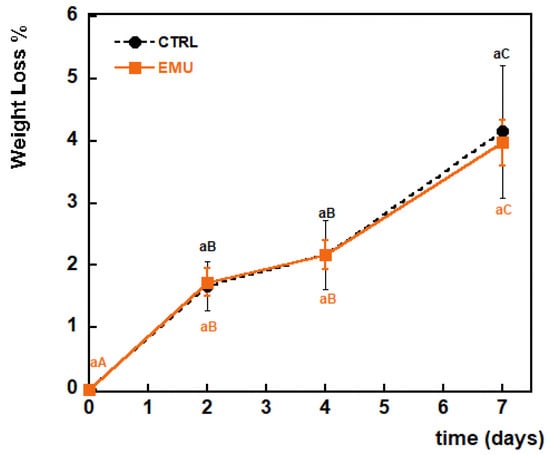
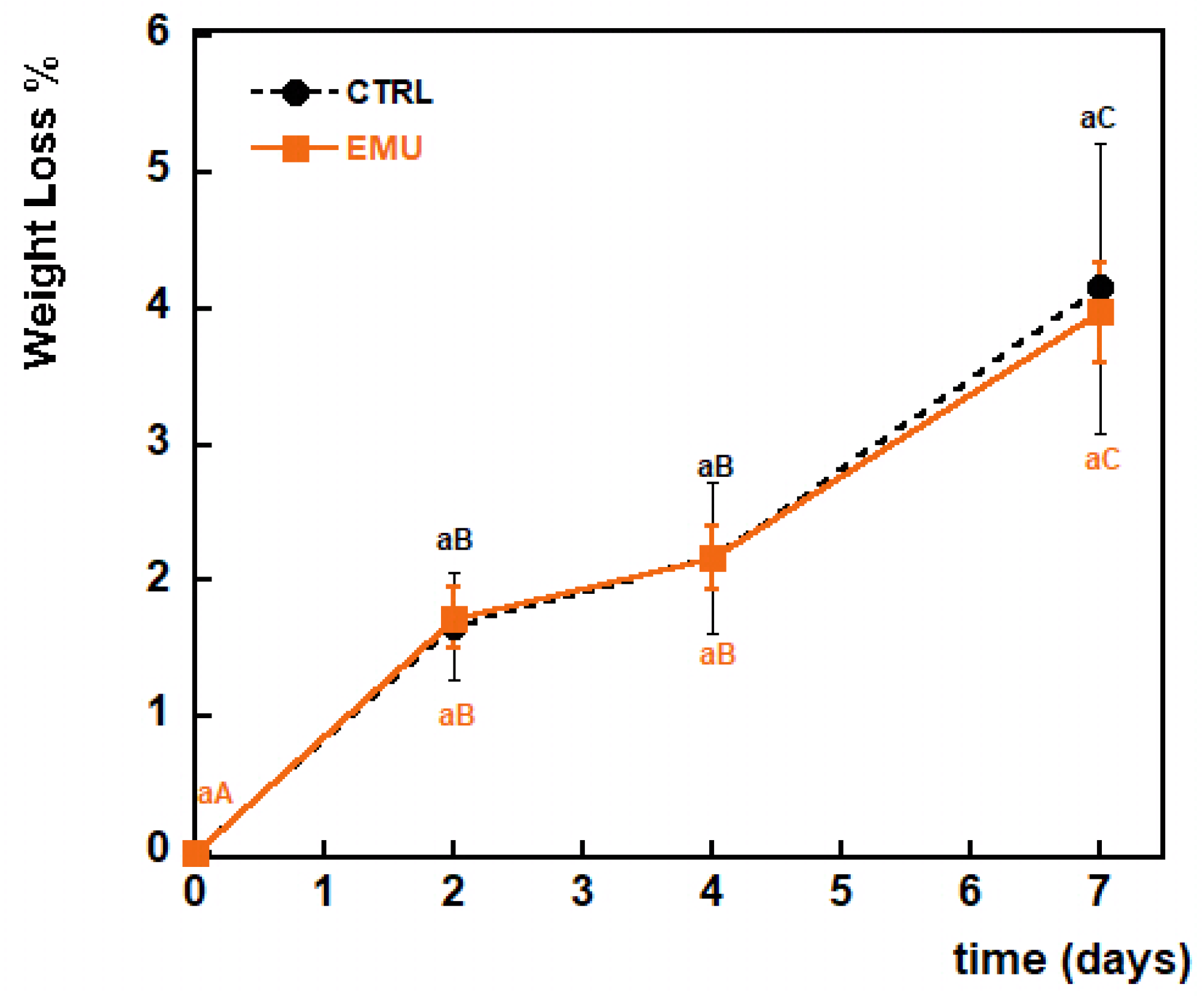
As depicted in Figure 1, weight loss progressively increased in both uncoated (CTRL) and coated (EMU) fish fillets during the storage period. Comparable weight loss trends were observed for the two treatments, although CTRL samples showed higher variability among replicates, as indicated by the larger standard deviations. No statistically significant differences were detected between CTRL and EMU samples at any sampling time.
Figure 1.
Weight loss (%) of fish fillets during refrigerated experimental conditions at 4 °C for uncoated (CTRL—black) and coated (EMU—orange) samples. Means with the same letters (lowercase: under different treatments for the same time; uppercase: under the same treatment during different storage times) are not significantly different (p > 0.05). Vertical bars indicate standard deviation.
These results indicate that, within the investigated storage period (0–7 days), the alginate–OEO emulsion did not exert a measurable barrier effect on water vapor transfer compared to uncoated samples. The similar dehydration patterns observed in CTRL and EMU fillets therefore suggest that any potential effect of the coating on moisture retention may become evident at longer storage times than those investigated in the present analysis.
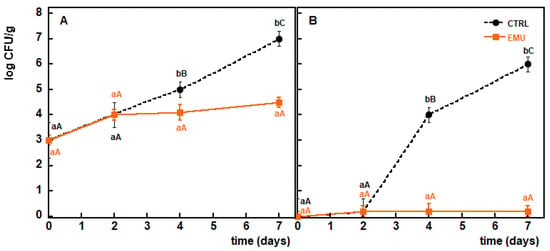
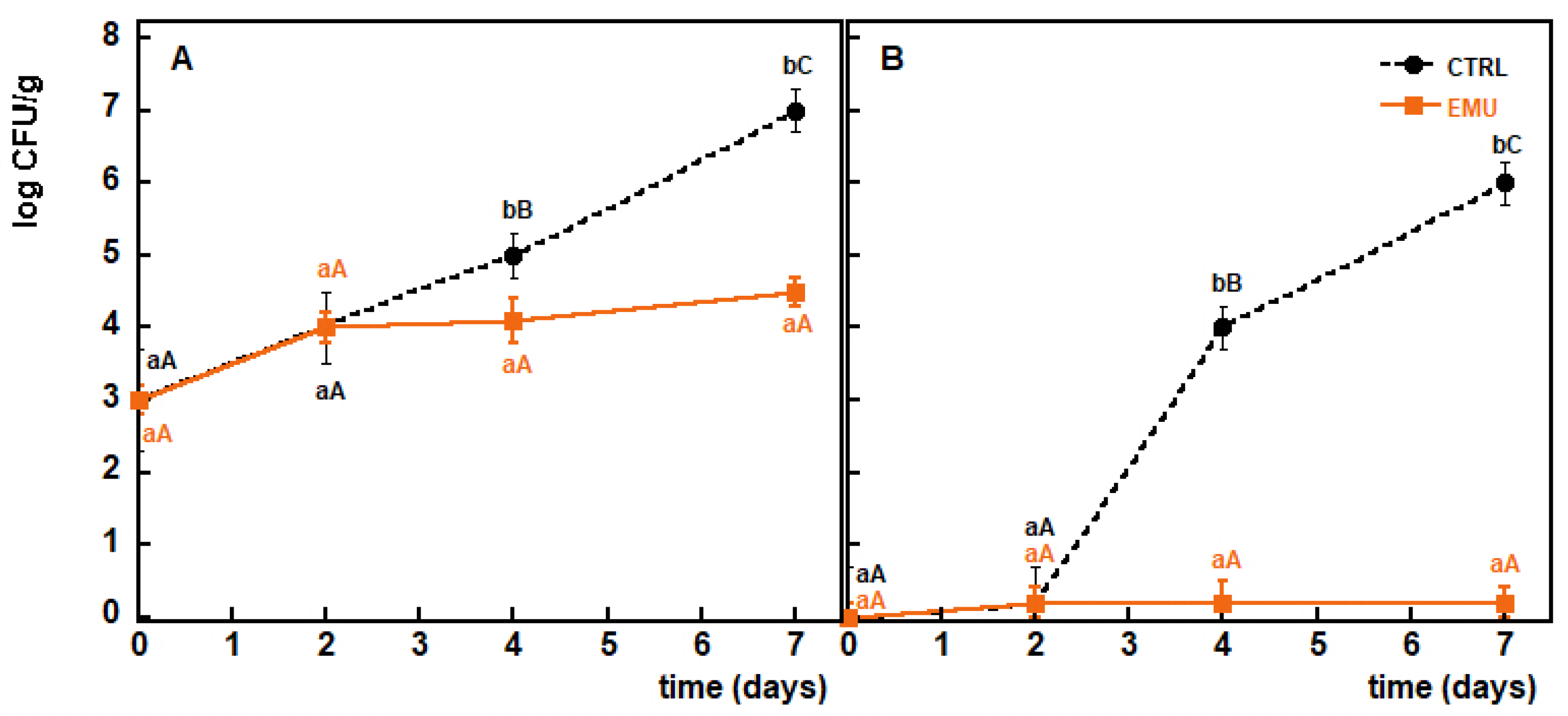
During the storage test, clear differences were observed in microbial trends between uncoated (CTRL) and coated (EMU) fish fillets (Figure 2). At day 0, TMC, Pseudomonas spp., and LAB were detected at low levels or below the detection limit in both batches, confirming good hygienic conditions during thawing and sample preparation.
Figure 2.
Changes in (A) total mesophilic count (TMC) and (B) Pseudomonas spp. in uncoated (CTRL, black) and coated (EMU, orange) fish fillets during storage at 4 °C. Microbial counts are expressed as log CFU/g. For graphical clarity, EMU values for Pseudomonas spp., which remain below the detection limit, are shown with a slight vertical offset (0.2 log CFU/g) without altering the original data interpretation. Means with the same letters (lowercase: different treatments at the same sampling time; uppercase: different sampling times within the same treatment) are not significantly different (p > 0.05). Vertical bars indicate standard deviation.
As the experimental period progressed, CTRL samples showed a marked increase in microbial loads. TMC increased steadily, reaching values close to 7 log CFU/g at day 7, while Pseudomonas spp. exhibited rapid growth after day 2, reaching approximately 6 log CFU/g at the end of the experimental period (Figure 2A). This trend supports the role of Pseudomonas spp. as dominant spoilage microorganisms under refrigerated air conditions. At these levels, TMC values are generally associated with the end of microbiological acceptability for fresh fish products, corresponding to advanced spoilage and loss of commercial quality [49,50,51].
In contrast, EMU fillets exhibited a markedly different behavior. TMC increased only slightly over time, remaining below 5 log CFU/g at day 7, while Pseudomonas spp. remained below the detection limit throughout the entire experimental period (Figure 2B). These results indicate that the alginate-based emulsion containing OEO effectively inhibited the growth of both the overall spoilage microbiota and Pseudomonas spp. under refrigerated air conditions. The strong suppression of Pseudomonas growth is therefore of particular technological relevance.
Regarding LAB, low levels were detected only at early sampling times in CTRL samples, while they remained below the detection limit in EMU-treated fillets throughout the experimental period This behavior is consistent with the typical microbiota of marine fish, where LAB generally represent a minor component and do not play a significant role in spoilage under aerobic refrigerated conditions, particularly when Gram-negative psychrotrophic bacteria such as Pseudomonas spp. dominate. Interestingly, LAB did not develop even in EMU samples where Pseudomonas spp. were absent, most likely due to the antimicrobial activity of OEO.
These results further support the effectiveness of the alginate–OEO coating in controlling microbial proliferation in RTC fish fillets stored under refrigerated air conditions that closely mimic real food systems.
Although molecular-level analyses were not performed in the present study, the observed antimicrobial effect during refrigerated storage is consistent with well-established mechanisms of essential oils and hydrocolloid coatings [10,43,44]. Alginate-based films can limit oxygen diffusion and moisture transfer, thereby modulating the surface microenvironment [10], whereas phenolic constituents of oregano essential oil (e.g., carvacrol and thymol) are known to disrupt microbial cell membranes and interfere with key cellular processes [23,41].
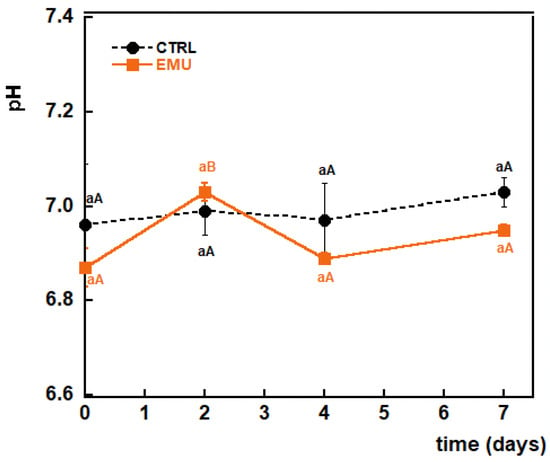
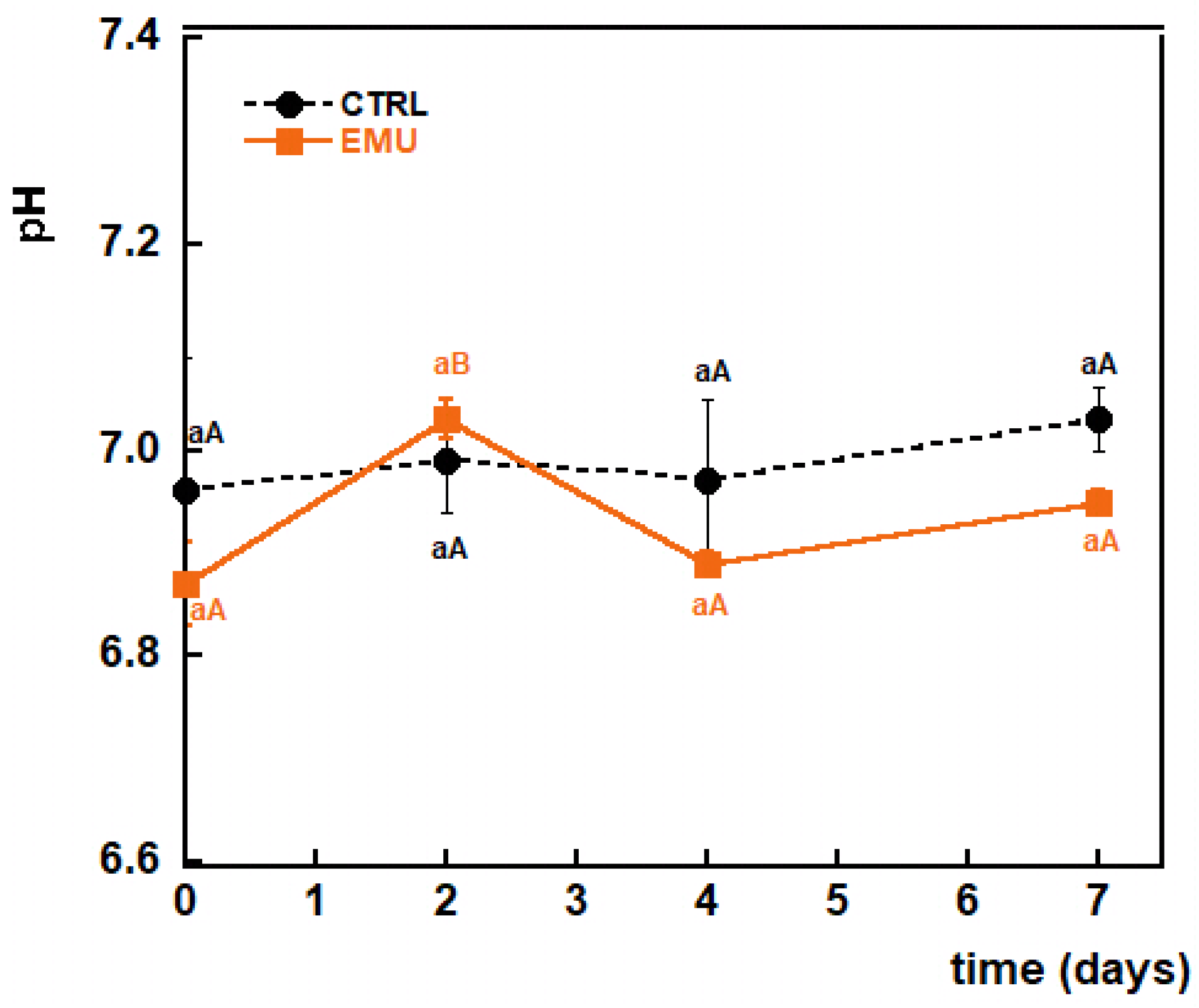
Figure 3 shows the pH values evolution during the storage test. Both CTRL and EMU batches exhibited limited variations in pH values over the experimental period. EMU samples displayed a transient increase in pH values at day 2, followed by stabilization at later sampling times. Despite this initial fluctuation, pH values in EMU samples remained within a narrow range throughout the experimental period and showed lower variability compared to the control. These results indicate that pH values alone were not a sensitive indicator to discriminate the effectiveness of the treatments under the tested conditions. This behavior is consistent with previous studies on fish and seafood products, where variations in pH values during refrigerated storage were reported to be limited and of secondary relevance when compared to microbiological and oxidative indicators [52,53]. Accordingly, changes in pH values should be interpreted in combination with other quality parameters to obtain a reliable assessment of product deterioration.
Figure 3.
Evolution of pH values of fish fillets uncoated (CTRL—black dots) and coated (EMU—orange dots) during storage test at 4 °C. Means with the same letters (lowercase: under different treatments for the same time; uppercase: under the same treatment during different storage times) are not significantly different (p > 0.05). Vertical bars indicate standard deviation.
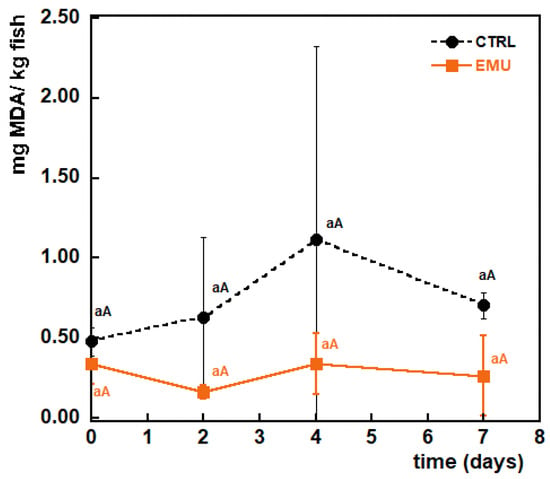
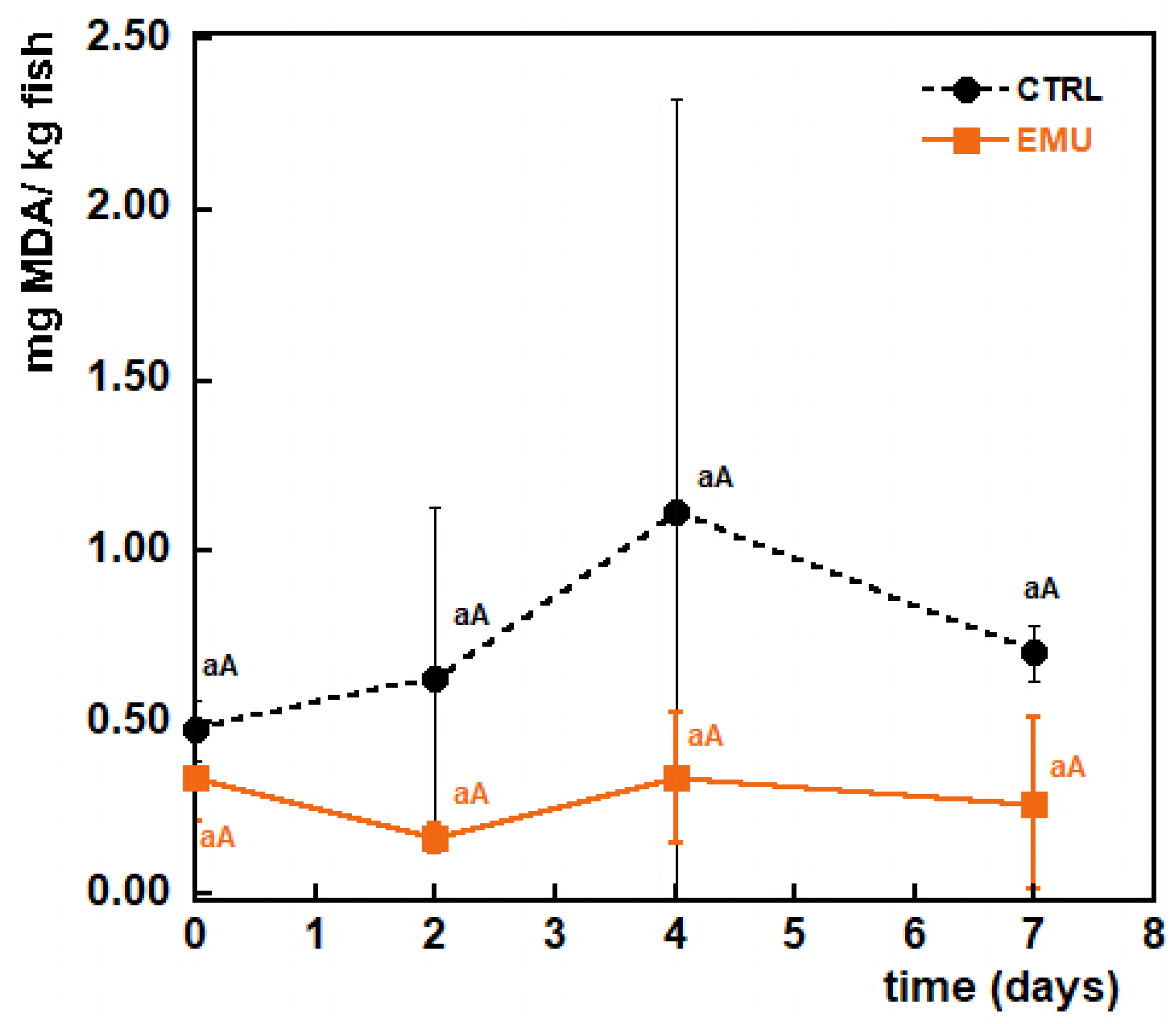
During the storage test under refrigerated air conditions at 4 °C, lipid oxidation was monitored by measuring thiobarbituric acid reactive substances (TBARS) (Figure 4). In uncoated (CTRL) fish fillets, TBARS values increased during the experimental period, reaching higher levels at intermediate times, followed by a slight decrease toward the end, a pattern commonly observed in fish and seafood products. In contrast, EMU-treated fillets consistently exhibited lower TBARS values throughout the entire experimental period, indicating a reduced extent of lipid oxidation compared to the control. TBARS values are widely used as comparative indicators of oxidative deterioration rather than as fixed acceptability thresholds; therefore, the lower levels observed in EMU samples clearly demonstrate the antioxidant effectiveness of the alginate–OEO coating under refrigerated air storage conditions.
Figure 4.
TBARS values (mg MDA/kg) in uncoated (CTRL, black) and coated (EMU, orange) fish fillets during refrigerated air storage at 4 °C. Means with the same letters (lowercase: under different treatments for the same time; uppercase: under the same treatment during different storage times) are not significantly different (p > 0.05). Vertical bars indicate standard deviation.
This behavior can be attributed to the combined effects of the alginate-based matrix, acting as a partial barrier to oxygen diffusion, and the antioxidant activity of phenolic compounds present in OEO. A similar approach has been reported in recent studies on seafood preservation, where chitosan-based coatings enriched with natural bioactive compounds resulted in significantly lower TBARS values compared to untreated samples, indicating delayed oxidative deterioration [52,53]. These findings are fully consistent with the present results and support the role of edible coatings incorporating natural antioxidants as effective tools to control lipid oxidation in fish fillets.
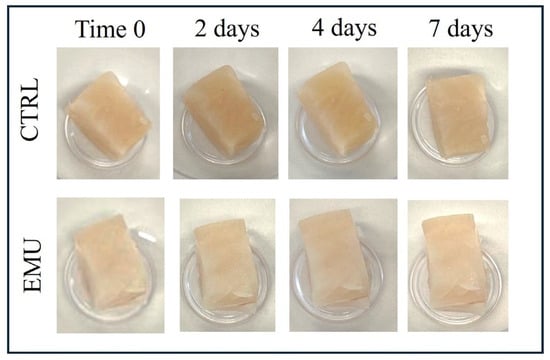
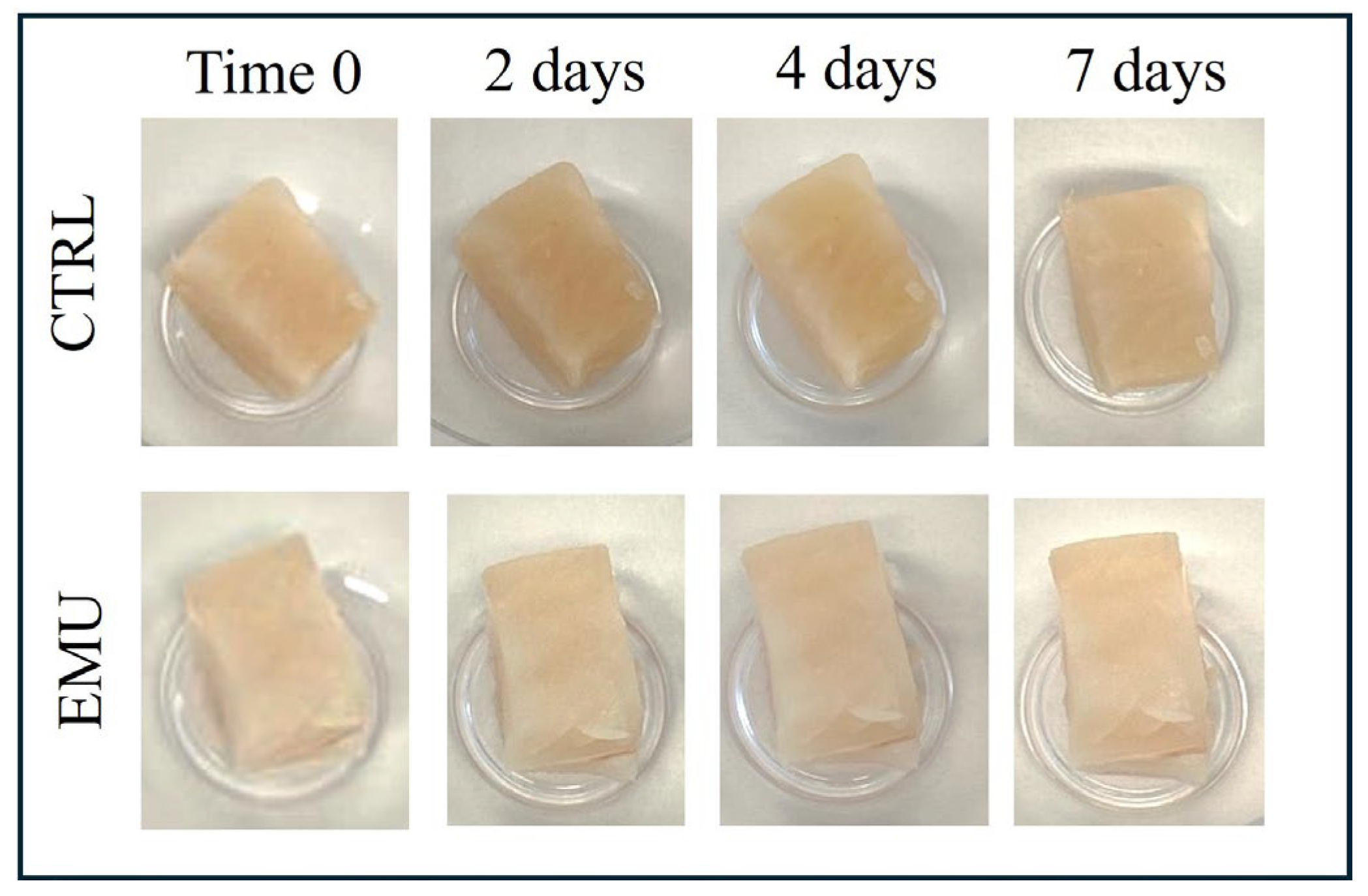
Representative images were collected during the storage test to visually document the effect of the alginate–OEO coating on the appearance of fish fillets over time.
Figure 5 shows the visual appearance of the fish fillet samples during the storage test. At time 0, hake fillets exhibited a white coloration with light pinkish streaks. After 7 days, uncoated control samples (CTRL) showed visible changes in surface appearance, including a loss of the pinkish streaks and a slight darkening of the fillet surface, resulting in a less bright and less uniform appearance.
Figure 5.
Representative images of fish fillet during storage at 4 °C.
In contrast, fillets treated with the alginate–OEO emulsion (EMU) appeared to maintain a more stable visual aspect over time, showing only minimal visible changes in surface color or overall appearance at the end of the experimental period.
Furthermore, a qualitative difference in odor was observed on day 7. Uncoated control samples emitted pronounced unpleasant off odors, whereas EMU-treated fillets maintained a neutral odor profile, allowing the perception of slight aromatic notes attributable to oregano essential oil.
Potential limitations of the proposed coating should also be acknowledged. The sensory impact of OEO, particularly at higher concentrations, warrants further investigation through dedicated sensory analyses. However, the alginate-based coating is water-soluble and can be easily removed from the fillet surface by simple rinsing under running water, potentially mitigating sensory concerns at the consumer level. From an economic perspective, the low amount of essential oil required suggests a negligible impact on production costs, while the simplicity of the coating application supports its potential feasibility at an industrial scale.
4. Conclusions
In this study, an alginate-based emulsion enriched with OEO demonstrated a clear potential to mitigate quality deterioration and extend the refrigerated shelf life of commercial frozen–thawed fish fillets. The application of the coating limited oxidative changes and promoted a more uniform visual appearance compared to uncoated samples, supporting its suitability as a clean-label preservation strategy for RTC fish products.
From a microbiological perspective, the alginate–OEO coating effectively delayed spoilage-related microbial growth under refrigerated air conditions, particularly by controlling Pseudomonas spp., one of the dominant spoilage microorganisms in fish fillets, thereby maintaining microbiological acceptability throughout the experimental period and extending its relative to uncoated samples.
The use of frozen–thawed commercial fish fillets proved to be a practical, reproducible, and informative model system specifically adopted under conditions that closely mimic real storage scenarios. This approach allowed for the assessment of coating performance in a realistic food matrix while ensuring experimental robustness and repeatability, thereby confirming its suitability as a preliminary and screening model for preservation strategies intended for industrial application.
Although this work focused on a model system, the results provide a solid foundation for future developments. Further studies will address sensory aspects and scalability, and the preservation approach will be applied to RTC fillets obtained from sustainably farmed sea bass (Dicentrarchus labrax) and sea bream (Sparus aurata), with the aim of improving microbiological stability and extending shelf life, thereby supporting product distribution, reducing food waste, and enhancing the economic sustainability of the production chain.
Author Contributions
Conceptualization, S.R., M.C., N.I., F.L. and E.S.; methodology, S.R., M.C., N.I., F.L. and E.S.; software, S.R. and M.C.; validation, S.R., M.C., N.I., F.L., L.M. and E.S.; formal analysis, S.R., M.C., N.I., F.L., L.M. and E.S.; investigation, G.C., A.M., E.A. and L.M.; data curation, S.R. and M.C.; writing—original draft preparation, S.R., M.C., N.I., F.L., G.C., A.M., E.A., L.M. and E.S.; writing—review and editing, S.R., M.C., N.I., F.L., L.M. and E.S.; visualization, S.R. and M.C.; supervision, N.I., F.L. and E.S. All authors have read and agreed to the published version of the manuscript.
Funding
This research received no external funding.
Institutional Review Board Statement
Not applicable.
Informed Consent Statement
Not applicable.
Data Availability Statement
The data presented in this study are available on request from the corresponding authors.
Conflicts of Interest
The authors declare no conflicts of interest.
References
- Critselis, E.; Tsiampalis, T.; Damigou, E.; Georgousopoulou, E.; Barkas, F.; Chrysohoou, C.; Skoumas, J.; Pitsavos, C.; Liberopoulos, E.; Tsioufis, C. High fish intake rich in n-3 polyunsaturated fatty acids reduces cardiovascular disease incidence in healthy adults: The ATTICA cohort study (2002–2022). Front. Phys. 2023, 14, 1158140. [Google Scholar] [CrossRef] [Scilit]
- OECD/FAO. OECD-FAO Agricultural Outlook 2025–2034; OECD Publishing: Paris, France; FAO: Rome, Italy, 2025. [Google Scholar] [CrossRef] [Scilit]
- Rosati, S.; Maiuro, L.; Lombardi, S.J.; Iaffaldano, N.; Di Iorio, M.; Cariglia, M.; Lopez, F.; Cofelice, M.; Tremonte, P.; Sorrentino, E. Integrated Biotechnological Strategies for the Sustainability and Quality of Mediterranean Sea Bass (Dicentrarchus labrax) and Sea Bream (Sparus aurata). Foods 2025, 14, 1020. [Google Scholar] [CrossRef] [Scilit]
- Cui, T.; Gine, G.R.; Lei, Y.; Shi, Z.; Jiang, B.; Yan, Y.; Zhang, H. Ready-to-Cook Foods: Technological Developments and Future Trends—A Systematic Review. Foods 2024, 13, 3454. [Google Scholar] [CrossRef] [Scilit] [PubMed]
- Gautam, R.K.; Kakatkar, A.S.; Debbarma, A.; Mishra, P.K.; Kumar, V.; Shashidhar, R.; Chatterjee, S. Shelf-life extension of ready-to-cook Tilapia (Oreochromis spp.) fish balls using hurdle technology. Food Biosci. 2025, 163, 05739. [Google Scholar] [CrossRef] [Scilit]
- FAO. The State of World Fisheries and Aquaculture 2022. Towards Blue Transformation; FAO: Rome, Italy, 2022. [Google Scholar] [CrossRef] [Scilit]
- Menozzi, D.; Nguyen, T.T.; Sogari, G.; Taskov, D.; Lucas, S.; Castro-Rial, J.L.S.; Mora, C. Consumers’ Preferences and Willingness to Pay for Fish Products with Health and Environmental Labels: Evidence from Five European Countries. Nutrients 2020, 12, 2650. [Google Scholar] [CrossRef] [Scilit] [PubMed]
- Cofelice, M.; Iftikhar, A.; Lopez, F.; De Leonardis, A. Effect of edible coatings on quality parameters and phenol composition of ready-to-eat Salanova lettuce. Eur. Food Res. Technol. 2024, 250, 691–700. [Google Scholar] [CrossRef] [Scilit]
- Cofelice, M.; Lopez, F.; Cuomo, F. Quality Control of Fresh-Cut Apples after Coating Application. Foods 2019, 8, 189. [Google Scholar] [CrossRef] [Scilit]
- Iacovino, S.; Cofelice, M.; Sorrentino, E.; Cuomo, F.; Messia, M.C.; Lopez, F. Alginate-Based Emulsions and Hydrogels for Extending the Shelf Life of Banana Fruit. Gels 2024, 10, 245. [Google Scholar] [CrossRef] [Scilit]
- Cofelice, M.; De Leonardis, A.; Letizia, F.; Iorizzo, M.; Cuomo, F.; Lopez, F. Alginate-Based Edible Coating to Preserve the Quality and Extend the Shelf Life of Fresh-Cut Salad. Colloids Int. 2025, 9, 87. [Google Scholar] [CrossRef] [Scilit]
- Cofelice, M.; Cuomo, F.; Lopez, F. Rheological Properties of Alginate–Essential Oil Nanodispersions. Colloids Int. 2018, 2, 48. [Google Scholar] [CrossRef] [Scilit]
- Antonino, C.; Difonzo, G.; Faccia, M.; Caponio, F. Effect of edible coatings and films enriched with plant extracts and essential oils on the preservation of animal-derived foods. J. Food Sci. 2024, 89, 748–772. [Google Scholar] [CrossRef] [Scilit] [PubMed]
- Kurek, M.; Pišonić, P.; Ščetar, M.; Janči, T.; Čanak, I.; Vidaček Filipec, S.; Benbettaieb, N.; Debeaufort, F.; Galić, K. Edible Coatings for Fish Preservation: Literature Data on Storage Temperature, Product Requirements, Antioxidant Activity, and Coating Performance—A Review. Antioxidants 2024, 13, 1417. [Google Scholar] [CrossRef] [Scilit] [PubMed]
- Ferraro, G.; Fratini, E.; Sacco, P.; Asaro, F.; Cuomo, F.; Donati, I.; Lopez, F. Structural characterization and physical ageing of mucilage from chia for food processing applications. Food Hydrocoll. 2022, 129, 107614. [Google Scholar] [CrossRef] [Scilit]
- Mosca, M.; Diantom, A.; Lopez, F.; Ambrosone, L.; Ceglie, A. Impact of antioxidants dispersions on the stability and oxidation of water-in-olive-oil emulsions. Eur. Food Res. Technol. 2013, 236, 319–328. [Google Scholar] [CrossRef] [Scilit]
- Cuomo, F.; Cofelice, M.; Lopez, F. Rheological characterization of hydrogels from alginate-based nanodispersion. Polymers 2019, 11, 259. [Google Scholar] [CrossRef] [Scilit]
- Cuomo, F.; Ceglie, S.; Miguel, M.; Lindman, B.; Lopez, F. Oral delivery of all-trans retinoic acid mediated by liposome carriers. Colloids Surf. B Biointerfaces 2021, 201, 111655. [Google Scholar] [CrossRef] [Scilit]
- Gradzielski, M.; Duvail, M.; de Molina, P.M.; Simon, M.; Talmon, Y.; Zemb, T. Using microemulsions: Formulation based on knowledge of their mesostructure. Chem. Rev. 2021, 121, 5671–5740. [Google Scholar] [CrossRef] [Scilit]
- Iseppi, R.; Camellini, S.; Zurlini, C.; Cigognini, I.M.; Cannavacciuolo, M.; Messi, P. Essential oils and bacteriocin-based active edible coating: An innovative, natural and sustainable approach for the control of Listeria monocytogenes in seafoods. Appl. Sci. 2023, 13, 2562. [Google Scholar] [CrossRef] [Scilit]
- Pierozan, M.B.; Oliveira Filho, J.G.D.; Cappato, L.P.; Costa, A.C.; Egea, M.B. Essential oils against spoilage in fish and seafood: Impact on product quality and future challenges. Foods 2024, 13, 3903. [Google Scholar] [CrossRef] [Scilit]
- Leyva-López, N.; Gutiérrez-Grijalva, E.P.; Vazquez-Olivo, G.; Heredia, J.B. Essential oils of oregano: Biological activity beyond their antimicrobial properties. Molecules 2017, 22, 989. [Google Scholar] [CrossRef] [Scilit]
- Hao, Y.; Li, J.; Shi, L. A carvacrol-rich essential oil extracted from oregano (Origanum vulgare “Hot & Spicy”) exerts potent antibacterial effects against Staphylococcus aureus. Front. Microbiol. 2021, 12, 741861. [Google Scholar] [CrossRef] [Scilit] [PubMed]
- Nurzyńska-Wierdak, R.; Walasek-Janusz, M. Chemical composition, biological activity, and potential uses of oregano (Origanum vulgare L.) and oregano essential oil. Pharmaceuticals 2025, 18, 267. [Google Scholar] [CrossRef] [Scilit] [PubMed]
- Saffarian, H.; Rahimi, E.; Khamesipour, F.; Hashemi Dehkordi, S.M. Antioxidant and antimicrobial effect of sodium alginate nanoemulsion coating enriched with oregano essential oil (Origanum vulgare L.) and Trachyspermum ammi oil (Carum cupticum) on food pathogenic bacteria. Food Sci. Nutr. 2024, 12, 2985–2997. [Google Scholar] [CrossRef] [Scilit] [PubMed]
- Wang, X.; Zheng, Z. Mechanistic insights into fish spoilage and integrated preservation technologies. Appl. Sci. 2025, 15, 7639. [Google Scholar] [CrossRef] [Scilit]
- Vital, A.C.P.; Guerrero, A.; Kempinski, E.M.B.C.; de Oliveira Monteschio, J.; Sary, C.; Ramos, T.R.; del Mar Campo, M.; do Prado, I.N. Consumer profile and acceptability of cooked beef steaks with edible and active coating containing oregano and rosemary essential oils. Meat Sci. 2018, 143, 153–158. [Google Scholar] [CrossRef] [Scilit]
- Tsironi, T.N.; Stoforos, N.G.; Taoukis, P.S. Quality and shelf-life modeling of frozen fish at constant and variable temperature conditions. Foods 2020, 9, 1893. [Google Scholar] [CrossRef] [Scilit]
- Tremonte, P.; Sorrentino, E.; Succi, M.; Tipaldi, L.; Pannella, G.; Ibanez, E.; Mendiola, J.A.; Di Renzo, T.; Coppola, R. Antimicrobial effect of Malpighia punicifolia and extension of water buffalo steak shelf-life. J. Food Sci. 2016, 81, M97–M105. [Google Scholar] [CrossRef] [Scilit]
- Sorrentino, E.; Succi, M.; Tipaldi, L.; Pannella, G.; Maiuro, L.; Sturchio, M.; Coppola, R.; Tremonte, P. Antimicrobial activity of gallic acid against food-related Pseudomonas strains and its use as biocontrol tool to improve the shelf life of fresh black truffles. Int. J. Food Microbiol. 2018, 266, 183–189. [Google Scholar] [CrossRef] [Scilit]
- Lombardi, S.J.; Pannella, G.; Coppola, F.; Vergalito, F.; Maiuro, L.; Succi, M.; Sorrentino, E.; Tremonte, P.; Coppola, R. Plant-Based Ingredients Utilized as Fat Replacers and Natural Antimicrobial Agents in Beef Burgers. Foods 2024, 13, 3229. [Google Scholar] [CrossRef] [Scilit]
- Reale, A.; Sorrentino, E.; Iaffaldano, N.; Rosato, M.P.; Ragni, P.; Coppola, R.; Capitani, D.; Anatoli, P.S.; Tremonte, P.; Succi, M.; et al. Effects of ionizing radiation and modified atmosphere packaging on the shelf life of aqua-cultured sea bass (Dicentrarchus labrax). World J. Microbiol. Biotechnol. 2008, 24, 2757–2765. [Google Scholar] [CrossRef] [Scilit]
- AbdelAziz, M.E.; Ali, M.R.; Hammad, K.S.; Morsy, N.F. Preservative effect of carboxymethyl cellulose coating enriched with oregano (Origanum vulgare L.) essential oil on European eel (Anguilla anguilla) fillets during cold storage. Egypt. J. Nutr. 2019, 34, 1–36. [Google Scholar] [CrossRef] [Scilit]
- Sorrentino, E.; Tremonte, P.; Succi, M.; Iorizzo, M.; Pannella, G.; Lombardi, S.J.; Sturchio, M.; Coppola, R. Detection of antilisterial activity of 3-phenyllactic acid using Listeria innocua as a model. Front. Microbiol. 2018, 9, 1373. [Google Scholar] [CrossRef] [Scilit] [PubMed]
- Tang, Z.; Chen, H.; Chen, W.; Zhong, Q.; Zhang, M.; Chen, W.; Yun, Y.H. Unraveling the antibacterial mechanism of 3-carene against Pseudomonas fragi by integrated proteomics and metabolomics analyses and its application in pork. Int. J. Food Microbiol. 2022, 379, 109846. [Google Scholar] [CrossRef] [Scilit] [PubMed]
- Tremonte, P.; Succi, M.; Coppola, R.; Sorrentino, E.; Tipaldi, L.; Picariello, G.; Pannella, G.; Fraternali, F. Homology-based modeling of Universal Stress Protein from Listeria innocua up-regulated under acid stress conditions. Front. Microbiol. 2016, 7, 1998. [Google Scholar] [CrossRef] [Scilit]
- Marques, C.S.; Arruda, T.R.; Silva, R.R.A.; Ferreira, A.L.V.; de Andrade Oliveira, W.L.; Rocha, F.; Mendes, L.A.; de Oliveira, T.V.; Vanetti, M.C.D.; de Fátima, N.; et al. Exposure to cellulose acetate films incorporated with garlic essential oil does not lead to homologous resistance in Listeria innocua ATCC 33090. Food Res. Int. 2022, 160, 111676. [Google Scholar] [CrossRef] [Scilit]
- Lin, H.J.; Hsu, P.H.; Lin, T.C.; Lu, W.J.; Lin, H.T.V. Solid-and Vapor-Phase Antibacterial Activities and Mechanisms of Essential Oils Against Fish Spoilage Bacteria. Antibiotics 2024, 13, 1137. [Google Scholar] [CrossRef] [Scilit]
- Tremonte, P.; Pannella, G.; Lombardi, S.J.; Iorizzo, M.; Vergalito, F.; Cozzolino, A.; Maiuro, L.; Succi, M.; Sorrentino, E.; Coppola, R. Low-Fat and High-Quality Fermented Sausages. Microorganisms 2020, 8, 1025. [Google Scholar] [CrossRef] [Scilit]
- Agrimonti, C.; White, J.C.; Tonetti, S.; Marmiroli, N. Antimicrobial activity of cellulosic pads amended with emulsions of essential oils of oregano, thyme and cinnamon against microorganisms in minced beef meat. Int. J. Food Microb. 2019, 305, 108246. [Google Scholar] [CrossRef] [Scilit]
- Luo, K.; Zhao, P.; He, Y.; Kang, S.; Shen, C.; Wang, S.; Guo, M.; Wang, L.; Shi, C. Antibacterial effect of oregano essential oil against Vibrio vulnificus and its mechanism. Foods 2022, 11, 403. [Google Scholar] [CrossRef] [Scilit]
- Zhang, J.; Li, Y.; Yang, X.; Liu, X.; Hong, H.; Luo, Y. Effects of oregano essential oil and nisin on the shelf life of modified atmosphere packed grass carp (Ctenopharyngodon idellus). LWT 2021, 147, 111609. [Google Scholar] [CrossRef] [Scilit]
- Ndao, A.; Adjallé, K. Overview of the biotransformation of limonene and α-pinene from wood and citrus residues by microorganisms. Waste 2023, 1, 841–859. [Google Scholar] [CrossRef] [Scilit]
- Zubair, M.; Shahzad, S.; Hussain, A.; Pradhan, R.A.; Arshad, M.; Ullah, A. Current Trends in the Utilization of Essential Oils for Polysaccharide and Protein-Derived Food Packaging Materials. Polymers 2022, 14, 1146. [Google Scholar] [CrossRef] [Scilit] [PubMed]
- Song, Z.; Ni, W.; Zheng, Y.; Ma, Y.; Cao, Y.; Han, L.; Yu, Q. A polysaccharide smart packaging materials: Anthocyanin microcapsules synergized with nanosilver co-filled gellan gum/sodium alginate film for monitoring chilled mutton freshness. Carbohydr. Polym. 2025, 368, 124221. [Google Scholar] [CrossRef] [Scilit] [PubMed]
- Olszewska, M.A.; Gędas, A.; Simões, M. Antimicrobial polyphenol-rich extracts: Applications and limitations in the food industry. Food Res. Int. 2020, 134, 109214. [Google Scholar] [CrossRef] [Scilit] [PubMed]
- Pinto, L.; Tapia-Rodríguez, M.R.; Baruzzi, F.; Ayala-Zavala, J.F. Plant antimicrobials for food quality and safety: Recent views and future challenges. Foods 2023, 12, 2315. [Google Scholar] [CrossRef] [Scilit]
- Azevedo, L.; Granato, D.; Maltarollo, V.G.; Gonçalves, J.E. A mosaic-structured framework applied in the healthy food design: Insights from integrated in silico and in vitro approaches. Curr. Opin. Food Sci. 2023, 52, 101047. [Google Scholar] [CrossRef] [Scilit]
- International Commission on Microbiological Specifications for Foods (ICMSF). Microorganisms in Foods 8: Use of Data for Assessing Process Control and Product Acceptance; Springer Science & Business Media: Berlin/Heidelberg, Germany, 2011; Volume 8. [Google Scholar] [CrossRef] [Scilit]
- Esteves, E.; Aníbal, J. Sensory evaluation of seafood freshness using the Quality Index Method: A meta-analysis. Int. J. Food Micr. 2020, 337, 108934. [Google Scholar] [CrossRef] [Scilit]
- Duarte, A.M.; Silva, F.; Pinto, F.R.; Barroso, S.; Gil, M.M. Quality assessment of chilled and frozen fish—A mini review. Foods 2020, 9, 1739. [Google Scholar] [CrossRef] [Scilit]
- Karimkhani, M.M.; Javanshir, S.; Ebadifard, F.; Salari, A.; Shahri, M.S.A. Shelf-life extension of green tiger prawn (Penaeus semisulcatus) using chitosan coating incorporated with jujube extract, cinnamon essential oil and thymoquinone during cold storage. LWT 2025, 230, 118252. [Google Scholar] [CrossRef] [Scilit]
- Besbes, N.; Sadok, S. Effects of chitosan-microparticles-coating on the quality of vacuum-packed sea bass (Dicentrarchus labrax) fillets during refrigerated storage. INSTM Bull. Mar. Freshw. Sci. 2023, 48, 2–12. [Google Scholar] [CrossRef]

Disclaimer/Publisher’s Note: The statements, opinions and data contained in all publications are solely those of the individual author(s) and contributor(s) and not of MDPI and/or the editor(s). MDPI and/or the editor(s) disclaim responsibility for any injury to people or property resulting from any ideas, methods, instructions or products referred to in the content. |
© 2026 by the authors. Licensee MDPI, Basel, Switzerland. This article is an open access article distributed under the terms and conditions of the Creative Commons Attribution (CC BY) license.