


Abstract
Charging electric vehicles (EVs) and integrating renewable energy sources (RESs) are becoming key aspects of residential energy systems. However, the variability of RES generation, combined with uncontrolled EV charging, poses challenges for reliability, power quality, and supply-demand balancing within communities. The challenges only grow when considering other electrified building loads as well. Accurate forecasting of power demand and renewable generation is essential for efficient and sustainable grid operation, optimal use of RESs, and effective energy trading within communities. Deep learning (DL), including supervised, unsupervised, and reinforcement learning (RL), has emerged as a promising solution for predicting consumer demand, renewable generation, and managing energy flows in residential environments. This paper provides a comprehensive review of the development and application of these methods for forecasting and energy management in residential communities. Evaluation metrics across studies indicate that supervised learning can achieve highly accurate forecasting results, especially when integrated with unsupervised K-means clustering and data decomposition. These methods help uncover patterns and relationships within the data while reducing noise, thereby enhancing prediction accuracy. RL shows significant potential in control applications, particularly for charging strategies. Similarly to how V2G-simulators model individual EV usage and simulate large fleets to generate grid-scale predictions, RL can be applied to various aspects of EV fleet management, including vehicle dispatching, smart scheduling, and charging coordination. Traditional methods are also used across different applications and help utilities with planning. However, these methods have limitations and may not always be completely accurate. Our review suggests that integrating hybrid supervised-unsupervised learning methods with RL can significantly improve the sustainability and resilience of energy systems. This approach can improve demand and generation forecasting while enabling smart charging coordination and scheduling for scalable EV fleets integrated with building electrification measures. Furthermore, the review introduces a unifying conceptual framework that links forecasting, optimization, and policy coupling through hierarchical deep learning layers, enabling scalable coordination of EV charging, renewable generation, and building energy management. Despite methodological advances, real-world deployment of hybrid and deep learning frameworks remains constrained by data-privacy restrictions, interoperability issues, and computational demands, highlighting the need for explainable, privacy-preserving, and standardized modeling approaches. To be effective in practice, these methods require robust data acquisition, optimized forecasting and control models, and integrated consideration of transport, building, and grid domains. Furthermore, deployment must account for data privacy regulations, cybersecurity safeguards, model interpretability, and economic feasibility to ensure resilient, scalable, and socially acceptable solutions.
1. Introduction
The global EV market is continuing on its strong growth trajectory. In 2024, over 17 million electric cars were sold worldwide, making up more than 20% of all new vehicle sales. Looking ahead, electric vehicle sales in 2025 are projected to surpass 20 million globally, representing over 25% of total new car sales across the world [1]. China remains at the forefront, accounting for 60% of global EV sales. However, the rapid growth of the EV industry introduces new challenges for power systems, including transformer overloading, voltage fluctuations, and peak demand exacerbation. Addressing these issues is crucial to facilitating a sustainable and efficient transition to electric mobility.
Renewable energy technologies are becoming vital in the modern residential energy systems, supporting the transition to low-carbon, electrified communities [2]. The increasing deployment of residential solar photovoltaic (PV) systems reduces environmental impacts while providing clean electricity. Combined with heat pumps and energy storage, these technologies enhance self-consumption, demand-side flexibility, and grid stability while supporting decarbonization goals.
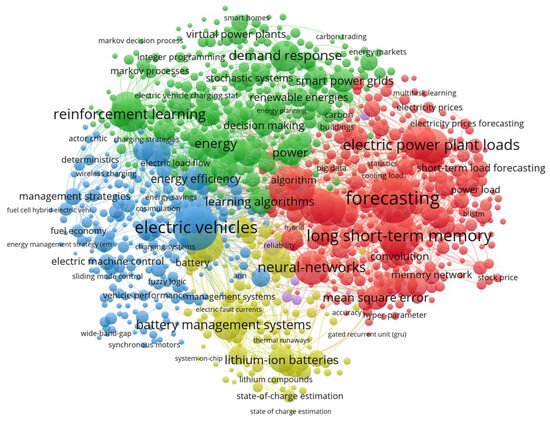
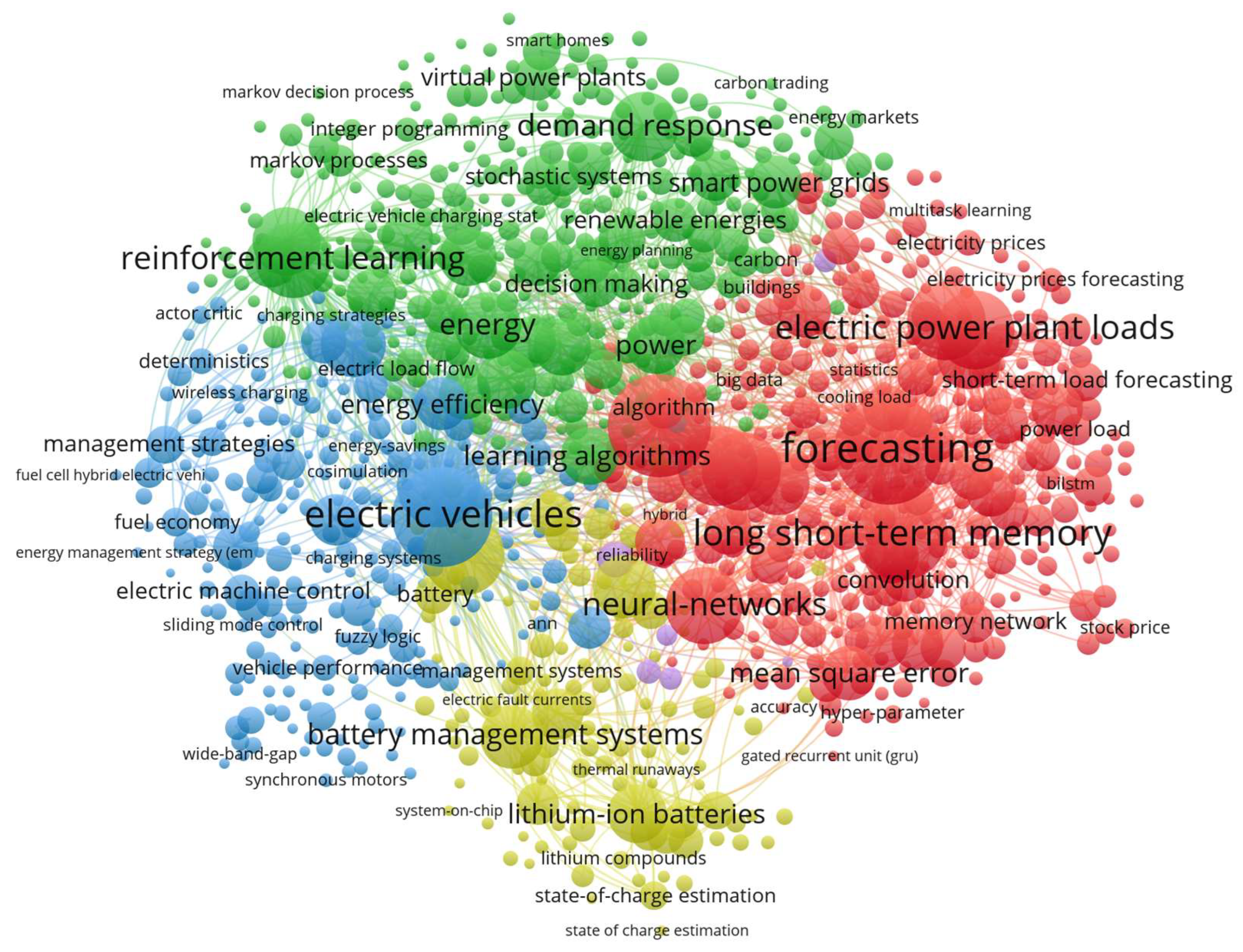
The increasing digitalization of prosumers, supported by big data applications and machine learning, is poised to shape the future of power systems [3]. Systematic assessments of energy management that incorporate DL and advanced charging strategies, while accounting for emerging building technologies, are essential to develop a comprehensive understanding of the current state of knowledge. This review compiles insights from relevant studies on load demand, charging behavior, and charging strategies for scalable EV fleets at both regional and global levels. It also explores theoretical and technological scenarios of hybrid energy systems in residential buildings, while highlighting areas for further research and information transfer. The literature search was conducted using major scientific databases, including Scopus, Web of Science, IEEE Xplore, ScienceDirect, MDPI, and SpringerLink, complemented by Google Scholar. Keywords and Boolean combinations related to EVs charging, Deep Learning forecasting, energy management, V2G, and renewable integration were used to ensure comprehensive coverage (Figure 1). Studies were included if they reported quantitative performance metrics or validated models applicable to residential or community-scale systems. To enhance methodological transparency and reproducibility, a structured, stepwise workflow was adopted encompassing database selection, keyword formulation, filtering for relevance (2014–2025), removal of duplicates and non-quantitative studies, and categorization of the studies. The scope of this review is limited to light-duty passenger EVs and residential charging systems. It excludes large-battery fleets such as electric buses or heavy-duty vehicles that require extensive spatial planning and operational scheduling. However, their broader system-level implications are discussed throughout the review to contextualize future research and urban-scale energy planning.
Figure 1.
Deep learning keywords for EV load/energy forecasting, charging management and control, and V2G generated from the Scopus database using VOSviewer (version 1.6.20, Leiden University, The Netherlands).
2. Materials and Methods
Data for this review were collected from technical reports and peer-reviewed modeling studies addressing forecasting and energy management in residential communities and buildings. In total, 110 studies were examined: 36 from North America, 30 from Europe, 37 from Asia, 3 from Africa, and 4 from Oceania. Each study was compiled and, where possible, categorized by description and limitation, geographic context, methodological approach, and reported performance indicators, with quantitative success metrics (Table 1, Table 2, Table 3, Table 4, Table 5, Table 6 and Table 7). It is important to note that contributions from Africa, Latin America, and other low-income economies remain extremely limited due to restricted data availability, fragmented monitoring infrastructure, and constrained research funding. This imbalance hampers model validation, cross-regional benchmarking, and the development of context-specific forecasting and control frameworks, underscoring the urgent need for broader global representation, open data-sharing initiatives, and targeted investment in regional EV-renewable research to ensure methodological inclusivity and equitable policy development.
At the core of these studies is the use of quantitative metrics to evaluate forecasting accuracy, optimization performance, and energy management effectiveness across diverse methodological families, ranging from deep learning to traditional statistical approaches. For supervised learning, success metrics typically capture improvements in prediction accuracy, computational efficiency, and stability, while unsupervised approaches emphasize clustering of EV charging behaviors and enhancing load management strategies. RL studies often report reductions in load or cost variance, reflecting their focus on adaptive control under uncertainty. V2G simulators extend these analyses by modeling individual EVs’ driving and charging behaviors to generate scalable insights on aggregated grid impacts. Traditional approaches such as probabilistic models, Monte Carlo methods, and mixed-integer optimization highlight forecasting accuracy and efficiency gains in regional EV load estimation. Finally, research on overnight/workplace charging strategies and the integration of EV infrastructure with electrified building loads and RESs emphasizes outcomes such as enhanced energy management, peak reduction, cost savings, and household-level bill minimization. Together, these findings demonstrate how forecasting and management frameworks converge to support scalable, resilient, and context-aware energy solutions in residential settings. In addition to these categories, hybrid approaches have emerged as a particularly effective direction, consistently delivering superior forecasting accuracy and more resilient energy management than single-model methods. By integrating supervised, unsupervised, and reinforcement learning techniques—often combined with data decomposition methods such as VMD or CEEMDAN—these models can capture behavioral heterogeneity, reduce data noise, and adapt to uncertainty in real time. This convergence links predictive accuracy with adaptive control, enabling cost savings, peak shaving, and improved renewable integration, while challenges remain around scalability, behavioral variability, and regional generalizability. Together, these findings demonstrate how forecasting and management frameworks, especially when hybridized, converge to support scalable, flexible, and context-aware energy solutions in residential settings.
3. Modeling Techniques for EV Charging Load Forecasting, Charging Behaviors Analysis, and EV Fleet Management Using Deep Learning and Traditional Approaches
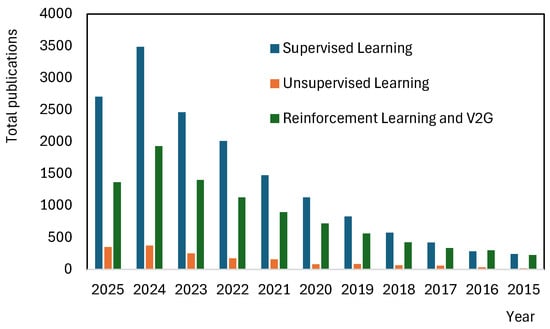
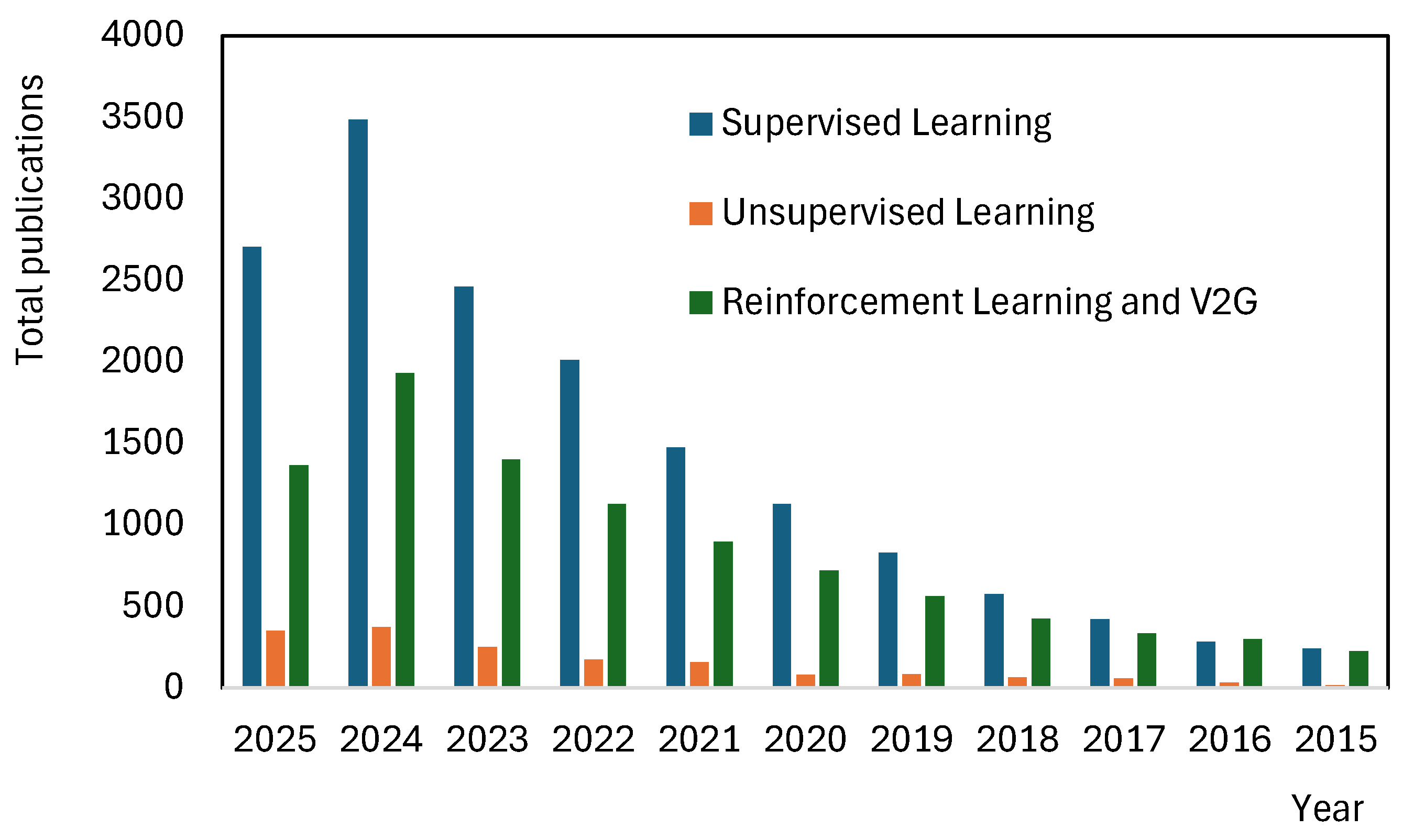
Over the past few decades, researchers have developed various methods to improve the accuracy of short-term load forecasting. These approaches use traditional techniques or, in recent years, have been increasingly incorporating DL. With the rapid progress of DL technology, intelligent algorithms have been successfully applied in various fields, especially in big data technologies. Despite the widespread use of DL models by power and energy utility companies to predict energy demand, challenges persist. Firstly, the complexity of the load series involves intricate seasonality patterns. Hourly load depends on the previous hour’s load and historical data from the same hour on previous days and weeks. Secondly, crucial exogenous variables such as weather conditions, holidays, and electricity prices impact the load demand. DL methods, which are divided into supervised, unsupervised, and RL, characterized by multiple hidden layers, effectively address these complexities and are widely employed in load forecasting, with charging strategies that surpass traditional shallow learning approaches. Figure 2 illustrates the utilization of three categories, including supervised, unsupervised, reinforcement learning, and V2G applications, based on total publications from 2015 to 2025. While this review aims to represent each learning paradigm comprehensively, the relative emphasis reflects the actual distribution of research activity, with supervised and reinforcement learning being more mature and extensively validated in EV load forecasting and control applications, whereas unsupervised learning remains comparatively nascent but promising for behavior clustering and data-driven pattern discovery; this imbalance is also influenced by the scope of the review, which focuses on light-duty passenger EVs and residential charging systems rather than large-battery fleets that require more complex spatial planning and operational scheduling frameworks. The figure clearly shows that the utilization of DL has increased gradually over the years. Supervised learning and reinforcement learning have been the most extensively used algorithms in the field of EV load forecasting and charging strategies. Unsupervised learning remains consistently low across all items, indicating a limited contribution compared to supervised learning and reinforcement learning.
Figure 2.
Trend of DL techniques in EV load forecasting, charging, and V2G over the past ten years, utilizing the Scopes database. Note: The total number of publications for 2025 is based on data from 1 January through 15 September.
Supervised learning models such as Gated Recurrent Units (GRU), Long Short-Term Memory (LSTM), and Bidirectional LSTM (BiLSTM) networks are widely used for forecasting electric loads, predicting EV charging behavior, and estimating battery State of Charge (SOC) [2,4,5,6,7,8]. These models are especially effective for time-series applications because they can capture complex temporal dependencies and nonlinear relationships [8]. GRU and LSTM are particularly effective at learning long-term dependencies in sequential data by mitigating the vanishing gradient problem, while BiLSTM processes information in both forward and backward directions to enhance prediction accuracy. A comparative study on day-ahead EV fleet load forecasting in Canada revealed that BiLSTM outperformed both GRU and LSTM models, delivering slightly higher accuracy in most cases [9]. Building upon recurrent sequence-learning architectures, emerging supervised frameworks such as Federated Learning (FL) and Physics-Informed Neural Networks (PINNs) extend model scalability and interpretability in energy forecasting. FL enables distributed model training across multiple charging stations or utilities without exchanging raw data, preserving user privacy while maintaining predictive performance across heterogeneous datasets. PINNs, in contrast, embed physical laws and energy-balance constraints directly into the learning process, ensuring physically consistent forecasts even under limited or noisy data conditions. When combined with recurrent or hybrid architectures, these methods bridge the gap between data-driven and physics-based modeling, providing greater robustness, transparency, and generalizability across diverse grid and climatic contexts. Table 1 provides an overview of recent research that employs supervised, federated, and physics-informed frameworks designed for regional load prediction or renewable energy generation. To improve usability for practitioners, detailed tabular summaries are complemented by conceptual figures (Figure 3, Figure 4, Figure 5 and Figure 6) that synthesize algorithmic roles, data flows, and decision hierarchies.
Table 1.
Summary of research on supervised, federated, and physics-informed frameworks designed for regional energy development.
Figure 3.
Unifying supervised learning framework for EV load/energy forecasting.
Figure 4.
Unifying Unsupervised Learning Framework for EV Load Forecasting and charging behavior.
Figure 5.
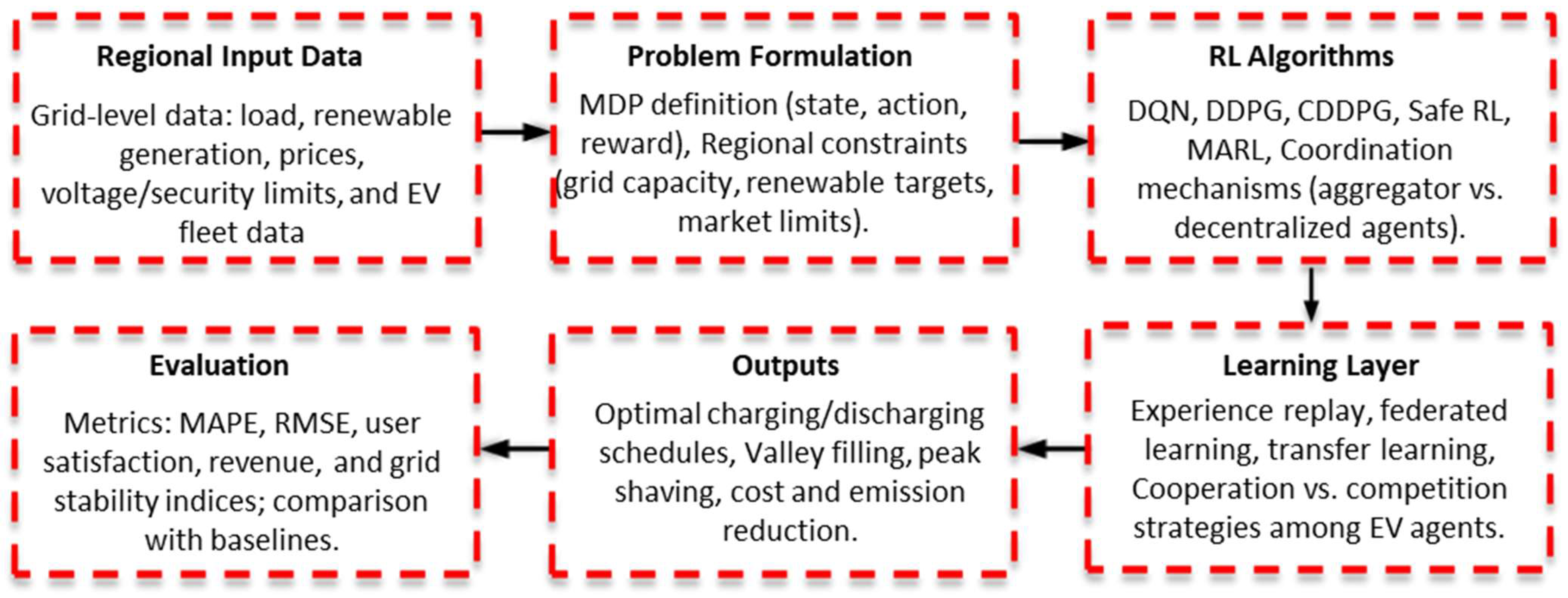
A unified RL framework for scalable fleet-level EV charging management at the regional level.
Figure 6.
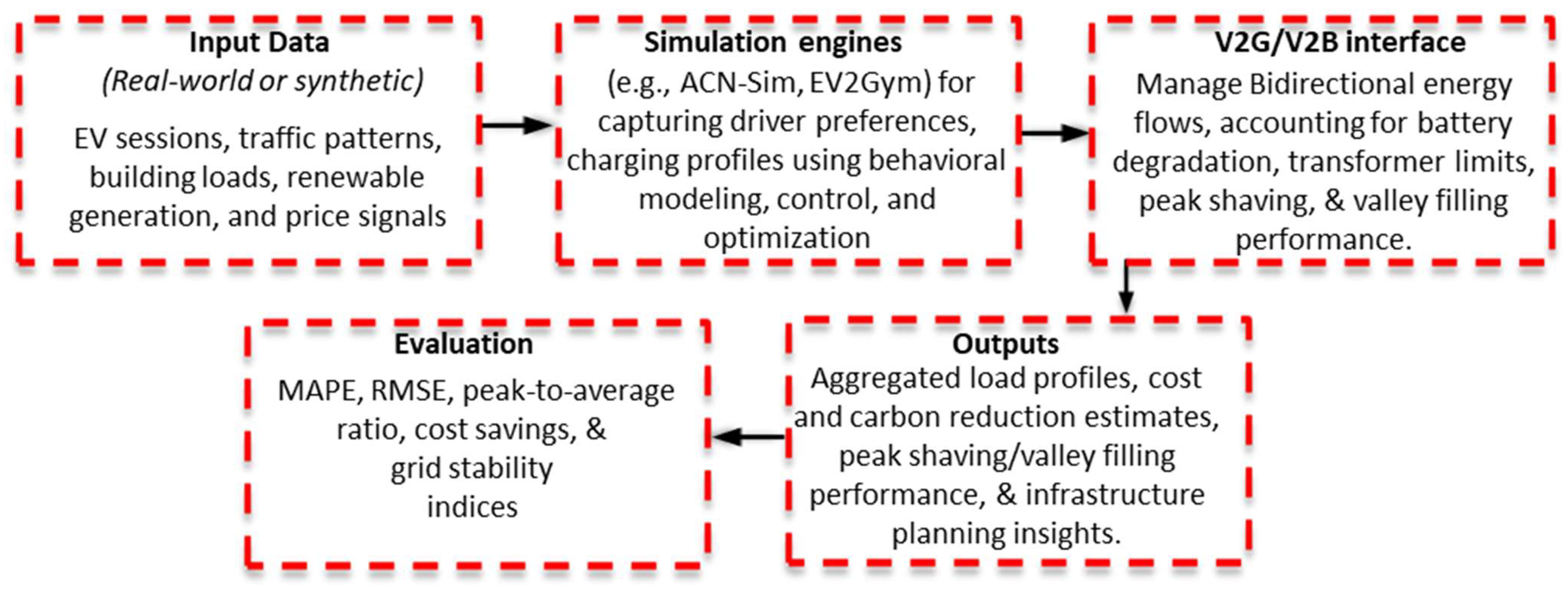
A unified framework for V2G and V2B simulators.
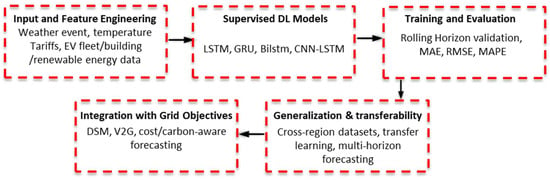
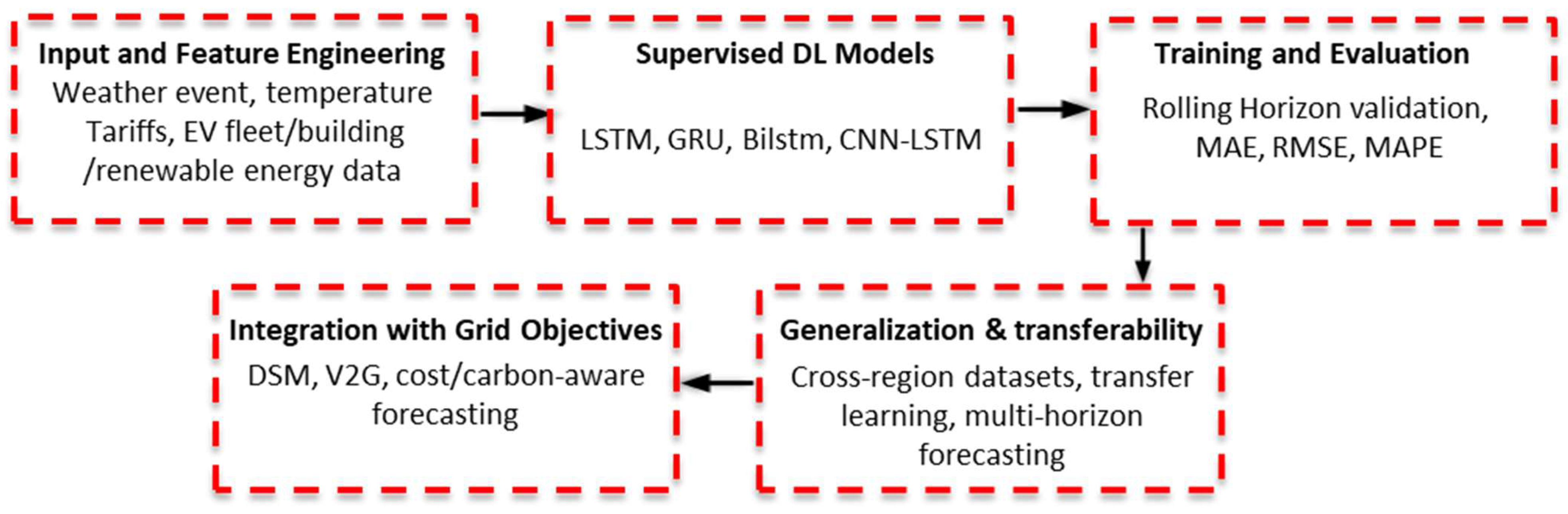
The conceptual flowchart of the unifying supervised learning framework for EV load forecasting illustrates a streamlined pipeline beginning with input and feature engineering, where diverse datasets (e.g., charging sessions, weather, tariffs, and fleet composition) are standardized and refined through supervised feature selection. These inputs are passed to supervised deep learning models such as LSTM, GRU, Bi-LSTM, CNN–LSTM hybrids, attention-based architectures, and transformer models, which form the methodological core of the framework. The flow then advances to training and evaluation, employing rolling horizon validation and standardized error metrics (MAE, RMSE, and MAPE) to ensure reproducibility and comparability. To extend applicability, the framework incorporates generalization and transferability, enabling cross-regional forecasting, transfer learning, and multi-horizon prediction. Finally, the flowchart concludes with integration into grid objectives, where supervised forecasts are linked to demand-side management, vehicle-to-grid (V2G) optimization, and scheduling, ensuring that methodological advances directly support practical energy system planning and sustainability goals (Figure 3).
Unsupervised learning is a type of machine learning in which the algorithm learns from unlabeled data without specific guidance or supervision. Unlike supervised learning, where the model is trained using labeled examples (input–output pairs), unsupervised learning operates on data without explicit target values. It helps to discover patterns, relationships, and structures within the data without relying on labeled outputs. There is limited literature reviewing the use of unsupervised learning to cluster EV charging behaviors and improve EV load management. Recent studies have also integrated explainable deep learning (XDL) techniques with unsupervised frameworks to improve interpretability—revealing which features or behavioral patterns most influence clustering outcomes, and supporting transparent, data-driven decision-making in energy performance. Table 2 summarizes research on unsupervised and explainable DL models developed for regional load development.
Table 2.
Summary of research on unsupervised and explainable deep learning models for regional energy development.
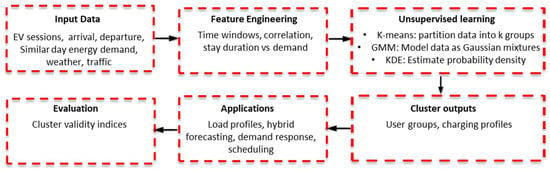
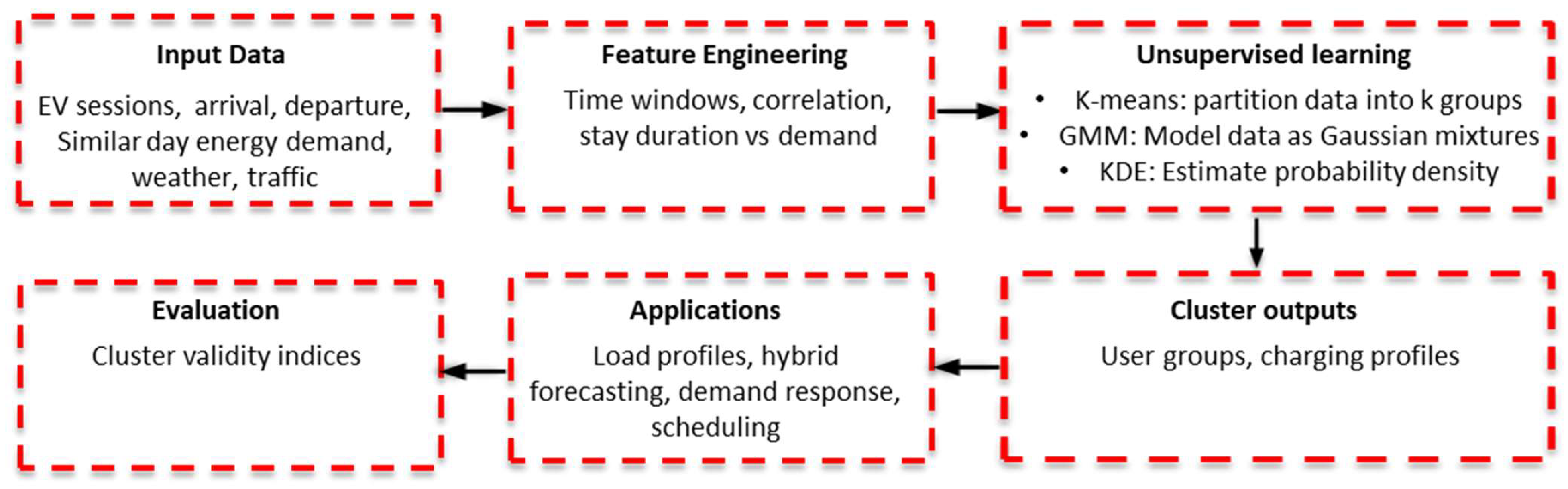
The unifying framework for unsupervised learning in EV load forecasting and charging behavior analysis emphasizes clustering and pattern discovery as a foundation for forecasting and control. Historical charging data are transformed into feature vectors that include session timing, stay duration, energy demand, similar day selection, and contextual variables such as weather or traffic. Clustering methods such as K-means (fixed partitions), Gaussian Mixture Models (GMMs) (probabilistic groupings), and Kernel Density Estimation (KDE) (continuous density estimation) are applied to uncover hidden patterns and group sessions into homogeneous categories. These clusters provide representative load profiles that enhance hybrid forecasting models, support demand response scheduling, and guide infrastructure planning. Evaluation relies on validity indices alongside improvements in downstream forecasting and scheduling. Despite sensitivities to feature choice, cluster numbers, and regional transferability, the framework offers a robust and scalable means of incorporating behavioral heterogeneity into EV-grid interaction studies (Figure 4).
Reinforcement Learning (RL) is a deep learning approach where an agent learns to make decisions by interacting with an environment and receiving feedback through rewards or penalties [39]. RL has been widely applied in EV fleet management for tasks such as vehicle dispatching, smart scheduling, and coordinated charging. In smart charging applications, Q-learning helps optimize decisions related to cost minimization, grid constraints, and user preferences, and has also been used to enhance user privacy [40]. However, its effectiveness diminishes in complex, high-dimensional scenarios. To address this, Deep Q-Networks (DQN) use deep neural networks to enable scalable and intelligent decision-making [41,42]. Double DQN further improves reliability by reducing the overestimation of Q-values, enhancing stability in uncertain environments [43]. Markov Decision Processes (MDP) offer a mathematical foundation for modeling sequential charging decisions under constraints, while Kernel Density Estimation (KDE) supports a non-parametric prediction of charging demand distributions, improving load forecasting and scheduling. Together, these methods support efficient, flexible, and user-centric charging strategies. Table 3 summarizes recent RL-based models for regional-scale EV fleet management.
Table 3.
Summary of research on model developments using reinforcement learning for a scalable fleet of EVs on the regional level.
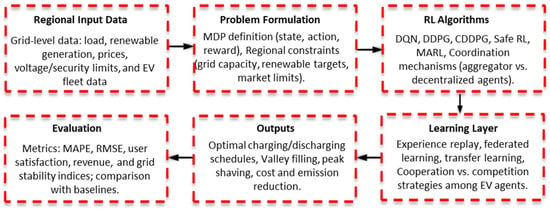
A unifying reinforcement learning framework for scalable fleet-level EV charging at the regional level integrates decentralized decision-making with centralized coordination to balance grid stability, user satisfaction, and economic efficiency. At its core, the framework models EV charging as an MDP, where each EV or charging station acts as an agent interacting with a dynamic environment shaped by electricity prices, renewable availability, and grid constraints. Deep RL algorithms—such as DQN, DDPG, and constrained RL—are employed to learn adaptive charging and discharging policies under uncertainty. To ensure scalability, MARL allows agents to learn cooperative or competitive strategies, while an aggregator coordinates global objectives such as peak shaving, valley filling, and cost reduction. Regionally, the framework incorporates transfer learning and federated RL so models trained in one city or utility region can generalize across heterogeneous grids. Finally, integration with DSOs enables RL outcomes to align with broader system objectives, including renewable integration, voltage regulation, and carbon reduction. While promising, challenges remain in handling communication delays, ensuring robustness against market feedback loops, and addressing the computational complexity of large-scale training.
Vehicle-To-Grid (V2G)/Vehicle-to-Building (V2B) is a system in which plug-in EVs sell demand response services to the grid. V2G/V2B-Simulator is a tool that models individual EV usage and aggregates large numbers of simulated vehicles to produce grid-scale predictions of the impacts and opportunities from vehicle-grid integration [52]. Most V2G/V2B simulators employ the RL approach to learn the optimal sequential charging and discharging decisions that minimize charging costs for individual users and reduce peak demand. Table 4 summarizes research on scalable V2G/V2B simulators for the load demand response of an EV fleet.
Table 4.
Summary of research on V2G/V2B simulators for EV charging behaviors and load demand response of an EV fleet.
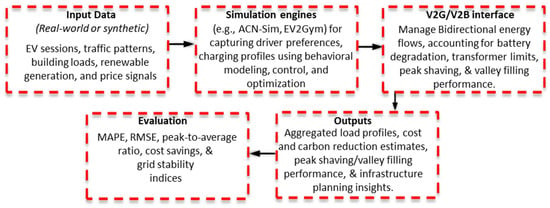
A unifying framework for V2G and V2B simulators integrates EV charging behavior, grid interaction, and demand response strategies into a modular and scalable environment (Figure 6). The framework begins with real-world or synthetic input data (EV sessions, traffic patterns, building loads, renewable generation, and price signals). These inputs feed into simulation engines (e.g., ACN-Sim, EV2Gym) that model EVSE infrastructure, grid constraints, and user heterogeneity. A behavioral modeling layer captures driver preferences, charging profiles, and probabilistic methods (e.g., KDE, GMM), while control and optimization modules apply algorithms such as MPC, heuristic scheduling, or RL (DQN, DDPG, MARL). The V2G/V2B interface manages bidirectional energy flows, accounting for battery degradation, transformer limits, and building demand response needs. Outputs include aggregated load profiles, cost and carbon reduction estimates, peak shaving/valley filling performance, and infrastructure planning insights. Finally, an evaluation layer validates results against benchmarks using metrics such as MAPE, RMSE, peak-to-average ratio, cost savings, and grid stability indices. This integrated framework enables researchers and operators to compare algorithms, optimize demand response, and assess long-term system impacts at both the building and regional levels.
Several traditional methods are used to estimate the regional energy demand of an EV fleet. These include the mixed-integer linear optimization model, the Monte Carlo method, probabilistic forecasts, and the empirical method (Table 5). While these techniques can support utilities in system planning and forecasting EV charging demand, they exhibit notable limitations in dynamic and data-rich environments. Specifically, traditional models often struggle to capture the nonlinear relationships and non-stationary behavior inherent in EV charging patterns, which can lead to significant deviations from actual demand. Moreover, they tend to underutilize detailed fleet-level characteristics and the influence of exogenous factors like weather conditions. In many cases, they also rely on simplified assumptions about user behavior (e.g., fixed travel routines, constant charging rates) and region-specific data that may not generalize across diverse markets. As EV adoption accelerates and usage patterns become increasingly diverse and uncertain, these limitations reduce the predictive accuracy and flexibility of conventional approaches, highlighting the need for more adaptive, data-driven forecasting frameworks.
Table 5.
Summary of research on traditional methods for regional energy development.
Beyond architectural descriptions, the performance of DL architectures such as LSTM, GRU, and BiLSTM depends heavily on training complexity, hyperparameter sensitivity, and computational scalability—challenges that become pronounced when dealing with large EV–renewable datasets combining high-resolution charging, mobility, and renewable generation data. These recurrent networks require careful tuning of hidden layers, learning rates, and sequence lengths to maintain stable convergence under non-stationary temporal dynamics and heterogeneous spatial inputs. For large-scale datasets, LSTM and BiLSTM models require significant computational resources due to their long-term memory retention and, in the case of BiLSTM, bidirectional processing. In contrast, GRUs achieve faster convergence with lower computational overhead, though sometimes at the expense of reduced temporal modeling depth. In RL applications, scalability is further limited by reliance on synthetic datasets, uniform battery-capacity assumptions, and simplified communication topologies that ignore latency, network congestion, and interoperability across heterogeneous chargers and grid interfaces. These limitations underscore the need for benchmark-scale hybrid frameworks capable of efficiently training on large EV–renewable datasets while integrating real-world variability, system coupling, and multi-agent coordination for more robust and transferable energy management solutions.
4. EV Overnight and Workplace Charging Strategy in the Residential Sector
Over the past few years, scientists have proposed various solutions, including overnight charging, workplace charging, or a combination of these two approaches, to alleviate the increase in peak electricity consumption, reduce the need for network upgrades, and ultimately benefit the consumer [66,75]. Future EV charging strategies, if uncontrolled, may lead to service transformer overloading or voltage violations. According to Cell Reports Physical Science, EV charging can reduce peak electricity demand and store solar energy if managed properly [75]. The study suggests that delayed home and workplace charging are effective strategies to achieve these benefits. Traditional TOU and critical peak pricing schemes were evaluated in residential buildings to explore how price signals could alter consumption patterns [76]. They found evidence of a remarkable time-shifting of charging among 62 households with a PEV based on time-of-use tariffs. The energy consumed by PEV charging during the nighttime increased from 32 percent prior to the pricing experiment to 55 percent during the months with TOU pricing.
Workplace charging can support drivers with long commutes or limited home charging access, while also aligning EV demand with periods of high renewable generation, thus reducing curtailment. Compared to home-dominant strategies, workplace charging can lower evening peaks by offsetting residential demand. Although EV charging strategies are widely studied, load modeling often relies on statistical methods. Recently, ML approaches have emerged to predict load and optimize charging, particularly for reducing peak demand. Table 6 shows a collection of studies focused on overnight and workplace EV charging in residential buildings.
Table 6.
Summary of research on model developments for EV overnight and workplace charging strategies.
Across the above studies, model performance depends strongly on context, data richness, and behavioral realism. Simulation and optimization models (e.g., [78,81]) perform well in controlled settings; however, their assumptions limit their applicability when user heterogeneity and uncertainty are high. Probabilistic and stochastic models (e.g., [77,83]) capture variability more effectively, although they require extensive input data and often overestimate infrastructure needs. Machine learning and hybrid forecasting approaches (e.g., [84]) excel in data-rich environments, offering improved predictive accuracy and enabling adaptive charging strategies that reduce peaks and costs. Region- and season-specific strategies (e.g., [66]) demonstrate that contextual factors such as climate, urban environment, and charging culture significantly influence outcomes, highlighting the need for adaptive frameworks tailored to local conditions.
To connect the diverse methodologies reviewed above, this study introduces a unifying conceptual framework (Figure 3, Figure 4, Figure 5 and Figure 6) that organizes the reviewed approaches into a hierarchical, multi-layered architecture linking forecasting, optimization, and policy coupling. The framework captures how supervised, unsupervised, and reinforcement learning models—together with V2G/V2B simulations—interact across stages of data acquisition, feature extraction, model development, optimization-based control, and evaluation.
Forecasting defines predictive baselines for load, renewable generation, and user behavior; optimization transforms these forecasts into real-time scheduling and control decisions; and policy coupling ensures alignment with regulatory, economic, and social objectives. Collectively, these layers illustrate how deep learning–based forecasting integrates with optimization-driven coordination to enable hierarchical decision-making across building, transport, and grid domains. This framework provides the conceptual foundation for the comparative and critical synthesis presented in Section 5.
5. Integrated Frameworks for EVs, Renewable-Buildings Energy Systems: Towards Decarbonization Pathways and Smart Energy Management
Section 5 presents a critical synthesis of integrated frameworks that connect EVs, RE, energy storage, and thermal systems within residential buildings to advance decarbonization and intelligent energy management. Building on the forecasting and control concepts discussed in previous sections, this part examines how data-driven, hybrid, and optimization-based models interact across the domains of prediction, scheduling, and system coupling. The analysis highlights that forecasting accuracy and energy management efficiency are jointly determined by data richness, spatial–temporal granularity, and the depth of cross-domain integration—demonstrating how hybrid learning and coordinated control can accelerate the transition toward low-carbon, grid-interactive neighborhoods.
Integrating EV charging infrastructure with RESs in residential buildings is increasingly recognized as a cornerstone of sustainable energy management. Expanding upon the analytical framework outlined at the end of the previous section, the reviewed studies demonstrate that hybrid and optimization-based approaches—which combine forecasting accuracy with adaptive control—consistently outperform single-model frameworks in addressing the variability of EV charging demand, renewable generation, and electrified building loads. This convergence underscores the importance of linking predictive accuracy with operational scheduling and real-time coordination across data, storage, and control layers. As illustrated in Figure 3, Figure 4, Figure 5 and Figure 6, coordinated and hybrid strategies not only enhance system efficiency and resilience but also deliver measurable benefits in cost reduction, peak shaving, and renewable integration, while highlighting ongoing challenges of scalability, behavioral diversity, and regional generalizability.
Table 7 extends this synthesis by consolidating research on the multi-domain integration of EVs, RESs, heat pumps, and energy storage in residential and community-scale infrastructures. These studies collectively explore all-electric residential systems, community energy solutions, and the coupling of EVs with public and institutional building energy systems, emphasizing coordinated operation and optimization of flexible loads. These investigations span several European countries, with a primary focus on minimizing operational costs, reducing CO2 emissions, and enhancing the overall efficiency and sustainability of energy systems.
Innovations in this field leverage ML-based optimization and hybrid control frameworks to enhance the coordination of EVs, photovoltaic generation, and thermal and electricity energy storage, thereby enabling greater demand flexibility and renewable penetration. Together, these integrated approaches demonstrate that coupling predictive analytics with coordinated control provides a scalable pathway for residential decarbonization while ensuring grid stability and occupant comfort. A key insight emerging from the reviewed studies is the geographic imbalance in analytical depth and data coverage. While most hybrid forecasting and energy management frameworks are validated in data-rich regions such as Europe and East Asia, research from Africa and Latin America remains underrepresented due to constrained data access and uneven research funding. This disparity limits the transferability of forecasting models and policy recommendations to emerging markets, where grid dynamics, renewable variability, and user behaviors differ markedly. Strengthening regional data infrastructure and funding partnerships is therefore critical to scaling EV-renewable integration in the Global South and ensuring equitable decarbonization pathways.
Table 7.
Summary of research on integrating EV charging infrastructure with RESs in residential buildings.
The reviewed studies (published between 2014–2023) on integrating EV charging infrastructure with RESs in residential buildings consistently show that coordinated and optimization-based models consistently outperform uncoordinated or static approaches, improving grid stability, cost reduction, and renewable integration. Early works (e.g., [101,104]) highlight the risks of unmanaged charging, with increased peak demand and localized grid stress, though pilot projects confirm that smart charging can be implemented while maintaining user satisfaction. More advanced hybrid and optimization approaches (e.g., [102,103,109]) demonstrate strong performance in forecasting and minimizing technical losses, but simplified assumptions about user behavior and uniform adoption patterns limit their effectiveness. More recent scenario-based and field-tested studies (e.g., [85,86,88]) emphasize local context, renewable integration, and emissions reductions, though they often rely on geographic- and policy-specific assumptions. Tool-based and review works (e.g., [87,108]) broaden the discussion but lack empirical validation.
Across the reviewed studies, methodological success depends on data richness, temporal granularity, and system coupling depth. Supervised approaches (e.g., LSTM, BiLSTM, GRU) achieve high forecasting accuracy under well-structured datasets but degrade under sparse or noisy conditions. Their performance further weakens when spatial planning of charging infrastructure and operational scheduling are not co-optimized with renewable generation or grid constraints, limiting real-world scalability. In contrast, hybrid frameworks combining unsupervised clustering (e.g., K-means, GMM) and RL control achieve greater adaptability by linking predictive accuracy with dynamic scheduling and multi-domain coordination. As illustrated in Figure 3, Figure 4, Figure 5 and Figure 6, the unifying conceptual framework organizes these methodologies into a hierarchical architecture connecting forecasting, optimization, and policy coupling layers. This structure bridges spatial siting, temporal scheduling, and regulatory integration across building, transport, and grid systems, enabling scalable and context-aware energy management.
Despite algorithmic progress, real-world deployment remains constrained by practical barriers: data privacy regulations restrict access to high-resolution mobility and consumption records; interoperability issues across charging standards and data formats hinder integration; and computational demands limit large-scale hybrid and RL applications. Furthermore, model interpretability and regulatory acceptance remain persistent challenges. Embedding explainable AI, privacy-preserving learning (e.g., federated learning), and open benchmarking datasets can accelerate the translation from simulation to real-world deployment.
Overall, the synthesis of reviewed studies demonstrates that integrating data-driven forecasting with coordinated spatial planning and operational scheduling yields the most resilient and cost-effective pathways for EV–renewable–building energy systems. Hybrid and context-aware approaches enhance predictive accuracy, adaptability, and interoperability across technical, behavioral, and regulatory dimensions. To operationalize these advances, policymakers and utilities should promote standardized data-sharing protocols, interoperable communication frameworks, and transparent benchmarking tools to ensure replicable, secure, and equitable deployment.
6. Conclusions
DL has become an essential tool for predicting EV charging demand, building loads, and RE generation at scale, as well as for managing energy in residential communities. This review critically examined DL and hybrid optimization approaches for forecasting, control, and the integration of EVs with RESs in residential and community contexts. Supervised models such as LSTM, BiLSTM, and GRU achieve high forecasting accuracy under structured datasets but are sensitive to data quality, temporal resolution, and exogenous variability. Hybrid architectures that integrate supervised, unsupervised, and reinforcement learning consistently outperform single-model approaches by coupling predictive precision with adaptive control. When combined with spatial planning and real-time operational strategies that account for renewable variability and grid constraints, these systems enhance forecasting reliability, operational efficiency, and overall energy system resilience.
As detailed in Section 5, the proposed unifying conceptual framework links forecasting, optimization, and policy coupling within a hierarchical architecture, enabling coordinated decision-making across building, transport, and grid layers. By integrating predictive modeling with optimization-based control and regulatory alignment, the framework provides a scalable pathway for real-world EV–renewable–building energy systems.
Although DL and hybrid optimization frameworks have demonstrated high predictive accuracy and adaptability, their large-scale deployment remains constrained by data privacy regulations, interoperability among heterogeneous systems, and computational resource requirements. Embedding explainable AI modules, federated learning, and open benchmarking datasets will be essential to ensure transparent, secure, and reproducible implementation in real-world energy systems. Moreover, coordinated policy action—through standardized data-sharing protocols, interoperable communication infrastructures, and incentive-based regulatory mechanisms—will accelerate technology adoption and ensure equitable access to smart charging and renewable integration solutions.
To make these approaches actionable, application-specific strategies should combine rich data acquisition, targeted model optimization, and deliberate cross-domain integration. Detailed EV session logs, traffic flows, household load data, and renewable output forecasts should be systematically collected to capture temporal, spatial, and behavioral heterogeneity. These datasets can then inform optimized forecasting and control pipelines, where supervised DL captures short-term variability, unsupervised clustering reveals user archetypes, and RL or MPC balances grid and user objectives under operational constraints. Cross-domain integration of transport, building, and grid models—augmented by robust optimization heuristics and demand-response mechanisms—ensures that EV charging, local renewables, and household flexibility are co-optimized. Collectively, these strategies operationalize the hierarchical framework linking forecasting, optimization, and policy coupling, enabling scalable, context-aware, and resilient energy management across residential and community systems.
7. Future Work and Policy Pathways
The findings of this review indicate that continued exploration is needed to enhance the sustainability and resilience of integrated energy systems through the combined use of DL, EV integration, and community-based RE solutions. While this study advances understanding of how EVs and RESs can be integrated into community grids, several methodological and implementation challenges remain. A key limitation is the availability and quality of high-resolution data, particularly for EVs equipped with large-capacity batteries and 20 kW chargers, since accurate DL training requires extensive datasets often restricted by privacy concerns in residential communities. DL models can also be computationally demanding, making real-time control and deployment in community-scale systems challenging without adequate computational resources. Additionally, interoperability with diverse EV models, charging hardware, and legacy grid systems must be addressed to ensure operational stability amid renewable generation and demand uncertainty.
Future research should prioritize comprehensive cluster analyses to better characterize residential charging behaviors and load profiles, particularly for next-generation EVs with higher power capacity. Applying advanced RL to EV scheduling can further enhance smart charging coordination under dynamic grid conditions while maintaining user convenience. Expanding model training to include field data, regional climate influences, and stochastic renewable fluctuations will improve robustness and adaptability for practical deployment. Post-processing tools such as global sensitivity analysis should also be explored to improve interpretability and provide greater transparency in model decision-making, thereby strengthening trust in DL-based forecasting and control frameworks.
Moreover, future studies should address regional and climatic diversity—especially the underrepresentation of cold weather contexts such as Canada—by developing climate-specific models and integrating complementary technologies such as thermal energy storage, building envelope retrofits, and cold-climate heat pumps within unified optimization frameworks. Beyond the residential context, future research should extend the proposed analytical framework to large-battery fleets such as electric buses and heavy-duty vehicles, which operate across multiple public charging depots and introduce additional challenges in spatial planning, power allocation, and grid coordination. Developing integrated deep learning and optimization models for these large-scale systems will be essential to support regional infrastructure planning, operational scheduling, and renewable energy alignment at the city and corridor levels. Policymakers and utilities can accelerate adoption by supporting standardized data-sharing protocols, interoperable communication infrastructures, and transparent benchmarking tools. Coordinated research across technical, behavioral, and regulatory domains will be vital to achieving scalable, equitable, and carbon-neutral energy communities where predictive accuracy, operational flexibility, and societal trust co-evolve.
Author Contributions
Conceptualization, A.M.; methodology, A.M.; formal analysis, A.M.; investigation, A.M.; writing—original draft preparation, A.M.; writing—review and editing, A.M., C.M. and E.E. All authors have read and agreed to the published version of the manuscript.
Funding
This research is financially supported by Natural Resources Canada, the Program of Energy Research and Development under grant CEO-23-108.
Data Availability Statement
Data is contained within the article.
Acknowledgments
The authors would like to thank the Office of Energy Research and Development (OERD) of Natural Resources Canada for their valuable financial support.
Conflicts of Interest
The authors declare no conflicts of interest.
Abbreviations
The following abbreviations are used in this manuscript:
| EVs | Electric Vehicles |
| EVSE | Electric Vehicle Supply Equipment |
| EMS | Energy Management System |
| PEVs | Plug-in EVs |
| STLF | Short-Term Load Forecasting |
| SD | Similar Day |
| AI | Artificial Intelligence |
| ML | Machine Learning |
| DL | Deep Learning |
| DQN | Deep Q-learning approach |
| RL | Reinforcement Learning |
| ACN-Sim | Adaptive Charging Network Simulator |
| ANN-DATA | Alternative Network Node Dataset |
| VARIMA | Vector Auto Regressive Moving Average |
| LNS | Large Neighborhood Search |
| RNN | Recurrent Neural Network |
| LSTM | Long Short-Term Memory |
| BiLSTM | Bidirectional LSTM |
| GRU | Gated Recurrent Units |
| XGB | Extreme Gradient Boosting |
| SCADA | Supervisory Control and Data Acquisition |
| VMD | Variational Mode Decomposition |
| EMD | Empirical Mode Decomposition |
| CEEMDAN | Ensemble EMD with Adaptive Noise |
| RMSE | Root Mean Square Error |
| MAE | Mean Absolute Error |
| MAPE | Mean Absolute Percentage Error |
| NMAE | Normalized Mean Absolute Error |
| PAR | Peak-to-Average Ratio |
| GMM | Gaussian Mixture Model |
| KDE | Kernel Density Estimation |
| MPC | Model Predictive Control |
| RESs | Renewable Energy Sources |
| PV | Photovoltaic |
| V2G | Vehicle-to-Grid |
| V2B | Vehicle-to-Building |
| SOC | State Of Charge |
| TOU | Time of Use |
| PINN | Physics-Informed Neural Network |
| XDL | Explainable Deep Learning |
| FMGCN | Federated Meta Graph Convolutional Network |
References
- IEA Executive Summary—Global EV Outlook 2025—Analysis. Available online: https://www.iea.org/reports/global-ev-outlook-2025/executive-summary (accessed on 17 July 2025).
- Luthander, R.; Widén, J.; Nilsson, D.; Palm, J. Photovoltaic Self-Consumption in Buildings: A Review. Appl. Energy 2015, 142, 80–94. [Google Scholar] [CrossRef] [Scilit]
- Hernandez-Matheus, A.; Löschenbrand, M.; Berg, K.; Fuchs, I.; Aragüés-Peñalba, M.; Bullich-Massagué, E.; Sumper, A. A Systematic Review of Machine Learning Techniques Related to Local Energy Communities. Renew. Sustain. Energy Rev. 2022, 170, 112651. [Google Scholar] [CrossRef] [Scilit]
- Bouktif, S.; Fiaz, A.; Ouni, A.; Serhani, M. Optimal Deep Learning LSTM Model for Electric Load Forecasting Using Feature Selection and Genetic Algorithm: Comparison with Machine Learning Approaches. Energies 2018, 11, 1636. [Google Scholar] [CrossRef] [Scilit]
- Wu, L.; Kong, C.; Hao, X.; Chen, W. A Short-Term Load Forecasting Method Based on GRU-CNN Hybrid Neural Network Model. Math. Probl. Eng. 2020, 2020, 1428104. [Google Scholar] [CrossRef] [Scilit]
- Guo, H.; Chen, L.; Wang, Z.; Li, L. Day-Ahead Prediction of Electric Vehicle Charging Demand Based on Quadratic Decomposition and Dual Attention Mechanisms. Appl. Energy 2025, 381, 125198. [Google Scholar] [CrossRef] [Scilit]
- Huang, Z.; Yang, F.; Xu, F.; Song, X.; Tsui, K.-L. Convolutional Gated Recurrent Unit–Recurrent Neural Network for State-of-Charge Estimation of Lithium-Ion Batteries. IEEE Access 2019, 7, 93139–93149. [Google Scholar] [CrossRef] [Scilit]
- Zheng, H.; Yuan, J.; Chen, L. Short-Term Load Forecasting Using EMD-LSTM Neural Networks with a Xgboost Algorithm for Feature Importance Evaluation. Energies 2017, 10, 1168. [Google Scholar] [CrossRef] [Scilit]
- Mohsenimanesh, A.; Entchev, E.; Lapouchnian, A.; Ribberink, H. A Comparative Study of Deep Learning Approaches for Day-Ahead Load Forecasting of an Electric Car Fleet. In Database and Expert Systems Applications—DEXA 2021 Workshops; Kotsis, G., Tjoa, A.M., Khalil, I., Moser, B., Mashkoor, A., Sametinger, J., Fensel, A., Martinez-Gil, J., Fischer, L., Czech, G., et al., Eds.; Springer International Publishing: Cham, Switzerland, 2021; Volume 1479, pp. 239–249. ISBN 978-3-030-87100-0. [Google Scholar]
- Wang, Q.; Yang, X.; Yu, X.; Yun, J.; Zhang, J. Electric Vehicle Participation in Regional Grid Demand Response: Potential Analysis Model and Architecture Planning. Sustainability 2023, 15, 2763. [Google Scholar] [CrossRef] [Scilit]
- Wan, Z.; Li, H.; He, H.; Prokhorov, D. Model-Free Real-Time EV Charging Scheduling Based on Deep Reinforcement Learning. IEEE Trans. Smart Grid 2019, 10, 5246–5257. [Google Scholar] [CrossRef] [Scilit]
- Tang, J.; Ge, G.; Liu, J.; Yang, H. A Novel Ultra Short-Term Load Forecasting Method for Regional Electric Vehicle Charging Load Using Charging Pile Usage Degree. Energy Eng. 2023, 120, 1107–1132. [Google Scholar] [CrossRef] [Scilit]
- Mohsenimanesh, A.; Entchev, E.; Bosnjak, F. Hybrid Model Based on an SD Selection, CEEMDAN, and Deep Learning for Short-Term Load Forecasting of an Electric Vehicle Fleet. Appl. Sci. 2022, 12, 9288. [Google Scholar] [CrossRef] [Scilit]
- Eddine, M.D.; Shen, Y. A Deep Learning Based Approach for Predicting the Demand of Electric Vehicle Charge. J. Supercomput. 2022, 78, 14072–14095. [Google Scholar] [CrossRef] [Scilit]
- Tang, M.; Sheng, W.; Qiu, J.; Zhang, C.; Li, H. Short-Term Load Forecasting of Electric Vehicle Charging Stations Based on Adaptive VMD-BiLSTM. J. Ind. Manag. Optim. 2025, 21, 2107–2129. [Google Scholar] [CrossRef] [Scilit]
- Lu, Y.; Gu, J.; Xie, D.; Li, Y. Integrated Route Planning Algorithm Based on Spot Price and Classified Travel Objectives for EV Users. IEEE Access 2019, 7, 122238–122250. [Google Scholar] [CrossRef] [Scilit]
- Mouaad, B.; Farag, M.; Kawtar, B.; Tarik, K.; Malika, Z. A Deep Learning Approach for Electric Vehicle Charging Duration Prediction at Public Charging Stations: The Case of Morocco. ITM Web Conf. 2022, 43, 01024. [Google Scholar] [CrossRef] [Scilit]
- Zahedi, R.; Ghodusinejad, M.H.; Aslani, A.; Hachem-Vermette, C. Modelling Community-Scale Renewable Energy and Electric Vehicle Management for Cold-Climate Regions Using Machine Learning. Energy Strategy Rev. 2022, 43, 100930. [Google Scholar] [CrossRef] [Scilit]
- Aslam, S.; Herodotou, H.; Mohsin, S.M.; Javaid, N.; Ashraf, N.; Aslam, S. A Survey on Deep Learning Methods for Power Load and Renewable Energy Forecasting in Smart Microgrids. Renew. Sustain. Energy Rev. 2021, 144, 110992. [Google Scholar] [CrossRef] [Scilit]
- Duan, P.; Askari, M.; Hemat, K.; Ali, Z.M. Optimal Operation and Simultaneous Analysis of the Electric Transport Systems and Distributed Energy Resources in the Smart City. Sustain. Cities Soc. 2021, 75, 103306. [Google Scholar] [CrossRef] [Scilit]
- Antonopoulos, I.; Robu, V.; Couraud, B.; Kirli, D.; Norbu, S.; Kiprakis, A.; Flynn, D.; Elizondo-Gonzalez, S.; Wattam, S. Artificial Intelligence and Machine Learning Approaches to Energy Demand-Side Response: A Systematic Review. Renew. Sustain. Energy Rev. 2020, 130, 109899. [Google Scholar] [CrossRef] [Scilit]
- Almaghrebi, A.; Aljuheshi, F.; Rafaie, M.; James, K.; Alahmad, M. Data-Driven Charging Demand Prediction at Public Charging Stations Using Supervised Machine Learning Regression Methods. Energies 2020, 13, 4231. [Google Scholar] [CrossRef] [Scilit]
- Zhu, J.; Yang, Z.; Mourshed, M.; Guo, Y.; Zhou, Y.; Chang, Y.; Wei, Y.; Feng, S. Electric Vehicle Charging Load Forecasting: A Comparative Study of Deep Learning Approaches. Energies 2019, 12, 2692. [Google Scholar] [CrossRef] [Scilit]
- Zhu, J.; Yang, Z.; Guo, Y.; Zhang, J.; Yang, H. Short-Term Load Forecasting for Electric Vehicle Charging Stations Based on Deep Learning Approaches. Appl. Sci. 2019, 9, 1723. [Google Scholar] [CrossRef] [Scilit]
- Xiaoyun, Q.; Yu, J.; Ying, Z.; Wenyue, W. Short-Term Wind Power Prediction of Regions Based on Deep Long Short-Term Memory Network and Gaussian Process Regression. In Proceedings of the 2021 International Conference on Power System Technology (POWERCON), Haikou, China, 8–9 December 2021; IEEE: Piscataway, NJ, USA, 2021; pp. 916–919. [Google Scholar]
- Hafeez, A.; Alammari, R.; Iqbal, A. Utilization of EV Charging Station in Demand Side Management Using Deep Learning Method. IEEE Access 2023, 11, 8747–8760. [Google Scholar] [CrossRef] [Scilit]
- Jarvis, P.; Climent, L.; Arbelaez, A. Smart and Sustainable Scheduling of Charging Events for Electric Buses. TOP 2024, 32, 22–56. [Google Scholar] [CrossRef] [Scilit]
- Yin, W.; Ji, J. Prediction of EV Charging Load Based on Federated Learning. Energy 2025, 316, 134559. [Google Scholar] [CrossRef] [Scilit]
- Han, Q.; Li, X. A Vertical Federated Learning Method for Electric Vehicle Charging Station Load Prediction in Coupled Transportation and Power Distribution Systems. Processes 2025, 13, 468. [Google Scholar] [CrossRef] [Scilit]
- You, L.; Chen, Q.; Qu, H.; Zhu, R.; Yan, J.; Santi, P.; Ratti, C. FMGCN: Federated Meta Learning-Augmented Graph Convolutional Network for EV Charging Demand Forecasting. IEEE Internet Things J. 2024, 11, 24452–24466. [Google Scholar] [CrossRef] [Scilit]
- Rajaperumal, T.A.; Chinnappan, C.C. Integrating Data-Driven and Physics-Based Approaches for Robust Wind Power Prediction: A Comprehensive ML-PINN-Simulink Framework. Sci. Rep. 2025, 15, 29102. [Google Scholar] [CrossRef] [Scilit]
- Shekari, M.; Arasteh, H.; Vahidinasab, V. Recognition of Electric Vehicles Charging Patterns with Machine Learning Techniques. In Electric Vehicle Integration via Smart Charging; Green Energy and Technology; Springer International Publishing: Cham, Switzerland, 2022; pp. 49–83. ISBN 978-3-031-05908-7. [Google Scholar]
- Lee, H.; Park, K.; Lee, B. Unsupervised Machine Learning-Based EV Load Profile Generation for Efficient Distribution System Operation. In Proceedings of the CIRED 2021—The 26th International Conference and Exhibition on Electricity Distribution; Institution of Engineering and Technology, Online, 20–23 September 2021; pp. 2062–2068. [Google Scholar]
- Xiong, Y.; Wang, B.; Chu, C.-C.; Gadh, R. Electric Vehicle Driver Clustering Using Statistical Model and Machine Learning. In Proceedings of the 2018 IEEE Power & Energy Society General Meeting (PESGM), Portland, OR, USA, 5–10 August 2018; IEEE: Piscataway, NJ, USA, 2018; pp. 1–5. [Google Scholar]
- Anastasiadou, M.; Dos Santos, V.D.; Dias, M.S. An Explainable Deep Learning Model for Energy Performance Classification and Retrofitting Recommendations. Energy Build. 2025, 349, 116522. [Google Scholar] [CrossRef] [Scilit]
- Machado, C.A.S.; Takiya, H.; Yamamura, C.L.K.; Quintanilha, J.A.; Berssaneti, F.T. Placement of Infrastructure for Urban Electromobility: A Sustainable Approach. Sustainability 2020, 12, 6324. [Google Scholar] [CrossRef] [Scilit]
- Kene, R.O.; Olwal, T.O. Data-Driven Modeling of Electric Vehicle Charging Sessions Based on Machine Learning Techniques. World Electr. Veh. J. 2025, 16, 107. [Google Scholar] [CrossRef] [Scilit]
- Lepolesa, L.J.; Adetunji, K.E.; Ouahada, K.; Liu, Z.; Cheng, L. Optimal EV Charging Strategy for Distribution Networks Load Balancing in a Smart Grid Using Dynamic Charging Price. IEEE Access 2024, 12, 47421–47432. [Google Scholar] [CrossRef] [Scilit]
- Reinforcement Learning—Wikipedia. Available online: https://en.wikipedia.org/wiki/Reinforcement_learning (accessed on 31 January 2024).
- Najafi, S.; Shafie-khah, M.; Siano, P.; Wei, W.; Catalão, J.P.S. Reinforcement Learning Method for Plug-in Electric Vehicle Bidding. IET Smart Grid 2019, 2, 529–536. [Google Scholar] [CrossRef] [Scilit]
- Viziteu, A.; Furtună, D.; Robu, A.; Senocico, S.; Cioată, P.; Remus Baltariu, M.; Filote, C.; Răboacă, M.S. Smart Scheduling of Electric Vehicles Based on Reinforcement Learning. Sensors 2022, 22, 3718. [Google Scholar] [CrossRef] [Scilit] [PubMed]
- Chifu, V.R.; Cioara, T.; Pop, C.B.; Rusu, H.G.; Anghel, I. Deep Q-Learning-Based Smart Scheduling of EVs for Demand Response in Smart Grids. Appl. Sci. 2024, 14, 1421. [Google Scholar] [CrossRef] [Scilit]
- Ming, F.; Gao, F.; Liu, K.; Wu, J.; Xu, Z.; Li, W. Constrained Double Deep Q-Learning Network for EVs Charging Scheduling with Renewable Energy. In Proceedings of the 2020 IEEE 16th International Conference on Automation Science and Engineering (CASE), Hong Kong, China, 20–21 August 2020; IEEE: Piscataway, NJ, USA, 2020; pp. 636–641. [Google Scholar]
- Tuchnitz, F.; Ebell, N.; Schlund, J.; Pruckner, M. Development and Evaluation of a Smart Charging Strategy for an Electric Vehicle Fleet Based on Reinforcement Learning. Appl. Energy 2021, 285, 116382. [Google Scholar] [CrossRef] [Scilit]
- Zhang, F.; Yang, Q.; An, D. CDDPG: A Deep-Reinforcement-Learning-Based Approach for Electric Vehicle Charging Control. IEEE Internet Things J. 2021, 8, 3075–3087. [Google Scholar] [CrossRef] [Scilit]
- Ding, T.; Zeng, Z.; Bai, J.; Qin, B.; Yang, Y.; Shahidehpour, M. Optimal Electric Vehicle Charging Strategy with Markov Decision Process and Reinforcement Learning Technique. IEEE Trans. Ind. Appl. 2020, 56, 5811–5823. [Google Scholar] [CrossRef] [Scilit]
- Li, H.; Wan, Z.; He, H. Constrained EV Charging Scheduling Based on Safe Deep Reinforcement Learning. IEEE Trans. Smart Grid 2020, 11, 2427–2439. [Google Scholar] [CrossRef] [Scilit]
- Liu, D.; Zeng, P.; Cui, S.; Song, C. Deep Reinforcement Learning for Charging Scheduling of Electric Vehicles Considering Distribution Network Voltage Stability. Sensors 2023, 23, 1618. [Google Scholar] [CrossRef] [Scilit]
- Chis, A.; Lunden, J.; Koivunen, V. Reinforcement Learning-Based Plug-in Electric Vehicle Charging with Forecasted Price. IEEE Trans. Veh. Technol. 2016, 66, 3674–3684. [Google Scholar] [CrossRef] [Scilit]
- Vandael, S.; Claessens, B.; Ernst, D.; Holvoet, T.; Deconinck, G. Reinforcement Learning of Heuristic EV Fleet Charging in a Day-Ahead Electricity Market. IEEE Trans. Smart Grid 2015, 6, 1795–1805. [Google Scholar] [CrossRef] [Scilit]
- Lee, J.; Lee, E.; Kim, J. Electric Vehicle Charging and Discharging Algorithm Based on Reinforcement Learning with Data-Driven Approach in Dynamic Pricing Scheme. Energies 2020, 13, 1950. [Google Scholar] [CrossRef] [Scilit]
- Mohseni, S.; Brent, A.C. Vehicle-to-Grid Demand Response Can Lead the Way for Decarbonizing City Fleets. Available online: https://smartcities.ieee.org/newsletter/november-2021/vehicle-to-grid-demand-response-can-lead-the-way-for-decarbonizing-city-fleets (accessed on 19 January 2024).
- Orfanoudakis, S.; Diaz-Londono, C.; Emre Yılmaz, Y.; Palensky, P.; Vergara, P.P. EV2Gym: A Flexible V2G Simulator for EV Smart Charging Research and Benchmarking. IEEE Trans. Intell. Transp. Syst. 2025, 26, 2410–2421. [Google Scholar] [CrossRef] [Scilit]
- Liu, F.; Sen, R.; Talusan, J.P.; Pettet, A.; Kandel, A.; Suzue, Y.; Mukhopadhyay, A.; Dubey, A. Reinforcement Learning-Based Approach for Vehicle-to-Building Charging with Heterogeneous Agents and Long Term Rewards. arXiv 2025, arXiv:2502.18526. [Google Scholar]
- Maldonato, F. Reinforcement Learning Control Strategies for Electric Vehicles and Renewable Energy Sources Virtual Power Plants, Technische Universität Berlin. arXiv 2024, arXiv:2405.01889. [Google Scholar]
- Wu, Z.; Manne, N.N.; Harper, J.; Chen, B.; Dobrzynski, D. A Cloud-Based Simulation and Testing Framework for Large-Scale EV Charging Energy Management and Charging Control. SAE Int. J. Adv. Curr. Prac. Mobil. 2022, 4, 1492–1500. [Google Scholar] [CrossRef] [Scilit]
- Greenblatt, J.; Zhang, C.; Saxena, S. Quantifying the Potential of Electric Vehicles to Provide Electric Grid Benefits in the MISO Area; Lawrence Berkeley National Laboratory: Berkeley, CA, USA, 2019.
- Canizes, B.; Soares, J.; Costa, A.; Pinto, T.; Lezama, F.; Novais, P.; Vale, Z. Electric Vehicles’ User Charging Behaviour Simulator for a Smart City. Energies 2019, 12, 1470. [Google Scholar] [CrossRef] [Scilit]
- Lee, Z.J.; Johansson, D.; Low, S.H. ACN-Sim: An Open-Source Simulator for Data-Driven Electric Vehicle Charging Research. In Proceedings of the 2019 IEEE International Conference on Communications, Control, and Computing Technologies for Smart Grids (SmartGridComm), Beijing, China, 21–23 October 2019; IEEE: Piscataway, NJ, USA, 2019; pp. 1–6. [Google Scholar]
- Kiaee, M.; Cruden, A.; Sharkh, S. Estimation of Cost Savings from Participation of Electric Vehicles in Vehicle to Grid (V2G) Schemes. J. Mod. Power Syst. Clean Energy 2015, 3, 249–258. [Google Scholar] [CrossRef] [Scilit]
- Loaiza Quintana, C.; Arbelaez, A.; Climent, L. Robust eBuses Charging Location Problem. IEEE Open J. Intell. Transp. Syst. 2022, 3, 856–871. [Google Scholar] [CrossRef] [Scilit]
- Mashhoodi, B.; Muñoz Unceta, P. Regional Allocation of EV Chargers’ Grid Load. Ann. GIS 2023, 29, 227–241. [Google Scholar] [CrossRef] [Scilit]
- Bian, H.; Guo, Z.; Zhou, C.; Peng, S. Multi-Time Scale Electric Vehicle Charging Load Forecasting Considering Constant Current Charging and Parallel Computing. Energy Rep. 2022, 8, 722–732. [Google Scholar] [CrossRef] [Scilit]
- Cai, H.; Xin, Y.; Martin, H.; Raubal, M. Optimizing Electric Vehicle Charging Schedules Based on Probabilistic Forecast of Individual Mobility. Agil. GIScience Ser. 2022, 3, 3. [Google Scholar] [CrossRef] [Scilit]
- Yang, X.; Guo, X.; Li, Y.; Yang, K. The Sequential Construction Research of Regional Public Electric Vehicle Charging Facilities Based on Data-Driven Analysis—Empirical Analysis of Shanxi Province. J. Clean. Prod. 2022, 380, 134948. [Google Scholar] [CrossRef] [Scilit]
- Cardenas, A.; Guzman, C.; Martinez, W. EV Overnight Charging Strategy in Residential Sector: Case of Winter Season in Quebec. Vehicles 2021, 3, 557–577. [Google Scholar] [CrossRef] [Scilit]
- Bian, H.; Guo, Z.; Zhou, C.; Wang, D. Regional Electric Vehicle Charging Load Forecasting and Analysis of Its Impact on the Peak-Valley Difference of the Power Grid. For. Chem. Rev. 2021, 31, 333–354. [Google Scholar]
- Buzna, L.; De Falco, P.; Ferruzzi, G.; Khormali, S.; Proto, D.; Refa, N.; Straka, M.; van der Poel, G. An Ensemble Methodology for Hierarchical Probabilistic Electric Vehicle Load Forecasting at Regular Charging Stations. Appl. Energy 2021, 283, 116337. [Google Scholar] [CrossRef] [Scilit]
- Huang, P.; Lovati, M.; Zhang, X.; Bales, C. A Coordinated Control to Improve Performance for a Building Cluster with Energy Storage, Electric Vehicles, and Energy Sharing Considered. Appl. Energy 2020, 268, 114983. [Google Scholar] [CrossRef] [Scilit]
- Niamir, L.; Filatova, T.; Voinov, A.; Bressers, H. Transition to Low-Carbon Economy: Assessing Cumulative Impacts of Individual Behavioral Changes. Energy Policy 2018, 118, 325–345. [Google Scholar] [CrossRef] [Scilit]
- Wood, E.; Raghavan, S.; Rames, C.; Eichman, J.; Melaina, M. Regional Charging Infrastructure for Plug-In Electric Vehicles: A Case Study of Massachusetts; National Renewable Energy Laboratory (NREL): Golden, CO, USA, 2017; pp. 1–33.
- Arias, M.B.; Kim, M.; Bae, S. Prediction of Electric Vehicle Charging-Power Demand in Realistic Urban Traffic Networks. Appl. Energy 2017, 195, 738–753. [Google Scholar] [CrossRef] [Scilit]
- Awasthi, A.; Venkitusamy, K.; Padmanaban, S.; Selvamuthukumaran, R.; Blaabjerg, F.; Singh, A.K. Optimal Planning of Electric Vehicle Charging Station at the Distribution System Using Hybrid Optimization Algorithm. Energy 2017, 133, 70–78. [Google Scholar] [CrossRef] [Scilit]
- Amini, M.H.; Kargarian, A.; Karabasoglu, O. ARIMA-Based Decoupled Time Series Forecasting of Electric Vehicle Charging Demand for Stochastic Power System Operation. Electr. Power Syst. Res. 2016, 140, 378–390. [Google Scholar] [CrossRef] [Scilit]
- Needell, Z.; Wei, W.; Trancik, J.E. Strategies for Beneficial Electric Vehicle Charging to Reduce Peak Electricity Demand and Store Solar Energy. Cell Rep. Phys. Sci. 2023, 4, 101287. [Google Scholar] [CrossRef] [Scilit]
- Zarnikau, J.; Zhu, S.; Russell, R.; Holloway, M.; Dittmer, M. How Will Tomorrow’s Residential Energy Consumers Respond to Price Signals? Insights from a Texas Pricing Experiment. Electr. J. 2015, 28, 57–71. [Google Scholar] [CrossRef] [Scilit]
- Liao, Y.; Tozluoğlu, Ç.; Sprei, F.; Yeh, S.; Dhamal, S. Impacts of Charging Behavior on BEV Charging Infrastructure Needs and Energy Use. Transp. Res. Part D Transp. Environ. 2023, 116, 103645. [Google Scholar] [CrossRef] [Scilit]
- Erdogan, N.; Kucuksari, S.; Murphy, J. A Multi-Objective Optimization Model for EVSE Deployment at Workplaces with Smart Charging Strategies and Scheduling Policies. Energy 2022, 254, 124161. [Google Scholar] [CrossRef] [Scilit]
- Spencer, S.I.; Fu, Z.; Apostolaki-Iosifidou, E.; Lipman, T.E. Evaluating Smart Charging Strategies Using Real-World Data from Optimized Plugin Electric Vehicles. Transp. Res. Part D Transp. Environ. 2021, 100, 103023. [Google Scholar] [CrossRef] [Scilit]
- Szinai, J.K.; Sheppard, C.J.R.; Abhyankar, N.; Gopal, A.R. Reduced Grid Operating Costs and Renewable Energy Curtailment with Electric Vehicle Charge Management. Energy Policy 2020, 136, 111051. [Google Scholar] [CrossRef] [Scilit]
- Ramos Muñoz, E.; Jabbari, F. A Decentralized, Non-Iterative Smart Protocol for Workplace Charging of Battery Electric Vehicles. Appl. Energy 2020, 272, 115187. [Google Scholar] [CrossRef] [Scilit]
- Powell, S.; Kara, E.C.; Sevlian, R.; Cezar, G.V.; Kiliccote, S.; Rajagopal, R. Controlled Workplace Charging of Electric Vehicles: The Impact of Rate Schedules on Transformer Aging. Appl. Energy 2020, 276, 115352. [Google Scholar] [CrossRef] [Scilit]
- Yunus, K.J.; Reza, M.; Zelaya- De La Parra, H.; Srivastava, K. Impacts of Stochastic Residential Plug-In Electric Vehicle Charging on Distribution Grid. In Proceedings of the 2012 IEEE PES Innovative Smart Grid Technologies (ISGT), Washington, DC, USA, 16–20 January 2012; IEEE: Piscataway, NJ, USA, 2012; pp. 1–8. [Google Scholar]
- Mohsenimanesh, A.; Entchev, E. Charging Strategies for Electric Vehicles Using a Machine Learning Load Forecasting Approach for Residential Buildings in Canada. Appl. Sci. 2024, 14, 11389. [Google Scholar] [CrossRef] [Scilit]
- Khan, S.; Sudhakar, K.; Bin Yusof, M.H. Building Integrated Photovoltaics Powered Electric Vehicle Charging with Energy Storage for Residential Building: Design, Simulation, and Assessment. J. Energy Storage 2023, 63, 107050. [Google Scholar] [CrossRef] [Scilit]
- Ramsebner, J.; Hiesl, A.; Haas, R.; Auer, H.; Ajanovic, A.; Mayrhofer, G.; Reinhardt, A.; Wimmer, A.; Ferchhumer, E.; Mitterndorfer, B.; et al. Smart Charging Infrastructure for Battery Electric Vehicles in Multi Apartment Buildings. Smart Energy 2023, 9, 100093. [Google Scholar] [CrossRef] [Scilit]
- IEA. Electric Vehicle Charging and Grid Integration Tool. 2023. Available online: https://www.iea.org/data-and-statistics/data-tools/electric-vehicle-charging-and-grid-integration-tool (accessed on 1 March 2025).
- Dik, A.; Kutlu, C.; Omer, S.; Boukhanouf, R.; Su, Y.; Riffat, S. An Approach for Energy Management of Renewable Energy Sources Using Electric Vehicles and Heat Pumps in an Integrated Electricity Grid System. Energy Build. 2023, 294, 113261. [Google Scholar] [CrossRef] [Scilit]
- Srithapon, C.; Månsson, D. Predictive Control and Coordination for Energy Community Flexibility with Electric Vehicles, Heat Pumps and Thermal Energy Storage. Appl. Energy 2023, 347, 121500. [Google Scholar] [CrossRef] [Scilit]
- Wang, M.; Abdalla, M.A.A. Optimal Energy Scheduling Based on Jaya Algorithm for Integration of Vehicle-to-Home and Energy Storage System with Photovoltaic Generation in Smart Home. Sensors 2022, 22, 1306. [Google Scholar] [CrossRef] [Scilit]
- Jones, J.C.; Vining, W.; Lave, M.; Haines, T.; Neuman, C.; Bennett, J.; Scoffield, D.R. Impact of Electric Vehicle Customer Response to Time-of-Use Rates on Distribution Power Grids. Energy Rep. 2022, 8, 8225–8235. [Google Scholar] [CrossRef] [Scilit]
- Jones, C.B.; Lave, M.; Vining, W.; Garcia, B.M. Uncontrolled Electric Vehicle Charging Impacts on Distribution Electric Power Systems with Primarily Residential, Commercial or Industrial Loads. Energies 2021, 14, 1688. [Google Scholar] [CrossRef] [Scilit]
- Mohammed, S.S.; Titus, F.; Thanikanti, S.B.; Mohammed, S.M.; Deb, S.; Kumar, N.M. Charge Scheduling Optimization of Plug-In Electric Vehicle in a PV Powered Grid-Connected Charging Station Based on Day-Ahead Solar Energy Forecasting in Australia. Sustainability 2022, 14, 3498. [Google Scholar] [CrossRef] [Scilit]
- Anvari, M.; Proedrou, E.; Schäfer, B.; Beck, C.; Kantz, H.; Timme, M. Data-Driven Load Profiles and the Dynamics of Residential Electricity Consumption. Nat. Commun. 2022, 13, 4593. [Google Scholar] [CrossRef] [Scilit]
- Seatle, M.; Stanislaw, L.; Xu, R.; McPherson, M. Integrated Transportation, Building, and Electricity System Models to Explore Decarbonization Pathways in Regina, Saskatchewan. Front. Sustain. Cities 2021, 3, 674848. [Google Scholar] [CrossRef] [Scilit]
- Zare Oskouei, M.; Mohammadi-Ivatloo, B.; Abapour, M.; Anvari-Moghaddam, A.; Mehrjerdi, H. Practical Implementation of Residential Load Management System by Considering Vehicle-for-Power Transfer: Profit Analysis. Sustain. Cities Soc. 2020, 60, 102144. [Google Scholar] [CrossRef] [Scilit]
- Müller, M.; Biedenbach, F.; Reinhard, J. Development of an Integrated Simulation Model for Load and Mobility Profiles of Private Households. Energies 2020, 13, 3843. [Google Scholar] [CrossRef] [Scilit]
- Rafique, S.; Hossain, M.J.; Nizami, M.S.H.; Irshad, U.B.; Mukhopadhyay, S.C. Energy Management Systems for Residential Buildings with Electric Vehicles and Distributed Energy Resources. IEEE Access 2021, 9, 46997–47007. [Google Scholar] [CrossRef] [Scilit]
- Huang, P.; Lovati, M.; Zhang, X.; Bales, C.; Hallbeck, S.; Becker, A.; Bergqvist, H.; Hedberg, J.; Maturi, L. Transforming a Residential Building Cluster into Electricity Prosumers in Sweden: Optimal Design of a Coupled PV-Heat Pump-Thermal Storage-Electric Vehicle System. Appl. Energy 2019, 255, 113864. [Google Scholar] [CrossRef] [Scilit]
- Terlouw, T.; AlSkaif, T.; Bauer, C.; Van Sark, W. Optimal Energy Management in All-Electric Residential Energy Systems with Heat and Electricity Storage. Appl. Energy 2019, 254, 113580. [Google Scholar] [CrossRef] [Scilit]
- Muratori, M. Impact of Uncoordinated Plug-in Electric Vehicle Charging on Residential Power Demand. Nat Energy 2018, 3, 193–201. [Google Scholar] [CrossRef] [Scilit]
- Duan, M.; Darvishan, A.; Mohammaditab, R.; Wakil, K.; Abedinia, O. A Novel Hybrid Prediction Model for Aggregated Loads of Buildings by Considering the Electric Vehicles. Sustain. Cities Soc. 2018, 41, 205–219. [Google Scholar] [CrossRef] [Scilit]
- Mozafar, M.R.; Moradi, M.H.; Amini, M.H. A Simultaneous Approach for Optimal Allocation of Renewable Energy Sources and Electric Vehicle Charging Stations in Smart Grids Based on Improved GA-PSO Algorithm. Sustain. Cities Soc. 2017, 32, 627–637. [Google Scholar] [CrossRef] [Scilit]
- Bauman, J.; Stevens, M.B.; Hacikyan, S.; Tremblay, L.; Mallia, E.; Mendes, C.J. Residential Smart-Charging Pilot Program in Toronto: Results of a Utility Controlled Charging Pilot. World Electr. Veh. J. 2016, 8, 531–542. [Google Scholar] [CrossRef] [Scilit]
- Ramos Muñoz, E.; Razeghi, G.; Zhang, L.; Jabbari, F. Electric Vehicle Charging Algorithms for Coordination of the Grid and Distribution Transformer Levels. Energy 2016, 113, 930–942. [Google Scholar] [CrossRef] [Scilit]
- Dubey, A.; Santoso, S. Electric Vehicle Charging on Residential Distribution Systems: Impacts and Mitigations. IEEE Access 2015, 3, 1871–1893. [Google Scholar] [CrossRef] [Scilit]
- De Hoog, J.; Alpcan, T.; Brazil, M.; Thomas, D.A.; Mareels, I. Optimal Charging of Electric Vehicles Taking Distribution Network Constraints into Account. IEEE Trans. Power Syst. 2015, 30, 365–375. [Google Scholar] [CrossRef] [Scilit]
- García-Villalobos, J.; Zamora, I.; San Martín, J.I.; Asensio, F.J.; Aperribay, V. Plug-in Electric Vehicles in Electric Distribution Networks: A Review of Smart Charging Approaches. Renew. Sustain. Energy Rev. 2014, 38, 717–731. [Google Scholar] [CrossRef] [Scilit]
- Zhang, K.; Xu, L.; Ouyang, M.; Wang, H.; Lu, L.; Li, J.; Li, Z. Optimal Decentralized Valley-Filling Charging Strategy for Electric Vehicles. Energy Convers. Manag. 2014, 78, 537–550. [Google Scholar] [CrossRef] [Scilit]
- Wi, Y.-M.; Lee, J.-U.; Joo, S.-K. Electric Vehicle Charging Method for Smart Homes/Buildings with a Photovoltaic System. IEEE Trans. Consum. Electron. 2013, 59, 323–328. [Google Scholar] [CrossRef] [Scilit]
Disclaimer/Publisher’s Note: The statements, opinions and data contained in all publications are solely those of the individual author(s) and contributor(s) and not of MDPI and/or the editor(s). MDPI and/or the editor(s) disclaim responsibility for any injury to people or property resulting from any ideas, methods, instructions or products referred to in the content. |
© 2025 by the authors. Published by MDPI on behalf of the World Electric Vehicle Association. Licensee MDPI, Basel, Switzerland. This article is an open access article distributed under the terms and conditions of the Creative Commons Attribution (CC BY) license (https://creativecommons.org/licenses/by/4.0/).