
Skip Content
You are currently on the new version of our website. Access the old version .

Pharmaceutics, Volume 11, Issue 6

2019 June - 48 articles

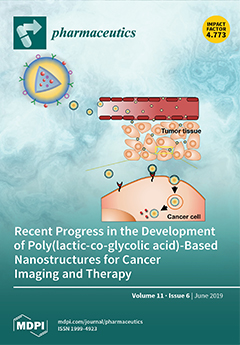
Cover Story: Poly(lactic-co-glycolic acid) (PLGA) has been widely used for biomedical applications due to its biocompatibility and biodegradability. Nanoparticles (NPs) based on PLGA and PLGA derivatives have been developed for cancer imaging and therapy after intravenous injection. Imaging modalities and therapeutic cargos can be encapsulated in PLGA-based NPs or attached onto the outer surface of NPs. In addition, tumor targeting moieties can be installed in the exterior part of PLGA-based NPs to accomplish active tumor targeting capability along with passive tumor targeting effect. Safety and versatility of PLGA-based NPs can elevate their feasibility for clinical application in cancer therapy. View this paper.
  • Issues are regarded as officially published after their release is announced to the table of contents alert mailing list .
  • You may sign up for email alerts to receive table of contents of newly released issues.
  • PDF is the official format for papers published in both, html and pdf forms. To view the papers in pdf format, click on the "PDF Full-text" link, and use the free Adobe Reader to open them.

Articles (48)

  • Article
  • Open Access
8 Citations
4,856 Views
16 Pages

β-Cyclodextrin as a Functional Excipient Used for Enhancing the Diminazene Aceturate Bioavailability

  • Narcisa Marangoci,
  • Daniel Timpu,
  • Andreia Corciova,
  • Cornelia Mircea,
  • Anca-Roxana Petrovici,
  • Alina Nicolescu,
  • Elena-Laura Ursu,
  • Valentin Nastasa,
  • Andra-Cristina Bostanaru and
  • Mariana Pinteala
  • + 2 authors

In this study, we proposed formulations of diminazene aceturate (DA) designed to improve its bioavailability and to maximize the therapeutic index in animals by overcoming the rapid degradation under the acidic pH of the stomach. An important consequ...

  • Article
  • Open Access
51 Citations
7,039 Views
21 Pages

Phytosomes with Persimmon (Diospyros kaki L.) Extract: Preparation and Preliminary Demonstration of In Vivo Tolerability

  • Rosa Direito,
  • Catarina Reis,
  • Luís Roque,
  • Margarida Gonçalves,
  • Ana Sanches-Silva,
  • Maria Manuela Gaspar,
  • Rui Pinto,
  • João Rocha,
  • Bruno Sepodes and
  • Maria Eduardo Figueira
  • + 1 author

Persimmon (Diospyros kaki L.), a fruit rich in phenolic compounds (PCs), has been considered effective in mitigating oxidative damage induced by an excess of reactive oxygen species. Due to large molecular weight and intrinsic instability in some phy...

  • Article
  • Open Access
17 Citations
5,300 Views
12 Pages

Co-delivery of D-(KLAKLAK)2 Peptide and Chlorin e6 using a Liposomal Complex for Synergistic Cancer Therapy

  • Chaemin Lim,
  • Jin Kook Kang,
  • Woong Roeck Won,
  • June Yong Park,
  • Sang Myung Han,
  • Thi ngoc Le,
  • Jae Chang Kim,
  • Jaewon Her,
  • Yuseon Shin and
  • Kyung Taek Oh

Nanotechnology-based photo-chemo combination therapy has been extensively investigated to improve therapeutic outcomes in anticancer treatment. Specifically, with the help of a singlet oxygen generated by the photosensitizer, the endocytosed nanopart...

  • Review
  • Open Access
46 Citations
9,408 Views
33 Pages

Nanoparticle- and Nanoporous-Membrane-Mediated Delivery of Therapeutics

  • Mostafa Mabrouk,
  • Rajakumari Rajendran,
  • Islam E. Soliman,
  • Mohamed M. Ashour,
  • Hanan H. Beherei,
  • Khairy M. Tohamy,
  • Sabu Thomas,
  • Nandakumar Kalarikkal,
  • Gangasalam Arthanareeswaran and
  • Diganta B. Das

Pharmaceutical particulates and membranes possess promising prospects for delivering drugs and bioactive molecules with the potential to improve drug delivery strategies like sustained and controlled release. For example, inorganic-based nanoparticle...

  • Review
  • Open Access
92 Citations
11,398 Views
16 Pages

Despite many available approaches for transdermal drug delivery, patient compliance and drug targeting at the desired concentration are still concerns for effective therapies. Precise and efficient film-forming systems provide great potential for con...

  • Article
  • Open Access
10 Citations
7,086 Views
17 Pages

Terahertz Spectroscopy: An Investigation of the Structural Dynamics of Freeze-Dried Poly Lactic-co-glycolic Acid Microspheres

  • Talia A. Shmool,
  • Philippa J. Hooper,
  • Gabriele S. Kaminski Schierle,
  • Christopher F. van der Walle and
  • J. Axel Zeitler

Biodegradable poly lactic-co-glycolic acid (PLGA) microspheres can be used to encapsulate peptide and offer a promising drug-delivery vehicle. In this work we investigate the dynamics of PLGA microspheres prepared by freeze-drying and the molecular m...

  • Review
  • Open Access
59 Citations
6,756 Views
16 Pages

Chemotherapy Based on Supramolecular Chemistry: A Promising Strategy in Cancer Therapy

  • Sherif Ashraf Fahmy,
  • Jana Brüßler,
  • Mohamad Alawak,
  • Mayyada M. H. El-Sayed,
  • Udo Bakowsky and
  • Tamer Shoeib

Chemotherapeutic agents are considered one of the strategies in treating cancer. However, their use is faced by many challenges, such as poor water solubility leading to poor bioavailability and non-selective targeting of cancerous cells leading to d...

  • Article
  • Open Access
28 Citations
5,240 Views
11 Pages

Quaternary Ammonium Leucine-Based Surfactants: The Effect of a Benzyl Group on Physicochemical Properties and Antimicrobial Activity

  • Diego Romano Perinelli,
  • Dezemona Petrelli,
  • Luca Agostino Vitali,
  • Giulia Bonacucina,
  • Marco Cespi,
  • Driton Vllasaliu,
  • Gianfabio Giorgioni and
  • Giovanni Filippo Palmieri

Quaternary ammonium amphiphiles are a class of compounds with a wide range of commercial and industrial uses. In the pharmaceutical field, the most common quaternary ammonium surfactant is benzalkonium chloride (BAC), which is employed as a preservat...

  • Article
  • Open Access
71 Citations
6,427 Views
21 Pages

There is a need for the improvement of conventional cancer treatment strategies by incorporation of targeted and non-invasive procedures aimed to reduce side-effects, drug resistance, and recurrent metastases. The anti-cancer drug, 5-fluorouracil (5-...

  • Article
  • Open Access
14 Citations
4,911 Views
17 Pages

Use of nPSi-βCD Composite Microparticles for the Controlled Release of Caffeic Acid and Pinocembrin, Two Main Polyphenolic Compounds Found in a Chilean Propolis

  • Dina Guzmán-Oyarzo,
  • Tanya Plaza,
  • Gonzalo Recio-Sánchez,
  • Dulcineia S. P. Abdalla,
  • Luis A. Salazar and
  • Jacobo Hernández-Montelongo

Propolis is widely recognized for its various therapeutic properties. These are attributed to its rich composition in polyphenols, which exhibit multiple biological properties (e.g., antioxidant, anti-inflammatory, anti-angiogenic). Despite its multi...

of 5

Get Alerted

Add your email address to receive forthcoming issues of this journal.

XFacebookLinkedIn
Pharmaceutics - ISSN 1999-4923