


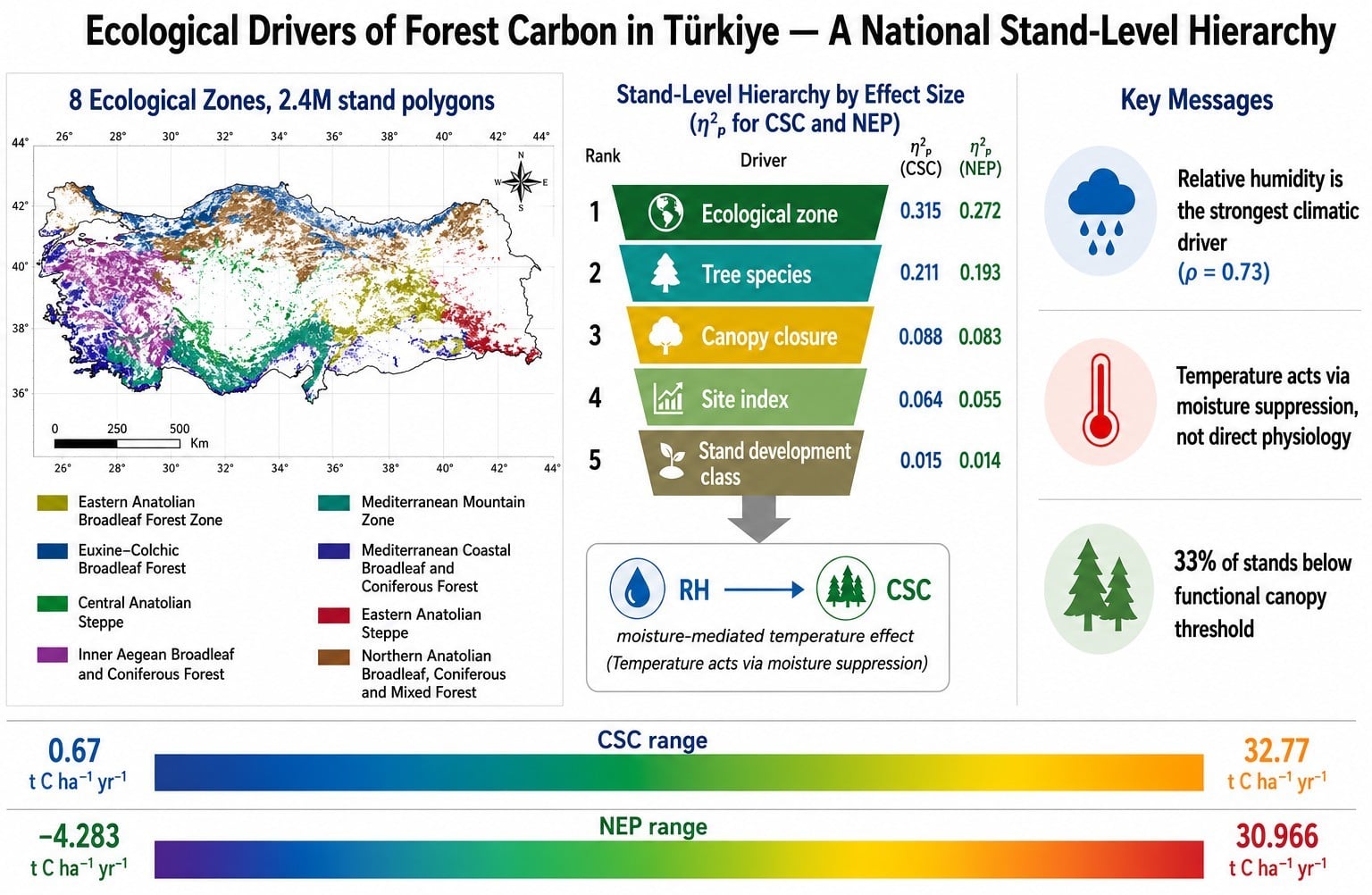
Ecological Drivers of Forest Carbon Sequestration and Net Ecosystem Production at the Intersection of the Euro-Siberian, Mediterranean and Iraniano-Turanian Regions—Part I: Baseline Stand-Level Hierarchy from a Complete National Inventory
 ,
,  , , , and
Abstract
Share and Cite
Güler, S.; Turgut, B.; Ayan, S.; Mısır, M.; Hatay, T.Y.; Kara, F.; Ivanova, N. Ecological Drivers of Forest Carbon Sequestration and Net Ecosystem Production at the Intersection of the Euro-Siberian, Mediterranean and Iraniano-Turanian Regions—Part I: Baseline Stand-Level Hierarchy from a Complete National Inventory. Forests 2026, 17, 1107. https://doi.org/10.3390/f17091107
Güler S, Turgut B, Ayan S, Mısır M, Hatay TY, Kara F, Ivanova N. Ecological Drivers of Forest Carbon Sequestration and Net Ecosystem Production at the Intersection of the Euro-Siberian, Mediterranean and Iraniano-Turanian Regions—Part I: Baseline Stand-Level Hierarchy from a Complete National Inventory. Forests. 2026; 17(9):1107. https://doi.org/10.3390/f17091107
Chicago/Turabian StyleGüler, Sümeyye, Bülent Turgut, Sezgin Ayan, Mehmet Mısır, Taha Yasin Hatay, Ferhat Kara, and Natalya Ivanova. 2026. "Ecological Drivers of Forest Carbon Sequestration and Net Ecosystem Production at the Intersection of the Euro-Siberian, Mediterranean and Iraniano-Turanian Regions—Part I: Baseline Stand-Level Hierarchy from a Complete National Inventory" Forests 17, no. 9: 1107. https://doi.org/10.3390/f17091107
APA StyleGüler, S., Turgut, B., Ayan, S., Mısır, M., Hatay, T. Y., Kara, F., & Ivanova, N. (2026). Ecological Drivers of Forest Carbon Sequestration and Net Ecosystem Production at the Intersection of the Euro-Siberian, Mediterranean and Iraniano-Turanian Regions—Part I: Baseline Stand-Level Hierarchy from a Complete National Inventory. Forests, 17(9), 1107. https://doi.org/10.3390/f17091107
