


Abstract
Bamboo served as an important writing support and raw material for tools and daily objects in ancient Asian societies, yet archaeological bamboo remains far less systematically reviewed than archaeological wood, paper, and parchment. Owing to its lignocellulosic composition and hierarchical vascular structure, archaeological bamboo is highly susceptible to hydrolysis, oxidation, microbial attack, and post-excavation dimensional instability. A structured search of the Web of Science Core Collection, completed in June 2026, identified 134 records for screening; after predefined eligibility assessment and exclusion of studies unrelated to archaeological or heritage bamboo, 75 studies were ultimately included and cited in this review. Unlike previous publications that address bamboo structure, degradation, or digital reconstruction separately, this review integrates archaeological context, graded anatomy, material deterioration, analytical characterization, treatment compatibility, inscription preservation, and computational restoration within a unified conservation-science framework. Evidence from Fourier transform infrared spectroscopy, Raman spectroscopy, scanning electron microscopy, X-ray diffraction, and thermal analysis is synthesized to link chemical loss with microstructural collapse and mechanical fragility. Excavation stabilization, dehydration, polymer consolidation, environmental control, artificial aging, digital reconstruction, and artificial intelligence-assisted fragment reassembly are critically evaluated. The available evidence indicates that bamboo-specific conservation research remains limited and that several treatments are still extrapolated from waterlogged wood or paper conservation. Major research gaps include standardized condition-assessment indicators, quantitative long-term treatment data, ink–substrate compatibility studies, and validated decision frameworks for archaeological bamboo conservation.
1. Introduction
Bamboo belongs to the subfamily Bambusoideae with the grass family Poaceae and comprises both herbaceous and woody lineages, with more than 1400 recognized taxa distributed across tropical, subtropical, and temperate regions worldwide [1,2,3]. Archaeological bamboo artifacts are predominantly manufactured from woody bamboo because their lignified culms combine low density with high longitudinal strength, flexibility, and workability. Structurally, bamboo is a hierarchically organized lignocellulosic material in which vascular bundles are unevenly distributed within parenchymatous ground tissue, producing pronounced gradients in density, fiber content, and mechanical performance across the culm wall. Its cell walls are primarily composed of cellulose, hemicellulose, and lignin, and the spatial distribution and interactions of these polymers strongly influence both the durability of bamboo and its susceptibility to burial-induced deterioration.
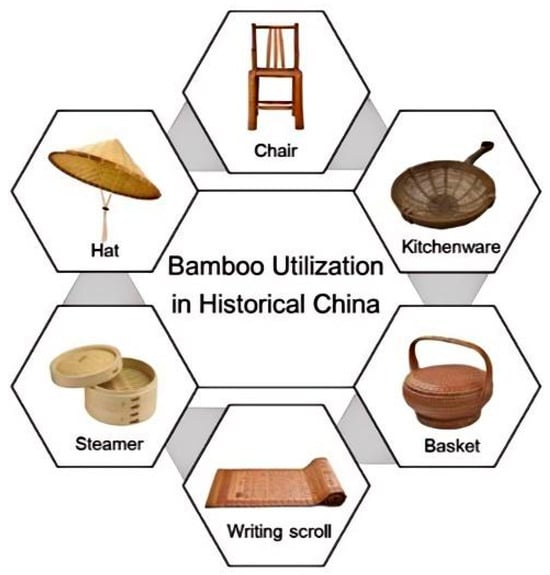
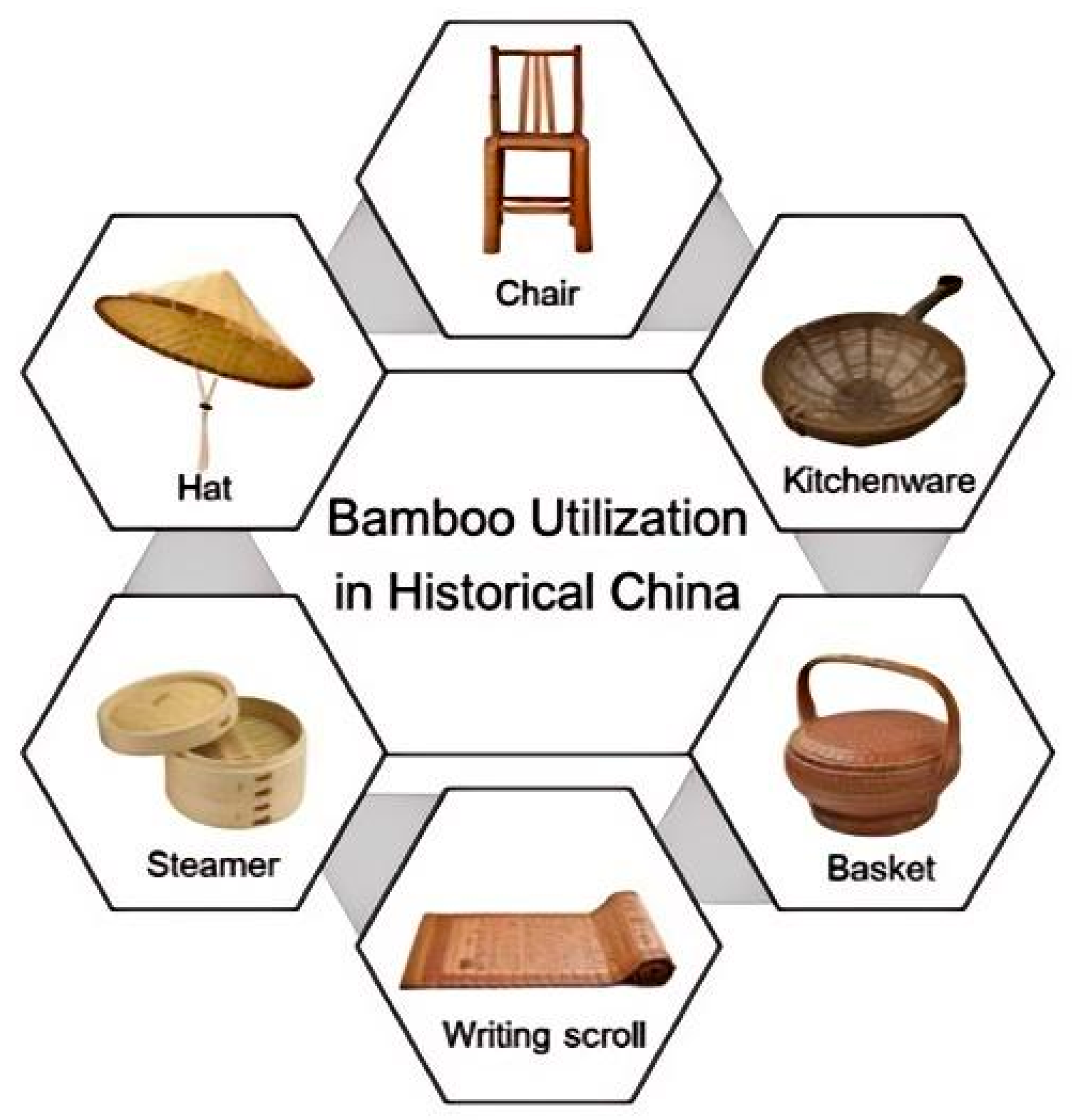
Bamboo has played an important role in the cultural and technological development of Asian societies for thousands of years. This review focuses primarily on archaeological bamboo cultural relics recovered from East Asia, particularly Chinese bamboo slips and related bamboo objects. Before the widespread use of paper, bamboo slips served as one of the earliest and most important carriers of written information in ancient China. Numerous historical records, philosophical works, administrative documents, and literary texts were preserved on bamboo manuscripts, providing valuable primary sources for the study of early Chinese history, politics, and culture [4,5,6,7]. Bamboo was also used to manufacture woven objects, tools, furniture, utensils, and other everyday products, reflecting the close relationship between material availability, traditional craftsmanship, and social practice [8]. Figure 1 summarizes these representative historical applications without attempting to provide an exhaustive typology of bamboo artifacts.
Figure 1.
Representative historical applications of bamboo in ancient China, including bamboo writing supports and selected domestic and craft objects [8].
Recent archaeological discoveries and advances in conservation science have shifted research from the interpretation of bamboo manuscripts toward the material processes governing their preservation and loss. During long-term burial, moisture, oxygen availability, soil chemistry, microorganisms, and temperature interact to promote hydrolysis, oxidation, polysaccharide depletion, cell-wall erosion, and structural collapse [9,10,11,12,13,14,15]. Waterlogged bamboo may retain its external morphology because water supports the weakened cellular framework, yet rapid moisture loss after excavation can induce shrinkage, warping, longitudinal cracking, and fragmentation. Although related mechanisms have been extensively studied in waterlogged archaeological wood and cellulose-based documentary materials, archaeological bamboo has received comparatively less systematic conservation-science attention [16,17]. Bamboo slips also differ fundamentally from paper, papyrus, and parchment: they possess a strongly graded vascular structure, pronounced longitudinal anisotropy, and a rigid inscribed surface, creating treatment conflicts between stabilizing a highly porous, moisture-sensitive substrate and preserving surface inscriptions.
Against this background, the present review connects bamboo anatomy, chemical composition, and physical properties with burial degradation, post-excavation instability, analytical characterization, and conservation decision-making. Rather than treating degradation, treatment, and digital restoration as separate topics, it evaluates representative evidence from comparative archaeological samples, microbial studies, artificial-aging experiments, excavation and stabilization cases, and computational fragment-reassembly research [18,19,20]. Particular attention is given to the strength and limitations of the available evidence, including the extent to which treatments developed for waterlogged wood, paper, or other lignocellulosic materials can be transferred to archaeological bamboo. The review also compares bamboo slips with other writing supports, identifies gaps in quantitative condition assessment, long-term treatment performance, and ink–substrate compatibility, and discusses emerging approaches involving nanomaterials, digital documentation, image enhancement, and artificial intelligence.
2. Methodology of Literature Review
This study was conducted as a narrative review supported by bibliometric mapping to synthesize current knowledge on the characterization, degradation, and conservation of archaeological bamboo cultural relics. Bibliographic searches were conducted using the Web of Science Core Collection database in June 2026. Two broad keyword queries were initially applied: “bamboo” AND “degradation”—yielding 1871 records, and “bamboo” AND “heritage”—yielding 174 records. The search covered peer-reviewed articles, reviews, and conference proceedings published in English, without an initial restriction on publication year. Bibliographic information, including titles, abstracts, author keywords, authors, and publication years, was exported for literature screening and bibliometric visualization.
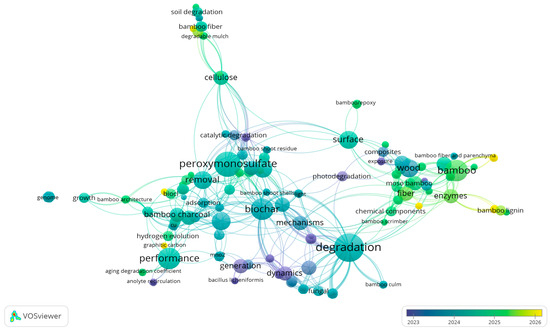
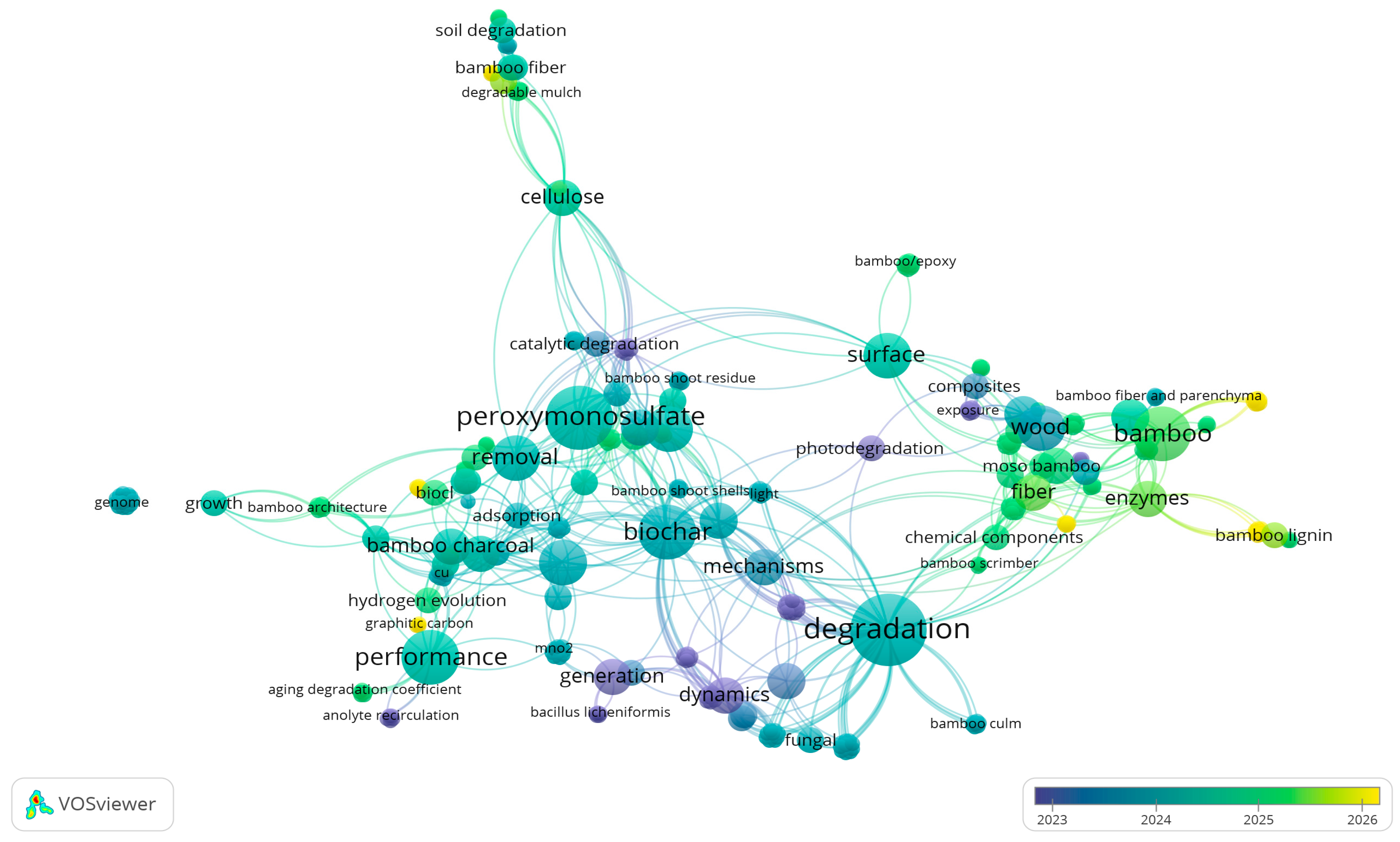
Keyword co-occurrence analysis was performed using VOSviewer (v1.6.20) to examine the thematic distribution of the initially retrieved literature. The “bamboo AND degradation” dataset revealed several distinct research clusters (Figure 2). In addition to themes associated with cellulose, lignocellulose, biodegradation, material properties, and deterioration, prominent clusters involving peroxymonosulfate, biochar, catalytic degradation, pollutant removal, and hydrogen-related processes were identified. These clusters primarily represent environmental engineering, catalysis, and functional-material research rather than the deterioration of archaeological bamboo. Their presence reflects the broad and multidisciplinary use of the term “degradation” in bamboo-related research. Therefore, Figure 2 is retained to illustrate the broader research landscape and to distinguish heritage-related deterioration research from unrelated applications.
Figure 2.
Keyword co-occurrence network for the initial Web of Science search “bamboo” AND “degradation” (n = 1871). Node size represents keyword occurrence frequency, links indicate co-occurrence relationships, and colors represent the major thematic clusters identified by VOSviewer.
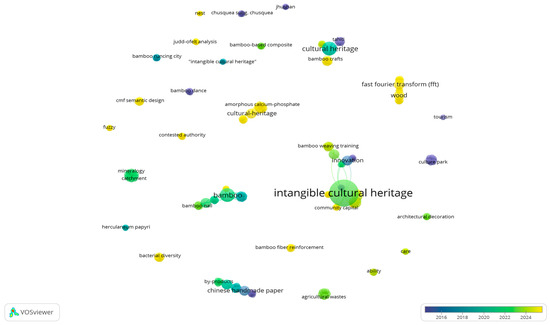
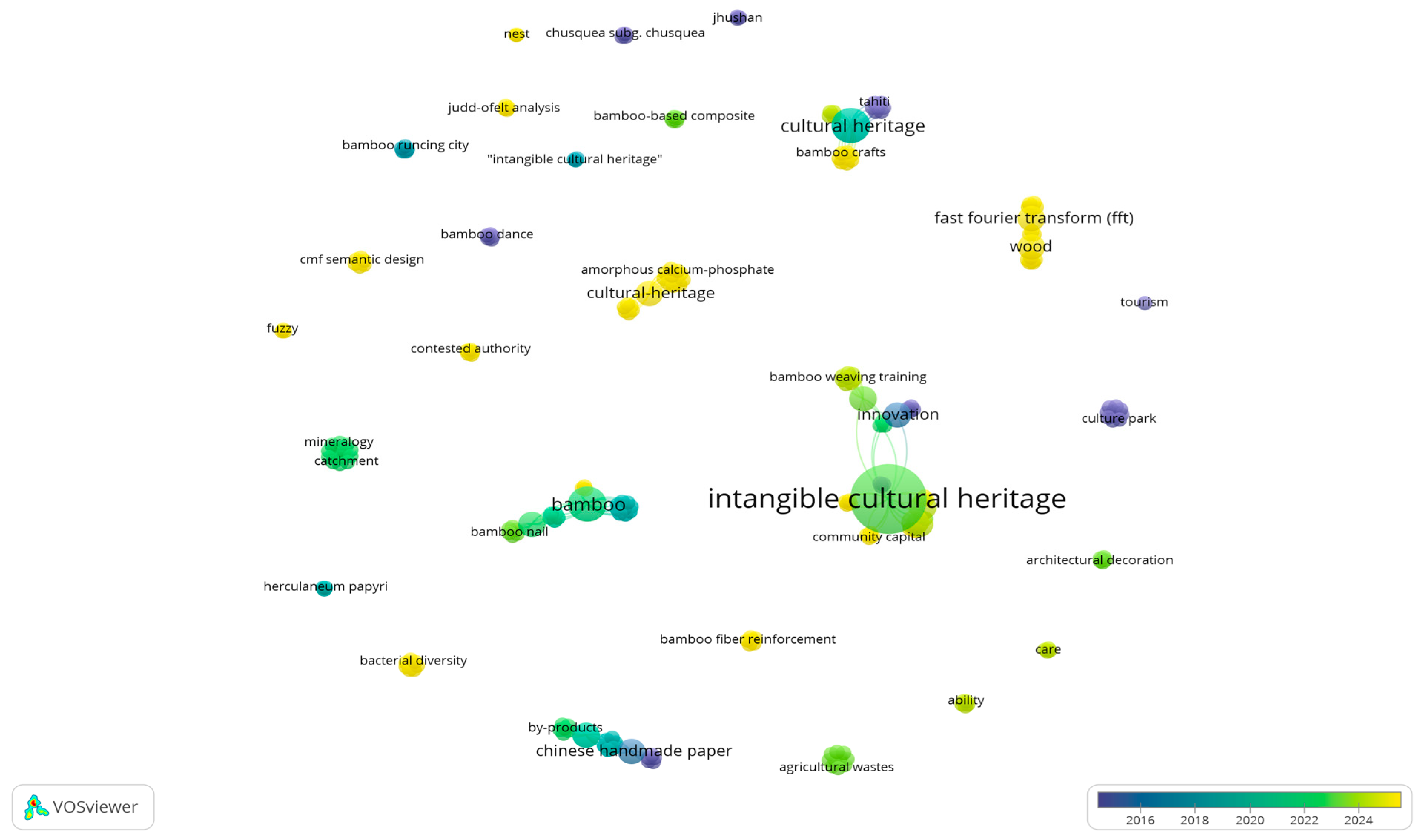
The “bamboo AND heritage” dataset was considerably smaller and showed stronger thematic relevance to the scope of this review (Figure 3). Major themes were associated with cultural heritage, traditional bamboo utilization, conservation, bamboo craftsmanship, archaeological materials, and digital technologies. Nevertheless, some studies focused primarily on intangible cultural heritage, contemporary architecture, bamboo products, or cultural sustainability rather than the material deterioration and conservation of archaeological bamboo. Figure 3 therefore provides a complementary overview of heritage-oriented bamboo research and helps identify the relatively limited body of literature specifically addressing the conservation science of archaeological bamboo. Together, Figure 2 and Figure 3 demonstrate a clear contrast between the extensive literature on general bamboo degradation and the much smaller research field devoted specifically to archaeological bamboo materials.
Figure 3.
Keyword co-occurrence network for the initial Web of Science search “bamboo” AND “heritage” (n = 174). Node size represents keyword occurrence frequency, links indicate co-occurrence relationships, and colors represent the major thematic clusters identified by VOSviewer.
Following bibliometric mapping, the retrieved publications were evaluated according to their relevance to the scope of this review. Priority was given to studies addressing: (i) archaeological or historically significant bamboo materials; (ii) bamboo anatomy, chemical composition, hygroscopicity, permeability, and mechanical properties relevant to deterioration; (iii) environmental, microbial, and chemical degradation of bamboo; (iv) analytical techniques for assessing deteriorated bamboo, including microscopy, spectroscopy, diffraction, and thermal analysis; (v) excavation, stabilization, dehydration, consolidation, and preventive conservation of bamboo or closely related lignocellulosic heritage materials; and (vi) emerging approaches such as artificial aging, nanomaterial-based conservation, digital reconstruction, image processing, and artificial intelligence-assisted fragment reassembly.
Publications focusing exclusively on industrial bamboo processing, energy production, catalysis, adsorption, biochar, environmental remediation, construction engineering, or ecological management without a direct connection to material deterioration or cultural heritage conservation were excluded from the narrative synthesis. After evaluation of titles, abstracts, and, where necessary, full texts, 75 publications were retained as the principal literature base for this review.
The selected literature was subsequently organized within a material–deterioration–characterization–conservation framework. Particular emphasis was placed on evidence derived directly from archaeological bamboo. Where bamboo-specific conservation studies were limited, research on closely related lignocellulosic heritage materials, particularly waterlogged archaeological wood and cellulose-based writing supports, was used for comparison, with such evidence clearly distinguished from direct studies of archaeological bamboo. This literature framework enables the review to critically compare current findings, identify transferable conservation approaches, and highlight research gaps specific to archaeological bamboo cultural relics.
3. Material Characteristics of Bamboo
3.1. Anatomical Structure of Bamboo
The vascular bundle system is a key anatomical feature of bamboo, playing a crucial role in its mechanical performance and durability. Vascular bundles are embedded within parenchyma tissues and distributed along the culm wall in a gradient: the outer layer has a higher proportion of fibers and greater mechanical strength, while the inner layer contains more parenchyma tissues, providing weaker structural support [9,12]. Unlike wood, bamboo lacks secondary radial growth and is characterized by longitudinally oriented vascular bundles embedded in a parenchymatous matrix. The frequency and fiber-sheath fraction of vascular bundles generally increase from the inner toward the outer culm wall, producing a functionally graded structure in density, stiffness, permeability, and moisture response [21,22]. Fiber cells serve as the main structural component, with secondary walls rich in cellulose and lignin. Cellulose microfibrils are oriented along the longitudinal axis, enhancing tensile strength and stiffness. Parenchyma cells occupy most of the culm volume and are more susceptible to degradation than fiber cells [23,24,25]. Mechanical properties therefore vary substantially across the culm wall; the fiber-rich outer region generally exhibits higher density, stiffness, and strength than the parenchyma-rich inner region [26].
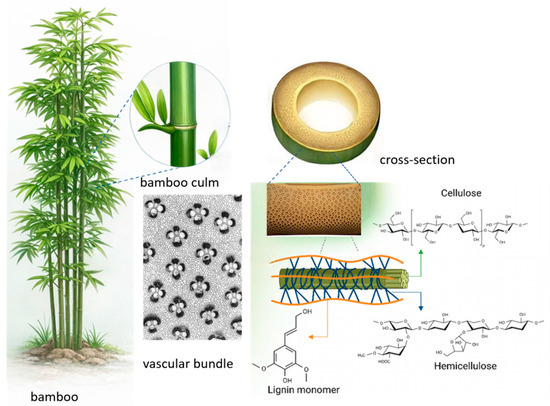
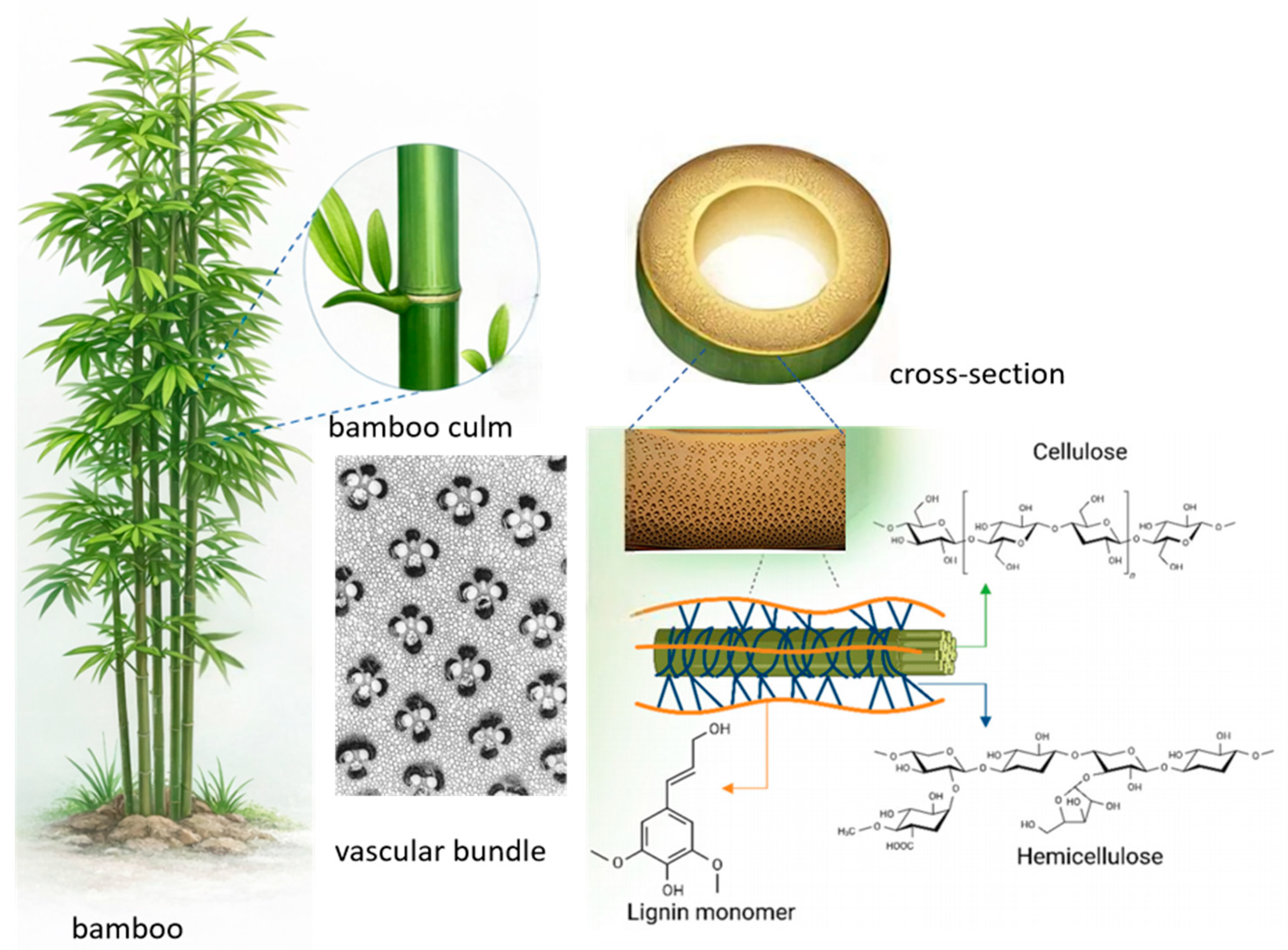
Bamboo exhibits pronounced anisotropy, with longitudinal strength higher than radial or tangential directions; cracks tend to propagate along fiber directions, and differential shrinkage during drying generates internal stress, causing deformation and fracture [2,27,28,29]. This anatomical heterogeneity is particularly relevant to archaeological bamboo because preferential degradation or collapse of thin-walled parenchyma can remove lateral support for the vascular bundles while the longitudinal fibers remain partially intact. Consequently, an excavated bamboo object may retain its overall longitudinal form despite substantial loss of transverse integrity, thereby increasing its susceptibility to longitudinal splitting during drying and handling. As illustrated in Figure 4, the hierarchical structure from the whole bamboo culm to the cross-section and vascular bundle distribution provides a clear view of bamboo anatomy.
Figure 4.
Bamboo structure from culm to vascular bundles and chemical composition.
3.2. Chemical Composition of Bamboo
Bamboo is primarily composed of lignocellulosic polymers, including cellulose, hemicellulose, and lignin, which are intricately organized within the cell wall and interact with anatomical features [30,31]. Their proportions vary among species, culm age, height, radial position, and analytical method; therefore, a single universal composition should not be assigned to all archaeological bamboo. Studies of modern bamboo nevertheless commonly identify cellulose, hemicellulose, and lignin as the dominant structural constituents, with smaller amounts of extractives, starch, proteins, waxes, and inorganic components [29,30]. Cellulose microfibrils provide tensile strength and stiffness, hemicellulose binds the fibrils maintaining wall cohesion, and lignin reinforces mechanical stiffness while imparting hydrophobicity.
Variations in polymer content between fiber and parenchyma cells generate chemical gradients, influencing mechanical performance, degradation susceptibility, and durability. For example, fibers have higher cellulose and lignin content compared with parenchyma, making them more resistant to microbial and environmental degradation, whereas parenchyma-rich layers are more prone to hydrolysis and oxidation. From a conservation perspective, these components also differ in degradation susceptibility: hemicelluloses and amorphous polysaccharide domains are generally more accessible to hydrolysis and microbial attack, whereas lignified fiber tissues can persist after substantial polysaccharide loss. Consequently, the residual chemical composition of archaeological bamboo may differ markedly from that of modern reference bamboo, and compositional data should be interpreted together with burial environment, anatomical position, and preservation state. Figure 4 illustrates the correlation between anatomical structures and chemical composition, highlighting the gradient from outer fiber-rich layers to inner parenchyma-rich layers.
3.3. Physical Properties Related to Degradation
Bamboo exhibits anisotropy, hygroscopicity, high porosity, and a density gradient across the culm wall, all of which influence its response to environmental stressors such as humidity, temperature, and microbial activity [32,33,34,35]. Representative measurements for modern Moso bamboo illustrate the magnitude of this heterogeneity. Reported density values vary substantially with species, culm height, age, and radial sampling position; for Moso bamboo, values of approximately 0.55–1.01 gcm−3 have been reported across different culm positions, with density generally increasing toward the fiber-rich outer wall [21]. More recent investigations likewise demonstrate significant radial gradients in density and associated mechanical properties [22]. These gradients mean that the inner, parenchyma-rich region provides substantially less mechanical resistance than the outer fiber-rich region.
Longitudinal mechanical performance exceeds radial and tangential directions, and cracks propagate preferentially along fiber alignments [36]. The anisotropy arises primarily from the longitudinal alignment of fibers and vascular bundles and their radial density gradient. Consequently, tensile and elastic properties measured parallel to the culm axis are substantially greater than those measured across the culm wall [2,37]. This directional imbalance has direct conservation implications: when weakened archaeological bamboo shrinks during dehydration, transverse stresses are poorly accommodated and can be released through longitudinal splitting along the fiber direction.
Its hygroscopic nature leads to dimensional changes and internal stresses under fluctuating humidity, causing microcracks and structural instability [38,39]. Humidity-controlled measurements have demonstrated that dimensional response is strongly anisotropic, with radial and tangential dimensional changes substantially greater than longitudinal changes [34,40]. Moreover, moisture sorption and dimensional response vary across the culm wall because fiber and parenchyma tissues have different anatomical and chemical characteristics [35]. Such heterogeneous swelling and shrinkage can generate internal stress even when the overall environmental relative humidity changes uniformly. Moisture sorption–desorption hysteresis further means that dimensional recovery does not necessarily follow the same pathway during wetting and drying, making repeated post-excavation humidity fluctuations particularly hazardous.
The porous cellular architecture facilitates water and nutrient transport but also enables microbial penetration, progressively degrading cellulose and hemicellulose, thereby increasing porosity [13]. Outer culm layers, enriched in fibers and denser, resist mechanical and biological damage better, while inner parenchyma-dominated layers are more vulnerable [31]. Nodes introduce an additional source of heterogeneity because their vascular architecture, fiber orientation, water absorption, and dimensional response differ from those of internodes; recent measurements confirm significant node–internode differences in water absorption and dimensional stability [41]. These differences may contribute to localized stress concentrations and nonuniform deformation in archaeological bamboo objects containing intact nodes.
Table 1 summarizes representative quantitative properties relevant to deterioration. Importantly, most available quantitative datasets were obtained from modern bamboo rather than excavated archaeological objects. Long-term hydrolysis, microbial degradation, polysaccharide loss, increased porosity, and cell-wall collapse can substantially alter density, moisture response, and mechanical properties. The numerical ranges in Table 1 should therefore be regarded as modern-material reference values for interpreting deterioration mechanisms rather than direct property values for archaeological bamboo. Establishing comparable quantitative datasets for archaeological specimens remains an important research need.
Table 1.
Representative physical properties of bamboo relevant to archaeological deterioration.
Taken together, the anatomical structure, chemical composition, and physical properties of bamboo form a coupled structure–composition–property relationship that controls its deterioration. The fiber-rich outer wall provides longitudinal reinforcement, whereas the parenchyma-rich inner region is generally less dense and more susceptible to structural loss. Hygroscopic anisotropy then amplifies this pre-existing heterogeneity during excavation and drying. For archaeological bamboo, however, the extent of these effects depends strongly on burial history and degradation state; consequently, quantitative properties measured in modern bamboo should be used as comparative baselines rather than directly transferred to conservation decision-making.
4. Degradation Mechanisms of Bamboo
4.1. Environmental and Biological Factors in Burial Conditions
Bamboo artifacts in archaeological contexts are subjected to a combination of environmental, biological, and chemical factors that contribute to their degradation. Long-term burial exposes bamboo to fluctuating moisture, temperature changes, and varying oxygen availability, all of which influence hydrolytic and oxidative processes. Waterlogged conditions may slow oxygen-dependent reactions but promote microbial activity, while exposure to air accelerates oxidative damage and drying-induced shrinkage [10,13]. In addition, prolonged burial under waterlogged and oxygen-limited conditions may facilitate the accumulation of inorganic species derived from the surrounding soil, groundwater, or associated metallic objects. Such burial-derived compounds may become important after excavation when the artifact is exposed to an oxidizing environment, although their specific roles in archaeological bamboo remain insufficiently investigated.
Microbial degradation plays a major role in the deterioration of buried bamboo. Bacteria and fungi can selectively degrade polysaccharides or lignin, depending on species and environmental conditions. Parenchyma cells with thin walls and lower lignin content are more susceptible to microbial attack, whereas fiber-rich vascular bundles are more resistant, producing a characteristic pattern of tissue loss [42,43]. Soft rot fungi, brown rot fungi, and insect activity contribute to erosion cavities, delamination, and fragmentation of bamboo tissues [44,45].
Chemical degradation also occurs simultaneously, including hydrolysis of cellulose and hemicellulose, oxidation of lignin, and acid-induced depolymerization. These processes reduce cell-wall cohesion, weaken tissues, and alter color, typically resulting in darkened surfaces and a more brittle structure [29,30]. The chemical environment may also change substantially after excavation because the transition from anoxic burial to oxygen-rich storage conditions can initiate oxidation reactions that were suppressed during burial. This phenomenon is particularly relevant to waterlogged lignocellulosic archaeological materials and warrants consideration when evaluating post-excavation bamboo stability. The combined effects of environmental, biological, and chemical factors lead to structural deterioration of bamboo, including cracks, warping, fragmentation, and overall loss of mechanical integrity [13,25].
4.2. Microstructural and Chemical Changes
Archaeological bamboo exhibits characteristic changes at the microstructural and molecular levels. Loss or thinning of secondary walls, delamination, and collapse of parenchyma cells are commonly observed under SEM and optical microscopy, reflecting degradation of lignocellulosic components [11,12].
Cellulose in bamboo consists of crystalline and amorphous regions. The crystalline domains provide rigidity and tensile strength, whereas amorphous regions are more susceptible to hydrolysis and enzymatic attack [15,46]. During early degradation, amorphous cellulose is preferentially lost, sometimes resulting in an apparent increase in relative crystallinity. With progressive deterioration, crystalline regions are also disrupted, leading to a decline in overall crystallinity, which correlates with decreased mechanical stability and increased vulnerability to further degradation [44,47,48,49].
Monitoring changes in crystallinity provides a molecular-level indicator of preservation quality. When interpreted alongside cell-wall damage, crystallinity data can differentiate mildly altered bamboo from severely degraded material requiring immediate stabilization [50]. However, chemical deterioration after excavation should not be evaluated solely in terms of lignocellulosic polymers. Inorganic contaminants accumulated during burial may also influence long-term stability, particularly where waterlogged artifacts are recovered from iron- or sulfur-rich environments.
4.3. Potential Iron- and Sulfur-Driven Post-Excavation Degradation
An additional potential degradation pathway that deserves consideration is iron- and sulfur-driven acidification after excavation. This mechanism has been extensively documented in waterlogged archaeological wood, most notably in the Vasa and Mary Rose collections. Under anoxic waterlogged conditions, microbial sulfate reduction can generate reduced sulfur species, while iron may be introduced from surrounding sediments, groundwater, or corroding archaeological metal objects. Reduced sulfur compounds can subsequently accumulate within the porous lignocellulosic matrix. When the material is excavated and exposed to oxygen, these reduced sulfur species may progressively oxidize to sulfate and sulfuric acid, resulting in localized acidification and further hydrolytic degradation of the organic substrate [51,52,53]. Iron species can participate in these redox reactions and may further promote oxidative deterioration [54].
For archaeological bamboo, however, the available evidence must be distinguished carefully from that for archaeological wood. Although bamboo and wood are both porous lignocellulosic materials and may experience comparable waterlogged and anoxic burial environments, direct evidence demonstrating substantial sulfur accumulation and subsequent iron-assisted acidification in archaeological bamboo remains scarce. Therefore, iron- and sulfur-driven deterioration should currently be regarded as a plausible but insufficiently demonstrated risk for archaeological bamboo rather than an established degradation mechanism. Whether it occurs is likely to depend on site-specific factors such as sulfate availability, burial redox conditions, sediment chemistry, microbial activity, and the presence of iron-containing objects in close proximity to bamboo artifacts.
This uncertainty is particularly relevant to waterlogged bamboo subsequently treated with polyethylene glycol (PEG). Research on PEG-treated archaeological wood has demonstrated that reduced sulfur compounds and iron species may remain within the material after conservation and continue to participate in oxidation and acidification processes; iron may also contribute to oxidative deterioration of PEG itself [54,55]. These observations should not be transferred directly to archaeological bamboo, but they raise an important question regarding the long-term chemical stability of PEG-treated waterlogged bamboo when burial-derived iron and sulfur are present. Consequently, elemental and chemical screening should be considered for bamboo artifacts recovered from potentially sulfur- or iron-rich waterlogged environments.
Future investigations could combine X-ray fluorescence (XRF) or scanning electron microscopy coupled with energy-dispersive X-ray spectroscopy (SEM–EDS) for elemental mapping with X-ray absorption near-edge structure (XANES) spectroscopy for determining iron and sulfur speciation. Spatial pH measurements and ion chromatography could further identify localized acidification and soluble sulfate species. Such analyses would help establish whether the well-documented iron–sulfur deterioration pathway in waterlogged archaeological wood is also relevant to archaeological bamboo and, importantly, whether it represents a long-term risk for PEG-treated bamboo cultural relics.
5. Characterization of Degraded Bamboo Cultural Relics
Assessing the preservation state of bamboo cultural relics requires both macroscopic and microscopic characterization. Long-term burial exposes bamboo to coupled environmental, biological, and chemical deterioration, altering its appearance, cell-wall structure, and chemical composition. Visual inspection alone is insufficient, as artifacts may retain their external shape while losing internal mechanical integrity. Integrated macroscopic, microstructural, and analytical methods allow identification of degradation pathways, evaluation of preservation quality, and guidance for conservation strategies. For inscribed bamboo slips, condition assessment should additionally consider the preservation of surface inscriptions, because stabilization of the bamboo substrate does not necessarily ensure the preservation of ink or pigment layers. Therefore, substrate deterioration and inscription condition should be evaluated as related but distinct conservation parameters.
5.1. Macroscopic Deterioration Features
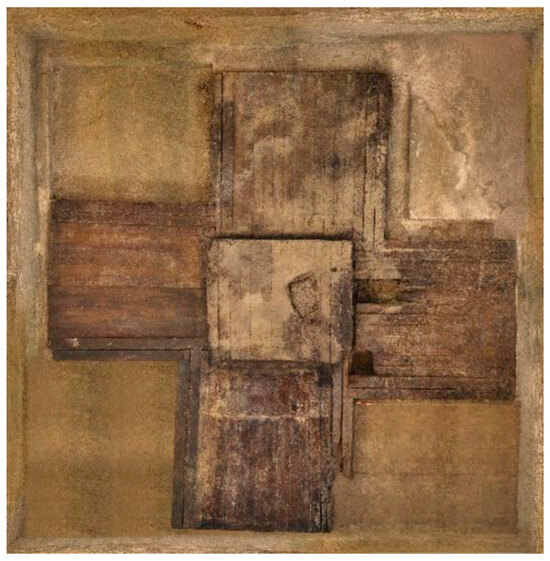
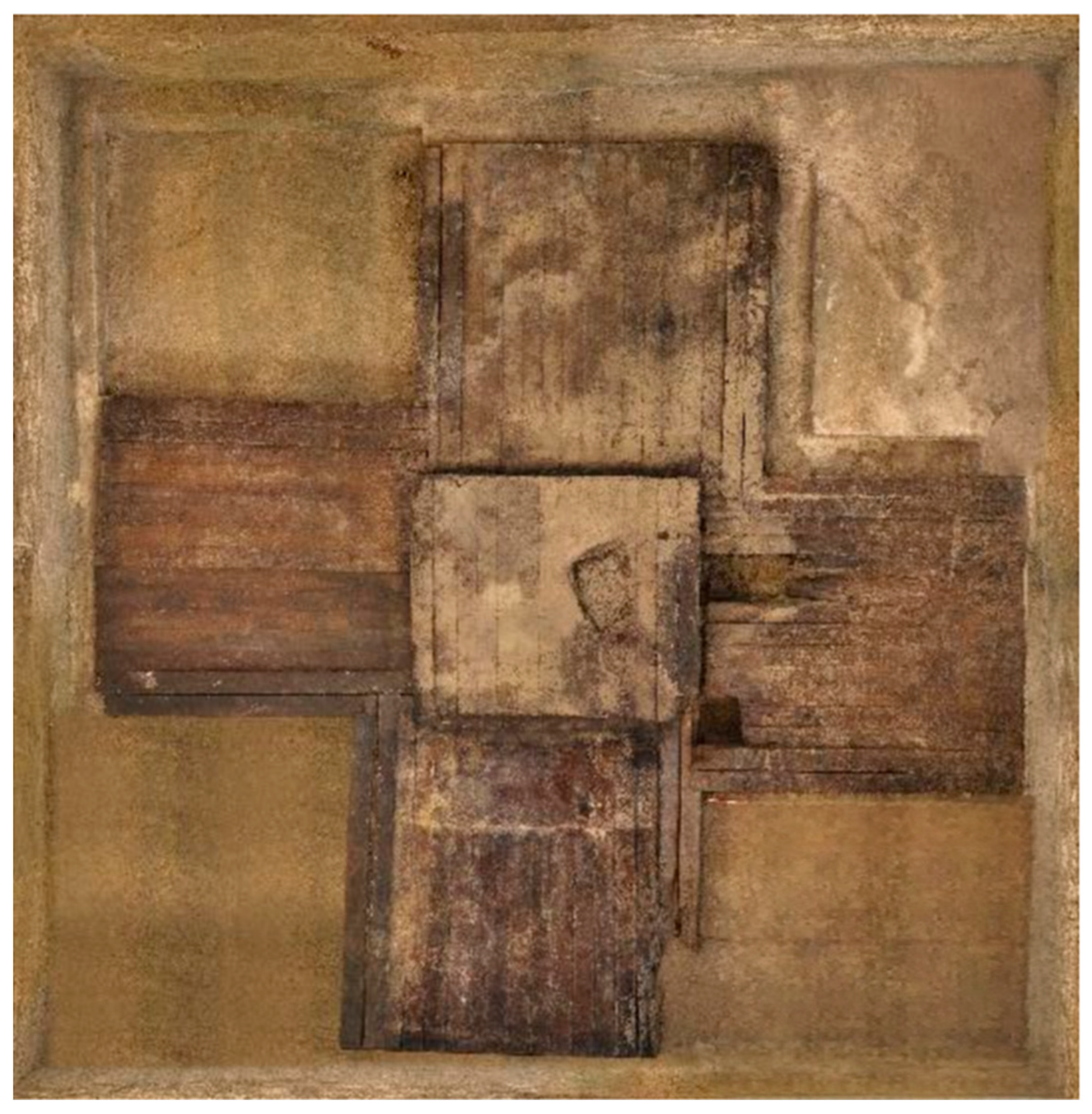
Macroscopic deterioration provides the first indication of bamboo preservation, including discoloration, deformation, cracking, softening, and fragmentation. Surface discoloration, often dark brown or black, results from oxidation, microbial activity, and chemical modification of lignin and other organic components (Figure 5). Deformation, including bending, twisting, or warping, occurs due to moisture loss after excavation, especially in waterlogged bamboo with weakened cell walls [56]. Cracking along fiber directions and fragmentation compromise both mechanical stability and the integrity of bamboo slips carrying textual information. Softening arises as water occupies voids left by degraded cell-wall polymers, rendering artifacts sponge-like and highly fragile [9,25]. In inscribed slips, macroscopic examination should also document changes in character contrast, ink flaking, blurred character boundaries, surface deposits, and local losses before any aqueous or solvent-based treatment is undertaken. Such documentation is particularly important because carbonaceous or mineral-based writing materials may respond differently from the lignocellulosic bamboo substrate during conservation [31,57]. Macroscopic observations thus provide preliminary insight but must be complemented by detailed microscopic and analytical studies.
Figure 5.
Orthographic view of archaeological bamboo from Wu wangdun Tomb No. 1 [31].
5.2. Microstructural Changes
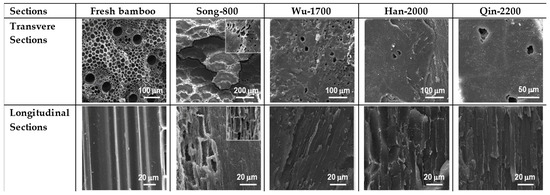
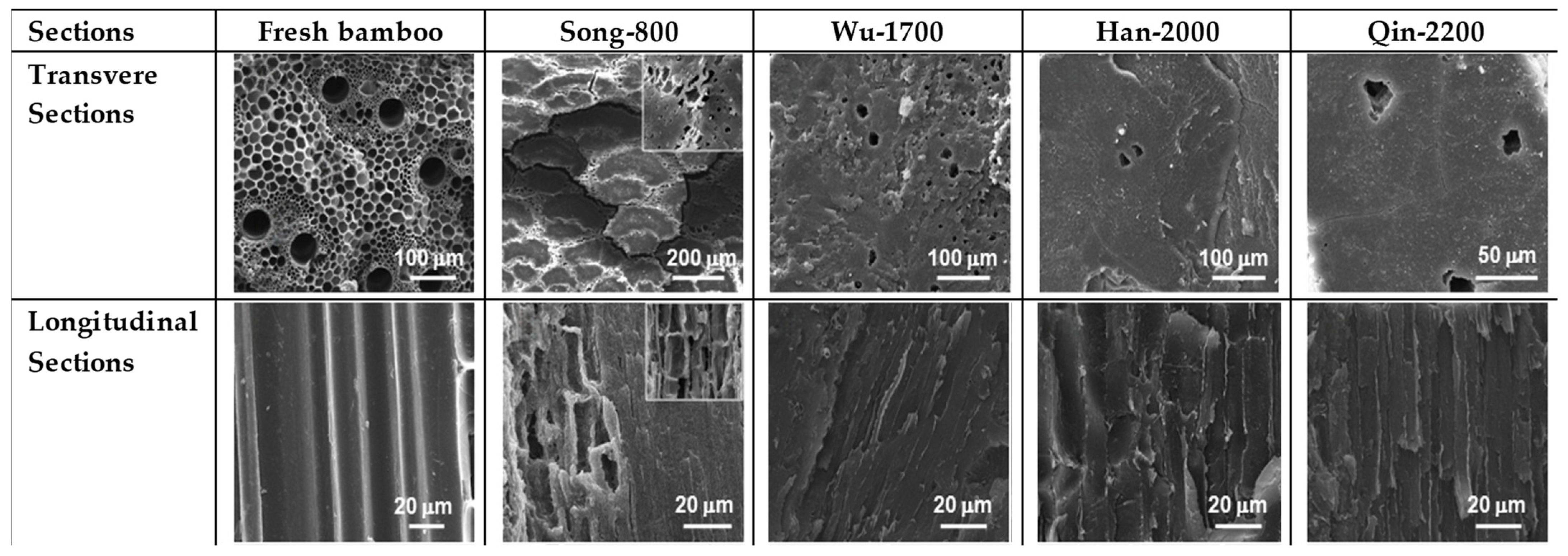
Microstructural changes reveal the internal deterioration of bamboo tissues, directly affecting mechanical performance. Cell-wall degradation is evident as thinning of secondary walls, delamination, irregular surfaces, and erosion cavities, with parenchyma cells affected first due to their thin walls and lower lignin content, while fiber cells exhibit greater resistance [12,13]. Comparative SEM observations of archaeological bamboo attributed to the Song (approximately 800 years old), Wu (approximately 1700 years old), Han (approximately 2000 years old), and Qin (approximately 2200 years old) periods demonstrate marked differences in tissue preservation, including progressive loss of parenchymatous ground tissue and vessels and deterioration of secondary-wall structures [9] (Figure 6). Progressive degradation of parenchyma increases void formation and reduces structural support for the remaining vascular bundles and sclerenchymatous fibers. Importantly, however, these chronological groups should not be interpreted as representing a universally applicable time-dependent degradation sequence. Archaeological bamboo samples may differ in species, original tissue characteristics, burial moisture, oxygen availability, soil chemistry, microbial activity, and post-excavation history; consequently, chronological age alone cannot adequately explain differences in preservation state.
Figure 6.
SEM (Scanning Electron Microscope) images of fresh bamboo and archaeological bamboo from different periods in transverse and longitudinal sections [9].
Cellulose crystallinity also changes during archaeological degradation. Li et al. (2014) [9], based on XRD together with chemical and anatomical analyses of bamboo strips from four historical periods, reported degradation of crystalline cellulose with increasing archaeological age, accompanied by substantial deterioration of hemicellulosic polyxylose and changes in lignin-related structures. Other investigations of archaeological bamboo likewise indicate that changes in cellulose organization should be interpreted together with chemical composition and microstructural deterioration rather than as an isolated preservation indicator [10,32]. Direct quantitative comparison among studies remains difficult because the available investigations do not consistently report the same degradation parameters or employ identical analytical protocols. Differences in bamboo species, tissue position, preservation state, sample preparation, XRD acquisition conditions, and crystallinity-calculation methods may further affect the reported results. Therefore, crystallinity should not be used as a stand-alone indicator of preservation quality; instead, it should be evaluated together with polysaccharide and lignin changes, porosity, cell-wall integrity, and, where available, mechanical properties. This evidence also highlights a current research gap: standardized quantitative indicators and comparable analytical protocols for assessing archaeological bamboo deterioration remain insufficiently established.
5.3. Analytical Techniques
Analytical methods quantify chemical and structural changes, complementing microscopic and macroscopic observations. Spectroscopic techniques such as FTIR and Raman detect alterations in cellulose, hemicellulose, and lignin, revealing oxidation, hydrolysis, and structural modification [58,59,60]. Because Raman or confocal Raman spectroscopy can provide spatially resolved information on cellulose and lignin distribution, it is particularly useful when chemical heterogeneity across cell walls or tissues is of interest; however, direct Raman studies on archaeological bamboo remain much less common than FTIR and SEM investigations, and evidence from modern bamboo and archaeological wood should therefore be identified as comparative rather than bamboo-specific [61,62]. Optical microscopy and SEM document tissue collapse, cell-wall thinning, and microbial damage [63,64]. Structural analyses, including XRD and thermal analysis (TGA, DSC), evaluate cellulose crystallinity and decomposition behavior, providing molecular-level assessment of degradation severity and thermal stability.
For inscribed bamboo slips, complementary non- or minimally invasive techniques such as visible/infrared imaging, Raman spectroscopy, and X-ray fluorescence may also be useful for distinguishing the bamboo substrate from ink or pigment components before conservation treatment. However, direct studies of treatment-induced ink migration or loss in archaeological bamboo remain limited, representing an important research gap that is further addressed in the conservation section. Table 2 summarizes the principal techniques, targets, and significance in archaeological bamboo characterization.
Table 2.
Main analytical techniques used for degraded bamboo cultural relics.
6. Conservation Strategies for Bamboo Cultural Relics
The conservation of bamboo cultural relics is challenging because excavated bamboo is structurally weakened, highly hygroscopic, and chemically unstable after long-term burial. Cell-wall polymers are often degraded, leaving artifacts with high moisture content, increased porosity, and low mechanical strength. Once removed from burial environments, especially waterlogged ones, bamboo can deteriorate rapidly through shrinkage, cracking, oxidation, and microbial activity. Conservation strategies therefore aim to stabilize structure, limit further degradation, and preserve morphology and historical information. Available evidence nevertheless remains uneven: relatively few conservation treatments have been evaluated directly on archaeological bamboo, whereas several approaches have been adapted from waterlogged archaeological wood, paper, or other lignocellulosic heritage materials. Consequently, treatment selection should distinguish bamboo-specific evidence from methods that remain transferable but insufficiently validated for bamboo. The process typically involves interconnected stages of excavation and temporary stabilization, treatment compatibility assessment, dehydration and drying, consolidation and reinforcement, and long-term environmental control (Table 3).
Table 3.
Main conservation approaches for degraded bamboo cultural relics.
6.1. Excavation and Stabilization Techniques
Excavation is often the most critical stage, as bamboo survives in situ only due to support from soil or water. Removal can induce cracking, deformation, or fragmentation, so conservation planning should be integrated from the outset. A representative bamboo-specific example is the underwater temporary solidification approach reported for fragile bamboo slips, in which the original arrangement of waterlogged slips was stabilized before extraction, thereby reducing displacement and preserving archaeological context [67]. This case illustrates an important principle for bamboo conservation: maintaining spatial relationships during recovery can be as important as maintaining the integrity of individual fragments. In situ stabilization methods, including temporary consolidants, surface coverings, rigid supports, or underwater solidification for waterlogged sites, help preserve both structural integrity and archaeological context. Documentation via photography, mapping, and digital recording, or block lifting of soil containing bamboo, is essential before disturbance. For waterlogged objects, temporary storage should maintain conditions close to those at excavation and avoid uncontrolled moisture loss before laboratory assessment.
6.2. Preservation and Treatment Compatibility of Inscriptions and Inks
Bamboo-slip conservation must preserve both the lignocellulosic substrate and the inscribed textual information. Before dehydration or consolidation, the composition and adhesion state of the writing material should therefore be assessed. Aqueous impregnation may mobilize water-sensitive binders or soluble inorganic components, whereas solvent-based consolidants may alter surface wettability, gloss, or optical contrast. PEG deposition may additionally obscure character boundaries or interfere with subsequent imaging. Carbon-based inks are generally chemically stable but may still be mechanically detached if the degraded bamboo surface loses cohesion, whereas mineral-containing inks may exhibit different solubility and interfacial behavior. Experience from other manuscript traditions demonstrates the value of combining non-invasive or minimally invasive analyses of the writing support and inks before intervention. For example, XRF, FTIR, and reflectance spectroscopy have been used to characterize parchment and historical inks prior to restoration, while Raman and related spectroscopic approaches can help distinguish carbonaceous and mineral writing materials [68,69]. These approaches are directly relevant to bamboo-slip assessment even though the substrate differs substantially. Because direct experimental evidence on ink–PEG, ink–freeze-drying, and ink–polymer interactions in archaeological bamboo slips remains limited, this lack of treatment-compatibility data should be regarded as a major conservation research gap rather than assumed from experience with other writing supports.
6.3. Dehydration and Drying Treatments
Waterlogged bamboo contains high moisture due to degraded cell-wall material. Uncontrolled drying can cause severe shrinkage, cracking, and collapse. PEG impregnation followed by controlled drying is well established for waterlogged archaeological wood, where PEG partly replaces or supports water-filled degraded cell-wall regions and reduces dimensional collapse [70]. Freeze-drying similarly reduces capillary stresses by removing frozen water through sublimation and has been extensively evaluated for waterlogged wood [71,72]. However, direct experimental evidence for routine freeze-drying of archaeological bamboo remains limited. It should therefore be described as a potentially transferable treatment rather than an established standard for bamboo cultural relics. The applicability of PEG or freeze-drying to bamboo depends on degradation state, wall thickness, permeability, retained inscriptions, and treatment objectives. Future bamboo-specific studies should report dimensional change, mass gain, penetration depth, surface appearance, and post-treatment mechanical properties so that treatment effectiveness can be compared quantitatively.
6.4. Consolidation and Reinforcement
Even after drying, bamboo may remain fragile due to loss of cellulose, hemicellulose, and tissue cohesion. Consolidants are intended to improve cohesion and handling resistance, but their use must balance penetration, mechanical reinforcement, visual alteration, reversibility, aging stability, and compatibility with inscriptions. Natural and cellulose-derived polymers such as chitosan, methyl cellulose, and hydroxypropyl cellulose have been investigated more extensively for paper, wood, and related cellulosic heritage materials than for archaeological bamboo. Their chemical affinity with polysaccharide substrates and, in the case of chitosan, potential antimicrobial activity make them relevant candidates, but bamboo-specific evidence remains insufficient. Similarly, synthetic polymers such as PVA and Paraloid B-72 are well established in broader conservation practice, yet their penetration and long-term behavior in highly anisotropic degraded bamboo should not be assumed from other substrates. Accordingly, consolidants should be evaluated using bamboo-specific artificial-aging or archaeological reference samples before routine application, with emphasis on strength recovery, dimensional stability, color change, reversibility, and ink compatibility.
6.5. Environmental Control for Long-Term Preservation
Long-term preservation relies on stable environmental conditions. Bamboo’s hygroscopic and biologically vulnerable nature makes fluctuations in relative humidity (RH), temperature, and light particularly damaging. Recommended conditions include 50%–60% RH and moderate, stable temperatures (18–22 °C). UV-filtered lighting prevents photochemical degradation. Biological control through clean storage, regular inspection, and integrated pest management minimizes microbial or insect attack. Protective housings and archival-quality display materials further buffer environmental fluctuations. Sustainable conservation combines careful treatment interventions with preventive environmental management to ensure artifact longevity.
6.6. Nanomaterial-Based Conservation and Consolidation
Nanomaterials represent a promising emerging direction because their small dimensions and high surface area may enable reinforcement within fine cell-wall pores while reducing the amount of added material. Nanocellulose, including cellulose nanofibrils and cellulose nanocrystals, is particularly attractive for lignocellulosic heritage because of its chemical compatibility with cellulose and its potential to improve cohesion without introducing an entirely foreign polymer phase [72,73]. Nanocellulose-based coatings and consolidants have been investigated for historical paper, wood, and other cellulosic artifacts, while inorganic nanoparticles such as Mg(OH)2, Ca(OH)2, ZnO, and related systems have been explored for deacidification, antimicrobial protection, and multifunctional conservation [74,75].
For archaeological bamboo, however, direct nanomaterial-conservation studies remain scarce. The gradient vascular structure, heterogeneous porosity, and presence of inscriptions may influence nanoparticle penetration and distribution differently from paper or wood. Potential risks include particle aggregation, surface whitening, altered wettability, restricted reversibility, and unintended interactions with inks. Thus, nanomaterials should currently be considered an emerging research direction rather than an established treatment for archaeological bamboo. Future work should evaluate penetration depth, mechanical reinforcement, aging stability, optical effects, and ink compatibility using representative degraded bamboo models before application to original artifacts.
6.7. Comparison with Other Writing Supports
Comparison with other writing supports clarifies why conservation methods cannot be transferred to bamboo without validation. Paper and papyrus consist primarily of interwoven cellulose-rich fibers and are therefore particularly vulnerable to acid hydrolysis, oxidation, embrittlement, and ink-related deterioration. Parchment, in contrast, is a collagen-based material whose deterioration includes hydrolysis, denaturation, gelatinization, and dimensional instability under changing humidity [68,69]. Bamboo slips differ from both groups because they retain the intact hierarchical anatomy of the plant culm, including longitudinal fiber bundles embedded in parenchymatous tissue. This produces stronger mechanical anisotropy, a pronounced radial density gradient, and a greater tendency toward longitudinal splitting and heterogeneous shrinkage.
These structural differences also affect treatment behavior. Paper consolidants can interact relatively uniformly with a thin fiber network, whereas bamboo presents a thicker, gradient porous structure that may produce uneven penetration. Likewise, the treatment of waterlogged wood provides useful analogies for PEG impregnation and freeze-drying, but bamboo has a different vascular architecture and lacks the secondary growth structure of wood. The main transferable lesson from paper, parchment, and wood conservation is therefore methodological rather than procedural: treatment should follow material identification, condition assessment, compatibility testing, and long-term evaluation rather than direct adoption of a method developed for another substrate. Recent nanoscience approaches for manuscript conservation further demonstrate the potential of nanoscale deacidification, consolidation, and ink stabilization, but their suitability for archaeological bamboo remains to be experimentally established [75].
6.8. Environmental Control for Long-Term Preservation
Long-term preservation relies on stable environmental conditions. Bamboo’s hygroscopic and biologically vulnerable nature makes fluctuations in relative humidity, temperature, and light particularly damaging. Rather than treating 50%–60% RH and 18–22 °C as universally applicable fixed values, storage parameters should be adjusted according to treatment history, moisture sensitivity, inscription stability, and institutional risk assessment. The principal requirement is minimizing rapid or repeated fluctuations that induce moisture gradients and dimensional stress. UV and excessive visible-light exposure should be minimized to reduce photochemical alteration, while clean storage, regular inspection, and integrated pest management can reduce biological deterioration. Protective housings and archival-quality display materials further buffer environmental variation. Preventive conservation is particularly important for treated archaeological bamboo because even successful consolidation cannot compensate for repeated hygroscopic cycling, microbial activation, or chemically incompatible storage conditions.
7. Emerging Technologies and Future Perspectives
Research on bamboo cultural relics has increasingly evolved from descriptive studies of deterioration and conventional conservation methods toward an interdisciplinary framework integrating materials science, digital technology, and computational analysis. Recent studies provide several concrete examples: accelerated aging has been used to reproduce chemical and structural changes in bamboo slips; visible–infrared image registration has improved character enhancement; and physics-driven deep learning has been applied to the reassembly of fragmented bamboo slips [18,19]. These studies illustrate a shift from passive documentation toward experimentally and computationally assisted conservation, although their applicability across sites and artifact types remains to be validated.
Recent advances in artificial aging, digital reconstruction, and artificial intelligence (AI) offer new opportunities for understanding degradation mechanisms and improving preservation. These approaches enhance knowledge of how bamboo deteriorates under burial and post-excavation conditions and provide practical tools for stabilizing, documenting, and restoring fragile artifacts.
7.1. Artificial Aging Studies of Bamboo Materials
Artificial aging simulates selected environmental stresses over shorter laboratory timescales and can help clarify degradation mechanisms that are difficult to reconstruct from archaeological samples alone. Studies of artificially aged bamboo slips have examined changes in chemical composition, thermal behavior, crystallinity, and microstructure, providing controlled reference states for comparison with archaeological materials [18]. The principal value of artificial aging is not to reproduce centuries of natural burial exactly, but to isolate individual variables and test causal relationships. Future protocols should combine temperature, relative humidity, oxygen exposure, waterlogging/drying cycles, pH, microorganisms, and relevant inorganic contaminants rather than relying solely on elevated temperature or UV irradiation. Equally important is that treated samples be subjected to post-treatment aging so that dimensional stability, color, strength retention, reversibility, and ink compatibility can be evaluated over time.
7.2. Digital Reconstruction of Bamboo Relics
Many bamboo slips are recovered in fragmented, disordered, or partially illegible states. High-resolution photography, multispectral or infrared imaging, 3D scanning, and computational modeling can capture fragment geometry, fracture edges, surface texture, and inscriptions without repeated physical manipulation. Recent visible–infrared registration and feature-fusion approaches have demonstrated improved character enhancement in archaeological bamboo slips, illustrating how multimodal imaging can simultaneously support textual interpretation and fragment matching [19]. Digital reconstruction therefore provides more than visualization: it creates a reproducible research record in which alternative joins can be tested, rejected, or reassessed without altering the original object. Future studies should report image resolution, registration accuracy, reconstruction uncertainty, and data provenance so that digital reconstructions remain scientifically auditable.
7.3. Artificial Intelligence in Cultural Heritage Restoration
AI has emerged as a powerful tool for fragment classification, feature extraction, damage recognition, character enhancement, and predictive rejoining. A notable recent example is the physics-driven WisePanda framework, which generates synthetic paired fracture data based on the mechanics of bamboo fragmentation and uses these data to train a matching network for ancient bamboo slips. The method addresses one of the major limitations of heritage AI—the scarcity of manually labeled matching pairs—and achieved significantly improved matching performance relative to conventional curve-matching and generative approaches [18]. AI should nevertheless be regarded as decision support rather than autonomous restoration. Model performance may depend strongly on excavation site, bamboo species, preservation condition, image quality, writing style, and fragment morphology; therefore, cross-site validation, uncertainty reporting, open benchmark datasets, and expert archaeological verification are essential before routine conservation use.
7.4. Future Research Directions
Despite recent progress, several major gaps remain. First, direct experimental evidence for many bamboo conservation treatments—including freeze-drying, polymer consolidation, nanomaterial reinforcement, and ink-compatible stabilization—remains much weaker than the corresponding literature for waterlogged wood or paper. Second, standardized quantitative criteria for grading archaeological bamboo preservation are still lacking, which makes comparison among sites and treatment studies difficult. Third, the compatibility of conservation agents with carbonaceous or mineral inscriptions remains insufficiently investigated. Fourth, long-term post-treatment aging data are scarce.
Future research should therefore combine multimodal chemical and structural characterization with controlled treatment trials and long-term monitoring. Synchrotron-based spectroscopy, nanoscale imaging, in situ moisture monitoring, and elemental mapping can provide deeper insight into lignocellulosic deterioration and inorganic contaminants. Nanocellulose and other bio-based nanosystems deserve particular attention because related cellulose-based heritage research has demonstrated potential for consolidation and surface protection, but their penetration, reversibility, and interaction with bamboo-slip inks must be established experimentally. Digital and AI-based approaches should likewise move toward shared datasets, standardized evaluation metrics, interpretable models, and integration with physical conservation records. The most productive future framework will therefore combine archaeology, conservation science, materials characterization, microbiology, and computational analysis rather than treating physical stabilization and digital restoration as separate problems.
8. Conclusions
Bamboo cultural relics are highly valued for their cultural, historical, and technological significance, yet their preservation is challenged by intrinsic vulnerabilities such as hygroscopicity, hierarchical structure, and chemical composition. Long-term burial causes coupled environmental, biological, and chemical degradation, resulting in polymer loss, weakened cell walls, increased porosity, surface discoloration, and reduced mechanical integrity. The available evidence indicates that degradation cannot be explained by chronological age alone; burial moisture, oxygen availability, soil chemistry, microbial activity, bamboo anatomy, and post-excavation conditions collectively determine preservation state. Comprehensive characterization using FTIR, Raman spectroscopy, SEM, XRD, and thermal analysis provides complementary information for assessing these deterioration processes and guiding conservation. Current conservation evidence specifically derived from archaeological bamboo remains relatively limited compared with that available for archaeological wood, paper, and other writing supports. Therefore, treatments such as PEG impregnation, freeze-drying, polymer consolidation, and emerging nanomaterial-based reinforcement should be selected according to bamboo-specific structural characteristics and validated for dimensional stability, long-term aging behavior, reversibility, and inscription compatibility. In particular, preservation of the bamboo substrate and preservation of textual information should be considered simultaneously.
Emerging approaches, including artificial aging, multimodal imaging, digital reconstruction, and AI-assisted fragment reassembly, are extending bamboo conservation from physical stabilization toward integrated material and digital preservation. However, standardized degradation indicators, comparable treatment-performance data, long-term monitoring, and shared datasets remain insufficient. Future research should therefore prioritize bamboo-specific quantitative assessment protocols, environmentally compatible consolidants and nanomaterials, ink–substrate–treatment interactions, and experimentally validated digital and computational methods. Interdisciplinary integration of archaeology, conservation science, materials research, microbiology, and computational analysis will be essential for establishing an evidence-based conservation framework specifically adapted to archaeological bamboo cultural relics.
Author Contributions
Conceptualization, Q.H. and W.W.; writing—original draft preparation, Q.H.; writing—review and editing, W.W.; visualization, Q.H.; supervision, W.W.; project administration, W.W.; funding acquisition, W.W. All authors have read and agreed to the published version of the manuscript.
Funding
This research received no external funding.
Institutional Review Board Statement
Not applicable.
Data Availability Statement
Data are contained within the article.
Conflicts of Interest
The authors declare no conflicts of interest.
References
- Chaowana, P. Bamboo: An alternative raw material for wood and wood-based composites. J. Mater. Sci. Res. 2013, 2, 90. [Google Scholar] [CrossRef] [Scilit]
- Dixon, P.G.; Gibson, L.J. The structure and mechanics of Moso bamboo material. J. R. Soc. Interface 2014, 11, 20140321. [Google Scholar] [CrossRef] [Scilit] [PubMed]
- Liu, W.; Hui, C.; Wang, F.; Wang, M.; Liu, G. Review of the resources and utilization of bamboo in China. In Bamboo-Current Future Prospects; IntechOpen: London, UK, 2018. [Google Scholar]
- Shinohara, H.; Chan, T.H.P. A computation design method for architectural artifacts adapted from traditional Kagome bamboo basketry techniques. Front. Archit. Res. 2024, 13, 249–264. [Google Scholar] [CrossRef] [Scilit]
- Allan, S. Buried Ideas: Legends of Abdication and Ideal Government in Early Chinese Bamboo-Slip Manuscripts; State University of New York Press: New York, NY, USA, 2015. [Google Scholar]
- Sujarwo, W. Bamboo resources, cultural values, and ex-situ conservation in Bali, Indonesia. Reinwardtia 2018, 17, 65–75. [Google Scholar] [CrossRef] [Scilit][Green Version]
- Um, C.; Tikhile, P.; Subbanna, S.; Viswanath, S. Socio-cultural and management significance of bamboos in Indian heritage and tradition. J. Bamboo Ratt. 2019, 18, 4. [Google Scholar]
- Dlamini, L.C.; Fakudze, S.; Makombe, G.G.; Muse, S.; Zhu, J. Bamboo as a valuable resource and its utilization in historical and modern-day China. BioResources 2022, 17, 1926–1938. [Google Scholar] [CrossRef] [Scilit]
- Li, M.Y.; Fang, B.S.; Zhao, Y.; Tong, T.; Hou, X.H.; Tong, H. Investigation into the deterioration process of archaeological bamboo strips of China from four different periods by chemical and anatomical analysis. Polym. Degrad. Stab. 2014, 109, 71–78. [Google Scholar] [CrossRef] [Scilit]
- Cha, M.Y.; Lee, K.H.; Kim, Y.S. Micromorphological and chemical aspects of archaeological bamboos under long-term waterlogged condition. Int. Biodeterior. Biodegrad. 2014, 86, 115–121. [Google Scholar] [CrossRef] [Scilit]
- Li, X.; Wei, Y.; Xu, J.; Xu, N.; He, Y. Quantitative visualization of lignocellulose components in transverse sections of moso bamboo based on FTIR macro- and micro-spectroscopy coupled with chemometrics. Biotechnol. Biofuels 2018, 11, 263. [Google Scholar] [CrossRef] [Scilit] [PubMed]
- Ryu, M.; Huang, H.H.; Vongsvivut, J.; Ng, S.H.; Dumbrytė, I.; Narbutis, D.; Morikawa, J. Anisotropy Analysis of Bamboo and Tooth Using 4-Angle Polarization Micro-Spectroscopy. Nano Sel. 2025, 7, e70099. [Google Scholar] [CrossRef] [Scilit]
- Zhao, T.; Cheng, Z.; Hui, H.; Lin, Q.; Qin, Y.; Wu, W.; Zhu, J.; Luo, H. Artificial simulated aging of bamboo slips and its degradation mechanism. Polym. Degrad. Stab. 2025, 235, 111254. [Google Scholar] [CrossRef] [Scilit]
- Zhong, L.; Li, W.; Gao, G.; Wang, Y.; Wang, C.; Pan, J. Environmental Filtering Drives Microbial Community Shifts and Functional Niche Differentiation of Fungi in Waterlogged and Dried Archeological Bamboo Slips. J. Fungi 2026, 12, 66. [Google Scholar] [CrossRef] [Scilit] [PubMed]
- Amada, S.; Ichikawa, Y.; Munekata, T.; Nagase, Y.; Shimizu, H. Fiber texture and mechanical graded structure of bamboo. Compos. Part B Eng. 1997, 28, 13–20. [Google Scholar] [CrossRef] [Scilit]
- Bicchieri, M.; Biocca, P.; Colaizzi, P.; Pinzari, F. Microscopic observations of paper and parchment: The archaeology of small objects. Herit. Sci. 2019, 7, 47. [Google Scholar] [CrossRef] [Scilit]
- Singh, A.P.; Kim, Y.S.; Chavan, R.R. Advances in understanding microbial deterioration of buried and waterlogged archaeological woods: A review. Forests 2022, 13, 394. [Google Scholar] [CrossRef] [Scilit]
- Zhu, J.; Zhao, Z.; Lei, H.; Wang, X.; Lu, J.; Li, J.; Tang, Q.; Xia, G.; Du, B.; Xu, Y. Rejoining fragmented ancient bamboo slips with physics-driven deep learning. Nat. Commun. 2026, 17, 3550. [Google Scholar] [CrossRef] [Scilit] [PubMed]
- Wan, T.; Qi, F.; Yang, Y.; Qi, Y.; Zhang, Q.; Du, S. Adaptive multi-feature fusion for visible-infrared image registration and character enhancement of bamboo slips. npj Herit. Sci. 2026, 14, 96. [Google Scholar] [CrossRef] [Scilit]
- Wang, X.; Zhang, B.; Hu, Y. Research on extraction of fragile bamboo slips by underwater temporary solidification in original state. J. Cult. Herit. 2021, 51, 174–181. [Google Scholar] [CrossRef] [Scilit]
- Yu, H.Q.; Jiang, Z.H.; Hse, C.Y.; Shupe, T.F. Selected physical and mechanical properties of moso bamboo (Phyllostachys pubescens). J. Trop. For. Sci. 2008, 20, 258–263. [Google Scholar]
- Jiang, T.; Feng, X.; Xia, Z.; Deng, S.; Wang, X. Gradient variation and correlation analysis of physical and mechanical properties of Moso bamboo (Phyllostachys edulis). Materials 2024, 17, 2069. [Google Scholar] [CrossRef] [Scilit] [PubMed]
- Zhang, X.Y.; Huang, X.; Li, J.; Zhao, K.; Yang, T.; Wu, H.; Li, M.; Liu, X.; Xiao, L. Isolation, identification, and functional characteristics of cultural bacteria in waterlogged bamboo slips unearthed from Tuzishan site in Yiyang, Hunan. Chin. J. Appl. Environ. Biol. 2020, 26, 1418–1425. [Google Scholar]
- Roy, S.S.; Ali, M.N.; Gantait, S.; Chakraborty, S.; Banerjee, M. Tissue culture and biochemical characterization of important bamboos. Res. J. Agric. Sci. 2014, 5, 135–146. [Google Scholar]
- Su, N.; Li, Y.; Yan, Q.; Zhu, M.; Wang, H.; Lian, C.; Xu, H. Qualitative and quantitative study of the anatomical characteristics of Phyllostachys edulis rhizome. Wood Sci. Technol. 2025, 60, 5. [Google Scholar] [CrossRef] [Scilit]
- Wang, X.; Keplinger, T.; Gierlinger, N.; Burgert, I. Plant material features responsible for bamboo’s excellent mechanical performance: A comparison of tensile properties of bamboo and spruce at the tissue, fibre and cell wall levels. Ann. Bot. 2014, 114, 1627–1635. [Google Scholar] [CrossRef] [Scilit] [PubMed]
- Su, N.; Li, Y.; Chen, Y.; Chen, L.; Xu, H.; Su, W. Study on the anatomical structure and chemical characteristics of several common bamboo rhizomes. Holzforschung 2026, 80, 53–67. [Google Scholar] [CrossRef] [Scilit]
- Su, N.; Zhu, M.; Yan, Q.; Li, Y.; Xu, H.; Su, W. Research on water absorption behavior and dimensional stability of bamboo rhizome. Wood Mater. Sci. Eng. 2025, 1–14. [Google Scholar] [CrossRef] [Scilit]
- Rusch, F.; Wastowski, A.D.; de Lira, T.S.; Moreira, K.C.C.S.R.; de Moraes Lúcio, D. Description of the component properties of species of bamboo: A review. Biomass Convers. Biorefinery 2023, 13, 2487–2495. [Google Scholar] [CrossRef] [Scilit]
- Wahab, R.; Mustafa, M.T.; Salam, M.A.; Sudin, M.; Samsi, H.W.; Rasat, M.S.M. Chemical composition of four cultivated tropical bamboo in genus Gigantochloa. J. Agric. Sci. 2013, 5, 66. [Google Scholar] [CrossRef] [Scilit]
- Wang, J.; Chu, J.; Fang, L.; Zhu, J.; Yu, M.; Zhang, Z. Degradation state and preservation quality of archaeological bamboo from a 2000-year-old Chinese royal tomb. npj Herit. Sci. 2025, 13, 223. [Google Scholar] [CrossRef] [Scilit]
- Liese, W.; Köhl, M. Bamboo: The Plant and Its Uses; Springer: Berlin/Heidelberg, Germany, 2015. [Google Scholar]
- Yuan, J.; Fang, C.; Chen, Q.; Fei, B. Observing bamboo dimensional change caused by humidity. Constr. Build. Mater. 2021, 309, 124988. [Google Scholar] [CrossRef] [Scilit]
- Wei, X.; Wang, G.; Smith, L.M.; Jiang, H. The hygroscopicity of moso bamboo (Phyllostachys edulis) with a gradient fiber structure. J. Mater. Res. Technol. 2021, 15, 4309–4316. [Google Scholar] [CrossRef] [Scilit]
- Chakkour, M.; Moussa, M.O.; Khay, I.; Balli, M.; Zineb, T.B. Effects of humidity conditions on the physical, morphological and mechanical properties of bamboo fibers composites. Ind. Crops Prod. 2023, 192, 116085. [Google Scholar] [CrossRef] [Scilit]
- Yuan, N.; Wang, E.; Lv, S.; Tang, X.; Wang, T.; Wang, G.; Zhou, Y.; Zhou, G.; Shi, Y.; Xu, L. Degradation reduces greenhouse gas emissions while weakening ecosystem carbon sequestration of Moso bamboo forests. Sci. Total Environ. 2023, 877, 162915. [Google Scholar] [CrossRef] [Scilit] [PubMed]
- Chang, C.W.; Chang, F.C. Comprehensive review of the elastic constants of bamboo. Eur. J. Wood Wood Prod. 2024, 82, 1739–1754. [Google Scholar] [CrossRef] [Scilit]
- Deng, L.; Chen, X.; Chen, F.; Liu, X.; Jiang, Z. Effect of environmental humidity on the acoustic vibration characteristics of bamboo. Forests 2022, 13, 329. [Google Scholar] [CrossRef] [Scilit]
- Jia, H.; Su, W.; Huang, B.; He, X.; Fan, S.; Huang, Z.; Pan, C.; Liu, C. Hydrothermal aging of moso bamboo: Degradation mechanisms and storage life prediction. J. Bioresour. Bioprod. 2025, 10, 660–675. [Google Scholar] [CrossRef] [Scilit]
- Roszyk, E.; Kropaczewski, R.; Mania, P.; Broda, M. Swelling behaviour of Bamboo (Phyllostachys pubescens). Forests 2024, 15, 118. [Google Scholar] [CrossRef] [Scilit]
- Su, N.; Li, Z.; Yan, Q.; Chen, Y.; Xu, H. Comparative study of water absorption and dimensional stability between bamboo nodes and internodes. Forests 2025, 16, 1685. [Google Scholar] [CrossRef] [Scilit]
- Schmidt, O.; Sheng Wei, D.; Liese, W.; Wollenberg, E. Fungal degradation of bamboo samples. Holzforschung 2011, 65, 6. [Google Scholar] [CrossRef] [Scilit]
- Luo, C.; Li, Y.; Chen, Y.; Fu, C.; Nong, X.; Yang, Y. Degradation of bamboo lignocellulose by bamboo snout beetle Cyrtotrachelus buqueti in vivo and vitro: Efficiency and mechanism. Biotechnol. Biofuels 2019, 12, 75. [Google Scholar] [CrossRef] [Scilit] [PubMed]
- Tomak, E.D.; Topaloglu, E.; Gumuskaya, E.; Yildiz, U.C.; Ay, N. An FT-IR study of the changes in chemical composition of bamboo degraded by brown-rot fungi. Int. Biodeterior. Biodegrad. 2013, 85, 131–138. [Google Scholar] [CrossRef] [Scilit]
- Yu, H.; Zhang, Y.; Li, J.; Rao, F. Structural characteristics and physicomechanical properties of bamboo scrimber composite during natural weathering. Surf. Interfaces 2024, 51, 104714. [Google Scholar] [CrossRef] [Scilit]
- Sulaiman, O.; Murphy, R.J. Ultrastructure of soft rot decay in bamboo cell walls. Mat. Org. 1995, 29, 241–253. [Google Scholar]
- Su, N.; Yan, Q.; Li, Y.; Xu, H.; Fang, C.; Su, W. A multiscale and integrative review of bamboo permeability: Structural mechanisms, detection techniques, and enhancement approaches. Forests 2025, 16, 1744. [Google Scholar] [CrossRef] [Scilit]
- Su, N.; Li, Y.; Zhang, C.; Chen, Y.; Xu, H.; Fang, C.; Chen, L. Bamboo rhizomes: Insights into structure, properties, and utilization. Forests 2025, 17, 6. [Google Scholar] [CrossRef] [Scilit]
- Kim, Y.; Singh, A.P. Wood as cultural heritage material and its deterioration by biotic and abiotic agents. In Secondary Xylem Biology; Elsevier: Amsterdam, The Netherlands, 2016; pp. 233–257. [Google Scholar]
- Sandström, M.; Jalilehvand, F.; Persson, I.; Gelius, U.; Frank, P.; Hall-Roth, I. Deterioration of the seventeenth-century warship Vasa by internal formation of sulphuric acid. Nature 2002, 415, 893–897. [Google Scholar] [CrossRef] [Scilit] [PubMed]
- Sandström, M.; Jalilehvand, F.; Damian, E.; Fors, Y.; Gelius, U.; Jones, M.; Salomé, M. Sulfur accumulation in the timbers of King Henry VIII’s warship Mary Rose: A pathway in the sulfur cycle of conservation concern. Proc. Natl. Acad. Sci. USA 2005, 102, 14165–14170. [Google Scholar] [CrossRef] [Scilit] [PubMed]
- Fors, Y.; Sandström, M. Sulfur and iron in shipwrecks cause conservation concerns. Chem. Soc. Rev. 2006, 35, 399–415. [Google Scholar] [CrossRef] [Scilit] [PubMed]
- Fors, Y.; Grudd, H.; Rindby, A.; Jalilehvand, F.; Sandström, M.; Cato, I.; Bornmalm, L. Sulfur and iron accumulation in three marine-archaeological shipwrecks in the Baltic Sea: The Ghost, the Crown and the Sword. Sci. Rep. 2014, 4, 4222. [Google Scholar] [CrossRef] [Scilit] [PubMed]
- Fors, Y.; Jalilehvand, F.; Sandström, M. Analytical aspects of waterlogged wood in historical shipwrecks. Anal. Sci. 2011, 27, 785. [Google Scholar] [CrossRef] [Scilit] [PubMed]
- Kılıç, A.G.; Kılıç, N.; Arnold, D.C. Analyses of sulfur and iron in waterlogged archaeological wood: The case of polyethylene-glycol-treated Yenikapı 12 shipwreck. Forests 2023, 14, 530. [Google Scholar] [CrossRef] [Scilit]
- Long, K.; Chen, K.; Lin, L.; Fu, F.; Zhong, Y. Deterioration of microstructures and properties in ancient architectural wood from Yingxian Wooden Pagoda (1056 AD) during natural aging. Forests 2023, 14, 393. [Google Scholar] [CrossRef] [Scilit]
- Stanley, T. The examination and analysis of Dunhuang and Turfan manuscript materials at Princeton University Library’s East Asian Library. J. Am. Inst. Conserv. 2017, 56, 194–210. [Google Scholar] [CrossRef] [Scilit]
- Pu, H.; Wang, X. The impact of environment on cultural relics. Sci. Cult. 2023, 9, 2. [Google Scholar]
- Zhang, Y.; Yu, Y.; Lu, Y.; Yu, W.; Wang, S. Effects of heat treatment on surface physicochemical properties and sorption behavior of bamboo (Phyllostachys edulis). Constr. Build. Mater. 2021, 282, 122683. [Google Scholar] [CrossRef] [Scilit]
- Zakikhani, P.; Zahari, R.; Sultan, M.T.; Majid, D.L. Thermal degradation of four bamboo species. BioResources 2016, 11, 414–425. [Google Scholar] [CrossRef] [Scilit]
- Pedersen, N.B.; Gierlinger, N.; Thygesen, L.G. Bacterial and abiotic decay in waterlogged archaeological Picea abies (L.) Karst studied by confocal Raman imaging and ATR-FTIR spectroscopy. Holzforschung 2015, 69, 103–112. [Google Scholar] [CrossRef] [Scilit]
- Lv, H.; Lian, C.; Xu, B.; Shu, X.; Yang, J.; Fei, B. Effects of microwave-assisted drying on the drying shrinkage and chemical properties of bamboo stems. Ind. Crops Prod. 2022, 187, 115547. [Google Scholar] [CrossRef] [Scilit]
- Ba, Z.; Luo, H.; Guan, J.; Luo, J.; Gao, J.; Wu, S.; Ritchie, R.O. Robust flexural performance and fracture behavior of TiO2 decorated densified bamboo as sustainable structural materials. Nat. Commun. 2023, 14, 1234. [Google Scholar] [CrossRef] [Scilit] [PubMed]
- Jiang, H.; Wang, G.; Chen, F.; Chen, X.; Wei, X. Degradation characteristics of environment-friendly bamboo fiber lunch box buried in the soil. Forests 2022, 13, 1008. [Google Scholar] [CrossRef] [Scilit]
- High, K.E.; Penkman, K.E. A review of analytical methods for assessing preservation in waterlogged archaeological wood and their application in practice. Herit. Sci. 2020, 8, 83. [Google Scholar] [CrossRef] [Scilit]
- Li, J.; Lian, C.; Wu, J.; Zhong, T.; Zou, Y.; Chen, H. Morphology, chemical composition and thermal stability of bamboo parenchyma cells and fibers isolated by different methods. Cellulose 2023, 30, 2007–2021. [Google Scholar] [CrossRef] [Scilit]
- Camargos, C.H.; Poggi, G.; Chelazzi, D.; Baglioni, P.; Rezende, C.A. Protective coatings based on cellulose nanofibrils, cellulose nanocrystals, and lignin nanoparticles for the conservation of cellulosic artifacts. ACS Appl. Nano Mater. 2022, 5, 13245–13259. [Google Scholar] [CrossRef] [Scilit]
- Oubelkacem, Y.; Fikri, I.; Lamhasni, T.; El Bakkali, A.; Ait Lyazidi, S.; Haddad, M. Materials characterization and conservation assessment of the XIVᵉ-century Marinid parchment from the Al-Qarawiyyin library in Fez. Spectrochim. Acta Part A 2025, 345, 126783. [Google Scholar] [CrossRef] [Scilit] [PubMed]
- Reiche, I.; Müller, K.; Egel, E.; Lopes Aibéo, C.; Puskar, L.; Schade, U.; Bispinck-Roßbacher, J. Parchment preservation state of the Prayer book of Mary of Guelders. Appl. Phys. A 2025, 131, 20. [Google Scholar] [CrossRef] [Scilit]
- Stelzner, I.; Stelzner, J.; Fischer, B.; Hamann, E.; Zuber, M.; Schuetz, P. A multi-technique and multiscale comparative study on the efficiency of conservation methods for the stabilisation of waterlogged archaeological pine. Sci. Rep. 2024, 14, 8681. [Google Scholar] [CrossRef] [Scilit] [PubMed]
- Zhang, S.; Yu, P.; Liu, D.; Zheng, Y.; Chen, G.; Lu, H. A thermophysical study on the freeze drying of wooden archaeological artifacts. J. Cult. Herit. 2016, 17, 95–101. [Google Scholar] [CrossRef] [Scilit]
- Fornari, A.; Rossi, M.; Rocco, D.; Mattiello, L. A review of applications of nanocellulose to preserve and protect cultural heritage wood, paintings, and historical papers. Appl. Sci. 2022, 12, 12846. [Google Scholar] [CrossRef] [Scilit]
- Kryg, P.; Mazela, B.; Perdoch, W.; Broda, M. Challenges and prospects of applying nanocellulose for the conservation of wooden cultural heritage—A review. Forests 2024, 15, 1174. [Google Scholar] [CrossRef] [Scilit]
- David, M.E.; Ion, R.M.; Grigorescu, R.M.; Iancu, L.; Andrei, E.R. Nanomaterials used in conservation and restoration of cultural heritage: An up-to-date overview. Materials 2020, 13, 2064. [Google Scholar] [CrossRef] [Scilit] [PubMed]
- Pooja, K.; Mishra, P.; Tripathi, S.; Maurya, A.; Tripathi, M. Nanoscience applications for the preservation and conservation of manuscripts and paper-based cultural heritage: A review. Discov. Chem. 2026, 3, 137. [Google Scholar] [CrossRef] [Scilit]

Disclaimer/Publisher’s Note: The statements, opinions and data contained in all publications are solely those of the individual author(s) and contributor(s) and not of MDPI and/or the editor(s). MDPI and/or the editor(s) disclaim responsibility for any injury to people or property resulting from any ideas, methods, instructions or products referred to in the content. |
© 2026 by the authors. Licensee MDPI, Basel, Switzerland. This article is an open access article distributed under the terms and conditions of the Creative Commons Attribution (CC BY) license.