


Abstract
Mediterranean ecosystems are particularly exposed to wildfire because seasonal summer drought, high temperatures, and flammable vegetation favour fire ignition and spread. Because post-fire nutrient patterns are context dependent, this observational study compared soil organic carbon (SOC) and nitrogen (N) stocks and selected physicochemical properties among sampling campaigns conducted before and after a wildfire in Vesuvius National Park (Italy). Surface mineral soil (0–10 cm) was sampled beneath two vegetation-cover categories (shrubs and trees) before fire (2015–2017) and approximately 22, 46, and 70 months after fire. Soils were analysed for pH, water content (WC), soil organic carbon concentration (Corg), total N concentration, bulk density, Corg:N ratio, and apparent fixed-depth soil organic carbon (SOC) and N stocks. Soil properties varied primarily among sampling periods, whereas vegetation category showed a more limited association. The short-term campaign was characterised by the highest pH and the lowest WC and total N concentration, whereas total N concentration and apparent fixed-depth N stock reached the highest median values during the long-term campaign. Vegetation category was associated only with WC and Corg:N ratio, which were generally higher under trees, and no significant sampling period × vegetation interaction was detected. Corg concentration and apparent fixed-depth SOC stock did not differ significantly among sampling periods. These differences cannot be attributed exclusively to wildfire or elapsed time because contemporaneous unburnt controls were unavailable and sampling period, calendar year, and spatial variability were not fully separable. The findings nevertheless show the value of jointly monitoring element concentrations and soil physical properties when assessing Mediterranean forest soils after wildfire.
1. Introduction
Fire is an ecological factor which affects many terrestrial ecosystems [1], and some of them, such as the Mediterranean ones, are strongly dependent on it. In Mediterranean ecosystems, recurrent fire acts as an ecological driver shaping community composition, vegetation structure, and biodiversity [2,3,4]. However, in Mediterranean regions, large forest fires constitute a serious problem, as the occurrence of the dry season and high temperatures create ideal conditions for the beginning and development of fires. In addition to summer aridity, torrential fall rains can erode large amounts of soil, leading to increased soil fragility and nutrient runoff [5,6].
Fire can modify soil physical, chemical, and biological properties, including pH, water content, microbial communities, and soil-fauna abundance and composition [7,8,9]. Its effects are particularly evident on soil organic matter (SOM). Heating and combustion can alter SOM and the concentrations, chemical forms, retention, and loss of soil organic carbon (SOC) and nitrogen (N) [10,11], with potential consequences for microbial, faunal, and plant communities and the quality and productivity of terrestrial ecosystems [12,13].
The effects of fire on vegetation can also be noticeable in terms of composition, succession and carbon budgets [14,15,16]. Relevant vegetation attributes include plant density and cover, species richness and composition, mortality and survival, tree diameter and height, above- and belowground biomass, regeneration, and the quantity and chemical quality of litter and root inputs. Fire-induced changes in these attributes can modify the amount, quality, and timing of organic inputs to soil and consequently influence soil C and N dynamics. Differences in plant functional characteristics may also influence the apparent stock depth of soil C and N. Fornara and Tilman [17], for example, reported that fast-growing herbaceous species generally produce more readily decomposable litter, whereas tree species often produce more lignified litter that decomposes more slowly. Nevertheless, vegetation effects on soil C and N are variable and strongly dependent on ecosystem type [18]. Therefore, evaluating soil properties under different vegetation categories may help to characterise variation in soil C and N after fire.
Post-fire soil trajectories can also be modulated by interannual variation in precipitation and temperature, which influences soil moisture, nutrient cycling, microbial activity, and vegetation recovery [19]. Consequently, multi-year observations are needed to distinguish transient differences from patterns that persist across successive campaigns and to support the evaluation of post-fire management practices, including reforestation, erosion control, and plant-species selection. Changes in soil C and N concentrations and stocks have been reported over both short and long periods after fire, but their magnitude and direction vary considerably. During the first two years after fire, an increase in soil C has been observed in Mediterranean forests and grasslands [20,21], whereas a decrease has been observed in Australian native forests [22]. Moreover, increases in soil N are reported in pine forests of California [23], but no significant changes are reported for other forested ecosystems in North America [24]. Over longer periods, several studies have reported decreases in soil C [25], whereas soil N responses remain inconsistent [25,26]. The general patterns and differences among different scenarios of fire effects on soil C and N are still a subject of debate. This variability has been related to ecosystem characteristics, fire regime, fire severity, environmental conditions, and the amount and properties of organic material remaining after combustion [7,27,28,29,30,31,32]. Therefore, a lack of consensus on the different responses of soil C and N to fire among ecosystems, recovery time and/or fire regimes hampers the ability to draw firm conclusions on which fire management approach should be recommended for the purpose of soil C sequestration.
In this context, the present observational study evaluated differences in surface-soil physicochemical properties, with particular emphasis on C and N concentrations and apparent fixed-depth stocks, among pre-fire and three post-fire sampling campaigns in a Mediterranean Andosol. Shrub and tree cover were considered broad site categories rather than directly measured mechanistic drivers. By combining observations collected before fire and three subsequent sampling campaigns spanning approximately six years, the study examined whether soil conditions differed among campaigns and whether these differences varied between vegetation categories. The hypothesis are as follows: (i) soil SOC and N properties would differ between shrub- and tree-covered sites, with a higher Corg:N ratio expected under trees because of their potentially more lignified organic inputs; (ii) Corg and N concentrations and their apparent fixed-depth stocks would be lower during the first post-fire campaign than before fire, with smaller differences during the medium- and long-term campaigns; and (iii) campaign-related patterns would differ between vegetation categories.
2. Materials and Methods
2.1. Experimental Design and Soil Sampling
The Vesuvius National Park, established in 1995, is located 12 km southeast of Naples (40°49′21″ N e 14°25′45″ E, Campania, Italy) and covers an area of 8482 ha. In July 2017, wildfires occurred at different intensities in the different park areas. In particular, 11% of the total forested area burned at high fire severity, 13% burned at moderate–low fire severity, 33% burned at low fire severity, and 12% remained unburned [33]. Fire caused the consumption of more than 50% (approximately 3000 ha) of the existing plant cover [33] and left burnt and unburnt areas inside each plant cover typology.
Prior to the fire, the area was mainly characterised by tree species such as holm oak (Quercus ilex L.) and pines (Pinus pinea L., Pinus nigra L.), together with shrub and herbaceous species typical of Mediterranean maquis, including Myrtus communis L., Laurus nobilis L., Viburnum tinus L., Cistus spp., and Genista spp. [4]. Black locust (Robinia pseudoacacia L.) was also locally present [34]. Quantitative pre-fire vegetation data, such as species richness, plant density, abundance, and percentage cover, were not available; therefore, vegetation was classified only according to the prevailing physiognomic cover as tree- or shrub-dominated. According to Di Gennaro [35], soils in the study area are classified as Lepti-vitric Andosols.
Before the wildfire, soil sampling was conducted each spring from 2015 to 2017 at 9 sites (surface between 200 and 400 m2), including 4 sites under shrub cover (UB_S) and 5 sites under tree cover (UB_T). Measurements were averaged within each site and soil variable to obtain a single pre-fire baseline value per site. Here, UB identifies the pre-fire baseline and does not represent a contemporaneous unburned control. Following the July 2017 wildfire, soil samples were collected in May 2019, May 2021, and May 2023, approximately 22 months after the fire (short term, ST), 46 months after the fire (medium term, MT), and 70 months after the fire (long term, LT), respectively. In the short term after fire, 11 sites were sampled, including 7 under shrub cover (BS) and 4 sites under tree cover (BT); in the medium and long term after fire, 12 sites were sampled, including 6 under shrub cover (BS) and 6 sites under tree cover (BT), selected within the burned area (Table 1) affected by high severity (3) according to Saulino [33]. The dataset comprised 44 site-by-campaign observations representing 27 distinct physical sites. The sampling design was unbalanced and partially repeated: 13 sites were sampled during at least two periods, while 14 sites were sampled only in one campaign. Correspondence among site identifiers was reconstructed from the original field records. The same site identifier was retained only when observations could be assigned to the same physical sampling location; spatially distinct sampling locations were assigned different identifiers and treated as independent sites.
Table 1.
Site label, coordinates (reported in the WGS84 reference system), dominant plant cover (tree: Q. ilex L., P. pinea L., and P. sylvestris L.; shrub: Robinia pseudoacacia L., Laurus nobilis L., Viburnum tinus L., Rosmarinus officinalis L., Cistus sp., and Genista sp.), elevation, slope and exposure of each site sampled in the Vesuvius National Park. For the complete site history, refer to Table S1.
Sampling was conducted along the same roads and within the same general sectors surveyed before the wildfire, using the same broad vegetation-cover categories to improve spatial comparability. Original locations, or their immediate surroundings, were resampled when their vegetation-cover category remained identifiable. Nevertheless, some formerly tree-covered areas lost their tree canopy following the fire and became predominantly shrub-covered; consequently, they could no longer be included in the tree-cover category. Thus, the study compares pre- and post-fire sites selected within the same general area and vegetation-cover categories rather than repeated measurements of identical plots.
At each site, five soil cores were collected from the upper 10 cm of mineral soil after removing litter or ash deposits. This layer was selected because it contains a large proportion of soil organic matter, fine roots, and biological activity and is directly exposed to fire-related heating, ash deposition, erosion, and subsequent changes in organic inputs [7]. Furthermore, soil within the study area is frequently shallow and stony, preventing the consistent collection of comparable deeper layers across all sites. The five cores were pooled and homogenised to obtain one composite sample per site.
2.2. Soil Analyses
In the laboratory, soil samples were sieved through a 2 mm mesh prior to analysis. Soil pH was measured potentiometrically in a soil–deionised water suspension prepared using 10 g of fresh soil and 25 mL of deionised water, corresponding to a soil mass-to-water volume ratio of 1:2.5 (w:v). Water content (WC) was determined gravimetrically by drying fresh soil subsamples at 105 °C to constant mass and was expressed as a percentage of dry soil mass [36].
Total N concentrations were determined using a Thermo Finnigan Flash EA 1112 Series elemental analyser (Thermo Fisher Scientific, Waltham, MA, USA). Oven-dried and finely ground soil samples of approximately 10 mg were weighed and placed into tin capsules and analysed by dynamic flash combustion. Combustion was performed in a quartz oxidation reactor maintained at 1020 °C under a pulse of high-purity oxygen in a helium carrier gas. Exothermic oxidation of the tin capsule temporarily increased the combustion temperature to >1800 °C, ensuring complete sample oxidation. The combustion gases subsequently passed through a reduction reactor containing elemental copper, where nitrogen oxides were reduced to N2 and excess oxygen was removed. The resulting N2 and CO2 gases were separated in the analyser’s integrated gas-separation column and quantified using a thermal conductivity detector. Multipoint calibration curves for N were generated using increasing masses of Thermo Scientific Soil Reference Material NCS (Cat. No. 33840026). The same certified reference material was analysed periodically throughout the analytical sequence as a quality-control sample. Analytical precision, evaluated from replicate measurements of the reference material, was better than 2% relative standard deviation. The original instrument method files were no longer available; therefore, exact gas-flow rates, oxygen-pulse conditions, column specifications, reduction reactor temperature, TCD settings, calibration range, recovery, and method-specific limits of quantification could not be verified and are not reported.
Soil organic carbon concentration (Corg) was determined after removing inorganic carbonates by acid pretreatment. Approximately 1 g of air-dried, finely ground soil was treated with approximately 10 mL of 10% HCl. Acid treatment continued until effervescence ceased, indicating the removal of carbonates. The acid-treated samples were not rinsed, thereby avoiding the loss of acid-soluble organic compounds during washing. Samples were dried at 75 °C to constant mass and re-homogenised. Approximately 10 mg of the decarbonated material was subsequently weighed into tin capsules and analysed using the same elemental analyser and operating conditions described above. All chemical determinations were performed in three technical analytical replicates. The three replicate values were averaged to obtain one value for each composite site sample. Only the resulting site-level mean was used in the statistical analyses; technical replicates were not treated as independent observations.
Bulk density (BD, g cm−3) was determined using one independent undisturbed soil core per site. Stainless-steel cylinders with an internal diameter of approximately 5.0 cm and a height of 15 cm were used to collect soil samples. The corer had a nominal internal volume of approximately 294 cm3. The height of the BD core was used only to determine core volume and was not used as the reference depth for elemental stock calculations. Soil cores were dried at 105 °C for 48 h and weighed after cooling.
Bulk density was calculated as
BD (g cm−3) = oven-dry soil mass (g)/core volume (cm−3)
Large stones visible at the soil surface were avoided or removed during field collection to allow insertion of the cylinder. No subsequent correction for skeletal fragments > 2 mm was applied to the bulk density values.
Because no correction to an equivalent soil mass was possible, these values are reported as apparent fixed-depth stocks (Mg ha−1) calculated for the sampled 0–10 cm soil layer according to the following equation:
Element stock (Mg ha−1) = BD (g cm−3) × depth (cm) × concentration (%)
2.3. Statistical Analyses
All statistical analyses and graphical outputs were generated using R version 4.4.1.
Differences in pH, water content (WC), soil organic carbon concentration (Corg), total nitrogen concentration, bulk density (BD), Corg:N ratio, and apparent fixed-depth SOC and N stocks were analysed using factorial linear mixed-effects models. Sampling period (pre-fire, short, medium, and long term), vegetation category (shrubs and trees), and their interaction were included as fixed effects. Physical site identity was included as a random intercept to account for the partial repeated-measures structure, while retaining sites sampled during only one campaign. Because fire condition, calendar year, spatial variation, and elapsed time since fire were not fully separable in the observational design, sampling period was treated as a categorical campaign factor and not as an isolated causal measure of post-fire time.
Before model fitting, each response variable was Box–Cox transformed, with the transformation parameter estimated separately by profile likelihood. The λ values were −0.623 for pH, 0.163 for WC, 0.723 for total N, 0.205 for Corg, 0.365 for Corg:N ratio, 0.652 for BD, 0.097 for apparent SOC stock, and 0.480 for apparent N stock. Models were fitted using restricted maximum likelihood. Overall fixed effects were evaluated using Type III marginal Wald χ2 tests with sum-to-zero contrasts. The coefficients and their Wald 95% confidence intervals were also reported. Model convergence and singularity were assessed, and the estimated site-level and residual variances were examined. Model assumptions were evaluated using quantile–quantile plots, residual-versus-fitted plots, and Shapiro–Wilk tests of model residuals. Marginal means, representing variance explained by the fixed effects, and conditional meaning, representing variance explained by both fixed and random effects, were calculated as model-level effect-size measures. Full transformation parameters and diagnostic results are reported in Table S2, and model coefficients and confidence intervals are provided in Table S3.
When a significant main effect was detected in the absence of a significant sampling period × vegetation interaction, pairwise comparisons were performed using model-derived estimated marginal means (EMMs). Because the interaction was not significant for any response variable, comparisons among sampling periods were averaged over vegetation categories, and vegetation effects were averaged over sampling periods. Statistical tests were conducted on the transformed scale, and p-values were adjusted within each response variable using the sequential Holm procedure. Statistical significance was set at p < 0.05.
For presentation, EMMs and their 95% confidence intervals were returned to the original measurement scale using the inverse Box–Cox transformation:
where yBC is the estimated value on the transformed scale and is the response-specific transformation parameter. No bias adjustment was applied; therefore, the reported values represent back-transformed marginal location estimates rather than arithmetic means. Standardised pairwise differences were calculated by dividing contrasts on the transformed scale by the model residual standard deviation. Their confidence limits were obtained by applying the same standardisation to the confidence limits of the corresponding contrasts. Back-transformed EMMs, pairwise comparisons, Holm-adjusted p-values, and effect sizes are reported in Tables S4 and S5.
To explore multivariate patterns in the directly measured soil properties, principal component analysis (PCA) was performed on pH, WC, Corg, total N, and BD. Corg:N ratio and apparent SOC and N stocks were excluded because they are mathematically derived from the directly measured variables. All 44 observations were complete for the five variables. Before PCA, each variable was centred to zero mean and scaled to unit variance because the variables were expressed in different units and numerical ranges. The PCA was therefore based on the correlation matrix. Eigenvalues, percentages of explained and cumulative variance, site scores, and variable loadings were calculated. Loadings were expressed as correlations between the original standardised variables and the principal components, calculated by multiplying each eigenvector by the square root of its corresponding eigenvalue. Descriptive 95% data ellipses were used only to visualise the dispersion of sampling period × vegetation combinations and were not interpreted as inferential tests. Eigenvalues and loadings are reported in Tables S6 and S7, respectively.
3. Results
Impact of Fire and Vegetation Cover on Soil Characteristics in Soil Before and After Fire in the Short, Medium and Long Term
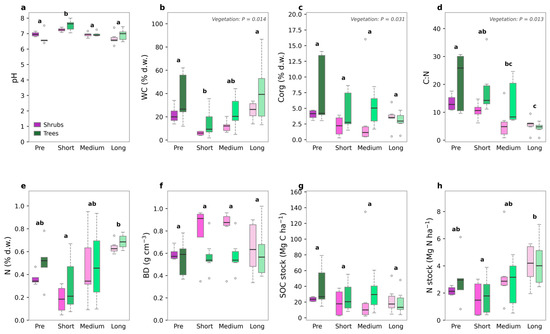
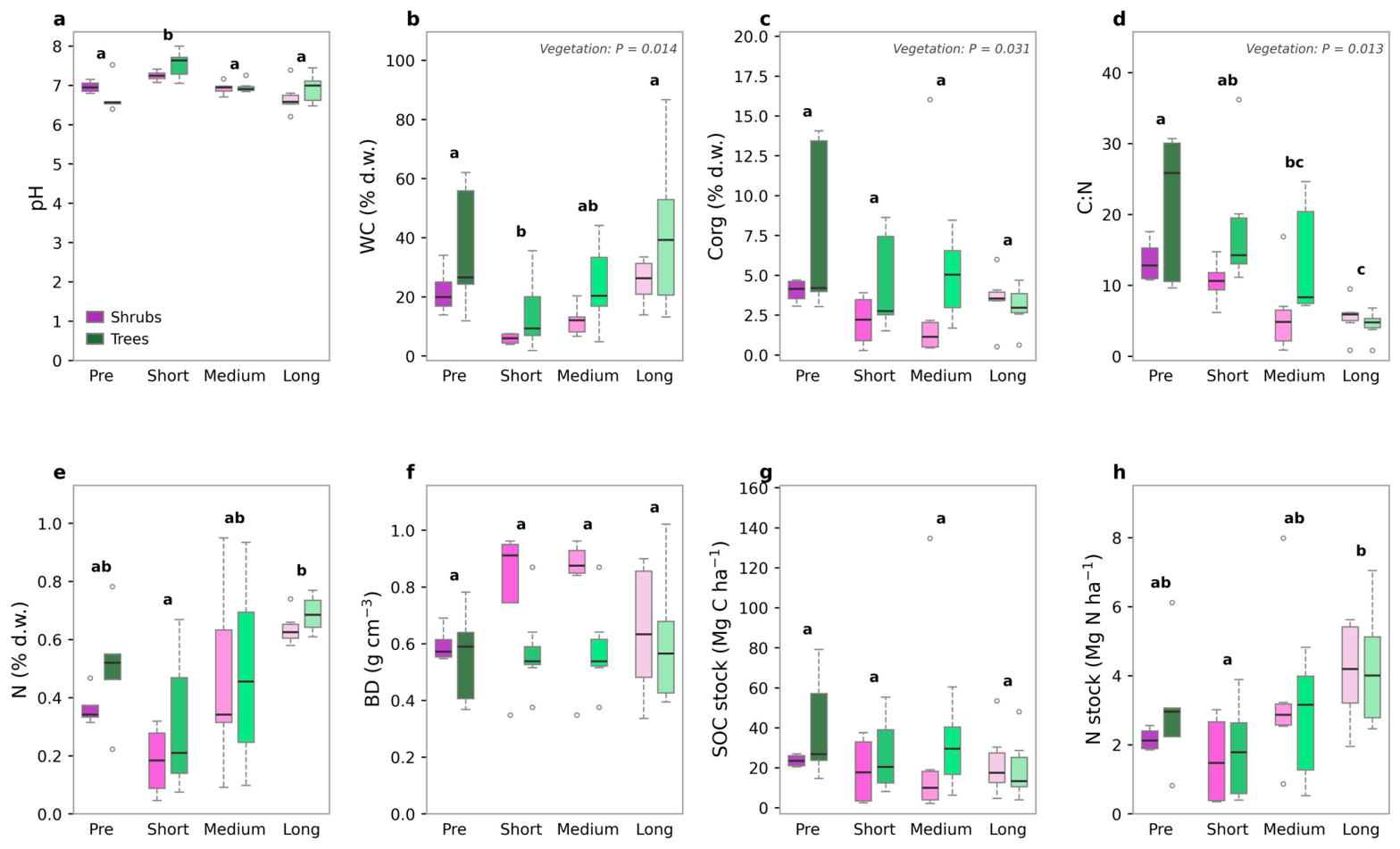
No significant sampling period × vegetation interaction was detected for any soil property (all p > 0.05; Table 2; Figure 1). Sampling period significantly affected soil pH, WC, total N concentration, and the Corg:N ratio (all p ≤ 0.0011), and had a weaker but significant effect on apparent fixed-depth N stock (Wald χ2 = 7.93, df = 3, p = 0.047). By contrast, Corg concentration, bulk density (BD), and apparent fixed-depth SOC stock did not differ significantly among sampling periods. Median pH increased from 6.78 before fire to 7.30 at short term and subsequently decreased to 6.92 and 6.70 at medium and long term, respectively; short-term values differed significantly from all other periods (Holm-adjusted p ≤ 0.015).
Table 2.
Results of the factorial models testing the effects of sampling period, vegetation cover, and their interaction on soil physicochemical properties and apparent fixed-depth stocks. Values are Type III Wald χ2 statistics and associated p-values (degrees of freedom: sampling period = 3, vegetation = 1, sampling period × vegetation = 3). Linear mixed-effects models included site identity as a random intercept to account for repeated observations. Significant effects (p < 0.05) are shown in bold. WC: water content; Corg: organic carbon concentration; Corg:N: soil organic carbon-to-total nitrogen ratio; SOC stock: apparent fixed-depth soil organic carbon stock; N stock: apparent fixed-depth total nitrogen stock; BD: bulk density.
Figure 1.
Boxplots of soil (a) pH, (b) water content (WC), (c) organic carbon concentration (Corg), (d) Corg:N ratio (C:N), (e) total N concentration, (f) bulk density (BD), (g) soil organic carbon (SOC) stock, and (h) total N stock in unburnt soils covered by shrubs (UB_S, deep dark violet) and trees (deep dark green) and in burnt soils covered by shrubs (BS) and trees (BT) at short (dark violet and green, respectively), medium (violet and green, respectively) and long term (light violet and green, respectively) after fire. Boxes represent the interquartile range, horizontal white lines indicate medians, whiskers indicate minimum and maximum values, and points represent individual site-level observations. Sample sizes were 9, 11, 12, and 12 sites for BF, ST, MT, and LT, respectively. Different letters indicate significant differences among sampling periods based on pairwise comparisons of estimated marginal means averaged over vegetation categories, with Holm-adjusted values.
Median WC decreased from 22.3% before fire to 7.57% at short term and then increased to 15.1% and 30.0% at medium and long term, with significantly lower values at short term than before fire and at long term (Holm-adjusted p = 0.003 and p < 0.001, respectively). The total N concentration decreased from 0.37% before fire to 0.21% at short term and subsequently increased to 0.34% and 0.65% at medium and long term; long-term values were significantly higher than pre-fire and short-term values (Holm-adjusted p = 0.024 and p < 0.001, respectively). The median Corg:N ratios were 13.4, 13.8, 7.29, and 5.16 before fire and at short, medium, and long term, respectively, with significant decreases from pre-fire to medium and long term and from short to long term (Holm-adjusted p ≤ 0.034). Apparent fixed-depth N stock increased from a median of 1.78 Mg N ha−1 at short term to 4.19 Mg N ha−1 at long term, and the difference between these periods was significant (Holm-adjusted p = 0.034). The apparent fixed-depth SOC stock declined from 27.9 Mg C ha−1 before fire to 15.6 Mg C ha−1 at long term, although this difference was not statistically significant. Across sampling periods, vegetation type significantly affected only WC and the Corg:N ratio (p = 0.019 and p = 0.042, respectively), both of which showed higher overall median values under trees than under shrubs (20.5 vs. 14.2% for WC and 13.3 vs. 9.13 for Corg:N ratio).
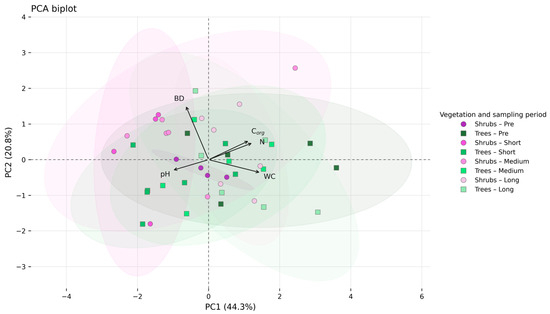
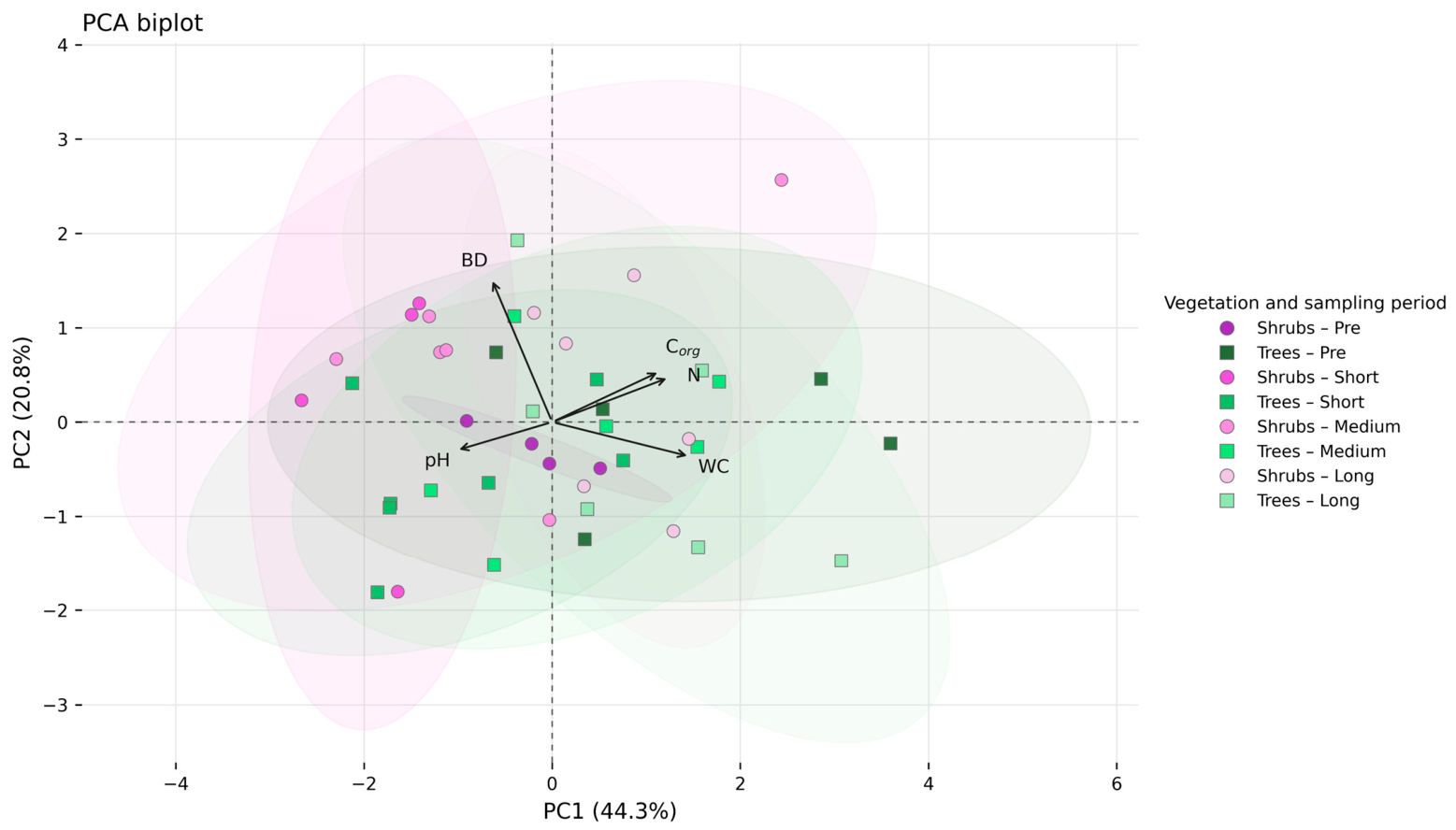
The first two principal components explained 65.1% of the total variance in the standardised soil property dataset, with PC1 and PC2 accounting for 44.3% and 20.8%, respectively (Figure 2; Tables S6 and S7). PC1 was primarily positively associated with WC, total N, and Corg, with loadings of 0.857, 0.729, and 0.671, respectively. Conversely, pH and BD were negatively associated with PC1, with loadings of −0.597 and −0.377, respectively. PC2 was mainly positively associated with BD (0.889), whereas the remaining variables showed weaker associations with this axis. Unburnt soils under trees were distributed predominantly towards positive PC1 scores and showed the greatest dispersion, consistent with their broad variation in WC and Corg. Burnt soils under shrubs were located mainly towards negative PC1 scores, whereas burnt soils under trees and unburnt soils under shrubs were distributed closer to the centre of the ordination. Nevertheless, the confidence ellipses showed extensive overlap among groups (Figure 2).
Figure 2.
Graphical display of the first two axes of the principal component analysis (PCA) on the soil abiotic (pH; water content, WC; organic carbon, Corg; total N concentration; and bulk density, BD) properties measured. Circles represent shrub-covered sites and squares represent tree-covered sites; progressively lighter violet and green shades indicate pre-fire, short-, medium-, and long-term sampling, respectively, from inside the Vesuvius National Park.
4. Discussion
In the investigated area, sampling period was the main factor associated with soil variability, whereas vegetation cover was associated only with WC and the Corg:N ratio. The absence of significant sampling period × vegetation interactions provides no evidence that soils under trees and shrubs followed distinct trajectories. Corg concentration and apparent fixed-depth SOC stock did not differ significantly among sampling periods, whereas apparent fixed-depth N stock showed a weaker sampling period effect, mainly reflecting its increase from short to long term. The absence of significant differences in Corg and apparent fixed-depth SOC stock is consistent with studies reporting limited or delayed soil C responses after fire, but contrasts with the persistent depletion observed in other ecosystems [11,37,38]. These contrasting findings indicate that the direction and duration of soil C responses depend on ecosystem characteristics, fire conditions, and the length of the observation period. The increase in total N concentration at long term agrees with studies showing that post-fire N responses may extend beyond the initial combustion phase [39,40,41,42]. However, it contrasts with the immediate N losses often attributed to volatilisation [5] and with the transient increases in inorganic N associated with mineralisation and reduced plant uptake [43]. This difference may partly reflect the timing of the present study because the first post-fire campaign was conducted approximately 22 months after fire, and total N, rather than individual inorganic N forms, was measured. The observed pattern therefore indicates that soil N remained responsive during the investigated period, although the underlying processes cannot be identified from the available data. The dynamics of SOC and N observed in the investigated sites, six years after fire, suggest that post-fire recovery trajectories may still be ongoing after six years, and that longer-term monitoring is required to capture potential alteration in SOC and N stocks.
Consistent with the contrasting patterns of Corg and N, the Corg:N ratio decreased markedly at medium and long term. This decrease was primarily associated with the relative increase in measured N rather than with a demonstrated loss of C or recovery of organic matter turnover. Similar variability in the relative responses of soil C, soil N, and C:N ratio following fire has been reported across ecosystems, depending on recovery stage, fire severity, fire frequency, and environmental conditions [5,11,38,39,44]. Fire may produce unequal changes in C and N because carbon-rich organic materials can be consumed during combustion, while part of the N may persist or subsequently occur in inorganic forms. Thus, preferential C loss and the persistence or subsequent formation of inorganic N reported in previous studies [7,30,42,45] provide a plausible context for the observed decline in Corg:N ratio. In the present study, however, the decline was more directly associated with increasing measured total N than with a significant change in Corg.
Vegetation type significantly affected the Corg:N ratio, with higher values under trees than under shrubs. Nevertheless, the absence of a significant sampling period × vegetation interaction indicates that its temporal pattern did not differ between the two vegetation categories. Vegetation type was not associated with Corg concentration, total N concentration, SOC stock, or N stock. The absence of vegetation effects on Corg, total N, and their apparent fixed-depth stocks agrees with studies indicating that broad vegetation categories do not always explain post-fire differences in soil C and N storage [46,47]. Thus, although trees and shrubs differ in structure and potential organic inputs, the present results provide no evidence of faster C accumulation or greater nutrient stabilisation under trees. The higher overall Corg:N ratio under trees may be related to differences in the quantity and chemical composition of plant inputs, because litter quality can influence decomposition and soil C and N dynamics [48,49]. This interpretation remains tentative, particularly because the broad vegetation categories included species with potentially contrasting litter characteristics.
In addition to nutrient-related properties, soil pH and WC differed among sampling campaigns. Soil pH reached its highest value at short term and subsequently declined, with short-term soils differing from all other campaigns. Transient increases in pH after fire are commonly related to ash deposition and the release of base cations during organic matter combustion [5,8,50,51] whereas subsequent decreases may reflect ash removal, leaching, and progressive changes in soil chemical conditions [30]. These processes are consistent with the observed short-term maximum, although ash characteristics and exchangeable cations were not determined.
By contrast, WC showed the opposite pattern, reaching its lowest median at short term and its highest value at long term. Post-fire reductions in soil moisture have been associated with changes in soil structure, surface cover, infiltration, evaporation, and water repellency [7,52]. Conversely, vegetation and litter development may reduce direct solar radiation and evaporation, thereby favouring soil moisture retention [52,53,54]. These mechanisms provide possible explanations for the observed pattern; however, WC variability may also reflect the meteorological conditions preceding each sampling campaign.
The PCA was consistent with the univariate results. The extensive overlap among confidence ellipses indicated that the combination of directly measured soil properties did not clearly separate the groups defined by vegetation and sampling condition. Accordingly, the ordination does not support distinct recovery trajectories under shrubs and trees.
5. Study Limitations
The principal limitation of this study is its observational design. Because pre-fire and post-fire observations were obtained from different calendar years and included both repeatedly sampled and campaign-specific sites, the effects of fire, sampling period, interannual meteorological variability, and spatial heterogeneity could not be fully separated. Moreover, contemporaneous unburnt controls were not available during the post-fire campaigns. The reported stocks were calculated for a fixed 0–10 cm layer and therefore depend on both elemental concentration and the mass of soil sampled. Although BD did not differ significantly among sampling periods, fixed-depth estimates cannot be considered equivalent-soil-mass estimates and should be interpreted as apparent stocks rather than direct evidence of C or N accumulation or loss. Finally, fire severity, inorganic N forms, nutrient fluxes, microbial processes, vegetation recovery, and litter quantity and quality were not measured, while the broad tree and shrub categories included species with potentially different functional characteristics. These limitations restrict causal and mechanistic interpretation but do not invalidate the observed differences among sampling campaigns.
6. Conclusions
The present study showed that sampling period was the main source of variation in soil properties, whereas vegetation cover played a secondary role. The initial hypotheses were only partially supported. Vegetation category was associated with WC and Corg:N, ratio but not with Corg, total N, or their apparent fixed-depth stocks, and the absence of sampling period × vegetation interactions provided no evidence of different SOC and N trajectories under shrubs and trees. Total N concentration and apparent fixed-depth N stock increased from short to long term, whereas Corg concentration and SOC stock did not differ significantly among sampling periods. The marked decline in Corg:N therefore indicates a change in soil elemental balance driven primarily by the greater responsiveness of N rather than demonstrated organic matter accumulation. Overall, soil stoichiometry and water status were more responsive than C storage, identifying pH, WC, total N, and Corg:N ratio as complementary indicators for monitoring fire-prone Mediterranean soils.
These observational patterns cannot be attributed exclusively to fire or elapsed time. Future studies should combine permanent paired burned and unburnt plots with equivalent-soil-mass estimates and measurements of fire severity, meteorological conditions, vegetation recovery, litter inputs, and biological processes to clarify the mechanisms and longer-term direction of soil recovery.
Supplementary Materials
The following supporting information can be downloaded at https://www.mdpi.com/article/10.3390/f17091032/s1, Table S1: Sampling history of the physical sites included in the study, showing the original sample labels and vegetation categories recorded during the pre-fire campaigns (BF: 2015–2017) and the short-, medium-, and long-term post-fire campaigns (ST: 2019, MT: 2021, and LT: 2023, respectively). The table also identifies sites sampled during multiple analytical periods; Table S2: Box–Cox transformations, random-effect estimates, diagnostic statistics and model-level effect sizes for the mixed-effects models. All response variables were Box–Cox transformed using the reported λ parameters. represents the variance explained by the fixed effects, whereas represents the variance explained by both fixed and random effects. ICC is the intraclass correlation coefficient associated with physical site identity. A boundary fit indicates that the estimated site-level variance approached zero. Residual normality was evaluated using the Shapiro–Wilk statistic together with graphical inspection of quantile–quantile and residual-versus-fitted plots; Table S3: Fixed-effect coefficients and 95% confidence intervals from the mixed-effects models. Coefficients are reported on the Box–Cox-transformed scale. The intercept represents shrub-covered soil under pre-fire conditions. BF and shrub were the reference levels. ST, MT and LT indicate short-, medium- and long-term post-fire sampling, respectively. Each cell contains the coefficient estimate followed by its 95% confidence interval; Table S4: Back-transformed estimated marginal means and 95% confidence intervals for sampling period and vegetation category. Sampling-period EMMs were averaged equally over vegetation categories, whereas vegetation EMMs were averaged equally over sampling periods. Statistical inference was performed on the transformed scale. Values shown here were returned to the original measurement scale using the inverse Box–Cox transformation; Table S5: Significant pairwise comparisons among sampling-period or vegetation-category EMMs. P-values were adjusted using the Holm procedure within each response variable. Standardised differences were calculated on the transformed model scale by dividing the contrast by the residual standard deviation. Absolute values of approximately 0.2, 0.5 and 0.8 correspond to small, moderate and large standardised differences, respectively; Table S6: Eigenvalues, percentage of variance explained, and cumulative variance explained by the five principal components obtained from the PCA of the standardised soil physicochemical variables. The analysis included pH, water content (WC), soil organic carbon concentration (Corg), total nitrogen concentration (N), and bulk density (BD). All variables were centred and scaled to unit variance before analysis; Table S7: Loadings of the five standardised soil physicochemical variables on the five principal components. Loadings represent correlations between each original variable and the corresponding principal component. The PCA was conducted on 44 site-by-period observations. Corg, soil organic carbon concentration; WC, water content; N, total nitrogen concentration; BD, bulk density; Table S8: Median [first–third quartile] and minimum–maximum range calculated for soil organic carbon concentration (Corg), total nitrogen concentration, bulk density (BD), apparent fixed-depth SOC stock, and apparent fixed-depth N stock according to sampling time and vegetation category. The number of site-level observations is reported for each combination. BF, pre-fire baseline; ST, short-term; MT, medium-term; LT, long-term; Table S9: Comparison between the present study and previous publications by the research team, indicating the sampling campaigns whose data were partially used in each publication; Statistical_analyses_S1. Complete R script used for data import, calculation checks, Box–Cox transformations, mixed-effects models, model diagnostics, estimated marginal means, pairwise comparisons, effect-size calculations, boxplots, and principal component analysis.
Author Contributions
V.M.: Conceptualization, Methodology, Software, Validation, Formal Analysis, Investigation, Data Curation, and Writing—Original Draft; L.S.: Methodology, Software, Validation, Writing—Review and Editing, and Visualisation; G.S.: Methodology, Validation, and Visualisation; M.Z.: Methodology, Validation, and Visualisation; S.C.P.: Validation and Visualisation; G.D.N.: Methodology, Validation, Data Curation, Formal Analyses, and Visualisation; M.T.: Methodology, Validation, Data Curation, Formal Analyses, and Visualisation; R.B.: Validation, Visualisation, Resources, Funding Acquisition, and Project Administration; A.D.M.: Validation and Visualisation; G.M.: Conceptualization, Methodology, Writing—Original Draft, Writing—Review and Editing, Supervision, Project Administration, and Funding Acquisition. All authors have read and agreed to the published version of the manuscript.
Funding
The research was funded by the collaboration of the Biology Department of University Federico II of Naples and the Vesuvius National Park within the projects: “Azione di Sistema—Impatto antropico da pressione turistica nelle aree protette: interferenze su territorio e biodiversità—CUP: E65J13000030001”; “Effetti del traffico veicolare e degli incendi sulle caratteristiche del suolo (Pedo-Inc)—CUP: E65J13000030001”; “Effetti del traffico veicolare e degli incendi sulle caratteristiche del suolo (Pedo-Inc2)—CUP: E65J13000030001”; and “Biomonitoraggio della qualità dei suoli del Parco Nazionale de Vesuvio (Pedo-Biomon)—CUP: E65F21004140005” funded by “Ministero dell’Ambiente e della Tutela del Territorio e del Mare”, Direttiva Conservazione della Biodiversità.
Data Availability Statement
The complete R code used for data verification, stock calculations, statistical analyses, and figures is provided in the Supplementary Materials. The site-level dataset is subject to third-party ownership restrictions and cannot be made publicly available without authorisation from the data owner. Requests for access may be considered subject to the owner’s permission.
Conflicts of Interest
The authors declare that they have no known competing financial interests or personal relationships that could have appeared to influence the work reported in this paper.
References
- du Toit, J.T.; Rogers, K.H.; Biggs, H.C. (Eds.) The Kruger Experience: Ecology and Management of Savanna Heterogeneity; Island Press: Washington, DC, USA, 2003; ISBN 978-1-55963-982-8. [Google Scholar]
- He, T.; Lamont, B.B.; Pausas, J.G. Fire as a key driver of Earth’s biodiversity. Biol. Rev. 2019, 94, 1983–2010. [Google Scholar] [CrossRef] [Scilit]
- Higgins, S.I.; Bond, W.J.; Trollope, W.S.W. Fire, resprouting and variability: A recipe for grass–tree coexistence in savanna. J. Ecol. 2000, 88, 213–229. [Google Scholar] [CrossRef] [Scilit]
- Panico, S.C.; Memoli, V.; Santorufo, L.; Aiello, S.; Barile, R.; De Marco, A.; Maisto, G. Soil biological responses under different vegetation types in Mediterranean area. Int. J. Environ. Res. Public Health 2022, 19, 903. [Google Scholar] [CrossRef] [Scilit]
- Agbeshie, A.A.; Abugre, S.; Atta-Darkwa, T.; Awuah, R. A review of the effects of forest fire on soil properties. J. For. Res. 2022, 33, 1419–1441. [Google Scholar] [CrossRef] [Scilit]
- Catalanotti, A.E.; Giuditta, E.; Marzaioli, R.; Ascoli, D.; Esposito, A.; Strumia, S.; Mazzoleni, S.; Rutigliano, F.A. Effects of single and repeated prescribed burns on soil organic C and microbial activity in a Pinus halepensis plantation of southern Italy. Appl. Soil Ecol. 2018, 125, 108–116. [Google Scholar] [CrossRef] [Scilit]
- Certini, G. Effects of fire on properties of forest soils: A review. Oecologia 2005, 143, 1–10. [Google Scholar] [CrossRef] [Scilit]
- Santorufo, L.; Memoli, V.; Panico, S.C.; Santini, G.; Barile, R.; Di Natale, G.; Trifuoggi, M.; De Marco, A.; Maisto, G. Early post-fire changes in properties of Andosols within a Mediterranean area. Geoderma 2021, 394, 115016. [Google Scholar] [CrossRef] [Scilit]
- Certini, G.; Moya, D.; Lucas-Borja, M.E.; Mastrolonardo, G. The impact of fire on soil-dwelling biota: A review. For. Ecol. Manag. 2021, 488, 118989. [Google Scholar] [CrossRef] [Scilit]
- Cheng, Y.; Luo, P.; Yang, H.; Li, H.; Luo, C.; Jia, H.; Huang, Y. Fire effects on soil carbon cycling pools in forest ecosystems: A global meta-analysis. Sci. Total Environ. 2023, 895, 165001. [Google Scholar] [CrossRef] [Scilit]
- Ferreira, C.S.S.; Seifollahi-Aghmiuni, S.; Destouni, G.; Ghajarnia, N.; Kalantari, Z. Soil degradation in the European Mediterranean region: Processes, status and consequences. Sci. Total Environ. 2022, 805, 150106. [Google Scholar] [CrossRef] [Scilit]
- Doane, T.A. A survey of photogeochemistry. Geochem. Trans. 2017, 18, 1. [Google Scholar] [CrossRef] [Scilit]
- Kuypers, M.M.M.; Marchant, H.K.; Kartal, B. The microbial nitrogen-cycling network. Nat. Rev. Microbiol. 2018, 16, 263–276. [Google Scholar] [CrossRef] [Scilit]
- Burrell, A.L.; Sun, Q.; Baxter, R.; Kukavskaya, E.A.; Zhila, S.; Shestakova, T.; Rogers, B.M.; Kaduk, J.; Barrett, K. Climate change, fire return intervals and the growing risk of permanent forest loss in boreal Eurasia. Sci. Total Environ. 2022, 831, 154885. [Google Scholar] [CrossRef] [Scilit]
- Nolè, A.; Rita, A.; Spatola, M.F.; Borghetti, M. Biogeographic variability in wildfire severity and post-fire vegetation recovery across the European forests via remote sensing-derived spectral metrics. Sci. Total Environ. 2022, 823, 153807. [Google Scholar] [CrossRef] [Scilit]
- Lin, S.; He, Z.; Huang, H.; Chen, L.; Li, L. Mixed forest specific calibration of the 3-PGmix model parameters from site observations to predict post-fire forest regrowth. For. Ecol. Manag. 2022, 515, 120208. [Google Scholar] [CrossRef] [Scilit]
- Fornara, D.A.; Tilman, D. Plant functional composition influences rates of soil carbon and nitrogen accumulation. J. Ecol. 2008, 96, 314–322. [Google Scholar] [CrossRef] [Scilit]
- Panico, S.C.; Memoli, V.; Santorufo, L.; Esposito, F.; De Marco, A.; Barile, R.; Maisto, G. Linkage between site features and soil characteristics within a Mediterranean volcanic area. Front. For. Glob. Change 2021, 3, 621231. [Google Scholar] [CrossRef] [Scilit]
- Hinojosa, M.B.; Parra, A.; Laudicina, V.A.; Moreno, J.M. Post-fire soil functionality and microbial community structure in a Mediterranean shrubland subjected to experimental drought. Sci. Total Environ. 2016, 573, 1178–1189. [Google Scholar] [CrossRef] [Scilit]
- Úbeda, X.; Lorca, M.; Outeiro, L.; Bernia, S.; Castellnou, M. Effects of prescribed fire on soil quality in Mediterranean grassland (Prades Mountains, north-east Spain). Int. J. Wildland Fire 2005, 14, 379–384. [Google Scholar] [CrossRef] [Scilit]
- Alcañiz, M.; Outeiro, L.; Francos, M.; Farguell, J.; Úbeda, X. Long-term dynamics of soil chemical properties after a prescribed fire in a Mediterranean forest (Montgrí Massif, Catalonia, Spain). Sci. Total Environ. 2016, 572, 1329–1335. [Google Scholar] [CrossRef] [Scilit]
- Tomkins, I.B.; Kellas, J.D.; Tolhurst, K.G.; Oswin, D.A. Effects of fire intensity on soil chemistry in a eucalypt forest. Aust. J. Soil Res. 1991, 29, 25–47. [Google Scholar] [CrossRef] [Scilit]
- Murphy, J.; Johnson, D.; Miller, W.; Walker, R.; Blank, R. Prescribed fire effects on forest floor and soil nutrients in a Sierra Nevada forest. Soil Sci. 2006, 171, 181–199. [Google Scholar] [CrossRef] [Scilit]
- Hubbard, R.M.; Vose, J.M.; Clinton, B.D.; Elliott, K.J.; Knoepp, J.D. Stand restoration burning in oak–pine forests in the southern Appalachians: Effects on aboveground biomass and carbon and nitrogen cycling. For. Ecol. Manag. 2004, 190, 311–321. [Google Scholar] [CrossRef] [Scilit]
- Pellegrini, A.F.A.; Ahlström, A.; Hobbie, S.E.; Reich, P.B.; Nieradzik, L.P.; Staver, A.C.; Scharenbroch, B.C.; Jumpponen, A.; Anderegg, W.R.L.; Randerson, J.T.; et al. Fire frequency drives decadal changes in soil carbon and nitrogen and ecosystem productivity. Nature 2018, 553, 194–198. [Google Scholar] [CrossRef] [Scilit]
- Brye, K.R. Soil physiochemical changes following 12 years of annual burning in a humid–subtropical tallgrass prairie: A hypothesis. Acta Oecol. 2006, 30, 407–413. [Google Scholar] [CrossRef] [Scilit]
- Alcañiz, M.; Outeiro, L.; Francos, M.; Úbeda, X. Effects of prescribed fires on soil properties: A review. Sci. Total Environ. 2018, 613–614, 944–957. [Google Scholar] [CrossRef] [Scilit]
- Bowd, E.J.; Banks, S.C.; Strong, C.L.; Lindenmayer, D.B. Long-term impacts of wildfire and logging on forest soils. Nat. Geosci. 2019, 12, 113–118. [Google Scholar] [CrossRef] [Scilit]
- Caon, L.; Vallejo, V.R.; Ritsema, C.J.; Geissen, V. Effects of wildfire on soil nutrients in Mediterranean ecosystems. Earth-Sci. Rev. 2014, 139, 47–58. [Google Scholar] [CrossRef] [Scilit]
- González-Pérez, J.A.; González-Vila, F.J.; Almendros, G.; Knicker, H. The effect of fire on soil organic matter—A review. Environ. Int. 2004, 30, 855–870. [Google Scholar] [CrossRef] [Scilit]
- Hurteau, M.D.; Brooks, M.L. Short- and long-term effects of fire on carbon in US dry temperate forest systems. BioScience 2011, 61, 139–146. [Google Scholar] [CrossRef] [Scilit]
- McLauchlan, K.K.; Higuera, P.E.; Miesel, J.; Rogers, B.M.; Schweitzer, J.; Shuman, J.K.; Tepley, A.J.; Varner, J.M.; Veblen, T.T.; Adalsteinsson, S.A.; et al. Fire as a fundamental ecological process: Research advances and frontiers. J. Ecol. 2020, 108, 2047–2069. [Google Scholar] [CrossRef] [Scilit]
- Saulino, L.; Rita, A.; Migliozzi, A.; Maffei, C.; Allevato, E.; Garonna, A.P.; Saracino, A. Detecting burn severity across Mediterranean forest types by coupling medium-spatial resolution satellite imagery and field data. Remote Sens. 2020, 12, 741. [Google Scholar] [CrossRef] [Scilit]
- De Marco, A.; Napoletano, P.; Panico, S.C.; Memoli, V.; Santorufo, L.; Ruggiero, A.G.; Colombo, C.; Barile, R.; Maisto, G. Combined effect of black locust invasion and fire on soils of Mediterranean shrublands and pine forests. Catena 2023, 220, 106656. [Google Scholar] [CrossRef] [Scilit]
- Di Gennaro, A.; Aronne, G.; De Mascellis, R.; Vingiani, S.; Sarnataro, M.; Abalsamo, P.; Cona, F.; Vitelli, L.; Arpaia, G. I Sistemi di Terre Della Campania: Monografia e Carta 1:250,000, con Legenda; Regione Campania, Assessorato Regionale alla Ricerca Scientifica: Florence, Italy; SELCA: Florence, Italy, 2002; 63p. [Google Scholar]
- Allen, S.E. (Ed.) Chemical Analysis of Ecological Materials, 2nd ed.; Blackwell Scientific Publications: Oxford, UK, 1989; 368p, ISBN 978-0-632-01742-3. [Google Scholar]
- Ludwig, S.M.; Alexander, H.D.; Kielland, K.; Mann, P.J.; Natali, S.M.; Ruess, R.W. Fire severity effects on soil carbon and nutrients and microbial processes in a Siberian larch forest. Glob. Change Biol. 2018, 24, 5841–5852. [Google Scholar] [CrossRef] [Scilit]
- Nave, L.E.; Vance, E.D.; Swanston, C.W.; Curtis, P.S. Fire effects on temperate forest soil C and N storage. Ecol. Appl. 2011, 21, 1189–1201. [Google Scholar] [CrossRef] [Scilit]
- Roth, H.K.; McKenna, A.M.; Simpson, M.J.; Chen, H.; Srikanthan, N.; Fegel, T.S.; Nelson, A.R.; Rhoades, C.C.; Wilkins, M.J.; Borch, T. Effects of burn severity on organic nitrogen and carbon chemistry in high-elevation forest soils. Soil Environ. Health 2023, 1, 100023. [Google Scholar] [CrossRef] [Scilit]
- Jones, R.; Chambers, J.C.; Johnson, D.W.; Blank, R.R.; Board, D.I. Effect of repeated burning on plant and soil carbon and nitrogen in cheatgrass (Bromus tectorum)-dominated ecosystems. Plant Soil 2015, 386, 47–64. [Google Scholar] [CrossRef] [Scilit]
- Verma, S.; Jayakumar, S. Impact of forest fire on physical, chemical and biological properties of soil: A review. Proc. Int. Acad. Ecol. Environ. Sci. 2012, 2, 168–176. [Google Scholar]
- Turner, M.G.; Smithwick, E.A.H.; Metzger, K.L.; Tinker, D.B.; Romme, W.H. Inorganic nitrogen availability after severe stand-replacing fire in the Greater Yellowstone ecosystem. Proc. Natl. Acad. Sci. USA 2007, 104, 4782–4789. [Google Scholar] [CrossRef] [Scilit]
- Köster, K.; Kohli, J.; Lindberg, H.; Pumpanen, J. Post-fire soil greenhouse gas fluxes in boreal Scots pine forests—Are they affected by surface fires with different severities? Agric. For. Meteorol. 2024, 349, 109954. [Google Scholar] [CrossRef] [Scilit]
- Souza-Alonso, P.; Prats, S.A.; Merino, A.; Guiomar, N.; Guijarro, M.; Madrigal, J. Fire enhances changes in phosphorus (P) dynamics determining potential post-fire soil recovery in Mediterranean woodlands. Sci. Rep. 2024, 14, 21718. [Google Scholar] [CrossRef] [Scilit]
- Martí-Roura, M.; Casals, P.; Romanyà, J. Long-term retention of post-fire soil mineral nitrogen pools in Mediterranean shrubland and grassland. Plant Soil 2013, 371, 521–531. [Google Scholar] [CrossRef] [Scilit]
- Xu, W.; Elberling, B.; Ambus, P.L. Fire increases soil nitrogen retention and alters nitrogen uptake patterns among dominant shrub species in an Arctic dry heath tundra. Sci. Total Environ. 2022, 807, 150990. [Google Scholar] [CrossRef] [Scilit]
- Rocci, K.S.; Cleveland, C.C.; Eastman, B.A.; Georgiou, K.; Grandy, A.S.; Hartman, M.D.; Hauser, E.; Holland-Moritz, H.; Kyker-Snowman, E.; Pierson, D.; et al. Aligning theoretical and empirical representations of soil carbon-to-nitrogen stoichiometry with process-based terrestrial biogeochemistry models. Soil Biol. Biochem. 2024, 189, 109272. [Google Scholar] [CrossRef] [Scilit]
- Santorufo, L.; Panico, S.C.; Zarrelli, A.; De Marco, A.; Santini, G.; Memoli, V.; Maisto, G. Examining litter and soil characteristics impact on decomposer communities, detritivores and carbon accumulation in the Mediterranean area. Plant Soil 2024, 505, 381–396. [Google Scholar] [CrossRef] [Scilit]
- Osei, R.; Titeux, H.; Bielak, K.; Bravo, F.; Collet, C.; Cools, C.; Cornelis, J.-T.; Heym, M.; Korboulewsky, N.; Löf, M.; et al. Tree species identity drives soil organic carbon storage more than species mixing in major two-species mixtures (pine, oak, beech) in Europe. For. Ecol. Manag. 2021, 481, 118752. [Google Scholar] [CrossRef] [Scilit]
- Molina, M.; Fuentes, R.; Calderón, R.; Escudey, M.; Avendaño, K.; Gutiérrez, M.; Chang, A. Impact of forest fire ash on surface charge characteristics of Andisols. Soil Sci. 2007, 172, 820–834. [Google Scholar] [CrossRef] [Scilit]
- Schafer, J.L.; Mack, M.C. Short-term effects of fire on soil and plant nutrients in palmetto flatwoods. Plant Soil 2010, 334, 433–447. [Google Scholar] [CrossRef] [Scilit]
- Gaudio, N.; Gendre, X.; Saudreau, M.; Seigner, V.; Balandier, P. Impact of tree canopy on thermal and radiative microclimates in a mixed temperate forest: A new statistical method to analyse hourly temporal dynamics. Agric. For. Meteorol. 2017, 237–238, 71–79. [Google Scholar] [CrossRef] [Scilit]
- Padovan, M.P.; Brook, R.M.; Barrios, M.; Cruz-Castillo, J.B.; Vilchez-Mendoza, S.J.; Costa, A.N.; Rapidel, B. Water loss by transpiration and soil evaporation in coffee shaded by Tabebuia rosea Bertol. and Simarouba glauca DC. compared to unshaded coffee in sub-optimal environmental conditions. Agric. For. Meteorol. 2018, 248, 1–14. [Google Scholar] [CrossRef] [Scilit]
- Strydom, T.; Smit, I.P.J.; van Tol, J.J. Short- and long-term fire effects on soil C and N in an African savanna. Geoderma Reg. 2024, 37, e00802. [Google Scholar] [CrossRef] [Scilit]

Disclaimer/Publisher’s Note: The statements, opinions and data contained in all publications are solely those of the individual author(s) and contributor(s) and not of MDPI and/or the editor(s). MDPI and/or the editor(s) disclaim responsibility for any injury to people or property resulting from any ideas, methods, instructions or products referred to in the content. |
© 2026 by the authors. Licensee MDPI, Basel, Switzerland. This article is an open access article distributed under the terms and conditions of the Creative Commons Attribution (CC BY) license.