


Abstract
Post-transplant shock is a key barrier to seedling establishment in Mediterranean-type ecosystems, especially when plant species are selected without consideration of functional traits conferring drought resistance. In this study, we investigated the responses to soil water restriction after the planting of six native sclerophyllous species, with growth form and leaf habit of evergreen trees (Lithraea caustica, Quillaja saponaria, Escallonia pulverulenta, Peumus boldus), semideciduous (Colliguaya odorifera), and deciduous shrubs (Vachellia caven), in a Mediterranean-type climate site in Central Chile. Seedlings were outplanted with tree shelters on a fire-disturbed site and subjected to two contrasting watering regimes during summer (2 L−1 week−1 seedling−1 for 5 months versus no watering). We assessed growth, survival, gas exchange, and midday water potential one season after planting. Species differed markedly in their drought response strategies. Deciduous shrubs such as V. caven maintained high stomatal conductance and photosynthesis despite the relatively high water potential, whereas evergreen trees sustained lower water potential through pronounced stomatal closure. The highest survival (>80%) and height increments were observed in V. caven, Q. saponaria, and C. odorifera. In contrast, E. pulverulenta exhibited positive increments in height but medium survival (63%), whereas P. boldus exhibited the poorest survival (33%), indicative of low capacity to survive and successfully establish after dry summers in Mediterranean-type climates. The different strategies of the species to cope with the post-transplant shock and the harsh conditions of the planting site may guide the selection of appropriate species to guarantee the successful seedling establishment and to support the future restoration of degraded sites characterized by long periods of drought.
1. Introduction
Mediterranean-type ecosystems are characterized by dry and hot summers and low soil moisture availability, which challenge restoration projects because newly established seedlings must tolerate long periods of drought. In these ecosystems, seedling survival depends on adaptation strategies to cope with drought after the post-transplant shock [1,2]. Functional traits such as reduced leaf area, steeply leaf angles [3,4,5], strict stomatal control over transpiration [6], and the ability to extend roots towards new volumes of soil [7] allow sclerophyllous species to survive in harsh Mediterranean climates. The morphological attributes of seedlings at establishment are also important traits in controlling the successful establishment and survival of newly planted seedlings [8,9,10]. High quality of seedlings positively influences outplanting performance [11,12,13], and morphological attributes such as plant height and root collar diameter are considered good predictors of outplanting survival [14]. In general, the establishment of seedlings with high body mass increases their chances of survival as they possess larger roots that confer the capacity to explore moisture in deep soil horizons [15,16,17,18]. Exceptionally, small seedlings can experience higher survival rates, which is attributed to their low transpiring area that decreases the risk of desiccation [19].
In the Mediterranean semi-arid ecosystem of Central Chile (30° to 36° S), which covers c.a. 2 million hectares [20], most of the vegetation types are dry xerophytic and mesic communities dominated by evergreen and deciduous sclerophyllous species. The most common tree species of this ecosystem are Vachellia caven Arn. (Fabales: Fabaceae), Quillaja saponaria (Mol.) (Rosales: Rosaceae), Escallonia pulverulenta (Ruiz et Pav.) Pers. (Escalloniales: Escalloniaceae), Peumus boldus Mol. (Laurales: Monimiaceae), and Colliguaya odorifera Mol. (Malpighiales: Euphorbiaceae), among others [21]. These species have adaptations such as small compound leaves with reduced leaf area (V. caven), steeply inclined leaves (60° or higher, C. odorifera), leaf folding and rolling (P. boldus, E. pulverulenta), deep root systems and strict stomatal control (L. caustica, Q. saponaria) [3,22,23,24,25,26]. For these species, there is insufficient information on the physiological mechanisms that newly established seedlings possess to cope with post-transplant shock and to support growth and survival during the summer months in an ecosystem characterized by water scarcity. In a field study, Espinoza et al. [26,27] reported that V. caven and C. odorifera were the highest performers in terms of photochemical efficiency of photosystem II (PSII) in comparison to the evergreen P. boldus, which tended to suffer photoinhibition due to the high temperatures and water scarcity during the summer months. Yañez et al. [25], in a controlled experiment of shade and water restriction, found that C. odorifera and P. boldus exhibited the highest and lowest photosynthetic performance (photosynthesis and stomatal conductance), respectively. Overall, beyond responses observed in adult trees of some species in the Mediterranean semi-arid ecosystem of Central Chile [28,29] or in pot studies [30,31], there is still limited knowledge about the adaptive mechanisms that newly established seedlings from sclerophyllous species employ to overcome post-transplant shock. Analogously, supporting irrigation and/or rescue irrigation for planted seedlings has been little explored in these ecosystems despite the positive effects on seedling survival and establishment [32,33,34]. Espinoza et al. [26] reported no significant effect of watering on the chlorophyll fluorescence variability of V. caven, P. boldus, E. pulverulenta, Q. saponaria, C. odorifera and L. caustica established in a drought-prone site. The authors concluded that under the harsh conditions of the planting site; characterized by dry and warm summers with high temperatures and radiation loads, foliar adaptations among species, more than summer irrigation, explain species’ photosynthetic performance.
As global climate models project an increase in the number of extreme droughts in Central Chile [35], it is important to understand the functional traits that explain post-transplant survival under drought in sclerophyllous tree species in a Mediterranean-type ecosystem. This is particularly important in young seedlings as they are more susceptible to drought than their adults [36]. Thus, this information is fundamental to assisting species selection to restore ecosystems where water availability is insufficient to support survival and growth during the summer months [37]. In this context and given the different behaviors and growth habits among Chilean sclerophyllous species, we have undertaken a comparative field experiment to investigate the responses followed by newly established seedlings in terms of growth, survival, gas exchange, and water potential. The aim of this study was to investigate the functional mechanisms to withstand post-transplant water stress in six Chilean sclerophyllous species having different behavior and growth habits (V. caven, L. caustica, Q. saponaria, E. pulverulenta, P. boldus, and C. odorifera), established in a Mediterranean-type climate site and submitted to two irrigation treatments.
2. Materials and Methods
2.1. Site Characterization and Species Descriptions
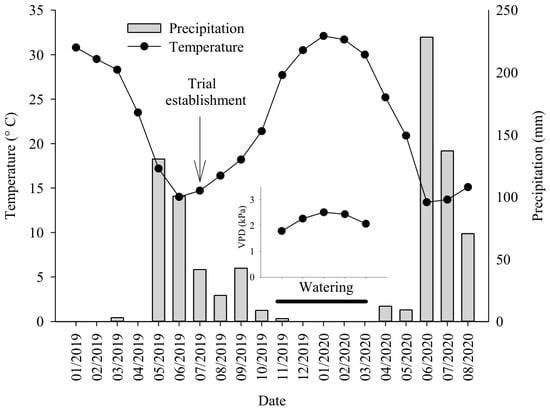
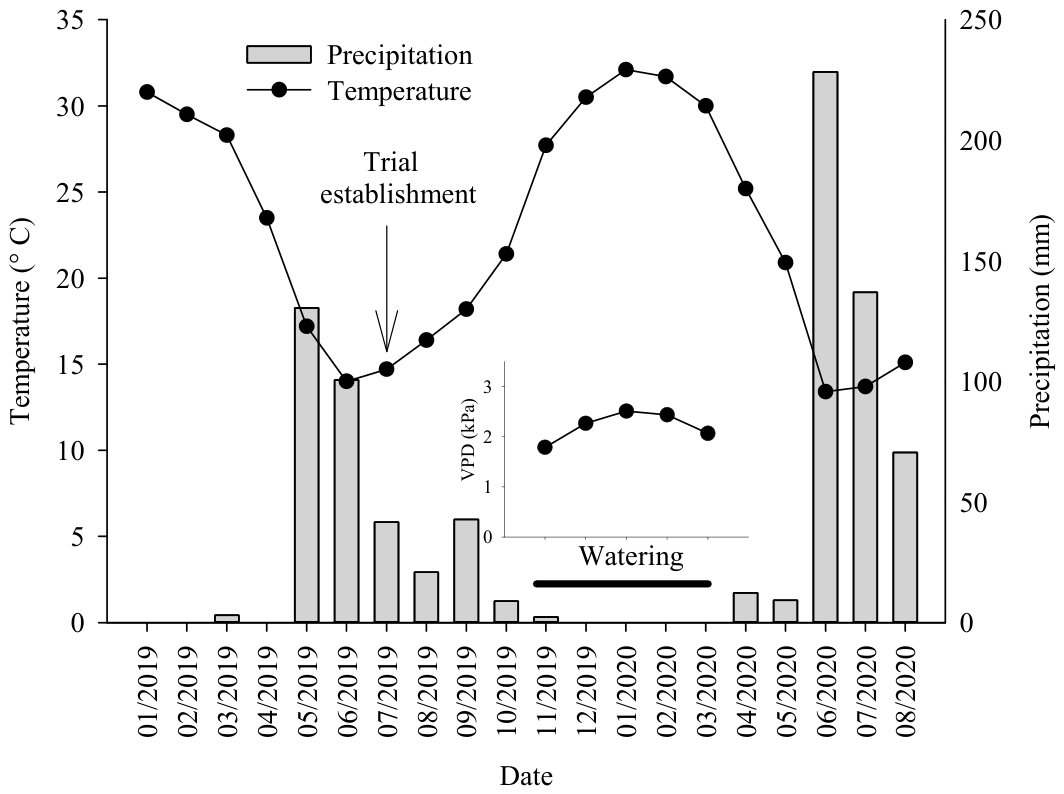
The study was carried out in the Las Brisas Experimental Station, property of the Universidad de Chile (35°34′ S, 72°06′ W, 254 m a.s.l.). The climate is Mediterranean semi-arid with seven dry months per year and 90% of the annual precipitation concentrated from June to August. Mean annual precipitation is 734 mm, and annual mean temperature is 13.7 °C. During the study period (5 months, November 2019 to March 2020), monthly mean temperatures and total precipitation were 20.1 °C and 2.4 mm, whereas total precipitation during spring months (September–December) was 54.1 mm (Figure 1). During the hottest months of the experiment, the vapor pressure deficit (VPD) reached daily maximum values close to 3.0 kPa. The soil at the study site is sandy clay, with pH 6.1, and 1.5% organic matter content. The levels of available N, P, and K were 4, 8, and 168 mg kg−1, respectively. Seeds of six species naturally occurring in Central Chile were collected at 20 km from the planting site and raised in a nursery. Each species was represented by a mix of seeds from different mother trees. Seedlings were cultivated in containers with 140 mL capacity and filled with composted bark of Pinus radiata D. Don (Pinales: Pinaceae) and slow-release fertilizer.
Figure 1.
Maximum temperature and monthly precipitation during the study period. An arrow indicates the date of planting. A solid horizontal line indicates the watering period, and the average monthly VPD values for the same period are shown in the inset graph.
2.2. Experimental Design and Preliminary Measurements
During July 2019, we established a total of 600 seedlings arranged in a split-plot design with five blocks. The main plot corresponded to two watering treatments applied from November 2019 to March 2020, which were 2 L plant−1 week−1 (W+) versus no watering (W−), and were separated 20 m from each other to avoid crossover of the watering effect. The volume of 2 L plant−1 week−1 was designed to mimic operational irrigation practices in restoration projects. We built a small semi-circular microcatchment (radius 30 cm) around each seedling, and watering was provided by manually dumping 2 L of water per seedling and date. The sub-plot treatment corresponded to the six species described in Table 1 and Figure 2. During the study period, we measured soil water content at a depth of 20 cm by using a soil moisture sensor (GS3 dielectric probe, Decagon Devices Inc., Pullman, WA, USA). In the W+ treatment, average values were 0.26 and 0.18 cm3 cm−3 on the same day and two days after irrigation. In the W− treatment, soil moisture averaged 0.15 cm3 cm−3. A rectangular plot of 10 trees (60 plots in total) in a 2 m × 5 m seedling arrangement (spacing of 1 × 1 m) was the experimental plot (i.e., 2 watering regimes × 6 species × 5 blocks × 10 seedlings per plot = 600 seedlings), and a row of L. caustica seedlings surrounded the trial. Seedlings were hand-planted, and no fertilizer was added to the planting holes. Plots were fenced to exclude herbivores, and tree shelters 80 cm tall (Bioland S.A., Santiago, Chile) were installed at each seedling. In January 2020, the photosynthetically active radiation (PAR), measured over one week at 12.00 midday using an LI-6800-01A light source (LI-COR Inc., Lincoln, NE, USA), was 300 μmol m−2 s−1 inside the shelters (i.e., 15% of full sunlight). To estimate growth increments, we measured height (H) and root collar diameter (D) in all seedlings before planting the experiment. H and D were measured using a stainless-steel ruler and a digital caliper, respectively, and the slenderness index was estimated as the height-to-diameter ratio (H/D). Additionally, before being planted in the field, we randomly sampled 15 seedlings per species to determine biomass partitioning. Seedlings were carefully removed from their containers, and the root systems were gently washed with tap water over a fine-mesh sieve (≤1 mm) to remove all substrate while minimizing loss of fine roots. Each seedling was then separated at the root collar into aboveground (stem + leaves) and belowground (root) fractions using a scalpel. The two fractions were placed in separate paper bags, oven-dried at 65 °C for 24 h (or until constant weight), and weighed on an analytical balance (precision ± 0.1 mg) to obtain shoot dry weight (SDW = dry weight of leaves plus stems, mg) and root dry weight (RDW, mg). The root-to-shoot ratio was then calculated for each seedling as RSR = RDW/SDW.
Table 1.
List of species considered for study with their growth form and leaf habit [38,39,40,41,42,43].
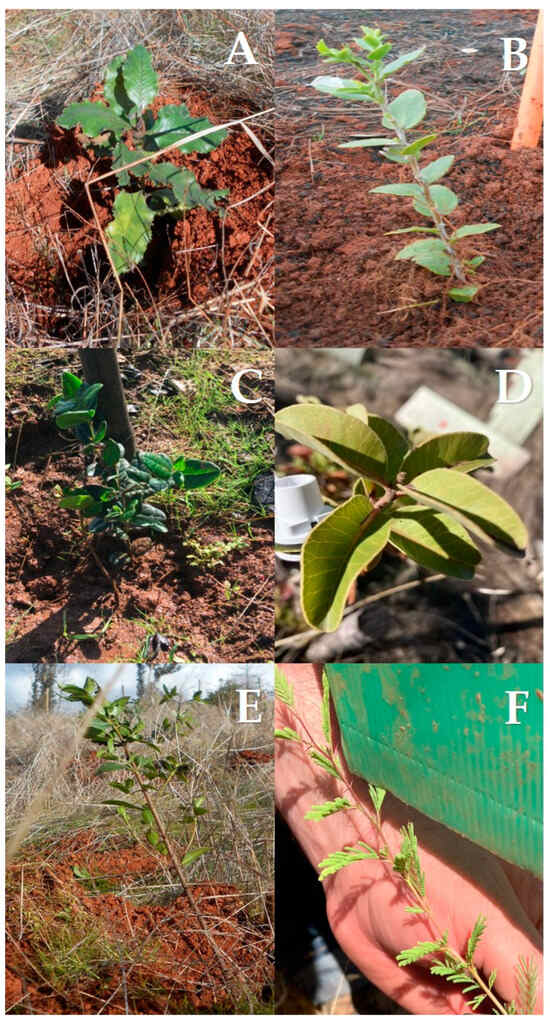
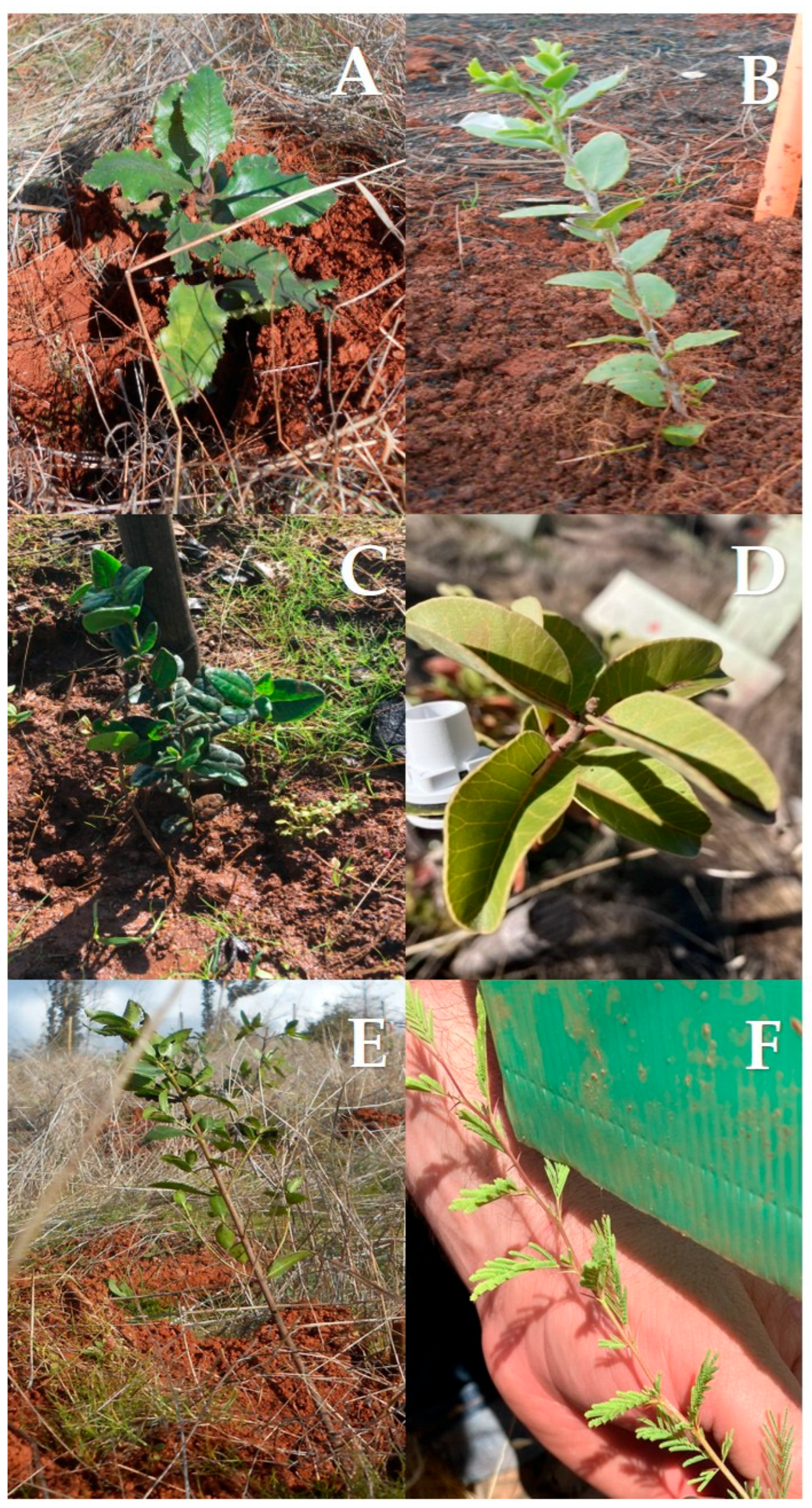
Figure 2.
Visual representations of E. pulverulenta (A), Q. saponaria (B), P. boldus (C), L. caustica (D), C. odorifera (E), and V. caven (F) during trial establishment in July 2019.
2.3. Field Performance and Physiological Measurements
Field performance was assessed in June 2020 by measurements of H, D, and survival (SUR). We estimated increments for D (INCd) and H (INCh) as the differences in D and H between two assessments (from before planting to 1 year after establishment). Survival was recorded as a binomial trait (i.e., live seedling = 1, dead seedling = 0). Light-saturated photosynthesis (Asat), transpiration (E), and stomatal conductance (gs) were measured in 2 fully developed and healthy leaves per plant, taken from the stem apex during January 2020, in a subsample of 60 seedlings (2 watering treatments × 6 species × 5 blocks × 1 seedling per plot). Intrinsic water use efficiency (WUE) was estimated as the ratio Asat/gs. Measurements were taken between 10:00 and 12:00 (local time) using an LI-6800 photosynthesis system (LI-COR Inc., Lincoln, NE, USA). Irradiance, temperature, and reference CO2 concentration were held constant at 1800 mmol m−2 s−1, 25 °C, 400 ppm, respectively. At 12:00–13:00 h solar time of the same day we measured the midday stem water potential (Ψstem) by using a pressure chamber (Model 600, PMS Instrument Co., Albany, OR, USA). Healthy leaves were wrapped with transparent plastic film and aluminum foil at least one hour before measurements. After that, they were cut and immediately measured for Ψstem.
2.4. Data Analysis
To evaluate differences in outplanting survival, the six species were compared using the complete dataset (n = 600), whereas the results for increments (i.e., differences in H and D before and after planting) were compared on a subset of data (n = 428). The analyses of survival and increments were done with type III sum of squares, but in the analyses of increments, we assumed an incomplete block design with fixed blocks due to the low number of surviving seedlings in the species P. boldus, C. odorifera, and E. pulverulenta in seven plots of the W− treatment. Those seven plots had fewer than three alive seedlings (including three plots with complete mortality) and were discarded from analyses of increments. We used a two-way ANOVA with watering regime, species, and their interaction being considered fixed effects. The data for survival (i.e., 1, 0) was analyzed with a generalized linear model, using a logit link function for binomial distribution. To meet the assumptions of normality and constant variance, traits other than survival were transformed using the Box–Cox transformation when needed. Post hoc mean comparisons were based on the Tukey test at p ≤ 0.05. We also investigated the relationship between Asat and gs by adjusting the following hyperbolic function:
with y representing Asat, x representing gs, a representing the asymptote, i.e., the maximum achievable Asat when gs tends to infinite, and b representing the half-saturation constant, i.e., the gs value at which Asat reaches half of its maximum. The average values of Asat and gs based on measurements from all seedlings at W+ and W− were used to fit the curve. In addition, we conducted a path analysis with the aim of assessing how the independent variables measured at outplanting (i.e., D, H, Asat, gs, E, Ψstem) influenced the seedling outplanting survival. In this analysis we omitted the traits derived from other traits to avoid multicollinearity (i.e., WUE, INCd, INCh). Finally, a Principal Component Analysis (PCA) was carried out with the aim to explore the relationship between the growth form of all species and seedling performance at outplanting. Data were standardized, and the 10 variables (physiological variables, growth, increments, and survival) were included as ‘response variables’ whereas the factor growth form (evergreen, deciduous, and semideciduous) was included as the ‘classification variable’. The statistical analyses were performed with IBM® SPSS® 25.0.0, IBM® SPSS® Amos 26.0.0 (SPSS Inc, Chicago, IL, USA), and SigmaPlot Version 16 (Grafiti LLC, San José, CA, USA).
y= ax/(b + x)
3. Results
3.1. Seedling Initial Characteristics
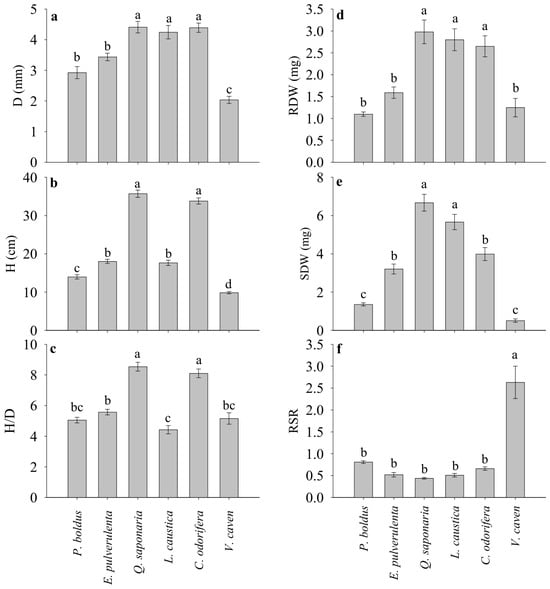
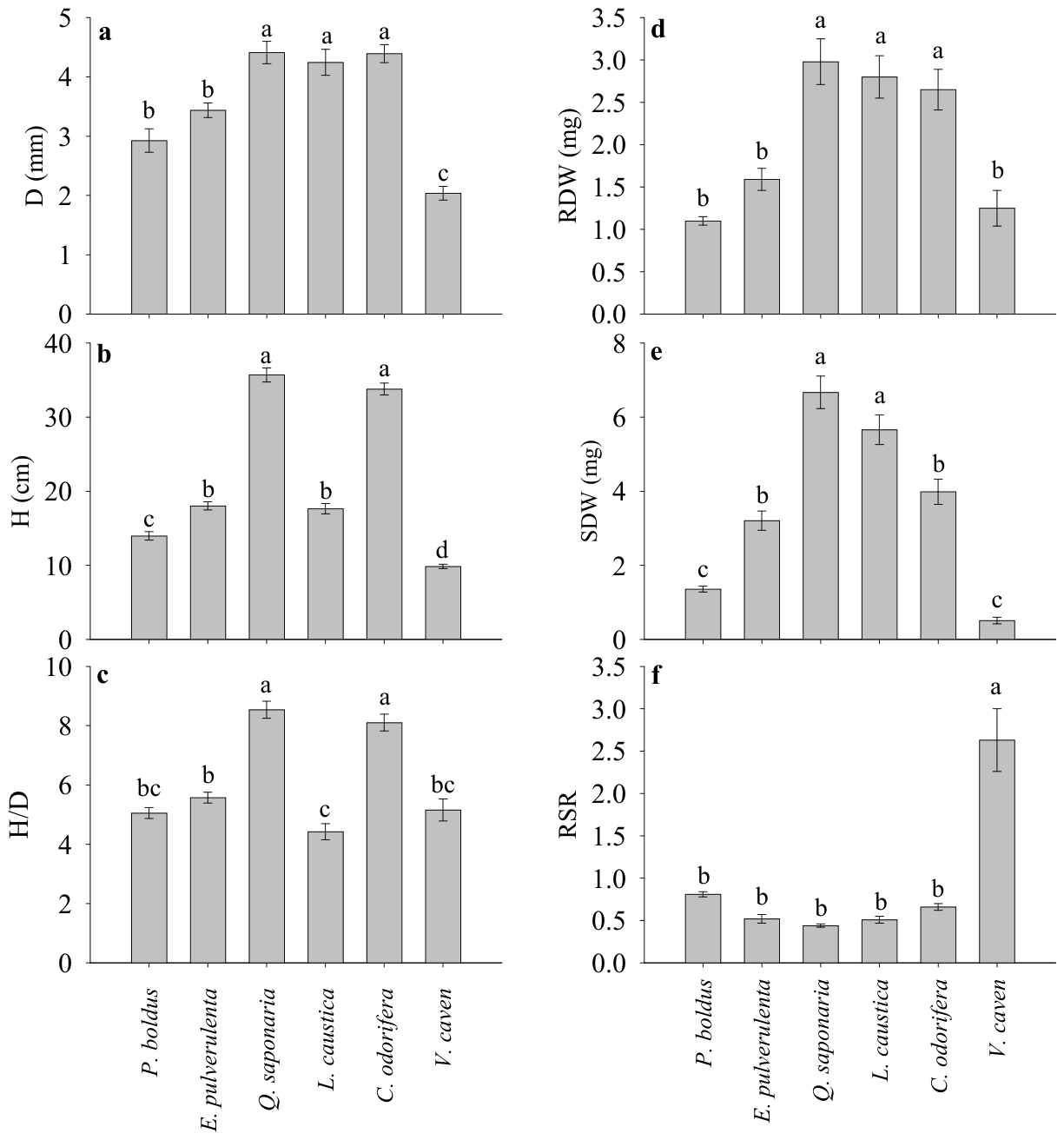
Prior to planting, species differed in diameter, height, and H/D (p < 0.01). Height was more variable among species than diameter; thus, H/D varied more because of differences in height than in diameter. Seedling growth in Q. saponaria and C. odorifera was higher than that of seedlings from the other species (Figure 3a,b). V. caven produced the shortest seedlings (9.8 cm), which were approximately four-fold shorter than those of Q. saponaria and C. odorifera. The species L. caustica, while producing seedlings with high diameter, it exhibited the lowest H/D due to its low height (Figure 3c). Biomass allocation patterns were also different among species. Larger masses allocated to the root system were found in Q. saponaria, L. caustica, and C. odorifera, whereas the smallest shoots but higher root: shoot ratios were found in V. caven (Figure 3d–f).
Figure 3.
Seedling initial characteristics for the six species under study. (a) D = root collar diameter, (b) H = height, (c) H/D = height-to-diameter ratio, (d) RDW = root dry weight, (e) SDW = shoot dry weight, (f) RSR = root-to-shoot ratio. Different letters indicate significant differences among species at the 0.05 level. The error bars indicate the standard error.
3.2. Growth and Survival After Outplanting
One season after outplanting, irrigation was significant only for diameter and survival, with irrigated seedlings exhibiting thicker diameters and high survival rates (Table 2). In the case of species, P. boldus and V. caven were still the lowest seedlings with slimmer diameters, but they exhibited positive and significantly higher increments in height, as did L. caustica and E. pulverulenta (Table 2). V. caven exhibited the highest increment in height. Contrarily, Q. saponaria and C. odorifera, despite having the tallest seedlings with the thickest diameters of all species before planting, experienced a decrease in height and medium increments in diameter. In terms of survival, it was observed that P. boldus had a survival of approximately two-fold lower than that of L. caustica, which exhibited the highest survival of the experiment.
Table 2.
Absolute growth, growth increments, and survival of the six species under study one year after outplanting (mean ± SE).
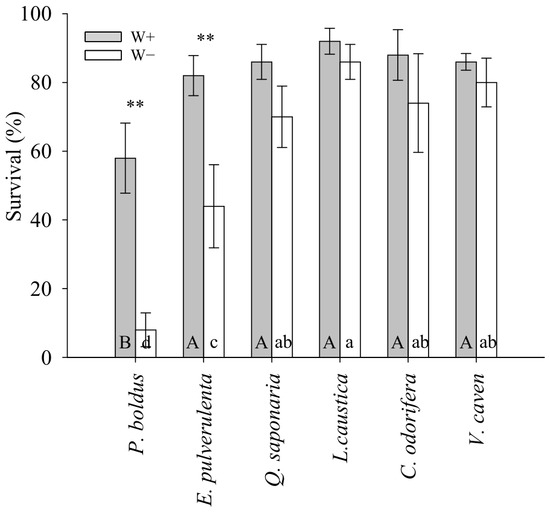
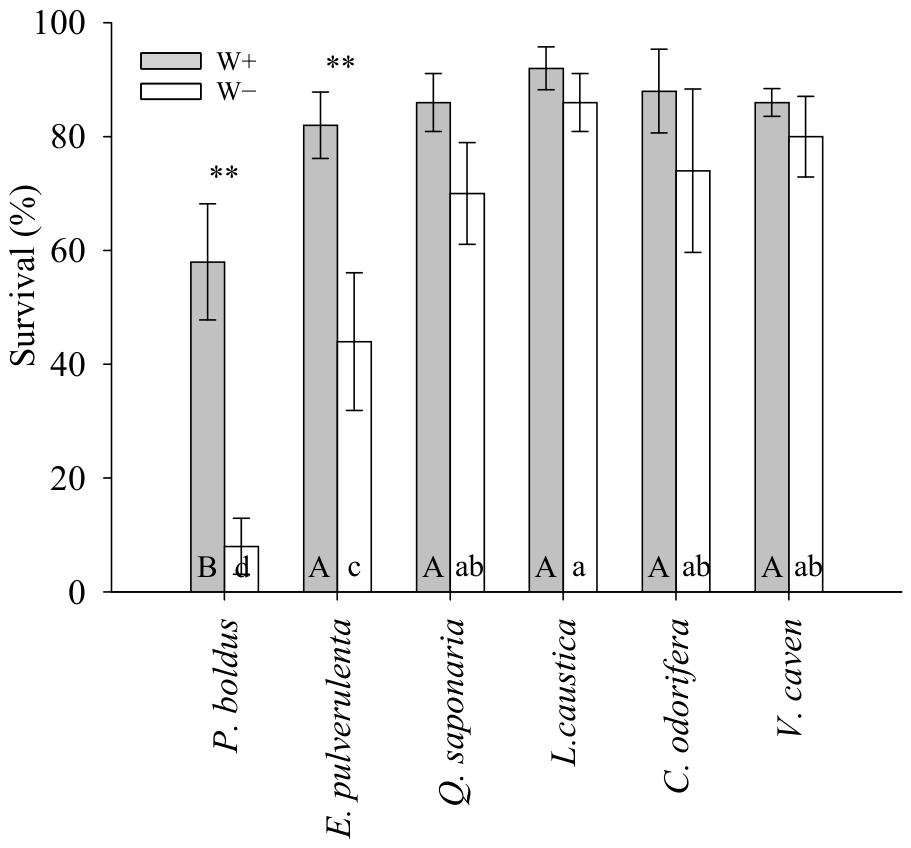
Species differed in survival by watering treatment, with the intensity of the effect varying by species (species × watering interaction; Table 2). For the species P. boldus and E. pulverulenta, the differences in survival between irrigated and non-irrigated seedlings were large, this was not the case for the rest of the species. Both species exhibited a considerable decrease in survival in the W− treatment, with survival reaching only 8 and 44%, respectively (Figure 4). On the contrary, the other four species had survival higher than 70% in W−. L. caustica had survival nearly ten and two times higher than those of P. boldus and E. pulverulenta in the W− treatment, respectively.
Figure 4.
Variations in survival one year after outplanting according to the watering regime (W+ = watering, W− = no watering). ** indicates significant differences within a species in the different watering treatments at 0.01 level. Uppercase letters indicate significant differences (p < 0.05) among the six species in W+, whereas lowercase letters indicate differences among species in W−.
3.3. Leaf-Level Gas Exchange and Water Potential
Watering treatments only affected Asat and Ψstem, and both traits were drastically reduced in the W− treatment (Table 3). At the species level, V. caven had the highest Asat, gs, and E, but no differences in WUE were observed among species. As with survival, the lowest performance in gas-exchange traits was observed in P. boldus. In comparison to V. caven, values for Asat, gs, and E in P. boldus were 98, 23, and four times lower. Asat was similar among E. pulverulenta, Q. saponaria, and L. caustica, but gs and E were lower in L. caustica. In the case of gs, both P. boldus and L. caustica had statistically similar values, but Asat was drastically reduced in P. boldus compared to L. caustica. Analogously, Q. saponaria and C. odorifera had similar gs, but Asat was slightly higher in C. odorifera. In the hydric status of seedlings, E. pulverulenta was the most stressed species with Ψstem close to −4.0 MPa, whereas L. caustica, C. odorifera, and V. caven had the highest Ψstem of the experiment.
Table 3.
Gas-exchange traits and water potential (mean ± SE) one year after outplanting in the six species and watering treatments.
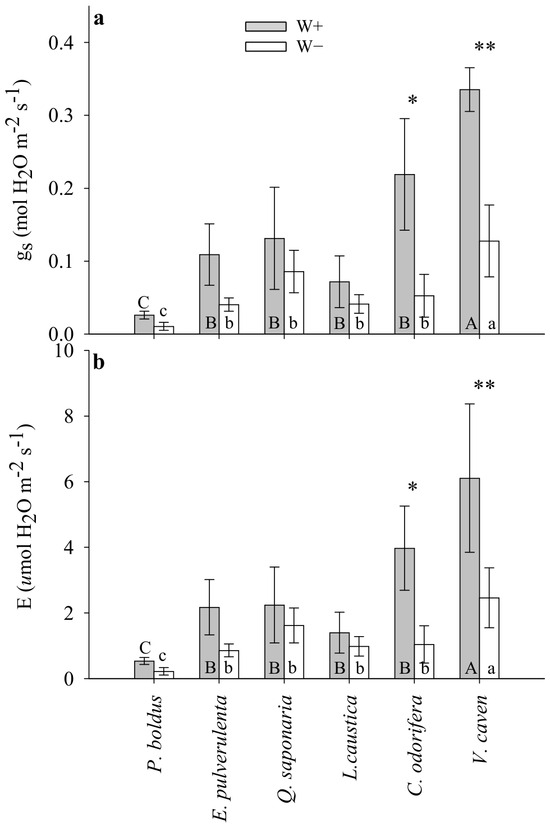
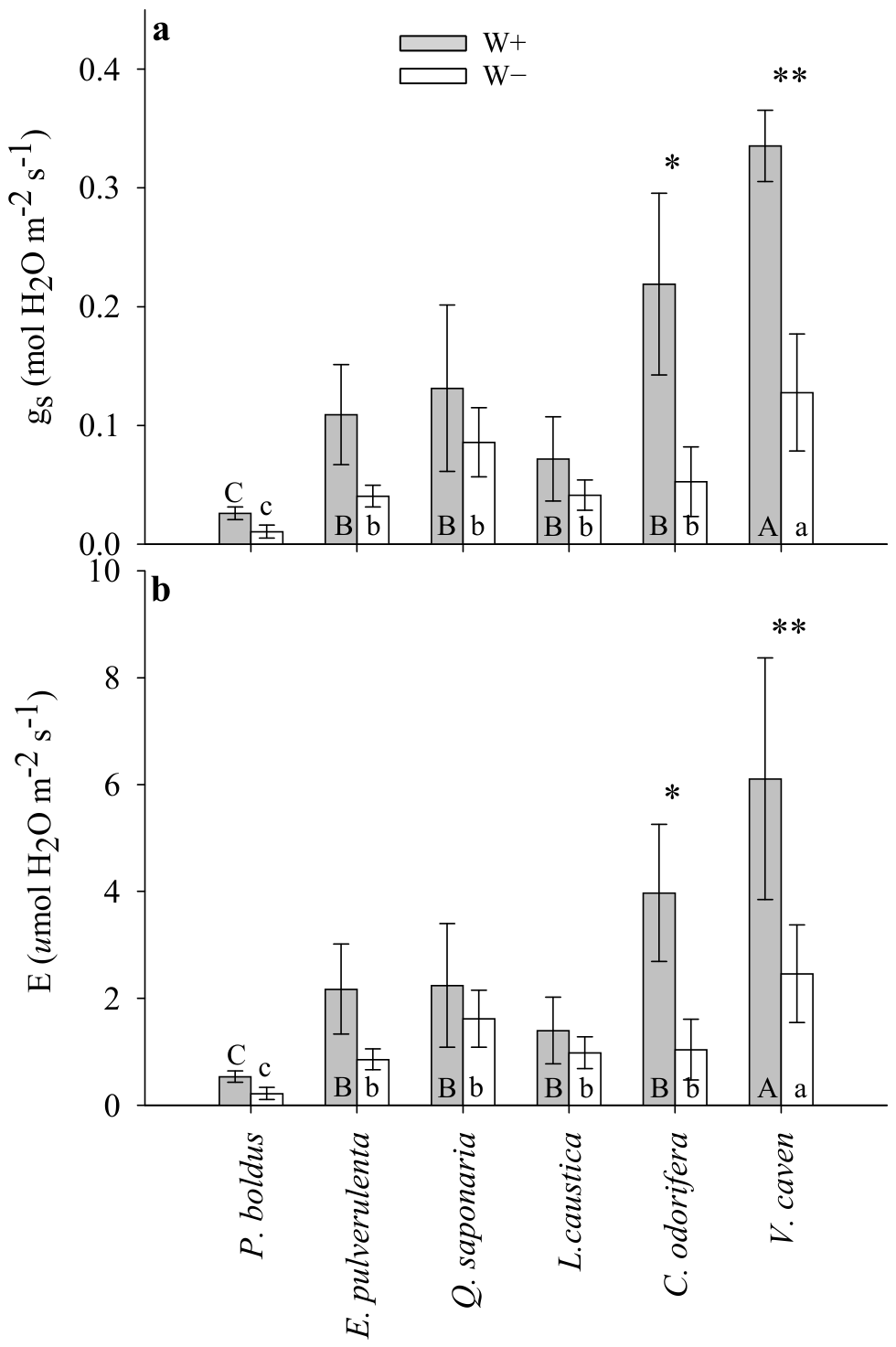
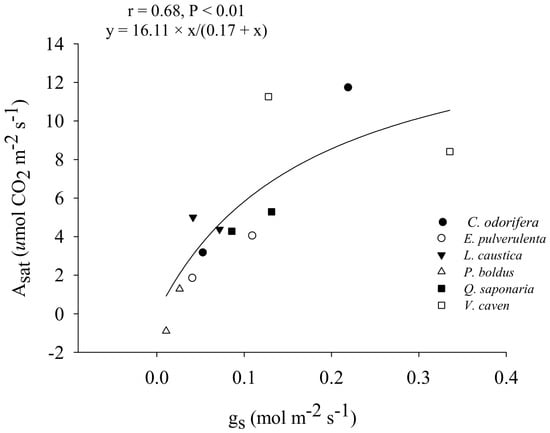
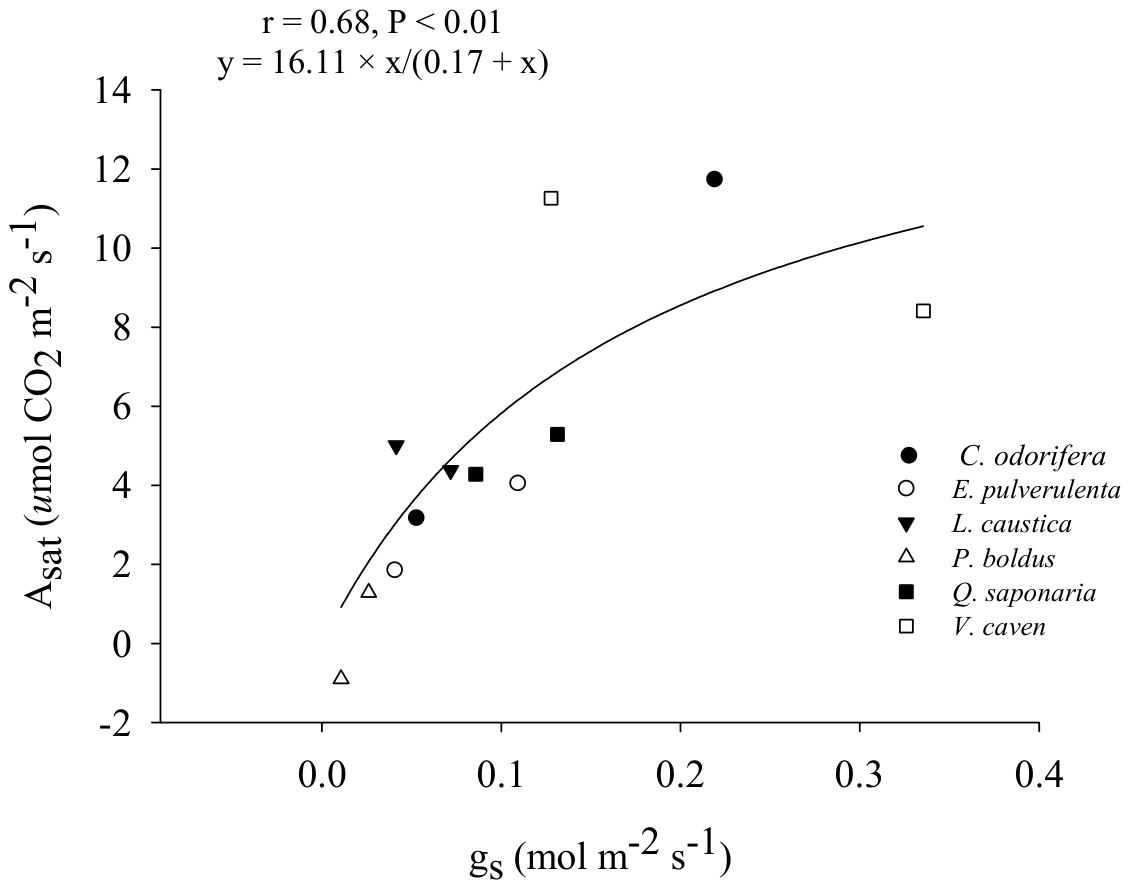
Species also differed in gs and E by watering treatment. The differences were mainly attributed to differences between both watering treatments for V. caven and C. odorifera and to the higher performance of V. caven in the W− treatment (Figure 5a). Both species decreased gs and E by 3.4 and 3.2 times in the W− treatment compared to the W+ treatment. The reductions in gs and E in the other species were not pronounced, but P. boldus exhibited the lowest gs and E among all species both in the W+ and W− treatments. The relationship between Asat and gs followed the typical hyperbolic function, but P. boldus and V. caven exhibited the lowest and highest values for both variables (Figure 6).
Figure 5.
Variations in stomatal conductance (a) and transpiration (b) according to the watering regime (W+ = watering, W− = no watering). * and ** indicate significant differences within a species in the different watering treatments at 0.05 and 0.01 levels, respectively. Uppercase letters indicate significant differences (p < 0.05) among the six species in W−, whereas lowercase letters indicate differences among species in W+.
Figure 6.
Hyperbolic relationship between light-saturated photosynthesis (Asat) and stomatal conductance (gs). Each point corresponds to the average of 5 seedlings in each watering treatment.
3.4. Multivariate Analysis of Relationships Between Outplanting Survival and Independent Variables
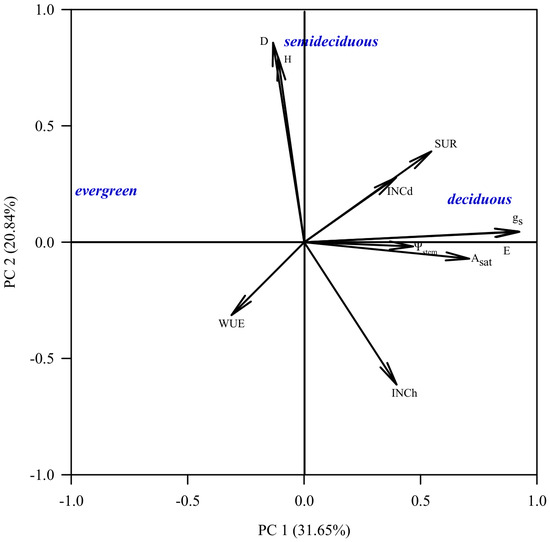
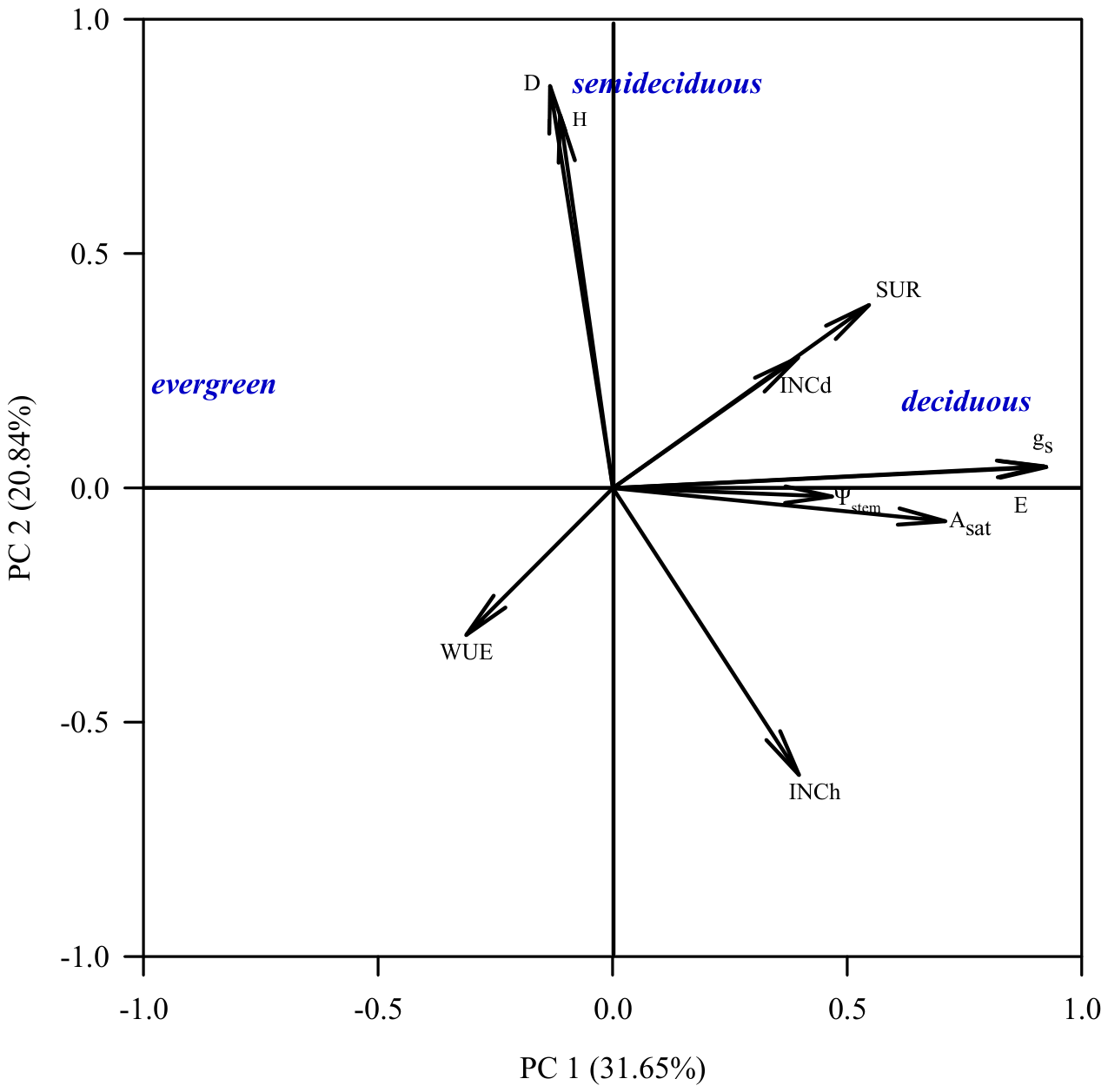
In the path analysis, there were no significant direct effects of independent variables on survival. The variables with the greatest direct positive effects were gs, D, and Ψstem, whereas E exhibited the highest direct negative effect (Table 4). There was a significant indirect correlation between survival with Ψstem (correlation of 0.34) which is mainly determined by gs. The rest of variables exhibited no significant indirect effects. The Principal Component Analysis indicated that the first (PC1) and second (PC2) principal components explained 52.4% of the variability in the species under study (Figure 7). According to the component loadings, the PC1 mostly captures photosynthesis performance (mainly Asat, E, and gs), whereas the PC2 captures seedling growth (D and H). Survival appeared to be positively correlated with gs and INCd but negatively correlated with WUE. The deciduous V. caven is associated with a higher survival and physiological status but lower growth whereas the semideciduous C. odorifera is associated with a high growth. No clear association was observed for the evergreen species.
Table 4.
Path analysis of the relationships between outplanting survival and the various independent variables (growth and leaf-level physiology).
Figure 7.
Principal Component Analysis for the relationship between growth form and seedling performance at outplanting. E = transpiration, Asat = light-saturated photosynthesis, gs = stomatal conductance, WUE = water use efficiency, Ψstem= stem water potential, D = diameter, H = height, SUR = survival, INCd = increment in diameter, INCh = increment in H.
4. Discussion
4.1. Growth and Survival
According to Puértolas et al. [44], Villar-Salvador et al. [45], Cuesta et al. [16], and Andivia et al. [18], growth and survival of sclerophyllous species improve when using larger seedlings. In contrast, lower growth and survival are expected when planting small seedlings due to the reduced water uptake associated with smaller root systems [15,46]. However, in harsh environments, seedling morphological attributes do not contribute to establishment success [47,48,49], and survival could be related to functional adaptations. In our experiment, the survival rates higher than 70% in the W− treatment for L. caustica, Q. saponaria and C. odorifera might be related to their deep root system (Figure 4) [23,24] that enhanced the water-absorbing area, and to their leaf angles that improved light capture and reduced temperature, minimizing water loss during the dry season. Rooting depth has been found to be strongly and positively related to plant development in arid environments, as it allows for exploring water in depth during summer drought [37]. V. caven has adaptations such as small compound leaves that provide thinner boundary layers, which enhance convective heat transfer and reduce transpiration. The species also has a high root:shoot ratio that enhances the balance between the absorbing and transpiring surface area. Small leaves can shed heat rapidly by convection [50]. Both small leaves and a high root:shoot ratio allowed V. caven to survive the harsh environment of the planting site. Higher root:shoot ratio have been positively related to outplanting survival [51] because it improves the water supply to the foliage [52,53]. In our study, V. caven had root:shoot ratio 2.5-fold higher than the rest of the species (Figure 3f) and survival close to 80% both in W+ and W− treatments (Figure 2). In the case of P. boldus and E. pulverulenta, both species exhibit leaf rolling, i.e., a mechanism that slows down the evaporation of water from the leaf surface [54,55,56,57], and P. boldus possesses waxes and trichomes, which help in reflecting light and reducing leaf temperature. However, their low survival seems to be more related to mechanisms of stomatal control and water potential than morphological attributes (see next section). These results must be viewed with caution because seven plots with fewer than three surviving seedlings were excluded from the analyses because plot-level means could not be reliably estimated by so few individuals, especially when the early growth of the species under study might be very variable. Notably, all excluded plots belonged to the non-irrigated treatment, reflecting the higher mortality observed in this treatment (see survival analysis). Consequently, the growth dataset for the W− treatment is necessarily biased toward the subset of plots and species with comparatively higher survival, while the W+ treatment retained its full range of variation. This asymmetry could lead to an underestimation of the true growth reduction associated with water stress, since the most severely affected experimental units were the ones excluded from the growth analysis.
4.2. Leaf-Level Gas Exchange, and Water Potential
Deciduous species compensate for their shorter growth period with higher photosynthetic rates. In contrast, evergreen species maintain photosynthetic activity during the winter months when deciduous species are dormant. In our study, summer photosynthesis and stomatal conductance varied considerably among evergreen and deciduous species, and results compared well with other short-term studies in the same species under water restriction [58,59,60]. However, our study was based on a single-point measurement that represents the physiological performance of seedlings during the first year after outplanting, thus extrapolating to long-term drought adaptation must be viewed with caution. The deciduous V. caven exhibited relatively high gas exchange under drought, which may be associated with its small compound leaves, elevated root:shoot ratio, and intermediate water potential. These traits are consistent with a possible ‘water-spender’ strategy (i.e., anisohydric tendency) [61,62] and suggest a strong hydraulic capacity, although this interpretation should be considered as a working hypothesis rather than a demonstrated mechanism. This behavior was supported by the Principal Component Analysis in which V. caven (deciduous) is associated with higher survival rates and photosynthetic performance. In the case of L. caustica we hypothesize a conservative ‘water-saver’ strategy, characterized by stomatal closure and maintenance of higher water potential, possibly facilitated by deep rooting. V. caven and C. odorifera, with survival > 80%, had the highest stomatal conductance and water potential. These patterns are consistent with the associations suggested by the path analysis, although they should be interpreted as indirect relationships rather than demonstrated causal effects. P. boldus and E. pulverulenta close stomata to prevent damage but increase water potential (less negative), possibly exposing themselves to the risk of carbon depletion (particularly P. boldus with the lowest Asat). For both species, but particularly for P. boldus, it could be hypothesized that this species adjusts to the ‘water-saver’ strategy (i.e., isohydric behavior). The reduction in stomatal conductance has been largely described as one of the earliest plant responses to low soil water content and/or high atmospheric water demand. On the other hand, Q. saponaria and C. odorifera tend to keep stomata open and reduce water potential at the risk of cavitation but without negatively affecting carbon assimilation, i.e., it could be hypothesized as a ‘water-spender’ strategy. Vulnerability to cavitation and dynamics of non-structural carbohydrates (NSC) at the seedling stage have been little investigated in Chilean sclerophyllous species. In a study of the species Aristotelia chilensis (Molina) Stuntz (Oxalidales: Elaeocarpaceae), Yañez et al. [63] found a moderate vulnerability to cavitation in 2-year-old potted plants and hypothesized that the species might have resilience to increasing levels of vapor pressure deficit (VPD). In the case of NSC, Piper et al. [64] in a field study found that the decline in growth of juvenile trees of sclerophyllous species (e.g., L. caustica, Q. saponaria and P. boldus among others) was more associated with limitations to photosynthesis than reductions in NSC. Thus, future studies incorporating vulnerability curves and NSC dynamics would help disentangle whether hydraulic failure, carbon starvation, or their interaction drives the low drought survival observed in P. boldus and E. pulverulenta in our study.
The high survival and carbon assimilation of V. caven, associated with high stomatal conductance, which allowed higher CO2 diffusion inside leaves, might also be related to the small leaf area of this species, which implies lower water demands. V. caven was able to maintain a survival of 80% in the W− treatment, with more than half the stomatal conductance reported in the W+ treatment. According to Grassi and Magnani [65], gs lower than 0.1 mol H2O m−2 s−1 are indicative of severely water-stressed seedlings, but V. caven was the only species able to maintain gs > 0.1 mol H2O m−2 s−1 in the W− treatment. C. odorifera also had high Asat during the summer months of the experiment, which might be associated with its steeply leaf angles of c.a., 65°. Steep leaf angles help in reducing overheating and photoinhibition [66], which in turn maintain high photosynthetic rates during periods of high radiation loads [4]. L. caustica seems to have an intermediate behavior because the species had low gs but high Ψstem. Despite L. caustica exhibiting gs close to 0.05 mol H2O m−2 s−1 in the W− treatment, the threshold proposed as severe water stress [67], the species had 86% survival, probably mediated by its root system [22,68], which improved the absorption of water [69], or by its osmotic adjustment [70], i.e., an adaptation that allows the species to avoid dehydration [71]. E. pulverulenta had gs slightly higher than L. caustica but low Asat at lower Ψstem, suggesting it follows a conservative water use strategy under drought conditions, like P. boldus [72]. Such responses suggest moderate-to-low drought resistance because stomatal closure was insufficient to maintain high water potential. E. pulverulenta possesses large leaves, reflecting a high transpiring surface, perhaps enabling it to maximize the absorption of carbon during the winter and spring months [73], but at the expense of survival in the dry season. The wider leaves of this species and the lowest Ψstem of the experiment (−3.8 MPa) could have increased embolism risk, negatively impacting survival. Embolism rises as a consequence of water stress [74] and a Ψstem of −3.8 MPa in E. pulverulenta is indicative of water stress.
Our results indicate that the magnitude of changes in growth and physiological performance was mainly species-dependent (i.e., adaptations in leaves and roots). The irrigation treatments had a minor influence, which was evidenced by the lower F-values in most traits (see Table 1 and Table 2). A possible explanation for the lack of significance of the irrigation treatments is that the water doses were too low for plant use (2 L−1 per plant) and were applied every 7 days during the hottest summer months. We observed that the soil water content falls quickly just two days after irrigation (i.e., from 0.26 to 0.18 cm3 cm−3). This suggests that the high temperatures registered during the summer months provoked water to evaporate quickly. Support irrigation and/or rescue irrigation of planted seedlings have been little explored in the Mediterranean semi-arid ecosystem of Central Chile [32] despite the positive effects on seedling survival and establishment when adequate amounts of water are applied [33,47]. However, we used only two watering regimes (well-watered and water-restricted), which does not allow us to quantify species-specific response thresholds and might have influenced the interpretation of species drought responses. Experimental designs using a gradient of water-deficit intensities have shown that plant physiological and growth responses can be non-linear and threshold-dependent, with different traits responding at different deficit levels within the same species [75,76].
Taken together, we hypothesize that high survival might have been achieved by distinct pathways: (i) an anisohydric, drought-escape like strategy in the deciduous V. caven, combining high gas exchange with phenological plasticity; (ii) an isohydric-but-effective strategy in Q. saponaria and C. odorifera, which tolerated more negative water potentials while keeping stomata relatively open, likely buffered by deep rooting; and (iii) a conservative strategy in L. caustica, which combined low gs with comparatively high Ψstem. In contrast, P. boldus and E. pulverulenta shared a similar morphological trait (leaf rolling) yet showed markedly different water potentials (−2.8 vs. −3.8 MPa) and survival outcomes, suggesting that leaf-level morphological traits alone were insufficient to predict drought performance, and that species-specific differences in transpiring leaf area (E. pulverulenta has considerably larger leaves) likely overrode the shared morphological adaptation.
This study contributes evidence by linking survival to a multivariate suite of morphological and physiological traits under field outplanting conditions. From an applied perspective, our results provide direct, field-validated guidance for restoration practitioners in Central Chile: species selection criteria should move beyond generic ’large seedling’ recommendations toward trait-informed, species-specific outplanting strategies (e.g., prioritizing deep-rooted or phenologically drought-escaping species in unshaded, water-limited sites), and highlight P. boldus and E. pulverulenta as priority candidates for support irrigation or shading interventions in future restoration programs. However, as we provide information on the first-year response of young seedlings; the most critical stage of plant establishment, our results cannot be extrapolated to long-term restoration. First-year survival, growth, and physiological responses, while informative, may not fully predict long-term establishment success, since root development, hydraulic acclimation, and interannual climate variability (e.g., successive drought years) can substantially alter outcomes in subsequent years. Future studies, including repeated measurements across the growing season, or across multiple years with contrasting water availability, would allow a better characterization of dose–response relationship and define more precise thresholds for supporting irrigation in restoration programs.
5. Conclusions
Summer photosynthesis, stomatal conductance, and water potential varied considerably among evergreen, semideciduous, and deciduous species. Deciduous and semideciduous shrubs (i.e., V. caven and C. odorifera) exhibited survival > 80%, which was associated with the maintenance of high stomatal conductance and photosynthesis despite relatively high water potential. Evergreen species such as Q. saponaria and L. caustica tended to sustain lower water potentials through pronounced stomatal closure and survival in a similar range to deciduous and semideciduous. The exceptions were the evergreen P. boldus and E. pulverulenta, which exhibited low survival associated with the lowest water potential of the species under study. Our findings highlight the importance of selecting species with functional traits that confer drought resistance. P. boldus exhibited the lowest performance under the planting site conditions. Thus, the incorporation of this species in the restoration of ecosystems with Mediterranean-type climate must be viewed with caution. The remaining species studied exhibit functional responses to water stress that enable them to overcome post-transplant shock during arid summers in Mediterranean-type climates.
Author Contributions
Conceptualization, S.E.E. and C.M.; methodology, S.E.E. and C.M.; formal analysis, S.E.E.; writing—original draft preparation, S.E.E.; writing—review and editing, M.A.Y.; J.F.O., J.A.O., J.G. and E.M.-H.; funding acquisition, S.E.E. All authors have read and agreed to the published version of the manuscript.
Funding
This research was funded by the Fondo de Investigación del Bosque Nativo, from the Corporación Nacional Forestal (CONAF-Chile), grant number 015/2017 to S.E. The APC was funded by the Universidad de Chile.
Data Availability Statement
The data that support the findings of this study are available from the corresponding author upon reasonable request.
Acknowledgments
Many thanks to Betsabé Abarca and Nicole Toro from Centro Productor de Árboles y Semillas Forestales (CESAF) from the Universidad de Chile for their assistance in determination of biomass partitioning. Special thanks also go to the Dirección de Investigación, Vicerrectoría de Investigación y Postgrado, Universidad Católica del Maule.
Conflicts of Interest
The authors declare no conflicts of interest.
Abbreviations
The following abbreviations are used in this manuscript:
| D | Root collar diameter (mm) |
| H | Height (cm) |
| H/D | Height-to-diameter ratio |
| RDW | Root dry weight (mg) |
| RSR | Root-to-shoot ratio |
| INCd | Increment in diameter (mm) |
| INCh | Increment in height (cm) |
| SUR | Survival (%) |
| Asat | Light-saturated photosynthesis (umol m−2 s−1) |
| gs | Stomatal conductance (mol m−2 s−1) |
| E | Transpiration (mmol m−2 s−1) |
| WUE | Intrinsic water use efficiency (Asat/gs) |
| VPD | Vapor pressure deficit (kPa) |
| Ψstem | Midday water potential |
References
- Kaushal, P.; Aussenac, G. Transplanting shock in Corsican Pine and Cedar of Atlas seedlings: Internal water deficits, growth and root regeneration. For. Ecol. Manag. 1989, 27, 29–40. [Google Scholar] [CrossRef] [Scilit]
- South, D.B.; Zwolinsky, J.B. Transplant stress index: A proposed method of quantifying planting check. New For. 1997, 13, 315–328. [Google Scholar] [CrossRef] [Scilit]
- Ehleringer, J.R.; Comstock, J. Leaf absorptance and leaf angle: Mechanisms for stress avoidance. In Plant Response to Stress; Tenhunen, J.D., Catarino, F.M., Lange, O.L., Oechel, W.C., Eds.; Springer: Berlin, Germany, 1987; pp. 55–76. [Google Scholar]
- Falster, D.S.; Westoby, M. Leaf size and angle vary widely across species: What consequences for light interception? New Phytol. 2003, 158, 509–525. [Google Scholar] [CrossRef] [Scilit] [PubMed]
- Baldocchi, D.D.; Xu, L. What limits evaporation from Mediterranean oak woodlands—The supply of moisture in the soil, physiological control by plants or the demand by the atmosphere? Adv. Water Resour. 2007, 30, 2113–2122. [Google Scholar] [CrossRef] [Scilit]
- Mediavilla, S.; Escudero, A. Stomatal responses to drought at a Mediterranean site: A comparative study of co-occurring woody species differing in leaf longevity. Tree Physiol. 2003, 23, 987–996. [Google Scholar] [CrossRef] [Scilit] [PubMed]
- Luis, V.C.; Puértolas, J.; Climent, J.; Peters, J.; González-Rodríguez, Á.M.; Morales, D.; Jiménez, M.S. Nursery fertilization enhances survival and physiological status in Canary Island pine (Pinus canariensis) seedlings planted in a semiarid environment. Eur. J. For. Res. 2009, 128, 221–229. [Google Scholar] [CrossRef] [Scilit]
- Margolis, M.A.; Brand, D.G. An ecophysiological basis for understanding plantation establishment. Can. J. For. Res. 1990, 20, 375–390. [Google Scholar] [CrossRef] [Scilit]
- Grossnickle, S. Importance of root growth in overcoming planting stress. New For. 2005, 30, 273–294. [Google Scholar] [CrossRef] [Scilit]
- Rojas-Arevalo, N.; Ovalle, J.F.; Oliet, J.A.; Piper, F.I.; Valenzuela, P.; Ginocchio, R.; Arellano, E.C. Solid shelter tubes alleviate summer stresses during outplanting in drought-tolerant species of Mediterranean forests. New For. 2022, 53, 555–569. [Google Scholar] [CrossRef] [Scilit]
- Tsakaldimi, M.; Zagas, T.; Tsitsoni, T.; Ganastas, P. Root morphology, stem growth and field performance of seedlings of two Mediterranean evergreen oak species raised in different container types. Plant Soil 2005, 278, 85–93. [Google Scholar] [CrossRef] [Scilit]
- Jacobs, D.F.; Goodman, R.C.; Gardiner, E.S.; Salifu, K.F.; Overton, R.P.; Hernandez, G. Nursery stock quality as an indicator of bottomland hardwood forest restoration success in the Lower Mississippi River Alluvial Valley. Scand. J. For. Res. 2012, 27, 255–269. [Google Scholar] [CrossRef] [Scilit]
- Acevedo, M.; Álvarez-Maldini, C.; Ovalle, J.F.; Cartes-Rodríguez, E.; González, M. Producción de Plantas Nativas en Vivero Forestales para Proyectos de Restauración. In Restauración de Ecosistemas Forestales; Bannister, J., Ovalle, J.F., Vargas-Gaete, R., Claramunt-Torche, V., Eds.; Editorial Universitaria: Santiago, Chile, 2024; pp. 458–485. [Google Scholar]
- Grossnickle, S.C.; MacDonald, J.E. Why seedlings grow: Influence of plant attributes. New For. 2018, 49, 1–34. [Google Scholar] [CrossRef] [Scilit]
- Oliet, J.A.; Planelles, Z.R.; Artero, Z.F.; Valverde, Z.R.; Jacobs, D.F.; Segura, Z.M.L. Field performance of Pinus halepensis planted in Mediterranean arid conditions: Relative influence of seedling morphology and mineral nutrition. New For. 2009, 37, 313–331. [Google Scholar] [CrossRef] [Scilit]
- Cuesta, B.; Villar-Salvador, P.; Puértolas, J.; Jacobs, D.F.; Rey Benayas, J.M. Why do large, nitrogen rich seedlings better resist stressful transplanting conditions? A physiological analysis in two functionally contrasting Mediterranean forest species. For. Ecol. Manag. 2010, 260, 71–78. [Google Scholar] [CrossRef] [Scilit]
- Villar-Salvador, P.; Puértolas, J.; Cuesta, B.; Penuelas, J.L.; Uscola, M.; Heredia-Guerrero, N.; Benayas, J.M.R. Increase in size and nitrogen concentration enhances seedling survival in Mediterranean plantations. Insights from an ecophysiological conceptual model of plant survival. New For. 2012, 43, 755–770. [Google Scholar] [CrossRef] [Scilit]
- Andivia, E.; Villar-Salvador, P.; Oliet, J.; Puértolas, J.; Dumroese, K.; Ivetić, V.; Molina-Venegas, R.; Arellano, E.; Li, G.; Ovalle, J.F. Climate and species stress resistance modulate the higher survival of large seedlings in forest restoration worldwide. Ecol. Appl. 2021, 31, e02394. [Google Scholar] [CrossRef] [Scilit] [PubMed]
- Trubat, R.; Cortina, J.; Vilagrosa, A. Nutrient deprivation improves field performance of woody seedlings in a degraded semi-arid shrubland. Ecol. Eng. 2011, 37, 1164–1173. [Google Scholar] [CrossRef] [Scilit]
- Aronson, J.; Ovalle, C.; Aguilera, L.; Leon, P. Phenology of an ‘inmigrant’ savanna tree (Acacia caven, Legumoniosae) in the Mediterranean climate zone of Chile. J. Arid Environ. 1994, 27, 55–70. [Google Scholar] [CrossRef] [Scilit]
- Arroyo, M.T.K.; Armesto, J.J.; Squeo, F.; Gutierrez, J. Global Change: The flora and vegetation of Chile. In Earth-Systems Responses to Global Change: Contrasts Between North and South America; Mooney, H., Fuentes, E., Krinberg, B., Eds.; Academic Press: San Diego, CA, USA, 1993; pp. 239–264. [Google Scholar]
- Giliberto, J.; Estay, H. Seasonal water stress in some chilean matorral shrubs. Bot. Gaz. 1978, 139, 236–240. [Google Scholar] [CrossRef] [Scilit] [PubMed]
- Hoffmann, A.; Kummerow, J. Root Studies in the Chilean Matorral. Oecologia 1978, 69, 57–69. [Google Scholar] [CrossRef] [Scilit] [PubMed]
- Ovalle, J.F.; Arellano, E.C.; Ginocchio, R. Trade-offs between drought survival and rooting strategy of two South American Mediterranean tree species: Implications for dryland forests restoration. Forests 2015, 6, 3733–3747. [Google Scholar] [CrossRef] [Scilit]
- Yáñez, M.A.; Espinoza, S.E.; Magni, C.R.; Martínez-Herrera, E. Early Growth and Physiological Acclimation to Shade and Water Restriction of Seven Sclerophyllous Species of the Mediterranean Forests of Central Chile. Plants 2024, 13, 2410. [Google Scholar] [CrossRef] [Scilit] [PubMed]
- Espinoza, S.; Magni, C.; Yáñez, M.; Toro, N.; Martínez-Herrera, E. Foliar Traits Drive Chlorophyll Fluorescence Variability in Chilean Sclerophyllous Species Under Early Outplanting Stress. Plants 2025, 14, 2682. [Google Scholar] [CrossRef] [Scilit] [PubMed]
- Espinoza, S.; Yáñez, M.; Martínez-Herrera, E.; Magni, C. Seasonal Dynamics of Chlorophyll Fluorescence in the Evergreen Peumus boldus and the Semideciduous Colliguaja odorifera Under Field Conditions. Plants 2026, 15, 276. [Google Scholar] [CrossRef] [Scilit] [PubMed]
- Aronson, J.; Floret, C.; Le Floc’h, E.; Ovalle, C.; Pontanier, R. Restoration and rehabilitation of degraded ecosystems in arid and semi-arid lands. I. A view from the south. Restor. Ecol. 1993, 1, 8–17. [Google Scholar] [CrossRef] [Scilit]
- Aronson, J.; Floret, C.; Le Floc’h, E.; Ovalle, C.; Pontanier, R. Restoration and rehabilitation of degraded ecosystems in arid and semi-arid lands. II. Case studies in Southern Tunisia, Central Chile and Northern Cameroon. Restor. Ecol. 1993, 1, 168–187. [Google Scholar] [CrossRef] [Scilit]
- Brito, C.E.; Bown, H.E.; Fuentes, J.P.; Franck, N.; Perez-Quezada, J.F. Mesophyll conductance constraints photosynthesis in three common sclerophyllous species in Central Chile. Rev. Chil. Hist. Nat. 2014, 87, 8. [Google Scholar] [CrossRef] [Scilit]
- Ortiz, J.; Hernández-Fuentes, C.; Sáez, P.L.; Fernandez Del Saz, N.; Cavieres, L.A. Compound and simple leaf woody species of the Chilean matorral are equally affected by extreme drought. Plant Ecol. 2023, 224, 33–45. [Google Scholar] [CrossRef] [Scilit]
- Bown, H.E.; Fuentes, J.P.; Martínez, A.M. Assessing water use and soil water balance of planted native tree species under strong water limitations in Northern Chile. New For. 2018, 49, 871–892. [Google Scholar] [CrossRef] [Scilit]
- Rey-Benayas, J.M.; López-Pintor, A.; García, C.; De la Cámara, N.; Strasser, R.; Sal, A.G. Early establishment of planted Retama sphaerocarpa seedlings under different levels of light, water and weed competition. Plant Ecol. 2002, 159, 201–209. [Google Scholar] [CrossRef] [Scilit]
- Siles, G.; Rey, P.J.; Alcántara, J.M.; Bastida, J.M.; Herreros, J.L. Effects of soil enrichment, watering and seedling age on establishment of Mediterranean woody species. Acta Oecol. 2010, 36, 357–364. [Google Scholar] [CrossRef] [Scilit]
- Matskovsky, V.; Venegas-González, A.; Garreaud, R.; Roig, F.A.; Gutiérrez, A.G.; Muñoz, A.A.; Le Quesne, C.; Klock, K.; Canales, C. Tree growth decline as a response to projected climate change in the 21st century in Mediterranean mountain forests of Chile. Glob. Planet. Change 2021, 198, 103406. [Google Scholar] [CrossRef] [Scilit]
- Rodman, K.C.; Veblen, T.T.; Battaglia, M.A.; Chambers, M.E.; Fornwalt, P.J.; Holden, Z.A.; Kolb, T.E.; Ouzts, J.R.; Rother, M.T. A changing climate is snuffing out post-fire recovery in montane forests. Glob. Ecol. Biogeogr. 2020, 29, 2039–2051. [Google Scholar] [CrossRef] [Scilit]
- Padilla, F.M.; Ortega, R.; Sánchez, J.; Pugnaire, F.I. Rethinking species selection for restoration of arid shrublands. Basic Appl. Ecol. 2009, 10, 640–647. [Google Scholar] [CrossRef] [Scilit]
- Montenegro, G.; Riveros De La Puente, F. Comparison of differential environmental responses of Colliguaya odorifera. Flora 1977, 166, 125–135. [Google Scholar] [CrossRef] [Scilit]
- Armesto, J.J.; Martίnez, J.A. Relations between vegetation structure and slope aspect in the mediterranean region of Chile. J. Ecol. 1978, 66, 881–889. [Google Scholar] [CrossRef] [Scilit]
- Hoffmann, A.J.; Alliende, M.C. Interactions in the patterns of vegetative growth and reproduction in woody dioecious plants. Oecologia 1984, 61, 109–114. [Google Scholar] [CrossRef] [Scilit] [PubMed]
- Armesto, J.J.; Vidiella, P.E.; Jiménez, H.E. Evaluating causes and mechanisms of succession in the mediterranean regions in Chile and California. In Ecology and Biogeography of Mediterranean Ecosystems in Chile, California, and Australia; Kalin Arroyo, M.T., Zedler, P.H., Fox, M.D., Eds.; Springer: Berlin, Germany, 1995; pp. 418–434. [Google Scholar]
- Montenegro, G.; Avila, G.; Aljaro, M.E.; Osorio, R.; Gómez, M. Chile. In Plant Pheno-Morphological Studies in Mediterranean Type Ecosystems; Orshan, G., Ed.; Kluwer Academic Publishers: Dordrecht, The Netherlands, 1989; pp. 347–387. [Google Scholar]
- Gotor, B. Evaluación de Parámetros Fisiológicos y de Crecimiento en Plantas de Quillaja saponaria Mol. Bajo Condiciones de Déficit Hídrico. Undergraduate Thesis, Forestry Engenieer, Facultad de Ciencias Forestales, Universidad de Chile, Santiago, Chile, 2008. [Google Scholar]
- Puértolas, J.; Gil, L.; Pardos, J.A. Effects of nutritional status and seedling size on field performance of Pinus halepensis planted on former arable land in the Mediterranean basin. Forestry 2003, 76, 159–168. [Google Scholar] [CrossRef] [Scilit]
- Villar-Salvador, P.; Planelles, R.; Enriquez, E.; Peñuelas-Rubira, J. Nursery cultivation regimes, plant functional attributes and field performance relationships in the Mediterranean oak Quercus ilex L. For. Ecol. Manag. 2004, 196, 257–266. [Google Scholar] [CrossRef] [Scilit]
- Padilla, F.M.; Pugnaire, F.I. Rooting depth and soil moisture control Mediterranean woody seedling survival during drought. Funct. Ecol. 2007, 21, 489–495. [Google Scholar] [CrossRef] [Scilit]
- Ovalle, J.F.; Oliet, J.A.; Vilagrosa, A.; Morcillo, L.; Meli, P.; Arellano, E.C.; Becerra, P.I.; Espinoza, S.; Jacobs, D.F.; León-Lobos, P.; et al. Técnicas de revegetación para restauración de ecosistemas. In Restauración de Ecosistemas Forestales; Bannister, J., Ovalle, J.F., Vargas-Gaete, R., Claramunt-Torche, V., Eds.; Editorial Universitaria: Santiago, Chile, 2024; pp. 486–545. [Google Scholar]
- Trubat, R.; Cortina, J.; Vilagrosa, A. Nursery fertilization affects seedling traits but not field performance in Quercus suber L. J. Arid Environ. 2010, 74, 491–497. [Google Scholar] [CrossRef] [Scilit]
- Tsakaldimi, M.; Ganastas, P.; Jacobs, D.F. Prediction of planted seedling survival of five Mediterranean species based on initial seedling morphology. New For. 2013, 44, 327–339. [Google Scholar] [CrossRef] [Scilit]
- Del Campo, A.D.; Navarro, R.M.; Ceacero, C.J. Seedling quality and field performance of commercial stocklots of containerized holm oak (Quercus ilex) in Mediterranean Spain: An approach for establishing a quality standard. New For. 2010, 39, 19–37. [Google Scholar] [CrossRef] [Scilit]
- Parkhurst, D.F.; Loucks, O.L. Optimal leaf size in relation to environment. J. Ecol. 1972, 60, 505–537. [Google Scholar] [CrossRef] [Scilit]
- Grossnickle, S.C. Why seedlings survive: Influence of plant attributes. New For. 2012, 43, 711–738. [Google Scholar] [CrossRef] [Scilit]
- Manzoni, S.; Vico, G.; Thompson, S.; Beyer, F.; Weih, M. Contrasting leaf phenological strategies optimize carbon gain under droughts of different duration. Adv. Water Resour. 2015, 84, 37–51. [Google Scholar] [CrossRef] [Scilit]
- Maseda, P.H.; Fernandez, R.J. Stay wet or else: Three ways in which plants can adjust hydraulically to their environment. J. Exp. Bot. 2006, 57, 3963–3977. [Google Scholar] [CrossRef] [Scilit] [PubMed]
- Doll, U.; Aedo, D.; Lopez, P. Morphological characterization of three provenances of Boldo (Peumus boldus) in a 6-year-old plantation. Bosque 2005, 26, 45–54. [Google Scholar]
- O’Toole, J.C.; Cruz, R.T. Leaf rolling and transpiration. Plant Sci. Lett. 1979, 16, 111–114. [Google Scholar]
- Kadioglu, A.; Terzi, R. A dehydration avoidance mechanism: Leaf rolling. Bot. Rev. 2007, 73, 290–302. [Google Scholar] [CrossRef] [Scilit]
- Donoso, S.; Peña-Rojas, K.; Pacheco, C.; Durán, S.; Santelices, R.; Mascaró, C. The physiological and growth response of Acacia caven under water stress and the application of different levels of biosolids. Cienc. Investig. Agrar. 2015, 42, 273–283. [Google Scholar] [CrossRef] [Scilit][Green Version]
- Magni, C.; Espinoza, S.; Poch, P.; Abarca, B.; Grez, I.; Martínez, E.; Yáñez, M.; Santelices, R.; Cabrera, A. Growth and biomass partitioning of nine provenances of Quillaja saponaria seedlings to water stress. South. For. 2018, 81, 103–109. [Google Scholar] [CrossRef] [Scilit]
- Espinoza, S.E.; Yañez, M.A.; Magni, C.R.; Santelices, R.E.; Cabrera, A.M. Outplanting performance of three provenances of Quillaja saponaria Mol. established in a Mediterranean drought-prone site and grown in different container size. iForest 2020, 13, 33–40. [Google Scholar] [CrossRef] [Scilit]
- Guehl, J.M.; Aussenac, G. Photosynthesis decrease and stomatal control of gas exchange in Abies alba Mill. in response to vapour pressure difference. Plant Physiol. 1987, 83, 316–322. [Google Scholar] [CrossRef] [Scilit] [PubMed]
- Lo Gullo, M.A.; Salleo, S. Different strategies of drought resistance in three Mediterranean sclerophyllous trees growing in the same environmental conditions. New Phytol. 1988, 108, 267–276. [Google Scholar] [CrossRef] [Scilit] [PubMed]
- Yáñez, M.A.; Urzua, J.I.; Espinoza, S.E.; Peña, V.L. Limited Phenotypic Variation in Vulnerability to Cavitation and Stomatal Sensitivity to Vapor Pressure Deficit among Clones of Aristotelia chilensis from Different Climatic Origins. Plants 2021, 10, 1777. [Google Scholar] [CrossRef] [Scilit] [PubMed]
- Piper, F.I.; Paula, S.; Urrutia-Jalabert, R. Tight stomatal regulation and high intrinsic capacity of carbon assimilation inferred from isotopic composition negatively correlate with drought-driven decline in sclerophyllous species. Ann. Bot. 2026, 138, 536–547. [Google Scholar] [CrossRef] [Scilit] [PubMed]
- Grassi, G.; Magnani, F. Stomatal, mesophyll conductance and biochemical limitations to photosynthesis as affected by drought and leaf ontogeny in ash and oak trees. Plant Cell Environ. 2005, 28, 834–849. [Google Scholar] [CrossRef] [Scilit]
- Valladares, F.; Pugnaire, F.I. Tradeoffs between irradiance capture and avoidance in semi-arid environments assessed with a crown architecture model. Ann. Bot. 1999, 83, 459–469. [Google Scholar] [CrossRef] [Scilit]
- Medrano, H.; Escalona, J.M.; Bota, J.; Gulias, J.; Flexas, J. Regulation of photosynthesis of C3 plants in response to progressive drought: Stomatal conductance as a reference parameter. Ann. Bot. 2002, 89, 895–905. [Google Scholar] [CrossRef] [Scilit] [PubMed]
- Avila, G.; Aljaro, M.E.; Araya, S.; Montenegro, G.; Kummerow, J. The seasonal cambium activity of Chilean and Californian shrubs. Am. J. Bot. 1975, 62, 473–478. [Google Scholar] [CrossRef] [Scilit]
- Villar-Salvador, P.; Valladares, F.; Domínguez-Lerena, S.; Ruiz-Díez, B.; Fernández-Pascual, M.; Delgado, A.; Peñuelas, J.L. Functional traits related to seedling performance in the Mediterranean leguminous shrub Retama sphaerocarpa: Insights from a provenance, fertilization, and rhizobial inoculation study. Environ. Exp. Bot. 2008, 64, 145–154. [Google Scholar] [CrossRef] [Scilit]
- Peña-Rojas, K.; Donoso, S.; Pacheco, C.; Riquelme, A.; Gangas, R.; Guajardo, A.; Durán, S. Respuestas morfo-fisiológicas de plantas de Lithraea caustica (Anacardiaceae) sometidas a restricción hídrica controlada. Bosque 2018, 39, 27–36. [Google Scholar] [CrossRef] [Scilit]
- Sanders, G.J.; Arndt, S.K. Osmotic Adjustment Under Drought Conditions. In Plant Responses to Drought Stress; Aroca, R., Ed.; Springer: Berlin, Germany, 2012; pp. 199–229. [Google Scholar]
- Castell, C.; Terradas, J.; Tenhunen, J.D. Water relations, gas exchange, and growth of resprouts and mature plant shoots of Arbutus unedo L. and Quercus ilex L. Oecologia 1994, 98, 201–211. [Google Scholar] [CrossRef] [Scilit] [PubMed]
- Goulden, M.L. Carbon assimilation and water-use efficiency by neighboring Mediterranean-climate oaks that differ in water access. Tree Physiol. 1996, 16, 417–424. [Google Scholar] [CrossRef] [Scilit] [PubMed]
- Tyree, M.T.; Sperry, J.S. Vulnerability of xylem cavitation and embolism. Ann. Rev. Plant. Physol. Mol. Bio. 1989, 40, 19–38. [Google Scholar] [CrossRef]
- McKiernan, A.B.; Potts, B.M.; Hovenden, M.J.; Brodribb, T.J.; Davies, N.W.; Rodemann, T.; McAdam, S.A.M.; O’Reilly-Wapstra, J.M. A water availability gradient reveals the deficit level required to affect traits in potted juvenile Eucalyptus globulus. Ann. Bot. 2017, 119, 1043–1052. [Google Scholar] [CrossRef] [Scilit] [PubMed][Green Version]
- Yan, W.; Zhong, Y.; Shangguan, Z. Responses of different physiological parameter thresholds to soil water availability in four plant species during prolonged drought. Agric. For. Meteorol. 2017, 247, 311–319. [Google Scholar] [CrossRef] [Scilit]

Disclaimer/Publisher’s Note: The statements, opinions and data contained in all publications are solely those of the individual author(s) and contributor(s) and not of MDPI and/or the editor(s). MDPI and/or the editor(s) disclaim responsibility for any injury to people or property resulting from any ideas, methods, instructions or products referred to in the content. |
© 2026 by the authors. Licensee MDPI, Basel, Switzerland. This article is an open access article distributed under the terms and conditions of the Creative Commons Attribution (CC BY) license.