


Abstract
Environmental accumulation issues arise from discarded waste, synthetic, and natural polymers in landfills, whose slow degradation exacerbates the problem. These materials can be upcycled as renewable feedstocks and properly reused. Therefore, this research examines the fabrication of an extruded wood–plastic suitable for large-scale production, made from recycled polypropylene (PP) and reinforced with plant-based fillers extracted from the lignocellulosic shell of Bertholletia excelsa, well-known as Castanha-do-Pará (CDP), offering a cost-effective and sustainable solution that minimizes waste and fosters a circular economy, enhancing its mechanical properties and environmental benefits. The fractions of 10%, 20%, and 30% by mass of CDP were tested. X-ray diffraction (XRD) analyses indicated that CDP acts as a nucleating agent for the polymer’s beta phase. Fourier-transform infrared spectroscopy (FTIR) indicated interactions between the components as the filler content increased. Scanning Electron Microscopy (SEM) images revealed increased void regions at different CDP contents, corroborating the impact results. These outcomes indicate that incorporating 20%–30% Castanha-do-Pará filler can enhance the wood–plastic flexural properties. This reduces reliance on purely synthetic materials and positions Bertholletia excelsa wood–plastic as a valuable, potentially large-scale product.
1. Introduction
Since their commercial introduction in the early twentieth century, fiber-reinforced polymer composites have evolved from inexpensive substitutes for conventional materials into engineered materials designed for structural and functional applications. Advances in polymer processing, filler technology, and composite design have enabled the production of materials with tailored mechanical performance, durability, and environmental resistance [1]. Among these materials, wood–plastic composites (WPCs) have attracted considerable attention because they combine the favorable properties of thermoplastics with renewable lignocellulosic fillers, offering an attractive alternative to solid wood in applications requiring dimensional stability, durability, and low maintenance. In recent years, WPCs have become one of the fastest-growing segments of the composite materials industry, driven by increasing environmental awareness, circular economy policies, and the demand for sustainable materials. Recent market reports estimate that the global WPC market was valued at approximately USD 9–10 billion in 2025 and is expected to exceed USD 20 billion by 2033, with compound annual growth rates approaching 12%. Building and construction remain the largest application sectors, followed by furniture, automotive components, packaging, and consumer products [2]. This rapid market expansion reflects the growing replacement of conventional materials by composites manufactured from renewable resources and recycled polymers.
Growing experience with Wood Plastic Composites (WPC) supports their acceptance in packaging, alternative wood, and household equipment [3]. The increasing demand for WPCs has stimulated extensive research into alternative lignocellulosic fillers capable of replacing conventional wood flour while maintaining satisfactory mechanical and physical performance. Recent studies have demonstrated the successful incorporation of numerous agricultural and forestry residues into thermoplastic matrices, including coconut fiber, rice husk, bamboo, sisal, oil palm residues, and several Amazonian biomasses. These materials not only improve the sustainability of composite production but also reduce dependence on virgin raw materials while promoting the valorization of agro-industrial by-products.
Furthermore, recent reviews indicate that research has progressively shifted from simply improving mechanical performance toward the development of composites based on recycled polymers, underutilized lignocellulosic residues, and circular bioeconomy principles [4,5]. This transition has positioned recycled polypropylene (rPP) as one of the most attractive polymer matrices because of its widespread availability, relatively low processing cost, favorable mechanical properties, and compatibility with a broad range of natural fillers.
Among the various Amazonian residues, the Castanha-do-Pará nut (Bertholletia excelsa Bonpl.), also known as Brazil nut, represents a particularly promising yet underutilized lignocellulosic resource. Brazil nut trees produce various fruits and seeds [6]; their fruits are commonly known as “Castanha-do-Pará”. Brazil nut extraction constitutes one of the most important non-timber forest product activities in the Amazon, providing income for thousands of rural and traditional communities while supporting regional bioeconomy initiatives. During industrial processing, however, large quantities of shells are generated as by-products. Although these residues have been investigated for applications such as energy generation, activated carbon production, and other low-value uses, their utilization in polymer composites remains largely unexplored. Considering the abundance of this biomass, its lignocellulosic composition, and its continuous availability throughout the Amazon region, Bertholletia excelsa represents an attractive alternative raw material for sustainable composite manufacturing.
Despite the substantial progress achieved in WPC technology, most published studies continue to focus on conventional lignocellulosic fillers such as wood flour, rice husk, bamboo, and coconut fiber. Comparatively few investigations have evaluated agroforestry residues originating from Amazonian extractive systems, particularly Brazil nut shells, as reinforcing fillers for recycled thermoplastics. Consequently, important questions remain regarding the influence of Brazil nut shell particulates on the physical, mechanical, thermal, structural, and morphological performance of recycled polypropylene composites. Addressing these knowledge gaps is essential for expanding the portfolio of renewable fillers available for WPC production while simultaneously creating value-added applications for abundant agro-extractive residues generated in the Amazon.
The global sustainability goal is to promote eco-friendly materials and reduce carbon footprints [7]. To increase environmental sustainability, future research efforts should prioritize the use or recirculation of by-products, extend the lifespan of cultivation infrastructure, incorporate biodegradable materials into system design, and adopt renewable energy sources for processing and drying operations [8]. By repurposing waste materials, the composites developed in this study contribute to addressing resource scarcity, minimizing landfill waste, and supporting circular economy principles. Industries are increasingly looking for ways to lower their carbon footprint, and adopting these sustainable composites could significantly reduce the reliance on virgin polymers and non-renewable resources [9].
Therefore, the present work investigates the Bertholletia excelsa shell particulates as a lignocellulosic filler for recycled polypropylene in the production of wood–plastic composites manufactured by compression molding integrating two representative waste streams, Bertholletia excelsa shell and post-consumer polypropylene, contributing to biomass valorization, polymer recycling, and circular bioeconomy strategies while providing a novel sustainable alternative for wood–plastic composite production.
2. Materials and Methods
The Brazil nut seed coat came from the processing of almonds by the Mutran Exportadora Industry, located on Arthur Bernardes Avenue, Belém, PA, Brazil. The polypropylene used in this research was recycled at the Ecocomposites Laboratory of the Federal University of Pará (UFPA), Belém, PA, Brazil. Arkema Innovative Chemistry donated the compatibilizing agent under the trade name ORAVEC CA100.
2.1. Raw Materials
The main material was Bertholletia excelsa (Castanha-do-Pará) integuments. This vegetable fraction is a lignocellulosic agro-industrial residue generated during the processing of Brazil nuts, representing a substantial fraction of the fruit biomass. A total of 10.0 kg (kilograms) was used, and the residues from post-processing were inspected visually to separate and remove materials in the decomposition phase. The remaining selected material was sanitized in distilled water and placed in a SOLIDSTEEL circulation oven at the Research Campus of the Museu Paraense Emílio Goeldi, at 70 °C for 72 h. After drying, the plant material was ground in a 360-watt, low-speed 4.0 L Metvisa LQ-4.0 Industrial Blender (Metvisa, Brusque, SC, Brazil) for 15 min to obtain the lignocellulosic filler. The Castanha-do-Pará powder (CDP) produced was sieved through a 40 and 60 Mesh sieve and dried for 12 h at 70 ± 2 °C. Maleic anhydride functionalized polypropylene (PP-g-MAH) was used at 2% as a coupling agent for the composite production.
Recycled polypropylene (rPP) was selected as the polymer matrix because of its wide availability, low cost, and increasing importance in circular economy strategies. Although recycled polypropylene may experience a slight reduction in molecular weight and mechanical performance due to thermo-mechanical degradation during previous service life and reprocessing cycles, it generally retains adequate processability for extrusion and compression molding. Furthermore, the incorporation of compatibilizing agents such as maleic anhydride-grafted polypropylene (PP-g-MAH) has been widely demonstrated to improve the interfacial adhesion between recycled polypropylene and lignocellulosic fillers, enabling the production of composites with satisfactory mechanical performance [10].
2.2. Composite Manufacturing
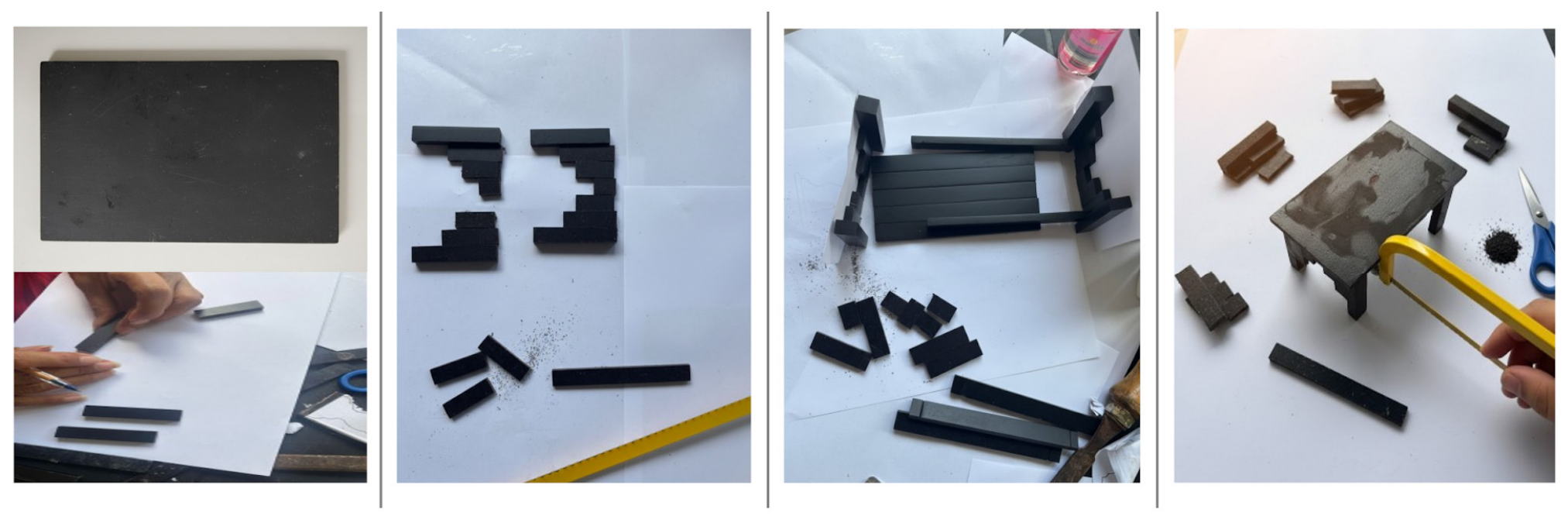
Castanha-do-Pará powder, polypropylene, and PP-g-MAH were blended in a resistance-heated mixer to promote surface adhesion between the polymer matrix and the plant-based filler. Lignocellulosic filler was incorporated into the composite at 10%, 20%, and 30% by weight relative to the total formulation. Following the mixing stage, the material was processed in a single-screw extruder equipped with three heating zones. The temperature profile was set and maintained at 170 °C, 180 °C, and 180 °C from the feeding zone to the die, with a screw rotation speed of 100 RPM. The extruded material was collected, cooled in water at room temperature, and pelletized mechanically. The pellets were then oven-dried at 70 °C for 24 h to remove residual moisture. Subsequently, the dried pellets were molded into composite panels (250 mm × 250 mm × 3 mm) using a stainless-steel mold and compression molding in a hot press with resistance heating on both plates at 180 °C for 10 min. Additionally to the mechanical tests performed, to also demonstrate the material’s processability and practical potential, part of the panels was cut and assembled into a scaled-down table prototype, reproducing the visual and structural features of natural wood.
2.3. Preparation of the WPCs
The nomenclature of the samples produced. The percentage of PP-g-MAH corre-sponds to a fraction of 100% of the lignocellulosic and polypropylene load (Table 1).
Table 1.
Composition of materials for the production of wood-plastic composite.
2.4. X-Ray Diffraction Analysis
A Malvern Panalytical X-ray diffractometer (Cu Kα = 1.5418 Å, 35 kV and 30 mA) was used to determine the crystalline phases of reclaimed polypropylene, Brazil nut filler, and wood plastic composites (WPC). The experimental measurements were performed in a Bragg–Brentano reflection geometry, scanning an angle in 2θ from 10 to 40º at a speed of 0.01º/min. The data obtained were analyzed using PeakFit V4.12 and OriginPro 8 software to prepare the graphs, in conjunction with X’Pert HighScore Plus to determine the crystallographic planes and patterns of the measurement. The relative crystallinity index of Polypropylene, CDP, PP_10CDP, PP_20CDP, and PP_30CDP was calculated from the trapezoidal numerical integration method, using the area under the crystalline peaks and the amorphous region. The degree of crystallinity of the material follows the methodology described in the following formula [11]. The average size of Dhkl crystallites was calculated using the method Scherrer proposed.
2.5. Fourier Transform Infrared Spectroscopy (FTIR)
Five types of samples were prepared for analysis, containing the standards (CDP/PP) and percentage fractions of WPC. The samples were then ground and dried in an oven at 70 °C for 24 h to reduce moisture. Infrared measurements were performed at the Institute of Geosciences-IG (Mineral Characterization Laboratory—UFPA) with a Thermo Fisher Scientific Nicolet iS50 FTIR Fourier transform infrared spectrometer (Thermo Fisher Scientific, Madison, WI, USA) operating in attenuated total reflection (ATR) mode. Each spectrum was obtained using 32 scans ranging from 4000 to 500 cm−1 with a resolution of 4 cm−1.
2.6. Mechanical Tests
After obtaining the wood–plastic composite profile, the specimens were machined to the dimensions prescribed by ASTM standards. All material characterization tests were performed on twelve samples taken from the WPC profiles, which had rectangular cross-sections and dimensions of 250 mm × 250 mm × 3 mm for impact and bending [12,13].
2.7. Impact Testing
The impact test was performed following ASTM D256-10 2018 “Standard Test Methods for Determining the Izod Pendulum Impact Resistance of Plastics” [12] to determine the impact resistance of the samples via the Izod technique of plastic and composite material with a type A notch. An NZ polymer pendulum impact equipment model XJC-25D with a hammer energy of 2.75 J (Philpolymer, São Roque, SP, Brazil) was used for the impact test. Before the tests, the samples were prepared following the dimensions recommended in the standard and tested under temperature conditions of 23.5 °C and 48% humidity. The recommended length of the specimens was 63.5 ± 2 mm, and the notch depth was 10.16 ± 0.05 mm with a notch angle of 45 ± 1°. The notches were prepared using a milling machine, and the appropriate length was cut on a band saw. Six replicates for each specimen were tested for statistical analysis.
2.8. Flexural Test
The flexural test followed the standard test method for flexible properties of unreinforced and reinforced plastics and electrical insulating materials [12]. Procedure A was adopted to perform this test, as it is the method used when the aim is to obtain flexural properties, even when the material is expected to withstand large displacements during the test, in which case Procedure B is more appropriate. The plates produced from the polypropylene matrix and CDP were machined according to the guidelines provided in the standard. The test specimens were cut and separated according to their respective fractions: PP (Standard), 10% (PP_10CDP), 20% (PP_20CDP), and 30% (PP_30CDP). After machining, the specimens were subjected to three-point bending tests to characterize the different fractions of the specimens. The variations in the loads present in the polymer matrix structure allowed for the evaluation of the mechanical behavior results related to the flexural tests. The results obtained through flexural analysis, such as flexural strength and modulus, were statistically processed using ANOVA (one-way) and Tukey tests to assess whether the data showed significant statistical differences between the samples.
2.9. Statistical Analysis
A one-way analysis of variance (ANOVA) test was performed to evaluate any significant difference between the means of the different mechanical flexural and impact tests for PP and its WPCs at the three levels of filler load. The difference in means was considered significant at p << 0.05.
2.10. Scanning Electron Microscopy (SEM)
The morphology of the wood–plastic composites (PP_10CDP, PP_20CDP, and PP_30CDP) was examined under a scanning electron microscope. For this analysis, a TESCAN VEGA3 scanning electron microscope, coupled to an energy-dispersive microanalysis (EDS) system (TESCAN, Brno, Czech Republic), was used, operating at a voltage of 15 kV in the Scanning Electron Microscopy Laboratory at the Museu Paraense Emílio Goeldi Research Campus—MPEG. Tensile and flexural stresses fractured all samples, and their surfaces were studied. The fractured regions of the pieces were sprayed with gold for observation and to obtain high-resolution images.
3. Results and Discussion
3.1. Composite Processing Characteristics
The produced panel (Figure 1) exhibited a homogeneous appearance, with dark coloration resulting from the tone of the incorporated vegetal filler. The material demonstrated adequate machinability during cutting, presenting well-defined cutting regions and behavior comparable to that of natural wood. The assembled components showed sufficient interfacial adhesion to maintain the structural integrity of the table prototype.
Figure 1.
Bertholletia excelsa wood–plastic table prototype.
The panel color showed the full interaction between the filler and the polymer, giving it the proper castanha’s brown color. The produced panel exhibited a homogeneous appearance, with a dark coloration resulting from the tone of the incorporated vegetal filler. No visible defects, such as voids, cracks, or delamination, were observed on the panel surface after fabrication. The surface texture was uniform across the panel, indicating effective dispersion of the vegetal filler within the polymer matrix. Additionally, the panel edges presented clean finishes after machining, requiring no additional surface correction before assembly.
During processing, the material demonstrated adequate machinability when subjected to cutting, drilling, and fastening operations. Well-defined cutting regions were obtained, with no evidence of excessive chipping, edge fraying, or localized material loss. The composite responded consistently to standard woodworking tools, exhibiting behavior comparable to that of natural wood. Dimensional stability was maintained throughout machining, with no observable warping or distortion. Unlike virgin polypropylene, recycled polypropylene may exhibit slight variations in viscosity, crystallinity, and mechanical properties owing to its processing history. Nevertheless, numerous studies have demonstrated that these differences do not prevent its successful application as a matrix for lignocellulosic composites, particularly when compatibilizers are employed to improve stress transfer across the polymer–particle interface. Therefore, the results obtained in the present study reinforce the technical feasibility of employing recycled polypropylene in sustainable composite manufacturing [10].
The assembled components showed sufficient interfacial adhesion to maintain the structural integrity of the table prototype. Fasteners were securely retained within the panel, with no signs of pull-out, cracking, or interfacial separation at the joints. Throughout handling and assembly, the joints remained intact, and the prototype preserved its geometric alignment under its own weight, showing no visible deformation. Visual inspection after assembly confirmed the overall structural coherence of the prototype, supporting the suitability of the material for furniture-related applications.
3.2. X-Ray Diffraction (XRD)
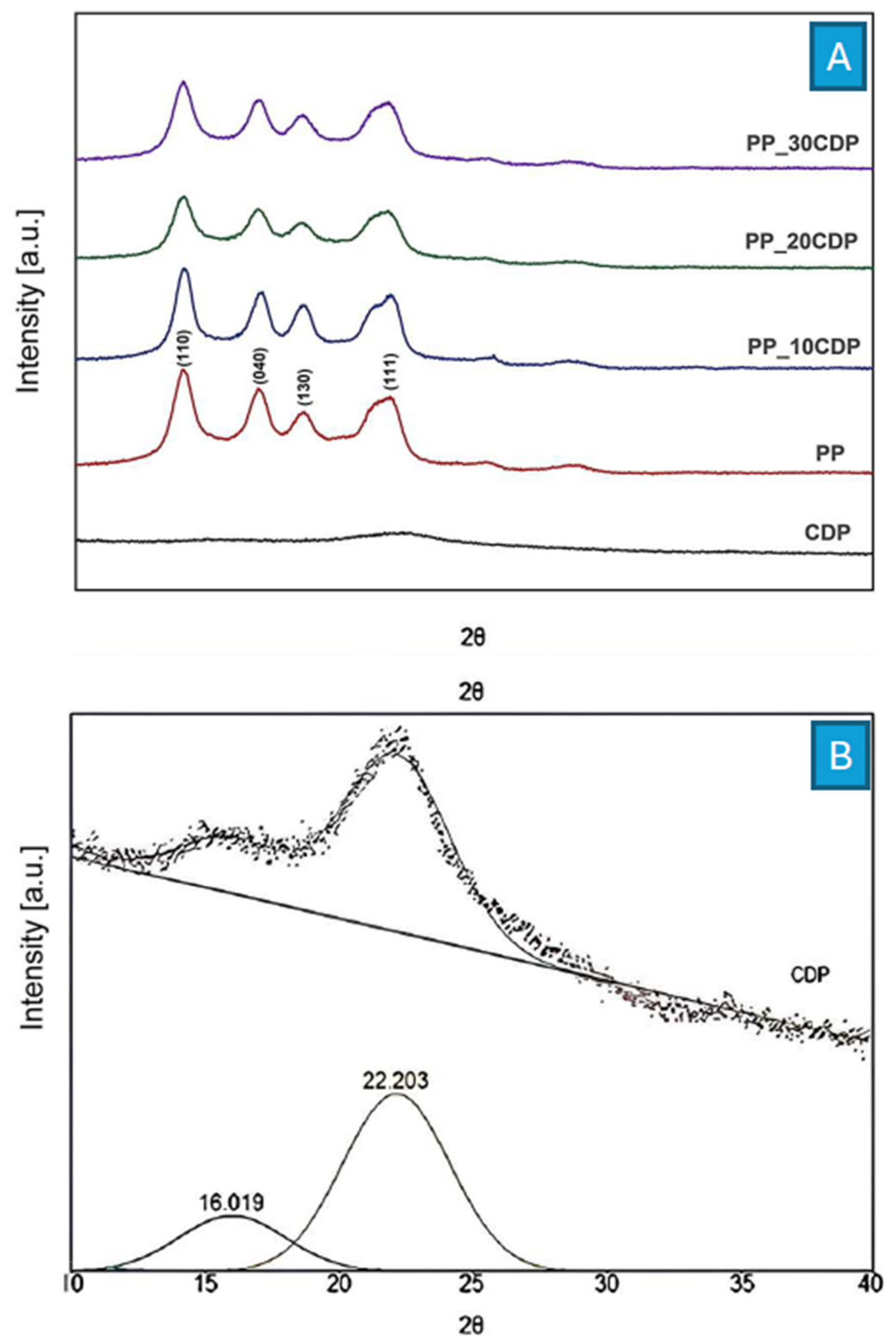
The X-ray diffraction results for the revalorized polypropylene, identified by the red line (Figure 2), suggest a predominantly α-phase structure, due to the characteristic peaks observed at 2θ positions at 14.2° α (110), 17.1° α (040), 18.7° α (130), and 21.4° α (111), corresponding to typical patterns of cellulose type I at 16° (110) and 22° (200) [14]. Figure 2 shows the results obtained from X-ray diffraction (XRD) analysis of Brazil nut shell (CDP), revalorized polypropylene (PP), and composites with different fractions, PP_10CDP, PP_20CDP, and PP_30CDP.
Figure 2.
X-ray diffraction profile. Diffraction pattern of revalorized polypropylene and wood plastic composites—PP_10CDP, PP_20CDP, and PP_30CDP (A); Diffraction pattern of Brazil nut shell—CDP (B) X-ray diffractogram of the CDP sample, showing the deconvolution of the curve with fitted peaks.
Adding plant-based filler to the PP polymer matrix does not promote the visualization of new peaks due to their overlap, as observed in the composite diffractograms. Incorporating plant material into the polypropylene matrix could induce crystalline transitions, visible at 2θ, as shown in Figure 2A. Thus, it is suggested that CDP might induce the β crystalline form (hexagonal) [15].
The crystallinity of cellulose polymers is strongly related to the hydrogen bonds and Van der Waals forces between the cellulose molecules within the cellulose crystallites [14]. The crystallographic analysis of peak positions in the diffraction profiles for PP_10CDP, PP_20CDP, and PP_30CDP composites showed similarities to the pure revalorized PP standard, indicating no structural changes due to the blending and processing.
However, a variation in diffraction peak intensities was observed, which directly relates to the decrease in the PP standard sample volume and the increased lignocellulosic (amorphous) mass percentage. This is primarily because XRD has a direct relationship with the diffracted crystalline volume and an inverse relationship with the degree of disorder (amorphous), which are convoluted in the observed diffraction intensities.
Additionally, lignocellulosic materials typically exhibit a high degree of disorder (amorphous) in their molecular structure components, like lignin and hemicellulose. This suggests that the plant-based filler from the Brazil nut shell had minimal impact on the crystallization behavior of polypropylene, insufficient to cause structural alterations in wood–plastic composites [16].
Investigating the crystallinity index (Xc) for isotactic polypropylene, Brazil nut shell, PP_10CDP, PP_20CDP, and PP_30CDP, estimated from XRD measurements, revealed relevant information. Under the treatment and processing conditions applied in this study, the crystallinity index of polypropylene was 35.5%, CDP was 41.9%, PP_10CDP was 48%, PP_20CDP was 35.9%, and PP_30CDP was 38%, values consistent with those found in studies on PP and cellulose composites [17].
PP_10CDP showed the highest crystallinity index compared to the others. However, the PP_20CDP and PP_30CDP composites did not exhibit a significant increase in Xc, with values very close to the pure polypropylene standard.
The average crystallite sizes (Table 2), calculated using the Scherrer equation, did not show significant numerical variation, as seen in Table 2. The crystallite size of PP_10CDP compared to the polypropylene matrix showed a significant increase of 3.56%, while PP_30CDP exhibited a 5.03% reduction compared to the standard.
Table 2.
Value of average crystallite size.
3.3. FTIR Analysis
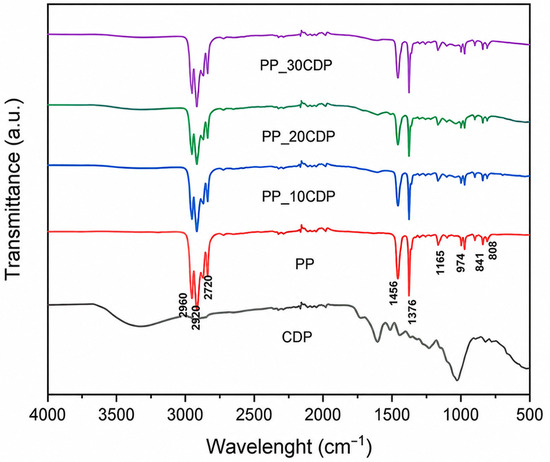
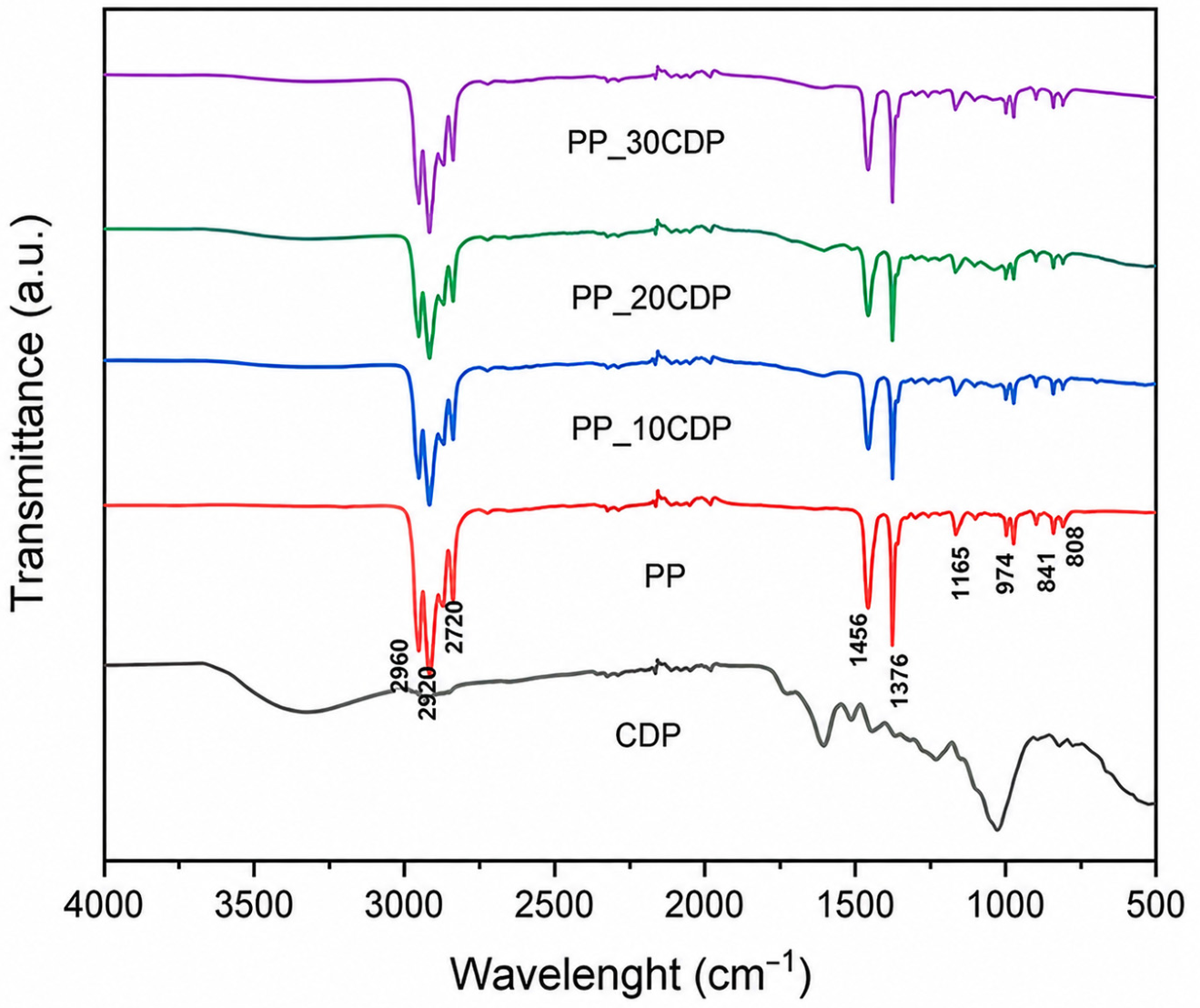
The spectra obtained through Fourier transform infrared spectroscopy with attenuated total reflectance (FTIR-ATR) in composites made from plant-based and polymeric raw materials are shown in Figure 3.
Figure 3.
FTIR spectrum of wood–plastic composites composed of polypropylene and plant-based filler.
The FTIR spectra for the polypropylene matrix, shown in red, display characteristic PP bands with CH2 and CH bond stretching patterns at wavelengths around 2920 cm−1 and 2960 cm−1, similar to the findings in [18]. At 2720 cm−1, there is CH bending and CH3 stretching, CH3 asymmetric deformation at 1456 cm−1, symmetric deformation at 1376 cm−1, tertiary carbon bending vibration at 1165 cm−1, and out-of-plane deformation at 974, 841, and 808 cm−1, as described in the literature [19,20,21]. These bands are listed in Table 3.
Table 3.
Polypropylene FTIR bands.
The bands align with those reported in the literature (Table 4) and can be observed in the 3750–3000 cm−1 range, where the stretching vibration of hydroxyl groups, a cellulose component, occurs. The presence of hemicellulose is identified through the peak at 1730 cm−1 in the grey spectrum, which is directly associated with the stretching vibration of the carbonyl group present. Meanwhile, the band at 1507 cm−1 corresponds to the vibration of aromatic rings in lignin’s structure, as found in the study by [22].
Table 4.
Bertholletia excelsa powder FTIR bands.
3.4. Impact Strength
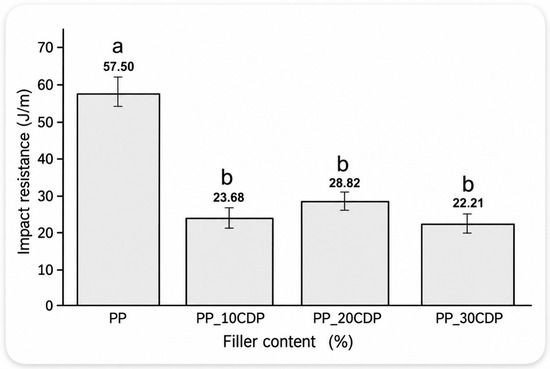
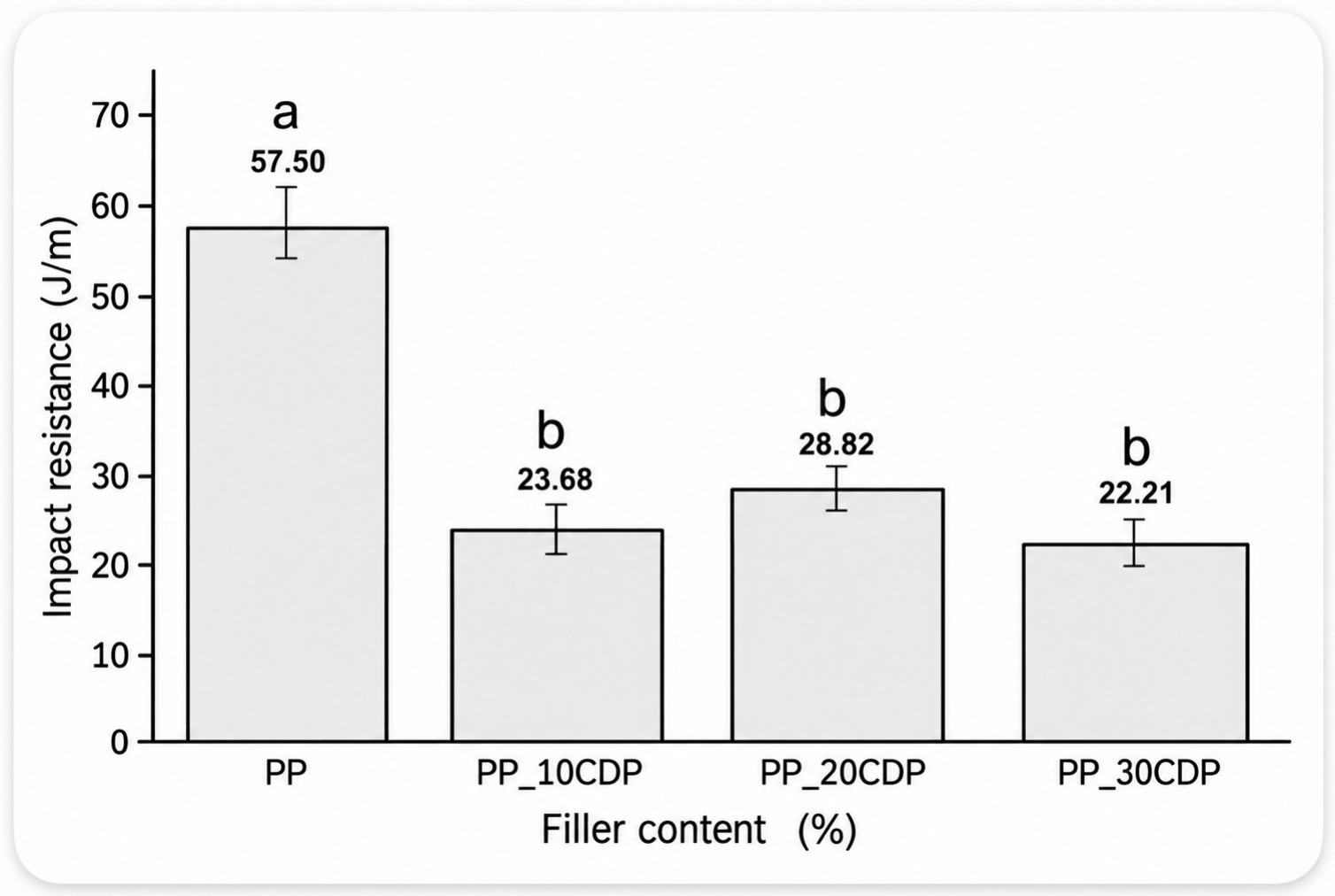
The samples of composites prepared using the polymer matrix showed a significant decrease in impact resistance at values of p << 0.05, as pure PP exhibits superior impact properties compared to WPCs (Figure 4). Adding plant material reduces the impact properties of polypropylene composites [23,24].
Figure 4.
Impact resistance of standard PP specimens and composites. The statistical groups were represented with the letters “a” and “b”.
The results demonstrated that PP_10CDP led to a drop in impact resistance of about 58% compared to pure polypropylene, PP_20CDP by 49%, and PP_30CDP by 38%. The different concentrations did not show statistical differences among themselves at p << 0.05.
These decreases may be related to the increased stiffness introduced by the filler [25]. The result suggests a possible reduction in ductility or defects in the material structure, leading to weak stress transfer in the composite [26].
The addition of filler to the PP matrix can create a heterogeneous system, potentially promoting stress concentration regions within the structure. This concentration of stress affects the deformation and fracture behavior of wood–plastic composites, as local maximum stresses encourage crack propagation and fractures [27,28,29]. The process begins with the polymer’s plastic deformation, followed by particle displacement, directly impacting the fracture toughness of the composites.
We observed a moderate decrease (10%–15%) in impact resistance with increasing filler content, a common trend in wood–plastic composites attributed to filler-induced brittleness. Similar reductions have been reported in PP composites with other plant-based fillers, such as wood flour and nutshell particles [30,31]. This decrease is often linked to stress concentration zones and reduced ductility resulting from poor matrix-filler interfacial bonding. The addition of coupling agents like PP-g-MAH, as used in our study, helps reduce this effect by enhancing matrix–filler adhesion.
The ANOVA analysis revealed a highly significant effect of filler content [F(3,20) = 27.84, p < 0.0001]. Neat polypropylene exhibited significantly higher impact resistance (5.67 ± 1.14 kJ m−2) than all composites (p < 0.001), whereas no statistically significant differences were detected among PP_CDP10 (2.33 ± 0.52 kJ m−2), PP_CDP20 (2.83 ± 0.72 kJ m−2), and PP_CDP30 (2.18 ± 0.46 kJ m−2) (p > 0.05). Compared with neat polypropylene, impact strength decreased by 58.9%, 50.1%, and 61.6% for PP_CDP10, PP_CDP20, and PP_CDP30, respectively, confirming the embrittlement effect associated with the incorporation of lignocellulosic particles.
3.5. Flexural Test
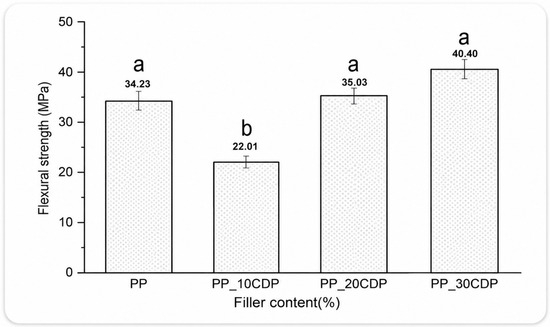
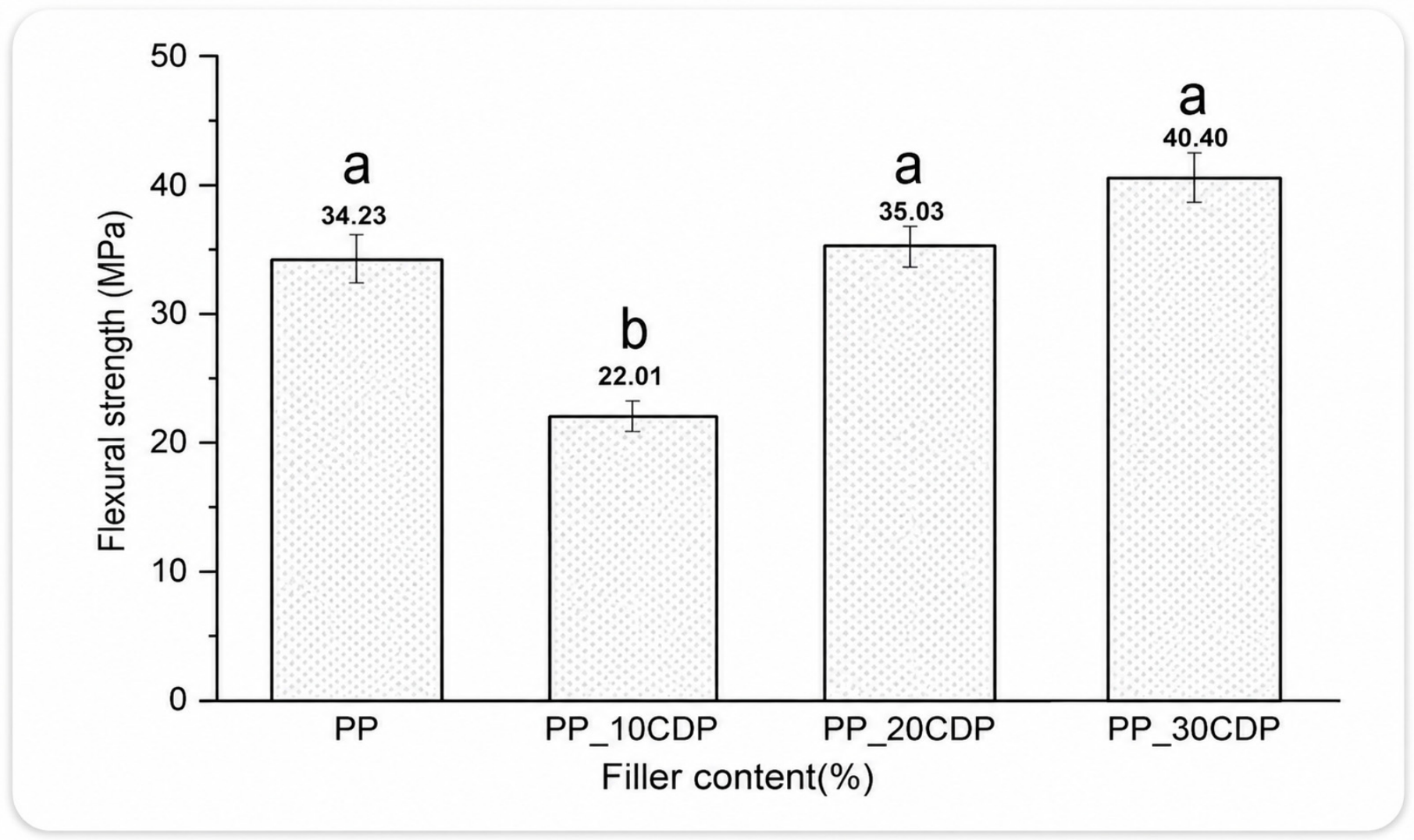
It was possible to observe a decrease in this property with the addition of 10% load (PP_10CDP) and a trend of growth for the 20% (PP_20CDP) and 30% (PP_30CDP) load patterns, as seen in Figure 5. However, analyzing the standard deviations, the flexural test results show a significant reduction (p < 0.05) of about 35.7% in the flexural strength value with the addition of 10% load in the standard polymer matrix (PP_10CDP), reducing the value from 34.23 MPa to 22.01 MPa, respectively [30]. The decrease in flexural strength with the addition of load can be attributed to various factors, such as load agglomeration and void formation at the interface, with the increase in percentage [31]. The flexural strength decreased as the wood fiber content in a wood fiber polypropylene composite increased [32]. On the other hand, the values related to 20% (PP_20CDP) and 30% (PP_30CDP) load did not show significant changes in flexural strength (p < 0.05) compared to pure polypropylene. This condition may be related to the low distribution of the load in the matrix, morphological complexity, and weak interaction with the coupling agent, resulting in a statistically insignificant increase, equal to the PP standard [33]. As a result, the incorporated load in the matrix acts more as a filler material than a reinforcement [18].
Figure 5.
Effect of adding different percentages of woody shell load on the flexural strength of wood–plastic composites (WPC). The statistical groups were represented with the letters “a” and “b”.
Flexural strength was also significantly affected by filler loading [F(3,16) = 7.14, p = 0.0028]. PP_CDP10 (22.0 ± 4.6 MPa) exhibited a 35.3% reduction compared with neat polypropylene (34.0 ± 6.6 MPa) and differed significantly from the control (p < 0.05). In contrast, PP_CDP20 (35.0 ± 7.4 MPa) and PP_CDP30 (40.4 ± 3.9 MPa) were not significantly different from neat polypropylene (p > 0.05), corresponding to increases of 2.9% and 18.8%, respectively.
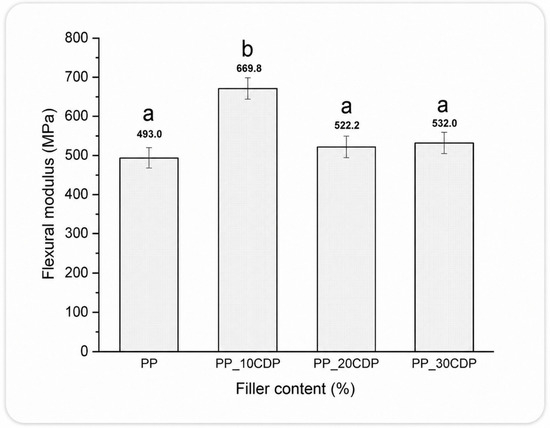
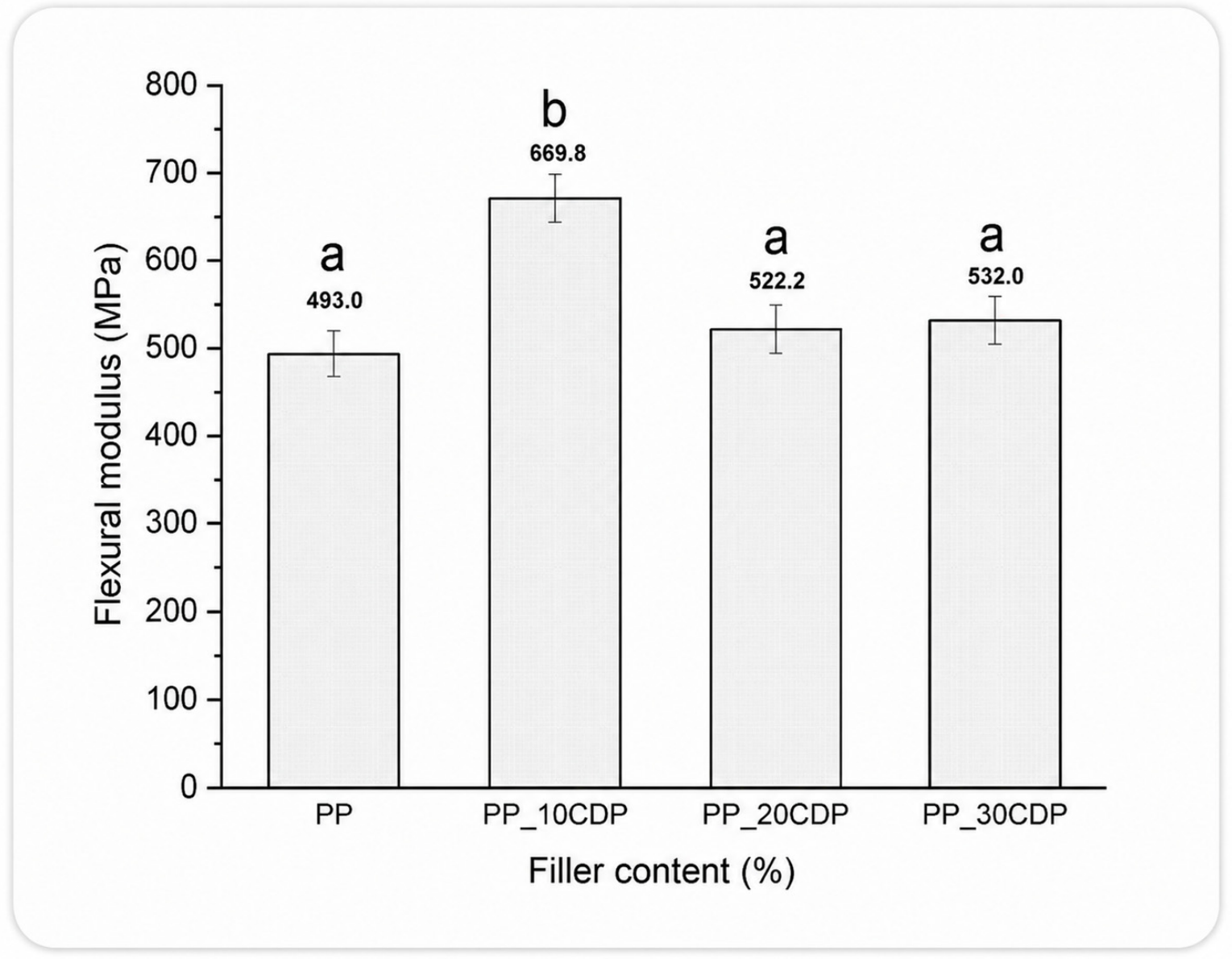
The flexural tests indicated a significant increase (p < 0.05) of about 36% in the flexural modulus value with the addition of 10% (PP_10CDP) of load in the polypropylene matrix, raising the value from 493 MPa to 669.8 MPa, respectively (Figure 6). The incorporation of fillers in a thermoplastic polymer matrix results in a decrease in elastic deformation by restricting movement, which in turn leads to an increase in the flexural modulus [31,34]. The 20% (PP_20CDP) and 30% (PP_30CDP) samples did not show statistically different modulus values (p < 0.05) compared to the standard polymer. The increase in the modulus was significant up to 10%.
Figure 6.
Effect of adding different percentages of woody shell load on the flexural modulus of wood–plastic composites (WPC). The statistical groups were represented with the letters “a” and “b”.
A significant effect was likewise observed for flexural modulus [F(3,16) = 6.67, p = 0.0039]. PP_CDP10 (669.8 ± 44.7 MPa) showed a 35.9% increase compared with neat polypropylene (493.0 ± 92.5 MPa) and differed significantly from all other groups (p < 0.05). Conversely, PP_CDP20 (522.2 ± 42.4 MPa) and PP_CDP30 (532.0 ± 50.4 MPa) did not differ significantly from neat polypropylene (p > 0.05), showing only modest increases of 5.9% and 7.9%, respectively. Combined with the SEM observations discussed in Section 3.7, these findings indicate that although low filler loading effectively increased composite stiffness, higher filler contents promoted particle agglomeration and interfacial void formation, limiting further improvements in flexural performance.
Our composites with 20–30 wt% Bertholletia excelsa shell filler showed an approximately 30% increase in flexural modulus compared to neat PP. This aligns with findings from similar studies. For example, PP composites reinforced with 2 wt% corn cob cellulose nanocrystals exhibited a ~36% increase in modulus [34]. Similar trends were also observed in PP/wood flour or PP/lignocellulosic nanofiber systems [35,36].
A study on PP composites with 30 wt% walnut shell flour reported a flexural modulus of ~3633 MPa [37], comparable to our highest values.
These results suggest that intermediate and higher filler contents compensated for the initial reduction in strength, probably owing to the stiffening effect promoted by the lignocellulosic particles.
3.6. Morphological and Microstructural Features
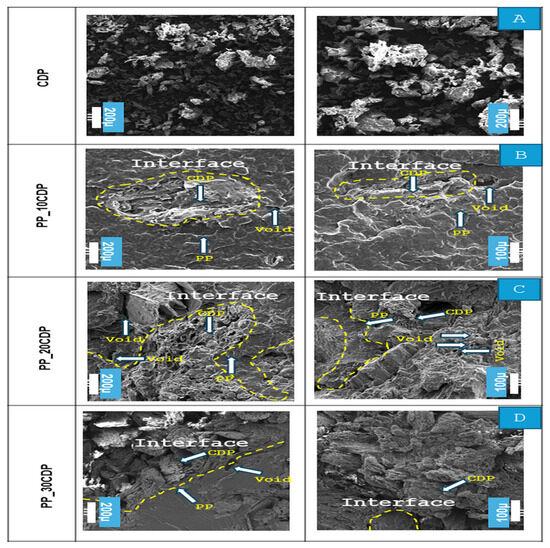
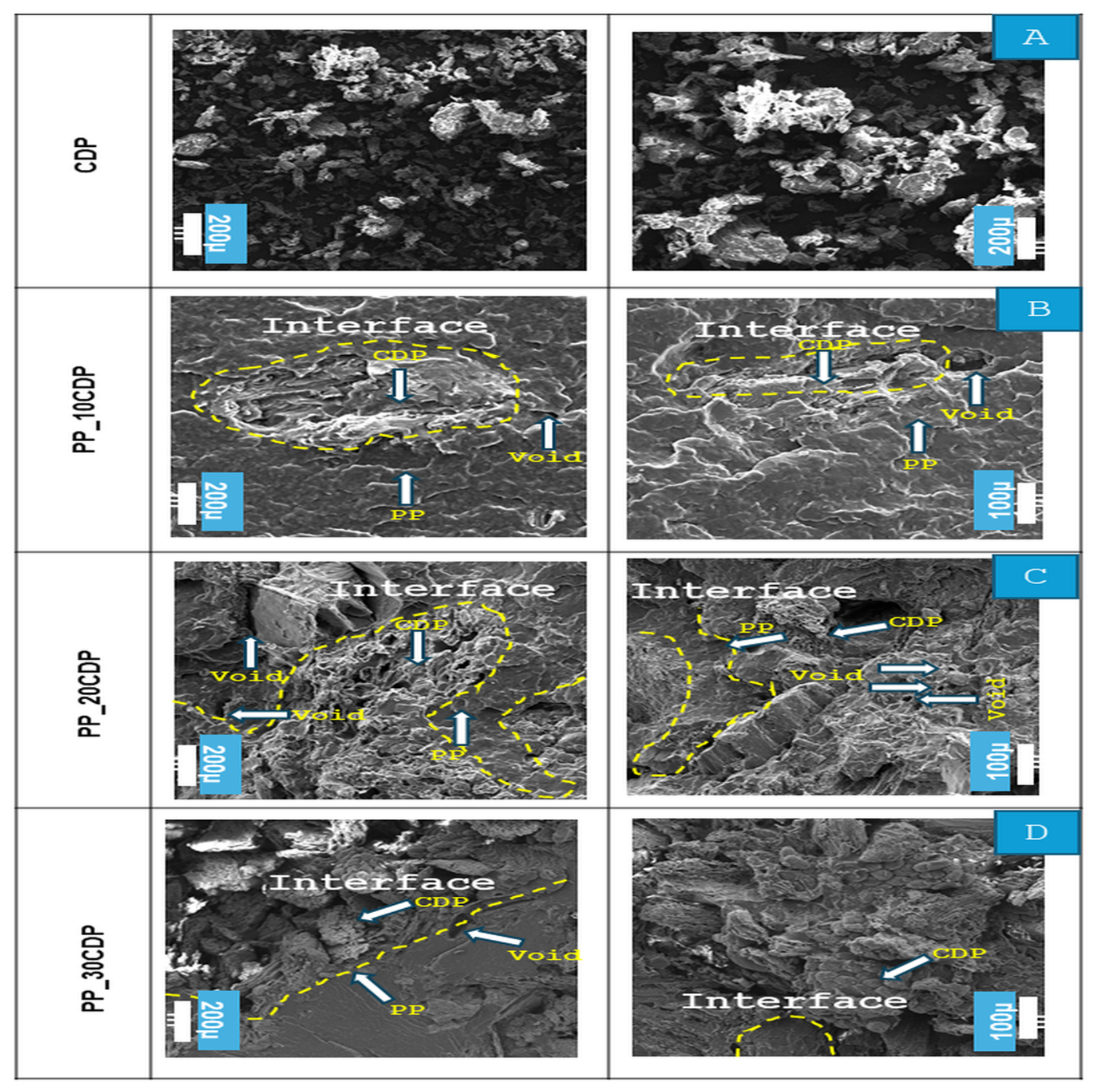
The scanning electron microscopy analysis of the lignocellulosic load from the Brazil nut (CDP) can be seen in Figure 7A. It was possible to observe an irregular morphology of the load in terms of shape and size, with roughness on the plant structure. This heterogeneity can be attributed to the microstructure present, which serves to transport water and nutrients during the plant’s growth [23]. Particle sizes averaged around 300 μm.
Figure 7.
Scanning Electron Microscopy of the load and WPCs: load at 200 μm and 100 μm scales (A); PP_10CDP at 200 μm and 100 μm scales (B); PP_20CDP at 200 μm and 100 μm scales (C); PP_30CDP at 200 μm and 100 μm scales (D).
The morphology of the Brazil nut loads and the PP_10CDP, PP_20CDP, and PP_30CDP composites, analyzed at 300× and 600× magnifications, showed various profiles regarding load distribution, coupling effect, voids, matrix/load interface, and gaps. In Figure 7B, for the composite with a 10% load, it is possible to see a high dispersion of material within the matrix, creating isolated load points within the polypropylene. This may be due to the smaller load quantity and better distribution during composite processing. Voids are also visible, resulting from load detachment. Arrows indicate the components observed, with the matrix/load interface region marked by yellow dashed lines [21]. Similar results were also found on SEM images from Bertholletia excelsa mesocarp, showing voids in the mesocarp [38].
In Figure 7C, the composite interface shows two well-defined regions: one smoother region with small characteristic polypropylene striations and another much rougher region derived from the Brazil nut filler [18]. Voids due to poor adhesion between the load and the matrix can be observed, along with regions of weak interfacial bonding [35]. This can be attributed to the poor distribution of the compatibilizer within the composite, creating regions with low coupling.
A key factor influencing the mechanical performance of our composites, particularly under impact loading, is the presence of voids and the quality of interfacial bonding. Voids commonly arise from incomplete wetting of filler surfaces and entrapped air during processing, acting as stress concentrators and thereby reducing mechanical strength and toughness [39]. In our SEM micrographs, we observed micro-voids along the filler–matrix interface, indicating partial wetting and limited chemical bonding. Such voids negatively affect impact strength by facilitating crack propagation, despite relatively stable flexural stiffness [40]. To address this, we incorporated a coupling agent (PP-g-MAH), which is known to promote interfacial adhesion via chemical interactions between the polar filler surface and the nonpolar polypropylene matrix [21]. Previous studies have confirmed that maleic anhydride-functionalized coupling agents improve interfacial compatibility, reduce interfacial voids, and enhance load transfer in lignocellulosic composites [21,22]. Reported improved matrix infiltration and reduced interfacial cracks in wood–plastic composites treated with hybrid compatibilizers [22].
Additionally, fiber surface pre-treatment has been shown to effectively reduce void content and improve fiber–matrix adhesion. For instance, reported that alkaline treatment of jute fibers removed surface impurities and enhanced interfacial bonding, resulting in significant improvements in the impact resistance of jute fiber composites [40]. Although no chemical treatment was applied in our study, the mechanical processing of the Bertholletia excelsa shells and the use of a compatibilizer appear to have contributed to improved matrix-filler adhesion.
Therefore, the mechanical performance of the developed composites reflects a balance between filler-induced stiffness and the reduction in toughness caused by void formation. Future work could improve interfacial properties through fiber surface modification and compatibilizer selection to minimize void content and enhance impact energy absorption.
Due to their molecular conditions, polymers and plant structures exhibit poor adhesion, leading to voids between the matrix/load interfaces. However, adding a coupling agent and distributing it within the matrix enhanced the adhesion of these constituents [41]. The characteristics of wood polymer composites are significantly dependent on the level of the particle dispersion in the polymer matrix and its adhesion to the polymeric material [42].
In Figure 7D, a high concentration of undissolved load within the PP matrix can be observed as the load content increases [43]. These conditions directly affect the mechanical properties of the composites due to the lack of load/matrix wettability [28]. Another observable condition is the gaps left by the displacement of the plant material during fracture [44]. These conditions can also directly interfere with this material on a macro scale.
The SEM micrographs (Figure 7) revealed a progressive increase in voids and localized filler–matrix debonding as the Bertholletia excelsa shell content increased from 10 to 30 wt%. At the lowest filler loading (PP_CDP10), fewer interfacial defects were observed, suggesting that the amount of polypropylene-graft-maleic anhydride (PP-g-MAH) was sufficient to effectively improve the wetting and adhesion between the hydrophilic lignocellulosic particles and the polypropylene matrix. Similar improvements in interfacial compatibility promoted by PP-g-MAH have been widely reported for wood–polypropylene composites, where the compatibilizer enhances filler dispersion, reduces fiber–fiber interactions, and improves stress transfer across the interface [45,46,47].
As the filler content increased to 20 and 30 wt%, the total lignocellulosic surface area increased considerably, reducing the effectiveness of the available compatibilizer and promoting the formation of interfacial defects. The FTIR spectra did not exhibit significant band shifts or the appearance of new characteristic absorption bands with increasing filler loading, suggesting that the interfacial interaction remained predominantly governed by improved physical compatibility rather than extensive chemical modification. No conclusive FTIR evidence were found of extensive ester bond formation in maleated polypropylene/wood composites and attributed the improved mechanical performance primarily to enhanced wetting, filler dispersion, and mechanical interlocking [48].
The XRD results further support this interpretation. Although the lignocellulosic particles promoted β-phase nucleation, the crystallinity index decreased from 48% for PP_CDP10 to values approaching that of neat polypropylene at higher filler contents, indicating that the increasing concentration of rigid particles progressively restricted polymer chain mobility during crystallization. Similar relationships between interfacial compatibility, crystallization behavior, and composite performance have been reported for PP-based wood composites modified with maleic anhydride compatibilizers [49].
Furthermore, the mismatch between the coefficients of thermal expansion of the polypropylene matrix and the rigid lignocellulosic particles may generate differential shrinkage stresses during cooling after compression molding. When interfacial adhesion becomes less effective at higher filler contents, these stresses promote localized debonding and micro void formation, as observed in Figure 7C,D. These defects act as stress concentrators that facilitate crack initiation during impact loading, explaining the reduction in impact strength despite the relatively stable flexural modulus. Overall, these observations indicate that optimizing the compatibilizer-to-filler ratio would likely improve interfacial integrity and enhance the toughness of highly filled recycled polypropylene composites.
Similar to the Castanha-do-Pará lignocellulosic charge, results obtained in a work with bio-based WPCs showed a reduced cost of the material compared to the neat materials. Moreover, composites with exciting properties, including excellent mechanical properties, enhanced thermal stability, delayed degradation processes, and an attractive dark brown color, were obtained [50]. These comparisons demonstrate that our results align with previous reports and underscore the potential of Bertholletia excelsa shell as a sustainable and effective filler in PP-based composites. The novelty of using a unique Amazonian agroforestry byproduct strengthens the environmental and regional relevance of the material.
Over the past 100 years, polymer science has enabled the development of many materials that are key to modern life. However, now sustainable alternatives to conventional polymers are needed to mitigate environmental damage and reduce reliance on petroleum resources [51]. With the growing need for sustainability, Amazonian feedstock could provide a two-fold solution, valorizing underexploited materials and promoting sustainable economic development [52]. Therefore, lignocellulosic biomass waste such as Bertholletia excelsa shell, a biomass waste from the food industry, working as a composite filler, reduces the price gap between bio-based polymers and petroleum-based plastic while increasing the circularity of the material by reducing the need for virgin feedstock [53]. These materials provide a viable solution for waste management in the Amazon, transforming previously underutilized by-products into valuable resources for the industry [54].
Moreover, this work demonstrates that this filler could possibly induce beta-phase crystallization in the PP matrix and maintain flexural strength at higher filler loadings (20–30 wt%), which is a promising result for industrial WPC applications. These aspects provide both scientific and practical advances in the design of sustainable polymer composites using underutilized biomass from tropical ecosystems. Highlighting the feasibility of converting discarded plant waste into value-added materials, offering a sustainable alternative to conventional plastics and reinforcing strategies for waste reduction and circular resource utilization. This type of green material contributes to reducing resource use and environmental protection [54].
To minimize waste, industrial manufacturing of two potential WPC products (table/chair legs and crates) of recycled plastic and wood, for two different applications showed successful substitutions of recycled bulky plastics and wood wastes with the virgin ones, and therefore, to contribute to the circular economy, valorization of these wastes by upscaling laboratory results for development of marketable new products need to be explored [55]. Agro-industrial wastes are low-cost, biodegradable, and do not cause any harm to the environment during production, use, or disposal [56]. Incorporating plastic waste into the production line offers a promising and sustainable strategy for the forest-based industry. This approach not only helps reduce costs and enhance competitiveness but also aligns with environmental objectives, thus strengthening both the economic and ecological foundations of the sector [57].
3.7. Economic and Sustainability Considerations
In addition to the mechanical and thermal performance, the proposed composites offer a potential economic advantage through the partial replacement of recycled polypropylene with Brazil nut shell powder, an abundant agro-industrial residue with limited commercial value. Although a comprehensive techno-economic analysis is beyond the scope of this study, a preliminary assessment of raw material substitution can provide an indication of the potential reduction in polymer consumption. Table 5 summarizes the amounts of recycled polypropylene and Brazil nut shell powder required to produce one metric ton (1000 kg) of each composite formulation, highlighting the corresponding reduction in polymer demand as the filler content increases.
Table 5.
Preliminary assessment of raw material substitution for the production of one metric ton (1000 kg) of recycled polypropylene/Castanha-do-Pará powder composites.
Producing one tonne of composite containing 30 wt% Castanha-do-Pará nut shell powder requires approximately 300 kg less recycled polypropylene than the unfilled polymer. As shown in Table 5, increasing the Brazil nut shell powder content progressively reduces the amount of recycled polypropylene required for composite production. The formulation containing 30 wt% Brazil nut shell powder replaces 300 kg of recycled polypropylene per metric ton of composite, corresponding to a 30% reduction in polymer consumption. Considering that Brazil nut shell is an abundant agro-industrial by-product with low commercial value, this substitution has the potential to reduce raw material demand while promoting waste valorization and supporting circular economy principles. However, the overall economic feasibility of large-scale production will also depend on factors such as residue collection, preprocessing, transportation, manufacturing costs, and market conditions, which should be addressed in future techno-economic studies.
4. Conclusions
The use of Bertholletia excelsa shells, a lignocellulosic by-product from Amazonian agricultural systems, demonstrates how agricultural residues can be valorized and transformed into high-value functional materials. The developed wood–plastic composites (WPCs) proved feasible with up to 30% vegetable filler using a single-screw extruder, representing a sustainable alternative for polypropylene-based applications. Furthermore, the composites were processed through a conventional extrusion technique without requiring major modifications to industrial equipment, reinforcing their large-scale commercial feasibility. The incorporation of 10% vegetable fibers (CDP) into the polymer matrix increased crystallinity without altering the diffraction pattern, while FTIR analyses confirmed the purity of the reclaimed polypropylene, showing no significant changes in chemical interactions. Flexural strength showed a slight reduction at 10% filler content but remained stable at 20% and 30%, whereas impact resistance decreased for all levels of vegetable filler. Microscopic analyses indicated improved adhesion between the matrix and the filler at 10% and 20% coupling agent concentrations, although efficiency decreased at 30%. Therefore, the incorporation of 20%–30% vegetable filler demonstrated potential to enhance flexural properties, adding sustainable value to the polypropylene matrix and reducing dependence on purely synthetic materials. The fabrication of a reduced-scale table prototype demonstrated excellent surface quality and an aesthetic resemblance to natural wood, confirming the material’s practical applicability in the furniture and construction industries. Nevertheless, the prototype manufactured in this study should be regarded solely as a proof of concept demonstrating processability rather than structural validation for furniture or construction products. The balance between filler content and matrix–filler adhesion can substantially contribute to the development of more eco-efficient materials with optimized resource use, suitable for various industrial applications. Thus, the results validate the B. excelsa-based composite as a promising alternative for developing environmentally friendly materials with efficient resource utilization, strengthening the circular bioeconomy by adding value to underutilized residues from tropical ecosystems. The benefit is that the nutshells’ husk incurs no harvesting costs, as it is found on sawmills and collected for traditional communities. These results highlight the technical and environmental potential of integrating vegetable fillers into polypropylene matrices, outlining a promising route for improving the sustainability of wood–plastic composites without significantly compromising mechanical performance. This approach directly supports the principles of the circular economy by reducing reliance on virgin resources and adding value to regional biomass, helping traditional communities, such as those living along rivers, as well as large producers. Future investigations should include full-scale structural testing, water absorption, accelerated weathering, creep behavior, fatigue resistance, life-cycle assessment, and techno-economic analysis to establish the long-term performance and commercial feasibility of these composites.
Author Contributions
D.R.B. wrote the original draft and conceptualized the work. J.L.L.J. wrote, revised, and edited the final manuscript. A.C.d.A.S. supervised specific experiments. W.A.d.S.L. provided the raw materials. C.B.d.A. revised the writing. C.G.B.T.D. led this research and supervised the experiments. All authors have read and agreed to the published version of the manuscript.
Funding
National Council for Scientific and Technological Development—CNPq (scholarship 133506/2020-7).
Data Availability Statement
Data are contained within the article.
Acknowledgments
The authors thank the Arkema Innovative Chemistry and Industria Mutran Exportadora for providing the lignocellulosic materials utilized in this work. We also thank the Coordination for the Improvement of Higher Education Personnel (CAPES). The authors have reviewed and edited the output and take fully responsible for the content of this publication.
Conflicts of Interest
The authors declare no conflicts of interest.
References
- Mital’ová, Z.; Mital’, D.; Berladir, K. A Concise Review of the Components and Properties of Wood–Plastic Composites. Polymers 2024, 16, 1556. [Google Scholar] [CrossRef] [Scilit] [PubMed]
- Grand View Research. Wood Plastic Composites Market Size, Share & Trends Analysis Report, 2026–2033. 2025. Available online: https://www.grandviewresearch.com/industry-analysis/wood-plastic-composites-market (accessed on 1 August 2026).
- Hasanin, M.S.; Abd El-Aziz, M.E.; El-Nagar, I.; Hassan, Y.R.; Youssef, A.M. Green enhancement of wood plastic composite based on agriculture wastes compatibility via fungal enzymes. Sci. Rep. 2022, 12, 19197. [Google Scholar] [CrossRef] [Scilit] [PubMed]
- Khan, A.; Mishra, A.; Thakur, V.K.; Pappu, A. Towards sustainable wood–plastic composites: Polymer types, properties, processing and future prospects. RSC Sustain. 2025, 3, 2833–2862. [Google Scholar] [CrossRef] [Scilit]
- Baba, M.N.; Baba, M.C. A Meta-Synthesis of Review Studies on Wood–Polymer Composites: Mapping the Current Research Landscape. Polymers 2025, 18, 63. [Google Scholar] [CrossRef] [Scilit] [PubMed]
- Baldoni, A.B.; Teodoro, L.P.R.; Teodoro, P.E.; Tonini, H.; Tardin, F.D.; Botin, A.A.; Hoogerheide, E.S.S.; Botelho, S.d.C.C.; Lulu, J.; Neto, A.L.d.F.; et al. Genetic diversity of Brazil nut tree (Bertholletia excelsa Bonpl.) in southern Brazilian Amazon. Ecol. Manag. 2019, 458, 117795. [Google Scholar] [CrossRef] [Scilit]
- Raja, T. Exploring a natural fiber extracted from henequen plant leaves: A sustainable innovation for reinforcement in composite materials. Results Eng. 2025, 25, 104015. [Google Scholar] [CrossRef] [Scilit]
- Waqas, M.A.; Hashemi, F.; Mogensen, L.; Knudsen, M.T. Environmental performance of seaweed cultivation and use in different industries: A systematic review. Sustain. Prod. Consum. 2024, 48, 123–142. [Google Scholar] [CrossRef] [Scilit]
- Kuzmin, A.; Ashori, A.; Pantyukhov, P.; Zhou, Y.; Guan, L.; Hu, C. Mechanical, thermal, and water absorption properties of HDPE/barley straw composites incorporating waste rubber. Sci. Rep. 2024, 14, 25232. [Google Scholar] [CrossRef] [Scilit] [PubMed]
- La Mantia, F.P.; Scaffaro, R.; Balsamo, G.; Giuffré, C.; Rodi, E.G.; Corviseri, S.; Citarrella, M.C. Sustainable Composites from Recycled Polypropylene and Hazelnut Shell Flour for Application in Irrigation Systems. Polymers 2025, 17, 3207. [Google Scholar] [CrossRef] [Scilit] [PubMed]
- Franciszczak, P.; Wojnowski, J.; Kalniņš, K.; Piesowicz, E. The influence of matrix crystallinity on the mechanical performance of short-fiber composites—Based on homo-polypropylene and a random polypropylene copolymer reinforced with man-made cellulose and glass fibres. Compos. Part B Eng. 2019, 166, 516–526. [Google Scholar] [CrossRef] [Scilit]
- ASTM D256-10; Standard Test Methods for Determining the Izod Pendulum Impact Resistance of Plastics. ASTM International: West Conshohocken, PA, USA, 2018.
- ASTM D790-17; Standard Test Method for Flexural Properties of Unreinforced and Reinforced Plastics and Electrical Insulating Materials. ASTM International: West Conshohocken, PA, USA, 2026.
- Hafid, H.S.; Omar, F.N.; Zhu, J.; Wakisaka, M. Enhanced crystallinity and thermal properties of cellulose from rice husk using acid hydrolysis treatment. Carbohydr. Polym. 2020, 260, 117789. [Google Scholar] [CrossRef] [Scilit] [PubMed]
- Li, L.; Wang, Q.; Guo, C. The influence of wood flour and compatibilizer (m-TMI-g-PP) on crystallization and melting behavior of polypropylene. J. Therm. Anal. Calorim. 2012, 107, 717–723. [Google Scholar] [CrossRef] [Scilit]
- Huang, L.; Wu, Q.; Li, S.; Ou, R.; Wang, Q. Toughness and crystallization enhancement in wood fiber-reinforced polypropylene composite through controlling matrix nucleation. J. Mater. Sci. 2018, 53, 6542–6551. [Google Scholar] [CrossRef] [Scilit]
- Tienne, L.G.P.; Cordeiro, S.B.; Brito, E.B.; Marques, M.d.F.V. Microcrystalline cellulose treated by steam explosion and used for thermo-mechanical improvement of polypropylene. J. Compos. Mater. 2020, 54, 3611–3624. [Google Scholar] [CrossRef] [Scilit]
- Catto, A.L.; Júnior, M.A.D.; Hansen, B.; Francisquetti, E.L.; Borsoi, C. Characterization of polypropylene composites using yerba mate fibers as reinforcing filler. Compos. Part B Eng. 2019, 174, 106935. [Google Scholar] [CrossRef] [Scilit]
- Karimpour-Motlagh, N.; Khonakdar, H.A.; Jafari, S.M.A.; Mahjub, A.; Panahi-Sarmad, M.; Kasbi, S.F.; Shojaei, S.; Goodarzi, V.; Arjmand, M. Influence of polypropylene and nanoclay on thermal and thermo-oxidative degradation of poly(lactide acid): TG-FTIR, TG-DSC studies and kinetic analysis. Thermochim. Acta 2020, 691, 178709. [Google Scholar] [CrossRef] [Scilit]
- Lin, J.H.; Huang, C.-L.; Lin, Z.-I.; Lou, C.-W. Far-infrared emissive polypropylene/wood flour wood plastic composites: Manufacturing technique and property evaluations. J. Compos. Mater. 2016, 50, 2099–2109. [Google Scholar] [CrossRef] [Scilit]
- Stefani, D.; Junior, M.A.D.; Francisquetti, E.L.; Reis, F.S.; Borsoi, C.; Hansen, B.; Catto, A.L. Influence of coupling agent on post-consumption polypropylene composites reinforced with malt bagasse fibers. J. Compos. Mater. 2021, 55, 4333–4346. [Google Scholar] [CrossRef] [Scilit]
- Elamin, M.A.M.; Li, S.X.; Osman, Z.A.; Otitoju, T.A. Preparation and characterization of wood-plastic composite by utilizing a hybrid compatibilizer system. Ind. Crops Prod. 2020, 154, 112659. [Google Scholar] [CrossRef] [Scilit]
- Kufel, A.; Kuciel, S. Basalt/wood hybrid composites based on polypropylene: Morphology, processing properties, and mechanical and thermal expansion performance. Materials 2019, 12, 2557. [Google Scholar] [CrossRef] [Scilit] [PubMed]
- Pregi, E.; Faludi, G.; Kun, D.; Móczó, J.; Pukánszky, B. Three-component polypropylene/lignin/flax composites with high natural additive content for structural applications. Ind. Crops Prod. 2022, 182, 114890. [Google Scholar] [CrossRef] [Scilit]
- Zhou, H.; Li, W.; Hao, X.; Zong, G.; Yi, X.; Xu, J.; Ou, R.; Wang, Q. Recycling end-of-life WPC products into ultra-high-filled, high-performance wood fiber/polyethylene composites: A sustainable strategy for clean and cyclic processing in the WPC industry. J. Mater. Res. Technol. 2022, 18, 1–14. [Google Scholar] [CrossRef] [Scilit]
- Anosike-Francis, E.N.; Obianyo, I.I.; Salami, O.W.; Ihekweme, G.O.; Ofem, M.I.; Olorunnisola, A.O.; Onwualu, A.P. Physical-Mechanical properties of wood-based composite reinforced with recycled polypropylene and cowpea (Vigna unguiculata Walp) husk. Clean. Mater. 2022, 5, 100101. [Google Scholar] [CrossRef] [Scilit]
- Kieling, A.C.; Santana, G.P.; Dos Santos, M.C.; Neto, J.C.D.M.; Del Pino, G.G.; Dos Santos, M.D.; Duvoisin, S.; Panzera, T.H. Wood-Plastic Composite Based on Recycled Polypropylene and Amazonian Tucumã (Astrocaryum aculeatum) Endocarp Waste. Fibers Polym. 2021, 22, 2834–2845. [Google Scholar] [CrossRef] [Scilit]
- Subramaniam, D.; Natesan, R.; Shanmugavel, B.P. Development of storage bin using lantana camara flour reinforced polypropylene composites: Product performance study on the composite bin for pharmaceutical applications. J. Polym. Res. 2022, 29, 122. [Google Scholar] [CrossRef] [Scilit]
- Xu, J.; Hao, X.; Tang, W.; Zhou, H.; Chen, L.; Guo, C.; Wang, Q.; Ou, R. Mechanical properties, morphology, and creep resistance of ultra-highly filled bamboo fiber/polypropylene composites: Effects of filler content and melt flow index of polypropylene. Constr. Build. Mater. 2021, 310, 125289. [Google Scholar] [CrossRef] [Scilit]
- Chatterjee, A.; Singh, H. Development and Characterization of Peanut Shell Flour–Polypropylene Composite. J. Inst. Eng. India Ser. D 2019, 100, 147–153. [Google Scholar] [CrossRef] [Scilit]
- Zhang, Y.; Zhang, J.; Shi, J.; Toghiani, H.; Xue, Y.; Pittman, C.U. Flexural properties and micromorphologies of wood flour/carbon nanofiber/maleated polypropylene/polypropylene composites. Compos. Part A Appl. Sci. Manuf. 2009, 40, 948–953. [Google Scholar] [CrossRef] [Scilit]
- Liu, Y.; Chen, F.; Ni, X.; Xia, X. The effect of reinforcement on the mechanical properties of veneered wood fiber/polypropylene composites assembled with chlorinated polypropylene. Sci. Rep. 2022, 12, 14007. [Google Scholar] [CrossRef] [Scilit] [PubMed]
- Gozdecki, C.; Wilczyński, A.; Kociszewski, M.; Zajchowski, S. Properties of wood–plastic composites made of milled particleboard and polypropylene. Eur. J. Wood Wood Prod. 2015, 73, 87–95. [Google Scholar] [CrossRef] [Scilit]
- Wan, Y.; Wu, H.; Huang, L.; Zhang, J.; Tan, S.; Cai, X. Preparation and characterization of corn cob/polypropylene composite reinforced by wood ash. Polym. Bull. 2018, 75, 2125–2138. [Google Scholar] [CrossRef] [Scilit]
- Lin, N.; Huang, J.; Chang, P.R.; Anderson, D.P.; Yu, J. Preparation, Modification, and Application of Starch Nanoparticles: A Review. J. Colloid Interface Sci. 2016, 369, 1–16. [Google Scholar]
- Gomez-Caturla, J.; Quiles-Carrillo, L.; Montanes, N.; Balart, R.; Torres-Giner, S. Development and Characterization of Injection-Molded Wood Flour-Reinforced Polypropylene Composites with Enhanced Toughness. Polymers 2022, 14, 837. [Google Scholar] [CrossRef] [Scilit] [PubMed]
- Erdogan, S.; Huner, U. Physical and Mechanical Properties of PP Composites based on Different Types of Lignocellulosic Fillers. J. Wuhan Univ. Technol.-Mater. Sci. Ed. 2018, 33, 1298–1307. [Google Scholar] [CrossRef] [Scilit]
- Wan, Y.; Wu, H.; Zhan, L.; Yue, X.; Zhang, Y. Morphology and Performance of PE-HD/Natural Fiber Composites Fabricated via Rotational Molding. Compos. Part A Appl. Sci. Manuf. 2018, 109, 413–422. [Google Scholar] [CrossRef] [Scilit]
- Mehdikhani, M.; Gorbatikh, L.; Verpoest, I.; Lomov, S.V. Voids in Fiber-Reinforced Polymer Composites: A Review on Their Formation, Characteristics, and Effects on Mechanical Performance. J. Compos. Mater. 2019, 53, 1579–1669. [Google Scholar] [CrossRef] [Scilit]
- Gupta, M.K.; Srivastava, R.K.; Bisaria, H.S. Investigations on Jute Fibre-Reinforced Polyester Composites: Effect of Alkali Treatment and Poly(lactic acid) Coating. J. Ind. Text. 2020, 49, 923–942. [Google Scholar] [CrossRef] [Scilit]
- Madhavi, S.; Raju, S.; Johns, A. Characterization of Bamboo—Polypropylene Composites: Effect of coupling agent. Fibers Polym. 2021, 22, 3183–3191. [Google Scholar] [CrossRef] [Scilit]
- Gill, Y.Q.; Abid, U.; Irfan, M.S.; Saeed, F.; Shakoor, A.; Firdaus, A. Fabrication, Characterization, and Machining of Polypropylene/Wood Flour Composites. Arab. J. Sci. Eng. 2021, 47, 5973–5983. [Google Scholar] [CrossRef] [Scilit]
- Rosa, C.H.S.S.; Mothé, M.G.; Marques, M.F.V.; Mothé, C.G.; Monteiro, S.N. Steam-exploded fibers of almond tree leaves as reinforcement of novel recycled polypropylene composites. J. Mater. Res. Technol. 2020, 9, 11791–11800. [Google Scholar] [CrossRef] [Scilit]
- Lima, C.; Rodríguez, J.; Hernandez, P. Use of organic acids in bamboo fiber-reinforced polypropylene composites: Mechanical properties and interfacial morphology. Polymers 2021, 13, 2007. [Google Scholar] [CrossRef] [Scilit] [PubMed]
- Keener, T.J.; Stuart, R.K.; Brown, T.K. Maleated coupling agents for natural fibre composites. Compos. Part A Appl. Sci. Manuf. 2004, 35, 357–362. [Google Scholar] [CrossRef] [Scilit]
- Kazayawoko, M.; Balatinecz, J.J.; Matuana, L.M. Surface modification and adhesion mechanisms in woodfiber–polypropylene composites. J. Mater. Sci. 1999, 34, 6189–6199. [Google Scholar] [CrossRef] [Scilit]
- Dang, W.; Song, Y.; Wang, Q.; Wang, W. Improvement in compatibility and mechanical properties of modified wood fiber/polypropylene composites. Front. For. China 2008, 3, 243–247. [Google Scholar] [CrossRef] [Scilit]
- Yi, S.; Xu, S.; Fang, Y.; Wang, H.; Wang, Q. Effects of Matrix Modification on the Mechanical Properties of Wood–Polypropylene Composites. Polymers 2017, 9, 712. [Google Scholar] [CrossRef] [Scilit] [PubMed]
- Gomez-Caturla, J.; Balart, R.; Ivorra-Martinez, J.; Garcia-Garcia, D.; Dominici, F.; Puglia, D. Biopolypropylene-based wood plastic composites reinforced with mango peel flour and compatibilized with an environmentally friendly copolymer from itaconic acid. ACS Appl. Polym. Mater. 2022, 4, 4398–4410. [Google Scholar] [CrossRef] [Scilit]
- O’Dea, R.M.; Willie, J.A.; Epps, T.H., III. 100th anniversary of macromolecular science viewpoint: Polymers from lignocellulosic biomass. Current challenges and future opportunities. ACS Macro Lett. 2020, 9, 476–493. [Google Scholar] [CrossRef] [Scilit] [PubMed]
- Godbille-Cardona, G.F.; de Oliveira, W.; Lima, C.P.; Coslovsky, S.V.; Olsen, B.D. Amazonian Fibers for Sustainable Packaging Materials and Circular Bioeconomies. ACS Sustain. Resour. Manag. 2026, 3, 11–30. [Google Scholar] [CrossRef] [Scilit]
- Rech, A.; Siamos, E.; Nicholas, P.; Daugaard, A.E. Recyclable extrudable biopolymer composites from alginate and lignocellulosic biomass waste. ACS Sustain. Chem. Eng. 2023, 11, 8939–8947. [Google Scholar] [CrossRef] [Scilit]
- Leite-Barbosa, O.; Pinto, C.C.D.O.; Leite-da-Silva, J.M.; de Aguiar, E.M.M.M.; Veiga-Junior, V.F. Polymer Composites Reinforced with Residues from Amazonian AgroExtractivism and Timber Industries: A Sustainable Approach to Enhancing Material Properties and Promoting Bioeconomy. Polymers 2024, 16, 3282. [Google Scholar] [CrossRef] [Scilit] [PubMed]
- Tian, G.; Li, L.; Li, Y.; Wang, Q. Water-Soluble Poly(Vinyl Alcohol)/Biomass Waste Composites: A New Route toward Ecofriendly Materials. ACS Omega 2022, 7, 42515–42523. [Google Scholar] [CrossRef] [Scilit] [PubMed]
- Basalp, D.; Tihminlioglu, F.; Sofuoglu, S.C.; Inal, F.; Sofuoglu, A. Utilization of Municipal Plastic and Wood Waste in Industrial Manufacturing of Wood Plastic Composites. Waste Biomass Valorization 2020, 11, 5419–5430. [Google Scholar] [CrossRef] [Scilit]
- Paula, Y.L.D.; Melo, R.R.D.; Paula, E.A.D.O.; Morais, E.R.C.D.; Rodolfo Junior, F.; Pimenta, A.S.; Rusch, F.; Scatolino, M.V.; Pedrosa, T.D. Seedling Production in Eco-Friendly Tubes Manufactured with Beeswax and Cashew Nutshell. Forests 2024, 15, 2228. [Google Scholar] [CrossRef] [Scilit]
- Osvaldová, M.; Potkány, M. Circular Economy and Technological Innovation in the Forest-Based Sector: A Study on Wood–Plastic Composites Business Plan and Cost Calculations. Forests 2025, 16, 52. [Google Scholar] [CrossRef] [Scilit]

Disclaimer/Publisher’s Note: The statements, opinions and data contained in all publications are solely those of the individual author(s) and contributor(s) and not of MDPI and/or the editor(s). MDPI and/or the editor(s) disclaim responsibility for any injury to people or property resulting from any ideas, methods, instructions or products referred to in the content. |
© 2026 by the authors. Licensee MDPI, Basel, Switzerland. This article is an open access article distributed under the terms and conditions of the Creative Commons Attribution (CC BY) license.