


Abstract
Tree-related microhabitats act as key links between forest structure and biodiversity, but these pathways may be altered in urban forests. In Mediterranean urban forests, we found that deadwood-related processes were weaker than hypothesized, while structural diversity remained the primary driver of microhabitat richness. We evaluated whether hierarchical pathways linking structure, diversity, and richness are maintained under urban conditions. A Structural Equation Model was applied to 180 plots across three Italian cities (Florence, Rome, Campobasso), assessing relationships among tree and deadwood volume, diversity, richness, and landscape variables (forest area, patch shape complexity, canopy cover). A consistent bottom-up hierarchy emerged, in which structural heterogeneity was associated with microhabitat richness through diversity-mediated pathways. However, deadwood-related pathways were positive but less consistent than living-tree-related pathways. Landscape context acted mainly as a secondary filter, although canopy cover positively influenced some richness components. Overall, urban forest microhabitat richness depended more on structural heterogeneity than biomass; patterns are consistent with the hypothesis that management, including deadwood removal, may constrain habitat continuity. Maintaining structurally diverse stands, retaining deadwood where compatible with public safety, and integrating microhabitat monitoring into spatial planning are essential to support biodiversity and ecosystem services in urban forests.
1. Introduction
Urban forests have increasingly been considered essential components of cities, given their ability to provide a wide range of ecosystem services and benefits for human well-being while supporting biodiversity. Urban forests reduce temperatures [1], filter air [2], and provide recreational spaces that alleviate stress [3], thereby mitigating the negative effects of urbanization and land-use change [3,4] while helping to counteract habitat loss and fragmentation globally [5]. The quality and quantity of ecosystem services [6] and the health and resilience of urban forests [7] are strongly influenced by their structure and composition. The vertical and horizontal structure of urban forests (i.e., canopy density, stem density, tree size and health, species composition) can strongly influence key ecological processes and the exchanges of evapotranspiration, carbon and energy between urban ecosystems and the atmosphere [8] as well as the composition, abundance, density, and stability of animal communities [9,10,11]. In this context, an increasing number and diversity of tree species and key structures, such as deadwood and tree hollows [12], can increase the structural complexity of urban forests.
Trees are the main natural infrastructure in urban areas [12,13]. Beyond enhancing urban aesthetics, they regulate environmental processes and support different species [14,15,16] by providing habitat and developing Tree-related Microhabitats (TreMs) [17,18]. TreMs are distinct and well-delineated structures occurring on living or standing dead trees [18,19,20] and comprise, for example, cavities, rot holes, crown deadwood, injuries, nests or bracket fungi. TreMs constitute a particular and essential substrate or life site for species or species communities during part of their life cycle to develop, feed, shelter, or breed [21,22], carrying out specific functions for the urban forest ecosystem. In forests, the presence of tree hollows is used to indicate the value of trees for biodiversity [18,21,23]. According to Martin et al. [24], greater richness and diversity of TreMs within forests may result in greater structural complexity, favoring the availability of different ecological niches and the maintenance of diverse biological communities [11]. Furthermore, several studies both in natural and semi-natural forests (e.g., [21,24]) and in urban green spaces (e.g., [25,26,27]) have shown that TreMs are more likely to be found on larger rather than smaller trees, as well as on dead trees and certain tree species that promote the formation of unique TreM groups because these trees provide a greater variety of substrates and are exposed to longer periods of habitat-forming processes such as decay, injury, and fungal colonization. This suggests that the presence of deadwood and structurally complex trees, particularly large and mature individuals rich in TreMs, can support species of high conservation priority [25], while a heterogeneous forest structure is essential to sustain these benefits over time and increase the resilience of urban forests [28]. In natural forests, deadwood occurs in different forms, such as dead standing trees and dead branches still attached to tree crowns and fallen dead tree trunks, and stages of decomposition [29,30,31]. Depending on their structural characteristics and the surrounding environmental context, these forms can play a crucial role in shaping saproxylic beetle communities and overall biodiversity by increasing habitat complexity and the diversity of available trophic and nesting resources [20,32,33,34]. These structural forms are especially important for taxa closely associated with decaying wood, such as saproxylic beetles and cavity-nesting birds, including woodpeckers [30,35].
The management of urban green spaces is subject to strict arboriculture policies [26]. Although common urban policies value large, old trees, this does not apply to those that age and accumulate TreM, such as cavities, deadwood in the canopy, or fungal fruiting bodies. Furthermore, the presence of deadwood in an urban green space is regarded as aesthetically disagreeable, due to the possibility of dead tree collapse and potential fires [36,37]. Safety concerns therefore often necessitate targeted interventions on these habitat trees, including pruning [38] or even complete removal by felling [25,39]. However, the removal of deadwood significantly reduces the occurrence and diversity of TreMs, which can compromise biodiversity and the ecological functioning of urban green spaces [27]. Therefore, it is important to develop management strategies that integrate safety, ecological functionality, and social needs, a crucial challenge for the future of sustainable urban forest planning [40].
However, systematic quantitative assessments of hierarchical pathways linking trees, deadwood, and TreMs remain limited in urban forests, especially where strict management, safety constraints, and limited space may alter these relationships. It remains unclear whether the ecological linkages among tree diversity, deadwood dynamics, and microhabitat formation—well documented in natural forests—are preserved in urban environments, where intensive management, safety-driven deadwood removal, and spatial constraints may disrupt or decouple these processes. To address this knowledge gap, this study aims to understand how urbanization and management practices influence the structural and functional relationships among tree diversity, deadwood, and TreMs in urban forest ecosystems. In particular, we investigated 12 urban forests across three Italian cities (Florence, Rome, and Campobasso) characterized by high variability in terms of compositional, structural and functional diversity. The specific questions our study answers are as follows:
- To what extent are the hierarchical relationships linking tree diversity, deadwood heterogeneity, and microhabitat richness preserved in urban forest ecosystems?
- Do living-tree and deadwood-related diversity pathways differ in their strength of association with microhabitat formation?
- How do landscape constraints—forest area, patch shape complexity and canopy cover—modify pathways generating structures for biodiversity in urban forests?
2. Materials and Methods
2.1. Study Area and Field Measurements
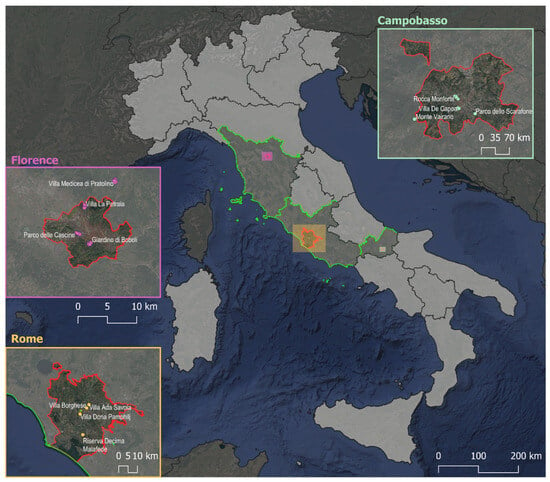
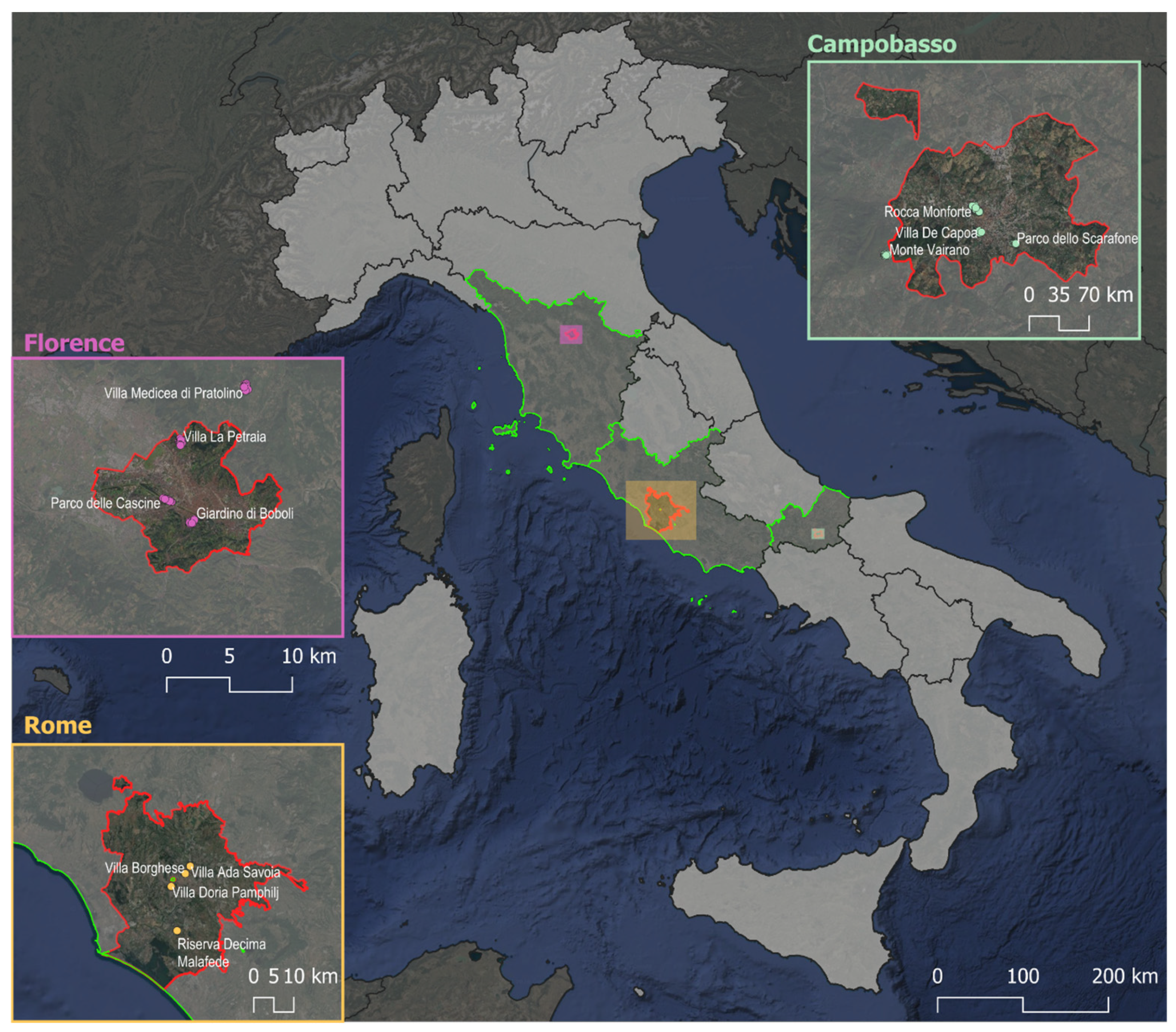
The study was conducted in the urban forests of three Italian cities (Florence, Rome, and Campobasso) (Figure 1). The study area comprised 12 urban parks, with four parks selected in each city. The selected parks differed in size, morphology, and vegetation characteristics, providing a wide range of structural and ecological conditions. Within each park, 15 circular plots (radius = 13 m defined in the Italian National Forest Inventory by Gasperini and Tabacchi [41]) were established to survey representative urban forest stands, resulting in a total of 180 sampling plots (i.e., 15 plots × 4 parks × 3 municipalities). Between 2022 and 2025, the structural attributes and dendrometric parameters were determined in each stand for all living trees with a diameter ≥ 5 cm. For each tree, the stem diameter at 1.30 m, total height, tree species and height to the base of the live crown were measured. TreMs were recorded for each sampled tree and classified according to the official catalogue proposed by Kraus et al. [42], which distinguishes 64 different microhabitat types. Deadwood components were also surveyed and measured within each plot following standardized field protocols and classified into the main deadwood categories: coarse woody debris, standing dead trees, stumps, snags, and dead downed trees. Diversity and inequality metrics were derived from relative abundance or frequency distributions within each domain, using indices tailored to their ecological meaning. Shannon diversity was applied to tree and deadwood components, reflecting species and decay-stage heterogeneity, whereas microhabitat compositional inequality was quantified using the Gini coefficient to capture inequality in the distribution of TreM types at plot level. Richness was defined as the total number of distinct categories observed per plot for each domain. A detailed description of the characteristics of living trees, deadwood and TreMs along with maps of forest cover for each urban forest is provided in Borghi et al. [12].
Figure 1.
Location of the study area and sampling design. The study was conducted in three Italian municipalities (Florence, Rome, and Campobasso, delimited by red solid lines) located in three administrative regions (Tuscany, Lazio, Molise, delimited by green solid lines), where four urban parks were selected per city (12 parks in total in different color dots for each municipality). Within each park, 15 circular plots (radius = 13 m) were established, for a total of 180 plots. In each plot, forest structure, dendrometric variables, deadwood components, and tree-related microhabitats (TreMs) were systematically surveyed.
2.2. Statistical Analysis
We evaluated hypothesized causal relationships among forest structure, deadwood attributes, and TreMs using piecewise structural equation modelling (pSEM). In ecological applications, pSEM is particularly useful when causal hypotheses are represented by a network of linked regressions, like in this case study, rather than by a single covariance-based model, and when the data include hierarchical structure, non-Gaussian responses, or both [43,44,45,46].
The conceptual backbone retained for interpretation is summarized in Table 1.
Table 1.
Conceptual backbone of the piecewise SEM.
The model was designed to test explicit a priori hypotheses: tree volume was expected to be positively associated with tree diversity; tree diversity with TreM diversity and richness; deadwood decay stage diversity and richness with TreM diversity and richness; and landscape variables were expected to regulate richness directly by representing habitat amount, configuration, and local habitat conditions. Because no non-urban reference system was included, any attenuation of deadwood-related pathways is interpreted as a hypothesis consistent with urban management constraints rather than as a direct demonstration of differences from natural forests.
The SEM was specified a priori as a hierarchical ecological cascade in which structural attributes influence compositional diversity, which in turn influences richness. Landscape and configuration variables were treated as exogenous contextual constraints acting directly on richness responses rather than as part of the mediated structural cascade.
Formally, the pSEM can be expressed as a system of linear equations, where each component model represents a causal claim of the form:
where is the response variable of the i-th equation, are the predictor variables, are the standardized path coefficients describing the magnitude and direction of effects, is the intercept, and is the residual error term, including random effects when specified. In this framework, the path coefficients are analogous to partial regression coefficients and quantify the direct contribution of each predictor to the response, while indirect effects emerge through chains of linked equations.
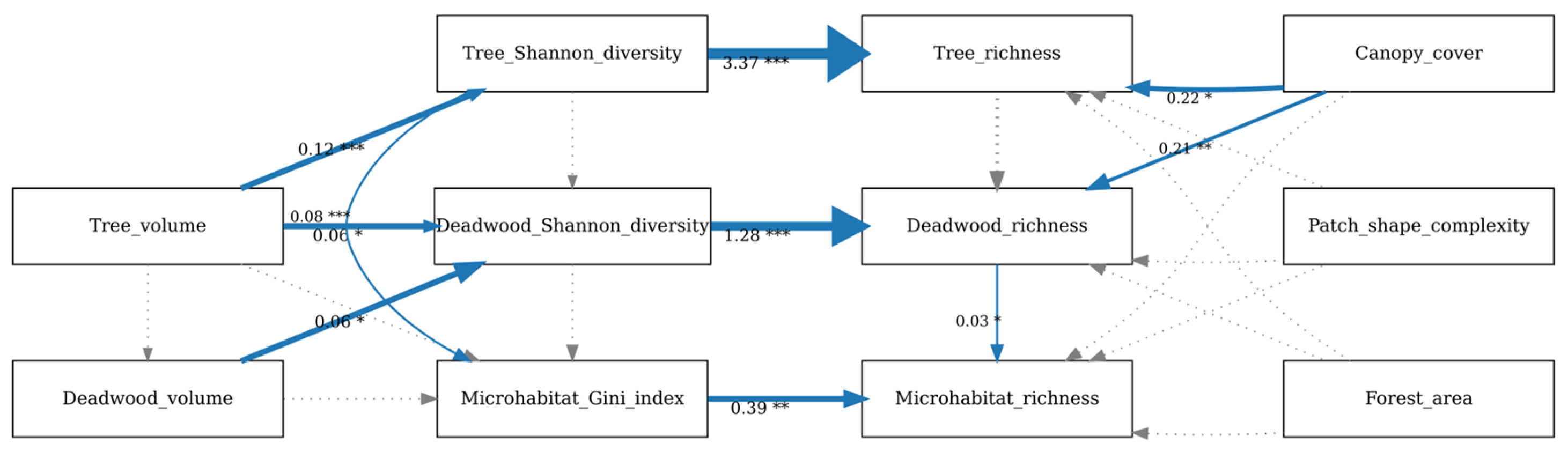
The pSEM operationalizes the hypothesized ecological cascade by linking tree volume to tree and deadwood attributes, which subsequently influence microhabitat inequality and richness (Table 2), while landscape variables are included as direct predictors of richness. Tree volume was used as a proxy for stand-level biomass and structural development, capturing both tree size and density. The constituent models included in the final pSEM are listed in Table 2, and the fixed-effect estimates reported from those models are summarized in Figure 2 and Figure 3.
Table 2.
Constituent models included in the final piecewise Structural Equation Model. Abbreviations: LMM = Linear Mixed Model; GLM = Generalized Linear Model; GLMM = Generalized Linear Mixed Model.
Figure 2.
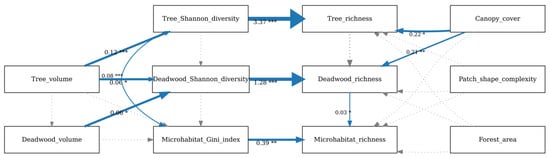
Conceptual structural equation model showing relationships among forest structural attributes (tree volume, deadwood volume, canopy cover, patch shape complexity, and forest area) and structural habitat components (diversity/inequality and richness of trees, deadwood, and microhabitats). Boxes represent observed variables. Arrows indicate hypothesized causal pathways: blue arrows show positive effects, and grey dashed arrows denote non-significant relationships. Values next to arrows are unstandardized path coefficients; asterisks denote significance levels (* p < 0.05, ** p < 0.01, *** p < 0.001; ns = non-significant). Line thickness is proportional to the absolute magnitude of the displayed unstandardized coefficient. Standardized effects and 95% confidence intervals are reported in Figure 3.
Figure 3.
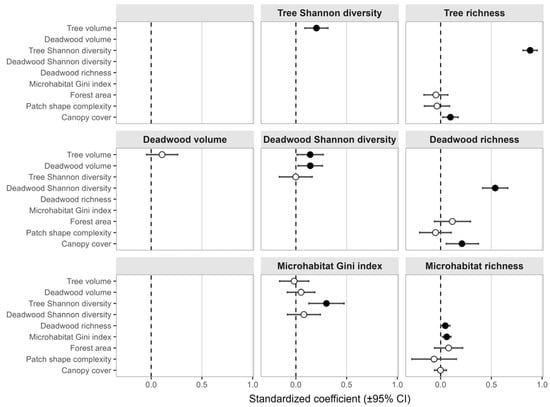
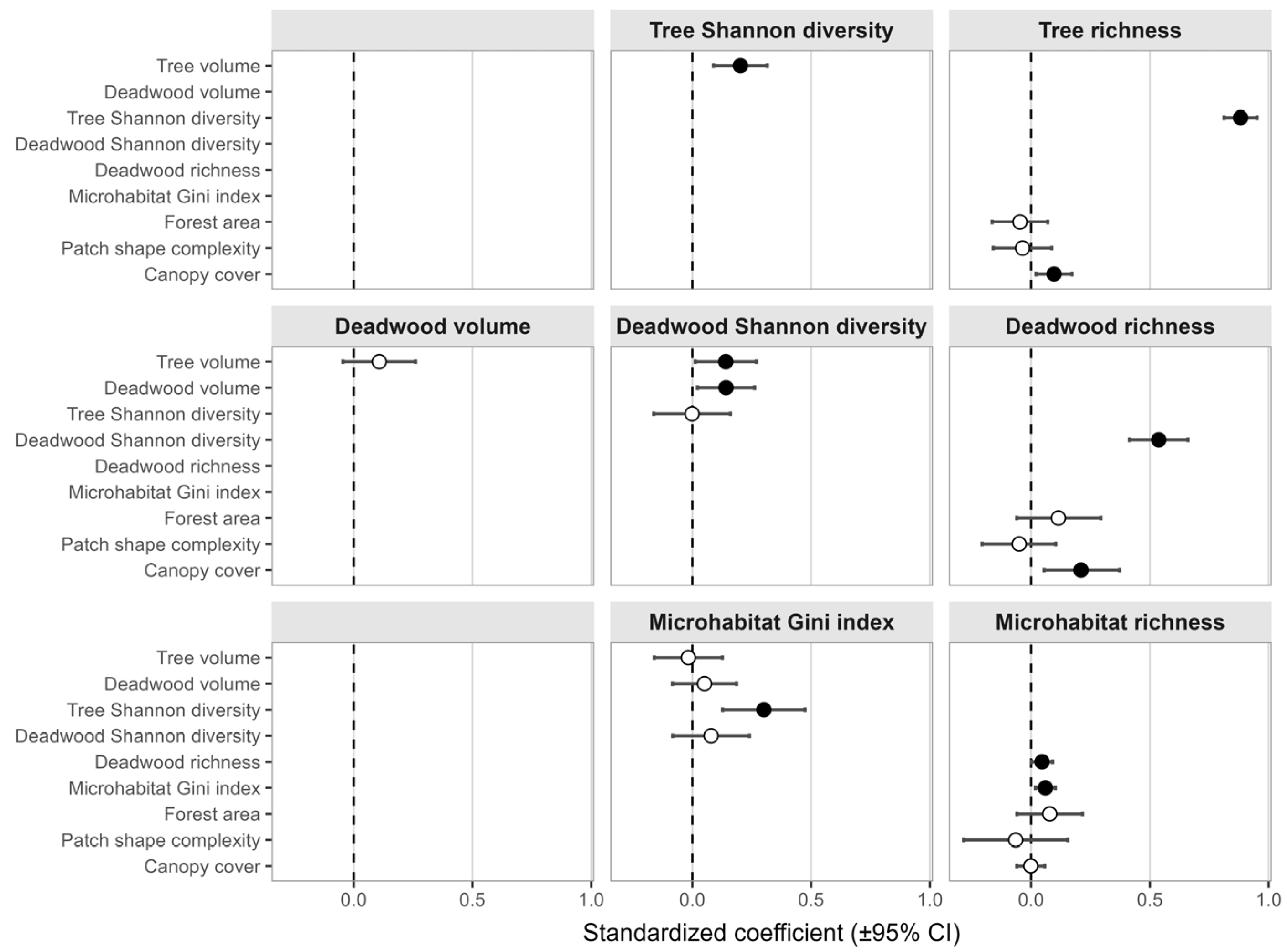
Standardized coefficients (±95% confidence intervals) from the component models included in the final piecewise structural equation model (pSEM), arranged to reflect the hierarchical organization of diversity pathways. Panels are grouped by domain across rows, with tree-related responses in the first row, deadwood-related responses in the second row, and microhabitat-related responses in the third row; empty panels are included to preserve this structure. Within each panel, points indicate standardized effect sizes of predictors, and horizontal bars represent 95% confidence intervals. The vertical dashed line denotes zero effect. Positive and negative values indicate the direction of relationships. Filled circles denote effects whose confidence intervals do not overlap zero (statistically supported at p < 0.05), whereas open circles indicate non-supported effects (p ≥ 0.05). Standardization was performed using a refitting approach to allow comparison across models with different response distributions and scales. Intercepts are not shown, as they are not interpreted within the causal framework.
Continuous predictors were standardized to mean zero and unit variance prior to modelling, allowing direct comparison of effect sizes across component models. Forest area was log-transformed before standardization. Missing values in deadwood-related variables were replaced with zeros because they corresponded to true absences recorded during field surveys, rather than unmeasured or missing observations. Deadwood presence was systematically assessed in all plots following a standardized protocol, ensuring that zero values reflected the actual lack of deadwood rather than incomplete sampling.
Component models were fitted using R [47]. Gaussian responses were analyzed using linear mixed-effects models implemented in lme4 [48], with park included as a random intercept to account for the hierarchical structure of the data. Plots were treated as independent sampling units, while potential spatial dependence among plots within the same park was accommodated through this random effect. Degrees of freedom and p-values shown for linear mixed models were obtained from lmerTest, which extends lme4 and provides Satterthwaite-based inference for fixed effects [49]. Count responses were analyzed using Poisson generalized linear models or generalized linear mixed-effects models with a log link, depending on whether random effects were retained in the final model structure. Overdispersion in count models was assessed using the ratio of residual deviance to residual degrees of freedom.
The overall pSEM was assembled and evaluated using the piecewise SEM framework [46]. Model fit was assessed using Shipley’s test of direct separation, which evaluates whether the set of conditional independence claims implied by the model is supported by the data. This approach tests whether all variables that are not explicitly connected in the model are conditionally independent, thereby identifying potentially missing pathways. For each independence claim, a p-value is obtained, and these are combined into a single test statistic, Fisher’s C (Equation (2)).
where pi is the p-value associated with the i-th independence claim in a basis set of size k. Under the null hypothesis that all conditional independence claims hold, C follows a chi-squared distribution with 2k degrees of freedom. Thus, a non-significant result (p > α, typically 0.05) indicates that the hypothesized causal structure is consistent with the observed data.
Explained variance was quantified for each component model. Marginal () and conditional () coefficients of determination were calculated for mixed models, representing the variance explained by fixed effects alone and by both fixed and random effects, respectively. The difference between these (ΔR2 = ) reflects the contribution of hierarchical structure to model performance. Marginal and conditional R2 values for mixed models were interpreted following the framework of Nakagawa & Schielzeth [50] and its later extension for generalized mixed models [51].
Importantly, the pSEM developed here was specified a priori based on ecological theory and existing empirical evidence, rather than derived through an exhaustive search for a fully saturated causal network. We therefore did not compare this a priori model with a data-driven full model selected through stepwise procedures, because doing so would shift the analysis from a confirmatory framework to an exploratory one and could reduce the ecological interpretability of the hypothesized pathways. Instead, model adequacy was evaluated using Shipley’s test of directed separation, standardized coefficients, confidence intervals, and explained variance of the component models. This methodological framework allows testing whether the structural pathways generating habitats for biodiversity observed in natural forests are retained or altered under urban conditions.
To further explore differences in microhabitat composition among municipalities, we performed a non-metric multidimensional scaling (NMDS) ordination based on Bray–Curtis dissimilarities using the abundance of microhabitat categories recorded in each plot. NMDS was chosen as a robust, non-parametric approach suitable for community composition data with non-linear relationships. The analysis was conducted using the vegan package in R, and ordination was performed in two dimensions. Only plots with non-zero microhabitat observations were included. The resulting ordination scores were visualized to compare compositional patterns among municipalities, and 95% confidence ellipses were added to highlight group-level differences. In addition, microhabitat categories were overlaid to identify the main components driving compositional variation.
3. Results
3.1. Global Structure of Diversity Pathways in the pSEM
The piecewise SEM revealed a structured network of relationships linking forest attributes, diversity components, and landscape variables (Figure 2 and Figure 3). The pSEM (Figure 2) highlights strong positive pathways linking diversity (Shannon) or inequality (Gini) to richness across all domains, while several upstream structural relationships remain weak or non-significant. The global goodness-of-fit test indicated that the full pSEM reproduced the data well based on a comparison of Fisher’s C statistic to a chi-squared distribution (Fisher’s C = 61.5, df = 52, p = 0.171).
Among all pathways, the effect of tree Shannon diversity on tree richness and of microhabitat inequality (Gini index) on microhabitat richness were among the strongest relationships in the model (Figure 3). Within the tree domain, tree volume positively influenced Shannon tree diversity, which in turn strongly increased tree richness. However, several hypothesized structural links were not supported by the data, particularly the relationship between tree volume and deadwood volume (Figure 3). Nevertheless, deadwood volume positively influenced Shannon deadwood diversity, which was the primary predictor of deadwood richness. Within the microhabitat domain, microhabitat inequality (Gini index) increased with tree Shannon diversity and was a significant predictor of microhabitat richness. Microhabitat richness was also positively associated with deadwood richness.
Landscape variables exerted direct effects on richness responses across domains. Canopy cover, an indicator of gap opening in urban parks due to harvesting of groups of trees for landscaping or for safety reasons, positively affected tree richness and deadwood richness. In contrast, microhabitat richness showed no significant relationships with forest area, patch shape complexity, or canopy cover. Overall, forest area had consistently positive but non-significant effects on richness, whereas patch complexity had consistently negative but non-significant effects.
The component models showed moderate to high explanatory power (Table 3). Tree richness and deadwood richness models exhibited the highest explained variance, whereas models involving deadwood volume and tree diversity showed comparatively lower explanatory power, particularly in terms of marginal R2.
Table 3.
Explained variance of the component models included in the final piecewise structural equation model (pSEM). For each response variable, the table reports the type of model fitted and the proportion of variance explained. Marginal R2 values represent the variance explained by fixed effects only, whereas conditional R2 values represent the variance explained by both fixed and random effects (for mixed models). For generalized linear models (GLM/GLMM), R2 values were calculated using appropriate pseudo-R2 metrics (Nagelkerke for GLM and trigamma-based estimates for GLMM). Conditional R2 is not applicable for models without random effects (indicated by “—“).
3.2. Inter-Municipality Comparison
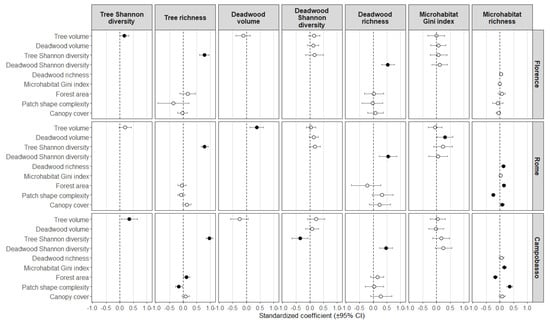
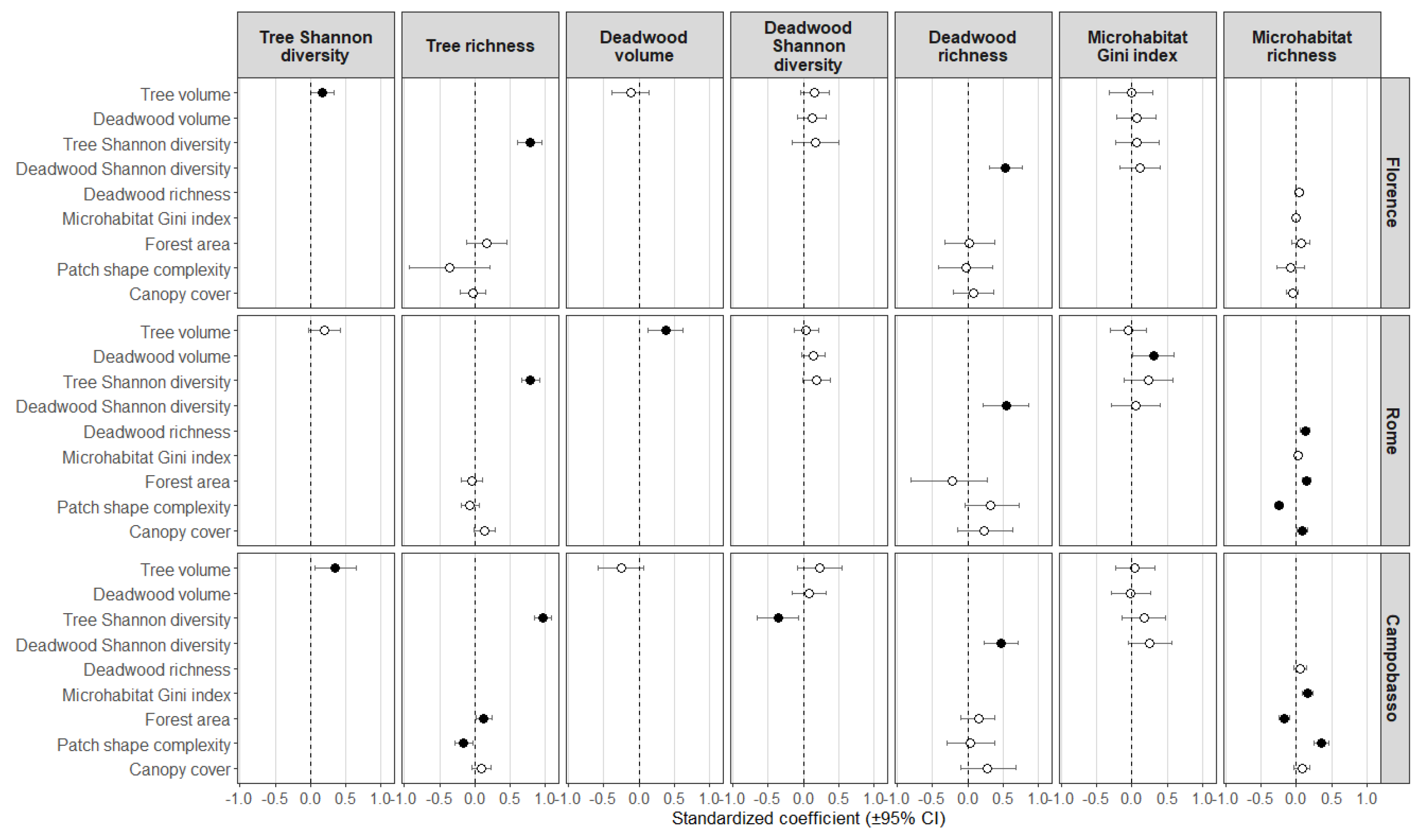
Across municipalities, the overall structure of the pSEM was broadly conserved, with consistent positive association between diversity and richness within each domain, particularly for trees and deadwood (Figure 4). In all three cities, tree Shannon diversity was strongly positively associated with tree richness, and deadwood Shannon diversity was consistently positively associated with deadwood richness, indicating stable within-domain relationships between related diversity metrics.
Figure 4.
Standardized coefficients (±95% confidence intervals) from the component models included in the final piecewise structural equation model (pSEM) for the three municipalities. Within each panel, points indicate standardized effect sizes of predictors, and horizontal bars represent 95% confidence intervals. The vertical dashed line denotes zero effect. Positive and negative values indicate the direction of relationships. Filled circles denote effects whose confidence intervals do not overlap zero (statistically supported at p < 0.05), whereas open circles indicate non-supported effects (p ≥ 0.05). Standardization was performed using a refitting approach to allow comparison across models with different response distributions and scales. Intercepts are not shown, as they are not interpreted within the causal framework. In contrast, tree–deadwood linkages were more variable among municipalities. The effect of tree volume on deadwood volume was strongest and clearly positive in Rome, whereas it was weaker and less consistent in Florence and Campobasso. Similarly, tree-mediated effects on deadwood diversity were generally modest across all cities, indicating that deadwood dynamics are only partially coupled with standing tree structure.
Relationships between deadwood and microhabitats were more consistent but still varied in strength. Deadwood diversity and richness contributed positively to microhabitat responses in all municipalities, with particularly strong effects of deadwood richness on microhabitat richness in Rome and Campobasso. However, effects on the microhabitat Gini index were weaker and less consistent, suggesting that while deadwood availability supports microhabitat quantity, its influence on structural inequality is more context-dependent.
Landscape effects showed the greatest divergence among municipalities. In Florence, richness responses were primarily associated with patch shape complexity, with weaker contributions from forest area. In Rome, landscape variables had more moderate and less consistent effects across responses. In contrast, Campobasso showed stronger and more consistent landscape influences, with both forest area and patch shape complexity positively affecting tree and microhabitat richness. Overall, these patterns indicate that while core ecological pathways are shared, the strength of tree–deadwood coupling and the role of landscape structure vary substantially among municipalities.
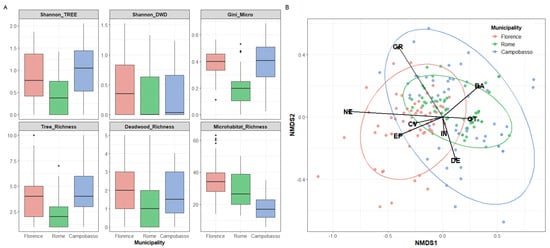
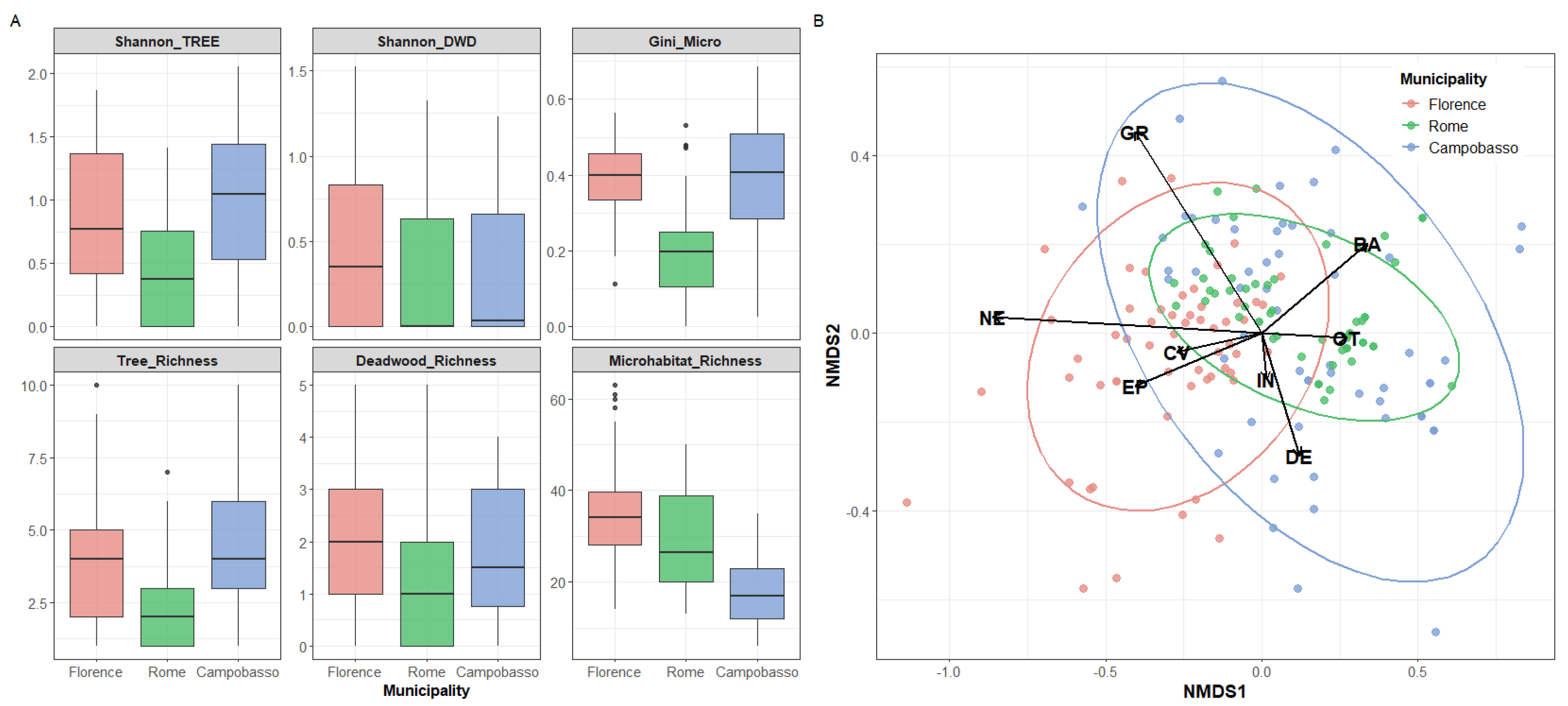
Complementary patterns emerged from comparing diversity and microhabitat composition among municipalities. Boxplots of richness and diversity metrics (Figure 5A) revealed clear differences in central tendency and variability across cities, particularly for microhabitat richness and diversity, as well as tree-related metrics. These differences were further supported by the NMDS ordination, which showed partial separation of plots according to municipality, indicating shifts in microhabitat composition rather than only differences in total richness. In particular, tree and microhabitat richness was similarly higher in Florence and Campobasso compared to Rome, while deadwood diversity was higher in Florence and similarly lower in Rome and Campobasso. Tree and deadwood richness was similarly higher in Florence and Campobasso than in Rome, while microhabitat inequality was highest in Florence, intermediate in Rome, and lowest in Campobasso.
Figure 5.
Differences in structural habitat attributes and TreM composition among municipalities. (A) Boxplots of tree, deadwood, and TreM richness/diversity or inequality metrics across municipalities. (B) Non-metric multidimensional scaling (NMDS) ordination of TreM composition based on Bray–Curtis dissimilarities. Points represent plots colored by municipality, and ellipses indicate 95% confidence regions around municipality groups. Where shown, arrows indicate the direction and relative contribution of TreM types to the ordination space.
The NMDS ordination (Figure 5B) revealed partial separation among municipalities, indicating differences in microhabitat composition beyond variation in richness and diversity. Although some overlap was observed, particularly between Florence and Rome, Campobasso showed a clearer shift along the main ordination gradient (NMDS1), suggesting a distinct compositional structure.
The distribution of microhabitat vectors highlighted the contribution of specific categories to these patterns. Cavities (CV), insect-related microhabitats (IN), and bark-related structures (BA) were primarily associated with the central portion of the ordination space, contributing to the shared compositional core among municipalities. In contrast, epiphytic and fungal-related microhabitats (EP), together with nest-related structures (NE), were more aligned with the negative side of NMDS1, contributing to the differentiation of Florence. Deadwood-related microhabitats (DE) and some growth-related features (GR) were more associated with the positive side of the ordination space, contributing to the separation of Campobasso.
These patterns indicate that differences among municipalities are driven not only by the overall availability of microhabitats but also by shifts in their relative composition. In particular, Florence appears to be characterized by a higher contribution of epiphytic and cavity-related microhabitats, while Campobasso shows a greater association with deadwood-related and growth-related structures. Rome occupies an intermediate position, with a more compact distribution of plots and a composition largely overlapping with the common microhabitat core.
Overall, the NMDS results support the interpretation that urban forest diversity varies among municipalities in terms of both magnitude and structural composition, reflecting differences in forest structure, management intensity, and ecological processes influencing microhabitat formation.
4. Discussion
4.1. Interpreting the pSEM: Parsimony, Fit, and Hierarchical Signal
The pSEM is consistent with the simplified and hypothesis-driven structure of the urban forest ecosystems. Rather than seeking a statistically saturated model, we adopted a parsimonious approach aligned with a priori ecological hypotheses, thereby prioritizing interpretability and mechanistic insight over exhaustive representation of all conditional dependencies [43,44,46]. Such an approach is particularly appropriate in ecological systems, where complex multivariate interactions are often better captured by simplified, hypothesis-driven models than by fully saturated statistical structures. Accordingly, the pSEM should be interpreted as a theory-informed framework capturing the dominant relationships among structural attributes, diversity components, and landscape context.
The distribution of explained variance further supports this interpretation, with higher explanatory power concentrated in richness responses—particularly tree and deadwood richness—while upstream structural components and some diversity components show lower explained variance. This pattern is consistent with a hierarchical propagation of ecological signal rather than with overfitting across all levels of the model.
At the same time, the model’s parsimony implies that some indirect pathways and interactions may be underrepresented. For example, landscape configuration could indirectly affect diversity by influencing tree growth, deadwood accumulation, microclimatic conditions, or the persistence of habitat-bearing trees. These omitted pathways mean that some direct effects should be interpreted as summaries of broader ecological processes rather than as isolated mechanisms.
4.2. Structural Complexity as the Foundation of Urban Forest Diversity
The piecewise SEM supports a hierarchical, bottom-up organization of diversity in urban forests, indicating that stand structural attributes are primary drivers of ecological complexity and influence diversity primarily through indirect pathways. Among the variables considered, tree volume emerged as a key driver of diversification at all levels influencing, directly, tree diversity and deadwood heterogeneity and, indirectly, microhabitat inequality. This finding is consistent with growing evidence that large trees and structurally complex stands constitute key ecological infrastructure in both natural and urban forests, as they provide a wide range of resources, substrates, and environmental conditions for associated organisms [11,18,24]. Forest development is generally accompanied by increases in biomass accumulation, tree size variability, canopy stratification, and the abundance of habitat-bearing trees as indicators of biological legacies. As forests mature, structural heterogeneity increases, creating a wider range of environmental conditions and habitat opportunities [52]. Our results suggest that diversity is promoted not by biomass accumulation itself, but by the structural complexity generated during stand development. Similar patterns have been observed across European forests, where structural complexity consistently outperforms traditional stand metrics such as density or productivity in explaining diversity patterns [52].
In urban environments, where forest patches are frequently constrained by fragmentation and management interventions, structural complexity may become particularly important. Large trees contribute disproportionately to ecosystem functioning because they support higher numbers of microhabitats, increase habitat continuity through time, and provide resources for specialized taxa that are often absent from younger or intensively managed stands [27,53]. Consequently, maintaining structurally diverse urban forests appears fundamental not only for sustaining ecosystem services but also for preserving the ecological processes that support urban biodiversity.
This has direct implications for urban planning. Urban forestry strategies based only on increasing green cover or tree numbers may overlook the structural attributes that determine habitat availability. From a nature-based solutions perspective, maintaining structurally heterogeneous stands, large old trees, trees bearing TreMs, and a diversity of tree sizes and species is therefore essential for converting urban green spaces into ecologically functional habitats.
4.3. Diversity-Mediated Pathways and the Central Role of Tree-Related Microhabitats
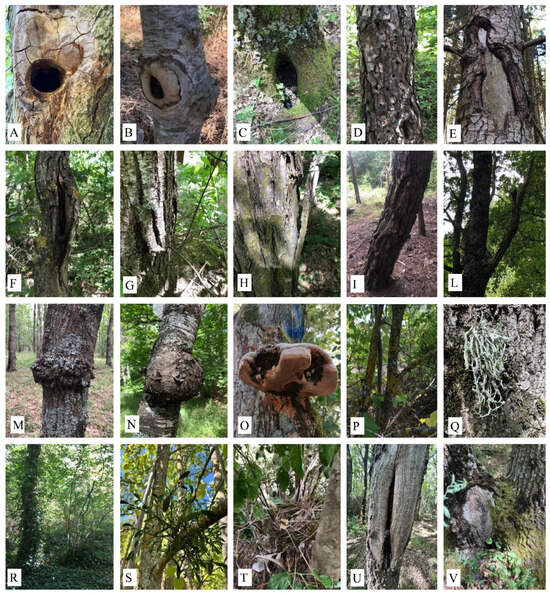
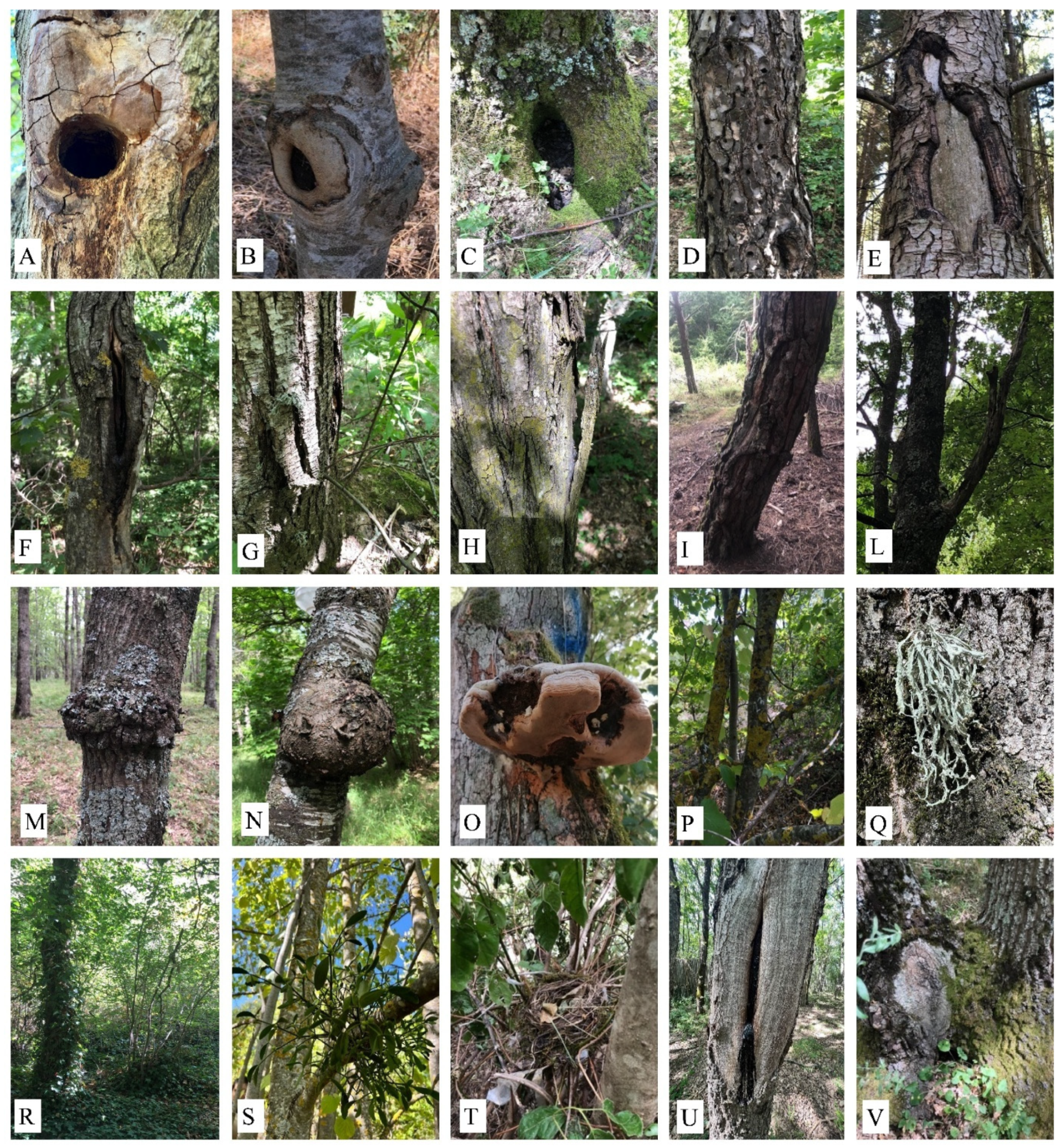
Tree-related microhabitats (TreMs) emerged as the main integrative component of the diversity network, linking forest structure and composition to habitat availability. The pSEM showed that structural attributes did not directly increase richness; rather, their effects were largely mediated through diversity pathways. Tree and deadwood volume contributed to richness indirectly by promoting diversity or structural inequality, which in turn increased richness across domains. This pattern supports the view that biodiversity in urban forests depends more on the diversification of habitat structures than on biomass accumulation alone [54]. Within this hierarchical framework, TreMs occupied a central position by integrating contributions from tree diversity, deadwood-related components, and stand structure. Their role is consistent with growing evidence that identifies TreMs as reliable indicators of biodiversity potential, as they reflect multiple ecological processes spanning tree development, senescence, injury, fungal colonization, and decay (Figure 6). TreMs therefore represent a key interface through which forest structural complexity is translated into habitat resources for a broad range of organisms [24,33]. The positive associations between tree diversity, deadwood-related attributes, and microhabitat responses further suggest that structurally and compositionally heterogeneous forests provide a wider range of habitat opportunities. However, our results indicate that the ecological value of urban forests is associated less with the abundance of habitat structures than with their diversity and heterogeneity [29,55]. Consequently, maintaining a diverse array of trees, deadwood elements, and microhabitats appears essential for sustaining habitat complexity and biodiversity potential in urban forests [11,30,56].
Figure 6.
Some tree-related microhabitats of trees representative of urban forests: (A): Cavity entrance; (B): Rot-holes originating from branch breakage; (C): Cup-shaped concavities to trunk base; (D): Gallery with single large bore hole; (E): Bark loss; (F): Cleft through the bark; (G): Bark shelter; (H): Bark pocket; (I): Coarse bark; (L): Decaying wood; (M): Cancerous growth; (N): Decayed canker; (O): Perennial polypores; (P): Epiphytic bryophytes; (Q): Epiphytic foliose and fruticose lichens; (R): Lianas coverage; (S): Mistletoe; (T): Small vertebrate nest; (U): Sap flow; (V): Bark microsoil.
Because TreMs can be recorded relatively quickly in the field, they also serve as a practical tool for urban forest managers. Their richness and composition can be used to monitor potential habitat availability, compare management units, and evaluate whether conservation-oriented interventions increase structural habitat complexity over time. They should therefore be interpreted as indicators of biodiversity-supporting potential rather than direct measures of realized biodiversity.
4.4. Urban Disruption of Deadwood-Mediated Diversity Pathways
One of the most notable findings of this study is the weak coupling between tree volume, deadwood accumulation, and microhabitat development. While larger and structurally complex stands generally supported higher levels of tree diversity, the downstream relationships involving deadwood were partially weaker than those hypothesized for less disturbed forest ecosystems. In particular, deadwood decay stage richness showed a relatively modest but significant contribution to microhabitat richness, suggesting a possible weakening of the ecological pathways that connect forest development, biological legacies, and habitat availability.
In natural forests, tree mortality and senescence generate a continuous supply of deadwood in various forms and stages of decomposition, including standing dead trees, snags, fallen logs, and dead branches retained within the canopy [33]. These structures support essential ecological functions, including nutrient cycling, carbon storage, moisture retention, and habitat provision for a broad range of organisms [34,57,58]. Deadwood also plays a crucial role in the development of microhabitats through decomposition processes, fungal activity, branch mortality, and structural decay [21]. A plausible explanation for the relatively weak deadwood-mediated pathways observed here is the influence of urban forest management. However, because direct information on pruning frequency, deadwood removal policies, and management intensity was not available, this explanation should be considered an inference rather than a directly tested mechanism. Future studies should explicitly quantify management intensity, for example, through indicators such as pruning frequency, deadwood removals per unit area, retention of standing dead trees, and safety-driven interventions.
If deadwood continuity is reduced, urban forests may retain relatively high levels of living tree diversity while losing important components of habitat complexity. Such weakening of deadwood-related pathways may disproportionately affect organisms that depend on decaying wood or specific TreMs, including saproxylic beetles, cavity-nesting birds, fungi, and other specialized taxa [13,34,59]. Together, these patterns support a simplified urban pathway in which deadwood retains a positive but reduced and more context-dependent role in microhabitat formation.
4.5. Landscape Context as a Secondary Diversity Filter
Beyond stand-level characteristics, landscape variables acted mainly as secondary filters on richness responses. Canopy cover was the only landscape variable showing significant direct effects, being positively associated with both tree and deadwood richness, whereas microhabitat richness was not significantly related to forest area, patch shape complexity, or canopy cover. Although forest area and patch complexity showed only non-significant effects, their positive and negative directions, respectively, are consistent with landscape ecology theory, which predicts that habitat amount and spatial configuration influence biodiversity through habitat continuity, dispersal opportunities, and edge dynamics [57,58]. Larger forest patches generally support greater environmental stability, resource continuity, and structural heterogeneity, thereby increasing the likelihood of maintaining habitat-bearing trees, deadwood resources, and diverse microhabitat assemblages [58,59]. Conversely, irregular and fragmented patches are characterized by a greater proportion of edge habitats. Increased edge exposure alters microclimatic conditions, modifies decomposition processes, and may reduce habitat quality for forest-dependent organisms [58,60]. The absence of significant direct effects on TreM richness suggests that landscape context affects microhabitat formation mainly indirectly, by shaping the availability of trees and deadwood rather than directly determining TreM richness. Once suitable trees, deadwood elements, and local structural conditions are present, TreM formation may depend more strongly on biological processes such as tree age, injury, decay, fungal colonization, and species-specific traits. Alternatively, the landscape variables used here—forest area, patch shape complexity, and canopy cover—may not fully capture other relevant dimensions, such as patch connectivity, surrounding land use, park-use intensity, or human disturbance. Similar patterns have been reported in studies showing that biodiversity patterns depend not only on local habitat quality but also on the spatial arrangement and connectivity of habitat patches across the landscape [6,61]. These findings support integrating stand-level management with broader landscape planning strategies, while emphasizing that local structural heterogeneity remains central for sustaining microhabitat richness.
4.6. Context Dependency Among Municipalities
Although the overall hierarchical organization of habitat-complexity pathways was consistent across municipalities, the strength of individual relationships varied among cities, indicating that local environmental conditions, landscape structure, and management practices may influence the processes generating habitat complexity [62,63]. In all municipalities, diversity remained strongly associated with richness within domains, supporting the generality of the diversity-mediated pathways identified by the pSEM.
However, cross-domain relationships linking trees, deadwood, and microhabitats were more context-dependent. Rome showed stronger coupling between tree volume, deadwood accumulation, and microhabitat richness, suggesting ecological dynamics closer to those hypothesized for less intensively managed forests [21,28]. In contrast, Florence and Campobasso displayed weaker tree–deadwood linkages and a greater influence of landscape attributes, indicating that fragmentation [63] and management practices [13,59] may exert stronger control over habitat formation processes.
Differences among municipalities were also reflected in microhabitat composition, highlighting that similar richness levels can arise from different combinations of habitat structures. Florence appeared more associated with epiphytic and cavity-related microhabitats, Campobasso with deadwood-related and growth-related features, and Rome with a more compact composition overlapping the shared microhabitat core. This suggests that urban forest habitat complexity depends not only on the quantity of available microhabitats but also on their composition and spatial arrangement [28,37]. Consequently, pathways linking forest structure, deadwood dynamics, and microhabitats should be viewed as context-dependent, with their expression shaped by local ecological conditions and management regimes.
4.7. Limitations
Despite the strong mechanistic insights provided by the piecewise SEM, several limitations should be acknowledged. First, the analysis is based on observational data, and therefore causal relationships inferred from the SEM should be interpreted cautiously, as unmeasured variables or alternative pathways may also contribute to the observed patterns [45,46]. Although the model was specified a priori based on established ecological theory, the simplified structure necessarily omits potentially relevant interactions, particularly feedbacks among diversity components and finer-scale management variables that were not explicitly quantified [46].
Second, the use of structural proxies such as tree volume, deadwood volume, and diversity indices may not fully capture the functional quality of habitats, including specific microhabitat attributes or decay stages that influence species assemblages [18,20,52,61].
Third, municipality-specific models were fitted separately to explore context dependence, but differences in sample size, environmental heterogeneity, and management regimes among cities may influence the comparability of parameter estimates [61,62]. In addition, the absence of a non-urban or unmanaged reference system limits the ability to directly assess how far observed pathways deviate from natural forest dynamics [27,64]. As a result, inter-municipality contrasts and interpretations of pathway modification should be considered relative rather than absolute.
Finally, TreM richness and diversity were analyzed as aggregated metrics encompassing a wide range of microhabitat types with distinct ecological functions. While this approach provides an integrated measure of forest habitat complexity and facilitates the identification of general drivers, it may mask differences in the responses of specific microhabitat groups (e.g., cavities, epiphytes, fungal structures, or bark-related features) to forest composition, structure, and management. Future studies could explore functional groups of TreMs separately to better resolve these potentially contrasting patterns.
5. Conclusions
Urban forest habitat complexity was primarily associated with structural complexity generated during forest development, but these relationships operated mainly through diversity-mediated pathways rather than through biomass alone. Across municipalities, richness responses were consistently associated with diversity or inequality metrics within each domain. TreMs acted as the key integrative layer linking forest structure, deadwood attributes, and habitat availability, supporting their use as practical indicators of biodiversity-supporting potential in urban forests.
Overall, habitat complexity pathways in urban forests were partially preserved but modified under urban conditions. Living-tree-related pathways were more consistent across municipalities, whereas deadwood-related pathways were positive but weaker or more context-dependent. This pattern is consistent with the hypothesis that safety- and aesthetics-driven management may reduce deadwood continuity and simplify habitat-complexity pathways compared with those hypothesized for less disturbed forests. However, because direct management data and non-urban reference systems were not available, this interpretation should be considered inferential.
Landscape context acted mainly as a secondary filter. Canopy cover was positively associated with tree and deadwood richness, whereas TreM richness showed no significant direct relationships with forest area, patch shape complexity, or canopy cover. These findings suggest that landscape structure may influence habitat complexity mainly by shaping the availability of trees and deadwood, while local structural heterogeneity remains central for sustaining microhabitat richness.
Conservation-oriented urban forestry should therefore move beyond strategies focused only on increasing tree numbers or canopy cover alone, and should prioritize structurally diverse stands, large, old and habitat-bearing trees, deadwood retention where compatible with public safety, coherent forest patches, and TreM-based monitoring of habitat availability.
Author Contributions
Conceptualization, data curation, methodology, resources, roles/writing—original draft, writing—review and editing: A.M.; investigation, methodology, resources, roles/writing—original draft, writing—review and editing: F.P., C.B. and S.V.; supervision, writing—review and editing: A.M., D.T., G.C., M.M., B.L. and F.P. All authors have read and agreed to the published version of the manuscript.
Funding
This study was partially supported by the following projects: PNRR, project funded under the National Recovery and Resilience Plan (NRRP), Mission 4 Component 2 Investment 1.4—Call for tender No. 3138 of 16 December 2021, rectified by Decree n.3175 of 18 December 2021 of Italian Ministry of University and Research funded by the European Union—NextGenerationEU; Project code CN_00000033, Concession Decree No. 1034 of 17 June 2022 adopted by the Italian Ministry of University and Research, CUP H73C22000300001, Project title “National Biodiversity Future Center—NBFC”. AM received funding from the Research Council of Finland Flagship “Forest-Human-Machine Interplay—Building Resilience, Redefining Value Networks and Enabling Meaningful Experiences (UNITE)” (337653).
Data Availability Statement
Data are available upon reasonable request to the corresponding author.
Acknowledgments
We sincerely thank all those who contributed to the forest surveys for their invaluable support and dedication.
Conflicts of Interest
The authors declare no conflicts of interest.
Abbreviations
The following abbreviations are used in this manuscript:
| TreMs | Tree-related Microhabitats |
| pSEM | piecewise Structural Equation Modelling |
| LMM | Linear Mixed Model |
| GLM | Generalized Linear Model |
| GLMM | Generalized Linear Mixed Model |
References
- Gangwisch, M.; Saha, S.; Matzarakis, A. Spatial Neighborhood Analysis Linking Urban Morphology and Green Infrastructure to Atmospheric Conditions in Karlsruhe, Germany. Urban Clim. 2023, 51, 101624. [Google Scholar] [CrossRef] [Scilit]
- Livesley, S.J.; McPherson, E.G.; Calfapietra, C. The Urban Forest and Ecosystem Services: Impacts on Urban Water, Heat, and Pollution Cycles at the Tree, Street, and City Scale. J. Environ. Qual. 2016, 45, 119–124. [Google Scholar] [CrossRef] [Scilit]
- van Vliet, J. Direct and Indirect Loss of Natural Area from Urban Expansion. Nat. Sustain. 2019, 2, 755–763. [Google Scholar] [CrossRef] [Scilit]
- McDonald, R.I.; Mansur, A.V.; Ascensão, F.; Colbert, M.; Crossman, K.; Elmqvist, T. Research Gaps in Knowledge of the Impact of Urban Growth on Biodiversity. Nat. Sustain. 2020, 3, 16–24. [Google Scholar] [CrossRef] [Scilit]
- Yuan, R.; Zhang, N.; Zhang, Q. The Impact of Habitat Loss and Fragmentation on Biodiversity in Global Protected Areas. Sci. Total Environ. 2024, 931, 173004. [Google Scholar] [CrossRef] [Scilit] [PubMed]
- Roman, L.A.; Conway, T.M.; Eisenman, T.S.; Koeser, A.K.; Ordóñez Barona, C.; Locke, D.H. Beyond “Trees Are Good”: Disservices, Management Costs, and Tradeoffs in Urban Forestry. Ambio 2020, 50, 615–630. [Google Scholar] [CrossRef] [Scilit] [PubMed]
- Paquette, A.; Sousa-Silva, R.; Maure, F.; Cameron, E.; Belluau, M.; Messier, C. Praise for Diversity: A Functional Approach to Reduce Risks in Urban Forests. Urban For. Urban Green. 2021, 62, 127157. [Google Scholar] [CrossRef] [Scilit]
- Ren, Z.; Zheng, H.; He, X.; Zhang, D.; Yu, X.; Shen, G. Spatial Estimation of Urban Forest Structures with Landsat TM Data and Field Measurements. Urban For. Urban Green. 2015, 14, 336–344. [Google Scholar] [CrossRef] [Scilit]
- Culbert, P.D.; Radeloff, V.C.; Flather, C.H.; Kellndorfer, J.M.; Rittenhouse, C.D.; Pidgeon, A.M. The Influence of Vertical and Horizontal Habitat Structure on Nationwide Patterns of Avian Biodiversity. Auk 2013, 130, 656–665. [Google Scholar] [CrossRef] [Scilit]
- Gustin, M.; Nardelli, R.; Brichetti, P.; Battistoni, A.; Rondinini, C.; Teofili, C. Lista Rossa IUCN Degli Uccelli Nidificanti in Italia; Comitato Italiano IUCN e Ministero dell’Ambiente e della Tutela del Territorio e del Mare: Rome, Italy; Ufficio dell’ambiente federale (UFAM): Rome, Italy; Stazione ornitologica svizzera: Sempach, Switzerland, 2021.
- Gossmann, A.; Jansson, N.; Öckinger, E.; Ryding, C.; Ranius, T. In Urban Areas, Tree Cover Increases Species Richness and Shapes Species Composition of Saproxylic Beetles along with the Microclimate. Ecol. Entomol. 2025, 50, 980–991. [Google Scholar] [CrossRef] [Scilit]
- Borghi, C.; Versace, S.; Di Pirro, E.; Travaglini, D.; Chirici, G.; Lasserre, B.; Marchetti, M.; D’Amico, G.; Vangi, E.; Francini, S.; et al. A Dataset on Forest Stand Structures, Deadwood, and Tree-Related Microhabitats along an Urban-Periurban Gradient in Central Italy. Data Br. 2025, 60, 111561. [Google Scholar] [CrossRef] [Scilit] [PubMed]
- Salbitano, F.; Borelli, S.; Conigliaro, M.; Chen, Y. Guidelines on Urban and Peri-Urban Forestry; Food and Agriculture Organization of the United Nations: Rome, Italy, 2016. [Google Scholar]
- MacGregor-Fors, I.; Escobar, F.; Rueda-Hernández, R.; Avendaño-Reyes, S.; Baena, M.; Bandala, V.; Chacón-Zapata, S.; Guillén-Servent, A.; González-García, F.; Lorea-Hernández, F.; et al. City “Green” Contributions: The Role of Urban Greenspaces as Reservoirs for Biodiversity. Forests 2016, 7, 146. [Google Scholar] [CrossRef] [Scilit]
- Padoa-Schioppa, E.; Canedoli, C. Urban Forests and Biodiversity. In Routledge Handbook of Urban Forestry; Routledge/Taylor & Francis: London, UK; New York, NY, USA, 2017; pp. 123–135. [Google Scholar]
- Feng, Y.; Tan, P.Y. Imperatives for Greening Cities: A Historical Perspective. In Greening Cities: Forms and Functions; Tan, P.Y., Jim, J., Eds.; Springer: Berlin/Heidelberg, Germany, 2017; pp. 41–70. [Google Scholar]
- Shrestha, B.; Sharma, B.K.; Yadav, R.K.P. Tree-Related Microhabitats and Trees Outside Forest along the Urban-Rural Gradient in Kathmandu Valley. Banko Janakari 2023, 33, 12–28. [Google Scholar] [CrossRef] [Scilit]
- Larrieu, L.; Paillet, Y.; Winter, S.; Bütler, R.; Kraus, D.; Krumm, F.; Lachat, T.; Michel, A.K.; Regnery, B.; Vandekerkhove, K. Tree Related Microhabitats in Temperate and Mediterranean European Forests: A Hierarchical Typology for Inventory Standardization. Ecol. Indic. 2018, 84, 194–207. [Google Scholar] [CrossRef] [Scilit]
- Parisi, F.; Pioli, S.; Lombardi, F.; Fravolini, G.; Marchetti, M.; Tognetti, R. Linking Deadwood Traits with Saproxylic Invertebrates and Fungi in European Forests—A Review. iForest Biogeosci. For. 2018, 11, 423–436. [Google Scholar] [CrossRef] [Scilit]
- Parisi, F.; Mazziotta, A.; Travaglini, D. Trees, Deadwood and Tree-Related Microhabitats Explain Patterns of Alpha and Beta Saproxylic Beetle Diversity in Silver Fir-Beech Forests in Central Italy. Forests 2025, 16, 1715. [Google Scholar] [CrossRef] [Scilit]
- Asbeck, T.; Pyttel, P.; Frey, J.; Bauhus, J. Predicting Abundance and Diversity of Tree-Related Microhabitats in Central European Montane Forests from Common Forest Attributes. For. Ecol. Manag. 2019, 432, 400–408. [Google Scholar] [CrossRef] [Scilit]
- Kozák, D.; Mikoláš, M.; Svitok, M.; Bače, R.; Paillet, Y.; Larrieu, L.; Nagel, T.A.; Begovič, K.; Čada, V.; Diku, A.; et al. Profile of Tree-Related Microhabitats in European Primary Beech-Dominated Forests. For. Ecol. Manag. 2018, 429, 363–374. [Google Scholar] [CrossRef] [Scilit]
- Paillet, Y.; Debaive, N.; Archaux, F.; Cateau, E.; Gilg, O.; Guilbert, E. Nothing Else Matters? Tree Diameter and Living Status Have More Effects than Biogeoclimatic Context on Microhabitat Number and Occurrence: An Analysis in French Forest Reserves. PLoS ONE 2019, 14, e0216500. [Google Scholar] [CrossRef] [Scilit] [PubMed]
- Martin, M.; Paillet, Y.; Larrieu, L.; Kern, C.C.; Raymond, P.; Drapeau, P.; Fenton, N.J.; Basile, M. Tree-Related Microhabitats Are Promising Yet Underused Tools for Biodiversity and Nature Conservation: A Systematic Review for International Perspectives. Front. For. Glob. Change 2022, 5, 1–18. [Google Scholar] [CrossRef] [Scilit]
- Carpaneto, G.M.; Mazziotta, A.; Coletti, G.; Luiselli, L.; Audisio, P. Conflict between Insect Conservation and Public Safety: The Case Study of a Saproxylic Beetle (Osmoderma Eremita) in Urban Parks. J. Insect Conserv. 2010, 14, 555–565. [Google Scholar] [CrossRef] [Scilit]
- Fröhlich, A.; Ciach, M. Dead Wood Resources Vary across Different Types of Urban Green Spaces and Depend on Property Prices. Landsc. Urban Plan. 2020, 197, 103747. [Google Scholar] [CrossRef] [Scilit]
- Großmann, J.; Pyttel, P.; Bauhus, J.; Lecigne, B.; Messier, C. The Benefits of Tree Wounds: Microhabitat Development in Urban Trees as Affected by Intensive Tree Maintenance. Urban For. Urban Green. 2020, 55, 126817. [Google Scholar] [CrossRef] [Scilit]
- Song, P.; Kim, G.; Mayer, A.; He, R.; Tian, G. Assessing the Ecosystem Services of Various Types of Urban Green Spaces Based on I-Tree Eco. Sustainability 2020, 12, 1630. [Google Scholar] [CrossRef] [Scilit]
- Stokland, J.N.; Siitonen, J.; Jonsson, B.G. Biodiversity in Dead Wood; Cambridge University Press: Cambridge, UK, 2012; ISBN 9781139025843. [Google Scholar]
- Seibold, S.; Hagge, J.; Müller, J.; Gruppe, A.; Brandl, R.; Bässler, C.; Thorn, S. Experiments with Dead Wood Reveal the Importance of Dead Branches in the Canopy for Saproxylic Beetle Conservation. For. Ecol. Manag. 2018, 409, 564–570. [Google Scholar] [CrossRef] [Scilit]
- Basile, M.; Parisi, F.; Tognetti, R.; Francini, S.; Lombardi, F.; Marchetti, M.; Travaglini, D.; De Santis, E.; Chirici, G.; Francini, F.; et al. Diversity of Beetle Species and Functional Traits along Gradients of Deadwood Suggests Weak Environmental Filtering. For. Ecosyst. 2023, 10, 100090. [Google Scholar] [CrossRef] [Scilit]
- Doerfler, I.; Gossner, M.M.; Müller, J.; Seibold, S.; Weisser, W.W. Deadwood Enrichment Combining Integrative and Segregative Conservation Elements Enhances Biodiversity of Multiple Taxa in Managed Forests. Biol. Conserv. 2018, 228, 70–78. [Google Scholar] [CrossRef] [Scilit]
- Leidinger, J.; Blaschke, M.; Ehrhardt, M.; Fischer, A.; Gossner, M.M.; Jung, K.; Weisser, W.W. Shifting Tree Species Composition Affects Biodiversity of Multiple Taxa in Central European Forests. For. Ecol. Manag. 2021, 498, 119552. [Google Scholar] [CrossRef] [Scilit]
- Parisi, F.; Innangi, M.; Tognetti, R.; Lombardi, F.; Chirici, G.; Marchetti, M. Forest Stand Structure and Coarse Woody Debris Determine the Biodiversity of Beetle Communities in Mediterranean Mountain Beech Forests. Glob. Ecol. Conserv. 2021, 28, e01637. [Google Scholar] [CrossRef] [Scilit]
- Porro, Z.; Odicino, M.; Bogliani, G.; Chiatante, G. Intensive Forestry and Biodiversity: Use of Poplar Plantations by Woodpeckers in a Lowland Area of Northern Italy. For. Ecol. Manag. 2021, 497, 119490. [Google Scholar] [CrossRef] [Scilit]
- Brookes, A. Preventing Death and Serious Injury from Falling Trees and Branches. J. Outdoor Environ. Educ. 2007, 11, 50–59. [Google Scholar] [CrossRef] [Scilit]
- Nali, C.; Lorenzini, G. Residents’ Perception of Tree Diseases in the Urban Environment. Arboric. Urban For. 2009, 35, 87–93. [Google Scholar] [CrossRef] [Scilit]
- Avilés, J.M. Pruning Promotes the Formation of an Insufficient Number of Cavities for Hollow-Dependent Birds in Iberian Holm-Oak Dehesas. For. Ecol. Manag. 2019, 453, 117627. [Google Scholar] [CrossRef] [Scilit]
- Fröhlich, A.; Ciach, M. Dead Tree Branches in Urban Forests and Private Gardens Are Key Habitat Components for Woodpeckers in a City Matrix. Landsc. Urban Plan. 2020, 202, 103869. [Google Scholar] [CrossRef] [Scilit]
- Vuidot, A.; Paillet, Y.; Archaux, F.; Gosselin, F. Influence of Tree Characteristics and Forest Management on Tree Microhabitats. Biol. Conserv. 2011, 144, 441–450. [Google Scholar] [CrossRef] [Scilit]
- Gasparini, P.; Tabacchi, G. L’Inventario Nazionale Delle Foreste e Dei Serbatoi Forestali Di Carbonio—INFC-2005. Secondo Inventario Forestale Nazionale Italiano; Edagricole: Bologna, Italy, 2011; ISBN 978-88-506-5394-2. [Google Scholar]
- Kraus, D.; Bütler, R.; Krumm, F.; Lachat, T.; Larrieu, L.; Mergner, U.; Paillet, Y.; Schuck, A.; Winter, S. Catalogue of Tree Microhabitats: Reference Field List. In Catalogue of tree microhabitats; European Forest Institute: Joensuu, Finland, 2016. [Google Scholar]
- Shipley, B. A New Inferential Test for Path Models Based on Directed Acyclic Graphs. Struct. Equ. Model. 2000, 7, 206–218. [Google Scholar] [CrossRef] [Scilit] [PubMed]
- Shipley, B. Confirmatory Path Analysis in a Generalized Multilevel Context. Ecology 2009, 90, 363–368. [Google Scholar] [CrossRef] [Scilit] [PubMed]
- Grace, J.B. Structural Equation Modeling and Natural Systems; Cambridge University Press: Cambridge, UK, 2006. [Google Scholar]
- Lefcheck, J.S. PiecewiseSEM: Piecewise Structural Equation Modelling in R for Ecology, Evolution, and Systematics. Methods Ecol. Evol. 2016, 7, 573–579. [Google Scholar] [CrossRef] [Scilit]
- R Core Team. R: A Language and Environment for Statistical Computing; R Core Team: Vienna, Austria, 2024. [Google Scholar]
- Bates, D.; Mächler, M.; Bolker, B.; Walker, S. Fitting Linear Mixed-Effects Models Using Lme4. J. Stat. Softw. 2015, 67, 1–48. [Google Scholar] [CrossRef] [Scilit]
- Kuznetsova, A.; Brockhoff, P.B.; Christensen, R.H.B. LmerTest Package: Tests in Linear Mixed Effects Models. J. Stat. Softw. 2017, 82, 1–26. [Google Scholar] [CrossRef] [Scilit]
- Nakagawa, S.; Schielzeth, H. A General and Simple Method for Obtaining R2 from Generalized Linear Mixed-Effects Models. Methods Ecol. Evol. 2013, 4, 133–142. [Google Scholar] [CrossRef] [Scilit]
- Nakagawa, S.; Johnson, P.C.D.; Schielzeth, H. The Coefficient of Determination R2 and Intra-Class Correlation Coefficient from Generalized Linear Mixed-Effects Models Revisited and Expanded. J. R. Soc. Interface 2017, 14, 20170213. [Google Scholar] [CrossRef] [Scilit] [PubMed]
- Asbeck, T.; Großmann, J.; Paillet, Y.; Winiger, N.; Bauhus, J. The Use of Tree-Related Microhabitats as Forest Biodiversity Indicators and to Guide Integrated Forest Management. Curr. For. Rep. 2021, 7, 59–68. [Google Scholar] [CrossRef] [Scilit]
- Fröhlich, A.; Przepióra, F.; Drobniak, S.; Mikusiński, G.; Ciach, M. Public Safety Considerations Constraint the Conservation of Large Old Trees and Their Crucial Ecological Heritage in Urban Green Spaces. Sci. Total Environ. 2024, 948, 174919. [Google Scholar] [CrossRef] [Scilit] [PubMed]
- Tews, J.; Brose, U.; Grimm, V.; Tielbörger, K.; Wichmann, M.C.; Schwager, M.; Jeltsch, F. Animal Species Diversity Driven by Habitat Heterogeneity/Diversity: The Importance of Keystone Structures. J. Biogeogr. 2004, 31, 79–92. [Google Scholar] [CrossRef] [Scilit]
- Seibold, S.; Bässler, C.; Brandl, R.; Gossner, M.; Thorn, S.; Ulyshen, M.D.; Müller, J. Experimental Studies of Dead-Wood Biodiversity—A Review Identifying Global Gaps in Knowledge. Biol. Conserv. 2015, 191, 139–149. [Google Scholar] [CrossRef] [Scilit]
- Müller, J.; Wende, B.; Strobl, C.; Eugster, M.; Gallenberger, I.; Floren, A.; Steffan-Dewenter, I.; Linsenmair, K.E.; Weisser, W.W.; Gossner, M.M. Forest Management and Regional Tree Composition Drive the Host Preference of Saproxylic Beetle Communities. J. Appl. Ecol. 2015, 52, 753–762. [Google Scholar] [CrossRef] [Scilit]
- Li, X.; Ou, X.; Sun, X.; Li, H.; Li, Y.; Zheng, X. Urban Biodiversity Conservation: A Framework for Ecological Network Construction and Priority Areas Identification Considering Habit Differences within Species. J. Environ. Manag. 2024, 365, 121512. [Google Scholar] [CrossRef] [Scilit] [PubMed]
- Le Roux, D.S.; Ikin, K.; Lindenmayer, D.B.; Blanchard, W.; Manning, A.D.; Gibbons, P. Reduced Availability of Habitat Structures in Urban Landscapes: Implications for Policy and Practice. Landsc. Urban Plan. 2014, 125, 57–64. [Google Scholar] [CrossRef] [Scilit]
- Lelli, C.; Bruun, H.H.; Chiarucci, A.; Donati, D.; Frascaroli, F.; Fritz, Ö.; Goldberg, I.; Nascimbene, J.; Tøttrup, A.P.; Rahbek, C.; et al. Biodiversity Response to Forest Structure and Management: Comparing Species Richness, Conservation Relevant Species and Functional Diversity as Metrics in Forest Conservation. For. Ecol. Manag. 2019, 432, 707–717. [Google Scholar] [CrossRef] [Scilit]
- Fahrig, L. Effects of Habitat Fragmentation on Biodiversity. Annu. Rev. Ecol. Evol. Syst. 2003, 34, 487–515. [Google Scholar] [CrossRef] [Scilit]
- Haddad, N.M.; Brudvig, L.A.; Clobert, J.; Davies, K.F.; Gonzalez, A.; Holt, R.D.; Townshend, J.R. Habitat Fragmentation and Its Lasting Impact on Earth’s Ecosystems. Sci. Adv. 2015, 1, e1500052. [Google Scholar] [CrossRef] [Scilit] [PubMed]
- Fahrig, L. Rethinking Patch Size and Isolation Effects: The Habitat Amount Hypothesis. J. Biogeogr. 2013, 40, 1649–1663. [Google Scholar] [CrossRef] [Scilit]
- Harper, K.A.; Macdonald, S.E.; Burton, P.J.; Chen, J.; Brosofske, K.D.; Saunders, S.C.; Euskirchen, E.S.; Roberts, D.A.R.; Jaiteh, M.S.; Esseen, P. Edge Influence on Forest Structure and Composition in Fragmented Landscapes. Conserv. Biol. 2005, 19, 768–782. [Google Scholar] [CrossRef] [Scilit]
- Aronson, M.F.; Lepczyk, C.A.; Evans, K.L.; Goddard, M.A.; Lerman, S.B.; MacIvor, J.S.; Vargo, T. Biodiversity in the City: Key Challenges for Urban Green Space Management. Front. Ecol. Environ. 2017, 15, 189–196. [Google Scholar] [CrossRef] [Scilit]

Disclaimer/Publisher’s Note: The statements, opinions and data contained in all publications are solely those of the individual author(s) and contributor(s) and not of MDPI and/or the editor(s). MDPI and/or the editor(s) disclaim responsibility for any injury to people or property resulting from any ideas, methods, instructions or products referred to in the content. |
© 2026 by the authors. Licensee MDPI, Basel, Switzerland. This article is an open access article distributed under the terms and conditions of the Creative Commons Attribution (CC BY) license.