


Abstract
Mangrove restoration is increasingly recognized as an effective nature-based solution for biodiversity conservation, climate-change mitigation, and coastal resilience. However, long-term evaluations of restoration outcomes remain scarce, particularly in arid coastal environments. This study assesses three decades of ecosystem recovery following the afforestation of Avicennia marina at Sajid Bay, Farasan Archipelago, Saudi Arabia. A total of 1050 seedlings were transplanted in 1994 into an unvegetated intertidal area and monitored using multi-temporal satellite imagery and Normalized Difference Vegetation Index (NDVI) analysis from 1994 to 2024. Results revealed a progressive expansion of mangrove cover to 15.48 ha over the 30-year period, corresponding to an average annual increase of approximately 0.516 ha yr−1. Spatial patterns of expansion were strongly influenced by local geomorphological and hydrodynamic conditions. Central areas characterized by low wave energy and stable sediments exhibited the highest rates of colonization and vegetation development, whereas peripheral areas exposed to greater hydrodynamic stress expanded more slowly. The establishment of reproductive stands enabled natural regeneration, transforming the original plantation into a self-sustaining mangrove ecosystem. The findings demonstrate that relatively small-scale afforestation efforts can trigger long-term ecosystem recovery when implemented under suitable environmental conditions. The transition from planted seedlings to a naturally regenerating mangrove forest highlights the importance of site selection, hydrodynamic suitability, and ecological processes in determining restoration success. This study provides rare empirical evidence of long-term mangrove recovery in an arid coastal system and offers a practical conservation framework for restoring degraded coastal habitats throughout the Red Sea region and other environmentally comparable coastlines.
1. Introduction
Mangrove forests are among the most valuable and productive coastal ecosystems on Earth, providing a broad range of ecological, economic, and social benefits. Distributed along tropical and subtropical coastlines in more than 120 countries, mangroves play a fundamental role in biodiversity conservation, shoreline stabilization, fisheries productivity, nutrient cycling, and climate-change mitigation [1,2,3,4]. These ecosystems provide essential nursery habitats for numerous fish and crustacean species, support complex coastal food webs, and enhance the resilience of coastal communities by reducing shoreline erosion, attenuating wave energy, and buffering the impacts of storms and sea-level rise [4,5]. Furthermore, mangrove forests contribute to the ecological integrity of adjacent coastal ecosystems, including coral reefs and seagrass meadows, by improving water quality, trapping sediments, and facilitating ecological connectivity [6,7]. Mangroves are also recognized as one of the world’s most efficient natural carbon sinks, storing substantial quantities of carbon within both aboveground biomass and long-lived sedimentary deposits. Their capacity to sequester and retain carbon frequently exceeds that of many terrestrial forest ecosystems, making them increasingly important components of global climate-change mitigation and blue carbon initiatives [4,8,9,10]. Consequently, the conservation and restoration of mangrove ecosystems have become international priorities for enhancing ecosystem resilience, conserving biodiversity, and supporting sustainable coastal development.
Despite their ecological importance, mangrove ecosystems have experienced widespread degradation over recent decades owing to coastal development, land reclamation, hydrological alteration, pollution, and climate-related disturbances. These pressures have resulted in substantial losses of mangrove extent and ecosystem functionality worldwide, stimulating increasing investment in mangrove conservation and restoration as effective nature-based solutions for recovering degraded coastal ecosystems and strengthening climate resilience [4,11]. Nevertheless, restoration success remains highly variable, emphasizing the need for a better understanding of the ecological processes and environmental conditions that govern long-term ecosystem recovery [12]. Restoration approaches generally include active restoration, involving direct interventions such as seedling planting or propagule transplantation, and passive restoration, whereby natural ecological processes facilitate ecosystem recovery once environmental conditions become suitable [13,14,15]. Increasing evidence indicates that successful mangrove restoration depends not only on planting efforts but also on the ability of restored stands to become self-sustaining through natural regeneration. Hydrodynamic regime, sediment stability, tidal inundation, geomorphological setting, salinity, and propagule production collectively regulate seedling establishment, stand development, and long-term ecosystem persistence [16,17,18]. Once restored mangrove stands reach reproductive maturity, propagules produced by the restored population can naturally colonize adjacent suitable habitats, promoting progressive ecosystem expansion and ecological succession. Consequently, long-term monitoring is essential to determine whether active restoration has successfully initiated ecological processes capable of sustaining ecosystem development beyond the initial planting phase.
Along the Saudi Arabian Red Sea coast, mangrove forests are dominated by A. marina, whereas Rhizophora mucronata occurs only in limited and localized stands [12,13,14,15]. These mangroves occur within one of the world’s most environmentally challenging coastal regions, characterized by hyper-arid climatic conditions, high seawater salinity, elevated air temperatures, limited freshwater inputs, and strong environmental gradients. Despite these constraints, favorable local geomorphological and hydrological conditions can support successful mangrove establishment and long-term ecosystem development. Understanding the factors controlling mangrove establishment, survival, and subsequent expansion under these harsh environmental conditions is therefore essential for improving restoration planning and conservation strategies throughout the Red Sea region.
Although numerous mangrove restoration programs have been implemented worldwide, most evaluations focus primarily on seedling survival and early establishment during the first few years after planting. In contrast, the long-term development of restored mangrove ecosystems remains poorly documented, particularly in arid coastal environments where environmental constraints may strongly influence ecosystem development. Studies spanning more than two decades are exceptionally rare, leaving important questions regarding the long-term effectiveness of restoration interventions and whether relatively small afforestation efforts can develop into self-sustaining mangrove ecosystems through natural regeneration. Addressing this knowledge gap is essential for evaluating restoration success beyond initial establishment and for informing future large-scale restoration initiatives. Advances in satellite remote sensing have substantially improved the ability to monitor long-term ecosystem dynamics across broad spatial and temporal scales. The integration of multi-temporal satellite imagery with vegetation indices such as the NDVI provides an effective and objective approach for quantifying changes in mangrove extent, evaluating restoration performance, and monitoring ecosystem development over decadal timescales [19]. Long-term remote sensing observations therefore provide a unique opportunity to reconstruct long-term ecosystem development that would otherwise be difficult to document through conventional field monitoring alone.
The aim of this study was to evaluate the long-term development of a restored mangrove ecosystem following the 1994 afforestation of A. marina at Sajid Bay in the Farasan Archipelago, Saudi Arabia. Using multi-temporal satellite imagery acquired between 1994 and 2024, we quantified long-term changes in mangrove extent, assessed patterns of spatial expansion, and evaluated the transition from an initially planted stand to a naturally regenerating mangrove ecosystem. By integrating restoration history with three decades of remote sensing observations, this study provides rare empirical evidence of ecosystem recovery in a hyper-arid coastal environment and contributes to the growing body of knowledge supporting mangrove conservation, ecological restoration, and climate-resilient coastal management. The findings also provide practical guidance for designing, implementing, and evaluating future mangrove restoration programs in the Red Sea region and other environmentally comparable coastal systems.
We hypothesized that the 1994 afforestation established the initial reproductive mangrove population within a previously unvegetated intertidal area, thereby initiating long-term ecosystem recovery. We further hypothesized that, following reproductive maturity, natural regeneration through propagule production from the restored mangrove stand, together with favorable environmental conditions, would sustain progressive expansion of mangrove cover over the subsequent three decades.
2. Materials and Methods
2.1. Study Area
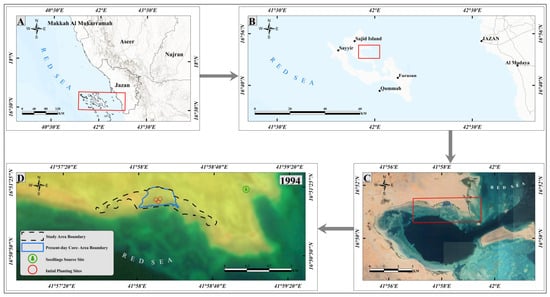
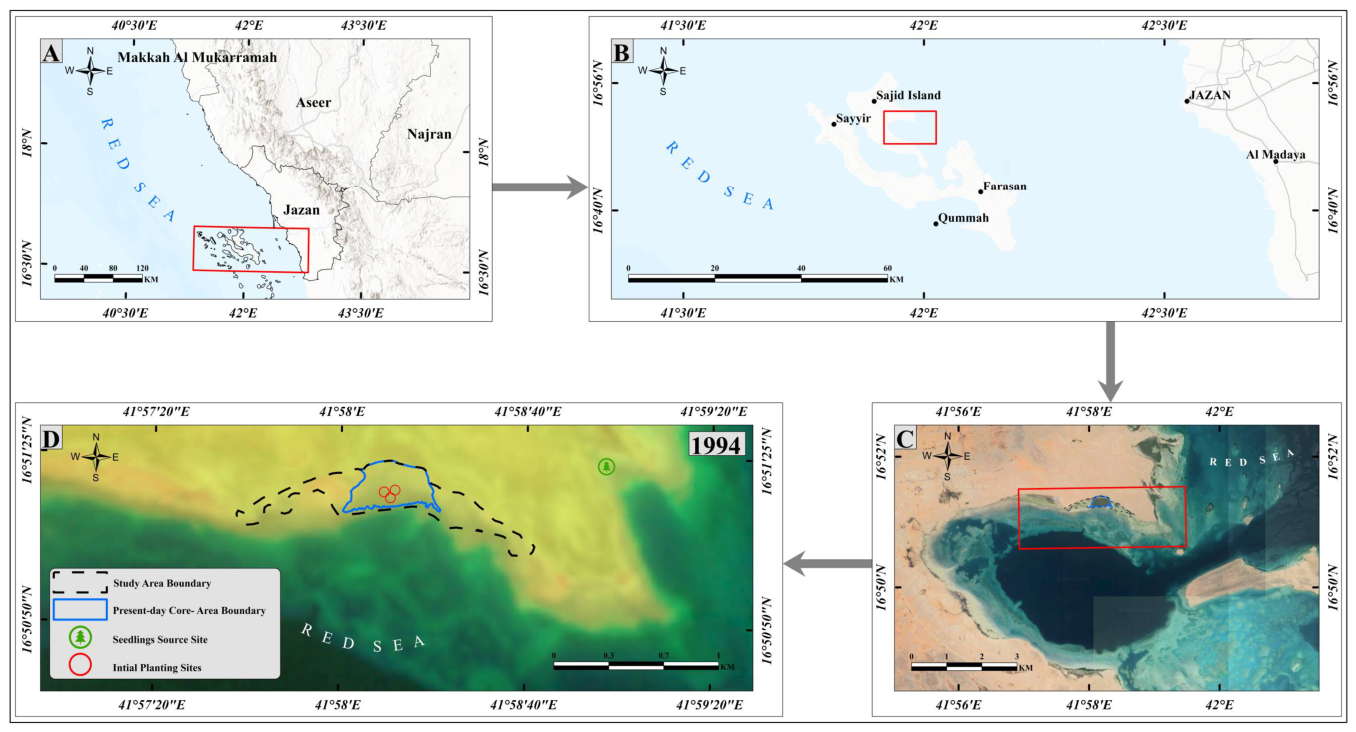
The study was conducted at Sajid Bay (16°51′17″ N, 41°58′07″ E) on Sajid Island within the Farasan Archipelago along the southern Red Sea coast of Saudi Arabia (Figure 1). The archipelago is recognized as one of the most ecologically important coastal systems in the Red Sea, supporting extensive coral reefs, seagrass meadows, tidal flats, and mangrove forests that collectively sustain high marine biodiversity and provide essential ecosystem services [20,21]. The study area experiences a hyper-arid tropical climate with mean annual air temperatures of approximately 28–30 °C, summer temperatures frequently exceeding 40 °C, annual precipitation generally below 100 mm, and high evaporation rates that contribute to naturally elevated seawater salinity. The restoration site comprises a gently sloping intertidal mudflat of fine- to moderately coarse carbonate-rich sediments overlying limestone bedrock. Sheltered coastal geomorphology, regular semidiurnal tidal inundation, stable sediments, low wave energy, and favorable hydrological connectivity provide suitable conditions for mangrove establishment despite the harsh environmental setting [16,22]. Historical project records and archived satellite imagery confirmed that the restoration site lacked established mangrove vegetation before the afforestation program initiated in 1994. Figure 1 illustrates the study area, the donor mangrove stand, and the locations of the three original restoration plots.
Figure 1.
Location of the mangrove restoration study area in the Farasan Islands, Red Sea, Saudi Arabia. (A) Regional location of the Farasan Archipelago. (B) Study site on Sajid Island. (C) Satellite image of the restoration site. (D) Detailed map showing the study boundary, present-day core mangrove area, seedling source site, and initial planting locations (1994).
2.2. Restoration Design
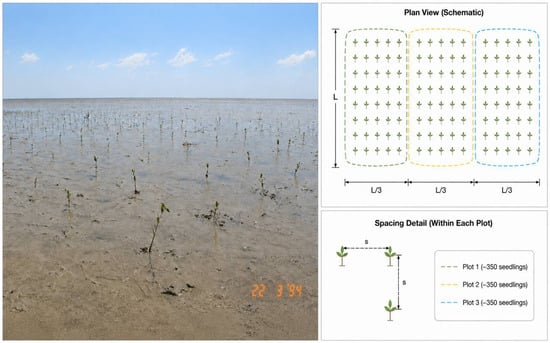
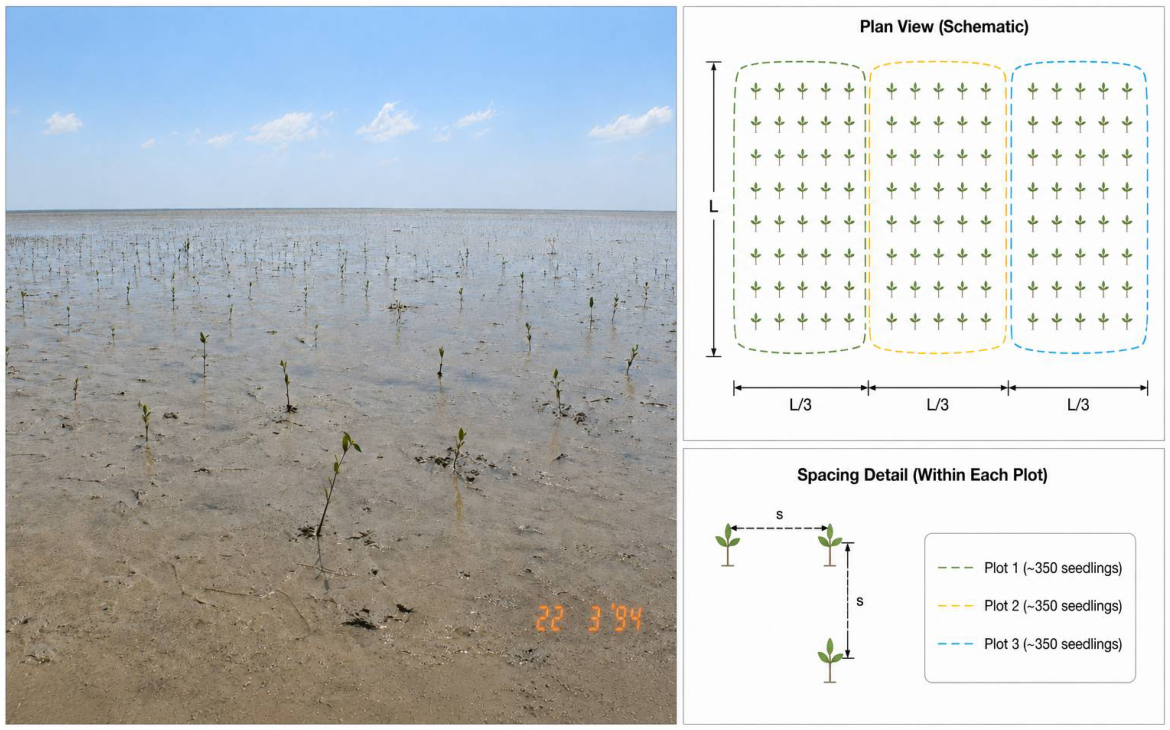
Mangrove restoration was initiated in March 1994 by transplanting 1050 naturally regenerated A. marina seedlings (15–20 cm height) from a donor mangrove stand located on the western side of Sajid Island (16°52′1.36″ N, 41°58′50.42″ E) into an unvegetated intertidal area at Sajid Bay. Sajid Bay was selected following ecological assessment because of its sheltered geomorphology, suitable intertidal elevation, stable carbonate-rich sediments, regular tidal inundation, low hydrodynamic energy, and favorable hydrological connectivity, all of which were considered conducive to long-term mangrove establishment. Seedlings were excavated with intact root balls and transplanted during low tide on the same day to minimize transplanting stress. The restoration area was divided into three adjacent plots, each containing approximately 350 seedlings, giving a total of 1050 transplanted seedlings arranged at uniform spacing (Figure 2). No additional planting or management interventions were undertaken after the initial restoration, allowing subsequent ecosystem development to proceed through natural ecological processes.
Figure 2.
Experimental design of the 1994 A. marina restoration program at Sajid Bay. (left) Field photograph showing transplanted seedlings immediately after establishment. (right) Schematic plan of the restoration layout comprising three adjacent planting plots, each containing approximately 350 seedlings.
2.3. Remote Sensing Analysis
Long-term changes in mangrove extent were assessed using multi-temporal satellite imagery acquired between 1994 and 2024 from Landsat 5 Thematic Mapper (TM), Landsat 7 Enhanced Thematic Mapper Plus (ETM+), Landsat 8 Operational Land Imager (OLI), and Sentinel-2 Multispectral Instrument (MSI). The image sequence included Landsat 5 (1994 and 2010), Landsat 7 (2005), Landsat 8 (2015 and 2020), and Sentinel-2 (2024), providing continuous observations over three decades. Landsat imagery has a spatial resolution of 30 m, whereas Sentinel-2 provides 10 m resolution. Images were selected to minimize cloud cover and represent comparable seasonal conditions. Radiometric preprocessing and image correction were completed prior to analysis, and all image processing, vegetation classification, and spatial analyses were performed using QGIS version 3.34.9. To ensure consistency among sensors with different spatial resolutions, all datasets were processed using an identical NDVI-based workflow and common interpretation criteria. Because the restored mangrove forest occupied an area substantially larger than the spatial resolution of either sensor, the influence of pixel-size differences on estimates of total mangrove extent was considered minimal. Final classifications were visually verified using field observations and high-resolution Google Earth imagery.
2.4. Vegetation Classification
Mangrove vegetation was identified using the Normalized Difference Vegetation Index (NDVI), calculated as:
where NIR and RED represent the reflectance values in the near-infrared and red spectral bands, respectively [23]. NDVI threshold values were established through iterative calibration using satellite imagery and expert interpretation of known mangrove boundaries. Classification results were validated against recent field observations and high-resolution Google Earth imagery before being converted to vector polygons in QGIS for area calculation. Total mangrove extent was quantified for each observation year (1994, 2005, 2010, 2015, 2020, and 2024), and temporal changes were assessed by comparing the extent of mangrove cover among successive years. Spatial expansion beyond the original restoration plots was interpreted as evidence of natural regeneration and ecological succession following successful establishment of the restored mangrove stand.
2.5. Data Analysis
Temporal changes in mangrove cover were summarized using descriptive statistics. Total mangrove area, net area gained, annual expansion rate (ha yr−1), and proportional mangrove cover within the study area were calculated for each monitoring period. Long-term restoration trajectories were evaluated by integrating satellite-derived vegetation maps with restoration history and site characteristics to assess ecosystem development and natural regeneration over the 30-year study period.
3. Results
3.1. Spatiotemporal Changes in Mangrove Cover
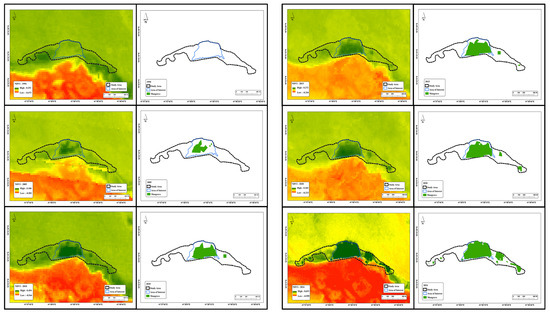
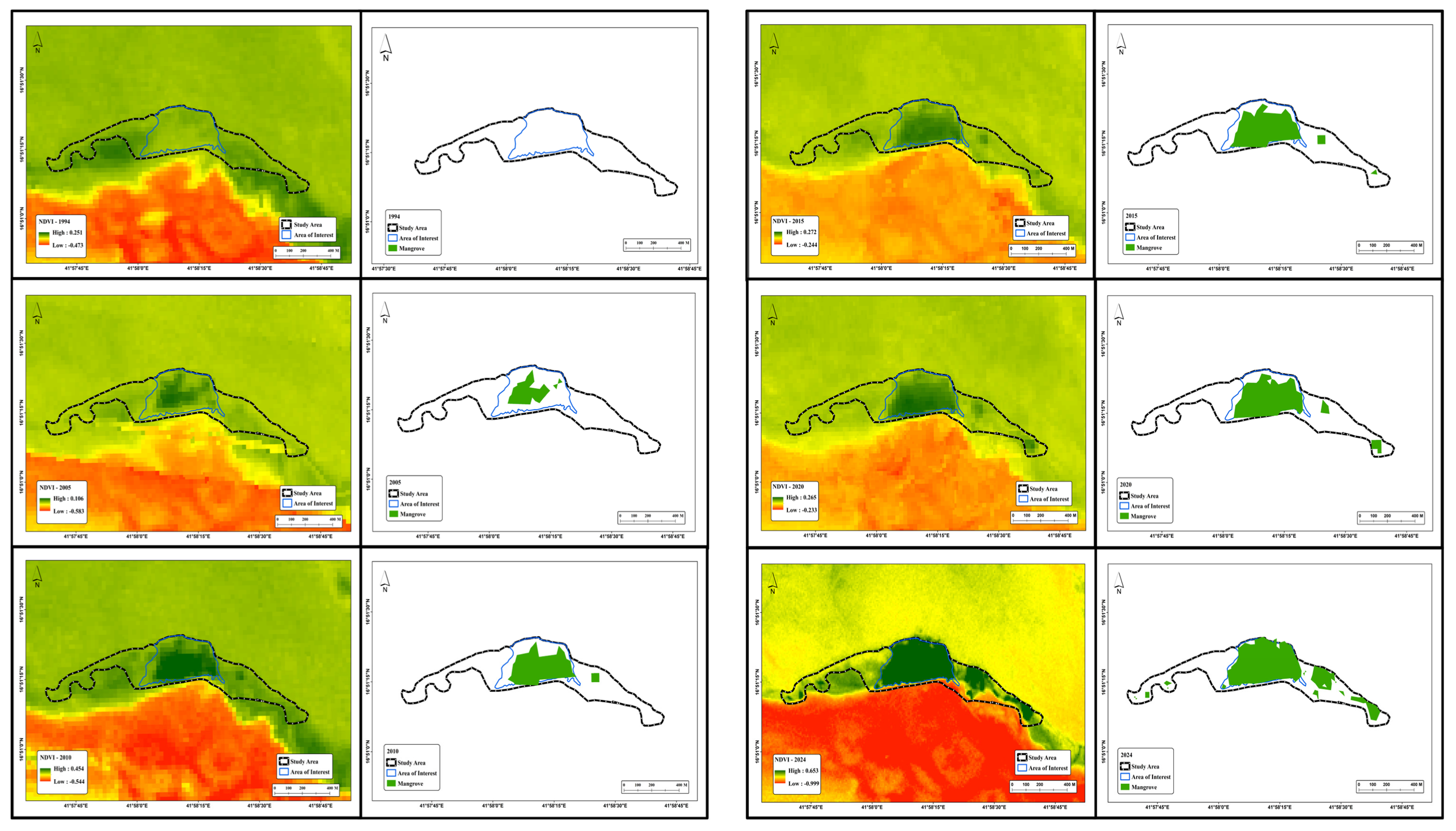
The multi-temporal NDVI imagery and classified vegetation maps (Figure 3) revealed a continuous increase in mangrove cover within the study area over the 30-year monitoring period. Following the transplantation of 1050 A. marina seedlings in 1994, the restored mangrove stands progressively expanded from the three original restoration plots into adjacent intertidal habitats. In 1994, vegetation was restricted to the planted plots, whereas by 2005 the restored stand had developed into a continuous mangrove canopy covering approximately 5.3 ha. Subsequent observations showed gradual outward expansion beyond the original restoration area, with new mangrove patches progressively colonizing adjacent suitable habitats. Expansion became increasingly evident after 2015 and accelerated during the final monitoring period (2020–2024). By 2024, the restored mangrove forest occupied 15.48 ha, forming a substantially larger and more continuous ecosystem than the original plantation.
Figure 3.
Spatiotemporal changes in mangrove cover at Sajid, Farasan Islands, Saudi Arabia (1994–2024). (Left): NDVI depicting vegetation vigor. (Right): Extracted mangrove extent (green polygons) with total area (ha). Insets indicate the location of the study area.
3.2. Quantitative Changes in Mangrove Area
Temporal changes in mangrove area and annual expansion rates are summarized in Table 1. Mangrove cover increased from 5.3 ha in 2005 to 8.2 ha in 2010, 9.6 ha in 2015, 10.9 ha in 2020, and 15.48 ha in 2024. The largest increase during the early stage of restoration occurred between 1994 and 2005, when mangrove cover expanded by 5.3 ha, corresponding to an average annual increase of 0.482 ha yr−1. Continued expansion was observed during the following monitoring intervals, with annual growth rates of 0.58, 0.28, and 0.26 ha yr−1 during the periods 2005–2010, 2010–2015, and 2015–2020, respectively. The highest rate of expansion occurred between 2020 and 2024, when mangrove cover increased by 4.58 ha over four years, equivalent to an average annual increase of 1.145 ha yr−1, representing the most rapid phase of ecosystem expansion recorded during the study.
Table 1.
Long-term expansion of mangrove cover and annual growth rates during ecosystem recovery at Sajid Bay, Saudi Arabian Red Sea (1994–2024).
3.3. Mangrove Expansion Within and Beyond the Restoration Area
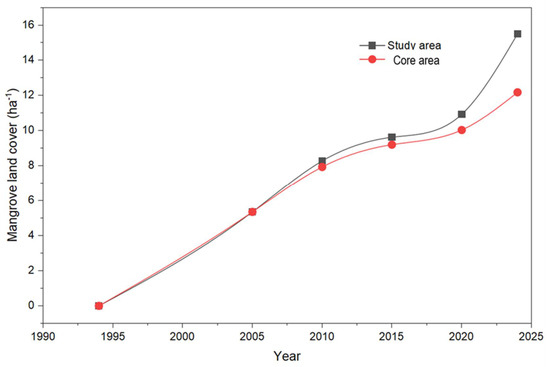
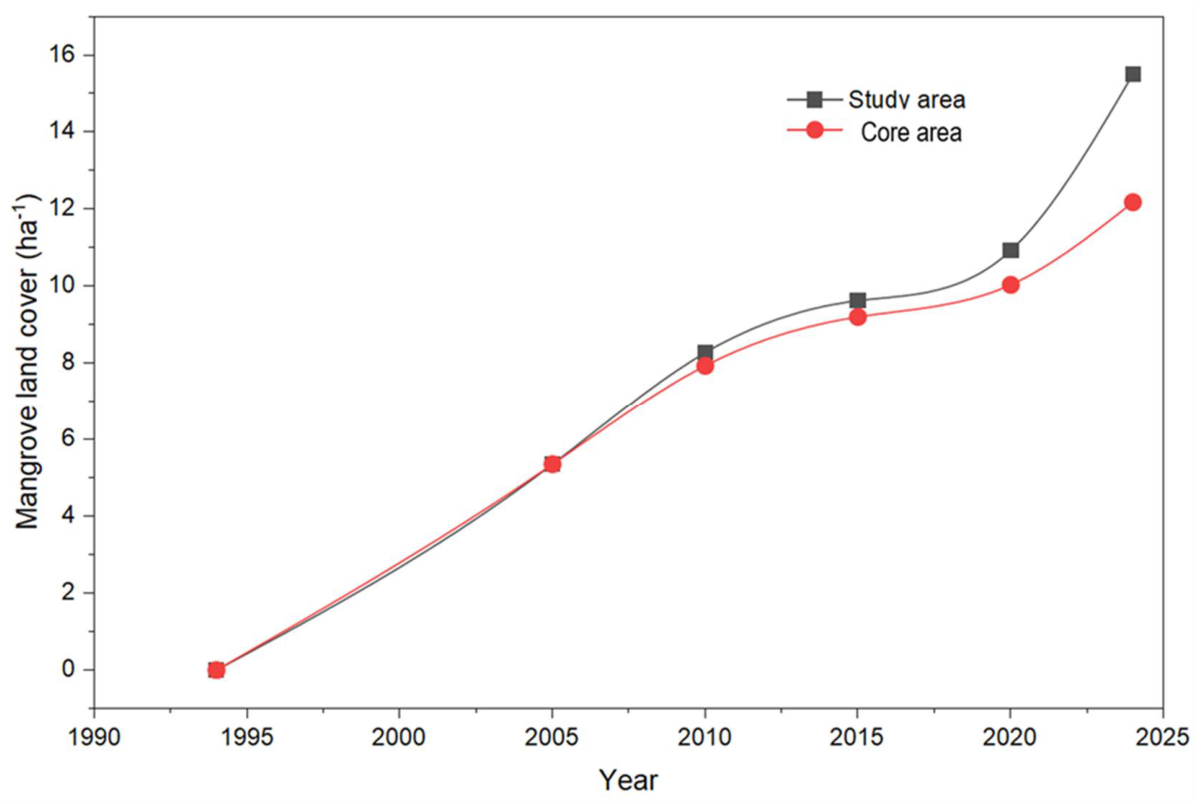
Comparison between mangrove cover within the original restoration area and the entire study area (Figure 4) further illustrates the long-term development pattern of the restored ecosystem. Between 1994 and 2005, increases in mangrove cover were almost identical in both areas, indicating that vegetation development was largely confined to the original planting plots. This pattern persisted until approximately 2015, reflecting continued growth and canopy closure of the transplanted seedlings. Thereafter, the two trends diverged as mangrove establishment increasingly occurred outside the original restoration area. By 2020, total mangrove cover within the study area exceeded that of the original restoration area by approximately 0.9 ha, and this difference increased substantially by 2024, when total mangrove extent reached 15.48 ha, compared with approximately 12.1 ha within the original restoration area. These findings demonstrate that a considerable proportion of mangrove expansion during the later stages of the monitoring period occurred beyond the initial planting sites, indicating sustained natural colonization of adjacent suitable habitats.
Figure 4.
Temporal changes in mangrove cover (ha) within the study area and core area from 1994–2024.
4. Discussion
4.1. Long-Term Mangrove Ecosystem Development
The present study demonstrates that mangrove afforestation can initiate sustained ecosystem development under the hyper-arid conditions of the southern Red Sea. Following the transplantation of 1050 A. marina seedlings in 1994, mangrove cover expanded progressively to 15.48 ha by 2024, indicating that the restored stand evolved from a localized plantation into a self-sustaining mangrove ecosystem. Unlike most restoration studies that emphasize seedling survival or early establishment, the present findings show that ecological recovery continued for three decades without additional planting, supporting the view that restoration success should be evaluated according to long-term ecosystem development and the recovery of ecological processes rather than short-term planting performance alone [24,25,26].
The temporal pattern of expansion indicates that ecosystem recovery proceeded through distinct developmental stages. During the first two decades, increases in mangrove cover were largely confined to the original restoration area, reflecting survival, canopy development, and structural maturation of the transplanted trees. Expansion accelerated markedly after 2020, when the highest annual increase in mangrove extent was recorded. The increasing divergence between the original restoration area and the total mangrove extent further indicates that forest development progressively shifted from growth within the planted stands to natural colonization of adjacent intertidal habitats. Similar transitions from restored stands to naturally expanding forests have been reported elsewhere, although few studies have documented these processes over monitoring periods exceeding two decades [16,17,27].
This acceleration is consistent with the reproductive ecology of A. marina and the progressive recovery of ecosystem functions. As restored trees reached reproductive maturity, propagule production likely increased substantially, enhancing recruitment within adjacent suitable habitats [13,27]. Simultaneously, increasing canopy cover promoted sediment stabilization, organic matter accumulation, and attenuation of near-surface hydrodynamic energy, thereby creating increasingly favorable conditions for propagule retention and seedling establishment [6,17]. These ecosystem-engineering processes generated positive ecological feedbacks that reinforced forest expansion beyond the original restoration area, demonstrating that the restored stand had acquired the capacity to sustain natural regeneration without further management intervention. Such a transition from active restoration to self-sustaining ecosystem development is widely regarded as one of the strongest indicators of restoration success [16,24,25,26].
A major strength of the present study is its 30-year monitoring period, which captures ecological processes rarely documented in mangrove restoration research. Most published assessments are limited to less than a decade and therefore evaluate only the initial stages of restoration [24,25,26]. By contrast, the long-term observations presented here encompass stand maturation, the onset of natural regeneration, and subsequent landscape-scale expansion, providing a more comprehensive understanding of restoration dynamics. These findings contribute rare long-term empirical evidence from the Red Sea and emphasize the importance of sustained monitoring for evaluating restoration outcomes and improving restoration strategies in arid coastal environments.
4.2. Ecological Drivers of Mangrove Expansion
The sustained expansion of mangrove cover over the 30-year monitoring period reflects the interaction between biological processes and favorable environmental conditions rather than the initial planting effort alone. Long-term success of mangrove restoration depends on restoring ecological processes that support natural regeneration, with hydrology, geomorphology, sediment characteristics, and propagule dispersal recognized as the principal controls on ecosystem persistence [16,17,24]. In the present study, Sajid Bay provided several environmental attributes conducive to mangrove establishment, including sheltered coastal geomorphology, regular semidiurnal tidal inundation, stable carbonate-rich sediments, gentle intertidal slopes, and low wave energy. These conditions favor propagule retention, sediment stability, and seedling establishment, thereby creating a suitable environment for sustained forest development. Similar environmental characteristics have been identified as key determinants of successful mangrove restoration in tropical and subtropical coastal ecosystems [17,18].
Hydrological connectivity further supported ecosystem development by maintaining suitable salinity and sediment moisture while facilitating propagule transport, nutrient exchange, and sediment deposition [17,18]. As the restored stand matured, increasing canopy cover enhanced sediment trapping and reduced near-surface hydrodynamic energy, creating progressively more favorable conditions for propagule retention and seedling establishment. The marked acceleration in mangrove expansion during the final monitoring period is consistent with the reproductive ecology of A. marina, whose mature trees produce abundant buoyant propagules capable of dispersing through tidal currents [13,27]. The combined effects of increasing propagule availability and improved habitat conditions therefore provide a plausible explanation for the transition from gradual stand development to rapid landscape-scale expansion, a pattern similarly reported in long-term mangrove restoration studies [25,26].
The contribution of neighboring natural mangrove forests should also be considered when interpreting the observed expansion. Historical project records and archived satellite imagery confirmed that the restoration site remained devoid of established mangrove vegetation prior to the 1994 afforestation program despite long-term exposure to propagules originating from nearby natural stands. If propagule supply alone had been sufficient to initiate colonization, mangrove establishment would likely have occurred before restoration. Instead, the first documented establishment followed the transplantation of A. marina seedlings, indicating that the planted stand functioned as the initial reproductive nucleus within the restoration site. As the restored trees reached reproductive maturity, locally produced propagules most likely became the primary source of natural regeneration. Although propagules from neighboring mangrove forests may have supplemented subsequent recruitment through tidal dispersal, the available evidence indicates that afforestation initiated the ecological processes responsible for long-term ecosystem development.
Climatic conditions undoubtedly influenced mangrove growth throughout the study period, particularly within the hyper-arid Red Sea environment characterized by high temperatures, elevated salinity, limited freshwater input, and intense evaporation [12,13,14,15]. However, long-term climate records indicate relatively stable regional climatic conditions over the three decades, suggesting that the sustained increase in mangrove cover was driven primarily by favorable local environmental conditions and ecological processes rather than by major climatic shifts. The consistency of this long-term trend is further supported by the integration of Landsat and Sentinel-2 imagery using standardized NDVI classification and field verification, providing robust evidence that the observed expansion represents a genuine ecological response rather than an artifact of sensor differences. Collectively, these findings demonstrate that successful mangrove restoration depends not only on establishing an initial mangrove population but also on selecting environmentally suitable sites where natural ecological processes can sustain long-term ecosystem recovery.
4.3. Implications for Mangrove Restoration
The findings of this study demonstrate that successful mangrove restoration depends less on planting intensity than on selecting environmentally suitable sites where natural ecological processes can sustain long-term ecosystem development. Although the original intervention was limited to three restoration plots, the restored A. marina population progressively expanded beyond the planted area through natural regeneration, resulting in a self-sustaining mangrove forest over three decades. These findings support process-based restoration approaches that prioritize appropriate hydrological and geomorphological conditions to facilitate natural ecosystem recovery rather than relying on repeated planting or intensive management interventions [16,17,24,25]. They also highlight the importance of long-term monitoring, as key ecological changes may only become evident decades after restoration has been initiated.
The present study further demonstrates the value of integrating long-term satellite observations with field verification to evaluate restoration outcomes. The consistent use of Landsat and Sentinel-2 imagery enabled reliable assessment of ecosystem development over three decades and provided insights into restoration dynamics that would be difficult to obtain through field observations alone. Such approaches offer practical and cost-effective tools for monitoring restoration performance, supporting adaptive management, and informing large-scale conservation planning, particularly in remote coastal environments [19].
Several limitations should nevertheless be acknowledged. Because the restoration program was implemented as a management intervention rather than a replicated experiment, an untreated control site was unavailable for direct comparison. In addition, although historical records and archived satellite imagery confirmed that the restoration site lacked mangrove vegetation before the 1994 intervention, neighboring natural mangrove forests may have contributed propagules after the restored stand became reproductively established. Future studies integrating hydrodynamic modeling, propagule dispersal analyses, genetic connectivity assessments, and permanent field monitoring would improve understanding of the relative contribution of these processes to long-term mangrove expansion. Despite these limitations, the present study provides rare empirical evidence that carefully planned afforestation can initiate self-sustaining ecosystem recovery under the hyper-arid conditions of the Red Sea, offering valuable guidance for future restoration programs in Saudi Arabia and other environmentally challenging coastal regions.
5. Conclusions
This study provides rare long-term evidence that mangrove afforestation can initiate sustained ecosystem recovery under the hyper-arid environmental conditions of the southern Red Sea. Over three decades, the transplantation of 1050 A. marina seedlings evolved into a self-sustaining mangrove ecosystem, with forest cover expanding from the original restoration area to 15.48 ha through natural regeneration and progressive colonization of adjacent intertidal habitats. The observed expansion was facilitated by favorable site conditions, including appropriate geomorphology, hydrological connectivity, and stable sediment characteristics, which enabled natural ecological processes to drive continued forest development after the initial intervention. These findings demonstrate that restoration success depends not only on planting but also on selecting environmentally suitable sites that support long-term ecosystem functioning. The study further highlights the value of integrating long-term satellite observations with field validation to evaluate restoration outcomes and capture ecological changes that may remain undetected during short-term assessments. The findings contribute valuable long-term evidence supporting process-based mangrove restoration and provide practical guidance for designing and evaluating future restoration programs in the Red Sea region and other environmentally challenging coastal environments.
Author Contributions
Conceptualization, A.A.-M. and S.A.; methodology, A.A.-M. and S.A.; investigation, A.A.-M., A.A. (Abdullah Alwetaid) and C.M.; formal analysis, A.A.-M. and M.A.; data curation, A.A.-M., A.A. (Abdullah Almuthibi) and A.A. (Ahmed Alameen); visualization, A.A. (Abdullah Almuthibi) and A.A. (Ahmed Alameen); validation, M.A.; resources, A.A.-M., A.A. (Abdullah Alwetaid) and C.M.; writing—original draft preparation, A.A.-M.; writing—review and editing, A.A. (Abdullah Alwetaid), S.A., C.M. and M.A.; supervision, S.A. All authors have read and agreed to the published version of the manuscript.
Funding
This research received no external funding.
Data Availability Statement
The datasets generated and/or analyzed during the current study are available from the corresponding author upon reasonable request.
Acknowledgments
The authors gratefully acknowledge the General Directorate of Forestry (GDF) within the National Center for Vegetation Cover Development and Combating Desertification (NCVC) for supporting this work as part of its research activities. The authors also sincerely acknowledge the CEO of NCVC, Eng. Ahmed bin Saleh Al-Ayada, and Eng. Samir Malaika for their valuable support. The authors further thank Osama Al-Kashef for his valuable contribution to the preparation and design of some of the study maps.
Conflicts of Interest
The authors declare no conflicts of interest.
References
- FAO. The World’ s Mangroves 1980–2005; FAO Forestry Paper No. 153; Food and Agriculture Organization of the United Nations: Rome, Italy, 2007. [Google Scholar]
- UNEP-WCMC. The Importance of Mangroves to People: A Call to Action; United Nations Environment Programme World Conservation Monitoring Centre: Cambridge, UK, 2014. [Google Scholar]
- Alongi, D.M. Mangrove forests: Resilience, protection from tsunamis, and responses to global climate change. Estuar. Coast. Shelf Sci. 2008, 76, 1–13. [Google Scholar] [CrossRef] [Scilit]
- Feller, I.C.; Friess, D.A.; Krauss, K.W.; Lewis, R.R., III. The state of the world’s mangroves in the 21st century under climate change. Hydrobiologia 2017, 803, 1–12. [Google Scholar] [CrossRef] [Scilit]
- Duke, N.C.; Meynecke, J.O.; Dittmann, S.; Ellison, A.M.; Anger, K.; Berger, U.; Cannicci, S.; Diele, K.; Ewel, K.C.; Field, C.D.; et al. A world without mangroves? Science 2007, 317, 41–42. [Google Scholar] [CrossRef] [Scilit] [PubMed]
- Friess, D.A.; Rogers, K.; Lovelock, C.E.; Krauss, K.W.; Hamilton, S.E.; Lee, S.Y.; Lucas, R.; Primavera, J.; Rajkaran, A.; Shi, S. The state of the world’s mangrove forests: Past, present, and future. Annu. Rev. Environ. Resour. 2019, 44, 89–115. [Google Scholar] [CrossRef] [Scilit]
- Al-Mansi, A.M. Red Sea and Arabian Gulf Environments; Self-Published: Riyadh, Saudi Arabia, 1999; p. 156. (In Arabic) [Google Scholar]
- Donato, D.C.; Kauffman, J.B.; Murdiyarso, D.; Kurnianto, S.; Stidham, M.; Kanninen, M. Mangroves among the most carbon-rich forests in the tropics. Nat. Geosci. 2011, 4, 293–297. [Google Scholar] [CrossRef] [Scilit]
- Kauffman, J.B.; Adame, M.F.; Arifanti, V.B.; Schile-Beers, L.M.; Bernardino, A.F.; Bhomia, R.K.; Donato, D.C.; Feller, I.C.; Ferreira, T.O.; Jesus, A.D.; et al. Total ecosystem carbon stocks of mangroves across broad global environmental and physical gradients. Ecol. Monogr. 2020, 90, e01405. [Google Scholar] [CrossRef] [Scilit]
- Choudhary, B.; Dhar, V.; Pawase, A.S. Blue carbon and the role of mangroves in carbon sequestration: Its mechanisms, estimation, human impacts and conservation strategies for economic incentives. J. Sea Res. 2024, 199, 102504. [Google Scholar] [CrossRef] [Scilit]
- Kathiresan, K.; Bingham, B.L. Biology of mangroves and mangrove ecosystems. Adv. Mar. Biol. 2001, 40, 81–251. [Google Scholar] [CrossRef] [Scilit]
- El-Khouly, A.A.; Abdel-Hamid, K.A. Zonation pattern of Avicennia marina and Rhizophora mucronata along the Red Sea coast, Egypt. World Appl. Sci. J. 2007, 2, 283–288. [Google Scholar] [CrossRef] [Scilit]
- Ghoraba, S.M.M.; Almahasheer, H.; Siddig, A.A.H.; Nagi, H.M.; Suárez, E.L. IUCN Red List of Ecosystems: Mangroves of the Red Sea and Gulf of Aden. EcoEvoRxiv 2024. [Google Scholar] [CrossRef] [Scilit]
- Lewis, R.R., III. Ecological engineering for successful management and restoration of mangrove forests. Ecol. Eng. 2005, 24, 403–418. [Google Scholar] [CrossRef] [Scilit]
- Kibler, K.M.; Pilato, C.; Walters, L.J.; Donnelly, M.J.; Taye, J. Hydrodynamic limitations to mangrove seedling retention in subtropical estuaries. Sustainability 2022, 14, 8605. [Google Scholar] [CrossRef] [Scilit]
- Hsiung, A.R.; Fest, B.; Rubinstein, T.; Swearer, S.E.; Morris, R.L. Effectiveness of novel hybrid mangrove living shorelines is context dependent. J. Appl. Ecol. 2025, 62, 1188–1201. [Google Scholar] [CrossRef] [Scilit]
- Vasquez, J.; Acevedo-Barrios, R.; Miranda-Castro, W.; Guerrero, M.; Meneses-Ospina, L. Determining changes in mangrove cover using remote sensing with Landsat images: A review. Water Air Soil Pollut. 2024, 235, 18. [Google Scholar] [CrossRef] [Scilit]
- UNESCO. Juzur Farasan Biosphere Reserve; United Nations Educational, Scientific and Cultural Organization: Paris, France, 2021; Available online: https://www.unesco.org/en/mab/juzur-farasan (accessed on 22 June 2026).
- Al Mutairi, K.; El-Bana, M.; Mansor, M.; Al-Rowaily, S.; Mansor, A. Floristic diversity, composition, and environmental correlates on the arid, coralline islands of the Farasan Archipelago, Red Sea, Saudi Arabia. Arid. Land Res. Manag. 2012, 26, 137–150. [Google Scholar] [CrossRef] [Scilit]
- Monsef, H.A.-E.; Aguib, A.S.H.; Smith, S.E. Locating suitable mangrove plantation sites along the Saudi Arabia Red Sea Coast. J. Afr. Earth Sci. 2013, 83, 1–9. [Google Scholar] [CrossRef] [Scilit]
- Gitelson, A.A.; Kaufman, Y.J.; Merzlyak, M.N. Use of a green channel in remote sensing of global vegetation from EOS-MODIS. Remote Sens. Environ. 1996, 58, 289–298. [Google Scholar] [CrossRef] [Scilit]
- Duke, N.C. Mangrove taxonomy, biogeography and evolution—Implications for conservation and management (An Indo-West Pacific perspective). In Proceedings of the International Symposium and Workshop on Mangrove Ecology, Functioning and Management, Brisbane, Australia, 25–30 June 2006; University of Queensland: Brisbane, Australia, 2008; pp. 26–38. [Google Scholar]
- Saenger, P.; West, P.W. Phenotypic variation of the mangrove species Avicennia marina (Forssk.) Vierh. from seven provenances around Australia. Aquat. Bot. 2018, 149, 28–32. [Google Scholar] [CrossRef] [Scilit]
- Lee, S.Y.; Hamilton, S.; Barbier, E.B.; Primavera, J.; Lewis, R.R. Better restoration policies are needed to conserve mangrove ecosystems. Nat. Ecol. Evol. 2019, 3, 870–872. [Google Scholar] [CrossRef] [Scilit] [PubMed]
- Lovelock, C.E.; Barbier, E.B.; Duarte, C.M. Tackling the mangrove restoration challenge. Proc. Natl. Acad. Sci. USA 2022, 119, e2118522119. [Google Scholar] [CrossRef] [Scilit] [PubMed]
- Waltham, N.J.; Elliott, M.; Lee, S.Y.; Lovelock, C.; Duarte, C.M.; Buelow, C.; Simenstad, C.; Nagelkerken, I.; Claassens, L.; Wen, C.K.C.; et al. UN Decade on Ecosystem Restoration 2021–2030—What chance for success in restoring coastal ecosystems? Front. Mar. Sci. 2020, 7, 71. [Google Scholar] [CrossRef] [Scilit]
- Al-Qthanin, R.N.; Alharbi, S.A. Spatial structure and genetic variation of a mangrove species (Avicennia marina (Forssk.) Vierh.) in the Farasan Archipelago. Forests 2020, 11, 1287. [Google Scholar] [CrossRef] [Scilit]

Disclaimer/Publisher’s Note: The statements, opinions and data contained in all publications are solely those of the individual author(s) and contributor(s) and not of MDPI and/or the editor(s). MDPI and/or the editor(s) disclaim responsibility for any injury to people or property resulting from any ideas, methods, instructions or products referred to in the content. |
© 2026 by the authors. Licensee MDPI, Basel, Switzerland. This article is an open access article distributed under the terms and conditions of the Creative Commons Attribution (CC BY) license.