


Abstract
Salt stress significantly constrains plant growth and development, with the root system serving as the primary organ for sensing and responding to salinity. Poplar (Populus spp.), a widely cultivated tree species, plays important roles in urban greening, windbreaks and sand fixation, and various economic sectors. In this study, we conducted a comparative analysis of the salt tolerance of root systems of six different poplar cultivars. Key physiological indicators—including root activity, ion homeostasis, reactive oxygen species (ROS)-scavenging capacity, and nitric oxide (NO) content—were evaluated under saline conditions. Our findings indicate that the salt resistance of the six cultivars follows the order: P. simonii > P. cathayana > P. tremula × P. alba ‘717’ > P. deltoides × P. euramericana ‘Nanlin 895’ > P. deltoides × P. euramericana ‘Bofeng 3’ > P. alba × P. glandulosa ‘84K’. Furthermore, a transcriptomic analysis was performed on the most resilient species, P. simonii. These results reveal that P. simonii primarily orchestrates its salt stress response through the modulation of MAPK cascades and nitrogen metabolism pathways. This research provides theoretical support for elucidating the molecular mechanisms underlying the salt stress response in poplars and offers a foundation for the molecular breeding of salt tolerant poplar varieties.
1. Introduction
Salinization has emerged as a predominant abiotic stressor that severely constrains crop productivity and hinders plant ontogeny [1]. Globally, approximately 954 million hectares of arable land are plagued by high salinity. In China, salinized soil covers approximately 100 million hectares, a figure that is projected to increase in the future [2]. As important parts of terrestrial ecosystems, forests play important roles in maintaining the balance of the earth’s ecosystem and repairing saline–alkaline soil. Therefore, studying the salt tolerance of some major afforestation species and their physiological processes in saline soil is important. Poplar is an important tree species for green planting in northern China. Research on the salt tolerance of poplars and its mechanism is highly important for improving plant salt tolerance, and provides a foundation for the molecular breeding of salt-tolerant varieties and the restoration of saline–alkaline land.
Soil salinity poses a challenge to plant development, with the root system being the most vulnerable system. As the primary interface between plants and saline environments, roots are indispensable for nutrient and water acquisition; however, their architecture and physiological efficacy are profoundly compromised under salt stress [3]. High salinity triggers an influx of ions, which in turn increases internal osmotic tension and perturbs ionic homeostasis. Such physiological imbalances can lead to the excessive buildup of Na+ to phytotoxic concentrations within plant tissues [4]. Maintaining the intracellular ion concentration is essential for ion homeostasis in plants. Na+ can enter plant cells through a variety of pathways under salt stress and may be detrimental to cytosolic enzymes at high concentrations. Thus, plant cells must maintain high and low concentrations of K+ and Na+ in the cytoplasm, respectively, and they release excess Na+ or collect it in vacuoles [5].
Regulating Na+/K+ ion homeostasis helps to improve plant salt tolerance. The Na+/K+ ratio of salt-tolerant rice plants is lower than that of salt-sensitive rice plants [6]. Ding et al. reported that under long periods of salt stress, P. euphratica can maintain a low Na content and a low Na+/K+ ratio in leaves, and is more salt-tolerant than P. popularis [7]. Comparisons of the salt tolerance of different cucumber varieties revealed that lower Na+/K+ ratios, higher osmotic concentrations, and the selective absorption of useful ions are important factors for cucumber salt tolerance [8].
Salt stress can induce a significant accumulation of reactive oxygen species (ROS) in plants, leading to lipid peroxidation of membranes and oxidative damage to macromolecules such as proteins and nucleic acids, thus disrupting the integrity of cell membranes [9]. The production of antioxidants (such as superoxide dismutase, peroxidase and catalase), non-enzymatic compounds (such as ascorbic acid, phenolics, different sugars, malondialdehyde, and hydrogen peroxide (H2O2)), and osmolytes (such as proline, glycine betaine, and ascorbate peroxidase) is increased in plants under extreme saline conditions [10]. Different antioxidants can eliminate ROS and improve plant immunity under harsh environmental conditions [11,12].
Nitrogen (N) metabolism plays important roles in the salt tolerance of plants, and increased N uptake can increase plant salt tolerance. Salt stress can suppress the uptake of N by plants [13]. The balance within the nitrogen metabolism system is maintained primarily by nitrate reductase (NR), glutamine synthetase (GS), glutamate synthase (GOGAT) and glutamate dehydrogenase (GDH). Many studies have shown that the activities of GDH, GS, GOGAT and NR decrease in response to salt stress in plants [13,14]. Nitric oxide (NO) is an essential gaseous signalling molecule that participates in the regulation of various physiological processes in plants including germination, root formation, seedling growth, stomatal movement, maturation, leaf senescence, and biotic and abiotic stress responses [15,16,17]. The exogenous addition of NO can improve plant salt tolerance by promoting Na+ efflux and ion transporter gene expression and reducing the Na content and Na+/K+ ratio [18,19,20]. However, few studies have investigated the changes in NO content in plants under salt stress, especially in roots.
Many resistance genes are expressed in plants in response to salt stress, and transcriptome analysis has been used as a method for revealing changes in gene expression levels in plants under salt stress [21,22,23,24]. Salt tolerance is not determined by a single gene; it requires many genes to work together. Transcriptome analysis has revealed that many biological processes, such as mitogen-activated protein kinase (MAPK) signalling [25,26], nitrogen metabolism [14], and reduction–oxidation pathways [27,28], are related to salt stress.
In this study, from section Populus, section Aigeiros and section Tacamahaca, we selected six poplar varieties each for salt tolerance research; we investigated the changes in the root systems of different poplar varieties in response to salt stress and selected the more salt-tolerant Populus simonii to analyse the molecular mechanism underlying the response of poplar root systems to salt stress. This study provides theoretical support for the selection and breeding of salt-tolerant poplar cultivars by investigating the mechanisms of salt tolerance in Populus.
2. Materials and Methods
2.1. Plant Materials and Growth Conditions
The study materials consisted of six poplar types, namely, Populus alba × P. glandulosa cv. ‘84K’, Populus tremula L. × P. alba L., Populus cathayana, Populus simonii, Populus × euramaricana ‘Bofeng 3 hao’ and Populus. Deltoids × Populus. euramericana cv. ‘Nanlin895’. The above materials’ designations are 84K, 717, QY, XYY, BF3, and NL895.
Poplars (Populus spp.) were grown on solid media in a phytotron (25 °C, 16/8 h light/dark, and 50 µmol photons m−2 s−1 light intensity). The seedlings were subsequently transplanted into hydroponic conditions, where the temperature of the growing room was maintained at 22 °C and the relative humidity ranged from 70 to 75%. The seedlings were allowed to grow for 60 days, and the nutrient solution (Coolaber, NS10115, Beijing, China) was replaced three times a week while the pH of the growth conditions was maintained between 5.8 and 6.2. Each experiment was conducted with three independent replications.
2.2. Stress Treatments
To evaluate the salt stress tolerance of different kinds of poplars, poplars grown for 60 days under hydroponic conditions were treated with a 75 mM NaCl solution for 3 days, after which the plants were harvested and sampled. The root samples were instantly frozen in liquid nitrogen at −80 °C for biochemical analysis. Different growth parameters, as well as ionic and physiological indices, were recorded.
2.3. Histochemical Staining and Physiological Indices
H2O2, NO, and Na+ in the lateral root apices of six poplar types were detected using dichlorodihydrofluorescein diacetate (DCFH-DA) (D6883; Sigma-Aldrich, St Louis, MO, USA), DAF-FM™ (D23844; Invitrogen, Carlsbad, CA, USA) and CoroNa™ Green-AM (Molecular Probes; Eugene, OR, USA), respectively, after the poplar plants were hydroponically grown with 0 and 75 mM NaCl for 3 days [29]. The images were visualized using a fluorescence microscope (Olympus BX51, Tokyo, Japan). At least 20 roots were harvested from three biological replicates (more than 10 individuals each).
The H2O2, O2− and NO contents in the fresh roots were measured using customized kits (Beijing Solarbio Science & Technology Co., Ltd., Beijing, China) following the manufacturer’s instructions. The Na+ and K+ contents were measured using an atomic absorption spectrometer (PerkinElmer, PinAAcle 900H, Waltham, MA, USA). The above experiments were performed three times.
2.4. Determination of Relative Electrical Conductivity (REC)
The REC was measured according to the method of Su et al. [30]. Root samples, with a root length of 10 cm, from plants grown under salt stress and the corresponding controls were collected and then incubated in 30 mL of deionized water.
After vacuuming for 30 min, the electrical conductivity of the solution (C1) was measured. Afterwards, the samples were autoclaved at 115 °C for 20 min. After cooling to room temperature, the conductivity was remeasured (C2). The REC was calculated using the equation REC (%) = C1/C2 × 100.
2.5. Root Activity Evaluation
Poplar root activity was determined after salt stress treatment, and the strength of the root activity was expressed as the amount of 2,3,5-triphenyltetrazolium chloride (TTC) reduction [31]. In accordance with the instructions of the kit (Beijing Solarbio Science & Technology Co., Ltd., Beijing, China), the kit was used for qualitative observation of root activity and quantitative determination of root 1,3,5-triphenylformazan (TTF) content.
2.6. Transcriptome Sequencing
The roots (0~0.5 cm) of different kinds of poplar (control and salt-treated) were selected, and total RNA was extracted from the tissues using the TRIzol method. The concentration and purity of the total extracted RNA were determined using a Nanodrop, the integrity of the RNA was determined by agarose gel electrophoresis, and the RIN was determined using an Agilent 2100 (Agilent Technologies, Palo Alto, CA, USA); the mRNA was enriched with magnetic beads with Oligo (dt) and used to analyse the transcriptome information. mRNA molecules were purified and then fragmented into small pieces for cDNA synthesis. The synthesized cDNA was subjected to end repair and then 3′ adenylation. Adapters were ligated to the ends of these 3′ adenylated cDNA fragments. After the PCR, the PCR products were purified and dissolved in EB solution. The library was validated using an Agilent Technologies 2100 bioanalyser, followed by sequencing using the Illumina sequencing platform. Transcriptome analysis was performed by Biomarker Technologies (Beijing, China). After rapid filtering (version 0.18.0), the HISAT2.2.4 and Bowtie2 tools were used to compare clean reads with the poplar genome (https://phytozome-next.jgi.doe.gov/info/ptrichocarpa_v4_1, accessed on 8 December 2024). RNA-Seq by Expectation-Maximization (RESM) v1.3.1 software was used to calculate the values of fragment per kilobase of transcript per million mapped reads (FPKM). Differentially expressed genes (DEGs) were determined according to cutoffs of log2(fold change) ≥ 1 and p ≤ 0.05. Kyoto Encyclopedia of Genes and Genomes (KEGG) and Gene Ontology (GO) tools were used to analyse the DEGs. Quantitative real-time PCR (qRT-PCR) analysis was conducted according to Sun et al. [32], and the primers used for qRT-PCR are listed in Table A1.
2.7. Statistical Analysis
Each experiment was repeated at least three times. The histogram data were normalized. Statistical analysis was performed using one-way analysis of variance (ANOVA). The significant differences between treatment means were determined using Duncan’s multiple range test (DMRT) at a significance level of p ≤ 0.05.
3. Results
3.1. Responses of Root Reactive Oxygen Species and Relative Electrical Conductivity to Salt Stress
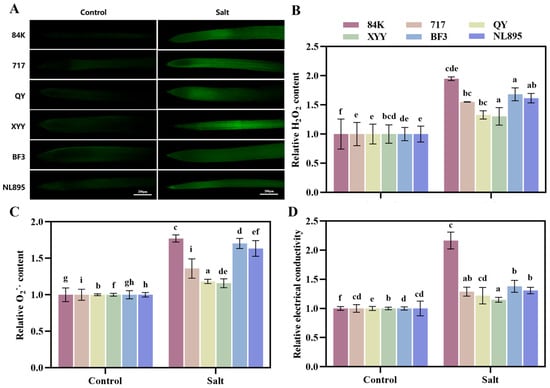
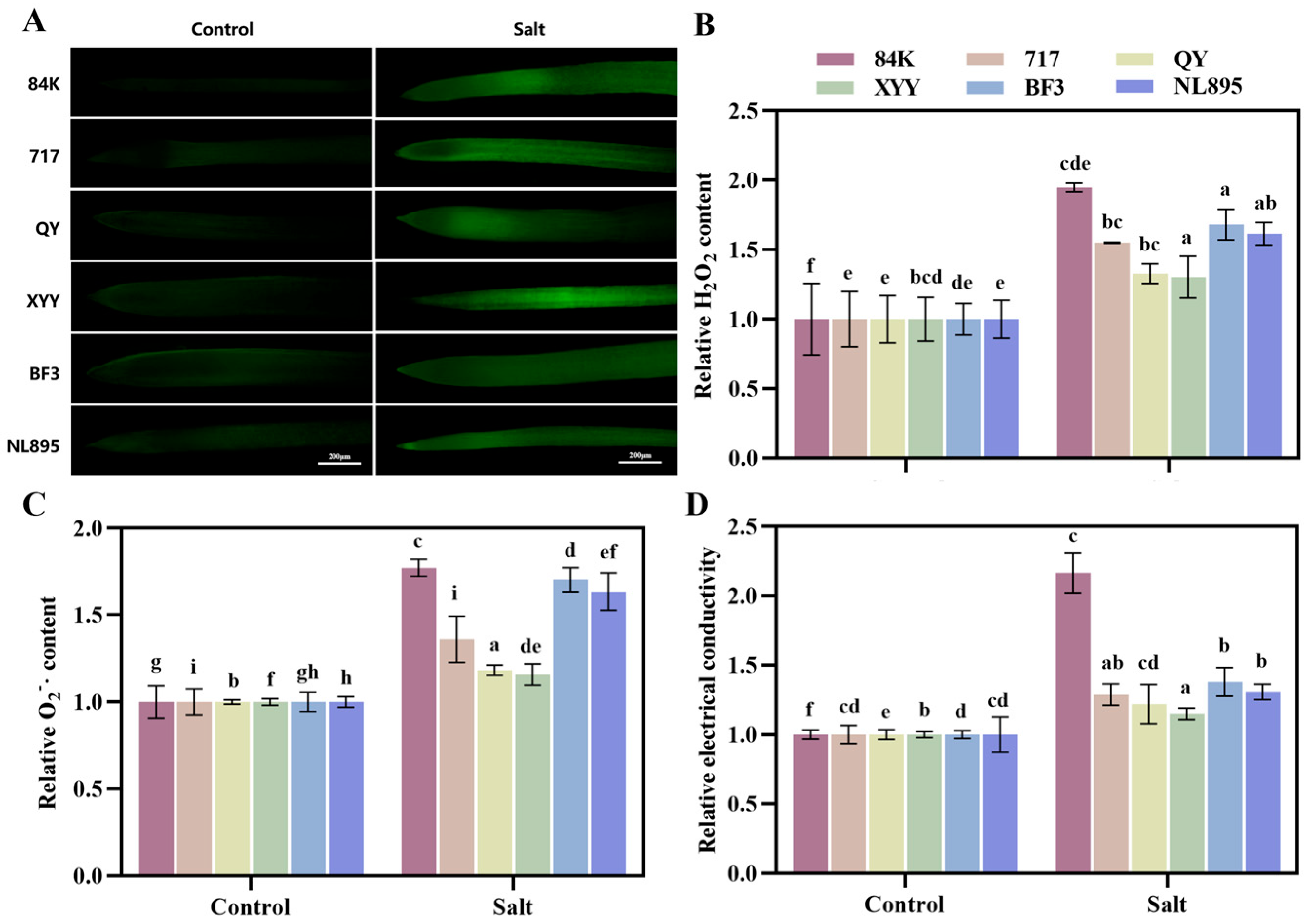
Under salt stress, ROS over-accumulate in the cell and the degree of oxidative stress in the cell increases; thus, the content of ROS in cells can be used to characterize the degree of salt stress in plants, and the higher the content of ROS is, the greater the degree to which the plant is harmed by salt stress. In this study, the DCFH-DA fluorescent labelling technique was used to visualize the accumulation pattern of reactive oxygen species in the root systems of different poplar types. The fluorescence signals of the root systems of different poplar types were weak under normal growth conditions. However, a strong fluorescence signal was observed after salt stress in different poplar roots (Figure 1A).
Figure 1.
Changes in root ROS levels and relative electrical conductivity of different kinds of poplar plants under salt stress. (A) DCFH-DA staining of the ROS content in roots of different poplar types. Green fluorescence reflects the level of intracellular ROS stained with DCFH-DA.; (B) relative H2O2 content, (C) relative O2− content and (D) relative electrical conductivity in the roots of six kinds of poplar. Each staining method was performed with three biological replicates, with each replicate consisting of no less than 10 roots. The histogram data were normalized. The error bars represent ± SD, and the letters indicate significant differences between different kinds of poplar (p ≤ 0.05).
The H2O2 content tended to increase in different poplar types under salt stress treatment, but the increases significantly differed (Figure 1B). Compared with that in the control group, the intracellular H2O2 accumulation in XYY, QY and 717 in the treatment group increased by 30.4%, 32.8% and 55.1%, respectively; compared with that in the control group, the root system H2O2 content in NL895, BF3 and 84K was 1.62, 1.68 and 1.95 times greater, respectively.
The O2− content of the root system significantly differed before and after salt stress in the different kinds of poplar (Figure 1C). By calculating the relative O2− contents, the results revealed that the O2− contents of the different kinds of poplar increased to different magnitudes under salt stress treatment, among which the O2− accumulations of XYY, QY, and 717 were 1.16, 1.18, and 1.36 times lower, respectively, and the accumulation of O2− in the roots of NL895, BF3 and 84K was greater.
Under normal conditions and salt stress, the root conductivity of the different kinds of poplar differed significantly, and the variations among poplars were eliminated by standardization to compare the degree of cell membrane stability changes of the different types in response to salt stress (Figure 1D). Under salt stress, the relative conductivities of the other types all tended to increase, but the magnitude of the increase of 84K was the most significant, with an increase of 116.7%, whereas the other five kinds of poplar showed smaller increases in relative conductivity, with XYY showing only a 14.8% increase in relative conductivity. The increase in the relative conductivity of the remaining four types was approximately 25%.
In conclusion, the accumulation of H2O2 and O2− and the amount of electrical conductivity in the roots of NL895, BF3 and 84K were greater, whereas those in XYY, QY and 717 were lower.
3.2. Response of Root Ion Homeostasis to Salt Stress
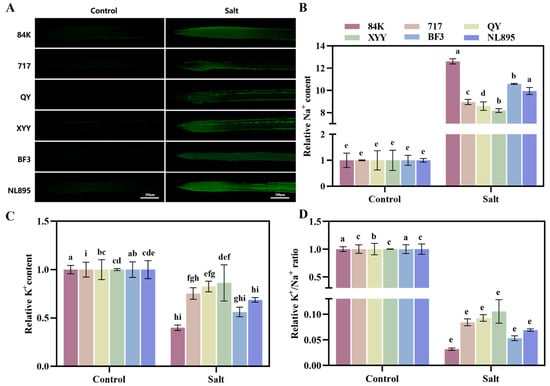
The accumulation of Na+ in the root systems of the different kinds of poplar was qualitatively evaluated using CoroNa™ Green-AM staining. Under normal growth conditions, the fluorescence signals of the root systems of the different kinds of poplar were low, and there was no significant difference between the types; after salt stress treatment, the intensity of the fluorescence signals in the six kinds of poplar increased, and the fluorescence signals of the root system of 84K were stronger than those of the other five kinds of poplar (Figure 2A). The Na+ content of the root cells of all the types of poplar increased substantially after salt stress, and the differences in the increases were significant. After the salt stress treatment, the relative Na+ content of the root systems of XYY, QY and 717 increased relatively little—8.18, 8.59 and 8.96 times that of the control group, respectively—and the Na+ content of the root system of 84K increased the most, 12.60 times that of the control group; moreover, a large amount of Na+ flowed into the root cells (Figure 2B).
Figure 2.
The changes in root ion contents in different kinds of poplar under salt stress. (A) CoroNa™ Green-AM staining of Na+ content in roots of different kinds of poplar. Green fluorescence indicates intracellular free Na+ labeled by CoroNa™ Green-AM. (B) The relative K+ content, (C) relative Na+ content, and (D) relative K+/Na+ ratio in roots of different kinds of poplar. Each staining method was performed with three biological replicates, with each replicate consisting of no less than 10 roots. The histogram data were normalized. The error bars represent ± SD, and the letters indicate significant differences between different kinds of poplar (p ≤ 0.05).
Under normal conditions, the K+ contents of the root systems of different poplar types differed from each other; the relative K+ content was calculated. The K+ content of the root systems of different poplar types tended to decrease after salt stress treatment, and the magnitude of these decreases differed. Compared with that of the control, the K+ contents of XYY, QY and 717 were slightly reduced, by 13.7%, 17.4% and 24.7%, respectively, whereas the K+ contents of NL895, BF3 and 84K were reduced considerably, by 31.3%, 43.7% and 60.1%, respectively (Figure 2C).
Under normal conditions, the root K+/Na+ ratios differed significantly across the different poplar types. Analysis of the relative K+/Na+ ratios revealed that under salt stress, the K+/Na+ ratios of the root systems decreased substantially compared with that of the control; the K+/Na+ ratios of XYY, QY, and 717 decreased relatively less, by 89.4%, 90.7%, and 91.6%, respectively, and the K+/Na+ ratios of the other three poplars decreased more, but the differences were not significant (Figure 2D).
3.3. Responses of Root Vitality and NO Content in Different Poplar Types to Salt Stress
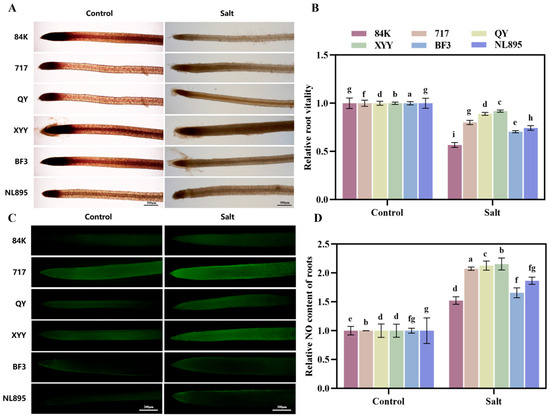
Under salt stress, the root system maintains relatively high vigour to adapt to the stress. The differences in the changes in root vitality of the different kinds of poplar plants after salt stress were compared, and quantitative observations of the root vitality of the different kinds of poplar revealed a decrease in root vitality after salt stress (Figure 3A). The quantitative results are shown in Figure 3B, where the differences in root vigour among different poplar types were significant under normal conditions. The relative root vitality was calculated to compare the changes in root vitality of the different types under salt stress. The root vitality of all the kinds of poplar tended to decrease under salt stress, and compared with the control, XYY, QY and 717 decreased by 8.2%, 11.1%, and 20.0%, respectively, whereas 84K showed the greatest decrease in root vitality, a decrease of nearly 50%.
Figure 3.
The changes in root vitality and NO content of different kinds of poplar under salt stress. (A) TTC staining of root systems in different poplar types. (B) Root vitality in different kinds of poplar. (C) DAF-FM™ staining of NO content in roots of six kinds of poplar. The green fluorescence signal in the images corresponds to intracellular NO stained by DAF-FM™. (D) Relative NO content in roots of different poplar. The histogram data were normalized. Each staining method was performed with three biological replicates, with each replicate consisting of no less than 10 roots. The error bars represent ± SD, and the letters indicate significant differences between different kinds of poplar (p ≤ 0.05).
The changes in the NO content in the roots of different poplar types before and after salt stress were determined using DAF-FM™ staining. The fluorescence signals of the poplar root systems increased to different degrees after salt stress treatment (Figure 3C). The relative NO content significantly increased in different poplar roots after salt stress, and XYY, QY, and 717 responded more strongly to salt stress, with increases of 115.5%, 112.7%, and 107.5%, respectively (Figure 3D).
3.4. Quality Analysis of Sequencing Results from the Root System of Populus simonii After Salt Stress Treatment
The average Q30 scores of the RNA from samples collected from the control (CK) and salt stages and sequenced on the Illumina HiSeq platform after filtration were greater than 94.45%. The guanine–cytosine content was approximately 44.10%. The data quality is reliable and can be used for subsequent analysis (Table A2).
Gene expression in the control and salt-stressed groups of XYY poplar was analysed. In total, 2999 genes whose expression significantly differed were detected in Psi.CK vs. Psi.Salt. Under salt stress, 1659 genes were upregulated and 1340 genes were downregulated, accounting for 55.3% and 44.7% of the differentially expressed genes, respectively (Figure A1).
The ST and CK transcriptome data have been deposited into the NCBI database under the bioproject accession number PRJNA1494114. To confirm the RNA-seq results, we performed qRT-PCR expression analysis on 10 poplar genes. The results revealed no significant differences compared with the RNA-seq data, with both upregulated and downregulated genes following similar trends (Figure A2). These findings validate the RNA-seq data and reliably reflect the transcriptomic changes observed in our study.
3.5. GO Functional Annotation and KEGG Enrichment Analyses of Differentially Expressed Genes
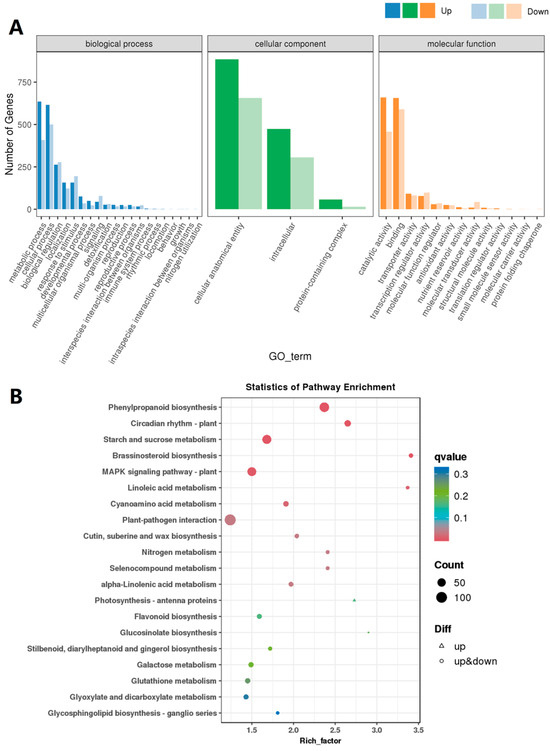
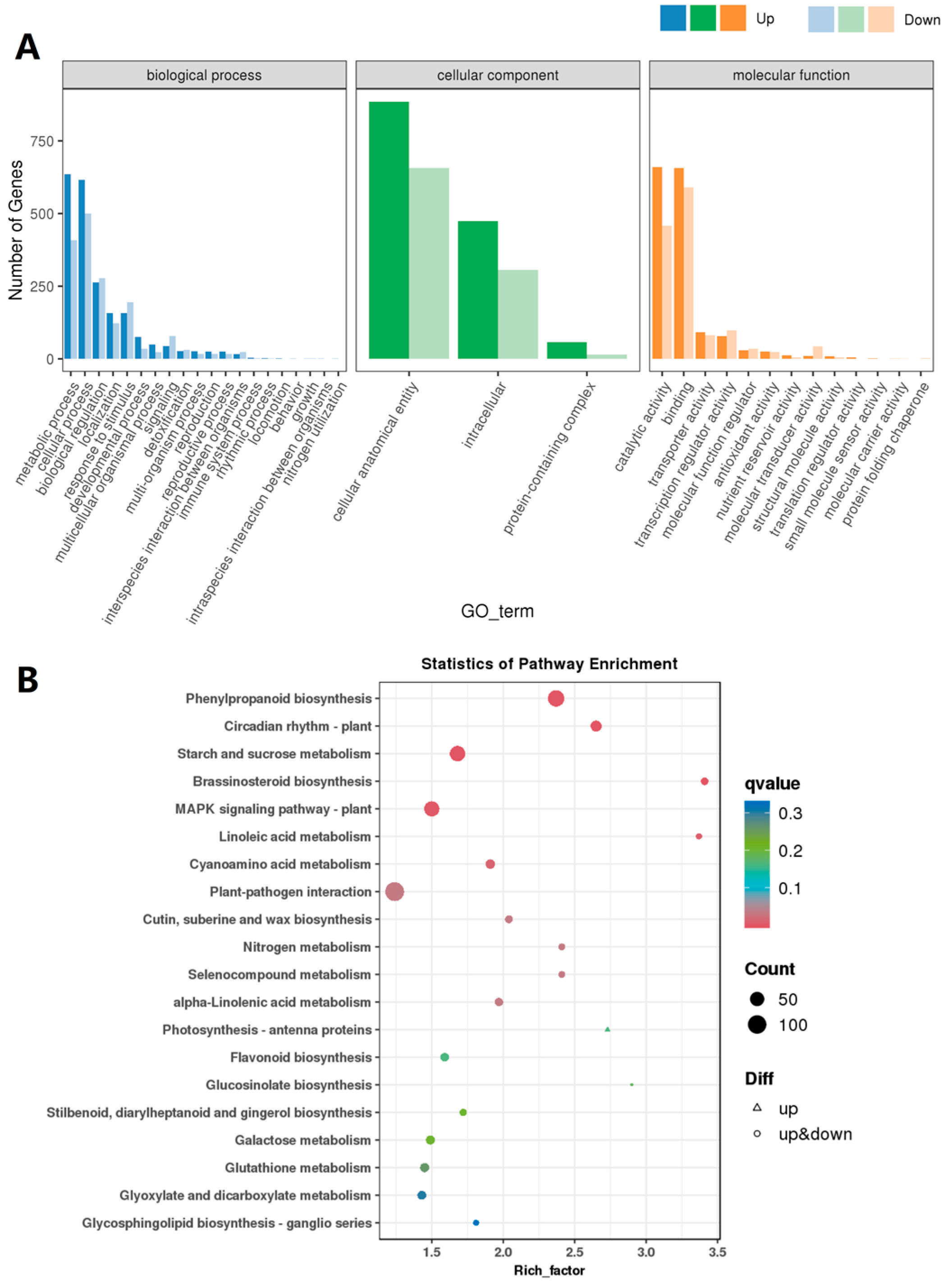
To analyse the biological functions of the DEGs, three types of GO functional annotation analyses were carried out: biological process, cellular component, and molecular function (Figure 4A). In terms of biological processes, the DEGs were enriched mainly in metabolic processes, cellular processes, biological regulation, and responses to stimuli; in terms of cellular components, most DEGs were enriched primarily in cellular anatomical entities and intracellular entities. The molecular function annotations of the DEGs are focused mainly on catalytic activity and binding.
Figure 4.
(A) GO functional annotation and (B) KEGG enrichment analyses of differential genes in Populus simonii roots.
After KEGG analysis of the differentially expressed genes of XYY under salt stress, the top 20 pathways with the greatest degree of enrichment were selected, which are shown in the enrichment bubble figure in Figure 4B. The enriched pathways were the MAPK signalling pathway, nitrogen metabolism, and plant–pathogen interactions, among others.
3.6. MAPK Signalling Pathway in Populus simonii Roots Under High Salt Conditions
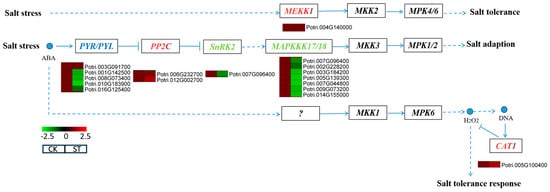
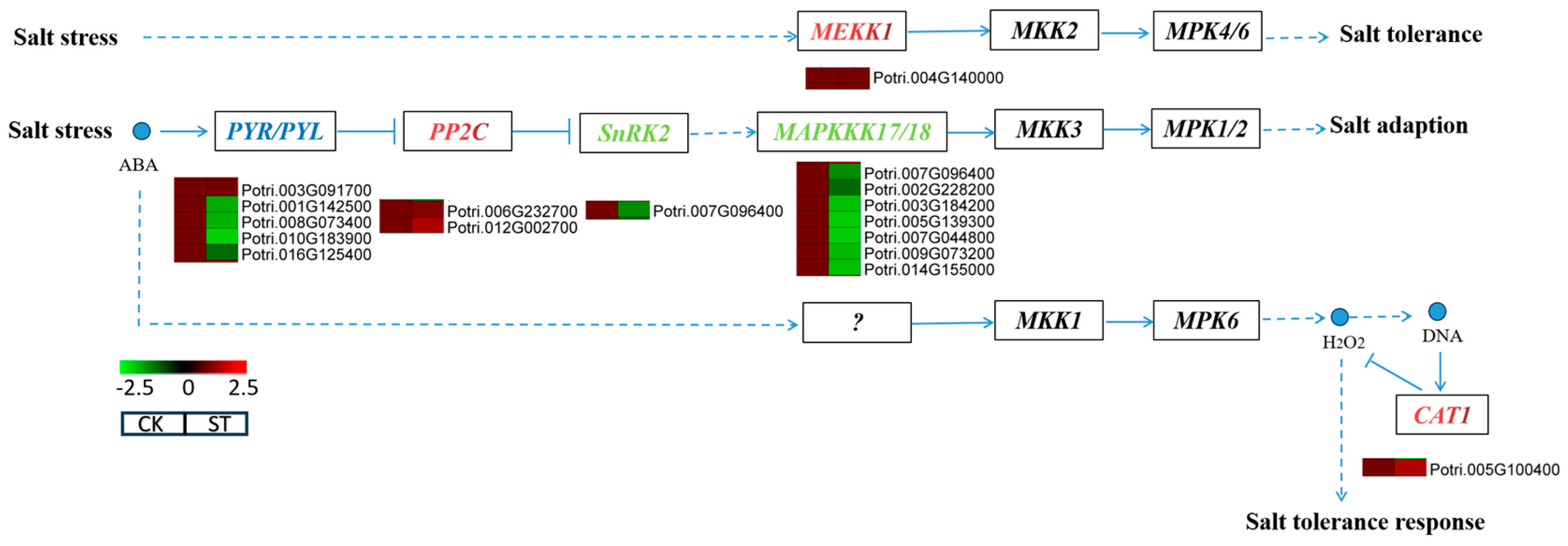
According to the result of the correlation analysis of the transcriptome in XYY roots under salt stress conditions, we found that the MAPK signalling pathway was the main regulatory pathway in plants under salt stress. The expression levels of protein phosphatase type 2C (PP2C; Potri.006G232700 and Potri.012G002700) increased by 1.11 and 1.43 times, respectively. The expression of the MEKK1 (Potri.004G140000) gene was upregulated 1.01 times. The expression of the PYR/PYL (Potri.003G091700) gene also increased 1.01 times in the plant roots. Most PYR/PYL (Potri.001G142500, Potri.008G073400, Potri.010G183900 and Potri.016G125400) genes decreased. The SnRK2 (Potri.007G096400) gene was downregulated by 26%. All MAPKKK17/18 (Potri.007G096400, Potri.002G228200, Potri.003G184200, Potri.005G139300, Potri.007G044800, Potri.009G073200 and Potri.014G155000) genes were downregulated after salt stress (Figure 5).
Figure 5.
MAPK signalling pathway under salt stress in XYY roots. The boxes in the pathway represent DEGs. Red and green represent upregulated and downregulated genes.
3.7. Nitrogen Metabolism Pathway in Populus simonii Roots Under High Salt Conditions
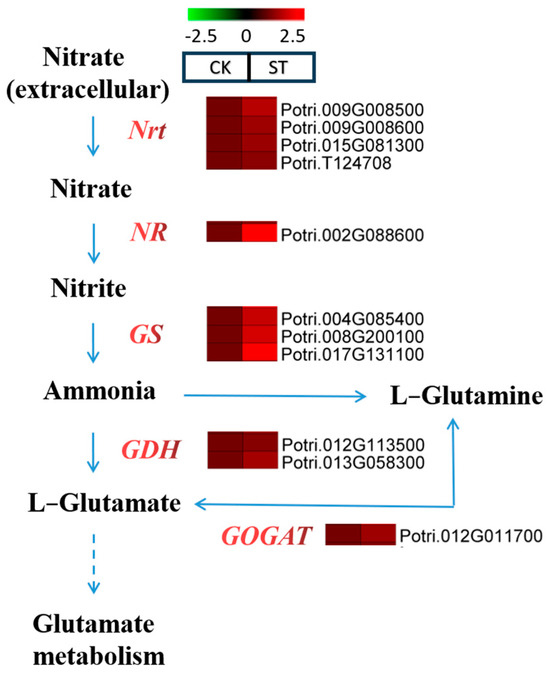
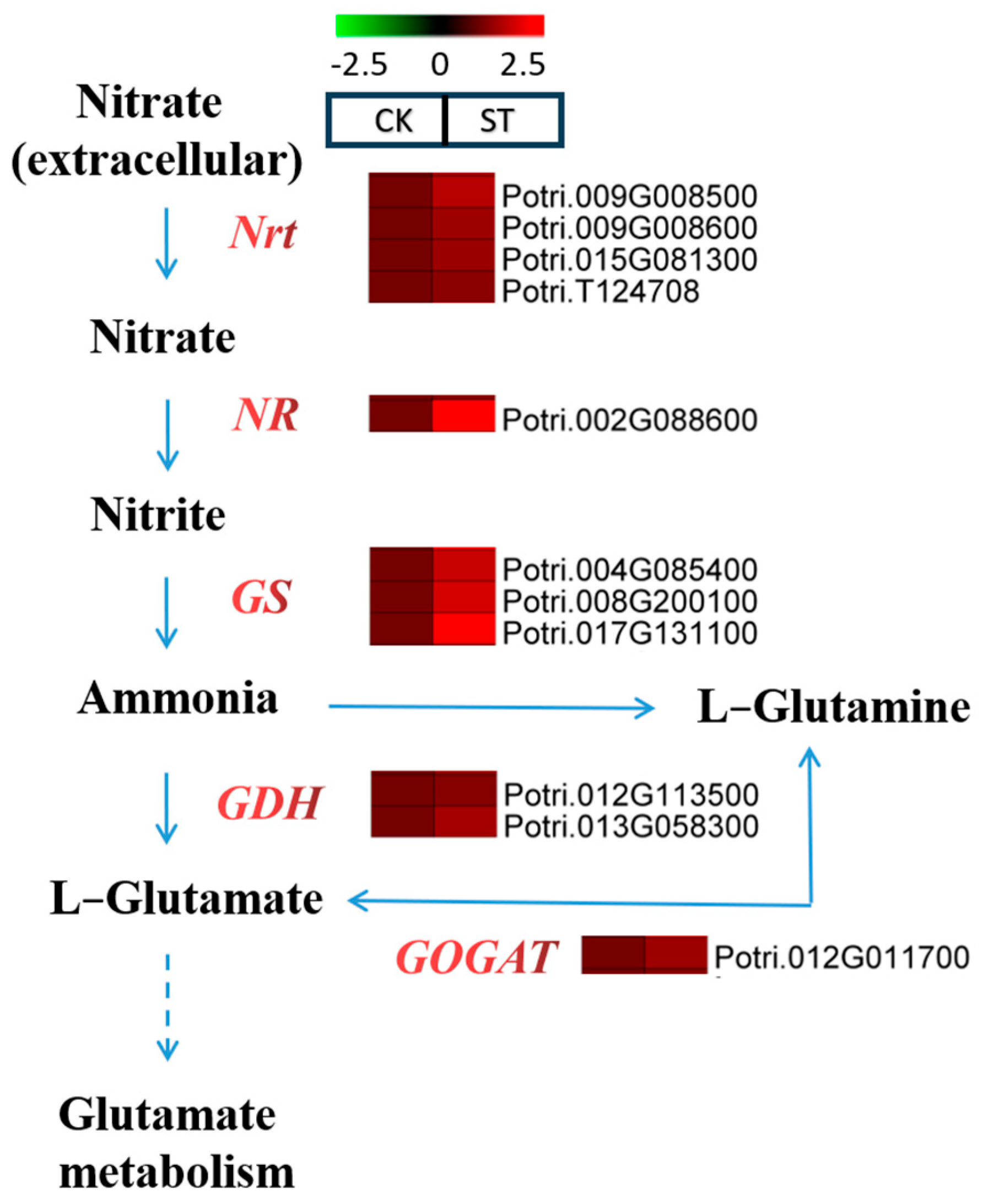
Another enriched pathway under salt stress was the nitrogen metabolism pathway. The expression levels of all the DEGs involved in the nitrogen metabolism pathway increased in XYY roots. The expression levels of nitrate/nitrite transporters (Nrt; Potri.005G100400, Potri.009G008500, Potri.009G008600, Potri.015G081300 and Potri.T124708) increased by 1.56, 1.34, 1.31 and 1.17 times, respectively. The expression of the NR (Potri.002G088600), GS (Potri.004G085400, Potri.008G200100 and Potri.017G131100), GOGAT (Potri.012G011700) and GDH (Potri.012G113500 and Potri.013G058300) genes increased, especially that of the NR gene, whose expression increased nearly 3-fold (Figure 6).
Figure 6.
Nitrogen metabolism under salt stress in Populus simonii roots. The boxes in the pathway represent DEGs. Red and green represent upregulated and downregulated genes.
4. Discussion
Poplars, which comprise approximately 100 species, are widely disseminated across diverse climatic regions [33]. Characterized by rapid growth and high biomass accumulation, poplars have become foundational species for global afforestation initiatives and the establishment of protective shelterbelts [34]. Populus displays a wide variety of morphological features and physiological adaptations [35]. Resistance to saline–alkaline stress varies significantly among different poplars; for example, the poplar species P. pruinosa and P. euphratica both grow in deserts and are adapted to salt stress conditions [36,37]. Conversely, the majority of other populus species exhibit marked sensitivity to salt, including the grey poplar (Populus × canescens), Populus × euramericana, and Populus popularis, which are usually used as sensitive biological controls in comparative salt-response studies [38]. Salt treatment effects are observed at various stages of plant development. Specifically, high salt concentrations significantly impede seed germination, longitudinal root extension, overall plant height, and reproductive success. As the primary interface between the plant and the soil environment, the root system serves as the “frontline” organ for sensing and responding to salt stress. To sustain vegetative growth and promote the efficient uptake of nutrients and water, roots must dynamically adapt to fluctuating soil salinity. In this study, six different poplar species were selected to compare the morphological and physiological responses of their root systems to saline stress, thus revealing the varying degrees of salt resistance among these genotypes.
Salt stress increases the aerobic metabolism ability of plants, resulting in the production of superoxide anions, hydroxyl radicals, H2O2 and other harmful ROS. The overproduction of ROS is the most frequent phenomenon during salt stress [10]. DCFH-DA has been widely used in the detection of ROS [39]. Under salt stress treatment, the fluorescence signals of the root systems of different poplar types increased to different degrees, indicating that a large amount of reactive oxygen species accumulated in the root cells and that the dynamic balance of reactive oxygen species was disrupted. The degree of damage to plant cell membranes caused by salt stress is reflected by the relative change in conductivity, with a higher relative conductivity indicating greater permeability of cell membranes and greater damage to plant cells caused by salt stress [40]. It can be concluded that salt stress had little effect on the poplar species XYY, QY and 717 but strongly affected the poplar species NL895, BF3 and 84K. Transcriptome analysis revealed that the specific RPKM values of most antioxidant enzyme-related genes, such as thioredoxin, glutaredoxin, lipase GDSL, plant peroxidase, multicopper oxidase, hydroxymethylglutaryl-coenzyme A reductase, methylenetetrahydrofolate reductase, enoyl-(acyl carrier protein) reductase, glutathione S-transferase, and the N-terminal domain, increased in XYY poplar trees (Table A3). Luo et al. [41] compared transcriptome changes in Populus pruinosa, P. euphratica, P. trichocarpa and P. tomentosa under salt stress. They also reported that the expression of several genes related to oxidoreductase activity increased in salt-sensitive poplars but decreased in the two salt-tolerant species under salinity stress. The increased expression of antioxidant enzyme-related genes in XYY poplar trees may explain their stronger resistance to salt stress.
NaCl stress induces hyperosmotic stress and secondary ionic toxicity, which collectively impair physiological homeostasis and constrain overall plant development and productivity [42,43]. The presence of Na+ and Cl– serves as a chemical signal that initiates the salt stress response. Beyond direct ionic toxicity, these elements compromise plant vigour by precipitating secondary metabolic challenges, including osmotic stress and oxidative bursts [44,45]. The core response of plant root systems to salt stress involves the precise regulation of ion balance [46]. The CoroNa™ Green-AM fluorescence signals of the root system indicated that, compared with the five other kinds of poplar, 84K contains more Na+ under salt stress. The K+/Na+ ratio is typically used as an important index to characterize a plant’s stress tolerance, and is used to illustrate the degree of influence of Na+ on K+ uptake, and the higher the ratio is, the stronger the plant’s salt tolerance [47]. Compared with those in NL895, BF3 and 84K, the K+/Na+ content in the roots of all six poplar species decreased under salt stress, and those of XYY, QY and 717 decreased slightly. The results revealed that the ion balance ability of the root systems of XYY, QY and 717 was stronger than that of NL895, BF3 and 84K. Transcriptome analysis revealed that potassium transport (Potri.009G010700) was upregulated by 5.29 times and that ATPase/Hsp70 (Potri.018G098200) expression was upregulated by 8.21 times (Table A3). The strong potassium absorption and sodium excretion ability may explain the strong resistance of XYY root systems.
The root system serves as the primary sensor for salinity; however, its development is markedly suppressed upon exposure to high salinity. To counteract deleterious effects, roots must sustain a threshold level of physiological vitality to promote adaptation. Salt stress can impede the growth of rice roots, as manifested by significant reductions in root length, root surface area and root volume, all of which affect the activity of the plant [48]. Quantitative observation of the root vitality of the different kinds of poplar revealed a decrease in root vitality after salt stress. The root vitality of all the kinds of poplar tended to decrease under salt stress, and compared with the control, XYY, QY and 717 decreased less, whereas 84K resulted in the greatest decrease in root vitality. All the genes related to the root cap in XYY poplar trees were upregulated (Table A3). These genes may be involved in the regulation of root activity under salt stress conditions.
The MAPK signalling framework is an evolutionarily conserved mechanism that connects sensory perception and cellular action. By interpreting signals initiated at the receptor level, these cascades enable the translation of environmental cues into functional cellular adaptations [49,50,51]. Under salt stress conditions, the DEGs in the roots were enriched in the MAPK pathway according to the KEGG analysis of XYY poplar roots under salt stress. PP2C, a Mn2+- or Mg2+-dependent protein serine/threonine phosphatase, plays important roles in ABA and MAPK signalling [52]. BdPP2CA6 in Brachypodium distachyon and BpPP2C1 from Betula platyphylla have been reported to positively regulate plant salt tolerance. The overexpression of BpPP2C1 and BdPP2CA6 improved plant salt tolerance [53,54]. The expression level of the PP2C (Potri.012G002700) gene significantly increased in the roots of XYY poplar plants, and increased PP2C expression increased the salt tolerance of the XYY poplar root system. Most plant SnRK2 proteins are activated by abiotic stresses, and overexpression of SnRK2 genes has been reported to increase abiotic stress tolerance [55,56,57,58,59,60]. For example, overexpression of poplar PtSnRK2.5 and PtSnRK2.7 improved salt stress tolerance in Arabidopsis [60]. However, the opposite results have also been reported: overexpression of ZmSnRK2.11 reduces salt and drought tolerance in Arabidopsis [61]. The expression of SnRK2 (Potri.007G096400) was downregulated in the roots of poplar plants; perhaps in these plants, it activated negative feedback loops to prevent excessive activation of signals under salt stress. The activity of SnRK2 is negatively regulated by phosphatases (such as PP2C) or by the ubiquitination degradation pathway. SnRK2 (Potri.007G096400) may be a negative regulatory factor involved in the signal transduction pathway for plant salt stress in poplar roots. Under salt stress, the DEGs of Hordeum spontaneum were enriched in the MEKK1-MKK2-MPK4/6 pathway [25]. The expression level of the MEKK1 (Potri.004G140000) gene in poplar was upregulated, indicating that the root system of poplar mainly increased the expression of the MEKK1 gene in response to salt stress.
Nitrogen metabolism plays a significant role in the resistance of plants to salt stress. NO is not only a by-product of nitrogen metabolism but also a key signalling molecule that regulates nitrogen absorption, assimilation, and balance [62]. As a key signalling molecule, NO plays important roles in various plant physiological and developmental processes as well as plant responses to biotic and abiotic stresses, such as salt stress [63,64]. High salinity strongly induces NO accumulation in plant tissues, which can increase the salt tolerance of plants to a certain extent under salt stress [65,66]. The relative NO content significantly increased in the roots of the six poplar species after salt stress, and XYY, QY, and 717 responded more strongly to salt stress, indicating that these three poplar species are strongly resistant to salt stress.
Salt stress can affect the absorption of nitrogen by plants. Salt stress affects the nitrogen metabolism of different varieties of rice, leading to nitrogen deficiency [67]. Ref. [68] reported that the changes in NR activity in rice during the germination stage under saline–alkaline stress were closely related to its salt tolerance. Specifically, the NR activity of salt-tolerant varieties increased significantly, whereas that of salt-sensitive varieties decreased considerably. Studies on maize [69] and sugar beet [70] have shown that salt stress has different effects on key nitrogen metabolism enzymes; it can stimulate the activities of NR and GOGAT while inhibiting those of GS and GDH. Under salt stress, the expression levels of metabolism-related genes in the nitrogen signalling pathway in XYY poplar trees increased significantly (Figure 6). The expression levels of Nrt, NR, GS, GOGAT, and GDH were upregulated under salt stress in Populus simonii, indicating that this pathway plays an important role in the response of XYY poplar trees to salt stress.
5. Conclusions
Through physiological measurements of root reactive oxygen species and relative electrical conductivity, ion homeostasis, root activity, ROS-scavenging capacity, and NO content, the salt resistance of the six studied poplar cultivars decreased in the order of P. simonii > P. cathayana > P. tremula × P. alba ‘717’ > P. deltoides × P. euramericana ‘Nanlin 895’ > P. deltoides × P. euramericana ‘Bofeng 3’ > P. alba × P. glandulosa ‘84K’. Furthermore, a transcriptomic analysis was performed on the most resilient species, P. simonii. These results reveal that P. simonii primarily mediates its salt stress response through the modulation of MAPK cascades and nitrogen metabolism pathways. However, functional validation of the pathway and core genes through experimental approaches such as genetic transformation, gene silencing, or overexpression was not conducted, and the functional associations between genes, pathways, and poplar salt tolerance, as well as their specific regulatory mechanisms, remain to be further confirmed and elucidated. This research provides theoretical support for elucidating the molecular mechanisms underlying the salt stress response of poplars and provides a foundation for the molecular breeding of salt-tolerant varieties.
Author Contributions
T.-T.S. and L.-Q.W. designed the experiments. J.-H.M. prepared the plant samples. J.-H.M., W.-T.Z., L.R., K.-P.L. and H.-C.L. conducted the experiments and analysed the data. T.-T.S., J.-H.M. and W.-T.Z. wrote the manuscript. All authors have read and agreed to the published version of the manuscript.
Funding
This work was supported by the Fundamental Research Funds of CAF (CAFYBB2022QC001) and the Construction of Beijing Science and Technology Innovation and Service Capacity in Top Subjects (Grant No. CEFF–PXM2019_014207_000032).
Data Availability Statement
The datasets will be available on reasonable request.
Conflicts of Interest
The authors have no conflicts of interest to declare.
Appendix A
Figure A1.
(A) Principal component analysis of expressed genes. (B) Distribution of gene expression in CK and salt-stressed plants. (C) Volcano map of DEGs in XYY roots under salt stress. (D) Heatmap of DEGs in XYY roots under salt stress.
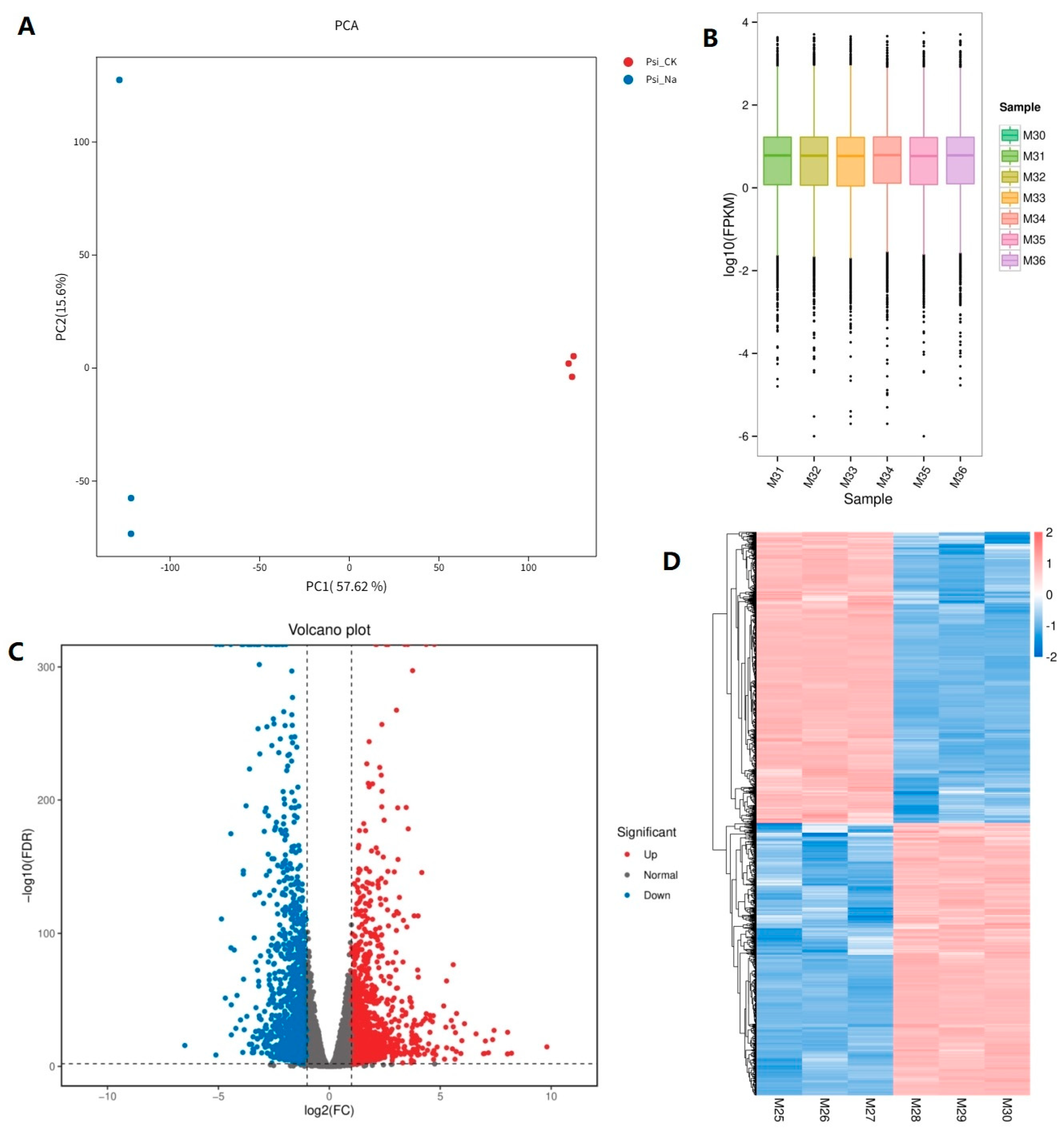
Figure A2.
Validation of the differentially expressed genes in XYY roots under salt stress using qRT-PCR.
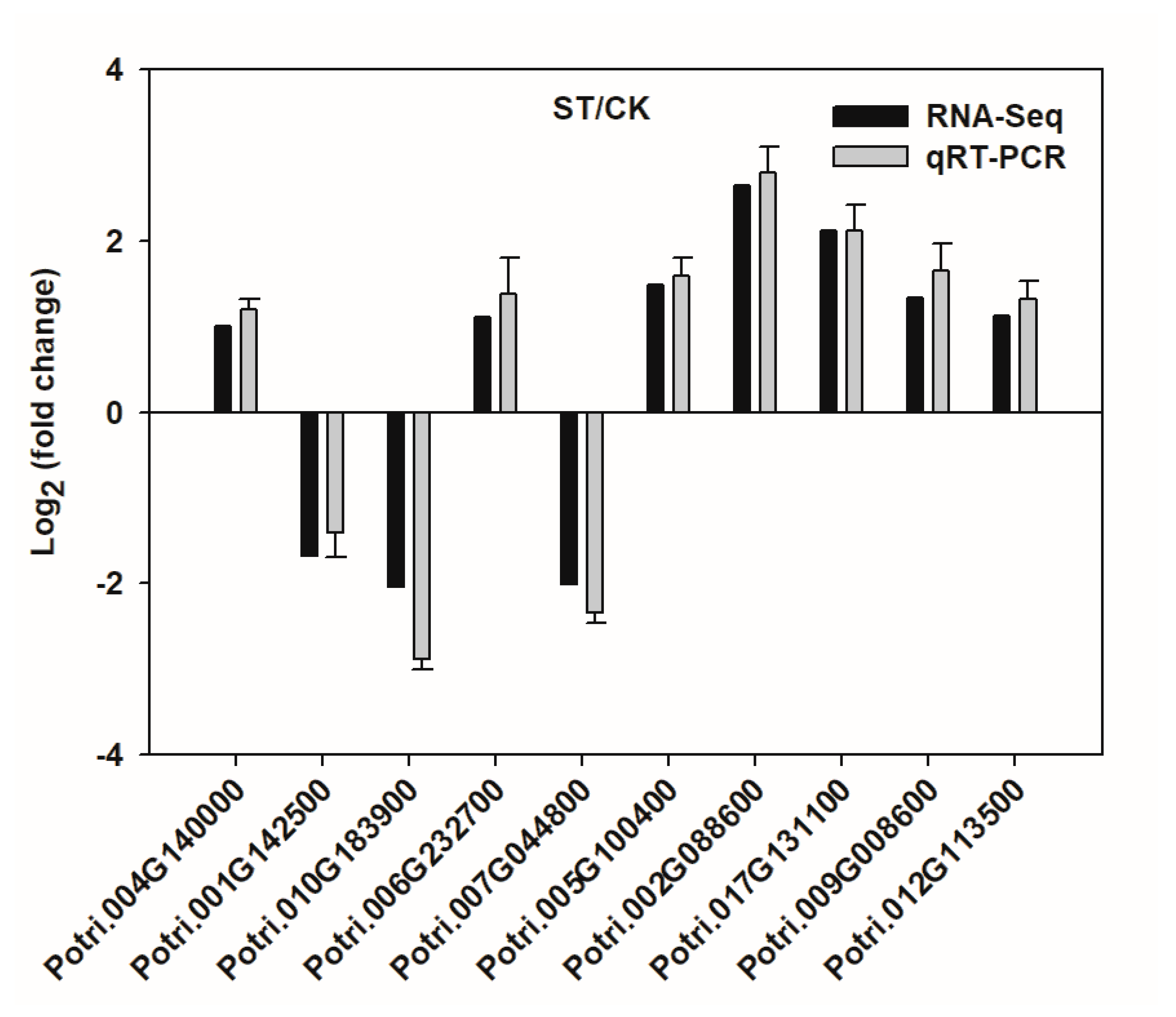
Table A1.
The primers used for qRT-PCR.
Table A2.
Summary of the sequencing data generated for RNA-seq and mapping of the Populus genome.
Table A3.
Candidate genes related to salt treatment in Populus genome.
References
- Munns, R.; Gilliham, M. Salinity tolerance of crops—What is the cost? New Phytol. 2015, 208, 668–673. [Google Scholar] [CrossRef] [Scilit] [PubMed]
- Wu, H.; Guo, J.; Wang, C.; Li, K.; Zhang, X.; Yang, Z.; Li, M.; Wang, B. An Effective Screening Method and a Reliable Screening Trait for Salt Tolerance of Brassica napus at the Germination Stage. Front. Plant Sci. 2019, 10, 530. [Google Scholar] [CrossRef] [Scilit] [PubMed]
- Cavalcanti, F.R.; Lima, J.P.; Ferreira-Silva, S.L.; Viégas, R.A.; Silveira, J.A. Roots and leaves display contrasting oxidative response during salt stress and recovery in cowpea. J. Plant Physiol. 2007, 164, 591–600. [Google Scholar] [CrossRef] [Scilit] [PubMed]
- Khare, T.; Seth, C.S.; Kumar, V. Sodium stress-induced oxidative damage and antioxidant responses during grain filling in Indica rice. Plant Cell Rep. 2024, 43, 239. [Google Scholar] [CrossRef] [Scilit] [PubMed]
- Lazar, T.; Taiz, L.; Zeiger, E. Plant physiology. 3rd edn. Ann. Bot. 2003, 91, 750–751. [Google Scholar] [CrossRef] [Scilit]
- Farooq, M.; Park, J.-R.; Jang, Y.-H.; Kim, E.-G.; Kim, K.-M. Rice Cultivars Under Salt Stress Show Differential Expression of Genes Related to the Regulation of Na+/K+ Balance. Front. Plant Sci. 2021, 12, 680131. [Google Scholar] [CrossRef] [Scilit] [PubMed]
- Ding, M.; Hou, P.; Shen, X.; Wang, M.; Deng, S.; Sun, J.; Xiao, F.; Wang, R.; Zhou, X.; Lu, C.; et al. Salt-induced expression of genes related to Na(+)/K(+) and ROS homeostasis in leaves of salt-resistant and salt-sensitive poplar species. Plant Mol. Biol. 2010, 73, 251–269. [Google Scholar] [CrossRef] [Scilit] [PubMed]
- Tiwari, J.K.; Munshi, A.D.; Kumar, R.; Pandey, R.N.; Arora, A.; Bhat, J.S.; Sureja, A.K. Effect of salt stress on cucumber: Na+–K+ ratio, osmolyte concentration, phenols and chlorophyll content. Acta Physiol. Plant. 2010, 32, 103–114. [Google Scholar]
- Kesawat, M.S.; Satheesh, N.; Kherawat, B.S.; Kumar, A.; Kim, H.U.; Chung, S.M.; Kumar, M. Regulation of Reactive Oxygen Species during Salt Stress in Plants and Their Crosstalk with Other Signaling Molecules-Current Perspectives and Future Directions. Plants 2023, 12, 864. [Google Scholar] [CrossRef] [Scilit] [PubMed]
- Ahmad, R.; Hussain, S.; Anjum, M.A.; Khalid, M.F.; Saqib, M.; Zakir, I.; Hassan, A.; Fahad, S.; Ahmad, S. Oxidative Stress and Antioxidant Defense Mechanisms in Plants Under Salt Stress. In Plant Abiotic Stress Tolerance: Agronomic, Molecular and Biotechnological Approaches; Hasanuzzaman, M., Hakeem, K.R., Nahar, K., Alharby, H.F., Eds.; Springer International Publishing: Cham, Switzerland, 2019; pp. 191–205. [Google Scholar]
- Shahzad, S.; Ali, S.; Ahmad, R.; Ercisli, S.; Anjum, M.A. Foliar Application of Silicon Enhances Growth, Flower Yield, Quality and Postharvest Life of Tuberose (Polianthes tuberosa L.) under Saline Conditions by Improving Antioxidant Defense Mechanism. Silicon 2022, 14, 1511–1518. [Google Scholar] [CrossRef] [Scilit]
- Hawrylak-Nowak, B. Beneficial effects of exogenous selenium in cucumber seedlings subjected to salt stress. Biol. Trace Elem. Res. 2009, 132, 259–269. [Google Scholar] [CrossRef] [Scilit] [PubMed]
- Abouelsaad, I.; Weihrauch, D.; Renault, S. Effects of salt stress on the expression of key genes related to nitrogen assimilation and transport in the roots of the cultivated tomato and its wild salt-tolerant relative. Sci. Hortic. 2016, 211, 70–78. [Google Scholar] [CrossRef] [Scilit]
- Cui, G.; Zhang, Y.; Zhang, W.; Lang, D.; Zhang, X.; Li, Z.; Zhang, X. Response of Carbon and Nitrogen Metabolism and Secondary Metabolites to Drought Stress and Salt Stress in Plants. J. Plant Biol. 2019, 62, 387–399. [Google Scholar] [CrossRef] [Scilit]
- Corpas, F.J.; Barroso, J.B. Nitro-oxidative stress vs oxidative or nitrosative stress in higher plants. New Phytol. 2013, 199, 633–635. [Google Scholar] [CrossRef] [Scilit] [PubMed]
- Fancy, N.N.; Bahlmann, A.-K.; Loake, G.J. Nitric oxide function in plant abiotic stress. Plant Cell Environ. 2017, 40, 462–472. [Google Scholar] [PubMed]
- Groß, F.; Durner, J.; Gaupels, F. Nitric oxide, antioxidants and prooxidants in plant defence responses. Front. Plant Sci. 2013, 4, 419. [Google Scholar] [CrossRef] [Scilit] [PubMed]
- Gao, Z.; Zhang, J.; Zhang, J.; Zhang, W.; Zheng, L.; Borjigin, T.; Wang, Y. Nitric oxide alleviates salt-induced stress damage by regulating the ascorbate–glutathione cycle and Na+/K+ homeostasis in Nitraria tangutorum Bobr. Plant Physiol. Biochem. 2022, 173, 46–58. [Google Scholar] [CrossRef] [Scilit] [PubMed]
- Chen, Z.; Zhao, X.; Hu, Z.; Leng, P. Nitric oxide modulating ion balance in Hylotelephium erythrostictum roots subjected to NaCl stress based on the analysis of transcriptome, fluorescence, and ion fluxes. Sci. Rep. 2019, 9, 18317. [Google Scholar] [CrossRef] [Scilit] [PubMed]
- Zhang, Y.; Wang, L.; Liu, Y.; Zhang, Q.; Wei, Q.; Zhang, W. Nitric oxide enhances salt tolerance in maize seedlings through increasing activities of proton-pump and Na+/H+ antiport in the tonoplast. Planta 2006, 224, 545–555. [Google Scholar] [CrossRef] [Scilit] [PubMed]
- Walia, H.; Wilson, C.; Wahid, A.; Condamine, P.; Cui, X.; Close, T.J. Expression analysis of barley (Hordeum vulgare L.) during salinity stress. Funct. Integr. Genom. 2006, 6, 143–156. [Google Scholar] [CrossRef] [Scilit]
- Heydarian, Z.; Gruber, M.; Glick, B.R.; Hegedus, D.D. Gene Expression Patterns in Roots of Camelina sativa With Enhanced Salinity Tolerance Arising From Inoculation of Soil With Plant Growth Promoting Bacteria Producing 1-Aminocyclopropane-1-Carboxylate Deaminase or Expression the Corresponding acdS Gene. Front. Microbiol. 2018, 9, 1297. [Google Scholar] [CrossRef] [Scilit] [PubMed]
- Wang, R.; Wang, X.; Liu, K.; Zhang, X.-J.; Zhang, L.-Y.; Fan, S.-J. Comparative Transcriptome Analysis of Halophyte Zoysia macrostachya in Response to Salinity Stress. Plants 2020, 9, 458. [Google Scholar] [CrossRef] [Scilit] [PubMed]
- Lu, J.; Tang, H.; Li, W.; Jiang, Y.; Zou, H.; Wang, Z.; Li, W.; Wang, Q.; Wang, L. Dual function of GbNAC2 in flavonoid metabolism and hormonal pathways enhances salt tolerance in Ginkgo biloba. For. Res. 2025, 5, e028. [Google Scholar] [CrossRef] [Scilit]
- Abulfaraj, A.A. Stepwise signal transduction cascades under salt stress in leaves of wild barley (Hordeum spontaneum). Biotechnol. Biotechnol. Equip. 2020, 34, 860–872. [Google Scholar] [CrossRef] [Scilit]
- Kong, X.; Pan, J.; Zhang, M.; Xing, X.; Zhou, Y.; Liu, Y.; Li, D.; Li, D. ZmMKK4, a novel group C mitogen-activated protein kinase kinase in maize (Zea mays), confers salt and cold tolerance in transgenic Arabidopsis. Plant Cell Environ. 2011, 34, 1291–1303. [Google Scholar] [CrossRef] [Scilit] [PubMed]
- Zhou, J.; Huang, J.; Tian, X.; Zheng, J.; He, X. Transcriptome analysis reveals dynamic changes in the salt stress response in Salix. J. For. Res. 2020, 31, 1851–1862. [Google Scholar]
- Kashif, M.H.; Tang, D.; Li, Z.; Wei, F.; Liang, Z.; Chen, P. Comparative Cytological and Gene Expression Analysis Reveals Potential Metabolic Pathways and Target Genes Responsive to Salt Stress in Kenaf (Hibiscus cannabinus L.). J. Plant Growth Regul. 2020, 39, 1245–1260. [Google Scholar] [CrossRef] [Scilit]
- Zhang, D.; Li, Y.; Zhang, X.; Zha, P.; Lin, R. The SWI2/SNF2 Chromatin-Remodeling ATPase BRAHMA Regulates Chlorophyll Biosynthesis in Arabidopsis. Mol. Plant 2017, 10, 155–167. [Google Scholar] [CrossRef] [Scilit] [PubMed]
- Su, L.; Dai, Z.; Li, S.; Xin, H. A novel system for evaluating drought-cold tolerance of grapevines using chlorophyll fluorescence. BMC Plant Biol. 2015, 15, 82. [Google Scholar] [CrossRef] [Scilit] [PubMed]
- Qi, W.-Z.; Liu, H.-H.; Liu, P.; Dong, S.-T.; Zhao, B.-Q.; So, H.B.; Li, G.; Liu, H.-D.; Zhang, J.-W.; Zhao, B. Morphological and physiological characteristics of corn (Zea mays L.) roots from cultivars with different yield potentials. Eur. J. Agron. 2012, 38, 54–63. [Google Scholar] [CrossRef] [Scilit]
- Sun, T.; Zhang, J.; Zhang, Q.; Li, X.; Li, M.; Yang, Y.; Zhou, J.; Wei, Q.; Zhou, B. Integrative physiological, transcriptome, and metabolome analysis reveals the effects of nitrogen sufficiency and deficiency conditions in apple leaves and roots. Environ. Exp. Bot. 2021, 192, 104633. [Google Scholar] [CrossRef] [Scilit]
- Sixto, H.; Grau, J.M.; Alba, N.; Alía, R. Response to sodium chloride in different species and clones of genus Populus L. For. Int. J. For. Res. 2005, 78, 93–104. [Google Scholar] [CrossRef] [Scilit]
- Jansson, S.; Douglas, C.J. Populus: A model system for plant biology. Annu. Rev. Plant Biol. 2007, 58, 435–458. [Google Scholar] [CrossRef] [Scilit] [PubMed]
- Grünhofer, P.; Stöcker, T.; Guo, Y.; Li, R.; Lin, J.; Ranathunge, K.; Schoof, H.; Schreiber, L. Populus × canescens root suberization in reaction to osmotic and salt stress is limited to the developing younger root tip region. Physiol. Plant. 2022, 174, e13765. [Google Scholar] [CrossRef] [Scilit] [PubMed]
- Zhang, J.; Xie, P.; Lascoux, M.; Meagher, T.R.; Liu, J. Rapidly evolving genes and stress adaptation of two desert poplars, Populus euphratica and P. pruinosa. PLoS ONE 2013, 8, e66370. [Google Scholar] [CrossRef] [Scilit] [PubMed]
- Zhang, J.; Feng, J.; Lu, J.; Yang, Y.; Zhang, X.; Wan, D.; Liu, J. Transcriptome differences between two sister desert poplar species under salt stress. BMC Genom. 2014, 15, 337. [Google Scholar] [CrossRef] [Scilit]
- Zhang, X.; Liu, L.; Chen, B.; Qin, Z.; Xiao, Y.; Zhang, Y.; Yao, R.; Liu, H.; Yang, H. Progress in Understanding the Physiological and Molecular Responses of Populus to Salt Stress. Int. J. Mol. Sci. 2019, 20, 1312. [Google Scholar] [CrossRef] [Scilit] [PubMed]
- Yu, D.; Zha, Y.; Zhong, Z.; Ruan, Y.; Li, Z.; Sun, L.; Hou, S. Improved detection of reactive oxygen species by DCFH-DA: New insight into self-amplification of fluorescence signal by light irradiation. Sens. Actuators B Chem. 2021, 339, 129878. [Google Scholar] [CrossRef] [Scilit]
- Tang, Y.; Qiu, S.; Li, B.; Sui, D.; Jiang, K.; Zheng, J.; Zou, J.; Lian, J.; Wang, L.; Yuan, Y. Integrative Physiological and Multi-Omics Insights: Salt Stress Adaptation and Functional Specialization in Suaeda salsa L. Physiol. Plant. 2025, 177, e70581. [Google Scholar] [CrossRef] [Scilit] [PubMed]
- Luo, W.; Zhang, C.; Zhang, J.; Jiang, D.; Guo, W.; Wan, D. Transcriptome analysis of four poplars exposed to continuous salinity stress. Biochem. Syst. Ecol. 2017, 70, 311–319. [Google Scholar] [CrossRef] [Scilit]
- Zhu, J.K. Salt and drought stress signal transduction in plants. Annu. Rev. Plant Biol. 2002, 53, 247–273. [Google Scholar] [CrossRef] [Scilit] [PubMed]
- Kamran, M.; Xie, K.; Sun, J.; Wang, D.; Shi, C.; Lu, Y.; Gu, W.; Xu, P. Modulation of growth performance and coordinated induction of ascorbate-glutathione and methylglyoxal detoxification systems by salicylic acid mitigates salt toxicity in choysum (Brassica parachinensis L.). Ecotoxicol. Environ. Saf. 2020, 188, 109877. [Google Scholar] [CrossRef] [Scilit] [PubMed]
- Zhao, S.; Zhang, Q.; Liu, M.; Zhou, H.; Ma, C.; Wang, P. Regulation of Plant Responses to Salt Stress. Int. J. Mol. Sci. 2021, 22, 4609. [Google Scholar] [CrossRef] [Scilit] [PubMed]
- Ahmed, I.M.; Nadira, U.A.; Bibi, N.; Cao, F.; He, X.; Zhang, G.; Wu, F. Secondary metabolism and antioxidants are involved in the tolerance to drought and salinity, separately and combined, in Tibetan wild barley. Environ. Exp. Bot. 2015, 111, 1–12. [Google Scholar] [CrossRef] [Scilit]
- Cui, B.; Xu, Y.; Li, Y.; Song, J.; Ritonga, F.N.; Gao, J.; Li, J. The integrated function of roots in plant salt tolerance. J. Plant Physiol. 2025, 315, 154638. [Google Scholar] [CrossRef] [Scilit] [PubMed]
- Fang, S.; Hou, X.; Liang, X. Response Mechanisms of Plants Under Saline-Alkali Stress. Front. Plant Sci. 2021, 12, 667458. [Google Scholar] [CrossRef] [Scilit] [PubMed]
- Hussain, S.; Zhang, J.-H.; Zhong, C.; Zhu, L.-F.; Cao, X.-C.; Yu, S.-M.; Allen Bohr, J.; Hu, J.-J.; Jin, Q.-Y. Effects of salt stress on rice growth, development characteristics, and the regulating ways: A review. J. Integr. Agric. 2017, 16, 2357–2374. [Google Scholar] [CrossRef] [Scilit]
- Tena, G.; Asai, T.; Chiu, W.-L.; Sheen, J. Plant mitogen-activated protein kinase signaling cascades. Curr. Opin. Plant Biol. 2001, 4, 392–400. [Google Scholar] [CrossRef] [Scilit] [PubMed]
- Zhang, S.; Klessig, D.F. MAPK cascades in plant defense signaling. Trends Plant Sci. 2001, 6, 520–527. [Google Scholar] [CrossRef] [Scilit] [PubMed]
- Ren, D.; Liu, Y.; Yang, K.Y.; Han, L.; Mao, G.; Glazebrook, J.; Zhang, S. A fungal-responsive MAPK cascade regulates phytoalexin biosynthesis in Arabidopsis. Proc. Natl. Acad. Sci. USA 2008, 105, 5638–5643. [Google Scholar] [CrossRef] [Scilit] [PubMed]
- Liu, C.; Dong, X.; Yang, D.; Ge, Q.; Dai, J.; Ma, Z.; Wang, R.; Zhao, H. Genome-Wide Identification and Expression Analysis of PP2C Gene Family in Eelgrass. Genes 2025, 16, 657. [Google Scholar] [CrossRef] [Scilit] [PubMed]
- Zhang, F.; Wei, Q.; Shi, J.; Jin, X.; He, Y.; Zhang, Y.; Luo, Q.; Wang, Y.; Chang, J.; Yang, G.; et al. Brachypodium distachyon BdPP2CA6 Interacts with BdPYLs and BdSnRK2 and Positively Regulates Salt Tolerance in Transgenic Arabidopsis. Front. Plant Sci. 2017, 8, 264. [Google Scholar] [CrossRef] [Scilit] [PubMed]
- Xing, B.; Gu, C.; Zhang, T.; Zhang, Q.; Yu, Q.; Jiang, J.; Liu, G. Functional Study of BpPP2C1 Revealed Its Role in Salt Stress in Betula platyphylla. Front. Plant Sci. 2020, 11, 617635. [Google Scholar] [PubMed]
- Umezawa, T.; Yoshida, R.; Maruyama, K.; Yamaguchi-Shinozaki, K.; Shinozaki, K. SRK2C, a SNF1-related protein kinase 2, improves drought tolerance by controlling stress-responsive gene expression in Arabidopsis thaliana. Proc. Natl. Acad. Sci. USA 2004, 101, 17306–17311. [Google Scholar] [CrossRef] [Scilit] [PubMed]
- Diédhiou, C.J.; Popova, O.V.; Dietz, K.-J.; Golldack, D. The SNF1-type serine-threonine protein kinase SAPK4regulates stress-responsive gene expression in rice. BMC Plant Biol. 2008, 8, 49. [Google Scholar] [CrossRef] [Scilit] [PubMed]
- Mao, X.; Zhang, H.; Tian, S.; Chang, X.; Jing, R. TaSnRK2.4, an SNF1-type serine/threonine protein kinase of wheat (Triticum aestivum L.), confers enhanced multistress tolerance in Arabidopsis. J. Exp. Bot. 2009, 61, 683–696. [Google Scholar] [CrossRef] [Scilit] [PubMed]
- Zhang, H.; Mao, X.; Wang, C.; Jing, R. Overexpression of a common wheat gene TaSnRK2.8 enhances tolerance to drought, salt and low temperature in Arabidopsis. PLoS ONE 2010, 5, e16041. [Google Scholar] [CrossRef] [Scilit] [PubMed]
- Tian, S.; Mao, X.; Zhang, H.; Chen, S.; Zhai, C.; Yang, S.; Jing, R. Cloning and characterization of TaSnRK2.3, a novel SnRK2 gene in common wheat. J. Exp. Bot. 2013, 64, 2063–2080. [Google Scholar] [CrossRef] [Scilit] [PubMed]
- Song, X.; Yu, X.; Hori, C.; Demura, T.; Ohtani, M.; Zhuge, Q. Heterologous Overexpression of Poplar SnRK2 Genes Enhanced Salt Stress Tolerance in Arabidopsis thaliana. Front. Plant Sci. 2016, 7, 612. [Google Scholar] [CrossRef] [Scilit] [PubMed]
- Zhang, F.; Chen, X.-J.; Wang, J.-H.; Zheng, J. Overexpression of a maize SNF-related protein kinase gene, ZmSnRK2.11, reduces salt and drought tolerance in Arabidopsis. J. Integr. Agric. 2015, 14, 1229–1241. [Google Scholar] [CrossRef] [Scilit]
- Li, T.T.; Liu, W.C.; Wang, F.F.; Ma, Q.B.; Lu, Y.T.; Yuan, T.T. SORTING NEXIN 1 Functions in Plant Salt Stress Tolerance Through Changes of NO Accumulation by Regulating NO Synthase-Like Activity. Front. Plant Sci. 2018, 9, 1634. [Google Scholar] [CrossRef] [Scilit] [PubMed]
- Grün, S.; Lindermayr, C.; Sell, S.; Durner, J. Nitric oxide and gene regulation in plants. J. Exp. Bot. 2006, 57, 507–516. [Google Scholar] [CrossRef] [Scilit] [PubMed]
- del Río, L.A. ROS and RNS in plant physiology: An overview. J. Exp. Bot. 2015, 66, 2827–2837. [Google Scholar] [CrossRef] [Scilit] [PubMed]
- Fernández-Marcos, M.; Sanz, L.; Lewis, D.R.; Muday, G.K.; Lorenzo, O. Nitric oxide causes root apical meristem defects and growth inhibition while reducing PIN-FORMED 1 (PIN1)-dependent acropetal auxin transport. Proc. Natl. Acad. Sci. USA 2011, 108, 18506–18511. [Google Scholar] [CrossRef] [Scilit] [PubMed]
- Liu, W.; Li, R.J.; Han, T.T.; Cai, W.; Fu, Z.W.; Lu, Y.T. Salt stress reduces root meristem size by nitric oxide-mediated modulation of auxin accumulation and signaling in Arabidopsis. Plant Physiol. 2015, 168, 343–356. [Google Scholar] [CrossRef] [Scilit] [PubMed]
- Guo, L.; Lu, Y.; Bao, S.; Zhang, Q.; Geng, Y.; Shao, X. Carbon and nitrogen metabolism in rice cultivars affected by salt-alkaline stress. Crop Pasture Sci. 2021, 72, 372–382. [Google Scholar] [CrossRef] [Scilit]
- Zeng, L.; Shannon, M.C. Salinity Effects on Seedling Growth and Yield Components of Rice. Crop Sci. 2000, 40, 996–1003. [Google Scholar] [CrossRef] [Scilit]
- Wang, Y.; Cao, H.; Wang, S.; Guo, J.; Dou, H.; Qiao, J.; Yang, Q.; Shao, R.; Wang, H. Exogenous γ-aminobutyric acid (GABA) improves salt-inhibited nitrogen metabolism and the anaplerotic reaction of the tricarboxylic acid cycle by regulating GABA-shunt metabolism in maize seedlings. Ecotoxicol. Environ. Saf. 2023, 254, 114756. [Google Scholar] [CrossRef] [Scilit] [PubMed]
- Yu, X.; Wang, X.; Zhang, P.; Chen, J.; Gu, W.; Wang, Y. Exogenous γ-Aminobutyric Acid (GABA) Regulates the Response of Sugar Beet Seedlings to Salt Stress Through GABA Branched Metabolism. J. Plant Growth Regul. 2025, 44, 2977–2994. [Google Scholar]
Disclaimer/Publisher’s Note: The statements, opinions and data contained in all publications are solely those of the individual author(s) and contributor(s) and not of MDPI and/or the editor(s). MDPI and/or the editor(s) disclaim responsibility for any injury to people or property resulting from any ideas, methods, instructions or products referred to in the content. |
© 2026 by the authors. Licensee MDPI, Basel, Switzerland. This article is an open access article distributed under the terms and conditions of the Creative Commons Attribution (CC BY) license.