


Abstract
This study evaluated the economic viability and risk of a eucalyptus forestry project by integrating deterministic and probabilistic economic analyses. Operational costs for motor–manual harvesting, manual extraction and loading, and forest transportation were estimated using standard cost models, while silvicultural, road maintenance, and transportation costs were obtained from operational records. Economic viability was assessed using Net Present Value (NPV), Internal Rate of Return (IRR), Equivalent Annual Value (EAV), and Average Production Cost (APC). Economic risk was evaluated through Monte Carlo simulation (10,000 iterations), considering ±10% variation in interest rate, transportation distance, harvesting productivity, labor, fuel, lubricant, and road maintenance costs, followed by sensitivity and correlation analyses. The project was economically viable, presenting an NPV of USD 110.11 ha−1, an IRR of 8.0%, an EAV of USD 20.43 ha−1 year−1, and an APC of USD 29.11 m−3. Transportation distance showed a limited operational slack of only 10 km when land cost was considered, indicating that the project operates close to its economic limit. Monte Carlo simulation indicated an 11.5% probability of economic infeasibility, while interest rate, transportation distance, and manual loading cost exerted the greatest negative influence on NPV. The integrated deterministic and probabilistic approach enabled the identification of critical operational thresholds for transportation distance, timber price, wood productivity, and land cost under the evaluated conditions, providing practical decision-support parameters for transportation planning, cost management, and economic risk assessment in similar forestry projects.
1. Introduction
Timber harvesting and transportation are crucial economic stages, accounting for a significant portion of the timber cost at the mill. Understanding the cost variables in the harvesting and transportation processes which most affect the viability of forestry projects, as well as the associated risk projections, is a strategic measure in decision-making and economic management for the forestry sector [1,2,3].
These activities are characterized as the final stage of the production cycle, comprising the felling, extraction, loading, and forest transportation processes. By knowing the hourly operating costs of machinery and manual activities per hectare in each process, as well as the yield from the respective operations, it is possible to calculate the production costs for harvesting and transportation. Similarly, these costs can be calculated during the implementation and management of stands to contextualize the total expenditure of the forestry enterprise [3].
Revenue can be measured based on the price per cubic meter of timber at the mill and the volume per hectare. Through revenues and costs, it becomes possible to determine economic indicators based on an interest rate. According to Simões et al. (2022) [1], the indicators normally used in the economic analysis of forestry projects are Net Present Value (NPV), Internal Rate of Return (IRR), Average Production Cost (APC), and Periodic Equivalent Value (PEV).
Regarding risks, any event involving a degree of uncertainty must have its probability established to achieve a more assertive decision-making process. The input variables for economic risk modeling must be considered potential cost influencers, justifying an analysis focused on forest harvesting and transportation activities. Depreciation and fuel are considered strategic among the most significant operational cost components in harvesting, as they represent a significant portion of fixed and variable costs, respectively [4]. In addition to these factors, transportation distance and labor costs also significantly influence forest transportation costs [5,6].
Projected fluctuations in these variables under both favorable and unfavorable conditions result in changes in total operational costs, opening up new viability scenarios for forestry production. From this perspective, assessing the projected increases and decreases in strategic variables with high economic impact on forest harvesting and transportation activities can generate important scenarios for risk management [7,8,9].
Previous studies have demonstrated the importance of deterministic economic indicators, such as NPV and IRR, for evaluating the financial viability of forestry investment projects [10,11]. Monte Carlo simulation has been incorporated into forestry economic analyses to quantify uncertainty and estimate the probability of investment success under different production scenarios [12,13,14]. In parallel, sensitivity analyses have been applied to identify the variables with the greatest influence on project performance and economic risk [10,12]. However, these studies have generally addressed economic evaluation, risk analysis, logistics, or supply chain optimization separately, without integrating deterministic economic indicators, probabilistic risk assessment, sensitivity analysis, and the identification of operational threshold values within a single project-level decision-support framework.
In this context, the present study contributes by integrating operational cost components, transport logistics, and Monte Carlo-based risk analysis into a single economic framework, enabling the identification of critical thresholds and managerial limits related to transportation distance, timber price, land cost, and wood productivity.
This study aimed to conduct a deterministic and probabilistic economic analysis for a eucalyptus reforestation project using feasibility indicators. The strategic cost and revenue components of the forest harvesting and transportation process were considered as input variables for risk modeling.
2. Materials and Methods
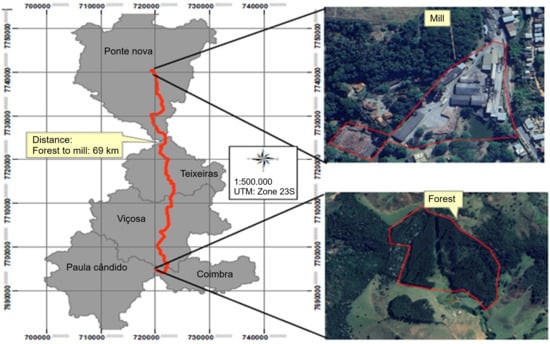
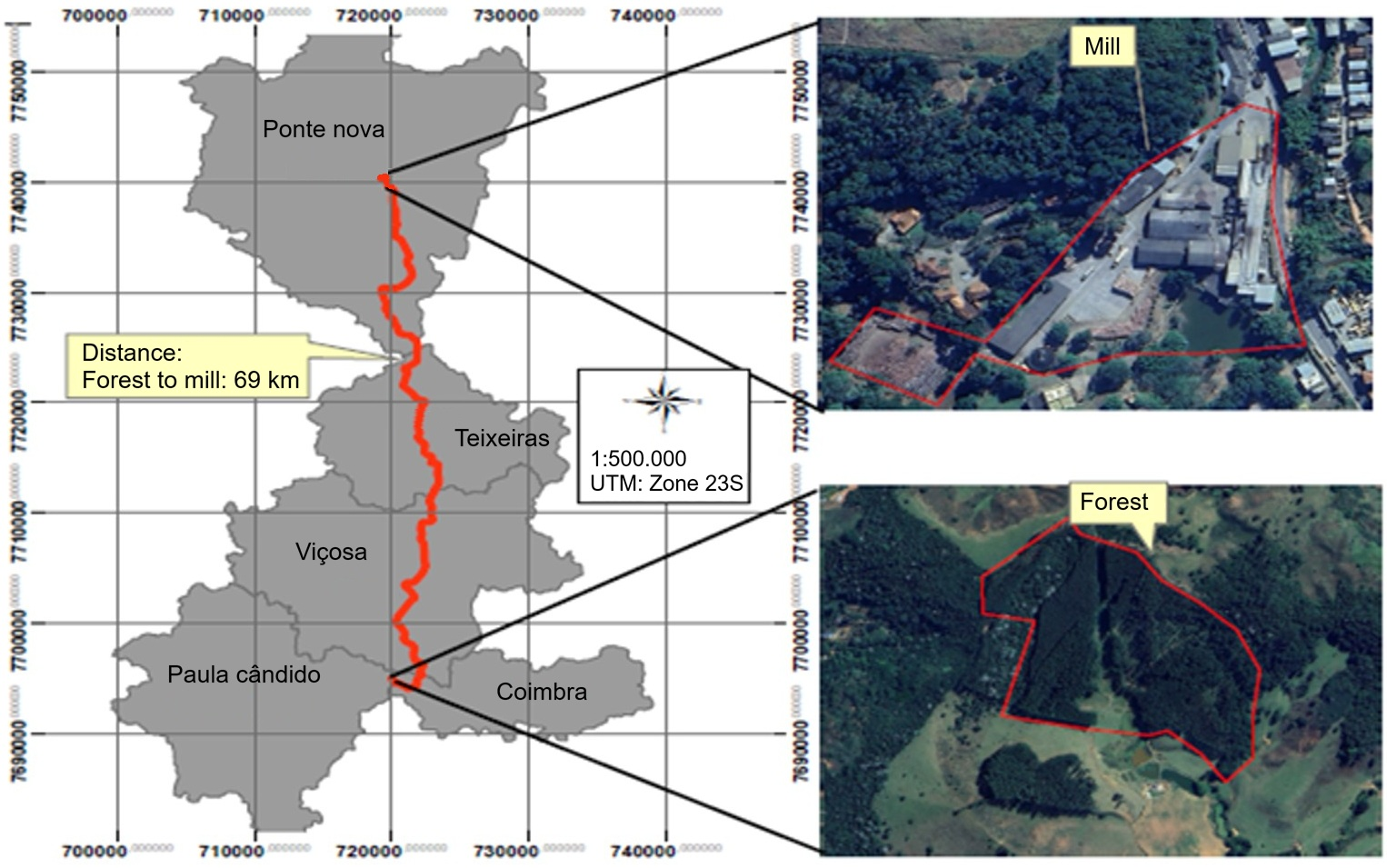
Data were collected from October to December 2024 on a property located in the rural area of Viçosa, MG, Brazil, with 22 hectares of planted Eucalyptus (Eucalyptus urophylla × Eucalyptus grandis), located at geographic coordinates 20°49′48.8” S 42°53′10.9” W. The transportation distance between the forest and the factory was 69 km, consisting of 64 km of asphalted roads and 5 km of gravel roads located near the forest property (Figure 1). Considering the round-trip transportation cycle, the total distance travelled was 138 km.
Figure 1.
Study area of the evaluated forestry project.
The climate in the region is classified as Cwb according to the Köppen [15] climate classification, characterized by mild temperatures, rainy summers, and dry winters. The average annual temperature is 21.8 °C, and the average annual rainfall is 1314.2 mm. The soil in the region is predominantly Red-Yellow Latosol, with low natural fertility [16,17].
The harvesting system used was cut-to-length (CTL), in which timber shorter than six meters was processed within the stand. Felling and processing were performed using a motor–manual system with a chainsaw operator and an assistant. Extraction and loading operations were performed manually by an outsourced crew. Transportation was carried out by a medium-capacity truck (25 m3).
Implementation and maintenance costs were determined based on the hourly operational yield of mechanized and manual activities per hectare and the hourly cost to perform them.
Input costs for herbicides, ant killers, soil conditioners, and fertilizers were calculated per hectare and added to the cost spreadsheet for their respective years.
Operational and economic data were obtained through structured interviews with eight forest producers operating within the study area. The interviewed producers were selected because they conducted commercial eucalyptus harvesting under operational conditions similar to those evaluated in this study. The information collected included operational costs, labor requirements, fuel consumption, and productivity parameters used to estimate harvesting and transportation costs. The identities of the participants and the companies involved were kept confidential in accordance with the informed consent and confidentiality agreement established for this study. The collected information was subsequently validated by comparison with the values reported by Leite et al. (2014) [18].
The operational and economic data were obtained through structured interviews with eight forest producers operating within the study area. The interviewed producers were selected because they conducted commercial eucalyptus harvesting under operational conditions similar to those evaluated in this study. The information collected included operational costs, labor requirements, fuel consumption, and productivity parameters used to estimate harvesting and transportation costs. The identities of the participants and the companies involved were kept confidential in accordance with the informed consent and confidentiality agreement established for this study.
The collected information was subsequently validated by comparison with the values reported by Leite et al. (2014) [18]. The monetary currency in Brazilian Reais (BRL) was converted to United States Dollars (USD) based on the official exchange rate of 27 January 2026 (1 USD = 5.20 BRL).
To calculate depreciation, the chainsaw’s purchase price was set at USD 692.31, with a salvage value of USD 346.15 and a useful life of 4425 effective working hours. Interest, insurance, and tax costs were estimated based on the Average Annual Investment (AAI). The parameters used for this determination included the purchase price, salvage value, interest rate (7% year−1), and the chainsaw’s annual effective working hours (1770).
Variable costs related to fuel, lubricants, and two-stroke engine oil were determined by multiplying the effective hourly consumption (L) by the unit price per liter. The chain replacement cost was based on the ratio between its unit price and its estimated useful life in hours. Labor cost was obtained by dividing the total annual operator salary cost by the annual effective working hours performed, while administrative cost was calculated by multiplying a coefficient (k = 0.5) by the sum of fixed and variable costs (Table 1).
Table 1.
Equations for estimating operational costs in motor–manual forest cutting activity.
The production cost in motor–manual forest cutting was estimated per cubic meter of wood produced (USD. m−3), according to the equation below. The forest had an average height of 26 m and an average diameter of 18 cm, variables that strongly influence both operational productivity and production costs.
where PC is the production cost (USD m−3), TC is the total operating cost per Effective Working Hour (USD/(EWH), and P is productivity (m3 h−1).
PC = TC/P,
The costs per cubic meter in the motor–manual forest cutting were multiplied by the volume per hectare (255.5 m3), to obtain the cost per hectare of the activity. The per-hectare costs for extraction, loading, and road maintenance activities (USD 393.06, USD 589.59, and USD 17.13, respectively) were determined from the average values of eight outsourcing service contracts established with forest producers operating within the study area under operational conditions similar to those evaluated in this study. The identities of the producers, contractors, and companies remain confidential in accordance with the informed consent and confidentiality agreement established for this research.
The forest road transport cost was determined per effective working hour (Table 2). This cost was multiplied by the vehicle’s operational cycle time—including effective travel time (3 h) and loading and unloading times (4 h)—to determine the cost per cycle. The cost per cycle was then divided by the vehicle’s cargo capacity (25 m3), providing the cost per cubic meter transported. Finally, this value was multiplied by the wood volume per hectare (255.5 m3 h−1), resulting in the cost per hectare.
Table 2.
Operational cost per effective working hour for the forest transport vehicle.
The operational cost of the timber transport vehicle, representing the sum of fixed and variable costs, totaled USD 60.67 per effective working hour (EWH). Fixed costs comprise expenses related to asset depreciation, as well as interest, insurance, and taxes. Variable costs encompass fuel, lubricants, tires, mechanical maintenance, and driver labor costs, including fringe benefits. The table below details the monetary values per effective working hour (USD/EWH) and the respective technical parameters adopted for the calculations (Table 2).
Finally, the sum of the per-hectare costs for forest harvesting and transportation activity, road maintenance, and silvicultural establishment and maintenance activities resulted in the total production cost of the evaluated forest project (total cost per hectare).
Revenues were calculated based on the average wood volume per hectare (m3 ha−1) and the selling price per cubic meter of wood delivered to the recycled paper mill. The adopted selling price (USD 29.61 m−3) corresponded to the contractual price established between the producer and the purchasing mill, which was consistent with the prevailing regional market price at the time of data collection.
Because this contractual price remained fixed throughout the planning horizon considered in the economic evaluation, timber price was treated as a deterministic parameter rather than as a stochastic input in the Monte Carlo simulation. The influence of timber price on project viability was evaluated separately through deterministic threshold analysis to determine the minimum selling price required for economic feasibility.
The selected study area represents a typical commercial eucalyptus production system adopted in the region, including the silvicultural practices, harvesting method, transportation logistics, and the standard seven-year rotation commonly used by local forest producers. Operational and economic data were obtained through structured interviews with eight forest producers operating within the study area and complemented with information from outsourcing service contracts established under similar operational conditions.
The participating producers were selected because they managed commercial plantations with comparable stand characteristics, harvesting systems, and transportation conditions, ensuring that the collected data were representative of the regional production system. The identities of the producers and the companies involved were kept confidential in accordance with the informed consent and confidentiality agreement established for this study.
The data collection period (October to December 2024) was intended to obtain operational and economic information rather than to monitor seasonal field performance. Most of the evaluated cost components, including labor, harvesting, loading, transportation, and outsourced services, are defined through commercial agreements and operational contracts, making them less susceptible to short-term seasonal fluctuations. Furthermore, the seven-year production cycle adopted in this study corresponds to the standard commercial rotation for eucalyptus plantations in the study region and was therefore considered representative for evaluating the project’s economic feasibility.
To verify the consistency of the collected operational and economic parameters, the results were compared with those reported by Leite et al. (2014) [18], which evaluated the same eucalyptus hybrid under harvesting conditions and environmental characteristics (soil and climate) comparable to those of the present study. Although published earlier, this reference was used exclusively as an external benchmark for methodological validation, while the discussion of the results was supported by additional and more recent studies.
2.1. Deterministic Analysis
The following economic viability indicators were determined using revenues, costs, and interest rates, which are typically used to calculate value equivalencies for the same planning horizon: Net Present Value (NPV), Internal Rate of Return (IRR), Average Production Cost (APC), and Periodic Equivalent Value (PEV). An interest rate of 7.00% per year was adopted, consisting of a rate close to the discount rates of constitutional funds for forest plantations [19].
Transportation costs were incorporated into the economic model based on transportation distance, freight costs, road maintenance, and operational information provided by the producer. These variables were included in the deterministic and probabilistic analyses of project viability.
Threshold values were obtained by progressively varying transportation distance, wood productivity, timber price, and land cost in the deterministic cash-flow model until the economic viability limits were reached, considering NPV = 0, and IRR equal to the adopted discount rate (7% per year).
The equations for calculating the economic indicators are shown in Table 3. The economic viability indicators were determined for two scenarios: scenario 1 with land costs; and scenario 2 without land costs.
Table 3.
Economic viability indicators used in the study. Adapted from [20,21].
Scenario 1 incorporated the opportunity cost of land by considering a market land value of USD 1500.00 ha−1, corresponding to an annual opportunity cost of USD 120.00 ha−1 year−1 based on the discount rate adopted in the economic analysis.
This value was included in the cash-flow model to represent the opportunity cost of allocating the land to eucalyptus production throughout the project planning horizon. In contrast, Scenario 2 excluded land cost, allowing the economic performance of the production system to be evaluated independently of land ownership. The adopted land value represents the economic opportunity cost of retaining the land in forest production rather than an acquisition cost incurred during the project period.
Land cost was considered as the market value of the rural property allocated to the forestry project and incorporated into the economic analysis as an opportunity cost of land use. Scenario 1 included land cost in the cash flow, representing situations in which the producer must acquire, lease, or remunerate the use of the land for forest production. Scenario 2 excluded land cost to simulate conditions in which the producer already owns the property and does not consider land remuneration in the operational analysis.
Although land acquisition is not a mandatory legal requirement for forest production, land cost influences the economic viability of forestry projects, especially under low timber prices and long transportation distances.
2.2. Probabilistic Analysis
The risk analysis was designed based on the forestry project’s cash flow, meaning the balance between revenues and costs within their respective planning horizons. The Monte Carlo method was used with the aid of Excel, which allowed for reproducing reality by generating random models and scenarios, as well as addressing the various uncertainties related to the project activities [22].
For the economic risk modeling, ten thousand iterations were performed, considering the following input variables: interest rate, fuel and chain lubricant costs for motor–manual cutting activity, labor (felling, extraction, and loading activities), forest transport distance, road maintenance, and yield for motor–manual cutting. Fluctuations of ±10% were projected for input variables.
A standardized ±10% uncertainty range was applied to input variables to allow a consistent comparison of their relative influence on project performance within the same probabilistic framework. This approach does not intend to reproduce the historical volatility of each individual variable, which would require long-term datasets. Therefore, the sensitivity rankings should be interpreted as relative responses under a common uncertainty scenario rather than as estimates of real-world market volatility.
The triangular distribution was adopted because no historical data were available for the input variables, which allows flexibility regarding the degree of asymmetry. This distribution requires only minimum, most likely, and maximum values and is particularly suitable when uncertainty must be represented using limited information rather than extensive historical observations. Similar approaches have been adopted in forestry economic risk analyses when historical data for individual variables were unavailable [23,24].
The Net Present Value indicator was adopted as the output variable for assessing economic risk.
The simulations of economic viability scenarios and their accumulated probabilities were portrayed through graphs and tables, making it possible to infer the economic risks related to forest harvesting and transportation activities.
2.3. Sensitivity and Correlation Analysis
Sensitivity and correlation analyses were performed to identify the relative influence of the input variables on the Net Present Value (NPV) generated by the Monte Carlo simulation. These analyses provided quantitative support for identifying the operational and economic variables that most affected project performance under uncertainty.
Sensitivity analysis was conducted by evaluating the percentage variation in NPV resulting from standardized ±10% changes in each input variable while maintaining the probabilistic framework adopted in the simulation. The magnitude of the response was used to rank the variables according to their influence on project profitability and to identify critical operational thresholds.
Correlation analysis was performed using Pearson’s correlation coefficients calculated between the simulated input variables and the resulting NPV values. The sign and magnitude of the correlation coefficients were used to determine whether each variable had a positive or negative influence on project performance and to quantify the strength of these relationships under the simulated conditions.
2.4. Statistical Analysis
The statistical analysis was based on the 10,000 Net Present Value (NPV) values generated by the Monte Carlo simulation. These simulated values were used to characterize the economic behavior of the forestry project under uncertainty and to support the assessment of investment risk. Monte Carlo simulations were performed using Microsoft Office Professional Plus 2021 (Microsoft Corporation, Redmond, WA, USA), whereas the statistical analyses and graphical representations were conducted using GraphPad Prism version 11.0.2 (GraphPad Software Inc., San Diego, CA, USA) and R software version 4.5.1 (R Foundation for Statistical Computing, Vienna, Austria).
Descriptive statistical analyses were performed to characterize the distribution of the simulated NPV values. The following statistics were calculated: minimum, maximum, mean, median, mode, variance, standard deviation, coefficient of variation, skewness, kurtosis, and selected percentiles. Measures of central tendency and dispersion were used to evaluate the expected economic performance and the variability among the simulated scenarios, whereas the coefficient of variation was used to assess the relative variability of the economic outcomes.
The probability distribution of the simulated NPV values was further evaluated using skewness and kurtosis to assess distribution symmetry and concentration around the mean, respectively. Percentile analysis was performed to estimate the probability of occurrence of different economic scenarios and to identify the range of NPV values associated with favorable and unfavorable investment conditions.
In addition, Pearson’s correlation coefficients were used to quantify the relationships between the simulated input variables and the resulting NPV values, while the sensitivity analysis evaluated the percentage variation in NPV resulting from standardized changes in each input variable. The statistical results supported the interpretation of the deterministic and probabilistic analyses, allowing the identification of the variables with the greatest influence on project performance and the assessment of the economic robustness of the evaluated forestry project.
3. Results
3.1. Deterministic Analysis
Considering scenario 1 (with land costs), the project proved viable, with a profit of 110.11 USD ha−1 for a seven-year cycle (NPV), resulting in annual net revenues of 20.43 USD ha−1 year−1 (EAV) (Table 4). The timber price (29.61 USD m−3) exceeded the average production cost (APC) by 0.50 USD m−3, demonstrating a small profit margin per cubic meter of timber delivered to the mill. The Internal Rate of Return exceeded the adopted interest rate (7.00% per year) by only 1.00%, demonstrating the project’s limited attractiveness.
Table 4.
Results of economic indicators and limit values with and without land costs.
The time and motion study and the economic viability analysis determined the threshold values for both scenarios. Scenario 1 showed a maximum transportation distance of 148 km, minimum wood production of 248 m3 ha−1, and minimum timber price of 28.98 USD m−3. Scenario 2 showed a maximum transportation distance of 219 km, minimum wood production of 196 m3 ha−1, and minimum timber price of 24.22 USD m−3 (Table 4).
The slack limits were determined to ensure the project would not become unfeasible, considering the following variables as reference: transportation distance, forest production, timber price, and land cost. A slack of only 10 km was observed for transportation distance, indicating that the project is very close to the maximum radius (forest-to-factory).
When disregarding land cost (scenario 2), the project showed a slack for transportation distance of approximately 81 km. Due to the low price paid for the wood at the mill, the reforestation project turned out to be unattractive.
Forest production showed a cushion of only 7.50 m3 per hectare for scenario 1. Forest production for scenario 2 (without land costs) would support a reduction of up to 59.50 m3 per hectare. Considering the price of timber ex-factory, the cushion is only USD 0.64 per cubic meter. In other words, if the price paid at the mill (USD 29.61 m3) falls below USD 28.97 m3 (the limit), the forest producer would operate at a loss.
For scenario 2, the producer would support a price reduction for timber delivered to the mill of up to USD 5.39. As expected, the analyzed slack variables were more favorable in scenario 2.
The maximum transportation distance (limit value) increased from 148 km in scenario 1 to 219 km in scenario 2. For charcoal transportation conditions, Oliveira et al. (2017) [25] reported a maximum transportation radius of 97 km for production in the hot tail system, while the maximum transportation distance for the kiln-furnace system was 374 km.
The threshold price per cubic meter of wood delivered to the mill decreased from USD 28.98 to USD 24.22 in scenario 2, indicating that the latter is more resilient to a potential decline in wood prices (Table 4).
3.2. Probabilistic Analysis
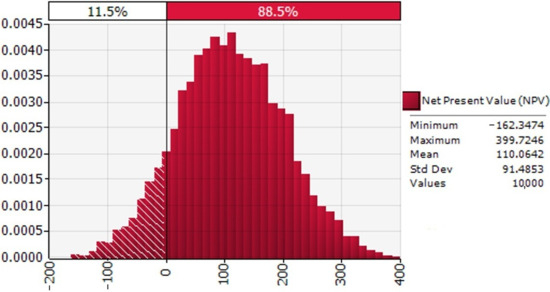
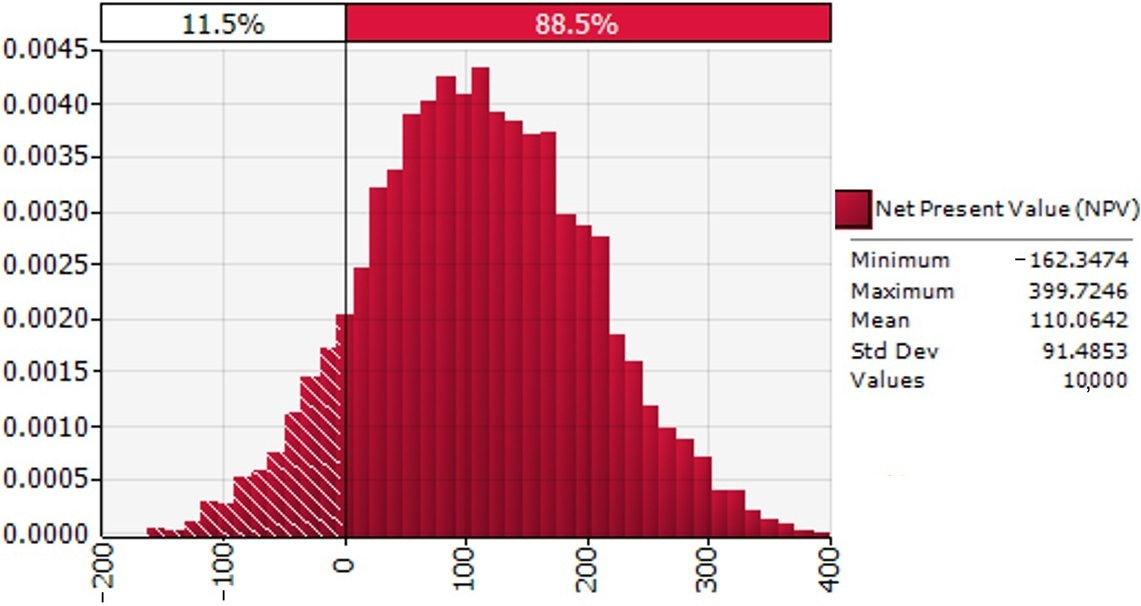
The probabilistic analysis in scenario 1, obtained through the Monte Carlo method, showed an 11.5% risk of the project becoming unfeasible, considering variations of ±10 on the input variables (interest rate, transport distance, cost of fuel and lubricant for the chainsaw, labor cost in motor–manual cutting, productivity of chainsaw operators in cutting, labor cost in extraction and manual loading, and cost of road maintenance), as seen in Figure 2.
Figure 2.
Relative frequency distribution for the NPV of the forestry project in relation to the input variables analyzed.
3.3. Correlation and Sensitivity Analysis
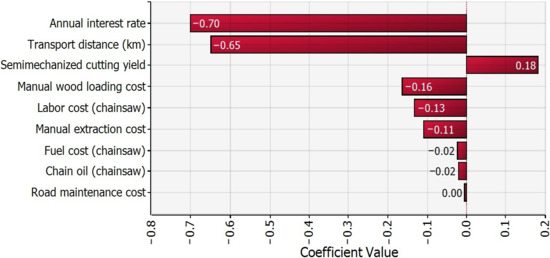
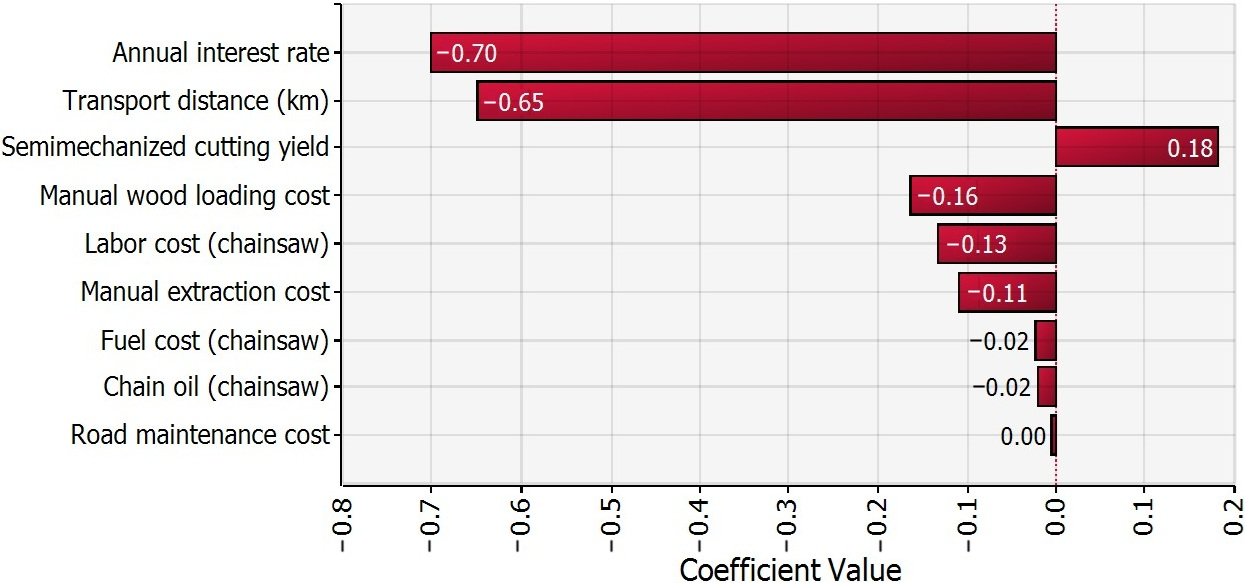
The correlation coefficients that most negatively influenced the output variable (NPV) were the interest rate, transportation distance and manual wood loading cost, with coefficients of −0.70, −0.65 and −0.16, respectively (Figure 3 and Figure 4).
Figure 3.
Correlation coefficients illustrating the influence of input variables (harvesting and forest transport activities) on the output variable (NPV).
Figure 4.
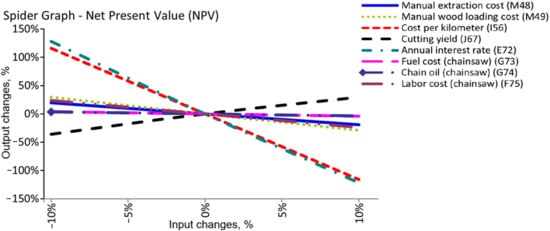
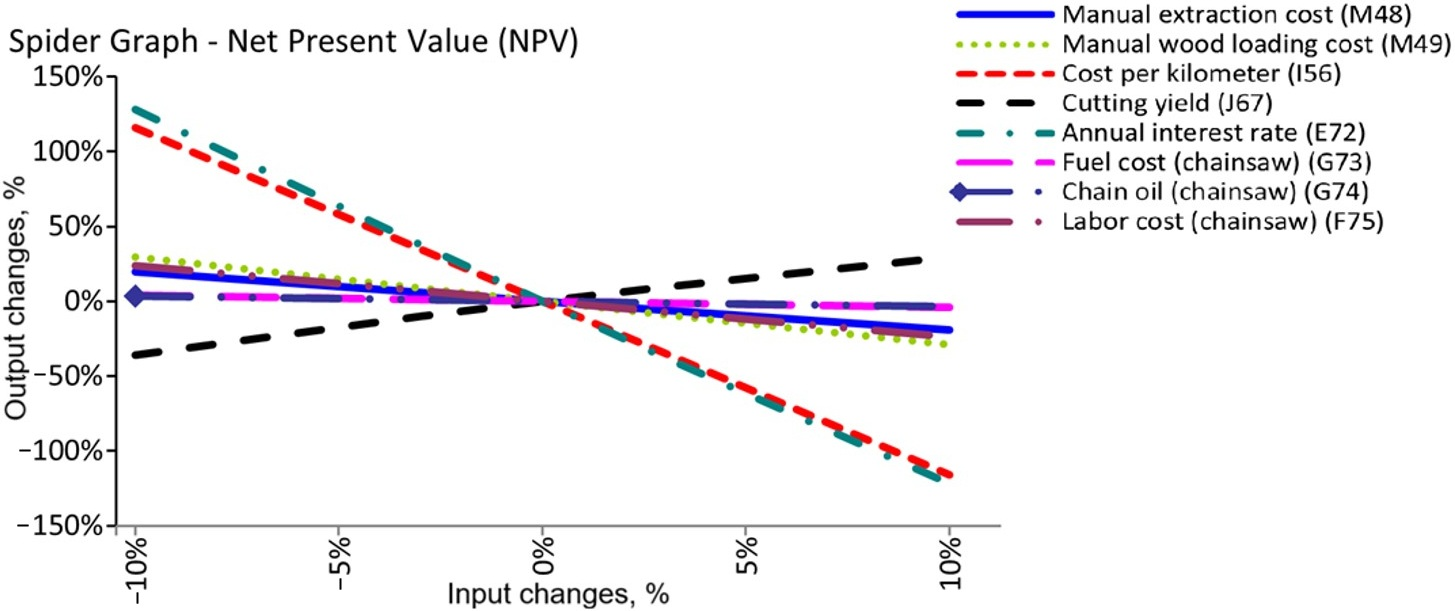
Sensitivity analysis illustrating the effect of input variables related to forest harvesting and transportation activities on the output variable (NPV).
On the positive side, the only variable which contributed to the NPV performance in the study was productivity in motor–manual forest cutting activity, with a coefficient of 0.18. In this case, a 10% increase in operator productivity would imply a 1.8% increase in NPV (Figure 3).
3.4. Statistical Analysis
Table 5 illustrates the results of the descriptive statistics of the data generated in the risk analysis, with information regarding the minimum, maximum, mean, variance, standard deviation, kurtosis, skewness, and percentile values.
Table 5.
Descriptive statistics generated in the risk analysis of the forestry project for the NPV indicator.
The symmetrical behavior of the data obtained in the distribution (Figure 2) can be verified by the statistical indicator skewness (asymmetry), which was close to zero (Table 5). The most significant index for kurtosis indicates a significant value of data from the distribution close to the mean (Table 5 and Figure 2). The percentile analyses showed that 95% of the NPV values generated in the simulation were below USD 264.13 ha−1 (Table 5).
4. Discussion
4.1. Deterministic Analysis
The project’s low attractiveness may be related to the low price paid for timber at the mill and the transportation distance adopted. The timber sales price is the variable which most influences the economic results of forestry projects [26,27].
The timber price dominates economic performance because it directly determines revenue, while operational costs remain relatively rigid; in local markets with limited competition and strong industrial bargaining power, combined with long transportation distances, producers face constrained price negotiation, which further compresses profit margins [28,29].
Forestry projects may have a positive NPV, but remain sensitive to timber prices, which reduces economic robustness. The difference of only USD 0.50 m−3 between revenue and cost indicates vulnerability to small market variations [1,27,30].
This limited economic margin results from the cost structure of the system, in which harvesting and transportation concentrate most production expenses. Motor–manual harvesting operations reduce efficiency and limit economies of scale, increasing operational costs and reducing profit margins [17,31].
Transportation costs also increase with distance and can become the dominant cost component, especially under moderate productivity and low timber prices [32,33]. As a result, most revenue is absorbed by operational costs, which explains the IRR close to the discount rate and the high sensitivity of the project to small variations in price and cost.
The reduced transportation slack observed in scenario 1 indicates that the project operates close to its economic and logistical limit. Small increases in transportation distance, fuel costs, loading time, or road maintenance may compromise project viability. Transportation distance strongly influences harvesting costs, wood flow efficiency, and supply chain performance in forestry systems [34,35].
These findings highlight the importance of locating wood supply areas closer to the mill and improving transportation planning to reduce operational costs and increase logistical efficiency. Optimizing transport routes and synchronizing harvesting, loading, and transportation operations may reduce idle time, improve delivery reliability, and enhance wood flow performance in forestry supply chains [35,36].
Integrated planning between harvesting operations, transportation scheduling, and industrial demand also contributes to reducing delays and minimizing acquisition and inventory costs. Recent studies demonstrated that digitalized logistics systems, operational coordination, and route consolidation improve decision-making efficiency and increase resilience in timber supply chains operating under long transportation distances and market uncertainty [37,38,39].
In addition, coordination among forest producers, transport companies, and processing industries becomes essential to maintain operational continuity in low-margin production systems. Integrated transportation planning and operational synchronization may reduce supply risks, improve transportation performance, and increase the economic resilience of forestry operations [34,40].
4.2. Probabilistic Analysis
The Monte Carlo simulation indicated an 11.5% probability of negative NPV values, demonstrating that the project operates under moderate economic risk despite the positive deterministic indicators. This result shows that economic viability is sensitive to simultaneous fluctuations in operational and financial variables, particularly in production systems with reduced profit margins.
Oliveira et al. (2017) [25] also reported the occurrence of economic risk in eucalyptus-based production systems subjected to operational and market uncertainties. In contrast, Guedes et al. (2021) [41] found lower economic risk under more favorable management conditions, reinforcing that project stability depends on the balance between operational costs, productivity, and timber revenue.
The probability distribution obtained in this study indicates that relatively small variations in input variables may shift the project from a viable to an unfeasible condition. This behavior reflects the limited economic robustness observed in scenario 1, in which the difference between timber revenue and production cost was minimal. Under these conditions, forestry projects become more exposed to market oscillations, cost escalation, and operational inefficiencies.
According to Bergman et al. (2022) [42], productive forest sites tend to reduce economic risk because higher yields dilute operational costs per unit of wood produced. This interpretation agrees with the present study, in which the project maintained economic viability under the evaluated productivity conditions, but showed limited tolerance to adverse economic variations.
Overall, the probabilistic analysis demonstrated that deterministic indicators alone may overestimate project stability. Incorporating uncertainty into economic analysis improves risk interpretation and supports more reliable decision-making in forestry investment planning.
4.3. Correlation and Sensitivity Analysis
The sensitivity analysis demonstrated that interest rate, transportation distance, and manual loading cost were the variables with the greatest negative influence on NPV. This result agrees with Merganič et al. (2022) [43], who showed that increasing interest rates reduce the attractiveness of forestry projects because future revenues lose present value in long production cycles. Therefore, projects operating with low profit margins require stricter control of financial costs and should prioritize credit lines with lower interest rates.
Transportation distance also showed a strong negative effect on NPV. Moreira et al. (2017) [44] reported a reduction in project viability from 93.72% to 72.87% when transportation distance increased from 20 to 40 km in eucalyptus production for firewood. In the present study, the project showed only 10 km of transportation slack in scenario 1. Therefore, under the evaluated conditions, transportation distances above 148 km should be avoided. This threshold provides a practical decision rule for defining wood acquisition areas, selecting suppliers, and planning transportation routes [44,45].
The threshold timber price of USD 28.98 m−3 also provides a managerial rule for price negotiation. Timber prices below this value tend to eliminate the project’s economic margin, especially when transportation distances are long and harvesting productivity is low.
Munis et al. (2022) [27] also demonstrated that timber price strongly affects the economic viability of forest plantations. Therefore, producers should avoid supply contracts below this minimum price unless they reduce transportation, loading, or harvesting costs.
Manual loading cost was another variable with a negative effect on NPV. This result indicates that labor-intensive operations reduce the economic resilience of low-margin forestry systems.
D’Amours et al. (2008) [46] emphasized that integrated planning in forest supply chains must coordinate harvesting, transportation, and industrial demand to reduce operational inefficiencies. Thus, producers should reduce loading delays, improve synchronization between harvesting and transport, and evaluate more efficient loading systems.
Motor–manual harvesting productivity was the only variable with a positive effect on NPV. This result confirms that productivity gains reduce production costs per cubic meter and improve economic performance [47,48,49].
Di Fulvio et al. (2024) [31] also showed that productivity and operational conditions strongly influence harvesting costs in industrial plantations. Therefore, operator training, preventive maintenance, work organization, and better coordination between cutting, extraction, loading, and transportation should be treated as managerial priorities [31,47].
Overall, the sensitivity analysis provides practical decision rules for forestry project management: keep transportation distance below 148 km, negotiate timber prices above USD 28.98 m−3, reduce manual loading inefficiencies, improve harvesting productivity, and prioritize lower-cost financing.
These rules translate the economic sensitivity results into operational parameters that support transportation planning, cost control, and risk reduction in forestry projects.
4.4. Statistical Analysis
The statistical distribution generated by the Monte Carlo simulation showed approximately symmetrical behavior, as indicated by the skewness coefficient close to zero and the proximity between mean and median NPV values. The kurtosis result indicated moderate concentration of observations around the mean, demonstrating limited dispersion of simulated values.
Despite the predominance of positive NPV values, the lower percentiles showed negative NPV results, confirming the possibility of economic infeasibility under unfavorable operational and financial conditions. Similar approaches have been used in forestry economic risk analyses based on Monte Carlo simulation [50,51].
Overall, the statistical analysis reinforced that the project remained economically viable in most simulated scenarios; however, the occurrence of negative NPV values in the lower percentiles demonstrated that relatively small increases in operational costs or reductions in revenue may compromise project profitability under unfavorable conditions.
5. Conclusions
The integrated deterministic and probabilistic economic analyses demonstrated that the evaluated eucalyptus forestry project was economically viable under both scenarios (with and without land costs). However, the reduced operational slack for transportation distance, timber price, and wood productivity indicates limited economic robustness and high sensitivity to relatively small operational and market variations.
Monte Carlo simulation complemented the deterministic analysis by demonstrating that positive deterministic economic indicators alone do not guarantee economic robustness, revealing an 11.5% probability of economic infeasibility under simultaneous variations in the evaluated input variables. Interest rate, transportation distance, manual loading cost, and harvesting productivity were identified as the variables with the greatest influence on project performance.
The integration of deterministic economic indicators with probabilistic risk analysis enabled the identification of operational threshold values for transportation distance, timber price, wood productivity, and land cost under the operational, economic, and logistical conditions evaluated in this study. These thresholds provide objective decision-support parameters for transportation planning, cost management, and investment decision-making in forestry projects with similar production systems and cost structures.
Overall, the proposed framework supports more reliable economic planning by incorporating uncertainty into investment analysis and identifying critical operational thresholds, thereby improving decision-making and economic risk management in forestry projects.
Author Contributions
Conceptualization, L.C.d.F. and L.J.M.; methodology, L.C.d.F., L.J.M. and F.d.A.C.F.; software, L.C.d.F.; validation, L.C.d.F., M.L.d.S. and F.d.A.C.F.; formal analysis, L.C.d.F., M.L.d.S. and L.J.M.; investigation, L.C.d.F., C.F.L., R.C.A.L., L.F.d.S., S.S. and V.C.d.O.; resources, L.C.d.F., M.L.d.S., L.J.M. and N.C.F.; data curation, L.C.d.F.; writing—original draft preparation, L.C.d.F. and L.M.R.d.S.; writing—review and editing, L.C.d.F., L.M.R.d.S., M.L.d.S., L.J.M., F.d.A.C.F., N.C.F., L.F.d.S., S.S. and V.C.d.O.; visualization, M.L.d.S.; supervision, M.L.d.S.; project administration, L.C.d.F., M.L.d.S.; funding acquisition, L.C.d.F. All authors have read and agreed to the published version of the manuscript.
Funding
This research was supported by the National Council for Scientific and Technological Development (CNPq)—Brazil (Grant Number: 101806/2024-8).
Data Availability Statement
The data presented in this study are available on request from the corresponding author due to confidentiality restrictions related to proprietary operational and economic data from the evaluated forests.
Acknowledgments
The authors acknowledge the Conselho Nacional de Desenvolvimento Científico e Tecnológico (CNPq)—Brazil for providing financial support for this research. Thanks are also extended to the forestry producer for granting access to the operational and cost data used in this study. The authors thank the Universidade Federal de Viçosa (UFV) and the Universidade Estadual do Sudoeste da Bahia (UESB) for their technical and institutional support.
Conflicts of Interest
The authors declare no conflicts of interest.
Abbreviations
| APC | Average Production Cost |
| CL | Cost of lubricants |
| CO | Cost of 2-stroke oil |
| CCR | Chain cost |
| CTj | Total updated cost in each period |
| Dp | Depreciation cost |
| EAV | Equivalent Annual Value |
| FC | Fixed costs |
| HH | Human Hour |
| hf | Effective working hours per year |
| I | Interest |
| Ia | Annual licensing for chainsaw use |
| i | Interest rate |
| IRR | Internal Rate of Return |
| k | Administration coefficient |
| K12 | Constant equivalent to the 12 months of the year |
| LC | Labor cost |
| MACH | Machine Hour |
| Ms | Monthly salaries |
| NPV | Net Present Value |
| N | Useful life |
| P | Productivity |
| PC | Production cost |
| PEV | Periodic Equivalent Value |
| PTj | Total equivalent production in each period |
| Pu | Price of fuel |
| Pl | Price of lubricant |
| Po | Price of oil |
| Rv | Residual value |
| Rj | Present value of revenues |
| Cj | Present value of costs |
| S | Social security factor |
| TC | Total operating cost |
| T | Taxes |
| VC | Variable costs |
| vuc | Chain life |
References
- Simões, D.; Rocha, Q.S.; Munis, R.A.; Da Silva, R.B.G.; Garcia, G.C. Real Options Analysis Applied to Investment Projects in Planted Forests of Pinus. Bois For. Trop. 2022, 354, 55–64. [Google Scholar] [CrossRef] [Scilit]
- Rana, P.; Juutinen, A.; Eyvindson, K.; Tolvanen, A. Cost-Efficiency Analysis of Multiple Ecosystem Services across Forest Management Regimes. J. Environ. Manag. 2024, 370, 122438. [Google Scholar] [CrossRef] [Scilit] [PubMed]
- Bont, L.G.; Fraefel, M.; Frutig, F.; Holm, S.; Ginzler, C.; Fischer, C. Improving Forest Management by Implementing Best Suitable Timber Harvesting Methods. J. Environ. Manag. 2022, 302, 114099. [Google Scholar] [CrossRef] [Scilit] [PubMed]
- Ferreira, F.d.A.C.; de Freitas, L.C.; Leite, E.d.S.; dos Santos, S.L.M.; Rocabado, J.M.A. Work Efficiency and Harvester Costs in Brazilian Eucalyptus Plantations. Int. J. For. Eng. 2024, 35, 21–28. [Google Scholar]
- Soranso, D.R.; Minette, L.J.; Lima, R.C.A.; Schettino, S.; Nascimento, G.S.P.; Bermudes, W.L.; Costa Campos, J.C. Biomechanical Analysis of Wood Processing Work in Tropical Forest Regions: A Study in Midwest Brazil. J. Occup. Environ. Hyg. 2023, 20, 452–459. [Google Scholar] [CrossRef] [Scilit] [PubMed]
- da Silva, T.R.; Schettino, S.; Lima, R.C.A.; Figueiredo, R.d.S.; Antunes, M.F.L. Analysis of Variables Influencing the Cost of Wood Freight: The Case of Southeastern Brazil. Int. J. For. Eng. 2024, 35, 105–112. [Google Scholar]
- Addas, A. Impact of Forestry on Environment and Human Health: An Evidence-Based Investigation. Front. Public Health 2023, 11, 1260519. [Google Scholar] [CrossRef] [Scilit] [PubMed]
- Christian, B.; Stefan, P. Required Displacement Factors for Evaluating and Comparing Climate Impacts of Intensive and Extensive Forestry in Germany. Carbon Balance Manag. 2022, 17, 14. [Google Scholar] [CrossRef] [Scilit] [PubMed]
- de Melo, G.A.; Paes, T.F.A.; da Costa, J.S.; Jarochinski e Silva, C.S.; de Castro Júnior, L.G.; Gomide, L.R.; Peixoto, M.G.M.; Guarnieri, P.; Barbosa, S.B.; Serrano, A.L.M.; et al. Optimizing Forest Sector Performance Based on Life Cycle Cost Analysis and Real Options. Sci. Total Environ. 2025, 988, 179675. [Google Scholar] [CrossRef] [Scilit] [PubMed]
- Dube, F.; Couto, L.; Silva, M.L.; Leite, H.G.; Garcia, R.; Araujo, G.A.A. A Simulation Model for Evaluating Technical and Economic Aspects of an Industrial Eucalyptus-Based Agroforestry System in Minas Gerais, Brazil. Agrofor. Syst. 2002, 55, 73–80. [Google Scholar] [CrossRef] [Scilit]
- de Oliveira Silva, J.; Monteiro, F.G.; dos Santos, L.A.; da Rocha, J.E.C.; Miranda, G.M. Economic Viability in Eucalyptus spp. Clonal Plantation for Production of Pulp. Floresta Ambiente 2020, 27, e20180123. [Google Scholar] [CrossRef] [Scilit]
- Simões, D.; Dinardi, A.J.; da Silva, M.R. Investment Uncertainty Analysis in Eucalyptus Bole Biomass Production in Brazil. Forests 2018, 9, 384. [Google Scholar] [CrossRef] [Scilit]
- Rocha, Q.S.; Lima, R.C.A.; Munis, R.A.; Pereira, G.; Simões, D. Economic Viability of the Whole Tree Harvest under Conditions of Uncertainty: A Study in Southeastern Brazil. Int. J. For. Eng. 2022, 33, 181–188. [Google Scholar] [CrossRef] [Scilit]
- Ribeiro, A.; e Silva, C.S.J.; Ferraz Filho, A.C.; Scolforo, J.R.S. Financial and Risk Analysis of African Mahogany Plantations in Brazil. Cienc. Agrotecnol. 2018, 42, 148–158. [Google Scholar] [CrossRef] [Scilit]
- Köppen, W.; Geiger, R. Das Geographische System Der Klimate. In Handbuch der Klimatologie; Gebrüder Borntraeger: Berlin, Germany, 1936. [Google Scholar]
- Avila-Diaz, A.; Justino, F.; Lindemann, D.S.; Rodrigues, J.M.; Ferreira, G.R. Climatological Aspects and Changes in Temperature and Precipitation Extremes in Viçosa-Minas Gerais. An. Acad. Bras. Cienc. 2020, 92, e20190388. [Google Scholar] [CrossRef] [Scilit] [PubMed]
- Ackerman, P.; Belbo, H.; Eliasson, L.; de Jong, A.; Lazdins, A.; Lyons, J. The COST Model for Calculation of Forest Operations Costs. Int. J. For. Eng. 2014, 25, 75–81. [Google Scholar] [CrossRef] [Scilit]
- da Silva Leite, E.; Fernandes, H.C.; Guedes, I.L.; do Amaral, E.J. Technical and Economic Analysis of Semimechanized Harvest of Eucalyptus in Different Spacing. Cerne 2014, 20, 637–643. [Google Scholar] [CrossRef] [Scilit]
- Banco do Brasil S/A BB Reflorestando o Brasil. Available online: https://www.bb.com.br/site/agronegocios/agronegocio-sustentavel/bb-reflorestando-o-brasil/ (accessed on 13 April 2026).
- Klemperer, W.D. Forest Resource Economics and Finance; McGraw-Hill: New York, NY, USA, 1996. [Google Scholar]
- Sullivan, W.G.; Wicks, E.M.; Koelling, C.P. Engineering Economy, 16th ed.; Pearson: Upper Saddle River, NJ, USA, 2015. [Google Scholar]
- Li, Z.; Bi, S.; Hao, S.; Cui, Y. Aboveground Biomass Estimation in Forests with Random Forest and Monte Carlo-Based Uncertainty Analysis. Ecol. Indic. 2022, 142, 109246. [Google Scholar] [CrossRef] [Scilit]
- Miyajima, R.H.; Barreto, V.C.S.; de Oliveira, P.A.; Batistela, G.C.; Simões, D. Risk Analysis of the Economic Benefits of Ochroma Pyramidale: A Case Study of Forest Planting in Brazil. J. Agric. Sci. Technol. B 2018, 8, 444–453. [Google Scholar] [CrossRef] [Scilit]
- Virgens, A.P.; Freitas, L.C.; Silva, M.L.; da Silva Leite, E. Analysis of Incorporating Outsourced Transport Activity by the Forestry Company: An Economic Feasibility and Sensitivity Analysis. Floresta 2022, 52, 207–212. [Google Scholar] [CrossRef] [Scilit]
- Oliveira, A.C.; Pereira, B.L.C.; Salles, T.T.; Carneiro, A.d.C.O.; Lana, A.Q. Análise de Risco Econômico de Dois Sistemas Produtivos de Carvão Vegetal. Floresta Ambiente 2017, 24, 1–11. [Google Scholar] [CrossRef] [Scilit]
- Belavenutti, P.; Chung, W.; Ager, A.A. The Economic Reality of the Forest and Fuel Management Deficit on a Fire Prone Western US National Forest. J. Environ. Manag. 2021, 293, 112825. [Google Scholar] [CrossRef] [Scilit] [PubMed]
- Munis, R.A.; Camargo, D.A.; Simões, D. Forest Plantations with Toona Ciliata: Impacts of the Managerial Flexibility on Economic Viability. Bois For. Trop. 2022, 353, 31–41. [Google Scholar] [CrossRef] [Scilit]
- Nepal, P.; Johnston, C.M.T.; Ganguly, I. Effects on Global Forests and Wood Product Markets of Increased Demand for Mass Timber. Sustainability 2021, 13, 13943. [Google Scholar] [CrossRef] [Scilit]
- Vaezin, S.M.H.; Juybari, M.M.; Sadeghi, S.M.M.; Banás, J.; Marcu, M.V. The Seasonal Fluctuation of Timber Prices in Hyrcanian Temperate Forests, Northern Iran. Forests 2022, 13, 761. [Google Scholar] [CrossRef] [Scilit]
- Munis, R.A.; Camargo, D.A.; da Silva, R.B.G.; Tsunemi, M.H.; Ibrahim, S.N.I.; Simões, D. Price Modeling of Eucalyptus Wood under Different Silvicultural Management for Real Options Approach. Forests 2022, 13, 478. [Google Scholar] [CrossRef] [Scilit]
- Di Fulvio, F.; Acuna, M.; Ackerman, P.; Ackerman, S.; Spinelli, R.; Abbas, D.; Kaakkurivaara, N.; Sánchez-García, S.; Guerra, S.P.S. Benchmarking Operational Conditions, Productivity, and Costs of Harvesting from Industrial Plantations in Different Global Regions. Int. J. For. Eng. 2024, 35, 225–250. [Google Scholar] [CrossRef] [Scilit]
- Shadbahr, J.; Bensebaa, F.; Ebadian, M. Impact of Forest Harvest Intensity and Transportation Distance on Biomass Delivered Costs within Sustainable Forest Management—A Case Study in Southeastern Canada. J. Environ. Manag. 2021, 284, 112073. [Google Scholar] [CrossRef] [Scilit] [PubMed]
- Laurito-Friend, D.F.; Mendes, F.M.; Reinoso, F.M.; Ferraz, A.; Milagres, A.M.F. Sugarcane Hybrids with Original Low Lignin Contents and High Field Productivity Are Useful Toreach High Glucose Yields from Bagasse. Biomass Bioenergy 2015, 75, 65–74. [Google Scholar] [CrossRef] [Scilit]
- Jahani, N.; LeBel, L.; Gautam, S. Wood Flow Management for Supply and Demand Synchronization: A Literature Review. For. Policy Econ. 2026, 186, 103757. [Google Scholar] [CrossRef] [Scilit]
- Ferrari, L.S.; Arce, J.E.; Pelissari, A.L.; da Silva, J.P.; Filho, A.F.; de Oliveira, E.B. Tactical Planning of Forest Harvesting under Different Scheduling Restrictions. Sci. For./For. Sci. 2021, 48, e3334. [Google Scholar] [CrossRef] [Scilit]
- Palander, T.; Tokola, T.; Borz, S.A.; Rauch, P. Forest Supply Chains During Digitalization: Current Implementations and Prospects in Near Future. Curr. For. Rep. 2024, 10, 223–238. [Google Scholar] [CrossRef] [Scilit]
- Kogler, C.; Schimpfhuber, S.; Eichberger, C.; Rauch, P. Benchmarking Procurement Cost Saving Strategies for Wood Supply Chains. Forests 2021, 12, 1086. [Google Scholar] [CrossRef] [Scilit]
- Kogler, C.; Rauch, P. Lead Time and Quality Driven Transport Strategies for the Wood Supply Chain. Res. Transp. Bus. Manag. 2023, 47, 100946. [Google Scholar] [CrossRef] [Scilit]
- Kogler, C.; Rauch, P. Discrete Event Simulation of Multimodal and Unimodal Transportation in the Wood Supply Chain: A Literature Review. Silva Fenn. 2018, 52, 9984. [Google Scholar] [CrossRef] [Scilit]
- Veisi, O.; Moradi, M.A.; Gharaei, B.; Maleki, F.J.; Rahbar, M. Sustainable Forestry Logistics: Using Modified A-Star Algorithm for Efficient Timber Transportation Route Optimization. For. Policy Econ. 2025, 173, 103456. [Google Scholar] [CrossRef] [Scilit]
- Guedes, I.C.D.L.; Júnior, L.M.C.; De Oliveira, A.D.; De Mello, J.M.; De Rezende, J.L.P.; Silva, C.P.d.C. Economic Analysis of Replacement Regeneration and Coppice Regeneration in Eucalyptus Stands under Risk Conditions. Cerne 2011, 17, 393–401. [Google Scholar] [CrossRef] [Scilit]
- Bergman, R.; Sahoo, K.; Englund, K.; Mousavi-Avval, S.H. Lifecycle Assessment and Techno-Economic Analysis of Biochar Pellet Production from Forest Residues and Field Application. Energies 2022, 15, 1559. [Google Scholar] [CrossRef] [Scilit]
- Merganič, J.; Merganičová, K.; Výbošok, J.; Valent, P.; Bahýľ, J. Impact of Interest Rates on Forest Management Planning Based on Multi-Criteria Decision Analysis. Cent. Eur. For. J. 2022, 68, 23–35. [Google Scholar] [CrossRef] [Scilit]
- Moreira, J.M.M.Á.P.; Simioni, F.J.; de Santana, L.F. Impact of Transportation Cost on Forest Risk and Profitability in the Region of Itapeva, São Paulo. Rev. Parana. Desenvolv. 2017, 38, 77. [Google Scholar]
- Baghizadeh, K.; Zimon, D.; Jum’a, L. Modeling and Optimization Sustainable Forest Supply Chain Considering Discount in Transportation System and Supplier Selection under Uncertainty. Forests 2021, 12, 964. [Google Scholar] [CrossRef] [Scilit]
- D’Amours, S.; Ronnqvist, M.; Weintraub, A. Using Operational Research for Supply Chain Planning in the Forest Products Industry. Inf. Syst. Oper. Res. 2008, 46, 265–281. [Google Scholar] [CrossRef] [Scilit]
- Louis, L.T.; Kizha, A.R.; Daigneault, A.; Han, H.S.; Weiskittel, A. Factors Affecting Operational Cost and Productivity of Ground-Based Timber Harvesting Machines: A Meta-Analysis. Curr. For. Rep. 2022, 8, 38–54. [Google Scholar] [CrossRef] [Scilit]
- Jourgholami, M.; Majnounian, B.; Zargham, N. Performance, Capability and Costs of Motor-Manual Tree Felling in Hyrcanian Hardwood Forest. Croat. J. For. Eng. 2013, 34, 283–293. Available online: https://hrcak.srce.hr/116784 (accessed on 15 March 2026).
- Kärhä, K.; Eliasson, L.; Kühmaier, M.; Spinelli, R. Fuel Consumption and CO2 Emissions in Fully Mechanized Cut-to-Length (CTL) Harvesting Operations of Industrial Roundwood: A Review. Curr. For. Rep. 2024, 10, 255–272. [Google Scholar] [CrossRef] [Scilit]
- Cordeiro, S.A.; da Silva, M.L.; Jacovine, L.A.G.; Valverde, S.R.; Soares, N.S. Contribution of the Public Promotion of a Forest of Minas Gerais in Returns and Risk Reduction for Rural Producers. Rev. Árvore 2010, 34, 367–376. [Google Scholar] [CrossRef] [Scilit]
- Kallio, A.M.I. Accounting for Uncertainty in a Forest Sector Model Using Monte Carlo Simulation. For. Policy Econ. 2010, 12, 9–16. [Google Scholar] [CrossRef] [Scilit]

Disclaimer/Publisher’s Note: The statements, opinions and data contained in all publications are solely those of the individual author(s) and contributor(s) and not of MDPI and/or the editor(s). MDPI and/or the editor(s) disclaim responsibility for any injury to people or property resulting from any ideas, methods, instructions or products referred to in the content. |
© 2026 by the authors. Licensee MDPI, Basel, Switzerland. This article is an open access article distributed under the terms and conditions of the Creative Commons Attribution (CC BY) license.