


Abstract
Accurate identification of timber species is essential for sustainable forest management and the prevention of illegal logging, particularly in regions such as the Peruvian Amazon. This study evaluated explainable deep learning models for the classification of cedar (Cedrela montana) and cinchona (Cinchona pubescens) using macro-images of transverse wood sections collected in the Amazonas region of northern Peru. A dataset of wood images was expanded through a sliding-window patch extraction strategy and used to train and compare three architectures: a custom Convolutional Neural Network (CNN), MobileNetV2, and EfficientNetB0. Model performance was assessed using accuracy, precision, recall, and F1-score, while Gradient-weighted Class Activation Mapping (Grad-CAM) was applied to interpret the visual regions influencing predictions. All models achieved high classification performance. EfficientNetB0 obtained the best results, reaching 100% accuracy, precision, recall, and F1-score, while MobileNetV2 and the custom CNN achieved near-perfect performance. Training and validation curves indicated stable convergence without significant overfitting. Grad-CAM analysis showed that the custom CNN generated more localized and interpretable activation regions, whereas MobileNetV2 and EfficientNetB0 focused on broader textural patterns, revealing different feature-learning strategies. These findings demonstrate the potential of explainable deep learning for automated wood identification and support applications in forest monitoring, biodiversity conservation, and illegal logging control.
1. Introduction
Globally, forest resources constitute an essential component for ecological balance, biodiversity conservation, and sustainable economic development [1]. Wood is one of the most commercially traded forest products worldwide; however, illegal timber trade represents one of the major threats to forest ecosystems, significantly contributing to deforestation, environmental degradation, and the loss of native species [2,3]. This issue particularly affects biodiversity-rich countries, where deficiencies in monitoring and control systems hinder the traceability and identification of forest resource origins [4]. In Latin America, this problem is intensified by the high diversity of timber species and the limitations of forest inspection and enforcement systems [5]. The region hosts species of high commercial value that are subject to intensive exploitation, thereby increasing their vulnerability to illegal logging [6].
In this context, cedar (Cedrela sp.) and cinchona (Cinchona sp.) represent forest species of high ecological, economic, and historical relevance. Cedar is highly valued in the global timber industry due to the quality, durability, and high commercial value of its wood [7]. International reports indicate that more than 40% of species traded as cedar exhibit continuously declining populations, mainly due to selective logging and land-use change [8]. Furthermore, ecological projections estimate that suitable natural habitats for species of the Cedrela genus could decline by up to 40.4% by the year 2100 as a consequence of deforestation and climate change [9]. Currently, all species within the Cedrela genus are included in Appendix II of the Convention on International Trade in Endangered Species (CITES) due to the risks associated with overexploitation and unregulated trade [10].
Similarly, cinchona has worldwide historical and medicinal importance as the natural source of antimalarial compounds such as quinine, which has been used for centuries in malaria treatment [11]. The economic value derived from its bark sustains constant demand driven by the pharmaceutical and beverage industries. The global quinine market was valued at approximately USD 2.45 billion and is projected to reach USD 3.76 billion by 2030 [12]. Nevertheless, multiple species of the Cinchona genus are currently classified from Vulnerable to Endangered on the International Union for Conservation of Nature (IUCN) Red List due to the degradation of Andean cloud forests caused by agricultural expansion and extensive livestock farming [13]. In addition, distribution models estimate that less than 8% of optimal areas with potential presence of cinchona trees are located within Protected Natural Areas, increasing their vulnerability to deforestation and habitat loss [14].
In this scenario, accurate identification of timber species is essential to strengthen monitoring mechanisms and promote sustainable forest management [15]. However, this process is still mainly performed through visual inspection based on characteristics such as texture, color, and anatomical patterns, introducing a high degree of subjectivity and dependence on expert knowledge [16].
In Peru, a country recognized for its megadiversity, this issue represents a significant challenge [17]. In 2020, approximately 190,000 hectares of forest loss were recorded, representing one of the highest figures reported in recent years and contributing to a historical reduction of nearly 4.4% of the national forest cover since 2000, equivalent to more than 3 million hectares [18,19]. This situation directly impacts native timber species such as cedar (Cedrela sp.) and cinchona (Cinchona sp.), which face distinct yet equally critical threats [20].
Cedar, considered one of the most valuable woods in the market, is subjected to intense extraction pressure [21]. Peru hosts approximately 10 of the 17 cedar species existing in the Neotropics, positioning the country as a key center of diversity [22]. However, in 2025, the illegal logging of more than 63,000 cubic meters of timber was detected nationwide, highlighting the magnitude of the problem [23]. Moreover, through the use of satellite monitoring and artificial intelligence, cases involving more than 10,500 m3 of illegal timber were identified within a single year [24,25].
On the other hand, the cinchona tree, a national symbol of Peru and globally recognized for its historical contribution to medicine, is undergoing a silent extinction process associated with the loss of its natural habitat [26]. It is estimated that only between 500 and 600 specimens of the original species currently remain in the wild, evidencing a critical risk of disappearance [27]. The progressive reduction of its natural populations, together with forest ecosystem fragmentation, has increased its vulnerability and threatens its long-term conservation. Despite reforestation efforts involving the planting of thousands of seedlings, the conservation of this species continues to represent a significant challenge [28].
At the operational level, one of the main challenges in forest management lies in the reliable identification of timber species [29]. Currently, this process heavily depends on traditional visual inspection methods, limiting precision and hindering the implementation of efficient monitoring systems, particularly in rural and hard-to-access areas such as the Amazonas region [30]. Another challenge involves strengthening terrestrial and riverine controls to prevent the illegal transportation of timber species such as cedar. Nevertheless, these procedures still rely on physical verification of forest products and by-products, as well as documentation related to harvesting permits, origin, and species identification, among other factors [31].
In response to this problem, artificial intelligence has emerged as an effective tool for complex data analysis [32,33,34]. In particular, deep learning through Convolutional Neural Networks (CNNs) has demonstrated high performance in image classification tasks, enabling the detection of complex anatomical and textural patterns [35,36,37,38]. These capabilities are especially relevant for timber species classification, where differences between classes may be subtle [39]. Furthermore, interpretability techniques such as Gradient-weighted Class Activation Mapping (Grad-CAM) allow the identification of image regions influencing model decisions, thereby improving transparency and reliability [40,41].
In the Amazonas region of northern Peru, where significant forest species diversity is concentrated, the identification of woods such as cedar and cinchona is predominantly performed manually, limiting the efficiency of monitoring and conservation processes [42,43]. Despite the ecological and economic importance of these species, studies applying explainable deep learning models for their automated classification remain scarce, particularly in the Peruvian Amazon. Furthermore, comparative analyses integrating both classification performance and model interpretability are still limited for native timber species. In this regard, the development of accurate and explainable deep learning models represents a promising alternative for supporting forest monitoring, combating illegal logging, and promoting biodiversity conservation.
Therefore, the present study aims to evaluate and compare the performance and interpretability of deep learning models (CNN, MobileNetV2, and EfficientNetB0) for the classification of transverse wood-section images of Cedrela montana and Cinchona pubescens using Grad-CAM as an interpretability technique. Based on this objective, the study hypothesizes that deep learning models can accurately discriminate between both timber species while providing meaningful visual explanations of their classification decisions. The scope of this research is limited to the analysis of transverse wood-section macro-images collected in the Amazonas region of northern Peru and focuses on comparing classification performance and model interpretability using Grad-CAM.
2. Materials and Methods
This study was conducted to evaluate the performance and interpretability of deep learning models for the classification of cedar (Cedrela montana) and cinchona (Cinchona pubescens) wood images. The methodological workflow included sample collection, image acquisition and preprocessing, model training and evaluation, and explainability analysis using Grad-CAM.
2.1. Study Area
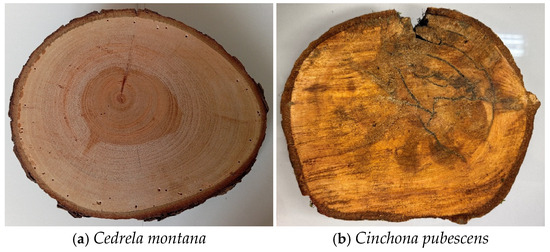
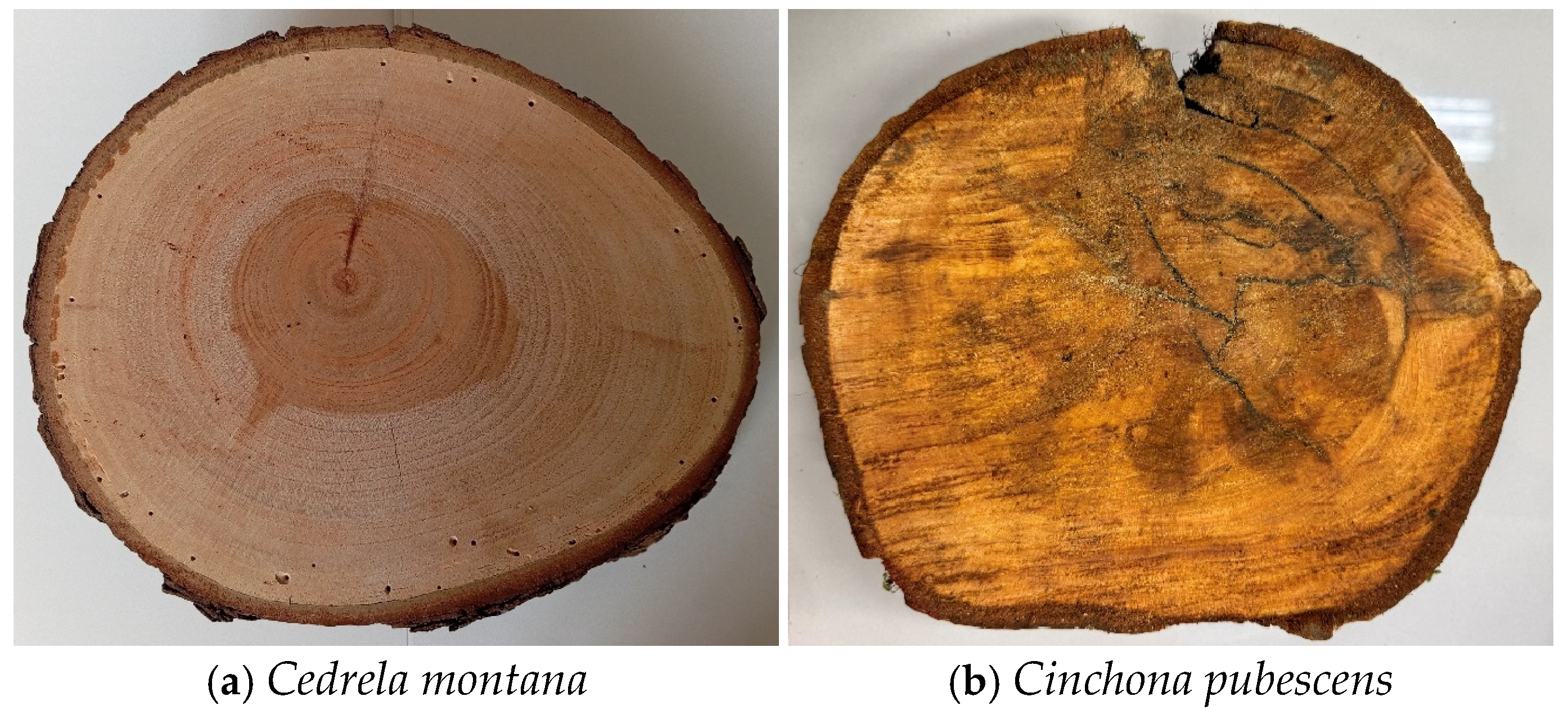
The samples used in the present study corresponded to images of transverse wood sections from two native forest species: cedar (Cedrela montana) (Figure 1a) and cinchona (Cinchona pubescens) (Figure 1b), collected from the Amazonas region in northern Peru. The cedar samples were obtained from xylarium specimens deposited in the Gocta Xylarium at the Universidad Nacional Toribio Rodríguez de Mendoza (UNTRM), located in the city of Chachapoyas. This scientific collection houses reference material used in anatomical and taxonomic studies of forest species, ensuring the reliability of the identification of the analyzed material.
Figure 1.
Transverse wood sections of the forest species used in the study: (a) cedar (Cedrela montana) and (b) cinchona (Cinchona pubescens), collected from the Amazonas region. Original macro-images were acquired using smartphone cameras at high spatial resolution prior to preprocessing and patch extraction.
On the other hand, the cinchona samples were obtained from tree stumps of previously harvested individuals located in a montane forest in the Shucahuala sector, belonging to the peasant community of Conila, Luya district, Amazonas region. This procedure avoided affecting living individuals, ensuring a responsible approach to sample collection. Subsequently, the material was prepared under controlled conditions in order to preserve the anatomical characteristics relevant to the analysis.
2.2. Dataset Construction and Preprocessing
The dataset used in this study consisted of images of transverse wood sections corresponding to two species: cedar (Cedrela montana) and cinchona (Cinchona pubescens). Initially, the dataset included 36 cedar images and 20 cinchona images. To prevent data leakage, the original images were divided at the whole-image level into three subsets, training (70%), validation (15%), and testing (15%), ensuring that patches derived from the same image were not present across different subsets.
Additionally, to further assess model robustness and address potential concerns regarding performance inflation associated with patch-based dataset expansion, a five-fold cross-validation procedure was subsequently performed at the original image level. In each fold, approximately 45 original images were used for training and 11 independent images were used for testing prior to patch generation. Final image-level predictions were obtained through majority voting across all patches extracted from each specimen. This additional validation strategy ensured that model performance was evaluated on previously unseen specimens and provided a more reliable assessment of generalization capability.
Due to the limited size of the original dataset, a data expansion strategy based on patch generation was implemented. Each image was segmented into sub-images of 224 × 224 pixels using a sliding-window approach with a stride of 112 pixels, corresponding to a 50% overlap between consecutive patches. This procedure significantly increased the dataset size and enabled the capture of local texture and anatomical structure patterns relevant for classification. Patch generation was performed independently for each subset, preventing bias or information transfer among the training, validation, and testing datasets.
Subsequently, a balancing process based on undersampling was applied to equalize the number of samples per class. As a result, the final balanced dataset contained 4048 image patches, with 2024 patches per species. The final distribution included 1416 patches per class for training, 304 patches per class for validation, and 304 patches per class for testing.
The images were resized to a standard resolution of 224 × 224 pixels according to the input requirements of the employed architectures. Regarding preprocessing, pixel values were rescaled to the range [0, 1] for the custom Convolutional Neural Network, whereas the corresponding architecture-specific preprocessing function was applied for the pretrained MobileNetV2 and EfficientNetB0 models.
2.3. Methodological Workflow
The present study was developed using a deep learning-based approach for timber species classification, employing both a specifically designed Convolutional Neural Network (CNN) and pretrained models. The general workflow of the methodological process, from data preparation to result interpretation, is presented in Figure 2.
Figure 2.
Methodological flow diagram.
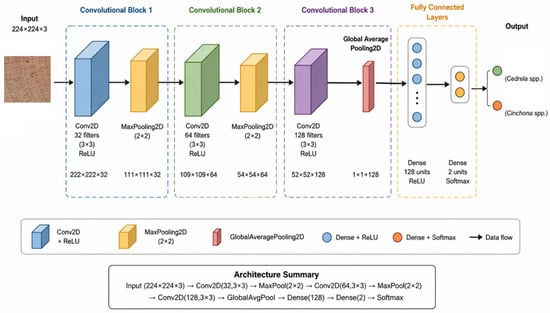
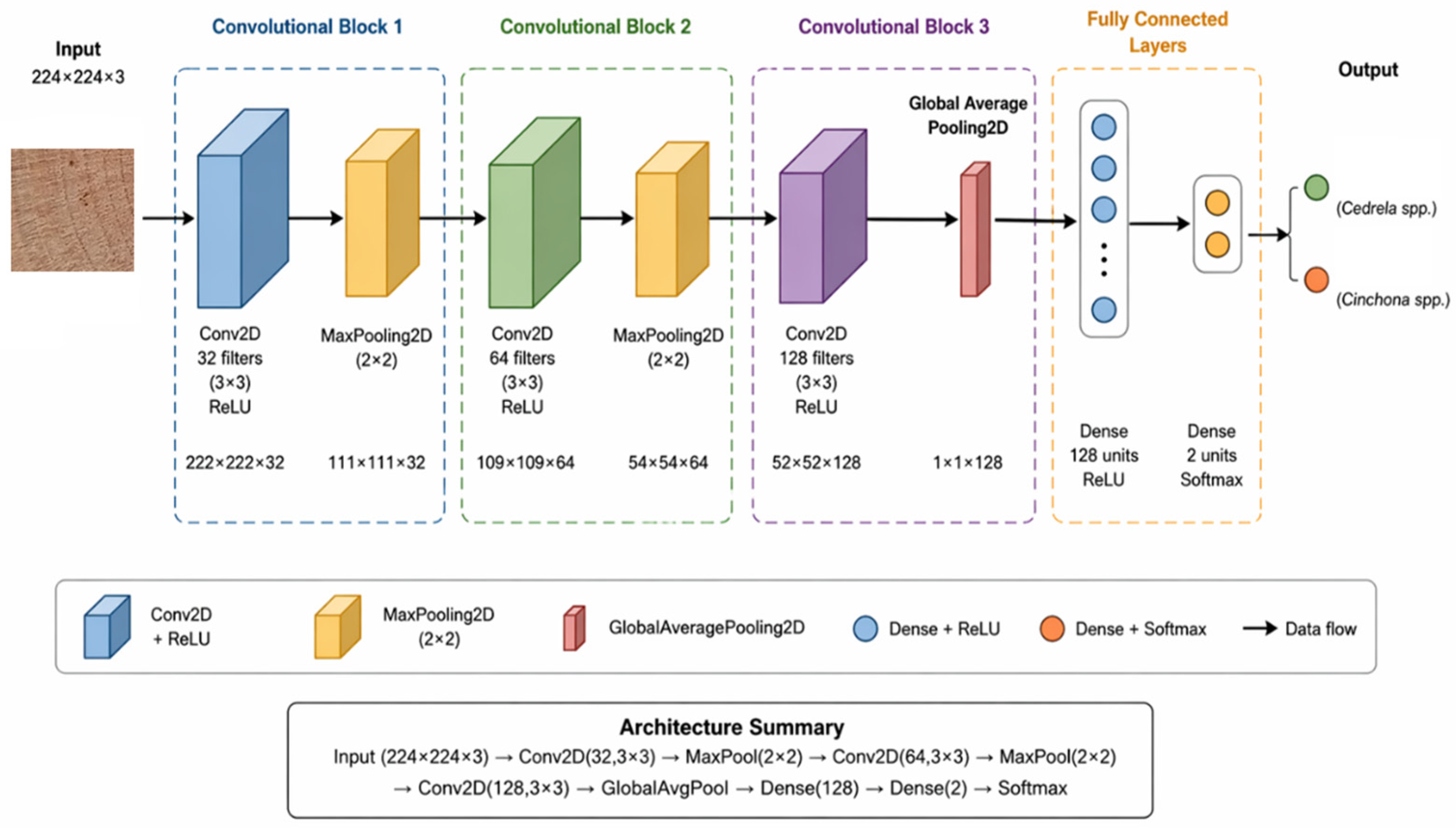
For the modeling stage, a sequential CNN architecture was implemented for the extraction of relevant visual features from images of transverse wood sections. The network architecture is presented in Figure 3 and includes three convolutional blocks with ReLU activation functions, interleaved with max-pooling layers for spatial dimensionality reduction, followed by a global average pooling layer to condense spatial information before the classification stage. Finally, dense layers were incorporated, using a ReLU activation function in the intermediate layer and a softmax activation function in the output layer for binary classification between the cedar and cinchona classes.
Figure 3.
Proposed Convolutional Neural Network (CNN) Architecture..
Additionally, the pretrained MobileNetV2 and EfficientNetB0 architectures were employed using weights previously learned from the ImageNet dataset. MobileNetV2 is a lightweight convolutional neural network that utilizes depthwise separable convolutions and inverted residual blocks to reduce computational complexity while maintaining high classification performance. EfficientNetB0 employs a compound scaling strategy that jointly scales network depth, width, and input resolution, providing an effective balance between accuracy and computational efficiency. Therefore, the three architectures differ in their feature extraction strategies: the custom CNN learns task-specific representations directly from the training dataset, MobileNetV2 emphasizes computational efficiency through lightweight convolutional operations, and EfficientNetB0 improves feature representation by systematically balancing network depth, width, and input resolution. For both architectures, the original ImageNet classification head was removed (include_top = False) and replaced with a task-specific classification head consisting of a Global Average Pooling layer, a fully connected layer with 128 neurons and ReLU activation, and a final Softmax layer with two output neurons corresponding to the target classes. During training, the convolutional base remained frozen while only the newly added classification layers were optimized.
The training process was performed using the Adam optimizer with a learning rate of 0.0001 and the sparse categorical cross-entropy loss function. Models were trained for 15 epochs using a batch size of 32, while classification performance was monitored through the accuracy metric. Model parameters were iteratively updated through backpropagation, where gradients were computed between the predicted class probabilities and the corresponding reference labels. The objective of the optimization process was to minimize the sparse categorical cross-entropy loss over successive training epochs.
To interpret model behavior and identify image regions influencing the classification process, the Gradient-weighted Class Activation Mapping (Grad-CAM) technique was applied. Grad-CAM computes the gradients of the target class score with respect to the feature maps of the final convolutional layer. These gradients are globally averaged to obtain importance weights, which are then combined with the corresponding feature maps to generate a class-discriminative localization map. After applying a ReLU operation, the resulting activation map is resized and superimposed on the original image to produce a heatmap, where warmer colors indicate regions contributing most strongly to the model prediction.
2.4. Computational Environment
All experiments were conducted on a personal computer equipped with a 12th Generation Intel® Core™ i7-1260P processor (2.10 GHz), 16 GB RAM, and Intel® UHD integrated graphics, running Windows 11 Pro (64-bit). The models were implemented using TensorFlow 2.20.0 and Keras 3.13.2.
The custom CNN architecture contained 110,018 trainable parameters. MobileNetV2 contained 2,422,210 total parameters, including 164,226 trainable parameters and 2,257,984 frozen parameters. EfficientNetB0 contained 4,213,797 total parameters, including 164,226 trainable parameters and 4,049,571 frozen parameters. For MobileNetV2 and EfficientNetB0, the pretrained convolutional layers were frozen during training, and only the classification head was optimized (Table 1).
Table 1.
Computational characteristics of the evaluated architectures.
3. Results and Discussion
This section presents and discusses the results obtained from the automatic classification of wood samples using the CNN, MobileNetV2, and EfficientNetB0 models. The performance of each architecture is evaluated based on quantitative metrics, confusion matrices, training curves, and visual interpretability techniques such as Grad-CAM.
3.1. Classification Performance
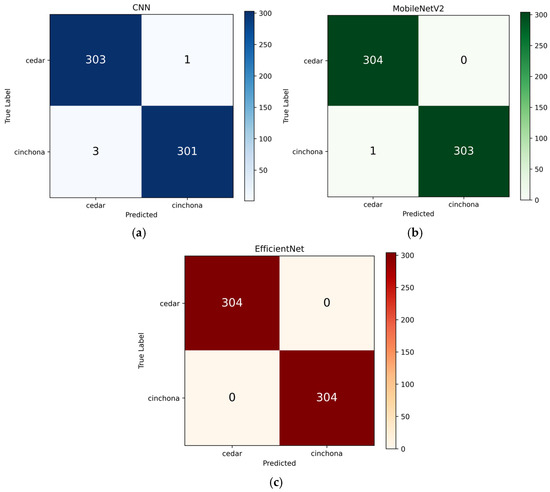
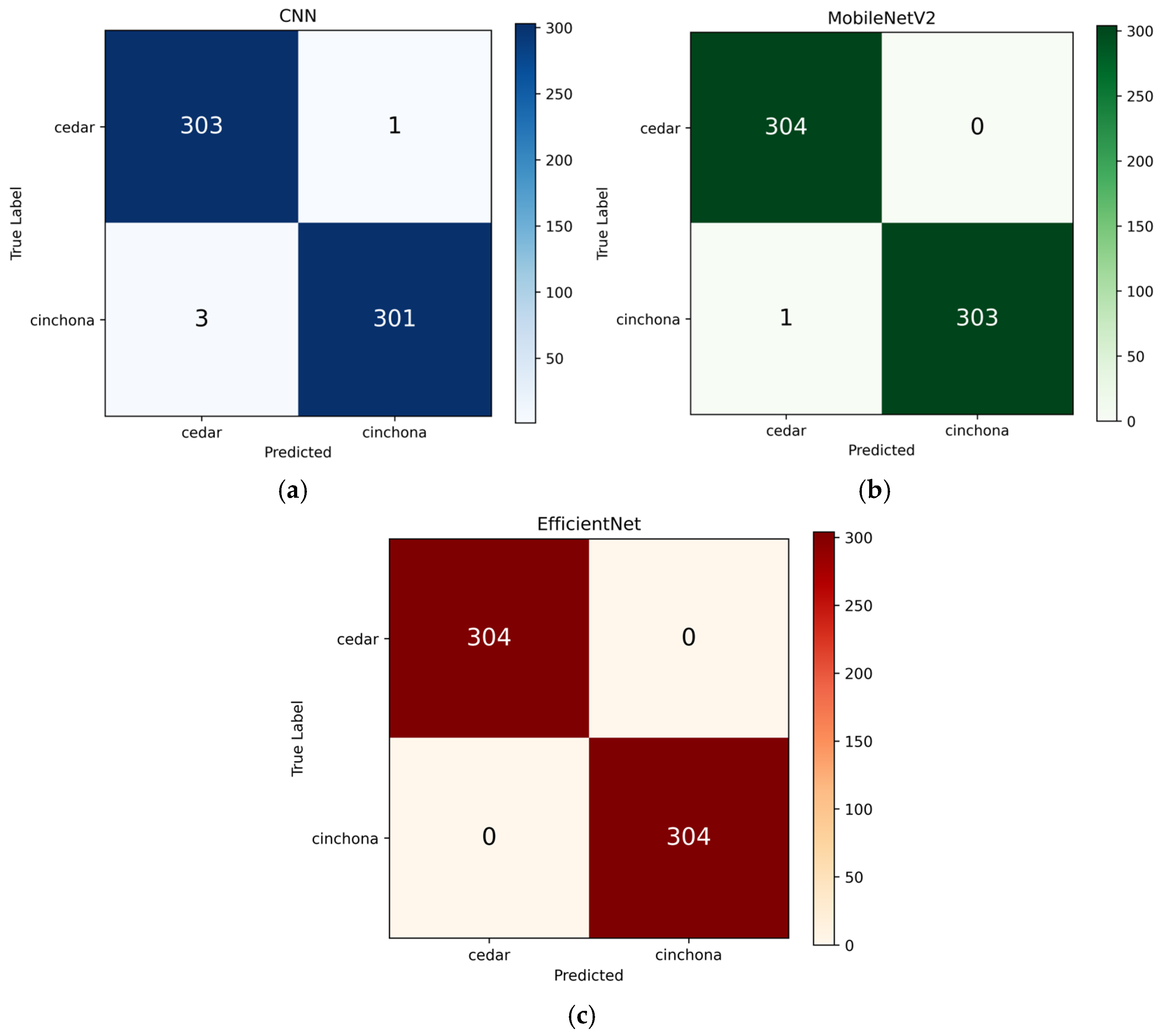
The confusion matrices reveal high classification performance for both timber species across the three evaluated models, with slight differences in error distribution. In the CNN model, 303 cedar samples and 301 cinchona samples were correctly classified, with a total of four misclassifications, including one cedar sample and three cinchona samples, indicating greater difficulty in distinguishing the latter class. In contrast, MobileNetV2 achieved improved performance, with only a single misclassification in the cinchona class, while EfficientNetB0 achieved perfect classification without errors in either class. Overall, these results indicate that although all models exhibited high performance, the deeper architectures demonstrated superior generalization capability (Figure 4).
Figure 4.
Confusion matrices of the evaluated models: (a) CNN, (b) MobileNetV2, and (c) EfficientNetB0.
Similar results have been reported in studies on automated wood identification using deep learning, where transfer learning-based models consistently outperformed architectures trained from scratch [44,45]. The greater difficulty observed in the cinchona class may be associated with higher anatomical variability or textural similarities with cedar, a phenomenon previously documented in timber identification studies reporting visual overlap among certain wood species [46]. Furthermore, the superior performance of MobileNetV2 and EfficientNetB0 highlights the capability of pretrained deep architectures to extract more complex discriminative features and achieve better generalization, particularly when training data are limited [47,48]. These findings further support the applicability of advanced deep learning approaches for automated timber species identification, consistent with recent studies conducted on tropical woods [49,50].
The precision, recall, and F1-score metrics demonstrate highly consistent performance across the three models (Table 2), with values close to or equal to 1.00 for both classes. The CNN exhibited a slight decrease in recall for the cinchona class (0.99), indicating a lower ability to completely identify this class, consistent with the confusion matrix results. In contrast, MobileNetV2 improved this behavior, while EfficientNetB0 achieved perfect values across all evaluation metrics, reflecting an optimal balance between precision and sensitivity.
Table 2.
Performance metrics of the evaluated models.
Similar findings have been reported in previous studies, where deep learning models achieved performance values ranging from 99% to 100% in both wood classification and agricultural applications. In particular, CNN ensembles have been reported to achieve up to 100% accuracy in timber species classification [51], while architectures such as EfficientNet and MobileNet have exceeded 99% accuracy in crop disease detection tasks [52,53,54]. Overall, the present results confirm the effectiveness of pretrained models in capturing complex discriminative patterns and achieving robust classification performance. Nevertheless, performance values approaching 100% may also be influenced by factors such as dataset composition and the patch-based extraction strategy employed in this study.
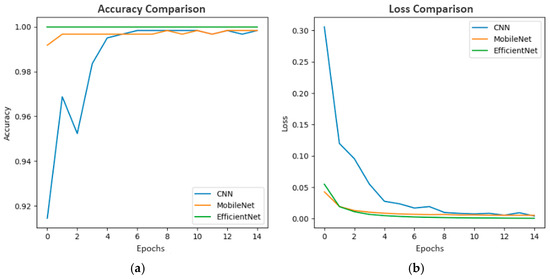
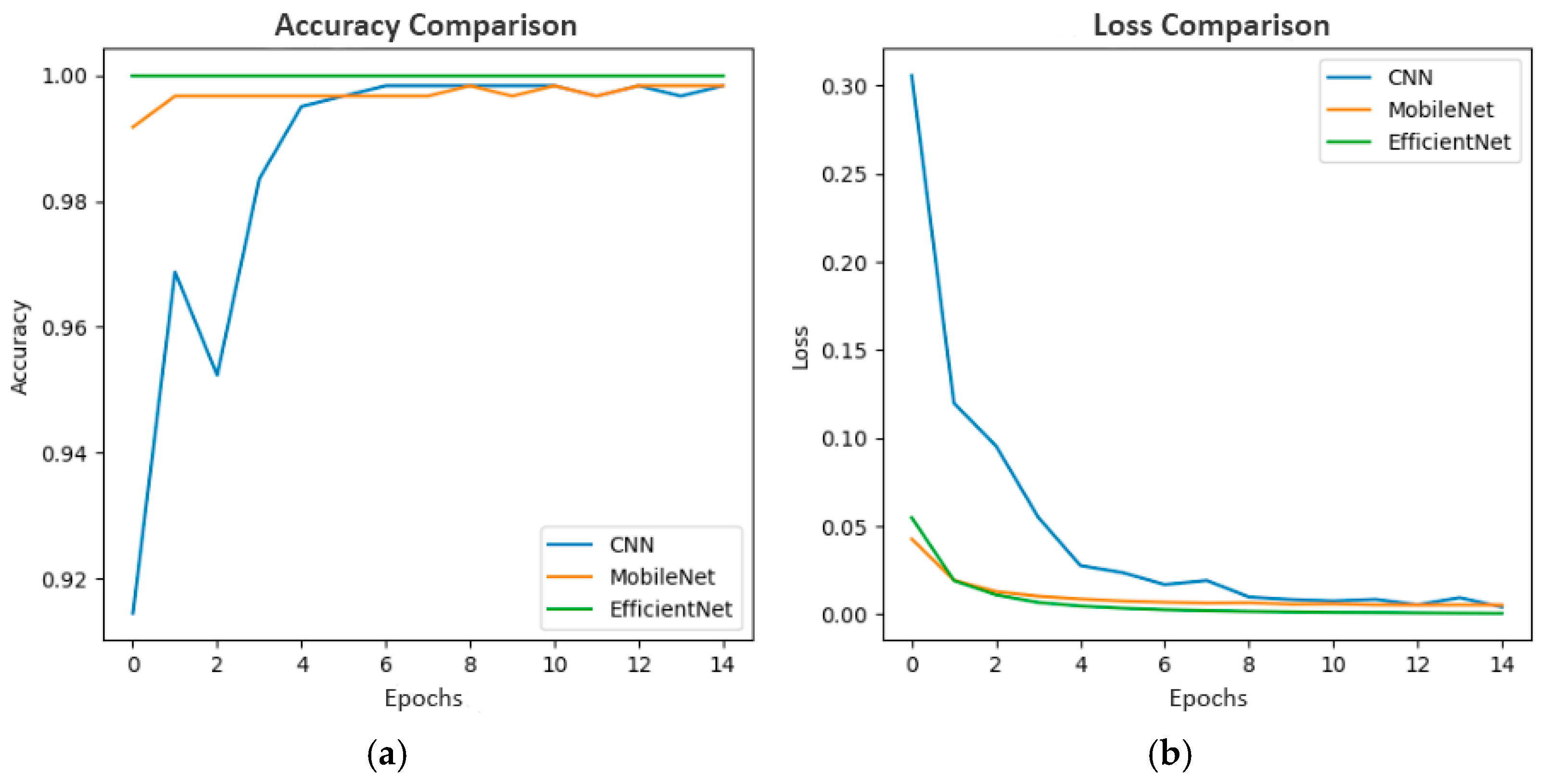
The evolution of accuracy and loss during training (Figure 5) demonstrates a stable learning process across the three evaluated models. In terms of accuracy, EfficientNetB0 and MobileNetV2 rapidly achieved values close to 1.00 during the early epochs and maintained stable trajectories throughout training, indicating fast convergence and a strong ability to capture discriminative patterns. In contrast, the CNN exhibited greater variability during the initial training phase, with progressive improvements until stabilizing around 0.99, suggesting a slower learning process compared to the pretrained models.
Figure 5.
Evolution of the training metrics for the evaluated models: (a) Accuracy and (b) loss.
Regarding the loss function, a consistent decrease was observed across all three models, particularly during the initial training epochs. EfficientNetB0 and MobileNetV2 reached near-zero loss values more rapidly, reflecting more efficient optimization during learning. Conversely, the CNN maintained slightly higher loss values for a greater number of epochs, a behavior associated with its lower architectural depth and the absence of pretraining.
Similar behavior has been reported in previous studies [55,56], where transfer learning-based models exhibited faster and more stable convergence due to their ability to reuse features previously learned from large-scale datasets. EfficientNet has been shown to achieve an effective balance between classification performance and computational efficiency through its compound scaling strategy [57], whereas MobileNetV2 maintains high performance with reduced computational complexity owing to the use of depthwise separable convolutions [58]. In contrast, CNNs trained from scratch generally require larger datasets and additional training epochs to achieve comparable levels of stability and generalization [59]. In the context of classifying macro-images of cedar (Cedrela montana) and cinchona (Cinchona pubescens) wood, the present findings indicate that pretrained models provide more efficient representations of anatomical and textural features, resulting in improved classification accuracy and training stability.
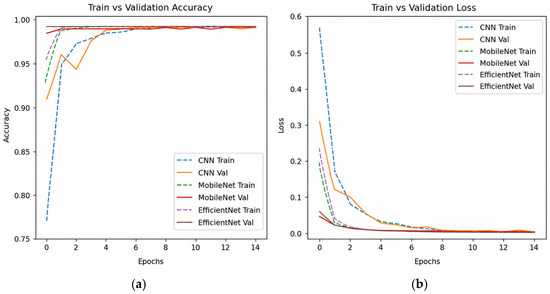
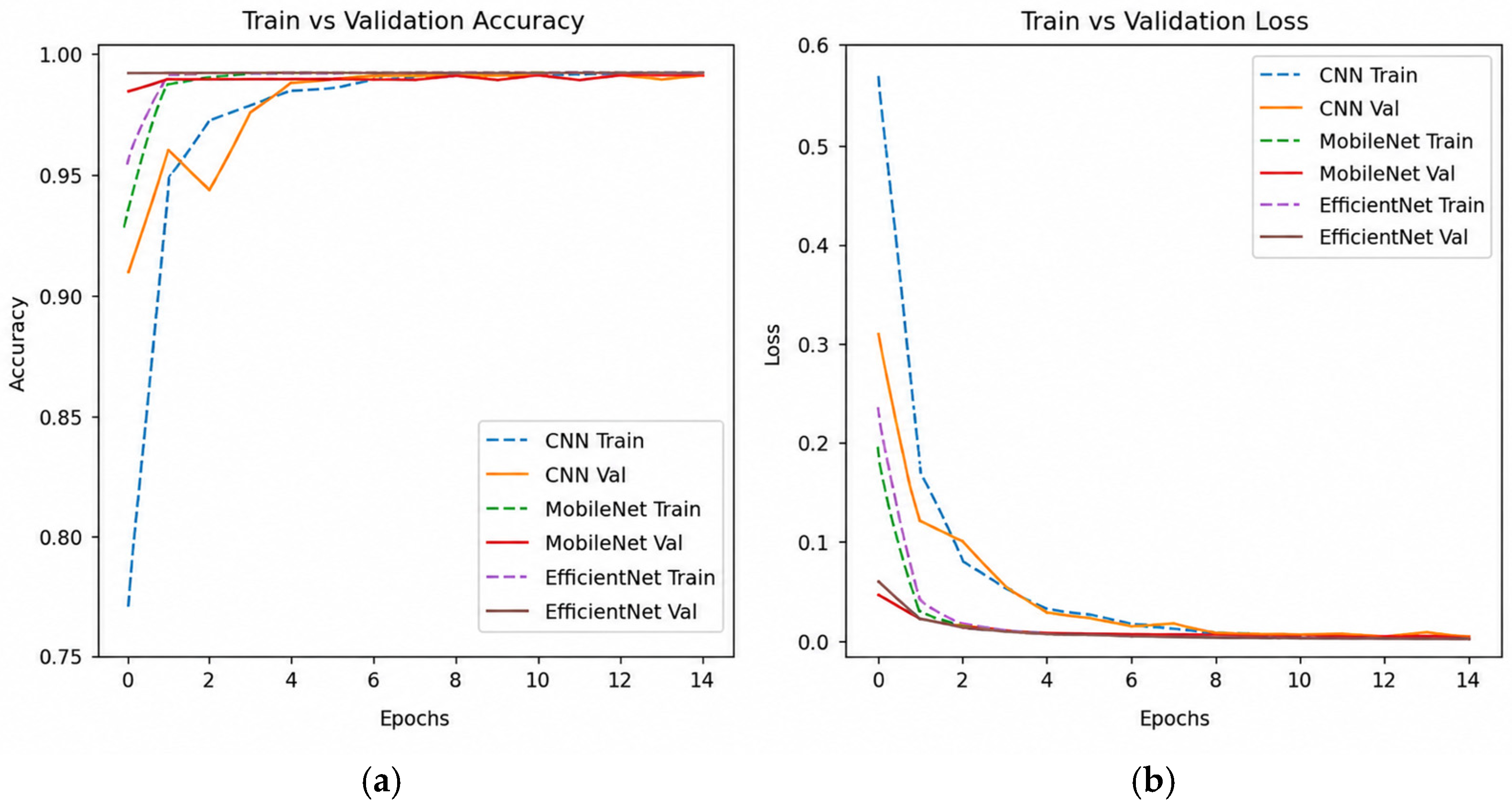
The comparison between the training and validation curves reveals consistent behavior across the three models, with no significant discrepancies between the two datasets (Figure 6). In terms of accuracy, EfficientNetB0 and MobileNetV2 maintained nearly identical values during both training and validation, indicating strong generalization capability. Although the CNN exhibited slight variations during the early epochs, it progressively converged toward a stable learning pattern. The absence of pronounced divergence between the curves suggests that overfitting did not occur, indicating that the models learned representative features that remained consistent when evaluated on unseen samples.
Figure 6.
Training and validation curves of the evaluated models: (a) Accuracy and (b) Loss.
Overall, these results confirm the effectiveness of the training strategy and demonstrate that all models achieved good generalization performance, with greater consistency observed in the pretrained architectures. Similar findings have been reported in previous studies [60,61,62], where the close agreement between training and validation curves was identified as an indicator of reduced overfitting and robust generalization capability in image classification tasks.
3.2. Statistical Validation of Model Performance
To further assess the robustness and generalization capability of the proposed deep learning models, a five-fold cross-validation procedure was performed at the original image level rather than at the patch level. The dataset consisted of 56 independent wood macro-images (36 Cedrela and 20 Cinchona specimens). In each fold, approximately 45 original images were used for training and 11 independent images were used for testing. Final image-level predictions were obtained through majority voting across all patches extracted from each specimen. This strategy prevented information leakage between folds and ensured that the reported performance reflected the ability of the models to generalize to unseen specimens rather than to individual image patches.
The cross-validation results demonstrated highly consistent performance across all evaluated architectures. CNN, MobileNetV2, and EfficientNetB0 achieved perfect image-level classification accuracy in all five folds, resulting in a mean accuracy of 1.000 with zero standard deviation. Likewise, the corresponding confidence intervals collapsed to [1.000, 1.000] for all models due to the absence of variability across folds, indicating complete consistency across the evaluated partitions.
Table 3 summarizes the image-level cross-validation results obtained for the three architectures.
Table 3.
Five-fold cross-validation results at image level.
Because all three models achieved identical accuracies across the five folds, no ranking differences were observed among architectures. Consequently, statistical comparison using the Friedman test was not informative, as the absence of performance variability resulted in equivalent rankings for all models under the present experimental conditions.
The perfect classification performance observed during image-level cross-validation indicates that the evaluated architectures successfully captured discriminative anatomical and textural features of Cedrela and Cinchona wood specimens. Nevertheless, these results should be interpreted with caution due to the limited number of independent specimens available in the original dataset (n = 56). Although the patch extraction strategy substantially increased the number of training samples, it did not increase the number of biologically independent wood specimens.
The sliding-window procedure generated multiple overlapping patches from each macro-image, allowing the models to learn local anatomical structures and texture patterns more effectively. However, patches originating from the same specimen may still share highly similar visual characteristics. Consequently, the effective diversity of the dataset may be lower than suggested by the total number of generated patches. Therefore, part of the observed classification performance may be influenced by the relatively homogeneous nature of the available specimens and by the patch-based expansion strategy.
To address this concern, an additional five-fold cross-validation procedure was conducted at the original image level. Complete macro-images were assigned to training and testing subsets before patch extraction, ensuring that patches derived from the same specimen never appeared in both subsets simultaneously. Furthermore, final specimen-level predictions were obtained through majority voting across all patches extracted from each image. The consistent performance observed across all folds provides additional evidence that the models learned discriminative features that generalized to previously unseen specimens within the available dataset.
Despite these encouraging results, the limited number of independent wood samples remains an important limitation of the present study. Future research should include larger collections of specimens from different geographical regions, environmental conditions, tree ages, and additional species, as well as external validation datasets, to further assess the robustness and generalizability of the proposed approach under real-world forestry conditions.
Therefore, the subsequent analysis focuses on Grad-CAM visualizations to further investigate how the evaluated models identify relevant anatomical and textural features during the classification process.
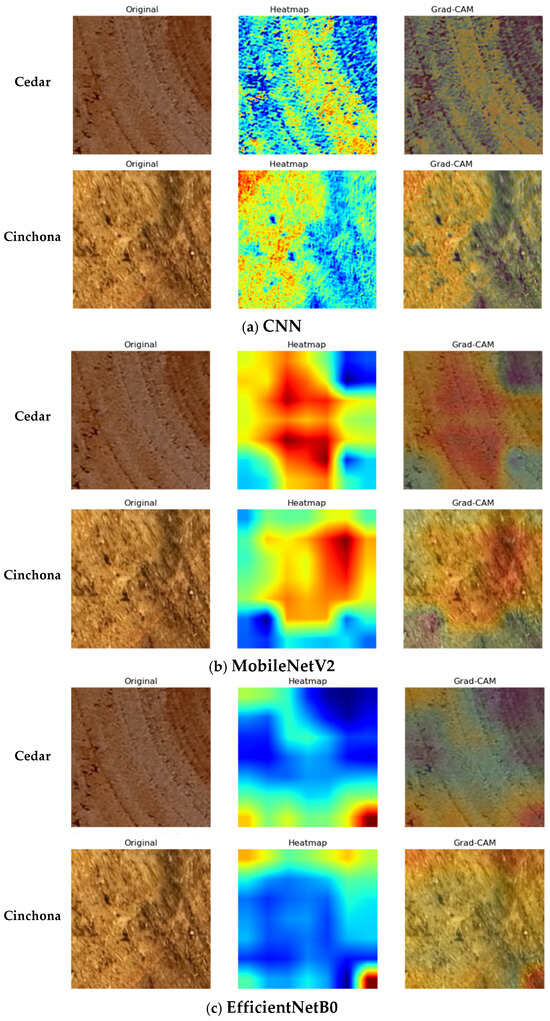
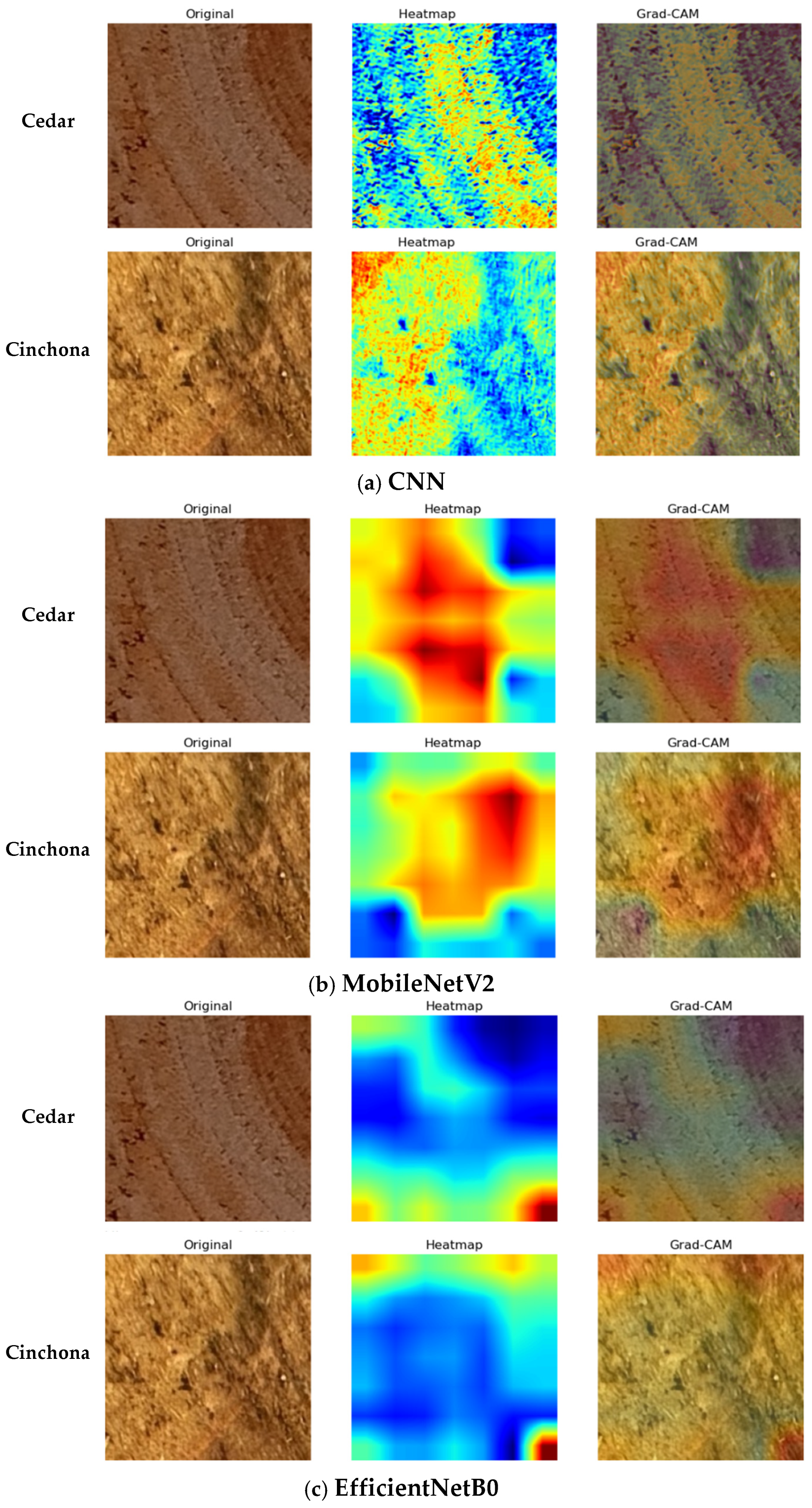
Figure 7 presents the activation maps generated using Grad-CAM for the CNN, MobileNetV2, and EfficientNetB0 models applied to the classification of macro-images of cinchona and cedar wood. The results reveal important differences in the manner in which each architecture identifies and prioritizes relevant visual features during the classification process. In the case of EfficientNetB0 and MobileNetV2, the activations are distributed more broadly across different regions of the image, indicating that the models generate a more global representation of the textural and anatomical patterns present in the wood. Similar behavior has been reported in previous studies [63,64], which showed that transfer learning-based architectures tend to produce more generalized feature representations by reusing features previously learned from large-scale datasets, thereby enhancing model stability and generalization capability.
Figure 7.
Grad-CAM visualizations of the evaluated models: (a) CNN, (b) MobileNetV2, and (c) EfficientNetB0.
In contrast, the CNN produced more focused and visually defined activation maps over specific texture regions, enabling a clearer distinction of grain patterns, fibers, and anatomical variations present in the cinchona and cedar samples. Unlike the pretrained models, the CNN activations demonstrated more localized attention toward fine surface features of the wood, suggesting that the model developed a more specific representation of the discriminative characteristics of each forest species. This difference can be explained by the underlying learning strategies of the evaluated architectures. MobileNetV2 and EfficientNetB0 were initialized with ImageNet-pretrained weights, which promote the extraction of generalized and globally distributed visual features learned from large-scale image datasets. In contrast, the custom CNN was trained exclusively on the wood image dataset, allowing it to develop more specialized feature detectors focused on local anatomical and textural characteristics. Consequently, the pretrained models tended to produce broader activation patterns, whereas the CNN generated more concentrated and visually interpretable attention regions. This behavior is particularly relevant because it provides a more interpretable visualization of the model’s decision-making process, which is a fundamental aspect of explainable artificial intelligence (XAI). Similar observations have been reported in previous studies [65,66,67], where CNNs trained from scratch exhibited greater sensitivity to local patterns and textural details in specialized visual classification tasks.
Although EfficientNetB0 and MobileNetV2 achieved superior classification performance and faster convergence during training, their Grad-CAM maps exhibited more diffuse and spatially less specific activations. This suggests that these models prioritize global representation patterns rather than specific anatomical details. In contrast, despite presenting a slower learning process and slight variations during training, the CNN was able to highlight anatomically meaningful regions that were more interpretable from a human visual perspective. This finding represents an important contribution of the present study, demonstrating that higher predictive performance does not necessarily imply greater visual interpretability.
Recent studies have emphasized that the evaluation of computer vision models should not be limited to accuracy metrics alone but should also consider the interpretability of attention maps and the ability of models to identify semantically meaningful regions [68,69].
Finally, the obtained results demonstrate that Grad-CAM effectively verified that the evaluated models based their classifications on relevant anatomical and textural wood patterns rather than on noise or irrelevant image regions. From an applied perspective, these findings reinforce the potential of explainable artificial intelligence for the automated recognition of forest species, contributing not only to improved classification accuracy but also to enhanced transparency and reliability in forestry monitoring, timber traceability, and biodiversity conservation applications.
It is important to note that the proposed methodology is based on transverse wood-section images and is therefore primarily intended for laboratory-based wood identification, xylarium collections, timber traceability systems, and forensic verification of harvested timber. Consequently, the current approach is not designed for the direct identification of standing living trees, where obtaining transverse wood sections is not feasible. Future research should explore the integration of non-destructive imaging technologies and portable acquisition systems to extend the applicability of deep learning-based species identification to in situ forest monitoring and forest inventory applications.
4. Conclusions
This study demonstrated the feasibility of combining deep learning and explainable artificial intelligence for the automated identification of cedar (Cedrela montana) and cinchona (Cinchona pubescens) wood species using transverse macro-images collected in the northern Peruvian Amazon. The evaluated architectures successfully captured discriminative anatomical and textural features, achieving highly accurate classification performance and confirming the potential of computer vision techniques as a complementary tool for wood identification and forestry monitoring.
Beyond predictive performance, the integration of Grad-CAM provided valuable insights into the decision-making process of the models. While the pretrained architectures achieved the highest classification accuracy, the custom CNN produced more localized and visually interpretable activation patterns. These findings highlight the importance of considering both predictive capability and explainability when developing artificial intelligence systems for forestry applications, where transparency and trustworthiness are essential for practical adoption.
Unlike conventional deep learning approaches, explainable deep learning incorporates interpretation mechanisms that allow visualization of the image regions contributing to model predictions. This additional level of transparency facilitates model validation, improves user trust, and supports decision-making in practical forestry applications.
The additional image-level cross-validation analysis further supported the robustness of the proposed approach by demonstrating consistent classification performance across independent specimen partitions. This result suggests that the evaluated models learned meaningful anatomical and textural representations associated with the studied species rather than relying solely on patch-specific patterns.
Despite these promising findings, several limitations should be acknowledged. The study was restricted to 56 independent wood specimens belonging to only two forest taxa. Although patch-based expansion increased the number of training samples, it did not increase the number of biologically independent specimens. Furthermore, extending the methodology to additional species may introduce greater anatomical complexity and interspecific similarity, particularly in characteristics such as vessel distribution, fiber arrangement, growth-ring boundaries, and parenchyma patterns. Variations associated with tree age, environmental conditions, geographical origin, surface preparation, illumination, image acquisition procedures, and the presence of wood defects such as decay, cracks, knots, or biological deterioration may also influence classification performance under real-world conditions.
Future research should therefore incorporate larger and more diverse collections of wood specimens, additional forest species, and external validation datasets to further assess model generalization. Moreover, the integration of advanced explainability techniques and multimodal wood characterization approaches may contribute to the development of more robust, transparent, and operationally applicable systems for timber traceability, biodiversity conservation, and the prevention of illegal logging.
Author Contributions
Conceptualization, H.K.M.V., J.B.T., R.C.S.C.A. and E.M.-R.; methodology, H.K.M.V., V.G.I.M., P.F. and E.M.-R.; software, H.K.M.V. and P.F.; validation, P.F. and E.M.-R.; formal analysis, C.L.L.A., E.T.C. and J.M.-D.; investigation, H.K.M.V., J.B.T., V.G.I.M. and E.M.-R.; resources, R.C.S.C.A.; data curation, H.K.M.V. and J.B.T.; writing—original draft preparation, H.K.M.V. and E.M.-R.; writing—review and editing, E.M.-R., C.L.L.A., J.M.-D. and T.S.-S.; visualization, P.F., V.G.I.M. and E.M.-R.; supervision, C.L.L.A., J.M.-D. and P.F.; project administration, H.K.M.V., J.B.T. and E.M.-R.; funding acquisition, R.C.S.C.A. and P.F. All authors have read and agreed to the published version of the manuscript.
Funding
This study received financial support from the Office of the Vice Rector for Research at the Toribio Rodríguez de Mendoza National University of Amazonas to cover publication costs (APC), in accordance with Resolution No. 308-2025-UNTRM/CU.
Data Availability Statement
All the raw data is available on request.
Acknowledgments
The authors acknowledge and thank the Institute for Research in Information and Communication Technologies (IITIC), Faculty of Systems Engineering, and Electrical Mechanics of the Universidad Nacional Toribio Rodríguez de Mendoza de Amazonas (UNTRM).
Conflicts of Interest
The authors declare no conflicts of interest.
References
- Rajasugunasekar, D.; Patel, A.K.; Devi, K.B.; Singh, A.; Selvam, P.; Chandra, A. An Integrative Review for the Role of Forests in Combating Climate Change and Promoting Sustainable Development. Int. J. Environ. Clim. Change 2023, 13, 4331–4341. [Google Scholar] [CrossRef] [Scilit]
- Richardson, S.B.; Simeone, J.C.; Deklerck, V. The global wood species priority list: A living database of tree species most at risk for illegal logging, unsustainable deforestation, and high rates of trade globally. Wood Fiber Sci. 2023, 55, 31–42. [Google Scholar] [CrossRef] [Scilit]
- Sheng, J.; Gao, X.; Zhang, Z. Sustainability of Forest Development in China from the Perspective of the Illegal Logging Trade. Sustainability 2023, 15, 12250. [Google Scholar] [CrossRef] [Scilit]
- Franca, C.S.S.; Persson, U.M.; Carvalho, T.; Lentini, M. Quantifying Timber Illegality Risk in the Brazilian Forest Frontier. Nat. Sustain. 2023, 6, 1485–1495. [Google Scholar] [CrossRef] [Scilit]
- López-Tobar, R.; Herrera-Feijoo, R.J.; García-Robredo, F.; Mateo, R.G.; Torres, B. Timber Harvesting and Conservation Status of Forest Species in the Ecuadorian Amazon. Front. For. Glob. Change 2024, 7, 1389852. [Google Scholar] [CrossRef] [Scilit]
- Andrade, F.W.C.; Pinto, T.I.; Moreira, L.D.S.; Da Ponte, M.J.M.; Lobato, T.D.C.; De Sousa, J.T.R.; Moutinho, V.H.P. The Legal Roundwood Market in the Amazon and Its Impact on Deforestation in the Region between 2009–2015. Forests 2022, 13, 558. [Google Scholar] [CrossRef] [Scilit]
- Darshani, P. Devadaru (Cedrus Deodara Sarg.): Ancient Tree with Significant Medicinal Benefits. Int. J. Sci. Res. 2023, 12, 582–586. [Google Scholar] [CrossRef] [Scilit]
- Botanic Gardens Conservation International. One in Five Tree Species Is on the Brink of Extinction. Harvard ALI Social Impact Review. 2021. Available online: https://www.sir.advancedleadership.harvard.edu/articles/one-in-five-tree-species-is-on-the-brink-of-extinction (accessed on 15 April 2026).
- Ames-Martínez, F.N.; Capcha Romero, I.; Guerra, A.; Inga Guillen, J.G.; Quispe-Melgar, H.R.; Galeano, E.; Rodríguez-Ramírez, E.C. Climate Change and Tree Cover Loss Affect the Habitat Suitability of Cedrela angustifolia: Evaluating Climate Vulnerability and Conservation in Andean Montane Forests. PeerJ 2025, 13, e18799. [Google Scholar] [CrossRef] [Scilit] [PubMed]
- Finch, K.N.; Jones, F.A.; Cronn, R.C. Cryptic Species Diversity in a Widespread Neotropical Tree Genus: The Case of Cedrela Odorata. Am. J. Bot. 2022, 109, 1622–1640. [Google Scholar] [CrossRef] [Scilit] [PubMed]
- Mishra, Y.; Mishra, V.; Onyeakagbu, L.S. Chemical Constituents and Pharmacological Importance of Cinchona in Treatment of Malaria: A Global Perspective. AIP Conf. Proc. 2024, 2986, 030135. [Google Scholar] [CrossRef] [Scilit]
- Research and Markets. Quinine Market Report 2026. Research and Markets. 2026. Available online: https://www.researchandmarkets.com/reports/6104916/quinine-market-report (accessed on 14 April 2026).
- Mekonnen, B.; Cizungu, L.; Alegre, J.; Blondeel, H.; De Lombaerde, E.; Verbeeck, H.; Duchateau, L.; Schrevens, E.; Verheyen, K.; Boeckx, P.; et al. Smallholder Farmers’ Knowledge on Management of Cinchona in the Democratic Republic of the Congo. Plant Ecol. Evol. 2025, 158, 3–13. [Google Scholar] [CrossRef] [Scilit]
- García, L.; Veneros, J.; Chavez, S.G.; Oliva, M.; Rojas-Briceño, N.B. World Historical Mapping and Potential Distribution of Cinchona Spp. in Peru as a Contribution for Its Restoration and Conservation. J. Nat. Conserv. 2022, 70, 126290. [Google Scholar] [CrossRef] [Scilit]
- Price, E.R.; Mcclure, P.J.; Huffman, A.N.; Voin, D.; Espinoza, E.O. Reliability of Wood Identification Using DART-TOFMS and the ForeST © Database: A Validation Study. SSRN Electron. J. 2022, 2, 100045. [Google Scholar] [CrossRef] [Scilit]
- Zeng, Z.; Feng, Z.; Wang, J.; Lyu, J.; Jiao, J.; Wang, M.; Lu, J.; Zhu, J.; Yao, Q.; Ding, Z. MultiWoodID: A Multispecies Wood Identification System Based on Wood Cross-Section Images. IAWA J. 2025, 46, 515–534. [Google Scholar] [CrossRef] [Scilit]
- Requena, D.; Rozendaal, D.M.A.; De Sy, V.; Decuyper, M.; Málaga, N.; Durán Montesinos, P.; Arana Olivos, A.; De la Cruz Paiva, R.; Martius, C.; Herold, M. Forest Disturbance and Recovery in Peruvian Amazonia. Glob. Change Biol. 2023, 29, 3601–3621. [Google Scholar] [CrossRef] [Scilit] [PubMed]
- Cespedes, T.V.C.; Alvarez, S.M.G.; Rojas, J.M.L.; Fernández, G.I.L. Spectral Vegetation Indices and Markov Chain to Evaluate the Loss of Forest Cover in the Allpahuayo Mishana National Reserve, in the Period 2002–2021. In Proceedings of the LACCEI International Multi-Conference for Engineering, Education and Technology, Boca Raton, FL, USA, 18–22 July 2022; Latin American and Caribbean Consortium of Engineering Institutions: Bogotá, DC, Colombia, 2022; Volume 2022. [Google Scholar] [CrossRef] [Scilit]
- Móstiga, M.; Armenteras, D.; Vayreda, J.; Retana, J. Two Decades of Accelerated Deforestation in Peruvian Forests: A National and Regional Analysis (2000–2020). Reg. Environ. Change 2024, 24, 42. [Google Scholar] [CrossRef] [Scilit]
- Cotrina, A.; Rojas, N.B.; Bandopadhyay, S.; Ghosh, S.; Torres, C.; Oliva, M.; Guzman, B.K.; Salas, R. Biogeographic Distribution of Cedrela Spp. Genus in Peru Using Maxent Modeling: A Conservation and Restoration Approach. Diversity 2021, 13, 261. [Google Scholar] [CrossRef] [Scilit]
- Chauiyakh, O.; El Fahime, E.; Aarabi, S.; Ninich, O.; Bentata, F.; Kettani, K.; Chaouch, A.; Ettahir, A. A Systematic Review on Chemical Composition and Biological Activities of Cedar Oils and Extracts. Res. J. Pharm. Technol. 2023, 16, 3875–3883. [Google Scholar] [CrossRef] [Scilit]
- SERFOR. Estado Situacional Del Género Cedrela En Perú; SERFOR: Lima, Peru, 2021; p. 130. Available online: https://repositorio.serfor.gob.pe/bitstream/SERFOR/899/2/SERFOR%202020%20Estado%20situacional%20del%20genero%20cedrela%20en%20el%20Peru.pdf (accessed on 20 April 2026).
- OSINFOR. Perú Acreditó el Origen Legal de Más de 500,000 Metros Cúbicos de Madera Durante el 2025; Organismo de Supervisión de los Recursos Forestales y de Fauna Silvestre (OSINFOR): Lima, Peru, 2026; Available online: https://www.gob.pe/institucion/osinfor/noticias/1329815-peru-acredito-el-origen-legal-de-mas-de-500-000-metros-cubicos-de-madera-durante-el-2025 (accessed on 15 April 2026).
- Ali, G.; Mijwil, M.M.; Adamopoulos, I.; Ayad, J. Leveraging the Internet of Things, Remote Sensing, and Artificial Intelligence for Sustainable Forest Management. Babylon. J. Internet Things 2025, 2025, 1–65. [Google Scholar] [CrossRef] [Scilit] [PubMed]
- Haq, B.; Jamshed, M.A.; Member, S.; Ali, K.; Kasi, B.; Arshad, S.; Kasi, M.K.; Ali, I.; Shabbir, A.; Abbasi, Q.H.; et al. Tech-Driven Forest Conservation: Combating Deforestation With Internet of Things, Artificial Intelligence, and Remote Sensing. IEEE Internet Things J. 2024, 11, 24551–24568. [Google Scholar] [CrossRef] [Scilit]
- Sánchez Santillan, T.; Meléndez Mori, J.; Morales Rojas, E.; Chichipe Puscan, A.; Oliva Cruz, S.; Huaman Vela, M. Multiplicación clonal del árbol de la quina (Cinchona officinalis): Una alternativa para conservar el árbol nacional de Perú. Bioagro 2021, 33, 215–222. [Google Scholar] [CrossRef] [Scilit]
- Huamani, N. Proyecto de Ley N.° 6225/2020-CR: Ley que Declara de Necesidad Pública e Interés Nacional la Promoción y Fortalecimiento de la Producción de la Quina; Congreso de la República del Perú: Lima, Peru, 2020; Available online: https://www.leyes.congreso.gob.pe/Documentos/2016_2021/Proyectos_de_Ley_y_de_Resoluciones_Legislativas/Proyectos_Firmas_digitales/PL06225.pdf (accessed on 15 April 2026).
- Fernandez-Zarate, F.H.; Huaccha-Castillo, A.E.; Quiñones-Huatangari, L.; Vaca-Marquina, S.P.; Sanchez-Santillan, T.; Guelac-Santillan, M.; Seminario-Cunya, A. Effect of Arbuscular Mycorrhizae on the Growth of Cinchona officinalis L. (Rubiaceae) in Nursery. For. Sci. Technol. 2024, 20, 244–248. [Google Scholar] [CrossRef] [Scilit]
- Ferreira, C.A.; Inga, J.G.G.; Buendia, R.H.; Vidal, O.D.A.; Reyes, D.C.A.; Centeno, W.G.; Ascue, B.S.M.; Moya, S.M.M.; Centeno, T.U.; Echeverry, A.V.; et al. Identification of 20 Species from the Peruvian Amazon Tropical Forest by the Wood Macroscopic Features. Cerne 2023, 29, e-103134. [Google Scholar] [CrossRef] [Scilit]
- Vizcarra, G.; Bermejo, D.; Mauricio, A.; Zarate Gomez, R.; Dianderas, E. The Peruvian Amazon Forestry Dataset: A Leaf Image Classification Corpus. Ecol. Inform. 2021, 62, 101268. [Google Scholar] [CrossRef] [Scilit]
- SERFOR. Resolución de Dirección Ejecutiva N.° D000031-2021-MIDAGRI-SERFOR-DE: Aprueban el Protocolo de Control Forestal Maderable para el Transporte Terrestre; Servicio Nacional Forestal y de Fauna Silvestre: Lima, Peru, 2021; Available online: https://www.gob.pe/institucion/serfor/normas-legales/1734843-d000031-2021-midagri-serfor-de (accessed on 15 April 2026).
- Masgo, H.K.; Maldonado, I.; Santa Cruz, R.C.; Ruiz, W.; Suarez, J.E.; Paredes, J.C.; Musayón, M.P.; Balcazar, C.R.; Lobatón, C.L.; Rojas, J.A.; et al. Neural Networks for Pest Diagnosis in Agriculture: A Global Literature Review. Int. J. Adv. Comput. Sci. Appl. 2025, 16, 2025. [Google Scholar] [CrossRef] [Scilit]
- Ravindran, P.; Owens, F.C.; Wade, A.C.; Vega, P.; Montenegro, R.; Shmulsky, R.; Wiedenhoeft, A.C. Field-Deployable Computer Vision Wood Identification of Peruvian Timbers. Front. Plant Sci. 2021, 12, 647515. [Google Scholar] [CrossRef] [Scilit] [PubMed]
- Silva, J.L.; Bordalo, R.; Pissarra, J.; de Palacios, P. Computer Vision-Based Wood Identification: A Review. Forests 2022, 13, 2041. [Google Scholar] [CrossRef] [Scilit]
- Chen, L.; Li, S.; Bai, Q.; Yang, J.; Jiang, S.; Miao, Y. Review of Image Classification Algorithms Based on Convolutional Neural Networks. Remote Sens. 2021, 13, 4712. [Google Scholar] [CrossRef] [Scilit]
- He, T.; Liu, Y.; Yu, Y.; Zhao, Q.; Hu, Z. Application of Deep Convolutional Neural Network on Feature Extraction and Detection of Wood Defects. Meas. J. Int. Meas. Confed. 2020, 152, 107357. [Google Scholar] [CrossRef] [Scilit]
- Huaquipaco, S.; Vera, O.; Yana-Mamani, V.; Mamani, W.; Calsina, H.; Puma, F.; Morales-Rojas, E.; Beltran, N.; Cruz, J. Peacock Spot Detection in Olive Leaves Using Self Supervised Learning in an Assembly Meta-Architecture. IEEE Access 2024, 12, 192828–192839. [Google Scholar] [CrossRef] [Scilit]
- Masgo, H.K.; Vergaray, C.M.; Maldonado, I.; Santa Cruz, R.C.; Ruiz, W.; Suarez, J.E.; Pérez, R.; Velayarce, F.; Morales-Rojas, E. Image Classification-Based System for Disease Diagnosis in Coffee Crops: A Case Study in the Province of Rodriguez de Mendoza, Northern Peru. For. Sci. Technol. 2026, 1, 11. [Google Scholar] [CrossRef] [Scilit]
- Neethu, S.; Syla, L. Wood Species Recognition Using Machine Learning. In Proceedings of the 4th International Conference on Microelectronics, Signals and Systems, ICMSS 2021; Institute of Electrical and Electronics Engineers Inc.: Piscataway, NJ, USA, 2021. [Google Scholar] [CrossRef] [Scilit]
- Fayyaz, A.M.; Abdulkadir, S.J.; Talpur, N.; Al-Selwi, S.M.; Hassan, S.U.; Sumiea, E.H. Grad-CAM (Gradient-Weighted Class Activation Mapping): A Systematic Literature Review. Comput. Biol. Med. 2025, 198, 111200. [Google Scholar] [CrossRef] [Scilit] [PubMed]
- Gao, Y.; Liu, J.; Li, W.; Hou, M.; Li, Y.; Zhao, H. Augmented Grad-CAM++: Super-Resolution Saliency Maps for Visual Interpretation of Deep Neural Network. Electronics 2023, 12, 4846. [Google Scholar] [CrossRef] [Scilit]
- Blanco, A.; Sánchez, J.; del Carpio, C.; Dianderas, E.; Kemper, G. Identification of Peruvian Timber Species Based on Image Processing and Convolutional Neural Networks. Int. J. Appl. Sci. Eng. 2023, 21, 1–17. [Google Scholar] [CrossRef] [Scilit]
- SERFOR; ITP/CITEmadera. Manual para la Identificación Anatómica de la Madera de Especies Forestales de la Amazonía Peruana; Servicio Nacional Forestal y de Fauna Silvestre (SERFOR) and Instituto Tecnológico de la Producción (ITP/CITEmadera): Lima, Peru, 2022; p. 94. Available online: https://cdn.www.gob.pe/uploads/document/file/4158691/87769%2000%20COOP%20ALEMANA%20MANUAL%20-%20web.pdf.pdf (accessed on 15 April 2026).
- Ergun, H. Wood Identification Based on Macroscopic Images Using Deep and Transfer Learning Approaches. PeerJ 2024, 12, e17021. [Google Scholar] [CrossRef] [Scilit] [PubMed]
- Kiliç, K.; Sinaice, B.B.; Özcan, U.; Kiliç, K. Wood Species Image Classification Using Two-Dimensional Convolutional Neural Network. Drv. Ind. 2023, 74, 407–417. [Google Scholar] [CrossRef] [Scilit]
- Kırbaş, İ.; Çifci, A. An Effective and Fast Solution for Classification of Wood Species: A Deep Transfer Learning Approach. Ecol. Inform. 2022, 69, 101633. [Google Scholar] [CrossRef] [Scilit]
- De Geus, A.R.; Silva, S.F.D.; Gontijo, A.B.; Silva, F.O.; Batista, M.A.; Souza, J.R. An Analysis of Timber Sections and Deep Learning for Wood Species Classification. Multimed. Tools Appl. 2020, 79, 34513–34529. [Google Scholar] [CrossRef] [Scilit]
- De Geus, A.R.; Backes, A.R.; Gontijo, A.B.; Albuquerque, G.H.Q.; Souza, J.R. Amazon Wood Species Classification: A Comparison between Deep Learning and Pre-Designed Features. Wood Sci. Technol. 2021, 55, 857–872. [Google Scholar] [CrossRef] [Scilit]
- Nguyen-Trong, K. Evaluation of Wood Species Identification Using CNN-Based Networks at Different Magnification Levels. Int. J. Adv. Comput. Sci. Appl. 2023, 14, 787–796. [Google Scholar] [CrossRef] [Scilit]
- Wu, F.; Gazo, R.; Haviarova, E.; Benes, B. Wood Identification Based on Longitudinal Section Images by Using Deep Learning. Wood Sci. Technol. 2021, 55, 553–563. [Google Scholar] [CrossRef] [Scilit]
- He, T.; Mu, S.; Zhou, H.; Hu, J. Wood Species Identification Based on an Ensemble of Deep Convolution Neural Networks. Wood Res. 2021, 66, 1–14. [Google Scholar] [CrossRef] [Scilit]
- Albattah, W.; Javed, A.; Nawaz, M.; Masood, M.; Albahli, S. Artificial Intelligence-Based Drone System for Multiclass Plant Disease Detection Using an Improved Efficient Convolutional Neural Network. Front. Plant Sci. 2022, 13, 808380. [Google Scholar] [CrossRef] [Scilit] [PubMed]
- Haider, I.; Khan, M.A.; Nazir, M.; Kim, T.; Cha, J.-H. An Artificial Intelligence-Based Framework for Fruits Disease Recognition Using Deep Learning. Comput. Syst. Sci. Eng. 2024, 48, 529–554. [Google Scholar] [CrossRef] [Scilit]
- Karim, M.J.; Goni, M.O.F.; Nahiduzzaman, M.; Ahsan, M.; Haider, J.; Kowalski, M. Enhancing Agriculture through Real-Time Grape Leaf Disease Classification via an Edge Device with a Lightweight CNN Architecture and Grad-CAM. Sci. Rep. 2024, 14, 16022. [Google Scholar] [CrossRef] [Scilit] [PubMed]
- Kim, H.E.; Cosa-Linan, A.; Santhanam, N.; Jannesari, M.; Maros, M.E.; Ganslandt, T. Transfer Learning for Medical Image Classification: A Literature Review. BMC Med. Imaging 2022, 22, 69. [Google Scholar] [CrossRef] [Scilit] [PubMed]
- Wagh, K.; Suresh, K.S.; Sayed, M.; Shahane, S. Exploring Transfer Learning in Image Analysis Using Feature Extraction with Pre-Trained Models. J. Image Video Process. 2024, 14, 3203–3208. [Google Scholar] [CrossRef] [Scilit]
- Lin, C.; Yang, P.; Wang, Q.; Qiu, Z.; Lv, W.; Wang, Z. Efficient and Accurate Compound Scaling for Convolutional Neural Networks. Neural Netw. 2023, 167, 787–797. [Google Scholar] [CrossRef] [Scilit] [PubMed]
- Li, G.; Zhang, J.; Zhang, M.; Wu, R.; Cao, X.; Liu, W. Efficient Depthwise Separable Convolution Accelerator for Classification and UAV Object Detection. Neurocomputing 2022, 490, 1–16. [Google Scholar] [CrossRef] [Scilit]
- Livinus, U. Survey of Image Classification Models for Transfer Learning. World J. Adv. Res. Rev. 2024, 21, 373–383. [Google Scholar] [CrossRef] [Scilit]
- Gulzar, Y. Fruit Image Classification Model Based on MobileNetV2 with Deep Transfer Learning Technique. Sustainability 2023, 15, 1906. [Google Scholar] [CrossRef] [Scilit]
- Reyes, D.; Sánchez, J. Performance of Convolutional Neural Networks for the Classification of Brain Tumors Using Magnetic Resonance Imaging. Heliyon 2024, 10, e25468. [Google Scholar] [CrossRef] [Scilit] [PubMed]
- Sher, M.; Remyes, D.; Sharma, R.; Toma, M. Learning Dynamics Analysis: Assessing Generalization of Machine Learning Models for Optical Coherence Tomography Multiclass Classification. Informatics 2025, 12, 128. [Google Scholar] [CrossRef] [Scilit]
- Liu, X.; Aldrich, C. Deep Learning Approaches to Image Texture Analysis in Material Processing. Metals 2022, 12, 355. [Google Scholar] [CrossRef] [Scilit]
- Wang, X.; Yu, X. Understanding the Effect of Transfer Learning on the Automatic Welding Defect Detection. NDT E Int. 2023, 134, 102784. [Google Scholar] [CrossRef] [Scilit]
- Christoff, N.; Bardarov, N.; Nikolova, D. Automatic Classification of Wood Species Using Deep Learning. In Proceedings of the 2022 International Conference on INnovations in Intelligent SysTems and Applications (INISTA), Biarritz, France, 8 August 2022; IEEE: Piscataway, NJ, USA, 2022; pp. 1–5. [Google Scholar] [CrossRef] [Scilit]
- Malik, K.; Robertson, C. Landscape Similarity Analysis Using Texture Encoded Deep-Learning Features on Unclassified Remote Sensing Imagery. Remote Sens. 2021, 13, 492. [Google Scholar] [CrossRef] [Scilit]
- Shinde, S.; Tupe-Waghmare, P.; Chougule, T.; Saini, J.; Ingalhalikar, M. Predictive and Discriminative Localization of Pathology Using High Resolution Class Activation Maps with CNNs. PeerJ Comput. Sci. 2021, 7, e622. [Google Scholar] [CrossRef] [Scilit] [PubMed]
- Kondaveeti, H.K.; Simhadri, C.G. Evaluation of Deep Learning Models Using Explainable AI with Qualitative and Quantitative Analysis for Rice Leaf Disease Detection. Sci. Rep. 2025, 15, 31850. [Google Scholar] [CrossRef] [Scilit] [PubMed]
- Rahimiaghdam, S.; Alemdar, H. Evaluating the Quality of Visual Explanations on Chest X-Ray Images for Thorax Diseases Classification. Neural Comput. Appl. 2024, 36, 10239–10255. [Google Scholar] [CrossRef] [Scilit]



Disclaimer/Publisher’s Note: The statements, opinions and data contained in all publications are solely those of the individual author(s) and contributor(s) and not of MDPI and/or the editor(s). MDPI and/or the editor(s) disclaim responsibility for any injury to people or property resulting from any ideas, methods, instructions or products referred to in the content. |
© 2026 by the authors. Licensee MDPI, Basel, Switzerland. This article is an open access article distributed under the terms and conditions of the Creative Commons Attribution (CC BY) license.