


Abstract
Karst rocky desertification (KRD) is a critical abiotic stressor that compromises Rosa roxburghii Tratt fruit quality, yet its underlying physiological and ecological pathways remain poorly understood. This study aims to bridge this knowledge gap by elucidating how KRD-driven soil C:N:P:K stoichiometric shifts indirectly affect fruit quality (vitamin C and fructose) by disrupting fruit internal elemental balance. We characterized soil nutrient dynamics and evaluated fruit quality along the natural rocky desertification gradient (RDG) in Guizhou, China. Mantel tests and structural equation modeling (SEM) were applied to identify primary predictors and quantify integrated pathways. With increasing desertification, total organic carbon (TOC), total nitrogen (TN), and soil C:P ratio (C:P) increased monotonically, while total phosphorus (TP) remained at a low concentration without significant change. Available phosphorus (AP) and available potassium (AK) followed a U-shaped trend, reaching their minimum under moderate desertification, whereas total potassium (TK) peaked at this stage before declining. Correspondingly, fruit vitamin C (FVC) and fruit fructose (FF) exhibited a non-linear pattern, first increasing under light stress, then decreasing under moderate stress, and finally rebounding under severe desertification, which is consistent with the nonlinear response pattern of fruit C:P ratio (FC:FP) reported for the same desertification stages. The SEM revealed a dual-pathway mechanism: KRD directly enhanced FVC (β = 0.69, p < 0.001), while KRD and soil properties enhanced FF (β = 0.39 and 0.64, respectively, p < 0.01). KRD also indirectly lowered FVC and FF through a sequential nutrient cascade that promoted soil nutrients (Soil, β = 0.81–0.82, p < 0.001), which triggered negative effects particularly via soil stoichiometry (SS, |β| = 0.76–0.91, p < 0.001), with a modest additional contribution from fruit stoichiometry (FS, |β| ≈ 0.27, p < 0.05). This suggests that KRD influences fruit quality via a soil–plant network mediated by soil P-limitation and K-dynamics. Balanced P and K management may, therefore, be critical for maintaining fruit quality and ecological restoration in karst ecosystems.
1. Introduction
Rocky desertification in karst regions triggers soil nutrient depletion and site quality degradation [1], impairs soil water-holding capacity [2], and induces pronounced spatial heterogeneity in soil nutrient distribution [3], collectively imposing severe environmental constraints on Rosa roxburghii Tratt growth in these fragile habitats [4]. As a native species with robust adaptability, R. roxburghii fruit quality exhibits significant variability along the rocky desertification gradient (RDG), constraining sustainable yield and quality improvement [5,6]. Although RDG-driven soil impoverishment has been documented [7], the quantitative pathways through which soil stoichiometric shifts regulate fruit quality formation remain poorly understood. Quantifying these mechanisms is fundamental to synergizing ecological restoration with sustainable agricultural development [8].
R. roxburghii Tratt, an endemic species of the Southwest China karst regions, holds significant economic value as a premier functional food source, underpinning an extensive regional industry [9]. Its fruit is characterized by exceptional nutritional profiles, including high concentrations of vitamin C, vitamin P, and total flavonoids [10]. This biochemical richness renders the species particularly sensitive to soil nutrient heterogeneity [11]. Previous research indicates that fruit quality attributes, such as ascorbic acid and soluble sugar levels, exhibit significant spatial variation driven by soil physicochemical properties across diverse karst topographies such as dissolution depressions and erosion terraces [12]. Consequently, soil quality plays a critical role in shaping the metabolic accumulation and fruit characteristics of R. roxburghii in rocky desertification landscapes [11]. Recent studies have elucidated R. roxburghii nutrient ecology, yet critical gaps remain. Li et al. (2024) revealed that non-desertified areas exhibit higher litter P and K concentrations through stoichiometric analysis, but they did not link these patterns to fruit quality [3]. Xiang et al. (2025) reported that biochar fertilizers enhance soil nutrients and vitamin C levels, yet the underlying C:N:P stoichiometric mechanisms remain unexplained [11]. Addressing these gaps, this study establishes a systematic “soil stoichiometric imbalance–fruit quality” linkage along the RDG.
Ecological stoichiometry provides a robust framework for diagnosing nutrient constraints and their fundamental roles in modulating plant metabolic homeostasis [13,14]. Along the RDG, escalating soil C:P and N:P ratios signify intensifying phosphorus limitation [15], which subsequently impairs nutrient cycling and degrades litter quality. Driven by fluctuations in soil bioavailability [16], these stoichiometric imbalances facilitate a spatial redirection of nutrient allocation: shifting from litter-dominated turnover in non-desertified areas toward soil-borne pools at advanced degradation stages [3]. Ultimately, this stoichiometric restructuring dictates the adaptive modulation of forest growth strategies in response to habitat degradation.
Phosphorus deficiency in southwestern China’s karst forests significantly impairs woody species productivity by perturbing carbon partitioning [17]. Under nutrient-sensitive source–sink dynamics, restricted CO2 assimilation redirects surplus photosynthates from biomass accumulation toward adaptive root morphological changes, such as increased root-to-shoot ratios, and stress-related secondary metabolism [18]. Hormone-mediated signaling (e.g., IAA, ABA, GA) triggers transcriptional regulation, promoting the accumulation of specific metabolites including flavonoids and phenolics [19]. However, the mechanisms through which the RDG modulates the allocation from nutrient uptake to secondary metabolism in R. roxburghii remain poorly understood [3,12]. We propose the following hypotheses: (H1) the RDG intensifies nutrient imbalances by inducing shifts in phosphorus limitation thresholds; (H2) these stoichiometric imbalances regulate metabolic partitioning, where altered C:N:P ratios determine specific fruit quality attributes.
This study aims to (1) evaluate the co-variation patterns of soil stoichiometry and fruit quality along the RDG, and (2) elucidate the mechanistic pathways by which these stoichiometric shifts mediate fruit quality formation. The findings will reveal the regulatory mechanisms linking karst rocky desertification to fruit quality, providing insights into plant–soil feedback in fragile ecosystems.
2. Materials and Methods
2.1. Overview of the Study Area
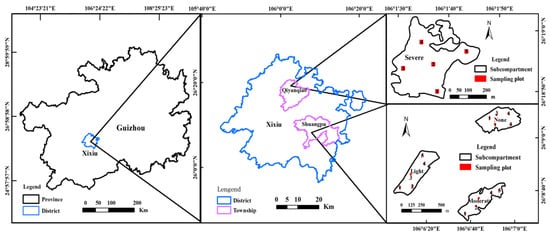
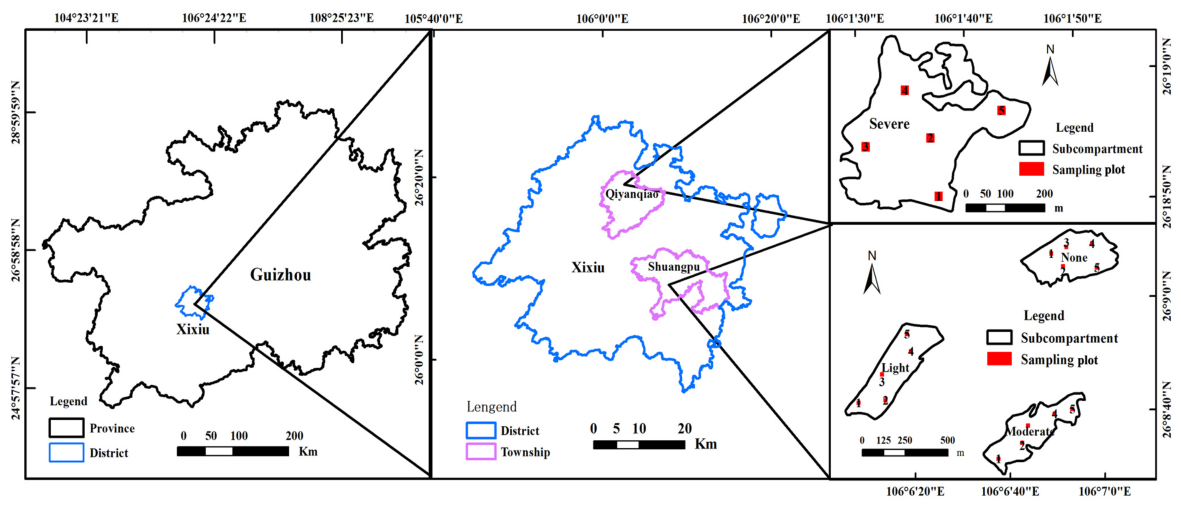
This study was conducted in Shuangbao Daba Village, Anshun, Guizhou Province, China (106.02–106.17° E, 26.15–26.30° N; Figure 1). The study area is a karst plateau–canyon region with an average elevation of 1350 m) with yellow and limestone soils. The area features a subtropical monsoon climate (mean annual temp: 13.5 °C, precipitation: 1150 mm) and vegetation dominated by subtropical evergreen–deciduous broadleaved mixed forest, including cultivated R. roxburghii. Plots were established across four RDG levels classified by bedrock exposure (LY/T 1838-2009). Local floras include R. roxburghii, Clematis spp., Ziziphus jujuba, Betula luminifera, and Pinus massoniana.
Figure 1.
Location and topographical context of the study area. The left panel depicts the study area with a blue polygon, the middle panel illustrates the sample plot distribution via purple polygons, and the right panel characterizes the four RDG zones through black lines, with red numerals marking the specific plots.
2.2. Plot Establishment
Following Xiong et al. [20], 20 permanent 50 m × 50 m plots of 10-year-old R. roxburghii monocultures were established using a stratified sampling design. These plots were distributed across four RDG levels categorized by bedrock exposure rates: none (<20%), light (20%–45%), moderate (46%–70%), and severe (>70%) (Table A1). To ensure spatial independence, five plots per RDG were distributed across different micro-watersheds separated by at least 500 m. The topographically homogeneous sites (elevation: 1200–1500 m; aspect variation: <15°) feature slightly acidic yellow earth (pH 6.43; total organic carbon 33.80 g·kg−1, total nitrogen 1.69 g·kg−1, total phosphorus 0.45 g·kg−1, total potassium 13.98 g·kg−1). Recorded covariates for each plot included vegetation coverage and soil depth, with the latter corresponding to 60, 50, and 30 cm across the gradient. To maintain experimental consistency, all plots were subjected to 10 years of standardized organic management and conventional silviculture (e.g., pruning and weeding) under natural precipitation conditions.
2.3. Sampling Collection
Sampling was conducted in September 2025 during the peak fruiting season. Within each plot, five sampling points were systematically arranged using a diagonal pattern to ensure spatial representation. Five healthy, mature fruit-bearing plants (exhibiting no symptoms of pests or diseases, with less than 5% leaf lesions) were selected, yielding a total of 25 individuals. Mature fruits with at least 80% surface coloration were harvested from each plant. A minimum inter-plant distance of 20 m was maintained to minimize spatial autocorrelation and ensure that each plant served as a spatially independent experimental unit. Soil samples were collected at 0–20 cm and 20–40 cm depths within a 1 m radius of each plant. For each individual, six soil cores (three per depth) were thoroughly homogenized to form a representative composite sample. This procedure yielded five biological replicates per plot, totaling 100 soil samples across the four RDG levels. The soil samples were air-dried at 25 °C (RH < 30%), stone and root debris were removed, and a representative 500 g subsample was obtained by quartering, followed by ball-milling and passing through a 100-mesh sieve.
2.4. Analytical Methods
Soil pH (1:2.5 soil:water) and moisture content (oven-drying at 105 °C, ISO 11465) were determined, the latter cross-validated via a HydraProbe II sensor (Stevens Water Monitoring Systems, Inc., Portland, OR, USA). All chemical reagents were of analytical grade and purchased from Sinopharm Chemical Reagent Co., Ltd. (Shanghai, China). Total organic carbon (TOC) and total nitrogen (TN) in soil and fruit were quantified by dry combustion (ISO 10694). Available nitrogen (AN) was extracted with 2 M KCl. Total phosphorus (TP), post HClO4–H2SO4 digestion, was measured via molybdenum blue colorimetry, while available phosphorus (AP) used Olsen’s method. Total and available potassium (TK, AK) were analyzed by flame photometry (Sherwood M410 flame photometer, Sherwood Scientific Ltd., Cambridge, UK), with AK extracted via ammonium acetate. Fruit vitamin C (FVC) content was determined by HPLC (Agilent 1260 Infinity HPLC system, Agilent Technologies, Santa Clara, CA, USA) according to GB 5009.86-2016, and fruit fructose (FF) was measured using the phenol–sulfuric acid method with glucose as a standard. Experiments were performed with three biological replicates, each containing three technical replicates. Quantification was based on calibration curves with R2 > 0.999. Before analysis, data were preprocessed using Shapiro–Wilk normality tests and Grubbs’ tests (α = 0.05) for outlier removal to ensure statistical integrity.
2.5. Statistical Analysis
Differences between desertification grades were assessed using one-way ANOVA followed by Duncan’s post hoc test (p < 0.05). Before that, three key assumptions were verified: (1) independence, which was ensured by the stratified sampling design; (2) normality, assessed via the Shapiro–Wilk test, which confirmed the approximately normal distribution of all variables (p > 0.05 for the majority of groups); and (3) homogeneity of variances, which was checked using Levene’s test (p > 0.05 for all variables). To identify key drivers for model construction, pairwise associations were evaluated using Pearson correlation analysis. Based on ecological considerations, we hypothesized that the RDG indirectly affects fruit quality traits (FVC and FF) through the sequential mediation of soil nutrients, soil stoichiometry, and fruit stoichiometry. Following a hierarchical analytical strategy, ANOVA was applied as the primary confirmatory method to test for differences in key response variables across the four RDG levels.
Subsequently, SEM was employed to evaluate potential mechanistic pathways linking soil attributes to fruit quality traits. The dataset follows a nested hierarchy: individual plants (Level 1, n = 100), plots (Level 2, n = 20), and RDG treatments (Level 3, n = 4). To implement the SEM, each plant was treated as an independent sample (n = 100) due to the minimum 20 m spacing and environmental heterogeneity. To ensure model robustness and handle potential non-normality, we employed data standardization and 1000 bootstrap resamples (bias-corrected percentile CIs) prior to analysis. Model assumptions were rigorously verified, ensuring multivariate normality (Mardia’s test), absence of multicollinearity (VIF < 3.0), and proper model identification (df > 0). The final model fit was evaluated using multiple indices (e.g., χ2/df, CFI, and RMSEA), with significance set at p < 0.05 after Benjamini–Hochberg FDR correction. To test for within-plot dependence, a sensitivity analysis was performed using plot-level means (n = 20). It was confirmed that core pathways retained their direction and significance and that n = 100 results were not driven by within-plot resemblance. All statistical analyses were performed using R version 4.4.3 (R Core Team, Vienna, Austria, 2025) and SPSS version 26.0 (IBM Corp., Armonk, NY, USA).
3. Results
3.1. Response Patterns Along the Rocky Desertification Gradient
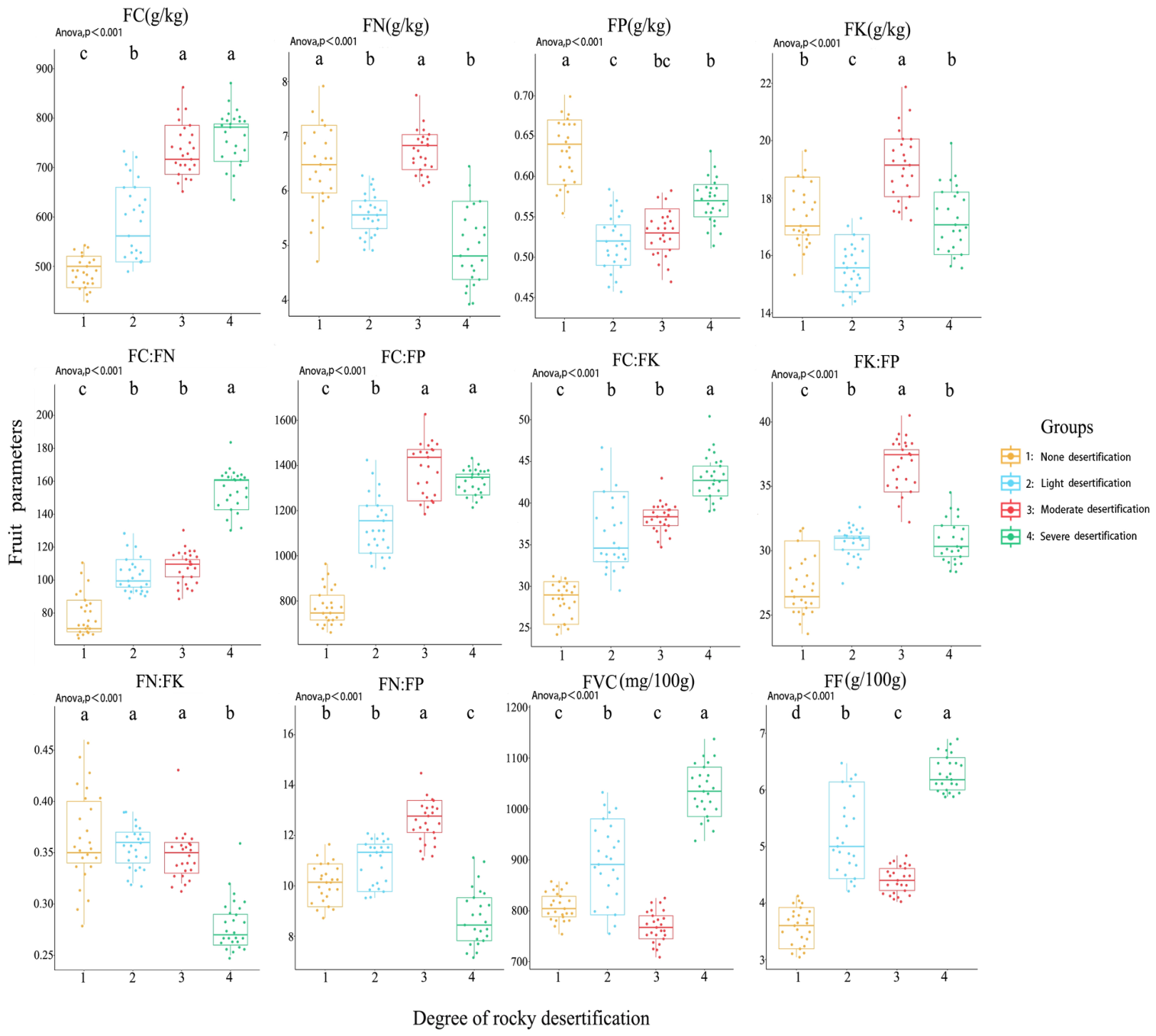
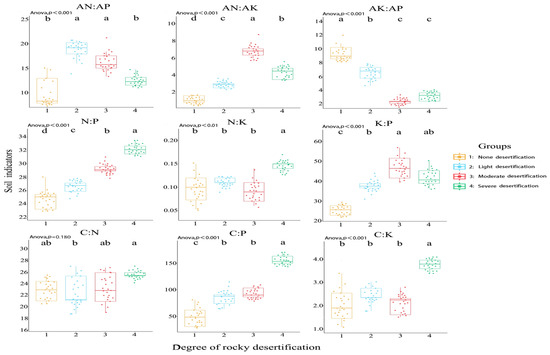
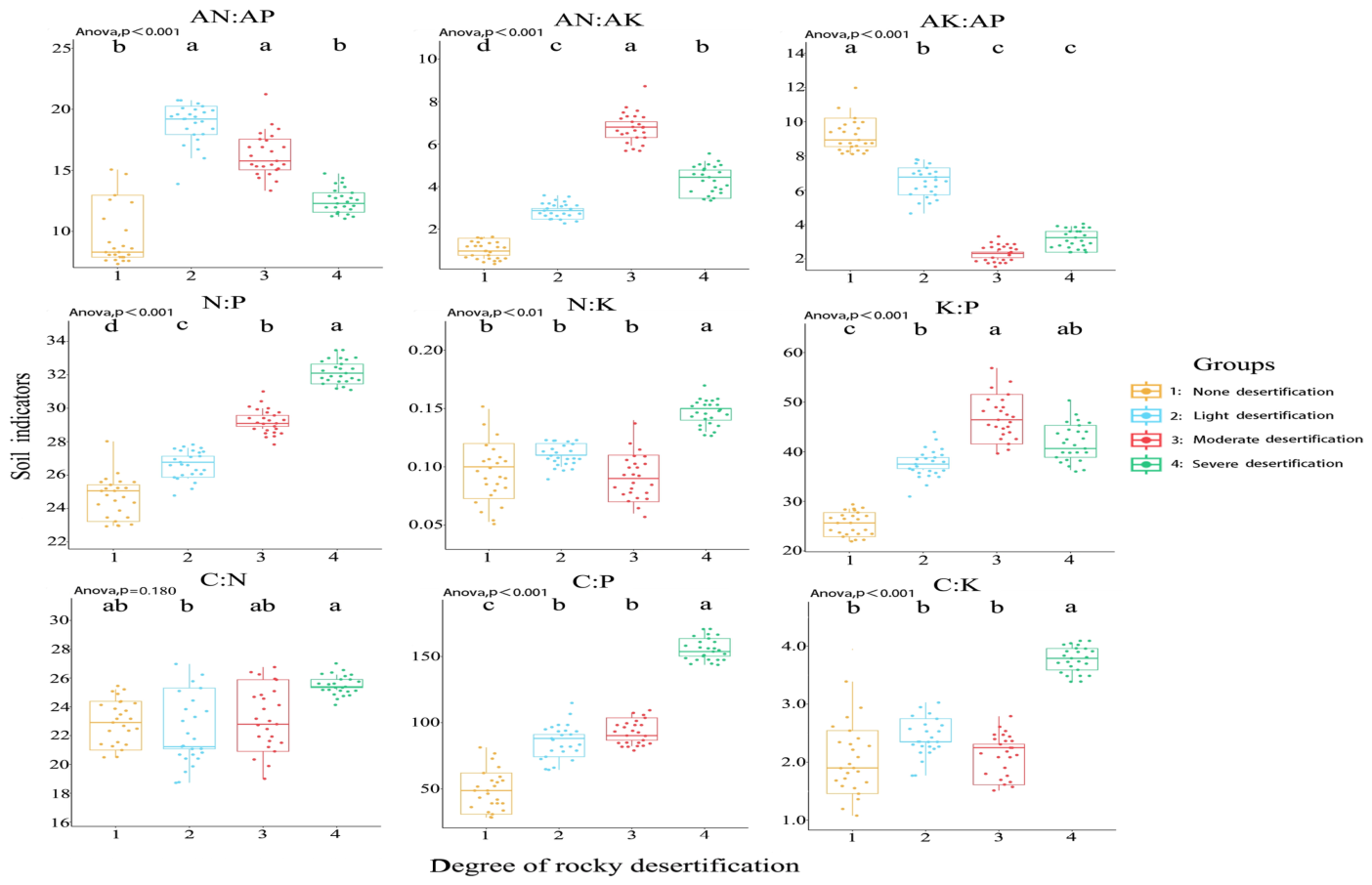
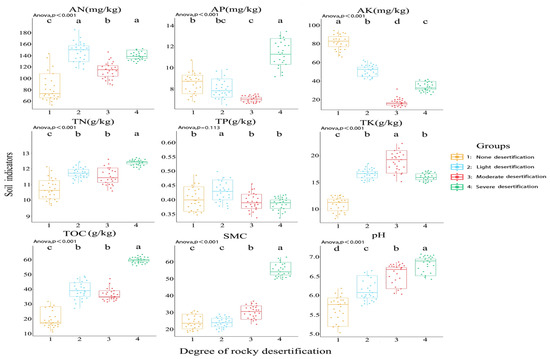
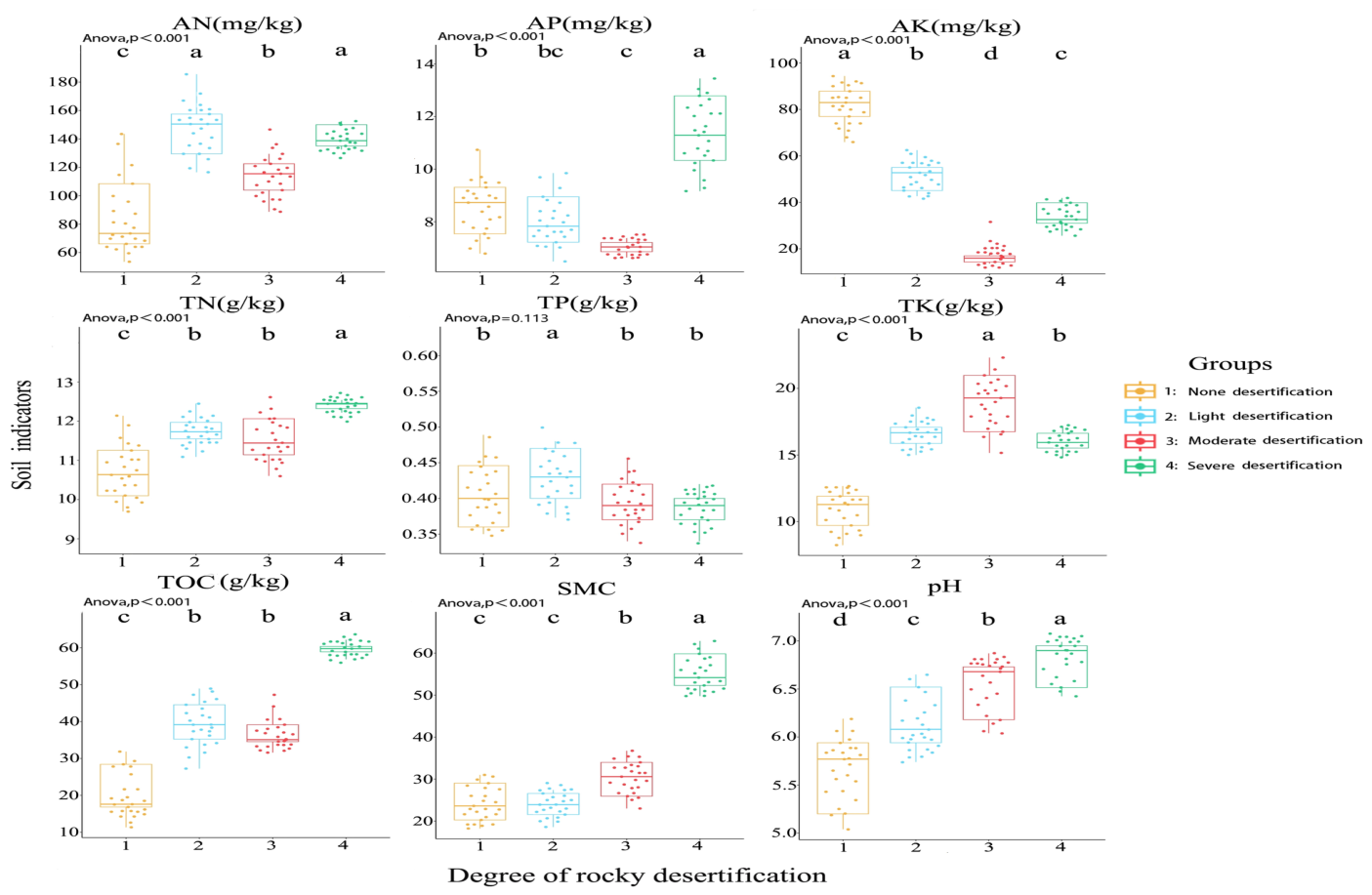
As shown in Figure 2, Figure 3 and Figure 4: (1) Along the rocky desertification gradient, the key parameters exhibited three principal response patterns. Soil total nitrogen (TN), total organic carbon (TOC), N:P, C:P, fruit carbon (FC), and soil water content (SMC) showed a monotonically increasing pattern, driven by concentration effects or undecomposed litter accumulation. In contrast, available N:K ratios and soil total potassium (TK) peaked at moderate desertification, reflecting an ecological threshold of nutrient availability. Furthermore, the soil C:K ratio exhibited a non-linear fluctuation pattern—characterized by a transient improvement under light stress, intensified imbalance under moderate stress, and partial recovery under severe stress—suggesting an adaptive system adjustment. Overall, the rocky desertification gradient drives a phased transition from “nutrient accumulation” to “availability constraint” and then to “system feedback.” (2) Fruit C:P ratio (FC:FP) and soil available potassium (AK) followed opposing unimodal patterns, peaking and reaching a minimum under moderate desertification, respectively. Unlike the monotonic increases in soil TN, TOC, N:P, and C:P mentioned above, the AK response highlights a decoupling between bulk nutrient pools and potassium bioavailability. This asynchrony suggests that plant reproductive allocation is sensitive to the depletion of available nutrients rather than total nutrient accumulation during karst desertification.
Figure 2.
Variations in C, N, P, and K concentrations, their stoichiometric ratios, and fruit quality indicators in Rosa roxburghii Tratt woodlands across a gradient of rocky desertification. The visualization utilizes four distinct colors to represent the measured indices across different karst desertification intensities. On the X-axis, the numerical identifiers 1, 2, 3, and 4 correspond to non-, light, moderate, and severe rocky desertification levels, respectively. In the multi-panel layout, the first row delineates the elemental concentrations (C, N, P, and K), while the subsequent rows illustrate the stoichiometric ratios between these elements. Different lowercase letters within the same row denote significant differences at the p ≤ 0.05 level as determined by the Least Significant Difference (LSD) test.
Figure 3.
Variations in soil C, N, P, and K concentrations, along with available N, P, and K, characterize the nutrient dynamics in R. roxburghii woodland across different degrees of karst rocky desertification. Specific definitions for the parameters used are detailed in Figure 2.
Figure 4.
The ecological stoichiometric characteristics of soil total and available C, N, P, and K exhibit significant variation patterns along a rocky desertification gradient in R. roxburghii woodlands. Specific definitions for the parameters used are detailed in Figure 2.
3.2. Correlations Among Soil Indicators and Between Soil and Fruit Quality Indicators
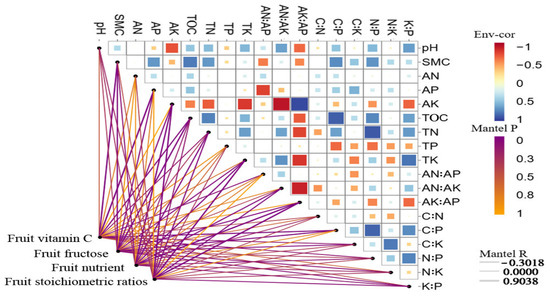
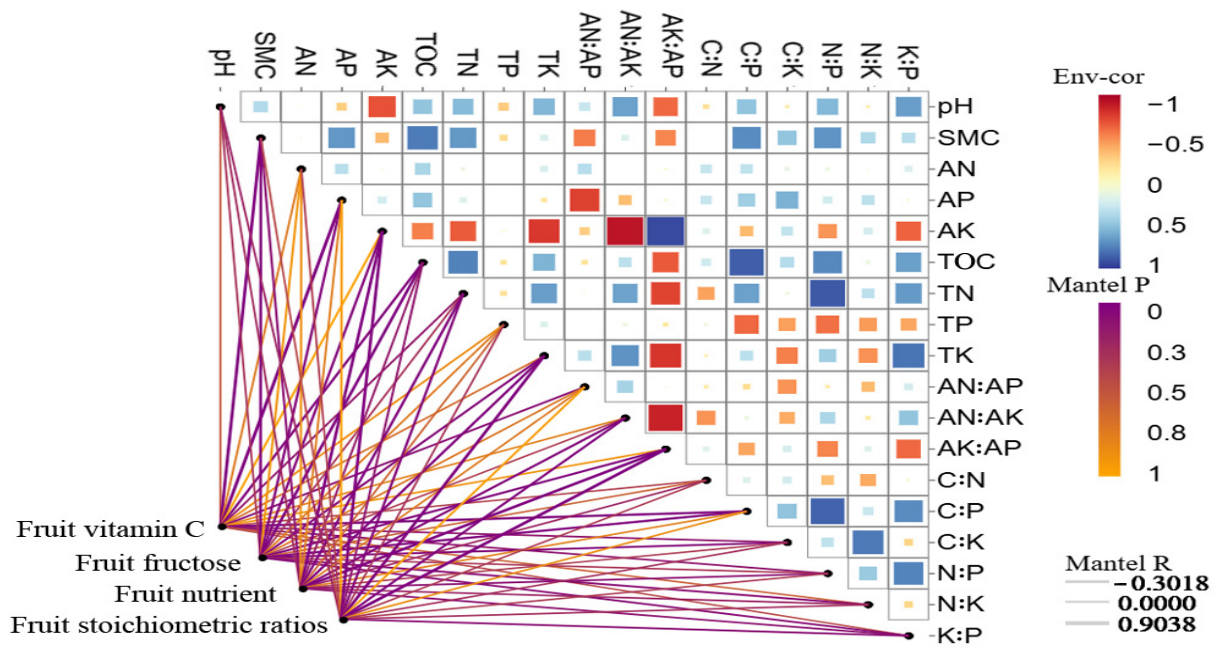
The Mantel test revealed distinct correlation patterns between soil properties and fruit quality parameters (Table A2 and Table A3 and Figure 5). Regarding fruit internal quality, soil properties, including available K:P ratios, available N:K ratios, AK, TK, and TN, were significantly and positively associated with fruit nutrient content and stoichiometric ratios (r = 0.29–0.74, p = 0.001–0.037). In contrast, the correlation patterns for physical traits (FVC and FF) appeared more heterogeneous: TOC, AP, C:P, and SMC exhibited significant correlations with both parameters (r = 0.28–0.63, p = 0.003–0.04), whereas N:P was uniquely linked to FVC (r = 0.34, p = 0.031). Additionally, AK, TK, and C:K demonstrated specific correlations with FF (r = 0.24–0.29, p = 0.039–0.048).
Figure 5.
Correlations between soil properties and R. roxburghii fruit traits. Mantel test network (left): lines connect fruit traits to soil properties; line thickness reflects Mantel’s *r* statistic, with purple and orange edges indicating significant and non-significant correlations, respectively. Matrix of soil variable correlations (right): tile size and color intensity (red/blue) represent the magnitude and sign of Pearson correlation coefficients between soil properties.
Correlation analysis revealed a tightly coupled soil property network. Within the carbon–water–phosphorus system, SMC displayed high associations with TOC (r = 0.77) and the soil C:P ratio (C:P; r = 0.72), while showing a moderate association with AP (r = 0.68). In the potassium system, AK functioned as a dynamic core, exhibiting pronounced negative covariation with TK (r = −0.78) and available N:K ratios (r = −0.91), alongside a robust positive correlation with available K:P ratios (r = 0.94). This network also encompassed significant interactions of TK with available K:P ratios (r = −0.79) and available N:K ratios (r = 0.70), as well as between available K:P ratios and available N:K ratios (r = −0.86). Furthermore, the key stoichiometric ratios were primarily driven by single elements—specifically, C:P by TOC (r = 0.87) and N:P by TN (r = 0.88)—highlighting the inherent collinearity in ratio-based metrics.
3.3. SEM Analysis of Karst Stress Effects on Fruit Traits
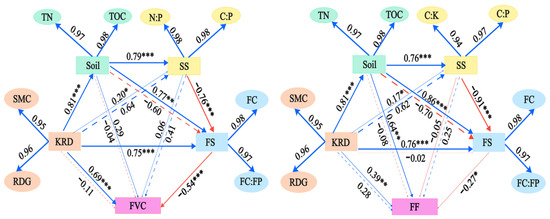
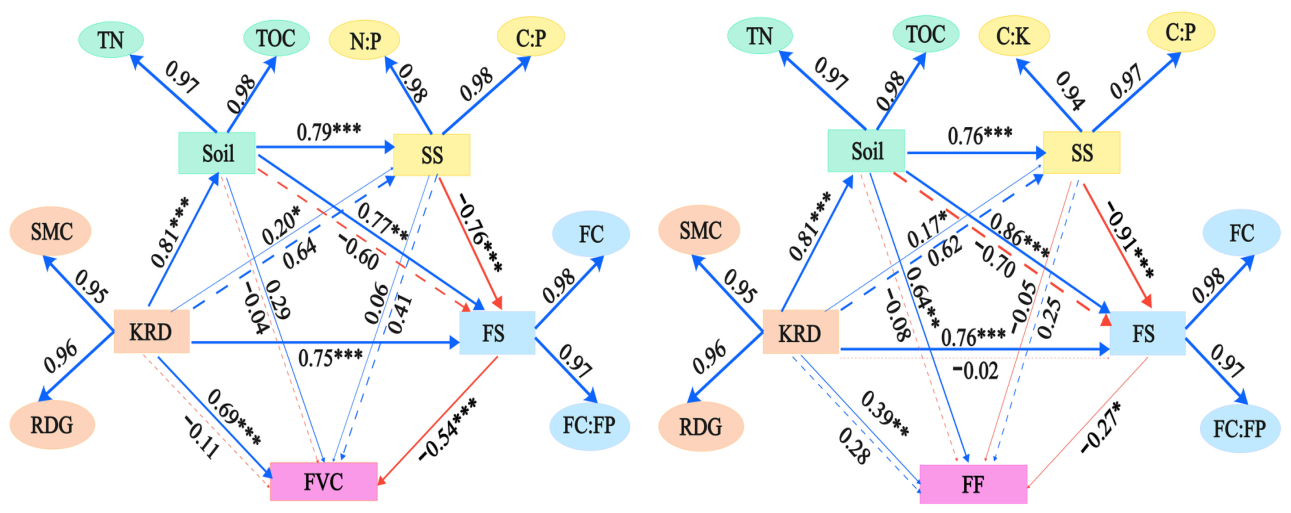
Preliminary checks confirmed VIFs < 3.0 and model identifiability. To account for the observed non-normality (Mardia’s test, p < 0.001), a bootstrap procedure (1000 resamples) was employed to ensure stable SEs and BCa CIs. All measurement models exhibited good to excellent fit (GOF > 0.79), and all latent variables achieved an AVE > 0.90, indicating strong convergent validity (Table A4, Figure 6). All indicator loadings were high and statistically significant, ranging from λ = 0.94 to 0.98. Specifically, the karst rocky desertification (KRD) latent variable was reliably measured by RDG and SMC, while the soil latent variable was indicated by TOC and TN. The soil stoichiometry (SS) latent variable was represented by C:P and N:P in FVC (λ = 0.981), and by C:P and C:K in FF (λ = 0.944–0.969), with high AVEs (0.916–0.963). The fruit stoichiometry (FS) latent variable was consistently represented by FC (λ = 0.978–0.979) and FC:FP (λ = 0.974–0.975) across both models (AVE = 0.954).
Figure 6.
Structural equation models of R. roxburghii fruit traits and soil properties. In the SEM diagrams, rectangles represent latent variables, including karst rocky desertification (KRD), soil nutrients (soil), soil stoichiometry (SS), fruit stoichiometry (FS), and fruit traits (FVC/FF). Ellipses represent observed variables, such as specific indicators of KRD (e.g., rocky desertification gradient (RDG), soil moisture content (SMC)), soil (e.g., total organic carbon (TOC), total nitrogen (TN)), SS (e.g., soil N:P ratio (N:P), soil C:P ratio (C:P), soil C:K ratio (C:K)), and FS (e.g., fruit organic carbon (FC), fruit C:P ratio (FC:FP)). Blue and red arrows denote significant positive and negative pathways, respectively (solid arrows: direct effects; dashed arrows: indirect effects). Path coefficients are standardized. Significance levels: * p < 0.05, ** p < 0.01, *** p < 0.001.
The SEM and path analysis (Table A5 and Table A6, Figure 6) revealed a primary regulatory pathway: KRD significantly promoted soil development (β = 0.81–0.82, p < 0.001), which subsequently influenced SS. Notably, SS exerted a consistent and strong negative direct effect on FS across all models (β = −0.76 to −0.91, p < 0.001). The regulatory impacts on final fruit traits exhibited patterns of convergence and divergence. Specifically, FVC was positively influenced by KRD (β = 0.69) but inhibited by FS (β = −0.54), with both effects reaching high significance (p < 0.001). For FF, while KRD and soil showed positive direct effects (β = 0.39 and 0.64, respectively; p = 0.007 for KRD, p = 0.001 for soil), FS showed negative effects in the n = 100 model (β = −0.27, p = 0.021) but was non-significant in the n = 20 model (β = −0.20, p = 0.350).
All models demonstrated acceptable to good overall fit (Table A7: χ2/df = 3.15–3.27, RMSEA ≤ 0.075, CFI ≥ 0.916, SRMR ≤ 0.083, GOF > 0.79), confirming the robustness of the framework in capturing the linkages within the karst environment–soil–stoichiometry–fruit trait system.
4. Discussion
4.1. Direct Induction and P-Limited Accumulation of Vitamin C Under Karst Stress
In this study, the soil N:P ratio ranged from 25.49 to 32.45 (Table A8), and all values were well above the threshold for phosphorus limitation (N:P > 16). TP concentrations range from 0.38 to 0.44 g·kg−1, and AP concentrations range from 7.02 to 11.37 mg·kg−1 (Table A8). Although the AP levels are partially comparable to the reported ranges for karst regions of Guangxi (2.11–9.37 mg·kg−1) [21], the TP levels are significantly lower than those benchmarks (0.84–2.36 g·kg−1) [21]. It is evident that phosphorus deficiency is a critical factor limiting the recovery of this degraded karst ecosystem.
The SEM reveals that KRD exhibits dual associations with the FVC content in R. roxburghii fruit. Specifically, KRD has a significant direct positive effect on FVC, suggesting that karst stress itself serves as a potential primary driver for the accumulation of this anti-oxidant compound [22,23]. Nevertheless, this potential positive association is accompanied by an indirect negative effect on soil phosphorus availability. Specifically, KRD-induced phosphorus limitation—reflected in elevated soil C:P and N:P ratios (SS)—corresponds to a discernible decline in fruit phosphorus status (FS), as evidenced by the elevated FC:FP and decreased fruit phosphorus (FP), and is significantly associated with FVC accumulation [24,25]. According to ecological stoichiometry theory [26], such phosphorus scarcity is negatively associated with the synthesis of carbon-rich secondary metabolites such as vitamin C, together with the prioritization of limited phosphorus toward essential primary physiological processes. This theoretical interpretation is consistent with our observed negative association between phosphorus deficiency and FVC, although the present study did not directly measure carbon allocation, metabolic flux, or physiological partitioning.
The final FVC content reflects a trade-off between two opposing patterns: the RDG-induced morphological response, and the additional biomass allocation costs that co-occur with phosphorus limitation [27]. Consequently, FVC exhibits a non-monotonic response along the relative RDG: direct RDG induction dominates under mild stress but weakens or reverses under severe stress. As RDG stress intensifies further, the inhibitory pattern associated with phosphorus limitation reaches a critical threshold and shows a stronger association than the facilitative pattern of RDG induction. Under severe stress, acute survival pressure coincides with a compensatory antioxidant synthesis response, potentially corresponding to elevated FVC levels together with the bypassing of stoichiometric constraints [28]. This trade-off is consistent with plant resource allocation principles [29], where environmental signals and internal resource status interact to shape metabolic investment [30,31]. This regulatory logic underscores how fruit quality traits may emerge from context-dependent prioritization between stress adaptation and nutrient limitations [32,33].
4.2. Fructose Accumulation Balanced by Direct Karst Stress and Phosphorus Limitation
FF accumulation under KRD appears to be associated with direct and indirect pathways. The direct pathway is suggested by the enhancing effects of KRD and soil nutrients (TOC and TN) on FF concentrations, indicating that stress conditions and nitrogen availability may be linked to photoassimilate transport and carbohydrate assimilation [34]. Furthermore, the significant correlations between soil/fruit potassium (AK, TK, C:K) and FF suggest that potassium is positively associated with this accumulation [35,36], although direct measurements of phloem transport or sugar translocation were not conducted in this study [37].
The indirect pathway pertains to the manifestation of phosphorus (P) limitation: KRD-induced increases in soil nutrients are associated with alterations in nutrient stoichiometry, corresponding to elevated SS, which, in turn, corresponds to a decline in FS, and ultimately, is negatively associated with FF. This P-limited state is potentially associated with disruptions in sugar metabolism and storage in fruit sink cells [38], but the underlying physiological and molecular mechanisms (e.g., ATP supply, membrane synthesis, gene expression) were not directly tested. Within this metabolic context, potassium dynamics may interact with these P-associated constraints [39,40]; specifically, an optimal potassium status could be partially related to an alleviation of the sink-strength limitation that co-occurs with P deficiency [41], although the specific mechanisms (e.g., cellular turgor or enzyme activities) remain to be elucidated without direct measurements.
FF shows a nonlinear response to KRD intensity across a gradient of stress severity. Under mild stress, direct promotion (including nutrient-driven and potassium-facilitated transport) is the dominant association. As the intensity progresses into moderate stress, P-limitation-mediated metabolic constraints peak, effectively coinciding with further suppressed accumulation. Under severe stress, however, increased osmotic or storage demands may partially co-occur with a reduction in these constraints, corresponding to a secondary phase of accumulation [42]. This pattern is consistent with a dynamic trade-off between nutrient/transport-driven promotion and stoichiometry-associated metabolic limitation, reflecting shifts in internal resource allocation under elemental imbalance [43]. In summary, FF accumulation likely reflects the integration of direct nutrient signals and metabolic networks, where phosphorus limitation corresponds to a fundamental metabolic threshold, while potassium dynamics are associated with modulations in the efficiency of source–sink regulation and sugar transport under this condition.
4.3. A Dual-Pathway Framework of Direct Stress and Stoichiometric Constraints
The conclusion that phosphorus limitation is associated with KRD effects is supported by elevated soil C:P and N:P ratios, which indicate intensified biological P limitation [44]. Furthermore, the SEM confirms that this nutrient restriction corresponds to an inhibition-related pathway from SS to FS, with a potential link to fruit metabolites. These results are synthesized into a dual-pathway “stress induction–stoichiometric constraint” framework. KRD is associated with fruit quality through (1) a direct stress–response pathway, where KRD is positively associated with the accumulation of vitamin C and fructose [45,46], and (2) an indirect pathway where P limitation—acting as the primary stoichiometric constraint—systemically corresponds to resource conversion via the SS → FS signaling cascade [47,48]. This framework illustrates how stoichiometric imbalance, rather than total nutrient pools, is related to metabolic outcomes under environmental stress.
The final metabolite levels reflect the intricate balance between these metabolic pathways. Phosphorus constraint strongly inhibits vitamin C accumulation under moderate stress, although compensatory mechanisms may emerge under severe stress [49]. Conversely, fructose accumulation results from the interplay between P-promoted processes (notably potassium-facilitated transport) and P-limited suppression of carbohydrate metabolism [50,51]. These pathways coexist and exert a synergistic regulation on R. roxburghii fruit traits [52,53], through divergent responses are displayed by vitamin C and fructose to P availability.
5. Conclusions
KRD is correlatively associated with R. roxburghii fruit quality through a dual-pathway mechanism. The nonlinear effects of KRD stress on vitamin C and fructose are associated with soil C:N:P:K stoichiometry, which links direct stress induction to metabolic constraints. Specifically, phosphorus limitation is negatively associated with the biosynthesis of energy-intensive metabolites such as vitamin C, and this relationship corresponds to the source–sink balance and is associated with fructose accumulation under stoichiometric constraints.
These findings are integrated into a “stress induction–stoichiometric constraint” framework, wherein final fruit quality corresponds to the dynamic balance between the two pathways. This correlative framework provides a novel stoichiometric perspective, but it requires causal validation through experimental nutrient enrichment (e.g., factorial P and K applications) and molecular studies to elucidate nutrient-signaling cross-talk and disentangle the effects of P limitation from associated potassium dynamics.
Author Contributions
M.D. contributed to formal analysis, resources, writing—original draft preparation, and funding acquisition; M.L. contributed to investigation, methodology, and writing—review and editing. All authors have read and agreed to the published version of the manuscript.
Funding
This research was supported by the Science and Technology Support Project of Guizhou Province under Grant No. Qian-ke-he Zhicheng (2020) 1Y120.
Data Availability Statement
All original data generated in this study are presented within the article.
Acknowledgments
We are grateful to the technicians at the Forestry Bureau of Xixiu District for their assistance in the field trial, and to the academic technician and student assistants at Guizhou Academy of Agricultural Sciences for their excellent laboratory work and support.
Conflicts of Interest
The authors declare no conflicts of interest.
Abbreviations
| TOC | Total organic carbon |
| TN | Total nitrogen |
| TP | Total phosphorus |
| TK | Total potassium |
| C:N | Soil C:N ratio |
| C:P | Soil C:P ratio |
| C:K | Soil C:K ratio |
| N:P | Soil N:P ratio |
| N:K | Soil N:K ratio |
| K:P | Soil K:P ratio |
| AN | Available nitrogen |
| AP | Available phosphorus |
| AK | Available potassium |
| AN:AP | Available N:P ratio |
| AN:AK | Available N:K ratio |
| AK:AP | Available K:P ratio |
| FC | Fruit organic carbon |
| FN | Fruit nitrogen |
| FP | Fruit phosphorus |
| FK | Fruit potassium |
| FC:FN | Fruit C:N ratio |
| FC:FP | Fruit C:P ratio |
| FN:FP | Fruit N:P ratio |
| FC:FK | Fruit C:K ratio |
| FN:FK | Fruit N:K ratio |
| FK:FP | Fruit K:P ratio |
| FVC | Fruit vitamin C |
| FF | Fruit fructose |
| KRD | Karst rocky desertification |
| RDG | Rocky desertification gradient |
| SMC | Soil moisture content |
Appendix A
Table A1.
Soil properties and spatial heterogeneity in R. roxburghii forests across rocky desertification gradients.
Table A2.
Correlations between soil properties and R. roxburghii fruit quality under karst rocky desertification.
Table A3.
Correlation matrix of soil nutrients and stoichiometric ratios in R. roxburghii. * p < 0.05, ** p < 0.01.
Table A4.
Model fit indices for soil properties and R. roxburghii fruit traits. Factor loadings (λ) > 0.90 and communalities > 0.89 indicate excellent model quality. SS indicators: N:P for the FVC model and C:K for the FF model.
Table A5.
Standardized direct path coefficients from soil properties to R. roxburghii fruit traits (structural equation model). Standardized path coefficients (β) with significance levels indicated (* p < 0.05, ** p < 0.01, *** p < 0.001; n.s., not significant).
Table A6.
Direct, indirect, and total effects of soil properties on R. roxburghii fruit quality in structural equation modeling. All effects are standardized. * p < 0.05, ** p < 0.01, *** p < 0.001.
Table A7.
Goodness-of-fit indices of the structural equation model linking soil properties to R. roxburghii fruit quality.
Table A8.
List of soil and fruit indicators measured in R. roxburghii under different karst rocky desertification (KRD) gradients.
References
- Jiang, Z.; Lian, Y.; Qin, X. Rocky desertification in Southwest China: Impacts, causes, and restoration. Earth-Sci. Rev. 2014, 132, 1–12. [Google Scholar] [CrossRef] [Scilit]
- Yang, Q.; Zhu, D.; Chen, J. Effects of Planting Patterns on Soil Aggregates and Enzyme Activities in Rocky Desertification Areas of Karst Plateau Mountains. Pol. J. Environ. Stud. 2023, 32, 405–418. [Google Scholar] [CrossRef] [Scilit] [PubMed]
- Li, M.; Du, M.; Chen, H.; Shi, Y.; Yao, D.; Shi, Q. Stoichiometric Coupling of C, N, P, and K in the Litter and Soil of Rosa roxburghii Tratt Woodlands across Rocky Desertification Grades and Seasons. Forests 2024, 15, 1415. [Google Scholar] [CrossRef] [Scilit]
- Wang, L.; Lv, M.; An, J.; Fan, X.; Dong, M.; Zhang, S.; Wang, J.; Wang, Y.; Cai, Z.; Fu, Y. Botanical characteristics, phyto-chemistry and related biological activities of Rosa roxburghii Tratt fruit, and its potential use in functional foods: A review. Food Funct. 2021, 12, 1432–1451. [Google Scholar] [CrossRef] [Scilit] [PubMed]
- Meng, Q.; Fan, W. Calcium-tolerance type and adaptability to high-calcium habitats of Rosa roxburghii. Chin. J. Plant Ecol. 2022, 46, 1562–1572. [Google Scholar] [CrossRef] [Scilit]
- Min, X.; Zhang, S.; Xiong, K.; Wang, L.; Yang, Q. Pattern and driver of Rosa roxburghii Tratt suitability and its effect on ecological services in karst desertification control areas. Herit. Sci. 2024, 12, 422. [Google Scholar] [CrossRef] [Scilit]
- Liao, W.; Wei, Y.; Wei, Z. Exploring innovative assessment and driving mechanisms for achieving land degradation neutrality in rocky desertification areas: A case study of Yunnan-Guangxi-Guizhou, China. Ecol. Inform. 2025, 90, 103310. [Google Scholar] [CrossRef] [Scilit]
- Hu, T.; Xiong, K.; Yu, Y.; Wang, J.; Wu, Y. Ecological stoichiometry and homeostasis characteristics of plant-litter-soil system with vegetation restoration of the karst desertification control. Front. Plant Sci. 2023, 14, 1224691. [Google Scholar] [CrossRef] [Scilit] [PubMed]
- Zhang, J.; Li, X.; Wang, Q.; Wang, F.; Deng, B.; Han, Y.-b.; Li, W.; Yang, R. Cili (Rosa roxburghii Tratt.) as a Functional Food and Medicinal Resource: Current Advances and Future Directions. Curr. Issues Mol. Biol. 2026, 48, 249. [Google Scholar] [CrossRef] [Scilit] [PubMed]
- Xu, J.; Vidyarthi, S.; Bai, W.; Pan, Z. Nutritional constituents, health benefits and processing of Rosa roxburghii: A review. J. Funct. Foods 2019, 60, 103456. [Google Scholar] [CrossRef] [Scilit]
- Xiang, Y.; Luo, J.; Liu, Y.; Luo, Y.; Bolan, N.; Fan, J.; Shurpali, N.; Bhattarai, H.R.; Siddique, K.H.M.; Li, Y. Enhancing Soil Physicochemical Properties and Fruit Production of Rosa roxburghii with Biochar-Based Fertilizer in Karst Agricultural Systems. Food Energy Secur. 2025, 14, e70138. [Google Scholar] [CrossRef] [Scilit]
- Chen, J.; Ran, W.; Zhao, Y.; Zhao, Z.; Song, Y. Effects of fertilization on soil ecological stoichiometry and fruit quality in Karst pitaya orchard. Sci. Rep. 2024, 14, 68831. [Google Scholar] [CrossRef] [Scilit] [PubMed]
- Yang, H.; Zhang, P.; Zhu, T.; Li, Q.; Cao, J. The Characteristics of Soil C, N, and P Stoichiometric Ratios as Affected by Geological Background in a Karst Graben Area, Southwest China. Forests 2019, 10, 601. [Google Scholar] [CrossRef] [Scilit]
- He, J.; Zhang, X.; Guo, G.; Xiang, Y. Effects of Sod Cultivation on Stoichiometric Characteristics and Nutrient Contribution Rate of Soil Aggregates in Rosa roxburghii Tratt Orchard. Appl. Ecol. Environ. Res. 2023, 21, 2805–2818. [Google Scholar] [CrossRef] [Scilit]
- Hu, Q.; Sheng, M.; Bai, Y.; Jie, Y.; Xiao, H. Response of C, N, and P stoichiometry characteristics of Broussonetia papyrifera to altitude gradients and soil nutrients in the karst rocky ecosystem, SW China. Plant Soil 2020, 475, 123–136. [Google Scholar] [CrossRef] [Scilit]
- Wang, L.; Wang, P.; Sheng, M.; Jing, T. Ecological stoichiometry and environmental influencing factors of soil nutrients in the karst rocky desertification ecosystem, southwest China. Glob. Ecol. Conserv. 2018, 16, e00449. [Google Scholar] [CrossRef] [Scilit]
- Zhang, W.; Zhao, J.; Pan, F.; Li, D.; Chen, H.; Wang, K. Changes in nitrogen and phosphorus limitation during secondary succession in a karst region in southwest China. Plant Soil 2015, 391, 77–91. [Google Scholar] [CrossRef] [Scilit]
- Yu, M.; Sun, P.; Huang, X.; Zha, Z.; Wang, X.; Mantri, N.; Lou, H.; Jiang, B.; Shen, Z.; Sun, Y.-F.; et al. Interacting Effects of CO2, Temperature, and Nitrogen Supply on Photosynthetic, Root Growth, and Nitrogen Allocation of Strawberry at the Fruiting Stage. Agronomy 2023, 13, 1353. [Google Scholar] [CrossRef] [Scilit]
- Mao, Y.; Luo, J.; Cai, Z. Biosynthesis and Regulatory Mechanisms of Plant Flavonoids: A Review. Plants 2025, 14, 1847. [Google Scholar] [CrossRef] [Scilit] [PubMed]
- Xiong, K.N.; Li, P.; Zhou, Z.F.; An, Y.L.; Lü, T.; Lan, A.J. A Typical Study of Remote Sensing GIS on Karst Rocky Desertification: Guizhou Province; Geological Press: Beijing, China, 2002; pp. 134–137. [Google Scholar]
- Jiang, P.P.; Cao, Y.; Chen, Y.M.; Zhao, Y.P. N and P stoichiometric characteristics of leaves, litter, and soil for three dominant tree species in the Shaanxi Province. Acta Ecol. Sin. 2017, 37, 443–454. [Google Scholar] [CrossRef] [Scilit]
- Ferrandino, A.; Pagliarani, C.; Pérez-Álvarez, E. Secondary metabolites in grapevine: Crosstalk of transcriptional, metabolic and hormonal signals controlling stress defence responses in berries and vegetative organs. Front. Plant Sci. 2023, 14, 1124298. [Google Scholar] [CrossRef] [Scilit] [PubMed]
- Decros, G.; Baldet, P.; Beauvoit, B.; Stevens, R.; Flandin, A.; Colombié, S.; Gibon, Y.; Pétriacq, P. Get the Balance Right: ROS Homeostasis and Redox Signalling in Fruit. Front. Plant Sci. 2019, 10, 1091. [Google Scholar] [CrossRef] [Scilit] [PubMed]
- Paz-Ares, J.; Puga, M.; Rojas-Triana, M.; Martinez-Hevia, I.; Díaz, S.; Poza-Carrión, C.; Miñambres, M.; Leyva, A. Plant adaptation to low phosphorus availability: Core signaling, crosstalks and applied implications. Mol. Plant 2022, 15, 104–124. [Google Scholar] [CrossRef] [Scilit] [PubMed]
- Zheng, X.; Zhang, Q.; Tan, H.; Li, L.; Tang, Y.; Li, Z.; Peng, M.; Deng, W. Metabolism and Regulation of Ascorbic Acid in Fruits. Plants 2022, 11, 1602. [Google Scholar] [CrossRef] [Scilit] [PubMed]
- RoyChowdhury, A.; Srivastava, R.A.; Shukla, G.; Zehirov, G.; Mishev, K.; Kumar, R. Metabolic footprints in phosphate-starved plants. Physiol. Mol. Biol. Plants 2023, 29, 755–767. [Google Scholar] [CrossRef] [Scilit] [PubMed]
- Kayoumu, M.; Iqbal, A.; Muhammad, N.; Li, X.; Li, L.; Wang, X.; Gui, H.; Qi, Q.; Ruan, S.; Guo, R.; et al. Phosphorus Availability Affects the Photosynthesis and Antioxidant System of Contrasting Low-P-Tolerant Cotton Genotypes. Antioxidants 2023, 12, 466. [Google Scholar] [CrossRef] [Scilit] [PubMed]
- Vukmirović, A.; Škvorc, Ž.; Bogdan, S.; Krstonošić, D.; Bogdan, I.; Karažija, T.; Bačurin, M.; Brener, M.; Sever, K. The Role of Phosphorus Fertilization in Antioxidant Responses of Drought-Stressed Common Beech and Sessile Oak Provenances. Int. J. Mol. Sci. 2025, 26, 3053. [Google Scholar] [CrossRef] [Scilit] [PubMed]
- Mundim, F.; Pringle, E. Whole-Plant Metabolic Allocation Under Water Stress. Front. Plant Sci. 2018, 9, 852. [Google Scholar] [CrossRef] [Scilit] [PubMed]
- Isah, T. Stress and defense responses in plant secondary metabolites production. Biol. Res. 2019, 52, 39. [Google Scholar] [CrossRef] [Scilit] [PubMed]
- Du, B.; Haensch, R.; Alfarraj, S.; Rennenberg, H. Strategies of plants to overcome abiotic and biotic stresses. Biol. Rev. 2024, 99, 1524–1556. [Google Scholar] [CrossRef] [Scilit] [PubMed]
- Ozowara, X.; Whitehead, S. Variability in apple fruit quality across management systems and latitudinal climate gradients. Plants People Planet 2026, 8, 212–230. [Google Scholar] [CrossRef] [Scilit]
- Cervantes, L.; Ariza, M.; Miranda, L.; Lozano, D.; Medina, J.; Soria, C.; Martínez-Ferrí, E. Stability of Fruit Quality Traits of Different Strawberry Varieties under Variable Environmental Conditions. Agronomy 2020, 10, 1242. [Google Scholar] [CrossRef] [Scilit]
- Wu, Y.; Wu, Y. The Increase in the Karstification–Photosynthesis Coupled Carbon Sink and Its Implication for Carbon Neutrality. Agronomy 2022, 12, 2147. [Google Scholar] [CrossRef] [Scilit]
- Rogiers, S.; Coetzee, Z.; Walker, R.; Deloire, A.; Tyerman, S. Potassium in the Grape (Vitis vinifera L.) Berry: Transport and Function. Front. Plant Sci. 2017, 8, 1629. [Google Scholar] [CrossRef] [Scilit] [PubMed]
- Abelenda, J.; Bergonzi, S.; Oortwijn, M.; Sonnewald, S.; Du, M.; Visser, R.; Sonnewald, U.; Bachem, C. Source-Sink Regulation Is Mediated by Interaction of an FT Homolog with a SWEET Protein in Potato. Curr. Biol. 2019, 29, 1178–1186.e6. [Google Scholar] [CrossRef] [Scilit] [PubMed]
- Gu, H.; He, Z.; Lu, Z.; Liao, S.; Zhang, Y.; Li, X.; Cong, R.; Ren, T.; Lu, J. Growth and survival strategies of oilseed rape (Brassica napus L.) leaves under potassium deficiency stress: Trade-offs in potassium ion distribution between vacuoles and chloroplasts. Plant J. 2025, 121, e70009. [Google Scholar] [CrossRef] [Scilit] [PubMed]
- Wu, S.; Li, M.; Zhang, C.; Tan, Q.; Yang, X.; Sun, X.; Pan, Z.; Deng, X.; Hu, C. Effects of phosphorus on fruit soluble sugar and citric acid accumulations in citrus. Plant Physiol. Biochem. 2021, 160, 73–81. [Google Scholar] [CrossRef] [Scilit] [PubMed]
- McDonough, A.; Fenton, R. Potassium homeostasis: Sensors, mediators, and targets. Pflüg. Arch. Eur. J. Physiol. 2022, 474, 853–867. [Google Scholar] [CrossRef] [Scilit] [PubMed]
- Mahiwal, S.; Pandey, G. Potassium: A vital nutrient mediating stress tolerance in plants. J. Plant Biochem. Biotechnol. 2022, 31, 705–719. [Google Scholar] [CrossRef] [Scilit]
- Yan, J.; Ye, X.; Song, Y.; Ren, T.; Wang, C.; Li, X.; Cong, R.; Lu, Z.; Lu, J. Sufficient potassium improves inorganic phosphate-limited photosynthesis in Brassica napus by enhancing metabolic phosphorus fractions and Rubisco activity. Plant J. 2022, 113, 576–594. [Google Scholar] [CrossRef] [Scilit] [PubMed]
- Wen, D.; Huang, Y.; Huang, Y.; Ding, N.; Ni, K.; Wang, H.; Elrys, A.; Meng, L.; Zhu, T.; Gessert, A.; et al. Karst rocky desertification restoration increases soil inorganic N supply to reduce plant N limitation. CATENA 2024, 243, 108012. [Google Scholar] [CrossRef] [Scilit]
- Xie, J.; Yan, Z.; Wang, G.; Xue, W.; Li, C.; Chen, X.; Chen, D. A Bacterium Isolated From Soil in a Karst Rocky Desertification Region Has Efficient Phosphate-Solubilizing and Plant Growth-Promoting Ability. Front. Microbiol. 2021, 11, 625450. [Google Scholar] [CrossRef] [Scilit] [PubMed]
- Pang, D.; Wang, G.; Li, G.; Sun, Y.; Liu, Y.; Zhou, J. Ecological Stoichiometric Characteristics of Two Typical Plantations in the Karst Ecosystem of Southwestern China. Forests 2018, 9, 56. [Google Scholar] [CrossRef] [Scilit]
- Huang, M.; Xu, Q.; Deng, X. L-Ascorbic acid metabolism during fruit development in an ascorbate-rich fruit crop chestnut rose (Rosa roxburghii Tratt). J. Plant Physiol. 2014, 171, 1205–1216. [Google Scholar] [CrossRef] [Scilit] [PubMed]
- Feng, T.; Sun, Z.; Liu, M.; Zhao, H.; Zhang, Y.; García-Caparrós, P.; Yang, B.; Yang, Y. Genome-Wide Characterization and Identification of Auxin Response Factor (ARF) Gene Family Reveals the Regulation of RrARF5 in AsA Metabolism in Rosa roxburghii Tratt Fruits. Biology 2025, 14, 1156. [Google Scholar] [CrossRef] [Scilit] [PubMed]
- Vance, C.; Uhde-Stone, C.; Allan, D. Phosphorus acquisition and use: Critical adaptations by plants for securing a nonrenewable resource. New Phytol. 2003, 157, 423–447. [Google Scholar] [CrossRef] [Scilit] [PubMed]
- Chiou, T.; Lin, S. Signaling network in sensing phosphate availability in plants. Annu. Rev. Plant Biol. 2011, 62, 185–206. [Google Scholar] [CrossRef] [Scilit] [PubMed]
- Meng, X.; Chen, W.; Wang, Y.; Huang, Z.; Ye, X.; Chen, L.; Yang, L. Effects of phosphorus deficiency on the absorption of mineral nutrients, photosynthetic system performance and antioxidant metabolism in Citrus grandis. PLoS ONE 2021, 16, e0246944. [Google Scholar] [CrossRef] [Scilit] [PubMed]
- Xie, W.; Hodge, A.; Hao, Z.; Fu, W.; Guo, L.; Zhang, X.; Chen, B. Increased Carbon Partitioning to Secondary Metabolites Under Phosphorus Deficiency in Glycyrrhiza uralensis Fisch. Is Modulated by Plant Growth Stage and Arbuscular Mycorrhizal Symbiosis. Front. Plant Sci. 2022, 13, 876192. [Google Scholar] [CrossRef] [Scilit] [PubMed]
- Karthikeyan, A.; Varadarajan, D.; Jain, A.; Held, M.; Carpita, N.; Raghothama, K. Phosphate starvation responses are mediated by sugar signaling in Arabidopsis. Planta 2007, 225, 907–918. [Google Scholar] [CrossRef] [Scilit] [PubMed]
- Ali, M.; Yousef, A.; Li, B.; Chen, F. Effect of Environmental Factors on Growth and Development of Fruits. Trop. Plant Biol. 2021, 14, 226–238. [Google Scholar] [CrossRef] [Scilit]
- Han, L.; Wu, Q.; Wu, X. Dissipation and Residues of Pyraclostrobin in Rosa roxburghii and Soil under Field Conditions. Foods 2022, 11, 669. [Google Scholar] [CrossRef] [Scilit] [PubMed]
Disclaimer/Publisher’s Note: The statements, opinions and data contained in all publications are solely those of the individual author(s) and contributor(s) and not of MDPI and/or the editor(s). MDPI and/or the editor(s) disclaim responsibility for any injury to people or property resulting from any ideas, methods, instructions or products referred to in the content. |
© 2026 by the authors. Licensee MDPI, Basel, Switzerland. This article is an open access article distributed under the terms and conditions of the Creative Commons Attribution (CC BY) license.