


Abstract
Forests in Poland play a key recreational role, and the growing interest in sylvaturism requires optimized management. Despite the growing body of research on forest recreation, existing studies rarely address the role of small-scale infrastructure in shaping user preferences and its integration into spatial planning frameworks, which constitutes a research gap in this study. This study aimed to identify user preferences for small infrastructure and to develop an application-oriented, socially sensitive model for forest trail design that supports sustainable management. The research was conducted in 2021–2024 using the CAWI method on a group of 402 adult Poles. Data analysis included descriptive statistics, Pearson’s chi-square tests to assess demographic differences, and correspondence analysis to identify user preference profiles. The results not only confirmed a clear hierarchy of needs but also demonstrated that differences between user groups relate primarily to the intensity rather than the structure of preferences. A clear hierarchy of needs was confirmed, with route map boards (86.32%), educational boards (72.64%), and benches (71.14%) dominating. Based on the results, a modular design model was developed (modules: basic, comfort, accessibility, and activity), which constitutes a conceptual advancement over existing planning approaches by introducing a flexible, user-oriented framework that links social preferences with spatial decision-making. By integrating empirical social data into the planning process, the proposed framework extends current knowledge on recreation planning and provides a structured basis for adaptive forest trail design. This tool could help managers efficiently channel tourist traffic, protect ecosystems, and promote public health.
1. Introduction
Forests in Poland, covering nearly 30% of the country’s area [1], form the foundation of organized recreational spaces and serve as a major public attraction due to their natural values, tranquility, and clean air [2,3,4]. Forest trails and routes constitute the backbone of organized recreational areas, acting as a crucial link between society and the natural environment [5,6]. As linear infrastructure elements, they are essential for engaging in various forms of physical activity, such as hiking, cycling, horseback riding, running, and Nordic walking, which continue to grow in popularity [3,4,7]. Their accessibility directly contributes to public health improvement by offering users opportunities for psychophysical regeneration, stress reduction, and an escape from urban hustle toward nature [2,8].
In recent decades, there has been a dynamic increase in interest in sylvaturism (forest tourism), driven by advancing urbanization, rising societal wealth, and the innate human need for physical and mental regeneration in nature [3]. Forested areas undoubtedly play a significant role in shaping contemporary nature tourism, being one of its most accessible and popular segments. The aim of nature tourism includes, among others, learning about flora and fauna. Recently, it has become one of the more engaging and popular ways to spend leisure time [9,10]. In the scientific literature, trips aimed at exploring natural attractions to gain new experiences and expand knowledge of the biotic and abiotic elements of the environment are referred to as “nature tourism,” “nature-based tourism,” “wildlife tourism,” and “ecotourism” [11,12,13,14,15,16,17]. The term “green tourism” also appears in the literature [18,19]. Depending on the concept, different emphasis is placed on the links between tourists’ cognitive motivation and the need for active recreation [20].
Due to its prevalence and accessibility, forest tourism constitutes an important element of sustainable nature tourism development [8], while simultaneously enabling the protection of valuable natural, landscape, and historical resources [21,22,23]. Forest trails become a strategic tool for channeling tourist traffic, directing visitors along designated routes, and thereby protecting sensitive habitats from uncontrolled anthropogenic pressure. These trails also serve a significant educational function, combining recreation with the opportunity to gain knowledge about nature through direct observation. A well-designed trail network enhances the scenic attractiveness of a region, serving as a guide that allows for safe, comfortable experiences of forest environment values [6,24].
Contemporary forestry is evolving towards a multifunctional model, where traditional production functions (timber harvesting) are increasingly balanced by non-production functions—protective and social [25]. Modern approaches to forest area management emphasize the need to balance ecological, social, and economic needs, for example, by creating new forest trails or modernizing and adapting existing ones to societal requirements [26]. However, effective access to these areas requires careful infrastructure design that, on the one hand, meets users’ needs and, on the other, minimizes negative anthropogenic impacts on valuable forest ecosystems [3,26].
The theoretical foundations of human contact with forests are based on the biophilia hypothesis, which assumes an innate need to belong to the natural world, as well as on restoration theories, such as Kaplan’s Attention Restoration Theory (ART) and Ulrich’s Stress Reduction Theory (SRT) [3,8]. Research shows that forest environments, thanks to their specific microclimate and the presence of phytoncides, facilitate the recovery of psychophysical balance, as reflected in the popularization of the Japanese practice of shinrin-yoku (forest bathing) [2,8]. From a spatial planning perspective, the concept of cultural ecosystem services (CES) is crucial, encompassing the intangible benefits we derive from nature, including recreation and landscape esthetics [25,26].
In tourism management theory, the Recreation Opportunity Spectrum (ROS) model is often cited, which assumes a continuum of experiences—from “primitive” to “urbanized” areas. Management is based on three dimensions: physical (infrastructure), social (number and behavior of users), and managerial (regulations). Forest trail design in this context must take into account that different user groups seek different experiences, from solitude and challenges deep in the forest to safe, amenity-equipped walking trails near urban areas [27]. Zhou & Wang [28] indicate that natural areas play a very significant role in people’s lives, especially around urban agglomerations. Health-motivated individuals tend to use trails more frequently than others [29]. Another major driver of forest visitation is the demand for time spent outdoors [30], and a strong recreational offer increases participation in outdoor activities [31]. The use of the ROS model, in combination with regeneration theories (ART/SRT), enables the design of trails that not only make the forest accessible but also maximize its health-promoting potential through appropriate infrastructure saturation (CES).
Contemporary forest users increasingly expect available infrastructure and perceive forest space as evolving toward active forms of recreation, such as running, Nordic walking, or cycling [4]. Studies on the recreational and tourism management of natural areas largely provide information on the distance from users’ place of residence and frequency of visits [32,33], trail surface quality [34], facilities for families with children [35], persons with disabilities [36,37,38], or transportation accessibility [35]. Research shows that tourists value linear elements most highly: cycling trails (38.6%), walking trails (32.9%), and viewpoints (29.9%) [25]. Interestingly, theoretical studies indicate that respondents rate natural, undeveloped trails higher, yet in practice, they use paved routes most intensively, which provide easier access and greater safety [27]. Very few studies, however, examine how small recreational infrastructure affects visitation frequency and the choice of leisure destinations.
An important factor shaping public opinion has been the COVID-19 pandemic, during which forests came to be perceived as a “new living room,” a haven that allowed for social distancing and recovery after isolation. This experience increased social awareness of the importance of forests for public health and strengthened the pressure to develop infrastructure supporting well-being [3,8].
In practical terms, forest trail design involves selecting appropriate accompanying facilities, which can be categorized as follows [3,5,8,39]:
- Recreational and social facilities: Picnic shelters with tables, Benches, and increasingly proposed trash bins and toilets, whose absence is cited as a primary factor reducing the comfort of recreation.
- Educational infrastructure: Traditional Educational boards, though common, are rated by users as moderately attractive; the introduction of interactive forms, “sensory trails,” and panels engaging the senses of touch or hearing is recommended.
- Signage and parking: Clear trail markings and adequate parking at starting points are crucial for properly channeling visitor traffic and protecting habitats from uncontrolled vehicle access.
A key practical challenge is inclusivity, i.e., implementing universal design principles. It involves eliminating architectural barriers (e.g., sandy surfaces, steep slopes) and providing amenities for visually impaired individuals (e.g., Braille educational boards, tactile graphics) and older adults, which is becoming an obligation in light of demographic projections [6,40].
The importance of inclusiveness in the design of recreational spaces is also emphasized by research conducted in various geographic contexts. In the United States, attention is drawn to the need to adapt forms of communication and infrastructure to diverse user groups [41,42], while in China, the need to consider diverse spatial and informational preferences when designing trails is highlighted [43]. A common conclusion of these studies is the need to implement universal design principles as a standard in the management of recreational areas.
Another goal of infrastructure development is to enhance comfort, safety, knowledge, and the quality of recreation for tourists and residents [44,45,46,47,48,49]. Skłodowski et al. [35] indicate that the most desired small infrastructure elements are Educational boards and trash bins, while exercise and play equipment for children are the least desired. According to Macieja & Wojtyszyn [50], the role of small tourist and recreational architecture is invaluable in protected areas, as its primary task should be to enable every visitor, including people with disabilities, to interact with the external environment as independently, naturally, and comfortably as possible, while minimizing interference with natural and landscape resources.
Information on people’s perceptions, attitudes, and behaviors in the context of recreational and tourism development provides an important contribution to policy-making, planning, and management of natural areas, including forests. However, due to the increasingly diverse demands of the population [51], it is a relatively challenging task to adapt these areas to the needs of the general public. Reconciling different stakeholders’ views on development is difficult and demanding, as it requires a thorough analysis of social preferences to implement them while considering multiple aspects, such as nature protection, economic factors, legal issues, and educational objectives [52,53].
This pilot study aimed to identify user preferences regarding accompanying infrastructure elements of forest trails and to determine differences in these preferences depending on selected socio-demographic characteristics (gender, age, place of residence) and the frequency of visits to forest areas. Based on the findings, a conceptual framework for socially sensitive trail design is proposed. The following research hypotheses were formulated:
H1.
User preferences regarding forest trail infrastructure exhibit a clear hierarchy, with informational and rest-facilitating elements predominating.
H2.
Preferences for forest trail infrastructure elements differ significantly by users’ socio-demographic characteristics and the frequency of visits to forest areas.
H3.
User preferences regarding forest trail infrastructure form distinct, homogeneous profiles depending on socio-demographic characteristics.
H4.
Place of residence and frequency of visits to forest areas are the main factors that differentiate user preferences for forest trail infrastructure.
2. Materials and Methods
2.1. Study Area
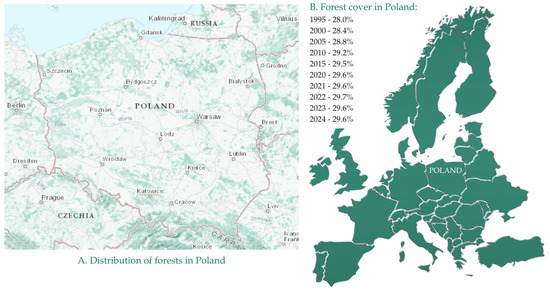
The study focuses on the area of Poland (Figure 1). It is a country in Central Europe with nearly 37 million inhabitants, characterized by natural diversity due to its access to the Baltic Sea and numerous mountain ranges in the southern part of the country. Poland ranks among the European leaders in terms of forest area. Currently, the forest area in Poland exceeds 9.2 million ha [54], corresponding to a forest cover of 29.6% [1]. The vast majority of these forests are state-owned, with over 7.1 million ha managed by the State Forests National Forest Holding (Państwowe Gospodarstwo Leśne Lasy Państwowe) [54].
Figure 1.
Study area, forest distribution (A) [54] and forest cover in Poland (B) [1].
No fees are charged for entering forests. On specially designated routes, horseback riding and cycling are permitted, while other trails are freely accessible for walking. Forest areas also allow the collection of forest fruits and herbs for personal use without restrictions. Polish forests also feature numerous amenities, including small infrastructure. Regular monitoring of recreational use of forest areas is not conducted, which results, among other factors, from the vastness of the forests, their significant fragmentation (Figure 1), and methodological difficulties [55].
2.2. Data Collection
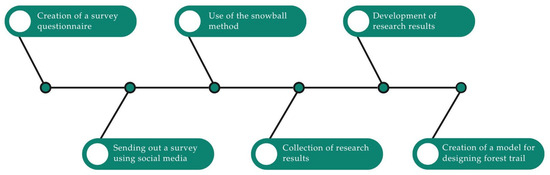
The study employed the CAWI (Computer–Assisted Web Interview) method. The online questionnaire was created in Google Forms and consisted of five closed-ended, single-choice questions. It included three demographic questions (gender, age, place of residence), one behavioral question regarding the frequency of forest visits, and a question concerning the elements of forest tourism infrastructure that should accompany forest trails. The survey was conducted from October 2021 to October 2024 on a group of anonymous adult Poles (over 18 years old). Questionnaires were distributed directly from the authors’ main profiles via social media, among other methods, using the snowball sampling technique, in which participants were asked to forward the survey link to at least 2 other adults. This approach, combining CAWI surveys with snowball sampling, is commonly used in exploratory and pilot studies on recreation and environmental perception [53,56,57,58].
Participation in the study was voluntary. The authors ensured the protection of personal data for individuals who chose to participate, in accordance with the Act of 10 May 2018 on Personal Data Protection [59]. The authors also confirmed that all procedures conducted in this study complied with the ethical standards of the Polish Committee for Ethics in Science and the Declaration of Helsinki of 1964, as amended. The results obtained formed the basis for developing a socially sensitive model for forest trail infrastructure design, integrating quantitative analyses with their functional interpretation (Figure 2).
Figure 2.
Stages of the research process used in the work.
2.3. Characteristics of Respondents
Among the 402 respondents, women predominated, accounting for 62.4% of the sample. The largest age group was 18–30 years old. Respondents came from various types of settlements, with the majority living in large cities (over 100,000 inhabitants)—44.28%. The largest proportion of respondents reported visiting forests only once a year—40.05% (Table 1).
Table 1.
Socio-demographic Characteristics of Respondents.
2.4. Statistical Analysis
The data analysis was carried out in several stages, combining descriptive statistics, significance tests, and multivariate dependency analysis. The analyses aimed to determine respondents’ preferences for small infrastructure elements along forest trails and to identify differences in these preferences by socio-demographic characteristics and the frequency of visits to forest areas.
In the first stage, frequencies and percentages of indications for each infrastructure element were calculated for the entire sample and for specific respondent groups. These analyses allowed for establishing a hierarchy of the most frequently indicated infrastructure elements and provided a preliminary comparison of preferences between groups.
In the next stage, Pearson’s chi-square test was applied to assess the statistical significance of differences in preferences between respondent groups distinguished by gender, age, place of residence, and frequency of forest visits. All analyses were based on r × c contingency tables constructed for categorical variables, depending on the number of response categories. For each independent variable, the relationship with individual infrastructure elements was analyzed, with a significance level set at p < 0.05. These tests enabled the identification of infrastructure elements for which differences in the frequency of indications between groups were statistically significant. The assumptions of the chi-square test were verified, including the expected frequency criterion (minimum expected counts ≥ 5) and the independence of observations. As multiple chi-square tests were performed, results were interpreted at the individual test level without formal adjustment for multiple comparisons; however, effect sizes were additionally reported to support interpretation. Additionally, Cramér’s V was calculated to assess the strength of these relationships.
Complementing the univariate analyses, correspondence analysis was employed to examine the structure of dependencies between preferences for infrastructure elements (rows) and categories of socio-demographic and behavioral variables (columns). Correspondence analysis allowed for evaluating whether observed percentage differences led to the identification of distinct user preference profiles. Within the correspondence analysis, eigenvalues, inertia of individual dimensions, and the percentage of explained inertia were determined, as well as the chi-square statistic for contingency tables. The interpretation of results was based on the coordinates of categories in multidimensional space and Cos2 values, which indicate the quality of representation of individual categories in the analyzed dimensions. High Cos2 values and significant contributions to inertia were treated as a basis for interpreting relationships between categories.
Statistical analyses were performed using Statistica software (STATISTICA 13.3 PL (TIBCO Software Inc., Palo Alto, CA, USA (2017)). Statistica (data analysis software system), version 13. http://statistica.io).
3. Results
3.1. Infrastructure Elements That Should Accompany Forest Trails According to Respondents
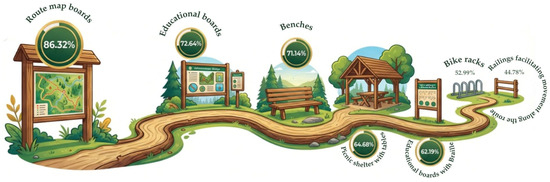
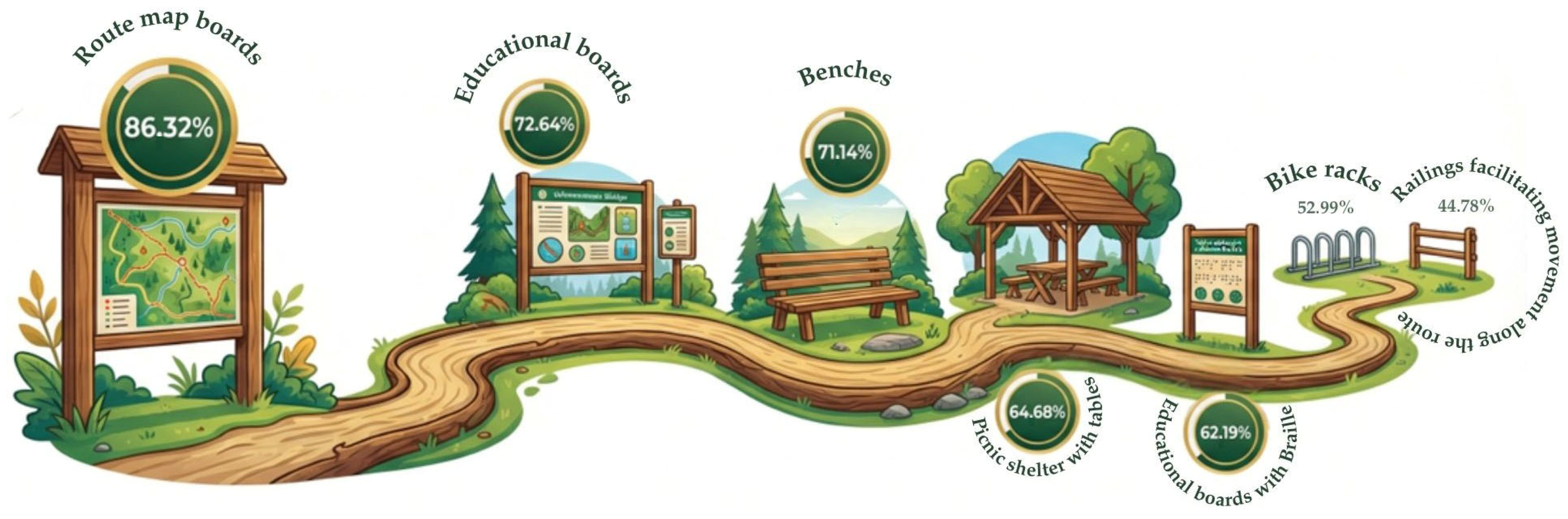
According to the largest number of respondents, forest trails should be accompanied by infrastructure elements such as route map boards (86.32%). Educational boards (72.64%) and benches (71.14%) were also popular. Less frequently chosen were bike racks (52.99%) and railings facilitating movement along the route (44.78%) (Figure 3).
Figure 3.
Infrastructure elements that should accompany forest trails, according to respondents. Source: authors’ own elaboration; visualization based on the authors’ conceptual framework, generated with the support of NotebookLM and subsequently subjected to graphic modifications by the authors.
3.2. Infrastructure Elements That Should Accompany Forest Trails in the Public Opinion, Considering Socio-Demographic Factors
For women, the most important elements were route map boards (90.44%), benches (77.29%), and educational boards (73.71%). For men, the most important were route map boards (79.47%) and educational boards (70.86%). Statistically significant differences in responses between women and men (p < 0.05) were observed for four infrastructure elements. However, the strength of these associations was weak, with Cramér’s V ranging from 0.12 to 0.17. Women preferred route map boards, benches, bike racks, and railings that facilitate movement along the route more frequently than men did. The largest differences were observed in responses regarding benches (16.36%) and railings (14.44%) (Table 2).
Table 2.
Infrastructure elements that should accompany forest trails—differences in preferences between men and women.
Correspondence analysis did not reveal statistically significant associations between respondents’ gender and preferences for infrastructure elements accompanying forest trails (χ2 = 3.83; df = 6; p = 0.700). Both women and men indicated individual infrastructure elements to a similar extent. Low inertia values and the placement of categories near the center of the plot indicate a lack of clear gender-based preference differences. Differences between women and men do exist (as indicated by Pearson’s chi-square), but these reflect intensity rather than qualitatively distinct preference profiles.
The youngest group (18–30 years) most frequently indicated the need for route map boards (91.32%), benches (77.27%), and educational boards (76.86%). Respondents aged 31–40 placed the highest importance on route map boards (83.33%) and educational boards (70.00%). Those aged 41–50 also prioritized route map boards (76.27%) and educational boards (69.49%). The oldest group particularly emphasized route map boards (75.61%) and benches (70.73%). Differences in preferences between age groups were statistically significant for most elements, except for the picnic shelter with tables. The strength of these associations was generally weak to moderate, with Cramér’s V ranging from 0.14 to 0.24. The need for educational boards and Route map boards decreased with age. The youngest and oldest groups, unlike respondents aged 31–50, more strongly preferred educational boards with Braille, benches, bike racks, and railings to facilitate movement along the route. For the last element, the response differences were the largest, which also demonstrated the strongest association (Cramér’s V = 0.24) (Table 3).
Table 3.
Infrastructure elements that should accompany forest trails—differences in preferences by age group.
Regarding age, correspondence analysis also did not reveal statistically significant associations between age groups and preferences for forest trail infrastructure (χ2 = 12.31; df = 18; p = 0.831). Similar choices dominated across all age groups, primarily route map boards, educational boards, and benches. The largest group was respondents aged 18–30, yet their preference profile did not differ markedly from that of other age groups. Correspondence analysis indicates that the observed differences reflect the intensity of preferences rather than clear user segmentation.
People living in rural areas particularly indicated the need for route map boards (90.54%), benches (75.68%), and educational boards (71.62%). Residents of smaller towns preferred benches (84.21%), route map boards (81.58%), and picnic shelters with tables (71.05%). Inhabitants of larger cities particularly emphasized route map boards (84.83%) and educational boards (75.84%). Statistically significant differences were observed in responses regarding benches and railings that facilitate movement along the route, with these elements being most preferred by residents of smaller towns compared to those living in larger cities and rural areas. However, the strength of these associations was weak (Cramér’s V = 0.15–0.19) (Table 4).
Table 4.
Infrastructure elements that should accompany forest trails—differences in preferences by place of residence.
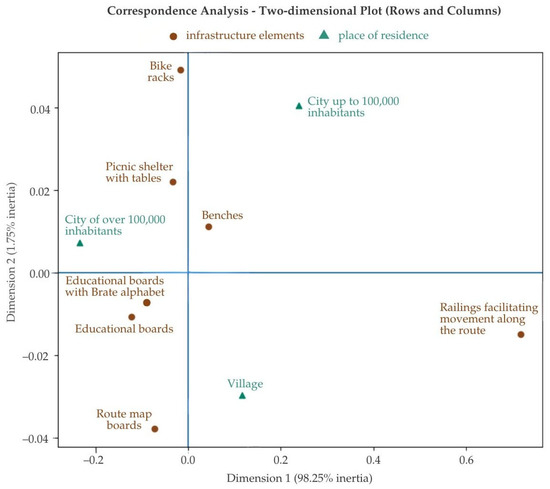
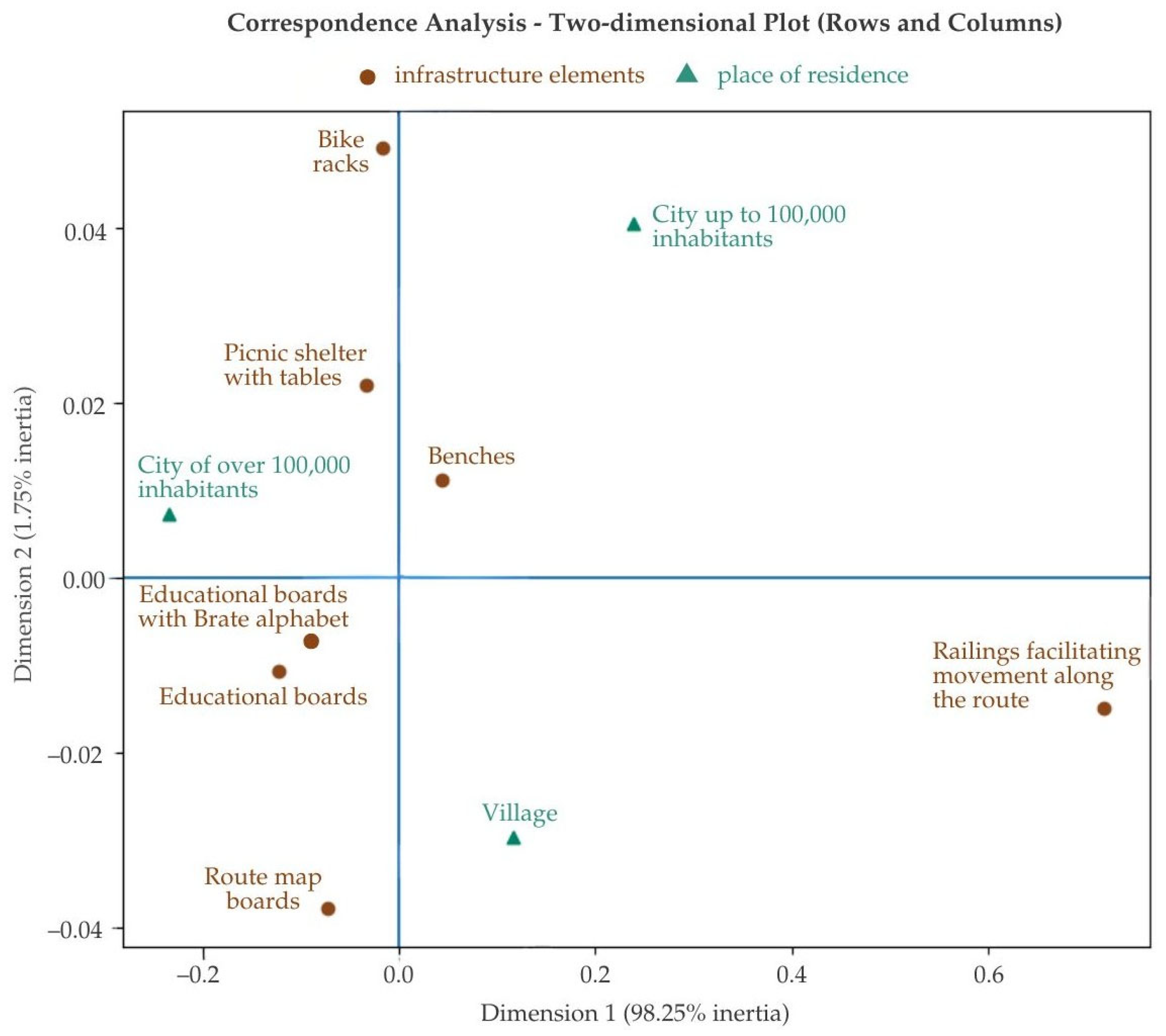
Correspondence analysis revealed statistically significant associations between respondents’ place of residence and preferences for infrastructure elements accompanying forest trails (χ2 = 70.82; df = 12; p < 0.001). The first dimension of the analysis explained 98.25% of the total inertia, indicating a clear, one-dimensional character of the relationship. The coordinates and high Cos2 values for place-of-residence categories confirm good quality of representation—particularly for residents of cities with over 100,000 inhabitants (Cos2 = 0.999), who occupied a clearly distinct position in the analysis space compared to rural residents and those from smaller towns.
Among the analyzed infrastructure elements, the barriers facilitating passage along the trails were most strongly associated with the first dimension, exhibiting both a high cos2 value and a significant contribution to the inertia of this dimension, indicating their role in differentiating response profiles. The remaining infrastructure elements were positioned closer to the center of the plot, suggesting a more universal character and less dependence on respondents’ place of residence (Figure 4).
Figure 4.
Two-dimensional correspondence analysis of forest infrastructure elements and place of residence.
3.3. Infrastructure Elements That Should Accompany Forest Trails in Public Opinion, Considering the Frequency of Forest Visits
Respondents who do not visit forests at all indicated the greatest need for route map boards (78.05%). The same applied to those visiting at least once a week (74.03%). Respondents visiting forests at least once a year preferred route map boards (91.93%), educational boards, and benches (77.02% each). Those visiting at least once a month more frequently indicated route map boards (89.43%), educational boards (78.86%), and benches (73.98%). Statistically significant differences were observed for most infrastructure elements. Respondents who visit forests at least once a month or once a year expressed a greater need for specific infrastructure elements than those who do not visit forests at all or visit very frequently. However, the strength of these associations was weak to moderate, with Cramér’s V ranging from 0.15 to 0.21 (Table 5).
Table 5.
Infrastructure elements that should accompany forest trails—differences in preferences by frequency of forest visits.
No statistically significant associations were found between the frequency of forest visits and preferences for infrastructure elements along forest trails (χ2 = 3.99; df = 18; p = 0.999). Regardless of whether respondents visited the forest sporadically or regularly, they indicated similar infrastructure elements. The most frequently chosen were route map boards, educational boards, and benches. Low inertia values and the absence of clear clusters in the correspondence plot suggest that the frequency of forest visits does not significantly differentiate expectations regarding infrastructure. Correspondence analysis indicates that the observed differences reflect the intensity of preferences rather than distinct user segmentation.
3.4. Socially Sensitive, Flexible, Modular Model for Forest Trail Design
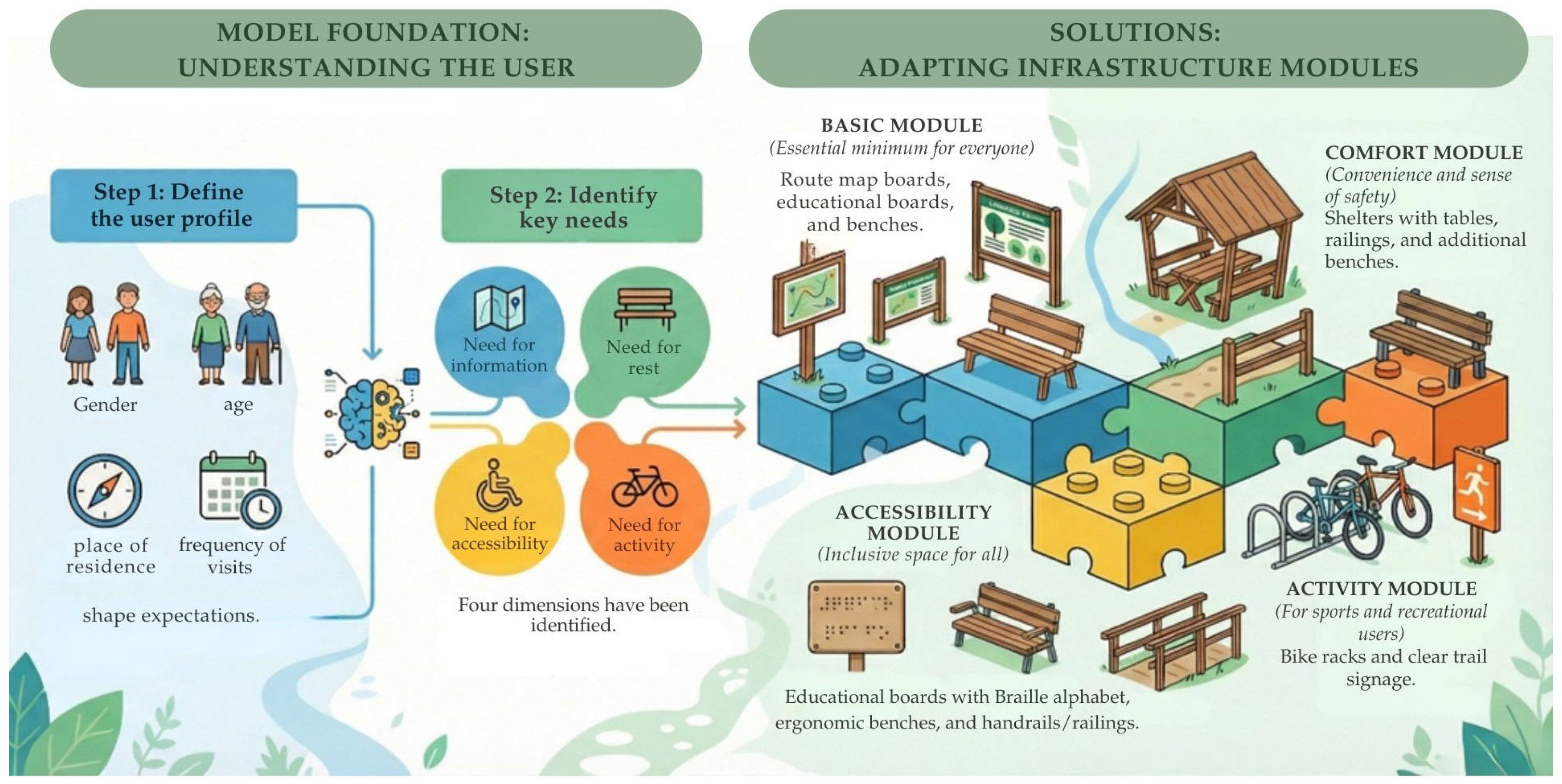
Based on the analyses, a socially sensitive, modular model for forest trail design was developed, synthesizing empirical research results and demonstrating their practical application in planning tourist infrastructure in forest areas. The developed model represents an attempt to connect social research with planning practice, demonstrating how user opinions can be translated into clear, functional design assumptions that support the sustainable development of recreation and nature-based tourism (Figure 5).
Figure 5.
Socially sensitive, modular model for forest trail design based on user preferences. Source: authors’ own elaboration; visualization based on the authors’ conceptual framework, generated with the support of NotebookLM and subsequently subjected to graphic modifications by the authors.
The first component of the model is the user profile, which includes four key variables differentiating respondents’ preferences: gender, age, place of residence, and frequency of forest visits. The research results showed that the analyzed socio-demographic and behavioral characteristics differentiate the intensity of preferences for forest trail infrastructure elements, with the strongest and most diverse patterns observed for respondents’ place of residence. Considering the user profile serves as a starting point for further design decisions and enables better tailoring of trails to actual social needs.
The central component of the model is the diversified needs of forest trail users, identified from survey results. These include four main functional dimensions of forest trails: informational, rest, accessibility, and physical activity. The intensity of individual needs varies with demographic characteristics and forest visit frequency, underscoring the need for a flexible approach to infrastructure design.
The response to the identified user needs is a modular infrastructure structure, enabling a gradual enhancement of forest trails depending on local conditions and user profiles:
- The basic module includes the elements most frequently indicated by all respondent groups: route map boards, educational boards, and benches, forming a core set of equipment that enhances the clarity, attractiveness, and functionality of trails. These elements form the informational and functional backbone of the trail. Map boards are not only navigation tools but also reduce the ‘fear of the unknown,’ which is essential for a secure nature experience and psychological comfort, especially for occasional visitors.
- The comfort module adds elements that improve rest quality and a sense of safety, such as picnic shelters with tables, railings to facilitate movement along the route, and additional benches. It is particularly important for women, older users, and residents of smaller towns. By providing facilities such as shelters and additional seating, this module directly supports psychophysical restoration. These specific elements allow users to extend their stay in the forest, facilitating stress reduction (SRT) and mental fatigue recovery (ART), which is a key component of human well-being in natural settings.
- The accessibility module addresses the needs of groups requiring greater inclusivity, including educational boards with Braille, ergonomically adapted benches, and handrails and other mobility aids, meeting the expectations of both the youngest and oldest trail users. This module represents the core of socially sensitive planning, ensuring that forest benefits are equitable. Implementing universal design—such as Braille boards and ergonomic benches—enables seniors and persons with disabilities to interact with the forest independently and naturally, fostering social integration and public health.
- The activity module targets recreational and sporting users, including bike racks, clear trail signage, and educational boards, and is particularly relevant for city dwellers and occasional forest visitors. The activity module targets the growing demand for forest-based sports. By providing bike racks and clear sports-oriented signage, it promotes active public health, encouraging urban residents to engage in regular physical exercise within a high-quality ecosystem service environment.
The proposed model serves as a decision-support tool at the conceptual design stage, allowing selection of infrastructure modules based on dominant user groups and trail function. The modular structure allows the model to be adapted to different types of forest areas without requiring a single rigid design scheme. The model does not provide a ready-made design plan but offers a flexible framework for shaping forest trails according to user profiles and recreational and tourist functions.
4. Discussion
Social research plays a crucial role in better understanding both visitors’ expectations and needs, as well as the impact of their activities on ecosystems. Sustainable management of natural areas, including forests, requires a comprehensive approach that considers both environmental and social aspects. It helps minimize the negative environmental impacts of recreation and tourism and supports the development of legal standards to protect natural areas. While visitors expect authentic, unspoiled nature experiences [11,15,60], managers of natural areas must balance meeting these needs with protecting natural resources, and are also compelled to follow new trends in tourism.
According to the study results, recreational infrastructure in forests is essential for enhancing visitor experiences while ensuring ecosystem sustainability [25]. Hypothesis H1 was confirmed. The research revealed a clear hierarchy of needs, with informational elements—route map boards and educational boards—and benches for rest at the top. Most previous studies indicate that infrastructure and amenities along forest trails are a significant factor affecting visitor satisfaction and motivation [61,62,63,64,65]. The highest percentage of respondents indicated route map boards (86.32%) and educational boards (72.64%), suggesting that users value both easy terrain orientation and the educational aspects of tourism. The work of Williams [66] and Olenderek [67] confirms these assumptions, showing that trail signage affects user convenience, safety, and positive experiences in natural spaces. According to Gundersen & Vistad [27], marked trails attract and concentrate visitors in specific areas. Properly designed boards facilitate the interpretation of nature, understanding natural processes, and perceiving broader environmental changes [68,69,70].
Elements such as benches, picnic shelters with tables, and railings facilitating movement along the route also play an important role in ensuring visitor comfort and safety. The results indicate that users expect regularly spaced rest areas, especially at viewpoints or along more demanding sections of trails. This can be interpreted as a need to create trails that are friendly to families, older adults, and tourists with varying physical abilities [40,71]. The findings also show high tolerance and inclusivity in the design of such facilities, aligning with the principles of sustainable tourism development [72,73].
Hypothesis H2 was partially confirmed: preferences for forest trail infrastructure elements did not differ significantly across infrastructure elements, nor did they differ significantly by users’ socio-demographic characteristics or frequency of forest visits. However, in most cases, such differences were observed. For example, women more frequently indicated a need for additional benches and barriers, which may reflect a desire for greater comfort and safety while using the trails. Younger respondents showed greater interest in bicycle racks, likely due to the popularity of cycling within this age group [74,75]. Visit frequency also strongly influenced expectations—people visiting the forest once a year or once a month expressed a greater demand for infrastructure than those visiting daily.
Hypotheses H3 and H4 were partially confirmed. Correspondence analysis did not reveal qualitatively distinct preference profiles for gender, age, or visit frequency; in these groups, differences reflected only the intensity of the same preferences. An exception was the place of residence, which significantly differentiated preferences regarding infrastructure along forest trails, although the extent of these differences was limited. This relationship was predominantly one-dimensional, with most analyzed infrastructure elements exhibiting a universal character, independent of place of residence. A clear exception was barriers facilitating trail passage, which constituted the only infrastructure element significantly differentiating respondent profiles.
The results indicate differences in preferences among various demographic groups, suggesting that a universal approach to trail design may not be sufficient. It implies that trail planning should consider the diverse needs of different user groups and adapt infrastructure to their preferences. According to Zhang [65], appropriately equipped forest trails can enhance tourists’ perceptions of the landscape and ecological value of an area, thereby increasing their overall satisfaction with the tourism experience. Arnberger & Eder [76] highlight that reconciling the differing, and sometimes conflicting, needs and preferences of forest visitors regarding infrastructure can be addressed through a differentiated approach to planning and managing recreational areas. It means that trail designers should ensure that spaces are accessible to everyone, regardless of physical limitations. Inclusive trail design not only improves accessibility but also promotes social equality and integration.
The modular design model proposed in this paper represents a practical extension of the Recreation Opportunity Spectrum (ROS) concept. Instead of rigid frameworks, this model allows for flexible adaptation of infrastructure to specific user profiles (e.g., an accessibility module for groups with limited mobility or an activity module for athletes). This approach allows forest managers to rationally manage resources while promoting social equity and inclusiveness in access to ecosystem services.
5. Limitations
The results are based on respondents’ self-reports rather than direct observation of their behavior, which is one limitation of the applied research method. However, it should be emphasized that, according to Albert Bandura’s self-efficacy theory, subjective beliefs about one’s own competencies play a key role in shaping behavior. Thus, assessments of personal abilities and knowledge can serve as an important indicator of potential readiness to make specific decisions or express opinions [77]. The significance of such measurements is also confirmed by the study of Frick et al. [78], which shows that subjective knowledge, operating alongside objective knowledge, is one of the most important predictors of environmental attitudes and behaviors.
This study was a pilot and exploratory study. The use of the CAWI method and the snowball sampling technique limits the possibility of directly generalizing the results to the entire population and drawing causal conclusions. Snowball sampling, while effective for reaching specific groups in exploratory studies, often leads to a more homogeneous sample that may overrepresent certain demographic segments with higher levels of environmental interest [8]. Consequently, caution is required when attempting to extrapolate these findings to broader, more diverse populations outside of Poland, where social norms and recreational habits may differ significantly [79]. The long data-collection period (2021–2024) encompasses significant social changes related to the COVID-19 pandemic, which permanently altered perceptions of forests as key places for psychophysical well-being. Although such a time span may affect temporal consistency in responses, it enabled the identification of a universal hierarchy of needs that dominates user preferences regardless of changing external conditions.
The study was limited to Poland, meaning that specific needs (e.g., a high demand for informational boards) may stem from local cultural conditions and forestry traditions in Central Europe. In Poland, informational and educational boards have a long tradition as primary tools for environmental education and traffic management, with many designated educational paths across state-managed forests [8,80]. This systematic presence of infrastructure has likely shaped a specific cultural expectation among Polish visitors, who perceive boards not only as educational aids but also as essential tools for navigation and safety, helping to minimize the risk of getting lost in large forest complexes [8,81]. In more car-dependent or differently managed metropolitan contexts, such as those analyzed in international studies, visitor priorities might shift more toward accessibility and transit connectivity rather than educational signage [79]. Therefore, the high demand for informational modules observed here reflects a unique Central European “pedagogical” approach to forest recreation that may not be equally prevalent in other global contexts [8,81]. The developed tool constitutes a flexible decision-making framework rather than a ready-made design scheme. Any implementation must take into account local environmental, legal, and economic conditions, which were not the subject of this quantitative analysis. The analysis focuses on social needs, omitting the long-term impact of implemented infrastructure on the sustainability of forest ecosystems, an issue that requires further research.
6. Conclusions
The study revealed a clear hierarchy of user preferences for forest trail infrastructure, with informational elements and infrastructure supporting rest playing a key role. These elements are universal and important regardless of the analyzed socio-demographic and behavioral characteristics.
Although statistical analyses confirmed significant differences in the selection frequency of specific infrastructure elements across user groups, correspondence analysis revealed no clear, homogeneous preference profiles for most variables. The observed relationships were generally weak, indicating limited effect sizes across analyzed variables. It suggests that variations in preferences primarily concern the intensity of needs rather than their qualitative differentiation.
The findings provided the basis for proposing a modular approach to the design of forest trail infrastructure, allowing the scope to be flexibly adjusted to local conditions and the diverse needs of users. Such an approach can support the planning of forest trails in a functional, socially sensitive manner, consistent with the principles of sustainable recreation and tourism.
The study’s practical implications also include expanding educational elements along trails, which can enhance visitors’ ecological awareness and foster more responsible attitudes toward nature. In the context of sustainable tourism policy, these informational and educational elements serve as a strategic tool for channeling tourist traffic. By effectively directing visitors onto designated routes, managers can actively protect sensitive habitats from uncontrolled anthropogenic pressure. Furthermore, the developed modular model serves as a practical decision-support tool for forest governance. It enables managers to rationally allocate limited financial resources by matching infrastructure investments to real local needs, such as the Comfort or Activity Modules, rather than applying inefficient, one-size-fits-all solutions. Finally, the implementation of universal design principles through the Accessibility Module should be an integral part of forestry social policy. Promoting inclusivity not only fosters social equality and integration but also supports public health and societal well-being amid demographic changes.
Future research should use objective methods, such as GPS tracking and observation, to verify how individual infrastructure modules (e.g., basic or accessibility) influence tourists’ actual behavior and distribution in the field. The application of GPS technology offers significant advantages over traditional survey methods by enabling the investigation of actual visitor movements rather than self-reported behaviors, leading to more reliable, accurate, and precise data [82]. This methodology allows for the effective validation of proposed infrastructure modules in real-world scenarios by providing detailed spatial-temporal information, such as specific movement trajectories and dwell times [8]. GPS-based tracking and digital footprints generated by mobile devices can be utilized to identify activity hotspots and quantify how effectively informational and directional modules channel tourist traffic in practice [81]. Furthermore, quasi-experimental evaluations using consented GPS data could demonstrate the causal impact of new trail links or infrastructure on visitor distribution, ensuring that modular interventions successfully mitigate anthropogenic pressure [79]. An important direction for future research is also to analyze the long-term impact of infrastructure expansion on ecosystem sustainability, particularly given growing demands for comfort and inclusiveness. Additionally, comparing traditional and interactive forms of education will help us determine which approaches are more effective at building environmental awareness and promoting responsible attitudes towards nature. The effectiveness of various traffic channeling signage should also be assessed, as this is essential for protecting sensitive habitats from uncontrolled anthropogenic pressure.
Author Contributions
Conceptualization, A.K. and N.K.; methodology, A.K. and N.K.; software, N.K.; validation, A.K. and N.K.; formal analysis, A.K.; investigation, A.K. and N.K.; resources, A.K. and N.K.; data curation, A.K. and N.K.; writing—original draft preparation, A.K. and N.K.; writing—review and editing, A.K. and N.K.; visualization, A.K. and N.K.; supervision, A.K. and N.K.; project administration, A.K. and N.K.; funding acquisition, A.K. All authors have read and agreed to the published version of the manuscript.
Funding
University of Life Sciences in Lublin (SUBB.WRT.19.032).
Data Availability Statement
No new data were created or analyzed in this study.
Conflicts of Interest
The authors declare no conflicts of interest.
References
- GUS; US w Białymstoku. Rocznik Statystyczny Leśnictwa 2025; GUS: Warszawa/Białystok, Poland, 2025; p. 27. Available online: https://stat.gov.pl/obszary-tematyczne/roczniki-statystyczne/roczniki-statystyczne/rocznik-statystyczny-lesnictwa-2025,13,8.html (accessed on 10 January 2026).
- Jalinik, M. Obszary leśne w rozwoju turystyki. Ekon. Środow. 2016, 3, 313–323. [Google Scholar]
- Kwiecińska, K.; Kosicka-Gębska, M.; Gębski, J. Turystyka i edukacja leśna a potrzeby współczesnych konsumentów. Ekon. Probl. Tur. 2016, 34, 49–59. [Google Scholar] [CrossRef] [Scilit]
- Malchrowicz-Mośko, E.; Poczta, J. Turystyka sportowa na obszarach leśnych w Polsce—Szanse i zagrożenia. Aktywność Ruchowa Ludzi W Różnym Wieku 2017, 33, 29–38. [Google Scholar]
- Janeczko, E. Ścieżki edukacyjne jako element rekreacyjnego zagospodarowania lasu. Stud. Mater. Cent. Eduk. Przyr.-Leśn. 2010, 12, 100–107. [Google Scholar]
- Pigan, M. Leśna ścieżka poznawcza jednym z najważniejszych obiektów edukacyjnych. Stud. Mater. Cent. Eduk. Przyr.-Leśn. 2012, 14, 11–17. [Google Scholar]
- Cieszewska, A.; Giedych, A.; Maksymiuk, G.; Waldykowski, P.; Adamczyk, J. Inwentaryzacja liniowych elementów infrastruktury turystycznej na potrzeby rozwoju funkcji rekreacyjnej w lasach na przykładzie Nadleśnictwa Celestynów. Probl. Ekol. Kraj. Rekreac. W Kraj. O Wysokim Potencjale. 2013, 34, 27–33. [Google Scholar]
- Wojciechowska-Solis, J.; Kobyłka, A.; Ciesielski, M.; Korcz, N. Potencjał Turystyki Przyrodniczej w Polsce; Wydawnictwo Uniwersytetu Ekonomicznego we Wrocławiu: Wrocław, Poland, 2024. [Google Scholar]
- Bell, S.; Tyrväinen, L.; Sievänen, T.; Pröbstl, U.; Simpson, M. Outdoor recreation and nature tourism: A European perspective. Living Rev. Landsc. Res. 2007, 1, 1–46. [Google Scholar] [CrossRef] [Scilit]
- Cetin, M.; Sevik, H. Evaluating the recreation potential of Ilgaz Mountain National Park in Turkey. Environ. Monit. Assess. 2016, 188, 52. [Google Scholar] [CrossRef] [Scilit]
- Coghlan, A.; Buckley, R. Nature-based tourism. In The Routledge Handbook of Tourism and the Environment; Routledge: London, UK; New York, NY, USA, 2012; pp. 334–344. Available online: https://www.taylorfrancis.com/chapters/edit/10.4324/9780203121108-36/nature-based-tourism-alexandra-coghlan-ralf-buckley (accessed on 15 January 2026).
- Das, M.; Chatterjee, B. Ecotourism: A panacea or a predicament? Tour. Manag. Perspect. 2015, 14, 3–16. [Google Scholar] [CrossRef] [Scilit]
- Fennell, D.A. Ecotourism; Routledge: London, UK; New York, NY, USA, 2020. [Google Scholar] [CrossRef] [Scilit]
- Green, R.; Giese, M. Negative effects of wildlife tourism on wildlife. In Wildlife Tourism: Impacts, Management and Planning; Higginbottom, K., Ed.; Common Ground Publishing Pty Ltd.: Melbourne, Australia, 2004; pp. 81–97. Available online: https://www.researchgate.net/publication/40871766_Wildlife_Tourism_a_strategic_destination_analysis (accessed on 10 January 2026).
- Kuenzi, C.; McNeely, J. Nature-based tourism. In Global Risk Governance; International Risk Governance Council Bookseries; Renn, O., Walker, K.D., Eds.; Springer: Dordrecht, The Netherlands, 2008; Volume 1, pp. 155–178. [Google Scholar] [CrossRef] [Scilit]
- Newsome, D.; Rodger, K. Wildlife tourism. In The Routledge Handbook of Tourism and the Environment; Buckley, R., Ed.; Routledge: London, UK; New York, NY, USA, 2012; pp. 345–358. Available online: https://www.taylorfrancis.com/chapters/edit/10.4324/9780203121108-37/wildlife-tourism-david-newsome-kate-rodger (accessed on 10 January 2026).
- Sahebalzamani, S.; Bertella, G. Business models and sustainability in nature tourism: A systematic review of the literature. Sustainability 2018, 10, 3226. [Google Scholar] [CrossRef] [Scilit]
- Hasan, A. Green tourism. Media Wisata 2014, 12. Available online: http://jurnal.ampta.ac.id/index.php/MWS/article/view/195 (accessed on 12 January 2026). [CrossRef] [Scilit]
- Ibnou-Laaroussi, S.; Rjoub, H.; Wong, W.-K. Sustainability of green tourism among international tourists and its influence on the achievement of green environment: Evidence from North Cyprus. Sustainability 2020, 12, 5698. [Google Scholar] [CrossRef] [Scilit]
- Mika, M. Turystyka przyrodnicza—Jej istota i współczesne kierunki rozwoju. In Studia nad Turystyką. Tradycje, Stan Obecny, Perspektywy Badawcze; Kurek, W., Mika, M., Eds.; Wyd. Uniwersytet Jagielloński: Kraków, Poland, 2007; pp. 311–320. Available online: https://ruj.uj.edu.pl/xmlui/bitstream/handle/item/258674/mika_wspolczesne_kierunki_rozwoju_2007.pdf?sequence=1 (accessed on 14 January 2026).
- Kolkos, G.; Kantartzis, A.; Tsilikas, S.; Stergiadou, A.; Siakou, E.; Arabatzis, G. Development of path and trail network and forest infrastructure for pedestrians, cyclists and persons with disabilities in the Evros Region, Greece. E3S Web Conf. 2024, 585, 01022. [Google Scholar] [CrossRef] [Scilit]
- Sawicki, B.; Kobyłka, A. Ocena ruchu turystycznego w Parku Krajobrazowym Puszczy Knyszyńskiej. Ekon. Środow. 2015, 4, 243–252. [Google Scholar]
- Taylor, P. What factors make rail trails successful as tourism attractions? Developing a conceptual framework from relevant literature. J. Outdoor Recreat. Tour. 2015, 12, 89–98. [Google Scholar] [CrossRef] [Scilit]
- Polucha, I.; Marks, E.; Jaszczak, A.; Elkhatib, A. Zasady projektowania ścieżek dydaktycznych o tematyce zdrowotnej na obszarach leśnych. Probl. Ekol. Kraj. 2012, 34, 313–316. [Google Scholar]
- Janeczko, E.; Banaś, J.; Woźnicka, M.; Janeczko, K.; Zięba, S.; Utnik-Banaś, K.; Banaś, A. What kind of recreational infrastructure encourages forest visits the most? A case study of Poland. Sustainability 2025, 17, 3598. [Google Scholar] [CrossRef] [Scilit]
- Àvila Callau, A.; Erdozain, M.; Farías-Torbidoni, E.I.; de Miguel, S. Linking forest planning and recreational trail design: A GIS approach for enhancing the social use of forests. Environ. Manag. 2025, 75, 2150–2168. [Google Scholar] [CrossRef] [Scilit] [PubMed]
- Gundersen, V.; Vistad, O.I. Public opinions and use of various types of recreational infrastructure in boreal forest settings. Forests 2016, 7, 113. [Google Scholar] [CrossRef] [Scilit]
- Zhou, M.; Wang, F. The driving factors of recreational utilization of ecological space in urban agglomerations: The perspective of urban political ecology. Ecol. Indic. 2024, 158, 111409. [Google Scholar] [CrossRef] [Scilit]
- Gobster, P.H. Recreation and leisure research from an active living perspective: Taking a second look at urban trail use data. Leis. Sci. 2005, 27, 367–383. [Google Scholar] [CrossRef] [Scilit]
- Šodková, M.; Purwestri, R.C.; Riedl, M.; Jarský, V.; Hájek, M. Drivers and frequency of forest visits: Results of a national survey in the Czech Republic. Forests 2020, 11, 414. [Google Scholar] [CrossRef] [Scilit]
- Neuvonen, M.; Sievänen, T.; Tönnes, S.; Koskela, T. Access to green areas and the frequency of visits: A case study in Helsinki. Urban For. Urban Green. 2007, 6, 235–247. [Google Scholar] [CrossRef] [Scilit]
- Lindhagen, A. Forest Recreation in Sweden: Four Case Studies Using Quantitative and Qualitative Methods. 1996. Available online: https://www.cabidigitallibrary.org/doi/full/10.5555/19970603413 (accessed on 10 January 2026).
- Pouta, E.; Sievänen, T. Luonnon virkistyskäytön kysyntätutkimuksen tulokset-Kuinka suomalaiset ulkoilevat? Metsäntutkimuslaitoksen Tied. 2001, 802, 32–76. [Google Scholar]
- Cieszewska, A.; Deptuła, M. Czynniki wpływające na degradację szlaków turystycznych na terenie Tatrzańskiego Parku Narodowego. Stud. Mater. Cent. Eduk. Przyr.-Leśn. 2013, 15, 77–82. [Google Scholar]
- Skłodowski, J.; Gołos, P.; Skłodowski, M.; Ożga, W. Preferencje osób odwiedzających wybrane kompleksy leśne w zakresie turystyki leśnej i organizacji wypoczynku. Leśne Pr. Badaw. 2013, 74, 293–305. [Google Scholar] [CrossRef] [Scilit]
- Gillovic, B.; McIntosh, A. Accessibility and inclusive tourism development: Current state and future agenda. Sustainability 2020, 12, 9722. [Google Scholar] [CrossRef] [Scilit]
- Mahmoudzadeh, S.; Kourdi Sarjaz, N. Environmental barriers to tourism development for people with disabilities. Acta Tur. 2018, 30, 87–114. [Google Scholar] [CrossRef] [Scilit]
- Partyka, J. Udostępnianie turystyczne parków narodowych w Polsce a krajobraz. Pr. Kom. Kraj. Kult. 2010, 14, 252–263. [Google Scholar]
- Stasiak, A.; Śledzińska, J.; Włodarczyk, B. Szlaki Turystyczne od Pomysłu do Realizacji; Wydawnictwo PTTK “Kraj”: Warsaw, Poland, 2014; pp. 117–118. [Google Scholar]
- Janeczko, E.; Woźnicka, M.; Kargul-Plewa, D. Leśne ścieżki edukacyjne dostosowane do potrzeb osób niepełnosprawnych—Przykładowe rozwiązania. Stud. Mater. Cent. Eduk. Przyr.-Leśn. 2016, 18, 182–188. [Google Scholar]
- Devenport, S.E.; Edgeley, C.M. Visitor preferences and human-caused wildfire prevention: A survey of public land users in the US Southwest. J. For. 2025, 123, 171–196. [Google Scholar] [CrossRef] [Scilit]
- Westphal, L.M. The Future of Recreation on Public Lands: A Horizon Scan; US Department of Agriculture, Forest Service, Northern Research Station: Madison, WI, USA, 2022; pp. 1–106.
- Wang, X.; Zhang, J.; Wu, C. Users’ recreation choices and setting preferences for trails in urban forests in Nanjing, China. Urban For. Urban Green. 2022, 73, 127602. [Google Scholar] [CrossRef] [Scilit]
- Eriksson, L.; Nordlund, A.M.; Olsson, O.; Westin, K. Recreation in different forest settings: A scene preference study. Forests 2012, 3, 923–943. [Google Scholar] [CrossRef] [Scilit]
- Gołos, P. Społeczne i Ekonomiczne Aspekty Pozaprodukcyjnych Funkcji Lasu i Gospodarki Leśnej—Wyniki Badań Opinii Społecznej; Instytut Badawczy Leśnictwa: Sękocin Stary, Poland, 2018; Available online: https://bibliotekanauki.pl/books/2022398.pdf (accessed on 12 January 2026).
- Gundersen, V.; Tangeland, T.; Kaltenborn, B.P. Planning for recreation along the opportunity spectrum: The case of Oslo, Norway. Urban For. Urban Green. 2015, 14, 210–217. [Google Scholar] [CrossRef] [Scilit]
- Jensen, F.S. Landscape managers’ and politicians’ perception of the forest and landscape preferences of the population. For. Landsc. Res. 1993, 1, 79–93. [Google Scholar]
- Sever, I.; Verbič, M. Providing information to respondents in complex choice studies: A survey on recreational trail preferences in an urban nature park. Landsc. Urban Plan. 2018, 169, 160–177. [Google Scholar] [CrossRef] [Scilit]
- Słowiak, J. Zagospodarowanie turystyczne i rekreacyjne lasów miejskich w Szczecinie. Stud. Perieget. 2018, 2, 49–63. [Google Scholar] [CrossRef] [Scilit]
- Maciejko, A.; Wojtyszyn, B. Tourism infrastructure providing access to areas of protected landscape and nature in Poland: Selected examples. IOP Conf. Ser. Mater. Sci. Eng. 2019, 603, 042049. [Google Scholar] [CrossRef] [Scilit]
- Krajter Ostoić, S.; Konijnendijk van den Bosch, C.C.; Vuletić, D.; Stevanov, M.; Živojinović, I.; Mutabdžija-Bećirović, S.; Lazarević, J.; Stojanova, B.; Blagojević, D.; Stojanovska, M. Citizens’ perception of and satisfaction with urban forests and green space: Results from selected Southeast European cities. Urban For. Urban Green. 2017, 23, 93–103. [Google Scholar] [CrossRef] [Scilit]
- Andries, D.M.; Arnaiz-Schmitz, C.; Díaz-Rodríguez, P.; Herrero-Jáuregui, C.; Schmitz, M.F. Sustainable tourism and natural protected areas: Exploring local population perceptions in a post-conflict scenario. Land 2021, 10, 331. [Google Scholar] [CrossRef] [Scilit]
- Byrd, E.T. Stakeholders in sustainable tourism development and their roles: Applying stakeholder theory to sustainable tourism development. Tour. Rev. 2007, 62, 6–13. [Google Scholar] [CrossRef] [Scilit]
- Bank Danych o Lasach. Available online: https://www.lasy.gov.pl/pl/nasze-lasy/polskie-lasy (accessed on 13 January 2026).
- Ciesielski, M.; Stereńczak, K. What do we expect from forests? The European view of public demands. J. Environ. Manag. 2018, 209, 139–151. [Google Scholar] [CrossRef] [Scilit]
- Pouso, S.; Borja, Á.; Fleming, L.E.; Gómez-Baggethun, E.; White, M.P.; Uyarra, M.C. Contact with blue-green spaces during the COVID-19 pandemic lockdown beneficial for mental health. Sci. Total Environ. 2021, 756, 143984. [Google Scholar] [CrossRef] [Scilit] [PubMed]
- Korcz, N.; Kamińska, A.; Ciesielski, M. Ecological education in the city: Who, how, and with what effect educates the residents of the Warsaw metropolitan area—Preliminary research in Poland. Forests 2026, 17, 275. [Google Scholar] [CrossRef] [Scilit]
- Zawadka, J.; Uglis, J.; Kozera-Kowalska, M.; Jęczmyk, A.; Pietrzak-Zawadka, J.; Wojcieszak-Zbierska, M.M. An empirical assessment of students’ tourist preferences during the COVID-19 pandemic from a gender perspective: Evidence from Poland. Sustainability 2023, 15, 14346. [Google Scholar] [CrossRef] [Scilit]
- Ustawą z Dnia 10 Maja 2018 r. o Ochronie Danych Osobowych (Dz. U. 2018 poz. 1000). Available online: https://sip.lex.pl/akty-prawne/dzu-dziennik-ustaw/ochrona-danych-osobowych-18722262 (accessed on 14 January 2026).
- Wolf, I.D.; Croft, D.B.; Green, R.J. Nature conservation and nature-based tourism: A paradox? Environments 2019, 6, 104. [Google Scholar] [CrossRef] [Scilit]
- Buckley, R.; Pickering, C.; Weaver, D.B. (Eds.) Nature-Based Tourism, Environment and Land Management, 1st ed.; CABI Publishing: Wallingford, UK, 2003. [Google Scholar] [CrossRef] [Scilit]
- Gössling, S.; Hickler, T. Tourism and forest ecosystems. In Tourism and Global Environmental Change; Gössling, S., Hall, M., Eds.; Routledge: London, UK; New York, NY, USA, 2006; pp. 95–106. Available online: https://www.taylorfrancis.com/chapters/oa-edit/10.4324/9780203011911-6/tourism-forest-ecosystems-stefan-g%C3%B6ssling-thomas-hickler (accessed on 12 January 2026).
- Fino, E.; Iliceto, P. Do people have control over the decisions they make? Psychometric properties of the Italian version of the free will and scientific determinism questionnaire (FAD-plus-I). Curr. Psychol. 2023, 42, 11268–11286. [Google Scholar] [CrossRef] [Scilit]
- Singh, S.; Singh, N.; Kalinić, Z.; Liébana-Cabanillas, F.J. Assessing determinants influencing continued use of live streaming services: An extended perceived value theory of streaming addiction. Expert Syst. Appl. 2021, 168, 114241. [Google Scholar] [CrossRef] [Scilit]
- Zhang, L.; Wu, C.; Hao, Y. Effect of the development level of facilities for forest tourism on tourists’ willingness to visit urban forest parks. Forests 2022, 13, 1005. [Google Scholar] [CrossRef] [Scilit]
- Williams, S. Tourism and Recreation; Pearson Education: Harlow, UK, 2003; Available online: https://books.google.com/books?hl=pl&lr=&id=gi_9dT6gkwIC&oi=fnd&pg=PR9&dq=Restoration+and+Recreation:+Tourism+Development+and+Landscape+Restoration+in+Rural+Areas.+John+Wiley+%26+Sons&ots=W8dHglN7oS&sig=72-r8aR2S0Qc3oSWt3FSI71Swxg (accessed on 12 January 2026).
- Olenderek, T. Przedstawianie map na tablicach informacyjnych. Stud. Mater. Cent. Eduk. Przyr.-Leśn. 2015, 17, 108–117. [Google Scholar]
- Kidd, A.M.; Monz, C.; D’Antonio, A.; Manning, R.E.; Reigner, N.; Goonan, K.A.; Jacobi, C. The effect of minimum impact education on visitor spatial behavior in parks and protected areas: An experimental investigation using GPS-based tracking. J. Environ. Manag. 2015, 162, 53–62. [Google Scholar] [CrossRef] [Scilit] [PubMed]
- Hunter, I.R. What do people want from urban forestry?—The European experience. Urban Ecosyst. 2001, 5, 277–284. [Google Scholar] [CrossRef] [Scilit]
- Korcz, N.; Janeczko, E.; Bielinis, E.; Urban, D.; Koba, J.; Szabat, P.; Małecki, M. Influence of informal education in the forest stand redevelopment area on the psychological restoration of working adults. Forests 2021, 12, 993. [Google Scholar] [CrossRef] [Scilit]
- Szkiruc, Z. Turystyka w leśnych kompleksach promocyjnych na terenie RDLP w Białymstoku. Stud. Mater. Cent. Eduk. Przyr.-Leśn. 2013, 15, 299–304. [Google Scholar]
- Golovkova, L.S.; Yukhnovska, Y.O.; Ryzhenko, O.M. The development of ecological (green) and rural tourism for the disabled people in Ukraine. J. Geol. Geogr. Geoecol. 2023, 32, 26–35. [Google Scholar] [CrossRef] [Scilit]
- Sisto, R.; Cappelletti, G.M.; Bianchi, P.; Sica, E. Sustainable and accessible tourism in natural areas: A participatory approach. Curr. Issues Tour. 2022, 25, 1307–1324. [Google Scholar] [CrossRef] [Scilit]
- Prószyńska-Bordas, H. Przygotowanie polskich parków narodowych do turystyki w opinii odwiedzających. Tur. Rekreac. 2014, 11, 1. [Google Scholar]
- Uglis, J.; Roszak, A. Aktywność turystyczna mieszkańców wsi—Studium przypadku. Ekonom. Probl. Tur. 2016, 34, 95–105. [Google Scholar] [CrossRef] [Scilit]
- Arnberger, A.; Eder, R. The influence of age on recreational trail preferences of urban green-space visitors: A discrete choice experiment with digitally calibrated images. J. Environ. Plan. Manag. 2011, 54, 891–908. [Google Scholar] [CrossRef] [Scilit]
- Bandura, A. Self-Efficacy: Toward a Unifying Theory of Behavioral Change. Adv. Behav. Res. Ther. 1978, 1, 139–161. [Google Scholar] [CrossRef] [Scilit]
- Frick, J.; Kaiser, F.G.; Wilson, M. Environmental Knowledge and Conservation Behavior: Exploring Prevalence and Structure in a Representative Sample. Personal. Individ. Differ. 2004, 37, 1597–1613. [Google Scholar] [CrossRef] [Scilit]
- Stefán, F.; Ciesielski, M.; Scharl, T.; Zobel, T.; Taczanowska, K. Origin-Destination Flow Clustering for Sustainable Forest Recreation Planning–Case Study of Vienna Metropolitan Area, Austria. Urban For. Urban Green. 2026, 120, 129432. [Google Scholar] [CrossRef] [Scilit]
- Korcz, N.; Mazurek-Kusiak, A.; Kobylka, A.; Janeczko, E. How do educational boards in urban and suburban forests attract the attention of forest users and influence them in the process of understanding nature? Sylwan 2023, 167, 569–582. [Google Scholar] [CrossRef]
- Korcz, N.; Ciesielski, M.; Kamińska, A.; Choromański, K.; Gotlib, D.; Stefán, F.; Taczanowska, K. The use of digital tools in forest tourism and recreation-experiences from Warsaw agglomeration in Poland. Trees For. People 2024, 18, 100697. [Google Scholar] [CrossRef] [Scilit]
- Hallo, J.C.; Beeco, J.A.; Goetcheus, C.; McGee, J.; McGehee, N.G.; Norman, W.C. GPS as a method for assessing spatial and temporal use distributions of nature-based tourists. J. Travel Res. 2012, 51, 591–606. [Google Scholar] [CrossRef] [Scilit]

Disclaimer/Publisher’s Note: The statements, opinions and data contained in all publications are solely those of the individual author(s) and contributor(s) and not of MDPI and/or the editor(s). MDPI and/or the editor(s) disclaim responsibility for any injury to people or property resulting from any ideas, methods, instructions or products referred to in the content. |
© 2026 by the authors. Licensee MDPI, Basel, Switzerland. This article is an open access article distributed under the terms and conditions of the Creative Commons Attribution (CC BY) license.