User Preferences Regarding Forest Trail Infrastructure—Implications for Socially Sensitive Planning: A Pilot Study



Abstract
1. Introduction
- Recreational and social facilities: Picnic shelters with tables, Benches, and increasingly proposed trash bins and toilets, whose absence is cited as a primary factor reducing the comfort of recreation.
- Educational infrastructure: Traditional Educational boards, though common, are rated by users as moderately attractive; the introduction of interactive forms, “sensory trails,” and panels engaging the senses of touch or hearing is recommended.
- Signage and parking: Clear trail markings and adequate parking at starting points are crucial for properly channeling visitor traffic and protecting habitats from uncontrolled vehicle access.
2. Materials and Methods
2.1. Study Area
2.2. Data Collection
2.3. Characteristics of Respondents
2.4. Statistical Analysis
3. Results
3.1. Infrastructure Elements That Should Accompany Forest Trails According to Respondents
3.2. Infrastructure Elements That Should Accompany Forest Trails in the Public Opinion, Considering Socio-Demographic Factors
3.3. Infrastructure Elements That Should Accompany Forest Trails in Public Opinion, Considering the Frequency of Forest Visits
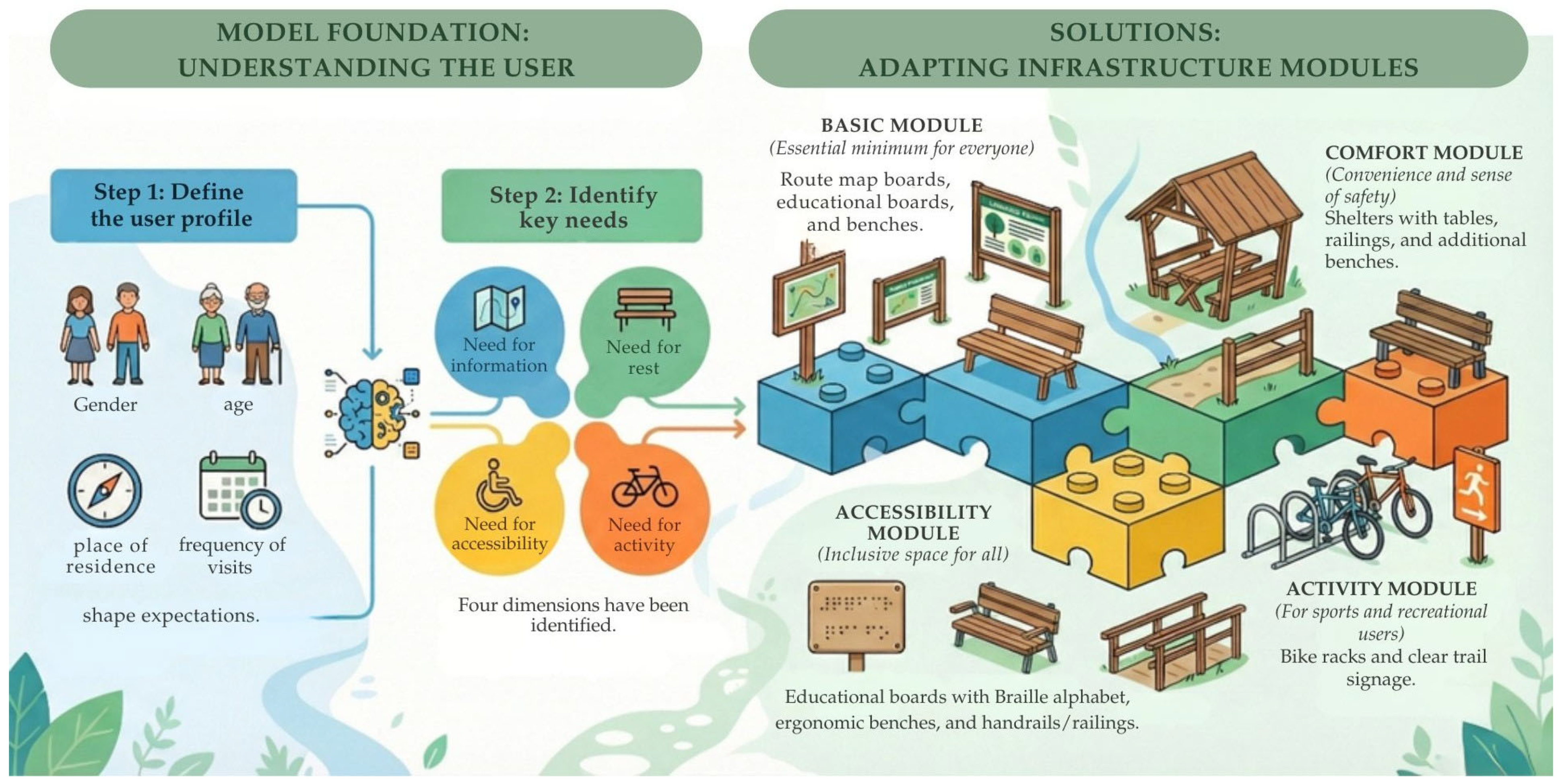
3.4. Socially Sensitive, Flexible, Modular Model for Forest Trail Design
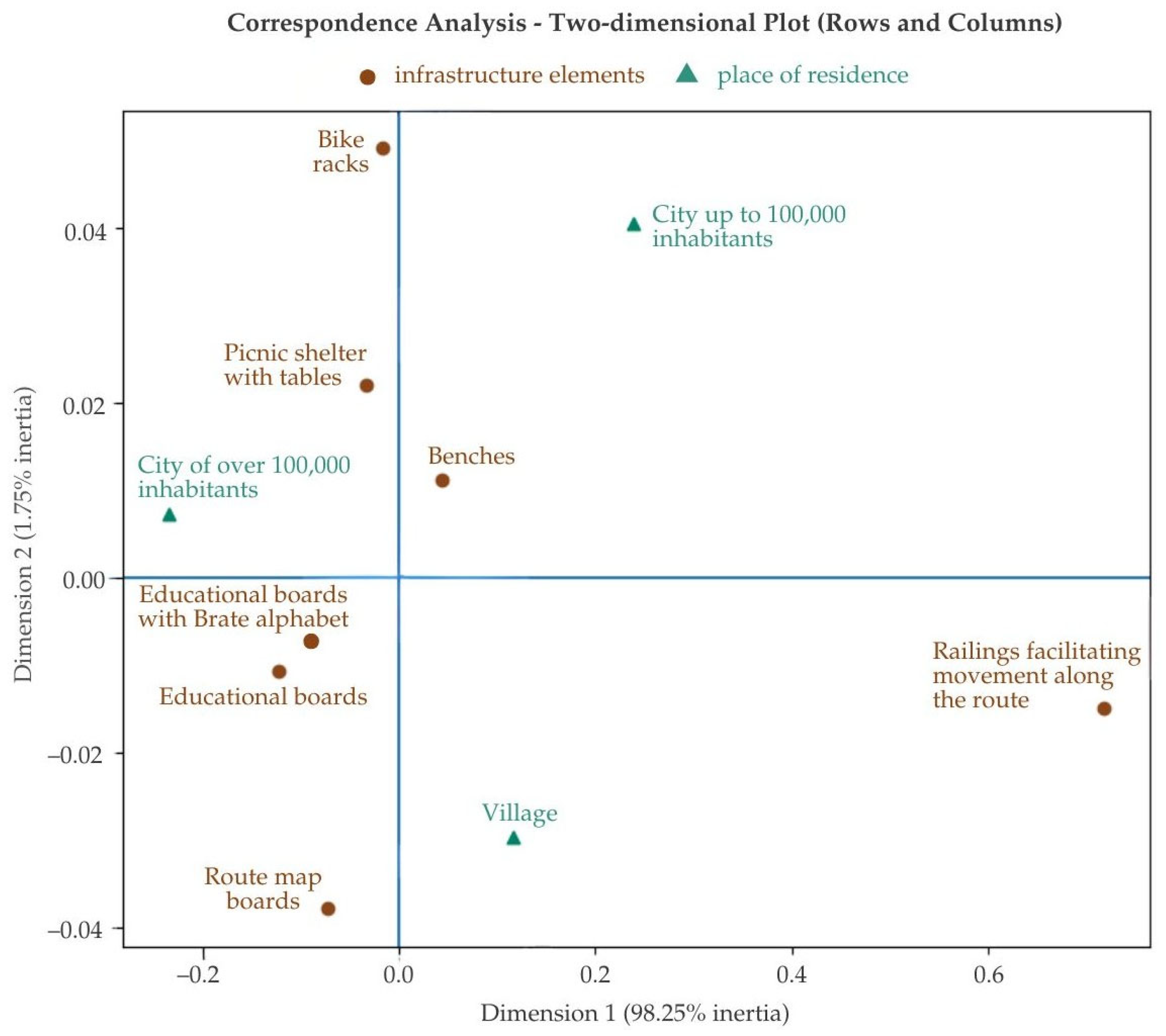
- The basic module includes the elements most frequently indicated by all respondent groups: route map boards, educational boards, and benches, forming a core set of equipment that enhances the clarity, attractiveness, and functionality of trails. These elements form the informational and functional backbone of the trail. Map boards are not only navigation tools but also reduce the ‘fear of the unknown,’ which is essential for a secure nature experience and psychological comfort, especially for occasional visitors.
- The comfort module adds elements that improve rest quality and a sense of safety, such as picnic shelters with tables, railings to facilitate movement along the route, and additional benches. It is particularly important for women, older users, and residents of smaller towns. By providing facilities such as shelters and additional seating, this module directly supports psychophysical restoration. These specific elements allow users to extend their stay in the forest, facilitating stress reduction (SRT) and mental fatigue recovery (ART), which is a key component of human well-being in natural settings.
- The accessibility module addresses the needs of groups requiring greater inclusivity, including educational boards with Braille, ergonomically adapted benches, and handrails and other mobility aids, meeting the expectations of both the youngest and oldest trail users. This module represents the core of socially sensitive planning, ensuring that forest benefits are equitable. Implementing universal design—such as Braille boards and ergonomic benches—enables seniors and persons with disabilities to interact with the forest independently and naturally, fostering social integration and public health.
- The activity module targets recreational and sporting users, including bike racks, clear trail signage, and educational boards, and is particularly relevant for city dwellers and occasional forest visitors. The activity module targets the growing demand for forest-based sports. By providing bike racks and clear sports-oriented signage, it promotes active public health, encouraging urban residents to engage in regular physical exercise within a high-quality ecosystem service environment.
4. Discussion
5. Limitations
6. Conclusions
Author Contributions
Funding
Data Availability Statement
Conflicts of Interest
References
- GUS; US w Białymstoku. Rocznik Statystyczny Leśnictwa 2025; GUS: Warszawa/Białystok, Poland, 2025; p. 27. Available online: https://stat.gov.pl/obszary-tematyczne/roczniki-statystyczne/roczniki-statystyczne/rocznik-statystyczny-lesnictwa-2025,13,8.html (accessed on 10 January 2026).
- Jalinik, M. Obszary leśne w rozwoju turystyki. Ekon. Środow. 2016, 3, 313–323. [Google Scholar]
- Kwiecińska, K.; Kosicka-Gębska, M.; Gębski, J. Turystyka i edukacja leśna a potrzeby współczesnych konsumentów. Ekon. Probl. Tur. 2016, 34, 49–59. [Google Scholar] [CrossRef] [Scilit]
- Malchrowicz-Mośko, E.; Poczta, J. Turystyka sportowa na obszarach leśnych w Polsce—Szanse i zagrożenia. Aktywność Ruchowa Ludzi W Różnym Wieku 2017, 33, 29–38. [Google Scholar]
- Janeczko, E. Ścieżki edukacyjne jako element rekreacyjnego zagospodarowania lasu. Stud. Mater. Cent. Eduk. Przyr.-Leśn. 2010, 12, 100–107. [Google Scholar]
- Pigan, M. Leśna ścieżka poznawcza jednym z najważniejszych obiektów edukacyjnych. Stud. Mater. Cent. Eduk. Przyr.-Leśn. 2012, 14, 11–17. [Google Scholar]
- Cieszewska, A.; Giedych, A.; Maksymiuk, G.; Waldykowski, P.; Adamczyk, J. Inwentaryzacja liniowych elementów infrastruktury turystycznej na potrzeby rozwoju funkcji rekreacyjnej w lasach na przykładzie Nadleśnictwa Celestynów. Probl. Ekol. Kraj. Rekreac. W Kraj. O Wysokim Potencjale. 2013, 34, 27–33. [Google Scholar]
- Wojciechowska-Solis, J.; Kobyłka, A.; Ciesielski, M.; Korcz, N. Potencjał Turystyki Przyrodniczej w Polsce; Wydawnictwo Uniwersytetu Ekonomicznego we Wrocławiu: Wrocław, Poland, 2024. [Google Scholar]
- Bell, S.; Tyrväinen, L.; Sievänen, T.; Pröbstl, U.; Simpson, M. Outdoor recreation and nature tourism: A European perspective. Living Rev. Landsc. Res. 2007, 1, 1–46. [Google Scholar] [CrossRef] [Scilit]
- Cetin, M.; Sevik, H. Evaluating the recreation potential of Ilgaz Mountain National Park in Turkey. Environ. Monit. Assess. 2016, 188, 52. [Google Scholar] [CrossRef] [Scilit]
- Coghlan, A.; Buckley, R. Nature-based tourism. In The Routledge Handbook of Tourism and the Environment; Routledge: London, UK; New York, NY, USA, 2012; pp. 334–344. Available online: https://www.taylorfrancis.com/chapters/edit/10.4324/9780203121108-36/nature-based-tourism-alexandra-coghlan-ralf-buckley (accessed on 15 January 2026).
- Das, M.; Chatterjee, B. Ecotourism: A panacea or a predicament? Tour. Manag. Perspect. 2015, 14, 3–16. [Google Scholar] [CrossRef] [Scilit]
- Fennell, D.A. Ecotourism; Routledge: London, UK; New York, NY, USA, 2020. [Google Scholar] [CrossRef] [Scilit]
- Green, R.; Giese, M. Negative effects of wildlife tourism on wildlife. In Wildlife Tourism: Impacts, Management and Planning; Higginbottom, K., Ed.; Common Ground Publishing Pty Ltd.: Melbourne, Australia, 2004; pp. 81–97. Available online: https://www.researchgate.net/publication/40871766_Wildlife_Tourism_a_strategic_destination_analysis (accessed on 10 January 2026).
- Kuenzi, C.; McNeely, J. Nature-based tourism. In Global Risk Governance; International Risk Governance Council Bookseries; Renn, O., Walker, K.D., Eds.; Springer: Dordrecht, The Netherlands, 2008; Volume 1, pp. 155–178. [Google Scholar] [CrossRef] [Scilit]
- Newsome, D.; Rodger, K. Wildlife tourism. In The Routledge Handbook of Tourism and the Environment; Buckley, R., Ed.; Routledge: London, UK; New York, NY, USA, 2012; pp. 345–358. Available online: https://www.taylorfrancis.com/chapters/edit/10.4324/9780203121108-37/wildlife-tourism-david-newsome-kate-rodger (accessed on 10 January 2026).
- Sahebalzamani, S.; Bertella, G. Business models and sustainability in nature tourism: A systematic review of the literature. Sustainability 2018, 10, 3226. [Google Scholar] [CrossRef] [Scilit]
- Hasan, A. Green tourism. Media Wisata 2014, 12. Available online: http://jurnal.ampta.ac.id/index.php/MWS/article/view/195 (accessed on 12 January 2026). [CrossRef] [Scilit]
- Ibnou-Laaroussi, S.; Rjoub, H.; Wong, W.-K. Sustainability of green tourism among international tourists and its influence on the achievement of green environment: Evidence from North Cyprus. Sustainability 2020, 12, 5698. [Google Scholar] [CrossRef] [Scilit]
- Mika, M. Turystyka przyrodnicza—Jej istota i współczesne kierunki rozwoju. In Studia nad Turystyką. Tradycje, Stan Obecny, Perspektywy Badawcze; Kurek, W., Mika, M., Eds.; Wyd. Uniwersytet Jagielloński: Kraków, Poland, 2007; pp. 311–320. Available online: https://ruj.uj.edu.pl/xmlui/bitstream/handle/item/258674/mika_wspolczesne_kierunki_rozwoju_2007.pdf?sequence=1 (accessed on 14 January 2026).
- Kolkos, G.; Kantartzis, A.; Tsilikas, S.; Stergiadou, A.; Siakou, E.; Arabatzis, G. Development of path and trail network and forest infrastructure for pedestrians, cyclists and persons with disabilities in the Evros Region, Greece. E3S Web Conf. 2024, 585, 01022. [Google Scholar] [CrossRef] [Scilit]
- Sawicki, B.; Kobyłka, A. Ocena ruchu turystycznego w Parku Krajobrazowym Puszczy Knyszyńskiej. Ekon. Środow. 2015, 4, 243–252. [Google Scholar]
- Taylor, P. What factors make rail trails successful as tourism attractions? Developing a conceptual framework from relevant literature. J. Outdoor Recreat. Tour. 2015, 12, 89–98. [Google Scholar] [CrossRef] [Scilit]
- Polucha, I.; Marks, E.; Jaszczak, A.; Elkhatib, A. Zasady projektowania ścieżek dydaktycznych o tematyce zdrowotnej na obszarach leśnych. Probl. Ekol. Kraj. 2012, 34, 313–316. [Google Scholar]
- Janeczko, E.; Banaś, J.; Woźnicka, M.; Janeczko, K.; Zięba, S.; Utnik-Banaś, K.; Banaś, A. What kind of recreational infrastructure encourages forest visits the most? A case study of Poland. Sustainability 2025, 17, 3598. [Google Scholar] [CrossRef] [Scilit]
- Àvila Callau, A.; Erdozain, M.; Farías-Torbidoni, E.I.; de Miguel, S. Linking forest planning and recreational trail design: A GIS approach for enhancing the social use of forests. Environ. Manag. 2025, 75, 2150–2168. [Google Scholar] [CrossRef] [Scilit] [PubMed]
- Gundersen, V.; Vistad, O.I. Public opinions and use of various types of recreational infrastructure in boreal forest settings. Forests 2016, 7, 113. [Google Scholar] [CrossRef] [Scilit]
- Zhou, M.; Wang, F. The driving factors of recreational utilization of ecological space in urban agglomerations: The perspective of urban political ecology. Ecol. Indic. 2024, 158, 111409. [Google Scholar] [CrossRef] [Scilit]
- Gobster, P.H. Recreation and leisure research from an active living perspective: Taking a second look at urban trail use data. Leis. Sci. 2005, 27, 367–383. [Google Scholar] [CrossRef] [Scilit]
- Šodková, M.; Purwestri, R.C.; Riedl, M.; Jarský, V.; Hájek, M. Drivers and frequency of forest visits: Results of a national survey in the Czech Republic. Forests 2020, 11, 414. [Google Scholar] [CrossRef] [Scilit]
- Neuvonen, M.; Sievänen, T.; Tönnes, S.; Koskela, T. Access to green areas and the frequency of visits: A case study in Helsinki. Urban For. Urban Green. 2007, 6, 235–247. [Google Scholar] [CrossRef] [Scilit]
- Lindhagen, A. Forest Recreation in Sweden: Four Case Studies Using Quantitative and Qualitative Methods. 1996. Available online: https://www.cabidigitallibrary.org/doi/full/10.5555/19970603413 (accessed on 10 January 2026).
- Pouta, E.; Sievänen, T. Luonnon virkistyskäytön kysyntätutkimuksen tulokset-Kuinka suomalaiset ulkoilevat? Metsäntutkimuslaitoksen Tied. 2001, 802, 32–76. [Google Scholar]
- Cieszewska, A.; Deptuła, M. Czynniki wpływające na degradację szlaków turystycznych na terenie Tatrzańskiego Parku Narodowego. Stud. Mater. Cent. Eduk. Przyr.-Leśn. 2013, 15, 77–82. [Google Scholar]
- Skłodowski, J.; Gołos, P.; Skłodowski, M.; Ożga, W. Preferencje osób odwiedzających wybrane kompleksy leśne w zakresie turystyki leśnej i organizacji wypoczynku. Leśne Pr. Badaw. 2013, 74, 293–305. [Google Scholar] [CrossRef] [Scilit]
- Gillovic, B.; McIntosh, A. Accessibility and inclusive tourism development: Current state and future agenda. Sustainability 2020, 12, 9722. [Google Scholar] [CrossRef] [Scilit]
- Mahmoudzadeh, S.; Kourdi Sarjaz, N. Environmental barriers to tourism development for people with disabilities. Acta Tur. 2018, 30, 87–114. [Google Scholar] [CrossRef] [Scilit]
- Partyka, J. Udostępnianie turystyczne parków narodowych w Polsce a krajobraz. Pr. Kom. Kraj. Kult. 2010, 14, 252–263. [Google Scholar]
- Stasiak, A.; Śledzińska, J.; Włodarczyk, B. Szlaki Turystyczne od Pomysłu do Realizacji; Wydawnictwo PTTK “Kraj”: Warsaw, Poland, 2014; pp. 117–118. [Google Scholar]
- Janeczko, E.; Woźnicka, M.; Kargul-Plewa, D. Leśne ścieżki edukacyjne dostosowane do potrzeb osób niepełnosprawnych—Przykładowe rozwiązania. Stud. Mater. Cent. Eduk. Przyr.-Leśn. 2016, 18, 182–188. [Google Scholar]
- Devenport, S.E.; Edgeley, C.M. Visitor preferences and human-caused wildfire prevention: A survey of public land users in the US Southwest. J. For. 2025, 123, 171–196. [Google Scholar] [CrossRef] [Scilit]
- Westphal, L.M. The Future of Recreation on Public Lands: A Horizon Scan; US Department of Agriculture, Forest Service, Northern Research Station: Madison, WI, USA, 2022; pp. 1–106.
- Wang, X.; Zhang, J.; Wu, C. Users’ recreation choices and setting preferences for trails in urban forests in Nanjing, China. Urban For. Urban Green. 2022, 73, 127602. [Google Scholar] [CrossRef] [Scilit]
- Eriksson, L.; Nordlund, A.M.; Olsson, O.; Westin, K. Recreation in different forest settings: A scene preference study. Forests 2012, 3, 923–943. [Google Scholar] [CrossRef] [Scilit]
- Gołos, P. Społeczne i Ekonomiczne Aspekty Pozaprodukcyjnych Funkcji Lasu i Gospodarki Leśnej—Wyniki Badań Opinii Społecznej; Instytut Badawczy Leśnictwa: Sękocin Stary, Poland, 2018; Available online: https://bibliotekanauki.pl/books/2022398.pdf (accessed on 12 January 2026).
- Gundersen, V.; Tangeland, T.; Kaltenborn, B.P. Planning for recreation along the opportunity spectrum: The case of Oslo, Norway. Urban For. Urban Green. 2015, 14, 210–217. [Google Scholar] [CrossRef] [Scilit]
- Jensen, F.S. Landscape managers’ and politicians’ perception of the forest and landscape preferences of the population. For. Landsc. Res. 1993, 1, 79–93. [Google Scholar]
- Sever, I.; Verbič, M. Providing information to respondents in complex choice studies: A survey on recreational trail preferences in an urban nature park. Landsc. Urban Plan. 2018, 169, 160–177. [Google Scholar] [CrossRef] [Scilit]
- Słowiak, J. Zagospodarowanie turystyczne i rekreacyjne lasów miejskich w Szczecinie. Stud. Perieget. 2018, 2, 49–63. [Google Scholar] [CrossRef] [Scilit]
- Maciejko, A.; Wojtyszyn, B. Tourism infrastructure providing access to areas of protected landscape and nature in Poland: Selected examples. IOP Conf. Ser. Mater. Sci. Eng. 2019, 603, 042049. [Google Scholar] [CrossRef] [Scilit]
- Krajter Ostoić, S.; Konijnendijk van den Bosch, C.C.; Vuletić, D.; Stevanov, M.; Živojinović, I.; Mutabdžija-Bećirović, S.; Lazarević, J.; Stojanova, B.; Blagojević, D.; Stojanovska, M. Citizens’ perception of and satisfaction with urban forests and green space: Results from selected Southeast European cities. Urban For. Urban Green. 2017, 23, 93–103. [Google Scholar] [CrossRef] [Scilit]
- Andries, D.M.; Arnaiz-Schmitz, C.; Díaz-Rodríguez, P.; Herrero-Jáuregui, C.; Schmitz, M.F. Sustainable tourism and natural protected areas: Exploring local population perceptions in a post-conflict scenario. Land 2021, 10, 331. [Google Scholar] [CrossRef] [Scilit]
- Byrd, E.T. Stakeholders in sustainable tourism development and their roles: Applying stakeholder theory to sustainable tourism development. Tour. Rev. 2007, 62, 6–13. [Google Scholar] [CrossRef] [Scilit]
- Bank Danych o Lasach. Available online: https://www.lasy.gov.pl/pl/nasze-lasy/polskie-lasy (accessed on 13 January 2026).
- Ciesielski, M.; Stereńczak, K. What do we expect from forests? The European view of public demands. J. Environ. Manag. 2018, 209, 139–151. [Google Scholar] [CrossRef] [Scilit]
- Pouso, S.; Borja, Á.; Fleming, L.E.; Gómez-Baggethun, E.; White, M.P.; Uyarra, M.C. Contact with blue-green spaces during the COVID-19 pandemic lockdown beneficial for mental health. Sci. Total Environ. 2021, 756, 143984. [Google Scholar] [CrossRef] [Scilit] [PubMed]
- Korcz, N.; Kamińska, A.; Ciesielski, M. Ecological education in the city: Who, how, and with what effect educates the residents of the Warsaw metropolitan area—Preliminary research in Poland. Forests 2026, 17, 275. [Google Scholar] [CrossRef] [Scilit]
- Zawadka, J.; Uglis, J.; Kozera-Kowalska, M.; Jęczmyk, A.; Pietrzak-Zawadka, J.; Wojcieszak-Zbierska, M.M. An empirical assessment of students’ tourist preferences during the COVID-19 pandemic from a gender perspective: Evidence from Poland. Sustainability 2023, 15, 14346. [Google Scholar] [CrossRef] [Scilit]
- Ustawą z Dnia 10 Maja 2018 r. o Ochronie Danych Osobowych (Dz. U. 2018 poz. 1000). Available online: https://sip.lex.pl/akty-prawne/dzu-dziennik-ustaw/ochrona-danych-osobowych-18722262 (accessed on 14 January 2026).
- Wolf, I.D.; Croft, D.B.; Green, R.J. Nature conservation and nature-based tourism: A paradox? Environments 2019, 6, 104. [Google Scholar] [CrossRef] [Scilit]
- Buckley, R.; Pickering, C.; Weaver, D.B. (Eds.) Nature-Based Tourism, Environment and Land Management, 1st ed.; CABI Publishing: Wallingford, UK, 2003. [Google Scholar] [CrossRef] [Scilit]
- Gössling, S.; Hickler, T. Tourism and forest ecosystems. In Tourism and Global Environmental Change; Gössling, S., Hall, M., Eds.; Routledge: London, UK; New York, NY, USA, 2006; pp. 95–106. Available online: https://www.taylorfrancis.com/chapters/oa-edit/10.4324/9780203011911-6/tourism-forest-ecosystems-stefan-g%C3%B6ssling-thomas-hickler (accessed on 12 January 2026).
- Fino, E.; Iliceto, P. Do people have control over the decisions they make? Psychometric properties of the Italian version of the free will and scientific determinism questionnaire (FAD-plus-I). Curr. Psychol. 2023, 42, 11268–11286. [Google Scholar] [CrossRef] [Scilit]
- Singh, S.; Singh, N.; Kalinić, Z.; Liébana-Cabanillas, F.J. Assessing determinants influencing continued use of live streaming services: An extended perceived value theory of streaming addiction. Expert Syst. Appl. 2021, 168, 114241. [Google Scholar] [CrossRef] [Scilit]
- Zhang, L.; Wu, C.; Hao, Y. Effect of the development level of facilities for forest tourism on tourists’ willingness to visit urban forest parks. Forests 2022, 13, 1005. [Google Scholar] [CrossRef] [Scilit]
- Williams, S. Tourism and Recreation; Pearson Education: Harlow, UK, 2003; Available online: https://books.google.com/books?hl=pl&lr=&id=gi_9dT6gkwIC&oi=fnd&pg=PR9&dq=Restoration+and+Recreation:+Tourism+Development+and+Landscape+Restoration+in+Rural+Areas.+John+Wiley+%26+Sons&ots=W8dHglN7oS&sig=72-r8aR2S0Qc3oSWt3FSI71Swxg (accessed on 12 January 2026).
- Olenderek, T. Przedstawianie map na tablicach informacyjnych. Stud. Mater. Cent. Eduk. Przyr.-Leśn. 2015, 17, 108–117. [Google Scholar]
- Kidd, A.M.; Monz, C.; D’Antonio, A.; Manning, R.E.; Reigner, N.; Goonan, K.A.; Jacobi, C. The effect of minimum impact education on visitor spatial behavior in parks and protected areas: An experimental investigation using GPS-based tracking. J. Environ. Manag. 2015, 162, 53–62. [Google Scholar] [CrossRef] [Scilit] [PubMed]
- Hunter, I.R. What do people want from urban forestry?—The European experience. Urban Ecosyst. 2001, 5, 277–284. [Google Scholar] [CrossRef] [Scilit]
- Korcz, N.; Janeczko, E.; Bielinis, E.; Urban, D.; Koba, J.; Szabat, P.; Małecki, M. Influence of informal education in the forest stand redevelopment area on the psychological restoration of working adults. Forests 2021, 12, 993. [Google Scholar] [CrossRef] [Scilit]
- Szkiruc, Z. Turystyka w leśnych kompleksach promocyjnych na terenie RDLP w Białymstoku. Stud. Mater. Cent. Eduk. Przyr.-Leśn. 2013, 15, 299–304. [Google Scholar]
- Golovkova, L.S.; Yukhnovska, Y.O.; Ryzhenko, O.M. The development of ecological (green) and rural tourism for the disabled people in Ukraine. J. Geol. Geogr. Geoecol. 2023, 32, 26–35. [Google Scholar] [CrossRef] [Scilit]
- Sisto, R.; Cappelletti, G.M.; Bianchi, P.; Sica, E. Sustainable and accessible tourism in natural areas: A participatory approach. Curr. Issues Tour. 2022, 25, 1307–1324. [Google Scholar] [CrossRef] [Scilit]
- Prószyńska-Bordas, H. Przygotowanie polskich parków narodowych do turystyki w opinii odwiedzających. Tur. Rekreac. 2014, 11, 1. [Google Scholar]
- Uglis, J.; Roszak, A. Aktywność turystyczna mieszkańców wsi—Studium przypadku. Ekonom. Probl. Tur. 2016, 34, 95–105. [Google Scholar] [CrossRef] [Scilit]
- Arnberger, A.; Eder, R. The influence of age on recreational trail preferences of urban green-space visitors: A discrete choice experiment with digitally calibrated images. J. Environ. Plan. Manag. 2011, 54, 891–908. [Google Scholar] [CrossRef] [Scilit]
- Bandura, A. Self-Efficacy: Toward a Unifying Theory of Behavioral Change. Adv. Behav. Res. Ther. 1978, 1, 139–161. [Google Scholar] [CrossRef] [Scilit]
- Frick, J.; Kaiser, F.G.; Wilson, M. Environmental Knowledge and Conservation Behavior: Exploring Prevalence and Structure in a Representative Sample. Personal. Individ. Differ. 2004, 37, 1597–1613. [Google Scholar] [CrossRef] [Scilit]
- Stefán, F.; Ciesielski, M.; Scharl, T.; Zobel, T.; Taczanowska, K. Origin-Destination Flow Clustering for Sustainable Forest Recreation Planning–Case Study of Vienna Metropolitan Area, Austria. Urban For. Urban Green. 2026, 120, 129432. [Google Scholar] [CrossRef] [Scilit]
- Korcz, N.; Mazurek-Kusiak, A.; Kobylka, A.; Janeczko, E. How do educational boards in urban and suburban forests attract the attention of forest users and influence them in the process of understanding nature? Sylwan 2023, 167, 569–582. [Google Scholar] [CrossRef]
- Korcz, N.; Ciesielski, M.; Kamińska, A.; Choromański, K.; Gotlib, D.; Stefán, F.; Taczanowska, K. The use of digital tools in forest tourism and recreation-experiences from Warsaw agglomeration in Poland. Trees For. People 2024, 18, 100697. [Google Scholar] [CrossRef] [Scilit]
- Hallo, J.C.; Beeco, J.A.; Goetcheus, C.; McGee, J.; McGehee, N.G.; Norman, W.C. GPS as a method for assessing spatial and temporal use distributions of nature-based tourists. J. Travel Res. 2012, 51, 591–606. [Google Scholar] [CrossRef] [Scilit]




| Group | n | % | ||
|---|---|---|---|---|
| Socio-demographic characteristics | Gender | Female | 251 | 62.44 |
| Male | 151 | 37.56 | ||
| Age | 18–30 | 242 | 60.20 | |
| 31–40 | 60 | 14.93 | ||
| 41–50 | 59 | 14.68 | ||
| >50 years old | 41 | 10.20 | ||
| Place of residence | Village | 148 | 36.82 | |
| City with up to 100,000 inhabitants | 76 | 18.91 | ||
| City of over 100,000 inhabitants | 178 | 44.28 | ||
| Frequency of going to the forests | In general | 41 | 10.20 | |
| At least once a year | 161 | 40.05 | ||
| At least once a month | 123 | 30.60 | ||
| At least once a week | 77 | 19.15 | ||
| Infrastructure Elements | Gender [%] | Statistics | |||
|---|---|---|---|---|---|
| Female | Male | χ2 | p * | Cramér’s V | |
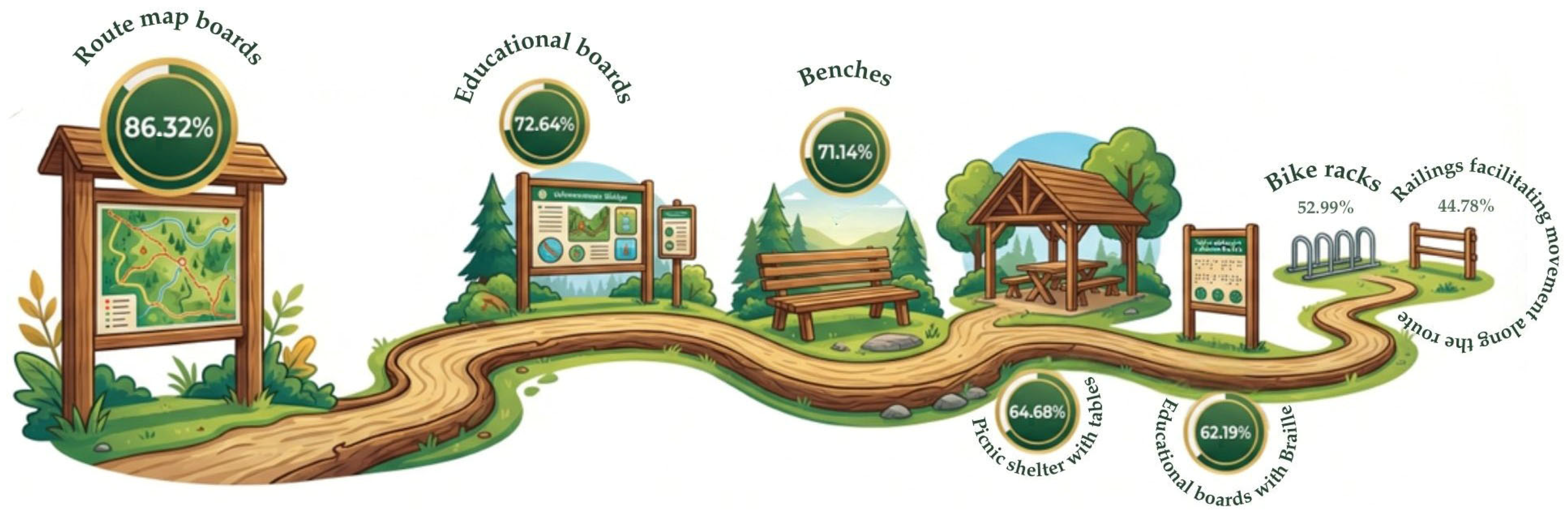
| Route map boards | 90.44 | 79.47 | 9.60 | 0.002 * | 0.15 |
| Educational boards | 73.71 | 70.86 | 0.38 | 0.536 | 0.03 |
| Benches | 77.29 | 60.93 | 12.30 | 0.000 * | 0.17 |
| Picnic shelter with tables | 65.74 | 62.91 | 0.33 | 0.570 | 0.03 |
| Educational boards with the Braille alphabet | 65.74 | 56.29 | 3.58 | 0.059 | 0.09 |
| Bike racks | 57.77 | 45.03 | 6.14 | 0.013 * | 0.12 |
| Railings facilitating movement along the route | 50.20 | 35.76 | 7.95 | 0.005 * | 0.14 |
| Infrastructure Elements | Age Group [%] | Statistics | |||||
|---|---|---|---|---|---|---|---|
| 18–30 Years Old | 31–40 Years Old | 41–50 Years Old | 50+ Years Old | χ2 | p * | Cramér’s V | |
| Route map boards | 91.32 | 83.33 | 76.27 | 75.61 | 14.61 | 0.002 * | 0.19 |
| Educational boards | 76.86 | 70.00 | 69.49 | 56.10 | 8.32 | 0.040 * | 0.14 |
| Benches | 77.27 | 53.33 | 64.41 | 70.73 | 15.01 | 0.002 * | 0.19 |
| Picnic shelter with tables | 69.01 | 58.33 | 54.24 | 63.41 | 5.89 | 0.117 | 0.12 |
| Educational boards with the Braille alphabet | 68.18 | 51.67 | 52.54 | 56.10 | 9.50 | 0.023 * | 0.15 |
| Bike racks | 59.92 | 36.67 | 38.98 | 56.10 | 15.88 | 0.001 * | 0.20 |
| Railings facilitating movement along the route | 52.48 | 23.33 | 30.51 | 51.22 | 22.51 | 0.000 * | 0.24 |
| Infrastructure Elements | Place of Residence [%] | Statistics | ||||
|---|---|---|---|---|---|---|
| Village | City up to 100,000 Inhabitants | City of over 100,000 Inhabitants | χ2 | p * | Cramér’s V | |
| Route map boards | 90.54 | 81.58 | 84.83 | 4.01 | 0.134 | 0.10 |
| Educational boards | 71.62 | 67.11 | 75.84 | 2.17 | 0.338 | 0.07 |
| Benches | 75.68 | 84.21 | 61.80 | 15.38 | 0.000 * | 0.19 |
| Picnic shelter with tables | 64.86 | 71.05 | 61.80 | 2.00 | 0.368 | 0.07 |
| Educational boards with the Braille alphabet | 62.16 | 60.53 | 62.92 | 0.12 | 0.937 | 0.17 |
| Bike racks | 52.03 | 61.84 | 50.00 | 3.08 | 0.214 | 0.09 |
| Railings facilitating movement along the route | 43.92 | 59.21 | 39.33 | 8.59 | 0.014 * | 0.15 |
| Infrastructure Elements | Frequency of Going to the Forests [%] | Statistics | |||||
|---|---|---|---|---|---|---|---|
| In General | At Least Once a Year | At Least Once a Month | At Least Once a Week | χ2 | p * | Cramér’s V | |
| Route map boards | 78.05 | 91.93 | 89.43 | 74.03 | 17.52 | 0.000 * | 0.21 |
| Educational boards | 60.98 | 77.02 | 78.86 | 59.74 | 13.21 | 0.004 * | 0.18 |
| Benches | 65.85 | 77.02 | 73.98 | 57.14 | 11.10 | 0.011 * | 0.16 |
| Picnic shelter with tables | 58.54 | 65.22 | 70.73 | 57.14 | 4.58 | 0.205 | 0.11 |
| Educational boards with the Braille alphabet | 41.46 | 66.46 | 69.11 | 53.25 | 13.86 | 0.003 * | 0.19 |
| Bike racks | 41.46 | 54.66 | 58.54 | 46.75 | 5.09 | 0.165 | 0.11 |
| Railings facilitating movement along the route | 39.02 | 50.93 | 47.15 | 31.17 | 9.06 | 0.028 * | 0.15 |
Disclaimer/Publisher’s Note: The statements, opinions and data contained in all publications are solely those of the individual author(s) and contributor(s) and not of MDPI and/or the editor(s). MDPI and/or the editor(s) disclaim responsibility for any injury to people or property resulting from any ideas, methods, instructions or products referred to in the content. |
© 2026 by the authors. Licensee MDPI, Basel, Switzerland. This article is an open access article distributed under the terms and conditions of the Creative Commons Attribution (CC BY) license.
Share and Cite
Kobyłka, A.; Korcz, N. User Preferences Regarding Forest Trail Infrastructure—Implications for Socially Sensitive Planning: A Pilot Study. Forests 2026, 17, 597. https://doi.org/10.3390/f17050597
Kobyłka A, Korcz N. User Preferences Regarding Forest Trail Infrastructure—Implications for Socially Sensitive Planning: A Pilot Study. Forests. 2026; 17(5):597. https://doi.org/10.3390/f17050597
Chicago/Turabian StyleKobyłka, Agata, and Natalia Korcz. 2026. "User Preferences Regarding Forest Trail Infrastructure—Implications for Socially Sensitive Planning: A Pilot Study" Forests 17, no. 5: 597. https://doi.org/10.3390/f17050597
APA StyleKobyłka, A., & Korcz, N. (2026). User Preferences Regarding Forest Trail Infrastructure—Implications for Socially Sensitive Planning: A Pilot Study. Forests, 17(5), 597. https://doi.org/10.3390/f17050597