Article

Mechanical Properties and Design Values of Hinoki (Chamaecyparis obtusa) Dimension Lumber from Japan

1
Wood Science and Engineering Department, Oregon State University, Corvallis, OR 97330, USA
2
Pacific Lumber Inspection Bureau, Federal Way, WA 98003, USA
3
Japan Lumber Inspection and Research Association, Tokyo 101-0052, Japan
4
Forestry and Forest Products Research Institute, Ibaraki 305-8687, Japan
*
Author to whom correspondence should be addressed.
Forests 2026, 17(5), 596; https://doi.org/10.3390/f17050596 (registering DOI)
Submission received: 14 April 2026 / Revised: 8 May 2026 / Accepted: 10 May 2026 / Published: 15 May 2026
(This article belongs to the Special Issue Testing and Assessment of Wood and Wood Products)

Abstract

This study evaluates the mechanical properties of Hinoki (Chamaecyparis obtusa) from Japan to determine reliable design values for its application as structural dimension lumber species in the United States. A comprehensive experimental program was conducted on 1464 (approximately 240 per grade/size) dimension lumber in-grade specimens sourced from prominent Hinoki-growing regions of Japan. These specimens were tested in bending, compression perpendicular to the grain, and horizontal shear. Tests were conducted, and the results were subjected to statistical analysis and adjustment factors to determine base reference values in accordance with ASTM International standards. The four-point bending tests showed moderate numerical variation across growing regions; however, one-way ANOVA confirmed no statistically significant regional effect on MOR or MOE. Compression parallel to grain and tensile strength were estimated from the MOR values using empirical relationships per ASTM D1990. The base design values after adjustments for 15% moisture content, specimen size, and volume effects fall within the expected range for high-quality structural species and support the acceptability of Hinoki as a load-carrying wood species. The results constitute the first complete, statistically verified dataset for Hinoki, and provide a basis for its use in wood design specifications such as the National Design Specification (NDS) for Wood Construction (NDS). Wider recognition of Hinoki as a viable structural species could expand its commercial use and support sustainable forest management practices in Japan.

1. Introduction

Hinoki, (Chamaecyparis obtusa) or Japanese Cypress, is one of Japan’s premier wood species. Known for its longevity and excellent structural properties, Hinoki is a conifer reaching 20–25 m in height (up to 36 m in natural settings) with a trunk diameter of approximately 1 m. The scale-like leaves are 2–4 mm (0.079–0.157 in) long, green on the top and bottom, and there is a white stomatal band at the base of each leaf. It likes damp, fertile loams best, but it may also grow in other types of soil if they drain properly. Optimal growth occurs in full sun; the species tolerates partial shade but requires wind protection. Japan grows it for its exceedingly high-quality wood, which is used to make palaces, temples, shrines, traditional Noh theaters, baths, table tennis blades, and masu (a traditional square wooden box used for measuring rice) [1]. The wood has a pleasant aroma, is naturally durable [2], and does not decay easily [2,3].
Hinoki’s exceptional structural properties are evidenced by its use in some of the world’s oldest surviving wooden structures, including Horyu-ji Temple in Ikaruga (constructed over 1300 years ago) and Osaka Castle [4]. Beyond its structural applications, Hinoki is also widely cultivated as an ornamental tree. In Japan and other temperate regions, including Western Europe and portions of North America, it is also a popular decorative tree in parks and gardens. Many different types of Hinoki cultivars have been selected for garden planting, including dwarf varieties, yellow-leaved cultivars, and dense-leaved cultivars. People also commonly cultivate it as a bonsai.
Hinoki wood has long been regarded as a highly desirable construction and interior material. It is aesthetically valued for its fine grain and pale white color, with a subtle reddish hue, and is also popular due to its natural durability and easy of machining [5]. Given its natural durability, fine grain, and mechanical performance documented in this study, Hinoki is particularly suited for exposed structural applications, including sill plates, heavy timber framing, and interior finish-grade structural members. In such applications, its performance characteristics are comparable to those of Western Red Cedar and Port Orford Cedar currently listed in the NDS Supplement for Wood Construction [6]. However, it is costly to use as construction material because Hinoki trees take longer to mature than other conifers. The standard harvest age for Hinoki in the Kyushu region is reported as 45 years [7]. Despite its notable structural attributes, the broader application of Hinoki in engineered construction, especially in the US, has been limited by the absence of formally established design values and standardized testing data, both of which are prerequisites for inclusion in building codes [8,9]. In the United States, structural design values for any dimension lumber species are listed in the NDS Supplement Design Values for Wood Construction [6].
The development of design values for wood species in the NDS Supplement [6] requires a systematic approach. A testing and materials protocol is developed that identifies the type of tests to be conducted and the sample size, considering the material’s geographic origin. Sample sizes are determined based on considerations of statistical reliability, especially when calculating the lower fifth percentile of material performance. Samples are then collected from the identified regions and prepared in accordance with the applicable testing standards. The mechanical test data are analyzed collaboratively with a certified engineer from a lumber grading rules-writing agency accredited by the American Lumber Standard Committee (ALSC), such as the Pacific Lumber Inspection Bureau (PLIB). The results are subsequently presented to the American Lumber Standards Committee (ALSC) Board of Review for approval and possible incorporation into the upcoming edition of the lumber agency’s grade rule book, such as the PLIB Grading Rules No. 18 [10] and subsequently in the NDS Supplement [6].
Despite Hinoki’s well-documented structural performance, no formally established design values or standardized in-grade test data exist for this species in the United States. This absence has limited its use in engineered construction. The novelty of this work lies in four key aspects: (1) it presents the first ASTM D1990-compliant in-grade test program for Hinoki dimension lumber at the grade and size sample requirements necessary for submission to the NDS Supplement; (2) it derives formally verified allowable design values suitable for review by the American Lumber Standards Committee (ALSC); (3) it evaluates the geographic uniformity of mechanical properties across five major growing regions of Japan; and (4) it provides the technical basis for the inclusion of Hinoki in U.S. and international building codes.

2. Materials and Methods

2.1. Materials

The test specimens used in this study were sourced from commercial plantation forests, which represent the dominant source of commercially produced Hinoki dimension lumber in Japan. The sampling program followed the PLIB approved sampling and testing plan, in which specimens were collected proportionally from major Hinoki-growing regions based on standing timber volume. Naturally grown Hinoki forests were not included because they do not represent the primary commercial supply stream for structural dimension lumber at the scale required for ASTM D1990 [11] in-grade testing programs. Accordingly, the proposed design values are intended to apply specifically to plantation-grown Hinoki dimension lumber visually graded in accordance with PLIB Rules No. 18. The collection of dimension lumber was facilitated by two sawmills in Japan, which operate in those regions and handle the majority of Hinoki logs. They are the Kyowa Mokuzai Company, Ltd. in Fukushima Prefecture (Fukushima, Japan), and the Cypress Sunadaya Company in Ehime Prefecture (Ehime, Japan). Kyowa Mokuzai supplied approximately 7% of the test samples, and Cypress Sunadaya supplied approximately 93%. The percentages registered here are based on data for the distribution of Hinoki in Japan [12]. The majority of Hinoki grows in the Southern Honshu, Shikoku, and Kyushu regions, and the proposed percentages of test pieces collected at the two sawmills reflect this. The number of samples obtained and the region from which they were obtained are described in Table 1. The test samples consisted of three sizes and two visual grades of dimension lumber. Samples comprise three sizes and two visual grades, with a minimum of 240 pieces per size/grade combination (cell) to ensure statistical reliability. The samples were graded as either Select Structural (SS) or No. 2 visually graded lumber, as described in Rules No. 18 [10], paragraphs 123 and 124. The number of test pieces per region is presented in Table 1. The number of samples for each evaluation was determined by the PLIB and outlined in a testing plan presented to the ALSC, ensuring that the data could be examined and analyzed, and that the resulting design values could be submitted to the ALSC for potential inclusion in the NDS Supplement [6].

2.2. Methodology

2.2.1. Bending Test

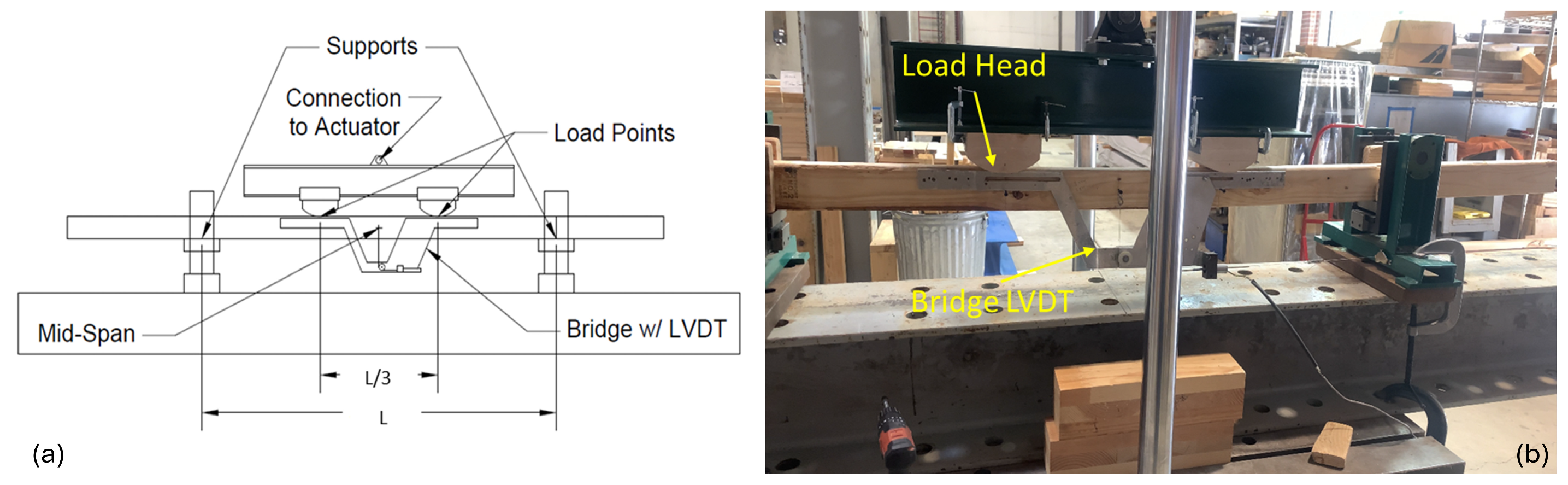
Four-point bending tests were performed on all specimens in accordance with ASTM D4761-25 [13]. A span-to-depth ratio of 17:1 was used for edge-bending tests. The cross-section, span-to-depth ratio, and the clear span of the three types of specimens used in this study are presented in Table 2. The loading points were set at one-third of the test span, as shown in Figure 1. Specimens were positioned so that strength-reducing characteristics (e.g., knots) were randomly oriented relative to the tension and compression zones and horizontally positioned so the estimated maximum strength-reducing characteristic was randomly positioned relative to the center of the test span. The specimens were tested using a hydraulic MTS Universal Testing Machine (UTM) equipped with a 180 kN load cell at a loading rate of 2 mm/min. The load and deflections were continuously recorded. These data were used to calculate Modulus of Elasticity (MOE) and Modulus of Rupture (MOR) using Equations (1) and (2), respectively. After the test, the failure code for each specimen was recorded to characterize the failure type, as described in ASTM D4761, Table X1.1 [13]. The equation for determining MOR is as follows:
MOR   =   P m a x   ×     L b   ×   h 2
where Pmax is the maximum load (N) recorded by the testing machine, L is the span (mm) of the beam, b (mm) is the thickness of the specimen, and h is the width (mm) of the specimen. MOE was calculated using the following equation:
MOE   =   k   ×   L   ×   a 2 4   ×   b   ×   h 3
where k is the slope of the shear-free load deflection profile below the proportional limit (N/mm), L is the span (mm), a is the shear-free middle third of the test span (mm), b is the width (mm) of the specimen, and h is the depth (mm) of the specimen.

2.2.2. Grade Quality Index

ASTM D1990 [11] specifies that the Grade Quality Index (GQI) be determined at the point of failure to quantify the characteristic that initiated the failure. This is usually a knot or slope of grain in the tension face of the piece. The GQI is a value based on the values in ASTM D245 [14] for the slope of grain and for distorted grain and knots. The GQI values for each grade/width (referred to as cells) are compiled and analyzed according to D1990 [11]. The GQI for a cell is the fifth percentile point estimate, as determined per ASTM D2915 [15]. The assigned GQI for the Select Structural grade is 65, and for the No. 2 grade, the GQI is 45. The GQI for the 2 × 6 and 2 × 8 No. 2 cells exceeded the limits in ASTM D1990 [11] and was reduced by the MOR and MOE Adjustment Factors in Table 3.
The adjusted MOR values and resulting summary statistics for each grade and size are presented in Tables 6 and 7 in Section 3.1.

2.2.3. MOR Characteristic Value Tests

Once the 2 × 8 × 144 characteristic values for the combined SS and No. 2 grade cells were determined, compliance was verified against the two tests required by Sections 9.3 and 12.6 of ASTM D1990 [11], Section 9.3 requires that the size-adjusted MOR characteristic value for a grade does not exceed the fifth percentile 75% UCI for any of the three cell sizes. Section 12.6 of ASTM D1990 requires that the size-adjusted characteristic value does not exceed the point estimate by more than 100 psi or 5% of the point estimate, whichever is less. All Select Structural and No. 2 size-adjusted characteristic values passed both checks without requiring adjustment, confirming the final 2 × 8 × 144 characteristic values of 21.72 MPa for Select Structural and 14.96 MPa for the No. 2 grade.

2.2.4. Compression Parallel

According to ASTM D1990 [11], the characteristic values for untested properties can be estimated from the modulus of rupture obtained from the bending test. In this study, testing was not done to determine the ultimate compressive stress (UCS); however, the equations in ASTM D1990 Section 9.5 [11] were used. These equations are derived from extensive datasets of North American commercial species and are explicitly sanctioned for use in the development of design values for new species. The equation used to evaluate the ultimate compressive strength is as follows:
For MOR ≤ 7200 psi
UCS = [ 1.55 ( 0.32   ×   M O R 1000 ) + ( 0.022   ×   ( M O R 1000 ) 2 ) ] × MOR
For MOR > 7200 psi
USC = 0.39 × MOR
where UCS is the ultimate compressive strength and MOR is the modulus of rupture, adjusted for GQI and moisture per ASTM D1990 [11].
The resulting estimates are considered conservative, as the empirical relationships incorporate variability associated with grain characteristics, knots, and other strength-reducing features across a wide range of species. While the independent direct testing of compression parallel to grain and tension parallel to grain (Ft) would provide additional validation, such testing is not required under current ALSC protocols for new species submissions and was beyond the scope of this study.

2.2.5. Compression Perpendicular (Fc)

Tests for compression perpendicular to the grain were conducted on undamaged portions of the Hinoki bending samples measuring 50.8 (width) × 38.1 (thickness) × 152.4 mm (length) using an Instron 5582 UTM equipped (Instron, Norwood Massachusetts 02062) with a 100 kN load cell. The modification of the specimen was in accordance with the Green–Shelley protocol [16], which permits the use of 38.1 mm (1.5”) thick (nominal 2”) specimens. This protocol was reviewed and accepted by major lumber grading agencies, including the Pacific Lumber Inspection Bureau (PLIB), for the Fc testing of dimension lumber. The reduction in specimen thickness from 50.8 mm to 38.1 mm does not alter the stress distribution under the bearing plate, because the specimen length (152.4 mm) is substantially greater than the bearing plate contact width (38.1 mm). As a result, the stress field beneath the plate develops fully and is governed by the contact area rather than specimen thickness.
The samples were stored for a period of approximately 8 weeks in a conditioning chamber that maintains a constant temperature of 20 °C and a relative humidity of 65%. After eight weeks, it was determined that the samples were at equilibrium and ready to test. During the testing phase, the load-bearing plate applied pressure to the radial surface of the specimen, which was positioned on a leveled steel plate. The load-bearing plate only compressed a 38.1 mm × 50.8 mm (1.5 × 2 in.) middle section of the sample. The crossarm was subsequently lowered at a rate of 0.305 mm/min. Testing was stopped once an extension of 2.5 mm was achieved. After the test, the region where the samples had been compressed was identified and the peak load was documented.
The compressive stress was calculated by using the force at a 1 mm deflection, based on ASTM D143 [17]. The load versus deflection curve helped in the determination of compressive strength by considering the load at 1 mm deflection, using the following formula:
Compressive   strength   =   P 1   mm W s a m p l e     ×     w l o a d   h e a d  
where P 1   mm is the load at 1 mm, W s a m p l e is the width of the sample (mm), and w l o a d   h e a d is the width of the load head (mm).

2.2.6. Tension Parallel

Like compression parallel to grain, ultimate tensile stress (UTS) was evaluated using the empirical equations of ASTM D1990 [11]. The equation for calculating UTS is as follows:
UTS = 0.45 × MOR
The MOR was adjusted for GQI and moisture in accordance with ASTM D1990 [11].

2.2.7. Horizontal Shear

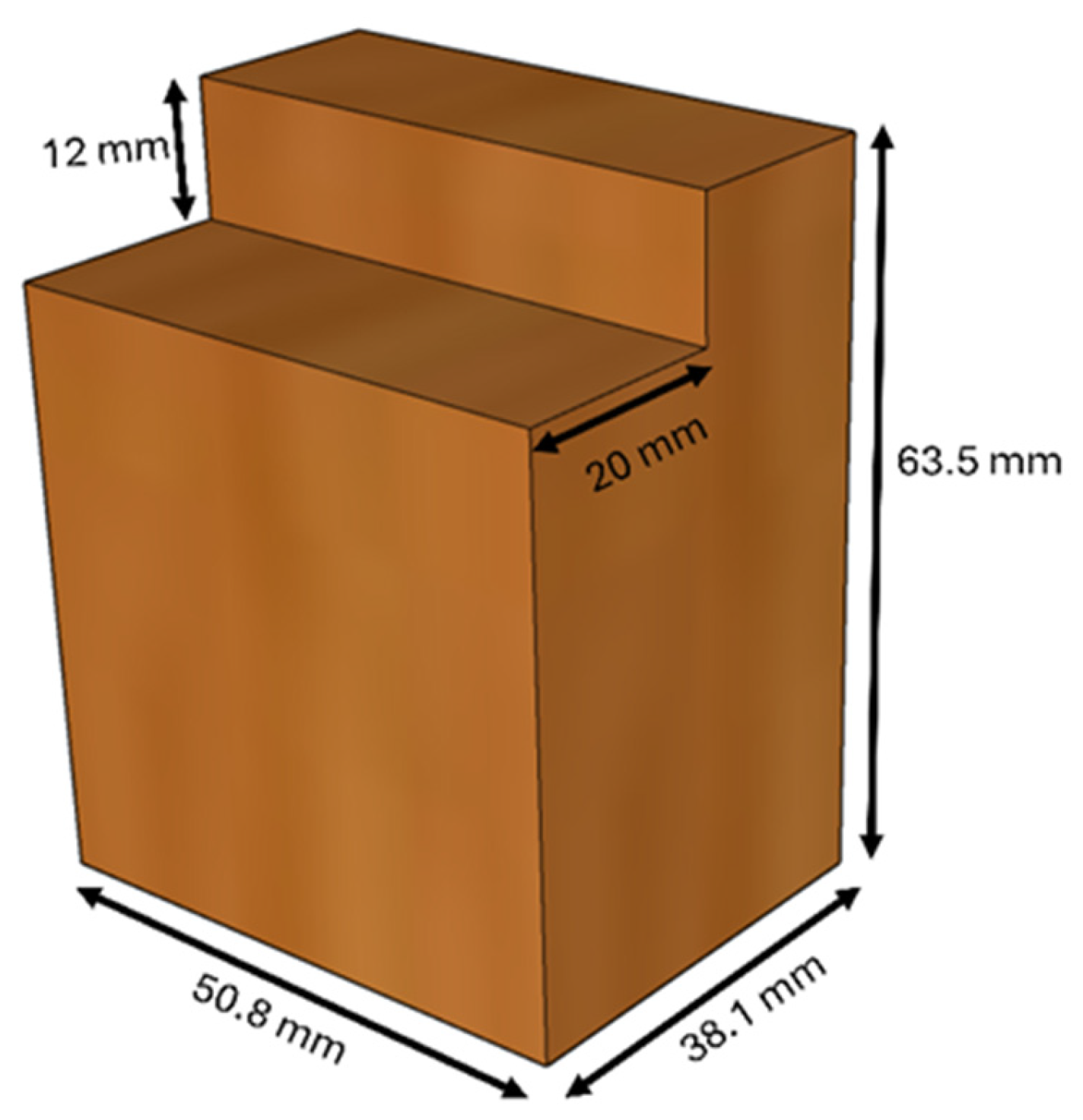
The shear test parallel to the grain was conducted according to ASTM D143 [17] with the exception being that the width was reduced from 50.8 mm to 38.1 mm. The specimens were cut from the undamaged portions of the Hinoki bending test pieces and prepared to a size of 50.8 mm × 38.1 mm × 63.5 mm, with a central notch to provide a shear plane, ensuring the grain was aligned parallel to the specimen length, as shown in Figure 2. The specimen was positioned in a shear testing apparatus with a small displacement between the support and loading surfaces, so that the force was applied at a controlled rate of 0.6 mm/min. The test was continued until failure occurred along the predefined shear plane, with the maximum load P m a x   being recorded. The shear strength parallel to the grain was calculated using the following equation:
τ   =   P m a x A
where τ is the shear stress, P is the maximum load at failure, and A is the area of the notch.

2.2.8. Moisture Content and Density

The calculations for moisture content and specific gravity were conducted in accordance with ASTM D4442 [18] Method B for moisture content and ASTM D2395 [19] Method A for specific gravity. A section measuring 25.4 × 25.4 × 50.8 mm (1 × 1 × 2 inch) was extracted from each specimen for the mechanical testing. However, for bending specimens a sample measuring 25.4 × 25.4 × 25.4 mm (1 × 1 × 1 inch) was extracted from the end of the beam for determining the moisture content and the specific gravity.
As reported in the PLIB testing dataset, the average MC of the shear and compression perpendicular to grain specimens was approximately 9.7%, while bending specimens generally ranged from approximately 9%–12% MC at the time of testing. Mechanical properties were subsequently adjusted to standardized reference moisture conditions prior to allowable property development. MOR and MOE values were adjusted to the ASTM D1990 reference moisture content of 15%, whereas shear parallel to grain (Fv) and compression perpendicular-to-grain (Fc) values were adjusted in accordance with the ASTM D245 [14] procedures referencing green condition properties. These procedures were consistent with the ASTM and PLIB-based methodology used throughout the study.

2.2.9. Dry/Green Ratio

According to ASTM D245 [14], the design values of horizontal shear and compression perpendicular to grain can be derived using the green clear wood properties as the starting point. In this study the specimens were tested in dry conditions; therefore, it is necessary to develop the properties in green conditions. To do so, the data was adjusted from dry to green (27%) using the average dry/green ratio for the three US Chamaecyparis species: Alaska Cedar (Cupressus nootkatensis), Port Orford Cedar (Chamaecyparis lawsoniana), and Atlantic White Cedar (Chamaecyparis thyoides), published in table X1.1 of ASTM D2555 [20].
A fiber saturation point (FSP) of 27% was adopted in this study. This value follows ASTM D245 [14] and ASTM D2555 [20], which specify 27% as the standard reference FSP for wood species when species-specific data are not available. Although published values for Hinoki FSP range from approximately 25% to 30%, the sensitivity of the DG ratio adjustment to this assumption is relatively small.
For compression perpendicular to grain, the initial DG ratio = 1.94
For shear parallel to grain, the initial DG ratio = 1.38
The initial DG ratio was subsequently adjusted to account for variations between the dry moisture content (12%) represented in the ratio factor and the moisture content of the test specimens. The adjustment equation is given below:
DG   Ratio   =   DG   Ratio   ×   F S P M C F S P 12
where DG Ratio = average dry/green ratio from ASTM D2555 (4), Table X1.1;
DG Ratio′ = dry/green ratio adjustment;
FSP = fiber saturation point (27%);
MC = average moisture content of specimens—9.7% (shear) and 9.7% (compression perpendicular).

2.2.10. Design Value Calculations

Values for Hinoki were determined for each mechanical property in accordance with the procedures specified in the ASTM Standards D245 [14] or D1990 [11] with ASTM D245 [14] used for determining the compression perpendicular to grain and shear, and ASTM D1990 [11] used for determining the MOR UTS, USC, and MOE values. The calculation steps varied by property: the modulus of rupture (MOR), tension parallel to grain, and compression parallel to grain adhered to the same procedures, while shear, compression perpendicular to grain, and modulus of elasticity needed adjustments tailored to each specific property. The derivation of design values involved integrating multiple factors, including adjustments for moisture content, specimen size, volume effects, and statistical reduction. The subsequent sections outline the methodologies and factors applied.

2.3. Adjustment for Temperature and Moisture Content

ASTM D1990 recommends that lumber is tested at 15% moisture content. If this is not possible, equations in ASTM D1990 [11], Annex A1 are used to adjust for property values. MOR and MOE are adjusted using the following equations:
For MOR < 2415 psi; S2 = S1
For   MOR > 2415   psi ;   S 2 = S 1 + [ ( S 1 B 1 ) ( B 2 M 1 ) ] × ( M 1 M 2 )
where M1 = moisture content at testing (%);
M2 = reference moisture content (15%);
S1 = strength property at M1 (MPa);
S2 = adjusted strength property at M2 (MPa);
B1 and B2 are constants defined in ASTM as follows:
For MOR, B1 = 2415 and B2 = 4.
Since the UTS and UCS values were based on the edge-bending MC-adjusted values, no further MC adjustments were needed.
The MOE values were adjusted according to D1990 [15], as shown in Equation (11):
S 2 =   S 1 +   ( B 1 ( B 2   ×   M 2 ) ) ( B 1 ( B 2 ×   M 1   ) )
where M1 = moisture content at testing (%);
M2 = reference moisture content (15%);
S1 = MOE at M1 (MPa);
S2 = adjusted MOE at M2 (MPa);
B1 and B2 are constants defined in ASTM as follows:
B1 = 1.857 and B2 = 0.0237.
This adjustment ensured that all property values were uniform, regardless of moisture content during testing, which was essential for comparing green Hinoki specimens.

2.4. Statistical Adjustment

To ensure conservative estimates, a fifth percentile nonparametric tolerance limit (75% confidence) was determined for the MOR using the NONPAR Excel spreadsheet provided by the US Forest Products Laboratory. The Shear value was derived by determining the 5% exclusion limit according to Section 4.4.3.2 of ASTM D2915 [15]. The value was derived by subtracting 1.645 times the sample standard deviation from the sample mean, corresponding to the lower fifth percentile of a standard normal distribution. The average MOE and Compression Perpendicular to grain values were used to determine the proposed design values, as these properties are primarily used for serviceability rather than failure.

2.5. Volume Adjustment Factor

In addition to depth effects, a volume adjustment factor was used to normalize the MOR test values to a Characteristic Value of 2 × 8 × 144 different lumber grade dimensions:
F 2   =   F 1   ×   ( W 1 W 2 ) w ×   ( L 1 L 2 ) l ×   ( T 1 T 2 ) t
where:
F1 = property value at reference volume;
F2 = property value at target volume;
W1, W2 = widths at F1 and F2;
L1, L2 = lengths at F1 and F2;
T1, T2 = thickness at F1 and F2.
Constants: w = 0.29 for the MOR and UTS, 0.13 for UCS, and 0 for MOE;
l = 0.14 for the MOR and 0 for UCS and MOE;
t = 0 for MOR, UTS, UCS, and MOE.

2.6. Strength Ratio and Reduction Factors

The factors for strength ratios were derived directly from the ASTM Standard D245 [14] pertaining to compression perpendicular to the grain and shear. For additional properties, values were determined by the Pacific Lumber Inspection Bureau (PLIB) and are shown in Table 4. Reduction factors and seasoning factors were derived from the ASTM D245 [14].
The design values for each property were derived stepwise by sequentially applying moisture content adjustment, volume adjustment, test cell checks, strength ratio factors, and reduction factors. The complete procedure is illustrated in Table 5. These adjustments produced conservative, service-ready design values for MOR, MOE, shear, and compression in Hinoki, ensuring reliability across growing regions and consistency with ASTM standardized methods.

3. Results and Discussions

3.1. Four Point Bending Test

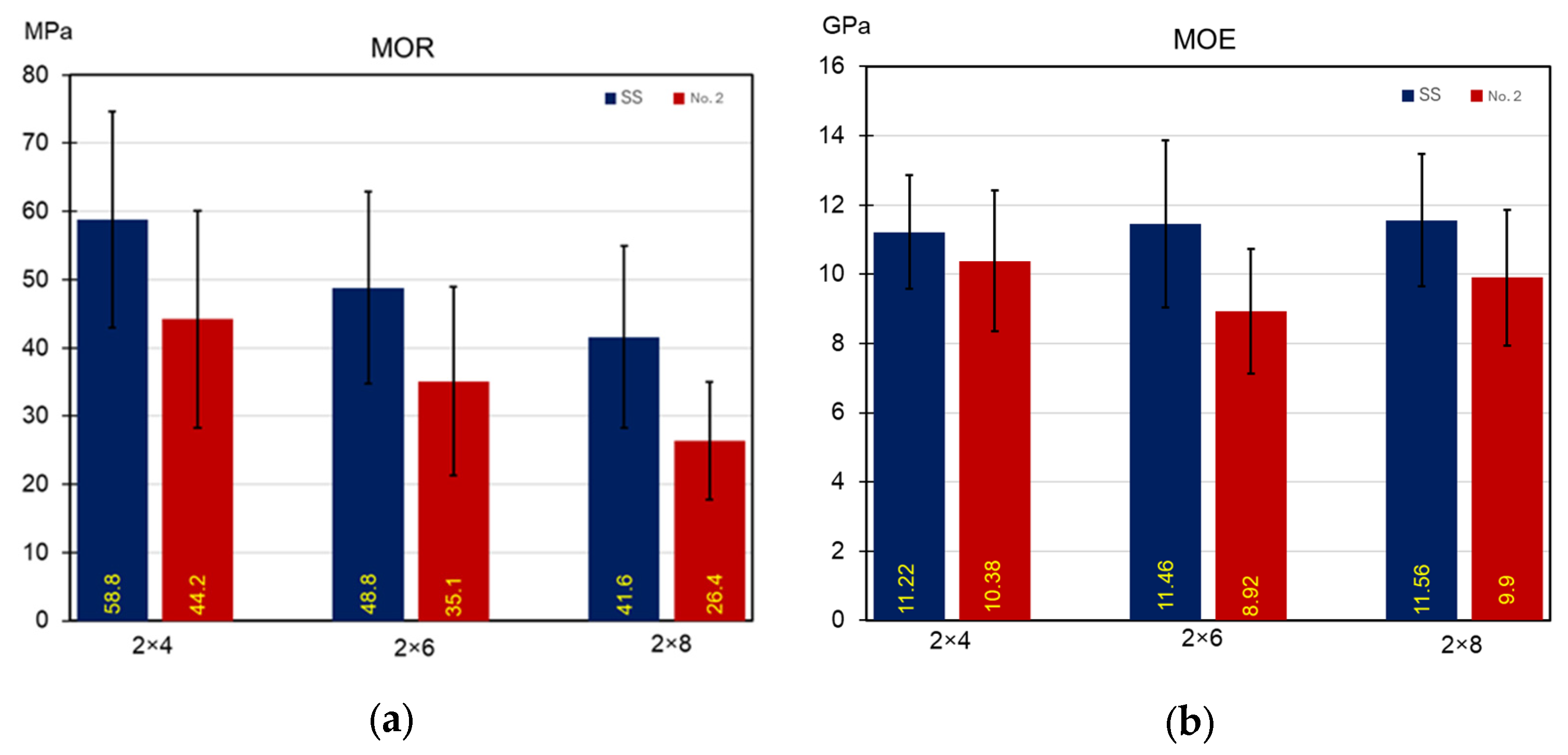
A total of 1464 Hinoki dimension lumber specimens were tested in terms of bending across three sizes and two visual aspects. The primary outputs were MOR as bending strength and MOE as stiffness. Figure 3 shows a comparison of raw test data (in MPa) for the high-quality Select Structural grade and No. 2 grade pieces before characteristic size adjustments were applied. For the Select Structural (SS) grade, bending strength decreased with increasing member size. Mean MOR was 58.8 MPa for 50.8 × 101.6, 48.75 MPa for 50.8 × 152.4, and 41.6 MPa for 50.8 × 203.2, with corresponding fifth percentile point estimates of 31.4, 25.8, and 21.7 MPa, respectively, as shown in Table 6. Stiffness was comparatively consistent across sizes, with mean MOE ranging from 11.22 to 11.56 GPa; the combined SS MOE was 11.42 GPa (fifth percentile point estimate 8.14 GPa). After combining MOR across sizes and adjusting to the standard characteristic size of 1.5 × 7.25 × 144 in., the SS combined MOR was 42.0 MPa, and the initial characteristic value (fifth percentile TL) was 21.7 MPa.
Table 6. Select Structural MOR Summary Statistic Values.
Statistics/Size2 × 4 (MPa)2 × 6 (MPa)2 × 8 (MPa)All 1 (MPa)
Mean58.81 48.75 41.58 41.92
Std. Dev.15.86 14.20 13.31 12.34
Median58.47 49.37 41.30 41.92
5th %tle PE31.37 25.7921.72 22.13
75% UCI32.34 26.34 22.61 22.68
75% LCI29.58 24.20 19.93 21.30
5th %tle TL29.99 24.41 20.41 21.72
N243248242733
1 Size Adjusted to 2 × 8 × 144 MOR Characteristic Values.
For the No. 2 grade, MOR also showed a strong size effect, with mean values of 44.2 MPa (2 × 4), 31.23 MPa (2 × 6), and 26.4 MPa (2 × 8); the fifth percentile point estimates were 21.4, 17.17, and 15.24 MPa, respectively, as shown in Table 7. Mean MOE ranged from 8.92 to 10.38 GPa, and the combined No. 2 MOE was 9.73 GPa (fifth percentile point estimate 6.60 GPa). The size-adjusted combined MOR for No. 2 was 29.5 MPa (mean), with an initial characteristic value (fifth percentile TL) of 15.0 MPa. Grade quality checks indicated that the No. 2 50.8 × 152.4 and 50.8 × 203.2 cells were of higher quality than the target grade assumptions, so MOR and MOE were reduced using the ASTM D1990 [14] adjustment factors reported in Table 3, and MOE values were standardized to a consistent 21:1 span-to-depth basis for reporting.
Table 7. No. 2 Grade MOR Summary Statistic Values.
Statistics/Size2 × 4 (MPa)2 × 6 (MPa)2 × 8 (MPa)All 1 (MPa)
Mean44.20 31.23 26.34 29.44
Std. Dev.15.20 11.03 8.62 11.10
Median44.20 28.89 24.55 27.10
5th %tle PE21.44 17.17 15.24 15.17
75% UCI21.65 17.37 15.86 15.44
75% LCI20.48 16.20 14.20 14.75
5th %tle TL20.89 16.69 14.69 14.96
N241244242727
1 Size Adjusted to 2 × 8 × 144 MOR Characteristic Values.
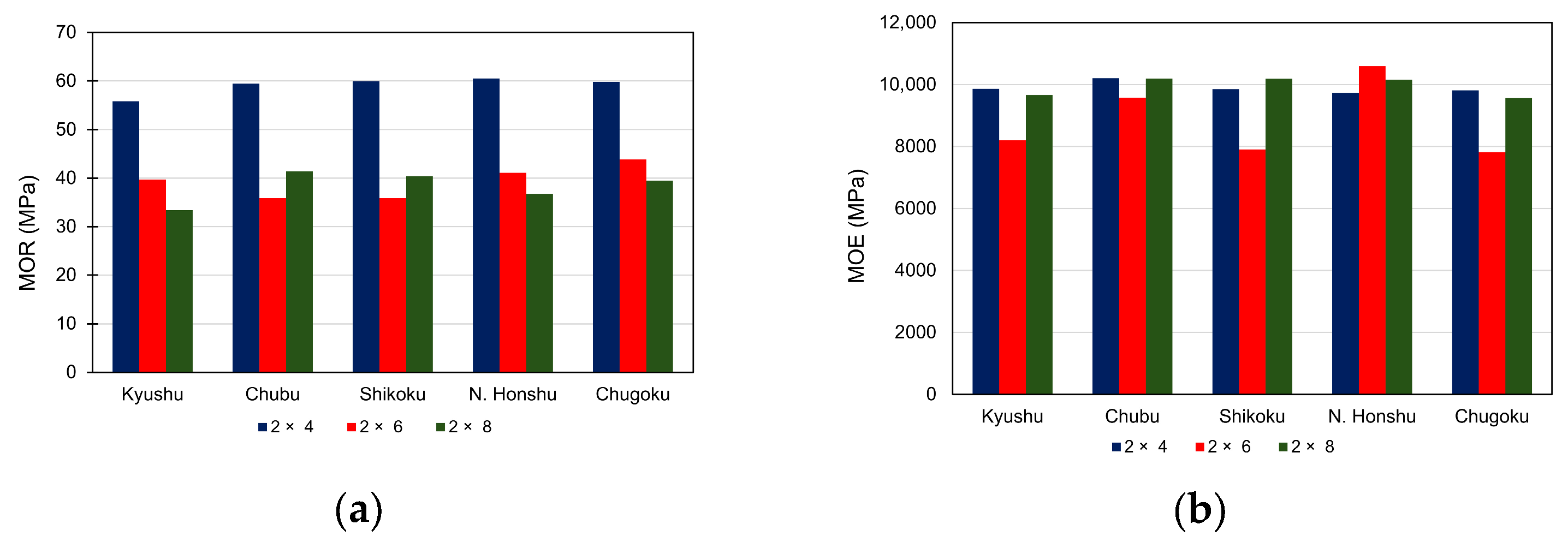
The modulus of rupture (MOR) values show a pattern of moderate regional variation. The 2 × 4 specimens consistently demonstrate the highest MOR values, typically around 55 to 60 MPa, with slightly higher strengths observed in North Honshu and Chugoku. In contrast, the 2 × 6 specimens show lower MOR values, generally between 35 and 45 MPa depending on the region. The 2 × 8 specimens fall between the two, with MOR values mostly in the range of 33 to 41 MPa. The modulus of elasticity (MOE) values are relatively consistent among regions, generally ranging from approximately 9500 to 10,500 MPa. The 2 × 4 specimens show fairly uniform MOE values across all regions, with slightly higher values observed in Chubu. For the 2 × 6 specimens, MOE tends to be somewhat lower compared with the other sizes. The variation in MOR and MOE with respect to the growing regions is shown in Figure 4. These results suggest that, although some variation among regions is observed, the differences are not large, indicating that the growing region has limited influence on the bending strength and stiffness of Hinoki lumber.
The normality of representative MOR and MOE datasets was evaluated using the Shapiro–Wilk test. Some datasets satisfied the normality assumption, whereas others exhibited slight to moderate deviations from normality, which is common for in-grade lumber property data due to inherent biological variability and defect distribution. Histogram inspection also indicated no severe departures from approximate distributional symmetry. Given the relatively large and approximately balanced sample sizes used in this study (n = 1464), ANOVA was considered sufficiently robust for evaluating overall regional trends.
The one-way ANOVA revealed no significant impact of the growing regions on MOR, F (4, 238) = 0.72; p = 0.58. While there were some numerical variations in the average MOR, they were not significant enough compared to the inherent variability in strength to indicate a regional influence. Similarly, one-way ANOVA of mean MOE values revealed no significant variation among the growing regions of Japan (p > 0.05). Overall, the results indicate the bending properties of Hinoki are relatively consistent across the studied regions of Japan. Failure modes during testing were consistent with those typically reported for bending tests, with initial tension failure on the lower surface, followed by shear propagation through the cross-section, as described in ASTM D143 [17] and ASTM D198 [21].
The PLIB bending dataset included failure classifications associated with knots, grain deviation, cross-sectional defects, and shear related failures consistent with standard in-grade lumber evaluation procedures. Bending failures were primarily initiated at strength-reducing characteristics such as edge knots, knot clusters, and localized grain deviation. No major qualitative differences in failure mechanisms were observed among specimen sizes; however, lower visual grades exhibited a greater frequency of defect-controlled failures compared to Select Structural specimens.

3.2. Compression Parallel to Grain

Compression parallel to the grain (Fc) values for Japanese Hinoki were estimated rather than measured directly, because ultimate compressive stress (UCS) testing was not performed. Instead, Fc was calculated from the MOR dataset using the quadratic MOR–UCS relationship specified in ASTM D1990, Section 9.5.2.2 [14]. On a standardized 2 × 8 × 144-inch basis, the resulting characteristic estimates were 16.51 MPa for Select Structural and 14.35 MPa for No. 2. Converting these to the 2 × 12 × 240-inch reference size produced initial base values of 15.60 MPa and 13.56 MPa, respectively. After applying the required property reduction (division by 1.9) and the applicable size/category adjustments (e.g., light framing versus studs), the proposed allowable base Fc values for Hinoki were 8.27 MPa for Select Structural; 7.24 MPa for No. 1, No. 2, Standard; 4.14 MPa for No. 3; 8.62 MPa for Construction; 4.83 MPa for Utility; and 4.48 MPa for Stud, representing the design-level compression capacities for members loaded parallel to the grain.

3.3. Compression Perpendicular to Grain and Horizontal Shear

Compression perpendicular to the grain (Fc) for Japanese Hinoki was established from direct testing and then reduced to a conservative allowable base value using standard adjustment procedures. The raw results tested at an average moisture content of 9.7% showed a mean strength of 7.79 MPa with a standard deviation of 1.32 MPa. To derive an allowable design value, the dry test results were first converted to an equivalent green-condition property using proxy data from North American species within the same genus (Chamaecyparis), obtaining 3.46 MPa. A general adjustment factor (GAF) of 1.67 was applied to account for variability in commercial material (e.g., growth-ring orientation), yielding an allowable unit stress of 2.07 MPa. Finally, a seasoning factor of 1.50 was applied to represent strength gains under in-service dry conditions, producing an unrounded value of 3.11 MPa, which was rounded to a proposed allowable base value of 3.10 MPa.
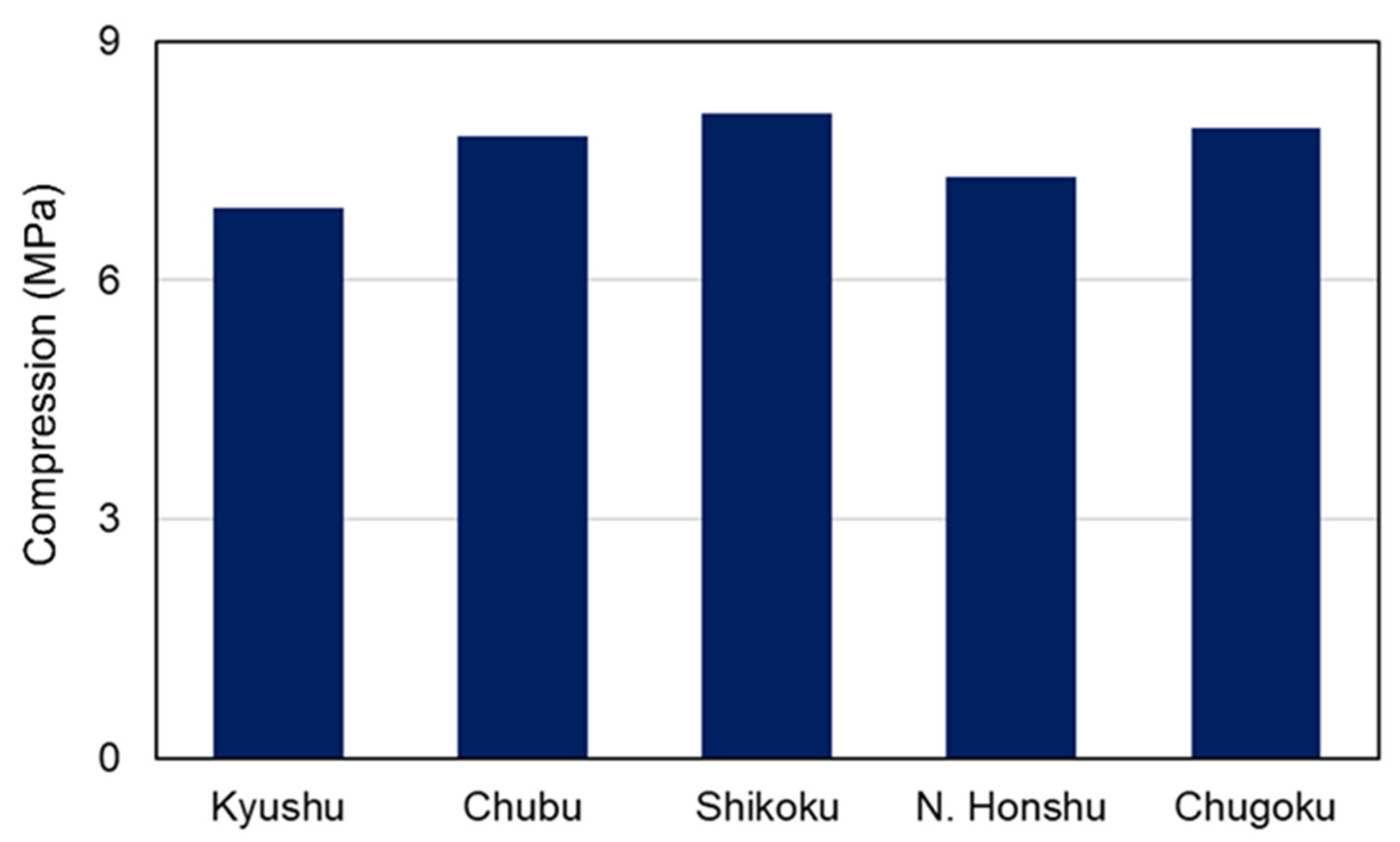
The specimens from Shikoku exhibited the highest average compressive strength, while those from Kyushu and N. Honshu showed the lowest values, as shown in Figure 5. Compression strength showed moderate regional differences (6.9 MPa to 8.1 MPa) among the five Hinoki-growing regions. This was strengthened by a one-way ANOVA analysis which showed no statistically significant difference among the growing regions (F = 1.08, p = 0.37). Since the calculated F value (1.08) is lower than the critical F value (2.48) at the 0.05 significance level, the null hypothesis cannot be rejected, indicating that the property values are not significantly different across the regions.
Upon comparison with the existing literature regarding Hinoki, which generally indicates values between 4 and 8 MPa at 12% moisture content [1], the current findings align with the anticipated range for this species. The deformation pattern observed during testing was typical of softwoods, with gradual cell wall collapse and densification rather than brittle failure. This behavior aligns with Hinoki’s anatomical structure: early wood bands compress easily under load before the latewood zones activate to counteract further deformation.
The findings indicate that Hinoki exhibits consistent performance under compressive stress perpendicular to the grain, demonstrating its dimensional uniformity and ability to effectively distribute localized bearing loads. These findings strengthen the established applications of Hinoki in areas such as sill plates, beam-to-column interfaces, and other structural joints where localized bearing stresses are essential for overall performance.

3.4. Horizontal Shear

Horizontal shear strength (Fv) for Japanese Hinoki was determined from small-specimen shear tests and subsequently reduced using standard adjustment steps to obtain a conservative allowable base value. A total of 88 specimens were prepared from undamaged regions of the full-size bending specimens and tested at an average moisture content of 9.7%. The measured shear strength averaged 7.68 MPa with a standard deviation of 1.52 MPa, and the lower 5% exclusion limit was 5.18 MPa. The specimen set included a mix of grain orientations (radial: 38.6%; tangential: 33.0%; mixed: 28.4%), reflecting the variability expected in commercial material. Because allowable property derivations are referenced to green-condition properties, the dry data lower limit was first converted to an equivalent green value using a dry-to-green ratio of 1.38 from North American proxy species within Chamaecyparis, yielding 3.26 MPa. A shear general adjustment factor (GAF) of 2.1 was then applied, resulting in 1.55 MPa, and this unit stress was further modified by a strength ratio of 0.5 and a seasoning factor of 1.08, yielding an unrounded value of 0.84 MPa. After standard rounding, the proposed allowable base value was 0.83 MPa, applied uniformly across Hinoki commercial grades (Select Structural through Utility), consistent with treating Fv as a species-level base property rather than a grade-dependent value.
The failure mode observed was consistent with that of clear wood specimens, featuring a smooth shear plane at the longitudinal–radial interface, with occasional minor splintering or compression crushing near the loading blocks. No indications of rolling shear or delamination were detected. It is acknowledged that the shear dataset (n = 88) is smaller than the bending dataset used in this study. The 5% exclusion limit was determined in accordance with ASTM D2915, Section 4.4.3.2 [15] using the parametric approach (mean − 1.645σ), which is appropriate for this sample size and does not require the same minimum sample size as nonparametric tolerance limit methods. Nonetheless, the relatively smaller dataset may introduce greater uncertainty in the proposed shear design value (Fv), and this limitation should be considered when interpreting the results.
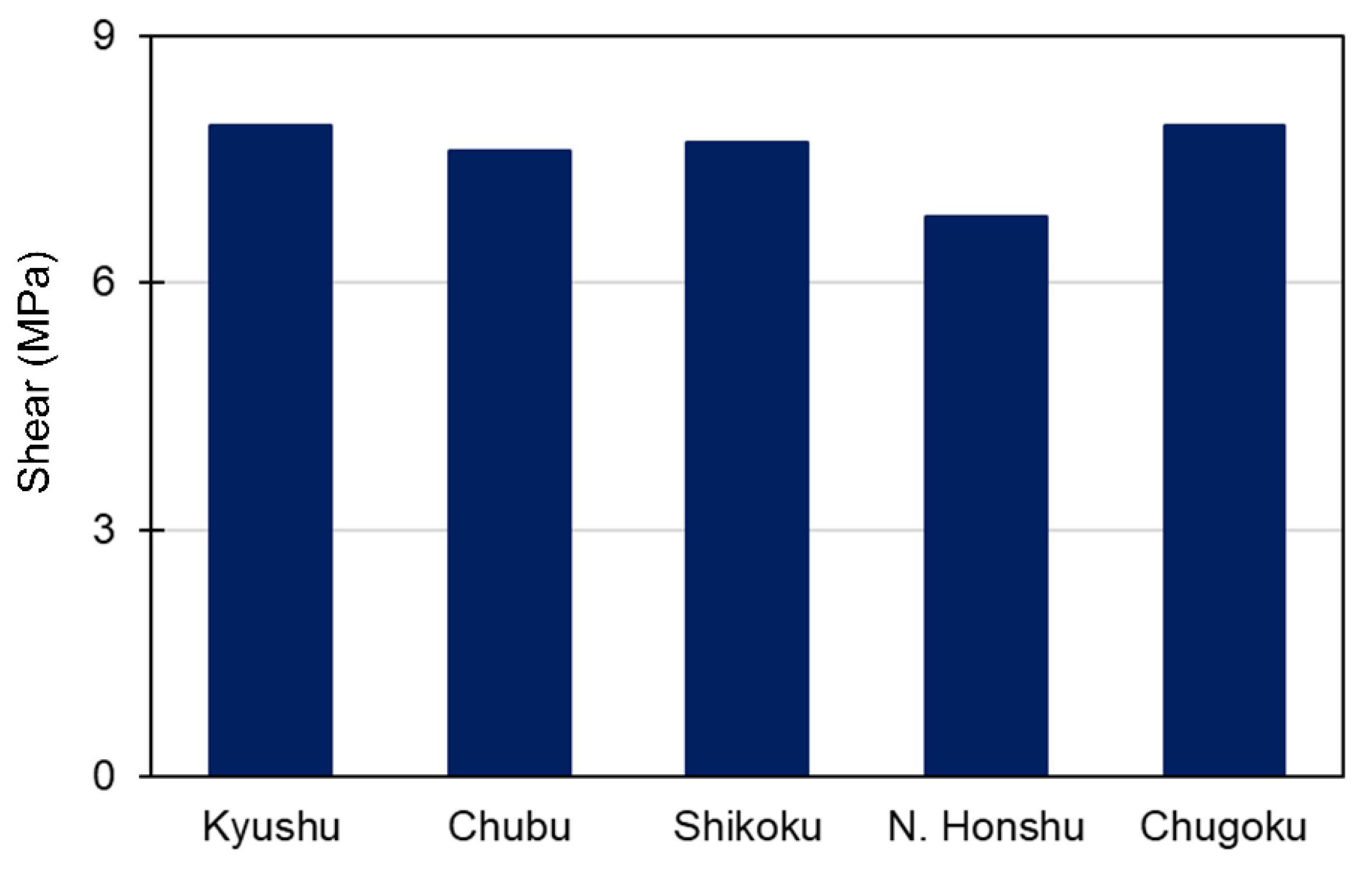
To estimate the regional differences in the horizontal shear values, a one-way ANOVA analysis was done. It indicated that the differences among the five regions were not statistically significant (F = 0.459, p = 0.765). This is also evident from Figure 6, which shows the average horizontal shear values of five growing regions of Japan. The shear values vary from 6.8 MPa to 7.9 MPa. It can be seen that only the values of N. Honshu region are lower than the other regions.

3.5. Design Values

Base design values for Hinoki were established for all mechanical properties using the pooled dataset from all five Japanese growing regions, following the stepwise procedures outlined in Section 2.2.9. Pooling across regions is consistent with ASTM D1990 [11] practice and is justified by the absence of a statistically significant regional effect on MOR, the property that governs most grade-dependent values. Also, regional differences in MOE and Fc were statistically insignificant, the between-district variance was substantially smaller than the within-district variance for most property grade combinations, and the use of pooled values is conservative in the context of design.
The resulting base design values are presented in Table 8. For the Select Structural grade, the proposed allowable bending stress is 8.62 MPa, with corresponding values of 3.79 MPa (tension parallel), 8.27 MPa (compression parallel), 3.10 MPa (compression perpendicular), 0.83 MPa (horizontal shear), and an MOE of 11,721 MPa. These values are consistent with published design values for other high-quality structural softwood species of comparable specific gravity.
Design values were derived from the MOR characteristic values by sequentially applying the GQI adjustment, MC correction, depth and volume adjustment factors, strength ratios, and reduction factors, as detailed in Table 4. Mean values were used for MOE and Fc, as these properties are governed by serviceability criteria rather than failure-based limit states. It should be noted that the values in Table 8 represent the foundational base design values derived from this experimental program. They reflect the current proposed values submitted for review; practitioners should consult the current NDS Supplement [6] for any values that received formal approval for use in design.

4. Conclusions

This study provides the first statistically validated basis for establishing structural design values for Japanese Hinoki (Chamaecyparis obtusa) dimension lumber for potential use in the United States. Based on the testing of 1464 in-grade specimens from five major growing regions of Japan, Hinoki demonstrated strong and consistent mechanical performance in bending, compression perpendicular to grain, and horizontal shear. The results showed clear grade and size effects, while regional differences were small and statistically insignificant for the key strength properties, supporting the use of pooled data for design-value development.
The proposed base design values confirm that Hinoki performs as a high-quality structural softwood with a strength and stiffness suitable for load-bearing applications. In particular, the Select Structural grade exhibited allowable base values of 8.62 MPa in bending, 8.27 MPa in compression parallel to grain, 3.10 MPa in compression perpendicular to grain, 0.83 MPa in horizontal shear, and 11,721 MPa in MOE. Overall, these findings demonstrate that Hinoki is a technically reliable structural species and provides a robust foundation for its consideration in grading rules and future inclusion in design standards such as the NDS Supplement. Recognition of Hinoki as a structural lumber species would expand its use in engineering and support the more effective utilization of Japan’s forest resources.
Implications: Formal recognition of Hinoki as an NDS-listed structural species would expand its commercial applications in the United States and in international markets subject to IBC/IRC requirements. This, in turn, could provide economic incentives for sustainable plantation management and optimized resource utilization within Japanese forest industries.

Author Contributions

A.S.: Formal Analysis, Project Administration, Data Curation, Funding Acquisition, Writing—Review and Editing; D.D.: Methodology, Formal Analysis, Visualization; A.G.: Writing—Original draft, Investigation; J.H.: Investigation; Y.S.: Resources, Funding Acquisition, Conceptualization; H.K.: Methodology, Writing—Review and Editing. All authors have read and agreed to the published version of the manuscript.

Funding

This study was funded by the Japan Lumber Inspection & Research Association via grant number 2023-WSE-0971.

Data Availability Statement

The data presented in this study are available on request from the corresponding author. The data are not currently publicly available due to the large volume of the raw experimental dataset and the multi-institutional agreements involved in this international collaboration. The research involves a comprehensive experimental program with over 1400 specimens. Due to the significant size of the raw data files, we are currently only able to provide data upon direct request.

Acknowledgments

The authors gratefully acknowledge the Japan Lumber Inspection & Research Association for funding, and Tyler, Anthony, and Kenneth Udele for their assistance in the laboratory.

Conflicts of Interest

The authors declare no conflicts of interest.

Abbreviations

The following abbreviations are used in this manuscript:
MOEModulus of Elasticity
MORModulus of Rupture
FSPFiber Saturation Point
DG RatioDry/Green Ratio
NDSNational Design Specification
WCLIBWest Coast Lumber Inspection Bureau
PLIBPacific Lumber Inspection Bureau
ALSCAmerican Lumber Standards Committee
SSSelect Structural
UTMUniversal Testing Machine
PMaximum load
LSpan
bWidth of specimen
hDepth of the specimen
kSlope of shear free load deflection profile
aShear-free middle third of the test specimen
UCSUltimate Compressive Stress
P 1   mm Load at 1 mm deflection
L s a m p l e Length of sample
w l o a d   h e a d Width of load head
UTSUltimate tensile strength
τShear Stress
PmaxMaximum load at failure
AArea of the notch
χ d r y Dry average strength property
χ g r e e n Green average strength property
MCMoisture content
SGSpecific Gravity

References

  1. Takahashi, Y.; Ishiguri, F.; Nezu, I.; Endo, R.; Kobayashi, S.; Tanabe, J.; Otsuka, K.; Ohshima, J.; Yokota, S. Sawn-timber quality of six half-sib families of hinoki cypress (Chamaecyparis obtusa (Siebold et Zucc.) Endl.). Wood Mater. Sci. Eng. 2023, 18, 1163–1170. [Google Scholar] [CrossRef]
  2. Israel, E.Y.; Morrell, J.J.; Sato, Y.; Cappellazzi, J.; Vega-Gutierrez, P.T.; Presley, G.; Sinha, A. Resistance of Plantation Hinoki to Fungal Attack. For. Prod. J. 2026, 76, 1–6. [Google Scholar] [CrossRef]
  3. Kijidani, Y.; Sakai, N.; Kimura, K.; Fujisawa, Y.; Hiraoka, Y.; Matsumura, J.; Koga, S. Termite resistance and color of heartwood of hinoki (Chamaecyparis obtusa) trees in 5 half-sib families in a progeny test stand in Kyushu, Japan. J. Wood Sci. 2012, 58, 471–478. [Google Scholar] [CrossRef]
  4. Kimura, J.; Fujimoto, T. Modeling the effects of growth rate on the intra-tree variation in basic density in hinoki cypress (Chamaecyparis obtusa). J. Wood Sci. 2012, 60, 305–312. [Google Scholar] [CrossRef]
  5. Israel, E.Y.; Cappellazzi, J.; Morrell, J.J.; Sinha, A.; Sato, Y. Durability of Plantation Hinoki. In Proceedings of the 14th World Conference on Timber Engineering: Advancing Timber for the Future Built Environment, Brisbane, Australia, 22–26 June 2025. [Google Scholar] [CrossRef]
  6. American Wood Council. National Design Specification (NDS) Supplement: Design Values for Wood Construction; American Wood Council: Leesburg, VA, USA, 2024; Available online: www.awc.org (accessed on 12 April 2026).
  7. Kondoh, H. Assessment of the Full Density Curve in Stand Density Management Diagrams for Hinoki (Chamaecyparis obtusa) in Kyushu Island, Japan: Implications for Forest Management. Forests 2023, 14, 2129. [Google Scholar] [CrossRef]
  8. International Code Council. International Building Code (IBC); International Code Council: Washington, DC, USA, 2021; Available online: https://www.iccsafe.org/products-and-services/i-codes/ibc/ (accessed on 12 April 2026).
  9. International Code Council. International Residential Code (IRC); International Code Council: Washington, DC, USA, 2021; Available online: https://www.iccsafe.org/products-and-services/i-codes/2018-i-codes/irc/ (accessed on 12 April 2026).
  10. Pacific Lumber Inspection Bureau. Standard Grading Rules for West Coast & Imported Softwood Lumber (No. 18); Pacific Lumber Inspection Bureau: Federal Way, WA, USA, 2024; Available online: www.plib.org (accessed on 12 April 2026).
  11. ASTM D1990; Practice for Establishing Allowable Properties for Visually-Graded Dimension Lumber from In-Grade Tests of Full-Size Specimens. ASTM International: West Conshohocken, PA, USA, 2025. [CrossRef]
  12. Forest Agency Japan. State of Japan’s Forests and Forest Management—3rd Country Report of Japan to the Montreal Process; Forestry Agency: Tokyo, Japan, 2019. [Google Scholar]
  13. ASTM D4761; Test Methods for Mechanical Properties of Lumber and Wood-Base Structural Material. ASTM International: West Conshohocken, PA, USA, 2018. [CrossRef]
  14. ASTM D245; Practice for Establishing Structural Grades and Related Allowable Properties for Visually Graded Lumber. ASTM International: West Conshohocken, PA, USA, 2022. [CrossRef]
  15. ASTM D2915; Standard Practice for Sampling and Data-Analysis for Structural Wood and Wood-Based Products. ASTM International: West Conshohocken, PA, USA, 2022. [CrossRef]
  16. Green, D.W.; Shelley, B.E. Guidelines for Assigning Allowable Properties to Visually Graded Foreign Species Based on Test Data from Full Sized Specimens; West Coast Lumber Inspection Bureau: Portland, OR, USA, 2006. [Google Scholar]
  17. ASTM D143; Test Methods for Small Clear Specimens of Timber. ASTM International: West Conshohocken, PA, USA, 2014. [CrossRef]
  18. ASTM D4442; Test Methods for Direct Moisture Content Measurement of Wood and Wood-Based Materials. ASTM International: West Conshohocken, PA, USA, 2020. [CrossRef]
  19. ASTM D2395; Test Methods for Density and Specific Gravity (Relative Density) of Wood and Wood-Based Materials. ASTM International: West Conshohocken, PA, USA, 2022. [CrossRef]
  20. ASTM D2555; Standard Practice for Establishing Clear Wood Strength Values. ASTM International: West Conshohocken, PA, USA, 2006. [CrossRef]
  21. ASTM D198; Test Methods of Static Tests of Lumber in Structural Sizes. ASTM International: West Conshohocken, PA, USA, 2022. [CrossRef]
Figure 1. (a) Schematic of the four-point bending test, and (b) test setup of the four-point bending test.
Forests 17 00596 g001
Figure 2. Specimen for shear parallel to grain test.
Forests 17 00596 g002
Figure 3. Test data for the high-quality Select Structural (SS) and No. 2 grade lumber (a) Modulus of rupture (MOR), (b) Modulus of Elasticity (MOE).
Forests 17 00596 g003
Figure 4. Variation in (a) MOR and (b) MOE in different growing regions of Japan.
Forests 17 00596 g004
Figure 5. Variation in compression perpendicular to grain with growing regions of Japan.
Forests 17 00596 g005
Figure 6. Variation in horizontal shear with growing regions of Japan.
Forests 17 00596 g006
Table 1. Number of test pieces per district of Japan (size and grade).
Material/Dimension, mm
(Nominal Size)
38.1 × 88.9
(2 × 4)
38.1 × 139.7
(2 × 6)
38.1 × 182.9
(2 × 8)
Total (%)
RegionSSNo. 2SSNo. 2SSNo. 2
Kyushu584552545451314 (21.4%)
Chubu717057414464347 (23.7%)
Shikoku394945494235259 (17.7%)
N. Honshu292820242019140 (9.6%)
Chugoku464978768273404 (27.6%)
Total2432412522442422421464 (100%)
Table 2. Span and span-to-depth ratio of bending specimens.
DesignationNominal Dimension (mm)Actual Dimensions (mm)Span to Depth RatioSpan (mm)
2 × 450.8 × 101.638.1 × 88.917 to 11511.3
2 × 650.8 × 152.438.1 × 139.717 to 12374.9
2 × 850.8 × 203.238.1 × 182.917 to 13130.55
Table 3. GQI and adjustment factors by grade and size.
SizeGradeSample
GQI
Sample
Size 1
Grade
GQI
MOR Adjustment FactorMOE Adjustment Factor
38.1 × 88.9 (2 × 4) SS59.4154651.000 21.000 2
38.1 × 88.9 (2 × 4)No. 245.6229451.000 21.000 2
38.1 × 139.7 (2 × 6) SS63.4188651.000 21.000 2
38.1 × 139.7 (2 × 6)No. 250.2226450.9960.955
38.1 × 182.9 (2 × 8)SS62.3208651.000 21.000 2
38.1 × 182.9 (2 × 8)No. 258.3232450.8580.892
1 Pieces with a 100% GQI or no GQI are omitted from the analysis. 2 If the difference between the sample GQI and the target GQI is 5 or less, the adjustment factor is 1.
Table 4. Factors from the ASTM standard D245 and PLIB.
GradeComp Para 1MOR, UTS 1MOE 1Comp PerpShear Para
Stress ratio factors
SS0.690.650.651.000.50
No. 10.620.550.551.000.50
No. 20.520.450.451.000.50
No. 3, Stud0.300.260.261.000.50
Construction0.560.340.341.000.50
Standard0.460.190.191.000.50
Utility0.300.090.091.000.50
Other factors
Reduction factor1.902.101.01.672.10
Seasoning factorEquation (8)Equation (8) 1.501.08
1 Strength ratios calculated by the PLIB (Pacific Lumber Inspection Bureau).
Table 5. Step-by-step process used to calculate design values of different wood properties.
Steps to Calculate Design Values
StepComp ParaMORComp PerpShear ParaMOE
1.Relationship to MOR per D1990 [10]Calculate MOR using Equation (1)5% EL
average
5% EL
average
Calculate MOE using Equation (2)
2.5th percentile tolerance limit (TL)Grade quality index (GQI)
adjustments
MC AdjustmentMC
Adjustment
Grade quality index (GQI) adjustments
3.Calculate UCSMC adjustmentDG ratioDG RatioMC
adjustment
4.Apply size adjustmentFifth percentile TL and size
adjustment
12% DG
adjustment
12% DG
adjustment
Fifth percentile TL and size adjustment
5.Adjust UCS, Apply factors from Table 2 of ASTM D1990Strength ratioStrength
ratio
Strength
ratio
Strength ratio
6.Convert UCS to Fc (UCS/1.9)Reduction factor Reduction
factor
DG = dry/green.
Table 8. Base design values of Hinoki using data obtained from growing regions of Japan.
GradeFiber Stress
MPa
Tension Parallel MPaComp Parallel MPaComp Perp MPaShear
MPa
MOE
MPa
SS8.623.798.273.100.8311,721
No. 16.032.767.243.100.8311,032
No. 25.862.597.243.100.839653
No. 33.451.554.143.100.838963
Construction6.722.938.623.100.838963
Standard3.791.727.243.100.838274
Utility1.720.864.833.100.837584
Stud4.652.074.483.100.838963
Disclaimer/Publisher’s Note: The statements, opinions and data contained in all publications are solely those of the individual author(s) and contributor(s) and not of MDPI and/or the editor(s). MDPI and/or the editor(s) disclaim responsibility for any injury to people or property resulting from any ideas, methods, instructions or products referred to in the content.