


Abstract
Different forest ecosystems affect the acquisition and loss of SOC by changing the niche differentiation of above-ground and under-ground, resulting in changes in the utilization efficiency of water and nutrient elements. The impact of different types of forests on carbon storage in forest soils has received significant attention in recent decades, as these ecosystems are critical for mitigating the effects of global climate change. There are significant differences in environmental factors among different types of forests, such as carbon source type, topographic characteristics, soil texture, microbial community status, climate and hydrological conditions. At present, the research on the effects of environmental factors such as climate, hydrological conditions or soil quality on SOC has been well carried out. Nevertheless, the distribution pattern of microbial carbon and particulate organic carbon in subtropical forest ecosystems and their contribution to SOC still need much of scientific research. Forest types have a significant impact on the content and distribution characteristics of MNC and particulate organic carbon fractions, but there is heterogeneity in different forests. Importantly, the random forest analysis showed that MNC and MAOC were the main factors affecting SOC compared with other variables, which indicated MNC and MAOC have higher relative importance to SOC (p < 0.05). Specifically, our research found that the total MNC and BNC content in natural forests and broad-leaved forests were significantly higher than that in coniferous forests (p < 0.05), while the FNC content and FNC/BNC in coniferous forests were significantly higher than that in the other two forests (p < 0.05). In addition, the MAOC content of natural forests was higher than others, which indicated the stability of natural forest is higher than other forests. However, CPOC, FPOC content, and POC/MAOC in coniferous forests were significantly higher than in broad-leaf forests and natural forests. Biotic and abiotic factors profoundly affect the dynamic changes in SOC accumulation and stability. Different environmental factors lead to more MNC and MAOC in forest types with faster decomposition rates. These findings have instructive implications for understanding the contributions of different forest types on SOC stability and accumulation mechanisms in forest soils.
1. Introduction
Forest is the main plant community type in terrestrial ecosystems, which is an important part of terrestrial ecosystems participating in the global carbon cycle process, and plays a key role in the process of the energy cycle and material flow [1,2]. The global forest resources assessment report of the Food and Agriculture Organization of the United Nations pointed out that the world’s forest area is more than 4.06 billion hectares, covering 31% of the world’s land area and storing about 296 billion tons of carbon. Forest is an important “carbon pool” of terrestrial ecosystems [3]. The carbon storage of forest soil accounts for about 39% of the global soil carbon storage. The forest ecosystem plays an active role in reducing the concentration of greenhouse gases such as CO2 in the atmosphere and slowing down global climate change. It serves as the habitat of most terrestrial organisms in the world which is of great significance in maintaining the balance of ecosystems. In recent decades, carbon sequestration in forest soil has attracted increasing international attention, due to its crucial role in preserving site productivity and mitigating climate change [4].
Different types of forests have unique above-ground and under-ground characteristics, such as plant diversity, biomass, litter type and quality, soil microorganisms, soil texture and fertility, and mineral elements [5]. Different forest ecosystems affect the acquisition and loss of soil organic carbon (SOC) by changing the niche differentiation of above-ground and under-ground, resulting in changes in the utilization efficiency of water and nutrient elements and affecting the composition and accumulation of soil organic carbon through key processes such as microbial community structure composition and organic carbon mineralization rate [6]. The effects of different forest types on SOC are not definitively understood, as there exists a significant level of uncertainty surrounding the magnitude and trajectory of change resulting from various influencing factors, such as soil type, forest age, climate, and other environmental factors [7].
The source and accumulation of SOC is the core of the global carbon cycle, and the input and distribution of carbon from plant and microbial sources directly reflect the formation and transformation mechanism of “input-transformation-sequestration” of organic carbon [8,9]. As an important carbon source in soil, microorganisms play an important role in the formation and long-term accumulation of the forest SOC pool [10]. Fungi and bacteria decomposed litter to produce a “synergistic effect”, driving the conversion of refractory substances in the soil to humic acid and reshaping the three-dimensional heterogeneous distribution of soil organic matter through the synergistic effect of mycelium-biofilm [11]. The new perspective highlights that 35–55% of stable organic carbon in global soil consists of dead microbial residues, which produce derivatives after microbial decomposition and utilization of plant and animal residues. The other 45–65% is plant-derived, but is protected by the mineral matrix (clay and oxides) [12], which produces derivatives after microbial decomposition and utilization of plant and animal residues and increases the stability of SOC in the form of microbial necromass carbon accumulation. Soil microbial activity and its community structure richness play an important role in the accumulation of microbial necromass carbon. Microorganisms promote the formation of mineral-associated organic carbon through the use of root secretions and animal–plant death residues, while promoting the efficient accumulation of stable organic carbon fractions during metabolism [13]. Therefore, the research on the distribution characteristics of microbial residual carbon can help to increase the understanding of SOC accumulation.
The stability of SOC depends on its ability to resist microbial mineralization. This process was achieved through biochemical protection mechanisms (such as microbial residue carbon accumulation and mineral adsorption), which determine the long-term sequestration capacity of soil carbon pools [14]. The stability of SOC pools is influenced by a variety of factors, including the type of carbon source, topography, soil texture, microbial community structure, climatic conditions, and other environmental factors [15]. For instance, organic carbon can be combined with organic compounds and soil minerals to reduce the decomposition efficiency of microorganisms and enhance soil stability [16]. Soil clay and silt protect organic carbon through adsorption, while sandy soils accelerate organic carbon decomposition due to high permeability. Iron-aluminum oxide and clay can promote the formation of mineral-associated organic carbon and enhance the stability of soil organic carbon. In addition, the acidic soil environment can effectively inhibit microbial activity, and the lack of nitrogen and phosphorus will inhibit the decomposition of microorganisms in the soil, which enhances the sequestration of SOC [17]. Generally, SOC is divided into coarse particulate organic carbon (CPOC), fine particulate organic carbon (FPOC), and mineral-associated organic carbon (MAOC) by physical fractionation [18]. The sum of FPOC and CPOC was collectively referred to as particulate organic carbon (POC), which was mainly derived from plant residues and animal feces [19,20]. It is also widely regarded as a sensitive indicator of soil organic carbon dynamics with vegetation. MAOC was characterized by a slow turnover rate. It is an inactive component of soil organic matter after microbial decomposition and has high stability [11]. Therefore, studying the distribution characteristics of POC and MAOC can provide valuable insights into the magnitude and resilience of the SOC pool.
Natural forests, broad-leaved plantations and coniferous plantations are widely distributed in the subtropical region of southern China, which was the main forest distribution area and has a huge carbon sequestration potential [21]. Different types of forests have unique patterns of SOC conversion and accumulation with micro-environmental differences. Various environmental factors collectively influence the storage and compositional characteristics of forest SOC pools, such as plant diversity, biomass, litter quality, soil microbial structure, soil texture, and moisture status [22]. At the same time, it is controlled by the synergistic effect of multiple biological cycle processes and the interaction between plants and soil, which further controls the accumulation and turnover process of SOC [23]. Different types of forests continue to influence SOC accumulation and stability through the “selection effect” of forest ecosystems due to significant differences in vegetation composition, patterns of litter inputs, microbial community structure, and environmental adaptation strategies [24]. The source and accumulation of forest SOC is a key link in the global carbon cycle, while the input and distribution of carbon from plant and microbial sources directly reflect the turnover mechanism of organic carbon input-transformation-sequestration [17]. The variability among forest types resulted in significant differences in source, composition, and stability of SOC in natural forests, broad-leaved forests and coniferous forests through the cascade effects of vegetation litter input, microbial transformation pathways, and mineral protection mechanisms [25]. According to one study, the content of nutrients in coniferous forest litter is lower than that of broad-leaf forests, while the larger proportion of structural carbohydrates, such as phenols, tannins, and lignin, increases the difficulty of decomposition by soil microorganisms and leads to a greater accumulation of plant-sourced carbon than microbial-sourced carbon in the soil organic matter of coniferous forests [26]. The researchers also found the higher abundance and activity of soil microorganisms in broad-leaf plantation forests than coniferous plantation forests at the subtropics, which improves the accumulation of microbial-sourced carbon fractions and the stability of SOC pools [27]. In general, the quantity and quality of litter control the distribution of POC and MAOC components. A recent study on soil carbon storage found that plant carbon inputs of higher quality, as indicated by low C/N, were more efficiently sequestered in MAOC or FPOC in comparison to CPOC. Therefore, high litter (low C/N) is more likely to be decomposed and used by soil microorganisms, promoting the conversion rate of POC components to MAOC components, which is beneficial to the accumulation and stability of SOC [28]. When considering multiple forest types, each shows a unique C accumulation pattern, which was influenced by the environmental factors of different forest ecosystems [29]. Researching the contribution of microbial-sourced carbon to SOC in different forest types as well as the formation and protection mechanisms of POC and MAOC in different forest ecosystems will help us to better understand the mechanisms of subtropical forests influence on SOC accumulation and stability which is important to enhancing the quality of forest ecosystems, the process of the global carbon cycle and responding to global climate change.
In this study, we established research sites in a subtropical climate area in southern China, which included coniferous forest, broad-leaf forest, and natural forest. The three forest types had different micro-environmental conditions (such as plant diversity, litter quantity and quality, and soil environment). In this experiment, we explore the distribution characteristics of BNC, FNC, POC, and MAOC in different forest types and their effects on SOC accumulation. The effects of different forest types on POC/MAOC and FNC/BNC were also compared, alongside the correlation between C fraction and environmental factors and the relative importance of these variables to SOC.
This research explored the effects of litter production with different quality on SOC storage in three forest types and the distribution patterns of microbial-derived carbon and particulate organic carbon in subtropical forest ecosystem. We also investigated the relative importance of various environment variables on SOC in subtropical forests. Our work has instructive implications for understanding the contributions of different forest types on SOC stability and accumulation mechanisms.
2. Materials and Methods
2.1. Site Description
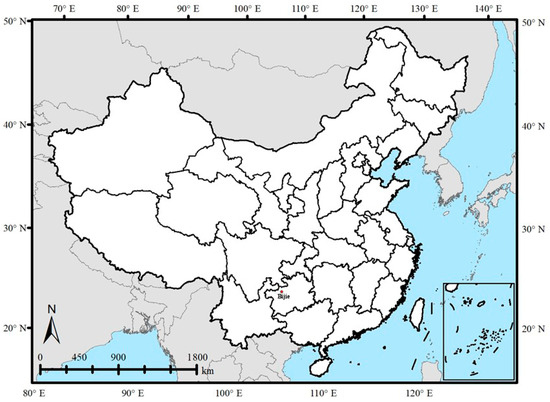
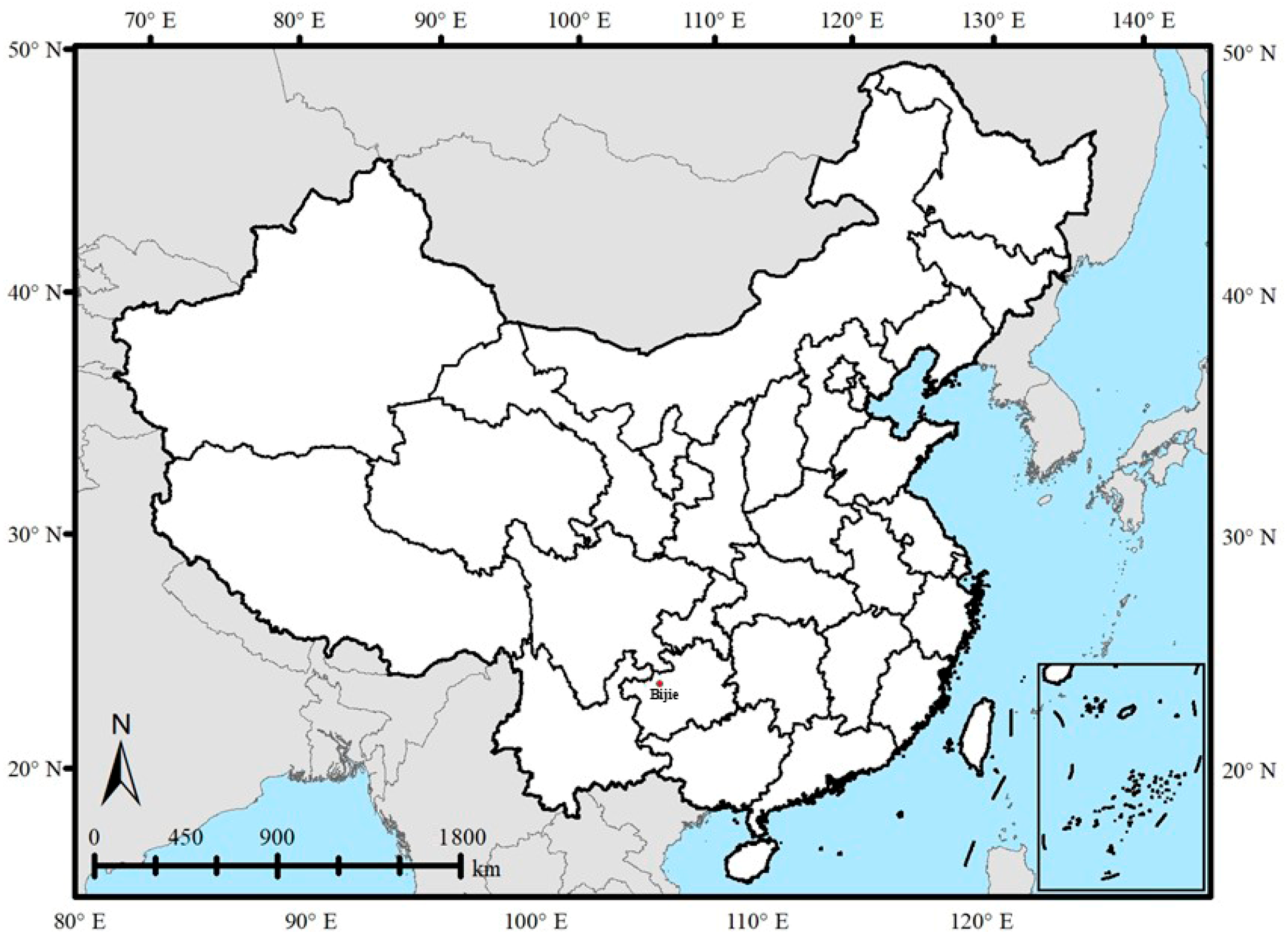
The study was conducted at the Bijie National Forest Park in Guizhou Province, subtropical China (Figure 1). The altitude ranges from 1435 to 2217 m above sea level. This region is characterized by its humid north-subtropical monsoon climate, with an average annual temperature ranging from 10.5 °C to 16.8 °C and an average annual precipitation of 849~1399 mm. A mean minimum temperature of 2.8 °C is observed in January, and a mean maximum temperature of 23.2 °C occurs in July. The soils at the sample plot were derived from sandstone parent material, and the soil type was Ultisol according to United States Department of Agriculture (USDA) classification standards. Further details about the research area are presented in Table 1.
Figure 1.
Maps showing the location of the sampling sites.
Table 1.
Site characteristics and soil physicochemical properties in different forest systems.
To investigate the effects of different subtropical forest types on SOC accumulation and stability, we selected broad-leaved forest, coniferous forest and natural forest in the study site. All the coniferous forests and broad-leaved forests belong to the typical plantation forests in southern China, with a tree age of 25–35 years, which have a certain scale of cultivation and high economic and ecological value. The natural forest was composed of native coniferous trees and broad-leaved trees with high fraction vegetation coverage and biodiversity. Cryptomeria fortune Hooibrenk was dominant and a single species in a coniferous plantation. Quercus glauca Thunb was dominant and a single species in the broad-leaved plantation. Furthermore, the natural forest was dominated by Castanopsis kawakamii Hayata, Pinus massoniana Lamb, Cunninghamia lanceolata Lamb, Cryptomeria fortune Hooibrenk, Quercus glauca Thunb, Pinus armandii Franch, Pinus yunnanensis Franch, Quercus variabilis Blume, Quercus acutissima Carruth.
2.2. Soil and Plant Litter Sampling
Three 20 × 20 m quadrats were set up in natural forest, broad-leaved forest and coniferous forest, respectively, with an interval of 150 m between plots. Three 3 × 3 m sampling points were randomly arranged in each poplar square, and each sampling point was sampled by five-point sampling method (soil drill was used to collect soil at the four corners and center of the plot). The collected soil was mixed into a soil test sample. A total of 9 soil samples were collected. We divided each forest soil sample into two parts; 20 g undisturbed air-dried soil was retained for particle classification and measurement of weight and carbon content. Another part of the soil samples (30 g soil) was meticulously sieved through a 2 mm mesh following the removal of stones, animal and plant residues, for the measurement of SOC, MNC, BNC, FNC, total N, soil C/N, pH, and soil moisture content. Meantime, three leaf litter samples were collected on the forest floor of each plot in a diagonal distribution. All the litter samples were dried at 60 °C until constant weight was reached and used for chemical analyses. Moreover, due to the environmental sensitivity, we mainly focus on the 0–10 cm soil layer, which was the main area of root distribution and an important layer for decomposition and transformation of various substances in the above-ground part. We acknowledge that the depth limitation should be clearly acknowledged as a constraint. In the future, the comparative study between different soil layers should be strengthened.
2.3. Soil and Litter Properties Analysis
SOC and total nitrogen (TN) concentrations of soil and plant litter samples were measured using an elemental analyzer (Elementar, Langenselbold, Germany) after crushing by a ball mill. Furthermore, soil moisture content (SMC) was measured by the oven-drying method, and pH was measured by a soil pH measuring instrument (Sartorius, Munich, Germany).
Soil particulate fractionation determination was based on the following methods: 20 g of soil was weighed and placed in a 250 mL conical flask, 100 mL of sodium hexametaphosphate solution at a concentration of 5 g·L−1 was added, and the shaker with a speed of 90 r·min−1 was shaken for 24 h. The purpose was to disperse particulate and non-particulate matter in soil samples. Meantime, the size fractions > 0.25 mm were collectively classified as the CPOC fraction, the size fractions ranging from 0.25 to 0.053 mm were classified as the FPOC fraction, and the size fractions measuring < 0.053 mm were classified as the MAOC fraction. Subsequently, the soil samples were collected using a tray and placed in an oven at 100 °C until constant weight was reached; the samples were then recorded and collected [16]. The carbon content in soil samples was determined by an elemental analyzer (Elementar, Germany). CPOC, FPOC, and MAOC contents were calculated by multiplying the carbon concentration of each particle fraction by the mass ratio, respectively.
The mass proportions of particle fractions were calculated as follows:
MP = Mf/Mt × 100%
In the formula, Mf is the weight of the different particulate fraction (g·kg−1), Mt is the total weight of the soil sample (g·kg−1), and MP is the mass proportion of different particle sizes (%).
Soil amino sugar determination was based on the following methods: soil samples were hydrolyzed in 6 mol/L HCl (105 °C, 8 h), and then the resulting solution was added to 0.1 mL of myoinositol and filtered. The pH was adjusted to 6.6~6.8 after completing the above steps, centrifuging and filtering, and then collecting the supernatant. Amino sugar derivatives were redissolved in methanol and then measured using a gas chromatograph (Agilent, Santa Clara, CA, USA). Subsequently, the concentrations of individual amino sugars glucosamine (GluN), muramic acid (MurN), and galactosamine (GalN) were quantified based on the internal standard myoinositol [30]. The microbial necromass carbon was calculated and converted by related amino sugar indicators. The calculation formula is as follows:
FNC = (GluN/179.17 − 2 × MurN/251.23) × 179.17 × 9
BNC = MurN × 45
TMNC = FNC + BNC
In the formula, FNC represents fungal necromass carbon, BNC represents bacterial necromass carbon, TMNC represents total microbial necromass carbon, 179.17 and 251.23 are the molecular weights of glucosamine and muramic acid, and 9 and 45 represent the conversion coefficients of fungal necromass carbon and bacterial necromass carbon, respectively.
2.4. Statistical Analysis
All statistical analyses were performed using software SPSS Statistics 23.0 and the R programming language (R4.4.3 random forest package). One-way ANOVA test with Tukey HSD multiple comparison was performed to reveal the differences in all variables (such as SOC, TN, litter C, litter N, litter C/N, litter standing stock, FNC, BNC, MNC, FNC/BNC, CPOC, FPOC, MAOC, POC/MAOC) in natural forest, broad-leaved forest, and coniferous forest ecosystems. The Pearson correlation coefficient was used to test the correlation between SOC and variables (such as pH, SOC, TN, litter C, litter N, litter C/N, litter standing stock, soil moisture content, FNC, BNC, MNC, FNC/BNC, CPOC, FPOC, MAOC, POC/MAOC). We use the random forest model to quick select different environmental factors and explore the contribution of different variables to SOC. The R programming language 4.4.3 was used for random forest analysis to test the relative importance of different variables (such as pH, SOC, TN, litter C, litter N, litter C/N, litter standing stock, soil moisture content, FNC, BNC, MNC, CPOC, FPOC, MAOC) to SOC.
3. Results
3.1. The Characteristics of SOC, TN, and Litter in Different Forest Types
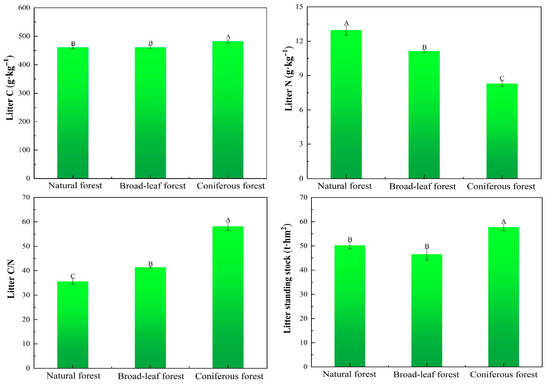
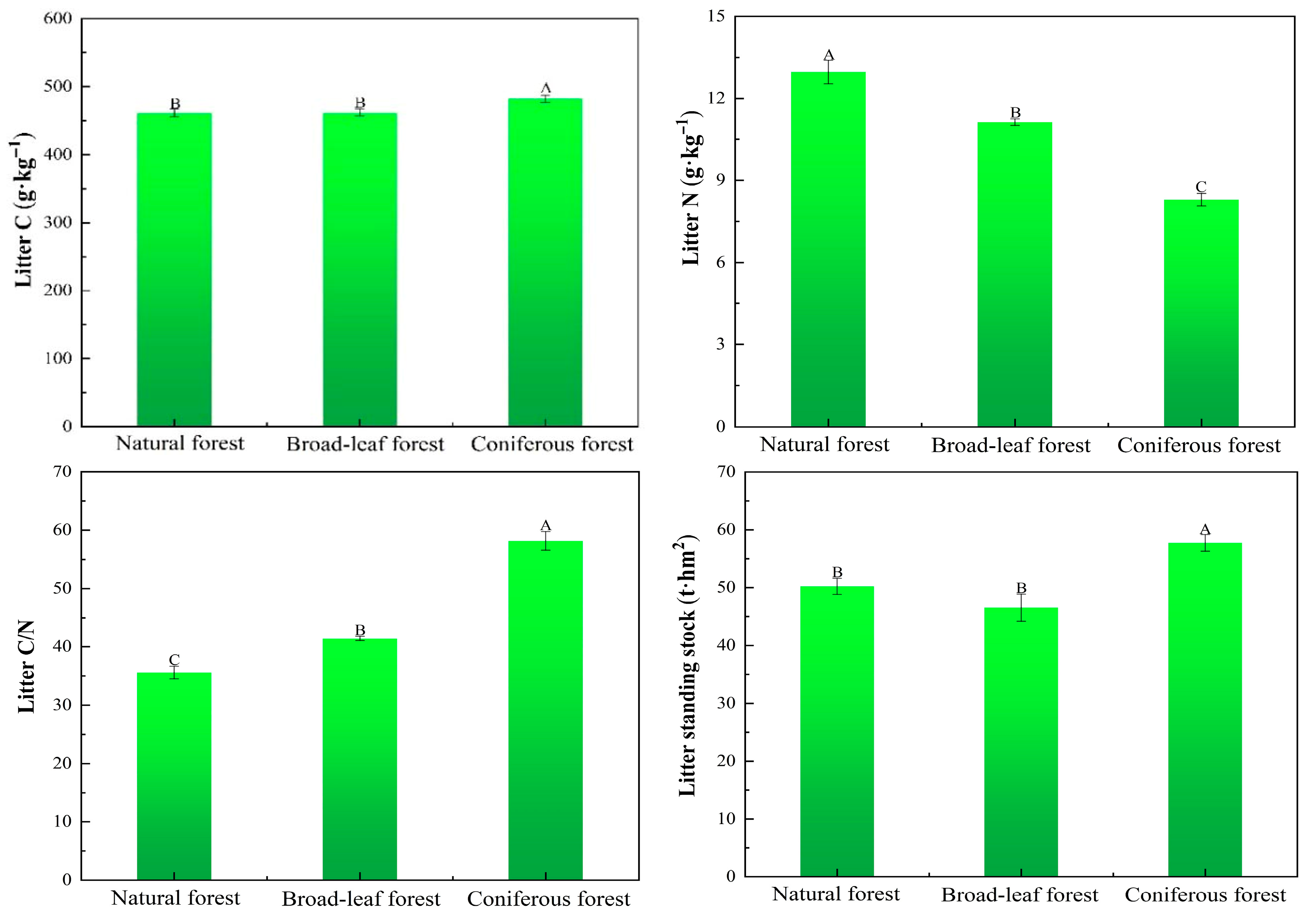
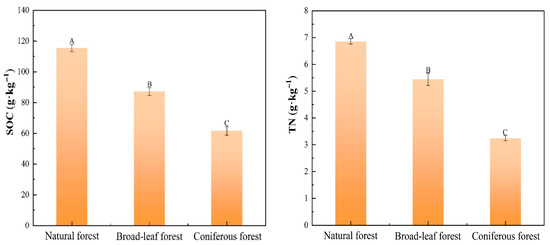
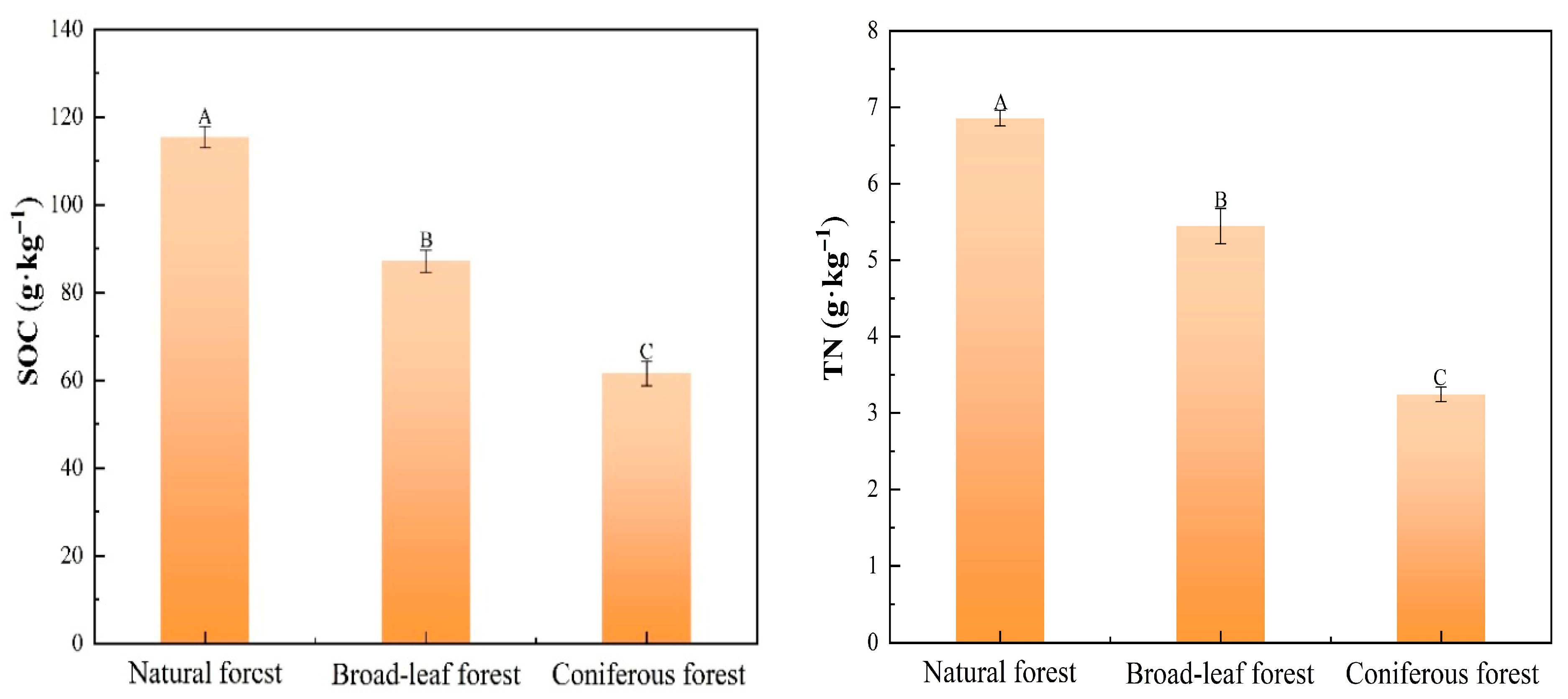
Forest types had significant influence on litter properties, with lower litter C, litter C: N, and litter standing stock (LSS) in both natural forest and broad-leaf forest than in coniferous forest at the site. However, the litter N of natural forest and broad-leaf forest was significantly higher than that of coniferous forest in the site (Figure 2). Furthermore, SOC and TN content were significantly influenced by forest type; the SOC and TN content in natural forest were significantly higher than broad-leaf forest and coniferous forest, which showed the regularity of natural forest > broad-leaf forest > coniferous forest (Figure 3).
Figure 2.
Litter quality (litter C, litter N and litter C/N) and litter standing stock were measured in natural forest, broad-leaf forest and coniferous forest in subtropical regions of China. Note: Different uppercase letters indicate significant differences among forest types (p < 0.05). Error bars defined the Standard Deviation, and the sample size is 3.
Figure 3.
Soil organic carbon and total nitrogen content were measured in natural forest, broad-leaf forest and coniferous forest in southern China. Note: Different uppercase letters indicate significant differences among forest types (p < 0.05). Error bars defined the Standard Deviation, and the sample size is 3.
3.2. The Contents of Microbial Necromass Carbon and Their Responses to Forest Type
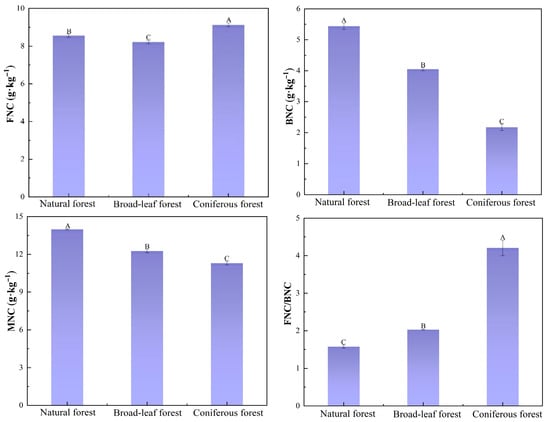
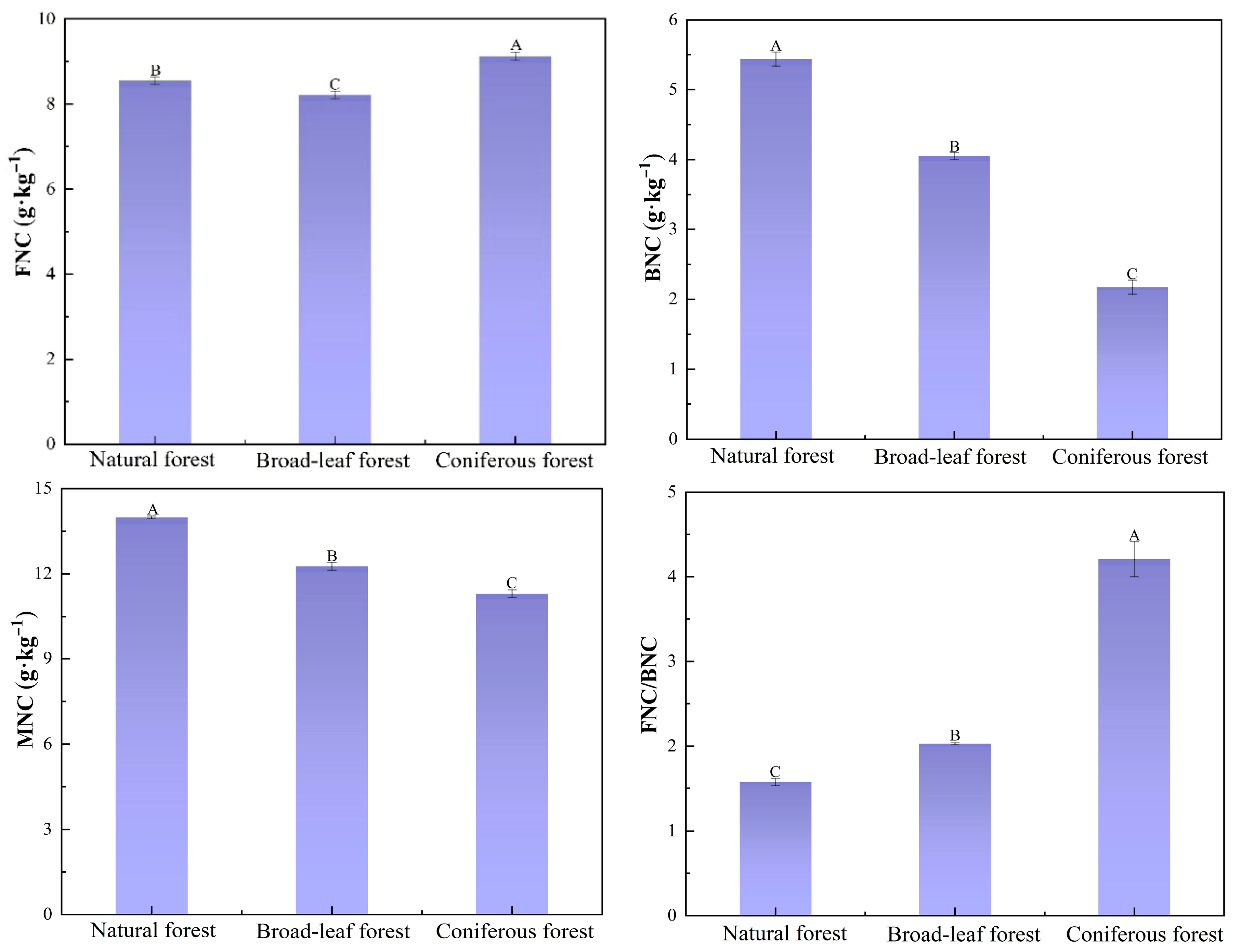
Forest types had a significant influence on microbial necromass carbon (MNC) content, with lower bacterial necromass carbon (BNC) and total microbial necromass carbon in coniferous forests than in natural forests and broad-leaf forests in research plots. However, the fungal necromass carbon (FNC) and FNC/BNC of coniferous forest were significantly higher than those of natural forest and broad-leaf forest in the research plots (Figure 4).
Figure 4.
Bacterial necromass carbon, fungal necromass carbon, total microbial necromass carbon content and FNC/BNC were measured in natural forest, broad-leaf forest and coniferous forest in subtropical region of southern China. Note: Different uppercase letters indicate significant differences among forest types (p < 0.05). Error bars defined the Standard Deviation, and the sample size is 3.
3.3. Distribution Patterns of Particulate Organic Carbon and Mineral-Associated Organic Carbon in Different Forest Types
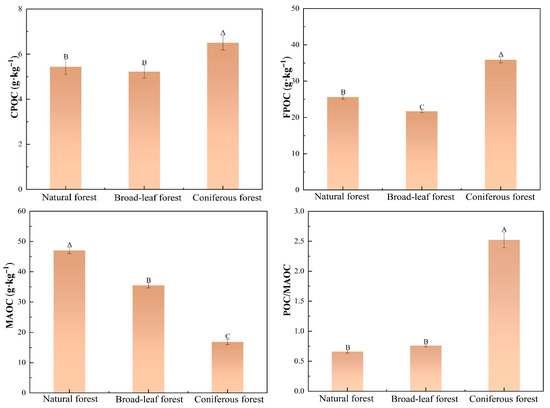
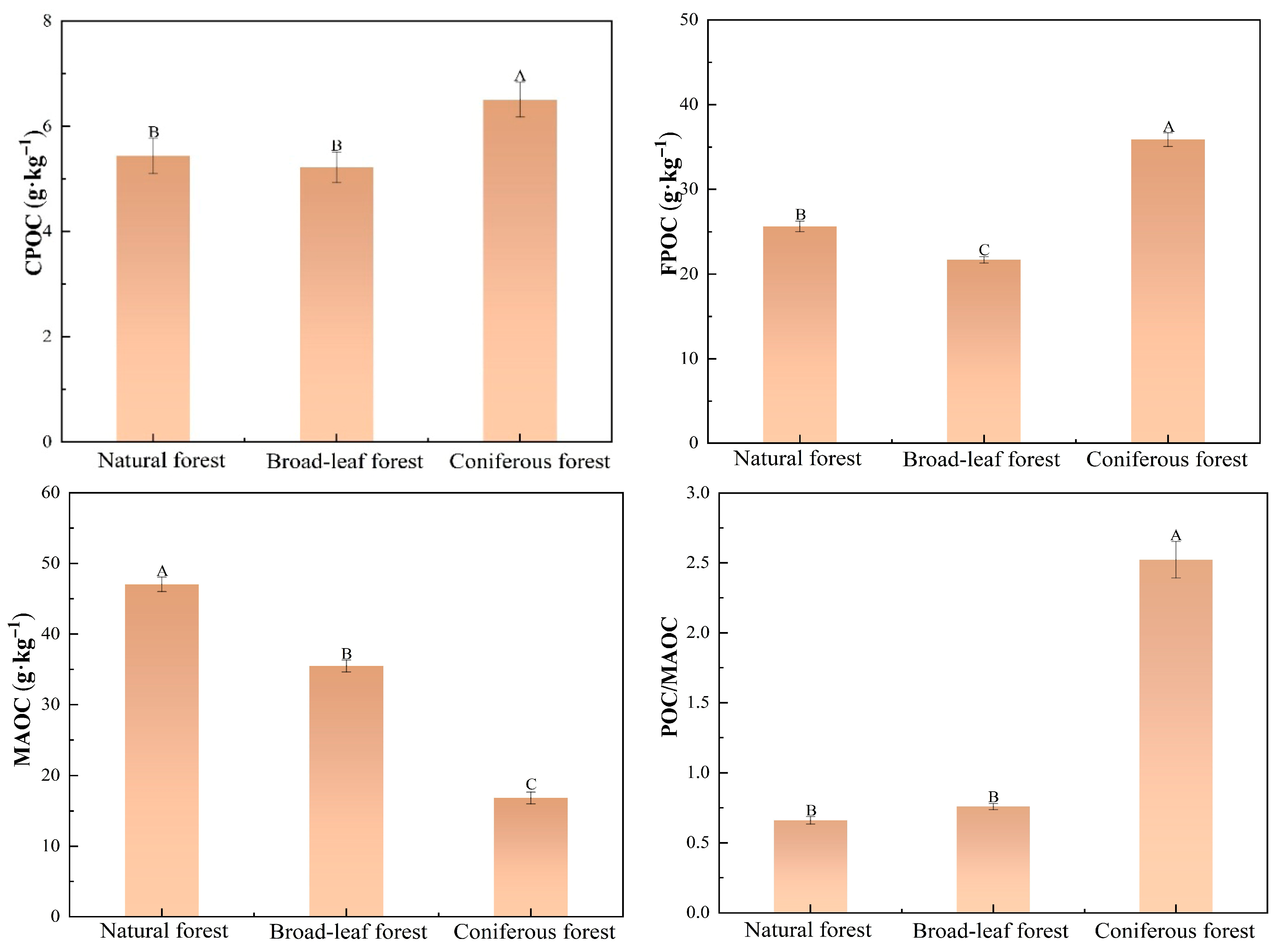
Forest types significantly affected the content of different POC. The CPOC and FPOC content and POC/MAOC in coniferous forest were significantly higher than those in natural forest and broad-leaf forest in the research plots. Nevertheless, the MAOC content showed the regularity of natural forest > broad-leaf forest > coniferous forest (Figure 5).
Figure 5.
Coarse particulate organic carbon, fine particulate organic carbon, mineral-associated organic carbon content, and POC/MAOC were measured in natural forest, broad-leaf forest, and coniferous forest at the subtropical climate transect in China, and the content of POC is equal to the sum of CPOC and FPOC. Note: Different uppercase letters indicate significant differences among forest types (p < 0.05). Error bars defined the Standard Deviation, and the sample size is 3.
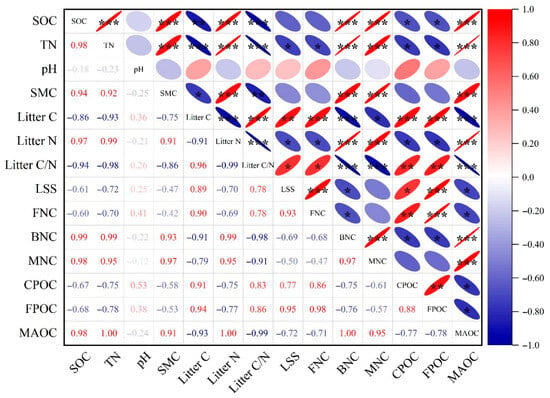
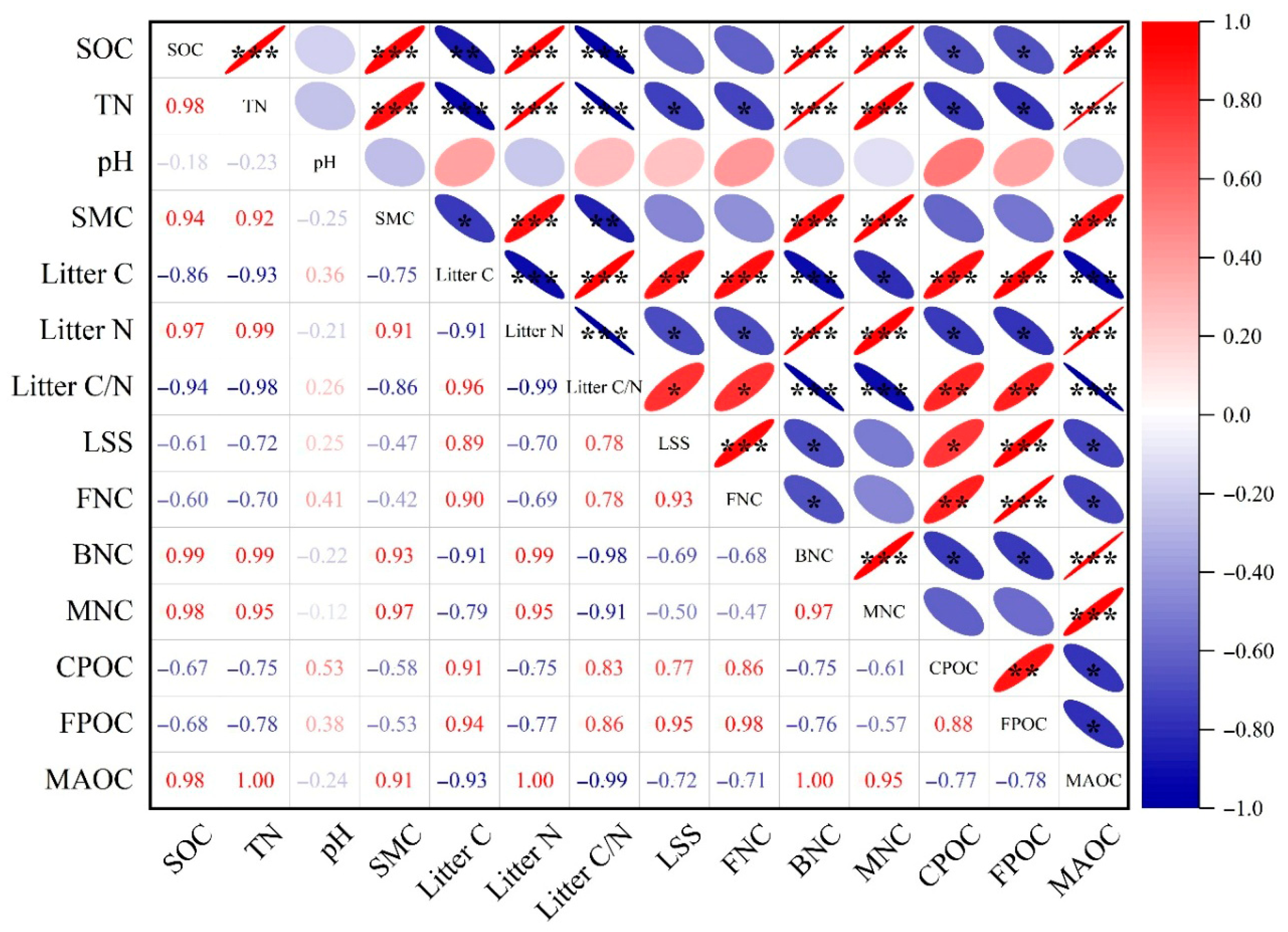
SOC showed a highly significant positive correlation with TN, SMC, litter N, BNC, MNC, and MAOC (p < 0.001) (Figure 6). Conversely, SOC exhibited significant negative correlation with litter C and litter C/N (p < 0.01), while exhibiting significant negative correlation with CPOC and FPOC (p < 0.05) (Figure 6).
Figure 6.
Relationship between different environmental variables in subtropical forest ecosystems. Note: SOC and TN represent soil organic carbon and total nitrogen, respectively. LSS represents litter standing stock, and SMC represents soil moisture content. FNC, BNC, and MNC represent fungal necromass carbon, bacterial necromass carbon, and total microbial necromass carbon, respectively. CPOC, FPOC, and MAOC represent coarse particulate organic carbon, fine particulate organic carbon and mineral-associated organic carbon, respectively. (Red indicate positive correlations, and blue indicate negative correlations; * p < 0.05; ** p < 0.01; *** p < 0.001).
3.4. The Contribution of Different Environmental Factors to Soil Organic Carbon
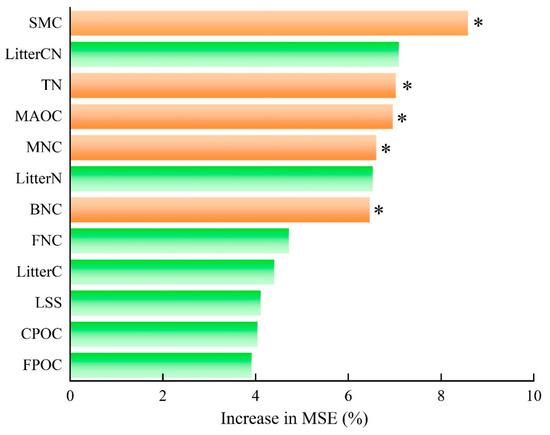
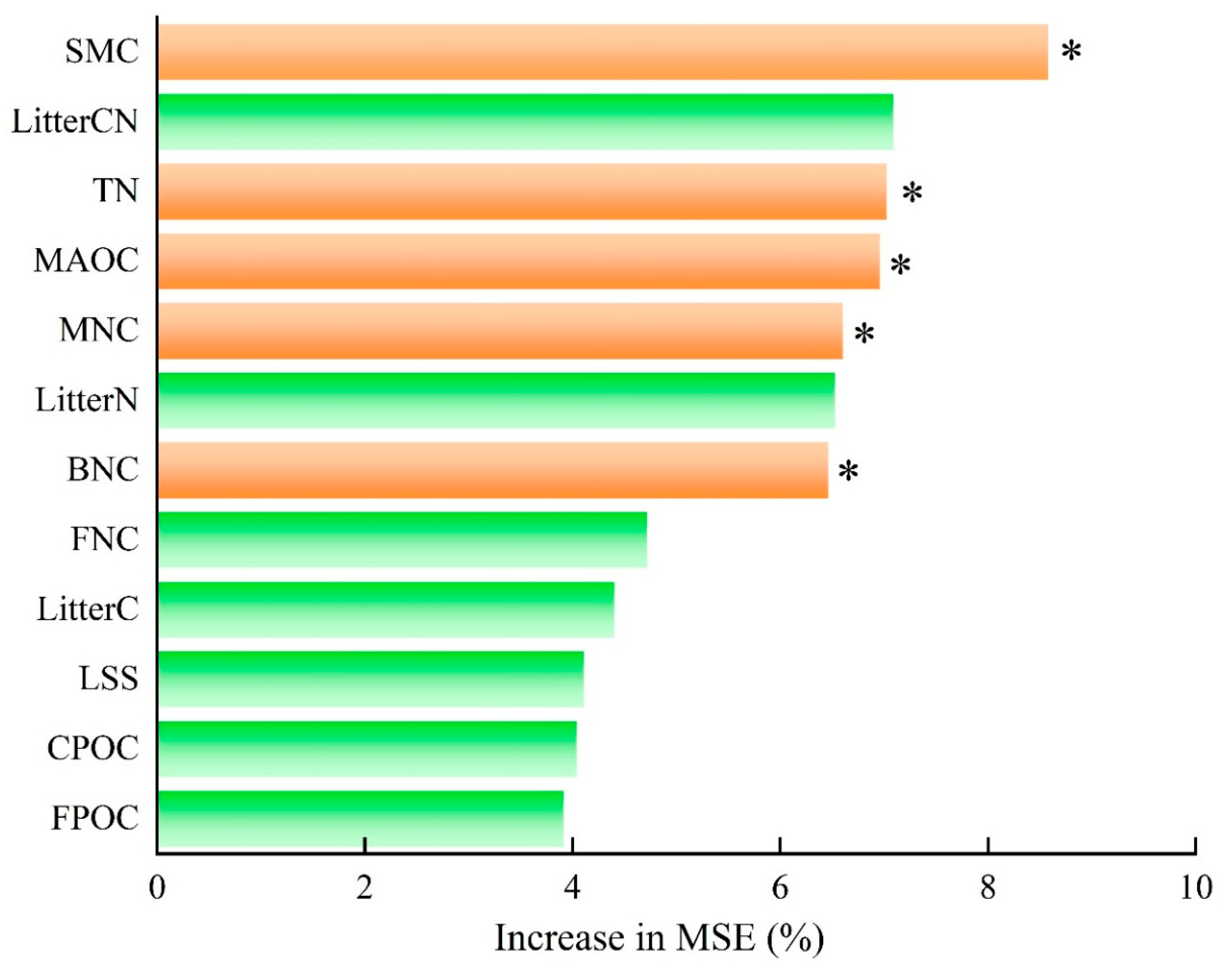
The random forest model showed that the SMC, TN, MAOC, MNC, and BNC were the main factors affecting SOC, and IncMSE were 8.58% (p < 0.05), 7.02% (p < 0.05), 6.96% (p < 0.05), 6.60% (p < 0.05), 6.46% (p < 0.05), respectively (Figure 7). Specifically, MAOC has a higher relative importance to SOC than CPOC and FPOC. Moreover, BNC has a higher relative importance to SOC than FNC.
Figure 7.
Relative importance of different environmental factors to SOC in subtropical forests. Note: TN represents total nitrogen. LSS represents litter standing stock, and SMC represent soil moisture content. FNC, BNC, and MNC represents fungal necromass carbon, bacterial necromass carbon, and total microbial necromass carbon, respectively. CPOC, FPOC, and MAOC represent coarse particulate organic carbon, fine particulate organic carbon and mineral-associated organic carbon, respectively. * Represent p < 0.05.
4. Discussion
4.1. The Influence of Different Forest Type on Litter and Soil Carbon Stocks
Different types of forests present unique patterns of SOC transformation and accumulation under micro-environmental differences. A variety of environmental factors jointly influence the composition and storage of forest SOC pools, including plant diversity, biomass, litter quality, microbial community structure, soil texture, and moisture status [2]. Experimental forests from the study area were classified as natural Forest, broad-leaf forest, and coniferous forest, which produced different quantities and qualities of litter. We observed significant differences in litter C/N between different types of forests, showing the pattern of natural forest (35.57) < broad-leaved forest (41.46) < coniferous forest (58.17), which proves that the quality of natural forest litter is significantly higher than that of other forests (Figure 2). Differences in decomposition turnover between litter and carbon pools in different forests are mainly due to differences in litter chemical composition [31]. Many studies on litter corroborate this perspective, which show that the type or chemical composition of the litter and the forest microenvironment influence the rate of decomposition [26]. Large amounts of higher-quality litter C inputs to natural forests and broad-leaf forests stimulate microbial decomposition and the accumulation of MNC, thereby accelerating the accumulation of microbial-sourced carbon in the SOC [13]. Furthermore, the researchers found a significant correlation between the amount of litter and SOC. Specifically, the increase in litter amount led to a significant increase in SOC content in broad-leaved forests and natural forests, while coniferous forests did not show the same response [6]. For forest surface soil, SOC storage mainly depends on the formation and decomposition rate of litter and the carbon turnover process. Compared with litters with lower C/N (C/N-low, indicating higher quality), litter with higher C/N (C/N-high, indicating lower quality) showed a greater proportion of resistant material remaining [7,32]. We observed a significant difference in SOC content between different types of forests, which showed the pattern of natural forest (115.46 g·kg−1) > broad-leaved forest (87.15 g·kg−1) > coniferous forest (61.55 g·kg−1) (Figure 3). The litter from broad-leaved forests and natural forests has a greater impact on SOC accumulation when compared to litter from coniferous forests. The rate of litter decomposition in broad-leaved forests and natural forests was significantly higher than in coniferous forests, which will lead to a more rapid response of soil carbon content to litter inputs in natural forests [33]. At the same time, a study found that the proportion of litter C input in natural forest and broad-leaved forests was significantly higher than in coniferous forests [13]. Compared with broad-leaved forests and coniferous forests, natural forest litter has a lower C/N ratio, which means a higher decomposition rate and higher topsoil C accumulation. Generally, broad-leaved forests and natural forests had higher litter standing stock and root biomass; the physical properties (such as leaf thickness, shape, and size) and chemical properties of litter play an important role in decomposition rates [32]. Therefore, the response of SOC in natural forests to litter input was more obvious than in broad-leaved forests and coniferous forests. In addition, high-quality litter in broad-leaf forests and natural forests was more readily decomposed and used by soil microorganisms [8]. This process accelerates the decomposition rate of litter and increases the fixation capacity of organic carbon in forest ecosystems.
Pearson correlation analysis showed that environmental factors such as litter C/N, SMC, and TN were significantly positively correlated with SOC (p < 0.001) (Figure 6), which indicates that the high-quality litter is easily preferentially decomposed and utilized by soil microorganisms and fixed in the soil. Meantime, TN was one of the main factors affecting SOC, the increase in the SOC accumulation rate was tightly associated with the enrichment in soil N, as SOC accrual depends largely on microbial processes that have a higher demand for N [34]. Additionally, the increase in microbial abundance could result in massive microbial residues that facilitate the formation of MAOC, contributing to the larger potential for SOC accumulation. Soil moisture directly affects the activity and decomposition rate of microorganisms. Appropriate soil moisture content and pH conditions can enhance the ability of microorganisms to decompose organic matter and promote the rapid accumulation of SOC [16]. Soil moisture content and pH imbalance will inhibit microbial activity and reduce SOC decomposition efficiency [35]. Taken together, litter quality and soil physical–chemical properties determine the difference in soil carbon stocks between natural forests, broad-leaved forests, and coniferous forests. In addition, the effects of environmental factors such as vegetation coverage, mineral surface area, Fe/Al oxide, and soil texture are also important. There are differences in the microenvironment of forest ecosystems in different altitude gradients and different regions. Relevant research should be strengthened in the future. This study provides a scientific basis for further exploring the mechanism of different forest types on soil organic carbon sequestration and stability, and has important reference for the sustainable management of forests.
4.2. The Distribution Characteristics of Microbial-Derived Carbon in Different Forest Types and the Contribution to SOC Accumulation
Microbial necromass is an SOC source essential for long-term soil carbon sequestration. Biotic and abiotic factors, such as litter quality, microbial community structure, climatic, and soil physical and chemical properties, profoundly affect the dynamics of MNC content [36]. The FNC and BNC contents in forest soil are dependent on forest types; this might be due to the micro-environment of different forest ecosystems. Generally, the decomposition of complex organic matter (such as Lignin and cellulose) is dominated by fungi because fungi are better adapted to degrade plant biomass and organic matter, as well as hydrophobic substances, by specific carbohydrate-active hydrolases and oxidases [37]. However, bacteria are better at decomposing simple organic matter (such as protein and urea), of which the decomposition rate is faster than fungi. Recent evidence suggests that FNC has important effects on long-term SOC sequestration in coniferous forests [12]. Fungal hyphae are involved in the formation and stabilization of soil aggregates, resulting in the physical protection of fungal necromass from microbial decomposition, and then increasing fungal necromass retention [38]. Meanwhile, the researchers found that bacteria are important for the accumulation of SOC in broad-leaf forests and natural forests due to high-quality litter C (low C/N) inputs accelerating microbial decomposition efficiency, which benefits the accumulation of BNC in the soils of natural forests and broad-leaf forests [39]. Pearson correlation analysis showed that there was a significant negative correlation between litter C/N (Low litter C/N indicates high quality) and MNC (p < 0.001) (Figure 6), indicating that a higher litter quality increases the rate and efficiency of microbial-mediated litter transformation, thereby increasing microbial necromass production and accumulation, consistent with the hypothesis proposed by the microbial carbon pump theory. In this study, the BNC content in natural forests (5.44 g·kg−1) and broad-leaved forests (4.05 g·kg−1) was significantly higher than that in coniferous forests (2.17 g·kg−1) (Figure 4), while the FNC content in coniferous forests (9.13 g·kg−1) was significantly higher than that in the other two forests (natural forests: 8.55 g·kg−1, broad-leaved forests: 8.21 g·kg−1) (Figure 4). This is mainly because bacteria benefit more from the high-nitrogen soil environment of natural forests and broad-leaved forests than fungi, because bacteria are more inclined to use N-rich substrates than fungi, which leads to their large accumulation in natural forests and broad-leaved forests [32]. Fungi are the principal decomposers of cellulose, hemicellulose, and lignin-containing polymers, which are less abundant in natural forest and broad-leaf forest soils than in coniferous forest soil [35]. The presence of complex substrates with a high C/N ratio (e.g., plant roots or Low-quality litter) in coniferous forests leads to intensive bacterial necromass consumption for N reutilization [26]. In addition, the FNC/BNC ratio is commonly used to differentiate the contributions of fungal and bacterial residues to SOC [40]. In our research, the FNC/BNC ratio of coniferous forest (4.21) was significantly higher than that of natural forest and broad-leaved forest, which indicates the dominance of fungal necromass in the coniferous forest and the dominance of bacterial necromass in other forests (natural forest: 1.57, broad-leaved forest: 2.03) (Figure 4).
Fungal cell walls are composed of more recalcitrant compounds, such as chitin, than bacterial cell walls, which leads to slower microbial decomposition of the fungal necromass [41]. Bacterial necromass would be preferentially reutilized due to the lower C/N ratio of bacterial necromass than fungal necromass, ultimately resulting in its low retention in natural forest and broad-leaved forest [7]. However, a considerable proportion of persistent plant residues (e.g., lignin and lignin-encrusted cellulose) decomposes very slowly in coniferous forests, which leads to longer turnover times [42]. This suggests that the higher MNC pool increases carbon content in forest soils through necromass accumulation. The microbial growth, biomass turnover rate, and biomass yield determine microbial necromass formation in subtropical forest soil [34]. Furthermore, the changes in FNC content and BNC influence stable SOC accumulation via the amounts of necromass input. For example, a suitable soil environment (such as rich nitrogen, balanced soil moisture, and pH) accelerates microbial growth and turnover, and increases microbial biomass content, further contributing to necromass accumulation [30]. Additionally, Large amounts of higher quality litter C inputs accelerate microbial growth and biomass formation, and further increase the amount of microbial necromass, which stimulates microbial decomposition and the accumulation of MNC, thereby accelerating the accumulation of microbial-sourced carbon in the SOC [32]. This might be due to the faster microbial growth and turnover rates, which results in higher amounts of microbial necromass accumulation, and this contributes to the stable accumulation of SOC. This work plays a key role in further exploring the formation and turnover of soil organic carbon in different forest types and the sustainable carbon sequestration potential of forest ecosystems.
4.3. Effects of Different Forest Types on the Distribution and Stability of Soil Particulate Organic Carbon
The response of SOC to forest type varies depending on the carbon component (CPOC, FPOC, MAOC). Because POC and MAOC are formed through different pathways, they are differentially affected by multiple drivers from forest types [43]. The quantity and quality of litter and different environmental factors play a key role in controlling POC and MAOC content. High-quality litter inputs will increase the proportion of MAOC fractions in the SOC and improve forest SOC stability [44]. Conversely, low-quality litter inputs with slow decomposition rates are more likely to result in an increase in the proportion of POC fractions in the SOC and a decrease in the stability of the forest SOC [17]. Different types of forests have unique patterns of soil carbon accumulation and transformation, which are influenced by the quantity and quality of litter inputs and changes in soil properties [26]. Generally, the increased POC content in subtropical forests promotes the conversion of plant decomposition products to microbial decomposition products and subsequent formation of stable MAOC fractions with soil minerals [45]. The researchers found significantly higher levels of MAOC in natural forests than in broad-leaf forests and coniferous forests in subtropical forests, due to the higher quality of litter and richer microbial community structure in natural forests [16]. A study showed that the replacement of coniferous plantation with broad-leaf plantation altered the rates of POC and MAOC accumulation and accelerated the accumulation of MAOC content [18]. This indicates that the potential critical value of MAOC in broad-leaf plantations is higher under the same soil environment, which is beneficial to the long-term sequestration of SOC. The different rates of SOC transformation in POC and MAOC result in more accumulation of MAOC than POC at high SOC levels, which was determined by the unique patterns of SOC accumulation and transformation in different forest types [7]. In this study, we observed that the MAOC content of natural forests was higher than that of other forests, which shows the regularity of natural (47.03 g·kg−1) > broad-leaf forests (35.47 g·kg−1) > coniferous forests (16.83 g·kg−1) (Figure 5). However, CPOC and FPOC content were significantly higher in coniferous forests (CPOC: 6.51 g·kg−1, FPOC: 35.87 g·kg−1) than broad-leaf forests (CPOC: 5.23 g·kg−1, FPOC: 21.69 g·kg−1) and natural forests (CPOC:5.44 g·kg−1, FPOC: 25.63 g·kg−1) (Figure 5). On the one hand, the litter quality of natural forests and broad-leaved forests is significantly higher than that of coniferous forests, while the litter of coniferous forests contains a large amount of lignin, cellulose, and other difficult-to-decompose substances, which increases the difficulty of decomposition for soil microorganisms, resulting in more CPOC and FPOC accumulation [14]. On the other hand, the natural forest soil environment (such as rich nitrogen, balanced soil moisture and pH) (Figure 3 and Table 1) was superior to the other two forest types, which improves the activity of soil microorganisms and the richness of community structure, promotes the decomposition efficiency of microorganisms on organic matter, and accelerates the conversion of POC to MAOC, which is conducive to the effective accumulation of MAOC [23]. The variations observed could potentially be attributed to disparities in litterfall accumulation and soil environment among natural forests, broad-leaf forests and coniferous forests. An increased quantity and quality of litter lead to an accelerated decomposition rate, resulting in elevated levels of SOC accumulation. These organic matter residues interact with soil minerals to facilitate the formation of more stable MAOC [16,20].
In addition, the products of microbial decomposition and transformation are the main sources of MAOC. The POC/MAOC ratio of coniferous forests (2.52) was significantly higher than that of broad-leaved forests (0.76) and natural forests (0.66) in the study plots which indicates that the stability of coniferous forest is low (Figure 5). The litter quality of coniferous forest litter is low, which hinders the decomposition and utilization of soil microorganisms, resulting in an increase in the POC/MAOC ratio. Consequently, natural forests and broad-leaf forests have higher SOC stability in the topsoil. Low-quality litter led to an increase in the POC/SOC ratio, resulting in a decrease in SOC stability [22]. The findings reconcile the observed relative changes in POC and MAOC fractions with the mass balance considerations, reflecting the gradual shifting pathway in SOC accumulation. This is also in line with the point that low-quality litter input promotes POC formation and is consistent with the hypothesis proposed by the microbial carbon pump theory [32]. The random forest model indicated that MAOC was the main factor influencing SOC in subtropical forests (p < 0.05) (Figure 7), and the Pearson correlation analysis also showed that MAOC and SOC had a significant positive correlation (p < 0.001) (Figure 6). The relative importance of MAOC on SOC was higher compared to CPOC and FPOC. Higher quality (lower C/N) litter likely led to faster litter decay and more MAOC accumulation, which is beneficial to the long-term sequestration of SOC in the topsoil of natural forest and broad-leaved forests compared to coniferous forests [46]. This study has a prominent role in comprehensively improving the quality, stability and carbon sink capacity of forest ecosystems and exploring the ecological functions of forest ecosystems.
5. Conclusions
In conclusion, our work explores the patterns of microbial-derived carbon and particulate organic carbon in subtropical forest ecosystem which provides a scientific basis for further exploring the mechanism of different forest types on soil organic carbon sequestration and stability, and has important reference for the sustainable management of forests. The results observed that the MNC and MAOC had important effects on the accumulation and stability of SOC, whereas their contributions to SOC represented contrasting patterns in different forest types. Notably, the total MNC and BNC content in natural forests and broad-leaved forests were significantly higher than that in coniferous forests, while the FNC content in coniferous forests was significantly higher than that in the other two forests. In addition, the MAOC content of natural forests was higher than that of other forests, which shows the regularity of natural > broad-leaf forests > coniferous forests. However, CPOC content and FPOC content were significantly higher in coniferous forests than in broad-leaf forests and natural forests. Specifically, biotic and abiotic factors, such as litter quality, microbial community structure, climatic, and soil physical and chemical properties, profoundly affect the dynamic changes in SOC accumulation and stability. Together, these findings have instructive implications for understanding the contributions of different forest types on SOC stability and their accumulation mechanisms in the forest soils of Southern China. We hope this research will elucidate the response mechanism of the soil carbon cycle to subtropical forest ecosystems and facilitate the prediction of carbon sink potential in forest ecosystems under future global climatic changes. This work plays a key role in further exploring the formation and turnover of soil organic carbon in different forest types and the sustainable carbon sequestration potential of forest ecosystems, as well as contribute to a more scientifically grounded exploration of global carbon neutrality.
Author Contributions
Z.Z.: Writing—original draft, Formal analysis, Conceptualization. S.S.: Writing—original draft, Formal analysis. Y.C.: Writing—review and editing, Funding acquisition, Conceptualization. All authors have read and agreed to the published version of the manuscript.
Funding
This research was supported by Guizhou Provincial Basic Research Program (Natural Science) (QianKeHeJiChuMS [2025] 247), and the Guizhou Provincial Science and Technology Projects (QianKeHeJiChu [2024] Youth 354). In addition, we are also grateful for the editors’ and reviewers’ reviewing.
Data Availability Statement
The original contributions presented in the study are included in the article; further inquiries can be directed to the corresponding author.
Acknowledgments
We are grateful to all our colleagues for their fruitful discussions on this work.
Conflicts of Interest
The authors declare that there are no competing interests.
References
- Pan, Y.D.; Birdsey, R.A.; Fang, J.Y.; Houghton, R.; Kauppi, P.E.; Kurz, W.A.; Phillips, O.L.; Shvidenko, A.; Lewis, S.L.; Canadell, J.G.; et al. A Large and Persistent Carbon Sink in the World’s Forests. Science 2011, 333, 988–993. [Google Scholar] [CrossRef] [Scilit]
- Xiang, D.F.; Wang, G.S.; Tian, J.; Li, W.Y. Global Patterns and Edaphic-Climatic Controls of Soil Carbon Decomposition Kinetics Predicted from Incubation Experiments. Nat. Commun. 2023, 14, 2171. [Google Scholar] [CrossRef] [Scilit]
- Heath, J.; Ayres, E.; Possell, M.; Bardgett, R.D.; Black, H.I.J.; Grant, H.; Ineson, P.; Kerstiens, G. Rising Atmospheric CO2 Reduces Sequestration of Root-Derived Soil Carbon. Science 2005, 309, 1711–1713. [Google Scholar] [CrossRef] [Scilit] [PubMed]
- Augusto, L.; Boca, A. Tree Functional Traits, Forest Biomass, and Tree Species Diversity Interact with Site Properties to Drive Forest Soil Carbon. Nat. Commun. 2022, 13, 1097. [Google Scholar] [CrossRef] [Scilit] [PubMed]
- Adair, E.C.; Parton, W.J.; Del Grosso, S.J.; Silver, W.L.; Harmon, M.E.; Hall, S.A.; Burke, I.C.; Hart, S.C. Simple Three-Pool Model Accurately Describes Patterns of Long-Term Litter Decomposition in Diverse Climates. Glob. Change Biol. 2008, 14, 2636–2660. [Google Scholar] [CrossRef] [Scilit]
- Liu, X.F.; Lin, T.C.; Yang, Z.J.; Vadeboncoeur, M.A.; Lin, C.F.; Xiong, D.C.; Lin, W.S.; Chen, G.S.; Xie, J.S.; Li, Y.Q.; et al. Increased Litter in Subtropical Forests Boosts Soil Respiration in Natural Forests but Not Plantations of Castanopsis Carlesii. Plant Soil 2017, 418, 141–151. [Google Scholar] [CrossRef] [Scilit]
- Han, Y.W.; Wang, Q.F.; Li, C.; Guo, Y.L.; Yan, W.P.; An, Y.D.; Bai, Y.P.; Yang, M.; Zheng, Y.T.; Hu, Q. The Difference in Soil Organic Carbon Distribution Between Natural and Planted Forests: A Case Study on Stony Soils Mountainous Area in the Upper Min River Arid Valley, China. Soil Use Manag. 2023, 39, 147–160. [Google Scholar]
- Ni, X.Y.; Liao, S.; Tan, S.Y.; Wang, D.Y.; Peng, Y.; Yue, K.; Wu, F.Z.; Yang, Y.S. A quantitative assessment of amino sugars in soil profiles. Soil Biol. Biochem. 2020, 143, 107762. [Google Scholar] [CrossRef] [Scilit]
- Zhu, X.J.; Yu, G.R.; He, H.L.; Wang, Q.F.; Chen, Z.; Gao, Y.N.; Zhang, Y.P.; Zhang, J.H.; Yan, J.H.; Wang, H.M.; et al. Geographical Statistical Assessments of Carbon Fluxes in Terrestrial Ecosystems of China: Results from Upscaling Network Observations. Glob. Planet. Change 2014, 118, 52–61. [Google Scholar] [CrossRef] [Scilit]
- Snajdr, J.; Valaskova, V.; Merhautova, V.; Herinková, J.; Cajthaml, T.; Baldrian, P. Spatial variability of enzyme activities and microbial biomass in the upper layers of Quercus petraea forest soil. Soil Biol. Biochem. 2008, 40, 2068–2075. [Google Scholar] [CrossRef] [Scilit]
- Fernandez, C.W.; Langley, J.A.; Chapman, S.; McCormack, M.L.; Koide, R.T. The decomposition of ectomycorrhizal fungal necromass. Soil Biol. Biochem. 2016, 93, 38–49. [Google Scholar] [CrossRef] [Scilit]
- Wang, X.X.; Zhou, L.Y.; Zhou, G.Y.; Zhou, H.M.; Lu, C.Y.; Gu, Z.Z.; Liu, R.Q.; He, Y.H.; Du, Z.G.; Liang, X.A.; et al. Tradeoffs of fungal and bacterial residues mediate soil carbon dynamics under persistent drought in subtropical evergreen forests. Appl. Soil Ecol. 2022, 178, 104588. [Google Scholar] [CrossRef] [Scilit]
- Song, S.S.; Hu, X.K.; Zhu, J.L.; Zheng, T.L.; Zhang, F.; Ji, C.J.; Zhu, J.X. The decomposition rates of leaf litter and fine root and their temperature sensitivities are influenced differently by biotic factors. Plant Soil 2021, 461, 603–616. [Google Scholar] [CrossRef] [Scilit]
- Tan, Q.J.; Song, T.Q.; Peng, W.X.; Zeng, F.P.; Du, H.; Yang, G.R.; Fan, F.J. Stability and organic carbon characteristics of soil aggregates under different ecosystems in karst canyon region. J. Appl. Ecol. 2014, 25, 671–678. [Google Scholar]
- Zhang, W.D.; Wang, S.L. Effects of NH4+ and NO3− on Litter and Soil Organic Carbon Decomposition in a Chinese Fir Plantation Forest in South China. Soil Biol. Biochem. 2012, 47, 116–122. [Google Scholar] [CrossRef] [Scilit]
- Zheng, Z.H.; Xu, Q.Q.; Hu, Y.L. Effects of Forest Types on Soil Particulate Organic Carbon Contents and Distribution Along a Subtropical Climate Transect in China. Land Degrad. Dev. 2025, 36, 1860–1870. [Google Scholar] [CrossRef] [Scilit]
- Fang, X.; Zhao, L.; Zhou, G.Y.; Huang, W.J.; Liu, J.X. Increased Litter Input Increases Litter Decomposition and Soil Respiration but Has Minor Effects on SOC in Subtropical Forests. Plant Soil 2015, 392, 139–153. [Google Scholar] [CrossRef] [Scilit]
- De Paula, J.D.; Luizao, F.J.; Piedade, M.T.F. The Size Distribution of Organic Carbon in Headwater Streams in the Amazon Basin. Environ. Sci. Pollut. Res. 2016, 23, 11461–11470. [Google Scholar] [CrossRef] [Scilit]
- Lajtha, K.; Townsend, K.L.; Kramer, M.G.; Swanston, C.; Bowden, R.D.; Nadelhoffer, K. Changes to Particulate Versus Mineral-Associated Soil Carbon After 50 Years of Litter Manipulation in Forest and Prairie Experimental Ecosystems. Biogeochemistry 2014, 119, 341–360. [Google Scholar] [CrossRef] [Scilit]
- Mambelli, S.; Bird, J.A.; Gleixner, G.; Dawson, T.E.; Torn, M.S. Relative Contribution of Foliar and Fine Root Pine Litter to the Molecular Composition of Soil Organic Matter After in Situ Degradation. Org. Geochem. 2011, 42, 1099–1108. [Google Scholar] [CrossRef] [Scilit]
- Zeng, Z.Q.; Tang, H.; Hu, Q.; Wang, S.L.; Li, M.H.; Yang, R.; Niu, Y.D.; Zhang, C.M. Tree Biomass Distribution Patterns with a Forest Succession in Subtropical China. Agron. J. 2021, 113, 706–710. [Google Scholar]
- Bird, J.A.; Torn, M.S. Fine Roots vs. Needles: A Comparison of C−13 and N−15 Dynamics in a Ponderosa Pine Forest Soil. Biogeochemistry 2006, 79, 361–382. [Google Scholar] [CrossRef] [Scilit]
- Hatton, P.J.; Castanha, C.; Torn, M.S.; Bird, J.A. Litter Type Control on Soil C and N Stabilization Dynamics in a Temperate Forest. Glob. Change Biol. 2015, 21, 1358–1367. [Google Scholar] [CrossRef] [Scilit] [PubMed]
- You, Y.M.; Wang, J.; Sun, X.L.; Tang, Z.X.; Zhou, Z.Y.; Sun, O.J. Differential controls on soil carbon density and mineralization among contrasting forest types in a temperate forest ecosystem. Sci. Rep. 2016, 6, 22411. [Google Scholar] [CrossRef] [Scilit] [PubMed]
- Liu, X.; Zhou, T.; Luo, H.; Xu, P.P.; Gao, S.; Liu, J.J. Models Ignoring Spatial Heterogeneities of Forest Age Will Significantly Overestimate the Climate Effects on Litterfall in China. Sci. Total Environ. 2019, 661, 492–503. [Google Scholar] [CrossRef] [Scilit]
- Pisani, O.; Lin, L.H.; Lun, L.H.; Lun, O.O.Y.; Lajtha, K.; Nadelhoffer, K.J.; Simpson, A.J.; Simpson, M.J. Long-Term Doubling of Litter Inputs Accelerates Soil Organic Matter Degradation and Reduces Soil Carbon Stocks. Biogeochemistry 2016, 127, 1–14. [Google Scholar] [CrossRef] [Scilit]
- Castro-Diez, P.; Fierro-Brunnenmeister, N.; Gonzalez-Munoz, N.; Gallardo, A. Effects of Exotic and Native Tree Leaf Litter on Soil Properties of Two Contrasting Sites in the Iberian Peninsula. Plant Soil 2012, 350, 179–191. [Google Scholar] [CrossRef] [Scilit]
- Baietto, A.; Hernandez, J.; Del Pino, A. Comparative Dynamics of Above-Ground Litter Production and Decomposition from Eucalyptus grandis Hill ex Maiden and Pinus taeda L., and Their Contribution to SOC. Forests 2021, 12, 349. [Google Scholar] [CrossRef] [Scilit]
- Pries, C.E.H.; Bird, J.A.; Castanha, C.; Hatton, P.J.; Torn, M.S. Long Term Decomposition: The Influence of Litter Type and Soil Horizon on Retention of Plant Carbon and Nitrogen in Soils. Biogeochemistry 2017, 134, 5–16. [Google Scholar] [CrossRef] [Scilit]
- He, J.H.; Nie, Y.X.; Tan, X.P.; Hu, A.; Li, Z.Q.; Dai, S.P.; Ye, Q.; Zhang, G.X.; Shen, W.J. Latitudinal patterns and drivers of plant lignin and microbial necromass accumulation in forest soils: Disentangling microbial and abiotic controls. Soil Biol. Biochem. 2024, 194, 109438. [Google Scholar] [CrossRef] [Scilit]
- Alvafritz, L.; Hertel, D. Impacts of Land Use History on Leaf Litter Input, Chemical Composition, Decomposition and Related Nutrient Cycling in Young and Old Secondary Tropical Lowland Rainforests (Sumatra, Indonesia). Plant Soil 2023, 495, 359–370. [Google Scholar] [CrossRef] [Scilit]
- Cotrufo, M.F.; Wallenstein, M.D.; Boot, C.M.; Denef, K.; Paul, E. The Microbial Efficiency Matrix Stabilization (MEMS) Framework Integrates Plant Litter Decomposition with Soil Organic Matter Stabilization: Do Labile Plant Inputs Form Stable Soil Organic Matter? Glob. Change Biol. 2013, 19, 988–995. [Google Scholar] [CrossRef] [Scilit] [PubMed]
- Harmon, M.E.; Silver, W.L.; Fasth, B.; Chen, H.; Burke, I.C.; Parton, W.J.; Hart, S.C.; Currie, W.S. Long-Term Patterns of Mass Loss During the Decomposition of Leaf and Fine Root Litter: An Intersite Comparison. Glob. Change Biol. 2009, 15, 1320–1338. [Google Scholar] [CrossRef] [Scilit]
- Liang, C.; Zhang, X.D.; Rubert, K.F.; Balser, T.C. Effect of plant materials on microbial transformation of amino sugars in three soil microcosms. Biol. Fertil. Soils 2007, 43, 631–639. [Google Scholar] [CrossRef] [Scilit]
- Xu, Z.W.; Yu, G.R.; Zhang, X.Y.; Ge, J.P.; He, N.P.; Wang, Q.F.; Wang, D. The variations in soil microbial communities, enzyme activities and their relationships with soil organic matter decomposition along the northern slope of Changbai Mountain. Appl. Soil Ecol. 2015, 86, 19–29. [Google Scholar] [CrossRef] [Scilit]
- Jing, Y.L.; Wang, Y.; Liu, S.R.; Zhang, X.D.; Wang, Q.K.; Liu, K.; Yin, Y.; Deng, J.F. Interactive effects of soil warming, throughfall reduction, and root exclusion on soil microbial community and residues in warm-temperate oak forests. Appl. Soil Ecol. 2019, 142, 52–58. [Google Scholar] [CrossRef] [Scilit]
- Ding, X.L.; Han, X.Z.; Zhang, X.D.; Qiao, Y.F. Effects of contrasting agricultural management on microbial residues in a Mollisol in China. Soil Tillage Res. 2013, 130, 13–17. [Google Scholar] [CrossRef] [Scilit]
- Chen, G.P.; Ma, S.H.; Tian, D.; Xiao, W.; Jiang, L.; Xing, A.J.; Zou, A.L.; Zhou, L.H.; Shen, H.H.; Zheng, C.Y.; et al. Patterns and determinants of soil microbial residues from tropical to boreal forests. Soil Biol. Biochem. 2020, 151, 108059. [Google Scholar] [CrossRef] [Scilit]
- Clemmensen, K.E.; Bahr, A.; Ovaskainen, O.; Dahlberg, A.; Ekblad, A.; Wallander, H.; Stenlid, J.; Finlay, R.D.; Wardle, D.A.; Lindahl, B.D. Roots and associated fungi drive long-term carbon sequestration in boreal forest. Science 2013, 339, 1615–1618. [Google Scholar] [CrossRef] [Scilit]
- Shao, P.S.; Liang, C.; Lynch, L.; Xie, H.T.; Bao, X.L. Reforestation accelerates soil organic carbon accumulation: Evidence from microbial biomarkers. Soil Biol. Biochem. 2019, 131, 182–190. [Google Scholar] [CrossRef] [Scilit]
- Lehmann, J.; Kleber, M. The contentious nature of soil organic matter. Nature 2015, 528, 60–68. [Google Scholar] [CrossRef] [Scilit]
- Joergensen, R.G. Amino sugars as specific indices for fungal and bacterial residues in soil. Biol. Fertil. Soils 2018, 54, 559–568. [Google Scholar] [CrossRef] [Scilit]
- Ahmed, Z.U.; Woodbury, P.B.; Sanderman, J.; Hawke, B.; Jauss, V.; Solomon, D.; Lehmann, J. Assessing Soil Carbon Vulnerability in the Western USA by Geospatial Modeling of Pyrogenic and Particulate Carbon Stocks. J. Geophys. Res.-Biogeosci. 2017, 122, 354–369. [Google Scholar] [CrossRef] [Scilit]
- Leppalammi-Kujansuu, J.; Salemaa, M.; Kleja, D.B.; Linder, S.; Helmisaari, H.S. Fine Root Turnover and Litter Production of Norway Spruce in a Long-Term Temperature and Nutrient Manipulation Experiment. Plant Soil 2014, 374, 73–88. [Google Scholar] [CrossRef] [Scilit]
- Maes, S.L.; Blondeel, H.; Perring, M.P.; Depauw, L.; Brumelis, G.; Brunet, J.; Decocq, G.; den Ouden, J.; Härdtle, W.; Hédl, R.; et al. Litter Quality, Land-Use History, and Nitrogen Deposition Effects on Topsoil Conditions Across European Temperate Deciduous Forests. For. Ecol. Manag. 2019, 433, 405–418. [Google Scholar] [CrossRef] [Scilit]
- Xiong, Y.M.; Liao, B.W.; Proffitt, E.; Guan, W.; Sun, Y.X.; Wang, F.M.; Liu, X. Soil Carbon Storage in Mangroves Is Primarily Controlled by Soil Properties: A Study at Dongzhai Bay, China. Sci. Total Environ. 2018, 619, 1226–1235. [Google Scholar] [CrossRef] [Scilit]

Disclaimer/Publisher’s Note: The statements, opinions and data contained in all publications are solely those of the individual author(s) and contributor(s) and not of MDPI and/or the editor(s). MDPI and/or the editor(s) disclaim responsibility for any injury to people or property resulting from any ideas, methods, instructions or products referred to in the content. |
© 2026 by the authors. Licensee MDPI, Basel, Switzerland. This article is an open access article distributed under the terms and conditions of the Creative Commons Attribution (CC BY) license.