Article

Linking Leaf Angle to Physiological Responses for Drought Stress Detection: Case Study on Quercus acutissima Carruth. in Forest Nursery


1
Forest Technology and Management Research Center, National Institute of Forest Science, Pocheon 11186, Republic of Korea
2
College of Forest and Environmental Science, Kangwon National University, Chuncheon 24341, Republic of Korea
*
Authors to whom correspondence should be addressed.
Forests 2026, 17(3), 348; https://doi.org/10.3390/f17030348
Submission received: 12 February 2026 / Revised: 3 March 2026 / Accepted: 8 March 2026 / Published: 10 March 2026

Abstract

Due to climate change, seedling damage caused by drought stress is expected to increase in both afforestation sites and nurseries. Therefore, to ensure stable seedling production under high-temperature conditions and to cultivate seedlings with enhanced drought tolerance through hardening treatments, the development of an effective irrigation system is required. Conventional physiological methods for non-destructive drought detection, such as chlorophyll fluorescence and leaf temperature measurements, require expensive and manual operation, thereby limiting their real-time applicability in forest nurseries. This study evaluated the applicability of using image-based leaf angle measurements for drought stress detection in Quercus acutissima Carruth. seedlings. One-year-old seedlings were grown under two water regimes—well-watered (CT: control) and unwatered (DT: drought)—through Day 8. Statistical analyses (RMANOVA) revealed that changes in the leaf angle parameter PMD–MD (the difference between the previous and current measurement days) showed treatment effects similar to those of the physiological responses ΦNO (quantum yield of non-regulated energy dissipation) and qL (fraction of open PSII reaction centers) to drought on Day 6. Leaf angle reflected drought stress but did not precede physiological changes, indicating its role as a complementary rather than an early indicator. Multiple regression models identified AT (air temperature), SM (soil moisture), Fm′ (maximum fluorescence in the light-adapted state), and VPD (vapor pressure deficit) as the main factors influencing leaf angle variation. Although leaf angle was affected by combined environmental stresses such as high temperature, it was less sensitive to heat stress than physiological responses based on RMANOVA results. These results indicate the potential of image-based leaf angle measurements for drought stress detection. To establish plant-based smart irrigation systems, future studies should validate and refine this approach using larger datasets.

1. Introduction

Recent climate change-driven increases in temperature and the frequency of localized heavy rainfall have intensified environmental stress on reforestation species, raising the potential for severe damage [1,2,3,4]. In particular, drought stress can have a critical impact on the survival of young seedlings planted in open-field conditions [5,6]. Such stress leads to physiological impairments, including reduced water-use efficiency, stomatal closure, and suppression of photosynthesis, and in extreme cases, can result in mortality [7]. However, in sites such as high-altitude or sloped terrains, the installation and maintenance of irrigation systems is challenging, and the ability to respond promptly to weather fluctuations is limited. Therefore, the establishment of seedling production systems that enhance stress adaptability is required to ensure stable rooting and growth.
Conventional forest nursery systems have limited capacity to cope with climate change, and even within the same species, survival rates can vary substantially depending on the planting site conditions. To overcome these challenges, precision nursery technologies that induce stress tolerance from the early growth stage or preselect seedlings with proven resilience are required. In particular, hardening treatments—controlled drought exposure during nursery production—have been reported as an effective strategy for improving drought tolerance [8,9,10,11]. Such treatments can be implemented more efficiently using ICT-based smart nursery systems capable of environmental monitoring and automated irrigation control [12,13,14]. However, compared to agricultural crops, forest seedlings have different production cycles and economic scales, making direct application of existing smart-farm technologies costly and technically challenging. Consequently, foundational research is needed to guide the development of smart nursery systems tailored to reforestation seedlings.
Non-destructive physiological measurement methods, such as chlorophyll fluorescence and leaf temperature, can detect drought stress earlier than visible symptoms like leaf browning or wilting [15,16]. However, these methods require expensive equipment and manual operation, limiting their real-time applicability in conventional nursery systems. Determining the optimal irrigation timing before drought stress reaches a physiological limit is crucial for effective management, and monitoring changes in leaf angle offers a promising approach. Leaf angle is known to be a physical adaptive strategy to environmental stress factors such as light, heat, and water availability [17]. Under drought stress, stomatal closure and reduced turgor pressure cause leaf wilting, which can be detected before irreversible damage occurs. However, continuous and precise manual measurement of leaf angle in nurseries is impractical.
Recent advances in image-based plant phenotyping have enabled automated monitoring of plant architecture and stress responses under controlled environments, including deep learning-based trait extraction, computer vision analysis of leaf structural characteristics, and high-throughput imaging for continuous monitoring of plant growth dynamics [18,19,20]. In particular, image-based monitoring of leaf angle has emerged as a low-cost, non-contact approach for assessing plant physiological status [21,22,23,24,25]. Leaf angle holds strong potential as an indirect indicator of drought-induced physiological and morphological changes in leaves. Previous studies conducted mainly on mature trees in ecological and physiological contexts have shown that leaf angle responds to changes in plant water status and canopy light-avoidance strategies [17,26,27,28,29,30,31]. However, applications to forest seedlings in nursery environments remain limited [32,33,34]. It is still unclear whether such drought-induced leaf angle responses are consistently expressed during early developmental stages, how closely image-derived leaf angle metrics correspond to conventional physiological indicators, and how early these changes can be detected before visible wilting occurs.
Because early detection and proactive irrigation management could substantially improve seedling survival and water-use efficiency, this study conducted a pilot experiment on one-year-old Quercus acutissima Carruth. seedlings to (1) quantify drought-induced changes in leaf angle derived from image analysis, and (2) evaluate the relationships between leaf angle and simultaneously measured physiological parameters, including their temporal sensitivity relative to conventional stress indicators. By integrating low-cost imaging with physiological measurements under controlled drought treatments, this work provides a proof-of-concept for incorporating leaf angle-based monitoring into smart nursery irrigation systems for reforestation seedlings.

2. Materials and Methods

2.1. Plant Materials

One-year-old Q. acutissima seedlings used in this study were produced in the greenhouse of the Forest Technology and Management Research Center (37°45′39″ N, 127°10′13″ E). In April 2024, seeds were sown in containers (top Ø6.4 cm × bottom Ø4.2 cm × height 14 cm, cell volume 320 mL, 24 cells per container) filled with growth medium composed of peat moss, perlite, and vermiculite at a 1:1:1 (v/v) ratio. Irrigation was applied daily at 20 L m−2 via sprinkler system. Fertilization was applied once per week using 1 g L−1 (1000 ppm) solution of MultiFeed 19 (19N:19P2O5:19K2O; Haifa Chemicals, Haifa, Israel). From June until the start of the experiment, seedlings were transferred to the greenhouse of Kangwon National University, College of Forest and Environmental Sciences (37°52′00″ N, 127°44′51″ E) and acclimated under the same irrigation regime.

2.2. Experimental Conditions

Seedlings were randomly assigned to control (CT, n = 7) and drought treatment (DT, n = 6) groups while ensuring sufficient leaf numbers for parametric statistical analyses, and were positioned at 3 different orientations within the greenhouse so that each image frame contained 4–5 seedlings against a black background board. CT received 2.35 L of water per container, applied directly to the soil with a watering can between 11:00 AM and 12:00 PM daily. DT was applied by withholding irrigation starting on July 1 (Day 1). Air temperature (AT), air humidity (AH), and solar radiation (SR) in the greenhouse were recorded every 10 min using Juns OL sensors (PurumBio, Suwon, Korea). Soil temperature (ST) and soil moisture (SM) were measured by inserting temperature sensor (S-SMDM005, Onset, Bourne, MA, USA) and moisture sensor (S-TMB-M002, Onset, Bourne, MA, USA) into the growth medium. Data were collected at 30 min intervals using Hobo micro station (H21-USB, Onset, Bourne, MA, USA).
During the experiment, alternating sunny, cloudy, and rainy days resulted in considerable day-to-day variability in AH, AT, and SR values (Figure 1A). Among the measurement days, Day 4 was the only day with clear weather, recording the lowest AH (59.43%) and the highest AT (33.93 °C) and SR (220.39 W m−2) during the experimental period. From BD (before drought) to Day 8, the drought treatment consistently maintained higher ST than the control (average 5.13 ± 2.23 °C) (Figure 1B). The SM of the control remained at 25.30 ± 1.32% from BD to Day 8, whereas the SM of the drought treatment continuously declined, reaching 2.19 ± 0.56% on Day 4 and converging to permanent wilting point thereafter.

2.3. Physiological Measurements

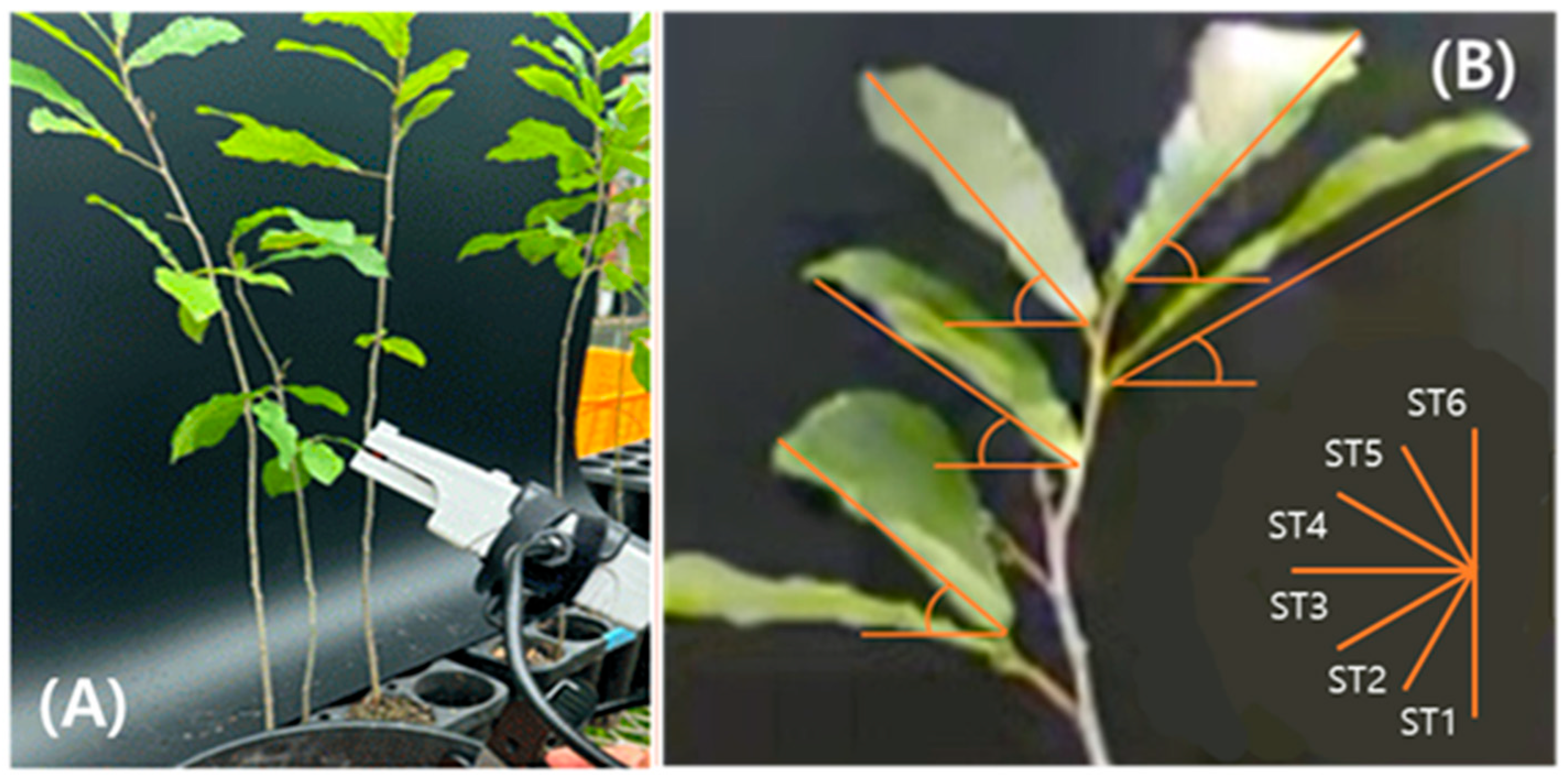
Prior to measurements, leaves (n = 37) from each treatment (CT and DT) that were measurable for leaf angle in the images were labeled. The labeled leaves were repeatedly measured by tracking the same leaves over time, ensuring consistency between physiological measurements and leaf angle assessments. The measured parameters included chlorophyll index (SPAD), chlorophyll fluorescence (Fm′: maximum fluorescence in light-adapted state; Fo′: minimum fluorescence in light-adapted state; Fv′/Fm′: maximum quantum yield of PSII in light-adapted state; ΦII: quantum yield of PSII; ΦNO: quantum yield of non-regulated energy dissipation; ΦNPQ: quantum yield of regulated energy dissipation; qL: fraction of open PSII reaction centers), vapor pressure deficit (VPD), and crop water stress index (CWSI). SPAD and chlorophyll fluorescence were measured with MultispeQ V2.0 device (PhotosynQ, East Lansing, MI, USA) between 12:00 PM and 6:00 PM. Leaf temperature data for VPD and CWSI calculations were collected using thermal camera (PI 160i, Optris, Berlin, Germany) positioned 2–3 m from the seedlings, with 10 min recordings taken daily (Figure 2A). The equations for calculating VPD and CWSI followed Gardner et al. [35], Stull [36], Grossiord et al. [37], and Zhou et al. [38] (Equations (1) and (2)).
V P D = 0.6108 × exp 17.27 T l T l + 237.3 ( 0.6108 × e x p ( 17.27 T a T a + 237.3 ) × A H 100 )
C W S I = T l T a ( T l w T a w ) T l d T a d ( T l w T a w )
Tl refers to leaf temperature, Ta to air temperature, Tlw to minimum leaf temperature, Tld to maximum leaf temperature, Taw to minimum air temperature, and Tad to maximum air temperature.

2.4. Leaf Angle Measurements

Leaf angle was measured using time-lapse camera (ATL200S, Afidus, New Taipei City, Taiwan) that captured RGB images (16:9 ratio) at 10 min intervals. To capture all labeled leaves within a single frame, images were taken from a height of 70 cm above the base of the target pot and 60 cm away from the seedlings. To minimize image distortion, all wide-angle, digital zoom, image stabilization, and auto-exposure optimization functions were disabled. RGB images were analyzed in ImageJ ver. 1.53k (NIH, Bethesda, MD, USA) to extract leaf angle data. Leaf angle was defined as the internal angle formed between horizontal reference line drawn from the petiole and line from the petiole to the leaf tip, measured using the angle tool in the software (Figure 2B). Leaves pointing upward were assigned angles between 0° and +90°, while downward-facing leaves were assigned between −90° and 0°. Collected leaf angle data were processed into leaf angle parameters according to Equations (3)–(5).
leaf angle ranges divided into six intervals (STx): −90° ≤ ST1 < −60°, −60° ≤ ST2 < −30°, −30° ≤ ST3 < 0°, 0° ≤ ST4 < +30°, +30° ≤ ST5 < +60°, +60° ≤ ST6 ≤ +90°
Δleaf angle (BD–MD): difference between measurements before drought and the current measurement day
Δleaf angle (PMD–MD): difference between the previous measurement day and the current measurement day
Figure 2. Physiological measurement and leaf angle monitoring for Q. acutissima seedlings. (A) Physiological measurement using MultispeQ; (B) RGB image-based leaf angle monitoring.
Forests 17 00348 g002

2.5. Statistical Analyses

Prior to statistical analysis, the environmental and leaf angle datasets were matched to the physiological data at 1 h intervals based on the timestamps recorded by the instruments. To assess the effects of DT on temporal and treatment-based variations in physiological parameters and leaf angle, two-way repeated measures analysis of variance (RMANOVA) was performed. Post hoc pairwise t-tests with Bonferroni correction (p < 0.05) were used. Stepwise multiple regression analysis was conducted to identify factors determining leaf angle variation, with leaf angle parameters as dependent variables and physiological parameters as independent variables (enter: p < 0.05, remove: p > 0.10). Multicollinearity among predictors was checked using tolerance and variance inflation factor (VIF) values. Principal component analysis (PCA) was performed to visualize variations in physiological and leaf angle characteristics across measurement days and to identify contributing factors. RMANOVA and regression analyses were conducted using SPSS ver. 26 (IBM, Armonk, NY, USA). PCA was performed in Python ver. 3.11 using the scikit-learn PCA module ver. 1.3.0, with StandardScaler applied to normalize all numerical data to account for differences in variable scales. Results were visualized as score plots for PC1 and PC2 using matplotlib ver. 3.7.2, and variable contributions were displayed as loading vectors.

3. Results

3.1. Physiological Responses

Physiological parameters showing an interaction effect were Fm′ (p < 0.05), ΦNO (p < 0.01), SPAD (p < 0.01), and CWSI (p < 0.05) (Table 1). Except for CWSI, all showed main effect for day (p < 0.01). The parameters that showed main effect for treatment were Fo′ (p < 0.01), Fm′ (p <0.001), ΦNO (p < 0.01), qL (p < 0.05), and CWSI (p < 0.01).
Overall, chlorophyll fluorescence such as decreases in Fv’/Fm’ (CT: 0.57 ± 0.13; DT: 0.58 ± 0.15) and increases in ΦNPQ (CT: 0.40 ± 0.18; DT: 0.38 ± 0.22) indicated that both treatments showed sharp increase in stress on Day 4 (Table 2 and Table 3). Except for Day 4, DT showed a consistent decreasing trend over time in certain physiological parameters Fv′/Fm′, ΦII, ΦNO, ΦNPQ (Table 3). In comparisons between treatments, Fo’ and Fm’ showed significant differences from Day 2 onward (except Fm′ on Day 4) (p < 0.05). ΦNO (Day 6 ** CT: 0.19 ± 0.02, DT: 0.18 ± 0.02; Day 8 *** CT: 0.20 ± 0.02, DT: 0.17 ± 0.03) and qL (Day 6 * CT: 0.63 ± 0.11, DT: 0.67 ± 0.06; Day 8 ** CT: 0.64 ± 0.11, DT: 0.70 ± 0.05) also differed significantly between the two treatments from Day 6 onward.

3.2. Leaf Angle Variation

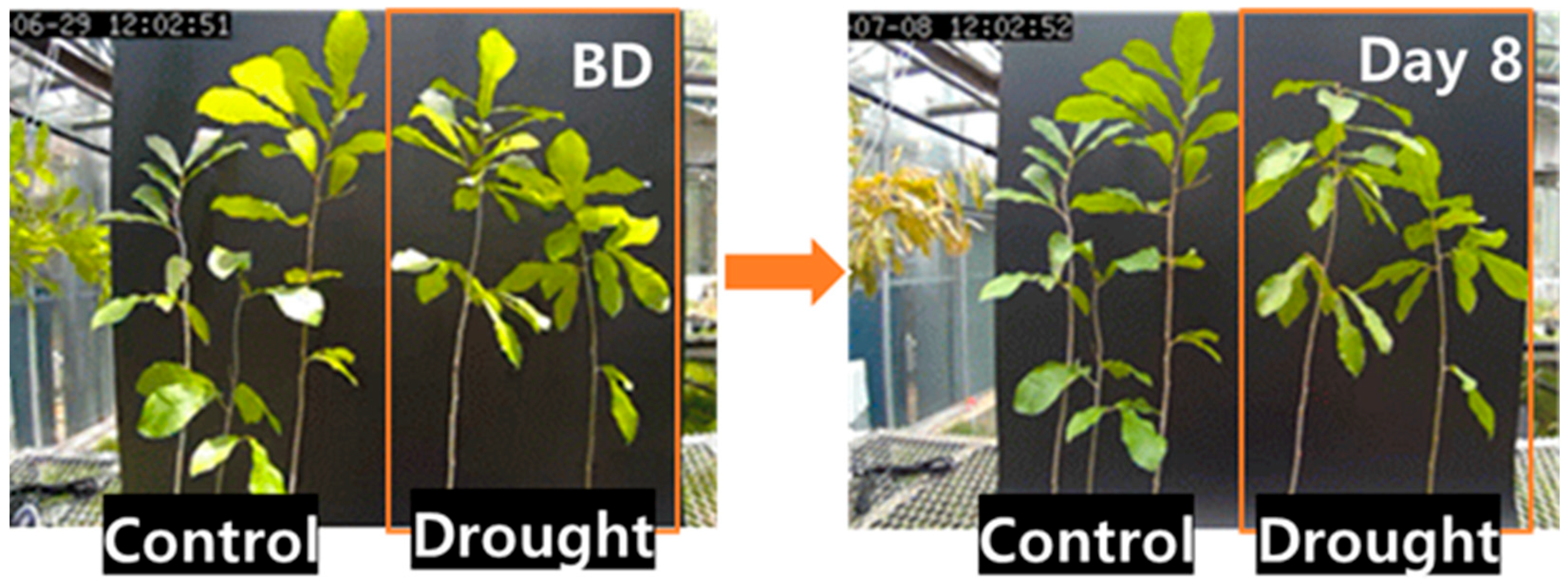
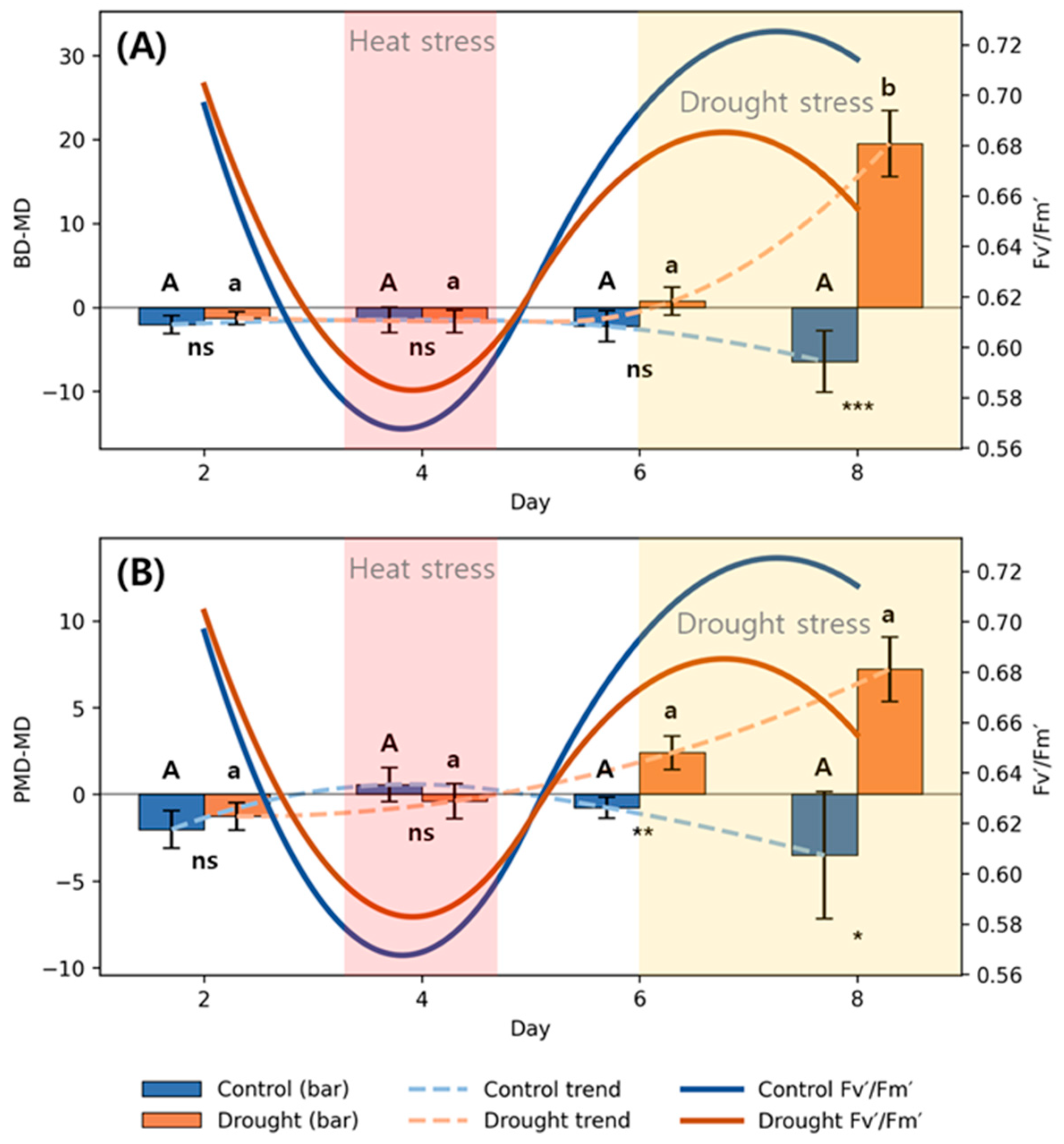
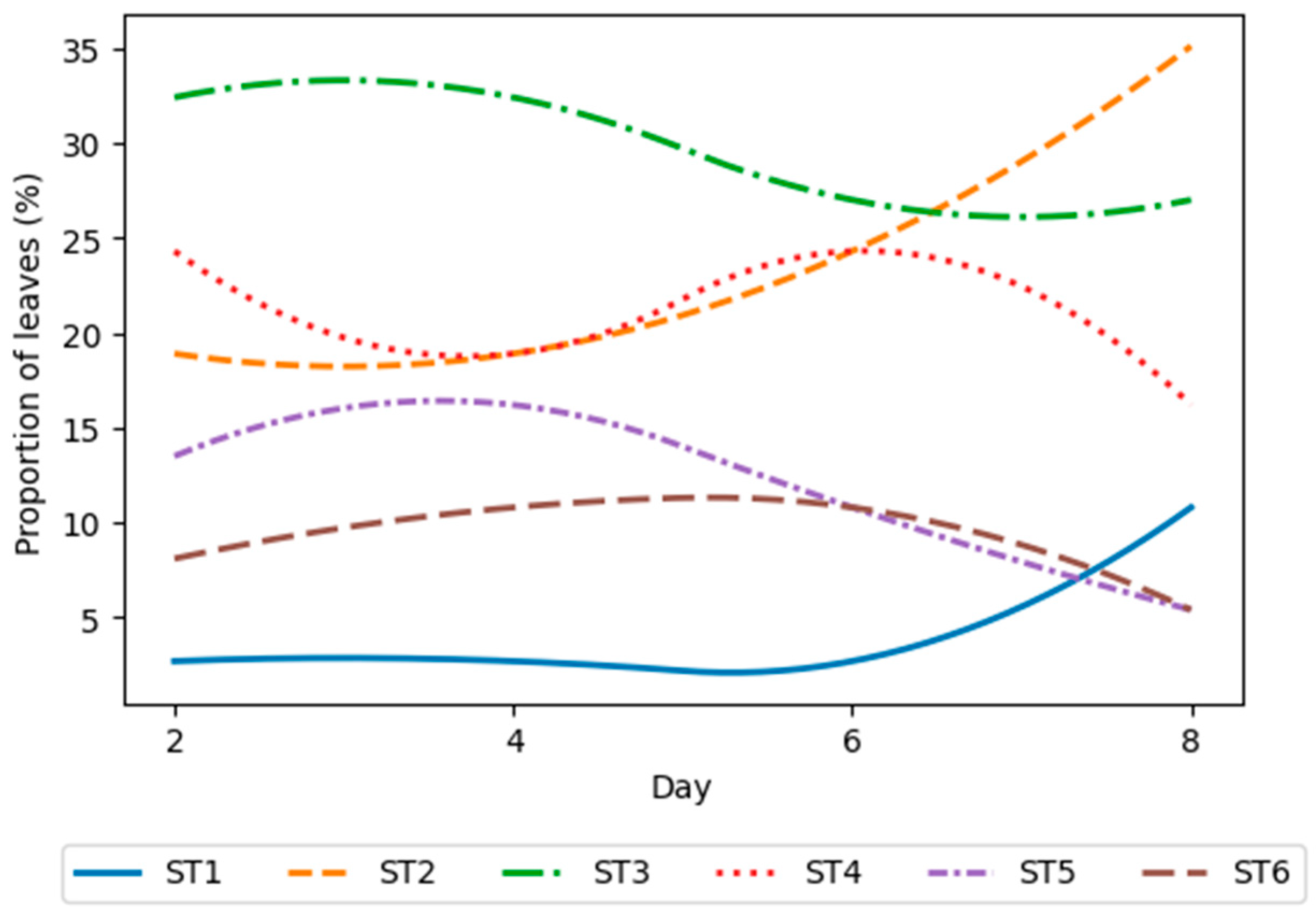
Visual observation revealed that noticeable leaf inclination occurred on Day 8 (Figure 3). BD–MD exhibited significant interaction (day × treatment: F = 20.607, p < 0.001) and main effects (day: F = 8.307, p < 0.01; treatment: F = 11.730, p < 0.01), with significant differences between treatments observed from Day 8 (CT: −6.43 ± 3.67°, DT: 19.52 ± 3.95°; p < 0.001) (Figure 4A). PMD–MD showed both interaction effect (day × treatment: F = 4.687, p < 0.05) and main effect for treatment (F = 9.592, p < 0.01), with significant differences between treatments beginning on Day 6 (CT: −0.77 ± 0.60°, DT: 2.39 ± 0.96°; p < 0.01) (Figure 4B). Notably, on Day 4, Fv′/Fm′ decreased in both treatments, likely reflecting responses to heat stress, whereas leaf angle parameters remained relatively stable (Figure 1A and Figure 4A). By Day 6, meteorological conditions began to resemble those of the early experimental period, with SM reaching the permanent wilting point, the PMD–MD exhibited clear drought stress responses between treatments (Figure 1 and Figure 4B). At the same time, from Day 6 onward, Fv′/Fm′ in the DT showed a more gradual increase followed by a steeper decline compared with the CT, indicating a more pronounced drought stress effect. In DT, ST1 and ST2, which were within the negative angle range, exhibited an upward trend over time (Figure 5), with ST2 showing the greatest increase (Day 2: 18.9%, Day 4: 18.9%, Day 6: 24.3%, Day 8: 35.1%; y = 1.00x + 4.00). In contrast, ST5 showed the most pronounced decline (Day 2: 13.5%, Day 4: 16.2%, Day 6: 10.8%, Day 8: 5.4%; y = −0.56x + 7.03).

3.3. Relationship Between Physiological and Leaf Angle Parameters

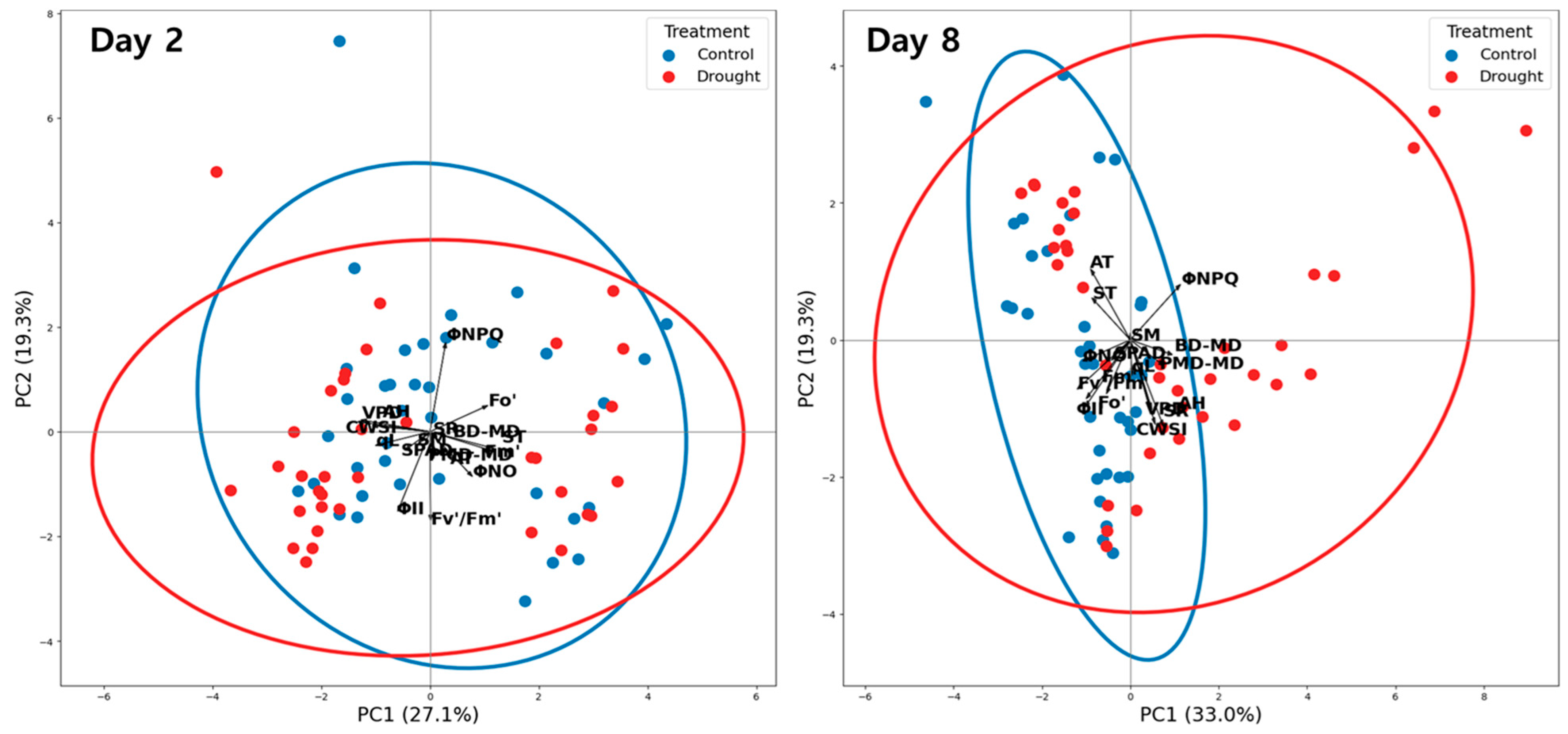
The BD–MD model (adjusted R2 = 0.389) exhibited relatively higher stability in explanatory power compared to the PMD–MD model (adjusted R2 = 0.242) (Table 4 and Table 5). However, since both models had R2 values below 0.5, they were appropriate for identifying general trends but could not be considered highly predictive. The addition of new variables contributed to an increase in explanatory power (Sig. F change < 0.05). The Durbin–Watson (DW) values were close to 2 indicating minimal autocorrelation. Significant variables selected in both models included SM, AT, Fm′, and VPD. Except for Fm′, most of these were environmental factors (AT, VPD, SM), which were identified as key drivers influencing leaf angle. In particular, AT (BD–MD standardized coefficient β = −1.079; PMD–MD standardized coefficient β = −0.672) exerted the strongest influence (negative) on both leaf angle parameters. On Day 8, PCA revealed a clear separation between CT and DT primarily along PC1, which accounted for 33.0% of the total variance (Figure 6). This separation was mainly driven by strong loadings of chlorophyll fluorescence and leaf angle parameters. In contrast, PC2 (19.3% of the variance) was dominated by atmospheric-related variables such as AH, SR, AT, VPD, and CWSI.

4. Discussion

4.1. Physiological Responses of Q. acutissima to Drought Stress

In contrast to this study, previous studies have shown that 1–2-year-old Q. acutissima seedlings can survive beyond 30 days of drought treatment [39,40,41,42]. Up to 30 days of drought, no significant differences in chlorophyll content between irrigated and drought-treated seedlings have been observed, and chlorophyll fluorescence responses also showed minimal variation [39,42]. Before rewatering, leaves exhibited visible wilting, but recovery was observed following rewatering [42,43]. Thermal imaging further confirmed that leaf temperatures returned to pre-drought levels after rewatering [42]. Although the seedlings did not die, leaf abscission occurred progressively over time, while surviving leaves tended to recover in photosynthetic parameters [43]. These studies consistently indicate that, even under DT, SM levels remained higher than in this study, and recovery upon rewatering was possible as long as SM did not reach permanent wilting point. According to Lim et al. [39], SM dropped below 1% after 30 days, after which drought stress responses were detected in chlorophyll fluorescence (Fv/Fm). This is consistent with the findings of this study, in which drought stress symptoms appeared when SM approached permanent wilting point. Further investigation is therefore required to determine whether leaf recovery can occur following rewatering once SM has reached permanent wilting point.
Even when leaf recovery was slow, Wang et al. [41] reported that stem starch concentrations increased 60 days after defoliation, suggesting an enhancement of drought tolerance through resource reallocation strategies. Liu et al. [44] observed that nutrient supplementation under drought conditions mitigated structural damage to leaves and maintained physiological functions, thereby alleviating drought stress. According to Li et al. [40], hardening treatment in Q. acutissima improved drought readaptation capacity by enhancing photosynthetic performance, activating carbon consumption reduction strategies, and increasing the fine-to-coarse root ratio. From physiological perspective, such effects could reduce leaf mortality, mitigate growth reduction, and enhance the feasibility of leaf-based drought stress detection.
In this context, the decline of SM to levels approaching the permanent wilting point in this study represents an extreme condition that is unlikely to occur frequently under natural field environments. Nevertheless, such moisture depletion provides important insight into the physiological limits and response thresholds of seedlings and becomes increasingly relevant under climate change scenarios characterized by more frequent drought events, elevated temperatures, and high VPD. In particular, containerized seedlings and recently planted seedlings with restricted rooting volumes may be more vulnerable to rapid SM depletion, and the findings of this study may contribute to the development of irrigation management strategies aimed at preventing irreversible stress.

4.2. Potential Applications of Leaf Angle Measurement

This study confirmed that changes in leaf angle closely align with physiological responses of seedlings to drought stress. On Day 6 of the no-irrigation treatment, significant differences between treatments were observed not only in ΦNO and qL but also in PMD–MD (CT: −0.77 ± 0.60°, DT: 2.39 ± 0.96°), confirming a drought stress response. The numerical range of this leaf angle parameter may serve as a reference threshold for identifying no-irrigation conditions, provided that measurements are conducted using the same methodological approach as in this study. On Day 4 of experiment, physiological responses exhibited greater sensitivity to light and heat stress, whereas leaf angle did not show pronounced response to these factors. This suggests that leaf angle may be less influenced by light and heat stress and therefore could serve as more reliable indicator for detecting drought stress. Although AT exhibited the strongest standardized coefficient in the regression model, this inconsistency likely stems from differences in analytical approaches between treatment-based post hoc and regression analyses using continuous environmental variables. The relatively large variability (particularly on Day 8) in leaf angle among individual leaves may have contributed to weaker statistical significance in day-to-day differences compared with treatment-based differences. This characteristic was also reflected in the relatively low R2 values observed in the regression models. In nursery environments, seedlings are inherently influenced by a complex interplay of factors, including water status, tissue elasticity, and leaf position. Therefore, expecting high explanatory power from a limited set of variables may not fully reflect realistic conditions. Accordingly, this (preliminary) study focused more on identifying significant parameters and exploring response trends rather than achieving high explanatory power per se. From this perspective, the results provide ecophysiologically meaningful insights into leaf angle research.
Leaf angle is known to significantly influence various physiological processes, including suppression of excessive light saturation, prevention of leaf temperature rise, protection of the photosynthetic apparatus, activation of the xanthophyll cycle, and improvement of photosynthetic efficiency [45]. In some species, inherent leaf angles serve as an adaptive strategy for enhancing survival [29]. Under nursery conditions, seedlings with positive mean leaf angle exhibited significantly improved physiological responses even under reduced irrigation, whereas those with negative mean leaf angle required greater irrigation inputs [32,33]. In conifers such as larch, upper needles exhibited more rapid wilting response compared to broadleaved species, and drought stress symptoms were detectable earlier than physiological changes [34]. In Larix kaempferi, needles wilted at night under drought stress but recovered by the following morning, indicating a clear irrigation threshold and supporting the applicability of leaf angle-based monitoring. In contrast, such pronounced movements were less evident in Q. acutissima, suggesting that identifying appropriate re-irrigation thresholds may require further investigation. These findings underscore the importance of incorporating morphology-derived traits into leaf angle-based monitoring strategies to reflect species-specific differences.
For more practical applications, the approach proposed by Jeong et al. [34] could be integrated with software (e.g., PlantCV) capable of detecting canopy leaf area or morphology-derived traits based on leaf angle dynamics and automatically collecting quantitative data. Moreover, images can now be easily captured using smartphones, and app-based developments are underway to extract leaf area and related phenotypes from such images [23,46]. If these low-cost image acquisition and measurement technologies are coupled with automated analytical processes, they could ultimately be integrated into cost-effective automated irrigation systems [47].
Recent advances in machine learning and deep learning techniques have enhanced the precision of image-based leaf angle analysis [23,24]. For example, Qi et al. [23] applied Pyramid Convolutional Neural Network (PCNN) to smartphone images of Euonymus japonicus Thunb., effectively estimating leaf azimuth with high accuracy, as indicated by strong R2 values, thus demonstrating its field applicability. Several other studies have also reported methods for measuring leaf angle distributions in various plant and crop species [21,22]. Jiang et al. [25] developed the Auto-LIA (leaf inclination angle) system, which integrates RGB imaging with computer vision techniques to achieve fully automated LIA measurement based on leaf–plant connectivity and 3D spatial information. This approach offers advantages of low cost and high precision, highlighting its potential for plant physiological monitoring and phenotyping. Furthermore, leaf angle datasets can be utilized for calibration modeling to improve measurement accuracy, and the data collected in this study are also expected to contribute to the development of future application technologies [33,48].

4.3. Limitation and Future Study

The relatively small sample size should be acknowledged as a primary limitation of this study. Although the repeated measures design partially enhanced analytical sensitivity by incorporating temporal data from labeled leaves, the limited number of independent seedlings may have constrained statistical power.
Genetic factors may also have contributed to variability, as seedlings were derived from open-pollinated seed sources and genetic variation was not strictly controlled. This variability may have influenced drought tolerance and leaf angle responses, highlighting the need for genetically uniform materials or explicit consideration of genetic effects in future studies.
In addition, this study was conducted only during July, corresponding to the active growth stage, and therefore did not account for seasonal variation or differences among leaf developmental stages. Previous studies have reported seasonal shifts in mean leaf angle [17,30], suggesting that temporal variability should be incorporated into future analyses. Increasing the number of replicates across different time periods and constructing separate datasets based on leaf position and environmental conditions would allow more robust modeling of leaf angle dynamics.
Despite these constraints, this study identified correlations and temporal trends in leaf angle responses under drought stress. The findings provide a preliminary experimental framework for designing more robust studies, including variation in seasonal timing and irrigation intensity. To enhance practical applicability, future research should extend analyses from individual leaves to containerized seedlings and larger plant populations, enabling evaluation of morphological patterns derived from leaf angle variation. With larger datasets, it may be possible to define threshold ranges associated with the onset of wilting and implement precision rewatering strategies based on real-time monitoring. The dataset generated in this study also provides foundational information for the development and validation of predictive models, including linear mixed modeling approaches.

5. Conclusions

This study explored the feasibility of image-based leaf angle monitoring for detecting drought-induced changes in one-year-old Q. acutissima container seedlings grown under controlled nursery conditions. From Day 6 of DT onward, leaf angle (PMD–MD) and physiological parameters (ΦNO and qL) exhibited comparable treatment-related differences, confirming that leaf angle reflected drought stress responses. However, leaf angle changes did not precede physiological responses, and the present experimental conditions did not allow for definitive validation of its early detection capability. Regression analyses indicated that SM and AT contributed to leaf angle variation. However, the relatively low R2 values suggest limited predictive power.
Overall, this study provides preliminary evidence that leaf angle monitoring may function as a complementary indicator of drought stress rather than a substitute for physiological measurements. Future studies should validate these findings using larger datasets, across multiple seasonal conditions, and in different species. In this context, the integration of image-based monitoring into smart irrigation systems should be considered a long-term research direction rather than an immediate practical application.

Author Contributions

Conceptualization, U.J., S.H.H. and E.J.C.; methodology, U.J.; validation, U.J. and D.K.; formal analysis, U.J. and D.K.; investigation, U.J., D.K., S.K. and J.P.; resources, S.H.H.; data curation, U.J. and D.K.; writing—original draft preparation, U.J.; writing—review and editing, U.J.; visualization, U.J.; supervision, U.J. and E.J.C.; project administration, E.J.C.; funding acquisition, S.H.H. All authors have read and agreed to the published version of the manuscript.

Funding

This research was funded by the National Institute of Forest Science, grant number SC0300-2023-01-2024.

Data Availability Statement

The original contributions presented in this study are included in the article. Further inquiries can be directed to the corresponding authors.

Conflicts of Interest

The authors declare no conflicts of interest.

Abbreviations

The following abbreviations are used in this manuscript:
CTControl
DTDrought treatment
ATAir temperature
AHAir humidity
SRSolar radiation
STSoil temperature
SMSoil moisture
Fo’Minimum fluorescence in light-adapted state
Fm’Maximum fluorescence in light-adapted state
Fv’/Fm’Maximum quantum yield of PSII in light-adapted state
ΦIIQuantum yield of PSII
ΦNOQuantum yield of non-regulated energy dissipation
ΦNPQQuantum yield of regulated energy dissipation
qLFraction of open PSII reaction centers
SPADChlorophyll index
VPDVapor pressure deficit
CWSICrop water stress index
STxLeaf angle ranges divided into six intervals
BD–MDDifference between measurements before drought and the current measurement day
PMD–MDDifference between the previous measurement day and the current measurement day

References

  1. Arnell, N.W.; Lowe, J.A.; Challinor, A.J.; Osborn, T.J. Global and regional impacts of climate change at different levels of global temperature increase. Clim. Change 2019, 155, 377–391. [Google Scholar] [CrossRef]
  2. Menezes-Silva, P.E.; Loram-Lourenço, L.; Alves, R.D.F.B.; Sousa, L.F.; Almeida, S.E.D.S.; Farnese, F.S. Different ways to die in a changing world: Consequences of climate change for tree species performance and survival through an ecophysiological perspective. Ecol. Evol. 2019, 9, 11979–11999. [Google Scholar] [CrossRef] [PubMed]
  3. Park, J.H.; Jung, S.Y.; Lee, K.S.; Lee, H.S. The Characteristics and survival rates of evergreen broad-leaved tree plantations in Korea. J. Korean Soc. For. Sci. 2019, 108, 513–521. [Google Scholar] [CrossRef]
  4. Fowler, H.J.; Ali, H.; Allan, R.P.; Ban, N.; Barbero, R.; Berg, P.; Blenkinsop, S.; Cabi, N.S.; Chan, S.; Dale, M.; et al. Towards advancing scientific knowledge of climate change impacts on short-duration rainfall extremes. Philos. Trans. Math. Phys. Eng. Sci. 2021, 379, 20190542. [Google Scholar] [CrossRef]
  5. Fisichelli, N.; Wright, A.; Rice, K.; Mau, A.; Buschena, C.; Reich, P.B. First-year seedlings and climate change: Species-specific responses of 15 North American tree species. Oikos 2014, 123, 1331–1340. [Google Scholar] [CrossRef]
  6. Mechergui, T.; Pardos, M.; Jacobs, D.F. Effect of acorn size on survival and growth of Quercus suber L. seedlings under water stress. Eur. J. For. Res. 2021, 140, 175–186. [Google Scholar] [CrossRef]
  7. Farooq, M.; Hussain, M.; Wahid, A.; Siddique, K.H.M. Drought stress in plants: An overview. Plant responses to drought stress: From morphological to molecular feature. In Plant Responses to Drought Stress; Aroca, R., Ed.; Springer: Berlin/Heidelberg, Germany, 2012; pp. 1–33. [Google Scholar]
  8. Abdallah, M.B.; Methenni, K.; Nouairi, I.; Zarrouk, M.; Youssef, N.B. Drought priming improves subsequent more severe drought in a drought-sensitive cultivar of olive cv. Chétoui. Sci. Hortic. 2017, 221, 43–52. [Google Scholar] [CrossRef]
  9. Lv, Z.; Zhang, H.; Huang, Y.; Zhu, L.; Yang, X.; Wu, L.; Chen, M.; Wang, H.; Jing, Q.; Shen, J.; et al. Drought priming at seedling stage improves photosynthetic performance and yield of potato exposed to a short-term drought stress. Plant Physiol. 2024, 292, 154157. [Google Scholar] [CrossRef]
  10. Puértolas, J.; Villar-Salvador, P.; Andivia, E.; Ahuja, I.; Cocozza, C.; Cvjetković, B.; Devetaković, J.; Diez, J.J.; Fløistad, I.S.; Ganatsas, P.; et al. Die-hard seedlings. A global meta-analysis on the factors determining the effectiveness of drought hardening on growth and survival of forest plantations. For. Ecol. Manag. 2024, 572, 122300. [Google Scholar] [CrossRef]
  11. Toca, A.; Gonzalez-Benecke, C.A.; Nelson, A.S.; Jacobs, D.F. Drought memory expression varies across ecologically contrasting forest tree species. Environ. Exp. Bot. 2025, 231, 106094. [Google Scholar] [CrossRef]
  12. Et-Taibi, B.; Abid, M.R.; Boufounas, E.M.; Morchid, A.; Bourhnane, S.; Hamed, T.A.; Benhaddou, D. Enhancing water management in smart agriculture: A cloud and IoT-Based smart irrigation system. Results Eng. 2024, 22, 102283. [Google Scholar] [CrossRef]
  13. Hong, S.; Park, S.; Youn, H.; Lee, J.; Kwon, S. Implementation of smart farm systems based on fog computing in artificial intelligence of things environments. Sensors 2024, 24, 6689. [Google Scholar] [CrossRef] [PubMed]
  14. Younes, A.; Abou Elassad, Z.E.; El Meslouhi, O.; Abou Elassad, D.E.; Majid, E.D.A. The application of machine learning techniques for smart irrigation systems: A systematic literature review. Smart Agric. Technol. 2024, 7, 100425. [Google Scholar] [CrossRef]
  15. Itam, M.; Hall, D.; Kramer, D.; Merewitz, E. Early detection of Kentucky bluegrass and perennial ryegrass responses to drought stress by measuring chlorophyll fluorescence parameters. Crop Sci. 2024, 64, 1015–1026. [Google Scholar] [CrossRef]
  16. Yang, C.Y.; Zhang, Y.C.; Hou, Y.L. Assessing water status in rice plants in water-deficient environments using thermal imaging. Bot. Stud. 2025, 66, 6. [Google Scholar] [CrossRef]
  17. Yang, X.; Li, R.; Jablonski, A.; Stovall, A.; Kim, J.; Yi, K.; Ma, Y.; Beverly, D.; Phillips, R.; Novics, K.; et al. Leaf angle as a leaf and canopy trait: Rejuvenating its role in ecology with new technology. Ecol. Lett. 2023, 26, 1005–1020. [Google Scholar] [CrossRef]
  18. Tsaftaris, S.A.; Minervini, M.; Scharr, H. Machine learning for plant phenotyping needs image processing. Trends Plant Sci. 2016, 21, 989–991. [Google Scholar] [CrossRef] [PubMed]
  19. Pound, M.P.; Atkinson, J.A.; Townsend, A.J.; Wilson, M.H.; Griffiths, M.; Jackson, A.S.; Bulat, A.; Tzimiropoulos, G.; Wells, D.M.; Murchie, E.H.; et al. Deep machine learning provides state-of-the-art performance in image-based plant phenotyping. Gigascience 2017, 6, gix083. [Google Scholar] [CrossRef]
  20. Mertens, S.; Verbraeken, L.; Sprenger, H.; De Meyer, S.; Demuynck, K.; Cannoot, B.; Merchie, J.; De Block, J.; Vogel, J.T.; Bruce, W.; et al. Monitoring of drought stress and transpiration rate using proximal thermal and hyperspectral imaging in an indoor automated plant phenotyping platform. Plant Methods 2023, 19, 132. [Google Scholar] [CrossRef]
  21. Zou, X.; Mõttus, M.; Tammeorg, P.; Torres, C.L.; Takala, T.; Pisek, J.; Mäkelä, P.; Stoddard, F.L.; Pellikka, P. Photographic measurement of leaf angles in field crops. Agric. For. Meteorol. 2014, 184, 137–146. [Google Scholar] [CrossRef]
  22. Müller-Linow, M.; Pinto-Espinosa, F.; Scharr, H.; Rascher, U. The leaf angle distribution of natural plant populations: Assessing the canopy with a novel software tool. Plant Methods 2015, 11, 11. [Google Scholar] [CrossRef] [PubMed]
  23. Qi, J.; Xie, D.; Li, L.; Zhang, W.; Mu, X.; Yan, G. Estimating leaf angle distribution from smartphone photographs. IEEE Geosci. Remote Sens. 2019, 16, 1190–1194. [Google Scholar] [CrossRef]
  24. Kenchanmane Raju, S.K.; Adkins, M.; Enersen, A.; Santana de Carvalho, D.; Studer, A.J.; Ganapathysubramanian, B.; Schnable, P.S.; Schnable, J.C. Leaf Angle eXtractor: A high-throughput image processing framework for leaf angle measurements in maize and sorghum. Appl. Plant Sci. 2020, 8, e11385. [Google Scholar] [CrossRef]
  25. Jiang, S.; Wu, X.; Wang, Q.; Pei, Z.; Wang, Y.; Jin, J.; Guo, Y.; Song, R.; Zang, L.; Liu, Y.J.; et al. Auto-LIA: The automated vision-based leaf inclination angle measurement system improves monitoring of plant physiology. Plant Phenomics 2024, 6, 0245. [Google Scholar] [CrossRef]
  26. King, D.A. The functional significance of leaf angle in Eucalyptus. Aust. J. Bot. 1997, 45, 619–639. [Google Scholar] [CrossRef]
  27. Ishida, A.; Toma, T.; Marjenah, M. Leaf gas exchange and cholorphyll fluorescence in relation to leaf angle, azimuth, and canopy position in the tropical pioneer tree, Macaranga conifera. Tree Physiol. 1999, 19, 117–124. [Google Scholar] [CrossRef]
  28. Posada, J.M.; Lechowicz, M.J.; Kitajima, K. Optimal photosynthetic use of light by tropical tree crowns achieved by adjustment of individual leaf angles and nitrogen content. Ann. Bot. 2009, 103, 795–805. [Google Scholar] [CrossRef]
  29. Mänd, P.; Hallik, L.; Peñuelas, J.; Kull, O. Electron transport efficiency at opposite leaf sides: Effect of vertical distribution of leaf angle, structure, chlorophyll content and species in a forest canopy. Tree Physiol. 2013, 33, 202–210. [Google Scholar] [CrossRef]
  30. Raabe, K.; Pisek, J.; Sonnentag, O.; Annuk, K. Variations of leaf inclination angle distribution with height over the growing season and light exposure for eight broadleaf tree species. Agric. For. Meteorol. 2015, 214, 2–11. [Google Scholar] [CrossRef]
  31. Hagemeier, M.; Leuschner, C. Functional crown architecture of five temperate broadleaf tree species: Vertical gradients in leaf morphology, leaf angle, and leaf area density. Forests 2019, 10, 265. [Google Scholar] [CrossRef]
  32. Delgado, L.G.M.; da Silva, R.B.G.; Gabira, M.M.; Rodrigues, A.L.; Simões, D.; de Almeida, L.F.R.; da Silva, M.R. Mean leaf angles affect irrigation efficiency and physiological responses of tropical species seedling. Forests 2022, 13, 832. [Google Scholar] [CrossRef]
  33. da Silva, R.B.G.; Simões, D.; Wendling, I.; do Prado, D.Z.; Sartori, M.M.P.; Bertholdi, A.A.D.S.; da Silva, M.R. Leaf Angle as a Criterion for Optimizing Irrigation in Forest Nurseries: Impacts on Physiological Seedling Quality and Performance after Planting in Pots. Forests 2023, 14, 1042. [Google Scholar] [CrossRef]
  34. Jeong, U.; Kim, D.; Kim, S.; Han, S.H.; Cheong, E.J. Needle angle dynamics as a rapid indicator of drought stress in Larix kaempferi (Lamb.) Carrière: Advancing non-destructive imaging techniques for resilient seedling production. Front. Plant Sci. 2025, 16, 1550748. [Google Scholar] [CrossRef]
  35. Gardner, B.R.; Nielsen, D.C.; Shock, C.C. Infrared thermometry and the crop water stress index. I. History, theory, and baselines. J. Prod. Agric. 1992, 5, 462–466. [Google Scholar] [CrossRef]
  36. Stull, R.B. Practical Meteorology: An Algebra-Based Survey of Atmospheric Science; University of British Columbia: Vancouver, BC, Canada, 2015. [Google Scholar] [CrossRef]
  37. Grossiord, C.; Buckley, T.N.; Cernusak, L.A.; Novick, K.A.; Poulter, B.; Siegwolf, R.T.; Sperry, J.S.; Mcdowell, N.G. Plant responses to rising vapor pressure deficit. New Phytol. 2020, 226, 1550–1566. [Google Scholar] [CrossRef]
  38. Zhou, Z.; Majeed, Y.; Naranjo, G.D.; Gambacorta, E.M. Assessment for crop water stress with infrared thermal imagery in precision agriculture: A review and future prospects for deep learning applications. Comput. Electron. Agric. 2021, 182, 106019. [Google Scholar] [CrossRef]
  39. Lim, H.; Kang, J.W.; Lee, S.; Lee, H.; Lee, W.Y. Growth and physiological responses of Quercus acutissima seedling under drought stress. Plant Breed. Biotechnol. 2017, 5, 363–370. [Google Scholar] [CrossRef]
  40. Li, Q.; Liu, X.; Sun, X.; Zhao, M.; Liu, L.; Wang, N.; Gao, Q.; Fan, P.; Du, N.; Wang, H.; et al. Effects of drought hardening on the carbohydrate dynamics of Quercus acutissima seedlings under successional drought. Front. Plant Sci. 2023, 14, 1184584. [Google Scholar] [CrossRef]
  41. Wang, N.; Song, M.; Zhang, Y.; Liu, X.; Wu, P.; Qi, L.; Song, H.; Du, N.; Wang, H.; Zheng, P.; et al. Physiological responses of Quercus acutissima and Quercus rubra seedlings to drought and defoliation treatments. Tree Physiol. 2023, 43, 737–750. [Google Scholar] [CrossRef]
  42. Kim, T.L.; Oh, C.; Denison, M.I.J.; Natarajan, S.; Lee, K.; Lim, H. Transcriptomic and physiological responses of Quercus acutissima and Quercus palustris to drought stress and rewatering. Front. Plant Sci. 2024, 15, 1430485. [Google Scholar] [CrossRef]
  43. Liu, D.; Guo, H.; Yan, L.P.; Gao, L.; Zhai, S.; Xu, Y. Physiological, photosynthetic and stomatal ultrastructural responses of quercus acutissima seedlings to drought stress and rewatering. Forests 2023, 15, 71. [Google Scholar] [CrossRef]
  44. Liu, X.; Li, Q.; Sun, X.; Yi, S.; Wu, P.; Wang, N. Nutrition addition alleviates negative drought effects on Quercus acutissima seedlings. For. Ecol. Manag. 2024, 562, 121980. [Google Scholar] [CrossRef]
  45. Liu, L.X.; Xu, S.M.; Woo, K.C. Influence of leaf angle on photosynthesis and the xanthophyll cycle in the tropical tree species Acacia crassicarpa. Tree Physiol. 2003, 23, 1255–1261. [Google Scholar] [CrossRef]
  46. Müller-Linow, M.; Wilhelm, J.; Briese, C.; Wojciechowski, T.; Schurr, U.; Fiorani, F. Plant Screen Mobile: An open-source mobile device app for plant trait analysis. Plant Methods 2019, 15, 2. [Google Scholar] [CrossRef]
  47. Ortiz, D.; Litvin, A.G.; Salas Fernandez, M.G. A cost-effective and customizable automated irrigation system for precise high-throughput phenotyping in drought stress studies. PLoS ONE 2019, 13, e0198546. [Google Scholar] [CrossRef]
  48. Pisek, J.; Sonnentag, O.; Richardson, A.D.; Mõttus, M. Is the spherical leaf inclination angle distribution a valid assumption for temperate and boreal broadleaf tree species? Agric. For. Meteorol. 2013, 169, 186–194. [Google Scholar] [CrossRef]
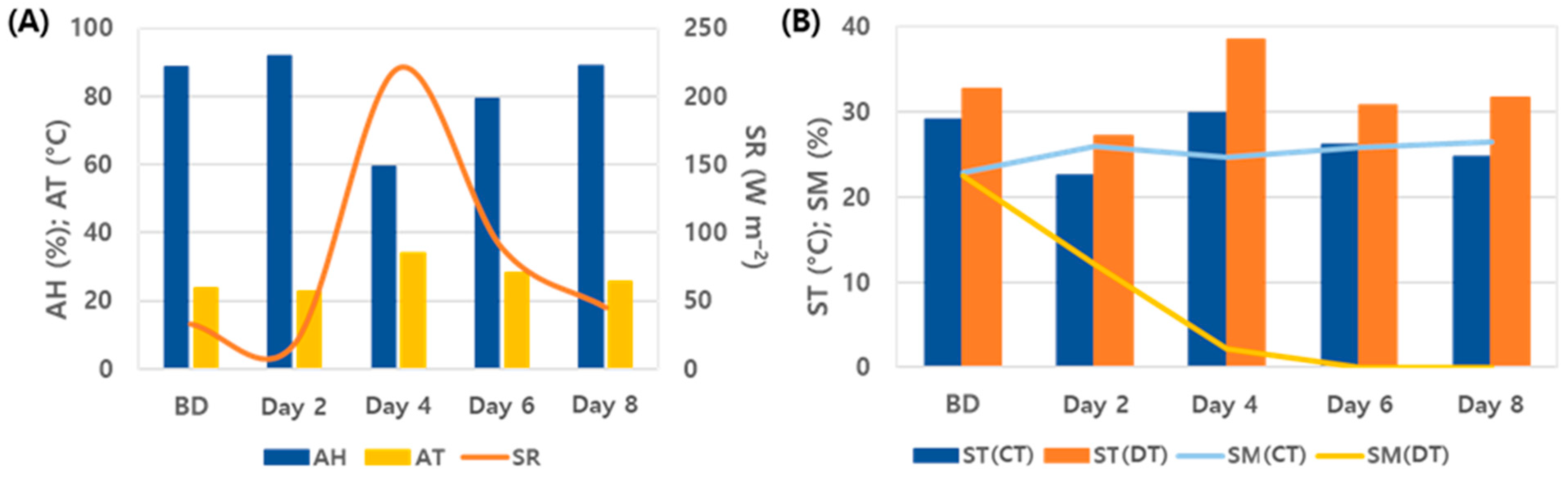
Figure 1. Overview of growth conditions during the experimental period. (A) Climatic conditions; (B) Soil conditions. AT: air temperature, AH: air humidity, SR: solar radiation, ST: soil temperature, SM: soil moisture, BD: before drought, CT: control, DT: drought.
Forests 17 00348 g001
Figure 3. Monitoring of temporal change in leaf angle during the experimental period. BD: before drought.
Forests 17 00348 g003
Figure 4. Statistical analysis results of leaf angle parameters by day and treatment. (A) BD–MD (difference between measurements before drought and the current measurement day); (B) PMD–MD (difference between the previous measurement day and the current measurement day). Bar graph represents mean and error bar indicates SE. Two-way RMANOVA was conducted, followed by pairwise t-tests with Bonferroni correction for post hoc analysis (p < 0.05). Uppercase letters indicate comparisons within control across days, while lowercase letters indicate comparisons within drought treatment across days. Significance levels for comparisons between the two treatments are denoted as follows: ns (p > 0.05), * (p < 0.05), ** (p < 0.01), *** (p < 0.001).
Forests 17 00348 g004
Figure 5. Temporal trends in the proportion of leaves across STx classes under drought treatment. STx leaf angle ranges divided into six intervals: −90° ≤ ST1 < −60°, −60° ≤ ST2 < −30°, −30° ≤ ST3 < 0°, 0° ≤ ST4 < +30°, +30° ≤ ST5 < +60°, +60° ≤ ST6 ≤ +90°.
Forests 17 00348 g005
Figure 6. PCA results by experimental day. AT: air temperature, AH: air humidity, SR: solar radiation, ST: soil temperature, SM: soil moisture, Fo′: minimum fluorescence in light-adapted state, Fm′: maximum fluorescence in light-adapted state, Fv′/Fm′: maximum quantum yield of PSII in light-adapted state, ΦII: quantum yield of PSII, ΦNO: quantum yield of non-regulated energy dissipation, ΦNPQ: quantum yield of regulated energy dissipation, qL: fraction of open PSII reaction centers, SPAD: chlorophyll index, VPD: vapor pressure deficit, CWSI: crop water stress index.
Forests 17 00348 g006
Table 1. Results of two-way RMANOVA for physiology parameters.
Parameter Sum of SquaredfMean SquareFp
Fo’D9,039,198.582.463,677,270.36190.34<0.001
T2,169,069.761.002,169,069.7611.849<0.01
D × T44,031.192.4617,912.500.93>0.05
Fm’D208,508,197.182.1696,431,192.15137.57<0.001
T30,413,395.131.0030,413,395.1315.17<0.001
D × T5,333,267.682.162,466,537.853.52<0.05
Fv’/Fm’D0.731.640.4436.78<0.001
T0.021.000.021.79>0.05
D × T0.061.640.043.14>0.05
ΦIID1.071.690.6435.42<0.001
T<0.001.00<0.00<0.00>0.05
D × T0.041.690.031.37>0.05
ΦNOD0.051.980.0321.78<0.001
T0.011.000.017.35<0.01
D × T0.011.980.014.93<0.01
ΦNPQD1.601.620.9938.34<0.001
T0.011.000.010.53>0.05
D × T0.101.620.062.33>0.05
qLD0.192.240.096.14<0.01
T0.081.000.084.84<0.05
D × T0.022.240.010.71>0.05
SPADD200.062.0597.4921.1<0.001
T41.661.0041.660.86>0.05
D × T66.372.0532.347.00<0.01
VPDD153.961.44106.73419.34<0.001
T0.501.000.53.00>0.05
D × T1.291.440.893.51>0.05
CWSID0.731.270.572.8>0.05
T0.3610.367.75<0.01
D × T1.121.270.884.31<0.05
Two-way RMANOVA was conducted, followed by pairwise t-tests with Bonferroni correction for post hoc analysis (p < 0.05). Greenhouse–Geisser correction was applied for sphericity. Bold and italic indicate statistically significant effect. D: main effect for day, T: main effect for treatment, D × T: interaction effect between day and treatment, Fo′: minimum fluorescence in light-adapted state, Fm′: maximum fluorescence in light-adapted state, Fv′/Fm′: maximum quantum yield of PSII in light-adapted state, ΦII: quantum yield of PSII, ΦNO: quantum yield of non-regulated energy dissipation, ΦNPQ: quantum yield of regulated energy dissipation, qL: fraction of open PSII reaction centers, SPAD: chlorophyll index, VPD: vapor pressure deficit, CWSI: crop water stress index.
Table 2. Statistical analysis results of physiology parameters among days in CT.
Day 2Day 4Day 6Day 8
Fo’1555.76 ± 253.68 a **1067.30 ± 235.62 c **1302.97 ± 220.82 b ***1351.68 ± 204.70 b *
Fm’5147.79 ± 779.32 a *2773.73 ± 1147.19 c4275.41 ± 742.00 b ***4742.26 ± 717.08 b ***
Fv’/Fm’0.70 ± 0.03 b0.57 ± 0.13 c0.69 ± 0.03 b0.71 ± 0.02 a
ΦII0.60 ± 0.04 a0.45 ± 0.15 b0.58 ± 0.07 a0.61 ± 0.07 a
ΦNO0.19 ± 0.02 b0.15 ± 0.05 c0.19 ± 0.02 ab **0.20 ± 0.02 a ***
ΦNPQ0.21 ± 0.05 b0.40 ± 0.18 a0.23 ± 0.06 b0.19 ± 0.06 c
qL0.67 ± 0.07 a0.61 ± 0.14 a0.63 ± 0.11 a *0.64 ± 0.11 a **
SPAD28.33 ± 4.22 c30.04 ± 4.24 a29.19 ± 3.94 bc29.81 ± 3.64 ab
VPD0.14 ± 0.11 d2.02 ± 0.52 a0.35 ± 0.11 c1.00 ± 0.48 b
CWSI0.61 ± 0.31 a0.54 ± 0.32 a0.36 ± 0.18 a ***0.38 ± 0.35 a
Mean ± SD (n = 37). Two-way RMANOVA was conducted, followed by pairwise t-tests with Bonferroni correction for post hoc analysis (p < 0.05). Differences in letters indicate the results of comparisons among days. The significance levels for comparisons with drought treatment on each day are indicated as follows: blank (p > 0.05), * (p < 0.05), ** (p < 0.01), *** (p < 0.001). Fo′: minimum fluorescence in light-adapted state, Fm′: maximum fluorescence in light-adapted state, Fv′/Fm′: maximum quantum yield of PSII in light-adapted state, ΦII: quantum yield of PSII, ΦNO: quantum yield of non-regulated energy dissipation, ΦNPQ: quantum yield of regulated energy dissipation, qL: fraction of open PSII reaction centers, SPAD: chlorophyll index, VPD: vapor pressure deficit, CWSI: crop water stress index.
Table 3. Statistical analysis results of physiology parameters among days in DT.
Day 2Day 4Day 6Day 8
Fo’1386.63 ± 282.61 a **901.14 ± 204.61 d **1094.11 ± 243.10 c ***1211.00 ± 264.06 b *
Fm’4694.94 ± 919.99 a *2449.97 ± 970.43 c3491.91 ± 1062.68 b ***3738.03 ± 1065.19 b ***
Fv’/Fm’0.70 ± 0.03 a0.58 ± 0.15 b0.67 ± 0.07 ab0.66 ± 0.10 b
ΦII0.62 ± 0.04 a0.47 ± 0.18 c0.58 ± 0.08 b0.57 ± 0.11 b
ΦNO0.19 ± 0.02 a0.16 ± 0.05 b0.18 ± 0.02 a **0.17 ± 0.03 ab ***
ΦNPQ0.19 ± 0.04 b0.38 ± 0.22 a0.24 ± 0.10 b0.26 ± 0.13 ab
qL0.69 ± 0.09 a0.62 ± 0.17 a0.67 ± 0.06 a *0.70 ± 0.05 a **
SPAD29.14 ± 4.11 bc31.97 ± 3.56 a30.17 ± 3.29 b29.09 ± 3.26 c
VPD0.11 ± 0.10 d1.97 ± 0.61 a0.49 ± 0.12 c1.27 ± 0.40 b
CWSI0.57 ± 0.29 a0.47 ± 0.20 a0.58 ± 0.19 a ***0.54 ± 0.31 a
Mean ± SD (n = 37). Two-way RMANOVA was conducted, followed by pairwise t-tests with Bonferroni correction for post hoc analysis (p < 0.05). Differences in letters indicate the results of comparisons among days. The significance levels for comparisons with control on each day are indicated as follows: blank (p > 0.05), * (p < 0.05), ** (p < 0.01), *** (p < 0.001). Fo′: minimum fluorescence in light-adapted state, Fm′: maximum fluorescence in light-adapted state, Fv′/Fm′: maximum quantum yield of PSII in light-adapted state, ΦII: quantum yield of PSII, ΦNO: quantum yield of non-regulated energy dissipation, ΦNPQ: quantum yield of regulated energy dissipation, qL: fraction of open PSII reaction centers, SPAD: chlorophyll index, VPD: vapor pressure deficit, CWSI: crop water stress index.
Table 4. Stepwise multiple regression model results for leaf angle parameter BD-MD.
BD-MDR2Adjusted R2F changeSig. F changeDW
0.4090.3896.9730.0092.197
βStandardized
coefficient β
p-valueToleranceVIF
intercept138.799-<0.001--
SM−1.249−0.384<0.0010.6651.504
AT−4.208−1.079<0.0010.2793.588
VPD11.4540.565<0.0010.3512.853
Fm’−0.005−0.386<0.0010.5921.688
CWSI−13.213−0.204<0.010.6941.441
equationY = 138.799 − 1.249 × SM − 4.208 × AT + 11.454 × VPD − 0.005 × Fm’ − 13.213 × CWSI
BD-MD: difference between measurements before drought and the current measurement day, SM: soil moisture, AT: air temperature, VPD: vapor pressure deficit, Fm’: maximum fluorescence in light-adapted state, CWSI: crop water stress index.
Table 5. Stepwise multiple regression model results for leaf angle parameter PMD-MD.
PMD-MDR2Adjusted R2F changeSig. F changeDW
0.2630.2424.7460.0312.112
βStandardized
coefficient β
p-valueToleranceVIF
intercept44.965-<0.001--
SM−0.651−0.403<0.0010.6671.499
AT−1.302−0.672<0.0010.3742.675
Fm’−0.002−0.305<0.010.6461.548
VPD2.3360.232<0.050.4552.200
equationY = 44.965 − 0.651 × SM − 1.302 × AT − 0.002 × Fm’ + 2.336 × VPD
PMD-MD: difference between the previous measurement day and the current measurement day, SM: soil moisture, AT: air temperature, VPD: vapor pressure deficit, Fm’: maximum fluorescence in light-adapted state.
Disclaimer/Publisher’s Note: The statements, opinions and data contained in all publications are solely those of the individual author(s) and contributor(s) and not of MDPI and/or the editor(s). MDPI and/or the editor(s) disclaim responsibility for any injury to people or property resulting from any ideas, methods, instructions or products referred to in the content.