


Abstract
In-depth data on business development processes is required to understand the reasons behind productivity dynamics and economic trends. However, even basic demographic knowledge of Russian timber enterprises is often scarce, which severely limits opportunities for advanced economic research. This paper addresses this issue by introducing an open dataset on the business demographics of logging and sawn wood production companies in Asian Russia, an important center of the global forestry economy. To create an aggregated dataset containing registration and liquidation information from 1991 to 2024, we developed an approach to collect and process primary data on 9731 legal entities in the specified timber industries and Russian regions. This paper presents the periodization of the Russian timber market for the first time based on the obtained dataset. This periodization allows us to track the effects of significant changes in the business environment over the past 35 years. The analysis revealed a structural shift in 2016, due to the launch of the tax authorities’ policy of liquidating abandoned and shell companies. This led to an overestimation of the number of liquidations in official statistics. Our estimates of the liquidation rates for economically active timber companies from 2016 to 2024 are three to five times lower, highlighting the importance of using micro-level data for economic research. Our findings suggest that the crises of 2019–2020 and 2022–2024 had a greater impact on new entries than exits in the Asian Russian timber market. The largest forest companies have demonstrated resilience in the face of changes in the timber market, the pandemic crisis, and economic sanctions imposed on Russia, as evidenced by their low liquidation rates.
1. Introduction
Russia has a significant amount of forest resources, making it a major contributor to balancing the Earth’s climate [1,2,3,4,5]. The nation’s extensive timber stock has led to significant timber harvesting and a longstanding role in the global market for roundwood, lumber, and birch plywood [6,7,8,9]. However, highly processed products such as furniture, paper, and cardboard are primarily produced in Russia for domestic consumption and then imported from other countries [10,11].
Over the past few decades, the Russian forestry industry has experienced a series of crises. The collapse of the Soviet Union in the 1990s led to a profound transformational shock that severely affected the domestic market, which consumed most of the country’s forest products. By the 2000s, the Russian forestry industry had adapted to the new economic conditions, gradually regaining its position, increasing production, and modernizing facilities. The most significant turning point in the development trajectory of the Russian forest industry occurred in 2022. That year, several notable events took place that year, including the Russian government’s decision to ban the export of unprocessed timber [12], the imposition of international trade sanctions on Russian goods [13], and the introduction of personal sanctions against the large business owners [14].
This paper focuses on the Asian part of Russia, which unites Siberia and the Russian Far East (Figure 1). This region includes both territories with large timber stock (Krasnoyarskiy kray, Irkutskaya oblast’, Respublika Sakha (Yakutiya), Khabarovskiy kray) and sparsely wooded regions (Chukotskiy avtonomnyy okrug, Magadanskaya oblast’).
Figure 1.
Distribution of timber stock among the regions of Asian Russia, billion cubic meters. Source: authors’ visualization based on Rosstat data [15].
In 2024, the volume of timber harvesting in Asian Russia amounted to 72.8 million cubic meters, which is about 38% of the all-Russian volume [16]. The Irkutskaya oblast’ and the Krasnoyarskiy kray account for the majority of the total cuts, with 27.5 million and 18.5 million cubic meters, respectively. Since the 2000s, an export-oriented forest policy has stimulated the growth of logging, reaching a peak of 100 million cubic meters harvested in Asian Russia during 2018. Subsequent global events, such as the US-China trade war, the COVID-19 pandemic, and the imposition of sanctions on Russia, have led to a gradual decrease in volumes. Illegal logging has long been a major concern in Asian Russia, due to the high demand for unprocessed timber from China. Some research suggests that in the early 2000s, about 40%–50% of all harvested wood was obtained illegally [17,18]. After two decades, the number of incidents of illegal cutting in Russia has significantly decreased. According to the Federal Forestry Agency of Russia (Rosleskhoz), in the first 9 months of 2025, the volume of illegal logging amounted to 222.8 thousand cubic meters [19]. One of the key reasons for this significant improvement is that the most attractive forest plots have been leased to large timber companies, which provide better management and control of these territories. Additionally, space monitoring is conducted in areas with the highest risk of illegal logging, which in 2025 covers 300 million hectares in 40 regions of Russia, with a special focus on the Irkutskaya oblast’ and the Krasnoyarskiy kray [20]. Moreover, since 2016, all timber transactions have been recorded in the Federal State Information System of the Forest Sector (FGIS LK), which confirms the legal origin of the timber.
As the entire Russian economy transforms under the influence of sanctions, the main role in adapting the forestry industry to the new conditions of doing business lies with the companies. Therefore, data that provide an opportunity to analyze trends in the timber industry at a micro level are particularly valuable. One of the approaches to benefit from micro-level data is to study indicators of business demography, which indirectly reflect the economic dynamics of a particular industry [21]. The analysis of demographic trends provides a deeper insight into how business responds to economic changes [22,23]. In addition to data concerning employment, inflation, GDP growth, and other macroeconomic indicators, estimating the rates of enterprises’ births and deaths can provide more information about the underlying causes of changes in the economy, as well as provide advance information about macroeconomic dynamics [24,25]. For instance, the entry of new enterprises into the market leads to increased competition in the industry, which stimulates the efficiency growth of existing businesses. Conversely, an increase in the number of deaths may indicate manifestations of the crisis in the industry, the consequences of regulatory mistakes or the threat of rising unemployment [26]. Therefore, demography research applied to business entities is particularly valuable for understanding the impact of macroeconomic shocks, such as the Great Recession [27], the global financial crisis of 2008/09 [28], and the COVID-19 pandemic [29,30]. In addition, micro-level data can help to better understand the reasons for the differences in firms’ contributions to the economy, depending on their characteristics such as company size, age and geographical location [31]. This information is essential for the government to make informed decisions on supporting entrepreneurship, promoting economic growth, and taking actions to combat unemployment [32]. Moreover, historical data on changes in business demographic indicators can help evaluate the effectiveness of applied policies. However, there is limited research on the Russian forest industry on a micro level.
Most papers on Russian timber companies focused on the development of corporate social responsibility and sustainable forest management [6,33,34,35]. It is shown that the main drivers of social responsibility development are large companies, which among other things certify forests and supply chains [35]. Some authors also evaluate the progress of forest certification in Russia [36,37]. Since 2022, FSC International has suspended the validity of all certificates previously issued by the organization in Russia and Belarus [38]. The study [39] analyzes how Russian logging companies in the Respublika Kareliya perceive the future development of their industry. It is shown that managers in logging industry are more concerned with technological and economic issues related to logging, rather than environmental and social concerns.
The economic analysis of Russian forest companies’ performance is even less represented in academic literature. Previously, we studied the relationship between the size of forest companies in Asian Russia and the number of their employees [40]. Using quantile regression, the potential impact on companies of different sizes in the event of staff reductions that could result from international sanctions imposed on Russia was assessed. The results showed that even reducing one employee can result in a revenue drop between 1.2% and 2.7%, depending on the size of the company. These findings highlight the importance of maintaining employment during economic slowdown. It should be noted that companies have in fact followed this imperative, as evidenced by the sharp increase in hiring already in 2023 [41]. In addition, an analysis of the forest companies’ financial indicators in 2022 compared to 2021 revealed that in most regions of Siberia, firms experienced an increase in revenue, while their net profit decreased [42]. Small companies that focused on the domestic market achieved the best financial performance, given the new growth opportunities resulting from sanctions and the withdrawal of foreign companies from the Russian market. Moreover, the support from regional authorities and the benefits of their geographical location had a significant impact on the revenues.
The aforementioned studies on Russian forest companies have in common the fact that they mainly focus on the current state of the timber market at a certain point in time. Until now, there have been no comprehensive studies on the impact of major structural changes during the period of the market economy in Russia on the activities of forest companies. The reasons for the growth and decline of the number of companies in the industry actually remained unexplained or were attributed to general crisis phenomena in the economy. This paper is a pioneering effort to fill this gap by proposing a new micro-level dataset that covers demographic indicators and the geographic distribution of legal persons engaged in timber harvesting and sawn wood production in Asian Russia for the past 35 years. Based on the data collected, the aims of this study can be summarized as follows:
- 1.
- To identify the key stages in the Asian Russian timber market development during 1991–2024 by analyzing the demographic indicators of the forest companies.
- 2.
- To complement and clarify the existing demographic data on Russian timber companies by distinguishing between the economic factors that led to the closure of timber companies and the administrative regulations that contributed to the liquidations number.
- 3.
- To study the differences in demographic indicators between companies of different sizes and geographic locations.
Achieving these goals provides insight into how the logging and sawn wood production market in Asian Russia has changed since the collapse of the Soviet Union and the transition to a market economy. Since 1991, several macroeconomic events have dramatically impacted on the demography of legal units and the market structure. These events include the 2008/09 global financial crisis, the 2018/19 trade wars between the United States and China concerning the forest industry in, the 2020/21 COVID-19 pandemic, and the trade sanctions imposed on Russia in 2014 and 2022. Studying the response of Russian timber companies to these crises can help to better understand the state of the business environment and develop government support measures that will help companies adapt to future shocks.
The remainder of this paper is organized as follows. Section 2 describes in detail the methodological approaches to analyze business demographic data, the processes of primary data collecting, processing and creating the open dataset, which is available in Supplementary Materials. Section 3 presents the analytical findings on the demography of legal units engaged in timber harvesting and processing in Asian Russia, based on created dataset. Section 4 discusses the results in comparison with existing literature and the challenges of conducting business demography analysis. Section 5 presents the final conclusions and suggests the directions for future research.
2. Methods and Data
2.1. Approaches to Analyze Business Demographic Data
The main data source on business for national statistic agencies is the statistical business register (SBR), which contains comprehensive information about legal units, enterprises, other statistical units and their relations. In Russia, SBR is maintained by the Federal State Statistics Service (Rosstat), using information from the Unified State Register of Legal Persons (USRLP), which is provided by the Federal Tax Service of Russia (FTS). Based on this primary data, Rosstat produces demographic statistics in two main areas: business demography and the demography of legal units. These are two related areas, but they represent different stages in a company’s lifecycle and therefore reflect the same demographic events in different ways.
Business demography data is produced in accordance with the national methodology [43], which is based on the Eurostat-OECD manual on Business Demography Statistics [21]. The main statistical unit in business demography is the enterprise. According to the United Nations Guidelines on the Use of Statistical Business Registers for Business Demography and Entrepreneurship Statistics, an enterprise is defined as “a legal unit producing economic goods and services with autonomy in respect of the financial and investment decision-making, as well as authority and responsibility for allocating resources for the production of goods and services” [44]. The key concept for recording demographic events in business demography is ‘economic activity’. An enterprise is considered active if it engages in the production of goods or services for the market and has employment, or turnover, or investment activities [44].
In contrast, the demography of legal units considers the legal unit as the basic statistical unit. These data focus on the registrations and liquidations of legal units in USRLP, regardless of whether the enterprises associated with these units are economically active. This methodological difference leads to the fact that demographic events have a different meaning in business demography statistics and in the statistics of the demography of legal units (Table 1).
Table 1.
Accounting for demographic events in business demography and the demography of legal units.
Table 1 shows that the demography of legal units’ records changes in SBR: a new unit is created every time a legal person is registered. On the contrary, in terms of business demography, birth is a manifestation of an enterprise’s economic activity, which may take place in another reporting period after registration of a legal person. Similarly, the death of an enterprise because of the cessation of economic activities may occur before the official liquidation of the legal unit. This is a common occurrence for Russian business entities. In Russia, the process of closing a business by the owner’s decision involves additional transaction costs. In fact, it is much more convenient for the owner to cease operations and not submit tax reports and wait for the Federal Tax Service’s decision to officially liquidate the legal unit. Such institutional peculiarities create significant lags in liquidation statistics compared to death records, as official liquidations usually occur much later than the enterprise ceases to be economically active.
Another critical difference between business demography and the demography of legal persons is the consideration of the changes in the distribution of production factors. For instance, in demography of legal units the concentration and de-concentration of enterprises lead to the changes in the number of registrations and liquidations (Table 1). Conversely, business demography does not take these events into account in birth and death records, as the combination of production factors is not created or dissolved.
The Federal State Statistics Service of Russia publishes data on both business demography and the demography of legal entities in the public domain [46]. However, the use of these data to study forest companies is limited due to the bunch of reasons. First of all, both types of data are aggregated strictly by type of activity or territory, which makes it impossible to estimate the demographic indicators in specific industries within each region of Russia. In addition, the time span for indicators varies significantly, making it difficult to compare time series. Secondly, the reasons for the liquidation of a legal unit are not taken into account, which leads to a biased liquidation rate and an incorrect understanding of economic trends in the industry. Finally, there is no information about the distribution of enterprises or legal units by size, which makes it challenging to assess the impact of small and medium-sized enterprises (SMEs) on industry performance.
Taken together, all these issues significantly limit the opportunity to study the dynamics of the demographic characteristics of Russian enterprises using official statistics. Thus, the academic literature on demographic trends regarding business or legal units in Russia is also scarce [47]. A promising research direction involves additional data sources, such as the Global Entrepreneurship Monitor [48,49,50] and surveys of companies’ executives [51,52,53]. Still, most existing studies rely on Rosstat data on legal units, which allow analyzing the dynamics of the registrations and liquidations since 2005 [49,54,55]. The main findings usually cover relationships of the demographic indicators with general economic trends based on aggregated data across industries [56] and regions [57,58]. However, analyzing industrial trends without carefully processing data on legal units can significantly affect the results, leading to biased estimates and misinterpretations of the findings. Podshivalova et al. [59] show that the analysis of registrations and liquidations of legal units should be conducted considering the reasons for changes in demographic indicators and taking into account national specifics. An analysis of the manufacturing industry in Russia reveal that a decline in the number of registered legal units and an increase in liquidations are not always indicative of a decrease in economic activity [59]. The main reason for the accelerated liquidation rate of manufacturing companies were not the macroeconomic shocks, but the increased monitoring and control of business activities by the Federal Tax Service of Russia. This finding highlights the limited usefulness of indicators published by Rosstat and emphasizes the necessity for careful processing of raw data on legal units.
This paper for the first time introduces an open dataset that aims to address the problems mentioned above and allows to analyze the demography of legal persons engaged in timber harvesting and sawn wood producing in Asian Russia from 1991 to 2024. A large amount of data has been collected and analyzed on 9731 legal persons that operate in the fields of timber harvesting and sawn wood production in Asian Russia between 1991 and 2024. The reporting data obtained contains information about the last tax period. Consequently, it is impossible to accurately determine the precise moment of the start or end of economic activity for a particular enterprise, and therefore it is difficult to calculate the main business demography indicators. Thus, this paper focuses on analyzing the demography indicators of legal persons as they also can provide valuable information about the business environment and industry dynamics. As a result of processing primary data, an open dataset was created that contains anonymized information about these legal persons. The proposed dataset can be useful to other researchers on the timber industry and has great potential for further analysis using data science methods such as causality analysis or time series econometrics.
2.2. Primary Data Description
This section outlines the whole process of collecting and processing data on legal persons of Asian Russia involved in logging and sawn wood production. Figure 2 provides an overview of the entire methodology from searching for primary data to creating the final dataset, which is available in Supplementary Materials. All data processing was done using the tidyverse packages [60] in the open-source R Core Team software environment version 4.4.2 [61]. Visualizations were created with FigJam [62] and the R packages ggraph version 2.2.1 [63], sf version 1.0-19 [64].
Figure 2.
Flowchart of the applied methodology resulting in the dataset on legal persons engaged in timber harvesting and manufacturing in Asian Russia. Source: visualized by the authors.
The information about all legal persons in Russia is recorded in a special state register, the Unified State Register of Legal Persons (USRLP), which is maintained by the Russian Federal Tax Service. The USRLP data is derived from two data sources: the non-profit service of the Federal Tax Service of Russia, ‘Transparent Business’ [65], and the commercial database, ‘Kontur.Focus’ [66].
The search in the databases was carried out in two directions: by type of activity and by territory. Each legal person in Russia must determine their principal activity during registration, based on the Russian National Classifier of Economic Activities (OKVED2). Legal persons operating in Asian Russia were selected, specifically in two principal activities: ‘logging’ (02.2 OKVED2 code) and ‘sawn wood manufacturing’ (16.1 OKVED2 code). Most timber companies in Russia engage in both wood harvesting and sawn wood production. Therefore, these two activities are considered to be part of a single economic sector.
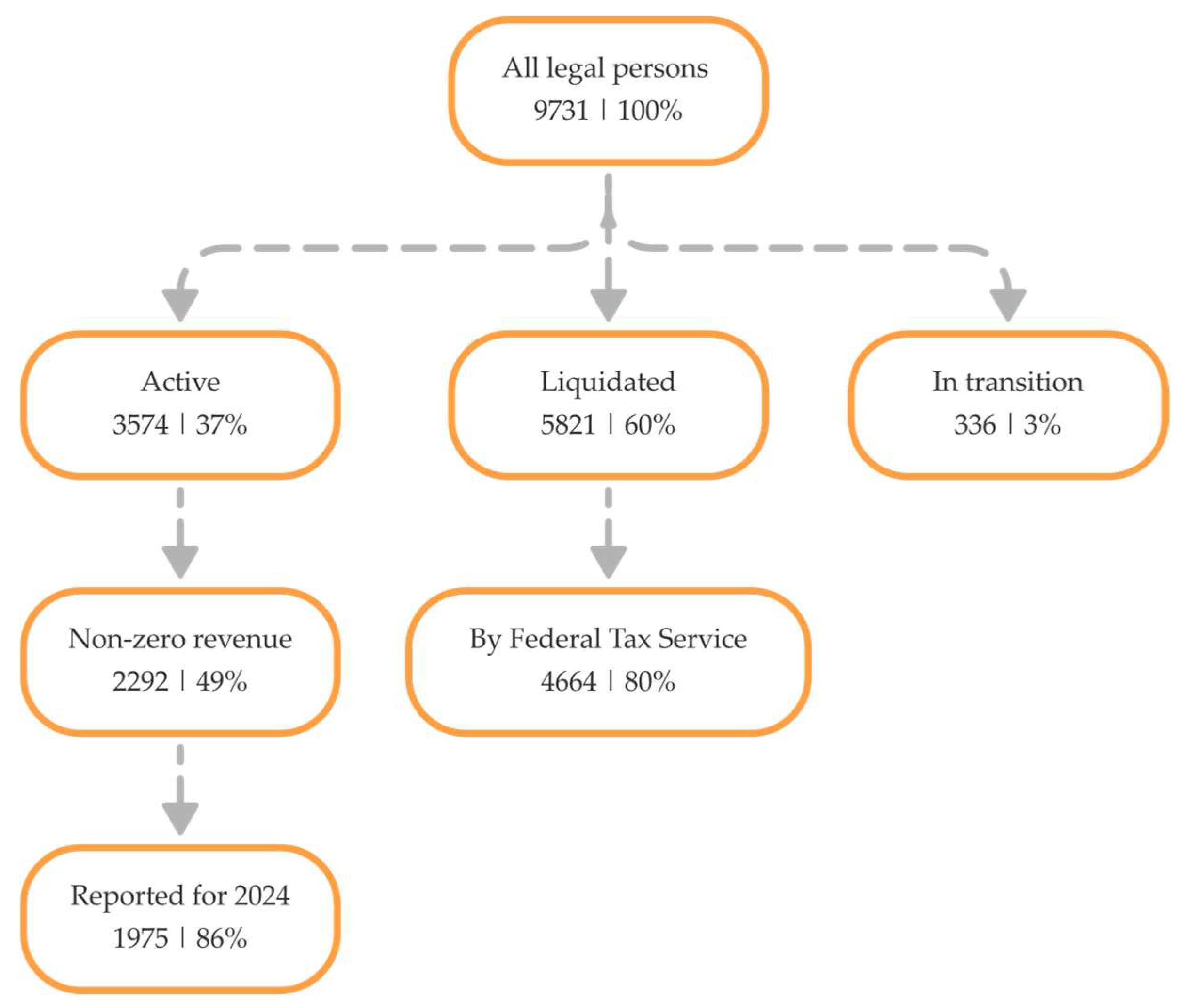
As of May 2025, the USRLP had information on 9731 legal persons engaged in logging or sawn wood production in Asian Russia. Only 37% of them were active at the time of data collection, 60% have already been liquidated and about 3% of all legal persons are in a transitional stage, which means they are undergoing processes such as enterprise concentration, de-concentration, bankruptcy, etc. The structure of the primary data and the sample structure are outlined in Appendix A. Among all the attributes, the tax reporting data and the status of the legal person deserve special attention, as they play a crucial role in further analysis.
2.2.1. Tax Reporting Data
The company’s reported data on the number of employees, revenue, and net profit is available only for the most recent year in which the legal person submitted a tax report. Only 2934 legal persons of our sample had revenue data for 2024 available. For the rest, the data either predates 2024 or is missing. To compare the financial performance of companies over time, their revenue is converted into the prices of 2024. For this purpose, we use producer price data for round coniferous timber, which is the main product of logging and sawn wood manufacturing companies in Siberia and the Far East (Appendix B). Most companies produce both roundwood and sawn wood, and it is impossible to accurately determine the proportion of revenue generated from each type of activity. Therefore, the price of roundwood seems to be optimal instrument for both activities: for harvesting enterprises, roundwood is their main output, and for sawn wood manufacturers, it represents the production cost.
2.2.2. Activity Status of the Legal Person
Activity statuses of legal persons in USRLP can be divided into three main categories:
- 1.
- ‘active’, if the legal person is not liquidated;
- 2.
- ‘in transition’, if the legal person is undergoing the changes in the distribution of production factors or a bankruptcy process, but this process has not yet been fully completed;
- 3.
- ‘liquidated’, if the legal unit is already closed.
Of particular interest are the reasons behind the legal persons’ liquidations, the analysis of which may shed light on changes in the business environment. The USRLP data allows to identify several main reasons for legal persons’ liquidations: the decision of the owner to close the legal person, changes in the distribution of production factors leading to liquidation of the current legal person (concentration or de-concentration processes), and the liquidation by decision of the Federal Tax Service of Russia.
According to Russian law, there are two causes why the Federal Tax Service may exclude a legal person from the Unified State Register of Legal Persons [67]:
- 1.
- If a legal person has not provided financial statements or conducted transactions on bank accounts for a year, the Federal Tax Service considers this legal person inactive.
- 2.
- If the tax audit finds that a legal person has provided false information. For instance, if there are more than five other legal units registered at the same address, or if the legal person is registered in a destroyed building, the Federal Tax Service will make a special record in the Unified State Register of Legal Persons indicating that the information is unreliable. If this record is valid for more than six months and the legal person has not updated its data, the legal person will be liquidated by the Federal Tax Service.
Therefore, it can be concluded that the liquidation of a legal person by the Federal Tax Service could potentially indicate that it was an abandoned company, which ceased its activities but was not officially closed by its owner. The institutional reasons for this case were discussed in Section 2.1. Another case could be a shell company, although this is not a widespread practice in the Russian timber industry. Common features of a shell company include no signs of doing business, no tax records, and a mailing address that was used by other legal units. The most obvious reasons for creating a shell company are to avoid paying taxes and to transfer money from other enterprises [68].
Consequently, the number of liquidations in particular year consists of two main components: (1) legal persons that were liquidated this year by their owners for economic reasons, and (2) legal persons that have long ceased their activities or even did not operate, but were liquidated by the Federal Tax Service in this year. The closure of a legal person of the latter type does not actually harm the economy, but only indicates the FTS’s efforts to clean up the Unified State Register of Legal Persons. This is the main reason why the number of liquidations of legal persons can greatly exceed the number of enterprise deaths in a given year. Therefore, in order to ensure that the dynamics of liquidations more accurately reflect the state of the business environment and economic trends, it is essential to consider a subset of legal persons that have not been liquidated by decision of the Federal Tax Service. However, usually all of the liquidation reasons are studied together, leading to biased estimates of the business environment dynamics [59]. The next subsection introduces our open dataset, which is the first to fill this gap in application to the logging and sawn wood producers in Asian Russia.
2.3. Creating the Final Dataset
To analyze the demography indicators, the primary data was aggregated by year. The resulting dataset consists of three samples:
- (a)
- all legal persons registered in the Unified State Register of Legal Persons (9731);
- (b)
- all legal persons registered in the USRLP, except those that have been liquidated by a decision of the Federal Tax Service of Russia (5067);
- (c)
- sample of largest enterprises that collectively generate at least 90% of the revenue in each region (837).
Selecting samples (b) and (c) from the total sample (a) creates an opportunity to analyze the dynamics of registrations and liquidations of legal persons more thoroughly. The sample (b) excludes all legal persons that were liquidated because the Federal Tax Service of Russia considered them as abandoned non-operating enterprises or shell companies. It is suggested that the liquidation of such enterprises is in fact a purge of the USRLP, does not harm the economy, and may not be related to macroeconomic shocks. Therefore, the dynamics of the liquidations in sample (b) are more likely influenced by the macroeconomic situation.
The sample (c) consists of the legal persons with the best financial performance and is intended to clean up data from the abandoned companies and other noise and allows to identify genuine trends in the Russian timber market across studied period. The analysis of this sample aims to provide a periodization of the Asian Russian timber market, considering the structural changes that have taken place. The sample (c) is formed according to the following rules:
- 1.
- Legal persons that submitted their tax report on 2024 were sorted in descending order of revenue in each region of Asian Russia. This part includes the 546 largest legal persons, which collectively generate at least 90% of the revenue in each region.
- 2.
- Legal persons that did not submit a report on 2024 for any reason, are treated separately. Their revenue is converted to 2024 prices according to the algorithm described in Section 2.2.1. After that their revenue in 2024 prices is compared with the minimum revenue of a certain region among the units selected in step 1. For each region, legal persons were selected whose revenue is higher than that minimum.
- 3.
- The resulting sample of 837 legal persons is a merger of the subsamples obtained at steps 1 and 2 and represent the enterprises with the largest revenue.
The structure of the whole dataset is provided in Table S2. Data on registrations in the USRLP is available since 1989, but in further sections the main conclusions are derived from the period between 1991 and 2024. This is because only four legal persons in the sample were registered during 1989 and 1990. Registration of new legal units intensified after the collapse of the USSR in 1991.
3. Results
3.1. The Dynamics of Liquidations
A significant turning point in Russia’s changing business landscape occurred in 2016 when the Federal Tax Service received additional powers to verify the activities of legal units. Specifically, the tax authorities were granted the right to verify the accuracy of information included in the Unified State Register of Legal Persons [69]. If the information provided turns out to be inaccurate, the legal person is required to provide new information within 30 days. Failure to do so may result in the addition of a note regarding the unreliability of the data to the USRLP, potentially leading to the liquidation of the unit. The list of reasons for refusing to register a legal person has also been expanded. For instance, a potential founder’s application may be rejected if his or her other legal person was already removed from the USRLP for unpaid debts, providing false information or failing to liquidate after a court ruling [70].
As a result, the number of legal persons registered in the Unified State Register decreased by 781 thousand in 2016 compared to 2015, and the liquidation rate increased by 3.6 times [70]. This difference is even more noticeable in the timber industry. From 1991 to 2015, only seven legal persons engaged in logging or sawn wood production were liquidated in Asian Russia. In contrast, 771 legal persons were liquidated in 2016. This confirms that most owners did not have an incentive to officially close their legal persons after ceasing economic activity, while FTS did not have the necessary powers to initiate the liquidation process until 2016. Therefore, our analysis of the liquidation dynamics will focus on the period after 2016.
The liquidation rates per 1000 units were calculated for all three samples described in Section 2.3, and their values were compared to official statistics (Figure 3). As it was mentioned above, Rosstat publishes the liquidation and registration rates by industry for the all-Russian economy without division by certain regions. Therefore, the liquidation rate for the whole country for legal persons involved in the sawn wood production is used as a baseline (r).
Figure 3.
Liquidation rates for Asian Russian legal persons engaged in logging and sawn wood manufacturing in 2016–2024, ‰. Source: authors’ calculations based on primary data [65,66] and Rosstat data [71].
Approximately 80% of the total number of liquidations can be attributed to the Federal Tax Service clearing the USRLP of inactive legal persons (see Figure A2). The calculated liquidation rates for all legal persons (a) are close to the data provided by Rosstat (r). Thus, it can be concluded that demographic trends in Siberia and the Far East do not differ significantly from other parts of Russia.
The results for the sample (b) indicate that the liquidation rate for economically active legal persons is 3 to 5 times lower than the rate for all registered legal persons (a). This finding underlines that estimates of the business environment based on the official Rosstat coefficient (r) may be unreliable and could significantly overestimate the liquidation rate of economically active units. On the contrary, the low liquidation rate among the largest enterprises (c) indicates that there is no major crisis among the leading companies in the sector. It is interesting that the indicator grew to 6‰ in 2023 for the largest firms. This increase can be explained by the intensification of enterprise concentration and de-concentration processes, which will be discussed in the next subsection.
In general, all four coefficients show a downward trend. The additional increase in liquidations in 2019 can be explained by the rise in the value-added tax rate from 18% to 20%, as well as general macroeconomic factors [59]. The timber industry was further impacted by the U.S.-China trade war, which led to a significant decrease in roundwood exports from Asian Russia to China in 2019 [72,73]. The pandemic crisis did not have a negative impact due to the growth of the global market for individual housing construction, which provoked an increase in sawn wood and roundwood prices [74,75,76]. Additional demand for roundwood has been provided by the pulp and paper industry. The active growth of home delivery services and measures to control the spread of COVID-19 have led to an increase in consumption of pulp and paper products, such as packaging and sanitary items. In conclusion, the trade sanctions on Russia since 2022 have not significantly impacted the dynamics of liquidations, since the mortality rate remains below pre-pandemic levels.
3.2. Concentrations and De-Concentrations of Enterprises
In 2016, the Federal Tax Service increased its control over companies’ activities, which led to the start of the enterprise concentration process, which facilitated the simplification of the structure of large corporate groups by reducing the number of legal persons involved. Prior to 2016, there was only one legal person on the USRLP that underwent such a process. In total, the USRLP contains 123 companies that completed their concentrations or de-concentrations. Of these, 86% have ceased operations due to the mergers or the take-overs. Among the mergers and the take-overs, 23% is accounted for by the three largest business groups of Asian Russia: Segezha Group PJSC, Ilim Group, and RFP Group. The process of asset consolidation was most pronounced in the Irkutskaya oblast’ and Khabarovskiy kray, which accounted for 36% and 27%, respectively. The Krasnoyarskiy kray accounts for only 8% of all concentration events, while the Altayskiy kray and Primorskiy kray account for 6.5% each (Figure 4).
Figure 4.
Number of legal persons in Asian Russia with principal activity in harvesting or sawn wood production involved in concentration or de-concentration events, 2016–2024. Source: authors’ calculations based on primary data [65,66].
3.3. The Dynamics of Registrations
In order to analyze the changes in the number of registrations of legal persons, the results for two samples are compared (Figure 5): all legal persons (sample a) and those that were not liquidated by the Federal Tax Service’s decision (sample b).
Figure 5.
The number of registrations (a,b) and the registration rate per 1000 of legal persons (c,d) in Asian Russia with principal activity in harvesting or sawn wood production, 1991–2024. Source: authors’ calculations based on primary data [65,66].
Figure 5a shows that a boom in the registration of legal persons began in 2004 and reached its peak in 2016. The number of registrations then decreased rapidly, by 1.5 times in 2021, and three times compared to the 2016 level by 2024. Figure 5b reveals a fundamentally different trend. The number of new registrations for these legal persons increased until 2018. The decline in 2019 and 2020 may have been caused by instability due to poor market conditions resulting from the U.S.-China trade wars and initial pandemic restrictions. The increase in 2021 can be attributed to both an increase in demand for wood products and a delay in registrations that were not done in 2020. Since 2022, the instability caused by trade restrictions and difficulties in transporting forest products has led to a decrease in the number of new legal persons. This reduction may also be partially explained by market saturation and the rising barriers to entry for new enterprises.
Since 2020, the convergence of the number of registered legal persons in Figure 5a,b suggests that, from 2004 to 2015, there were many registrations of legal persons that later were abandoned by their owners or had patterns of shell companies. After 2016, the registration number of such legal persons decreased significantly, indicating more thorough monitoring by the Federal Tax Service. However, it should be noted that the average age of legal persons that are liquidated by the Federal Tax Service is 7–8 years. This may also lead to an overestimation of the number of new registrations shown in Figure 5b. Thus, the main reasons for the decrease in the number of registrations include:
- 1.
- The intensification of inspection activities by the Federal Tax Service has both reduced incentives for the creation of shell companies and increased the likelihood of rejections if the founder has provided false information in the past.
- 2.
- The saturation of the logging and sawn wood manufacturing market during the process of developing a market economy makes it more difficult for new actors to enter.
- 3.
- Institutional regulations for obtaining forest land for lease require a long-term commitment to the legal unit under which the forest area is registered. This is particularly true for participants in the key program for the development of the Russian forest industry: Priority Investment Projects (PIPs).
- 4.
- Trends in the consolidation of assets of the largest companies in the late 2010s and early 2020s, including Segezha Group PJSC, Ilim Group, and RFP Group. The history of mergers and take-overs demonstrates a steady trend toward reducing the number of legal units within each business group.
- 5.
- The crisis phenomena in 2019–2020 and 2022–2024, which were caused by trade restrictions, unstable demand for timber and changes in logistics.
Similar to the rate of liquidations, the registration rate of legal entities has been consistently decreasing since 2016 (Figure 5c,d). This trend is caused by a decrease in the number of new registrations (the numerator in the registration rate coefficient), which has not been offset by the removal of a large number of legal persons from the Unified State Register of Legal Persons (the denominator). Figure 5d shows that the registration rate has remained fairly stable since 2009 for legal persons that were not excluded by the Federal Tax Service. This also indicates a gradual process of market stabilization.
3.4. Distribution of Registrations and Liquidations by Revenue Size and Geographic Location
According to Russian law on small and medium enterprises (SME) [77], businesses can be classified by size based on two criteria: annual revenue and the number of employees. The data on the number of employees is of poor quality, so revenue is used as the only classification criterion (Table 2).
Table 2.
Breakdown of Asian Russian legal persons engaged in timber harvesting and sawn wood production, by revenue size.
Logging in Russia is a unique example of a natural resource industry with a low level of market concentration. Industries related to natural resources are typically oligopolies. However, the logging industry is highly competitive, with numerous firms of various sizes on the market. The five largest logging companies account for only about 13% of the total harvests in Russia [78]. Revenue concentration is more pronounced, but even so, 24 large companies still account for only about 47% of total revenue (Table 2). In the woodworking and paper industry with high added value production, the concentration is higher. Specifically, almost all paper and cardboard in Russia is produced at several large mills located in the Northwestern regions, while in Asian Russia there are only a few enterprises left [79].
Geographically, the main harvesting and wood processing facilities in Asian Russia are concentrated in the Southern part of Siberia and the Far East [80,81]. A significant portion of Asian Russia’s territory is in the subarctic and Arctic regions. These areas are underdeveloped and difficult to access by land [82]. Thus, the Respublika Sakha (Yakutiya), located in the north of the Russian Far East, has a vast forest area of approximately 154 million hectares. Most of these forests are inaccessible for economic activities. In terms of timber stock, the Krasnoyarskiy kray (11.5 billion cubic meters) and Irkutskaya oblast’ (8.5 billion cubic meters) are undisputed leaders. As a consequence, these regions have the largest concentration of logging and woodworking companies in Asian Russia (Figure 6).
Figure 6.
The number of legal persons engaged in harvesting and sawn wood production in Asian Russia in 2024 (units), broken down by size. Source: authors’ calculations based on primary data [65,66].
There were no operating legal persons in two regions: the Magadanskaya oblast’ and the Chukotskiy avtonomnyy okrug. These regions are sparsely populated and difficult to reach. Large and medium-sized enterprises in Asian Russia are concentrated in a few regions. In Siberia, these regions include the Irkutskaya oblast’, the Krasnoyarskiy kray, the Altayskiy kray, the Tomskaya oblast’, and the Novosibirskaya oblast’. In the Far East, there are two coastal regions with the most developed port infrastructure in Asian Russia: the Khabarovskiy kray and the Primorskiy kray [83], accompanied by the Amurskaya oblast’, which also borders China.
Among the legal persons that were not liquidated by the decision of the Federal Tax Service (sample b), the geographic distribution of demographic indicators remains fairly stable over time. As expected, regions with the largest timber stock continue to lead both in terms of registrations and liquidations (Figure 7).
Figure 7.
Number of registrations and liquidations of legal persons with principal activity in harvesting or sawn wood production distributed by regions of Asian Russia in 2016 and 2024, units. Source: authors’ calculations based on primary data [65,66].
In most parts of Asian Russia, there has been a gradual decrease in both the number of registrations and liquidations of legal persons. This trend is most evident in regions with a well-developed timber industry and a large number of companies, such as Irkutskaya oblast’, Krasnoyarskiy kray, Khabarovskiy kray, Primorskiy kray, and Tomskaya oblast’. For some regions with a small number of companies, such as the Respublika Sakha (Yakutiya), the Respublika Tyva, and the Kamchatskiy kray, the opposite trend is observed. However, this does not have a significant impact on the economy of these regions, as new registrations and liquidations mainly occur among micro-enterprises with small logging volumes.
An interesting finding is the 2.5-fold decrease in the number of new registrations in the Irkutskaya oblast’, from 2016 to 2024. However, in the Krasnoyarskiy kray, which has a similar level of timber industry development, this value has remained relatively stable. This may be due to a more active policy of the regional authorities towards controlling microenterprises that lease forest plots. For instance, due to violations of logging regulations and delays in paying fines, between 2021 and 2022, leases for forest plots in the Irkutsk region were canceled for 10% of companies each year [84]. Consequently, there is less incentive for new legal persons to register. Because of strict control over land lease terms, small businesses may be more inclined to register as legal persons with a different primary activity, such as providing logging-related services. These legal persons were not included in our sample, which may have influenced the results for the Irkutskaya oblast’. Another possible explanation is the consolidation of assets among legal persons engaged in logging. As mentioned above, the Irkutskaya oblast’ accounted for more than a third of all mergers and take-overs.
As expected, the demographic indicators of legal persons vary depending on their revenue. From 2005 to 2019, the annual number of registered legal persons that can be considered as microenterprises ranged from 150 to 200. However, this number decreased significantly in 2023 and 2024, ranging from 70 to 90 for the aforementioned reasons. The number of new registered legal persons that can be considered as small businesses is about 10 times lower. The registration or liquidation of legal persons representing large and medium-sized businesses is a rare occurrence.
3.5. The Periodization of the Timber Market from 1991 to 2024
The periodization of the market development of logging and sawn wood production is most evident in a sample (c), which unites the 837 legal persons representing the enterprises with the largest revenue (Figure 8).
Figure 8.
The number of registrations and liquidations among the 837 legal persons representing the enterprises that accumulate 90% of revenue in each region of Asian Russia, 1991–2024. Source: authors’ calculations based on primary data [65,66].
Following the collapse of the Soviet Union, the Russian economy entered a period of crisis. The struggle to acquire large assets, the difficulty of finding new suppliers and markets, the low purchasing power of the population, and the high inflation rate led to a threefold decrease in timber harvest and sawn timber production between 1990 and 1995 [85]. The economy began to demonstrate signs of recovery in the early 2000s, which subsequently influenced the demographic patterns for legal persons.
Rapid growth in the number of large enterprises in Asian Russia started in the mid-2000s. In addition to macroeconomic factors, there are also institutional ones emerging. In 2007, the government of the Russian Federation launched a timber industry development program of Priority Investment Projects. In exchange for their commitment to modernize or establish new facilities that produce wood products with high added value, companies were granted forest plots on preferential lease terms [86]. In 2007, the minimum amount of capital investment for the company was 300 million rubles, which was equivalent to $11.7 million. This amount increased to 2 billion rubles in 2019, which was equal to $30.9 million. The criteria for participation in the program were such that only medium and large businesses are eligible. Consequently, over a period of approximately 15 years, from 2006 to 2021, there has been a relatively steady increase in the number of newly registered legal persons, with an average annual growth rate of 35 to 50 units.
A substantial decrease in the number of new legal persons is only observed in 2020, due to the uncertainty caused by the economic situation during the COVID-19 pandemic. From 2021 to 2023, the number of registrations decreased significantly, with an average of 6–18 units per year. This phenomenon can be attributed to several factors.
Firstly, the hypothesis of market saturation seems plausible. This is because the best forest areas with infrastructure have already been divided between existing economic agents. Developing new forest plots would necessitate a substantial investment in the construction of forest roads, greatly reducing the number of potential new market participants. Secondly, the increased scrutiny of the activities of legal persons by the Federal Tax Service has led to the removal of enterprises that were inactive and has discouraged the entry of new shell companies. Additionally, the largest corporate groups have begun the process of consolidating their assets, bringing together many small legal persons. Finally, since 2022, the macroeconomic conditions for timber enterprises have worsened. The Russian government imposed a ban on the export of untreated wood, and international sanctions were imposed on Russia, affecting logistics and sales markets. Consequently, commencing in 2023, the Central Bank of the Russian Federation initiated a gradual increase in the interest rate in order to combat inflation. This increase reached a maximum of 21% in October 2024. Due to these events, companies adopted a wait-and-see approach and reduced their investment pace, mainly completing previously started projects [87].
4. Discussion
One of the main challenges in studying the Russian forest industry is the lack of open data at the micro-level. This paper contributes to filling this gap by providing a dataset based on primary reporting data from legal persons engaged in the logging and sawn wood manufacturing industries in Asian Russia. While previous studies on Russian forestry mostly relied on macro data [88,89,90,91], this analysis is based on detailed micro-level statistics, which allowed to gain a more accurate understanding of the causes and effects of changes in timber product markets in Siberia and the Far East over the past 35 years.
Following [92,93,94] we study the response of the Russian forest industry to macroeconomic events. The existing academic literature on the Russian forestry contains research on the impact of various factors on the industry, such as customs tariffs [95,96,97], regional heterogeneity [79,98,99,100], institutional changes [101,102] or international sanctions [6,42,103]. However, all these studies were focused on a specific current state of the Russian timber market. On the contrary, this paper covers a 35-year period to examine the dynamics of business demographic indicators against the background of structural shifts in the Russian timber market. This allowed us to significantly supplement and expand on the results obtained by other researchers.
Section 4 demonstrates the potential of using the proposed dataset to analyze demographic trends among legal persons. Due to the limitations of the primary data, it was not possible to choose enterprises as statistical units, as is common in business demography research [24,28,44,104]. Based on the primary data, an approach was developed to obtain samples (b) and (c), which has opened up the opportunity of conducting a pioneering assessment of the business environment dynamics in Russian timber industry. A comparative analysis has shown that our estimates are more plausible than the indicators of liquidations and registrations of legal persons published by Rosstat, which are the basis for most academic research on Russian firms [55,57,58,105]. Our findings are consistent with [59] and indicate that research based on Rosstat indicators may lead to biased results due to the inability to distinguish between different reasons for liquidations. This highlights the paramount importance for researchers to work with data at the micro-level.
Most existing studies on Russian firms identify the concept of business demography with the demography of legal units due to their similar names and indicators published by Rosstat, which lead to potentially biased conclusions. This paper emphasizes that these are fundamentally dissimilar approaches, as they focus on different statistical units and reflect demographic events in different ways. When analyzing the demography of legal units, it is essential to take into account the delay in the liquidations of these units from the register compared to the actual death of enterprises, as well as the structural shift that occurred in 2016 due to changes in the powers of the Federal Tax Service of Russia. However, our findings suggest that in the absence of other available sources of data at the micro-level, the registrations and liquidations of legal persons can also be utilized to evaluate the dynamics of the business environment. Despite the challenging data acquisition, the proposed approach could potentially be useful for researchers analyzing other sectors of the Russian economy.
5. Conclusions
This paper explores the changes in the population of legal persons in Asian Russia between 1991 and 2024, considering the size of the companies, their geographical location, and external effects. For the first time, data has been collected on 9731 legal persons involved in logging and sawn wood production. Analysis of the information from the Unified State Register of Legal Persons shows that only 24% of them are active and generate non-zero revenue as of the last reporting date. A sampling method has been developed and tested, which allows to make conclusions about demographic trends in Asian Russia from 1991 to 2024 using a relatively small sample of 837 legal persons. This sample represents more than 90% of the total revenue in each region of Asian Russia. The results can be summarized as follows:
- 1.
- The timber industry is a very competitive market in Russia. The top 24 companies account for 47% of total revenue, while medium-sized businesses account for only 13%. Small and microenterprises account for approximately 40% of the market. This distinguishes logging and sawn wood manufacturing from both other natural resource extraction and high value-added pulp and paper production. Demographic indicators vary significantly depending on the size of the revenue. Most registrations and liquidations are accounted for by legal persons with revenues below 120 million rubles.
- 2.
- The geographical distribution of economic activity in Asian Russia aligns with regions that possess substantial timber stock and are in close proximity to sales markets. This is evident in the presence numerous large and medium-sized businesses operating in regions such as Krasnoyarskiy kray, Irkutskaya oblast’, Tomskaya oblast’, Altayskiy kray, Khabarovskiy kray, Primorskiy kray, and Amurskaya oblast’. A notable finding was the more significant decrease in the number of registered legal persons in the Irkutskaya oblast’ from 2016 to 2024, in comparison to the Krasnoyarskiy kray, which exhibits comparable harvesting volumes. This is likely due to several factors, including consolidation of assets by major corporate groups, a more active policy by regional authorities to control microenterprises, and the enterprise concentrations. The largest business groups in the Irkutskaya oblast’, Khabarovskiy kray, and Krasnoyarskiy kray such as Ilim Group, RFP Group, and Segezha Group play a major role in this trend.
- 3.
- Based on a long period of observation, the stages of development in the logging and sawn wood production market have been identified. The 1990s were marked by a relatively low number of newly registered legal persons. State-owned assets were gradually being transferred to private ownership, but difficult economic conditions in the country did not provide incentives for production growth. In the 2000s, the Russian economy began to recover, and the number of registrations started to grow rapidly in the middle of the decade. This growth was further encouraged by the state program of Priority Investment Projects in the field of forest development, which started in 2007 and is ongoing. The economic crisis of 2014–2015 had minimal impact on demography indicators of legal persons involved in timber harvesting and processing, as the devaluation of the ruble against the dollar actually increased their foreign exchange earnings. The high registration rate of legal persons persisted for approximately a decade, until 2016.
- 4.
- The most significant structural shift in the demographic landscape of legal persons in Russia occurred in 2016, when the Federal Tax Service gained new powers to regulate the registrations and liquidations in USRLP. This led to a widespread liquidation of inactive legal persons by the Federal Tax Service, more stringent registration requirements for unscrupulous founders, and the consolidation of numerous legal persons within corporate groups.
- 5.
- The crisis events of the past seven years, including the U.S.–China trade conflict, the pandemic of 2020/21, and international sanctions in 2022, have had a significant impact on the decrease in new registrations of legal persons, rather than an increase in liquidations. The calculated values of the liquidation rate for a sample of 837 firms indicate that larger enterprises are more resistant to these crisis phenomena, while small and microenterprises face greater challenges. During these crises, timber producers have reduced investments in anticipation of an improvement in economic conditions, a strategy that is still being employed today. Another contributing factor to the decline in registered legal persons may be market saturation of in the early 2020s. Key forest areas have already been claimed by existing enterprises, making it difficult for new large and mid-sized economic actors to enter the market. Taken together, all these factors lead to the fact that the number of registrations of legal persons is at an all-time low over the past 25 years. However, the simultaneous sharp decrease in the number of liquidations indicates the stabilization of the timber market.
Further research can be developed in several directions. First, the obtained dataset can be combined with data on revenue, net profit and employee numbers to study financial performance trends in the development of forestry businesses in Asian Russia. Second, the proposed approach can be used to create an additional dataset on companies in European Russia. This task will require significant resources, as the number of such legal persons is an order of magnitude greater. Third, the database can be expanded to include legal persons from sectors of the forestry economy with higher added value (e.g., panel and pulp and paper production). Some of these companies are integrated with the primary forestry sector (logging and sawmilling), but a comprehensive study of all production chains is a subject for a separate study.
Supplementary Materials
The following supporting information can be downloaded at: https://www.mdpi.com/article/10.3390/f16121793/s1, Table S1: Dataset on legal persons engaged in timber harvesting and sawn wood manufacturing in Asian Russia, 1991–2024; Table S2: Data structure.
Author Contributions
Conceptualization, A.I.P.; methodology, A.I.P. and R.V.G.; software, R.V.G.; formal analysis, R.V.G.; writing—original draft preparation, R.V.G.; writing—review and editing, R.V.G. and A.I.P.; visualization, R.V.G.; supervision, A.I.P.; project administration, A.I.P.; funding acquisition, A.I.P. All authors have read and agreed to the published version of the manuscript.
Funding
The research was supported by the grant of the Russian Science Foundation, project no. 25-18-20080, https://rscf.ru/en/project/25-18-20080/ (accessed on 26 November 2025), grant of the Krasnoyarsk Regional Science Foundation.
Data Availability Statement
The original contributions presented in this study are included in the article and Supplementary Materials. Further inquiries can be directed to the corresponding author.
Acknowledgments
The authors are grateful to Daniil Ziyazov for his valuable advice on data visualization.
Conflicts of Interest
The authors declare no conflicts of interest.
Abbreviations
The following abbreviations are used in this manuscript:
| FTS | Federal Tax Service of Russia |
| OKVED2 | Russian National Classifier of Economic Activities |
| Rosstat | Federal State Statistics Service of Russia |
| Rosleskhoz | Federal Forestry Agency of Russia |
| SBR | Statistical business register |
| SME | Small and medium enterprises |
| USRLP | Unified State Register of Legal Persons |
Appendix A
Figure A1.
Structure of the primary data on legal persons engaged in logging and sawn wood manufacturing in Asian Russia. Source: authors’ visualization based on primary data [65,66].
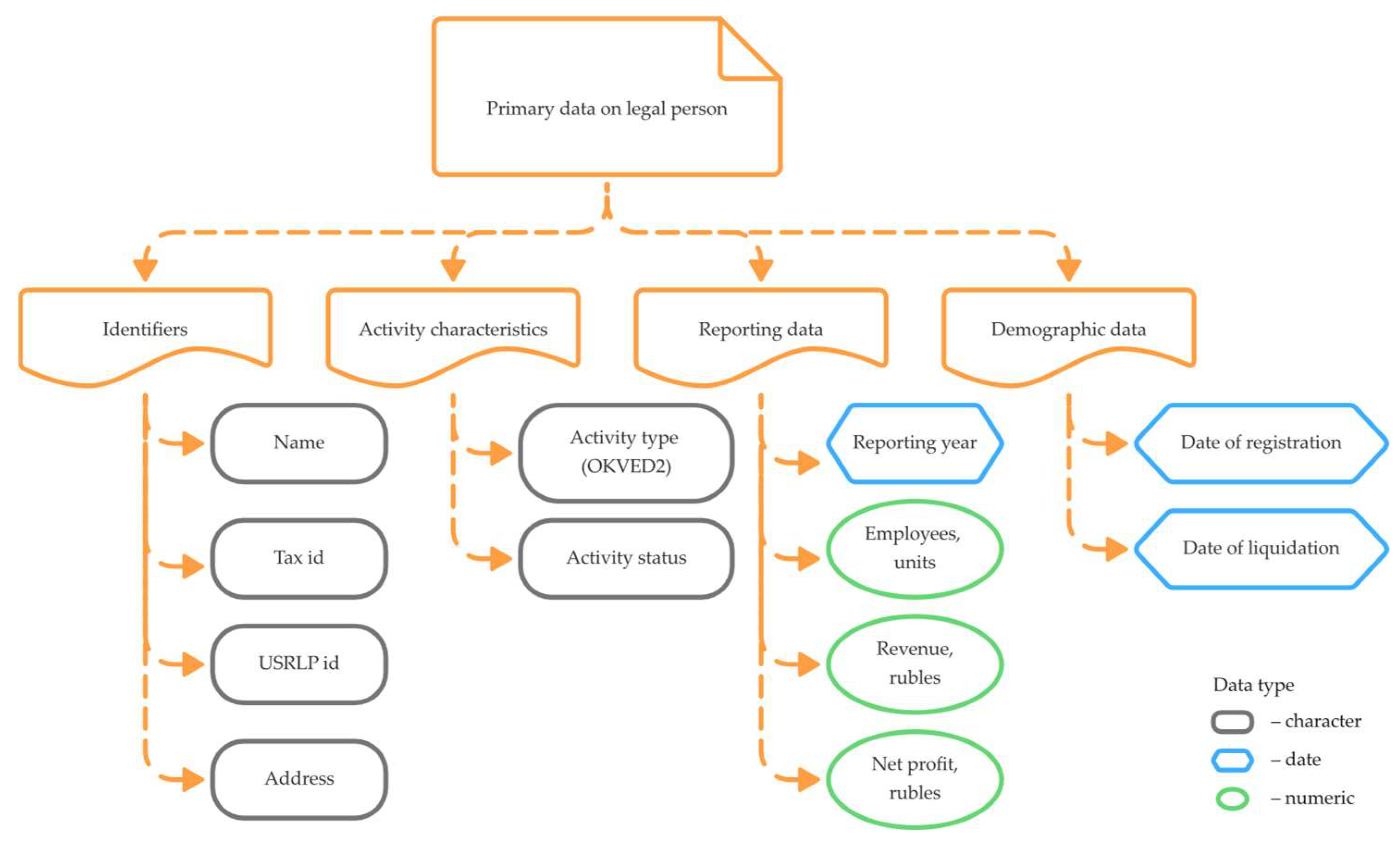
Figure A2.
Structure of USRLP data on Asian Russian legal persons engaged in logging and sawn wood manufacturing. Source: authors’ calculations based on primary data [65,66].
Appendix B
Table A1.
Producer prices for round coniferous timber in Russia, 2000–2024.
References
- Lukina, N.V. Global Challenges, Forests and Earth Remote Sensing. Zemlâ Vselennaâ 2020, 6, 18–26. [Google Scholar]
- Romanovskaya, A.; Korotkov, V. Balance of Anthropogenic and Natural Greenhouse Gas Fluxes of All Inland Ecosystems of the Russian Federation and the Contribution of Sequestration in Forests. Forests 2024, 15, 707. [Google Scholar] [CrossRef] [Scilit]
- Gustafson, E.J.; Lucash, M.S.; Shvidenko, A.Z.; Sturtevant, B.R.; Schepaschenko, D.; Mast, C.; Williams, N. Climate Change Threatens the Sustainability of Current Timber Harvesting Practices across a Latitudinal Gradient in Siberia. Eur. J. For. Res. 2025, 144, 635–653. [Google Scholar] [CrossRef] [Scilit]
- Schepaschenko, D.; Mukhortova, L.; Shvidenko, A. Estimation of Impact of Disturbances on Soil Respiration in Forest Ecosystems of Russia. Forests 2025, 16, 925. [Google Scholar] [CrossRef] [Scilit]
- Shvarts, E.A.; Ptichnikov, A.V.; Romanovskaya, A.A.; Korotkov, V.N.; Baybar, A.S. The Low-Carbon Development Strategy of Russia Until 2050 and the Role of Forests in Its Implementation. Sustainability 2025, 17, 6917. [Google Scholar] [CrossRef] [Scilit]
- Shvarts, E.A.; Karpachevskiy, M.L.; Shmatkov, N.M.; Baybar, A.S. Reforming Forest Policies and Management in Russia: Problems and Challenges. Forests 2023, 14, 1524. [Google Scholar] [CrossRef] [Scilit]
- Naumov, V.; Angelstam, P.; Elbakidze, M. Barriers and Bridges for Intensified Wood Production in Russia: Insights from the Environmental History of a Regional Logging Frontier. For. Policy Econ. 2016, 66, 1–10. [Google Scholar] [CrossRef] [Scilit]
- Chang, W.-Y.; Gaston, C. A Trade Flow Analysis of the Global Softwood Log Market: Implications of Russian Log Export Tax Reduction and New Zealand Log Production Restriction. Forestry 2016, 89, 20–35. [Google Scholar] [CrossRef] [Scilit]
- Dieter, M.; Englert, H. Competitiveness in the Global Forest Industry Sector: An Empirical Study with Special Emphasis on Germany. Eur. J. For. Res. 2007, 126, 401–412. [Google Scholar] [CrossRef] [Scilit]
- Antonova, N.E. Timber House Building as a Driver of Demand for Timber Products in the Far East. EKO 2025, 55, 71–88. [Google Scholar] [CrossRef] [Scilit]
- Gordeev, R. Comparative Advantages of Russian Forest Products on the Global Market. For. Policy Econ. 2020, 119, 102286. [Google Scholar] [CrossRef] [Scilit]
- Putin Instructs Government to Stop Uncontrolled Export of Unprocessed Timber. Available online: https://tass.com/economy/1206747 (accessed on 11 August 2025).
- Council Regulation (EU) 2022/576 of 8 April 2022 Amending Regulation (EU) No 833/2014 Concerning Restrictive Measures in View of Russia’s Actions Destabilising the Situation in Ukraine; European Union: Brussels, Belgium, 2022; Volume 111.
- Specially Designated Nationals and Blocked Persons List; US Office of Foreign Assets Control: Washington, DC, USA, 2022.
- Rosstat. The Total Timber Stock by Regions of Russia. Available from the Russian Network. Available online: https://www.fedstat.ru/indicator/38195 (accessed on 25 October 2025).
- Federal Forestry Agency (Rosleskhoz) Logging Volumes. Available from the Russian Network. Available online: https://www.fedstat.ru/indicator/37848 (accessed on 15 November 2025).
- Crowley, R.M. Stepping onto a Moving Train: The Collision of Illegal Logging, Forest. Pac. Rim Law Policy J. Assoc. 2005, 14, 425–453. [Google Scholar]
- Groisman, P.Y.; Gutman, G. (Eds.) Regional Environmental Changes in Siberia and Their Global Consequences; Springer Environmental Science and Engineering; Springer: Dordrecht, The Netherlands, 2013; ISBN 978-94-007-4568-1. [Google Scholar]
- Izvestiya Illegal Logging Has Decreased by Almost 30% in Russia since the Beginning of 2025.%. Available online: https://en.iz.ru/en/1987575/2025-11-10/illegal-logging-has-decreased-almost-30-russia-beginning-2025 (accessed on 15 November 2025).
- TASS Space-Based Monitoring of Illegal Logging in Russia Will Cover 40 Regions in 2025. Available online: https://tass.com/economy/1966017 (accessed on 15 November 2025).
- Eurostat-OECD. Eurostat-OECD Manual on Business Demography Statistics; OECD Publishing: Paris, France, 2008; p. 103. [Google Scholar]
- Lee, Y.; Mukoyama, T. Entry and Exit of Manufacturing Plants over the Business Cycle. Eur. Econ. Rev. 2015, 77, 20–27. [Google Scholar] [CrossRef] [Scilit]
- Daepp, M.I.G.; Hamilton, M.J.; West, G.B.; Bettencourt, L.M.A. The Mortality of Companies. J. R. Soc. Interface 2015, 12, 20150120. [Google Scholar] [CrossRef] [Scilit] [PubMed]
- Tian, C. Firm-Level Entry and Exit Dynamics over the Business Cycles. Eur. Econ. Rev. 2018, 102, 298–326. [Google Scholar] [CrossRef] [Scilit]
- Decker, R.A.; Haltiwanger, J.; Jarmin, R.S.; Miranda, J. Changing Business Dynamism and Productivity: Shocks versus Responsiveness. Am. Econ. Rev. 2020, 110, 3952–3990. [Google Scholar] [CrossRef] [Scilit]
- Ahmad, N. A Proposed Framework for Business Demography Statistics. In Measuring Entrepreneurship: Building a Statistical System; Congregado, E., Ed.; Springer: Boston, MA, USA, 2008; pp. 113–174. ISBN 978-0-387-72288-7. [Google Scholar]
- Dinlersoz, E.; Dunne, T.; Haltiwanger, J.; Penciakova, V. Business Formation: A Tale of Two Recessions. AEA Pap. Proc. 2021, 111, 253–257. [Google Scholar] [CrossRef] [Scilit]
- Cowling, M.; Liu, W.; Zhang, N. Did Firm Age, Experience, and Access to Finance Count? SME Performance after the Global Financial Crisis. J. Evol. Econ. 2018, 28, 77–100. [Google Scholar] [CrossRef] [Scilit]
- Crane, L.D.; Decker, R.A.; Flaaen, A.; Hamins-Puertolas, A.; Kurz, C. Business Exit during the COVID-19 Pandemic: Non-Traditional Measures in Historical Context. J. Macroecon. 2022, 72, 103419. [Google Scholar] [CrossRef] [Scilit]
- Zhou, N.; Sun, R. Coping with the Storm: The Role of Fintech in SME Survival. Int. Rev. Financ. Anal. 2024, 93, 103157. [Google Scholar] [CrossRef] [Scilit]
- Fairlie, R.; Fossen, F.M.; Johnsen, R.; Droboniku, G. Were Small Businesses More Likely to Permanently Close in the Pandemic? Small Bus. Econ. 2023, 60, 1613–1629. [Google Scholar] [CrossRef] [Scilit]
- Eurostat. Business Demography Statistics. Available online: https://ec.europa.eu/eurostat/statistics-explained/index.php?title=Business_demography_statistics (accessed on 1 October 2025).
- Angelstam, P.; Elbakidze, M.; Axelsson, R.; Khoroshev, A.; Pedroli, B.; Tysiachniouk, M.; Zabubenin, E. Model Forests in Russia as Landscape Approach: Demonstration Projects or Initiatives for Learning towards Sustainable Forest Management? For. Policy Econ. 2019, 101, 96–110. [Google Scholar] [CrossRef] [Scilit]
- Tysiachniouk, M.S.; McDermott, C.L.; Kulyasova, A.A.; Teitelbaum, S.; Elbakidze, M. The Politics of Scale in Global Governance: Do More Stringent International Forest Certification Standards Protect Local Rights in Russia? For. Policy Econ. 2021, 125, 102407. [Google Scholar] [CrossRef] [Scilit]
- Matilainen, A.-M. Forest Companies, Corporate Social Responsibility, and Company Stakeholders in the Russian Forest Sector. For. Policy Econ. 2013, 31, 44–49. [Google Scholar] [CrossRef] [Scilit]
- Trishkin, M.; Lopatin, E.; Karjalainen, T. Exploratory Assessment of a Company’s Due Diligence System against the EU Timber Regulation: A Case Study from Northwestern Russia. For. Trees Livelihoods 2015, 6, 1380–1396. [Google Scholar] [CrossRef] [Scilit]
- Trishkin, M.; Karjalainen, T.; Kangas, J. An Analysis of the Non-Conformities of Certified Companies Operating in Northwestern Russia. Forests 2019, 10, 1061. [Google Scholar] [CrossRef] [Scilit]
- FSC International. FAQs on the Current Situation in Russia and Belarus; FSC International: Bonn, Germany, 2022. [Google Scholar]
- Senko, S.; Pykäläinen, J. Exploring the Views of Forest Industry Companies on the Long-Term Forestry Development in Russia: A Case Study in Republic of Karelia. For. Policy Econ. 2020, 120, 102311. [Google Scholar] [CrossRef] [Scilit]
- Gordeev, R.V.; Pyzhev, A.I. Social and Economic Importance of Forest Companies in Asian Russia: Evidence from Corporate Financial Reporting. Forests 2022, 13, 2151. [Google Scholar] [CrossRef] [Scilit]
- HeadHunter. The Labor Market in the Forestry Industry by the End of 2023. Available online: https://hh.ru/article/32416 (accessed on 24 July 2025).
- Gordeev, R.V.; Pyzhev, A.I. Impact of Trade Restrictions on the Russian Forest Industry: Evidence from Siberian Timber Producers. Forests 2023, 14, 2452. [Google Scholar] [CrossRef] [Scilit]
- The Official Statistical Methodology for the Formation of Business Demography Indicators. Approved by Rosstat Order No. 541. 29 August 2014. Available online: https://rosstat.gov.ru/storage/mediabank/metodika_bizn-dem.pdf (accessed on 10 October 2025).
- United Nations. Guidelines on the Use of Statistical Business Registers for Business Demography and Entrepreneurship Statistics; United Nations: New York, NY, USA, 2019; 160p. [Google Scholar] [CrossRef] [Scilit]
- UNECE. Guidelines on Statistical Business Registers; United Nations: New York, NY, USA; Geneva, Switzerland, 2015; Available online: https://unece.org/statistics/publications/guidelines-statistical-business-registers (accessed on 13 November 2025).
- Rosstat. Institutional Transformations in the Economy. Available online: https://rosstat.gov.ru/statistics/instituteconomics (accessed on 10 October 2025).
- Karelina, M.G.; Mkhitarian, V.S. Statistical Study of Mergers and Acquisitions of Russian Business Entities and Assessment of Their Integration Activity. Vopr. Stat. 2018, 25, 15–24. [Google Scholar]
- Obraztsova, O.; Popovskaya, E. Microdata from Sample Surveys of Population as Concerns Development of a Business-Demography in Russia. Vopr. Stat. 2012, 12, 8–16. [Google Scholar]
- Aidis, R.; Adachi, Y. Russia: Firm Entry and Survival Barriers. Econ. Syst. 2007, 31, 391–411. [Google Scholar] [CrossRef] [Scilit]
- Sibirskaya, E.V.; Oveshnikova, L.V.; Makhova, O.A. Statistical Analysis of Entrepreneurial Activity. Vopr. Stat. 2018, 25, 47–60. [Google Scholar]
- Kuznetsov, B.V.; Golikova, V.V. Russian Manufacturing Executives on Sanctions Restrictions and Vulnerability to Them. EKO 2023, 53, 33–51. [Google Scholar] [CrossRef] [Scilit]
- Simachev, Y.V.; Yakovlev, A.A.; Golikova, V.V.; Gorodnyi, N.A.; Kuznetsov, B.V.; Kuzyk, M.G.; Fedyunina, A.A. Russian Industrial Companies under the “Second Wave” of Sanctions: Response Strategies. Vopr. Ekon. 2023, 12, 5–30. [Google Scholar] [CrossRef] [Scilit]
- Sprenger, C. Privatization and Survival: Evidence from a Russian Firm Survey. Econ. Ann. 2014, 59, 43–60. [Google Scholar] [CrossRef] [Scilit]
- Obraztsova, O.; Chepurenko, A. Sme Policy in the Russian Federation: Renewal After the Pandemic? Public Adm. Issues 2020, 2, 71–95. [Google Scholar] [CrossRef] [Scilit]
- Pinkovetskaia, I.; Kryukova, L.; Liubovtseva, E. Birth and Death Enterprises in Russia: Sectorial and Regional Characteristics. Rev. Espac. 2020, 41, 26. [Google Scholar]
- Ivanova, A.I.; Kravchenko, N.A. The Impact of Regional Conditions on the Business Demographics of Russian IT Companies. Vopr. Ekon. 2022, 5, 79–98. [Google Scholar] [CrossRef] [Scilit]
- Obraztsova, O.; Chepurenko, A. Entrepreneurial Activity in Russia and Its Cross-Regional Differences. J. New Econ. Assoc. 2020, 46, 198–210. [Google Scholar] [CrossRef] [Scilit]
- Iwasaki, I.; Maurel, M.; Meunier, B. Firm Entry and Exit during a Crisis Period: Evidence from Russian Regions. Russ. J. Econ. 2016, 2, 162–191. [Google Scholar] [CrossRef] [Scilit]
- Podshivalova, M.V.; Vaisman, E.D.; Podshivalov, D.V. Firm Demography in Russian Industry in the Context of Small Business Specifics: Is There a Silver Lining? Vopr. Ekon. 2025, 2, 19–38. [Google Scholar] [CrossRef] [Scilit]
- Wickham, H. Easily Install and Load the Tidyverse. Available online: https://tidyverse.tidyverse.org/ (accessed on 2 October 2025).
- R Core Team. R: A Language and Environment for Statistical Computing. Available online: https://www.r-project.org/ (accessed on 23 September 2021).
- FigJam: The Online Collaborative Whiteboard for Teams. Available online: https://www.figma.com/figjam/ (accessed on 2 October 2025).
- Pedersen, T.L. RStudio Ggraph: An Implementation of Grammar of Graphics for Graphs and Networks. CRAN. 2024. Available online: https://cran.r-project.org/web/packages/ggraph/refman/ggraph.html (accessed on 26 November 2025).
- Pebesma, E.; Bivand, R.; Racine, E.; Sumner, M.; Cook, I.; Keitt, T.; Lovelace, R.; Wickham, H.; Ooms, J.; Müller, K.; et al. Sf: Simple Features for R. CRAN. 2025. Available online: https://cran.r-project.org/web/packages/sf/index.html (accessed on 26 November 2025).
- Transparent Business. Available online: https://pb.nalog.ru/index.html (accessed on 3 November 2023).
- Kontur. Focus Database. Available online: https://focus.kontur.ru/ (accessed on 3 November 2023).
- Federal Law No. 129-FZ of August 8, 2001 “On State Registration of Legal Entities and Individual Entrepreneurs”. Available online: https://www.consultant.ru/document/cons_doc_LAW_32881/0017a6361857fb364a367648cedcb5946ce49bf1/#dst100348 (accessed on 11 October 2025).
- Findley, M.G.; Nielson, D.L.; Sharman, J.C. Global Shell Games: Experiments in Transnational Relations, Crime, and Terrorism; Cambridge Studies in International Relations; Cambridge University Press: Cambridge, UK, 2014; ISBN 978-1-107-04314-5. [Google Scholar]
- Federal Law “On Amendments to Certain Legislative Acts of the Russian Federation in Terms of Ensuring the Reliability of Information Provided During State Registration of Legal Entities and Individual Entrepreneurs” of 30.03.2015 No. 67-FZ. Available online: https://www.consultant.ru/document/cons_doc_LAW_177213/ (accessed on 9 August 2025).
- Bazanova, E. The Fight Against Phony Companies Resulted in a General Cleaning of the Unified State Register of Legal Entities. Available online: https://www.vedomosti.ru/economics/articles/2017/01/26/674942-kampaniya-firm-odnodnevok (accessed on 9 August 2025).
- Rosstat. The Number of Officially Liquidated Organizations Since 2017. Available from the Russian Network. Available online: https://www.fedstat.ru/indicator/57785 (accessed on 25 October 2025).
- Pan, W.; Chang, W.-Y.; Wu, T.; Zhang, H.; Ning, Z.; Yang, H. Impacts of the China-US Trade Restrictions on the Global Forest Sector: A Bilateral Trade Flow Analysis. For. Policy Econ. 2021, 123, 102375. [Google Scholar] [CrossRef] [Scilit]
- Muhammad, A.; Jones, K.G. The End of the Trade War? Effects of Tariff Exclusions on U.S. Forest Products in China. For. Policy Econ. 2021, 122, 102350. [Google Scholar] [CrossRef] [Scilit]
- Hlaváčková, P.; Banaś, J.; Utnik-Banaś, K. Intervention Analysis of COVID-19 Pandemic Impact on Timber Price in Selected Markets. For. Policy Econ. 2024, 159, 103123. [Google Scholar] [CrossRef] [Scilit]
- Stanturf, J.A.; Mansuy, N. COVID-19 and Forests in Canada and the United States: Initial Assessment and Beyond. Front. For. Glob. Change 2021, 4, 666960. [Google Scholar] [CrossRef] [Scilit]
- van Kooten, G.C.; Schmitz, A. COVID-19 Impacts on U.S. Lumber Markets. For. Policy Econ. 2022, 135, 102665. [Google Scholar] [CrossRef] [Scilit]
- Federal Law No. 209-FZ of 07/24/2007 “On the Development of Small and Medium-Sized Enterprises in the Russian Federation”. Available online: https://www.consultant.ru/document/cons_doc_LAW_52144/08b3ecbcdc9a360ad1dc314150a6328886703356/ (accessed on 9 August 2025).
- Roslesinforg Roslesinforg Identified Leaders Among Forestry Companies. Available online: https://roslesinforg.ru/news/all/roslesinforg-opredelil-liderov-sredi-lesopromyshlennykh-kompaniy-/ (accessed on 27 October 2022).
- Kuzminov, I. Socio-Economic Challenges to the Timber Industry in the North-European Part of Russia (Case Study of Kostroma Oblast). Reg. Res. Russ. 2011, 1, 41–51. [Google Scholar] [CrossRef] [Scilit]
- Shvarts, E.A.; Shmatkov, N.M.; Karpachevsky, M.L.; Baibar, A.S. Challenges and problems of reforming the forestry sector in Russia. Izv. St.-Peterbg. Lesoteh. Akad. 2022, 241, 157–172. [Google Scholar] [CrossRef] [Scilit]
- Leskinen, P.; Lindner, M.; Verkerk, P.J.; Nabuurs, G.J.; Van Brusselen, J.; Kulikova, E.; Hassegawa, M.; Lerink, B. (Eds.) Russian Forests and Climate Change. What Science Can Tell Us; European Forest Institute: Joensuu, Finland, 2020; ISBN 978-952-5980-99-8. [Google Scholar]
- Goltsev, V.; Lopatin, E. The Impact of Climate Change on the Technical Accessibility of Forests in the Tikhvin District of the Leningrad Region of Russia. Int. J. For. Eng. 2013, 24, 148–160. [Google Scholar] [CrossRef] [Scilit]
- Gordeev, R.V.; Pyzhev, A.I. Evaluating Carbon Emissions and Removals Resulting from Russia’s Trade in Harvested Wood Products. For. Policy Econ. 2025, 172, 103444. [Google Scholar] [CrossRef] [Scilit]
- LPK Sibiri The Number of Small Leaseholders for Logging Is Steadily Decreasing in the Irkutsk Oblast. Available online: https://lpk-sibiri.ru/news/v-irkutskoy-oblasti-planomerno-sokraschaetsya-kolichestvo-melkih-arendatorov-lesa-pod-vyrubku/ (accessed on 10 August 2025).
- Pyzhev, A.I. Adaptation of the Russian Forestry Industry to the Post-Soviet Structural Transformation of the Economy and the Recent Sanctions Crisis. Russ. J. Econ. Law 2025, 19, 80–99. [Google Scholar] [CrossRef] [Scilit]
- Ivantsova, E.D. Investment Encouragement Mechanisms in Forestry Sector: Analysis of Global Experience and Its Viability in Russia. Perm Univ. Her. Econ. 2020, 15, 566–586. [Google Scholar] [CrossRef] [Scilit]
- Kommersant. They Invest in the Forest for Old Times’ Sake. Available online: https://www.kommersant.ru/doc/6455404 (accessed on 10 August 2025).
- Thurner, T.; Kuzminov, I.; Lobanova, P. The Russian Forest Industry: Declining Wood Production and Emerging Opportunities in Bioenergy. Balt. For. 2022, 28, 623. [Google Scholar] [CrossRef] [Scilit]
- Antonova, N.E. Forestry Complex of Khabarovsk Krai in Search of Development Paths. ECO 2023, 53, 64–85. [Google Scholar] [CrossRef] [Scilit]
- Antonova, N. Forest Complex of the Far East: Is There Groundwork for Future Development? ECO 2019, 5, 27–47. (In Russian) [Google Scholar] [CrossRef] [Scilit]
- Stoilova, A. Impact of the Prospective Roundwood Export Ban on Russian Timber Production. J. Sib. Fed. Univ. Humanit. Soc. Sci. 2021, 14, 1080–1091. [Google Scholar] [CrossRef] [Scilit]
- Zykov, S.V.; Dayneko, D.V. The Analysis of the Russian Forest Industry. In Forest Industry of Russia: Smart Innovations and Success Stories; Springer: Singapore, 2022; pp. 17–103. ISBN 978-981-16-9861-3. [Google Scholar]
- Antonova, N.E.; Lomakina, N.V. Resource Industries of the Far East: Manifestations of the Current Crisis and Their Fundamental Causes. J. Sib. Fed. Univ. Humanit. Soc. Sci. 2021, 14, 978–986. [Google Scholar] [CrossRef] [Scilit]
- Sohag, K.; Gainetdinova, A.; Mariev, O. Economic Growth, Institutional Quality and Deforestation: Evidence from Russia. For. Policy Econ. 2023, 150, 102949. [Google Scholar] [CrossRef] [Scilit]
- Simeon, J. Russia’s Forest Sector and International Trade in Forest Products: Export Taxes on Roundwood, Priority Investment Projects, and WTO Accession. 2013. Available online: https://www.researchgate.net/publication/343833727_Russia’s_Forest_Sector_and_International_Trade_in_Forest_Products_Export_Taxes_on_Roundwood_Priority_Investment_Projects_and_WTO_Accession (accessed on 15 October 2025).
- Simeone, J. Timber Export Taxes and Trade between Russia and China: Development of the Forestry Sector in the Russian Far East. For. Chron. 2012, 88, 585–592. [Google Scholar] [CrossRef] [Scilit]
- Van Kooten, G.C.; Johnston, C. Global Impacts of Russian Log Export Restrictions and the Canada–U.S. Lumber Dispute: Modeling Trade in Logs and Lumber. For. Policy Econ. 2014, 39, 54–66. [Google Scholar] [CrossRef] [Scilit]
- Glazyrina, I.P.; Faleichik, L.M.; Yakovleva, K.A. Socioeconomic Effectiveness and “Green” Growth of Regional Forest Use. Geogr. Nat. Resour. 2015, 36, 327–334. [Google Scholar] [CrossRef] [Scilit]
- Kuz’minov, I.F. Geographical Conditions for the Development of the Russian Timber Industry in a Market Economy. Reg. Res. Russ. 2013, 3, 1–11. [Google Scholar] [CrossRef] [Scilit]
- Vukovic, N.; Zalesov, S.; Vukovic, D. Bioenergy Based on Wood Chips as the Development Driver of Non-Urban Forested Areas. J. Urban Reg. Anal. 2020, 9, 73–85. [Google Scholar] [CrossRef] [Scilit]
- Antonova, N.E. Transformation of the Forest Complex during the Years of Russian Reforms: The Far Eastern Viewpoint. Spat. Econ. 2017, 3, 83–106. [Google Scholar] [CrossRef] [Scilit]
- Ptichnikov, A.V.; Shvarts, E.A.; Kuznetsova, D.A. The Greenhouse Gas Absorption Potential of Russian Forests and Possibilities for Carbon Footprint Reduction for Exported Domestic Products. Dokl. Earth Sci. 2021, 499, 683–685. [Google Scholar] [CrossRef] [Scilit]
- Gordeev, R.V.; Pyzhev, A.I. The Timber Industry in Russia under Sanctions: Losses and Opportunities. Vopr. Ekon. 2023, 4, 45–66. [Google Scholar] [CrossRef] [Scilit]
- van Wissen, L.J.G. Demography of the Firm: A Useful Metaphor? Eur. J. Popul. 2002, 18, 263–279. [Google Scholar] [CrossRef] [Scilit]
- Somov, V.L.; Tolmachev, M.N. Trends of Main Indicators of Business Demography. Vopr. Stat. 2020, 27, 58–64. [Google Scholar] [CrossRef] [Scilit]
- Rosstat Producer Prices. Available online: https://rosstat.gov.ru/statistics/price (accessed on 25 October 2025).
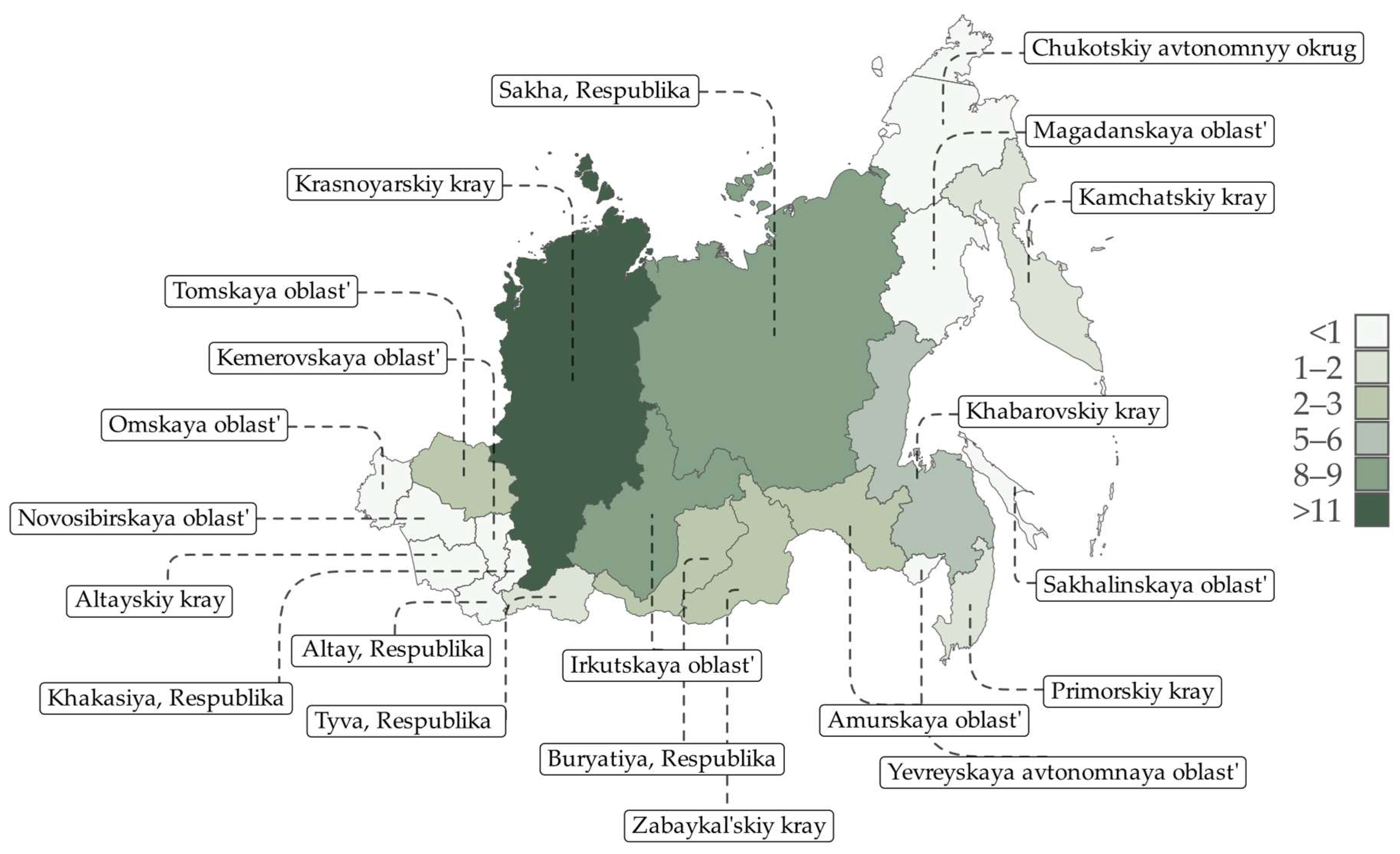
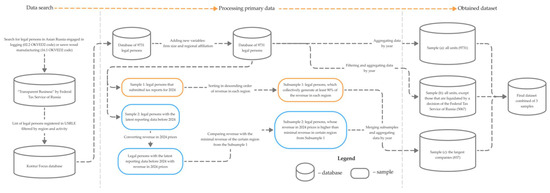
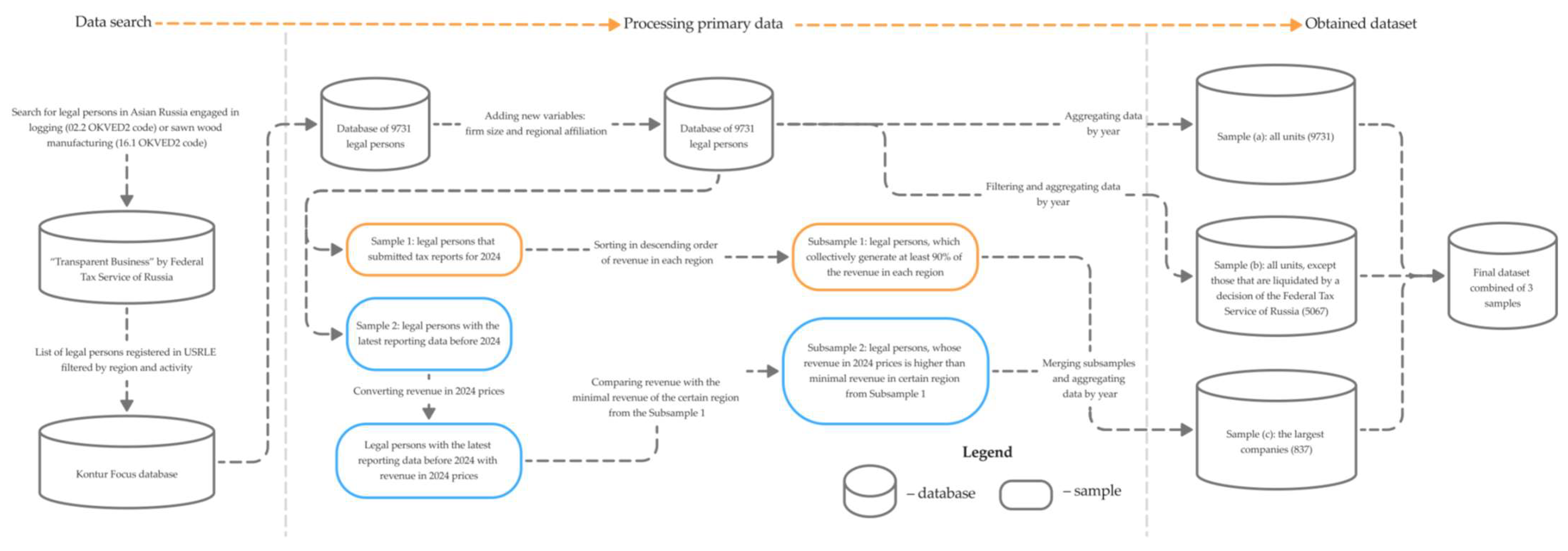
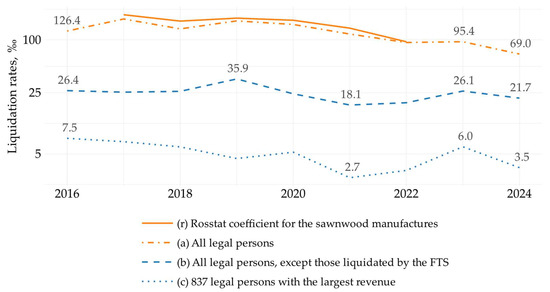
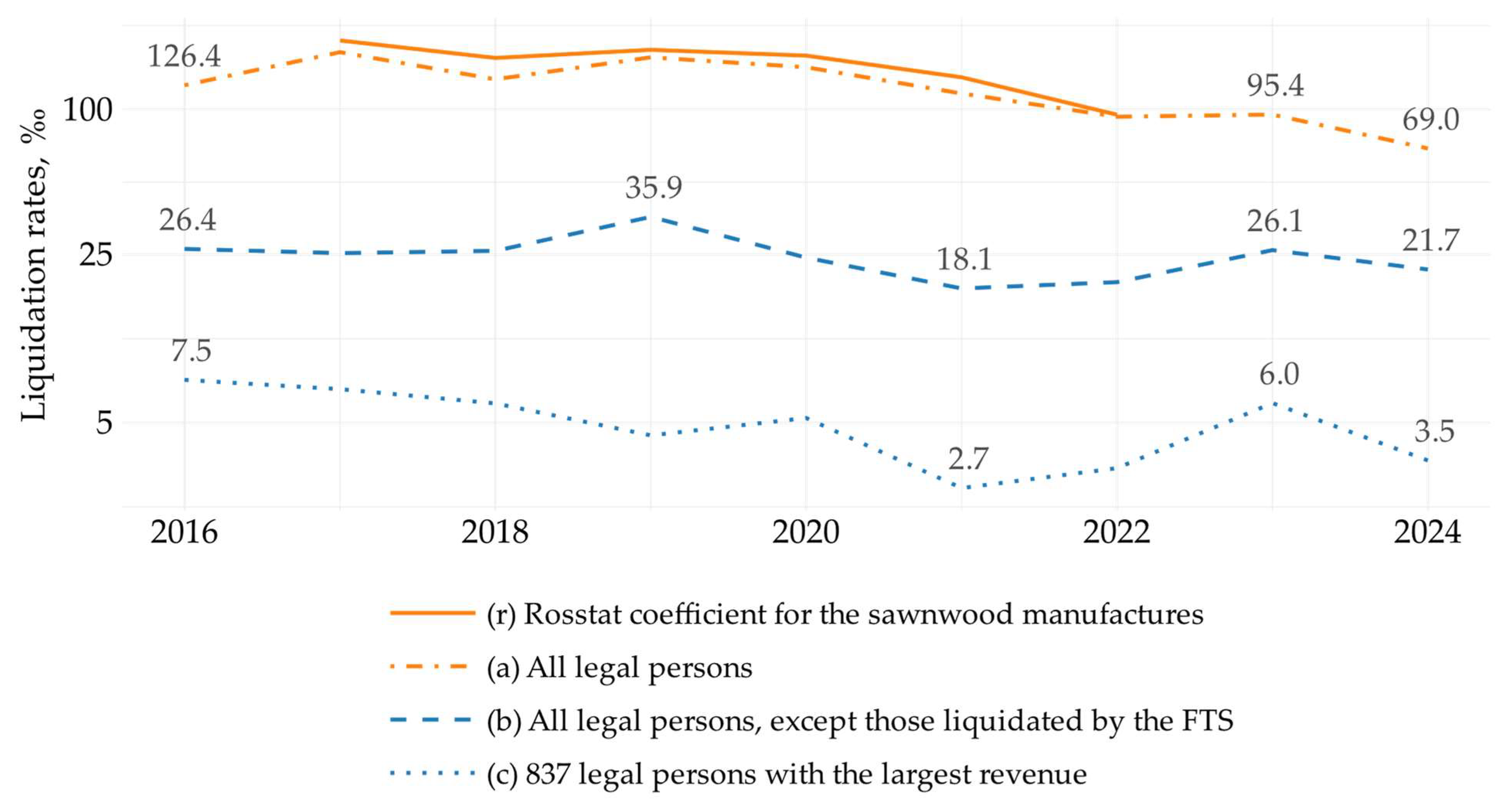
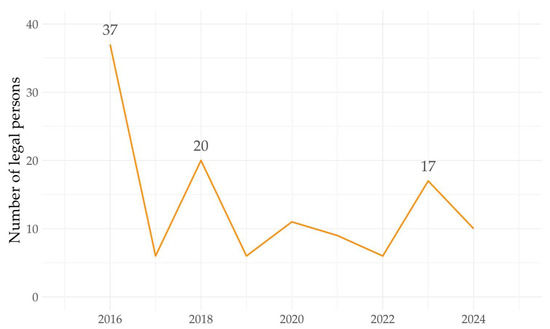
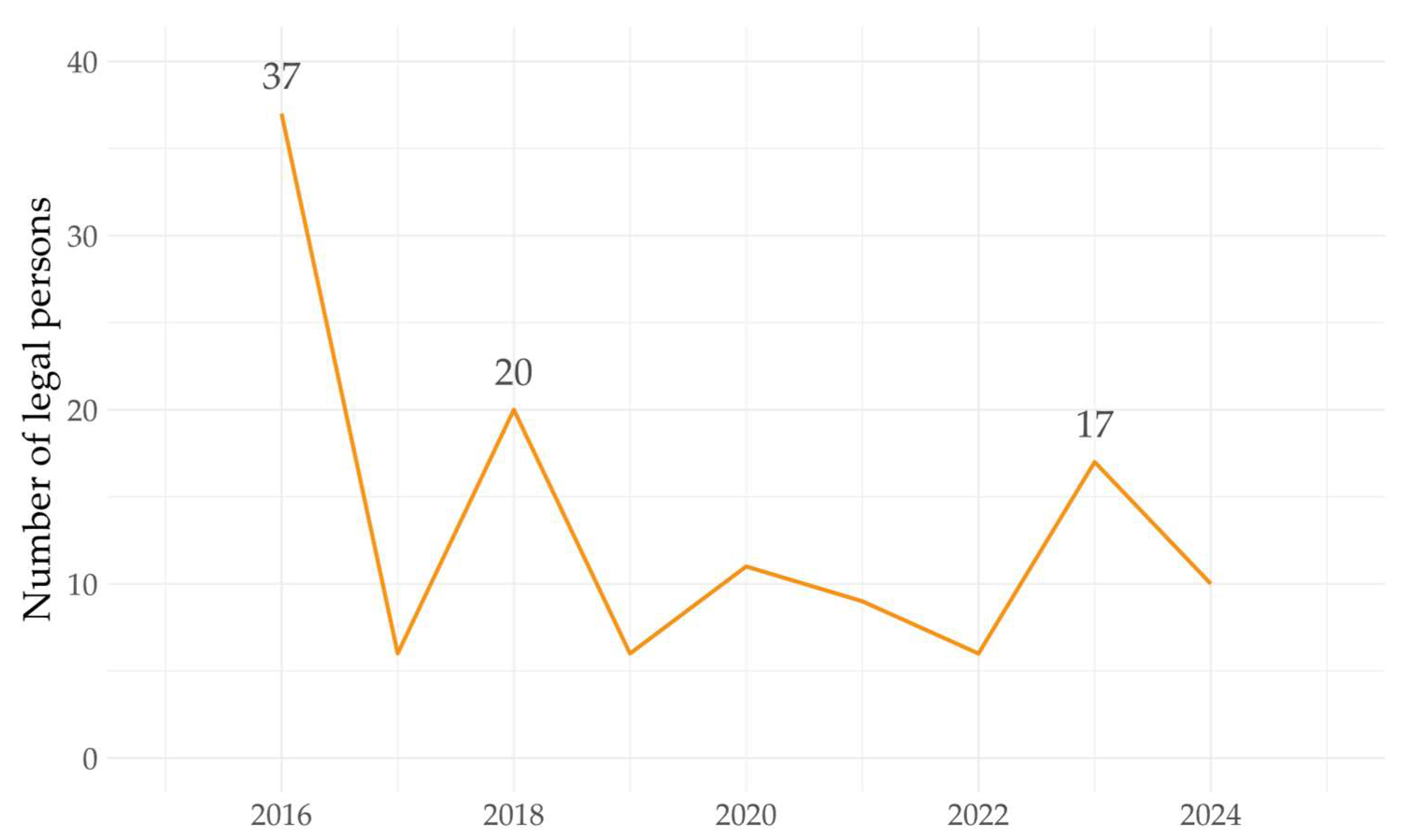
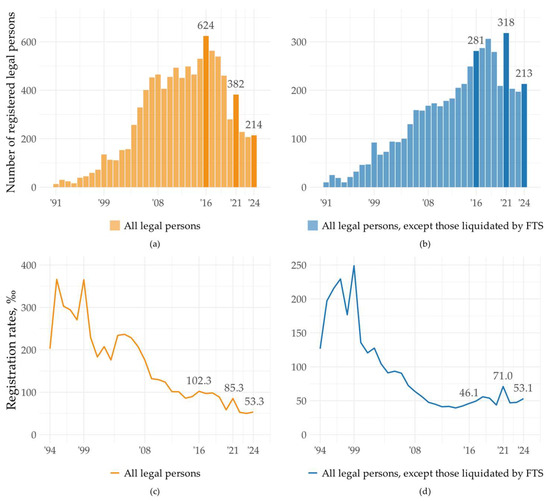
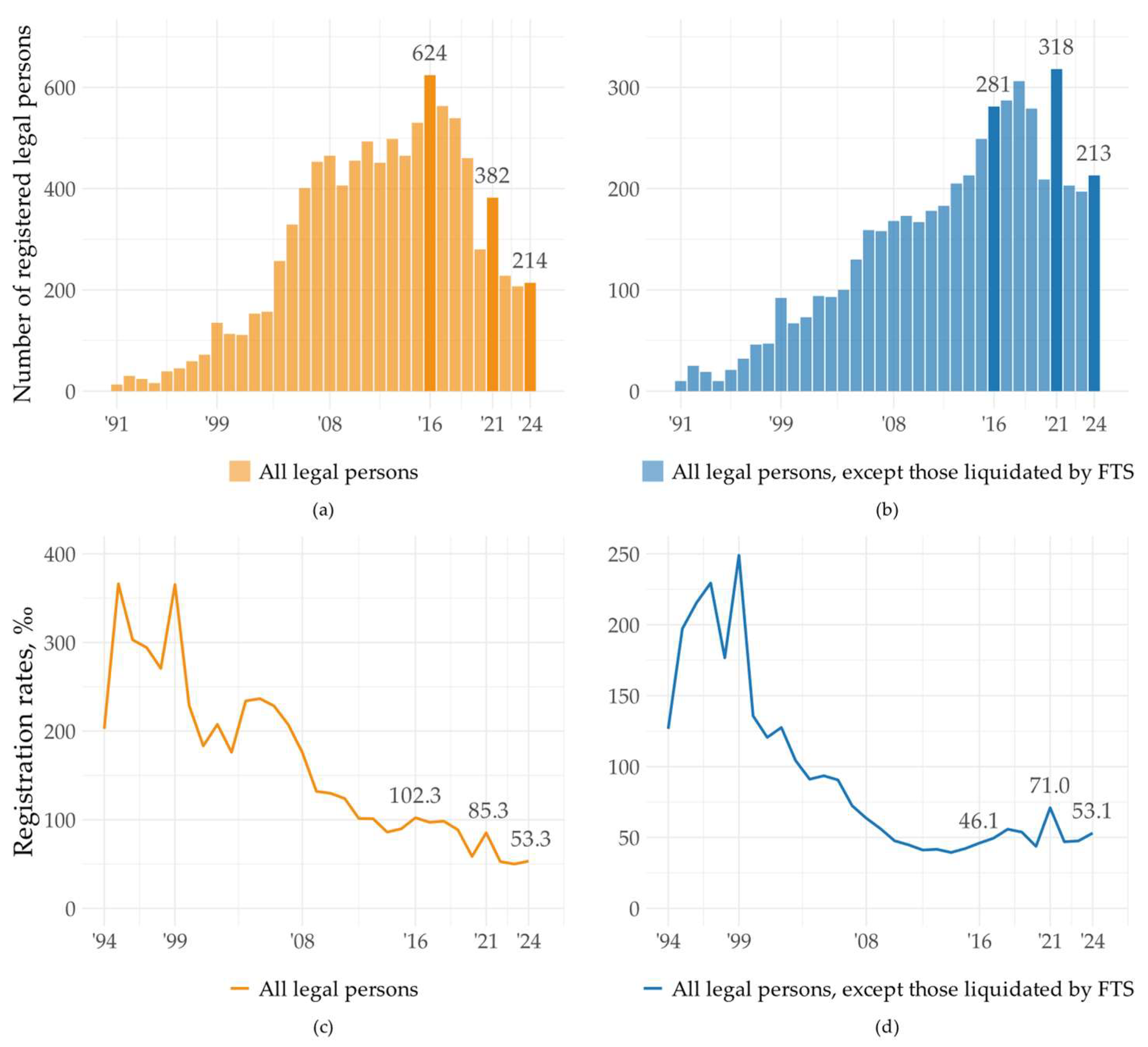
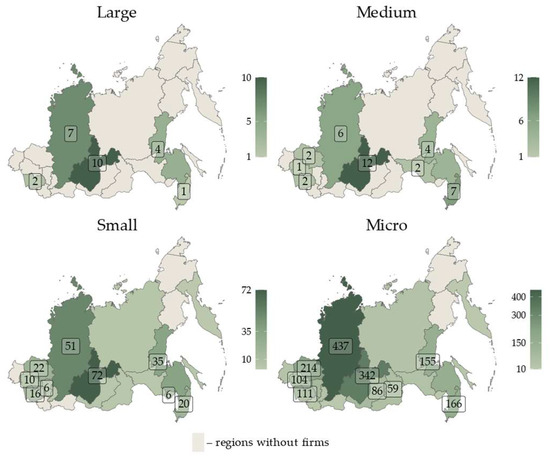
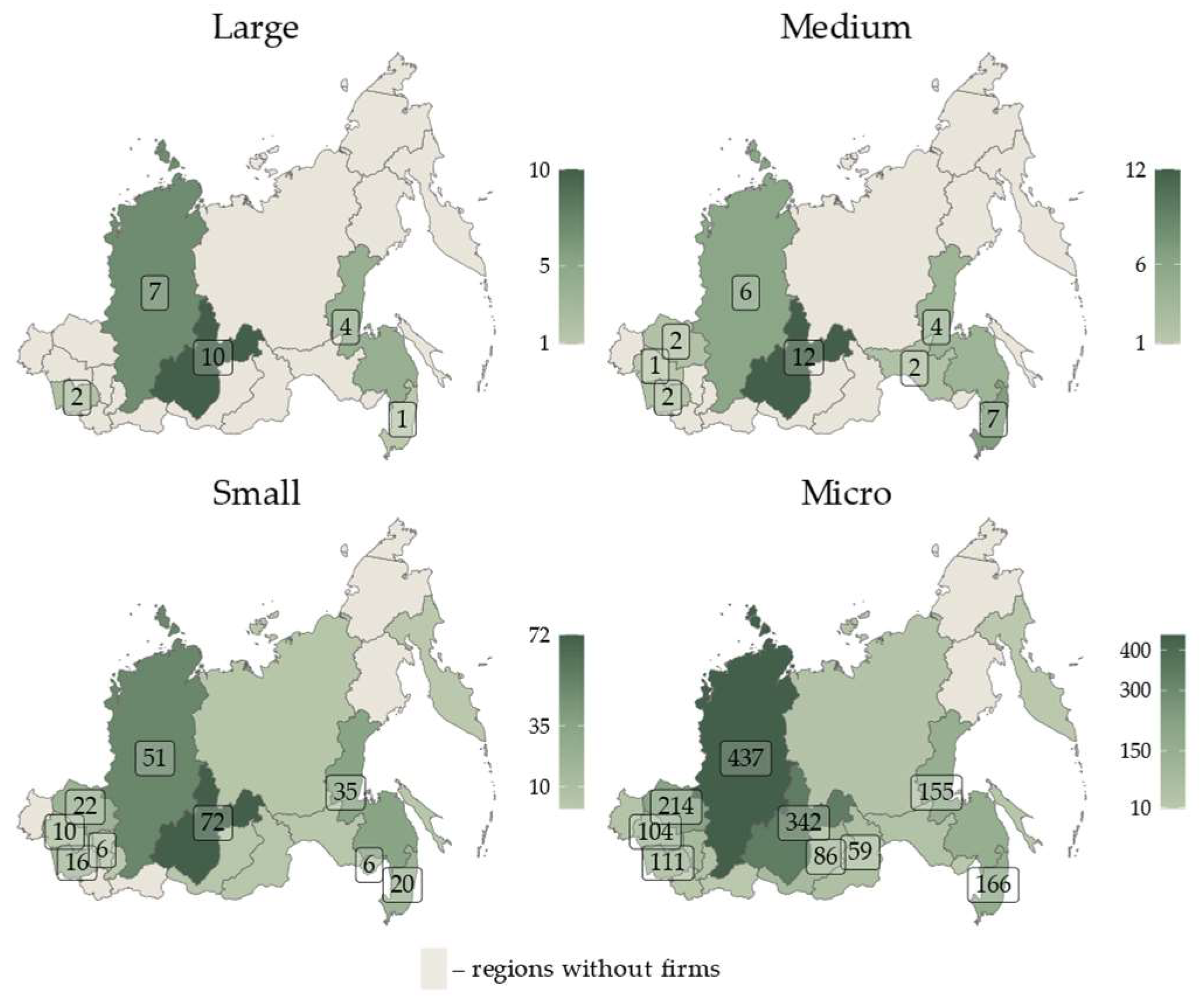
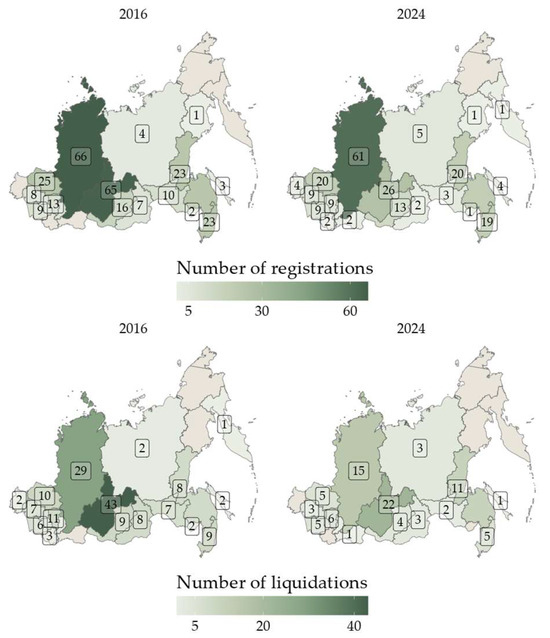
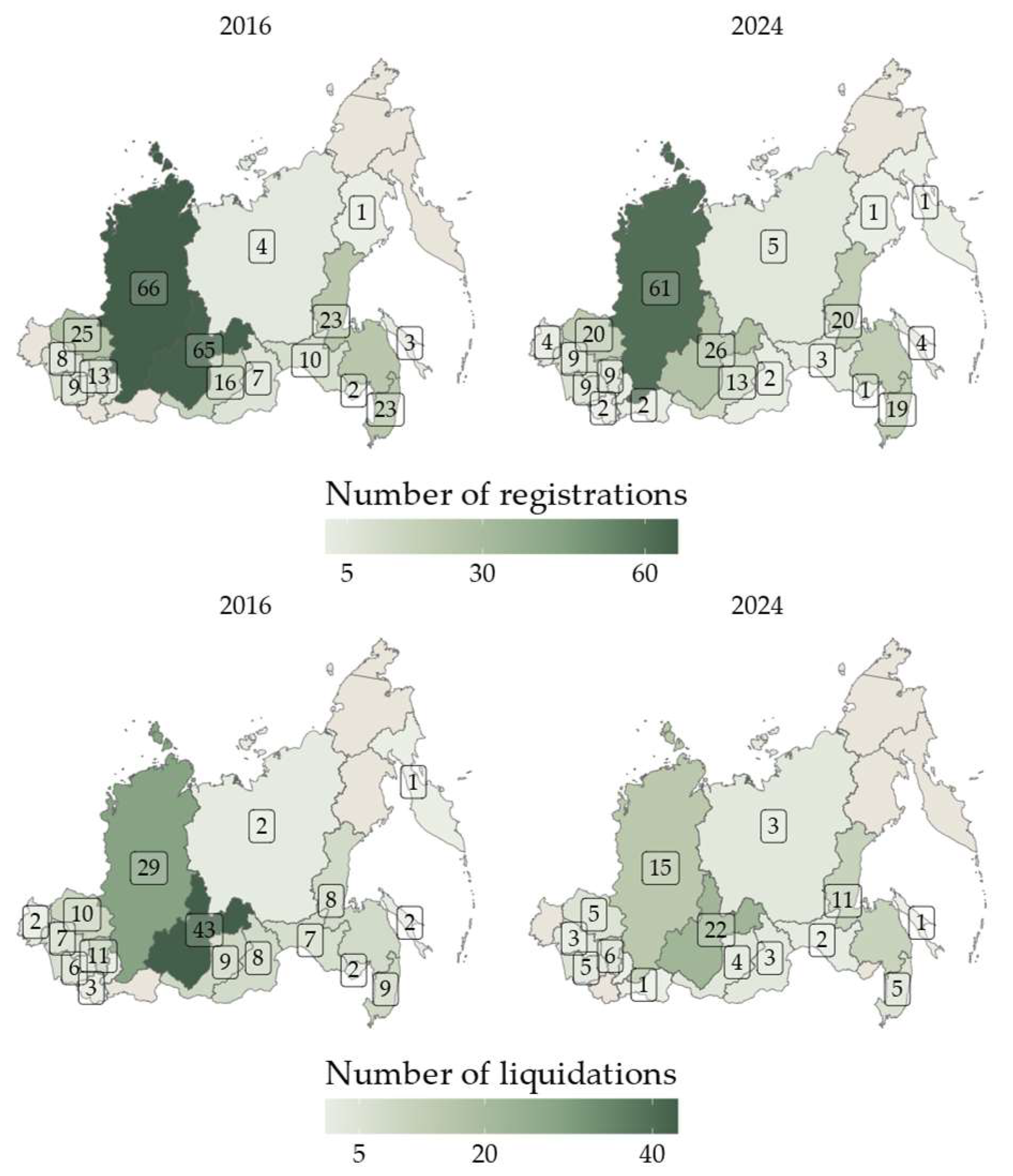
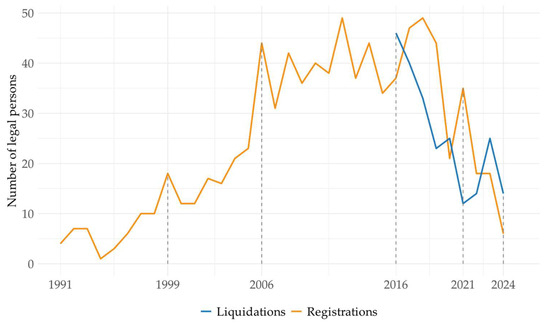
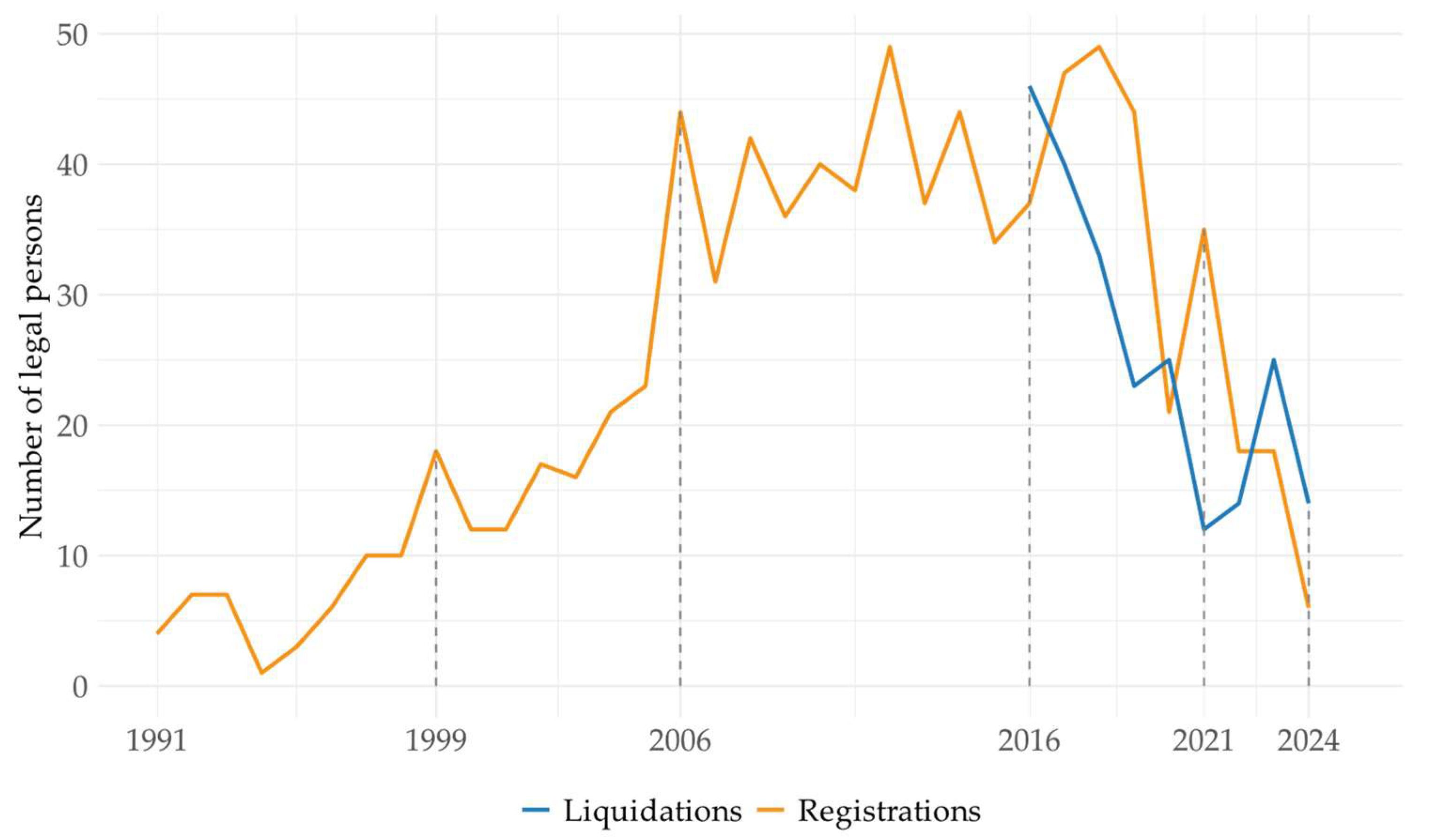

Disclaimer/Publisher’s Note: The statements, opinions and data contained in all publications are solely those of the individual author(s) and contributor(s) and not of MDPI and/or the editor(s). MDPI and/or the editor(s) disclaim responsibility for any injury to people or property resulting from any ideas, methods, instructions or products referred to in the content. |
© 2025 by the authors. Licensee MDPI, Basel, Switzerland. This article is an open access article distributed under the terms and conditions of the Creative Commons Attribution (CC BY) license (https://creativecommons.org/licenses/by/4.0/).